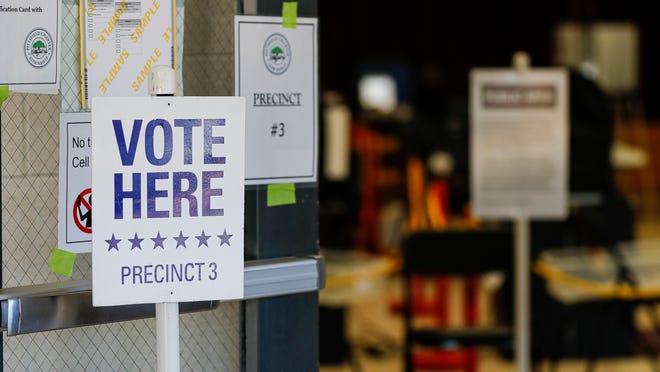
Polling locations throughout most of Michigan close at 8 pm EST, bringing an end to the August primary election Tuesday to decide which Republican candidate will emerge from a crowded field to face Gov. Gretchen Whitmer this fall along with several hotly contested intraparty congressional and state legislative fights.
Hundreds of thousands of Michigan voters returned absentee ballots before Election Day and by Tuesday morning, more than a million absentee ballots had been received by election officials across the state, according to the Secretary of State’s office.
>> LIVE: Michigan primary election results here
Those casting absentee ballots have until 8 pm Tuesday to return theirs. Polling locations serving in-person voters also close then, but those in line by 8 pm can still vote.
While voting ends at 8 pm EST the vast majority of the state, voting in the four Michigan counties in Central Time Zone — Dickinson, Gogebic, Iron and Menominee counties — is still underway for another hour.
More:Meet the Republican governor candidates running against Whitmer in Michigan election 2022
As polls close and election workers finish counting absentee ballots, you can follow unofficial results at Freep.com by visiting the home page or clicking on this link.
Whitmer ran unopposed in the Democratic primary, leaving the GOP gubernatorial primary the only contested statewide contest on the ballot.
Voters also weighed in on congressional and state legislative primaries Tuesday. While Michigan is home to a number of competitive seats, the primary Tuesday will likely determine who will represent voters in a number of safe Democratic and Republican districts.
The election results and outcomes reported when election workers finish processing and counting ballots are unofficial. In the coming weeks, county canvassing boards made up of two Democrats and two Republicans will review election materials, sign off on the vote totals and certify outcomes for races wholly contained within the county. they have two weeks to complete that job.
The state’s elections panel then meets to certify statewide contests and elections that cross county lines. The Board of State Canvassers – also made up of two Democrats and two Republicans – must agree by Aug. 22 to determine the results of the election.
Clara Hendrickson fact-checks Michigan issues and politics as a corps member with Report for America, an initiative of The GroundTruth Project. Make a tax-deductible contribution to support her work de ella at bit.ly/freepRFA. Contact her at [email protected] or 313-296-5743. Follow her on Twitter @clarajanehen.
Australian shares have dropped in morning trade, as ongoing economic uncertainty and flaring US-China tensions weighed on global market sentiment.
The arrival of US House of Representatives Speaker Nancy Pelosi in Taipei, despite warnings from Beijing, prompted China to launch war plans and buzz the Taiwan Strait in protest.
The ASX 200 dropped by a steeper-than-expected 0.9 per cent, to 6,938 points, by 10:35am AEST.
Nearly every sector traded lower, with utilities and materials suffering the biggest losses. Seven out of every 10 stocks were in the red.
Some of today’s worst performers include Champion Iron (-5.3pc), APA Group (-3.2pc), Seven Group (-3.2pc) and Eagers Automotive (-3.2pc).
On the flip side, some of the best performing stocks were Pinnacle Investment Management (+10.7pc), Block (+4.9pc), and Lynas Rare Earths (+4.6pc).
Aussie dollar sinks
The Australian dollar fell 0.4 per cent, to 68.9 US cents. That was on top of its sharp loss of 1.5 per cent overnight.
The sell-off began yesterday, when the Reserve Bank lifted its cash rate target by 0.5 percentage points, which takes the new rate to a six-year high of 1.85 per cent.
The weaker Australian dollar was also driven by a stronger US greenback as investors piled into currencies that are seen as “safe havens”.
In that regard, the Japanese yen jumped 0.9 per cent against the greenback, and was on track for a fifth day of gains, its longest winning streak since 2020.
“There is the uncertainty surrounding Pelosi’s trip to Taiwan and there’s additional data, regarding economic softness,” said Sam Stovall, chief investment strategist of CFRA Research.
“Regarding recession [in the United States]it’s not a question of ‘if’ but ‘when’ and how deep.”
‘An open question’ about further rate hikes
On Wall Street, the S&P 500 slipped by 0.7 per cent, to end the session at 4,091 points.
The Nasdaq declined 0.2 per cent to 12,349, while the Dow Jones index fell 1.2 per cent to 32,396.
On the economic front, a report from the Labor Department showed job openings in the United States dropped by 5.4 per cent in June, a sign that the job market is weakening amid softening demand.
Since the US Federal Reserve raised interest rates by 0.75 percentage points in July, investors have been speculating about whether the central bank’s largest hikes are already behind it.
“The market has to get really comfortable that they have fully baked in all the Fed’s rate hikes, and I think that remains an open question,” said Rob Haworth, senior investment strategist at US Bank Wealth Management in Seattle.
“The challenges and supply constraints aren’t necessarily done. They aren’t done and gone yet.”
Oil prices slipped ahead of the OPEC+ meeting of oil producers expected this week, the outcome of which could mean a boost to global crude supply, while lingering recession fears helped cap those gains.
Brent crude futures fell 0.4 per cent, to $US99.63 a barrel.
Spot gold dropped 0.7 per cent, to $1,760.24 an ounce.
Wayward Strand, the narrative adventure game developed by Melbourne-based studio Ghost Pattern, has announced the hefty Australian cast bringing its characters to life. They include the likes of Michael Caton (The Castle), Jenny Seedsman (Blue Heelers), and Anne Charleston (neighbors), among many others.
Set on a floating hospital in an alternate-reality 1970s Australia, the VISCREEN-funded game follows teenage protagonist Casey as she discovers more about the hospital’s inhabitants and story. The environment works like clockwork – inhabitants move and events occur whether Casey is there to witness them or not – meaning that you can choose to have Casey follow particular characters and narrative threads of your own accord.
The fourteen-year-old Casey is played by Nancy Curtis, who recorded over 1,200 pages of dialogue, according to Ghost Pattern. Curtis is joined by a veteran roster of Australian actors, including: Anne Charleston (Best known as Madge from neighbors) who plays Ida Vaughan; Michael Catton (The Castle, The Sullivans, Last Cab to Darwin), who plays the ‘loquacious’ Neil Avery; and Jenny Seedsman (Neighbors, Blue Heelers, State Coroner) who plays the stern Ruth Beaumaris.
Joining them is Bunurong man Shane Clayton, who Ghost Pattern says brought ‘warmth and heart’ to the character of Ted Muir; prominent Austrian and German actor Erhard Hartman, who plays Heinrich Pruess; and Australian director Michela Ledwidgewho acts as Esther Fitzgerald (pictured above).
Additional roles will be played by theater actor and anthropology scholar Josiah Lulham ace hospital director Felix Pettigrew; John Barrett as Devin the cook; actor, producer, and horticulturalist Harriet Wallace Mead as nurse Lily Marshall; actor and healthcare worker peter paltros as nurse Joe Tagliabue; and Jennifer Vuletic as Dr Margo Bouchard.
Finally, the character of Dr Celene Shen is played by Renée Lim, who is both a practicing actor and a practicing doctor.
Voiceover work was recorded at Original Score in Melbourne, ZigZag Post in Sydney, Innenhof in Vienna and Voiceover Soho in London.
Despite this hefty cast announcement, Ghost Pattern teased that even more characters – and the actors behind them – were yet to be revealed, kept as a secret until Wayward Strand’s possible release.
Wayward Strand will be available on 15 September 2022 on PC via Steam, as well as PlayStation 4, PlayStation 5, Xbox One, Xbox Series X/S, and Nintendo Switch.
The German international keeper Bernd Leno has completed his move to promoted Fulham from Arsenal after signing a three-year contract.
The Cottagers, who have the option of a further 12 months, have agreed to a deal reportedly worth up to £8m for the 30-year-old, for whom the Gunners paid around £20m when they signed him from Bayer Leverkusen in June 2018.
Leno, who lost his place to Aaron Ramsdale last season, told FFCtv: “It feels amazing to finally be here. I can’t wait to join the team, to train and play with the team. I’m relieved that everything is done. I’m just happy to be here. It took a little bit of time, but in the end we made it and that’s the most important thing.”
Leno, who had 304 games for Leverkusen under his belt by the time he arrived in north London, kept 37 clean sheets in his 125 appearances for Arsenal.
Fulham vice-chairman Tony Khan said: “Bernd Leno is the goalkeeper whom we have pursued steadfastly throughout this transfer window, and we’re very excited that we’ve reached a transfer agreement and he’s now fully committed to Fulham.
“He has played at the highest level, and he’ll bring this experience and his leadership to our team. He’ll be a great addition to [head coach] Frames [Silva] squad, who are all excited for the season ahead.”
Police are calling for the public’s help to track down two men after a road rage incident ended in a man being stabbed on a Melbourne street in the middle of the afternoon.
The attack occurred on Carinza Avenue near Oakdene Grove in Altona Meadows, in Melbourne’s west, just before 2.30pm on Tuesday, November 2, 2021.
The victim, a 53-year-old Altona Meadows man, was driving a white Ford Ranger utility when he got into a verbal incident with two men in a gray Volkswagen hatchback.
Police are calling for help to identify these men after a stabbing in Altona Meadows. (Victoria Police)
All three men then got out of their vehicles and got involved in an altercation, which ended in the driver of the ute being stabbed in his upper body.
He was taken to hospital with serious injuries.
The other two men fled in the hatchback and were last seen traveling north towards the Werribee area.
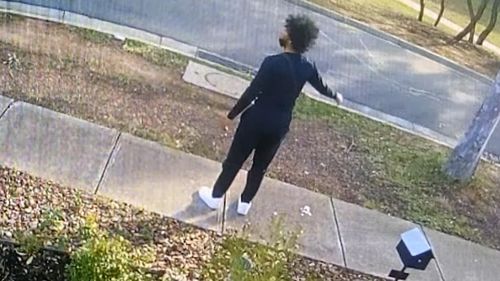
Police have released images of the men and CCTV footage in the hope someone recognizes them and contacts police.
Police have released CCTV from the time of the road rage incident in Altona Meadows. (Nine)
The men are both perceived to be African in appearance and aged in their early 20s.
Anyone who witnessed the incident, has dash cam footage or information is urged to contact police.
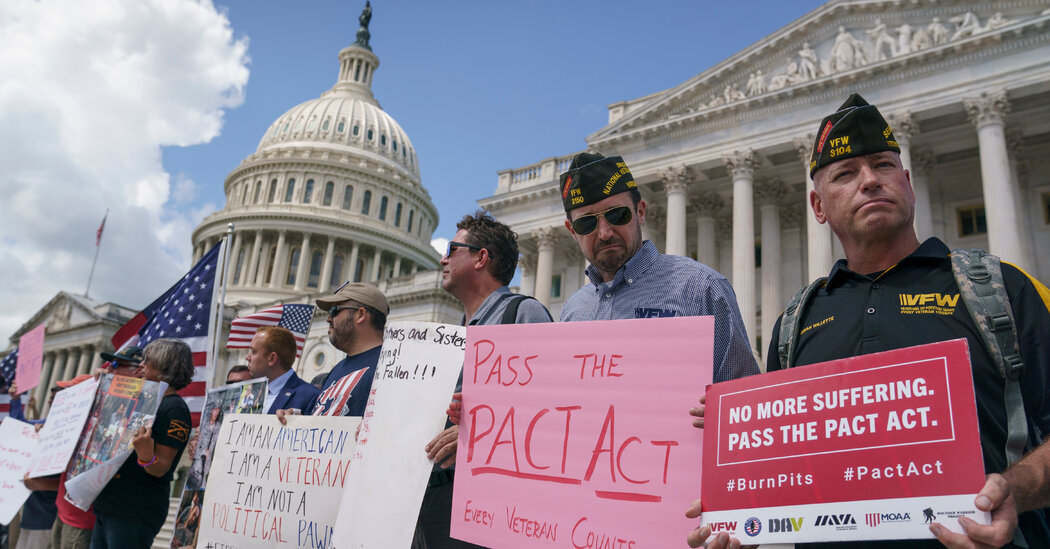
WASHINGTON — The Senate on Tuesday approved a bill to create a new entitlement program to treat veterans who may have been exposed to toxic substances from burning trash pits on US military bases, sending President Biden legislation that would expand medical care eligibility to an estimated 3.5 million people.
The bill was approved on a lopsided bipartisan vote, 86 to 11, only days after Republicans pulled their support in a dispute over how to pay for the benefits, imperiling the legislation and drawing days of angry protests from veterans who gathered outside the Capitol to demand action.
The measure would be the biggest expansion of veterans’ benefits since the Agent Orange Act of 1991, which increased access to care for Vietnam War veterans who had been exposed to the toxic herbicide that endangered generations of Vietnamese, Laotians and Cambodians.
The new legislation would effectively presume that any American service member stationed in a combat zone for the last 32 years could have been exposed to toxic substances, allocating a projected $280 billion over the next decade to treat ailments tied to those exposures and streamlining veterans’ access. to such care.
The House approved the bill last month, and Mr. Biden, who has championed the measure, was expected to quickly sign it. He has speculated that toxic substances from burn pits contributed to the brain cancer that killed his son Beau Biden, who served in Iraq, in 2015.
The legislation had drawn broad support on Capitol Hill, but just as it was expected to clear the Senate last week, Republicans in the chamber abruptly withdrew their backing, insisting that Democrats allow them a chance to limit the funding available to treat veterans.
The bill would provide guaranteed funding for treating veterans exposed to toxins by setting up a dedicated fund that would not be subject to the annual congressional spending process. Senator Patrick J. Toomey, Republican of Pennsylvania, warned that the measure was written in a way that could allow for immense new spending unrelated to veterans’ care.
Mr. Toomey tried and failed to cap the amount of money that could be put into the fund every year, a move that Denis McDonough, the secretary of veterans affairs, had warned could lead to “rationing of care for vets.”
Mr. Toomey also proposed shifting the fund for treating veterans into so-called discretionary spending after a decade, meaning that the Department of Veterans Affairs would have to request funding each year. That would subject the funding to Congress’s approval and the annual partisan spending battles on Capitol Hill, rather than having it guaranteed.
Democrats opposed both efforts, saying the legislation did not need to be changed.
“This is a bill that will work for this country, that will work for the taxpayers of this country and it will work, most importantly, for the veterans and their families,” said Senator Jon Tester, Democrat of Montana and the chairman of the Veterans’ Affairs Committee.
Susan Zeier, the mother-in-law of Heath Robinson, a member of the Ohio Army National Guard for whom the bill is named, had been protesting outside the Capitol for days to urge the Senate to pass the measure before leaving for its summer recess .
Mr. Robinson served in Iraq and died in 2020 after battling lung cancer believed to have been tied to burn pit exposure, and the bill is called the Sgt. First Class Heath Robinson Honoring Our Promise to Address Comprehensive Toxics Act of 2022.
“For me and my daughter, this is the satisfaction that we fulfilled our promise to Heath,” Ms. Zeier said. “We hope families don’t suffer like we did.”
If you thought the chaos at airports over the July school holidays was enough to send you mad, experts say a whole lot more pain is coming – and not just when it comes to flying.
With Christmas holidays creeping up and the busiest holiday period just around the corner, Aussies hoping for a breezy summer escape are being warned to book now – or face being left out in the cold.
Accommodation platform Stayz revealed one-in-five Aussies have already booked their end of year holiday, with newly released data predicting a possible sold out summer in top holiday home destinations over the Christmas break.
“Booking for year-end Christmas holidays in July is now the norm” says Simone Scoppa, travel expert at Stayz.
“Prior to the pandemic, we knew that travelers mostly booked Christmas holidays in the month of September. But, the last two years have seen this peak period move to July as travelers get in early to secure their holiday home.”
According to the research, families heading into the silly season are increasingly searching for whole holiday homes with pools, in a waterfront or beachside location, and for the accommodation offering to be pet friendly.
Ms Scoppa said heading into July and August, the most popular destinations that have seen a spike in summer bookings include the Fraser Coast in QLD, the South West region of WA, the Barossa wine region in South Australia and smaller coastal towns along the Great Ocean Road in Victoria.
Airbnb, who recently launched the ‘Categories’ section for unique-style homes, predict this summer will have an increased interest from the international market now that border restrictions are over.
“While traditional holiday destinations continue to be popular, last year we saw guests seeking stays in those lesser-known locations that might be slightly further afield,” Susan Wheeldon, Airbnb’s Country Manager for Australia and New Zealand, told news.com.au.
“This summer, Aussies won’t be the only ones snapping up fun and unique homes on Airbnb, with international travelers also looking to experience Down Under – from our world-famous coastal cities and towns, to breathtaking rural landscapes.”
Ms Wheeldon tips locations like Rye, Apollo Bay and Bright to be popular once again this summer, along with South West Rocks and Nelson Bay in NSW.
With airports and airlines across the country – but particularly along the east coast – battling staff shortages, flight cancellations and delays coupled with the post-Covid travel boom, experts warn travelers could be in for long wait times over the summer holidays for both domestic and international travel.
On Monday alone, 21 flights were canceled in Sydney across the Qantas, Virgin Australia, Jetstar and Rex networks. Virgin dumped 10 flights, Qantas nixed eight, with two pulled from Jetstar and one from Rex.
Melbourne Airport faced similar struggles, with 20 flights scrapped as of 8.30am.
This included seven flights from Qantas, five from Emirates and Virgin Australia, two from American Airlines and one from British Airways.
The flights canceled at both airports were between 6.30am and 7pm on Monday.
With airlines struggling to keep up with demand amid staff shortages, Qantas announced they would be reducing flights in July and August.
Domestic and International CEO Andrew David apologized to customers as a result of the ongoing chaos being faced at airports across the country.
“We are the national carrier, people have high expectations of us, we have high expectations of ourselves and clearly over the last few months we have not been delivering what we did pre-Covid,” he said.
“We have reduced some of our flying this month and we’re planning to do the same next month, recognizing the operation pressures we have.”
It is understood the airline will be rostering on extra staff for the Christmas period, and any large widebody aircraft will be deployed to assist with domestic flights if need be.
In 2022 alone, Aussies have faced a string of rising cost of living pressures and accommodation reservations have been no exemption.
It hasn’t exactly been cheap to holiday domestically for many years, but staggering figures show that it has gone from bad to worse in the past 13 months.
Data from trivago released in June – recorded hotel price shifts from more than 400 booking sites for over 2 million hotels around the world in its Hotel Price Index. The survey uncovered an astronomical increase in the price of an Aussie getaway.
It shows the average price of a hotel in Sydney has arisen almost 25 per cent over the past year while hotel rooms in Melbourne have seen a 24 per cent spike in the same period.
This means the average cost of a hotel room in Sydney is now above $240 per night, up from $206 a night a year ago. For Melbourne, the average cost is now $239, up from $200 in August last year.
The CEO of Tourism Accommodation Australia, Michael Johnson said the hike in prices came down to staff shortages still plaguing the industry, with many hotels forced to operate at 70 to 80 per cent capacity which was impacting revenue.
“I know hotels that are still looking for 30 to 40 staff, instead of running two restaurants they are only running one,” he said.
“They’re not taking conference bookings, because they just don’t have the staff to manage those bookings.”
But despite the angst and frustration following travelers to airports both domestically and internationally, Australians have not been deterred from traveling and there’s no sign of it waning off in the future, according to Finder’s Consumer Sentiment Tracker.
More than one-in-two (57 per cent) of Aussies are planning a getaway in the next 12 months, including 32 per cent who plan to travel within Australia, 12 per cent who plan to travel internationally, and 13 per cent who plan to travel both domestically and overseas.
This is up from 49 per cent last December.
According to Finder’s Covid Comfort Indicator, Aussies rank their level of comfort with overseas travel at 4.3 out of 10, up from 2.7 in January. They feel slightly more at ease with domestic travel, ranking it 6.1 out of 10.
“The travel industry is finally seeing some normalcy for the first time in over two years. People aren’t as concerned about prices, they just want to travel again,” said Angus Kidman, travel expert at Finder.
“The key to making the most of any travel sale is to be flexible with dates and open-minded about destinations. Don’t forget to book your travel insurance as soon as you’ve locked in your trip.”
Ms Scoppa agreed, saying with many Australians missing out on travel plans due to Covid-19 interrupting plans in 2021 – the advice was to be organized and book now.
“The advice is simple, we recommend that you book now for your Christmas holidays, rather than leaving it to the last minute, where there may be limited choice,” Ms Scoppa said.
“The Mackay and Central Coast NSW regions are typically favorite summer destinations, that in years past have been close to a sell out, so it is good news for travelers looking ahead to book for Christmas that availability is still looking good for these destinations.”
The first edition of the frenetic, hyperactive game of 3×3 basketball at the Commonwealth Games came to an end on Tuesday evening as England defeated Australia 17-16 in the most dramatic circumstances. England triumphed with a game-winning two-pointer in overtime to secure the first men’s gold medal of the Games.
In the women’s gold medal match, Canada narrowly edged out England after another dramatic ending, winning 14-13 with a buzzer beater from Canada’s Sarah Te-Biasu to take the gold medal
Even though no participating country was able to qualify for the Olympics, 3×3 basketball has clearly made a positive impact on the Games, with handsome crowds since the early rounds at the Smithfield building site, a venue adjacent to the beach volleyball stadium.
The men’s and women’s wheelchair finals immediately preceded the non-disabled athletes, with full crowds present as Australia’s men edged past Canada 11-9, then Canada’s women beat Australia 14-5.
By the time the England men’s team entered the court, the atmosphere was searing. The players continually called for the crowd, which responded in turn, cheering for its team, booing Australia during their free throw attempts and making their presence known with an intensity not normally associated with Commonwealth Games sports.
The sport’s defining quality is its speed. Seemingly every aspect of it is cut down in size compared to traditional basketball in order to create an even more rapid spectacle. It is played out on half a basketball court with only one hoop to attack between the two teams of three, there are 12 seconds on the shot clock and matches won by the first team to reach 21 points, with the leading team winning if the game passes the 10‑minute mark.
Greg Hire of Australia (top) and Jaydon Kayne Henry-McCalla of England. Photograph: Darren England/AAP
The final that unfolded in Smithfield was physical and tough, with constant fouls and hustle alike. After six minutes the two teams had combined for 18 fouls, with Australia already over the 10‑foul limit, meaning every subsequent foul led to two shots and possession for England.
Between the furious, high-octane defense and the nerves that accompanied the occasion, both teams committed offensive errors and scoring was low. But then the game exploded.
First Jaydon Kayne Henry-McCalla buried a clutch two-pointer to give England a 15-14 lead with 20 seconds to go but Daniel Johnson drew Australia level for 15-15 with 10 seconds remaining, ushering the game into overtime where the winner was required to win two points in a row. Australia took the upper hand and pressed for victory, a layup from Jesse Wagstaff moving them to 16-15.
Johnson’s two-pointer swirled around the inside of the rim, Australia seemed to have done it. But the ball swirled back out, prompting Orlan Jackman to leap into the air for a rebound, swiping it behind him.
The ball found Myles Hesson, from Birmingham, who shuffled outside of the two‑point line, lined up his shot and buried the two-pointer to mark England as the first 3×3 men’s basketball Commonwealth champions.
Police are calling on the public to help solve an assassination cold case from more than 40 years ago involving a Turkish diplomat and his bodyguard by listening to a phone call recording in the hopes of identifying the caller and to decipher its message.
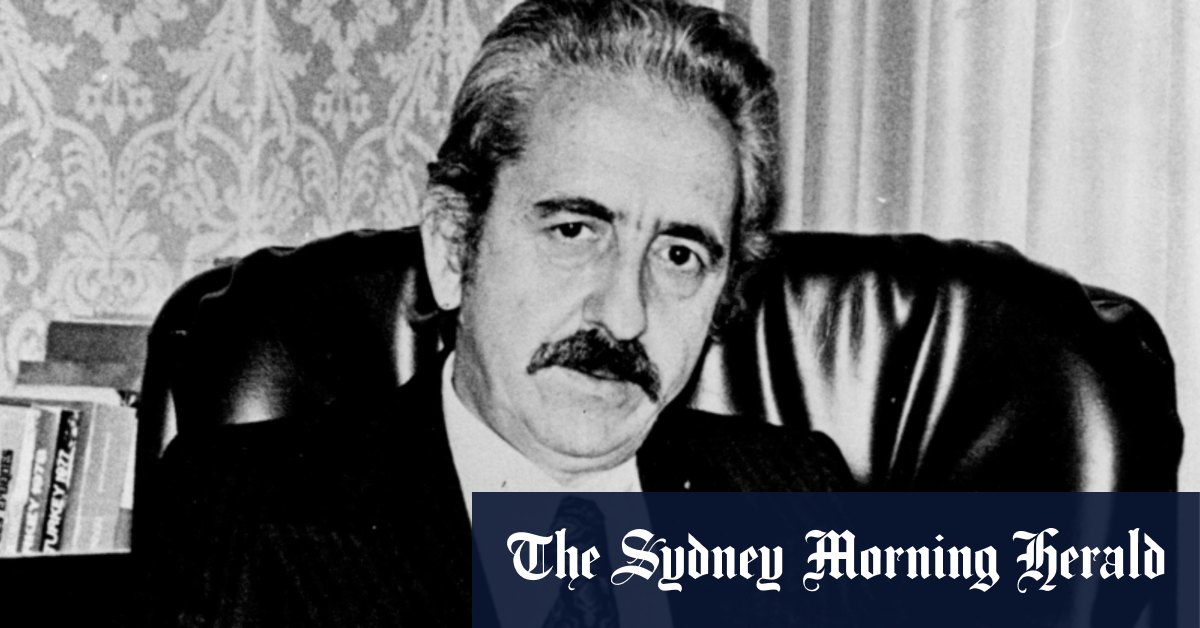
Turkish Consul-General Sarik Ariyak, 50, and his bodyguard Engin Sever, 28, were shot outside a residence in Dover Heights in Sydney’s east on December 17, 1980, by two men who fled on motorcycles after the shooting.
Turkish diplomat Sarik Ariyak was approached by two unknown men and shot in Sydney’s eastern suburbs.Credit:Barry James Gilmour
Ariyak died at the scene while Sever died a short time after in hospital.
Shortly after the shooting, an Armenian terrorist group – the Justice Commandos of the Armenian Genocide – claimed responsibility for the killings but no one has ever been charged despite an extensive investigation by police.
It was one of the first international politically motivated attacks on Australian soil, described by police as “calculated, deliberate” and “brutal”.
In 2019, the NSW Joint Counter Terrorism Team – consisting of the NSW Police, Australian Federal Police, the Australian Security Intelligence Organization and the NSW Crime Commission – launched a review and re-investigation into the case.
As part of its re-opening, detectives released an audio recording on Wednesday that contains the voice of a person who claims responsibility for the attack. The call was made by a woman to multiple media outlets after the shooting.
Investigators are asking for help to decipher inaudible words spoken in the audio clip after the words “the authors of” to identify their significance to the investigation, and for help to identify the woman.
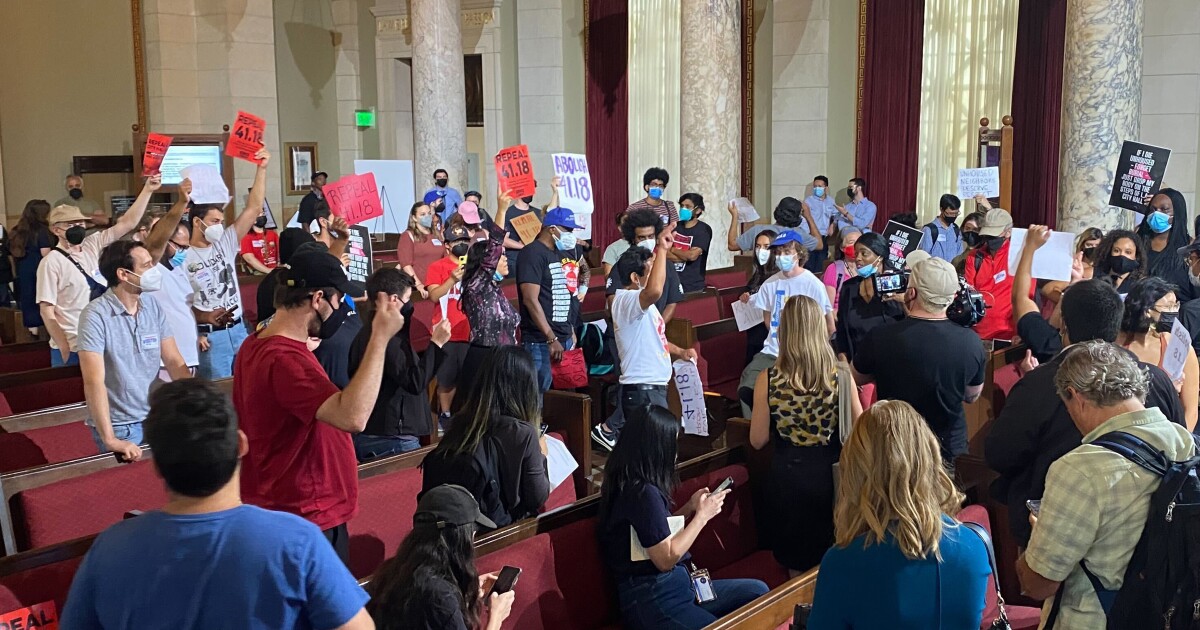
The Los Angeles City Council voted Tuesday to prohibit homeless people from setting up tents within 500 feet of schools and day-care centers, during a raucous meeting where protesters shouted down council members and, at one point, brought the meeting to a halt.
The new restrictions, approved on an 11-3 vote, dramatically expand the number of locations where sleeping and camping are off-limits. And they come amid a furious debate about how the city should respond to encampments that have taken hold in many parts of the city.
Audience members repeatedly chanted “shut it down” as Councilmember Joe Buscaino, a longtime proponent of increased enforcement, attempted to speak in favor of the restrictions. Council President Nury Martinez then stopped the meeting for more than an hour so police could clear the room.
After audience members had exited, council members reconvened, discussed the measure and voted.
“I think people were trying this morning to shut this place down and keep us from doing the very job that we were all elected to do,” Martinez said before the vote. “And that, I think, is incredibly disturbing.”
Under the new restrictions, people would be prohibited from sitting, sleeping, lying or storing property within 500 feet of every public and private school, not just the few dozen selected by the council over the last year.
Councilmember Marqueece Harris-Dawson, who represents South Los Angeles, voted against the restrictions, telling reporters they would move the city toward an “inhumanity that is beneath the citizens of the city.”
Councilmember Mike Bonin, another opponent of the restrictions, said city leaders should devote their energy instead toward improving programs that aid homeless Angelenos, such as those that help people with housing vouchers secure an apartment.
“We need to have a relentless, exclusive focus on getting people indoors,” said Bonin, who represents coastal neighborhoods from Los Angeles International Airport north to Pacific Palisades.
Councilwoman Nithya Raman, whose district includes the Hollywood Hills, also voted against the proposal. A second and final vote will be required next week.
Bonin predicted the changes would result in a roughly tenfold increase in the number of sites subject to enforcement, taking it from more than 200 to about 2,000. The city’s supporting documents on the proposal did not give a clear figure showing how many sites would be covered.
Los Angeles Unified School District officials told The Times that about 750 school sites are within the city limits, a figure that does not include private or parochial schools. Nearly 1,000 commercial day-care businesses are registered with the city’s Office of Finance, although it’s not clear whether all of those locations would be covered by the city’s new law.
Tuesday’s vote came more than two months after Alberto M. Carvalho, superintendent of the Los Angeles Unified School District, made a surprise in-person appearance before council members to ask for the new restrictions. Parents and school staff have also spoken out in favor of the changes, saying they have observed erratic or even violent behavior on or near school campuses.
Martha Alvarez, who oversees government relations for the school district, told the council that LA Unified had found 120 campuses with encampments over the last year.
“These conditions are a public health hazard,” she said. “They are unsafe and traumatic for students, families and staff as they enter school campuses.”
Buscaino also spoke in favor, saying he has already been working to open more beds for homeless people across the city.
“I’ve supported Bridge Home shelters. I’ve supported tiny homes, Project Roomkey, Project Homekey, permanent supportive housing,” Buscaino said. “But what I don’t support are drug dens near our schools, parks or anywhere children congregate.”
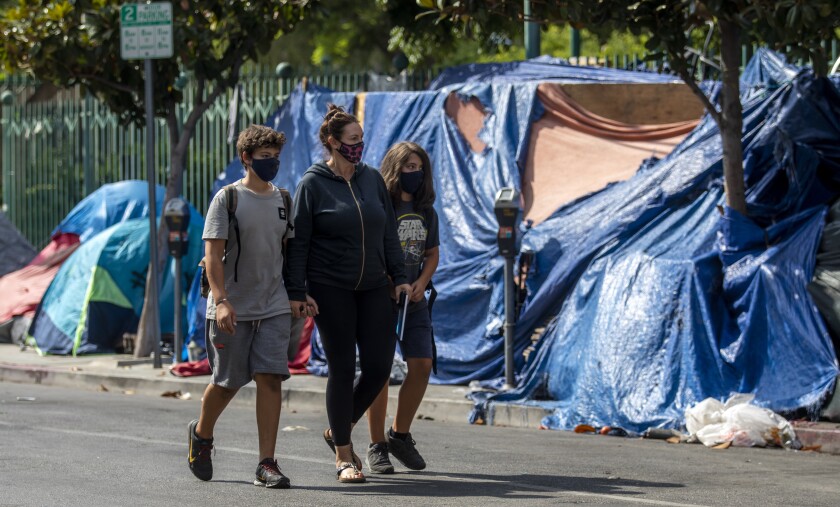
A woman and schoolchildren walk past a homeless encampment near Larchmont Charter School in August 2021.
(Francine Orr/Los Angeles Times)
The new school year starts Aug. 15.
Foes of the proposal have repeatedly argued the council’s restrictions would effectively outlaw poverty, leading to the deaths of homeless Angelenos. Prohibiting encampments around schools, they said, would simply push people and their belongings a block or two away.
“There are a lot of people who are struggling right now, and we should be helping them,” said Andrew Graebner, appearing before the council.
The council’s actions also drew opposition from PATH, or People Assisting the Homeless, which builds low-income housing with supportive services. Tyler Renner, a spokesman for the organization, said the restrictions would waste time and city resources.
“Enforcement of anti-camping ordinances… only displaces people and makes it harder for trained outreach staff to establish trust again,” he said in a statement.
The new restrictions come as city officials are gradually closing one of the signature programs set up to help the homeless during the COVID-19 pandemic: Project Roomkey, which turned multi-story hotels into makeshift shelters.
Those facilities allowed the city to bring far more people indoors than it had before, at a time when the congregate shelter system, where many people sleep in a single room, had to operate well below capacity under social distancing guidelines.
The Mayfair Hotel, which provided 252 rooms under the program, recently ended its participation. The LA Grand Hotel downtown and the Highland Gardens Hotel in Hollywood, which provided a combined 553 rooms, are scheduled to cease operation as Project Roomkey sites at the end of the month, according to Brian Buchner, the city’s homelessness coordinator.
The Airtel Plaza Hotel, which has provided 237 rooms, is set to end its participation in the program on Sept. 30.
Buchner said there are “active discussions” at City Hall and the Los Angeles Homeless Services Authority about extending the deadline at one or more of those facilities.
Tuesday’s vote represents a shift in the city’s approach on enforcement of its anti-camping law, reducing the amount of discretion wielded by individual council members and establishing a more sweeping policy. That’s a major contrast from last summer, when backers of the law pitched it as a narrow and targeted measure, with enforcement accompanied by offers of services from outreach workers.
Over the last year, permanent metal signs setting deadlines for homeless people to leave have been posted at more than 200 locations, 33 of them schools or day-care centers. At some locations, tents and makeshift shelters have remained weeks or months past the deadline, as outreach workers struggled to persuade people to move voluntarily.
Although some sites are now clear of tents and encampments, others later had more people living on the sidewalk than they did when outreach workers initially assessed the spots.
City and county officials, along with homeless services providers, previously told The Times that an insufficient number of outreach workers and a lack of interim housing options have hindered the implementation of the law.
Foes of the council’s homelessness strategy have repeatedly called for the restrictions on sidewalk camping to be rescinded. Some of those critics are now leading candidates in the Nov. 8 election.
newsletter
Get the lowdown on LA politics
In this pivotal election year, we’ll break down the ballot and tell you why it matters in our LA on the Record newsletter.
You may occasionally receive promotional content from the Los Angeles Times.
Accountant Kenneth Mejia, front-runner in the race to replace City Controller Ron Galperin, said the new rules would render about one-fifth of the city’s sidewalks off-limits to homeless people. On social media, he has repeatedly criticized the city’s anti-encampment law, which focuses not just on schools and day-care centers, but also requires that sidewalks offer 36 inches of passage for wheelchair users.
Councilmember Paul Koretz, who trailed Mejia by nearly 20 percentage points last month, voted in favor of the new law.
The new anti-encampment law is also an issue in other contests. Civil rights lawyer Faisal Gill, now running to succeed City Atty. Mike Feuer, has previously promised not to enforce the ordinance, saying it is unconstitutional and will be struck down by the US 9th Circuit Court of Appeals.
Gill’s opponent, attorney Hydee Feldstein Soto, declined to take a position on the measure when contacted by The Times.
“The validity, interpretation and enforceability of the [anti-encampment] ordinance will certainly come before the next LA city attorney,” she said in a statement. “And if I am the city attorney, I would want the opportunity to consult with my clients — LA City Council — before taking a fixed position.”
One citywide contest where there is some agreement on the council’s approach is the race for mayor. US Rep. Karen Bass and real estate developer Rick Caruso, both running for mayor, have come out in favor of the restrictions on encampments near schools and day-care centers.