Categories
Sports

Saints coach’s post-game comments questioned

David King has questioned Brett Ratten’s post-game comments following St Kilda’s 12-point win over Hawthorn on Saturday, telling the Saints coach: “You can’t have it both ways”.

After coming too close for comfort in almost blowing a 44-point lead in the third quarter, scenes at the final siren were somewhat subdued for St Kilda fans.

The narrative after the game was a strange one given the last quarter drop-off where the Hawks kicked five goals to one, but Ratten questioned that during his press conference.

“Probably everyone that speaks about us speaks about half-empty,” the Saints coach said post-match.

“Every time we speak to somebody we’re not going so well, we don’t do this, we don’t do that.

“We won the game of footy.

“We didn’t play the game for four quarters how we wanted to, but we took four points.

“Everyone can keep looking at how negative the Saints are and what the Saints are doing, we won a game of footy. It would be nice if people say well done for a change.”

The win over Hawthorn came just two weeks after St Kilda released inner-sanctum footage of Ratten imploring his players to challenge each other and drive standards on the field following a disappointing loss to the Western Bulldogs.

That footage came among questions of on-field leadership, and the drop-off against Hawthorn failed to dispel that theory.

However, the win importantly moved St Kilda into the top eight, and the victory could have been bigger had they not kicked 10.15.

“They should have smashed Hawthorn on the weekend,” King said on SEN’s Whateley.

“I’m a little bit with Ratts on this game, they kicked 10.15 and 5.8 from set shots, you’ve just got to have a better return than that.

“You’ve just got to be able to put these games well out of reach and break the hearts of the opposition.”

However, King questioned the comments in relation to what Ratten said a fortnight ago.

“I agree with Ratts a little bit, but hey Ratts, it was only seven days ago you were sitting in front of the group saying we’ve got to raise the bar,” the dual-premiership Kangaroos added.

“So which is it? Can we be positive about what you’re doing as a group, or are we still challenging internally for guys to get better and raise the bar?

“You can’t have it both ways.

“I like what they can do, I don’t always like what they actually do.”

Despite finishing Round 20 in the top eight, the Saints face an uphill battle to hold that spot, playing Geelong, Brisbane and Sydney in their last three games.


.

Categories
Australia

Sydney’s Forcite motorbike helmet sees accidents before they happen and resonates with riders worldwide

When Alfred Boyadgis hit an oil slick a few years ago and smashed his motorcycle, the mounting on his helmet camera acted like a lance. He punched into the side of his helmet and he was lucky to escape serious injury.

Boyadgis wondered why the camera couldn’t be built into the helmet. Indeed, in such a smart world, why was his helmet so dumb? Why couldn’t it have warned him of that hazard and helped keep him out of an accident, rather than just protect him once he was in one?

The Forcite helmet: the name means being able to predict what is about to happen on the road.

Boyadgis teamed up with fellow industrial designer Julian Chow in Sydney and, after nearly 100 prototypes, they launched the Forcite helmet, which is now attracting interest around the world. It has a built-in camera, along with recording equipment, speakers, microphone and an innovative information system using colored lights and audio that is claimed to be far less distracting than projecting information onto the viewer.

“The company is called Forcite,” says Boyadgis, “because it’s all about having that future vision about what’s going to happen next along the road.”

Force is working in tandem with motorcycle brands to enhance the helmet’s safety features.

The latest version of the helmet can record trip details and incidents, warn of hazards ahead (though not oil slicks, yet), and indicate when to turn left or right without the rider looking down at a screen.

Thanks to the over-the-air updates, it is hoped to incorporate vehicle-to-vehicle communication, and car-like features such as blind spot and collision warning systems. Force is working with motorcycle manufacturers to link these upcoming systems.

Categories
US

California McKinney Fire burns 80 square miles, with no containment

The McKinney Fire along California’s border with Oregon exploded in size Saturday to 80 square miles and forced the evacuations of more than 2,000 people in the Siskiyou County community of Yreka.

Officials said early Sunday morning that the 51,468-acre fire — the largest so far in California’s still-early wildfire season — was 0% contained. State Highway 96 was closed along the Klamath River and several other small, rural communities remained evacuated. The fire remained at 0% containment Sunday evening, but no new evacuations were ordered, the Siskiyou County Sheriff’s Office said just before 7 pm An updated amount total wasn’t provided.

The fire, however, remained at least 5½ miles from Yreka, according to an online map of the fire perimeter the Yreka Police Department shared Sunday morning on Facebook.

“Little progression was observed on the fire’s edge closest to Yreka City,” the fire’s incident commanders wrote in their 8 am update. A fire-mapping plane that flew over the perimeter Sunday afternoon continued to show minimal spread toward Yreka, Siskiyou County’s seat and home to 7,807 people.

Larry Castle and his wife, Nancy, were among the 2,000 people in Yreka who were told they had to leave their home Saturday night. Officials were going through neighborhoods tying red flags on the mailboxes of every house that they’d checked to ensure the occupants had left.

Larry Castle said he loaded up a trailer with some of his prized possessions, including his motorcycle and his rifles, and he, Nancy and three dogs headed to Mount Shasta to spend the night at their daughter’s house.

He was hopeful that recent brush and tree thinning projects foresters had conducted on the ridge-top above Yreka would save the town, but he wasn’t taking any chances.

“You look back at the Paradise fire and the Santa Rosa fire and you realize this stuff is very, very serious,” he said, referring to wildfires in 2017 and 2018 that burned thousands of homes and killed dozens of people.

WesternWildfires (7).JPG
A scorched pickup truck remains on California Highway 96 in Klamath National Forest as the McKinney Fire burns nearby on Saturday. Noah Berger AP

Fire creates lightning and winds

The massive smoke plume from the fire was creating its own weather, including lightning storms. Lightning strikes sparked other small fires, including one west of Fort Jones, according to Klamath National Forest officials.

“The area remains in a Red Flag Warning today for a threat of dry lightning and strong outflow winds associated with thunder cells,” officials wrote in their 8 am briefing. “These conditions can be extremely dangerous for firefighters, as winds can be erratic and extremely strong, causing fire to spread in any direction.”

The fire erupted at 2:38 pm Friday at Highway 96 and McKinney Creek Road southwest of the Klamath River, and the cause remains under investigation.

Officials haven’t provided a tally of buildings destroyed, but maps show the fire has burned through small, isolated communities, including the unincorporated town of Klamath River, home to about 190 people, 20 miles west of Yreka.

The fire burned down at least a dozen residences and wildlife was seen fleeing to avoid the flames.

Photos from the Grants Pass Daily Courier showed homes and the community center destroyed in Klamath River as well as burned vehicles on Highway 96.

Officials said they spent the nighttime hours keeping homes and buildings in the Klamath River area from burning. Other small communities under evacuation include those in Seiad Valley, Scott Bar and Horse Creek.

Stephanie Bossen of Klamath River and her dog, Biggie, were in Weed on Sunday trying to find a place to stay. Because she was staying Yreka when the fire hit, she did not know if her home de ella survived. She said she’d been growing increasingly nervous as the temperatures climbed into the 100s over the past few days.

”I knew that was gonna be bad, because all the dry heat and it’s been such a drought around here recently,” she said. “It was gonna be bad somewhere. I just hoped it wasn’t so close to my house.”

WesternWildfires (6).JPG
A horse grazes in a pasture as the McKinney Fire burns in Klamath National Forest on Saturday. Noah Berger AP

Hikers and pets evacuated

On Saturday afternoon, Yreka police evacuated a mobile home park called Oakridge Mobile Estates “due to its proximity to the fire and the need for additional time for this group of residents to safely evacuate,” the police department said in a Facebook post.

Authorities were providing buses to residents who needed transportation out of the area and set up an evacuation center at the Weed Community Center, 161 E. Lincoln Ave. Twenty-two people stayed at the shelter Saturday night, said Stephen Walsh, a spokesman for the area branch of the American Red Cross, which is operating the site.

On Saturday, Fairchild Medical Center, the main hospital in Siskiyou County, moved patients, out of “an abundance of caution,” to out-of-area hospitals as far away as Sacramento, a hospital spokesman said.

But the hospital, located in a part of Yreka that is currently under an evacuation warning, remained open Sunday.

Officials also began compiling lists of animals lost or found because of the fire; Updated information on animal sheltering and how to find animals lost in the evacuation zones is available on the Siskiyou County website.

In the past 48 hours, the Rescue Ranch — a nonprofit dog adoption and rehabilitation center in Yreka — has seen more than 130 animals, mostly dogs, dropped off by evacuees who are unable to keep their pets at emergency shelters or motels, Natalie Golay, a Rescue Ranch spokeswoman, said Sunday.

“They’re still coming in,” she said. One was a puppy that a news photographer picked up from outside a home that burned inside the evacuated area. Golay said the owner, who lost his home, was reunited with his dog on Sunday afternoon. The pup’s name is Patches. It’s not an entirely happy ending, however. She said Patch’s owner fears for the lives of three other dogs he had to leave behind in the frantic evacuation.

The group put out a call on Facebook seeking stainless steel pails, dog food and other donations to keep the dogs fed and cared for.

Meanwhile, search and rescue teams from Oregon and California have been locating hikers on the Pacific Crest Trail and escorting them to safety. The 2,650-mile popular hiking trail runs from Mexico to Canada and meanders for 110-miles through the evacuated area.

Around 60 hikers were transported in public transit buses from the California side of the Red Buttes Wilderness Saturday afternoon, according to the Jackson County Sheriff’s Office in Oregon.

The McKinney Fire is the largest to date this year, matching nearly all of the acreage burned in California so far in 2022 before it ignited.

Gov. Gavin Newsom declared a state of emergency Saturday in Siskiyou County.

WesternWildfires (10).JPG
Angela Crawford watches as a wildfire called the McKinney fire burns a hillside above her home in Klamath National Forest, Calif., on Saturday, July 30, 2022. Crawford and her husband stayed, as other residents evacuated, to defend their home from the fire . Noah Berger AP

California Wildfires (22).JPG
Flames from the McKinney Fire consume trees along California Highway 96 in Klamath National Forest, Calif., Saturday, July 30. Noah Berger AP

WesternWildfires (5).JPG
Scorched vehicles and residences line the Oaks Mobile Home Park in the Klamath River community as the McKinney Fire burns in Klamath National Forest on Saturday. Noah Berger AP
AP22212293180923
Angela Crawford leans against a fence as the McKinney Fire burns a hillside above her home outside Klamath National Forest on Saturday. Noah Berger AP

Western_Wildfires_72115.jpg
The Klamath River Community Hall is seen destroyed by the McKinney Fire in the community of Klamath River, Calif., Saturday, July 30, 2022. (Scott Stoddard/Grants Pass Daily Courier via AP) Scott Stoddard AP

Western_Wildfires_94038.jpg
In this remote image provided by Cal Fire, the McKinney Fire burns in Siskiyou County as seen from the Antelope Mountain Yreka 1 observation camera, early Saturday, July 30, 2022. (Cal Fire via AP) Cal Fire AP

Sacramento Bee photographer Sara Nevis contributed to this story.

This story was originally published July 31, 2022 7:56 AM.

Profile Image of Sam Stanton

Sam Stanton has worked for The Bee since 1991 and has covered a variety of issues, including politics, criminal justice and breaking news.

Profile Image of Ryan Sabalow

Ryan Sabalow covers environment, enterprise and investigative stories for McClatchy’s California newspapers. Before joining The Sacramento Bee in 2015, he was a reporter at the Auburn Journal, the Redding Record Searchlight and the Indianapolis Star.

.

Categories
Business

Genex Power knocks back Skip, offers management meetings

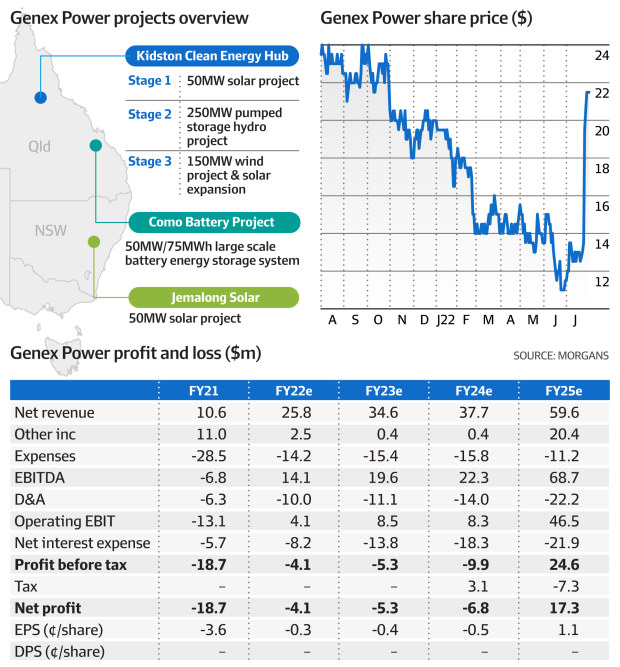
It’s the sort of call that suggests Genex’s board has a rosy outlook, viable Plan B and/or an iron-clad grip on its share register. It’s also a call that makes it pretty clear the capital hungry renewables developer isn’t working as an ASX-listed vehicle; how else do you explain a bid at a 70 per cent premium being knocked back?

The rejection shows a huge gulf between the market and the board’s view on value. Genex shares have traded at or below 15¢ since March, and hadn’t closed above 20¢ all year (until Skip/Stonepeak turned up last weekend, as Street Talk revealed).

The board wants shareholders to think about last year’s trading, when Genex was regularly around Skip/Stonepeak’s 23¢ mark, and small cap broker target prices of 29¢ to 35¢.

It also reckons there’s signs of better times ahead, even if that wasn’t reflected in its share price or Paradice Investment Management/First Sentier’s selling one week ago. There’s strong wholesale electricity prices are in its favor in the near term, which makes its solar farms more valuable, while the longer term story is propped up by Labor government policy to target 82 per cent renewables by 2030.

Clearly, Genex needs to do a better of selling that story, starting with management’s pitch to Skip/Stonepeak.

Skip/Stonepeak’s expected to play nice, for now at least. He knows it’s sitting in a strong position courtesy of a 19.99 per cent pre-bid stake.

Categories
Technology

How Do Pilots ‘Make Up’ Time in the Air?

Hello, dear reader! Welcome to another edition of Ask Giz, where we answer your reader-submitted questions from all over the techy, science and generally nerdy space.

If you’d like us to answer one of your questions, head on over to our Ask Giz submissions page.

Today’s question comes from Vanessa in Sydney. Vanessa wants to know:

“How do pilots ‘make up’ time in the air?”

Thanks for the question, Vanessa! Talking to my publisher about this one in planning this Ask Giz, she was pretty intrigued by how time was made up during a return flight from NYC. Travel (despite some glitches) is a thing again, so I imagine it’s a curious question among many international travelers (of which, I am not. The furthest I’ve flown is to Brisbane from Sydney).

So, let’s get to it. Pilots: how do you do that?

How do pilots ‘make up’ time in the air?

Making up time in the air isn’t actually sci-fi or as nerdy as it may seem: it’s really the result of well-organized planning between plans and air traffic control.

Air traffic control is the team at the airport that controls… The air traffic. Like, they speak to the planes in the air and make sure things are kept orderly up in the air space as the planes move from waypoint to waypoint.

Keep those waypoints in mind. Like in, say, a racing videogame, plans must pass through these waypoints to get through the airspace as indicated by air traffic control, like ordering traffic along with traffic lights.

But if you’re running a few minutes behind, one of these waypoints may be removed, shaving a few minutes off your flight time. This wouldn’t normally be done, but if there were a delay of some sort, such as slowing winds or problems at the airport, air traffic control can remove a waypoint if they talk to the pilot.

Here’s what Jim Cox, a retired airline pilot, told How Stuff Works:

“[Airline traffic control] has preferred routing out of and into large cities. They require that routing be the filed flight plan routing; Depending on traffic ATC may approve a request to shorten the flight path between navigation waypoints.”

So that’s kinda it. Making up time is usually something you’ll hear on longer flights experiencing delays, but shorter flights with fewer waypoints may be less likely to “make up” time.

No wormholes required

If you’ve got a curiosity of the Gizmodo type, we’d like to hear it.

Ask Giz is a fortnightly series where we answer your questions, be it tech, science, gadget, health or gaming related. This is a reader-involved series where we rely on Gizmodo Australia’s audience to submit questions. If you have a question for Giz, you can submit it here. Or check out the answer to our last Ask Giz: Why is My Poo Green?

Categories
Sports

David Mundy set to retire from AFL after 19 seasons with the Fremantle Dockers

Fremantle Dockers great David Mundy has announced he will retire from the AFL at the end of the season.

Mundy, 37, made his AFL debut for Fremantle in 2005 after being drafted from Victoria, and has played 371 games to date.

That places him 10th on the list of most AFL/VFL games played, and the Dockers veteran is set to move into outright 9th place at least by the time he hangs up his boots at season’s end.

“I’m incredibly proud, I’ve been living my dream for 19 years now and I’ve loved every bit of it,” Mundy said in announcing his decision to retire.

loading

“Not all of it has been easy, there’s been quite a few, really hard and emotional bits to it, but I’ve been able to grow as a person and as a player throughout my time at Fremantle and I wouldn’t have it any other way”.

Fremantle football manager Peter Bell was quick to point out how significant Mundy’s career had been in the context of the club’s history.

David Mundy points the finger after sinking Richmond
Mundy says he is “incredibly proud” of his career with the Dockers.(AAP: Julian Smith)

“Dave has been a major part of where we are as a club and where we are headed,” Bell said.

“He’s a great character who understands the bigger picture, understands what the stresses of being a player are, and understands more broadly the other decisions and leadership that we need as a football club.”

loading

Fremantle will honor Mundy’s career during the round 22 western derby, the club’s final home game of the season ahead of the finals series.

While the game will be the fans’ chance to say thank you to Mundy, the veteran said it was also important for him to be able to pay tribute to the club.

“It’s been an incredible thing to be apart of to be honest, to receive that kind of love and respect from the fans,” he said.

“It’s something that’s really grown in the back half of my career and I find it really hard to describe how it makes me feel. It’s obviously very special and I really appreciate that support.”

More to eat.

.

Categories
Australia

St Basil’s managers to answer Supreme Court on COVID outbreak

Their final argument was that the informal way Cain conducted a final session at the Coroners Court on December 16 – including hearing individually from families about the impact of the deaths – “could reasonably have given rise to an apprehension of bias in the mind of an informed and fair-minded lay observer”.

Vicky Kos, the former director of nursing at St Basil's in Fawkner.

Vicky Kos, the former director of nursing at St Basil’s in Fawkner.Credit:Jason South

Justice O’Meara rejected each one of these grounds for not appearing before Cain.

Among those listening to Monday’s ruling was Klery Loutas, whose mother, Filia Xynidakis, died in the nursing home, not of COVID-19 but of what she described as sheer neglect.

Loutas said she was relieved Kontis and Kos would have to appear before the coroner.

“What these poor souls suffered [in St Basil’s], it’s quite shocking what they endured. I feel a sense of relief that we are going to get another piece of the puzzle,” she said on Monday. “Understanding what happened before the outbreak, how prepared St Basil’s was or wasn’t, it will help us understand how and why it happened, and to ensure it doesn’t happen again.”

The current team that runs St Basil’s in Fawkner, where 56 residents live, have successfully controlled a new outbreak at the home that began last month. By mid-July, there were 27 residents and four staff members with a COVID-19 infection, federal health department figures show, but by last week, that number had fallen to just one resident.

loading

Meanwhile, also on Monday, WorkSafe laid nine criminal charges against the Fawkner home, which is owned by the Greek Orthodox Archdiocese of Australia.

The charges against St Basil’s included failing to provide a safe working environment, adequate instruction and supervision for staff at the home, and a safe place for residents. Of the 117 people residing at St Basil’s in July 2020, 94 caught COVID-19. Out of 120 employees, 94 caught the virus.

Charge sheets show that the alleged offenses occurred between March and July 2020, when the facility was expected to implement measures to keep COVID-19 out and to adequately deal with an outbreak. Each charge carries a maximum fine of $1.49 million.

The case will return to the Melbourne Magistrates’ Court in December.

The Morning Edition newsletter is our guide to the day’s most important and interesting stories, analysis and insights. Sign up here.

Categories
US

Senate GOP argues data shows Schumer-Manchin deal raises taxes on earners under $400K

The energy and healthcare deal from Sens. Joe Manchin and Chuck Schumer would raise taxes on millions of Americans earning less than $400,000 annually, Senate Republican say, citing non-partisan data.

The Congressional Joint Committee on Taxation found that taxes would jump by $16.7 billion on American taxpayers making less than $200,000 in 2023 and raise another $14.1 billion on taxpayers who make between $200,000 and $500,000.

During the 10-year window, the average tax rate would go up for most income categories, the Senate GOP said, citing the data from the joint committee. And by 2031, new energy credits and subsidies would have people earning less than $400,000 pay as much as two-thirds of the additional tax revenue collected that year, the release said.

“Americans are already experiencing the consequences of Democrats’ reckless economic policies. The mislabeled ‘Inflation Reduction Act’ will do nothing to bring the economy out of stagnation and recession, but it will raise billions of dollars in taxes on Americans making less than $400,000,” said Sen. Mike Crapo, an Idaho Republican who sits on the Senate Finance Committee as a ranking member, and who requested the analysis.

“The more this bill is analyzed by impartial experts, the more we can see Democrats are trying to sell the American people a bill of goods,” Crapo added.

Chuck Schumer
The Manchin-Schumer plan would spend $369 billion on energy and climate initiatives.
AP/J. Scott Applewhite

But Democrats are objecting to the GOP’s assertions with a spokesperson for Senate Finance Chair Ron Wyden stating families “will not pay one penny in additional taxes under this bill,” according to Politico.

The spokesperson, Ashley Schapitl, also said the JCT analysis isn’t complete because “it doesn’t include the benefits to middle-class families of making health insurance premiums and prescription drugs more affordable. The same goes for clean energy incentives for families,” Politico reported.

The Manchin-Schumer plan would spend $369 billion on energy and climate initiatives and another $64 billion to continue federal health insurance subsidies.

Joe Manchin
Manchin believes the bill is “not putting a burden on any taxpayers whatsoever.”
Reuters/Elizabeth Frantz

The measure would raise $739 billion over a ten-year span with much of that money coming from a 15% corporate minimum tax, the West Virginia Democrat and Senate Majority Leader from New York said.

Manchin, in touting the bill, said it “would dedicate hundreds of billions of dollars to deficit reduction by adopting a tax policy that protects small businesses and working-class Americans while ensuring that large corporations and the ultra-wealthy pay their fair share in taxes.” .”

He said on CNN Sunday the bill is “not putting a burden on any taxpayers whatsoever.”

On “Meet the Press” he said, “I agree with my Republican friends, we should not increase and we did not increase taxes.”

.

Categories
Business

Aldi Special Buys: Aldi mums obsess over Crofton defrosting chopping board

Aldi shoppers are obsessing over the discount supermarket’s latest “magic” Special Buys kitchen item, with stock selling out in parts of the country.

Members of the Facebook group Aldi Mums, which has more than 235,000 followers, are flocking to Aldi stores in an attempt to get their hands on a Crofton defrosting chopping board which is on sale for $16.99.

The multipurpose board is not your traditional chopping board, as one side is specifically dedicated to defrosting meat and other frozen items in a matter of hours.

There’s also a garlic or ginger grinder on the top of the board as well as a built-in knife sharpener.

The product description says that the board’s aluminum plate “assists in quickly and evenly defrosting frozen foods” while its drip line “catches moisture and reduces mess as food thaws”.

From defrosting lamb cutlets to thawing a kilo of mince, Aldi mums are raving about the product online which could be why some Sydney and Brisbane stores have sold out of the Special Buys item.

One Aldi mum used the board to defrost an entire turkey while it was still in the fridge.

“I had a bit of a panic after the fresh whole turkey I ordered for Saturday’s Xmas (sic) in July was delivered frozen with the advice of allowing a minimum of two full days to defrost fully before cooking,” she wrote to the group.

“Cue minor panic and the defrost board – result – a whole 6kg turkey defrosted in one afternoon, approx. five hours – turned each hour – this is a game changer!!”

The multipurpose board isn’t just used to defrost meat, with some finding it thaws other frozen food in a matter of minutes.

“I got one the other day and used it last night to defrost a few slices of bread. It took at least five mins (sic),” one member of the group commented.

“Got one for myself and mum today after a post on here a few days ago… the FOMO (fear of missing out) was real!!!” said another.

“It’s magic,” a third wrote.

But not all are convinced, with some skeptical about the board’s ability to defrost meat without batteries or a power source.

“Can you tell me how that’s better (or how it works) than just putting it on an ordinary rack or on the bench. Genuine question,” one group member asked.

“Is there something in the board that makes defrosting meat somewhat quicker than leaving it on the kitchen sink to defrost for a few hours?” questioned another.

For those wanting to know the secret behind how the product works, aluminum is a great conductor of ambient heat which is what gives the board the ability to thaw meats safely and efficiently without power.

Aldi’s defrosting chopping board may be trending among Aldi fans, but defrosting boards have been around for some time.

There’s also a range of brands available online for those who may have missed the boat on the Special Buys product.

As for those trying to find alternative thrifty ways to defrost meat, these members from the Aldi Mums Facebook group had the following recommendations.

“I use a metal baking tray, without non-stick coating, and it defrosts meat quickly,” an Adelaide mum said.

“I use a high standing cake rack. Perfect!” another said.

“I’ve always defrosted my meat on the edge of my stainless steel sink. Works to treat every time! I learned it from my grandma!” said a third member.

The 25cm by 36cm defrosting chopping board is still available in some Aldi stores and will be out on shelves while stocks last.

.

Categories
Technology

MIT’s New Analog Synapse Is 1 Million Times Faster Than the Synapses in the Human Brain

Analog Deep Learning Processor

This illustration shows an analog deep learning processor powered by ultra-fast protonics. Credit: Ella Maru Studio, Murat Onen

New Hardware Delivers Faster Computation for Artificial Intelligence, With Much Less Energy

Programmable resistors are the key building blocks in analog deep learning, just as transistors are the core elements for constructing digital processors. By repeating arrays of programmable resistors in complex layers, scientists can create a network of analog artificial “neurons” and “synapses” that execute computations just like a digital neural network. This network can then be trained to achieve complex AI tasks such as natural language processing and image recognition.

A multidisciplinary team of researchers from MIT set out to push the speed limits of a type of human-made analog synapse that they had previously developed. They employed a practical inorganic material in the fabrication process that enables their devices to run 1 million times faster than previous versions, which is also about 1 million times faster than the synapses in the human brain.

Furthermore, this inorganic material also makes the resistor incredibly energy-efficient. Unlike materials used in the earlier version of their device, the new material is compatible with silicon fabrication techniques. This change has enabled fabricating devices at the nanometer scale and could pave the way for integration into commercial computing hardware for deep-learning applications.

“With that key insight, and the very powerful nanofabrication techniques we have at MIT.nano, we have been able to put these pieces together and demonstrate that these devices are intrinsically very fast and operate with reasonable voltages,” says senior author Jesús A. del Alamo, the Donner Professor in MIT’s Department of Electrical Engineering and Computer Science (EECS). “This work has really put these devices at a point where they now look really promising for future applications.”

“The working mechanism of the device is electrochemical insertion of the smallest ion, the proton, into an insulating oxide to modulate its electronic conductivity. Because we are working with very thin devices, we could accelerate the motion of this ion by using a strong electric field, and push these ionic devices to the nanosecond operation regime,” explains senior author Bilge Yildiz, the Breene M. Kerr Professor in the departments of Nuclear Science and Engineering and Materials Science and Engineering.

“The action potential in biological cells rises and falls with a timescale of milliseconds, since the voltage difference of about 0.1 volt is constrained by the stability of water,” says senior author Ju Li, the Battelle Energy Alliance Professor of Nuclear Science and Engineering and professor of materials science and engineering, “Here we apply up to 10 volts across a special solid glass film of nanoscale thickness that conducts protons, without permanently damaging it. And the stronger the field, the faster the ionic devices.”

These programmable resistors drastically increase the speed at which a neural network is trained, while vastly reducing the cost and energy to perform that training. This could help researchers develop deep learning models much more quickly, which could then be applied in uses like self-driving cars, fraud detection, or medical image analysis.

“Once you have an analog processor, you will no longer be training networks everyone else is working on. You will be training networks with unprecedented complexities that no one else can afford to, and therefore vastly outperform them all. In other words, this is not a faster car, this is a spacecraft,” adds lead author and MIT postdoc Murat Onen.

Co-authors include Frances M. Ross, the Ellen Swallow Richards Professor in the Department of Materials Science and Engineering; postdocs Nicolas Emond and Baoming Wang; and Difei Zhang, an EECS graduate student. The research was published on July 28 in the journal Science.

Accelerating deep learning

Analog deep learning is faster and more energy-efficient than its digital counterpart for two primary reasons. “First, computation is performed in memory, so enormous loads of data are not transferred back and forth from memory to a processor.” Analog processors also perform operations in parallel. If the matrix size expands, an analog processor doesn’t need more time to complete new operations because all computation occurs simultaneously.

The key element of MIT’s new analog processor technology is known as a protonic programmable resistor. These resistors, which are measured in nanometers (one nanometer is one billionth of a meter), are arranged in an array, like a chess board.

In the human brain, learning happens due to the strengthening and weakening of connections between neurons, called synapses. Deep neural networks have long adopted this strategy, where the network weights are programmed through training algorithms. In the case of this new processor, increasing and decreasing the electrical conductance of protonic resistors enables analog machine learning.

The conductance is controlled by the movement of protons. To increase the conductance, more protons are pushed into a channel in the resistor, while to decrease conductance protons are taken out. This is accomplished using an electrolyte (similar to that of a battery) that conducts protons but blocks electrons.

To develop a super-fast and highly energy-efficient programmable protonic resistor, the scientists looked to different materials for the electrolyte. While other devices used organic compounds, Onen focused on inorganic phosphosilicate glass (PSG).

PSG is basically silicon dioxide, which is the powdery desiccant material found in tiny bags that come in the box with new furniture to remove moisture. It is studied as a proton conductor under humidified conditions for fuel cells. It is also the most well-known oxide used in silicon processing. To make PSG, a tiny bit of phosphorus is added to the silicon to give it special characteristics for proton conduction.

Onen hypothesized that an optimized PSG could have a high proton conductivity at room temperature without the need for water, which would make it an ideal solid electrolyte for this application. He was right.

Surprising speed

PSG enables ultrafast proton movement because it contains a multitude of nanometer-sized pores whose surfaces provide paths for proton diffusion. It can also withstand very strong, pulsed electric fields. This is critical, Onen explains, because applying more voltage to the device enables protons to move at blinding speeds.

“The speed certainly was surprising. Normally, we would not apply such extreme fields across devices, in order to not turn them into ash. But instead, protons ended up shuttling at immense speeds across the device stack, specifically a million times faster compared to what we had before. And this movement doesn’t damage anything, thanks to the small size and low mass of protons. It is almost like teleporting,” he says.

“The nanosecond timescale means we are close to the ballistic or even quantum tunneling regime for the proton, under such an extreme field,” adds Li.

Because the protons don’t damage the material, the resistor can run for millions of cycles without breaking down. This new electrolyte enabled a programmable protonic resistor that is a million times faster than their previous device and can operate effectively at room temperature, which is important for incorporating it into computing hardware.

Thanks to the insulating properties of PSG, almost no electric current passes through the material as protons move. This makes the device extremely energy efficient, Onen adds.

Now that they have demonstrated the effectiveness of these programmable resistors, the scientists plan to re-engineer them for high-volume manufacturing, says del Alamo. Then they can study the properties of resistor arrays and scale them up so they can be embedded into systems.

At the same time, they plan to study the materials to remove bottlenecks that limit the voltage that is required to efficiently transfer the protons to, through, and from the electrolyte.

“Another exciting direction that these ionic devices can enable is energy-efficient hardware to emulate the neural circuits and synaptic plasticity rules that are deduced in neuroscience, beyond analog deep neural networks. We have already started such a collaboration with neuroscience, supported by the MIT Quest for Intelligence,” adds Yildiz.

“The collaboration that we have is going to be essential to innovate in the future. The path forward is still going to be very challenging, but at the same time it is very exciting,” del Alamo says.

“Intercalation reactions such as those found in lithium-ion batteries have been explored extensively for memory devices. This work demonstrates that proton-based memory devices deliver impressive and surprising switching speed and endurance,” says William Chueh, associate professor of materials science and engineering at Stanford University, who was not involved with this research. “It lays the foundation for a new class of memory devices for powering deep learning algorithms.”

“This work demonstrates a significant breakthrough in biologically inspired resistive-memory devices. These all-solid-state protonic devices are based on exquisite atomic-scale control of protons, similar to biological synapses but at orders of magnitude faster rates,” says Elizabeth Dickey, the Teddy & Wilton Hawkins Distinguished Professor and head of the Department of Materials Science and Engineering at Carnegie Mellon University, who was not involved with this work. “I commend the interdisciplinary MIT team for this exciting development, which will enable future-generation computational devices.”

Reference: “Nanosecond protonic programmable resistors for analog deep learning” by Murat Onen, Nicolas Emond, Baoming Wang, Difei Zhang, Frances M. Ross, Ju Li, Bilge Yildiz and Jesús A. del Alamo, 28 July 2022, Science.
DOI: 10.1126/science.abp8064

This research is funded, in part, by the MIT-IBM Watson AI Lab.