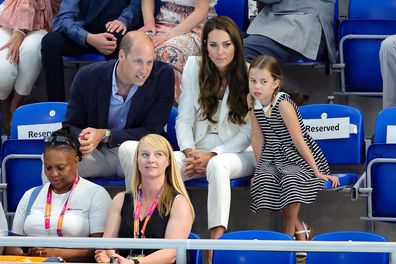
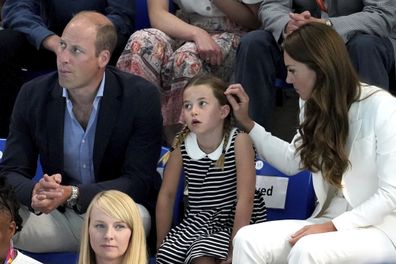
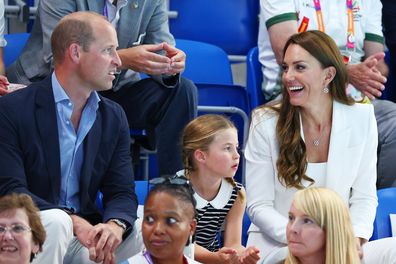
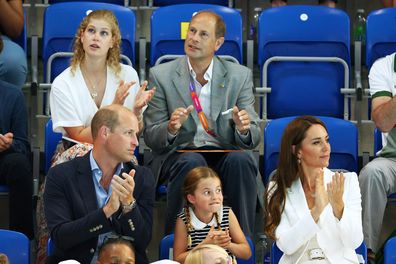
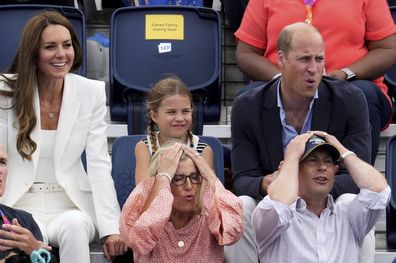
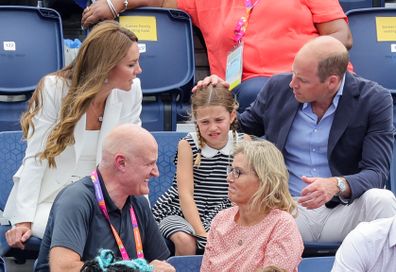
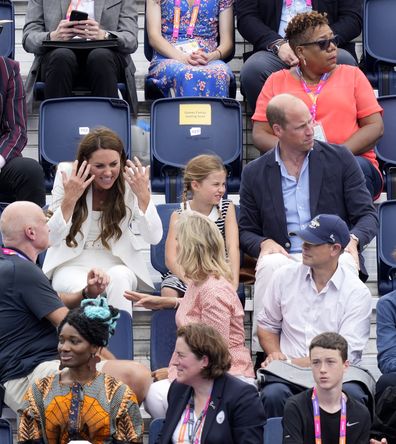
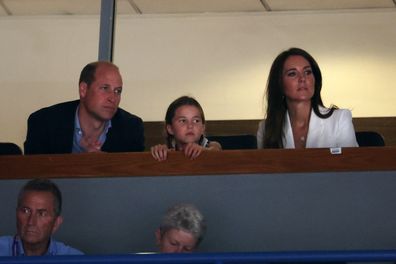
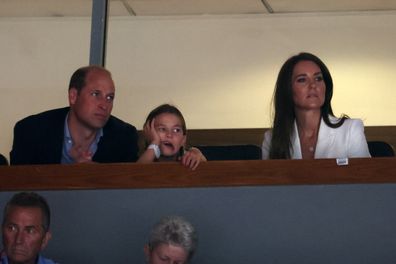
Princess Charlotte has stepped out with her parents the Duke and Duchess of Cambridge at the Commonwealth Games in Birmingham.
The seven-year-old joined prince william and Kate Middleton along with the Wessexes— Prince Edward, Sophie, Countess of Wessex and their two kids — at the Sandwell Aquatics Center to take in a session of swimming.
It’s the second appearance the young royal has made this week, after a rare video alongside dad Prince William to wish the Lionesses good luck ahead of their Euro 2022 win on Sunday.
READMORE:Meghan left struggling on her wedding day after being ‘very rude’ to army officer, author claims
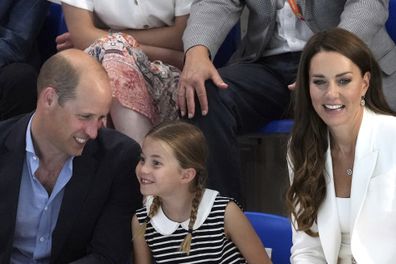
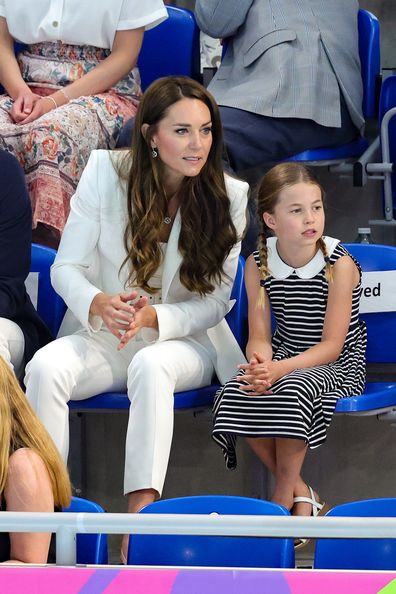
Princess Charlotte has stepped out with her parents the Duke and Duchess of Cambridge at the Commonwealth Games in Birmingham (Chris Jackson/Getty Images)Prince William and his daughter shared a laugh together while watching the competition (Jacob King/PA via AP)Doting mum Kate was seen explaining things to her daughter, pointing things out (AP Photo/Kirsty Wigglesworth)
Doting mum Kate was seen on Tuesday explaining things to her daughter and gently stroking Charlotte’s hair above her plaits.
At one point, Prince William was seen leaning across his wife to chat to his daughter.
READMORE:Princess Diana’s 1985 Ford Escort goes to auction complete with ‘stealth’ modifications for her protection
During the morning swimming session, the young royal watched a raft of Aussies in action, including Brianna Throssell, Abbey Connor and Elizabeth Dekkers qualifying for the women’s 200m butterfly final.
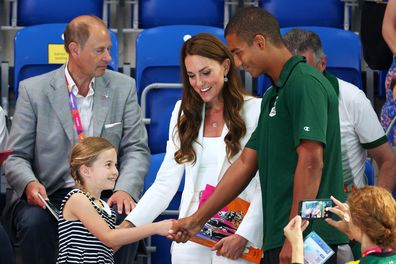
Charlotte also met with Warren Lawrence of Jamaica, dutifully shaking hands with him as mum Kate made the introduction.
During the morning swimming session, the young royal watched a raft of Aussies in action (Chris Jackson/Getty Images)Charlotte also met with Warren Lawrence of Team Jamaica, dutifully shaking hands with him as mum Kate made the introduction (Elsa/Getty Images)At one point, the Duchess gently put her hand through her daughter’s hair above her plaits (Jacob King/PA via AP)
Later, Princess Charlotte was seen sitting in between her parents, as Kate looked over, laughing at her husband’s reaction to something in the aquatic centre.
The young princess was wearing a dressed in a £39 ($69) navy Breton striped jersey dress by UK designer Rachel Riley featuring a Peter Pan collar with lace trim edges, along with white strappy sandals.
The Duchess donned an all-white three-piece ensemble and Prince William opted for a light blue and navy shirt and jacket combo with stone-coloured chinos.
Princess Charlotte was seen sitting in between her parents, as Kate looked over, laughing at her husband’s reaction to something in the aquatic center (Elsa/Getty Images)The Duchess donned an all-white three-piece ensemble and Prince William opted for a light blue and navy shirt and jacket combo with stone-coloured chinos. (Chris Jackson/Getty Images)The young princess was wearing a dressed in a £39 ($69) navy Breton striped jersey dress by UK designer Rachel Riley featuring a Peter Pan collar with lace trim edges (Chris Jackson/Getty Images)
The trio were one row in front of the other working senior royals: the Earl and Countess of Wessex and their 18-year-old daughter Lady Louise and son James, Viscount Severn, 14.
On Monday, Lady Louise was spotted at an event wearing a dress previously worn by her mum, the Countessas she attended alongside her parents and younger brother.
Later, the Cambridges and Wessexes were both spotted enjoying the hockey — a personal favorite of the Duchess of Cambridge, who used to play the sport at school.
Princess Charlotte got right into the sport on offer (Elsa/Getty Images)The trio were seen sitting one row in front of other working senior royal family members the Earl and Countess of Wessex and their 18-year-old daughter Lady Louise and son James, Viscount Severn, 14 (Chris Jackson/Getty Images)The two families watched England take on India at the University of Birmingham (Jacob King/PA via AP)
The two families watched England take on India at the University of Birmingham.
At one point the duchess and countess got into an animated discussion as they shared laughs and plenty of hand gestures.
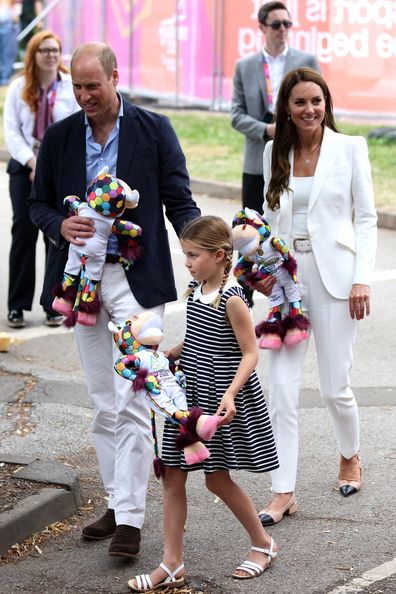
Princess Charlotte also got introduced to the Commonwealth Games mascot, Polly, across the day’s outings.
The Cambridges and Wessexes were also both spotted enjoying the hockey – a personal favorite of the Duchess of Cambridge (Chris Jackson/Getty Images)At one point the Duchess and Countess got into an animated discussion as they shared laughs and plenty of hand gestures (AP Photo/Aijaz Rahi)
The seven-year-old was spotted carrying a soft toy of the mascot after the hockey.
Parents William and Kate held one each as well, presumably for Princes George and Louis at home.
“Brilliant seeing athletes from all over the Commonwealth performing swimmingly at @BirminghamCG22 today,” a tweet on the Duke and Duchess of Cambridge’s official account said, alongside the image.
The seven year old was spotted carrying a soft toy of the mascot after the hockey with one for each of his brothers as well (Stephen Pond/Getty Images)
The Cambridges then headed to Arena Birmingham to watch the gymnastics, with the men’s horizontal bar final and the women’s floor exercise final on the schedule for day five.
It’s understood the Wessexes squeezed in a look at the athletics.
For a daily dose of 9Honey,subscribe to our newsletter here
The Cambridges then headed to Arena Birmingham to watch the gymnastics (Al Bello/Getty Images)The men’s horizontal bar final and the women’s floor exercise final in the schedule for day five. (Al Bello/Getty Images)
Prince William poses for rare royal selfie poolside
More Australians are now experiencing mild to moderate food insecurity due to the cost and unavailability of fruit and vegetables leading to ill health and pressures on charities, experts warn.
Key points:
Australia is experiencing mild to moderate food insecurity due to the rising costs of fruit and vegetables, an expert says
One family says their grocery bill has more than doubled with fresh food difficult to afford
There is concern poor nutrition could have a detrimental effect on the public health system
The skyrocketing cost of living has been particularly difficult for mum of three Jane Winters.
Her family of five, who live in Redcliffe, north of Brisbane, have seen their weekly grocery bill more than double from between $100 and $150 to nearly $300.
“We are going standard, home brand, whatever we can just to try and save some money because it’s a bit ridiculous,” she said.
A grocery list that was once full of fresh produce and healthy ingredients has now been replaced with cheaper alternatives and processed food.
“Fast food is fast becoming cheaper than healthy food which is awful,” Ms Winter said.
“It’s going to become a really big problem and I think childhood obesity is going to get so much bigger because of that.”
‘Unable to send kids to school with lunch’
Melissa Peters works in an affordable food shop west of Brisbane known as Restore, run by a not-for-profit organization Ipswich Assist.
Melissa Peters says the number of shoppers in Ipswich Assist’s charity grocery store has tripled, some of whom are from middle class backgrounds.(ABC News: Baz Ruddick)
She said the charity has seen a marked increase in families, some on dual incomes, seeking help to feed their families.
“Prior to this increase in the cost of living, we were seeing around maybe 30 to 40 people come through each week and now we’re cracking upwards of 100 people, 100 families coming through each week,” Ms Peters said.
“People tell us that they’re no longer able to afford just basic groceries, fruit and veggies, they’re unable to send their kids to school with lunches because the cost of living is just getting higher and higher each week.”
Cans of baked beans at Ipswich Assist’s charity grocery store.(ABC News: Baz Ruddick)
The store receives food from OzHarvest and Foodbank, as well as donations from mainstream supermarkets, with all items sold for $1 each.
“We’re seeing more and more families come through that have never needed to seek assistance before because they’ve never experienced any sort of financial hardship or crisis in the past,” she said.
“It’s a sense of vulnerability that they don’t want to have to show to the world… [but] we often remind them that seeking assistance is not weak.”
‘A big domino effect’
With the rising cost of food, fuel and rent showing no sign of abating, Ms Peters said the situation was only expected to worsen.
“At what point does it end? At what point does something happen that stops it from affecting every day Aussies?” she said.
“If people dig themselves into debt and get more and more into financial crisis, they have to then rely on more and more places to provide assistance.
“And those assistance places don’t have enough funding and it just becomes this big domino effect on people not being able to support themselves.”
Pru Burke’s second-hand clothing store now features a free community pantry.(ABC News: Baz Ruddick)
Redcliffe woman Pru Burke has also opened a free community pantry with stacks of free, donated pantry items destined for Queenslanders doing it tough.
“I see the mums every day come and tell me their stories and it is heartbreaking,” she said.
“It’s those small drops in the ocean that are going to save them a lot more money in the end.
“If you’ve got the ability, try doing something like this. Open a food pantry, talk to members of your community and find ways to help each other.”
Fears of rising obesity, chronic illness
Food security expert Dr Aletha Ward says there is a clear link between nutrient deficient diets and chronic disease.
University of Southern Queensland food security expert Aletha Ward said Australia was now experiencing mild to moderate food insecurity due to a lack of fruit and vegetable consumption.
“The problem with mild to moderate food insecurity is that it drives obesity, so we are having food, it is just not the right type of food,” Dr Ward said.
“Most families would not purchase an iceberg lettuce for $10.”
She said fresh food was often replaced with cheap pasta, bread and processed food, sparking fears of long-term health impacts among the general population.
“Only about 5 per cent of Australians have five serves of vegetables per day and with the pressures of the increased cost of vegetables it is just making it that little bit worse,” she said.
“This is a long-term consequence, so within 10 years to 20 years we could see skyrocketing rates of chronic disease.
“Children often have the eating patterns of their parents and that is handed down, so if we are seeing families that can’t afford fruit and vegetables, cutting out that can have a trans-generational effect and impact.”
She warned poor nutrition among the community could also have a detrimental effect on the public health system and lead to increased hospitalization rates.
She said governments should implement a subsidy on fresh produce to make healthy foods more affordable.
Pennsylvania’s mail-voting law is constitutional, the state Supreme Court ruled Tuesday, upholding the 2019 measure that allows any voter to use mail ballots and removing a cloud of uncertainty heading into the midterm elections.
The law dramatically expanded mail voting, from a method that had been allowed only in a very small number of cases — about 5% of votes in any given election — to one used by millions over the last two years.
It was the product of bipartisan negotiations between Democratic Gov. Tom Wolf and Republicans who control the state legislature, the biggest change to Pennsylvania election law in generations. But its implementation in 2020 came during both the first year of the pandemic and a heated presidential election. As massive numbers of voters cast ballots by mail, state and county election officials tried to build out the system — in some cases triggering Republican outrage and lawsuits over their decisions.
That was further stoked by then-President Donald Trump, who began attacking mail voting months before his loss to Joe Biden in the 2020 presidential election. Republicans have continued to try to dismantle the law — known as Act 77 — with some saying it has been abused in its implementation, and others espousing bogus conspiracy theories about widespread fraud.
The resulting partisan divide over a mail voting law that had been carefully negotiated — and trumpeted — by both Democrats and Republicans was on full display following the ruling Tuesday.
“I will continue to advocate for voting reforms that remove barriers and increase access to voting,” Wolf said in a statement as Democrats and allied groups applauded the court.
House Republicans’ point person on elections, meanwhile, suggested the elected Democrats who make up the court’s majority were acting as partisans. And the spokesperson for Senate Republicans said the ruling “underscores the importance of the actions taken by the General Assembly to strengthen election integrity,” including moving to add strict voter ID requirements to the Constitution.
» READ MORE: Fights over Pa. election rules that seemed settled after 2020 have now come roaring back
Partisanship helped create Act 77 in the first place, with bipartisan negotiations taking place in 2019 only after Wolf and Republican lawmakers repeatedly butted heads over election legislation and funding for new voting machines.
Constitutional questions also swirled around the law from the very beginning.
Pennsylvania’s Constitution explicitly describes situations allowing absentee voting, including for disabled voters and those who will be out of town on Election Day. Because of that, the legislature couldn’t simply expand absentee voting. Instead, Act 77 created a “mail-in” ballot that was the same as an absentee ballot. That created two functionally identical types of mail ballots — and lawmakers further blurred the lines between the two in a separate bill they passed in March 2020.
A group of Republican lawmakers — some of whom voted for the law in 2019 — and a Republican county commissioner sued last summer, saying Act 77 violates the state Constitution. The state Constitution’s protection of absentee voting, they argued, means it’s unconstitutional to provide mail voting in other cases.
Their argument also centered on the requirements for voter eligibility, which include that “he or she shall have resided in the election district where he or she shall offer to vote at least 60 days immediately preceding the election.”
That “offer to vote” language means voters must cast ballots in person unless they fall within the constitutional exception for absentee voting, Republicans argued, relying on two 1862 and 1924 cases.
The state Commonwealth Court agreed with that argument and temporarily struck down Act 77 in January. The state appealed to the Pennsylvania Supreme Court, which stayed the ruling and kept the law in place while it considered the case.
» READ MORE: Another election is coming and there’s still uncertainty around Pennsylvania’s mail voting law
The high court heard arguments in early March. Since then, officials and lawyers have waited for a ruling they knew could come at any time and had the potential to either affirm the status quo — or significantly disrupt the electoral system.
On Tuesday, the court its ruling: Act 77 didn’t overstep the Constitution in expanding mail voting, and the law remains on the books.
“We reiterate that our General Assembly is endowed with great legislative power, subject only to express restrictions in the Constitution,” Justice Christine Donohue wrote for the majority. “We find no restriction in our Constitution on the General Assembly’s ability to create universal mail-in voting.”
Donohue was joined by Chief Justice Max Baer and Justices Debra Todd and Kevin Dougherty; a fifth justice, David Wecht, agreed with most of the opinion. All five are Democrats.
They rejected the argument that previous court cases required them to limit mail voting only to the explicitly protected absentee voters. Walking through the history of the Constitution and absentee voting, the court reasoned that absentee voters are the minimum protected group of voters allowed to vote by mail — but that nothing bars the legislature from giving that option to others.
The two Republicans in court, Justices Sallie Updyke Mundy and Kevin Brobson, dissented. Both argued the court was improperly recasting history—and prior precedent—to protect the law.
“Succinctly stated, the majority overrules 160 years of this Court’s precedent to save a law that is not yet 3 years old,” Brobson wrote. “It does so not to right some egregiously wrong decision or to vindicate a fundamental constitutional right.”
Mundy emphasized that her disagreement with the Democratic majority was about law and precedent, not policy or politics.
“I express no opinion as to whether no-excuse mail-in voting reflects wise public policy,” Mundy wrote. “That is not my function as a member of this state’s Judiciary. My function is to apply the text of the Pennsylvania Constitution, understood in light of its history and judicial precedent. In so doing, I would hold that that venerable document must be amended before any such policy can validly be enacted.”
Tuesday’s decision is unlikely to dampen the partisan fighting over Pennsylvania elections.
The same Republican lawmakers who sued over Act 77 filed a second lawsuit in July, arguing that the law should be struck down on entirely separate grounds based on recent federal court rulings. Responses to that lawsuit are due Monday.
Woolworths has announced major changes to its fresh service counters and its normal trading hours in selected stores across Australia.
The supermarket giant has adjusted trading hours for its meat, seafood and deli departments to accommodate a “shift in consumer behaviour” which saw fewer customers early in the morning and late at night.
“Customers can still purchase similar products, such as chicken breast fillets and salmon, within our packed Fresh Convenience range located in-store,” a Woolworths spokesperson said.
Stream more Australian news with Flash. 25+ news channels in 1 place. New to Flash? Try 1 month free. Offer ends October 31, 2022
The fresh service deli will now trade from 7am to 8pm Monday to Sunday in selected stores across the country.
The seafood and meat counters will now trade from 9:30am to 7pm on weekdays and 9am to 7pm on weekends.
A handful of stores will still operate longer fresh service hours due to high customer demand in those areas.
It is understood hot roast chickens will still be available, even after close.
Woolworths has also made changes to its normal trading hours in a handful of stores nationwide in a move to offer “consistent customer experience.”
The spokesperson confirmed that selected stores would open one hour later or close one hour earlier.
“We’ve also moved to standardize our overall operating hours so we can offer a consistent customer experience across our store network,” the spokesperson said.
“Select stores across the country will open one hour later or close one hour earlier to align with other stores and better match customer shopping patterns.
“We’ll closely monitor customer and team member feedback over the next few months.”
At the front of each Woolworths and within the store, signage has been posted to notify customers of the altered trading hours.
Customers are encouraged to check the opening and closing hours of their local Woolworths by visiting woolworths.com.au/stores.
The initiative was first trialled in a handful of New South Wales stores in May.
Electrons find each other repulsive. Nothing personal — it’s just that their negative charges repel each other. So getting them to pair up and travel together, like they do in superconducting materials, requires a little nudge.
In old-school superconductors, which were discovered in 1911 and conduct electric current with no resistance, but only at extremely cold temperatures, the nudge comes from vibrations in the material’s atomic lattice.
But in newer, “unconventional” superconductors — which are especially exciting because of their potential to operate at close to room temperature for things like zero-loss power transmission — no one knows for sure what the nudge is, although researchers think it might involve stripes of electric charge, waves of flip-flopping electron spins that create magnetic excitations, or some combination of things.
In the hope of learning more by looking at the problem from a slightly different angle, researchers at Stanford University and the Department of Energy’s SLAC National Accelerator Laboratory synthesized another unconventional superconductor family — the nickel oxides, or nickelates. Since then, they’ve spent three years investigating the nickelates’ properties and comparing them to one of the most famous unconventional superconductors, the copper oxides or cuprates.
And in a paper published in Nature Physics today, the team reported a significant difference: Unlike in the cuprates, the magnetic fields in nickelates are always on.
Magnetism: Friend or foe?
Nickelates, the scientists said, are intrinsically magnetic, as if each nickel atom were clutching a tiny magnet. This is true whether the nickelate is in its non-superconducting, or normal, state or in a superconducting state where electrons have paired up and formed a sort of quantum soup that can host intertwining phases of quantum matter. Cuprates, on the other hand, are not magnetic in their superconducting state
“This study looked at fundamental properties of the nickelates compared to the cuprates, and what that can tell us about unconventional superconductors in general,” said Jennifer Fowlie, a postdoctoral researcher at SLAC’s Stanford Institute for Materials and Energy Sciences (SIMES) who led the experiments.
Some researchers think magnetism and superconductivity compete with each other in this type of system, she said; others think you can’t have superconductivity unless magnetism is close by.
“While our results don’t settle that question, they do highlight where more work should probably be done,” Fowlie said. “And they mark the first time that magnetism has been examined in both the superconducting and the normal state of nickelates.”
Harold Hwang, a professor at SLAC and Stanford and director of SIMES, said, “This is another important piece of the puzzle that the research community is putting together as we work to frame the properties and phenomena at the heart of these exciting materials.”
Enter the muon
Few things come easy in this field of research, and studying the nickelates has been harder than most.
While theorists predicted more than 20 years ago that their chemical similarity to the cuprates made it likely that they could host superconductivity, nickelates are so difficult to make that it took years of trying before the SLAC and Stanford team succeeded.
Even then, they could only make thin films of the material — not the thicker chunks needed to explore its properties with common techniques. A number of research groups around the world have been working on easier ways to synthesize nickelates in any form, Hwang said.
So the research team turned to a more exotic method, called low-energy muon spin rotation/relaxation, that can measure the magnetic properties of thin films and is available only at the Paul Scherrer Institute (PSI) in Switzerland.
Muons are fundamental charged particles that are similar to electrons, but 207 times more massive. They stick around for just 2.2 millionths of a second before decaying. Positively charged muons, which are often preferred for experiments like these, decay into a positron, a neutrino and an antineutrino. Like their electron cousins, they spin like tops and change the direction of their spin in response to magnetic fields. But they can “feel” those fields only in their immediate surroundings — up to about one nanometer, or a billionth of a meter, away.
At PSI, scientists use a beam of muons to embed the little particles in the material they want to study. When the muons decay, the positrons they produce fly off in the direction the muon is spinning. By tracing the positrons back to their origins, researchers can see which way the muons were pointing when they winked out of existence and thus determine the material’s overall magnetic properties.
Finding a workaround
The SLAC team applied to do experiments with the PSI system in 2020, but then the pandemic made it impossible to travel in or out of Switzerland. Fortunately, Fowlie was a postdoc at the University of Geneva at the time and already planning to come to SLAC to work in Hwang’s group. So she started the first round of experiments in Switzerland with a team led by Andreas Suter, a senior scientist at PSI and an expert in extracting information about superconductivity and magnetism from muon decay data.
After arriving at SLAC May 2021, Fowlie immediately started making various types of nickelate compounds the team wanted to test in their second round of experiments. When travel restrictions ended, the team was finally able to go back to Switzerland to finish the study.
The unique experimental setup at PSI allows scientists to embed muons at precise depths in the nickelate materials. From this, they were able to determine what was going on in each super-thin layer of various nickelate compounds with slightly different chemical compositions. They discovered that only the layers that contained nickel atoms were magnetic.
Interest in the nickelates is very high around the world, Hwang said. Half a dozen research groups have published their own ways of synthesizing nickelates and are working on improving the quality of the samples they study, and a huge number of theorists are trying to come up with insights to guide the research in productive directions.
“We are trying to do what we can with the resources we have as a research community,” he said, “but there’s still a lot more we can learn and do.”
Major funding for this work came from the DOE Office of Science and the Gordon and Betty Moore Foundation’s Emergent Phenomena in Quantum Systems Initiative. Fowlie’s work is also supported by a postdoctoral fellowship of the Swiss National Science Foundation.
Sophie Monk releases new video for sultry single Nice To Meet You during Beauty and the Geek
By Caleb Taylor For Daily Mail Australia
Published: | Updated:
Sophie Monk fans got to see a new film clip for her single, Nice To Meet You, on Monday night.
The pop star-turned-TV queen, 41, allowed her song to be used on Beauty and the Geek during a challenge.
During the episode, the beauties and geeks were tasked with creating a film clip for the song, which was released back in August last year.
Sophie Monk (pictured) released a video for her sultry single Nice To Meet You during Beauty and the Geek on Monday
The beauties were made to do a few racy moves in a diner. While the geeks filmed in the car with the number plate ‘Monk’.
The girls showed off their moves in a Pussycat Dolls style routine. While the geeks looked to channel the Backstreet Boys.
The beauties were made to do a few racy moves in an American-style diner. The geeks filmed in the car with the number plate ‘Monk’
Sophie got an overwhelming response to the song with her letting fans know it is available on Spotify soon after it aired.
‘Which music video do you prefer? Beauties or Geeks? My song is available on Spotify/etc. EVERYONE has been asking (no one has asked),’ she said.
In August last year, Sophie announced that she was making a comeback to the music scene, releasing her first single in 17 years.
The girls showed-off their moves in a Pussycat Dolls style routine. While the geeks looked to channel the Backstreet Boys
‘It’s taken me years to be ready to release a song and this happened so organically for me, I felt like the time was right,’ she told Daily Mail Australia in a statement.
‘People know me originally as a singer in Australia, so it’s nice to be going back to my number one love,’ she continued.
The jazz-inspired single was written by Monk during her time in Melbourne filming The Masked Singer.
Sophie got an overwhelming response to the song with her letting fans know it is available on Spotify soon after it aired
In the sultry song, Sophie’s raspy voice is heard singing the cryptic lyrics.
‘I’ve seen some things, that would make a grown man cry. So many things, that I have to leave behind. So complicated, but I prefer the simple life.’
Sophie says for the first time in her musical career she feels like she is in complete control after deciding to release her new music independently via Ditto Music.
Doing her own thing: ‘It’s taken me years to be ready to release a song and this happened so organically for me, I felt like the time was right,’ she told Daily Mail Australia in a statement
‘I feel like I am in complete control and I’m just excited by the opportunity to be able to do this, I hope everyone enjoys the song it as much as I did recording it,’ she said.
In December last year, Sophie teased a brand new solo single on Instagram – one which sounds very different to her days in noughties girl band, Bardot.
Beauty And the Geek continues Tuesday at 7.30pm on Channel Nine
Sophie’s music career began in 1999, when she competed on reality show Popstars
Eighteen months ago, sydney boy Arato Katsuda-Green was a young tennis star on the rise.
The then nine-year-old was out on the court six days a week and had dreams of playing as a professional.
However, it was around this time that Arato’s coach noticed something strange.
His young athlete was suddenly missing shots he would have nailed a year earlier.
Arato began playing tennis at the age of four. (Supplied)
“Arato’s coach was struggling to find an explanation and it rang alarm bells,” his father, Tim Green, said.
Green immediately had a suspicion of what was wrong, but it was something he had been assured by experts was extremely unlikely to happen.
Close to 25 years ago, Green had himself been diagnosed with a rare genetic eye condition called Stargardt’s disease.
The disease affects the macula and causes broad central vision loss.
At the time Green was diagnosed, he was told there was almost no chance he would pass on his eye condition to any future children he may have.
“I was told that it’s recessive, and therefore, I wouldn’t have to be concerned that my children would inherit this genetic problem,” he said.
Arato, pictured with his father Tim Green. (Supplied)
Research scientists have since discovered there are some forms of Stargardt’s disease caused by dominant genes.
Despite being told not to worry all those years ago, Green said he did get Arato tested by an ophthalmologist when he was about six years old and began showing a passionate interest in tennis.
The tests showed Arato had normal eyesight at the time.
Arato was given more tests a few years later, when his coach raised the alarm, which confirmed he did indeed have Stargardt’s disease and was displaying early signs of vision loss.
Arato’s journey has in some ways mirrored his father’s, despite him being diagnosed at a far younger age.
Green was also diagnosed with Stargart’s disease while training to become a professional athlete – in his case, competing in triathlons and ironman events.
“I was in full training for an ironman event at the time,” Green said.
“I started tripping over and riding over things, which was what prompted me to see an ophthalmologist to be tested.”
Arato, who is now 10, is one of the faces for this year’s Jeans for Genes Day, to be held this Friday.
The annual campaign raises funds for the Sydney’s Children’s Medical Research Institute.
Arato is one of the faces of this year’s Jeans for Genes Day fundraiser. (Supplied)
Although there is currently no cure for Stargardt’s disease, Green said the advances made through medical research towards finding a possible treatment was one of the things that gave him hope for Arato’s future.
“When I was diagnosed, there was no follow up. I was told there is nothing that we can do for you,” he said.
“But the conversation is very different now. You are advised to actually keep in contact with the clinicians because there are clinical trials happening.
“Science has come a long way and, in the conversations we’ve had with clinicians with respect to Stargardt, we are very hopeful in the next decade that there will be effective treatments.”
Green said his son had so far coped “exceptionally well” with his difficult diagnosis.
“He is taking things in his stride. There’s advantages and disadvantages to being diagnosed at a relatively young age, I think kids are pretty resilient and adaptable.”
Green said Arato was still playing tennis recreationally and was also enjoying taking part in a blind and low vision tennis (BLV) competition, run by Tennis Australia.
At school, things were a bit more of a challenge, with Arato needing vision aids in the classroom to see his work.
While Stargardt’s disease affects central vision, Green and his son are like many with the condition who have retained peripheral vision.
“I can still navigate myself around an environment that I’m familiar with, but I struggle on the stairs, because I can’t see the end of the step, or the depth,” Green explained.
“For Arato, at school it’s hard for people to understand why he can play handball so well, but he can’t read the whiteboard.
“Or when they play soccer he can see the ball, but he might kick it to the wrong person because he can’t see faces.”
It was Arato’s tennis coach who noticed he was suddenly missing easy shots. (Supplied)
Green said while living with Stargardt’s disease had presented him with plenty of challenges it had also opened up new and unexpected opportunities.
It was a chance conversation with the ophthalmologist who diagnosed him that led Green on the path to becoming a lawyer.
“We were talking about what my future would look like and he said to me, ‘Tim, the best thing you can do is go get yourself a good education and then you’ll always have a good job.’
“I have suggested becoming a lawyer and, indeed, that’s what I went and pursued.”
Green also recently took part in an ironman event in order to raise funds for Jeans for Genes Day and demonstrate for his three guiding principles he says he lives by – courage, commitment and resilience.
“When you have those three principles and values you can still achieve a lot of things,” Green said.
Money raised will go towards the Eye Genetics Research Unit at the Children’s Medical Research Institute, where scientists have developed the first ever gene therapy for a blinding eye condition in Australia and are researching new treatments for several forms of genetic blindness.
In the end it was one of the oldest mistakes in the fugitive’s handbook that apparently did for Ayman al-Zawahiri, the top al-Qaida leader killed, according to US intelligence, by a drone strike on Sunday morning: he developed a habit.
The co-planner of the 9/11 attacks on New York and Washington in 2001 had acquired a taste for sitting out on the balcony of his safe house in Sherpur, a well-to-do diplomatic enclave of Kabul. He grew especially fond of stepping out on to the balcony after morning prayers, so that he could watch the sun rise over the Afghan capital.
According to a US official who briefed reporters on Monday, it was such regular behavior that allowed intelligence agents, presumably the CIA, to piece together what they called “a pattern of life” of the target. That in turn allowed them to launch what the White House called a “tailored airstrike” involving two Hellfire missiles fired from a Reaper drone that are claimed to have struck the balcony, with Zawahiri on it, at 6.18am on Sunday.
It was the culmination of a decades-long hunt for the Egyptian surgeon who by the time he was killed had a $25m bounty on his head. Zawahiri, 71, was held accountable not only for his part as Bin Laden’s second in command for 9/11, with its death toll of almost 3,000 people, but also for several other of al-Qaida’s most deadly attacks, including the suicide bombing of the USS Cole in Yemen in October 2000, which killed 17 US sailors.
The mission to go after the al-Qaida leader was triggered, US officials said, in early April when intelligence sources picked up signals that Zawahiri and his family had moved off their mountainside hideaways and relocated to Kabul. Following the Taliban’s return to power in Afghanistan last August, and with the support of the Haqqani Taliban network, Zawahiri and his wife de él, together with their daughter and grandchildren, had moved into the Sherpur house.
map
In their telling of events, US officials were at pains to stress that under Joe Biden’s instructions the mission was carried out carefully and with precision to avoid civilian casualties. The US president was first apprised of Zawahiri’s whereabouts in April, and for the next two months a tightly knit group of officials delved into the intelligence and devised a plan.
A scale model of the Sherpur house was built, showing the balcony where the al-Qaida leader liked to sit. As discussions about a possible strike grew more intense, the model was brought into the situation room of the White House on 1 July so that Biden could see it for himself.
The president “closely examined the model of al-Zawahiri’s house that the intelligence community had built and brought into the White House situation room for briefings on this issue”, a senior administration official told reporters.
The White House made further claims to bolster its argument that the attack was lawful, flawless and with a loss of life limited to Zawahiri alone. Officials said that engineers were brought in to analyze the safe house and assess what would happen to it structurally in the wake of a drone strike.
Lawyers were similarly consulted on whether the attack was legal. They advised that it was, given the target’s prominent role as leader of a terrorist group.
Biden, by now quarantined with Covid, received a final briefing on July 25 and gave the go-ahead. It was a decision in stark contrast to the advice he gave Barack Obama in May 2011 not to proceed with the special forces mission that killed Bin Laden in a raid on his safe house in Abbottabad, Pakistan.
On Monday evening, Biden stood on his own balcony – this one in the White House with the Washington Monument and Jefferson Memorial as his backdrop – to address the nation.
“I authorized the precision strike that would remove him from the battlefield once and for all,” Biden said. “This measure was carefully planned, rigorously, to minimize the risk of harm to other civilians.”
Biden’s insistence that no one other than the al-Qaida leader was killed in the attack was amplified repeatedly by US officials. The narrative given by the White House was that Zawahiri was taken out cleanly through the application of modern technological warfare.
Skepticism remains, despite the protests. Over the years drone strikes have frequently proved to be anything but precise.
In August last year one such US drone strike in Kabul was initially hailed by the Pentagon as a successful mission to take out a would-be terrorist bomber planning an attack on the city’s airport. It was only after the New York Times had published an exhaustive investigation showing that the strike had in fact killed 10 civilians, including an aid worker and seven children, that the US military admitted the mission had gone tragically wrong.
Perhaps mindful of the doubts that are certain to swirl around the Zawahiri killing for days to come, the White House said that the Sherpur safe house where the drone strike happened had been kept under observation for 36 hours after the attack and before Biden spoke to the nation. Officials said that Zawahiri’s relatives were seen leaving the house under Haqqani Taliban escort, establishing that they had survived the strike.
The Reserve Bank has increased interest rates for the fourth month in a row, raising its cash rate target by half a percentage point.
Key points:
The RBA has raised interest rates by 0.5 of a percentage point
The cash rate target has now increased by 1.75 percentage points since the start of May to 1.85 per cent
The rise in the cash rate since early May will add about $472 a month to repayments on a $500,000 loan
The RBA has now lifted its benchmark interest rate by 1.75 percentage points since its first rate rise in May, with the cash rate target sitting at 1.85 per cent.
In his post-meeting statement, Reserve Bank Governor Philip Lowe said the latest rate rise was unlikely to be the last this year.
“The board expects to take further steps in the process of normalizing monetary conditions over the months ahead, but it is not on a pre-set path,” he said.
“The size and timing of future interest rate increases will be guided by the incoming data and the board’s assessment of the outlook for inflation and the labor market.
“The board is committed to doing what is necessary to ensure that inflation in Australia returns to target over time.”
Besa Deda is the chief economist for St George Bank and Westpac Business Bank.(ABC News: Daniel Irvine)
St George Bank chief economist Besa Deda said the Reserve Bank had already raised rates faster than any time since 1994, but she expected more.
“We think their cash rate could have a 3-handle on it by the end of this year, because inflation is running at its fastest rate since the early 1990s,” she told The Business.
“We are expecting that the Reserve Bank will deliver rate hikes for every board meeting until February next year.”
‘Real risk’ of recession
Mr Lowe acknowledged that it would be a difficult task.
“The board places a high priority on the return of inflation to the 2-3 per cent range over time, while keeping the economy on an even keel,” he warned.
“The path to achieve this balance is a narrow one and clouded in uncertainty, not least because of global developments.”
The managing director of EQ Economics and former ANZ Bank chief economist, Warren Hogan, warned that a recession was a “real risk” if the Reserve Bank raised interest rates too fast.
“I think they just need to be patient with this tightening cycle and try and get this inflation under control over a couple of years, rather than rush it and try and get it done within a year,” he cautioned.
He also told the ABC’s AM program that many of the threats to the economy were partly of the Reserve Bank’s own making.
In particular, he singled out the RBA’s statements until late last year that interest rates were unlikely to rise from near-zero until at least 2024, which he said lured many people to borrow too much money.
“I think the first home buyers are the ones who have the most significant grievance,” he told AM.
“When they first start that, they’re the most vulnerable to higher rates. And to be told by the central bank that rates will stay where they are, no matter how much conditionality they put on it, that nuance is lost on the broader community.
“And now they’re staring down the barrel of the most significant tightening of monetary policy in the modern era.”
Space to play or pause, M to mute, left and right arrows to seek, up and down arrows for volume.
The Reserve Bank’s rationale behind fourth successive hike
Figures from RateCity show the latest rate rise, if passed on in full by banks, will add another $140 a month to repayments on a $500,000 home loan.
Since rates started rising on May 3, someone with a $500,000 loan would be paying $472 a month more if their bank had simply matched the RBA moves.
‘It’s gonna be rough’
Man Huynh is one of those first home buyers struggling with the unexpected surge in mortgage repayments.
Man Huynh said he was told to expect no more than a percentage point of rate increases when he purchased his first home in October 2021.(ABC News: Rhiana Whitson)
He also owns two adjoining businesses in the Melbourne suburb of Footscray, selling hot dogs and bubble tea.
With annual inflation hitting 6.1 per cent and interest rate hikes, Mr Huynh is being hit by multiple cost pressures at work and at home.
“Everything’s going up — our bread, our rent, our insurance, everything. Even our wages are going up,” he said of his business costs.
Mr Huynh bought his first house in October last year and, even before today’s rate rise was passed on, his lender Pepper Money had increased his variable interest rate from 3.8 per cent to 5.37 per cent.
“It’s gonna be rough, we don’t know when it’s gonna stop.”
The steep increase in the cost of his mortgage was unexpected for Mr Huynh, who said his mortgage broker told him interest rates would likely only rise by between half to 1 percentage point.
“If you hear that it will only go up by a half per cent, then yes, you go and buy the house,” Mr Huynh said.
Mr Huynh said he would have made different decisions if he had known interest rates would rise this hard and fast.
“Definitely, I would have delayed purchasing my first time,” he said.
Mr Huynh’s climbing expenses come at a time when business is far from back to normal, and he has closed his other outlets to focus on his Footscray site.
“We are in front of a train station, we are in a prime position, yet no one’s catching the train, and everyone is still working from home,” he added.
Housing market, consumer confidence tumble
The rapid rise in interest rates since the start of May, combined with the high inflation that triggered the RBA’s moves, has seen consumer-confidence levels sink to depths usually seen during recessions.
House prices have also started falling rapidly in Australia’s largest cities, while they are softening in other parts of the nation as well.
“It hasn’t taken four Reserve Bank cash rate rises to slow down new borrowing, with the latest ABS new loan commitments showing that new housing lending fell in June by 4.4 per cent,” Canstar finance expert Steve Mickenbecker said.
“New borrowing has now fallen below last year’s level but is still up on pre-pandemic volumes.
“With more rate increases ahead, buyers and sellers are nervous about what is to come from this year’s spring selling season. Investors, who were previously the most bullish sector, are leading the exit.”
Federal Treasurer Jim Chalmers is warning the latest RBA decision will “sting”, even though Australian households have been bracing for further rate rises.
“Families will now have to make more hard decisions about how to balance the household budget in the face of other pressures, like higher grocery prices and higher power prices, and the costs of other essentials,” he told parliament just seconds after the RBA announcement was made.
“This decision doesn’t come as a surprise.
“It’s not a shock to anybody, but it will still sting.”
He argued the warning signs were clear prior to the election, and the federal government’s budget bottom line would also take a hit as a result.
Shadow Treasurer Angus Taylor said Mr Chalmers’ comments would be cold comfort to Australians doing it tough, and demanded more detail soon on any cost of living relief being planned by the government.
“It’s the fourth interest rate increase in a row, we’ve got the highest inflation since the early 90s,” Mr Taylor said.
“We want to see a plan, we don’t want to have to wait till the budget.”
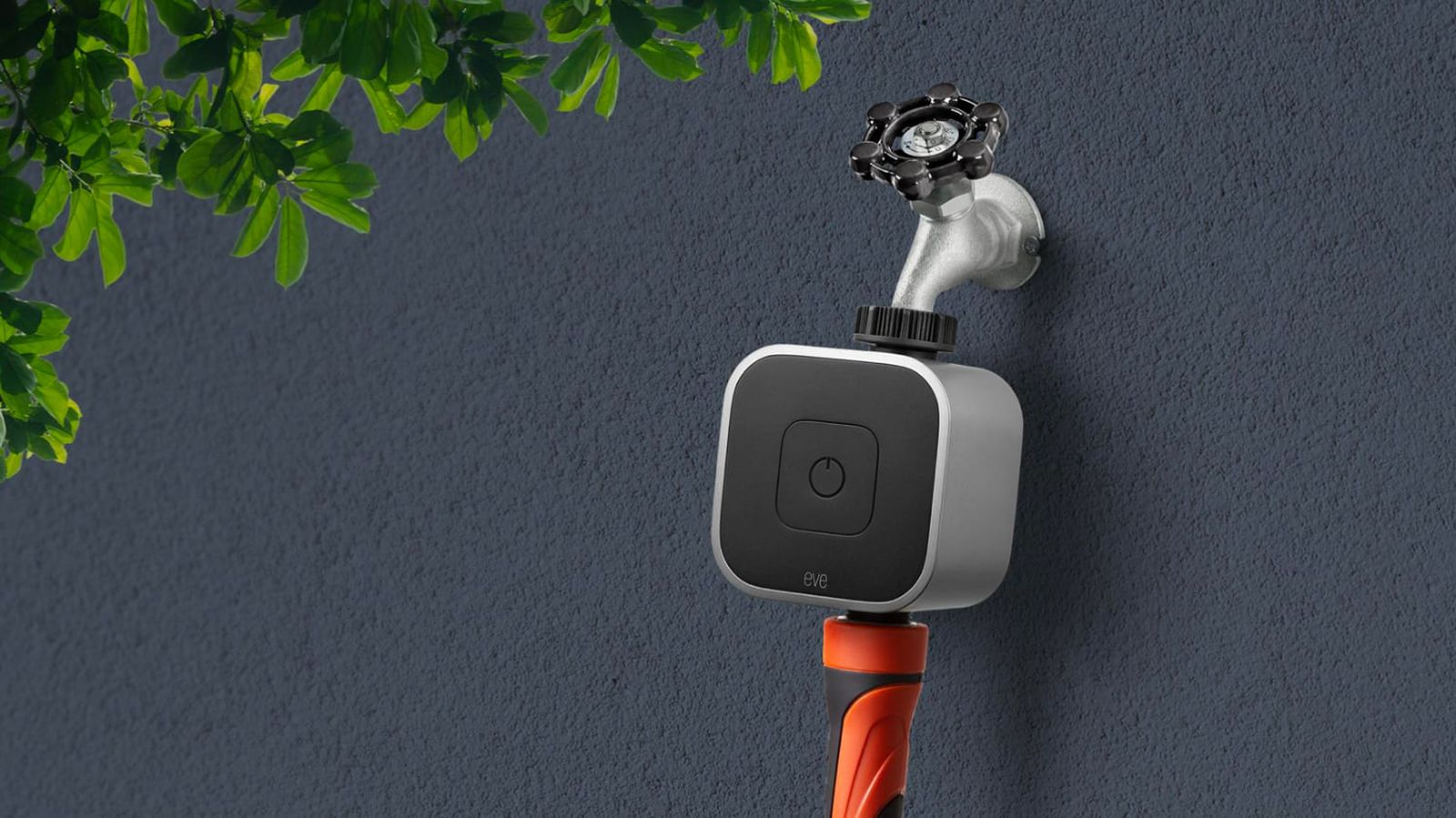
Eve Systems today announced the launch of a redesigned version of the Eve Aqua, a HomeKit-enabled smart home device designed to automate irrigation systems and convert standard outdoor faucets into smart water outlets.
The Eve Aqua water controller is able to automatically activate an irrigation system using the Home app on the iPhone, the Eve app, Siri voice commands, or a physical button on the device itself.
The third-generation Eve Aqua includes Thread support for improved reliability and reach when used with other Thread-compatible devices. It activates and shuts off automatically, with no internet connection, bridge, or gateway required for functionality, and it runs off of 2 AA batteries.
Eve Systems says that the new Eve Aqua has been redesigned with a sleeker look that features a space gray body and matte black front, along with a brass faucet connector and magnetic valve for improved durability, leak protection, and quieter operation.
The new Eve Aqua is available today for $149.95 from the Eve website.
Popular Stories
Top Stories: iOS 16 Beta 4, ‘Apple Watch Pro’ Rumors, and More
We’re probably about six weeks away from the unveiling of the iPhone 14 lineup and Apple is continuing to polish the iOS 16 update that will be released alongside the new hardware, so we’re seeing a number of tweaks as it moves through the beta testing period. This week also saw some rumors about the rugged “Apple Watch Pro” planned for launch later this year, as well as some of the…
iPhone 14 Still to Boost Performance Improvement Despite Sticking With A15 Chip
The standard iPhone 14 models will still have better performance than the iPhone 13, despite containing the same A15 Bionic chip, according to leaker “ShrimpApplePro.” In March, Apple analyst Ming-Chi Kuo claimed that only the iPhone 14 Pro models will feature the A16 chip, with the standard iPhone 14 and iPhone 14 Max models to be equipped with the A15 chip like the iPhone 13. In an April.. .
VMware Fusion Tech Preview Brings Windows 11 to Apple Silicon Macs
VMware this week announced that its latest VMware Fusion update brings Windows 11 support to both Intel and Apple silicon Macs. Available as a free tech preview, the 2H22 version of Fusion will finally allow Apple silicon Mac users to download and use Windows on their machines through virtualization. Features include Windows 11 support with 2D GFX and networking, VMtools installation for…
Apple’s Online Store is Currently Down in Some Countries [Updated]
Apple’s online store is currently down in some countries, including the United States, Canada, Australia, France, Germany, Italy, Spain, the United Kingdom, and more. The downtime is not worldwide, with the store still operational in some other countries. “We’re making updates to the Apple Store,” the store page says, as usual when there is downtime. Apple advises customers to “check back…
Apple Expands Apple TV Gift Card Offer to More Countries
Apple has expanded a previously US exclusive Apple TV gift card offer to more countries worldwide, offering customers a gift card alongside the purchase of an Apple TV 4K or Apple TV HD. The original offer was launched for US customers last month, giving buyers a $50 gift card with the purchase of an Apple TV. Following the Apple Store going down in several countries, Apple has…
Everything New in iOS 16 Beta 4 For Lock Screen, iMessage, CarPlay, and More
Apple today seeded the fourth beta of iOS 16 to developers for testing. The latest beta contains a handful of new features and changes involving the Messages app, Home app, Mail app, Lock Screen notifications, CarPlay, and more. Subscribe to MacRumors on YouTube iOS 16 is currently in beta for developers and members of Apple’s free public beta testing program, and the software update will be…
Apple Seeds Second Public Betas of iOS 16 and iPadOS 16
Apple today seeded the second betas of iOS 16 and iPadOS 16 to public beta testers, opening up the iOS 16 beta testing process to the general public. Today’s beta comes a little over two weeks after the first public beta, and it corresponds with the fourth developer beta. Public beta testers who have signed up for Apple’s free beta testing program can download the second iOS 16 and iPadOS 16 …