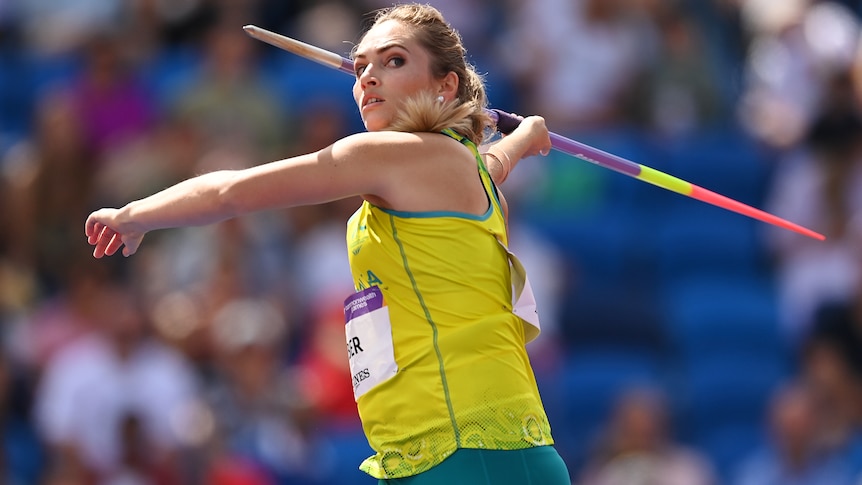
World champion Kelsey-Lee Barber has delivered when it mattered most, claiming the Commonwealth Games gold medal in the women’s javelin with her final throw.
Key points:
Barber won gold with her final attempt of 64.43m
Little was second with a personal best of 64.27m
Barber won her second world championship last month
Australian teammate Mackenzie Little had led the competition into the sixth and final round after producing a personal best of 64.27 meters with her fifth effort.
But Barber — who was struck down by COVID-19 on the eve of the Commonwealth Games — showed cool nerves to unleash the winning throw of 64.43m with her final attempt.
Little took the silver medal only a fortnight after she finished fifth behind Barber at the world championships in Eugene.
She had set what was a personal best of 64.03m with her first attempt in the Birmingham final.
Mackenzie Little set a new PB with a throw of 64.27 meters.(Getty Images: David Ramos)
Barber’s win in Eugene was her second world championship, while she was a bronze medalist at the Tokyo Olympics.
The 30-year-old now has the full set of Commonwealth Games medals, having won bronze in 2014 and silver in 2018.
The bronze in Birmingham went to India’s Annu Rani with 60.00m.
In other events, Australia’s Declan Tingay was overtaken by Canadian veteran Evan Dunfee in the final lap of the men’s 10,000m walk and had to settle for silver.
Dunfee clocked a winning time of 38 minutes and 36.37 seconds ahead of Tingay in 38:42.33.
Australian Michelle Jenneke produced another fast time but it provided only good enough for fifth in a red-hot 100m hurdles final.
World record holder Tobi Amusan from Nigeria blew the field away with a winning time of 12.30, smashing the 16-year-old Games record of 12.65 in the process.
Jenneke’s fellow Australian Celeste Mucci was seventh in 13.03.
Muzala Samukonga (44.66) won Zambia’s first gold medal of the Birmingham Games, storming home over the top of local hope Matthew Hudson-Smith (44.81) in the men’s 400m final.
Australian Steve Solomon was seventh in 46.22, ending another injury-blighted season.
A few more potential threats loomed at sunrise Sunday, particularly on the legislation’s insulin price cap. But Republicans otherwise made little headway during a legislative endurance run of politically tricky votes on immigration, taxes and other issues.
“I want my colleagues to understand what this is really about. These motions … are motions to kill this bill, period,” said Senate Finance Chair Ron Wyden (D-Ore.).
During the vote-a-rama, Democrats offered alternative amendments to buy some cover for their own vulnerable members on several GOP proposals. That included a side-by-side debate on Title 42, a polarizing Trump-era policy that placed limits on migration during the pandemic.
Democrats also rejected amendments from within their own caucus during overnight voting. Sen. Bernie Sander (I-Vt.) tried to insert provisions that would bolster prescription drug reforms, expand Medicare and create a Civilian Climate Corps, but he failed to attract support from the vast majority of his colleagues. Only Georgia Sens. Raphael Warnock and Jon Osoff joined Sanders in his effort to expand Medicare.
The vote-a-rama is the final episode of a lengthy drama that began more than a year ago with a Democratic budget designed to set the stage for a $3.5 trillion social spending package that could sidestep a filibuster. That vision for whittled down over the course of many months to the bill that the Senate is still set to pass later Sunday.
Democrats warned against making significant changes during the all-night Senate session, arguing that it was time to pass the bill after roughly a year of high-profile haggling that shined a spotlight on divisions between progressives and moderates.
The final bill was carefully negotiated to be able to win support from all 50 members of the Senate Democratic caucus. Sen. Joe Manchin (DW.Va.) surprised his colleagues late last month when he reached a deal with Majority Leader Chuck Schumer on tax and climate provisions as part of the agreement.
Before that Schumer-Manchin pact, Democrats had expected to pass a much smaller health care-only package to reduce drug costs and extend Affordable Care Act subsidies.
The deal struck by Schumer and Manchin kicked off a dayslong race to sell it to the rest of the caucus and vet the legislative text against stringent Senate budget rules that Democrats must obey to pass their bill without a GOP filibuster. Sen. Kyrsten Synema (D-Ariz.) later secured a handful of changes in exchange for her support to start debate.
Schumer made a handful of major changes to appease Sinema, eliminating language that would have tightened a loophole allowing certain investors to pay less in taxes that would have raised $14 billion in revenue. Instead, the pair agreed to add a 1 percent excise tax on stock buybacks, which is expected to raise $73 billion, while tweaking the corporate minimum tax to appease anxious manufacturers.
The bill could still change before it crosses the Senate’s finish line, however.
Democrats are still facing a Republican challenge to their proposed $35 monthly cap on what people pay out-of-pocket for insulin, a plan championed by Warnock. Republicans have argued that the provision does not comply with Senate budget rules.
The Senate parliamentarian, or the upper chamber’s rules referee, could decide in real time whether the insulin provisions should stay or go.
If the parliamentarian rules against it, Democrats are expected to try to muster 60 votes to overrule the decision and keep it in the bill. That would require finding support from 10 Republicans, which they’re not expected to get.
“I need them to not block it,” Warnock said of Republicans. “If they don’t block it, it will pass.”
The outcome of the insulin provision was the biggest question mark as the hourslong voting marathon stretched into Sunday.
On Saturday, the party-line proposal survived Senate vetting of the Medicare portions of its prescription drug reform plan, while Democrats lost ground on a separate pillar that penalizes drug companies for raising prices on individuals with private health insurance. The legislation’s tax and environmental provisions also advanced unscathed.
Democrats ultimately preserved the core pieces of their proposal: lowering some prescription drug prices, providing more than $300 billion into climate change and clean energy and imposing a 15 percent minimum tax on large corporations, plus a new 1 percent excise tax on stock buybacks. The bill also increases IRS enforcement and extends Obamacare subsidies through the 2024 election.
See how we were caught in a low-growth trap? Weak growth leads to low business investment, which leads to little productivity improvement, which leads to more weak growth.
During the Dreadful Decade, the prevailing view among policymakers was that high unemployment was preferable to high inflation, which might become entrenched. So, unemployment was left high, to keep inflation low.
Yetsenga says this decision to entrench relatively high unemployment was a mistake. “Unemployment, underemployment and the inequality they contribute to, all affect macroeconomic outcomes [adversely]“.
“Those on higher incomes tend to save more, reducing consumption, but those on lower incomes tend to borrow more. Inequality, in other words, trends to lower economic growth and exacerbate financial vulnerability.”
Even so, Yetsenga is optimistic. The policy response to the pandemic has “changed the baseline” and we’re in the process of escaping the low-growth trap.
To employ more people, give more hours to those working part-time, and raise wage growth, business needs to see demand strong enough to pay for the labour.
ANZ Bank economist Richard Yetsenga
Unemployment is at its lowest in five decades and underemployment has fallen significantly. Real consumer spending is 9 per cent above pre-pandemic levels, and businesses’ capacity utilization has been restored to high levels not seen since before the global financial crisis.
As a result, planned spending on business investment in the year ahead is about the highest in nearly three decades.
Yetsenga says the Reserve would like some of the rise in the rate of inflation to be permanent. “If monetary policy can deliver [annual] inflation of 2.5 per cent over time, rather than the 1.5 to 2 per cent that characterized the pre-pandemic period, it’s not just the rate of inflation that will be different.
“We should expect the ‘real’ side of the economy to have improved as well: more demand, more employment and more investment.”
“The role of wages in sustaining higher inflation is well known, but wage growth doesn’t occur in a vacuum. To employ more people, give more hours to those working part-time, and raise wage growth, business needs to see demand strong enough to pay for the labour.
“Some of the additional labor spend will be passed on to higher selling prices. The need to invest in more labor is likely to go hand-in-hand with more capital investment.”
The Australian economy created 60,600 new jobs in May.Credit:Bloomberg
I think Yetsenga makes some important points. First, the policy of keeping unemployment high so that inflation will be low has come at a price to growth and contributed to the low-growth trap.
Second, inequality isn’t fair about fairness. Economists in the international agencies are discovering that it causes lower growth. So, the policy of ignoring high and rising inequality has also contributed to the low-growth trap.
Third, the idea that we can’t get higher economic growth until we get more productivity improvement has got the “direction of causation” the wrong way around. We won’t get much productivity improvement until we bring about more growth.
Pandemic Panic
Despite all this, I don’t share Yetsenga’s optimism that the shock of the pandemic, and the econocrats’ switch to what I call Plan B – to use additional fiscal stimulus in the 2021 budget to get us much closer to full employment, as a last-ditch attempt to get wage rates growing faster than 2 or 2.5 per cent a year – will be sufficient to bust us out of the low-growth trap.
Yetsenga’s emphasis is on increasing household income by making it easier for households to increase their income by supplying more hours of work. He says little about households’ ability to protect and increase their wage income in real terms.
Another consequence of the pandemic period is the collapse of the consensus view that wages should at least rise in line with prices. Real wages should fall only to correct a period when real wage growth has been excessive.
But so panicked have the econocrats and the new Labor government been by a sudden sharp rise in prices (the frightening size of which is owed almost wholly to a coincidence of temporary, overseas supply disruptions) that they’re looking the other way while, according to the Reserve’s latest forecasts, real wages will fall for three calendar years in a row.
loading
Since it’s the easiest and quickest way of getting inflation down, they’re looking the other way while the nation’s employers – government and business – short-change their workers by a cumulative 6.5 per cent.
This makes a mockery of all the happy assurances that, by some magical economic mechanism, improvements in the productivity of labor flow through to workers as increases in their real wage.
Sorry, I won’t believe we’ve escaped the low-growth trap until I see that, as well as employing more workers, businesses are also paying them a reasonable wage.
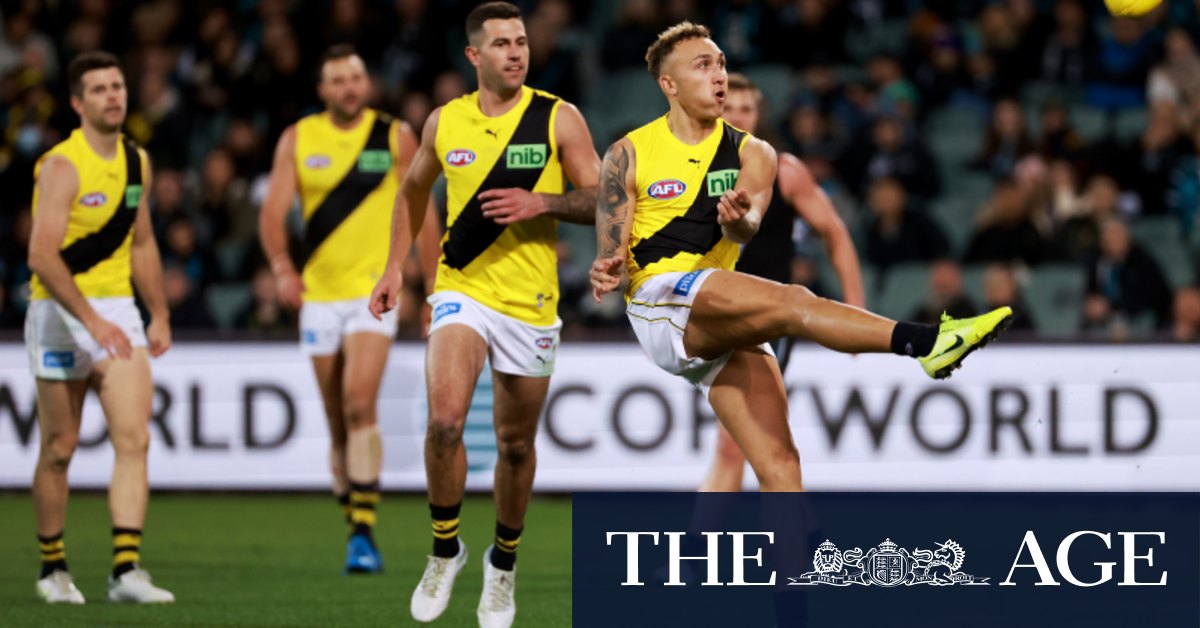
He followed a pack mark against Xavier Duursma and Burton with a goal on the quarter-time siren before finishing the first half in style.
Bolton sidestepped Karl Amon and Darcy Byrne-Jones and finished magnificently around the corner with two seconds remaining on the clock to stretch Richmond’s lead to eight points after the Power managed to tidy things up. “How do you stop this guy,” Fox Footy commentator David King exclaimed.
loading
Port’s tried-and-true engine room contingent of Travis Boak, Ollie Wines and Willem Drew paced Port’s second-revival from the center square before Richmond turned the tables and savaged them in the third stanza.
Trent Cotchin’s playmaking was of the highest order and Dion Prestia’s work at the contest was brutally efficient, feeding off the aerial dominance of Toby Nankervis, who completely outmatched second-gamer Brynn Tackle in ruck.
Bolton showcased his full bag of tricks in the fourth term, his wayward finishing – a season-long Achilles heel – the only drawback of his night out.
JACK IN THE PACK He has done it so many times across his glorious 323-game career that it shouldn’t come as a surprise. Jack Riewoldt had eyes only on the footy when he plucked a magnificent mark midway through the third term. Jayden Short’s deep entry was snaffled by Riewoldt, running back with the flight of the footy, Tom Jonas on his hammer and Aliir and Teakle both oncoming. Riewoldt’s fearlessness was rewarded when he converted the goal as Richmond continued to press home their advantage.
POWER CONCERNS Connor Rozee felt a scare through the Power camp midway through the second period when he sprained his left knee while attempting to lay a tackle on Noah Balta, moments after turning the footy over. Rozee limped off the ground before coming back on with his knee strapped after half-time. He was serviceable, often without looking 100 per cent, but he showed no ill-effects of the injury when he climbed on Daniel Rioli’s back for a superb mark in the fourth stanza, before converting. Also in that term, Darcy Byrne-Jones received treatment after being hit high by a clumsy spoil from Kamdyn McIntosh. Byrne-Jones came back on and moved into attack but had no real impact.
A few more potential threats loomed at sunrise Sunday, particularly on the legislation’s insulin price cap. But Republicans otherwise made little headway during a legislative endurance run of politically tricky votes on immigration, taxes and other issues.
“I want my colleagues to understand what this is really about. These motions … are motions to kill this bill, period,” said Senate Finance Chair Ron Wyden (D-Ore.).
During the vote-a-rama, Democrats offered alternative amendments to buy some cover for their own vulnerable members on several GOP proposals. That included a side-by-side debate on Title 42, a polarizing Trump-era policy that placed limits on migration during the pandemic.
Democrats also rejected amendments from within their own caucus during overnight voting. Sen. Bernie Sander (I-Vt.) tried to insert provisions that would bolster prescription drug reforms, expand Medicare and create a Civilian Climate Corps, but he failed to attract support from the vast majority of his colleagues. Only Georgia Sens. Raphael Warnock and Jon Osoff joined Sanders in his effort to expand Medicare.
The vote-a-rama is the final episode of a lengthy drama that began more than a year ago with a Democratic budget designed to set the stage for a $3.5 trillion social spending package that could sidestep a filibuster. That vision for whittled down over the course of many months to the bill that the Senate is still set to pass later Sunday.
Democrats warned against making significant changes during the all-night Senate session, arguing that it was time to pass the bill after roughly a year of high-profile haggling that shined a spotlight on divisions between progressives and moderates.
The final bill was carefully negotiated to be able to win support from all 50 members of the Senate Democratic caucus. Sen. Joe Manchin (DW.Va.) surprised his colleagues late last month when he reached a deal with Majority Leader Chuck Schumer on tax and climate provisions as part of the agreement.
Before that Schumer-Manchin pact, Democrats had expected to pass a much smaller health care-only package to reduce drug costs and extend Affordable Care Act subsidies.
The deal struck by Schumer and Manchin kicked off a dayslong race to sell it to the rest of the caucus and vet the legislative text against stringent Senate budget rules that Democrats must obey to pass their bill without a GOP filibuster. Sen. Kyrsten Synema (D-Ariz.) later secured a handful of changes in exchange for her support to start debate.
Schumer made a handful of major changes to appease Sinema, eliminating language that would have tightened a loophole allowing certain investors to pay less in taxes that would have raised $14 billion in revenue. Instead, the pair agreed to add a 1 percent excise tax on stock buybacks, which is expected to raise $73 billion, while tweaking the corporate minimum tax to appease anxious manufacturers.
The bill could still change before it crosses the Senate’s finish line, however.
Democrats are still facing a Republican challenge to their proposed $35 monthly cap on what people pay out-of-pocket for insulin, a plan championed by Warnock. Republicans have argued that the provision does not comply with Senate budget rules.
The Senate parliamentarian, or the upper chamber’s rules referee, could decide in real time whether the insulin provisions should stay or go.
If the parliamentarian rules against it, Democrats are expected to try to muster 60 votes to overrule the decision and keep it in the bill. That would require finding support from 10 Republicans, which they’re not expected to get.
“I need them to not block it,” Warnock said of Republicans. “If they don’t block it, it will pass.”
The outcome of the insulin provision was the biggest question mark as the hourslong voting marathon stretched into Sunday.
On Saturday, the party-line proposal survived Senate vetting of the Medicare portions of its prescription drug reform plan, while Democrats lost ground on a separate pillar that penalizes drug companies for raising prices on individuals with private health insurance. The legislation’s tax and environmental provisions also advanced unscathed.
Democrats ultimately preserved the core pieces of their proposal: lowering some prescription drug prices, providing more than $300 billion into climate change and clean energy and imposing a 15 percent minimum tax on large corporations, plus a new 1 percent excise tax on stock buybacks. The bill also increases IRS enforcement and extends Obamacare subsidies through the 2024 election.
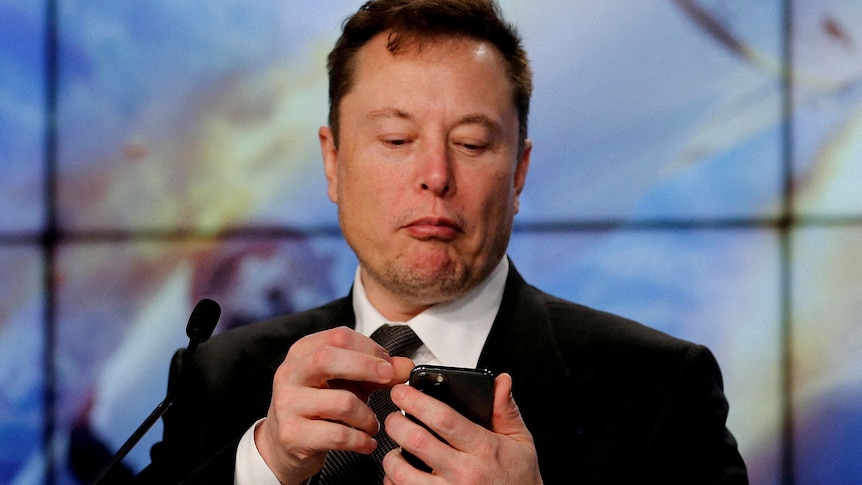
Elon Musk says his planned $US44 billion ($63.7 billion) takeover of Twitter should move forward if the company can confirm some details about how it measures whether user accounts are “spam bots” or real people.
Key points:
Twitter estimates less than 5 per cent of its user accounts are fake or spam
Mr Musk said his deal to buy Twitter would move ahead on its original terms if the company provided its method of sampling
Both sides are headed to trial in October
The billionaire and Tesla CEO have been trying to back out of his April agreement to buy the social media company, leading Twitter to sue him last month to complete the acquisition.
Mr Musk countersued, accusing Twitter of misleading his team about the true size of its user base and other problems he said amounted to fraud and breach of contract.
Both sides are headed toward an October trial in a Delaware court.
“If Twitter simply provides their method of sampling 100 accounts and how they’re confirmed to be real, the deal should proceed on original terms,” Mr Musk tweeted.
“However, if it turns out that their SEC filings are materially false, then it should not.”
Mr Musk, who has more than 100 million Twitter followers, went on to challenge Twitter CEO Parag Agrawal to a “public debate about the Twitter bot percentage.”
Twitter declined to comment.
The company has repeatedly disclosed to the Securities and Exchange Commission an estimate that fewer than 5 per cent of user accounts are fake or spam, with a disclaimer that it could be higher.
Mr Musk waived his right to further due diligence when he signed the April merger agreement.
Twitter has argued in court that Mr Musk is deliberately trying to tank the deal and using the bot question as an excuse because market conditions have deteriorated and the acquisition no longer serves his interests.
In a court filing, the company describes his counterclaims as an imagined story “contradicted by the evidence and common sense.”
“Musk invents representations Twitter never made and then tries to wield, selectively, the extensive confidential data Twitter provided him to conjure a breach of those purported representations,” Twitter lawyers wrote.
While Mr Musk has tried to keep the focus on bot disclosures, Twitter’s legal team has been digging for information about a host of tech investors and entrepreneurs connected to Mr Musk in a wide-ranging subpoena that could net some of their private communications with the Tesla CEO.
The Pokemon Company recently hosted a special presentation event to unveil more about their upcoming titles on Nintendo Switch, Pokemon Scarlet and Violet. Some of the game’s new features raised many questions among the fans.
ADVERTISEMENT
Article continues below this ad
Pokemon is among the most famous Nintendo games. The series’s popularity led it to get multiple anime and video game adaptations. The series will now welcome the ninth and the latest generation of the series, Scarlet and Violet.
ADVERTISEMENT
Article continues below this ad
This new game would release on November 18, 2022. Further, these two would be the first games in the series to be an open-world RPG games. Additionally, the game will introduce many new features, unlike the past game.
Pokemon Scalet and Violet won’t have level-scaling gyms
Most Pokemon games have followed a similar concept. The players have to catch and train strong Pokemon to take down eight gyms to challenge the Pokemon League to win the title of Pokemon champion. However, the upcoming two games broke free of this cycle.
The latest Pokemon Present revealed that the new game is set in the Paldea region, where players are prestigious academy students. They have three career paths in the game, one of them is the Pokemon League. So fighting the eight gyms and challenging the league is no longer a necessity.
ADVERTISEMENT
Article continues below this ad
However, that’s not the end of gym battles. In the past games, there was a set path to challenge each gym. But this time, there is no path and order, it’s up to the player which gym they want to take on first. However, this led to the speculation that the gym leaders would send pokemon based on the trainers.
But that might not be the case, as the developers mentioned it’s up to the players if they want to start with a strong gym leader or challenge the one nearest to their location. So, the player has to be wise while picking a gym to challenge as they won’t drop or increase their level to match the player.
ADVERTISEMENT
Article continues below this ad
Undoubtedly, these new games have many new features. So, it would be fascinating to see if these new features impress or disappoint the Pokemon fans. What are your thoughts about no level-scaling in Pokemon Scarlet and Violet’s open gym setting?
WATCH THIS STORY: Ranking The Highest Selling Nintendo Games of All Time
Aussie teen star Callum Peters has been “robbed” of gold after another farcical judging decision at the Commonwealth Games.
The Aussie, competing in his first senior tournament, showed nothing but class after the judges scores were announced with Scotland’s Sam Hickey being awarded the victory by the narrowest of margins.
The rollercoaster middleweight final was arguably the best fight of the entire Games.
However, it was overshadowed by the controversial finish which ended in a split decision 29-28 x3, 28-29 x2.
The greatest shock was the decision from judge No. 5 Mazlan Amzah to award Hickey the final round when all the other judges gave it to Peters. Peters had dominated the final round, repeatedly landing clean shots in the final minutes. That perplexing decision to award Hickey the final round ultimately decided the fight.
Peters just had to settle for silver.
Aussie sport commentators could not believe their eyes.
Sports reporter Phil Lutton posted on Twitter Peters had been “burgled”.
“That doesn’t look right at all to me,” I posted.
“Callum Peters gets the final round on four of the five cards but it’s not enough.”
He also posted: “Fair play to Sam Hickey, very tough Scot, but Callum Peters just burgled of gold there. One point the difference in the end, Peters absolutely dominant in that final round and one of the five judges gives it to the Hickey. Boxing delivers again.”
Hickey celebrated Scotland’s first boxing gold medal since 2014.
Fox Sports reporter Alex Conrad wrote on Twitter: “Sorry, WTF? Callum Peters robbed in that final boxing. Absolutely robbed. That is mind-boggling”.
The BBC’s Thomas Duncan also said the fight could have gone either way.
“There was a hug of mutual respect in the ring between Sam Hickey and Callum Peters in the ring there. What a fight that was, and it could have gone either way,” he said.
“But Hickey of Scotland is the Commonwealth champion. He puts his hands over his face, he ca n’t believe it. The crowd go wild.”
When Peter Meijer voted to impeach Donald Trump, breaking with nearly all of his Republican colleagues in one of his first acts as a newly elected member of Congress, Democrats praised him as the kind of principled conservative his party – and the nation – desperately needed.
But this election season, as Meijer fought for his political survival against a Trump-endorsed election denier in a primary contest for a Michigan House seat, Democrats twisted the knife and helped his extremist opponent win.
It is part of a risky, and some say downright dangerous, strategy Democrats are using in races for House, Senate and governor: spending money in Republican primaries to elevate far-right candidates over more mainstream conservatives in the hope that voters will recoil from the election-denying radicals in November.
In Michigan, the gamble paid off – for now. Meijer lost after the House Democrats’ official campaign arm spent $425,000to elevate Meijer’s opponent, John Gibbs, a former Trump administration official who asserted, falsely, that Joe Biden’s victory was “simply mathematically impossible”.
It is impossible to know what impact the Democrats’ ad had on the race, but cost more than the Gibbs campaign raised.
Now, as the primary season nears its conclusion and the political battlefield takes shape, Democrats will soon learn whether the gambit was successful. While election deniers have prevailed in Republican primaries across the country without any aid from Democrats, critics say the effort has already undermined the party’s grave warnings about the threats to democracy.
“It is immoral and dangerous,” said Richard Hasen, a UCLA law professor and director of the Safeguarding Democracy Project. He said the risk of miscalculation was great, particularly at a moment when the January 6 committee is attempting to show just how destructive Trump’s stolen election myth has been for American democracy.
“It’s hard for Democrats to take the high road when they’re cynically boosting some of these candidates in order to try to gain an advantage in the general election,” he said. “That doesn’t mean that what Democrats are doing is as bad as what Republicans are doing, but it still makes it objectionable.”
Meijer’s defeat has fueled a sharp debate among Democrats over the potential perils of the tactic, especially as the party warns of the risks posed by these very Republicans. But others argue it’s a necessary and calculated gamble in pursuit of keeping a dangerous party from winning power.
“If you let Republicans back in power, it is going to be those Maga Republicans who are going to take away your rights, your benefits and your freedom,” Congressman Sean Patrick Maloney, chair of the Democratic Congressional Campaign Committee, said, defending the strategy in a recent interview on MSNBC’s Morning Joe. “We need to stop it.”
The president’s party historically loses ground during the midterms. Decades-high inflation and widespread frustration with leaders in Washington have dragged Joe Biden’s approval ratings to record lows, hampering Democrats’ efforts to preserve their razor-thin majorities in Congress.
The ads are ostensibly scripted as an attack – highlighting a candidate’s loyalty to Trump and their conservative views on abortion. In Michigan, for example, Democrats charged that Gibbs was “handpicked by Trump to run for Congress” and “too conservative” for the district. But when aired during a primary, the message is intended to appeal to the conservative base.
“The voters in the Republican primary had agency,” said Bill Saxton, the Democratic party chair in Kent county. “They had two choices.”
Saxton, whose county is situated in the west Michigan district, said it was now time to set aside the bickering over tactics and focus on the real threat: Gibbs’s extremism.
In 2020, Gibbs could not win Senate confirmation to direct Trump’s Office of Personnel Management over past comments he made, among them calling Democrats the party of “’Islam, gender-bending, anti-police, ‘u racist!’”.
Democrats’ efforts to pick their opponents extends far beyond a single Michigan House race. They have deployed this strategy in House, Senate and governor’s races across the country.
In Maryland, the Democratic Governors Association boosted Dan Cox, who attended the January 6 rally and called Vice-President Mike Pence a “traitor” for not stopping the congressional certification of Biden’s victory as Trump wished. He won the party’s nomination for governor. That was after Democrats’ spent millions of dollars to successfully promote the Trump-backed election denier in the Illinois Republican gubernatorial primary. Both states lean Democratic and the party is reasonably confident their candidate will prevail.
Doug Mastriano, an election denier, is the Republican nominee for governor in Pennsylvania. His Democratic opponent of him spent big to support him in the primary. Photograph: Carolyn Kaster/AP
The race causing the most angst is in Pennsylvania battleground. There the Democratic nominee for governor, Josh Shapiro, spent hundreds of thousands of dollars in TV ads boosting the rightwing extremist Doug Mastriano – far more than the candidate spent on his own campaign. Mastriano, who attended the January 6 rally and has cast doubt on the legitimacy of the 2020 election, is now the Republican nominee in a swing state where the chief elections officer is appointed by the governor.
Polls show a tight race.
The strategy hasn’t always worked. In California, the incumbent Republican congressman David Valadao narrowly beat back a rightwing challenger despite Democratic spending on ads that highlighted his vote for him to impeach Trump.
And in Colorado, an outside group aligned with Democrats spent millions to boost an election denier who marched to the Capitol with rioters on January 6 over a relatively moderate Republican, businessman Joe O’Dea, in the race to take on the Democratic Senator Michael Bennet . O’Dea won and now the resources Democrats spent to make him unpalatable to the Republican base may help him appeal to moderate and independent swing voters.
Meddling in the opposition’s primary is not a new tactic. In 2012, Claire McCaskill, then a Democratic senator from Missouri, was facing a difficult re-election in a state where Barack Obama was deeply unpopular.
Surveying her prospective opponents, she devised a plan to lift the one she thought would be the weakest candidate, the far-right congressman Todd Akin. It worked: he won the primary, and she beat him decisively in the general.
But a decade later, she is urging caution.
“This has to be done very carefully,” she told NPR, adding: “You also have to be careful what you wish for.”
Maloney, the DCCC chair, has said the committee has a “high bar” for meddling in a Republican primary, but insisted that there are races where it “does make sense.” Still, it has become an issue for Maloney in his own primary race, where his challenger, Alessandra Biaggi, has accused him of playing “Russian roulette with our democracy”.
Some Democrats have also expressed misgivings about punishing the few Republicans willing to stand up to Trump. David Axelrod, a longtime Democratic strategist and political adviser to Barack Obama, said Democrats’ involvement in Meijer’s primary “makes them an instrument of Trump’s vengeance”.
Trump’s support has been one of the most decisive factors in choosing the party’s standard bearers, not Democrats, said David Turner, a spokesman for the Democratic Governors Association. In these races, he said Democrats seized the opportunity to expose a prospective opponent’s extremism early and pre-emptively blunt any attempt to “pivot” toward the mainstream during the general election.
Turner blamed Republican leaders for being “too cowardly to tell their voters the truth” about the 2020 election, a failure that he said ensured the success of election-deniers in the GOP’s 2022 nominating contests.
In Pennsylvania, one of Mastriano’s chief rivals was Lou Barletta, a signatory to the state’s fake elector scheme. And in Colorado, the candidate deemed more moderate won the Republican primary for governor but then selected an election denier to be her running mate.
“There aren’t any Liz Cheneys running for governor,” he said, referring to the Republican vice chair of the January 6 committee who may lose her primary over efforts to hold Trump accountable. “In terms of gubernatorial candidates, the scary part is that all these Republicans are regurgitating the same Maga talking points.”
Still, some Democrats argue that they are being held to a different standard than Republicans, who have failed to hold Trump and loyalists in Congress accountable. They say Republicans often cheer their leaders for being ruthless while Democrats are criticized for refusing to play hardball, especially when the stakes are the highest.
As a result of gerrymandering, Republican dominance of the redistricting process and historical trends, Democrats see few opportunities to flip House seats this cycle. Michigan’s third congressional district is one of them.
Gibbs has downplayed the impact of the ads, and projected confidence that he can win in November.
Hillary Scholten, the Democrat who will face him in the Michigan House race and had no involvement in the DCCC’s decision, called the focus on her party’s tactics an unwanted distraction from the issues voters care most about.
Scholten said: “It is the Republicans that decided who they wanted in their primary, and they chose John Gibbs, an extremist that embraces conspiracy theories and is way out of step with west Michigan. I’m focused on making sure he doesn’t get to Congress.”
Her newly redrawn Michigan district is considerably more favorable to Democrats this cycle than it was two years ago. And many Democrats believe Scholten, a former justice department attorney in the Obama administration who came close to beating Meijer in 2020, would have been a strong contender in a rematch.
While many are confident she can beat Gibbs, those still haunted by Trump’s against-the-odds victory in 2016 fear that in a “wave” election, Republicans deemed unelectable could be swept to power.
On the eve of his primary race, Meijer lashed Democrats in an online essay that accused them of “selling[ing] out any pretense of principle for political expediency”.
“Republican voters will be blamed if any of these candidates are ultimately elected,” Meijer wrote in an online essay published on the eve of the primary, “but there is no doubt Democrats’ fingerprints will be on the weapon. We should never forget it.”
Confronted with someone else’s wallet, most would like to think they’d drop it off to the nearest police station with the money and cards left inside.
But for one woman, the temptation of a wild night out on the town, an all-expenses-paid trip to a sex shop and pricey Qantas flights proved too strong.
University of Wollongong student Kirsten McNeice revealed her credit card was stolen and used for an extraordinary range of purchases, including bras, booze, food and sex toys.
Ms McNeice wasn’t aware of the woman’s weekend of paywaving until she looked at her bank statement earlier this week – something she now urges everyone to do more often.
The unknown woman spent more than $3,000 dollars on Ms McNeice’s card, according to bank statements seen by Daily Mail Australia.
She appeared to have made multiple trips to a popular Wollongong club, splashing cash around each time.
University of Wollongong student Kirsten McNeice (pictured) has revealed how her credit card was stolen before the thief went on a spending spree
The woman had multiple innings’ at Mr Crown (pictured) in Wollongong and spent nearly $400 at the venue
The thief’s daytime trips to Mr Crown, a public bar and nightclub, were broken up with visits to a Shellharbour bra and lingerie store and a $200 manicure.
She also ensured she would have a quick getaway when her hijinks outgrew the small industrial city – spending $876 on a Qantas ticket.
An $876 ticket would enable her to go to almost anywhere within southeast Asia and the Pacific, according to Qantas’ current offers.
The unknown woman went on a shopping spree around the retail district of Wollongong (pictured)
Ms McNeigh posted the bank records (pictured) on social media to the excitement of many University of Wollongong students
The unknown thief then parted at Mr Crown again, appearing to have ordered generously at the bar.
After leaving the pub, the woman bought a dinner at a local kebab shop with the $27 card swipe suggesting she opted for multiple kebabs or ‘snack packs’, perhaps to share with her friends.
The woman, at some point, retreated home for the evening, reloading for a Tuesday morning visit to the shops.
The mystery shopper made two matching purchases at Myer, a quick trip to Chemist Warehouse, and dropped a cool $80 at pajama store Peter Alexander.
The Wollongong grifter made an online fruit purchase before trundling down to a local Boost Juice, perhaps still craving a fruity hangover fix.
She then trekked to a quieter part of Wollongong, spending more than $400 at a discreet sex store, the Adult Warehouse, in the west of the city.
After that, her spending spree appeared to come to an abrupt stop.
Ms McNeice is already on track to receive her money back she said, but the culprit is still on the run.
‘Now it’s just a matter of finding her,’ she told Daily Mail Australia.
‘Thirteen rounds of drinks for your girlfriends at Mr Crown followed by a snack pack at King Kebabs? Respect.’
Ms McNeice said she believes she already had the name of the woman behind the in-and-out spree after asking a few of the businesses where the cash was spent.
Purchases made at a discreetly named company were actually for this Adult Warehouse store in the industrial area of Wollongong
Ms McNeice has left a statement with the police as they try to find the culprit.
Students in a local University of Wollongong Facebook group have followed developments in the case with interest, with one joking the episode needed to be a true crime podcast.
Ms McNeice had posted the expense sheets originally to the group, allowing the others to follow the inglorious money trail for themselves.
A later post in the group spurred a flurry of messages guessing at where the mystery woman would be by then.
‘She’s either at Mr Crown or Bras and Things, or on her way back to Mr Crown from Bras and Things,’ joked another.
‘Damn, did she get around… she wouldn’t have gotten that far on my bank card that’s for sure.’