Panasonic will release a mirrorless camera that it will jointly develop with Leica “in about a year” that is the result of the expanded partnership the two brands signed in May.
The report comes courtesy of Nikkei, which has found evidence that shows that the manufacture of all small digital cameras has basically ceased across the board. As part of that report, the publication spoke with Panasonic which confirmed that not only has it ceased production of Lumix-branded compact cameras, but that it would also be focusing on the high-end of the market which includes leveraging its partnership with Leica to produces a co-developed mirrorless camera next year.
“Production of existing products will continue for the time being, but in the future, the company plans to concentrate on developing high-end mirrorless machines aimed mainly at enthusiasts and professional filmmakers,” Panasonic tells Nikkei.
“We are planning to release a mirrorless machine jointly developed with Leica Camera, which we formed a comprehensive partnership with at the end of May, in about a year.”
In May, Panasonic and Leica announced a new agreement that was categorized as a “business alliance” that further tightened the relationship between the two companies. The two brands had already been working closely together for several years, but this agreement, known as Ltwowould join both business and marketing together in the development of cameras.
What the two brands would do under this new relationship was vague at the time, but this somewhat offhanded remark from Panasonic to Nikkei is the first confirmation that the two brands are working on a future camera product together under the new Ltwo partnership. Given Panasonic’s statement about a focus on high-end products and the history of Leica’s brand, it is probably safe to assume the final product will exist in that space.
It is not clear how this new camera will fit in with Panasonic or Leica’s current full-frame offerings. The two companies both produce mirrorless L-mount cameras that exist in that high-end space, and whether or not the co-developed camera will replace both lines or be in addition to them was not revealed.
An Arkansas judge drowned in a lake during a weekend getaway with family and friends, authorities said.
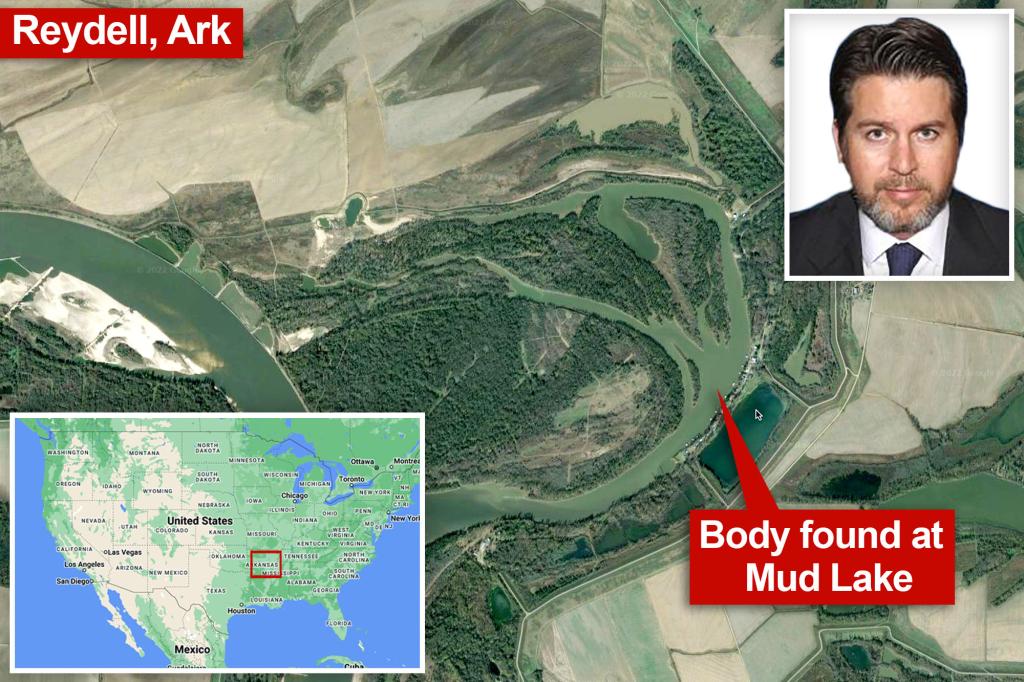
The body of Arkansas County Northern District Judge Jeremiah T. Bueker was recovered early Sunday from the bottom of Mud Lake in Jefferson County, sheriff officials said in a statement. He was 48.
The judge was spending time with several relatives and friends during a “recreational” outing over the weekend when he ventured off alone, authorities said.
“After time had passed and no one had seen or heard from Bueker, worry to set in,” sheriff officials said Sunday.
Bueker was last seen near Mud Lake, which dumps into the Arkansas River just north of Reydell. The judge’s family then called 911 after they couldn’t find him on Saturday.
Jefferson County deputies launched extensive ground and water searches for Bueker that were later suspended due to low visibility. Mud Lake was then scoured just after sunrise Sunday and a sonar detected the judge’s body at the bottom, authorities said.
Bueker’s death is being probed as an accidental drowning, but his body is being sent to a state medical examiner for an autopsy, authorities said.Jefferson County Sheriff’s Office
“Deputies utilized subsurface body recovery drag/rescue hooks to recover Bueker’s body,” authorities said. “Upon recovery of the body, deputies and investigators with the assistance of family positively identified the body as that of Bueker.”
Bueker’s death is being probed as an accidental drowning, but his body is being sent to a state medical examiner for an autopsy, authorities said.
Sheriff Lafayette Woods said he hoped the recovery of Bueker’s body provides “some sense of closure” to his family and loved ones.
Keep up with today’s most important news
Stay up on the very latest with Evening Update.
“The scour of emotions they must feel right now is devastating,” Woods said.
Stuttgart Mayor Norma Strabala, meanwhile, said she was “shocked and heartbroken” by Bueker’s sudden death.
“Jeremy was an important and special person in this community, serving as a good friend, fierce attorney, and as Arkansas County Northern District Court Judge for nearly a decade,” Strabala wrote on Facebook. “I am praying for Sunny, her family and this community as we mourn this tragic loss.”
Bueker, who was elected as a district judge in 2012, was an “avid outdoorsman” and a “very proud father,” a Stuttgart city official told the Arkansas Democrat-Gazette.
He was last seen alive late Saturday, authorities told the outlet.
“His family had a weekend at a cabin on the family’s property,” said Maj. Gary McClain of the Jefferson County Sheriff’s Office. “They were riding [utility vehicles] and returned back to the cabin. It appears he decided to go swimming after maybe being dusty and he went missing. No one was with him; he was alone.”
Relatives said Bueker loved to swim, so taking a spontaneous dip would not have been unusual for him, McClain added.
For regional motorists in South Australia, options are few and far between when it comes to the rapid charging of electric vehicles (EVs).
Key points:
Initial SA EV charging network will have gaps no longer than 200kms
100 of 140 sites have been assessed so far by the RAA
Construction aims to be completed by the end of 2023
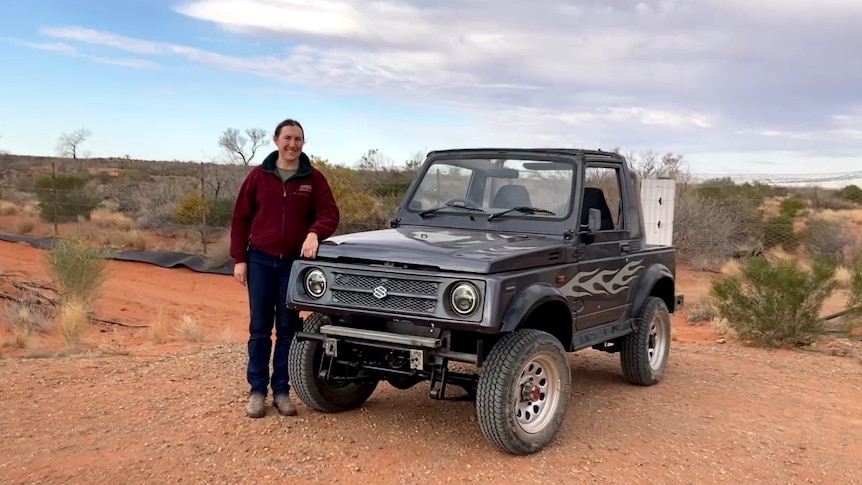
For some people, like Katherine Tuft from Roxby Downs, the EV infrastructure turned what would be a seven-hour drive to Adelaide into 10 hours.
“It’s quite doable but it’s not the most efficient way to get around as far out as we are, but that’s nothing to do with the car and all to do with the inadequacy of the charging network,” she said.
EVs can be charged from just about any power outlet, but Ms Tuft said it wasn’t about the number of charge points but the speed capability of the chargers.
“We’ll get to Port Augusta on about 30 per cent battery after having left at 100 per cent,” she said.
“There’s nowhere fast to charge, which is why we’ll sit on them for an hour or so and get another 10 or 15 per cent and that’s enough to get us to Clare, where there is a fast charger.
“We can then zip up to 80 per cent within half an hour and get to Adelaide.”
Janie Butterworth has had a rapid charging station outside her Port Lincoln business for five years.
As a destination point on the tip of the Eyre Peninsula, she has observed another issue of a patchy regional charging network.
“Hardly anybody uses it, people probably don’t come out this far if they’ve got an electric vehicle because it’s logistically impossible,” Ms Butterworth said.
“If you’re going to drive it somewhere that’s too far from your house, you’re going to get stuck charging it somewhere for a long time.”
Regional network update
To address range anxiety and charge time delays, in February a $12.4 million state government grant was awarded to the Royal Automobile Association (RAA) to construct a 140-site fast and rapid charging network across South Australia.
Project director Andrew Howard said 100 of those sites had been assessed for charging capabilities.
“The final list of site hosts will be available towards the end of this year and we’ll be well and truly into the construction phase early next year when all the details will be complete,” Mr Howard said.
“We’ll have a maximum distance between sites of 200 kilometers. In many cases, it’ll be far less and that will be well within range of a full charge for most EVs.”
Mr Howard said the network would serve as a basis for further charging points to be installed to close gaps between destinations.
“The network is really about solving range anxiety for South Australians,” he said.
“We know that up to 80 per cent of people are considering EVs as their next vehicle purchase.”
“This is about breaking that catch 22 scenario where people won’t buy EVs until there’s a network and there won’t be a network until there’s enough EVs.
“This network and the regional focus is all about creating that initial coverage and, of course, EV charging will grow as the fleet does.”
Regional councils plugging in
Copper Coast Council chief executive Russell Peate said charging sites at Wallaroo and Kadina could be linked to the network after RAA assessment.
“They will do a physical inspection with us shortly,” Mr Peate said.
“After that, it’ll be about agreeing about the actual site, the logistics, and having a host agreement in place.
“Once that’s done, I suspect it’ll only be two months before it’s installed.”
Until the first charging sites come online, prospective EV owners like Janie Butterworth will not be considering electric road trips.
“Personally, I would like an electric car but, living where I live, I would have it plugged in and charging at my house and just drive it around town,” she said.
Lenovo has published a preview image of the Xiaoxin Pro 27, an all-in-one AIO that happens to be the first we see with intel Arc graphics.
Intel is going slowly, but surely, in its return to the dedicated graphics market. The already marketed models of the M series for notebook computers will also be used in other product lines. We saw it last week in the Intel NUC 12 mini-PCs and now its presence is coming to us in an AIO.
Lenovo Xiaoxin Pro 27
It is a compact all-in-one desktop computer based on a 27 inches diagonally. (It is also announced that the series will be available in another 24-inch model). Other announced data tells us that its native resolution is 2K (2560 × 1440 pixels)
The panel has technologies against annoying blue light and has a refresh rate of 100Hz. In its chassis, it mounts 5-watt stereo speakers from the JBL brand, an FHD webcam and noise-canceling microphones. It has USB Type C and HDMI inputs, while its power supply is 230W.
The great novelty of this AIO is the integrated Intel graphics that it uses, the first time it has been announced in the segment. The model chosen by Lenovo is the A370M. Although it is the entry range of Intel, Lenovo ensures that outperforms an RTX 3050M of NVIDIA in video editors such as Adobe Premier or Davinci Resolve and says that it achieves 152 FPS in League of Legends (with 2K resolution), 110 FPS in Counter Strike GO and 142 FPS in World of Tanks with FHD resolution.
This AIO will use 12th Gen ‘Alder Lake’ Intel processors, but we don’t know the amount of RAM (probably 8GB LPDDR5 and up) and storage (surely at least 256GB M.2 PCIe SSD).
This Lenovo Xiaoxin Pro 27 is interesting for those looking for a compact desktop with an Intel base hardware and the first dedicated ones in the segment. It will be available next fall without a defined official price.
Remember our toilet scoop in Axios AM earlier this year? Maggie Haberman’s forthcoming book about former President Trump will report that White House residence staff periodically found wads of paper clogging a toilet — and believed the former president, a notorious destroyer of Oval Office documents, was the flusher.
Why it matters: Destroying records that should be preserved is potentially illegal.
Trump denied it and called Haberman, whose New York Times coverage he compulsively follows, a “maggot.”
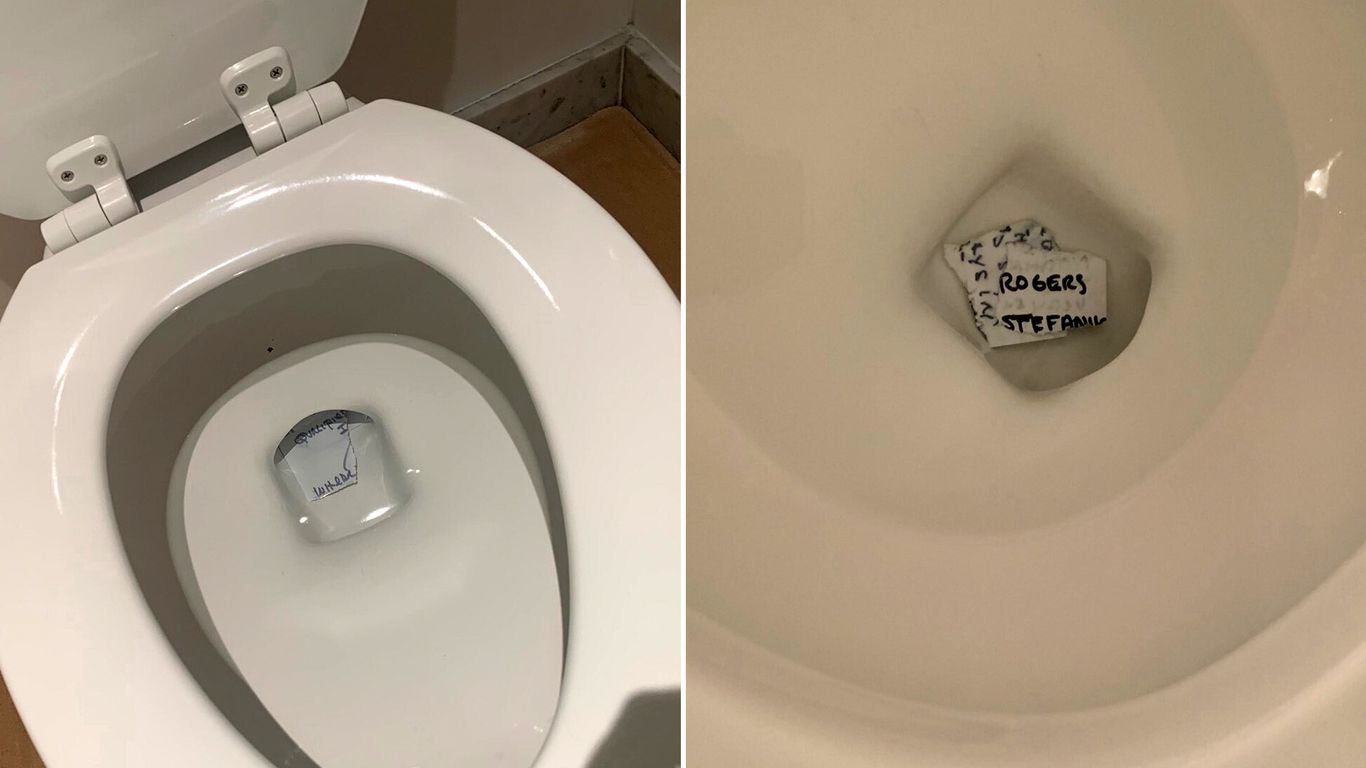
Well, it turns out there are photos. And here they are, published for the first time.
Habermann — who obtained the photos recently — shared them with us ahead of the Oct. 4 publication of her book, “Confidence Man: The Making of Donald Trump and the Breaking of America.”
A Trump White House source tells her the photo on the left shows a commode in the White House.
The photo on the right is from an overseas trip, according to the source.
Trump spokesperson Taylor Budowich told Axios: “You have to be pretty desperate to sell books if pictures of paper in a toilet bowl is part of your promotional plan.”
“We know … there’s enough people willing to fabricate stories like this in order to impress the media class — a media class who is willing to run with anything, as long as it is anti-Trump.”
Between the lines: The new evidence is a reminder that despite the flood of Trump books, Haberman’s is hotly anticipated in Trumpworld.
Cover: Penguin Press
Haberman’s sources report the document dumps happened multiple times at the White House, and on at least two foreign trips.
“That Mr. Trump was discarding documents this way was not widely known within the West Wing, but some aides were aware of the habit, which he engaged in repeatedly,” Haberman tells us.
“It was an extension of Trump’s term-long habit of ripping up documents that were supposed to be preserved under the Presidential Records Act.”
The handwriting is visibly Trump’s, written in the Sharpie ink I favored.
Most of the words are illegible.
But the scrawls include the name of Rep. Elise Stefanik of upstate New York, a Trump defender who’s a member of House Republican leadership.
Day by day the calls for Australia to introduce fuel efficiency standards in an effort to catch up to the rest of the world in the switch to electric vehicles – and to solve its growing fuel security, cost and pollution issues – grow stronger.
Experts have been calling for it for years, ever since an Australian Transport Council recommended it in 2008, and at leat nine different proposals have been presented since then – nearly one a year. The reason it didn’t was because of a series of outrageous scare campaigns led by industry and embraced by conservatives..
The result is that Australia has a fleet of dirty inefficient cars that likely cost an extra $2.2 billion in added fuel costs in 2021 alone – and is leaving the country with poor fuel security, bad pollution, and at the end of the queue when it comes to the uptake of electric vehicles.
Over the last six years, the total cost of not implementing fuel emission standards, as had been recommended by the Climate Change Authority, and endorsed by a ministerial forum, is estimated at $5.9 billion – and that is fuel costs alone, not health or climate impacts.
And it is all the result of what experts say are a series of misleading campaigns, with the strings pulled by the incumbent car lobby fearful of change and eager to protect one of the last “free markets” in the western world.
The Australia Institute has released a report that details the multiple attempts at stopping the introduction of a fuel efficiency standard, on the same day as Fairfax Media revealed correspondence that confirms the efforts by the car industry, and Toyota in particular, to continue to dilute and frustrate rules that could support a switch to EVs.
The documents revealed by Fairfax confirmed the huge lobbying efforts of some of the leading legacy car makers in diluting Australia’s policies on EVs, in a bid to protect their strong hold on hybrid vehicle sales.
Australia’s EV sales remain less than two per cent of total new car sales, a fraction of what they are in the US, and particularly in China and most parts of Europe. (The world average is expected to be nearly 14 per cent this year).
Yet the demand for EVs in Australia is huge and largely unmet – as witnessed by the massive orders for the Tesla Model Y (more than 15,000), which began deliveries in Australia last week – and because apart from Tesla it is near impossible to get hold of one.
Most other car companies are putting their priorities elsewhere, to countries that do have fuel and emissions standards, and are either not offering their EVS at all to Australia, or providing only a small number.
Australia may have come closest to a fuel efficiency standard in 2017, when the then energy and environment minister Josh Frydenberg floated the idea in an opinion piece, only to be shouted down by the Murdoch media for proposing a “carbon tax on wheels”.
Frydenberg dismissed the allegation, but the Coalition quickly backed off, and when Labor went to the 2019 election with a fuel emission standard proposal, prime minster Scott Morrison borrowed the Murdoch branding and called it a “carbon tax on cars”, and energy minister Angus Taylor described it as “reckless.”
It’s been typical of the scare campaigns thrown at new technologies by the fossil fuel lobby and conservatives. But now the industry and advocates have had enough, and are urging the new Labor government to finally embrace them. Climate and energy minister Chris Bowen is not ruling them out.
“Fuel efficiency standards are a common, relatively simple policy mechanism with net benefits,” The Australian Institute writes in a new report released on Monday. “However, previous attempts to introduce standards in Australia have been marred by disinformation and misleading claims.”
“Australians are being left behind simply because, as a nation, we are still accepting gas guzzling cars with no emissions standards,” says Richie Merzian, the TAI’s climate and energy program director.
“Australian motorists are the victims of having one of the world’s least efficient and most polluting car fleets, and it’s costing us every time we fill up at the petrol pump.”
Merzian argues that rather than extending the reduction of the fuel excise, policy makers should lock in savings for the motorists by introducing average efficiency standard for new cars in Australia that will ensure they are more efficient and less polluting.
Merzian says the introduction of robust fuel efficiency standards – rather than the soft ones now proposed by the main car lobby – should lead to 100 per cent zero emissions new vehicle sales by 2030 or 2035 at the latest.
This would not only reduce transport emissions, he says, but save Australians money in fuel costs and reduce the nation’s dependence on imported oil.
The best way to do it?
Merzian says fuel emissions standards should be implemented as soon as possible, and they need to have integrity, and should use the WLTP standard, or World Harmonize Light Vehicles Testing Procedure (WLTP).
Other considerations include allowing for manufactures to pool emissions with other manufactures, how a sales weighted average target could be applied to allow the vehicle
Other policy measures that could be added include higher fuel taxes, tax or registration fees based around a CO2 component, along with zero emissions vehicle sales targets, and incentives for efficient or zero emissions vehicles.
“Fee-bate systems”, which levy a fee on the purchase of higher emitting vehicles and use the revenue to incentivise the purchase of zero or low emissions vehicles, are also easy to implement and are self-funding if designed carefully. They exist in New Zealand and in France.
For more news on the EV transition, and the latest models and trends, please go to our EV-focused sister site, The Driven.
Giles Parkinson is founder and editor of Renew Economy, and is also the founder of One Step Off The Grid and founder/editor of the EV-focused The Driven. Giles has been a journalist for 40 years and is a former business and deputy editor of the Australian Financial Review.
Love foldable smartphones? Save up to $699 on Samsung Galaxy Z Flip3 5G and Fold3 5G. Know how to.
Love foldable smartphones? If yes, then this could be the best chance for you to get your hands on a feature packed foldable smartphone. Yes, Samsung Galaxy Z Flip3 5G and Fold3 5G prices have been slashed in the US ahead of Samsung Galaxy Z Flip4 and Fold4 launch. Bestbuy is offering an exciting deal on both of the handsets that let you save up to $699. You just have to choose an eligible plan from broadband service provider Verizon. That’s not all, you can even opt for EMI options to pay the remaining cost in monthly installations starting from $8.33/mo. This is a pretty decent deal for those who are looking for a premium foldable smartphone on a budget.
Samsung Galaxy Z Flip3 5G and Fold3 5G price drop in US: How to grab it
To grab the deal all you have to do is go to Bestbuy and select a Samsung Galaxy Z Flip3 5G 128GB phone and then choose an eligible network plan from Verizon. Pay the one time activation fee along with EMI and it’s done. Your device will be shipped to you. However, do note that you will have to opt for Verizon service for a period of 36 months in order to avail this discount. The handset is originally priced at $1049.
Similarly, if you want to grab a Fold3 5G 256GB, you can save $1000 on an eligible T Mobile plan. The monthly installation plan starts at $33.33 for 24 months. The phone was originally priced at $1799.
This is a limited time deal and if you’re planning to get a stylish 5G phone on budget, you must pick any of the Galaxy Z series handsets from Bestbuy sooner, rather than later.
Further if you want to save more, you can save $800 on trade-in of an eligible device like iPhone X, iPhone XR, iPhone XS, iPhone XS Max, iPhone 11 Pro, iPhone 11 Pro Max, iPhone 11, iPhone 12 Pro and others.
The sister of the pregnant woman who died in a California car crash that killed five other people said the family has forgiven the driver arrested in the fatal collision.
Sha’seana Kerr — whose sister Asherey Ryan was among the victims in the Thursday wreck — expressed sympathy for Nicole Lorraine Linton, 37, who allegedly caused the crash after she blew a red light at a Los Angeles intersection.
“I just want to tell her that we forgive her,” Kerr told news station KTLA.
“She will have to live with this for the rest of her life. That’s why she was spared. We understand it already.”
On Thursday about 1:40 pm, a Mercedes-Benz sped through a red light before it slammed into through traffic, video of the tragic crash obtained by RMG News shows.
Investigators allege that Linton – a nurse with Kaiser Permanente’s West Los Angeles Medical Center – was driving over 100 miles per hour in a 35 mph zone, Fox 11 reported.
Ryan’s unborn child, her 11-month-old son Alonzo Quintero and her boyfriend Reynold Lester all died in the collision.Ashley Ryan/FacebookAsherey Ryan, a 23-year-old who was pregnant, was among the several victims on Thursday, when a speeding driver blew a red light at a Los Angeles intersection. RMG
Ryan’s unborn child, her 11-month-old son Alonzo Quintero and her boyfriend Reynold Lester all died in the collision. Lester had reportedly been driving her to a prenatal checkup at the time of the crash.
Six minors and two adults were also injured in the wreck.
In the interview Saturday, Ryan’s sister said she was her “first best friend.”
“The first person I knew. The first person I probably had a conversation with,” she said at a gathering at the site of the crash. She’s my only big sister. Every day we take our sons outside and we walk them around the block. Cada dia. The neighbors know us. Today, I had to take that walk alone with my son.”
Six minors and two adults were also injured in the wreck.Los Angeles Times via Getty ImageRyan’s sister, Sha’seana Kerr, said Saturday, “I just want to tell her that we forgive her,” according to a local TV station. Los Angeles Times via Getty Image
Officials on Friday arrested Linton on charges of vehicular manslaughter and gross negligence.
The case has been referred to the Los Angeles County District Attorney’s Office.
Linton — who has been hospitalized for major injuries she sustained in the wreck — is expected to appear in court Monday.
The $HK8.68 billion loss at EnergyAustralia compared with a net profit of $HK837 million in the first half of 2021. It sent the whole CLP group to a loss of $HK4.86 billion for the six months, down from a profit of $HK4.62 billion a year earlier.
CLP still maintained its dividend, and Mr Lancaster said the first six months in Australia involved an unusual combination of events that led to very high spot prices. The half also included the unprecedented nine-day suspension of the National Electricity Market in June and the failure of several small electricity retailers,
Both of EnergyAustralia’s key rivals, AGL Energy and Origin Energy, were also badly impacted, with both revising profit guidance amid issues such as coal power outages and coal supply problems at some plants.
“I wouldn’t look at the last six months as being representative of the market in general, however volatility is something we must expect in Australia,” Mr Lancaster said.
“As economies go through an energy transition we do see the need for firm capacity and more storage capacity, which is essentially where we see good investments in Australia.”
The problems at EnergyAustralia, the country’s third-biggest electricity and gas supplier, contributed to Standard & Poor’s last month cutting the credit rating at the company to the lowest investment grade, BBB-, with a negative outlook. It said the company could be at risk of breaching one of its debt covenants, and suggested it may need financial assistance from its parent.
In the half-year report released in Hong Kong, CLP said EnergyAustralia would “continue to strengthen its capital structure to fund its current and future investment needs, providing the reliable supply needed to support customer demand and the transition to a lower-carbon power market ”.
Open to partnerships
Mr Lancaster said all options were open for partnerships at Energy Australia, and pointed to the example of India, where CLP linked with Canadian investment giant CDPQ to form Apraava Energy.
“We are open to partnerships for parts of the business, for projects and even for the whole business,” he told The Australian Financial Review.
“We do see a need to invest in the energy infrastructure in Australia in order to go through an energy transition.”
He pointed to firming power supply and energy storage as areas that CLP regards as good investments in Australia.
“This will require considerable and sustained capital investment, so by working with partners on projects, or in segments of our business or in the business as a whole such as we’ve done in India with CDPQ, we remain open to all of those options .”
EnergyAustralia also incurred high costs in the first half to settle forward contracts that could not be covered because of reduced generation at its biggest power stations, Yallourn in Victoria and Mount Piper in NSW.
Output at Yallourn was hit by unplanned outages, including a fire at a coal conveyor system, as well as “recurring maintenance issues”, CLP said.
At Mount Piper, output fell because of a major planned outage and constraints in the delivery of coal from the site’s major supplier.
CLP said EnergyAustralia had contracted its generation in advance, ahead of the spike in wholesale prices, and then had to cover the contracts in the market at the higher spot rates because of the shortfalls in output at the two plants.
Earnings in the retailing arm improved, thanks to gains from hedging and reduced bad debt expenses. Customer accounts rose to 2.45 million, boosted by customers transferred through the “retailer of last resort” scheme when their own retailer failed. EnergyAustralia joined other retailers in lifting tariffs for household and business customers, although analysts say that for some retailers, costs have risen even more steeply.
But CLP said that despite “challenging” operating conditions in Australia, rising wholesale power prices should benefit EnergyAustralia in the longer term. It said the company was planning maintenance work at Yallourn to tackle the reliability issues, while coal supply to Mount Piper should improve.
“Additional short-term coal and gas purchases have been made to enable EnergyAustralia’s power stations to support customers and the broader energy market in the second half,” CLP said.
The group also voiced support for the proposed “capacity mechanism” that would transform the National Electricity Market and said it should promote investments in new dispatchable capacity, and enable more renewable energy to enter the grid reliably and affordably.
Aerodynamic drag’s supreme reign over the cycling industry is apparently over, as the wind tunnel has made way over the past two years for the coronation of the “do-it-all” bike, frame, and wheels.
Nowhere has this transition of power been more evident than at Zipp. The brand’s carbon wheels, synonymous with aerodynamics, have undergone a shift of focus in recent years. Outright aerodynamic efficiency has been replaced with a focus on Total System Efficiency, or as Zipp describes it, “a balanced attack against the four barriers to speed: wind resistance, gravity, rolling resistance, and vibration.”
Zipp’s new approach was first seen in the new 303-S, and the 303 Firecrest, then the 353 NSW, and most recently the 454 NSW, and 404 Firecrest as each of these wheels got lighter, wider, tubeless, disc-brake only, and even sacrificed some purely aero savings, all in the name of going faster in the real world.
Now joining that list are the new 808 Firecrest and the 858 NSW wheelsets as Zipp’s deepest, fastest, and most aerodynamic wheels get the “real-world” treatment.
858 NSW – All kinds of faster
While, technically speaking, the 858 NSWs were last updated a mere 14 months ago, that update simply added Zipp’s new Cognition V2 hubset to the existing 77/82 mm undulating rim. The 858 NSWs unveiled today feature an entirely new rim paired to that same Cognition V2 hubset and a host of updates tackling Zipp’s four barriers to speed.
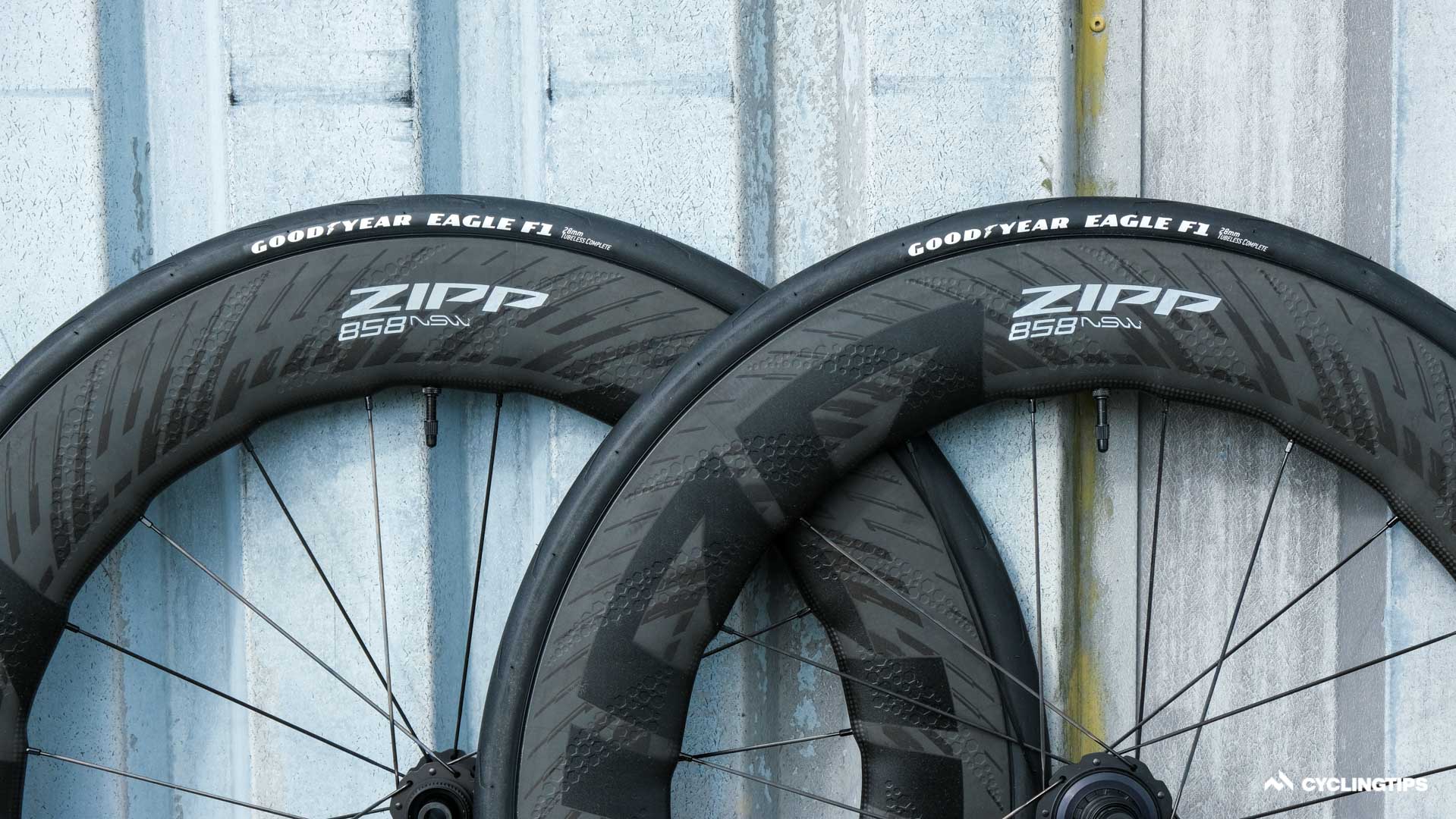
The new 858 NSW rim still features Zipp’s almost signature Sawtooth undulating rim shape with varying 82/85mm depth, but has grown wider with 23mm internal and 27mm external rim widths. This wider rim is now hookless tubeless only and optimized for 28mm tyres. While many manufacturers are now “optimizing” rim widths to specific tire sizes in pursuit of aerodynamic gains, Zipp’s optimization claims here are based on a balance of aerodynamics and rolling resistance.
The brand claims the wider rim shape paired with a wider 28mm tire reduces tire deflection and results in lower rolling resistance. Furthermore, Zipp claims the wider tire bead interface and external rim width actually create a smoother and more aerodynamic interface from the tire to the rim, despite the 27mm external rim not conforming with the widely accepted “rule of 105”.
The so-called “Rule of 105” states that the rim must be at least 105% the width of the tire to improve the chances of re-capturing airflow from the tire and controlling it or smoothing it over the rim and was originally coined by Josh Poertner of Silca.cc. However, Zipp points out that “the rule of 105” doesn’t account for the speed gains from a wider tire at lower tire pressures and claims the aerodynamic cost of a 28mm tire versus a 25mm tire is lower than the savings in rolling resistance.
“A wider tire bead interface also allows for a wider tire, which allows for lower tire pressure. Lowering tire pressure can increase overall system efficiency, reduce rider fatigue, and offers better handling in rough conditions.”
zipp
New Zipps, built for wider tyres.
Those increased rim widths are disguised behind Zipp’s signature sawtooth profile, retained for the new 858 NSW rims. First introduced on the 454 NSW wheels back in 2016, the sawtooth profile rim design is said to offer both improved aero efficiency and crosswind stability. Further improving this “Aerobalance” is Zipp’s other signature design cue, the HexFin ABLC dimple pattern rim.
Of course, with a hookless profile comes certain restrictions. While Zipp recommends a 28mm wide tire to maximize speed, 25mm is the minimum and 32mm the maximum tire widths compatible with the new wheels. Of course, regardless of tire width, the tire itself must be hookless tubeless compatible. Zipp has a list of compatible tires published on SRAM.com.
So what does all that mean? In terms of outright aerodynamics and wind tunnel testing, the new 858 NSWs are merely a single watt faster than the previous generation 858, but that is almost the point. Zipp explained its objective for the new wheels was merely to match the previous generation’s aerodynamics, focusing instead on other aspects of the wheels which make for a faster setup in the real world. The optimization around 28mm tires is just one part of these real-world improvements.
Zipp explained the 808 and 858 wheelsets are still their go-to option for time trials and triathlons, but now with the Total System Efficiency treatment, the 80+mm deep wheels are said to provide a real option for road racing and general road riding.
Dimpled, wavy, lighter, wider, the new 858 NSWs are for time trialling, road racing, and even general riding, according to Zipp.
A significant weight saving is central to Zipp’s versatility claims for the new wheelset. Zipp shed a relatively huge 243 grams from the new wheels versus the outgoing 858s. In doing so it brought the total weight of the wheelset (without tape and valves) down to just 1530 grams (719g front, 811g rear) and into the territory of many shallower wheels.
Zipp found most of this weight-saving with the move to a hookless rim. Each of the new wheelsets mentioned earlier all feature a hookless rim, and so while the move to hookless may still prove controversial, it was entirely predictable for the new 858s. In addition to helping drop the rim weight, Zipp claims the hookless design creates a stronger rim, and reduces both pricing and waste.
The brand credits an additional 10% of the rim weight savings to its Carbon internal Reinforcement (CiR) laminate technology. Most carbon rims feature uniform layup thickness throughout. However, Zipp suggests the forces exerted on the rim are not uniform, and explains CiR helps Zipp to place the optimal amount of carbon fiber precisely where it’s needed and less where it is not. Zipp claims this variable layup results in a rim with the same stiffness, strength, and durability but with a significant weight saving.
The updated Axial Clutch design supposedly runs with less friction, but what’ll likely be more significant to owners is that the simpler parts layout should be more reliable over the long haul. Photo: Zipp.
Unsurprisingly, Zipp has retained the new Cognition hubs introduced to the 858 NSW wheelset last year. The rear hub features Zipp’s Axial Clutch V2 technology said to reduce drag, lower friction, and offer quicker engagement with its Sylomer spring system and 54 points of engagement.
The Zipp 858 NSW wheelset uses Sapim CX-Ray spokes, with 20 spokes front and rear and external alloy nipples in a two-cross spoke pattern for the front wheel and radial laced drive side and two-cross non-drive on the rear.
All told, other than suggesting the new wheels are aerodynamically equal to the outgoing wheels, Zipp isn’t making any claims about exactly how much faster the new 858 NSW wheels are, focusing instead on the new wheel’s lower weight, comfier ride, and more stable handling characteristics. And while the wavy profile, dimples, and similar decals all combine to create a wheelset that at least aesthetically looks very similar to the narrower and heavier previous 858s, the good news is the pricing has dropped.
The new 858 NSWs are priced at $4,400 USD / €4,000 / £3,570 / $6,630 AU. While still a staggering amount of money for a wheelset, at least the pricing is going in the right direction. The new 858 NSWs will be available soon after launch through local retailers and online.
808 Firecrest – more dimply, less pricey
The 808 Firecrest wheelset has also received an update. The lower priced of the two new wheelsets, the 808 features a round 80mm-deep rim shape with a 23mm internal width hookless rim profile and maximum outside width of 27mm. The rim stats are broadly similar to that of the range-topping 858 NSW, with the 808s merely missing out on the sawtooth profiling and gaining 105 grams.
The new 808 Firecrest is also wider, lighter, and less pricey. Photo: Zipp.
What the 808 lacks in outright fanciness, it more than makes up for in other departments. While heavier than the new 858 NSWs, the new 808s actually achieve a greater weight saving of 282 grams over the previous model. The 808s weight saving is again largely thanks to the shift to a hookless rim and additionally a 2mm decrease in rim depth from 82mm to 80mm.
The new 808s also now feature wider internal and external rim widths optimized around a 28mm tire, with Zipp again pointing to the real-world speed gains offered by the wider setup.
Zipp has equipped the new 808 Firecrest Tubeless Disc-brake wheelset (to give its full title) with its ZR1 Disc-brake hub with a Center Lock disc rotor interface. Again, the Zipp ZR1 hub might not be quite as fancy as the range-topping Cognition, but with 66 points of engagement, it has a trump card of its own.
Go wide or go home, Zipp says “if you want to be faster, ride 28mm tires.” Photo: Zipp.
Laced to those ZR1 hubs are 20 Sapim CX-Sprint spokes. Built with external alloy nipples in a two-cross spoke pattern for the front wheel, the rear wheel has a radial laced drive side and two-cross non-drive.
All in, the new 808 Firecrests weigh in at 1,635 grams (without valves and tape). Perhaps more importantly though, the 808 Firecrests offer a significant cost saving versus their higher-tier NSW siblings. A complete 808 Firecrest wheelset will set you back US$2300.00 / £2235.00 / AU$3466 / €2500.00.
In other words, the new 808 Fircrests cost less than the 858 NSW rear wheel alone and offer a new, wider, lighter, and presumably faster wheelset than the previous generation 858 NSWs. I’d hazard a guess most riders considering the 808 Firecrests will gladly take the aero gains without a second thought given to the 1,635 gram total weight.
The suggested rider system weight limit (rider + gear) for both new wheelsets is the same as all other Zipp road wheels, 250lb / 115kg. Furthermore, both wheelsets are covered under Zipp’s lifetime warranty against manufacturing defects and impact damage during intended use. The usual original owner and proof of purchase caveats apply, but the coverage will provide some peace of mind for wheelsets which are both still substantial investments.
Zipp suggests both new wheelsets will be available shortly after today’s launch through local dealers and online.
Wide and very dimpled. Disc brake and hookless. Introducing the new 808 Firecrest.
incoming reviews
A pair of the new 858 NSW arrived at my door two days ago. With only two days to ride the new wheels so far, my thoughts right now are nothing more than first impressions. The wheels are certainly fast, and impressively lightweight for such a deep, tubeless, and disc brake wheelset. But anyone hoping for an 80+mm deep wheel with the stability of a shallower wheel might be disappointed.
I’d classify myself as pretty confident and competent in riding deep-section wheels in windy and even blustery conditions. Rarely, if ever, do I get spooked by a gust of wind catching my front wheel. However, on both rides on the new 858 NSW so far, I have noticed the increased side forces catching me off guard on several occasions. Again, these are 80+mm deep wheels and so, buyer beware, despite Zipp’s best endeavors, a ride in blustery conditions will still result in some hairy moments.
Given the extra speed available and impressively low weight penalty, I can’t imagine choosing anything other than the 858 NSWs for all but the hilliest or windiest of races. But based on two days of riding so far, I can’t imagine these very deep rims becoming my everyday wheelset either. Time will tell. Stay tuned for a longer-term review.