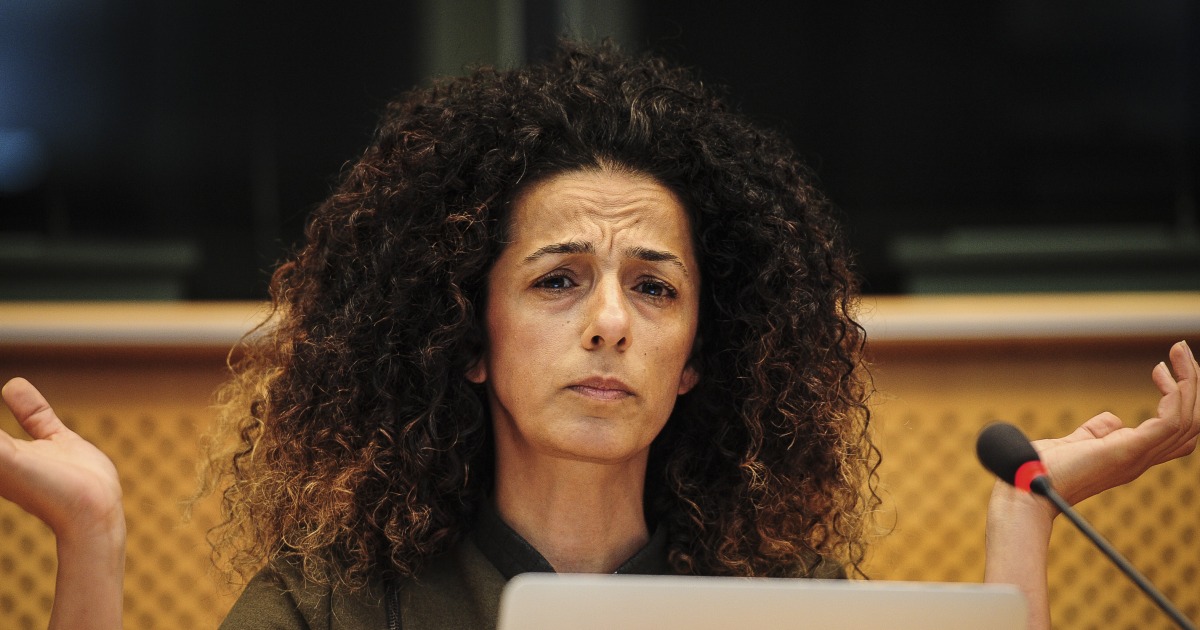
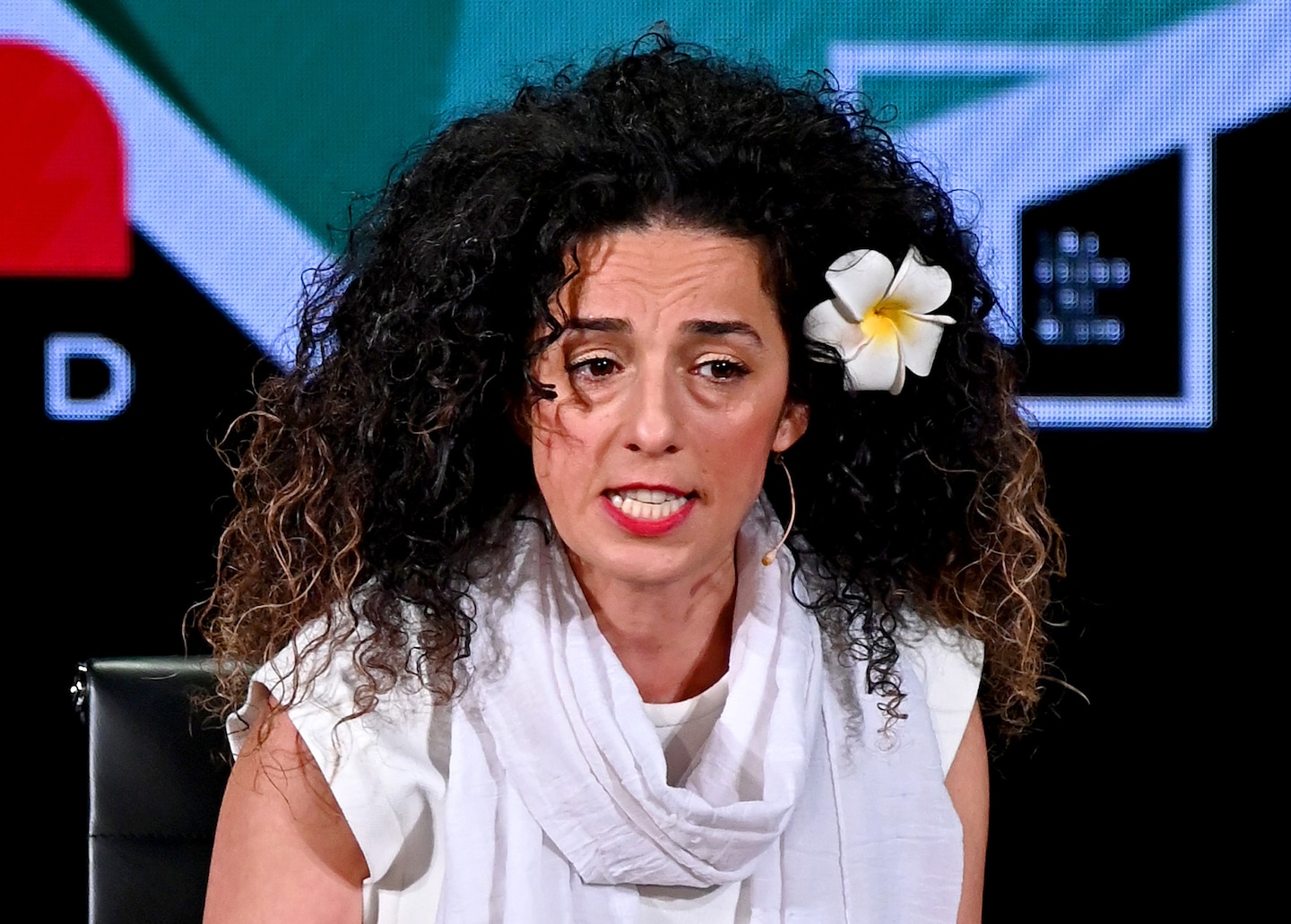
The FBI wants to know why a man was near the New York City home of a well-known Iranian journalist and author while allegedly in possession of an illegal military-style rifle loaded with 30 rounds.
The agency is probing whether the suspect, federally charged with possession of a firearm that lacked a visible serial number, was there as part of a possible plot to neutralize or assassinate Masih Alinejad, two law enforcement sources said.
Iranian intelligence plotted unsuccessfully to kidnap the Voice of America Persian Service host last year, the FBI said.
Alinejad said at the time that she believed the government wanted to shut down her social media voice.
Iran’s Islamist rulers “not only wanted to make sure that I physically didn’t exist anymore, they also wanted to destroy my Instagram, Facebook, Telegram and WhatsApp channels,” she said in a video message distributed by VOA.
Iran has denied the 2021 allegation, calling it “baseless.”
Sunday afternoon the journalist tweeted security video that shows a large man on her porch trying to open a door. Alinejad said that this is the suspect arrested and charged with the gun violation, and that he had come to her Brooklyn home to kill her.
“My crime is giving voice to voiceless people,” she tweeted.
Khalid Mehdiyev of Yonkers, New York, was arrested Thursday near the woman’s residence by New York City police for allegedly driving on a suspended license, according to the affidavit filed Friday along with a criminal complaint.
Police initially stopped him for allegedly driving past a stop sign without fully stopping, the document states. He was being held without bond.
FBI agents had been surveilling the man since at least the previous day and appeared to corroborate Alinejad’s claim that he had been on her porch and “attempted to open the front door,” FBI Special Agent Derek Kasse wrote in the affidavit.
The court document also claims that the vehicle Mehdiyev was using was issued a parking ticket near the journalist’s home July 23.
On Thursday, following that traffic stop, police said they found a Chinese-made AK 47 clone in a suitcase in the back of the vehicle, where they also discovered 66 rounds of ammunition, most inside two magazines, one of which was attached to the rifle, the FBI alleged.
The affidavit adds that $1,100 in cash was in the suitcase with the gun. The Subaru Forrester driven by Mehdiyev had Illinois plates and, inside, plates from two other states, the FBI alleges.
In an interview with agents after his arrest Mehdiyev said that he had borrowed the vehicle and that the case, gun and ammunition were not his, according to the affidavit.
But he reversed course in subsequent interview, said the gun was his, then asked for a lawyer, Kasse wrote.
It’s not clear if Mehdiyev retained counsel. The federal public defender’s office for the Brooklyn area did not immediately respond to a request for comment.
Alinejad has been critical of Iran’s leadership, particularly regarding its record on women’s rights and human rights.
“Last year, the Islamic Republic, tried to kidnap me, now they want to kill me,” Alinejad tweeted Sunday.
An FBI spokeswoman confirmed Mehdiyev’s arrest, but the agency declined to comment further.
Jonathan Dienst is a reporter for WNBC-TV in New York, leading its investigative reporting team and covering justice and law enforcement issues.
Myles Miller
Myles Miller is a reporter at WNBC-TV.
Ken Dilanian is the intelligence and national security correspondent for NBC News, based in Washington.
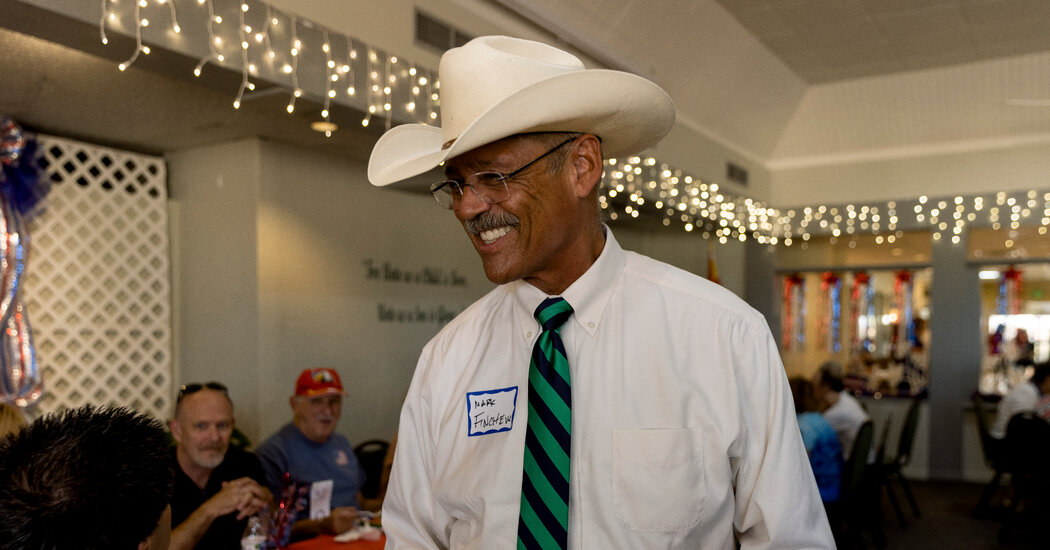
He speaks in sober and serious tones and presents himself as a common-sense family man. When asked about his family life by one interviewer, he said his “kids are all grown and gone” and added that nowadays, “I’m thinking about my grandkids” in battles he takes on.
But his family life has been rocky. He has been married four times and estranged for more than two decades from two adult children, and he does not know their children, family members said. (He also has two stepchildren.)
He talks frequently about his experience as a police officer and firefighter in Kalamazoo, Mich. But personnel records obtained from that city’s Department of Public Safety, which he left in 1999, include this note in his file from him: “Retired, poor rating, would not rehire.” A department spokesman declined to comment.
Mr. Finchem has raised more than $1.2 million, a considerable amount for a campaign for secretary of state. (Mr. Lane has raised about $1.1 million, while the other two candidates trail significantly behind.) Much of the money has come from out of state — seven of the eight donors who were listed as having donated the $5,300 maximum in his last two campaign filings were from elsewhere. Major donors include Brian T. Kennedy, a past president of the right-wing Claremont Institute, and Michael Marsicano, a former mayor of Hazleton, Pa., who recently lost a Republican congressional primary.
For all that, he has few visible signs of a staff or campaign office. About three-quarters of his expenditures, more than $750,000, have flowed to a Florida political consulting firm run by Spence Rogers, the nephew of Wendy Rogers, an Arizona lawmaker with ties to white nationalists, campaign filings show. A further $53,000, or nearly 5 percent of his total expenditures, have gone to payments to Mr. Trump’s Mar-a-Lago resort. (Many other Trump-backed candidates have done likewise, including Kari Lake, Mr. Trump’s favored candidate for Arizona governor, whose campaign has spent more than $100,000 at Mar-a-Lago.)
Senate Democrats are aiming to pass a major spending bill this week that includes funding for climate change, health care and tax increases on corporations.
The deal was unexpectedly struck last week by Senate Majority Leader Chuck Schumer, DN.Y., and a key centrist, Sen. Joe Manchin, DW.Va., giving Democrats optimism that they’ll have a robust agenda to run on in competitive races ahead of the midterm elections this fall.
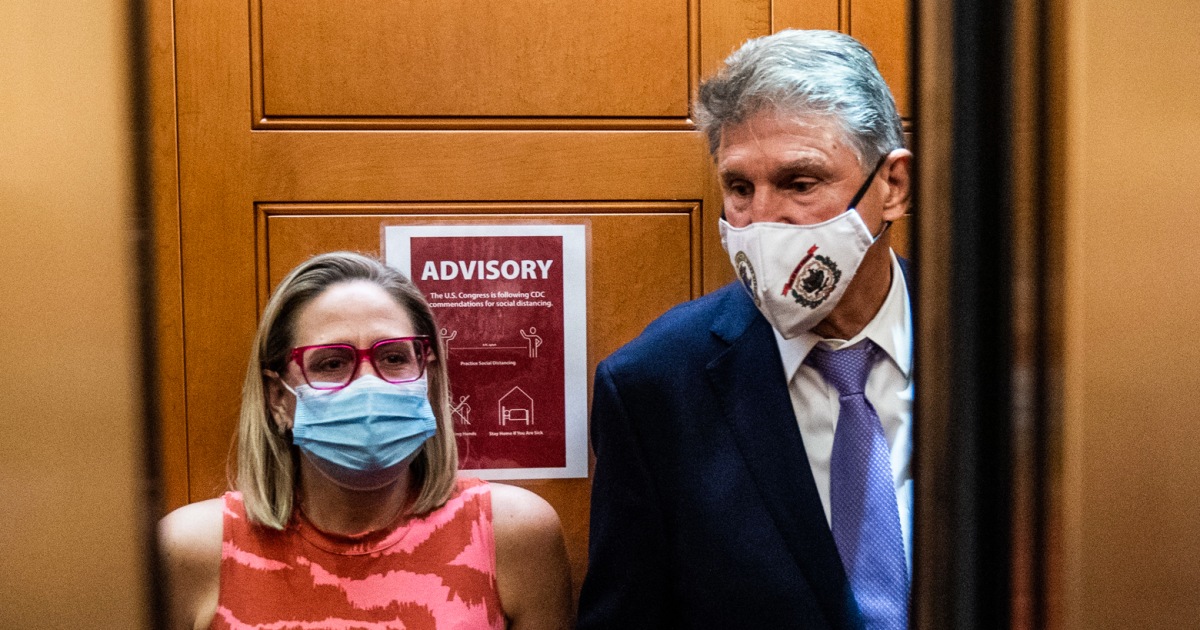
While Manchin appeared on five Sunday programs to defend the deal and call for its passage, another centrist who holds a swing vote in the 50-50 Senate, Sen. Kyrsten Sinema, D-Ariz., whom Democrats consider a difficult negotiator, has been quiet about whether she’d vote for the Inflation Reduction Act of 2022, released Wednesday.
Sinema’s vote could make or break the bill. Democrats, with no hope of winning Republican support, need every member of their caucus to be present and voting — not guaranteed given recent absences of senators infected with Covid — for it to clear the Senate.
A spokesperson for Sinema said Sunday she had no comment on the bill, adding that “she’s reviewing text and will need to see what comes out of the parliamentarian process,” referring to the Senate official who determines whether bills comply with the chamber’s strict budget rules .
Without her support, it’s still unclear if Senate Democrats will be able to pass it this week.
Democrats are also hoping to pass the PACT Act to extend medical care to veterans exposed to toxic burn pits during their service, a bipartisan measure that Senate Republicans blocked last week.
Party leaders were aiming to schedule another vote on that legislation for Monday but it could be delayed, leaving less time for the filibuster-proof bill. Republicans tanked the proposal amid anger that Democrats decided to proceed with the climate and tax legislation, which they had thought was dead due to Manchin’s earlier resistance.
Schumer’s office has said they intend to pass the legislation before the chamber’s August recess. But they haven’t shut the door to delay it if they need to be.
Why is Sinema undecided?
Sinema has been amenable to most provisions in the Democrats’ spending bill, which are consistent with a White House framework released Oct. 2021 that she endorsed. The big exception is the limitation of the carried interest tax break, which benefits investment managers.
Last year, Sinema made clear to Democratic leaders she opposed closing what many in her party called the “carried interest loophole,” according to multiple sources familiar with the negotiations. The provision was dropped from the House-passed Build Back Better Act, which stalled indefinitely in the Senate earlier this year. But Manchin favors ending the tax break, and it was re-added to the new bill.
Rep. Ruben Gallego, D-Ariz., who is being encouraged by some Democrats to challenge Sinema in 2024, said lawmakers should vote for the bill.
“Blocking this bill that will reduce inflation and make investments in reducing climate change to protect a loophole for the ultra wealthy would not be prudent,” Gallego told NBC News.
On NBC News’ “Meet The Press,” Manchin defended the legislation and said he hopes Sinema will support it.
“Kyrsten Sinema’s a friend of mine, and we work very close together,” he said. “She has a tremendous amount of input in this piece of legislation. And I would like to think she would be favorable towards it, but I respect her decision. Ella she’ll make her own decision based on the contents.
House Democrats in tough races are excited about passing the bill — if it gets through the Senate.
“I anticipate being being very supportive of it,” Rep. Katie Porter, D-Calif., told NBC News in an interview Saturday at Huntington Beach Pier. “Medicare should be able to negotiate prices… The climate part of it, I think, is something that really will set our economy up to compete with countries like China in the future.”
Even Porter’s Republican challenger, Scott Baugh, said he’s “interested” in the drug pricing provisions, some of which are broadly popular in surveys, and has to “fully evaluate” them before taking a position. But he opposes the rest of the bill.
“They’re doubling down on a failed policy,” he said in an interview at his campaign office in Newport Beach. “You can’t spend more money and increase taxes and solve the problem.”
Sen. Pat Toomey, R-Pa., a conservative fiscal staunch, said Sunday on CNN’s “State of the Union” that “it really looks to me like Joe Manchin has been taken to the cleaners.”
“The corporate tax increase is going to slow down growth, probably exacerbate a recession that we’re probably already in,” Toomey said.
Manchin, however, sounded committed to the legislation and defended the 15% corporate minimum tax, a centerpiece of the new revenues, and rejected Republican criticisms of it.
“You would at least think that they would be paying at least 15%. Most businesses and all corporations that I know pay 21%. So that’s not a tax increase. It’s closing a loophole,” he said Sunday. “The last two years have been massive, record profits.
“And with that being said, it’s been the lowest investment of capital expenditure that we’ve ever had. So it’s not the taxes that’s driving this.”
A proposal by the Biden administration to exchange notorious Russian arms dealer Viktor Bout for WNBA star Brittney Griner and former marine Paul Whelan, two high-profile Americans currently detained in Russia, has been met with praise, confusion and fury.
While some have praised the Biden administration and state department for doing whatever it takes to bring back Griner and Whelan, others have cast skepticism towards the deal, especially when it comes to releasing Bout, who has a notorious international reputation.
Many have wondered: is it worth exchanging two wrongfully detained Americans for an arms dealer nicknamed the “Merchant of Death”? Others ask if the deal should include Marc Fogel, the “other American” currently imprisoned in Russia after trying to enter the country last year with half an ounce of medical marijuana? Still more wonder if any exchange might encourage further hostage-taking? What about the several hundred thousand Americans who continue to be arrested domestically on marijuana-related charges?
In February, Griner was arrested at a Moscow airport after authorities found vape canisters containing cannabis oil – for which she had a doctor’s recommendation – in her bags. The arrest of the Phoenix Mercury star quickly made headlines as it came amid heightened US-Russia tensions ahead of Moscow sending its forces into Ukraine a week later.
Griner has since been detained in Russia and faces a maximum of 10 years in prison if convicted of transporting drugs.
Brittney Griner speaks to her lawyers standing in a cage at a courtroom prior to a hearing in Khimki, Russia on 26 July. Photograph: Alexander Zemlianichenko/AP
In December 2018, former US marine and corporate security executive Paul Whelan was arrested in Russia on espionage charges and was sentenced to 16 years in prison. According to Russian officials, he was caught with a flash drive that contained classified information. Whelan, who also holds passports from Canada, the UK and Ireland, has repeatedly denied the charges and claims that he was set up.
The US government has denounced Whelan’s charges as false and declared both Whelan and Griner as “wrongfully detained”.
On Wednesday, the secretary of state, Antony Blinken, announced that the US has made a “substantial proposal” to Russia to release Whelan and Griner. Although Blinken refused to say what the US was offering in return, a source familiar with the matter confirmed a CNN report that Washington was willing to swap Bout, who is currently serving a 25-year prison sentence in the US, as part of the exchange .
Prisoner swaps have been a long part of the history between the two former cold war adversaries. The first major exchange between the US and the Soviet Union occurred in February 1962 when Americans gave up Rudolf Abel, a convicted KGB spy, in exchange for American pilot Gary Powers, whose U2 spy plane was shot down over the Soviet Union two years earlier. The exchange, which took place on the fog-covered Glienicke Bridge on a cold, cloudy Berlin morning, was adapted into a Steven Spielberg thriller over 50 years later.
The Powers-Abel exchange paved the way for further prisoner swaps. A little over 20 years later, the US conducted what one American official called the “biggest spy swap” in history. The US released four eastern European spies in exchange for 25 people detained in East Germany and Poland. In more recent memory, 10 Russian agents detained by the US were exchanged in 2010 for four Russian officials that the Kremlin had jailed over their illegal contacts with the west.
Paul Whelan holds a sign as he stands inside a defendants’ cage during his verdict hearing in Moscow, Russia, on 15 June 2020. Photograph: Maxim Shemetov/Reuters
In April, former US marine Trevor Reed was released back to the US after being detained in Russia since 2019. Russian authorities had accused Reed of attacking a Moscow police officer and sentenced him to nine years in jail. In exchange for Reed, the US released jailed pilot Konstantin Yaroshenko, who was sentenced in 2011 to 20 years in prison for conspiring to import more than $100m worth of cocaine into the US.
Despite these exchanges, none have quite involved the notoriety of a figure like Bout. Born in 1967 in Dushanbe, Tajikistan, to a bookkeeper and a car mechanic, Bout went on to train as an interpreter at Moscow’s Soviet Military Institute of Foreign Languages.
Rumored to speak six languages, Bout developed a decades-long career by acquiring Soviet military transport plans and filling them with various weapons that were left behind after the Soviet Union’s collapse in 1991. Since then, Bout has supplied weapons to conflicts around the world including Afghanistan, Angola, Congo, Lebanon, Somalia and Yemen.
For decades, governments and rebels fought each other with weapons that Bout sold to either side.
In 2008, Bout was arrested in Bangkok after he was caught on camera trying to sell weapons for use against Americans by undercover US Drug Enforcement and Administration agents. He was convicted in a New York court in 2011 and was sentenced to 25 years at a federal prison in Marion, Illinois.
Reports of Bout’s potential release have since been met with an array of emotions.
Kathi Austin, founder of the Conflict Awareness Project, a non-profit that investigates major arms traffickers, expressed concerns about the possibility of Bout’s release.
“I spent nearly 15 years chasing Bout around the globe to stop his trade in death… My life and that of other colleagues and UN peacekeepers were put on the line to bring him to justice,” she told the Guardian.
“You cannot imagine how much I have emotionally struggled with the idea of Bout’s release … Putin knew very well what he was doing by making Brittney Griner a bargaining chip … In a post-release situation … Putin is certain to weaponize Bout in areas of the world where the Merchant of Death has a proven track record,” she said.
Viktor Bout waits in a holding cell in Bangkok on 9 March 2009. Photograph: Sukree Sukplang/REUTERS
Daryl Kimball, executive director of the nonpartisan membership organization Arms Control Association, echoed Austin’s concerns.
In a statement to the Guardian, Kimball said: “Releasing Viktor Bout … could certainly lead to adverse consequences … If he is part of a prisoner swap with Russia, it could damage future efforts to hold accountable those who illegally facilitate dangerous weapons transfers to warlords , conflict zones and undemocratic regimes.”
Jodi Vittori, a former air force lieutenant colonel and current professor at Georgetown University’s School of Foreign Service, said: “Given that Mr Bout has been incarcerated since then, it is unlikely that his arms trade networks remain significantly intact.”
Nevertheless, Vittori expressed concern over the irony of such a proposal, saying: “Trading American hostages for a notorious Russian arms trafficker with the ominous moniker of the Merchant of Death sends the world mixed messages at a time when the United States is striving to arm Ukraine as it fights for its life and democracy against Russia.”
Jordan Cohen, a defense policy and arms sale analyst at the Cato Institute, cast doubt on Bout’s ability to cause harm in the short term if he is released. “US and western intelligence will likely track him and his network to make sure no sudden arms trafficking deals are happening. Beyond that, his years in prison and solitary confinement also likely diminished his ability to quickly mobilize his network, ”Cohen told the Guardian.
Others have praised the Biden administration for its proposal. Michael McFaul, former US ambassador to Russia during the Obama administration, tweeted: “I applaud @SecBlinken & @StateDept efforts to bring Britney Griner and Paul Whelan home even if it means handing over Viktor Bout.”
However, I have urged the state department to also include Marc Fogel in the deal. Fogel, a former history teacher at the Anglo-American School in Moscow, was arrested last August after trying to enter Russia with medical marijuana that his doctor prescribed him to treat “severe spinal pain”. Russian authorities sentenced him to 14 years of hard labor, accusing him of committing “large-scale drug smuggling”.
“The tragic situations of Brittney Griner and Marc Fogel seem very similar. So I would hope Fogel could be included in a package deal. Getting three innocent Americans back, not just two, for one real criminal, seems like a good trade to me,” McFaul, whose sons Fogel taught at the Anglo-American School, told the Guardian.
In an interview with the Washington Post, Jane Fogel said that her hopes of securing her husband’s release have been fading, saying: “There’s a sinking feeling in the pit of my stomach that Marc will be left behind.”
While Griner’s wife received a call from Joe Biden, Fogel’s family has been stalled at the state department’s “mid-functionary level”. In a letter Marc Fogel recently addressed his family regarding the prisoner swap reports that the Washington Post reviewed, he wrote: “That hurt… Teachers are at least as important as bballers.”
Meanwhile, others have criticized the irony of the state department’s proposal as hundreds of thousands of Americans remain incarcerated over marijuana charges.
The Libertarian party of New Hampshire responded to the news of the prisoner swap by writing about action on drug offenses in the US, saying: “America is mad at Russia for doing to Brittney Griner what it does to 374,000 people per year.”
another user tweeted: “I often wonder how Americans who have family members still in American prisons over weed, feel watching this entire #BrittneyGriner thing unfolds?”
Joe Manchin avoided a question on whether he wants the Democratic Party to win the House and Senate.
Manchin said he thought people were sick of politicians fighting and holding “hostage” legislation.
He said he’d be OK with whoever the voters choose and would “work with whatever I have.”
Sen. Joe Manchin on Sunday dodged a direct question about whether he wanted the Democratic Party to win the November midterms and keep control of the House and Senate.
Speaking to NBC’s Chuck Todd on “Meet the Press,” the West Virginia lawmaker said: “I think people are sick and tired of politics, Chuck. I really do.”
“I think they’re sick and tired of Democrats and Republicans fighting and feuding and holding pieces of hostage legislation because they didn’t get what they wanted, or something or someone might get credit for something,” Manchin added.
Todd then pressed Manchin, asking him directly if he wanted the Democrats to win.
“I think the Democrats have great candidates that are running. They’re good people I’ve worked with,” the senator responded. “And I have a tremendous amount of respect and friendship with my Republican colleagues. So I can work on either side very easily.”
“You don’t care about the outcome this year of the election?” Todd asked Manchin.
“Well, whatever — whatever the voters choose. I can’t decide what’s going to happen in Kansas or California or Texas. I really can’t,” Manchin said.
He added that he has always respected the representatives elected by the states and does his best to work with them.
“I don’t play the politics that way. I don’t like it that way,” Manchin added. “That’s not who I am.”
Manchin has been one of the biggest obstacles to the Democrats passing major legislation in the Senate, despite the party having control of the chamber. For one, the senator killed President Joe Biden’s landmark Build Back Better legislation.
In April, Manchin also addressed claims that he might switch parties to the GOP — an idea touted by Senate Minority Leader Mitch McConnell — saying he’s “never considered” the idea from “such a standpoint.”
Manchin has also been reticent about expressing support for Biden in 2024.
In a surprise U-turn last week, Manchin said he would back the Inflation Reduction Act, a deal that he and Sen. Chuck Schumer cut that allots $370 billion for climate and energy programs and commits the US to a 40% emissions reduction by 2030.
A man has been arrested after he was found with an assault rifle outside the Brooklyn home of an Iranian American journalist who was previously the target of a brazen abduction plot by Iranian intelligence agents, according to court documents and the journalist.
Masih Alinejad, an exiled journalist and women’s rights advocate living in New York, has long been critical of the regime in Tehran. Last year, four Iranians were charged with conspiring to kidnap her and take her to the Middle Eastern country, possibly via a daring maritime mission. (Iranian officials dismissed the allegations at the time as “baseless.”)
Iranian intelligence agents plotted brazen abduction of Brooklyn dissident journalist, US prosecutors say
Alinejad was not identified by prosecutors, but on Sunday, she said she was the intended target in last week’s incident — posting a video on Twitter that she said showed the man outside her home. The video, in which the weapon was not visible, appeared to have been captured by a doorbell camera.
“Last year the FBI stopped the Islamic Republic from kidnapping me. My crime is giving voice to voiceless people. The US administration must be tough on terror,” she wrote on Twitter.
According to a criminal complaint filed in Federal District Court in Manhattan on Friday, the suspect, Khalid Mehdiyev, was observed by law enforcement officials near a home in Brooklyn on Wednesday and Thursday.
He “behaved suspiciously” during that time, the complaint reads, entering and leaving a gray Subaru Forester SUV several times, ordering food to the vehicle and appearing to attempt to look inside the windows of the house.
New York City police officers arrested him nearby on Thursday afternoon, after he did not stop at a stop sign and was found to be driving without a license.
During a subsequent search of the vehicle, investigators found a loaded AK-47-style assault rifle in a suitcase on the rear seat, the court document shows, along with identification for Mehdiyev showing a home address in Yonkers. The rifle’s serial number appeared to have been destroyed, but markings indicated it was made by Norinco, a Chinese state-owned manufacturer of firearms and military supplies.
The suitcase also contained $1,100 in hundred-dollar bills, investigators say.
According to the criminal complaint, Mehdiyev initially said that he didn’t know about a gun and that the suitcase was not his. He told investigators he had borrowed the vehicle and that he had placed his wallet and other personal effects in the front pocket of the suitcase for “safekeeping.”
During an interview with law enforcement officials, he said that he was in Brooklyn looking for a place to live and that he attempted to open the door of the residence to knock on an inner door to ask whether the residents would rent him a room. He told investigators he changed his mind because he thought he might wake a sleeping or sick occupant, the court document said.
But later, the complaint said, he called the investigators back and told them that the rifle was his and that he had been in Brooklyn because he was looking for someone.
Mehdiyev was charged with one count of possessing a firearm with a destroyed serial number and detained without bond. His attorney for him, Stephanie Carvlin, did not immediately respond to a request for comment Sunday night.
Several exiled Iranian dissidents have disappeared under mysterious circumstances in recent years, although threats such as those allegedly faced by Alinejad on US soil are especially rare.
Alinejad, a longtime critic of the theocratic government in Tehran, received a human rights award in Geneva in 2015 for creating a Facebook page inviting women in Iran, where hijabs are mandatory, to post pictures of themselves without their headscarves. She is a prominent figure on Farsi-language satellite channels abroad that critically view Iran.
Last month, she wrote in a column for The Washington Post that Instagram restricted her account after a video she shared that was critical of the Iranian government went viral; it was viewed 2.8 million times on Instagram and more than 1 million times on Twitter. An Instagram representative said at the time the restriction was placed “incorrectly because of a technical issue.”
Alinejad tweeted Sunday that she was “shocked to learn that an assassin with a loaded AK-47 came to my home in Brooklyn.” She added: “I’m grateful to federal agents but the Administration must do more to protect US citizens.”
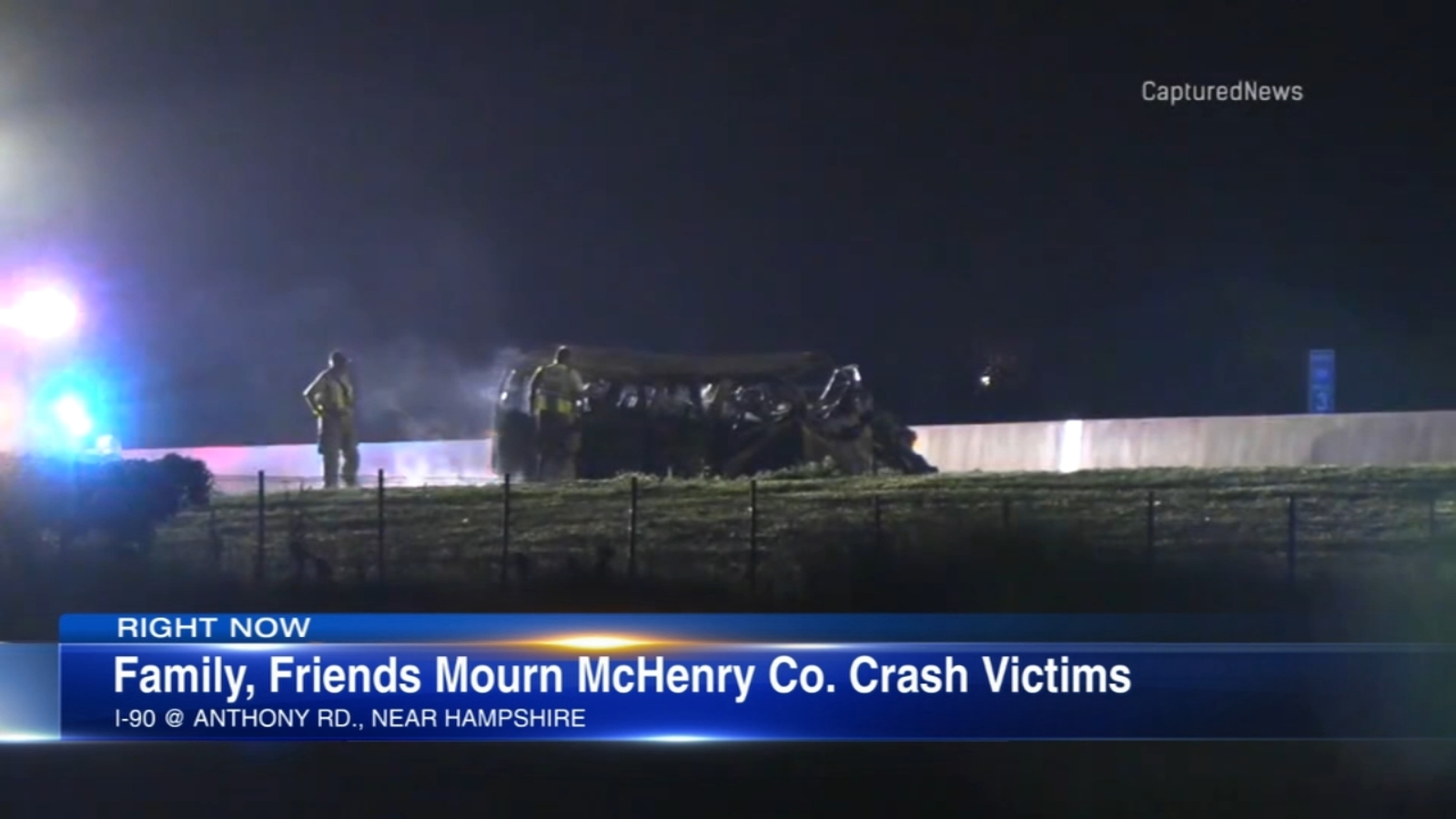
HAMPSHIRE, Ill. (WL S) — Questions remain after a mother from Rolling Meadows and five children were killed in a fiery crash on I-90 in McHenry County Sunday.
That sole survivor of the crash, Thomas Dobosz, 32, remains hospitalized here at Loyola University Medical Center.
A neighbor told ABC7 he lost his wife and all of his children in the crash.
Investigators said just after 2 am Sunday, Dobosz was driving westbound on I-90 near Hampshire in a blue Chevy van when the driver of a gray Acura, identified as 22-year-old Jennifer Fernandes of Carpentersville, was driving in the opposite direction and collided with Dobosz’s vehicle head on. Both cars became totally engulfed in flames.
Troopers said they found Fernandes dead on scene as well as all of Dobosz’s passengers, identified as 31-year-old Lauren Dobosz and five children: two 13-year-old girls, 7- and 6-year-old boys, and a 5 -year-old girl.
SEE ALSO | Kankakee couple killed, 3 kids injured in GA crash on way to visit grandparents
Neighbors in Rolling Meadows said four of them were the couple’s kids.
“When you find out it is people you’ve known for many years, it kind of hits a little harder,” David Moreno, a neighbor of the Dobosz family, said. “Losing your family in a split-second like that is not going to be easy for anybody.”
Moreno said four of the children were the couple’s kids.
“My understanding is one of the eldest daughters had a friend with them,” he said. “I know it’s going to be devastating for the community just to know that it was somebody that people have known.”
State Police are still trying to figure out why Hernandes was going the wrong way. Authorities have not yet released the identities of the five children.
The fatal crash also caused another one collision.
When a semi-truck had stopped to let a medical helicopter land, a second semi didn’t stop in time and rear ended it, officials said.
The trailer on one of them was torn open and the boxes inside scattered on the roadway.
One person had minor injuries from the second crash.
A man was arrested on Thursday while carrying an assault rifle outside the Brooklyn home of Iranian dissident journalist Masih Alinejad, according to federal officials and media reports.
Alinejad, a fierce critic of the Iranian government, was previously the target of a kidnapping plot allegedly orchestrated by Iranian government operatives. The attempt, which was foiled by the FBI, came after Alinejad wrote publicly about the Iranian regime’s efforts to silence her through a “social media campaign calling for my abduction.”
On Thursday, police arrested Khalid Mehdiyev, a 23-year-old Yonkers resident, who was “behaving suspiciously” outside an unidentified residence over a period of days, according to a complaint. After NYPD officers pulled him over for allegedly running a red light, they discovered a suitcase in his backseat containing a loaded AK-47 and 66 rounds of ammunition, prosecutors said.
While the court documents don’t explicitly name Alinejad, the Iranian journalist told the New York Times she was informed by authorities that the 23-year-old suspect was observing her house. She also told the Times she had security footage showing the suspect outside of her home. Law enforcement sources also told the Daily News that Mehdiyev was targeting her journalist’s home.
At one point, prosecutors said, Mehdiyev left his Subaru and attempted to open the front door of the residence in question.
According to the complaint, Mehdiyev told prosecutors that he could not afford his rent in Yonkers and was scoping out the residence to see if he could lease a room. He initially denied knowledge of the assault rifle, before later admitting it was his, adding he was in Brooklyn “because he was looking for someone,” prosecutors said.
Mehdiyev is facing a range of weapons charges, including possession of a firearm with an obliterated serial number, as well as failure to stop at a sign.
Broward Sheriff’s Office Sgt. Richard Van Der Eems describes the scene he encountered at the school after the mass shooting as he testifies during the penalty phase trial of Marjory Stoneman Douglas High School shooter Nikolas Cruz, Friday, July 22, at the Broward County Courthouse in Fort Lauderdale, Fla. (Mike Stocker, South Florida Sun-Sentinel via AP)
Estimated read time: 5-6 minutes
FORT LAUDERDALE, Fla. — Few Americans outside law enforcement and government ever see the most graphic videos or photos from the nation’s worst mass shootings — in most states, such evidence is only displayed at trial and most such killers die during or immediately after their attacks . They never make it to court.
That has made the penalty trial of Florida school shooter Nikolas Cruz for his 2018 murder of 17 people at Parkland’s Marjory Stoneman Douglas High School unusual.
As the worst US mass shooting to reach trial, the surveillance videos taken during his attack and the crime scene and autopsy photos that show its horrific aftermath are being seen by jurors on shielded video screens and, after each day’s court session, shown to a small group of journalists. But they are not shown in the gallery, where parents and spouses sit, or to the general public watching on TV.
Some online believe that should change — that to have an informed debate on gun violence, the public should see the carnage mass shooters like Cruz cause, often with high-velocity bullets fired from AR-15 semiautomatic rifles and similar weapons.
Others disagree. They say the public display of such videos and photos would add to the harm the victims’ families already endure and might entice some who are mentally disturbed to commit their own mass shooting. They believe such evidence should remain sealed.
Liz Dunning, a vice president at the Brady Center to Prevent Gun Violence, doesn’t believe releasing such videos and photos would have the political impact some think. Polls show that most Americans already support stronger background checks for gun buyers and bans or restrictions on AR-15s and similar weapons, said Dunning, whose mother was murdered by a gunman.
“Public perception is not the issue,” Dunning said. “We should be asking more of the powerful.”
Since most of the worst US mass shooters were killed by themselves or police during or immediately after their attack, it is rare for anyone outside government to see such surveillance videos or police and autopsy photos. The public didn’t see such evidence after the Las Vegas shooting in 2017, Orlando in 2016, Sandy Hook in 2012, Virginia Tech in 2007 and others.
Medical Examiner Dr. Wendolyn Sneed describes the wounds of Marjory Stoneman Douglas High School victims as she testifies in the penalty phase of Marjory Stoneman Douglas High School shooter Nikolas Cruz’s trial at the Broward County Courthouse in Fort Lauderdale, Fla., on Monday, July 25 (Photo: Carline Jean, South Florida Sun-Sentinel via AP)
But Cruz, 23, fled after his shooting and was arrested an hour later. He pleaded guilty in October to 17 counts of his first-degree murder-his trial is only to determine if he is sentenced to death or life without parole. The videos and photos are part of the prosecution’s case.
Since the trial began July 18, everyone in the courtroom and watching on TV has seen and heard heartbreaking testimony from teachers and students who saw others die. They have heard the gunshots and screams as jurors watched cellphone videos.
But when graphic videos and photos are presented, those are not shown. Usually, they only hear medical examiners and police officers give emotionless descriptions of what the jury is seeing.
Then at the end of each day, a group of reporters reviews the photos and videos, but are only allowed to write descriptions. That was a compromise as some parents feared photos of their dead children would be posted online and wanted no media access.
Miami media attorney Thomas Julin said in Florida before the internet, any photos or other evidence presented at trial could be seen and copied by anyone. Newspapers didn’t print the most thick photos, so no one cared.
But in the mid-1990s as the internet boomed, Danny Rolling faced a death penalty trial for the serial murders of four University of Florida students and a community college student. The victims’ families argued that the publication of crime scene photos would cause them emotional harm. The judge ruled that anyone could view the photos, but no one could copy them. Such compromises have since become standard in Florida’s high-profile murder trials.
The surveillance video of the Stoneman Douglas shooting is silent. It shows Cruz moving methodically from floor-to-floor in a three-story classroom building, shooting down hallways and into classrooms. Victims fall. Cruz often stops and shoots them again before moving on.
The crime scene photos show the dead where they fell, sometimes on top of or next to each other, often in contorted shapes. Blood and sometimes brain matter are splattered on floors and walls.
Marjory Stoneman Douglas High School shooter Nikolas Cruz is led into the courtroom during the penalty phase of his trial at the Broward County Courthouse in Fort Lauderdale, Fla., on Monday, July 25. (Photo: Carline Jean, South Florida Sun-Sentinel via P.A.)
The autopsy photos show the damage Cruz and his bullets did. Some victims have massive head wounds. One student had his elbow blown off, another had her shoulder blown open. Another of her had most of her forearm of her ripped away.
Yet, despite their grossness, Columbia University journalism professor Bruce Shapiro says most autopsy and crime scene photos wouldn’t have a lasting public impact because they don’t have context.
The photos and videos that have a strong effect on public opinion tell a story, said Shapiro, who runs the university’s think tank on how journalists should cover violence.
The photos of Emmett Till’s battered body lying in its coffin after the Black teenager was tortured and killed by Mississippi white supremacists in 1955. Mary Ann Vecchio screaming over Kent State student Jeffrey Miller’s body after he was shot by National Guard troops in 1970. Vietnamese child Phan Thi Kim Phuc running naked after being burned by a napalm bomb in 1972. The video of police officer Derek Chauvin kneeling on George Floyd’s neck until he’s dead in 2020.
“They work not just because they are graphic, but because they are powerful, stirring images,” Shapiro said.
And even if the graphic photos and videos were released, most major newspapers, wire services and television stations would be hesitant to use them. Their editors weigh whether the public benefit of seeing an image outweighs any prurient interest — and they usually pass.
That would leave most for only the most salacious websites. They would also become fodder for potential mass shooters, who frequently research past killers. cross did; testimony showed he spent the seven months before his attack making hundreds of computer searches about committing massacres.
“The images of the carnage will become part of their dark fantasy life,” Shapiro said.
CHICAGO — At least 44 people were shot, four fatally in weekend shootings across the city, Chicago police said.
Early Saturday, a 31-year-old man was standing near a sidewalk in the 1800-block of North Milwauee Avenue when someone in a vehicle approached him and opened fire around 1:40 am, Chicago police said. He was taken to Illinois Masonic Medical Center, where he was pronounced dead.
Just half an hour earlier, another man, 31, was fatally shot while stopped at a red light in Gresham on the Far South Side. The man was a passenger in the car in the 2000-block of West 87th Street when two people in a black Sedan drove by and fired at least 40 shots about 1:10 am, police said. He was taken to Christ Medical Center in Oak Lawn, where he was pronounced dead. A woman, 25, suffered multiple gunshot wounds and was taken to the same hospital. She was listed in critical condition, police said. Another man, 22, was shot multiple times in the torso and was taken to the University of Chicago Medical Center, where he was listed in critical condition, police said.
A man was fatally shot Saturday morning on the Bishop Ford Freeway near 130th Street, according to Illinois State Police. State troopers responded to the shooting about 11:40 am and found a person with gunshot wounds, state police said. The man was taken to a nearby hospital and pronounced dead, officials said. Police say shell casings were recovered from the road. No one was in custody. The northbound lanes of Interstate 94 were shut down for several hours as police investigated.
A 16-year-old boy was killed and a man was wounded in a shooting early Sunday in Brighton Park. They were stopped at a red light about 2 am in the 4700-block of South Kedzie Avenue when someone opened fire, police said. They continued driving until they crashed into a tree in the 4600 block of South Kedzie Avenue. The 16-year-old boy was shot in the head and taken to Mount Sinai Hospital, where he was pronounced dead, police said. The man, 19, suffered a graze wound to the head and was transported in good condition to Saint Anthony Hospital.
Sunday morning, a male was found shot to death Sunday morning in Chicago Lawn on the Southwest Side. The male was found with multiple gunshot wounds about 5:55 am in the 6900-block of South Talman Avenue, police said. He was pronounced dead at the scene, according to police.
Friday night, a 13-year-old boy was shot after he and at least three others tried to break into a parked vehicle in Hyde Park on the South Side, police said. The boy was among “four to five” men who were trying to breach a parked car in the 1100-block of East 52nd Street around 8 pm when the vehicle’s owner, a 34-year-old woman, confronted the group and shot the boy in the neck, police said. The boy was transported to Comer Children’s Hospital in fair condition.
Five people were killed and at least 60 others were wounded by gunfire across Chicago last weekend.
ABC7 Chicago contributed to this report.
(Source: Sun-Times Media Wire – Copyright Chicago Sun-Times 2022.)