Categories
Technology

Samsung Galaxy Watch 5 vs. Galaxy Watch 4

The Samsung Galaxy Watch 5 series is here, and if you’re in the market for a new Galaxy Watch, you might find yourself wondering if it’s worth shelling out for Samsung’s latest addition, or whether you should stick with the Galaxy Watch 4. differences between the two might not be immediately obvious, so we’ve done the leg work and compared the Samsung Galaxy Watch 5 vs. Galaxy Watch 4 across several categories to help you decide which one is the best buy for you.

Specs

Samsung Galaxy Watch 5
Samsung Galaxy Watch 4
display size 40mm: 1.2 inches

44mm: 1.4 inches

SapphireCrystal

40mm: 1.2 inches

44mm: 1.4 inches

body size 40mm: 40.4 x 39.3 x 9.8mm (1.59 x 1.55 x 0.39 inches)

44mm: 44.4 x 43.3 x 9.8mm (1.75 x 1.70 x 0.39 inches)

40mm: 40.4 x 39.3 x 9.8mm (1.59 x 1.55 x 0.39 inches)

44mm: 44.4 x 43.3 x 9.8mm (1.75 x 1.70 x 0.39 inches)

Weight 40mm: 28.7 grams

44mm: 33.5 grams

40mm: 25.9 grams

44mm: 30.3 grams

Resolution

40mm: 396×396

44mm: 450×450

40mm: 396 x 396 pixels (330 pixels per inch)

44mm: 450 x 450 pixels (330 ppi)

touch screen 40mm: 1.2-inch AMOLED touchscreen

44mm: 1.4-inch AMOLED touchscreen

40mm: 1.2-inch Super AMOLED touchscreen

44mm: 1.4-inch Super AMOLED touchscreen

Storage 16 GB 16 GB
wireless-interface Bluetooth 5.2, Wi-Fi 802.11 a/b/g/n 2.4+5GHz, NFC, LTE (select models), GPS/GLONASS/Beidou/Galileo Bluetooth 5.0, Wi-Fi 802.11 a/b/g/n, NFC, LTE (select models), GPS/GLONASS/Beidou/Galileo
Depth 9.8mm 9.8mm
Accelerometer And it is And it is
gyroscope And it is And it is
Ambient light sensor And it is And it is
heart rate sensor And it is And it is
Barometer And it is And it is
gps And it is And it is
water resistance Yes (5ATM + IP68) Yes (5ATM + IP68)
Battery life 40mm: 284mAh

44mm: 410mAh

Up to 50 hours (based on Samsung laboratory measurements)

WPC-based wireless charging

40mm: 247mAh

44mm: 361mAh

Up to 40 hours (based on Samsung laboratory measurements)

WPC-based wireless charging

Price From $280 From $200
Availability Samsung Samsung, Amazon, Best Buy
DT review hands-on 4 out of 5 stars

Design and display

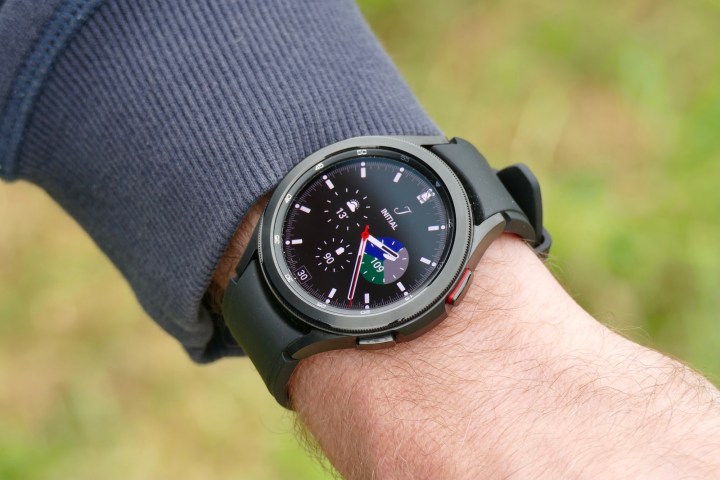
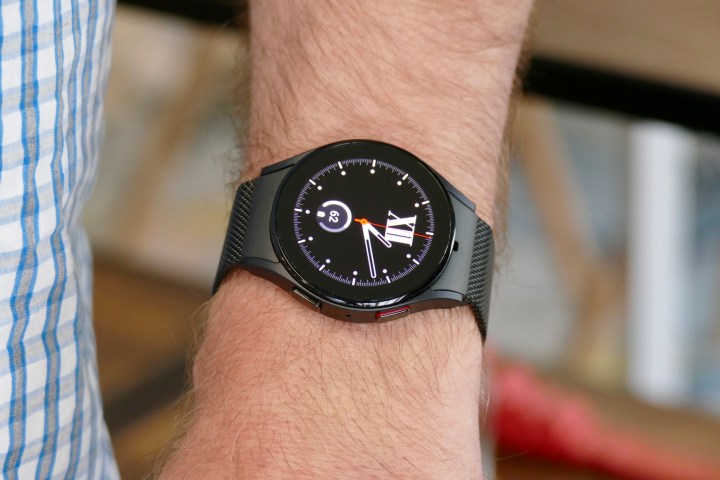
When it comes to design, Samsung has opted for repetition over reinvention here. Both watches look pretty similar and share virtually identical physical characteristics. Neither has a rotating bezel — you’ll need to grab the Watch 4 Classic if that’s your preference — but the digital alternative provides a contemporary, streamlined look.

The Watch 5 sports a modern, minimalist design and comes in two sizes, 40mm or 44mm, weighing 28.7 and 33.5 grams, respectively. The Watch 4 comes in the same sizes, again weighing in at 25.9 grams and 30.3 grams, respectively. There’s no difference between dimensions here, but the Watch 4 is ever so slightly lighter, if that’s important to you.

Whichever watch you go for, there’s a 1.2-inch or 1.4-inch Super AMOLED display on board, with the same resolution of 396 x 396 or 450 x 450 across the board too, depending on which size you choose. Everything looks sharp and clear. Samsung claims the Watch 5’s sapphire crystal lens provides a 60% harder outer layer than the Watch 4 series, but both watches have the same durable Armor Aluminum body.

The Galaxy Watch 5 40mm comes in Graphite, Pink Gold, or Silver with a Bora Purple strap designed to perfectly match the Galaxy Z Flip 4. The 44mm variant comes in Graphite, Sapphire, or Silver. You can pick up the Galaxy Watch 4 in Silver, Black, or Pink Gold with a choice of bands.

As you can see, the differences here are fairly minimal, so it may not be worth paying more for the Watch 5 if you’re considering upgrading — unless the new colors and sapphire crystal lens tempt you to trade in. As such, we’re calling this round a tie.

Winner: tie

Fitness and health-tracking features
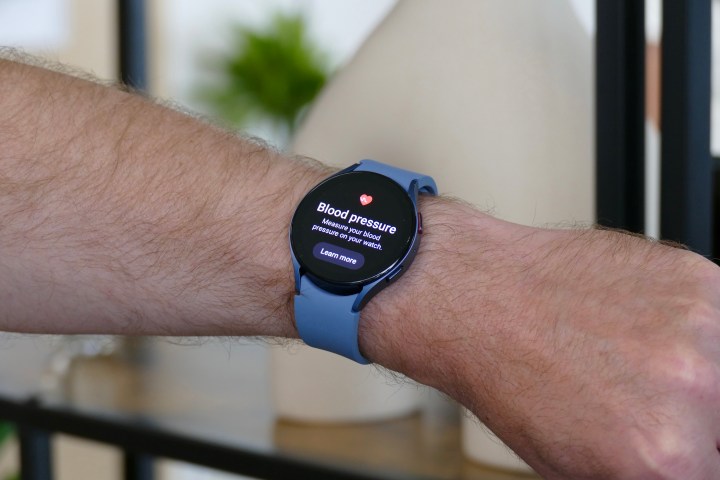
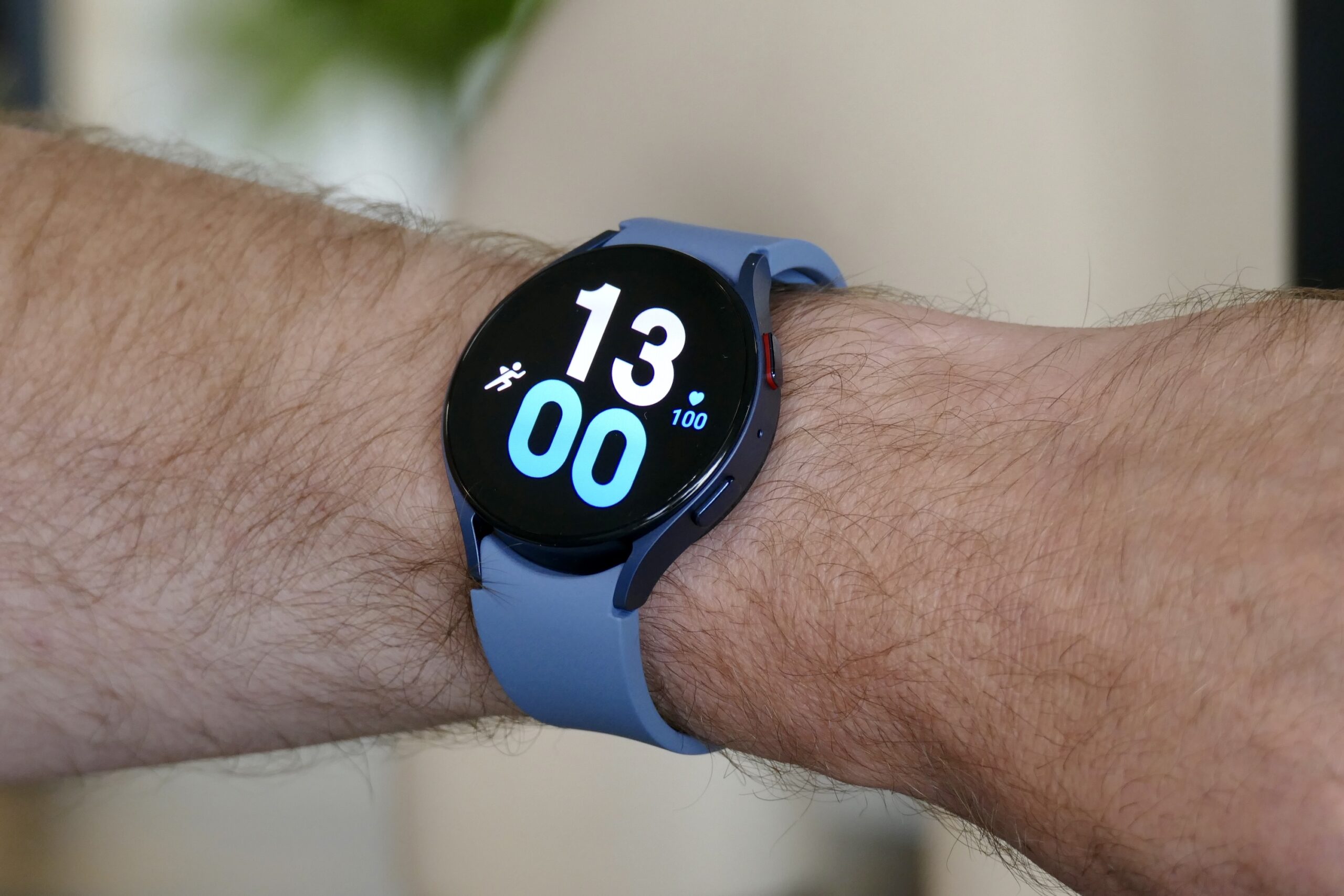
Samsung Galaxy Watch 5 44mm on a mans wrist.
Galaxy Watch 5 44mm Andy Boxall/Digital Trends

There are some subtle differences between these two devices when it comes to fitness tracking. Both feature Samsung’s BioActive Sensor, but the Watch 5 has an enlarged surface area to improve the accuracy of readings. The sensor includes a Bio-Electrical Impedance (BIA) sensor, electrocardiogram (ECG), and PPG heart rate sensor so you can monitor sleep, body fat levels, blood-oxygen level, and blood pressure (the latter is only available in some countries , however).

The Watch 5 has a few new features, including GPX, available for the first time on a Galaxy Watch, so you can download or display routes as well as record new routes and share them with friends. There is also turn-by-turn directions to help keep cyclists and runners on track, and the new trackback feature, which takes you back the way you came, great for long walks or hikes. While you’ll find these features on most Garmin and other multisport watches, they’re not usually included on flagship smartwatches, so this is a pretty neat addition. These new features ensure the Watch 5 is an excellent choice for runners, hikers, and long-distance walkers.

The main new feature on the Watch 5 is the temperature sensor, which uses infrared technology for accurate temperature monitoring, even if the temperature of your surroundings changes. This could be used for period tracking or as an early sickness indicator, but Samsung plans to work with developers to explore new ways to use this in the “near future,” so we could be waiting a while before there’s actually a use for it.

Both watches also offer advanced sleep tracking that monitors sleep stages, snore detection, and body oxygen levels. On the Watch 5, you also get Sleep Coaching, a tailored month-long guided program designed to help improve your sleep habits.

Both the Watch 4 and Watch 5 can track over 100 different workouts with automatic workout detection, plus the familiar digital running coach and VO2 max data, which lets you know how much oxygen you’re using during your training and is a good indicator of aerobics. fitness.

So which watch wins this round? We’re giving it to the Galaxy Watch 5, but it’s a close one as most of the health and fitness tracking features on the new Watch 5 can also be found on the Watch 4. The added GPX features, that new temperature sensor, and improved sleep tracking just push the Watch 5 into the lead here.

Winner: Samsung Galaxy Watch 5

Battery life
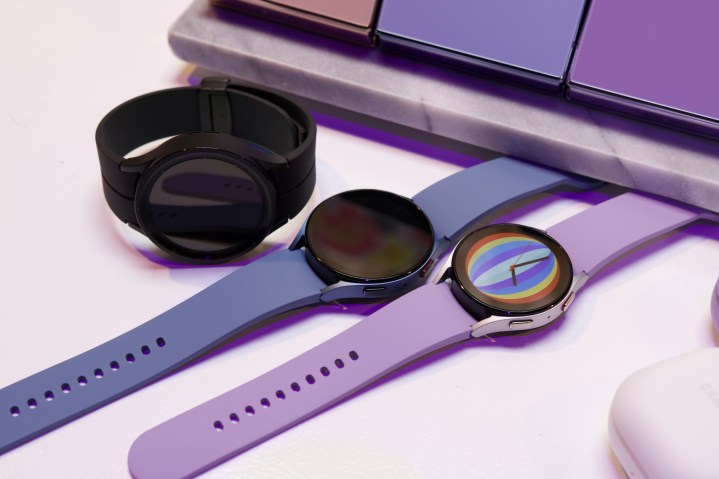
The Samsung Galaxy Watch 5 and Galaxy Watch 5 Pro.
Joe Maring/Digital Trends

Battery life is one of the key differences between these two watches. The 40mm variant of the Galaxy Watch 5 packs a 284mAh battery, compared to the 247mAh battery powering the 40mm Galaxy Watch 4. Meanwhile, the 44mm is powered by a 410mAh battery, compared to the 361mAh battery on offer in the 44mm Galaxy Watch 4. Samsung promises a battery life of up to 50 hours with the Watch 5 and 40 hours with the Watch 4, though this will depend on your usage.

Faster charging is on offer with the Galaxy Watch 5 too, with Samsung claiming you can top up from zero to 45% in just 30 minutes. If you use your watch for sleep tracking, you might be interested to know Samsung also says that eight minutes of charging will give you eight hours of battery life, so there’s no need to worry about your watch dying halfway through your sleep cycle.

There’s a clear winner here, and it’s the Watch 5 with its beefier battery and faster charging. This could change once we’ve spent more time with Samsung’s latest, though, so watch this space.

Winner: Samsung Galaxy Watch 5

special features
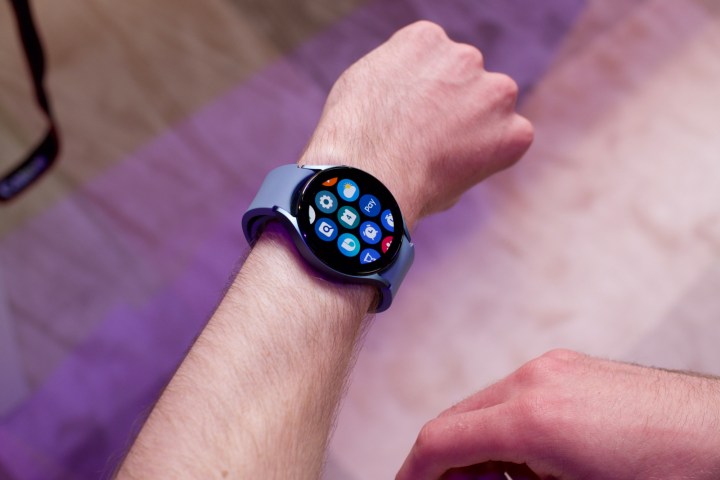
Neither watch has a rotating bezel, so if that’s a must-have for you, the Watch 4 Classic is the watch you’re looking for.

In terms of special features, both watches offer comprehensive sleep tracking, but the Watch 5 adds sleep coaching that tailors a guided program based on your sleep tracking metrics to help improve the quality of your sleep. Both watches also work with compatible smart devices and the Samsung SmartThings app to control lights, TVs, and air conditioners to improve your sleeping environment. With the Watch 5, you’re also getting that infrared temperature sensor, though it may be a while before we start to see compatible apps.

Both watches run WearOS 3 and Samsung’s One UI Watch. The Watch 5 ships with One UI Watch 4.5, with new accessibility features, an improved typing interface, and dual-SIM support. With Wear OS 3 you get access to Google Assistant from your watch, and features coming soon include being able to use voice navigation in Google Maps, plus music apps like Deezer and SoundCloud.

You’ll also find the same IP68 and 5ATM water (and dust) resistance ratings across both the Watch 4 and Watch 5.

There’s not enough here to differentiate between the two watches, as both pack similar special features, so ultimately, whether or not you want to spend more for an infrared temperature sensor and sleep coaching may be the deciding factor here.

Winner: tie

Price and availability

The Galaxy Watch 5 is available to until August 25. Pricing starts at $280 for the 40mm Bluetooth version and $330 for the 40mm LTE variant. Pre-orders also get a free Wireless Charger Duo, $75 off when you trade in an eligible smartwatch, and $50 of Samsung credit to spend on accessories. The Galaxy Watch 5 retail sales open August 26.

The Galaxy Watch 4 is from Samsung, Amazon, Best Buy, and other major retailers. Pricing starts from $200 for the 40mm Bluetooth variant and $250 for the 40mm LTE version.

Overall winner: Samsung Galaxy Watch 5

We’re crowning the Galaxy Watch 5 our overall winner, though we’d like to point out this was a very close run. Both watches are so similar across the board in terms of design, specs, and fitness tracking features that, for most people, the incremental upgrades simply aren’t enough to warrant the extra $80-plus cost of Samsung’s latest wearable. That said, if you’re buying your first Samsung Galaxy Watch, we’d wholeheartedly recommend the Watch 5. If you’re considering upgrading from the Galaxy Watch 4, there’s not a lot new here unless you’re into long-distance walking or hiking and need those GPX features, simply must have a bigger battery and faster charging, or you really want an infrared temperature sensor on your wrist.

Editors’ Recommendations


Categories
Technology

Asmongold comments on Riot’s upcoming MMORPG

Twitch star Zack “Asmongold” provided his thoughts on the MMORPG that is currently being developed by Riot Games.

During a recent livestream on his alternate Twitch channel Zackrawrr, the content creator reacted to lore videos related to the League of Legends universe, and was left bedazzled after watching a CGI video titled “The Call | Season 2022 Cinematic.”

youtube-cover

Following this, Asmongold provided his opinions on the massively multiplayer game that is in development at Riot Games and claimed that the latter has “everything that they need to succeed.” He said:

“I hope that the… I hope it’s good. I think this is like one of those situations where it’s like, everything is in their, in like, they have everything that they need to succeed.”

youtube-cover

Asmongold compares World of Warcraft to Riot Games’ upcoming MMORPG, and provides his thoughts

Zack has regularly been streaming on his alternative Twitch channel over the past few days and has spent recent broadcasts playing the newly launched open-world multiplayer game Tower of Defense.

At the three-hour mark of his August 12 stream, Asmongold reacted to some of the most viral League of Legends content and came across YouTuber Necrit’s titled videos The World of Riot’s MMO is Already Done.”

youtube-cover

Fans then asked the World of Warcraft gamer to view the CGI cinematic trailer produced by Riot Games, which was released earlier this year. Zack commented on the game’s hype after noticing that the video had garnered more than 135 million views:

“Okay, let’s see it. By the way, like, for the amount of hype that this game has, this came out f***ing seven months ago, it has a 138 million views. If you compare that to the Dragonflight ( World of Warcraft’s upcoming expansion) announcement, it has two million views.”

Timestamp: 03:58:24

The OTK co-founder was impressed after watching the cinematic video and hoped that the upcoming MMORPG would do well. He stated that Riot Games has everything needed for the game to succeed and said:

“They have a tremendous, massive existing fan base, they have an apparently gigantic, f***ing world, that I didn’t even really know, like 95% of. They have a like… a huge company. So , because it’s a huge company, they can spend a tremendous amount of money. They don’t have a history of games that have pay-to-win, and that.”

Asmongold cited Valorant and League of Legends as examples to highlight Riot Games’ huge success:

“So, it’s like, every single time, like, you know, one of these games comes out and people worry about, and it seems like, you know, they have the foundation, they have the resources, and also like, they have come success too. Valorant is a great game, League of Legends is a great game. Everybody hates League of Legends, but they still do play it.”

He continued further by saying:

“So, it’s like, I feel like they’ve made very, very good games, and they’ve cupped up with those good games.”

The discussion came to a close when Asmongold confirmed that he would play Riot Games’ MMORPG once it releases.


Fans react to the streamer’s initial thoughts on Riot Games’ MMORPG

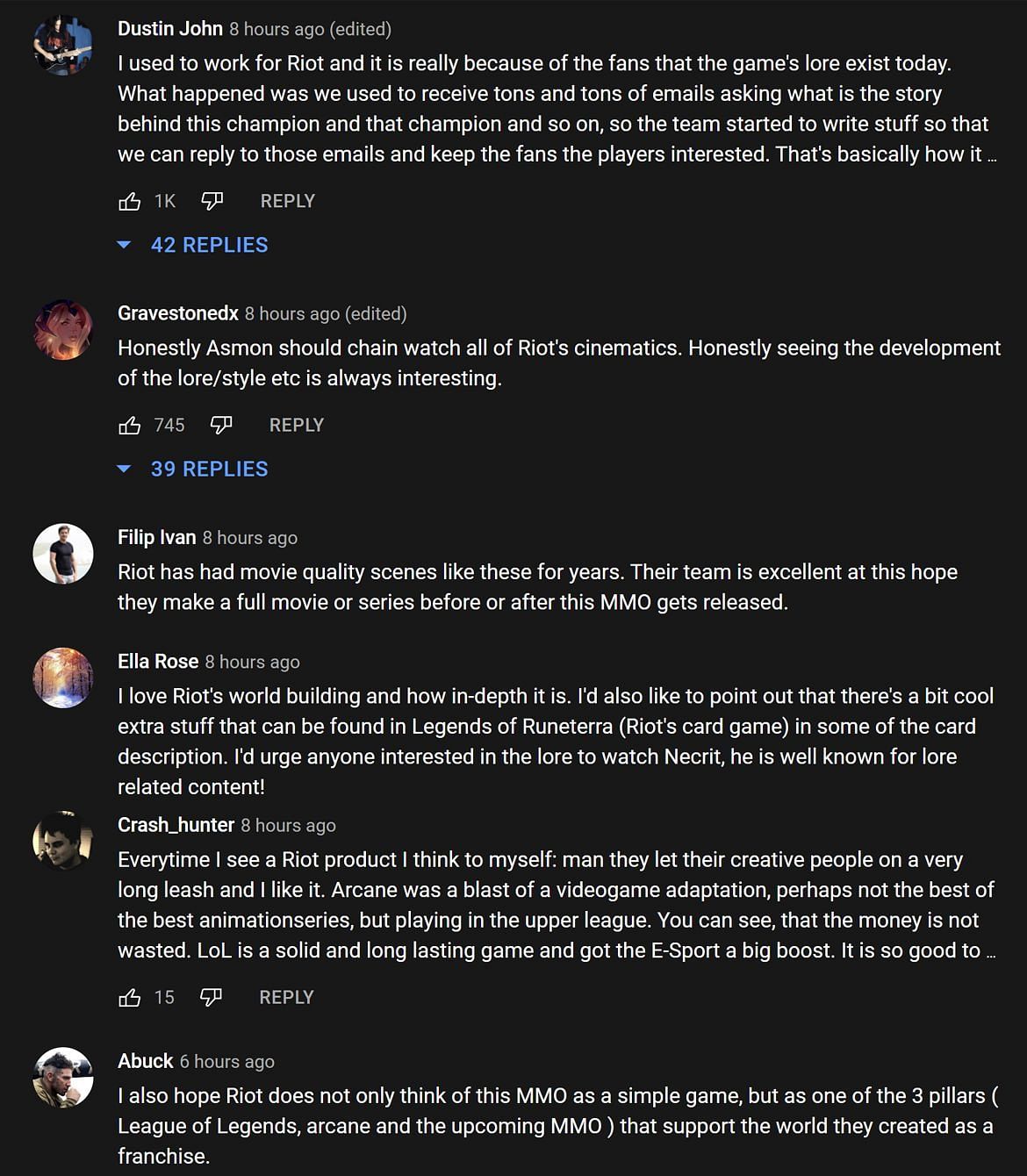
The YouTube comment section featured more than 1,000 fan comments, and here’s a snippet of some of the most relevant ones:

Fans in the YouTube comments section reacting to the streamer's thoughts (Images via Asmongold Clips/YouTube)
Fans in the YouTube comments section reacting to the streamer’s thoughts (Images via Asmongold Clips/YouTube)

For some reference, Riot Games confirmed that they’re currently developing a new MMORPG set in the League of Legends universe in February 2021.

Aside from this, the American game developers also stated that they’re simultaneously working on a fighting game codenamed Project L, and an action-adventure game codenamed Project F.


.

Categories
Technology

Marvel’s Spider-Man Remastered PC – recommended Optimized Settings provided by Digital Foundry

Digital Foundry has given Marvel’s Spider-Man Remastered a go on PC, and to help you get the best experience, a chart featuring recommended Optimized Settings was provided.

If you head over through the link, you will see the chart, as well as a breakdown of how each setting affects the game for good or ill.

On PC, Marvel’s Spider-Man features ray-traced reflections with varying quality levels, one of which is a new, higher-quality ray-traced mode that offers even more city detail.

The game supports Nvidia DLSS and Nvidia DLAA, the latter of which is an AI-based anti-aliasing mode for GeForce RTX gamers with GPU headroom to spare.

There are several display ratios to choose from, including ultrawide 21:9, panoramic 32:9, and Nvidia Surround multi-monitor setups. You can also choose other rendering systems such as SSAO, texture filtering, LoD quality, shadows, and more. The game supports windowed, full-screen, and exclusive full-screen rendering modes.

In addition to PC graphical features, there are multiple peripherals and customization options. You can use a PlayStation DualSense wireless controller, mouse and keyboard, and Steam Input with plenty of remapping options available.

Read over the minimum and recommended specs here.

Marvel’s Spider-Man Remastered released for PC on August 12, and Miles Morales will come to PC this fall.

Categories
Technology

ScienceNews | AI Model Suggests Personalized Fonts to Improve Digital Reading, Accessibility: Researchers

Florida [US]August 14 (ANI): A team of researchers who worked with an Adobe team has suggested that personalized font recommendations can improve the accessibility of digital information and enhance individual reading experiences.

The findings of the study were published in the journal, ‘ACM Designing Interactive Systems 2022’.

Also Read | TS PGECET 2022 Answer Key Released At pgecet.tsche.ac.in; Know How To Raise Objections.

“The future of readability is a device watching humans read and using their performance to tailor the format so that they read at their best,” says Ben Sawyer ’14MS ’15PhD, the director of the Readability Consortium and UCF’s Virtual Readability Lab. look forward to the day when you can pick up a device, read and receive information in a way that uniquely suits your needs.”

Sawyer and Zoya Bylinskii, an Adobe research scientist, were involved in the conception of the research and provided guidance throughout the study. Tianyuan Cai, an Acrobat.com machine learning engineer, led the FontMART study.

Also Read | She-Hulk Attorney at Law: Review, Release Date, Time, Where to Watch – All You Need to Know About Tatiana Maslany’s Marvel Disney+ Series!.

The study used the Font Preference Test featured on UCF’s Virtual Readability Lab’s website to provide baselines for evaluating FontMART’s recommendations.

The consideration of font preference is important since people’s preferred fonts often differ from the font that can best improve their reading experience and performance. The discrepancy between a reader’s preferred font and the fastest font has been demonstrated in previous readability research.

Study results indicated that the FontMART model can recommend fonts that improve reading speed by matching reader characteristics with specific font characteristics.

How the Model Works

The FontMART model learns to associate fonts with specific reader characteristics. FontMART was trained with a remote readability study of 252 crowd workers and their self-reported demographic information. Interviews with typographers influenced the selection of the eight fonts used in the study. The final font selection included fonts from both the serif (ie, Georgia, Merriweather, Times, and Source Serif Pro) and Sans Serif (ie, Arial, Open Sans, Poppins, and Roboto) families.

The effect of font varies by readers, researchers found.

FontMART can predict the fonts that work well for specific readers by understanding the relationship between font characteristics and reader characteristics like font familiarity, self-reported reading speed and age, according to the FontMART study. Among the characteristics considered, age plays the largest role when the model determines which font is recommended for readers.

For instance, font characteristics like heavier weight benefit the reading experience of older adults because thicker font strokes are easier to read for those with weaker and variable eyesight.

More research is needed and may include broader age distribution of participants to be more representative of the general population, evaluating the model’s effectiveness for other reading contexts like long-form or glanceable, and expanding the languages ​​and associated font characteristics to better accommodate reader diversity.

Continued collaborations and research will help expand the characteristics explored to improve the FontMART model and enhance individual reading experiences.

UCF’s Readability Consortium and Virtual Readability Lab address how personalization can improve reading efficiency and speed. Sawyer also leads LabX, an applied neuroscience group focused on human performance, and he is an associate professor in industrial engineering and management systems. Sawyer received a doctorate in human factors psychology and a master’s degree in industrial engineering from UCF. I have completed his postdoctoral studies at MIT. (ANI)

(This is an unedited and auto-generated story from Syndicated News feed, LatestLY Staff may not have modified or edited the content body)

Categories
Technology

Samsung Galaxy Watch 5 vs. Galaxy Watch 4

The Samsung Galaxy Watch 5 series is here, and if you’re in the market for a new Galaxy Watch, you might find yourself wondering if it’s worth shelling out for Samsung’s latest addition, or whether you should stick with the Galaxy Watch 4. differences between the two might not be immediately obvious, so we’ve done the leg work and compared the Samsung Galaxy Watch 5 vs. Galaxy Watch 4 across several categories to help you decide which one is the best buy for you.

Specs

Samsung Galaxy Watch 5
Samsung Galaxy Watch 4
display size 40mm: 1.2 inches

44mm: 1.4 inches

SapphireCrystal

40mm: 1.2 inches

44mm: 1.4 inches

body size 40mm: 40.4 x 39.3 x 9.8mm (1.59 x 1.55 x 0.39 inches)

44mm: 44.4 x 43.3 x 9.8mm (1.75 x 1.70 x 0.39 inches)

40mm: 40.4 x 39.3 x 9.8mm (1.59 x 1.55 x 0.39 inches)

44mm: 44.4 x 43.3 x 9.8mm (1.75 x 1.70 x 0.39 inches)

Weight 40mm: 28.7 grams

44mm: 33.5 grams

40mm: 25.9 grams

44mm: 30.3 grams

Resolution

40mm: 396×396

44mm: 450×450

40mm: 396 x 396 pixels (330 pixels per inch)

44mm: 450 x 450 pixels (330 ppi)

touch screen 40mm: 1.2-inch AMOLED touchscreen

44mm: 1.4-inch AMOLED touchscreen

40mm: 1.2-inch Super AMOLED touchscreen

44mm: 1.4-inch Super AMOLED touchscreen

Storage 16 GB 16 GB
wireless-interface Bluetooth 5.2, Wi-Fi 802.11 a/b/g/n 2.4+5GHz, NFC, LTE (select models), GPS/GLONASS/Beidou/Galileo Bluetooth 5.0, Wi-Fi 802.11 a/b/g/n, NFC, LTE (select models), GPS/GLONASS/Beidou/Galileo
Depth 9.8mm 9.8mm
Accelerometer And it is And it is
gyroscope And it is And it is
Ambient light sensor And it is And it is
heart rate sensor And it is And it is
Barometer And it is And it is
gps And it is And it is
water resistance Yes (5ATM + IP68) Yes (5ATM + IP68)
Battery life 40mm: 284mAh

44mm: 410mAh

Up to 50 hours (based on Samsung laboratory measurements)

WPC-based wireless charging

40mm: 247mAh

44mm: 361mAh

Up to 40 hours (based on Samsung laboratory measurements)

WPC-based wireless charging

Price From $280 From $200
Availability Samsung Samsung, Amazon, Best Buy
DT review hands-on 4 out of 5 stars

Design and display

When it comes to design, Samsung has opted for repetition over reinvention here. Both watches look pretty similar and share virtually identical physical characteristics. Neither has a rotating bezel — you’ll need to grab the Watch 4 Classic if that’s your preference — but the digital alternative provides a contemporary, streamlined look.

The Watch 5 sports a modern, minimalist design and comes in two sizes, 40mm or 44mm, weighing 28.7 and 33.5 grams, respectively. The Watch 4 comes in the same sizes, again weighing in at 25.9 grams and 30.3 grams, respectively. There’s no difference between dimensions here, but the Watch 4 is ever so slightly lighter, if that’s important to you.

Whichever watch you go for, there’s a 1.2-inch or 1.4-inch Super AMOLED display on board, with the same resolution of 396 x 396 or 450 x 450 across the board too, depending on which size you choose. Everything looks sharp and clear. Samsung claims the Watch 5’s sapphire crystal lens provides a 60% harder outer layer than the Watch 4 series, but both watches have the same durable Armor Aluminum body.

The Galaxy Watch 5 40mm comes in Graphite, Pink Gold, or Silver with a Bora Purple strap designed to perfectly match the Galaxy Z Flip 4. The 44mm variant comes in Graphite, Sapphire, or Silver. You can pick up the Galaxy Watch 4 in Silver, Black, or Pink Gold with a choice of bands.

As you can see, the differences here are fairly minimal, so it may not be worth paying more for the Watch 5 if you’re considering upgrading — unless the new colors and sapphire crystal lens tempt you to trade in. As such, we’re calling this round a tie.

Winner: tie

Fitness and health-tracking features

Samsung Galaxy Watch 5 44mm on a mans wrist.
Galaxy Watch 5 44mm Andy Boxall/Digital Trends

There are some subtle differences between these two devices when it comes to fitness tracking. Both feature Samsung’s BioActive Sensor, but the Watch 5 has an enlarged surface area to improve the accuracy of readings. The sensor includes a Bio-Electrical Impedance (BIA) sensor, electrocardiogram (ECG), and PPG heart rate sensor so you can monitor sleep, body fat levels, blood-oxygen level, and blood pressure (the latter is only available in some countries , however).

The Watch 5 has a few new features, including GPX, available for the first time on a Galaxy Watch, so you can download or display routes as well as record new routes and share them with friends. There is also turn-by-turn directions to help keep cyclists and runners on track, and the new trackback feature, which takes you back the way you came, great for long walks or hikes. While you’ll find these features on most Garmin and other multisport watches, they’re not usually included on flagship smartwatches, so this is a pretty neat addition. These new features ensure the Watch 5 is an excellent choice for runners, hikers, and long-distance walkers.

The main new feature on the Watch 5 is the temperature sensor, which uses infrared technology for accurate temperature monitoring, even if the temperature of your surroundings changes. This could be used for period tracking or as an early sickness indicator, but Samsung plans to work with developers to explore new ways to use this in the “near future,” so we could be waiting a while before there’s actually a use for it.

Both watches also offer advanced sleep tracking that monitors sleep stages, snore detection, and body oxygen levels. On the Watch 5, you also get Sleep Coaching, a tailored month-long guided program designed to help improve your sleep habits.

Both the Watch 4 and Watch 5 can track over 100 different workouts with automatic workout detection, plus the familiar digital running coach and VO2 max data, which lets you know how much oxygen you’re using during your training and is a good indicator of aerobics. fitness.

So which watch wins this round? We’re giving it to the Galaxy Watch 5, but it’s a close one as most of the health and fitness tracking features on the new Watch 5 can also be found on the Watch 4. The added GPX features, that new temperature sensor, and improved sleep tracking just push the Watch 5 into the lead here.

Winner: Samsung Galaxy Watch 5

Battery life

The Samsung Galaxy Watch 5 and Galaxy Watch 5 Pro.
Joe Maring/Digital Trends

Battery life is one of the key differences between these two watches. The 40mm variant of the Galaxy Watch 5 packs a 284mAh battery, compared to the 247mAh battery powering the 40mm Galaxy Watch 4. Meanwhile, the 44mm is powered by a 410mAh battery, compared to the 361mAh battery on offer in the 44mm Galaxy Watch 4. Samsung promises a battery life of up to 50 hours with the Watch 5 and 40 hours with the Watch 4, though this will depend on your usage.

Faster charging is on offer with the Galaxy Watch 5 too, with Samsung claiming you can top up from zero to 45% in just 30 minutes. If you use your watch for sleep tracking, you might be interested to know Samsung also says that eight minutes of charging will give you eight hours of battery life, so there’s no need to worry about your watch dying halfway through your sleep cycle.

There’s a clear winner here, and it’s the Watch 5 with its beefier battery and faster charging. This could change once we’ve spent more time with Samsung’s latest, though, so watch this space.

Winner: Samsung Galaxy Watch 5

special features
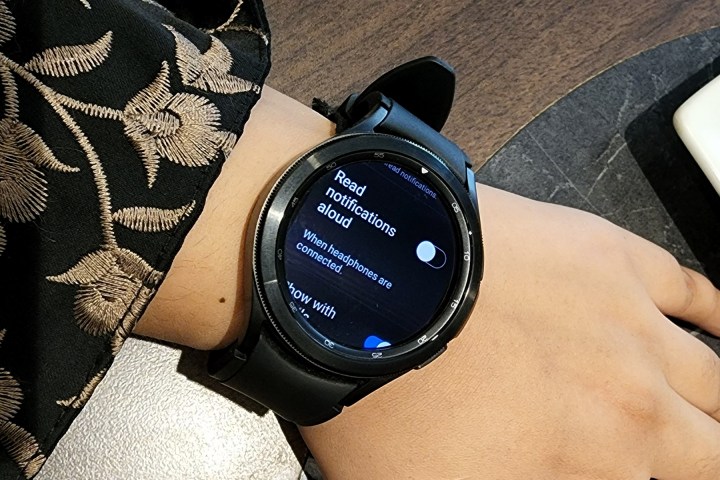
Neither watch has a rotating bezel, so if that’s a must-have for you, the Watch 4 Classic is the watch you’re looking for.

In terms of special features, both watches offer comprehensive sleep tracking, but the Watch 5 adds sleep coaching that tailors a guided program based on your sleep tracking metrics to help improve the quality of your sleep. Both watches also work with compatible smart devices and the Samsung SmartThings app to control lights, TVs, and air conditioners to improve your sleeping environment. With the Watch 5, you’re also getting that infrared temperature sensor, though it may be a while before we start to see compatible apps.

Both watches run WearOS 3 and Samsung’s One UI Watch. The Watch 5 ships with One UI Watch 4.5, with new accessibility features, an improved typing interface, and dual-SIM support. With Wear OS 3 you get access to Google Assistant from your watch, and features coming soon include being able to use voice navigation in Google Maps, plus music apps like Deezer and SoundCloud.

You’ll also find the same IP68 and 5ATM water (and dust) resistance ratings across both the Watch 4 and Watch 5.

There’s not enough here to differentiate between the two watches, as both pack similar special features, so ultimately, whether or not you want to spend more for an infrared temperature sensor and sleep coaching may be the deciding factor here.

Winner: tie

Price and availability

The Galaxy Watch 5 is available to until August 25. Pricing starts at $280 for the 40mm Bluetooth version and $330 for the 40mm LTE variant. Pre-orders also get a free Wireless Charger Duo, $75 off when you trade in an eligible smartwatch, and $50 of Samsung credit to spend on accessories. The Galaxy Watch 5 retail sales open August 26.

The Galaxy Watch 4 is from Samsung, Amazon, Best Buy, and other major retailers. Pricing starts from $200 for the 40mm Bluetooth variant and $250 for the 40mm LTE version.

Overall winner: Samsung Galaxy Watch 5

We’re crowning the Galaxy Watch 5 our overall winner, though we’d like to point out this was a very close run. Both watches are so similar across the board in terms of design, specs, and fitness tracking features that, for most people, the incremental upgrades simply aren’t enough to warrant the extra $80-plus cost of Samsung’s latest wearable. That said, if you’re buying your first Samsung Galaxy Watch, we’d wholeheartedly recommend the Watch 5. If you’re considering upgrading from the Galaxy Watch 4, there’s not a lot new here unless you’re into long-distance walking or hiking and need those GPX features, simply must have a bigger battery and faster charging, or you really want an infrared temperature sensor on your wrist.

Editors’ Recommendations



Categories
Technology

Steam Adds Feature Users Have Requested for Years

Valve appears to have quietly added a Steam feature that people have been asking about for a long time now: the ability to add a game to your library without having to download it. That may seem like a small thing (and it is, really), but it’s something players have only been able to do in the past via workarounds that didn’t make for the most convenient methods. It’s a feature that’s pretty much only useful whenever you’re downloading free-to-play games, but it does seem to have a few uses outside of that, too.

This new Steam feature wasn’t publicized in any sort of patch notes for Steam this week, so this stealthy feature was only noticed by people who shared news of it online after their discoveries. Twitter user RobotBrush, for example, screenshotted the option in the image below (which you may have to expand) that shows the usual “Play Game” button besides a new one that says “Add to Library.” Fellow Twitter user Morwul contextualized this for those who might not have understood what was going on from the first tweet alone.

As others pointed out in the replies there and in other threads where this feature was discussed, this Add to Library option was already available to a degree. There wasn’t a dedicated button for this action, and to achieve a similar effect, players could end the download of a game at the first confirmation window that pops up to have the game added to your library but not downloaded at that time. That workaround has essentially been condensed now into the one button you see pictured above.

For paid games, this won’t really be helpful seeing how you’d have to purchase the game anyway before adding it to your library. But considering the prevalence of free-to-play games nowadays with no end to that monetization method in sight, this feature will only be more useful as additional free-to-play games release. It’ll also be useful when claiming free DLC for a game you already own.

One caveat to this is that it doesn’t appear to be an option available on the Steam site at this time and is only found within the Steam app itself. It’s also unclear if this Add to Library button is present on games that are temporarily free-to-play or free-to-own seeing how there aren’t any games being promoted that way on Steam at this time, but those offers are never far apart from one another, so we’ll see soon if the button does indeed work that way, too.

.

Categories
Technology

7 best Minecraft 1.19 Bedrock addons in 2022

Minecraft is a game that has thrived in popular culture for more than a decade now. A large part of this continued success is due to the many mods the community has created for the game.

From adding basic functionality like multiplayer when the game was still in beta to modpacks such as RLCraft that completely change the game, there is no shortage of new experiences.

However, Bedrock edition players have much more limited access to mods. Most of what is available is through the marketplace and microtransactions. However, there are some free mods for Bedrock known as addons. While slightly different from Java mods, there addons can add a lot to the player experience.


The seven best addons for Minecraft 1.19 Bedrock

7)Dynamic Lighting

youtube-cover

The dynamic lighting mod does exactly what its title says. It adds dynamic lighting to Bedrock edition, meaning that torches and other light sources, such as lanterns and redstone lamps, will continuously light up the area around their location, even if they have not been placed down.

The major benefit of this addon is the ability for the player to use a single torch to explore an entire cave as the torch will light up the surrounding area.


6) Natural Structures

The webpage for the Natural Structures addon (Image via mcpedl)

As the name suggests, the Natural Structures addon introduces a plethora of new and interesting nature-based structures. This includes things such as new dead trees, giant poppies, pumpkins, and drying racks that can be used to turn kelp into dried kelp, or rotten flesh into leather.

This addon adds a lot of natural depth to the world, heightening world generation and adding a new flair to much of what would be an otherwise boring and average Minecraft world.


5) Mutant Creatures

youtube-cover

Mutant Creatures is an addon that fills the world with stronger mutant mobs. There are a total of 20 new mutants of the different vanilla mobs.

This list of mutants includes, but is not limited to, mutant endermen capable of weakening all nearby enemies through a roar, mutant skeletons that deal huge damage, and zombie mutants that are tanky and hit like a truck.

While most of the mutant mobs found in the addon are hostile to the player, there are potential allies that players can find throughout the world. Some mutant axolotls and wolves are much stronger and can be tamed by players. Mutant iron and snow golems can be created by players to help drive off the forces of evil.


4)MoreTools

youtube-cover

The More Tools addon adds a plethora of new tools to Minecraft. The addon adds more than 900 new tools and tool variants. While the addon focuses mainly on tools, it does add other things, such as more than 20 decorative blocks and more than 35 new types of armor.

These tools are mostly made up of new types of weapons that players can use to defend against the forces of the night. This includes battle axes, karambits, scythes, and maces. The battle axes tend to have powerful right-click effects. This addon can add dozens of hours to the longevity of a survival world just through experimentation and exploring new options.


3) More Bosses

youtube-cover

The More Bosses addon adds many new and exciting bosses for players to fight on their survival worlds.

Some of these bosses include:

  • The sea guardian: a high-health armored drowned
  • The old one: the old Minecraft creepypasta Herobrine turned into a boss fight
  • Tower of Flesh: a reference to one of Terraria’s most iconic bosses: The Wall of Flesh.

These bosses all have unique drops. The most interesting of these drops are unique trophies for each boss, which players can use to decorate their base and prove that they bested the boss in combat.


2) World Animals

youtube-cover

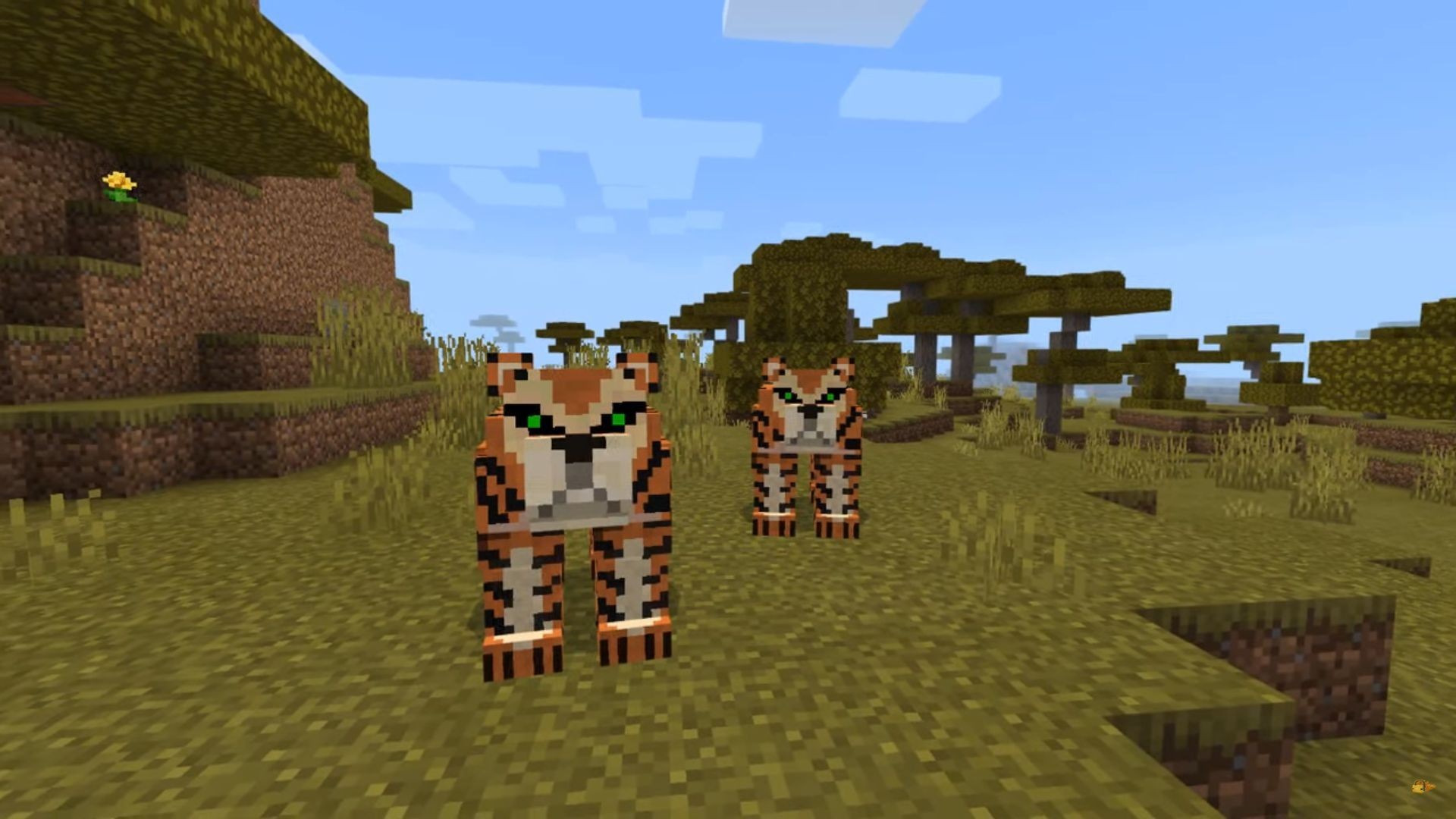
The World Animals addon adds a total of five dozen new animals. These animals come from totally different areas of the planet and range in size from tiny to huge, adding a huge amount of variety and life to the environment of Minecraft. For example, there are mobs as small as butterflies, shrimp, and kiwis to as large as elephants.

The addon also adds golden bones, which can be used to tame many of the addon’s animals, and a lot of the large mobs, including the elephants, have saddles available so players can ride them. New ores, including ruby ​​and citrine, and new food items such as rat tacos are also included.

This addon puts the Wild in the Wild Update, addressing some of the major complaints from the community.


1) Better Survival

youtube-cover

The Better Survival addon is focused on revamping and overhauling Minecraft’s core survival experience.

This is done in many ways, such as changing vanilla items to give them a purpose. For example, in the base game, there is no reason to craft cookies as they are one of the worst foods in Minecraft. However, for better survival, they grant speed. Additionally, dried kelp can grant players water breathing.

There are also several parity changes, which help bring the two versions of Minecraft in line with one another. This includes being able to trap endermen in boats or zombies dropping cooked potatoes when they die while on fire.

Fishing loot and piglin bartering have also been updated to offer better and more useful items. New structures and terrain generation features are present for players to discover and explore. The most recent version of the addon has added a new feature where players are given the coordinates of their last death, making retrieving loot dropped on death much easier and more convenient.


.

Categories
Technology

Security Researcher Raises Alarm After Detecting Possible Threat To macOS Version Of Zoom / Digital Information World

A security researcher has reportedly raised the alarm about a possible threat to the macOS version of Zoom.

The researcher claims to have found a new means through which attackers would now be able to enter into the whole operating system, thanks to a number of loopholes in the security offered by the platform.

New details surrounding the exploitation had to do with a presentation provided by Mac’s renowned security specialist named Patrick Wardle. He shed light on the matter in Las Vegas’s recent hacking conference that was held last Friday.

While some of the vulnerable bugs are gone, thanks to a quick interception by Zoom in this regard, it doesn’t mean everything is back to normal. The researcher has noted that there still remains one unresolved vulnerability that continues to affect all systems today.

As far as how the threat works are concerned, well, it has been detailed to target the installer involved in downloading Zoom. This is only possible when users give consent to allow a new Zoom to come forward or the old one to be removed from their device.

The installer needs the users to plug in their password when including the app in the system for the first time. When this occurs, Wardle realized that there was one function for auto updates that was continuing to run in the background after being given some great privileges.

When the app was seen releasing an update, the vulnerability would also get on board with the new version after making sure it was related to Zoom cryptographically. But the fact that there was now a bug being incorporated in the whole checking order means that if any file was provided with a similar name as that seen across the certificate of Zoom, it would pass this test with ease.

This way, so many attackers get the chance to replace any program on the app with malware and make it work thanks to the updater that gave it special privileges. And in the end, what you get is a privileged attack. This automatically thinks the attacker has entered the system and in the end, exploitation is conducted to get further access across the app.

At first, attackers start off as restricted users but within a short timeframe, they’re elevated to higher or superior statuses that are also commonly called superusers. This enables file addition, removal, and even deletion along the way.

Wardle was seen mentioning how he had warned Zoom last year in December regarding the major security threat. But to his dismay, their attempts at fixing it resulted in the addition of another major bug. This means there was still a bigger vulnerability at hand that could be exploited.

For this reason, I have waited for a good eight months, before publishing his recent research. This is after he told Zoom about the presence of a second bug.

Zoom provides a defense statement claiming that it gave a patch that would help rid the app but little did they know at the time that it wasn’t good enough to prevent the app from being exploited.

At the moment, the bug is definitely still working on Zoom but Wardle has mentioned how simple it is to fix. And that’s why his hopes of talking about it publicly can make all the difference.

As far as the latest update from Zoom is concerned, they have acknowledged the news with the firm’s head of security making claims of how they’re working hard to fix it diligently.

H/T: The Verge

Read next: Black Hat 2022 Security Researchers Reveal Hidden Loopholes In Tracking Devices

.

Categories
Technology

Relief for customers: Now broken screen of these Samsung phones will be converted to ₹2300

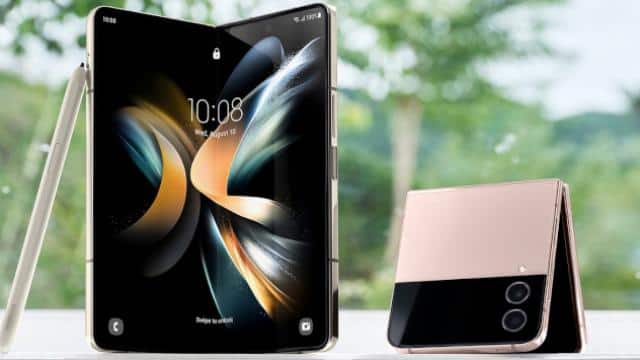
The cost of repairing expensive phones is also high, but Samsung has given great relief to customers of its high-end smartphones. We’re talking about Samsung Galaxy Z Fold 4 and Galaxy Z Flip 4 customers. The company launched these two new foldable phones to the world at the Unpacked event this week. To encourage customers to purchase the new foldable phone, the company is significantly repair costs under the Samsung Care+ reducing subscription plan this year. The Samsung Care+ plan includes coverage for drops, spills, and cracked screens. Eligible customers can replace the damaged screen of the new foldable phone by paying $29 (around Rs 2,300).

Samsung’s foldable phones come with one year of Samsung Care+ accidental damage protection. As mentioned, it covers devices against accidental damage, including screen replacement, water damage, and back cover replacement. However, after the warranty period, users will need to pay the full price for the folding screen replacement.

Also Read – 10 Cheapest Smartphones on Flipkart-Amazon: With Up to 6000mAh Battery and Up to 4GB RAM

This is the out-of-warranty screen repair cost
As reported by The Verge, new Galaxy Z Fold 4 and Galaxy Z Flip 4 repair costs now start at $29 (around Rs 2,300) to fix a broken screen. The screen repair cost for the previous generation Galaxy Z Fold 3 and Galaxy Z Flip 3 is around Rs 19,800 for those without standard warranty. According to Samsung’s support page, Samsung Care+ without out-of-warranty screen repair costs up to $480 (around Rs 38,200) for these models.

Price and features of the new foldable phone
Samsung Galaxy Z Fold 4 and Galaxy Z Flip 4 are expected to hit stores in the coming weeks with minor upgrades over their previous Galaxy Z Fold 3 and Galaxy Z Flip 3 models. India will start from noon on August 16th. Both new phones are powered by Qualcomm’s Snapdragon 8+ Gen 1 chip and support variable refresh rate. The screen and back glass have Corning Gorilla Glass Victus Plus protection and are IPX8 rated for dust and water resistance. The Samsung Galaxy Z Fold 4 starts at $1,799.99 (around Rs 1,42,700), while the Samsung Galaxy Z Flip 4 starts at $999 (around Rs 79,000).

Categories
Technology

Samsung Galaxy Buds 2 Pro early review: Most comfortable wireless earbuds yet?

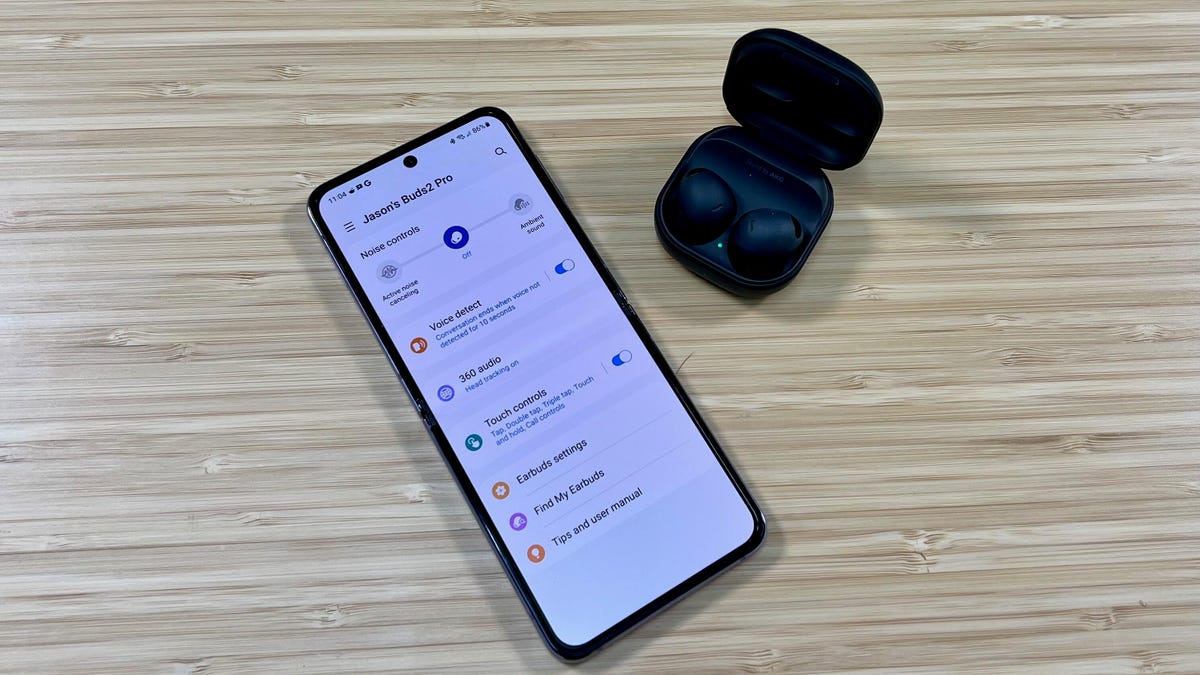
Galaxy Buds 2 Pro in their case with a phone showing the app

Jason Cipriani/ZDNet

Earlier this week Samsung announced a handful of new devicesall slated to begin arriving on Aug. 26. There are new Galaxy ZFold 4 and Galaxy ZFlip 4 smartphones, the Galaxy Watch 5 and Watch 5 Proand Galaxy Buds 2 Pro wireless earbuds. Shortly after the event ended, I received a review sample of the Buds 2 Pro.

For the past 48 hours, I’ve been using them as much as I could, listening to music and watching a few YouTube videos on a Z Flip 4. Thus far, the Buds 2 Pro are delivering on the promise of high-end wireless earbuds, with one exception.

Specifications

microphones 3 in each earbud
speaker Custom coaxial 2-way speaker
connectivity Bluetooth 5.3
Battery life w/ANC 5 hours listening, 18 hours total with case
Battery life w/ANC off 8 hours listening, 29 hours total with case
Features: Active noise cancellation, ambient mode, 360 audio, voice detection
Colors Bora Purple, Graphite, White
Water and sweat resistance IPX7
Price $229

Comfort is key

After 48 hours, I can say that the Buds 2 Pro just might be the most comfortable wireless earbuds I’ve worn yet. I was able to use the default medium-size ear tips that come installed on the earbuds. There are small and large tips included in the box, along with a USB-C to USB-C charging cable.

Comparing the Buds 2 Pro with the Pixel Buds Pro and AirPods Pro, Samsung’s earbuds have a unique shape to them. There’s the ear tip, then a small bump that fits nicely into my ear, with a larger area on the outside that houses the touchpad.

Review: Samsung Galaxy Z Fold 4: Lighter, brighter, and more user-friendly

I’ve been able to wear them for several hours nonstop without having to take a break because my ears are sore or feel uncomfortable. I also don’t feel as if the Buds 2 Pro are going to fall out of my ear. Maybe that’s because they feel much lighter than the Pixel Buds Pro. Each individual Buds 2 Pro earbud weighs 5.5 grams, while the Pixel Buds Pro earbuds weigh 6.2 grams each. It’s not a lot, but I can feel the difference (to be clear, I didn’t look up the weight until I started writing this, so it’s not a placebo effect).

The Galaxy Buds 2 Pro and a closed Galaxy Z Flip phone

Jason Cipriani/ZDNet

Sound quality and Pro features

The Buds 2 Pro have all of the staple features that now come with the Pro nomenclature for wireless earbuds. That means quick pairing, active noise cancellation (ANC) to block out background noise and some form of ambient or transparency mode that lets in background noise. All of those features work as expected, and are on par with the AirPods Pro or Pixel Buds Pro.

The ANC is strong enough to block out my very loud mechanical keyboard and office air conditioner when it’s running, while ambient mode lets all of that through while not drowning out the music I’m listening to.

The Buds 2 Pro, however, have a Voice Detect feature that turns on ambient mode and lowers the volume of whatever you’re listening to once it detects that you’re talking. The assumption is that you’re talking to someone, and adjusting the sound will make you better able to hear the person. After 10 seconds of the earbuds no longer detecting your voice, the sound settings revert to their previous state.

In a couple of quick tests, I found voice detection works well. It’s fast to respond when I start talking, and turns everything down low enough that I can hear someone across the room. You can customize the 10-second timeout to either 5 or 15 seconds, but not any longer than that. I wouldn’t mind a 20-second option.

Samsung also added 360 Audio to the Buds 2 Pro. It’s a feature that’s similar to Apple’s Spatial Audio that creates the effect of being surrounded by the music you’re listening to or the video you’re watching. Samsung’s 360 Audio is not as aggressive as Spatial Audio, but there have been times when I forgot 360 Audio was turned on and I’d turn my head and hear different instruments singled out.

Both Voice Detect and 360 Audio are features that you have to turn on in the Wear app — they aren’t enabled by default.

As for sound quality, Samsung added 24-bit Hi-Fi sound to the Galaxy Buds 2 Pro, but you need to have an audio source or streaming service that also supports 24-bit Hi-Fi. I don’t have access to either, so all I can speak to is the standard audio experience. As with ANC and ambient mode, the sound quality of the Buds 2 Pro is in line with other high-end wireless earbuds.

Battery life thus far has been good, but I need more time in order to get a real feel for how long the earbuds last, and how often I have to charge the case itself. More on battery life in the coming weeks, but as of right now it’s not something I’m worried about.

Galaxy Buds 2 Pro case, closed

Jason Cipriani/ZDNet

Automatic switching doesn’t seem to work

Or at least, I can’t figure it out. Samsung promises that once you pair the Buds 2 Pro with a Samsung device, the rest of your Samsung devices will automatically switch to the Buds 2 Pro if they’re in use and you start playing audio or receive a call. The caveat here is that you have to be signed in to both devices with the same Samsung account.

I did the initial setup and pairing of the Buds 2 Pro with the new Galaxy Z Flip 4, using the one and only Samsung account I have. On a few occasions, I’ve been listening to music on the Z Flip 4, and then tried to start streaming music or watch a YouTube video on my personal Z Fold 3 and a review model Z Fold 4. Not once has the audio switched away from the Flip 4 to either Fold device.

This is similar to my experience with the feature in the past with Samsung’s wireless earbuds. Am I doing something wrong?

I’ve reached out to Samsung about the apparent lack of auto-switching and will provide an update.

You can use the Buds 2 Pro with non-Samsung devices by pairing them via the traditional Bluetooth method. You need to place both earbuds in the charging case, and then long-press on both touchpads until the status light starts flashing red, green, and blue.

The Buds 2 Pro don’t support multipoint connections like the Pixel Buds Pro do. That means the Buds 2 Pro can only stay connected to one device at a time. If you want to switch from, say, a MacBook Pro back to your Galaxy phone, you’ll need to unlock the phone, open the Settings app, go to Connections and then Bluetooth, and select the earbuds.

For anyone who has multiple devices made by multiple companies, it’s a cumbersome and inconvenient process. And that’s unfortunate.

To be fair, Apple’s AirPods Pro (and the rest of the AirPods lineup) work in a similar fashion when in use with non-Apple devices. However, automatic switching between Apple devices is seamless.

Bottom line… for now

Early impressions are important, but I won’t pass final judgment after a couple of days of testing. Instead, I plan on updating this hands-on/early review over the course of the next two weeks, leading up to the full launch on Aug. 26. I have a couple of flights before then, which will be a great test of battery life and how well active noise cancellation blocks out noise.

Plenty more to eat.