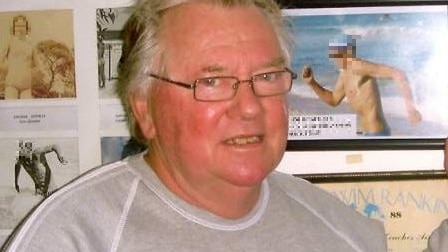
Former Australian swim coach Dick Caine is facing fresh sexual assault charges after four more alleged victims came forward to police.
Key points:
Police on Tuesday brought 11 new charges against Mr Caine
The former swim coach denies any wrongdoing
Last month a court was told Mr Caine only has months to live
The 76-year-old was arrested at his home in Condell Park in Sydney’s south-west last month following allegations of sexual assault by two former students in the mid-1970s.
The girls were aged 15 and 16 at the time.
NSW Police said they received information about alleged multiple sexual assaults of a teenage girl at a swim school in Sydney’s south.
During their investigation, police said they also received information about the alleged assault of another teenage girl at the same school.
On Tuesday, police brought 11 additional charges against Mr Caine for alleged acts of sexual assault against four new victims.
The alleged victims are three girls aged between 10 and 15 in the 1970s, and a 24-year-old woman in the 1990s.
He was granted conditional bail and appeared at Sutherland Local Court on Tuesday.
A court has previously heard Mr Caine has terminal lung and throat cancer and is expected to have just months to live.
He was released on bail due to his medical condition following his arrest in June.
Mr Caine is recognized as one of the country’s most successful swim coaches, training 17 Olympians and athletes from other sports.
He has been inducted into the Australian Marathon Swimming Hall of Fame.
The Gaudiosos’ lawyer Aaron Gadiel, a partner at Mills Oakley, said the state courts’ application of the law, in this case, represented “a radical change to the way compensation for land acquisition has been handled in NSW for decades”.
“The implications are quite sweeping,” Gadiel said. “It’s very rare that a family business will see the need to execute a formal lease. That’s not how family businesses will be thinking.
The family moved the showroom to a nearby site on Pyrmont Bridge Road, pictured, and the factory to Leichhardt.Credit:Wolter-Peeters
“Even when people have formal leases, if the lease doesn’t have a market value, if the lease isn’t tradable in the sense that it has a dollar value attached to it, then they will get no compensation if their business is forced to relocate.”
In submissions to the court, experts retained by the Gaudiosos estimated the business relocation costs were $6.23 million, including lost profit. Transport for NSW argued against any compensation but admitted, based on actual costs incurred, that if relocation costs had to be paid they amounted to $2.45 million – more than double the $1 million it originally paid.
Once the court found that no compensation was owed, lawyers for the government demanded the Gaudiosos repay the $1 million, warning that Transport for NSW reserved its right to take legal action to recover the money with interest.
Metropolitan Roads Minister Natalie Ward and Transport for NSW said it was not appropriate for them to make specific comments about the case because it remained before the courts.
“Unfortunately property acquisitions are unavoidable when it comes to delivering major infrastructure projects that are shaping the future of NSW,” Ward said.
A Transport for NSW spokesperson said the department appreciated the acquisition process was difficult for property owners, and respected their right to challenge offers in court.
The Gaudiosos moved Olde English Tiles to temporary premises nearby and eventually split the operations over two sites; a $5 million factory and $2.5 million neighboring warehouse in Leichhardt, and an Annandale showroom which they lease.
loading
But Antonino said he had to mortgage his Northwood home “to the max” to finance the relocation and fit out the new properties, which included installing a mezzanine at the factory to create sufficient floor space.
“[It’s] completely unfair,” he said. “They have robbed me for years of my work without even thinking [that] this man has worked for 40 years. I feel completely devastated.”
The family had also challenged the market value of the land, claiming it would have been worth more than $19 million if rezoned for higher-density residential and sold to a developer. The court did not accept this argument either.
“The legal reasoning was fair. We will move on. But the relocation expenses are really what gets us,” Dominic said.
“We operated on that land fairly for over a decade. We were acquired and because we didn’t have a lease in place, we don’t get a cent. Politicians need to revisit this nuance in that law, and they need to close that loophole.”
The saga is reminiscent of the compulsory acquisition of the Kerrigan family home in Rob Sitch’s Australian film classic TheCastle, which included the bumbling solicitor Dennis Denuto.
“Good old Dennis Denuto, he got across the line at the end,” Gadiel said. “We’re hoping for an equally happy ending with a smoother path for the Gaudiosos.”
The Morning Edition newsletter is our guide to the day’s most important and interesting stories, analysis and insights. Sign up here.
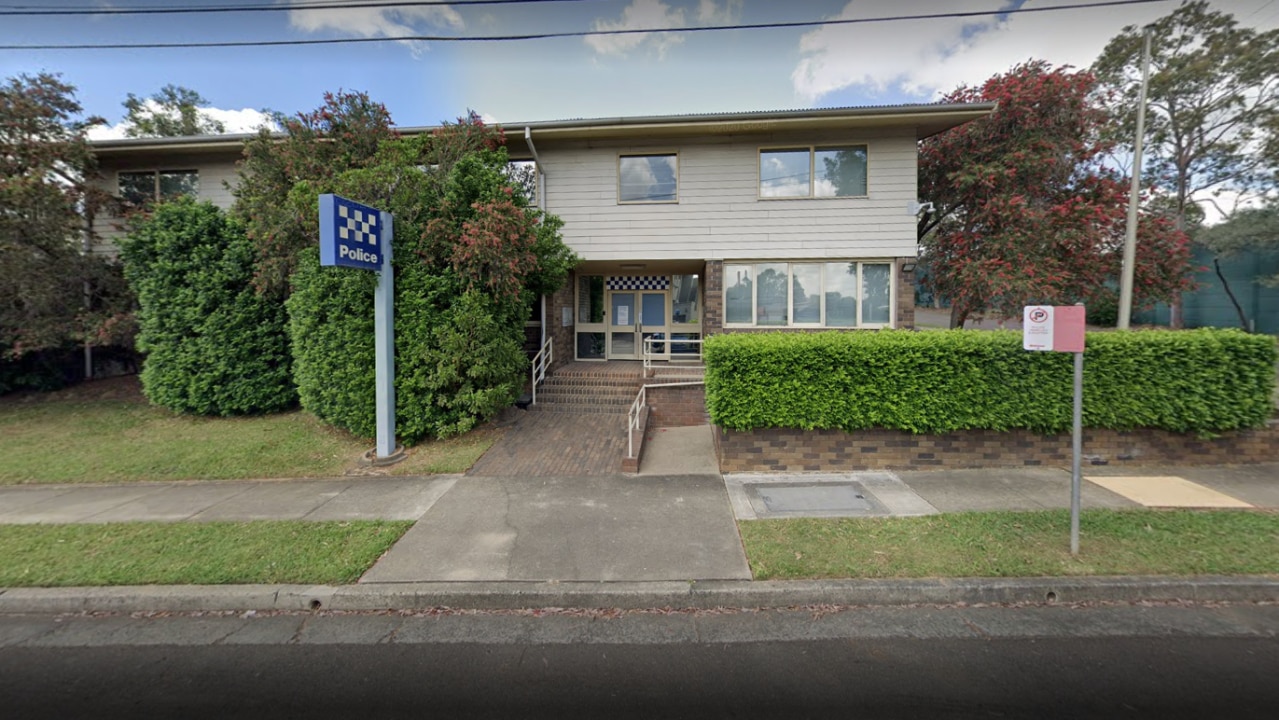
A detective has been found dead inside a police station in Sydney’s north-west.
The 46-year-old detective sergeant was on duty when he was found dead by colleagues inside a room at Ermington Police Station about 12:30pm on Monday.
NSW Police revealed initial inquiries suggest there are no suspicious circumstances surrounding the death.
The Daily Telegraph has reported the man died after a “shooting incident” and early investigations suggest the officer was shot with a police-issued firearm.
News has never been more important. Stream more than 20 global & local news sources with Flash. New to Flash? Try 1 month free =>
Detectives have launched a critical incident investigation into the man’s death.
“The 46-year-old detective sergeant from a specialist command was on-duty at the time and initial inquiries suggest there are no suspicious circumstances,” a statement from NSW Police read.
“A critical incident investigation has been launched by detectives from the South West Metropolitan Region, who will prepare a report for the Coroner.
“The investigation will also be reviewed by the Professional Standards Command and independently oversighted by the Law Enforcement Conduct Commission (LECC).”
Support services have been made available to the man’s colleagues, the officers who found him and those who were in the station at the time.
The death comes less than two years after another police officer took his own life at the Sydney Police Center in Surry Hills.
Prime minister Anthony Albanese has released the proposed draft change to the constitution to recognize Indigenous Australians with a voice to parliament.
But what will Australians be asked at a referendum, and what do we still need to know about a voice?
What is constitutional recognition?
Recognizing Indigenous Australians in the constitution is an idea that has gone through many iterations.
In 2007, the former Liberal prime minister, John Howard, proposed a symbolic preamble to the constitution to recognize the special place of Indigenous Australians as the first inhabitants of Australia.
The Rudd and Gillard governments set up an expert panel that in January 2012 recommended something more substantive: replacing the race power in the constitution with a new provision prohibiting racially discriminatory legislation.
In 2017 the Uluru statement from the heart, agreed by 250 Indigenous leaders after six months of consultation, asked for three things: a constitutionally enshrined voice to parliament; a Makarrata commission to supervise a process of agreement-making between governments and First Nations; and truth-telling.
What did Anthony Albanese propose?
On Saturday Albanese spoke at the Garma festival, revealing the proposed question for a referendum to recognize Indigenous Australians and the proposed alteration to the constitution.
The “starting point” is to add three sentences:
1. There shall be a body, to be called the Aboriginal and Torres Strait Islander Voice.
2. The Aboriginal and Torres Strait Islander Voice may make representations to parliament and the executive government on matters relating to Aboriginal and Torres Strait Islander peoples.
3. The parliament shall, subject to this constitution, have power to make laws with respect to the composition, functions, powers and procedures of the Aboriginal and Torres Strait Islander Voice.
At the referendum, Australians would then be asked:
Do you support an alteration to the constitution that establishes an Aboriginal and Torres Strait Islander Voice?
What does the Coalition say?
The opposition spokesperson on Indigenous Australians, Julian Leeser, said he supported the move to enshrine a voice in the constitution but wanted to see the detail of the question and the proposed reforms.
“We as a Coalition have an open mind about the issue of the voice that the government is putting forward, and we are awaiting the detail,” he said.
“This is a step today on that road, but we still want to know how the voice itself is going to operate.”
The Country Liberal senator, Jacinta Price, a Warlpiri woman, has been more strident, arguing in her first speech the government is “yet to demonstrate how this proposed voice will deliver practical outcomes and unite, rather than drive a wedge further between, Indigenous and non-Indigenous Australia”.
What detail already exists about the voice?
In July 2021, the Indigenous Voice Co-design Process, co-chaired Marcia Langton and Tom Calma, proposed voices at the local and regional, and the national level.
The national voice would be a “small body of Aboriginal and Torres Strait Islander members tasked to advise the Australian parliament and government” to ensure they “have a direct say on any national laws, policies and programs affecting them”.
The Australian parliament and government would be “’forced’ to ask the national voice for advice on a defined and limited number of proposed laws and policies that overwhelmingly affect Aboriginal and Torres Strait Islander peoples” while there would be an “expectation” to consult it on laws that “significantly” affect them.
It proposed “a 24-member model including five members representing remote regions, and one member representing the significant number of Torres Strait Islanders living on the mainland”.
Sign up to receive the top stories from Guardian Australia every morning
The report also detailed consultation standards and transparency mechanisms for the voice.
Constitutional recognition and the design of the voice has also been the subject of two joint select committees in parliament, including one co-chaired by Leeser and Labor’s Patrick Dodson.
When will the referendum happen?
The Albanese government has committed to take the voice proposal to a referendum in this term of parliament, which could be held as early as mid to late 2023.
In April the Uluru statement leadership launched a campaign ahead of the federal election calling for the voice referendum to occur on 27 January 2024, the “day after Invasion day/Australia day”, or 27 May 2023.
The latter date is the 56th anniversary of the successful 1967 referendum, which allowedthe commonwealth to make laws for Indigenous people and count them in the census, and also the sixth anniversary of the Uluru statement.
What happens now?
Since the parliament would have the power to set the “composition, functions, powers and procedures” of the voice, the question now is: what level of detail will the Albanese government give about these before the referendum?
On Friday, Langton said the structure of the voice had been “investigated to the point where there is nothing more we can say.”
She told Radio National:
When people say they want more detail, all that tells me is they refuse to read our report – because all that detail is there … I see this demand for more detail as mischief-making and sowing confusion … We couldn’t have been more clear than we have been … What we’ve set out in our report for a voice is very straightforward and clear, and is the preferred option of most Aboriginal and Torres Strait Islander people.”
On Sunday Albanese said the government won’t “go down the cul-de-sac of getting into every detail … because that is not a recipe for success”. On Monday, I told The Project “of course [voters] will know how it works” before the referendum.
The minister for Indigenous Australians, Linda Burney, indicated the body would be “representative” but more consultations would be needed about “the way in which a voice would be constituted”.
“I want to make sure that there is involvement and discussion not only with Indigenous leaders, not only across the parliament, but importantly with the Australian public, about what we should do going forward. It is not about the ‘what’ yet … it is about the ‘why’,” she told the ABC.
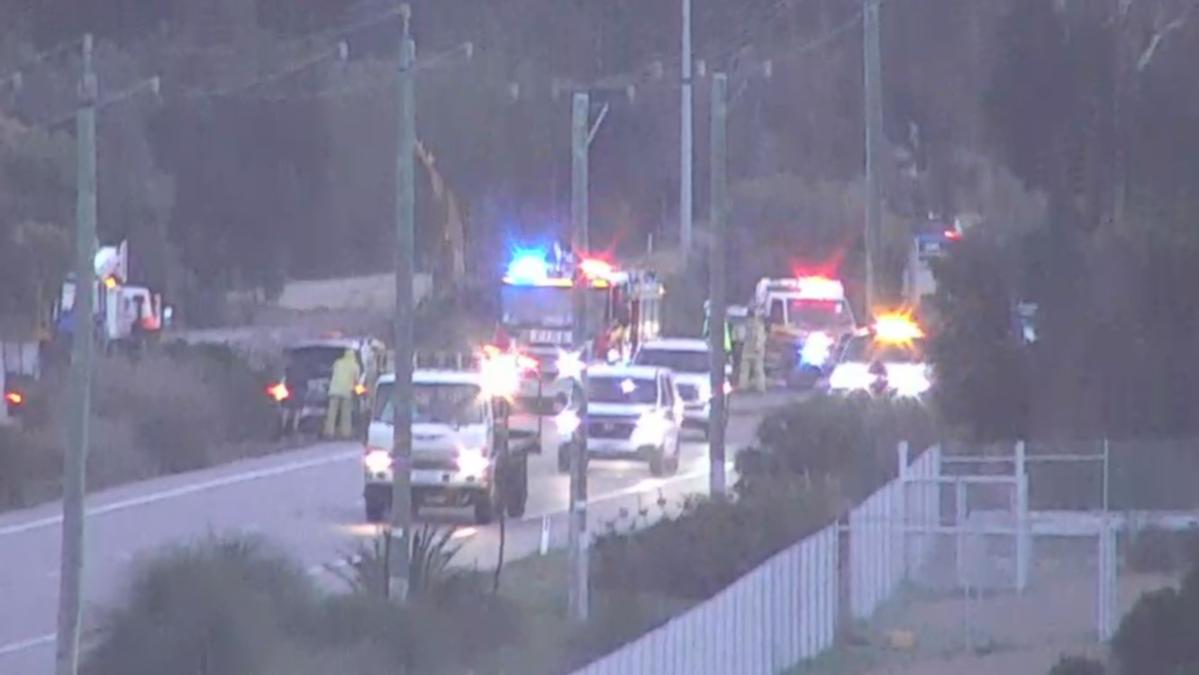
A tree has fallen on two cars in Ballajura on Tuesday morning, causing peak hour chaos as the once-in-a-year storm continues to rage through Perth.
Emergency services were called to the crash along Hepburn Avenue eastbound, after Marangaroo Drive about 6.30am, after two cars were struck by the tree.
Firefighters and western power are at the crash site working to clear the cars and debris from the road.
Everyone was evacuated from the cars and no serious injuries were reported.
Traffic remains heavy on approach and motorists are advised to seek an alternate route and expect delays.
Main Roads WA tweeted the crash about 7am, stating the right lane is blocked in the area and drivers should take caution.
It comes as thousands are without power across the State, with emergency services busy clearing failed power lines and trees blocking roads.
More than 155 calls for help were received by the Department of Fire and Emergency Services overnight.
The Bureau of Meteorology released a statement Tuesday morning stating the “series of strong cold fronts” will continue across the State until Wednesday.
“Thunderstorms and gale force winds exceeding 90km/h are expected for parts of the region,” the statement read.
“This weather system is expected to be windier and longer lasting than a typical front and is likely to produce the kind of weather that is only seen about once per year.”
Cape Leeuwin recorded a dangerous wind gust of 137km/h on Monday night, while Bickley recorded a gusty 117km/h on Tuesday morning.
Cape Naturaliste recorded 111km/h winds, Gingin Airport 109km/h, Shark Bay airport 107km/h, and the Busselton Jetty 100km/h.
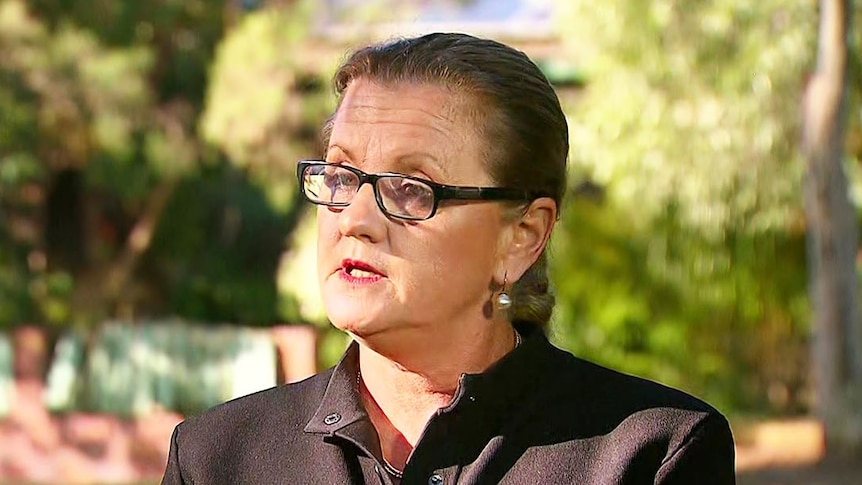
Redland Mayor Karen Williams has been investigated for misconduct by an independent assessor after complaints about her drink driving offence.
Key points:
Mayor Williams’s blood alcohol concentration was more than three times the legal limit
The Mayor has committed to return to work this week despite calls for her to resign
Mr Brown says he wrote to Steven Miles asking for the matter to be investigated
The Office of the Independent Assessor (OIA) confirmed it concluded an investigation into Ms Williams, relating to her crash in Cleveland in June, and the matter could be referred to the Councilor Conduct Tribunal.
Ms Williams was sentenced to 80 hours of community service and had her license disqualified for six months after pleading guilty to drink driving at the Cleveland Magistrates Court on Monday.
Her blood alcohol concentration was 0.177, more than three times the legal limit when she crashed her car on June 23.
The court heard Ms Williams crossed four lanes of traffic before she left the road, entered a ditch and struck a tree in the single-vehicle crash.
No conviction was recorded, and she was not fined over the offence.
The Redland Mayor described the incident as a “lapse in judgment” and has committed to return to work this week.
Member for Capalaba Don Brown said he wrote to Local Government Minister Steven Miles asking for the events leading up to the drink driving incident, including a zoom call with families of drink driving victims, to be investigated by the OIA.
“Elected officials, in the code of conduct for local government, can’t be drunk while conducting work — that’s what they’re investigating right now,” Mr Brown said.
Mr Brown said Ms Williams had lost the trust of her constituents.
“This is a time where Karen must put the people of Redlands first and know that we need new leadership.”
Ms Williams has been contacted for comment.
The OIA said the matter was currently with legal undergoing a natural justice process before possible referral to the Councilor Conduct Tribunal to decide.
In the summer of 2015-16, one of the most catastrophic mangrove diebacks ever recorded globally occurred in the Gulf of Carpentaria.
Key points:
Low sea levels caused by severe El Niño events are thought to have caused the mass mangrove deaths
Scientists say it is likely too late for the mangroves to recover
A $30 million fishing industry is expected to be impacted
Some 40 million mangroves died across more than 2,000 kilometers of coastline, releasing nearly 1 million tonnes of carbon — equivalent to 1,000 jumbo jets flying back from Sydney to Paris.
After six years of searching for answers, scientists have formally identified what is causing the mass destruction. They hope the discovery will help predict and possibly prevent future events.
Valuable mangroves ‘died of thirst’
Areas affected by severe mangrove dieback in late 2015 (grey shaded) along the gulf. Aerial surveys (red lines) were undertaken in 2016.(Supplied: NC Duke)
Mangrove ecologist and senior research scientist at James Cook University (JCU) Norman Duke was behind the discovery.
Dr Duke found that unusually low sea levels caused by severe El Niño events meant mangrove trees “essentially died of thirst”.
“The key factor responsible for this catastrophe appears to have been the sudden 40-centimetre drop in sea level that lasted for about six months, coinciding with no rainfall, killing vast areas of mangroves,” he said.
Author assisting with data analysis and JCU researcher Adam Canning said the study’s evidence for sea-level drop being the cause was found in the discovery of an earlier mass dieback in 1982, observed in satellite imagery.
Hundreds of kilometers of mangroves along the coast of Karumba have turned a ghostly white.(Supplied: James Cook University)
“The 1982 dieback also coincided with an unusually extreme drop in sea level during another very severe El Niño event. We know from satellite data that the mangroves took at least 15 years to recover from that dieback,” Dr Canning said.
“Now they are caught in a vicious collapse and recovery cycle because of repeated pressure from climate change — the question remains when or if they will recover.”
Economic impact
Mangroves are valuable coastal ecosystems providing buffer shorelines against rising sea levels, protection against erosion, abundant carbon sinks, shelter for animals, nursery habitats, and food for marine life.
The destruction of mangroves can lead to a loss of fisheries, increased flooding, increased coastal damage from cyclones, and increased salinity of coastal soils and water supplies.
Mangroves stripped of foliage along a small tidal channel near the Robinson River.(Supplied: Dr Norman Duke)
In the gulf, the mangrove dieback threatens a $30 million fishing industry, Dr Duke said.
“The fishing industry relies on these mangroves, including for redleg banana prawns, mudcrabs and fin fish,” he said.
“When the El Niño of 2015-16 struck, redleg banana prawn fishers reported their lowest-ever catches.”
Dr Duke said it was unlikely the gulf’s mangroves would recover due to the growing intensity of El Nino events.
“Our research reveals the presence of a previously unrecognized ‘collapse-recovery cycle’ of mangroves along gulf shorelines,” he said.
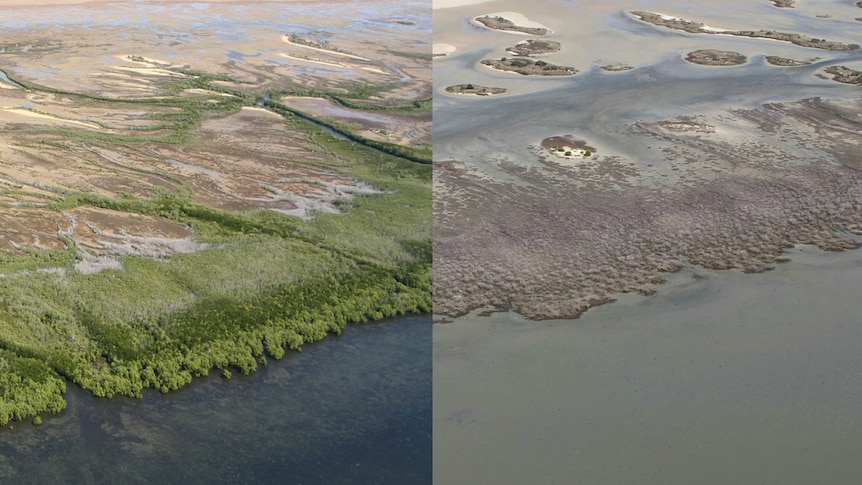
Images of different sections of foreshore taken months apart show the extent of mangrove dieback in the NT.(Supplied: NC Duke)
Before and after the loss of a section of mangroves in the Gulf of Carpentaria.(Supplied: Dr Norman Duke)
“The threat of future El Niño-driven sea level drops appears imminent, as evidence points to a link between climate change and severe El Niño and La Niña events.
“Indeed, El Niño and La Niña have become more deadly over the last 50 years, and the long-term damage they inflict is expected to escalate.
“Under these circumstances, the potential for the mangroves to recover is understandably low.
Protecting future ecosystems
Dr Duke said closer monitoring was key to preventing future mass diebacks. He said regular aerial surveys were a place to start.
“Tropical mangroves need much greater protection, and more effective maintenance with regular health checks from dedicated national shoreline monitoring,” he said.
Mangroves have died along a 2,000km stretch of coastline in the Gulf of Carpentaria.(Supplied: NC Duke)
“Our aerial surveys of more than 10,000 kilometers of north Australian coastlines have made a start.
“We’ve recorded environmental conditions and drivers of shoreline change for north-western Australia, eastern Cape York Peninsula, Torres Strait Islands and, of course, the Gulf of Carpentaria.
“As the climate continues to change, it’s vital to keep a close eye on our changing shoreline wetlands and to ensure we’re better prepared next time another El Niño disaster strikes.”
Dire teacher shortages have pushed the federal government to consider radical reforms to get more people to take up the profession or stay longer.
Key points:
Federal government will table plan to give some senior teachers a 40 per cent pay rise
Under the plan, professionals who want to retrain to be teachers could be paid to learn on the job
The Australian Education Union said pay rises are needed across the board
Under a plan to be tabled at an emergency meeting of federal, state and territory education ministers next week, senior teachers could get a pay rise, while professionals who want to retrain to be teachers could be paid to learn on the job.
But a pay rise would not be for everyone. So-called “master teacher” or senior teaching positions would be awarded a 40 per cent wage boost.
With more children at school than ever before but fewer people lining up to become teachers, Federal Education Minister Jason Clare said it was time for a shake up.
“It’s serious and it’s getting worse,” he said.
“It’s not just because of the flu, not just because of COVID, it’s bigger than that.”
He said paid teaching internships were on the table for professionals from other industries who were doing a two-year masters degree in education.
“It’s a good idea to get people already in the workforce — mid-career professionals — to make the shift to the classroom.”
“If you can get people who have got qualifications into the classroom, that’s a good thing.”
Pay rises needed ‘across the board’, says union
Mr Clare admitted higher pay would be a major shift but said it would be up for discussion.
“One thing is certain, we’re not going to fix this problem by doing the same thing time after time,” he said.
“We’ve got to look for new ideas that are going to help, not just fix the shortage of teachers but also raise the performance of our kids.”
In terms of paying for the changes, Mr Clare said the state and federal governments would have to “work together”.
The Australian Education Union deputy president Meredith Peace said the paid internship option could work.
She said people with experience in other careers were already benefiting students in classrooms.
But she wasn’t convinced by the idea of master teachers with big pay rises, arguing a wage rise for all teachers would be fairer.
“I don’t think it’s a solution to pick out a small group of people and give them significant pay increases,” she said.
“This is a much more complex issue than that. We need proper career structures that reward high performing teachers who want to stay in the classroom.
“We need to provide decent salaries across the board.”
It remains to be seen how service volumes change under Cross River Rail. Critics have questioned whether the project could deliver more than 24 trains an hour after earlier, and more expensive, designs promised up to 30 trains an hour.
The Cross River Rail Delivery Authority – the semi-government agency delivering the project – insists the long-awaited upgrade will provide the flexibility needed for south-east Queensland.
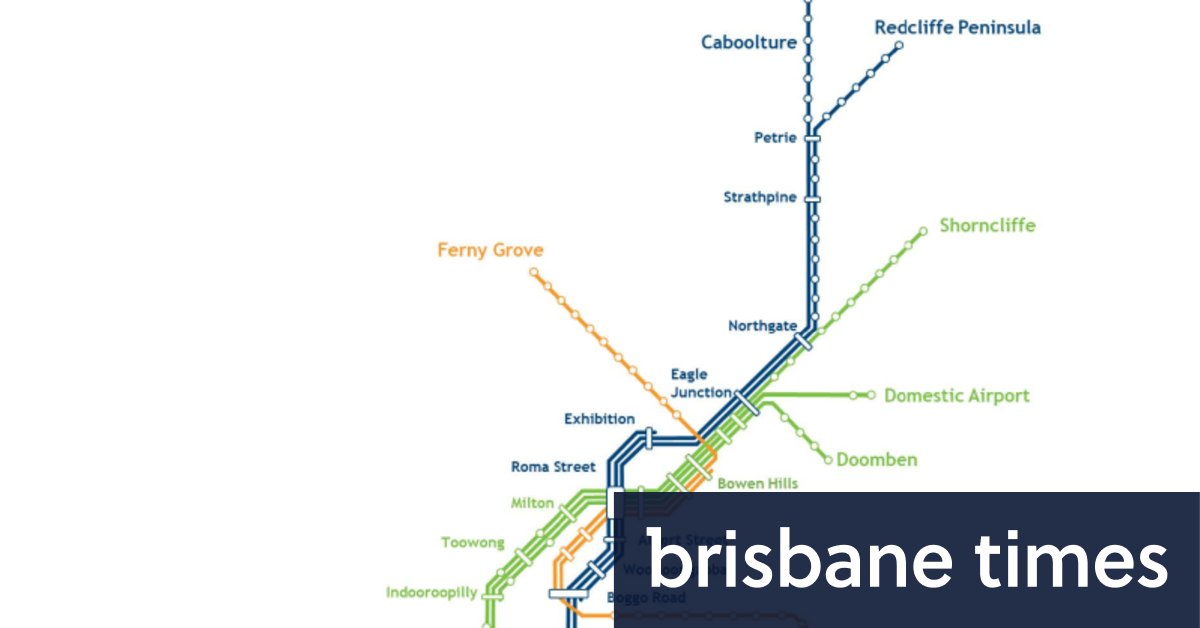
The current south-east Queensland rail network.
In October, the government honored a 2020 promise to build an additional 65 trains in Maryborough. The first 20 will be needed for Cross River Rail.
Bailey said all new services under Cross River Rail would travel via Roma Street, either through the existing station or below-ground platforms.
“This will be a big change for some customers,” he said.
“But it presents many opportunities, especially when considering the sheer level of investment and good jobs that will be supported.”
loading
The Gold Coast to Sunshine Coast line will service the new Boggo Road, Woolloongabba and Albert Street stations, also running through upgraded Roma Street and Exhibition stations.
The line, which will have three tracks in the inner-city but only two outside, is also subject to proposed extensions in the south (Salisbury to Beaudesert line) and the north (Beerwah to Caloundra and Maroochydore).
The Ipswich line recognized the proposed extension past Springfield, where a 25-kilometre loop back into central Ipswich through the fast-growing Ripley Valley is now being evaluated. It will have three tracks between Indooroopilly and Eagle Junction.
The announcement comes as Brisbane City Council reviews its bus routes. Connectivity between the two modes of transport will be crucial to cater for ongoing population growth in the region, with new transport hubs expected to support more residential development.
loading
Bailey said Cross River Rail would employ 1,700 Queensland subcontractors providing 7,700 jobs by mid-2025.
He said $7.2 billion transport funding over the next four years included planning for rail extensions.
“The Rail Connect plan is headlined by projects like the Beerburrum to Nambour and Kuraby to Beenleigh track duplications, the Gold Coast Light Rail stage three, station upgrades across Queensland, plus manufacturing 65 new trains in Maryborough,” he said.
NSW Trade Minister Stuart Ayres has conceded that he should have advised former deputy premier John Barilaro not to apply for an overseas trade role.
Key points:
Mr Ayres accepts his position would be untenable, if he is proven to have acted improperly
The NSW Premier says an independent review into Mr Barilaro’s appointment to the trade role is due “very shortly”
Leaked emails revealed Mr Ayres put forward a name to be added to a shortlist of candidates for the role
Mr Ayres has told Nine Radio that Mr Barilaro’s application for Trade Commissioner to the Americas came too soon after he left parliament, and that he should have advised him not to apply for the role.
“If I had my time again, I would have said to him: ‘The time frame between the end of your parliamentary career and you applying for this job will be too politically sensitive and you should not consider doing the role’,” Mr Ayres said.
He accepted his job was on the line and he would be unable to continue as trade minister if the review found he acted improperly.
“I am confident that all of my actions have been in the best interests of the public and I think that’s what that review will show,” Mr Ayres said.
“If the [Graham] Head review shows that I have not done the right thing, then I don’t think my position would be tenable, but I don’t believe that’s the case.”
Mr Ayres has confirmed he texted a copy of the job advertisement to Mr Barilaro when it was first advertised after Mr Barilaro expressed an interest in the role.
But Mr Ayres has denied he had any role in Mr Barilaro’s subsequent appointment to the role.
“Of course, I undertake my own reflections on my course of action, but everything I’ve done as a minister has been about making sure we deliver the best outcomes for the people of New South Wales,” Mr Ayres said.
“I’ve always acted in the interests of the public.
“I’ve always undertaken my ministerial duties with the highest level of integrity and I’ve always wanted to make decisions in the best interests of the public.”
Mr Barilaro was announced as the successful candidate in June.
The position is based in New York and comes with a $500,000 salary package.
Mr Barilaro later withdrew from the position, saying it had become untenable.
Mr Ayres said Premier Dominic Perrottet had not asked him to stand aside over the matter but admitted it had been a “challenging” few weeks.
“[Mr Perrottet] has been really supportive through this whole exercise,” Mr Ayres said.
“He’s made it pretty clear that he’s put in place the independent review that’s been conducted by Graham Head, a former public service commissioner, and he wants to wait until that review’s completed and he’ll make his decisions after that.”
Deputy Premier and Nationals leader Paul Toole refused to comment directly on whether he supported Mr Ayres but said public confidence in ministers was critical.
“As the leader of the National Party and as the Deputy Premier I have very high standards and I have very clear expectations of my ministers,” he said.
“I expect them to be acting with honesty and integrity at all times.”
Leaked emails last week revealed Mr Ayres put forward a name to be added to a shortlist of candidates for the role, but he maintains that name was not John Barilaro’s.
Documents released yesterday revealed another candidate was recommended ahead of Mr Barilaro before he was later ranked higher.
Mr Perrottet said he was expecting the independent review into Mr Barilaro’s appointment “very shortly”.
Mr Perrottet initiated the review in late June and it has been conducted alongside a parliamentary inquiry.