Categories
Technology

Using hand gestures can improve your experience of video calls

Signals, such as putting your hand over your heart to signify empathy or thumbs up to show you agree, seem to improve people’s experience of video calls more than typing words or using emojis

Technology


August 3, 2022

Back view of a woman making video call and showing thumbs up

Giving signs like a thumbs up can make video calls feel better

Josep Suria/Shutterstock

Using simple hand gestures during video calls seems to improve people’s experience of such interactions.

Paul Hills at University College London (UCL) came up with a set of gestures after many video calls during covid-19 lockdowns. “It was born out of my frustration with [online] meetings,” says Hills – who also works as a management consultant – during a video call with New Scientist in which he uses the hand actions.

In online meetings, he began informally testing a range of gestures, including ones borrowed from his work as a volunteer lifeguard and as a mentor to an addiction support group.

Initial positive feedback prompted him to team up with Daniel Richardson at UCL and other colleagues to more formally test the signals.

The researchers arranged a randomized trial involving about 120 undergraduate psychology students at UCL and their seminar leaders who were introduced to nine gestures, which they called Video Meeting Signals.

These include putting your hand over your heart to signify empathy, thumbs up or down to show agreement or disagreement and putting your hand on your head to suggest you want to ask a question. The last of these signals, says Hills, was borrowed from the movies of Laurel and Hardy.

Half of the students were asked to use those signals in seminars done by video call, and a control group had meetings, but didn’t use the signs. Participants reported in surveys afterwards that their group affiliation felt stronger because of their use of gestures. The data suggests a 98 per cent probability that this was because of the gestures, and a 93 per cent probability that they contributed to a better personal experience.

“It seemed to be helping,” says Richardson, speaking in the same video call interview as Hills and also using some of the gestures. “It did make these conversations more efficient, people said. They felt like they were achieving their goals sooner.”

The researchers did a second experiment, in which non-students were paid for their time, which also included a third group using emojis instead of gestures. Gestures showed a similar advantage over the control group again, and also over the emoji group.

Hills and Richardson feel that gestures are better than using emojis or typed words in a text chat because of their speed – although they acknowledge that using gestures requires participants to devote their full focus to video call screens, rather than multitasking on video calls, as many people do.

Hills now runs video meeting workshops for businesses on how to use the gesture technique, for a fee.

“It is interesting to see an empirical study examining the efficacy of gesture in this space,” says Matt Wood at the University of the West of England in Bristol, UK. He points out that the commercialization of the work means its results should be treated with caution. “The structure of conversation in videoconferencing appears to be important and to these ends, this paper introduces a potentially interesting framework,” he says. “But the use of gesture is not in any one researcher’s – or marketing company’s – hands.”

Journal reference: PLoS OneDOI: 10.1371/journal.pone.0270399

More on these topics:

.
Categories
US

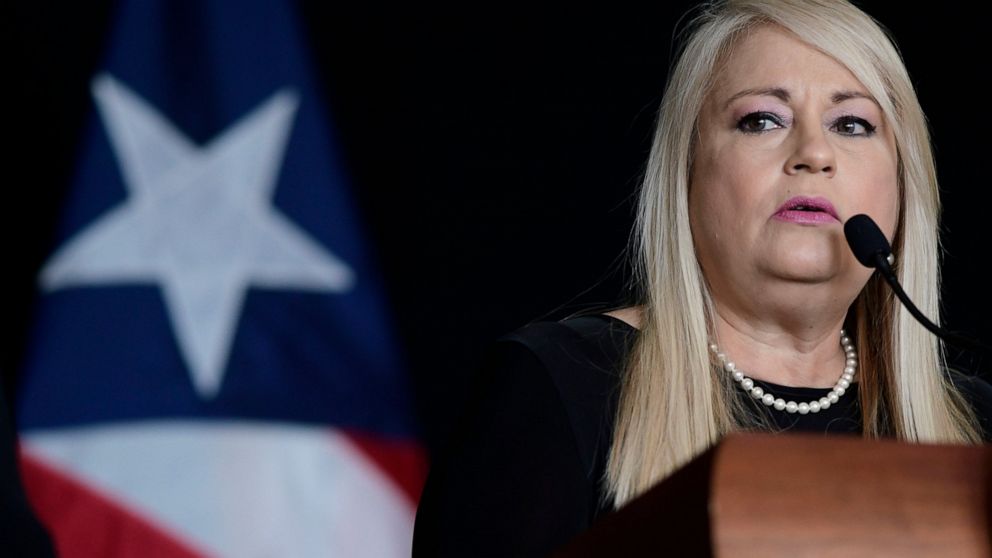
Former Puerto Rico Gov. Wanda Vázquez charged with bribery

San Juan Puerto Rico — Form Puerto Rico Gov. Wanda Vázquez was arrested Thursday on bribery charges related to the financing of her 2020 campaign, the latest hit to an island with a long history of corruption that brought fresh political upheaval to the US territory.

Vázquez is accused of engaging in a bribery scheme from December 2019 through June 2020 — while she was governor — with several people, including a Venezuelan-Italian bank owner, a former FBI agent, a bank president and a political consultant.

“I am innocent. I have not committed any crime,” she told reporters. “I assure you that they have committed a great injustice against me.”

The arrest embarrassed and angered many in Puerto Rico who believe the island’s already shaky image has been further tarnished, leaving a growing number of people who have lost faith in their local officials to wonder whether federal authorities are their only hope to root out entrenched government corruption . Concern over previous corruption cases led to a delay in federal aid for Puerto Rico after Hurricane Maria as the US government implemented more safeguards.

Thursday’s arrest also was a blow to Vázquez’s pro-statehood New Progressive Party, which is pushing to hold a referendum next year in a bid to become the 51st US state.

Vázquez was the second woman to serve as Puerto Rico’s governor and the first former governor to face federal charges. Former Gov. Aníbal Acevedo Vilá of the opposing Popular Democratic Party was charged with campaign finance violations while in office and was found not guilty in 2009. He had been the first Puerto Rico governor to be charged with a crime in recent history.

“For the second time in our history, political power and public office are used to finance an electoral campaign,” said José Luis Dalmau, president of Acevedo’s party. “Using the power of the government to advance political agendas is unacceptable and an affront to democracy in Puerto Rico.”

Vázquez’s consultant, identified as John Blakeman, and the bank president, identified as Frances Díaz, have pleaded guilty to participating in the bribery scheme, according to the US Department of Justice.

In early 2019, the international bank owned by Julio Martín Herrera Velutini was being scrutinized by Puerto Rico’s Office of the Commissioner of Financial Institutions because of transactions authorities believed were suspicious and had not been reported by the bank.

Authorities said Herrera and Mark Rossini, the former FBI agent who provided consulting services to Herrera, allegedly promised to financially support Vázquez’s 2020 campaign for governor in exchange for Vázquez dismissing the commissioner and appointing a new one of Herrera’s choosing.

Authorities said Vázquez accepted the bribery offer and in February 2020 demanded the commissioner’s resignation. She then was accused of appointing a former consultant for Herrera’s bank as the new commissioner in May 2020. After the move, officials said Herrera and Rossini paid more than $300,000 to political consultants to support Vázquez’s campaign.

A flurry of messages exchanged during that time between people involved in the case included a heart emoji attached to the commissioner’s resignation letter and three sealed lips emojis when someone provided Rossi’s name to Vázquez, who requested the name of “the guy from the FBI.” In addition, Herrera texted Rossini about the need for a campaign manager and said he didn’t want “a monkey from Puerto Rico.”

After Vázquez lost the primary to current Gov. Pedro Pierluisi, authorities said Herrera then allegedly sought to bribe Pierluisi to end an audit into his bank with favorable terms. Herrera is accused of using intermediaries from April 2021 to August 2021 to offer a bribe to Pierluisi’s representative, who was actually acting under FBI orders, according to the indictment.

Officials said Herrera then ordered a $25,000 payment to a political action committee in hopes of trying to bribe Pierluisi.

Stephen Muldrow, US Attorney for Puerto Rico, said Pierluisi is not involved in the case.

Vázquez, Herrera and Rossini are each charged with conspiracy, federal bribery programs and honest services wire fraud. If they are found guilty on all counts, they could face up to 20 years in prison, officials said.

Meanwhile, Díaz and Blakeman could face up to five years in prison, officials said.

Muldrow said officials believe Herrera is in the United Kingdom and Rossini in Spain. It wasn’t clear if the US would seek to extradite them.

Juan Rosado-Reynés, a spokesman for Vázquez, told the AP he did not have an immediate comment.

Attorneys for the other suspects charged in the case could not be immediately reached for comment.

In mid-May, Vázquez’s attorney told reporters that he and his client were preparing for possible charges as the former governor at the time denied any wrongdoing: “I can tell the people of Puerto Rico that I have not committed any crime, that I have not engaged in any illegal or incorrect conduct, as I have always said.”

Vázquez was sworn in as governor in August 2019 after former Gov. Ricardo Rosselló stepped down following massive protests. She served until 2021, after losing the primaries of the pro-statehood New Progressive Party to Pierluisi.

In a statement Thursday, Pierluisi said his administration will work with federal authorities to help fight corruption.

“No one is above the law in Puerto Rico,” he said. “Faced with this news that certainly affects and lacerates the confidence of our people, I reiterate that in my administration, we will continue to have a common front with federal authorities against anyone who commits an improper act, no matter where it comes from or who it may implicate.”

Vázquez previously served as the island’s justice secretary and a district attorney for more than 30 years.

She became governor after Puerto Rico’s Supreme Court ruled that the swearing in of Pierluisi — who was secretary of state in 2019 — as governor was unconstitutional. Vázquez at the time said she was not interested in running for office and would only finish the nearly two years left in Rosselló’s term.

Rosselló had resigned after tens of thousands of Puerto Ricans took to the street, angry over corruption, mismanagement of public funds and an obscenity-laced chat in which he and 11 other men including public officials made fun of women, gay people and victims of Hurricane Maria, among others.

Shortly after she was sworn in, Vázquez told the AP that her priorities were to fight corruption, secure federal hurricane recovery funds and help lift Puerto Rico out of a deep economic crisis as the government struggled to emerge from bankruptcy.

During the interview, she told the AP that she had long wanted to be in public service: as a girl, she would stand on her balcony and hold imaginary trials, always finding the supposed defendants guilty.

.

Categories
Technology

Halo 2’s ‘Impossible’ $20,000 Challenge Finally Conquered

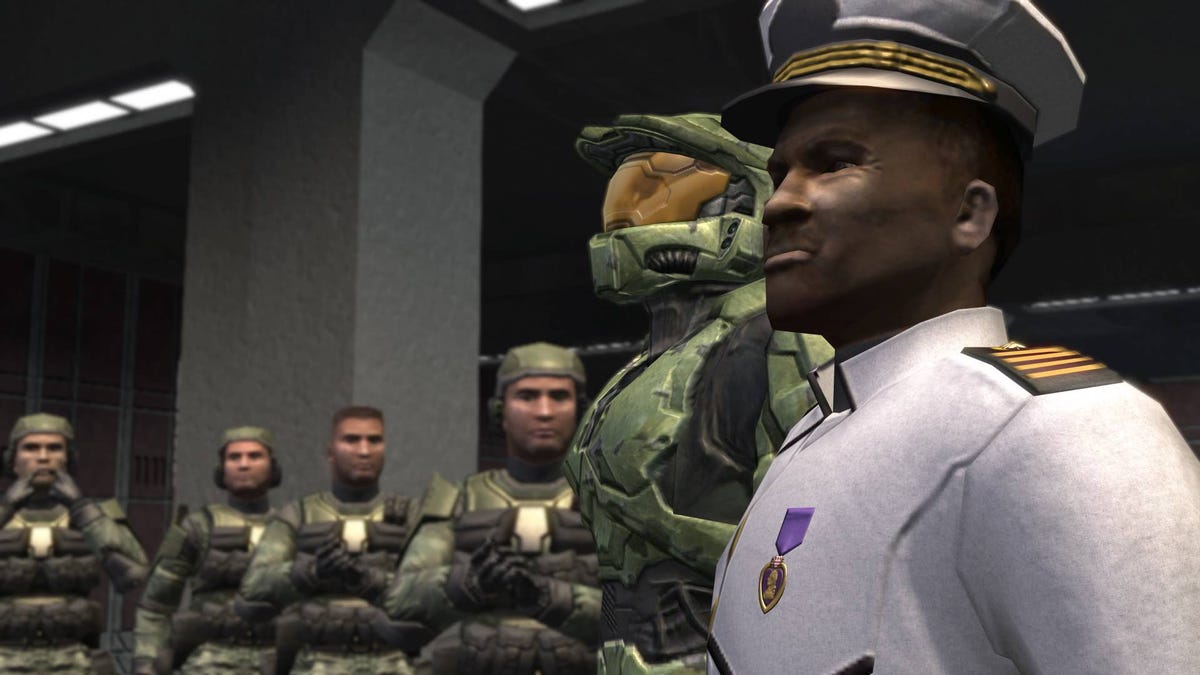
Master Chief stands next to Sergeant Johnson in Halo 2.

screenshot: Bungie/IGDB

They said it was impossible and, for nearly two decades, that seemed to be the case. But last night, a streamer named Jervalin beat Halo 2‘s “LASO deathless” challenge, earning a cool $20,000 in the process. Talk about finishing the fight.

Let’s rewind. Earlier this summer, the YouTuber Charles “Cr1tikal” White Jr.. posted a $5,000 bounty to beat Halo 2 on the highest difficulty setting, with every bonus challenge modifier turned on, without dying. In the 18 years since Halo 2‘s 2004 release on Xbox, no one had ever published evidence of completing the challenge. White’s challenge stipulates that the whole run is streamed, either on YouTube or Twitch. By July, no one had successfully stepped up to the plate, so last month, White tacked an extra $15,000 onto the bounty.

Most observers keeping tabs on the challenge had their money on Jervalin—a relatively private streamer who’s picked up a modest following for setting world records on a variety of Halo challenges—being the first person to complete it. Sure enough, late last night, I’ve crossed the finish line. (Here’s the archived stream.)

Bungie/Jervalin

Neither White nor Jervalin could be reached for comment in time for publication.

Jervalin was remarkably chill for finishing what some people, including White Jr., have called the “hardest challenge in all of gaming,” addressing viewers in the even-handed tone you’d use while moving on to the next addendum in a mostly empty community board meeting.

“All right, chat,” he said. “I think we did it. I think we fucking did it. Imagine that. Two years ago, I said, ‘I think this is impossible.’ Imagine fucking that.”

Whether or not Halo 2‘s “LASO deathless” challenge really is the “hardest… in gaming” is, of course, a subjective measure. But it’s definitely up there. You have to activate all of the game’s skulls, or gameplay modifiers that typically ramp up the difficulty. The Catch skull, for instance, makes enemies toss grenades more frequently. Famine, meanwhile, means enemies drop half the ammo they usually would. Mythic doubles the health of all enemies, while Angry increases the enemy’s fire rate. Blind removes your HUD. Assassins turns enemies invisible. (It’s not technically there skulls, however. For the challenge, Envy is left off, because that one grants you invisibility too, which does not make Halo 2 more difficult, for obvious reasons.) All together, when you turn every skull on and play on Legendary, the game’s highest difficulty setting, you more or less create a set of conditions that ensures you die instantly if you take any damage.

Jervalin had to rely on a few exploits to finish the challenge. To wit: He brought a banshee, a violet-colored aerial vehicle with a powerful cannon, into the final boss fight against Tartarus on the “Great Journey” level. That final fight takes place on a series of circumferential platforms hovering over an abyss. With pinpoint precision, he used the banshee’s cannon to send waves of foes careening off the edge as they spawn—before they get a chance to really even fight.

I’ve been covering the Halo community for a while now, and can’t recall a time where I’ve seen players pretty unanimous in an opinion, let alone a positive one. Sure, halo-infinitethe latest game in the series, has its issues, which players are not shy about criticizing. But there remains a reverence among even the biggest names for Bungie’s original games since the mid-2000s, and the mind-bogglingly impressive feats players are able to pull off.

The run garnered praising desde Halo streamers like Remy “Mint Blitz” and Luc “HiddenXperia.” Emanuel Lovejoy, the coach for Cloud 9, arguably the best professional Halo team on the planet right now, called Jervalin to “legend.” so did Spacestation Gaming’s UberNick. the Halo pro Kyle Elam noted how yesterday’s scrims—basically, matches between pro players that don’t count toward the official seasonal record—were put on pause so players could collectively watch Jervalin get it done. “Gonna need Jervalin to make a Twitter so we can actually @ this legend [clapping hands emoji],” Halo esports analyst and caster Alexander “Shyway” Hope said. It has been a genuine delight to witness such universal acclaim from all corners of the community.

But the most heartwarming moment—the sort of moment that proves Este, not the toxicity that inhales so much oxygen out of the room, is what video games are all about—happened in the final seconds of the stream: Jervalin’s family runs into the stream, embracing him in an almost suffocatingly tight bear hug. $20,000 is nice. That’s nicer.

.

Categories
US

You DA Chesa Boudin says he won’t run for re-election

Former San Francisco District Attorney Chesa Boudin — the progressive prosecutor who was ousted by voters in June — said Thursday he won’t be running in the special election this year.

Boudin explained his choice not to seek re-election in a Twitter threadsaying he is putting his “family first.”

“Over the past weeks, I’ve spoken to family, friends and every day San Franciscans about how we can best continue to make our criminal justice system fairer and more effective. I have devoted my public life to this effort because it makes our communities stronger & safer,” he wrote.

“I’ve also taken stock of the burden of more than three years of nearly non-stop campaigning placed on my family,” Boudin said, adding, “I’m committed to criminal justice reform; I’m also committed to my family.”

Fed-up San Francisco voters recalled the progressive DA during a June 7 election over what many said were Boudin’s soft-on-crime policies that contributed to the city’s surge in crime, open-air drug dealing and robberies.

Mayor London Breed appointed Brooke Jenkins as the new DA in July.

During a press conference on Wednesday, Jenkins announced a new office policy that would revoke open drug plea cases and promise to hold dealers accountable.

Chesa Boudin waves at cars as he canvasses in San Francisco prior to his ouster in June.
AP
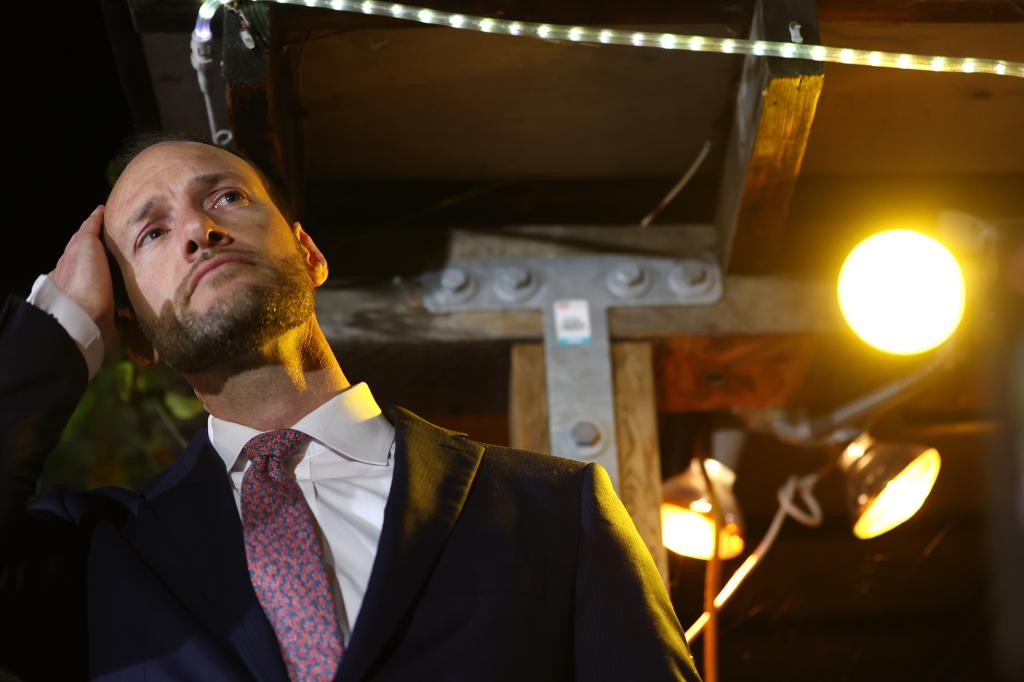
Boudin looks distracted during election night on June 7.
Getty Images

“We cannot stand by while these neighborhoods continue to suffer with violence and drug dealing happening openly on their streets, and we also cannot continue to stand by while people continue to die on our streets,” Jenkins said. “We have to make changes now to save lives.”

Boudin told the San Francisco Chronicle last month that he was still considering running for the top prosecutor position.

On Thursday, however, Boudin said focusing on his family will come first, including taking care of his elderly father, who “just came home from prison after more than 40 years.”

As DA, Boudin came under fire for his soft-on-crime policies in the face of rising crime in the city.
Getty Images

His father, David, who received parole last year, was part of the left-wing group Weather Underground. David Boudin and his wife, Kathy, served prison time for a botched 1981 robbery in New York that left two police officers and a Brinks truck guard dead.

Boudin’s mother died of cancer in May.

The embattled DA stood by his policies, including his resentencing work that “offered second chances to those who had caused harm and supported victims,” according to his tweet.

.

Categories
Technology

Game changed: Evil Geniuses signs former Dignitas women’s VALORANT roster

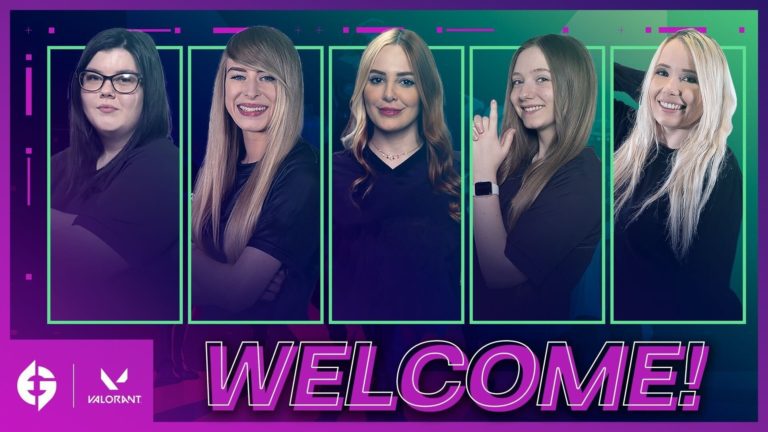
Evil Geniuses is continuing to bolster its growing presence in the developing VALORANT scene following the acquisition of the former Dignitas women’s roster.

The female roster, going by the name EG VALORANT or EG Game Changers VALORANT, consists of captain Emmalee “EMUHLEET” Garrido, Amanda “rain” Smith, Juliana “Showliana” Maransaldi, Melisa “theia” Mundorff, and Stefanie Jones. David “Xp3” Garrido will also come over as coach, according to EG’s announcement tweet. But an exclusive interview with Washington Post says that main roster coach Christine “potter” Chi will “oversee both teams.”

in that Washington Post interview with EG CEO Nicole LaPointe Jameson, Jameson said that the EG Game Changers roster will relocate to the organization’s Los Angeles facility, where they will have access to “subsidized housing, physical fitness conditioning, nutrition and data-driven training.” The team’s debut is set for the Astral Clash event beginning on Aug. 6, an event that the players qualified for while still under the Dignitas Female banner.

The acquisition of the Game Changers roster is the latest step forward for a growing VALORANT division at EG. The organization entered the scene with the first mixed roster at the beginning of 2021 but eventually parted ways with all of those players except for Potter, who eventually took over as head coach. After a dismal 0-5 showing in Stage One of NA VCT this year, the team re-tooled and finished top six in Stage Two, qualifying for the LCQ. Famed NA CS:GO pro Stewie2K recently stepped back from the active EG CS:GO roster to focus on primarily streaming VALORANT.

EG is seeking to improve its stake in VALORANT with a partnered spot in VCT 2023. On July 23, Jameson tweeted out that EG is “still in the running” for a slot.

Categories
US

Kentucky’s Floods Took Appalachian History With Them

Appalshop has been a cornerstone of Whitesburg, Ky., since 1969, working to tell stories about Appalachian people through art, film, music and more with a focus on their voices. Its theater usually hums with actors portraying the experiences of the region; the community radio broadcasts music and local news; and its rich archive provides a huge repository of central Appalachian history.

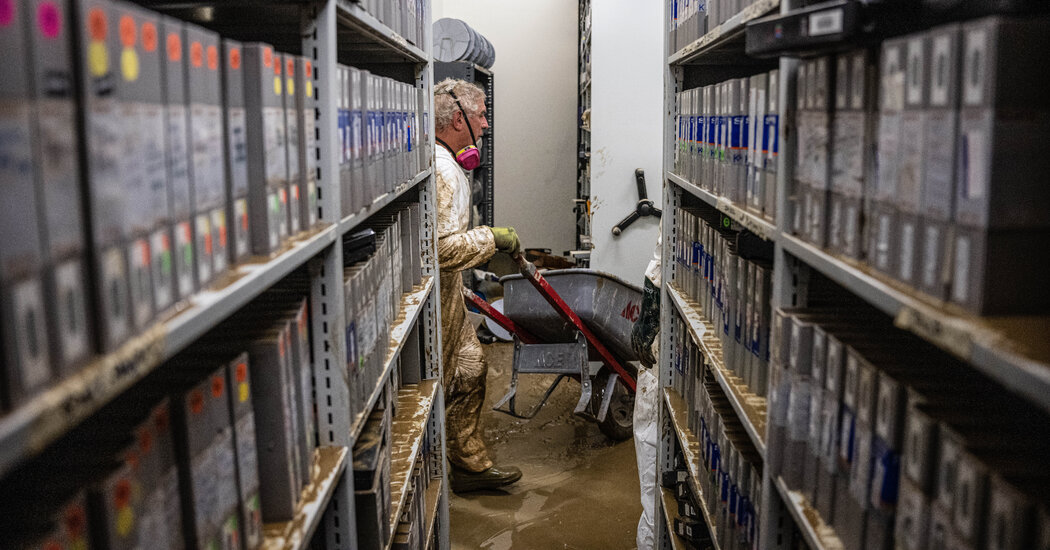
But on Wednesday, as Alex Gibson, the organization’s executive director, stood inside the building that has housed Appalshop for four decades, all he could see was mud.

Water damage covered the walls of the radio station. Every chair in the newly renovated 150-seat theater was caked in sludge. Filing cabinets, tables, CDs and loose film strips were tangled together. And possibly worst of all, many of the contents of Appalshop’s archives were covered in mud and debris after devastating floods in the region last week left the building submerged in water.

Mr. Gibson said he was most struck by the “indiscriminate nature with which the water destroyed things.”

“I’m seeing things that shouldn’t be together,” Mr. Gibson said. “There’s a banjo constructed by a master banjo maker covered in mud next to one of our first LP releases in 1970.”

I added, “We used to have an organized archive.”

The floods killed more than three dozen people across Eastern Kentucky and displaced hundreds more. Many are still without power. Even amid the loss of life and property, members of the Appalachian community were also mourning the loss of the region’s cultural heritage.

“We’re going to try our best to save everything we can save,” Mr. Gibson said. “It’s obviously emotionally devastating to see such precious materials just sitting in water and whatever chemical combination is on my boots right now.”

Mr. Gibson and Caroline Rubens, Appalshop’s archivist, are working against the clock alongside some 50 volunteers. Their goal is to recover what Appalshop estimated to be hundreds of thousands of archival pieces from across mediums: film, photographs, artisan crafts, woodworking, musical instruments, magazines, newspapers, posters and personal family archives that have been donated to the group — all depicting life in the Appalachian Mountains.

Water tore through the first floor of Appalshop’s building, which it has occupied since 1982. That included the radio station, theater, climate-controlled vault for archives and some gallery space used for art shows.

When Appalshop first got word of potential flooding last week, the priority was making sure the staff was safe. Then they mobilized to use their resources — social media, their website and the radio station — to get information to the Whitesburg community.

Now the organization’s highest priority is making sure the archives are rescued quickly, before mold can be set in. It’s still too soon to tell how many of the items are salvageable, damaged or destroyed, but the rescue has been aided by visiting archivists from nearby colleges and universities in Kentucky, Tennessee, Pennsylvania and the greater Appalachia region.

A piece that is likely gone is “Sun Quilt,” a stained glass sculpture by a local artist, Dan Neil Barnes, made up of five interlocking squares that mimic the quilts common through the region. It stood outside the Appalshop building and was a popular gathering spot for visitors.

“That was a particular ache,” said Meredith Scalos, Appalshop’s communications director. “It became an iconic piece of the building. We’re not sure if there are pieces of it, but it was glass, so probably not.”

Ms. Scalos said that Appalshop has had a history of documenting floods and climate change, and that she could “see a future where we will be telling this story, too.”

In the aftermath of the floods, Appalshop wants to prioritize the community, Ms. Scalos said, and has raised tens of thousands of dollars for various mutual aid groups. The outpouring of support from archivists and volunteers is a true mark of the mountain community, she added. She said there was a similar sense of camaraderie after tornadoes killed 74 people in the region in December.

“Kentuckians show up for each other, we do,” she said.

Ms. Scalos, who grew up in rural Kentucky, said she joined the organization in part to “reconnect with my own heritage.” “Appalshop has always been more of an idea in making people feel it’s OK to be proud to be Appalachian,” she added.

But the building itself has become central to the work the group does throughout the community, hosting art openings, concerts and regular radio programming. Appalshop started as a film workshop in 1969 but expanded to include photography and literary programs, a theater company, recording studio and community organizer, all centered around the mission of documenting and celebrating Appalachian culture. Appalshop had just finished its annual summer documentary program for young people and was set to show their films the week of the floods.

Steve Ruth, a volunteer DJ on WMMT 88.7 FM, the Appalshop’s community radio station, was looking forward to hosting a bluegrass event on July 28, but the floodwaters had other ideas.

“Walking into the radio air room and seeing the situation will about bring you to your knees,” he said. “There was about five feet of water in that space, I’m sure it looked like an aquarium at one point.”

Mr. Ruth said the Whitesburg community was in shock but was “rising to the challenge.” He and Appalshop hope to have the radio station back up and running at a temporary location in town soon.

“It’s been a place where folks interested in mountain history and the region’s history have gathered,” he said. “It’s been a place that’s just not one little thing for one little group, folks from all walks of life can come in and feel good and safe.”

While a full recovery of Appalshop may take months and the fate of many of the building’s contents remains unknown, a sign of hope brought Mr. Gibson, the center’s director, some joy: despite floodwaters of more than 20 feet, a young apple tree remained standing with some 30 apples attached.

“This tree was clearly totally submerged in the rapids, and it still has so many apples and leaves on it,” he said. “I didn’t know an apple was that hard to pluck.”

Categories
Technology

Improving RED algorithm congestion control by using the Markov decision process

The AQM algorithm

The default of AQM algorithm work is represent in RED algorithm. The RED Inception of the congestion depends on the average queue size (avg), two thresholds ((min_{th}) and (max_{th})) and maximum drop probability ((max_p)). Each packet arrives at the router queue; the algorithm calculates the avg by using exponential weight moving average (EWMA) as a low pass filter, which is shown in Eq. (1) as follows:

$$begin{aligned} avg = left( 1-w_qright) avg+w_qq end{aligned}$$

(1)

where (w_q) is the queue weight and q is the current queue size. If the avg value is (min_{th}, the algorithm starts marking the arrival packets to the router’s queue using the Explicit Congestion Notification (ECN) available in TCP/IP. Therefore, to reduce the sending rate, the drop probability P can be calculated based on Eq. (2) as follows:

$$begin{aligned} P= max_p(avg-min_{th})/(max_{th}+min_{th}) end{aligned}$$

(two)

The RED algorithm starts dropping all incoming packets when avg exceeds (max_th) to manage the congestion in the queue. The drawbacks of RED have a slow response to congestion and a difficulty tuning the parameter. Thus, these drawbacks make the algorithm work incorrectly when different applications and services use different data rates. The GRED has three values ​​of thresholds ((min_th),(max_th) and double (max_th)) to reduce drop probability slop curve. The proposed algorithm used three thresholds as in GRED and the dynamic value of (w_q) selected based on the Markov process.

Markov Process

The MDP depends on the combination of ((s_t), (a_t), (r_t)t)17 with transitional probability to determine which action needs to be taken for a given state, which can be seen in Eq. (3) as follows:

$$begin{aligned} P(s_{t+1}vert s_t,a)=P(s_{t+1}=jvert s_t=i,a=k) end{aligned}$$

(3)

where (s_t) and (s_{t+1}) indicate the present state and the next state, respectively, while a indicates that an action needs to be taken. Yo and j can be 1,2,3, … that represent states, where j is the next state and Yo is the current state; and k can be 1,2,3, … to indicate which action is taken.

(r_t) is the reward (return) from the environment to the agent after an action is applied to the current state, as shown in Eq. (4), and this reward can be the maximum or minimum. In this work, the reward represents a minimum number of packets dropped as follows:

$$begin{aligned} R_t=sum​​i=t}^{infty } r_{i}=r_t+r_{t+1}+r_{t+2}+… end{aligned }$$

(4)

The MDP includes the discount factor (gamma ), which has a value between 0 and 1 to give a weight for future rewards. In this study, the value of (gamma )=0 includes only the immediate reward without involving future rewards, which is shown in Eq. (5) as follows:

$$begin{aligned} R_t=r_t+sum i=t+1}^{infty } gamma ^i r_i end{aligned}$$

(5)

To map MDP on the RED algorithm, there is a need to consider the average queue length, avg, as a state and the type of drop packets as an action. We assume four sets of states S=(s_1, s_2, s_3, s_4). Then we have the (4times 4) transition probability matrix shown in Eq. (6). (s_1) means the avg state TCP for a slow start below a minimum threshold ((0< avg < min_{th})), (s_2) indicates the avg state between (min_{th}) thresholds and halfway of the two thresholds ((min_{th}< avg < (min_{th} +max_{th})/2), s_3) indicates the state when the avg is between halfway of the two thresholds and below the (max_{th} ((min_{th} + max_{th})/2< avg < max_{th}))and (s_4) indicates the state when the avg is greater than (max_{th}) and less than double (max_{th}) ((max_th. We assume that there are three sets of action A=(a_1,a_2,a_3)where (a_1) represents the no-drop packet, while (a_2) and (a_3) indicate the unforced drop and the forced drop, respectively, as follows:

$$begin{aligned} P_{ij} = begin{bmatrix} P_{00} &{} P_{01} &{} P_{02} &{} P_{03} \ P_{10} &{ } P_{11} &{} P_{12} &{} P_{13} \ P_{20} &{} P_{21} &{} P_{22} &{} P_{23} \ P_{ 30} &{} P_{31} &{} P_{32} &{} P_{33} \ end{bmatrix} end{aligned}$$

(6)

Design and methodology

The Point-To-Point Dumbbell network topology built by NS3 with ON-OFF application was used in this study, as shown in Fig. 1. In the current study, the network has five nodes on each left and right side at beginning then increasing by 5 nodes in each simulation round up to 200 nodes, the source and the destination, respectively, and the two nodes in the middle that reflect the router in the core network create a bottleneck. Figure 1 shows that the sending nodes have not sent any packet, while in Fig. 2, the bottleneck link has been congested, and the drop packets procedure started.

Figure 1
figure 1

NS3 Point-To-Point Dumbbell topology before starting simulation.

Figure 2
figure 2

NS3 Point-To-Point Dumbbell topology after 10 sec of run time.

TCP slow start

The TCP protocol has a default congestion control with four phases: slow start, congestion avoidance, fast retransmit, and fast recovery18. The slow start phase allows the TCP to inform the capacity of links in the transition path; this occurs by duplicating the window size per RTT of each acknowledgment received. If no acknowledgment is received, the TCP indicates that congestion occurs, and the congestion avoidance phase starts; then, the window size increases by one for all successful acknowledgments. Therefore, the TCP slow starts increasing exponentially in each RTT, which means that congestion can occur within a short time.

Tuning algorithm parameters

The default values ​​in the RED algorithm parameters are (w_q)=0.002, (min_{th})=5, (max_{th})=15, (max_p)=1/50two. In the present study, the probability transition matrix (P_{ij}) in Eq. (6) is calculated based on queue weight (w_q). Equation (7) shows the relation between the load rate and (w_q)as well as their effect on the avg valuetwo as follows:

$$begin{aligned} avg=L+1+frac{(1-w_q)^{(L+1)}-1}{w_q} end{aligned}$$

(7)

where L represents the load rate of the sending packets. (w_q) works as a time constant in a low pass filter on the average queue value, which reflects the response time and queue weight of incoming packets, as shown in Fig. 3. Therefore, if (w_q) is too large, then the algorithm does not filter out the congestion that appeared in a short time, especially in the slow start of the TCP protocol, as mentioned in the previous subsection. If (w_q) is too small, then the algorithm response to congestion is too slow to reflect the change in queue size, and the small value of the queue weight is suitable for the slow start phase in the TCP. In this study the initial value of (w_q) set to zero and increment by 0.002 when the state of avg change to other state, these values ​​selected to manage the exponential increase of TCP Slow Startup flow. Table 1 shows the range of the (w_q) used in the suggested algorithm.

Figure 3
figure 3

The effect of the avg as a function of (w_q) and the load rate.

Table 1 The value of avg based on the queue length state.

By using the values ​​of the (w_q), the MDP probability transition matrix is ​​obtained, shown in Eq. (6) as follows:

$$begin{aligned} P_{ij} = begin{bmatrix} 0 &{} 0.002 &{} 0.002 &{} 0.002 \ 0.004 &{} 0 &{} 0.004 &{} 0.004 \ 0.006 &{ } 0.006 &{} 0 &{} 0.006 \ 0.008 &{} 0.008 &{} 0.008 &{} 0 \ end{bmatrix} end{aligned}$$

(8)

The diagonal matrix assigns a zero value, which means there is no change in the queue weight value if the state is the same. The parameters of the implemented network are shown in Table 2:

Table 2 The parameter values ​​of the implemented algorithm.
figure out
Categories
US

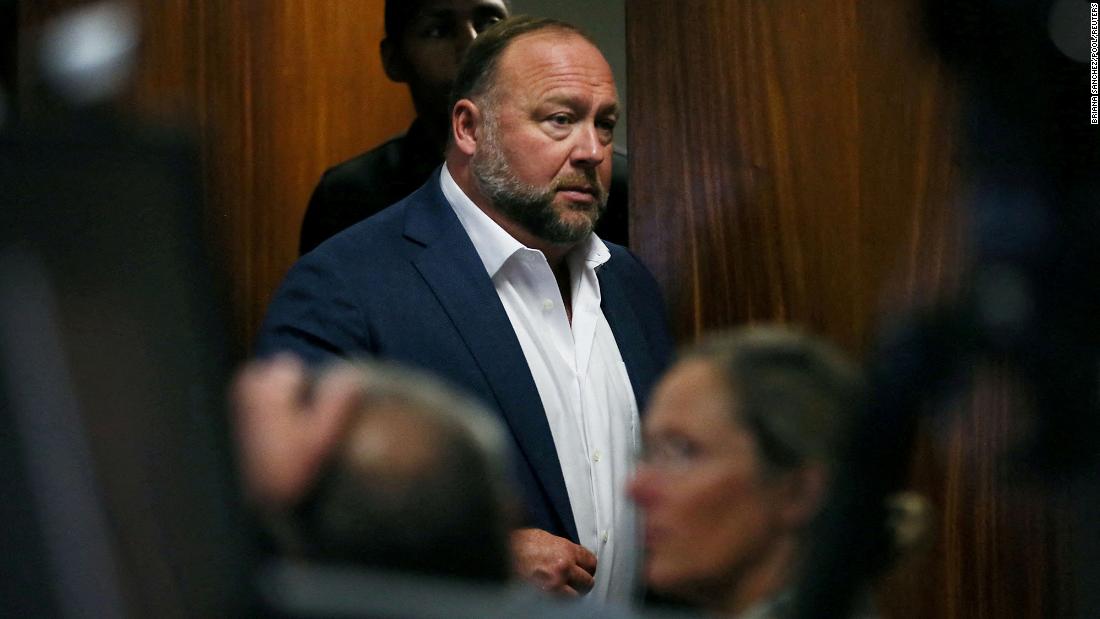
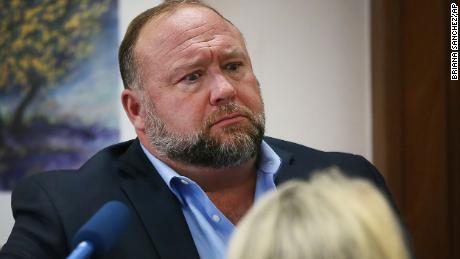
Jan. 6 committee and federal investigators have asked for Alex Jones’ phone records, Sandy Hook attorney says

“I am under request from various federal agencies and law enforcement to provide (the records),” Mark Bankston, the plaintiffs’ attorney, told Judge Maya Guerra Gamble. “Absent a ruling from you saying you cannot do that … I intend to do so immediately following this hearing.”

“I believe that there is absolutely nothing, nothing, that Mr. Reynal has done to fulfill his obligations to protect his client and prevent me from doing that,” he said, referring to Jones’ attorney, Andino Reynal.

Sandy Hook family attorney exposes Alex Jones'  dishonesty during brutal cross-examination

“I’ve been asked by the January 6 committee to turn the documents over,” Bankston added later.

Bankston declined to specify to CNN which other investigators outside of the House committee expressed interest in obtaining Jones’ text records.

Bankston revealed in court on Wednesday that Reynal’s firm, in an apparent mishap, sent him two years of cell phone records that included every text message Jones had sent.
Jones was a central player on January 6. He was at the rally before the riot though he did not storm the Capitol. The Infowars founder testified virtually before the January 6 committee earlier this year, but he said he repeatedly asserted his Fifth Amendment right to remain silent during the interview.

The judge overseeing the case advised Reynal to take some time while they await a verdict to investigate a legal argument to stop Bankston from disclosing information to the January 6 committee and others.

The jury hearing the case is deliberating how much Jones will have to pay the parents of a victim of the mass shooting at Sandy Hook Elementary School who sued him for defamation and infliction of emotional distress and won default judgments.

.

Categories
Business

Bondi, Melbourne, Brisbane: Australia destinations overseas visitors can’t pronounce properly

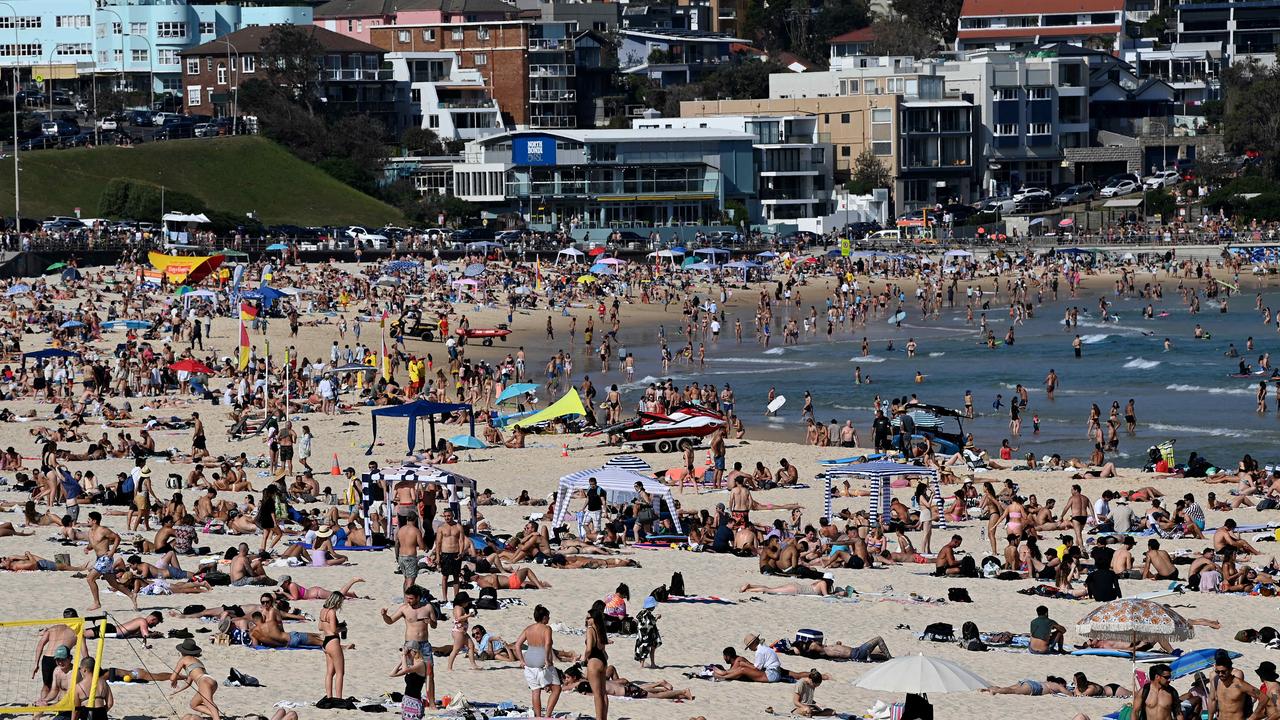
Tourists coming to Australia are often baffled by many of our place names and commonly mangle the pronunciation of some of the country’s most popular destinations, new research has found.

Sydney’s Bondi may be Australia’s most famous and busiest beach – with 1.7 million international visitors a year in 2018 according to Destination New South Wales – but a huge proportion of them are saying it wrong.

To Aussies it is of course pronounced “Bon-die” but many tourists, unfamiliar with the area, pronounce it phonetically as “Bon-dee”.

The pronunciation of Bondi is an example of a type of shibboleth, a word that can instantly distinguish whether someone is part of one group or another. In this case, saying “Bon-dee” would show the person wasn’t local or even resided in Australia.

The research was compiled by Preply, an online language learning platform that connects links up tutors with students.

The firm came to its conclusions by picking 68 major destinations where it’s known visitors can sometimes struggle over the correct pronunciation. It then analyzed Google search data to see how many instances there were of people inquiring about how to correctly say the places’ names and ranked them by the volume of searches.

In Australia, Brisbane and Melbourne were two other places where tourists found their tongues in a twist.

Melbourne sees three million international visitors a year. But you won’t make friends in Australia’s second biggest metropolis if you say “Mel-BOURNE” rather than “Mel-buhne”. Equally, it’s “BRIS-buhne” and definitely not “Bris-BAYNE” as some tourists will insist on saying.

“There’s nothing more embarrassing than arriving at a new holiday destination and mispronouncing its name in front of a local — especially if you butcher the regional accent,” said Preply learning success manager Amy Pritchett.

“When you learn to say these place names correctly, you’ll sound like a native — or at least a savvy tourist.”

Top five mangled global destinations

However, Australian place names were far down the global list of mispronounced metropolises, museums and other destinations.

It seems visitors find saying French place names are particularly mouthful with three of the five most butchered names in the land of the Gauls.

Topping the rankings was the beachside city of Cannes. And – just like most other visitors -Australians commonly get the pronunciation of this stylish French resort wrong.

It is definitely not pronounced “Carn” or “Cans” or “Cann-ess”. Rather, you drop the “es” at the end and simply say “Kan”. Short and sweet is a perfectly acceptable way to go. But if you want to sound really French you can do a distinctive semi linger at the end of the word by adding an “uh,” so “Kan-uh”.

One most Australians probably do better on, as so many have been to London, is the name of the river that runs through it.

Americans commonly think the Thames is pronounced as it looks and verbalizes a “Th” sound to produce the very oddly sounding River “Thaymez”. “Temz” is the way to go and will keep you in the good books of Londoners.

Third on the list is California’s Yosemite National Park. It’s not “Yoh-se-might” but “Yoh-seh-muh-tee” or “Yoh-she-muh-dee”.

The Louvre museum in Paris is definitely not the “Loop” or “Loo-ver” but “Loo-vruh” with a bit of a roll of the tongue on the second syllable.

Rounding out the top five of cringeworthy pronunciations is another French hotspot – the Place of Versailles where the French royals lived in pre-Revolution times.

Don’t say “Ver-sales,” do say “Vair-sigh”.

.

Categories
Technology

Previewing Vantage, Apex Legends’ first sniper character

With Vantage, Apex Legends’ newest character, the development team at Respawn wanted to really push the unique feel of a sniper-focused Legend — someone who can down another player at an unbelievable range. To accomplish this, Respawn decided on giving her an ultra powerful rifle, not unlike the Kraber special weapon.

Bit of a problem with that though — Krabers are supposed to be ultra-rare in addition to being ultra-powerful. Krabers are so rare, it’s unlikely you’ll see more than one per match. If every Vantage had a Kraber, and every team had a Vantage, you’d see 20 Krabers floating around the map. The game would be unplayable unless you also played Vantage.

“One of the things the Kraber also has is potentially no warning,” Vantage lead designer Chris Winder said. “You could just be sitting somewhere, looking in a direction, and then be down. Or, if it’s a body shot, that’s quite a lot of damage. So we knew we had to do something about that.”

To facilitate some sense of fairness, the team experimented with a lot of different options. One attempt gave enemy players a voice line letting them know they were in a Vantage’s crosshairs. Another forced Vantage to require a lock-on before being able to fire.

“We tried a bunch of different mechanics around trying to communicate that ahead of time and give players a way to avoid that, or potentially mitigate that after the fact,” Winder explained. “Maybe it still does a lot of damage, but there’s a way to stop some of it after you’re hit in some way.”

Despite these attempts, nothing felt fair enough to non-Vantage players. So they decided to switch things up — what if Vantage’s sniper rifles could only debuff enemies with slows, stuns or snares?

“You could imagine the debuffs we have, like slows and silences, and things like that, that we could try,” Winder says. “It could just debuff those targets and do some minimal amount of damage, but really just be about the debuff, and that’s the purpose of the Ultimate. I think some of those things worked from a gameplay standpoint – there was a loop around using it, and you understood why and your team understood what to do when those shots happened. But the thing we weren’t hitting at that point was the sniper fantasy. It didn’t really feel like you were holding a sniper rifle – it felt like you were holding a debuff gun.”

Heading back to the drawing board, the team struck what they feel is gold. Vantage’s current kit features the Ultimate ability ‘Sniper’s Mark’, which allows her to pull out a custom-built Sentinel rifle, fitted with a 3x/5x scope. Instead of waiting for full charges while scoped in, Sniper’s Mark has an ammo counter that counts up from one to five, letting the player choose when to fire. There is also a visual indicator on the scope that accounts for bullet drop, helping players aim this ultra-powerful weapon.

Sniper’s Mark deals 50 damage for a body shot, but any follow-ups that connect deal 100 damage, regardless of where you hit. The weapon also can benefit from headshot multipliers and Rampart shields.

“The idea is that the first shot does some lower amount of damage – and we played around a lot with that number or what that initial damage should be – and that second shot is where you get that larger amount of damage,” Winder explains. “And again, we played around with that number.”

Practiced players will be able to capitalize on the first shot, but the way the damage works out allows players on the receiving end to respond, either via counter-attack or sliding out of danger. That may seem frustrating to people wanting to pick up Vantage, but don’t worry — Sniper’s Mark has a few tricks to it than just solid damage.

Anyone tagged by a shot from Sniper’s Mark will be, well, ‘marked.’ It’s not a visually obvious ping like Bloodhound’s scan, but it is apparent enough to let your teammates know who to focus fire. Any shots landed from your teammates on the tagged enemy will deal 15% more damage — encouraging pushing as a team.

Vantage as a whole seems designed for pushing and aggressive play when you examine the rest of her kit. Her de ella Tactical ability, ‘Echo Relocation’, allows her to position her bat friend anywhere on the battlefield. So long as she maintains line-of-sight to Echo, she can soar to their location of her. Vantage can also cancel the relocation or double jump off the end of it. This opens up lots of new possibilities for aggressive and guerilla tactics—hit and runs, flanks, and straight-up dogpiling onto opponents.

Her passive, Spotter’s Lens, allows her to view detailed data on enemy shields — rarity, team size and range. Vantage can then share that info with her teammates, allowing calculations on when exactly to push to be run a little more effectively.

“The original goal was really around encouraging long-range engagements,” Winder says. “Can we make a character who’s based purely around long-range? So the first versions of the kit didn’t have any movement, there was no Echo, there was no movement tactical. You can end up too far from your team, or getting to high ground to make those shots can be a chore.

“Catching up or closing on a team when you have done those first few shots of damage is really difficult if you don’t have a character on your team that can help you do that. So that created that need to solve this problem, and Echo was it.”

Season 14 is titled ‘Hunted’, and with Vantage and Ash, we can see why. With a built-in enemy scan passive alongside Ash’s passive letting them know where death boxes are, we predict that this is going to be a very aggressive season in Apex Legends. Combined with the whole host of changes to King’s Canyon making areas more tight fit and close-quarters, as well as laser sight attachments announced for several close to mid range weapons.

So who does the development team see working well with Vantage? They have some thoughts on team composition: “A Rampart setting up some shields for her to shoot through to amp that damage even further,” Winder says. “Ash is a good one, as you mentioned, or any other movement Legend – Octane with the jump pad or Pathfinder with his grapple and the zip line itself. As she is now, she doesn’t really need the mobility from other legends to get there. But the fact that those legends have the mobility to pounce on a team, those are going to be good combinations.”

With such aggressive kits, however, there will be a need to compensate. Shield-based and mobility-based Legends can also isolate and take out a Vantage easily, and we’ll definitely see a rise of shield Legends this season. In internal playtesting, the dev team already spotted some fantastic Vantage plays — taking out Octane while he’s soaring through the air, or popping enemies off of ziplines from a distance.

“I think that most impressive are the ones where they’re very deliberate in the flanking,” design director Evan Nikolich explains. “Like, you get suppressed, then you lose track of Echo, and then all of a sudden you’re getting shot. It’s like, ‘Oh no, I have to reposition.’ So it’s like learning that new skill of knowing where Vantage is on the field. Now I have to respect her, but also where Echo is – where she could possibly be coming from. So yeah, some high-skill plays there.”

Apex Legends Season 14 hits the field August 9 — check out our hub article for every detail.

Written by Junior Miyai on behalf of GLHF.

.