A South Australian man jailed over a child sex abuse ring in the Philippines paid $30 for each live act of abuse online, threatening the children with starvation if they didn’t obey his demands.
Ian Ralph Schapel was jailed for 16 years after pleading guilty to 50 child sexual offences, including paying for children to be abused while he watched from his lounge room in Adelaide.
The investigation into his crimes led to the rescue of 15 young victims and the arrest of five people in the Philippines following an international investigation.
Watch the latest News on Channel 7 or stream for free on 7plus >>
The 68-year-old former government human resources manager was first detained in February 2020 after Australian Border Force officers examined his bags when he arrived in Melbourne on an overseas flight and allegedly found child abuse material on his mobile phone.
He was charged over the content, which eventually led to the discovery of more than 50,000 images and videos of child abuse material on a range of electronic devices at his Adelaide home.
South Australian man Ian Ralph Schapel. Credit: 7NEWS
The AFP used commonwealth laws for the first time to confiscate Schapel’s home in Mitchell Park because it was used as “an instrument of crime” where the majority of the offending took place.
He was ordered to pay a total of $165,000, half of his home’s value.
Further investigations by SA police found he had communicated with people in the Philippines to procure several children, the youngest aged three.
In February last year, Schapel admitted 50 offences, including viewing, remotely instructing and recording the sexual abuse of children on 55 occasions between March 2018 and January 2020.
An Adelaide man’s crimes led to the rescue of 15 young victims and five arrests in the Philippines. Credit: AAPOne of the alleged offenders of the ongoing child sex abuse hides her face inside a premises in the Philippines before her arrest. Credit: AFP
As part of the international investigation, Philippine authorities executed search warrants at multiple locations in Bislig, a remote area in the country’s east, in August 2020.
Thirteen children and two young adults were removed from harm and five women were arrested and accused of facilitating the abuse for profit. Among the abusers, were mothers, aunts and cousins of the victims.
On Wednesday, Judge Paul Cuthbertson described Schapel’s behavior as “callous” and “disgraceful” with “no thought given to the plight of the poor unfortunate children who were required to perform at request”.
The court had heard Schapel paid $30 for each live recording of the sexual abuse, and that he would threaten to let the children starve if they did not do what he asked.
Australian Federal Police Commander Erica Merrin said the case highlighted the force’s commitment to work with partners to protect children around the world.
“Children are being forced into the most appalling violence and torment on camera by the people who are meant to love and to protect them,” she said.
“This Adelaide man did not just watch children being hurt, he ordered specific abuse to happen and preyed on the economic vulnerability of the people involved.”
The case served as the first example where an AFP taskforce had sought to confiscate the home of a person charged with sex offences. Credit: AFP
Philippine Police Brigadier General Edgar De Mayo Cacayan said close collaboration with the AFP and other international partners should send a strong message to would-be child sex offenders.
“You will not buy and sell the sexual abuse of children in the Philippines,” he said.
“We will not allow it, and we will be their guardians. We will find you, and you will have to answer for your actions in a court of law.”
Merrin echoed a similar warning.
“It doesn’t matter when you offended, when you abused children, if you prey on children, it doesn’t matter where in the world you are, we will come for you.”
Taiwan Semiconductor Manufacturing Company (TSMC) is the biggest contract chipmaker in the world. But it has been thrust in the middle of US-China geopolitical tensions. logo displayed on the screen.
US House Speaker Nancy Pelosi may have left Taiwan but the visit has cast a spotlight once again on the island’s critical role in the global chip supply chain and in particular on the world’s biggest chipmaker, Taiwan Semiconductor Manufacturing Co., or TSMC.
The controversial visit, which angered Beijing, saw Pelosi meet with TSMC Chairman Mark Liu, in a sign of how critically important semiconductors are to US national security and the integral role that the company plays in making the most advanced chips.
Semiconductors, which go into everything from our smartphones to cars and refrigerators, have become a key part of the US and China’s rivalry over technology in the past few years. More recently, a shortage of semiconductors has spurred the US to try to catch up with Asia and maintain a lead over China in the industry.
“Taiwan’s unresolved diplomatic status will remain a source of intense geopolitical uncertainty. Even Pelosi’s trip underlines how important Taiwan is for both countries,” Reema Bhattacharya, head of Asia research at Verisk Maplecroft, told CNBC’s “Street Signs Europe” on Wednesday.
“The obvious reason being its crucial strategic importance as a chip manufacturer and in the global semiconductor supply chain.”
Pelosi’s visit to Taiwan and meeting with TSMC show the US can’t do it alone and will require collaboration with Asian companies that dominate the most cutting-edge chips.
TSMC’s crucial role
TSMC is a foundry. That means it manufactures chips that other companies design. TSMC has a long list of clients from Apple to Nvidia, some of the world’s biggest technology companies.
As the US fell behind in chip manufacturing over the last 15 years or so, companies like TSMC and Samsung Electronics in South Korea, pushed ahead with cutting-edge chipmaking techniques. While they still rely on tools and technology from the US, Europe and elsewhere, TSMC in particular, managed to cement its place as the world’s top chipmaker.
TSMC accounts for 54% of the global foundry market, according to Counterpoint Research. Taiwan as a country accounts for about two-thirds of the global foundry market alone when considering TSMC alongside other players like UMC and Vanguard. That highlights the importance of Taiwan in the world’s semiconductor market.
When you add Samsung into the mix, which has 15% of the global foundry market share, then Asia really dominates the chipmaking sphere.
That’s why Pelosi made it a point to meet with TSMC’s chairman.
Taiwan invasion fears
China views democratically, self-ruled Taiwan as a renegade province that needs to be reunified with the mainland. Beijing spent weeks telling Pelosi not to come to Taiwan.
During her visit, China ratcheted up tensions by carrying out military drills.
There is a concern that any kind of invasion of Taiwan by China could massively affect the power structure of the global chip market, giving Beijing control of technology it had not previously had. On top of that, there is a fear that an invasion could choke off the supply of cutting-edge chips to the rest of the world.
“Most likely, the Chinese would ‘nationalize it,’ (TSMC) and begin integrating the company, and its technology, into its own semiconductor industry,” Abishur Prakash, co-founder of advisory firm the Center for Innovating the Future, told CNBC via email.
What is the US doing?
How does China stack up?
SMIC is crucial to China’s ambitions, but sanctions have cut it off from the key tools it requires to make the most cutting-edge chips as TSMC does. SMIC remains years behind its rivals. And China’s semiconductor industry still relies heavily on foreign technology.
TSMC does have two chipmaking plants in China but they are producing less sophisticated semiconductors unlike the manufacturing facility in Arizona.
Chipmaking alliances
The US has been looking to form partnerships on semiconductors with allies in Asia including Japan and South Korea as a way to secure supply of the crucial components and maintain a lead over China.
TSMC meanwhile is caught in the middle of the US-China rivalry and could be forced to pick sides, according to Prakash. Its commitment to an advanced semiconductor plant in the US could already be a sign of which country it is siding with.
“In fact, a company like TSMC has already ‘picked sides.’ It’s investing in the US to support American chip making, and has said it wants to work with ‘democracies,’ like the EU, on chip making,” Prakash said.
“Increasingly, companies are striking an ideological tone in whom they work with. The question is, as tensions between Taiwan and China increase, will TSMC be able to maintain its position (aligning with the West), or will it be forced to recalibrate its geopolitical strategy.”
The story goes that then-Chinese leader Mao Zedong’s fourth wife Jiang Qing, a keen photographer, wanted to impress senior Communist Party members by handing out gifts.
She loved Leica cameras, but was not going to promote German products, so she commissioned a Chinese factory to replicate the Leica M4.
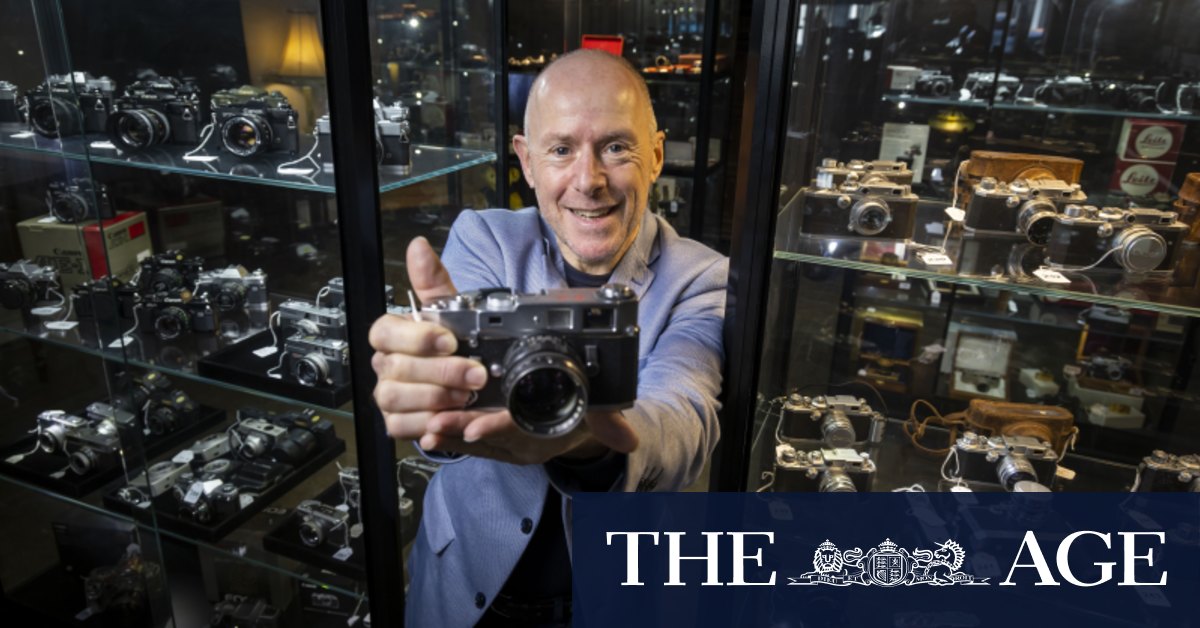
Leica cameras from the 1950s are among the items up for sale.Credit:Wayne Taylor
It wasn’t released commercially, but perhaps a comrade fell on hard times and was forced to sell one, because, somehow, there’s one in the Michaels’ museum.
On sale at the first Michaels museum auction will be authentic Leicas dating from the 1920s, late 1890s and early 1900s studio cameras, advertising posters, and a kerosene-powered 1890s slide projector.
Also on sale will be a three-meter tripod that Leski says in the 1930s was used to raise cameras above horse race finishing lines.
There is a working, see-through Canon EOS camera used by salespeople for demonstration purposes.
Items to be sold at future auctions include a telephoto lens damaged in the 1986 bombing of the Turkish consulate in South Yarra, and a 1928 ladies’ pocket-sized camera that includes a powder compact, lipstick and mirror.
Owner Peter Michael said he was sad to part with the pieces that he, his brothers Tony and Rob and their late father Alan collected for 50 years, starting with Alan buying a customer’s 1920s and 1930s Leica camera collection. “I loved showing people through the museum; there were so many interesting items,” Peter said.
“[The museum] was our pride and joy for so many years”.
He says he knows many items intimately, including a 1960s Canon Dial camera with a clockwork winding film mechanism he owned as a child.
loading
After Michaels closed its store at the corner of Elizabeth and Lonsdale streets to trade solely online early last year, the building was leased to a hospitality business.
That meant there was no longer a room for the museum, which used to attract camera enthusiasts from around the world.
“I thought that we’d be building this museum forever,” Michael said. “I never anticipated selling it. But circumstances have changed. You need such an enormous amount of space, just to maintain it.”
The Morning Edition newsletter is our guide to the day’s most important and interesting stories, analysis and insights. Sign up here.
Nothing is a brand that has been around for less than two years, but has made a lot of noise in the tech world the past few months.
The company’s founder is Carl Pei, who previously headed up OnePlus – a brand famous for their tagline ‘Never Settle’. Pei left OnePlus in October 2020 to focus on a new hardware business, called Nothing.
Based in London, Nothing has quite the backing, including an iPod inventor, Twitch co-founder, Reddit CEO and a big YouTuber and the launch of its first phone has certainly caused a lot of hype.
Watch the latest News on Channel 7 or stream for free on 7plus >>
How do I get it and what will it cost?
Nothing Phone 1 is available in Australia now through the official website.
In white and black colourways, starting price is $749 for the 128GB model.
Who is it good for?
Nothing aims to provide “tech that just works,” which was the early philosophy of a certain fruity tech company.
The company has already released its own wireless earbuds called Ear 1 with a very striking see-through design language. Its smartphone follows that same direction with a transparent back, and a familiar design – more on that soon.
Phone 1 is certainly a tech enthusiast’s product. You’d be hard-pressed to find anyone who doesn’t read the latest tech news to know about this smartphone. Therefore, if you love trying out the latest gadgets and want something a little different – Phone 1 is right up your alley.
The entire phone is well-rounded and offers a sprinkling of familiarity and innovation with its Glyph lighting back. Overall, it’s a practical choice, rather than something that has top-tier specs – and that could be part of the appeal for Nothing Phone 1.
How does it work?
There was a common conversation happening between friends and work colleagues while using Phone 1. They’d never heard of the Nothing brand, let alone the Phone 1 – yet they were intrigued by this “new iPhone”.
Yes, the design is extremely familiar to an iPhone 12 or 13 and that isn’t necessarily a bad thing considering Apple make some of the best products around.
However, Nothing’s design also has some different elements that tend to improve on what Apple offers. The phone is more comfortable in the hand due to slightly smoothed edges, there is no big cutout at the top of the display, and the back is unlike anything that we’ve seen from a smartphone before, with what Nothing calls the Glyph interface.
The back is covered in Gorilla Glass 5, however it is a fingerprint magnet – especially on the black version. White may be the better option if this is something that would trouble you.
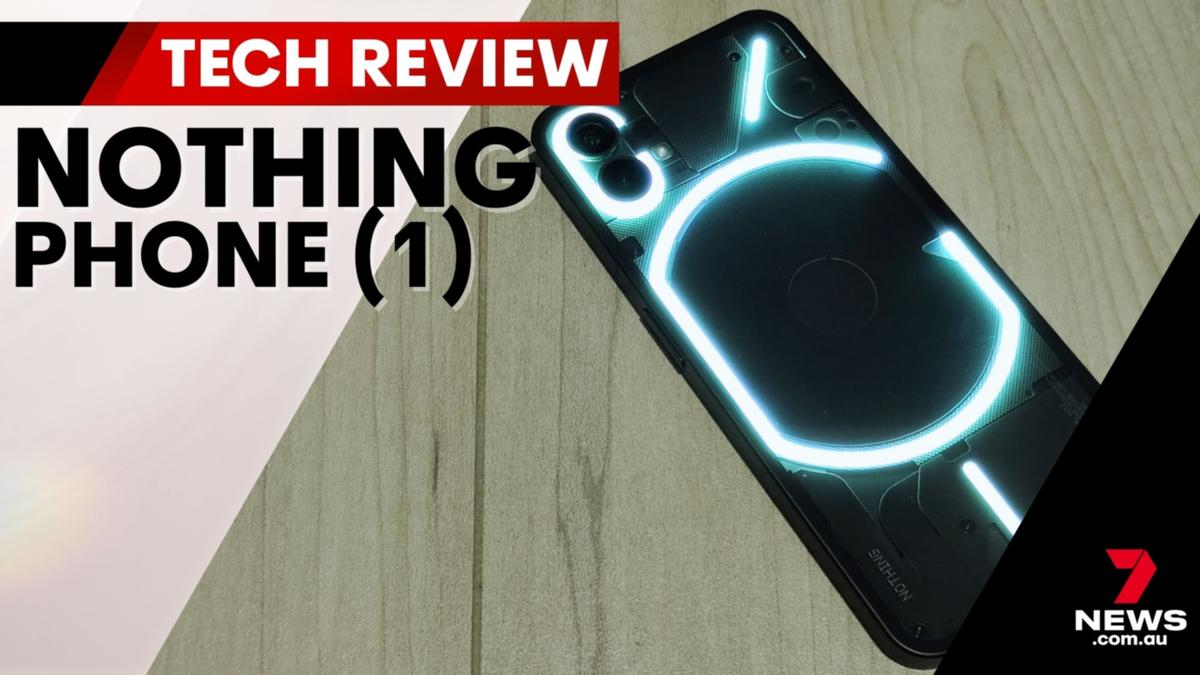
The conversation starter here is that Glyph lighting system, which is a series of 900 white LEDs that cover the back of the phone. These run around two camera lenses, the wireless charging coil and towards the USB-C charging port – which creatively doubles as a battery indicator.
There are multiple glyph patterns that can be customized according to different contacts – for phone calls – but there are currently no options to personalize these for individual app notifications. The LEDs can also be activated to provide an almost ring lighting effect for photos and video.
Nothing Phone 1 has a 6.55-inch OLED display with 120Hz high refresh rate and compatibility with HDR10+. A single hole sits to the top-left of the display to house the selfie camera.
The screen is decent and can be viewed in direct sunlight, which can be problematic with smartphones in this price bracket. There are two color profiles that can be selected to suit your tastes, and these can be further tweaked with a color temperature slider in the settings.
A dynamic high refresh and touch sampling rate makes Phone 1 look and feel very responsive, and the software – while pretty basic – keeps things close to stock Android. While on the software side, Nothing promises three years of Android update and four years of security updates, which is more than most manufacturers offer in this price segment.
There’s an under-display fingerprint reader and this works very well, which is pleasing for a device that costs under $800. But the less secure face unlock method is a mixed bag and is inconsistent at best.
Haptics on Phone 1 is also something to note. For some reason, when on silent it’s very loud. It has a mechanical whirring sound rather than a simple silent vibration, and this could be a turn-off for most people. I’ve also turned off vibration when typing because it was more an annoyance than a pleasure.
When it comes to performance, Phone 1 uses an older Snapdragon 778G+ chip. While it’s definitely a controversial decision, the chip is reliable. It handles multitasking, casual gaming and multimedia content easily. The real test will be how this chip holds up over time with feature and operating system updates, as well as security patches.
While Nothing has said they wanted to focus on including two great cameras rather than adding lenses that you won’t use, there is a bit of work that the company needs to do here.
The main 50MP sensor (Sony IMX766) offers some sharp, bright and punchy photos but can struggle when there is movement. The 50MP ultrawide (Samsung JN1) tends to be a little soft when pixel peeping. While this is good enough for social media posting, it doesn’t match the likes of Google’s latest Pixel 6a – which comes in at the same price point but offers up much better photos.
This is to be expected from the first phone from a newcomer, and hopefully some work on these cameras can be done with software updates in the future.
Phone 1 has dual stereo speakers, however they aren’t exactly balanced, with the bottom-firing speaker louder than the earpiece speaker. While the clarity is good, they don’t have a lot of bass.
In terms of battery life, while it’s very subjective on how different people use their devices, I have been impressed with how Nothing Phone 1 has been performing since almost two weeks of use. It’s definitely not class-leading, but almost six hours of screen time is acceptable to me. You won’t get through more than a single day, though. Standby time is quite good too, and you won’t lose as much juice as more expensive devices.
There is fast charging (up to 33W), wireless charging and reverse wireless charging all available on Phone 1.
Finally it’s worth noting local network connectivity which can be hit-and-miss between our three major telcos – especially on new devices from unpopular brands. However, Phone 1 works across Telstra, Optus and Vodafone networks with 5G, VoLTE (HD voice calling) and VoWiFi all working as they should.
What we think
There was a lot of hype around Nothing Phone 1, and while it won’t compete with the likes of the iPhone 13, Pixel 6 or Galaxy S22 it tends to balance most things quite well, while keeping the price relatively low.
If you’re someone who wants a powerful and feature-rich smartphone, Phone 1 won’t be for you, and you’re better off looking at Apple, Samsung, Google and OPPO. However, this will also come at a cost to you.
While the camera isn’t the strongest, it can take some good photos with the main lens, and that’s more than good enough for sharing with family and friends across social media. But if you want to start creating framed prints, you’ll start to notice what is lacking.
Nothing Phone 1 is an impressive first release, and it will be exciting to see what comes next for this new brand. But it’s in a hard spot with Google’s tried and tested Pixel 6a being priced the same in Australia, and Samsung’s A73 series only a few extra dollars.
Our reviews always remain independent of the manufacturer and the first time they will see the review is at the same time you’re reading it.
At just 19, Zambian Muzala Samukonga ran a personal best of 44.89 seconds to comfortably win his men’s 400m heat at the Birmingham 2022 Commonwealth Games on Wednesday.
See the moment Samukonga collapsed after the race in the video player above
Stream Seven’s coverage of the Commonwealth Games 2022 for free on 7plus >>
Not only that, he was the only qualifier of the semi-finals to run under 45 seconds.
But the rising star seems to have put himself at risk of missing his next race on Friday.
Samukonga had gained an approximately 10m lead with the finish line in sight on the final straight, but rather than slowing down towards the end as most athletes would do, he continued his sprint to the finish line to extend the margin.
He appeared elated but collapsed after the finish line and stayed on the ground for a number of minutes.
Samukonga was unable to walk after the race. Credit: 7Sport
And when he made it to his feet, he could not stay standing up.
Samukonga remained on the ground again and repeatedly slapped and punched his upper leg, before doctors determined he couldn’t walk.
He was wheelchaired out of the venue.
Channel 7 commentator Tamsyn Manou speculated the young runner could be suffering from lactic acid.
Samukonga needed to be wheelchaired out of the stadium. Credit: 7Sport
EVERYEVENT:Check out the full Commonwealth Games schedule
TALLY MEDAL:Every gold, silver and bronze at Birmingham 2022
LATEST RESULTS:Detailed breakdown of every event at the Games
“He’s in licorice there. Definite all sorts,” the Australian former sprinter said.
“That’s just lactic acid pain pulsating through those legs.
“He’s got it that badly, he’s going to take a while to recover from that.
“He’s going to need an ice bath for a while.”
Muzala Samukonga of Zambia reacts as he crosses the finish line. Credit: Alastair Grant/AP
Former English middle-distance runner Tim Hutchings was more critical, saying Samukonga had put himself in unnecessary distress and was unable to see a reason for him sprinting out the race.
“Maybe he thought I may never get a chance to run sub-45 (seconds) again,” Hutchings said in games commentary.
“I think most coaches would say, ‘it’s great to run a personal best, but actually this is just extravagant and you will pay for it’.
“That’s a 10m winning margin – and more by the time he hits the line.
“Really, really unnecessary, no one else goes under 46 seconds.
“He runs 44.89 and dare I say, he’s the word naïve.
“An incredible run, but I hope that’s not the last we see of him in Birmingham.”
Just like Tokyo 2020 on Seven, there will be one destination to watch every epic feat, every medal moment, every record attempt and every inspiring turn from the Birmingham 2022 Commonwealth Games.
7plus is the only place to watch up to 30 live and replay channels of sport, see what’s on when, keep up to date with the medal tally, create a watchlist to follow your favorite events and catch up on highlights.
The government has succeeded in passing its superannuation legislation, with the House of Representatives overwhelmingly voting in favour.
Greens leader Adam Bandt said his party opposed the changes, which close a potential loophole for public servants to include the value of their free overseas accommodation in their superannuation calculation, because it believes the government is rushing through the changes.
Assistant Treasurer Stephen Jones. Credit:alex ellinghausen
Ace Katina Curtis has written, the bill is in response to a case brought by three bureaucrats in the Federal Court. The government’s advice is that if the case succeeds, it could open the door to claims from some 10,000 public servants posted overseas since 1986. It is estimated this could cost the Commonwealth between $3 billion and $8 billion.
The bill was introduced in and has passed the Senate, and is being considered in the lower house.
Independent MP Zoe Daniel has declared a potential conflict of interest and withdrawn herself from a vote given she was a foreign correspondent at ABC, which is a publicly funded broadcaster. Dr Sophie Scamps has also declared a potential conflict in relation to a relative of her.
The Coalition supported the bill.
Shortly before the vote, Assistant Treasurer Stephen Jones countered the concerns raised by the Greens by citing the potential amount the government would be liable to pay.
loading
“It is about the cost of the pharmaceutical benefits scheme,” he said.
“These are not small amounts of money. No sane government would do otherwise than this government has done this morning.”
Parliamentarians are now being called to the House of Representatives to vote on the government’s landmark climate change bill that will legislate the 43 per cent emissions reduction target.
The Coalition has signaled they will oppose the bill. However, Tasmanian Liberal MP will cross the floor.
VIRGINIA BEACH, Va. (WAVY) — 10 On Your Side has acquired new documents identifying the 2-year-old girl found dead inside a Virginia Beach hotel earlier this week under suspicious circumstances, police said.
The child’s mother, 38-year-old Leandra Andrade, was charged with child abuse neglect, serious injury on Wednesday.
10 On Your Side contacted Matt Andelman, an attorney for Fabio Andrade Jr., the girl’s father, who identified the girl as 2-year-old Lanoix.
Fabio Andrade Jr. provided the statement below regarding Lanoix:
“My daughter Lanoix loved life and loved to make her friends and family smile. I am devastated that the opportunity for Lanoix to continue living a happy and loving life was senselessly taken from her.
I have been fighting tirelessly since March of this year for full physical and legal custody in order to provide my daughter the life she deserved. The court ruling last week awarding me temporary sole legal custody was one of several successful steps toward that goal. But that ruling did not affect the existing, court-ordered temporary shared physical custody schedule that put Lanoix with her mother de ella last weekend.
The family and friends of Lanoix ask for privacy at this time so that we may mourn our beloved angel.”
FABIO ANDRADE JR.
Lanoix Andrade, August 3, 2022 (Courtesy – Matthew B. Andelman)
Lanoix and Fabio Andrade, August 3, 2022 (Courtesy – Matthew B. Andelman)
Lanoix was found dead around 3:30 am Monday in a room at a hotel in the 3600 block of Atlantic Avenue, and police said a woman, later identified as the child’s mother, was also found suffering from a medical emergency and taken to the hospital.
Leandra Andrade was booked into the Virginia Beach Jail Wednesday and had a court hearing that same day, according to the Virginia Beach Sheriff’s Office. She is currently being held without bond.
No cause of death for the 2-year-old has been released at this time, however, 10 On Your Side has reached out for more information in the case.
Fabio was recently awarded temporary sole legal custody, but each parent was given equal physical custody of the child. Fabio was aware that Leandra would have their daughter this past weekend.
Treasuries had rallied last week after Fed Chair Jerome Powell signaled that the pace of future increases may slow later this year, increasing the odds for cuts next year in market-implied measures. Several Fed leaders have since said the central bank is far from done with tightening and remains laser-focused on tamping down price gains that are the hottest in four decades.
loading
“If there is a change in tone by Fed members, it is similar to a parent that is finally telling the kids that you’ve had enough candy, no more,” wrote Peter Boockvar, chief investment officer at Bleakley Financial Group.
“For decades the Fed always gave the markets more candy, especially when the kids raised out for it. Now, the kids are going to have to do without as long as inflation is at the very unsatisfactory levels that it’s pacing at, even with an expected fall.”
Markets are also somewhat calmer as US-China tensions simmered after House Speaker Nancy Pelosi left Taiwan. Her visit from Ella had provoked an angry response from China, and markets were on the edge ahead of her arrival from Ella on Tuesday.
US stocks were roaring on Wednesday after a session with many twists and turns the previous day.
PayPal jumped 8.9 per cent on a report that activist investor Elliott Management has taken a large stake in the payment company.
Robinhood Markets, whose stock trading app helped bring a new generation of investors to the market, rose 11.9 per cent following an announcement that it’s cutting nearly a quarter of its workforce. Crashing cryptocurrency prices and a turbulent stock market have kept more customers off its app.
But the strong equities trading doesn’t reflect the headwinds confronting the market, according to Goldman Sachs strategist Sharon Bell.
“There’s a little bit of complacency in there and markets are not fully taking into account the risks,” Bell said in an interview with Bloomberg TV.
Seeing riskier areas of the equity market reprice higher as some earnings estimates get slashed indicates that investors may be overly optimistic, said Emily Roland, co-chief investment strategist at John Hancock Investment Management.
“In this environment, we would rebalance into quality companies and sectors that have strong balance sheets and more durable profitability,” she said. “This is not the right time to emphasize cyclical areas or ones that have a greater need for capital.”
Oil fell after a brief rally as traders mulled the lack of relief for oil markets and a poor demand outlook. The US dollar wall gains after jumping to its highest in a week.
with Bloomberg
The Business Briefing newsletter delivers major stories, exclusive coverage and expert opinion.Sign up to get it every weekday morning.
The question of whether Macs are less susceptible to viruses has long been argued.
Now macOS spyware, named CloudMensis after detailed analysis conducted by Eset researchers, has been discovered as a backdoor that lets hackers spy on users of compromised Macs.
It exclusively uses public cloud storage services to communicate back and forth with its operators, enabling them to gather information from victims’ computers by exfiltrating documents, keystrokes and screen captures.
Described as a “powerful spying tool” by the researchers, it’s not clear how the virus is initially distributed and who the targets are, although it doesn’t have any undisclosed (zero-day) vulnerabilities.
It’s created to work through popular cloud platforms DropBox as well as pCloud, Yandex Disk, and Eset’s analysis of the code suggests CloudMensis may have been around for many years.
The quality of the code and lack of obfuscation suggests the creators are not very advanced or familiar with Mac development, the researchers believe, although it is able to bypass Apple’s own security protections.
“Use of vulnerabilities to work around macOS mitigations shows that the malware operators are actively trying to maximize the success of their spying operations,” the researchers said.
Gains admin access to do its dirty work
Once the CloudMensis spyware is executed and administrative privileges are gained, it sets off a two-stage process to release and act on its payload.
It includes authentication tokens to multiple cloud service providers enabling it to interact with cloud storage providers for receiving commands from its operators and for exfiltrating files.
The first-stage malware is set to download and then retrieve the second-stage malware, the spyagent client, as a system-wide daemon.
It’s this larger, second component that contains the instructions to collect information from a compromised Mac.
Since the release of macOS Mojave (10.14) in 2018, Macs have used a Transparency, Consent, and Control (TCC) system to protect access to some sensitive inputs, such as screen captures, cameras, microphones, and keyboard events.
However, the CloudMensis spyware bypasses these in-built security protocols, which avoids prompting the user to provide permissions, potentially leaving them unaware of the presence of malware on their infected device.
Ultimately the malware can list processes running on the infected devices, start a screen capture, list emails and attachments, list files form removable storage, upload password-protected files to cloud storage, and download and run arbitrary files.
“The intention of the attackers here is clearly to exfiltrate documents, screenshots, email attachments, and other sensitive data,” said the Eset researchers.
Apple helping users shut down malware risks
Apple is responding to the threats posed by spyware with a new feature called Lockdown Mode.
To be rolled out across macOS Ventura, iOS 16 and iPadOS 16, the company described it as an extreme option for additional protection where users face serious, targeted threats to their digital security.
Apple says this feature hardens existing device defenses and strictly limits certain functionalities in a bid to severely reduce the attack surface that could potentially be exploited by attackers.
Among the restrictions, most message attachment types other than images are blocked, certain complex web technologies are disabled, incoming invitations and service requests are blocked without a previous call or request, wired connections are blocked while locked and configuration profiles cannot be installed, and the device cannot enroll into mobile device management (MDM).
The company has also taken the extra step of offering rewards to researchers who discover Lockdown Mode bypasses or improvements.
Apple has also pledged to give $14.5 million (US$10 million) and any damages awarded from the lawsuit filed against NSO Group over its spyware to the Dignity and Justice Fund which is working to expose mercenary spyware and protect potential targets.
David Klemmer’s future at the Knights continues to hang by a thread, but coach Adam O’Brien reportedly is stuck at “arm’s length” over the Newcastle star’s situation.
According to veteran league journalist Brent Read, Klemmer and O’Brien reportedly have “no issue” with each other, with Read revealing on Fox League’s NRL360 that Klemmer apologized to his coach for blowing up at a trainer – an incident that subsequently saw Klemmer issued a show-cause notice by the Knights.
Stream every game of every round of the 2022 NRL Telstra Premiership Season Live & Ad-Break Free During Play on Kayo. New to Kayo? Start your free trial now >
Read also shut down a “conspiracy theory” linking the Klemmer saga to an aborted 11th-hour move to the Eels last week, although fellow NRL expert Phil Rothfield revealed deeper concerns at the Knights over Klemmer’s performances and attitude this season.
Read told NRL 360: “As I understand it, Klem’s apologized – he sent a text to Adam O’Brien on Sunday night acknowledging that he could have handled things better.
“I don’t think he’s got an issue with Adam O’Brien. I don’t think the coach is off him at all.”
Rothfield was doubtful that the Knights are genuinely hoping for Klemmer to leave the club, especially given an “awkward situation” between O’Brien and the player.
“I’m not convinced they do want him to go,” he said.
“And there’s a really awkward situation there where his manager is also the manager of Adam O’Brien, the coach. So how is the coach going to back him to sack one of his manager’s players? It gets too difficult.”
Read replied: “This is why Adam’s at arms length. This is (the responsibility of the new Director of Football) Peter Parr. Adam’s been told, ‘Stay out of it’ … My understanding is Adam has no issue with David Klemmer.”
There have been widespread rumors that Klemmer’s possible axing by the Knights is due to deeper problems, and not a reflection of this isolated incident.
NRL 360 host Paul Kent asked Read about the “conspiracy theory that it’s linked to the potential move to Parramatta”, earning an emphatic reply.
“That’s rubbish,” Read said. “Dave didn’t want to go to Parramatta. This happened after they’d already decided he wasn’t going to go.”
Parramatta had sought to sign Klemmer for the remainder of the season to boost their final hopes, but the Knights shut down the move prior to the August 1 deadline.
But Rothfield added that there have been lingering concerns in the club over Klemmer’s performance.
“Something I do know factually,” he said. “This is not an isolated issue with David Klemmer. I’m not saying there was anything as dramatic as him abusing the trainer.”
Read pointed out that Klemmer had “no other show causes, no blot marks on his record”.
But Rothfield countered: “But there’s still some issues that have happened at that football club behind the scenes. I mentioned some of them on Monday night: his failure to be able to carry out a game plan, (his tendency) to take one or two (too) many hit-ups.
“Some people have called him selfish, that he’s out there to make his meters and not follow what they’ve been training to do all week. They’re not getting quick play-the-balls.”
Pointing to video footage, Kent noted: “He’s been tackled there, but he continues to fight for three or four more seconds, which takes all the momentum out of your attack, which then leaves the rest of his team with no momentum to attack on the next play.”
But Read questioned: “So what are we saying, that they’re using this as a conspiracy to sack him?”
Nevertheless, Read opined that the single incident was not enough to see Klemmer’s contract torn up.
“It’s not a sackable offence… The terminology he used is freely used in that football club. It’s sprayed around,” Read said.
“My understanding is there was some language sprayed back at him as well.”
The situation remains murky in Newcastle. As Kent declared: “The whole thing’s weird. The whole thing’s crazy. It’s a very naive club.”
And with the latest drama engulfing the club, Rothfield added that O’Brien’s future at the club is under an increasingly dark cloud.
“I’ll be fair dinkum. I think we’ll know at 6 o’clock on Sunday night,” he said. “If they come away with nothing at Campbelltown, in light of the Klemmer drama and a few other things that have happened: I think there’ll be major drama next week.”
Originally published as ‘That’s rubbish’: Knights coach Adam O’Brien has ‘no issue’ with David Klemmer after apology