Categories
US

Democrats celebrate as climate bill moves to House – and critics weigh in | US politics

Democrats celebrated the much-delayed Senate passage of their healthcare and climate spending package, expressing hope that the bill’s approval could improve their prospects in the crucial midterm elections this November.

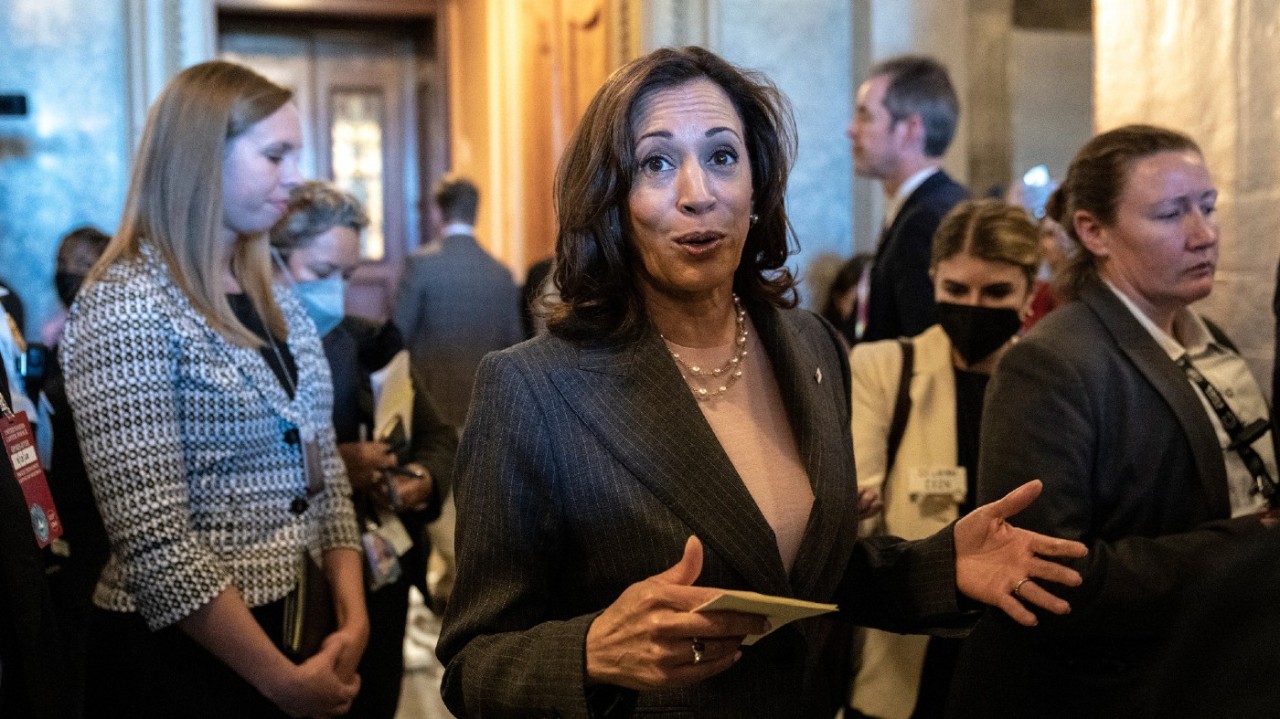
The bill, formally known as the Inflation Reduction Act, passed the Senate on Sunday in a party-line vote of 51-50, with Vice-President Kamala Harris breaking the tie in the evenly divided chamber.

Raucous applause broke out on the Senate floor after Harris announced the final tally, and Democrats continued their victory lap once the vote had concluded amid a belief that the bill will give Biden – and many Democrats – a record of significant achievement to campaign on.

“I’m really confident that the Inflation Reduction Act will endure as one of the defining feats of the 21st century,” the Senate majority leader, Chuck Schumer, said at a press conference after the bill’s passage. “To do small things with 50 votes is rough. To pass such a major piece of legislation – with only 50 votes, an intransigent Republican minority, a caucus running from Bernie Sanders to Joe Manchin – wow.”

Democrats’ work is not quite done though. The Senate-approved bill now heads to the House, which must pass the legislation before it can go to Joe Biden’s desk. The House is scheduled to return from its recess on Friday to take up the bill, and Democratic leaders have expressed confidence that it will pass.

“The House will return and move swiftly to send this bill to the president’s desk – proudly building a healthier, cleaner, fairer future for all Americans,” the Democratic speaker, Nancy Pelosi, said in a statement.

Democrats hope the bill’s passage could also help them persuade voters to keep them in control of Congress in November, when every House seat and 34 Senate seats will be up for grabs. So far, Democrats’ prospects in the midterm elections have appeared grim, as Republicans are heavily favored to regain control of the House of Representatives.

Asked on Monday morning whether he believed the bill’s approval would benefit Democrats running in November, Biden said, “Do I expect it to help? Yes, I do. It’s going to immediately help.”

Biden pointed to some of the bill’s healthcare provisions, including capping Medicare recipients’ out-of-pocket prescription costs at $2,000 a year, to argue that the legislation would provide concrete assistance to millions of Americans. But that policy will not go into effect until 2025, and Biden acknowledged that some of the bill’s most important provisions will take time to kick in.

That delayed implementation could prove detrimental to Democratic candidates trying to make a pitch to voters about how the party has made the most of its control of the White House and Congress.

Despite its name, the bill is also not expected to provide immediate relief to Americans struggling under the weight of record-high inflation. According to a report issued by Moody’s Analytics, the bill will “modestly reduce inflation over the 10-year budget horizon”.

Republicans accused Democrats of ramming through a partisan bill that failed to address voters’ top concerns, as polls show most Americans believe the economy is getting worse.

“Democrats have proven over and over they simply do not care about middle-class families’ priorities,” the Senate Republican leader, Mitch McConnell, said after the bill’s passage. “They have spent 18 months proving that. They just spent hundreds of billions of dollars to provide it again.”

Republicans’ talking points were echoed by a surprising voice on Sunday: Bernie Sanders. The progressive senator expressed concern that the bill would do little to help working Americans, after he unsuccessfully pushed amendments to the bill that would have expanded its healthcare and financial assistance provisions.

“It’s a very modest step forward,” Sanders told MSNBC. “Bottom line is, I’m going to support the bill because given the crisis of climate change, the environmental community says this is a step forward. It doesn’t go anywhere near as far as it should. It is a step forward.”

Democrats have championed the bill’s environmental provisions, which mark America’s most significant legislative effort yet to address the climate crisis. Experts estimate that the climate policies in the spending package will slash US greenhouse gas emissions by 40% by 2030, compared with 2005 levels. That accomplishment will bring the US within striking distance of Biden’s goal to cut emissions in half by the end of the decade, which scientists say must be achieved to avoid climate disaster.

To win the support of the centrist senator Joe Manchin, the bill also includes controversial proposals to expand oil and gas development on federal lands, which have sparked outcry among some climate activists. But the bill’s defenders say the climate benefits of the legislation far outweigh the costs.

As the spending package moves to the House, Pelosi has the weighty task of keeping her entire caucus in line to ensure the bill’s passage. Given Democrats’ narrow majority in the lower chamber, Pelosi can afford to lose only a few votes and still get the bill passed. It seems like Pelosi will have the votes she needs, after moderates and progressives alike endorsed the package, so Biden could be reaching for her bill-signing pen by the end of the week.

Categories
US

Torrents drench Denver as Death Valley recovers from 1,000-year deluge

Comment

Flash flood warnings were posted for parts of Denver on Sunday night as exceptional downpours overwhelmed roads, stranded cars and forced high-water rescues.

The flooding in Denver came about 48 hours after a historic deluge in Death Valley, Calif., on Friday that stranded about 1,000 people and was classified as a 1-in-1,000 year event. And the Death Valley flood followed three 1-in-1,000 year rain events across the Lower 48 to close July and begin August in St. Louis, eastern Kentucky and southern Illinois.

Excessive rainfall continued to plague parts of the Lower 48 on Monday morning, with counties west and south of Chicago under flash flood warnings after seeing up to half a foot of rain.

Every deluge is operating in a warmer atmosphere because of human-caused climate change and is capable of unleashing more extreme amounts.

In Denver, thunderstorms blasted parts of the northern metro area on Sunday evening, drenching them with up to an inch and a half of rain in just 20 minutes. In some areas, rainfall of this intensity is only expected to occur every several hundred years.

Numerous roads were closed, including a section of Interstate 70. Denver’s ABC affiliate described a “traffic nightmare” with drivers stranded for hours along the interstate and nearly 20 people needing rescue.

“Looks like our heaviest report came in at 2.5 inches of rain,” said David Barjenburch, a meteorologist at the National Weather Service office in Boulder, although radar showed the possibility of locally higher amounts.

I have explained that most areas only had storms for about 40 minutes at any given location. They were moving at about 15 mph.

“This is the peak [time of year] in terms of monsoonal rainfall,” said Barjenburch, referring to the Southwest monsoon — a seasonal wind shift that helps moisture to drift north over the desert Southwest, Four Corners region and, at times, the Colorado Front Range. “July, early August is typically our flash flood season. And this time we had abundant moisture, a lot more than we typically have here.”

He referred to infamous flood events, like one that struck Fort Collins in 1997 or the Big Thompson episode, which killed 144 people when a foot of rainfall gushed into the Big Thompson River in just a few hours’ time on July 31, 1976.

The people stranded in Friday’s Death Valley deluge were able to “carefully travel out through damaged roadways” over the weekend, according to the National Park Service.

About 1.46 inches of rain came down — just shy of the 1.47-inch record. The total equates to about three-quarters of a typical year’s worth of rain.

The lowest, driest and hottest location in the United States, Death Valley averages just 0.11 inches of rain in August.

Many cars were damaged by the sudden torrent and resulting mudslides.

The Park Service reported that the flooding destroyed a water system that serves numerous park residences and facilities. It also said that many thousands of roads were damaged and littered with debris.

Flash flood in Death Valley strands about 1,000 people in national park

Like Denver, its downpours were triggered by the Southwest monsoon.

Flooding in northern Illinois

Parts of Illinois west and south of Chicago were also visited by heavy rain early Monday, which sparked flash flood warnings in northwestern and north central parts of the state. The Weather Service office serving Chicago had received about a dozen reports of flooding, including around Rockford through midday.

“[T]he significant flash flooding has gotten as close to the metro as Rockford and Byron, Illinois, about 90 miles west of Chicago,” said Matt Friedlein, a meteorologist at the Weather Service. “DeKalb and Sycamore… about 70 miles west of Chicago… saw some flooding too.”

Friedlin said Rockford broke its Aug. 8 rainfall record with 2.62 inches as of 7 am One weather station south of Rockford posted 6.21 inches.

A brief slug of heavy rain passed through Chicago, but its impacts were limited.

Explaining the exceptional rainfall

The heavy rainfall has been driven by characteristic summertime moisture pooling along a stalled front draped from the Colorado Rockies into central states sitting atop a heat dome sprawled over the Southern US Such fronts wring the humidity out of the air like someone squeezing out a washcloth. That can lead to rainfall rates of 2 to 3 inches — or more — per hour. These fronts also act like train tracks guiding developing thunderstorms over the same areas repeatedly.

That was the case eight days ago in St. Louis, where 7.87 inches of rain fell in six hours’ time. That prompted flash flood emergencies across the city, and cars inundated by rising floodwaters. Extreme flooding plagued eastern Kentucky just two days later, with 37 people now confirmed dead. President Biden, who visited the region on Monday, has pledged assistance from the federal government in recovery efforts. Another storm dropped up to 14 inches of rain late last week near Effingham, Ill.

Biden visits flood-stricken Kentucky ahead of bill signings this week

As the atmosphere continues to warm, events of this magnitude will become increasingly common. That will translate to increased economic losses, damage to vulnerable and aging infrastructure, and danger to the public, particularly in urban areas.

In the past two weeks, we’ve observed four 1-in-1,000 year rain events. That doesn’t mean that level of rainfall occurs once every thousand years, but rather that in any given year it should have a 0.1 percent chance of occurring.

A limitation of the 1,000-year rainfall metric is that it is based on historical data and on the assumption the climate isn’t changing. As the atmosphere continues to warm, and its capacity to store and transport moisture increases, this metric loses its meaning as previously rare events become more common.

Categories
US

Trump complained his generals were not ‘totally loyal’ like Hitler’s, book reveals

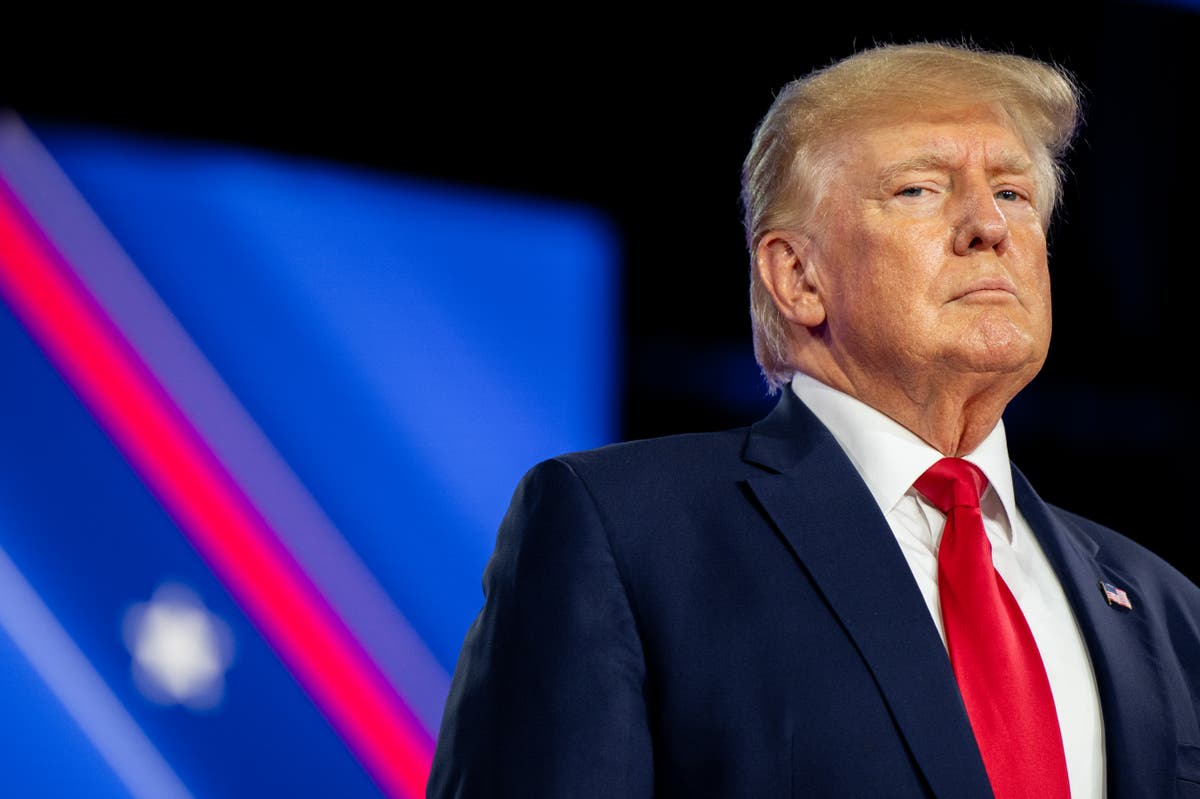
Donald Trump complained to his most senior aide, then-chief of staff John Kelly, that he wanted the US’s top generals including retired military figures to show him absolute, unquestioning loyalty while specifically pointing to Nazi Germany as an example.

In a bizarre exchange described by reporters for The New Yorker and New York Times in an upcoming book Mr Trump is said to have asked his top aid, who himself was a four-star general in charge of US Southern Command, “[W]hy can’t you be like the German generals?”

A bewildered Mr Kelly reportedly responded, “Which generals?” to which Mr Trump supposedly shot back, “The German generals in World War II.”

His chief of staff then allegedly told the president, “You do know that they tried to kill Hitler three times and almost pulled it off?”

But the president in response substituted his own version of history.

“No, no, no, they were totally loyal to him,” Mr Trump reportedly insisted to his aid.

The excerpts were published on Monday in The New Yorker. The Divider: Trump in the White House, by Peter Baker and Susan Glasser, is due to be released in September.

Mr Kelly served as chief of staff through the first half of Mr Trump’s tumultuous four years in office, joining after the exit of Reince Priebus. He has imposed some order on the rowdy group of Trump loyalists in the West Wing, including clashing with Steve Bannon, the ex-Breitbart News chief, and eventually ousting him.

He left the office in early January 2019. Surprisingly, the remarks reported on Monday are not the first approving words the ex-president has been accused of making about Nazi Germany and its leadership in conversations with Mr Kelly in particular. He is said to have told Mr Kelly, “Well, [Adolf] Hitler did a lot of good things” during a 2018 trip to France alongside his top advisers, a statement first reported by Michael Bender of The Wall Street Journal for his own book about the Trump presidency. Mr Trump denied making those remarks through a spokesperson after the book’s publication.

The former president had a troubled relationship with top American military brass while in office. He at first appeared to be seeking to align his administration with the views of the US military establishment by staffing a number of top positions in his White House, including his chief of staff position, with retired generals like Mr Kelly and James Mattis.

But by the end of his presidency he had clearly fallen out of favor with those same retired brass (and they with him as well) and was re-embracing the politicians and loyalists who made up much of his inner circle. In June of 2020 he received some of his most withering criticism made by a former member of his administration when Mr Mattis responded to the use of law enforcement officers to clear peaceful protesters from a park outside of the White House so that the president could take part in a photo op.

“Donald Trump is the first president in my lifetime who does not try to unite the American people — does not even pretend to try,” Mr Mattis wrote at the time. “Instead he tries to divide us.”

Categories
US

Trump complained his generals were not ‘totally loyal’ like Hitler’s, book reveals

Donald Trump complained to his most senior aide, then-chief of staff John Kelly, that he wanted the US’s top generals including retired military figures to show him absolute, unquestioning loyalty while specifically pointing to Nazi Germany as an example.

In a bizarre exchange described by reporters for The New Yorker and New York Times in an upcoming book Mr Trump is said to have asked his top aid, who himself was a four-star general in charge of US Southern Command, “[W]hy can’t you be like the German generals?”

A bewildered Mr Kelly reportedly responded, “Which generals?” to which Mr Trump supposedly shot back, “The German generals in World War II.”

His chief of staff then allegedly told the president, “You do know that they tried to kill Hitler three times and almost pulled it off?”

But the president in response substituted his own version of history.

“No, no, no, they were totally loyal to him,” Mr Trump reportedly insisted to his aid.

The excerpts were published on Monday in The New Yorker. The Divider: Trump in the White House, by Peter Baker and Susan Glasser, is due to be released in September.

Mr Kelly served as chief of staff through the first half of Mr Trump’s tumultuous four years in office, joining after the exit of Reince Priebus. He has imposed some order on the rowdy group of Trump loyalists in the West Wing, including clashing with Steve Bannon, the ex-Breitbart News chief, and eventually ousting him.

He left the office in early January 2019. Surprisingly, the remarks reported on Monday are not the first approving words the ex-president has been accused of making about Nazi Germany and its leadership in conversations with Mr Kelly in particular. He is said to have told Mr Kelly, “Well, [Adolf] Hitler did a lot of good things” during a 2018 trip to France alongside his top advisers, a statement first reported by Michael Bender of The Wall Street Journal for his own book about the Trump presidency. Mr Trump denied making those remarks through a spokesperson after the book’s publication.

The former president had a troubled relationship with top American military brass while in office. He at first appeared to be seeking to align his administration with the views of the US military establishment by staffing a number of top positions in his White House, including his chief of staff position, with retired generals like Mr Kelly and James Mattis.

But by the end of his presidency he had clearly fallen out of favor with those same retired brass (and they with him as well) and was re-embracing the politicians and loyalists who made up much of his inner circle. In June of 2020 he received some of his most withering criticism made by a former member of his administration when Mr Mattis responded to the use of law enforcement officers to clear peaceful protesters from a park outside of the White House so that the president could take part in a photo op.

“Donald Trump is the first president in my lifetime who does not try to unite the American people — does not even pretend to try,” Mr Mattis wrote at the time. “Instead he tries to divide us.”

Categories
US

Here’s what’s in the Inflation Reduction Act, the sweeping health and climate bill passed Sunday

The Senate passed Democrats’ Inflation Reduction Act on a party-line vote Sunday afternoon, delivering the long-awaited centerpiece to President Biden’s agenda.

Democrats rallied behind the $430 billion climate, health care and tax overhaul after Senate Majority Leader Charles Schumer (DN.Y.) reached a last-minute deal with Sen. Joe Manchin (DW.Va.), who had held up previous proposals.

The House is expected to approve the legislation on Friday and send it to Biden’s desk.

Here’s a summary of what’s in the Inflation Reduction Act:

ENVIRONMENT, ENERGY AND CLIMATE

Businesses would get incentives for deployment of lower-carbon and carbon-free energy sources.

  • Tax credits are extended for energy production and investment in technologies including wind, solar and geothermal energies. The investment tax credit also now applies to battery storage and biogas.
  • Tax credits would be created or extended for additional technologies and energy sources including nuclear energy, hydrogen energy coming from clean sources, biofuels and technology that captures carbon from fossil fuel power plants.
  • Many of the incentives also contain bonuses for companies based on how much they pay their workers and offer credits for manufacturing their steel, iron and other components in the US

Consumers and businesses get incentives to make cleaner energy choices.

  • Tax credits are extended for residential clean energy expenses including rooftop solar, heat pumps and small wind energy systems. Consumers can get credits for 30 percent of expenditures through 2032, and the credit phases down after that.
  • Tax credits of up to $7,500 are offered to consumers who buy electric vehicles — but this credit comes with stipulations that may make it difficult for vehicles to actually qualify.
  • A tax credit would be expanded for energy efficiency in commercial buildings.

Some fossil fuel production on public lands would be bolstered.

  • The future of solar and wind on public lands and wind in public waters would be tied to requirements to hold lease sales that open up new oil and gas production.
  • The bill reinstates the results of a recent offshore oil and gas lease sale that was struck down on environmental grounds. The Interior Department would be required to hold at least three more offshore oil and gas lease sales by next October.

New programs boost investment in climate.

  • A new program aims to reduce emissions of the planet-warming gas methane from oil and gas by both providing grants and loans to help companies reign in their emissions and levying fees on producers with excess methane emissions.
  • $27 billion would go to a green bank that would provide more incentives for clean energy technology.

Costs increase for fossil fuel production on public lands.

  • Minimum royalties increase for companies to pay the government for oil and gas they extract on public lands and waters. A royalty is added to the extraction of gas that is later burned off or released as waste instead of sold as fuel.

Communities that face high pollution burdens get relief.

  • $3 billion would go to environmental justice block grants — community-led programs addressing harms from climate change and pollutants, including $20 million for technical assistance at the community level, through fiscal 2026.
  • More than $3 billion is allocated to funds for air pollution monitoring in low-income communities. Nearly half of the funds — $117 million — would specifically go to communities in close proximity to industrial pollutants.
  • An excise tax on imported petroleum and crude oil products to fund the cleanup of industrial disaster sites increases from 9.7 cents to 16.4 cents per barrel. The reinstatement of the tax is projected to raise $11 billion.
  • The bill permanently extends and increases the Black Lung Disability Trust Fund, a tax on coal production to finance claims from workers with the condition. Black lung, caused by long-term exposure to and inhalation of coal dust, is believed to affect at least 10 percent of coal miners with at least 25 years’ experience, according to a 2018 study by the National Institute for Occupational Safety and Health.

— Rachel Frazin and Zack Budryk

HEALTH CARE

Medicare can negotiate lower prices.

The bill would allow Medicare to negotiate prices for some drugs for the first time, a policy Democrats have been trying to enact for years over the fierce objections of the pharmaceutical industry. The provisions save more than $200 billion over 10 years.

  • It would allow Medicare to negotiate lower prices for 10 high-cost drugs beginning in 2026, ramping up to 20 drugs by 2029. There is a steep penalty if a drug company doesn’t come to the table: a tax of up to 95 percent of the sales of the drug. There is also a ceiling that the negotiated price cannot rise above.
  • In a deal with moderates including Sen. Kyrsten Sinema (D-Ariz.), only older drugs are subject to negotiation after a period of nine years for most drugs and 13 years for more complex “biologic” drugs. That means the negotiations are more limited than many Democrats wanted.

Drug costs can be capped but largely only for Medicare.

The bill includes other measures to cap drug costs. The provisions still largely apply only to seniors on Medicare, not the millions of people who get health insurance through their jobs, in part because complex Senate rules limited how expansive the provisions would be.

  • If drug companies raise prices in Medicare faster than the rate of inflation, they must pay rebates back to the government for the difference.
  • Democrats tried to apply this provision to the private market, but the parliamentarian ruled it violated the Senate rules used to bypass a GOP filibuster.
  • In one of the most tangible provisions for patients, the bill caps out-of-pocket drug costs at $2,000 a year for seniors on Medicare, starting in 2025.
  • The bill also caps patients’ insulin costs at $35 a month, but only for seniors on Medicare. Republicans voted against overruling the Senate parliamentarian to extend that protection to patients with private insurance.

People enrolled in ACA plans get an extension on premium assistance.

The measure also builds on the Affordable Care Act (ACA) by extending enhanced financial assistance to help people enrolled in ACA plans afford premiums for three years. The extra help would otherwise have expired at the end of this year, setting up a cliff. The provision expands eligibility to allow more middle-class people to receive premium help and increases the amount of help overall.

—Peter Sullivan

TAXES

Large corporations will pay for climate and health measures within the bill.

The bill introduces new taxes on corporations to pay for its climate and health care measures.

The centerpiece of its tax plan is a 15 percent minimum tax on the income that big corporations report to their shareholders, a tax known as the minimum book tax. Initial proposals put the amount of revenue raised by the book tax at $313 billion — more than 40 percent of the $740 billion raised by the legislation as a whole.

The tax applies to companies reporting $1 billion in annual earnings. It would impact only around 150 large firms, according to the Joint Committee on Taxation.

Sinema demanded some last-minute exclusions to the minimum tax that were favorable to the US manufacturing sector and private equity firms.

  • The tax will exempt companies taking advantage of accelerated depreciation, a popular deduction that helps pay for capital investments such as new equipment.
  • Small businesses that are subsidiaries of highly profitable private equity firms will also be exempted from the minimum tax.

The IRS gets a funding boost.

Another key measure allocates $80 billion to increase enforcement at the IRS. Democrats hope that, with more employees and better technology, the IRS can more closely examine wealthy individuals and ensure they aren’t dodging taxes. That extra revenue is expected to lower the deficit by $203 billion over the next decade.

Stock buybacks will get an additional tax.

The bill enacts a 1 percent excise tax on stock buybacks to replace the revenues lost by appeasing Sinema. Democrats expect the provision to raise $74 million over a decade.

Share repurchases by S&P 500 companies have soared in recent years and are on track to surpass $1 trillion this year. Companies buy back their stock to reward shareholders and increase their stock price by artificially limiting supply.

  • The tax will impact the nation’s largest companies that rely on multibillion-dollar buybacks to raise their stock price, including Apple, Nike and Exxon Mobil.
  • Democrats have criticized the practice, arguing that companies should invest in workers and innovation instead of repurchasing stock.

To further recover revenue lost to the private equity sector, the bill also extends a set of limitations on losses that businesses can deduct from their taxes. The limits prevent wealthy individuals from significantly bringing down or even wiping out their income tax liability. Sen. Mark Warner (D-Va.) said that extending the caps would raise $52 billion.

— Tobias Burns and Karl Evers-Hillstrom

.

Categories
US

Here’s what’s in the Inflation Reduction Act, the sweeping health and climate bill passed Sunday

The Senate passed Democrats’ Inflation Reduction Act on a party-line vote Sunday afternoon, delivering the long-awaited centerpiece to President Biden’s agenda.

Democrats rallied behind the $430 billion climate, health care and tax overhaul after Senate Majority Leader Charles Schumer (DN.Y.) reached a last-minute deal with Sen. Joe Manchin (DW.Va.), who had held up previous proposals.

The House is expected to approve the legislation on Friday and send it to Biden’s desk.

Here’s a summary of what’s in the Inflation Reduction Act:

ENVIRONMENT, ENERGY AND CLIMATE

Businesses would get incentives for deployment of lower-carbon and carbon-free energy sources.

  • Tax credits are extended for energy production and investment in technologies including wind, solar and geothermal energies. The investment tax credit also now applies to battery storage and biogas.
  • Tax credits would be created or extended for additional technologies and energy sources including nuclear energy, hydrogen energy coming from clean sources, biofuels and technology that captures carbon from fossil fuel power plants.
  • Many of the incentives also contain bonuses for companies based on how much they pay their workers and offer credits for manufacturing their steel, iron and other components in the US

Consumers and businesses get incentives to make cleaner energy choices.

  • Tax credits are extended for residential clean energy expenses including rooftop solar, heat pumps and small wind energy systems. Consumers can get credits for 30 percent of expenditures through 2032, and the credit phases down after that.
  • Tax credits of up to $7,500 are offered to consumers who buy electric vehicles — but this credit comes with stipulations that may make it difficult for vehicles to actually qualify.
  • A tax credit would be expanded for energy efficiency in commercial buildings.

Some fossil fuel production on public lands would be bolstered.

  • The future of solar and wind on public lands and wind in public waters would be tied to requirements to hold lease sales that open up new oil and gas production.
  • The bill reinstates the results of a recent offshore oil and gas lease sale that was struck down on environmental grounds. The Interior Department would be required to hold at least three more offshore oil and gas lease sales by next October.

New programs boost investment in climate.

  • A new program aims to reduce emissions of the planet-warming gas methane from oil and gas by both providing grants and loans to help companies reign in their emissions and levying fees on producers with excess methane emissions.
  • $27 billion would go to a green bank that would provide more incentives for clean energy technology.

Costs increase for fossil fuel production on public lands.

  • Minimum royalties increase for companies to pay the government for oil and gas they extract on public lands and waters. A royalty is added to the extraction of gas that is later burned off or released as waste instead of sold as fuel.

Communities that face high pollution burdens get relief.

  • $3 billion would go to environmental justice block grants — community-led programs addressing harms from climate change and pollutants, including $20 million for technical assistance at the community level, through fiscal 2026.
  • More than $3 billion is allocated to funds for air pollution monitoring in low-income communities. Nearly half of the funds — $117 million — would specifically go to communities in close proximity to industrial pollutants.
  • An excise tax on imported petroleum and crude oil products to fund the cleanup of industrial disaster sites increases from 9.7 cents to 16.4 cents per barrel. The reinstatement of the tax is projected to raise $11 billion.
  • The bill permanently extends and increases the Black Lung Disability Trust Fund, a tax on coal production to finance claims from workers with the condition. Black lung, caused by long-term exposure to and inhalation of coal dust, is believed to affect at least 10 percent of coal miners with at least 25 years’ experience, according to a 2018 study by the National Institute for Occupational Safety and Health.

— Rachel Frazin and Zack Budryk

HEALTH CARE

Medicare can negotiate lower prices.

The bill would allow Medicare to negotiate prices for some drugs for the first time, a policy Democrats have been trying to enact for years over the fierce objections of the pharmaceutical industry. The provisions save more than $200 billion over 10 years.

  • It would allow Medicare to negotiate lower prices for 10 high-cost drugs beginning in 2026, ramping up to 20 drugs by 2029. There is a steep penalty if a drug company doesn’t come to the table: a tax of up to 95 percent of the sales of the drug. There is also a ceiling that the negotiated price cannot rise above.
  • In a deal with moderates including Sen. Kyrsten Sinema (D-Ariz.), only older drugs are subject to negotiation after a period of nine years for most drugs and 13 years for more complex “biologic” drugs. That means the negotiations are more limited than many Democrats wanted.

Drug costs can be capped but largely only for Medicare.

The bill includes other measures to cap drug costs. The provisions still largely apply only to seniors on Medicare, not the millions of people who get health insurance through their jobs, in part because complex Senate rules limited how expansive the provisions would be.

  • If drug companies raise prices in Medicare faster than the rate of inflation, they must pay rebates back to the government for the difference.
  • Democrats tried to apply this provision to the private market, but the parliamentarian ruled it violated the Senate rules used to bypass a GOP filibuster.
  • In one of the most tangible provisions for patients, the bill caps out-of-pocket drug costs at $2,000 a year for seniors on Medicare, starting in 2025.
  • The bill also caps patients’ insulin costs at $35 a month, but only for seniors on Medicare. Republicans voted against overruling the Senate parliamentarian to extend that protection to patients with private insurance.

People enrolled in ACA plans get an extension on premium assistance.

The measure also builds on the Affordable Care Act (ACA) by extending enhanced financial assistance to help people enrolled in ACA plans afford premiums for three years. The extra help would otherwise have expired at the end of this year, setting up a cliff. The provision expands eligibility to allow more middle-class people to receive premium help and increases the amount of help overall.

—Peter Sullivan

TAXES

Large corporations will pay for climate and health measures within the bill.

The bill introduces new taxes on corporations to pay for its climate and health care measures.

The centerpiece of its tax plan is a 15 percent minimum tax on the income that big corporations report to their shareholders, a tax known as the minimum book tax. Initial proposals put the amount of revenue raised by the book tax at $313 billion — more than 40 percent of the $740 billion raised by the legislation as a whole.

The tax applies to companies reporting $1 billion in annual earnings. It would impact only around 150 large firms, according to the Joint Committee on Taxation.

Sinema demanded some last-minute exclusions to the minimum tax that were favorable to the US manufacturing sector and private equity firms.

  • The tax will exempt companies taking advantage of accelerated depreciation, a popular deduction that helps pay for capital investments such as new equipment.
  • Small businesses that are subsidiaries of highly profitable private equity firms will also be exempted from the minimum tax.

The IRS gets a funding boost.

Another key measure allocates $80 billion to increase enforcement at the IRS. Democrats hope that, with more employees and better technology, the IRS can more closely examine wealthy individuals and ensure they aren’t dodging taxes. That extra revenue is expected to lower the deficit by $203 billion over the next decade.

Stock buybacks will get an additional tax.

The bill enacts a 1 percent excise tax on stock buybacks to replace the revenues lost by appeasing Sinema. Democrats expect the provision to raise $74 million over a decade.

Share repurchases by S&P 500 companies have soared in recent years and are on track to surpass $1 trillion this year. Companies buy back their stock to reward shareholders and increase their stock price by artificially limiting supply.

  • The tax will impact the nation’s largest companies that rely on multibillion-dollar buybacks to raise their stock price, including Apple, Nike and Exxon Mobil.
  • Democrats have criticized the practice, arguing that companies should invest in workers and innovation instead of repurchasing stock.

To further recover revenue lost to the private equity sector, the bill also extends a set of limitations on losses that businesses can deduct from their taxes. The limits prevent wealthy individuals from significantly bringing down or even wiping out their income tax liability. Sen. Mark Warner (D-Va.) said that extending the caps would raise $52 billion.

— Tobias Burns and Karl Evers-Hillstrom

.

Categories
US

Michigan AG alleges conspiracy by Trump backers to break into voting equipment

Aug 8 (Reuters) – Michigan Attorney General Dana Nessel is alleging that her Republican political opponent in the November elections orchestrated a conspiracy with a state lawmaker and a lawyer to break into voting equipment in a hunt for evidence to prove former president Donald Trump’s false voter -fraud claims.

The charge that Nessel’s Republican challenger, Matt DePerno, was involved in a potential felony is outlined in a petition filed by Nessel, a Democrat, seeking the appointment of a special prosecutor to continue the investigation. The petition notes that DePerno has emerged as “one of the prime instigators of the conspiracy,” creating a conflict of interest for her office de ella to take the case further.

Reuters exclusively reported on Sunday that DePerno led a team that gained unauthorized access to voting equipment in Richfield Township. The news organization linked the Trump-backed Republican candidate to the incident by matching the serial number on the compromised machine to a photograph in a report submitted by DePerno in a failed lawsuit alleging voter fraud.

Register now for FREE unlimited access to Reuters.com

The Richfield tabulator is among five such machines that the attorney general said were accessed without authorization, including a separate incident in Roscommon County and other breaches in Missaukee County’s Lake Township and Barry County’s Irving Township. The incidents occurred between early March and late June of 2021, the attorney general said.

DePerno did not respond to requests for comment, but said on Twitter that Nessel’s investigation was politically motivated. His tweet from him included a fundraising plea for donations to help him “fight back.”

“My opponent called for me to be arrested for the ‘crime’ of investigating voter fraud in 2020,” DePerno said in a tweet. His campaign called Nessel’s actions “unethical” in a statement.

Nessel declined a request for an interview and her communications director, Amber McCann, did not answer questions about when DePerno became a suspect in his investigation and why the office did not request a special prosecutor earlier. McCann said in a statement that the office “reviews facts and follows evidence” during investigations.

It remains unclear when the conflict of interest emerged. DePerno announced his candidacy against Nessel in July 2021 and received the Republican Party’s endorsement in April. Nessel announced her investigation into voting breaches in February.

The investigation into a Republican attorney general candidate in a voting-system breach comes amid a national effort by backers of Trump’s stolen-election falsehoods to win state offices that could prove critical in deciding any future contested elections.

Nessel’s petition says DePerno plotted to illegally access voting equipment with Republican State Rep. Daire Rendon and Stefanie Lambert, a lawyer who helped high-profile Trump allies file an ultimately unsuccessful lawsuit seeking to overturn Michigan’s election results. The trio “orchestrated a coordinated plan to gain access to voting tabulators” in three township offices and a county office, the petition said. In one case, Rendon allegedly told the Roscommon County clerk, falsely, that the state House of Representatives was conducting an investigation into election fraud.

The machines were taken to “hotels and/or AIRBNB’s” in Oakland County, in metropolitan Detroit. There, technical experts “broke into the tabulators and performed ‘tests’ on the equipment,” the petition says. In at least one instance, the petition notes, DePerno “was present at a hotel room during such ‘testing.’”

Rendon and Lambert did not respond to requests for comment.

The attorney general’s petition listed a series of crimes for potential prosecution, including malicious destruction of property, fraudulent access to a computer, and conspiracy. A conspiracy charge could be punished with up to five years in prison under Michigan state law.

The attorney general’s petition said her office had sought approval for criminal charges from the state Criminal Trials and Appeals Division. The office asked that a special prosecutor take over the handling of that request and any subsequent prosecutions. The Prosecuting Attorneys Coordinating Council, an autonomous entity within the attorney general’s office, will decide if a special prosecutor is warranted.

Nessel’s petition also names Dar Leaf, the sheriff in rural Barry County, as a participant in the scheme, alleging that he asked the Irving Township clerk to cooperate with “investigators” involved in the conspiracy. In a story last month, Reuters detailed the alleged involvement of Leaf, a far-right backer of Trump’s stolen-election falsehoods and a prominent figure in the extremist “constitutional sheriffs” movement. He said in an interview that no one in his department was involved in taking the tabulator and that he did not authorize anyone to do so.

Leaf did not respond to a request for comment on Nessel’s allegations.

The technical team that examined the voting equipment removed from government offices included James Penrose, a former analyst for the National Security Agency who has assisted prominent Trump allies in their efforts to overturn the 2020 election results, the attorney general’s petition said. It also included Doug Logan, head of Cyber ​​Ninjas, the now-defunct company hired to do a widely criticized partisan audit of the 2020 voting results in Maricopa County, Arizona. Others involved in examining the machines were Jeff Lenberg, a computer security consultant, and Ben Cotton, founder of the digital forensics firm CyFIR LLC.

Penrose, Lenbert and Cotton all worked with DePerno on his lawsuit alleging election fraud in Michigan’s Antrim County. None responded to requests for comments. Logan also did not respond to a request for comment.

Nessel’s petition names all four members of the technical team as targets for possible charges, along with DePerno, Rendon, Lambert and Leaf, the Barry County sheriff. Another person named as a target is Ann Howard, a Michigan lawyer who allegedly coordinated the printing of fake ballots to be run through the tabulators during their examination of her.

Howard declined to comment.

Nessel’s allegations mark a dramatic turn in an investigation that the attorney general launched in February at the request of Secretary of State Jocelyn Benson, a Democrat, who had received information on at least two of the breaches. Benson, a Democrat, said in a statement to Reuters: “There must be consequences for those who broke the law to undermine our elections in order to advance their own political agendas.”

Register now for FREE unlimited access to Reuters.com

Reporting by Peter Eisler and Nathan Layne; edited by Brian Thevenot

Our Standards: The Thomson Reuters Trust Principles.

.

Categories
US

US readies largest security package for Ukraine, bringing commitment to $9.8 billion

Ukraine was already stocking up on US-made Javelins before Russia invaded. Here a group of Ukrainian servicemen take a shipment of Javelins in early February, as Russia positioned troops on Ukraine’s border.

Sergey Supinsky | AFP | Getty Images

WASHINGTON – The Biden administration announced a $1 billion security assistance package for Ukraine on Monday, the largest weapons installation yet since Russia’s full-scale invasion began in late February.

The military aid package, the 18th such tranche, upcoming brings US commitment to about $9.8 billion and includes munitions for long-range weapons and armored medical transport vehicles.

The package consists of additional ammunition for High Mobility Artillery Rocket Systems or HIMARS, 75,000 rounds of 155 mm artillery ammunition, 20 120 mm mortar systems and 20,000 rounds of 120 mm mortar ammunition as well as munitions for National Advanced Surface-to-Air Missile Systems or NASAMS.

The HIMARS, manufactured by defense giant Lockheed Martin, are designed to shoot a variety of missiles from a mobile 5-ton truck and have sat high on Ukrainian wish lists. Under Secretary of Defense for Policy Colin Kahl said that the US was not sending HIMARS in this latest package, only ammunition for the system. Kahl declined to say how many rounds of ammunition would be in the next delivery.

The US has thus far provided 16 HIMARS to Ukraine.

The Pentagon will also send 1,000 Javelins, hundreds of AT4 anti-armor systems, 50 armored medical treatment vehicles, anti-personnel munitions, explosives, demolition munitions and demolition equipment.

Until now, the largest Ukraine assistance package was announced on June 15 but that installation was a mixture of presidential drawdown authority and the Ukraine Security Assistance Initiative. Monday’s package, solely a presidential drawdown authority, means the weapons come directly from US stockpiles.

“We will continue to consult closely with Ukraine and emerge additional available systems and capabilities carefully calibrated to make a difference on the battlefield and strengthen Ukraine’s eventual position at the negotiating table,” Secretary of State Antony Blinken said in a statement.

.

Categories
US

US to send $4.5 billion more to Ukraine for budget needs

National flags of Ukraine and the US fly at a compound of a police training base outside kyiv, Ukraine, May 6, 2016. Picture taken May 6, 2016. REUTERS/Valentyn Ogirenko

Register now for FREE unlimited access to Reuters.com

Aug 8 (Reuters) – The United States will provide an additional $4.5 billion to Ukraine’s government, bringing its total budgetary support since Russia’s February invasion to $8.5 billion, the US Agency for International Development said on Monday.

The funding, coordinated with the US Treasury Department through the World Bank, will go to the Ukraine government in tranches, beginning with a $3 billion disbursement in August, USAID, the Agency for International Development, said.

It follows previous transfers of $1.7 billion in July and $1.3 billion in June, USAID said. Washington has also provided billions of dollars in military and security support. The Pentagon announced a $1 billion arms aid package on Monday. read more

Register now for FREE unlimited access to Reuters.com

Overall, the United States has contributed more than $18 billion to Ukraine this year.

The new budgetary funds are to help the Ukrainian government maintain essential functions, including social and financial assistance for the growing poor population, children with disabilities, and millions of internally displaced persons, as the war drags on.

Ukrainian officials estimate the country faces a $5 billion-a-month fiscal shortfall – or 2.5% of pre-war gross domestic product – due to the cost of the war and declining tax revenues. Economists say that Ukraine’s annual deficit will swell to 25% of GDP, compared with 3.5% before the conflict.

The World Bank estimates that 55% of Ukrainians will be living in poverty by the end of 2023 as a result of the war and the large numbers of displaced persons, compared with 2.5% before the start of the war.

USAID said US budget support has enabled the Ukrainian government to keep gas and electricity flowing to hospitals, schools and other critical infrastructure and deliver urgently needed humanitarian supplies to citizens.

The funds have also paid for healthcare workers, teachers and other civil servants.

USAID said robust safeguards had been put in place by the World Bank, along with USAID-funded, third-party watchdogs embedded within the Ukrainian government to make sure the funds are directed where they are meant to go.

“This economic assistance is critical in supporting the Ukrainian people as they defend their democracy against Russia’s unprovoked war of aggression,” US Treasury Secretary Janet Yellen said in a statement provided to Reuters.

The injection of fresh cash for Ukraine comes as the war, which Russia calls “a special military operation,” stretches into a sixth month, with millions of displaced Ukrainians and authorities warning of likely gas shortages in winter.

Register now for FREE unlimited access to Reuters.com

Reporting by Andrea Shalal; Editing by Heather Timmons and Howard Goller

Our Standards: The Thomson Reuters Trust Principles.

.

Categories
US

2nd person dies after shooting in Atlanta park that injured 4 others, including 6-year-old – WSB-TV Channel 2

Police: 6-year-old critical, man dead, 4 more hurt in shooting during baseball game at Atlanta park

ATLANTA — Atlanta police are investigating a shooting that left two people dead and four others, including a child, wounded at an Atlanta park.

The shooting occurred at the Dunbar Recreational Center inside Rosa L. Burney Park on Windsor Street around 7 pm

[DOWNLOAD: Free WSB-TV News app for alerts as news breaks]

APD Deputy Chief Charles Hampton Jr. says there was a baseball or softball game occurring when an argument broke out, ending with shots fired.

When they arrived, officers found multiple people shot.

TRENDING STORIES:

A man in his 30s was transported to Grady Memorial Hospital, where he died from his injuries.

Another woman died Monday, according to police.

A 6-year-old child was also taken to Children’s Healthcare of Atlanta – Egleston Hospital and remains in critical condition.

[SIGN UP: WSB-TV Daily Headlines Newsletter]

The other four victims are stable.

Anyone with information about the shooting is asked to contact 911, Atlanta Police Homicide unit at 404-546-4235 or Crime Stoppers at 404-577-8477.

IN OTHER NEWS: