Former President Donald Trump apologized to Sen. Ted Cruz for insulting his wife’s looks of him, suggesting his father was involved in the assassination of President John F. Kennedy, and questioning whether the Texas Republican could legally run for president if he was born in Canada, according to a forthcoming book by Paul Manafort.
“On his own initiative, Trump did apologize for saying some of the things he said about Cruz, which was unusual for Trump,” the 45th president’s onetime campaign chairman writes, according to the Guardian.
During the bruising 2016 Republican primary race, Trump called Heidi Cruz “ugly,” suggested Ted’s father, Rafael, had ties to Kennedy assassin Lee Harvey Oswald, publicly cast doubt on Cruz’s eligibility to run for president and bestowed the nickname “Lyin’ Ted ”upon the senator.
Former President Donald Trump apologized to Sen. Ted Cruz for comments he made during the 2016 election regarding his wife and father of him.AP Photo/Paul Sancya, FileDonald Trump apologized to Ted Cruz for insulting his wife’s looks and suggesting his father was involved in the assassination of John F. Kennedy.Angela Major/The Janesville Gazette via AP
According to Manafort, the real estate tycoon approached Cruz prior to the Republican National Convention that July to secure the Texan’s endorsement.
Cruz, who had finished runner-up to Trump in the nominating contest, responded to the overture by saying he would work with Trump but not endorse him “because his supporters didn’t want him to.”
“It was a forced justification for someone who is normally very logical. Trump didn’t buy it,” Manafort reportedly writes.
Manafort resigned as Trump campaign chair that August after news reports detailed under-the-table payments he received.AP Photo/Seth Wenig, File
Despite Cruz’s cool reception, the author goes on, Trump apologized and told his rival that he “considered him an ally, not an enemy, and that he believed they could work together when Trump was president.”
Cruz notably did not endorse Trump in his convention remarks, outraging the delegates and leading his wife being escorted out of the hall over fears for her safety.
During Cruz’s remarks, Manafort recalls, Trump groused, “This is bulls–t” and walked to the back of the arena, “effectively pulling the attention away from Cruz and undercutting his speech.”
Cruz notably did not endorse Trump in his convention remarks, outraging the delegates and leading his wife being escorted out of the hall over fears for her safety.AP Photo/Phelan M. Ebenhack, FilDuring the bruising 2016 Republican primary race, Trump called Heidi Cruz “ugly” and suggested Ted’s father, Rafael, had ties to Kennedy assassin Lee Harvey Oswald.AP Photo/Seth Wenig
Cruz was initially upset by Trump’s display of petulance.
“It took months to bring that relationship back,” Manafort writes. “But eventually Cruz came around to support Trump, and Trump harbored no ill will.”
Manafort, now 73, resigned as Trump campaign chair that August after news reports detailed under-the-table payments he received for lobbying work on behalf of Ukraine’s pro-Moscow president, Viktor Yanukovych.
Ultimately, Manafort was sentenced to seven years in prison for tax fraud and other crimes related to his work in Ukraine — charges that emerged from special counsel Robert Mueller’s Russia investigation. Trump pardoned Manafort in December 2020.
Manafort’s book, “Political Prisoner: Persecuted, Prosecuted, but Not Silenced,” is due out Aug. 16.
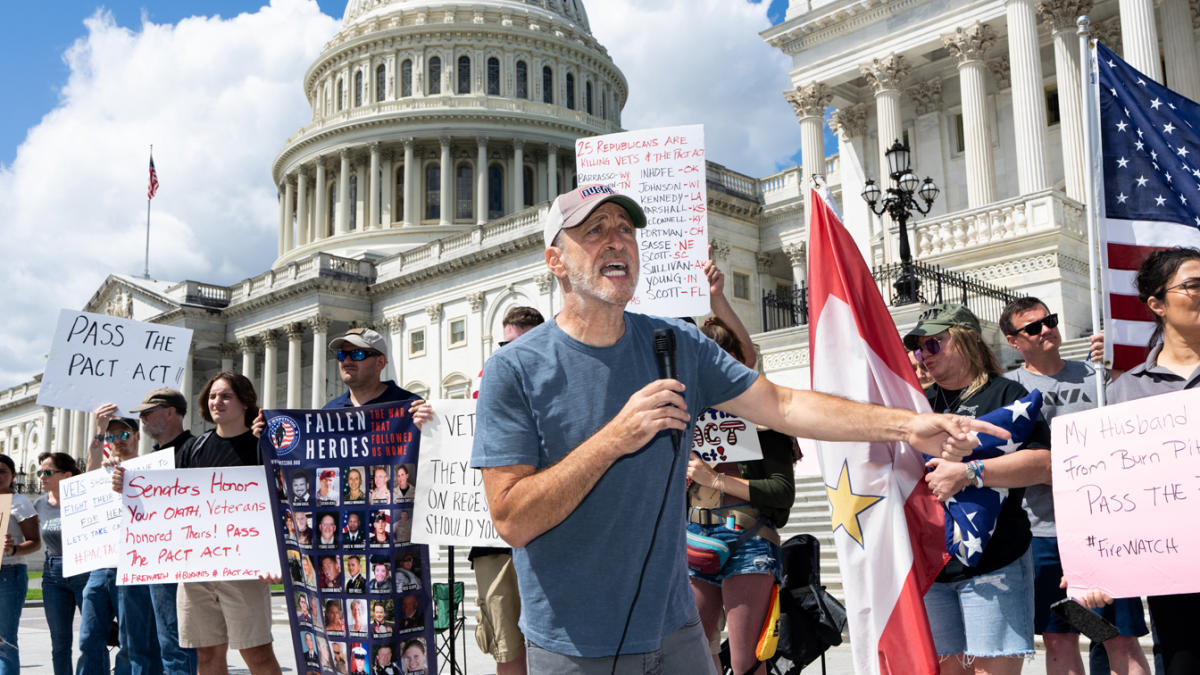
WASHINGTON — Comedian and activist Jon Stewart returned to Washington on Monday, holding a rally in front of the US Capitol to prod recalcitrant Senate Republicans into finally passing a bill that would extend treatment to soldiers exposed to toxic chemicals.
“This is the lowest hanging fruit of a functioning society. Like, if we can’t do this, the rest of us have no shot,” Stewart said, depicting the stalled bill as a symptom of deepening political dysfunction. “This is the canary in the coal mine.”
Behind him stood veterans and their families, including Susan Zeier, the mother-in-law of Sgt. 1st Class Heath Robinson, who died of lung cancer at the age of 39 two years ago. The Department of Veterans Affairs denied him the kind of benefits it extends to soldiers, and their families, when they are injured on active duty. The bill is named after Robinson, who left behind a 9-year-old daughter.
Comedian and activist Jon Stewart speaks during a rally to call on the Senate to pass the PACT Act, on Monday. (Bill Clark/CQ-Roll Call, Inc via Getty Images)
“Senators lie, veterans die,” said a sign held by one of the attendees behind Stewart. The sign brandished by another simply listed the names of the 25 US senators, all of them Republicans, who stymied passage last week.
Stewart hoped that his presence would break the impasse before legislators left on their customary August vacation. By turns angry and exasperated, I have highlighted the seemingly uncontroversial quality of the legislation. “This isn’t like the Democrats snuck in ‘abortion for all’ into a gay pride bill,” the former “Daily Show” host joked to Yahoo News after the rally was concluded.
The imperiled legislation, also known as the PACT Act, would allow the Department of Veterans Affairs to expand health care services for service members exposed to dangerous chemicals from so-called burn pits where garbage was incinerated, with the help of jet fuel, during the wars in Iraq and Afghanistan. At least nine respiratory cancers are believed to be potentially caused by breathing in the particulate matter emitted by the burn pits.
“Passage of the PACT Act is the highest priority in the entire veterans’ community,” legislative official Jeffrey Steele of the American Legion told Yahoo News.
Veterans and supporters of the Honoring Our PACT Act are seen during a press conference after Republican senators stalled the act, meant to help military veterans exposed to toxic burn pits, in front of the US Capitol on July 28. (Nathan Posner/Anadolu Agency via GettyImages)
The Senate had initially passed the bill in June with broad bipartisan support, but the removal of a single sentence about taxation required a new vote, setting up last week’s surprise defeat. In a surprise move that stunned veterans and their supporters, 25 Republicans in the GOP who had previously supported the bill decided to keep the measure from advancing.
“This is bulls***,” Sen. Kirsten Gillibrand, DN.Y., a supporter of the PACT Act, said at a rally last Thursday following the development. Stewart’s fiery speech at the same rally quickly became an Internet sensation. He is a longtime supporter of veterans’ issues and also fought for passage of the Zadroga Act (also sponsored by Gillibrand), which created a compensation fund for first responders sickened from working at Ground Zero after the Sept. 11 terrorist attacks.
“It was the original burn pit,” Stewart said of the ruined World Trade Center, whose collapse released a similar multitude of toxic chemicals. The difference, Stewart said, was that Ground Zero was the product of a terrorist attack, while the burn pits were the result of careless practice.
“The contracts that ran the burn pits did it to them,” he said. “Not because technology didn’t exist, not to do it. But because it was cheaper. ‘And they’re just soldiers. Who gives as***?’”
Republicans have maintained that the bill is too expensive. Some believe the move last week was little more than a show of frustration after a surprise announcement of a $700 billion reconciliation package that would address President Biden’s priorities on climate change and other health care expenses.
Sen. Pat Toomey. R-Pa., leaves the Senate chamber following the passage of the Bipartisan Safer Communities Act at the US Capitol on June 23. (Chip Somodevilla/Getty Images)
Sen. Pat Toomey, R-Pa., a leader of the recent Republican opposition to the PACT Act, said that he would vote for the bill as long as the Senate also approved an amendment he introduced to fix what he has described as a “budget gimmick” that would, in his view, allow Democrats to spend billions on issues unrelated to veterans’ care.
Veterans Affairs Secretary Denis McDonough has disputed Toomey’s characterization, pointing out that his proposed changes would put a ceiling on how much can be spent on care per year — and end all spending on burn pit care after 10 years, forcing Congress to either do away with the program or renew it through a new vote.
A vote on Toomey’s amendment is expected this week. The veterans who gathered on Capitol Hill vowed to hold rallies until the PACT Act was passed. “We think that Congress should not go anywhere for August recess until this bill gets done,” one of the speakers who followed Stewart said. “We’re going to stay. They need to stay.”
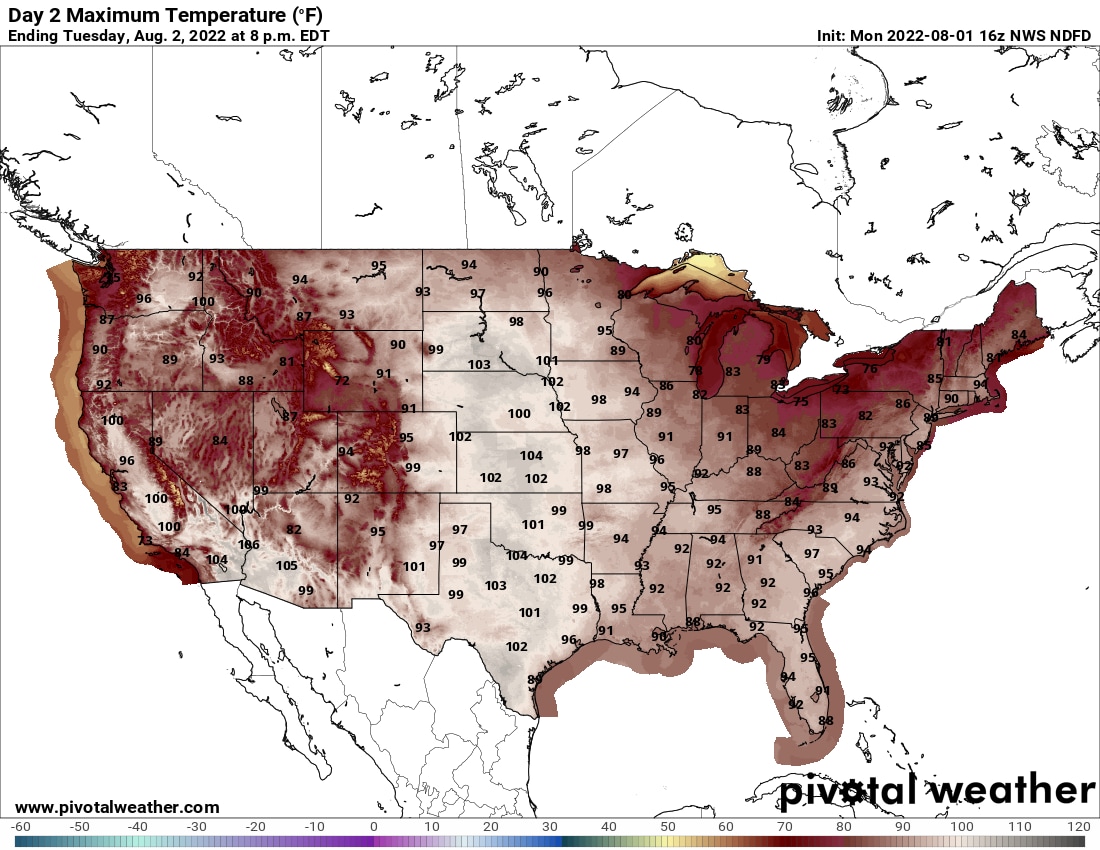
Large parts of the Lower 48 are set to bake this week after a punishing, prolonged heat wave that set records in the Pacific Northwest edges east and south. Few regions will be spared as the heat expands into different areas each day, scorching the Northern Rockies on Monday, the central states Tuesday and Wednesday, and the Northeast by Thursday.
There will be no escape from the heat in Texas, which has already endured a historically hot summer. Temperatures there are projected to remain above normal — with highs mostly in the triple digits — for the whole week.
The heat wave has its roots in the Pacific Northwest, where it set records for longevity in Seattle and Portland.
Combined with a historically severe drought, the heat has fueled dangerous conditions for the spread of wildfires in Northern California, where the newly ignited McKinney Fire devours the landscape. The blaze, located in the Klamath National Forest, has torched 51,468 acres and is entirely uncontained.
2 die in McKinney Fire, now California’s largest wildfire this year
As the heat wave builds eastward, it will bring triple-digit heat to 43 million Americans. Heat advisories are already being issued in the Plains states, and it’s likely that excessive-heat warnings will be rolled out in some cities in the days ahead.
Records crumble in Northwest and Northern California amid escalating fire danger
Relief is finally arriving in the Pacific Northwest after a week of blistering heat, although one more day of triple-digit highs is forecast in eastern parts of Washington and Oregon.
Seattle set a record for its longest stretch with highs at or above 90 degrees. The previous record was a tie between two five-day spans in 2015 and 1981. It hit 94 degrees on Tuesday, 91 on Wednesday, 94 on Thursday and Friday, and 95 on Saturday and Sunday.
Record typing 5th day in a row with a high 90°+ in Seattle today. Avg. high temp for the 5 day streak 93.8° (94,91,94,95,95). Avg. high temps during the other 5 day streaks. 95.0° 7/8-11/1981 91.6° 7/1-5/2015 Hottest 6 day stretch in Seattle, 6/24-29/2021, avg. high 94.8°. #wawx
Portland also experienced a record-long stretch of exceptional heat, with a full week of consecutive days at or above 95 degrees that ended Sunday. The previous record was a tie between a six-day span in 1941 and another in 1981. The city’s average July high is 81.8 degrees, and yet three days between July 25 and the end of the month reached the century mark.
NEW RECORD FOR PDX. Today marks the 7th straight day of 95+ temps. As of 345 pm the airport was at 97 degrees. Will it reach 100? #orwx#pdxtst
In Medford, Ore., it got as hot as 114 degrees Friday, just one degree from its all-time high. Tri-Cities Airport near Kennewick, Wash., managed a high of 110 degrees on Thursday, 112 on Friday and 109 Saturday.
The hot weather across the West has fueled a spattering of wildfires in Oregon and Washington, but the McKinney Fire in Northern California is the region’s most severe blaze. It has burned an area roughly twice the size of Disney World as high temperatures have helped desiccate the landscape, and the ground is replete with dry fuels available to burn.
Many small fires have been detected over this weekend. Crews are dispatched & are addressing them, but we need your help. We don’t have resources to spare to deal with careless human caused fires. Never leave a campfire unattended & no where they are allowed. pic.twitter.com/ab1CDlUoCj
— Forest Service NW (@ForestServiceNW) July 31, 2022
Just how dry is that region of California? The ERC, or Energy Release Component, is 97 percent. That’s a figure related to how much fuel per unit area is available to burn. Values over 80 percent reflect a propensity for dangerous wildfires; at 97 percent, explosive wildfire growth is possible.
High temperatures, increased by the effects of human-induced climate change, contribute to larger and more extreme wildfires. Eighteen of California’s 20 biggest wildfires have occurred in the past two decades.
Extreme heat oozing east in the short term
As the Pacific Northwest heat wave fades, the responsible zone of high pressure—or heat dome—will sink southeastward and become absorbed by another heat dome that stretches from the Four Corners to Florida. The combined heat domes will sometimes flex northeast in the days ahead.
Heat advisories have already been hoisted over the Plains, Ozarks and Corn Belt, encompassing St. Louis, Kansas City, Omaha, Des Moines, Sioux Falls and the Twin Cities.
The core of the heat will settle over the central states Tuesday and Wednesday, and could extend into the Northeast on Thursday.
Here are the day-by-day hot spots:
Numerous record highs between 90 and 105 degrees are forecast in the eastern Pacific Northwest and Northern Rockies from eastern Oregon to central Montana, including Billings, Helena, Great Falls and Missoula.
Highs in the triple digits are forecast for much of the zone from Texas (away from the coast) to western Nebraska. While predicted highs are only in the mid-90s in Missouri, the heat indexes are forecast to reach 100 to 110, including in St. Louis.
Highs of at least 100 degrees are anticipated from Texas (away from the coast) to South Dakota, with heat indexes up to 105 to 110.
Highs in the 90s are projected to cover much of the South and Midwest, with a massive zone seeing heat indexes of 100 to 105, including Dallas, Oklahoma City, Wichita, Omaha, Des Moines, Kansas City, St. Louis and Little Rock. Heat indexes flirting with 100 could extend as far north as Minneapolis.
The heat is concentrated from Texas through Illinois, with widespread forecast highs from the 90s to 105, and heat indexes from 100 to 110. The heat index could reach 100 as far north as Chicago and Detroit.
The heat spreads into the Northeast. Boston and Hartford, Conn.,are both expected to hit 96 degrees on Thursday, and Albany, NY, could spike to 98. That would tie a record set in 1955. Highs in the mid-90s are projected from DC to New York, with heat indexes 5 to 10 degrees higher.
Most of the Southeast will be in the low to mid-90s, but oppressive humidity will push heat indexes into the upper 90s or even near 100.
Across the Plains, upper 90s or lower 100s are likely. Dallas, Austin and San Antonio should see highs of 103 or 104 degrees.
Plains to keep baking in the longer range
A glance at the extended range, moreover, suggests that this heat dome could languish for a week or more, possibly into mid-August, as it consolidates over the Plains.
Here’s a look at how hot it could get:
Upper 90s to lower 100s spread from Texas all the way north to the Canadian Border, peaking around 102 degrees in Rapid City, SD That would tie a record of set in 1964.
Some cooler air sinks into the northern Plains, but highs well into the 90s and low 100s stretch from Texas to Iowa.
UPDATE: Interstate 78 West reopened just after 10 am Monday, nearly eight hours after a tractor-trailer crash closed the highway in that direction, authorities say. Soon after the highway reopened on the rainy morning, a crash involving a tractor-trailer and box truck was reported at mile marker 73.5 westbound, five miles from the initial wreck.
INITIAL REPORTING: At least two tractor-trailers crashed early Monday morning on Interstate 78 West in Lower Saucon Township shutting the highway in that direction between the Route 33 and Route 412 interchanges, Pennsylvania State Police say.
There were no injuries in the wreck about 2:20 am near mile marker 68.5, a Northampton County emergency dispatch supervisor and the Pennsylvania Department of Transportation said.
The closure could go on for some time due to the cleanup at the bottom of the hill near Easton Road, the supervisor said.
At 7 am, PennDOT said eastbound rubberneckers were disrupting traffic in that direction near the crash scene.
Just after 7:30 am, a Honda and a dump truck crashed at mile marker 73.2 westbound, resulting in minor injuries, police said.
Police advised drivers to use Route 22.
Our journalism needs your support. Please subscribe today to lehighvalleylive.com.
A broad daylight box cutter attack was captured on camera in the heart of New York City’s tourist hub.
The New York Police Department released video on Sunday showing an unidentified Black male — seen wearing a black zip up jacket and gray or white sweatpants — rush up behind a woman at approximately 10 am in the area of 7th Avenue and West 42nd Street in the bustling tourist destination Times Square.
Taking a wide swipe, the assault suspect slashed a woman wheeling what appears to be a cart for groceries with a box cutter in what police said was an “unprovoked attack.”
NYC WOMAN WHO FILED $10M LAWSUIT AGAINST MAFIA FAMILY OVER SON’S VICIOUS MURDER DIES IN BROOKLYN CAR CRASH
NYPD is seeking information on a wanted assault suspect after an “unprovoked” box cutter attack near Times Square. (NYPD)
The victim appears to walk away quickly, dragging her cart behind her, before leaving the frame in the brief snippet of surveillance footage released by the police department.
The extent of her injuries was not immediately clear. A reward of up to $3,500 is being offered for information on the suspect.
NYPD released surveillance video showing a box cutter attack near Times Square. (NYPD)
Police are asking anyone who can identify the suspect to call 1-800-577-TIPS. All calls are confidential.
CLICK HERE TO GET THE FOX NEWS APP
NYPD data showed a 17.3% increase in felony assaults citywide in June compared to the same month last year. The citywide crime statistics for July have not yet been released as of Monday.
Danielle Wallace is a reporter for Fox News Digital covering politics, crime, police and more. Story tips can be sent to [email protected] and on Twitter: @danimwallace.
Judge says Visa cannot escape Pornhub-related lawsuit
This weekend, Judge Cormac J. Carney of the US District Court of central California refused Visa’s request to be dismissed from a case that claims it conspired to help MindGeek, parent company of the website Pornhub, profit from images of child sexual abuse.
Is Visa helping others make money from illegal images? The court says it may have, allowing certain claims against Visa to proceed, based on its role in processing payments for MindGeek. The suit was filed by a woman who says MindGeek profited from naked videos taken when she was an underage teen that were posted on Pornhub.
“If Visa was aware that there was a substantial amount of child porn on MindGeek’s sites, which the Court must accept as true at this stage of the proceedings, then it was aware that it was processing the monetization of child porn, moving money from advertisers to MindGeek for advertisements playing alongside child porn like Plaintiff’s videos,” Judge Carney wrote.
The decision’s unusually strong language raises alarms for payment processors. This early-stage win signals that companies may not be able to easily distance themselves from accusations of misdeeds by their clients.
Judge Carney: “When the Court couples MindGeek’s expansive content removal with allegations that former MindGeek employees have reported a general anxiety at the company that Visa might pull the plug, it does not strike the Court as fatally speculative to say that Visa — with knowledge of what was being monetized and authority to withhold the means of monetization — bears direct responsibility (along with MindGeek) for MindGeek’s monetization of child porn, and in turn the monetization of Plaintiff’s videos.”
Visa argued that the case could upend finance. In its motion to dismiss, Visa said that a decision against the company would upend the financial and payment industries, making it impossible for Visa to do its job processing transactions for millions of law-abiding businesses and consumers. A company spokesman told DealBook in a statement that it condemns “sex trafficking, sexual exploitation, and child sexual abuse materials as repugnant to our values and purpose as a company.” The Visa spokesman said the company does not tolerate the use of its network for illegal activity and continues to believe it is an improper defendant, calling the ruling “disappointing,” and saying it “mischaracterizes Visa’s role.”
The judge, though, wrote that Visa’s argument was “reminiscent of the ‘too big to fail’ refrain from the financial industry in the 2008 financial crisis,” and said asking Visa to not let its services be used to facilitate illegal activity was not a tall order.
HERE’S WHAT’S HAPPENING
Lina Khan, the FTC chair, overruled her staff to Sue Meta, Bloomberg Law reports. The agency filed an injunction last week to block the company’s takeover of the maker of the virtual reality fitness app Within. The move by Khan reflects her de ella more aggressive approach to competition law and Big Tech.
More than 70 current and former Deutsche Bank employees are under investigation in a tax scheme. An internal inquiry at the bank reportedly found that its staff broke rules to help clients evade taxes. Deutsche Bank shared the results of its investigation, which it launched in 2015, with prosecutors, the Financial Times reported.
House Speaker Nancy Pelosi begins a tour of Asia that may include a stop in Taiwan. China has issued increasingly sharp warnings in recent days that a visit to the self-governing island would provoke a response, perhaps a military one. The Biden administration did not try to stop Pelosi, concluding that the potential risks of trying to halt the visit were greater than the risk of allowing Pelosi to proceed.
Two big antitrust suits start today. The Justice Department has sued to block Penguin Random House’s proposed acquisition of its rival Simon & Schuster for $2.2 billion, as well as UnitedHealth’s $13 billion acquisition of the health tech firm Change Healthcare. Both suits advance the Biden administration’s fight against corporate concentration.
Disney fights Visa and Mastercard over fees
Late Friday evening, Disney filed an antitrust lawsuit against Visa and Mastercard that is an offshoot of a 2005 lawsuit against the credit card companies over interchange fees, which they charge merchants for every transaction and pay to the bank that issued the card. Many companies that rely heavily on credit card purchases, like retailers, argue that the card companies’ hold on the market allows them to effectively price-fix those fees. And they say the end result is higher prices for customers.
The litigation stems from a roughly $6 billion settlement in 2012. The initial settlement included an agreement by Visa and Mastercard to reduce the charge to process transactions for eight months. But lawmakers, including Senator Richard J. Durbin of Illinois, argued that the concessions the credit card companies offered were insufficient. Certain large retailers, like Walmart, opted out of the settlement, hoping to get better terms themselves, as Amazon did earlier this year. That means the lawsuit could be Disney’s way of pushing for money, better terms with the credit card companies or both.
Disney claims that Visa and Mastercard used corporate maneuvering to shroud their hold on the industry. When Visa and Mastercard were private companies, they were backed by thousands of financial institutions, including such big banks as JPMorgan Chase, that were recipients of interchange fees. When the payment processors went public, in 2006 and 2008, it created a perception of separation between them and the banks, which some analysts said was aimed at mitigating regulatory scrutiny. “If it’s a single company, they hoped they would not be viewed as a cartel of banks,” Harry First, a law professor specializing in antitrust at NYU, told DealBook. “A single company can set its own price and do what it wants.” (The strategy is similar to one that the NFL used unsuccessfully in arguments before the Supreme Court years ago.)
While the corporate structure changed, Disney argues in the suit, the credit card companies’ behavior did not. Disney says that the beneficial fees that Visa and Mastercard offered the banks remain, and that the two companies dominate the industry, driving up costs. “The debit card market is dominated by Visa and Mastercard,” the suit notes. “Combined, Visa and Mastercard comprised about 75 percent of all debit purchase volume in 2004 and comprise over 80 percent today.” Fees continue to be a focus of legislative action, as well. Senator Durbin and a colleague plan to propose a new bill to target them.
“We do not anticipate litigating this and expect a resolution could be announced in the near term,” a spokesman for Mastercard told DealBook. Visa declined to comment on the record.
“It is surprising to me on some level that we saw all that arises from buying activity and we weren’t collectively able to see that it was going to end at some point.”
— JD Daunt, chief commercial officer at Liquidity Services, on the boom times for liquidators as retailers rush to get rid of goods that were in high demand just a year ago.
Rethinking the IPO
The initial public offering is one of the business world’s most fabled and fraud transactions. In “Going Public,” which was published last week, Dakin Campbell, Insider’s chief finance correspondent, details how the venture capitalist Bill Gurley led an effort in 2019 to make IPOs fairer (in his opinion of him) for start-ups and average investors . The effort challenged big banks’ control over the process, giving rise to different sorts of transactions, including direct listings and special purpose acquisition companies.
Three years later, some of the companies that went public in these nontraditional ways have seen their shares fail, causing big losses for investors. Other deals have been outright frauds. DealBook spoke with Campbell about this Silicon Valley-inspired IPO “revolution” and its aftermath.
Who benefited from the changes to IPOs pushed by Silicon Valley power brokers that you describe in the book?
There’s no doubt venture capitalists and other corporate insiders did well with direct listings, but average investors also came out ahead. The traditional IPO gives institutional investors an early opportunity to buy stock at a lower price than average investors. With a direct listing, average investors get access to IPO shares at the same time as institutional investors, at a price set by the market. It’s much more fair.
Is this good for the economy?
Over the last 20-plus years there has been a dramatic reduction in the number of companies listed on US stock exchanges. It’s fallen by half, according to some figures. If companies have more options to access the public markets, they will be more inclined to do so. And that would be a good thing for the state of corporate innovation, the larger economy and citizens who invest in public stocks to build wealth.
But many of these deals didn’t build wealth. SPACs have been some of the market’s biggest losers.
I’m sure many individual investors unfortunately did lose money. Institutional investors did as well. Broadly, that’s not a story about the process, in my view, as much as it’s a story about the business cycle. Fraud is a different matter entirely. The SEC has taken a firmer hand in regulating the SPAC market and I think we can agree that’s a good thing.
THE SPEED READ
Deals
Policy
best of the rest
Elon Musk’s antics turn fans and would-be buyers against Tesla’s electric vehicles. (Bloombergs)
The runner Usain Bolt’s e-bike startup, Bolt Mobility, seems to have vanished from several US cities. (TechCrunch)
An occasionally unrealistic Netflix show about an ambassador has diplomats abuzz. (Political)
We’d like your feedback! Please email thoughts and suggestions to [email protected].
A Texas man is dead after he shot a woman and himself with one bullet, according to the Dallas Police Department.
File photo
A Texas man is dead after he shot a woman and himself with the same bullet, Dallas police say.
Byron Redmon, 26, is accused of shooting a woman in the neck at an apartment along the 2200 block of the Medical District — and the bullet hit him too, the Dallas Police Department said in a release.
Officers responded to a call regarding the shooting at 11:39 am on Saturday, July 30. They arrived to find an empty apartment, with a trail of blood leading out from the front door, police said.
A short time later, a man and woman with gunshot wounds were found in a vehicle outside of a hospital nearby, according to the release.
When Redmon shot the woman, the bullet exited, striking him in the leg, investigators said. He died at the hospital.
Police did not comment on the condition of the woman.
An investigation is underway.
This story was originally published July 31, 2022 1:12 PM.
Mitchell Willetts is a real-time news reporter covering the central US for McClatchy. He is a University of Oklahoma graduate and outdoors enthusiast living in Texas.
More than 80 major American companies that employ tens of thousands of US workers are asking the Supreme Court to uphold the use of race as a factor in college admissions, calling affirmative action critical to building diverse workforces and, in turn, growing profits.
The businesses — some of the most high-profile and successful in the US economy — outlined their position in legal briefs filed Monday ahead of oral arguments this fall in a pair of cases expected to determine the future of the race-based policy.
The companies told the court they rely on universities to cultivate racially diverse student bodies which in turn yield pools of diverse, highly educated job candidates that can meet their business and customer needs.
“The government’s interest in promoting student-body diversity on university campuses remains compelling from a business perspective,” the companies wrote in an amicus, or friend-of-the-court, brief. “The interest in promoting student-body diversity at America’s universities has, if anything, grown in importance.”
Among the signatories are American Express, United and American Airlines, Apple, Intel, Bayer, General Electric, Kraft Heinz, Microsoft, Verizon, Procter & Gamble and Starbucks.
Citing data and research on a rapidly diversifying America, the companies said race-based diversity initiatives are about more than what many call a moral imperative and critical to their bottom lines.
“Prohibiting universities nationwide from considering race among other factors in composing student bodies would undermine businesses’ efforts to build diverse workforces,” they said.
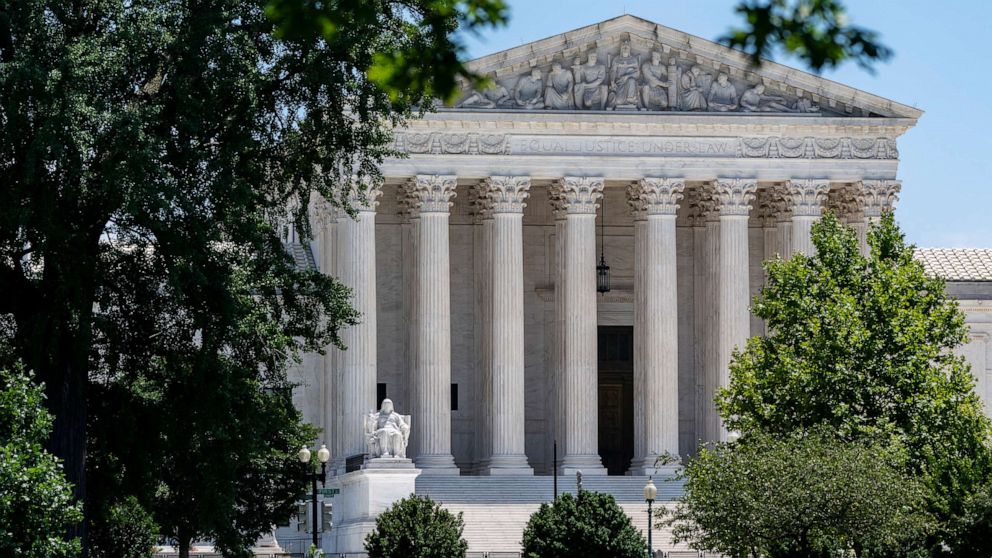
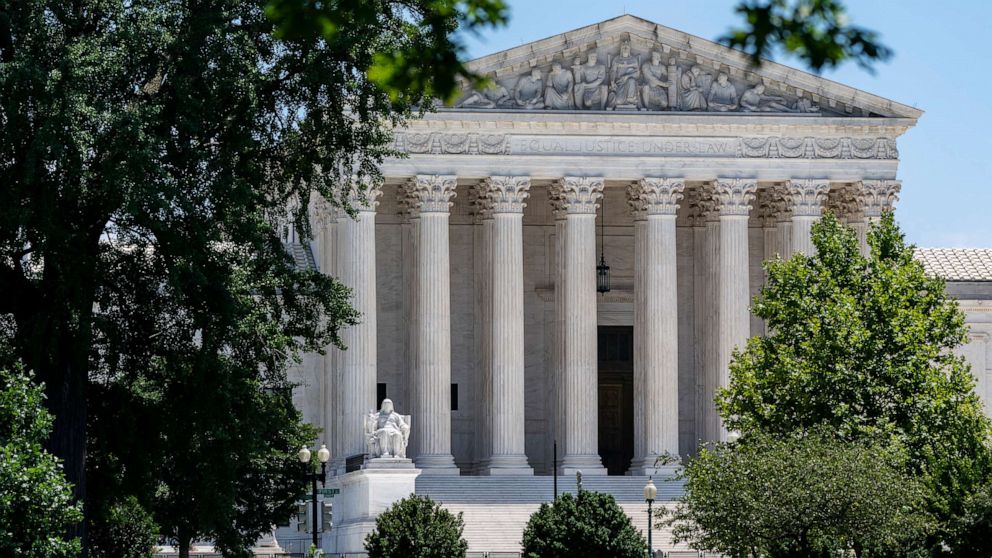
The Supreme Court is seen on Capitol Hill in Washington, July 14, 2022.
J. Scott Applewhite/AP
Eight of the top US science and technology companies, including DuPont and Gilead Sciences, filed a separate brief stressing their view on the importance of racially diverse campuses for cultivating the best future innovators.
“If universities are not educating a diverse student body, then they are not educating many of the best,” they wrote, urging the court not to strike down affirmative action. “Today’s markets require capitalizing on the racial and other diversity among us… Those efforts, in turn, contribute to the broader health of our nation’s economy.”
In a series of decisions beginning in 1978, the high court has found that race can be used as one factor among many when considering college admissions applications but that a school cannot use quotas or mathematical formulas to diversify a class.
“In order to cultivate a set of leaders with legitimacy in the eyes of the citizenry, it is necessary that the path to leadership be visibly open to talented and qualified individuals of every race and ethnicity,” Justice Sandra Day O’Connor wrote in her 2003 opinion in Grutter v. Bollinger.
A conservative student group challenging the use of race as a factor in undergraduate admissions at Harvard University, the nation’s oldest private college, and the University of North Carolina, the nation’s oldest public state university, is asking the court to overturn that precedent.
The group, Students for Fair Admissions, alleges that Asian-American applicants have been illegally targeted by Harvard and rejected at a disproportionately higher rate in violation of Supreme Court precedent and the students’ constitutional rights.
Two lower federal courts have rejected those claims.
That the Supreme Court has agreed to hear the cases is widely seen as an indication that the justices could be willing to revisit their precedents on affirmative action and end the use of racial classifications in admissions altogether.
It will be the first test on the issue for the court’s six-to-three conservative-leaning majority, following the retirement of Justice Anthony Kennedy and the death of Justice Ruth Bader Ginsburg, both of whom defended race-conscious admissions.
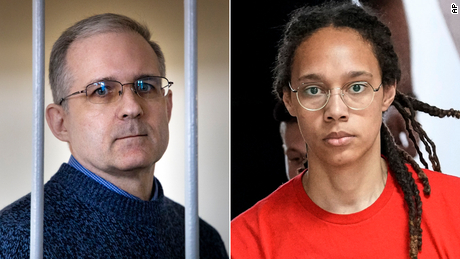
“I do have some information about the progress of how things are going … But that information comes from the Russian side as opposed to the American side,” Bout’s attorney Steve Zissou told CNN’s John Avalon on “New Day.” “I’m confident this is going to get done.”
Zissou continued, “Look, it’s no secret they’ve been wanting him back for several years now. They’ve been trying to get him back for decades. That’s not something they’ve ever kept secret.”
The US has offered Bout, who is serving a 25-year US prison sentence, as part of a potential deal to secure the release of Griner and Whelan. But Russian officials have requested that Vadim Krasikov, a former colonel from the country’s domestic spy agency, be included in the US’ proposed swap of Bout for Griner and Whelan, multiple sources familiar with the discussions have told CNN.
Krasikov was convicted in December of murdering a former Chechen fighter, Zelimkhan “Tornike” Khangoshvili, in Berlin’s Kleiner Tiergarten in 2019 and sentenced to life in prison.
The request was seen as problematic for several reasons, the sources told CNN, among them that Krasikov remains in German custody. As such, and because the request was not communicated formally but rather through an FSB backchannel, the US government did not view it as a legitimate counter to the US’ offer which was first revealed by CNN on Wednesday.
National Security Council coordinator for strategic communications John Kirby in an earlier interview on “New Day” called the Russian’s request a “bad faith attempt” and said the country should accept the US’ offer.
“This so-called, you call it a counteroffer, we would call it a bad faith attempt to avoid what is a serious proposal already on the table. And oh, by the way Brianna, has been on the table now for several weeks, Kirby told CNN’s Brianna Keilar on Monday. “Holding two Americans who have been wrongfully detained hostage for a convicted murderer in a third country is just — we don’t consider that a serious counteroffer at all. It is nothing more than a bad faith attempt by the Russians publicly to avoid what is a serious proposal, one that we are not making detailed in public and has been on the books for several weeks and we urge the Russians to accept it.”
On Friday US Secretary of State Antony Blinken spoke with Russian Foreign Minster Sergey Lavrov for the first time since Russia invaded Ukraine earlier this year.
Blinken said he “pressed the Kremlin to accept the substantial proposal that we put forth on the release of Paul Whelan and Brittney Griner.” At a press conference on Friday he declined to say whether he thought Russia was more or less likely to move on the proposal following the conversation, nor would he describe how Lavrov responded.
The Russian Foreign Ministry said in a statement following the call that Lavrov “strongly suggested” to Blinken that the United States should return to a mode of “quiet diplomacy” regarding a possible prisoner exchange “without any dubious media leaks.”
Prior to the call between Blinken and Lavrov, US officials had expressed frustration at Moscow’s lack of substantive response to the proposal to free Whelan and Griner. State Department spokesperson Ned Price on Thursday acknowledged “this has not moved to the extent we would like.”
CNN’s Natasha Bertrand, Frederik Pleitgen and Jennifer Hansler contributed to this report.
A Minnesota teenager died and four other people were seriously hurt after being stabbed while tubing down a Wisconsin river, authorities said. St. Croix County Sheriff Scott Knudson said the victims and suspect, 52-year-old Nicolae Miu from Prior Lake, Minnesota, were all on the Apple River when the attack happened Saturday afternoon. Knudson said investigators were working to determine what led to the stabbings and whether the victims and suspect knew each other. They were tubing with two different groups that included about 20 people. “We don’t know yet who was connected to who, who knew each other or what precipitated it,” Knudson said. The knife attack happened on a difficult-to-access section of the river near the town of Somerset, Wisconsin, which is about 35 miles (56 kilometers) east of Minneapolis. The suspect was arrested about an hour and a half later while getting off the river downstream. “Thank goodness a witness had taken a photo of him,” Knudson told the Minneapolis Star Tribune. “Another witness located him at the exit of the tubing area, where he was taken into custody.” A 17-year-old boy from Stillwater, Minnesota, died. Two of the other victims were flown to a hospital in St. Paul, Minnesota, and two others were taken there by ambulance. The sheriff’s office said Sunday that the condition of all four surviving victims _ a woman and three men in their 20s _ ranged from serious to critical. They suffered stab wounds to their chests and torsos. The sheriff’s office didn’t name the victims, but did provide a few details about them. The victims included a 20-year-old man and a 22-year-old man from Luck, Wisconsin; a 22-year-old man from Elk River, Minnesota; and a 24-year-old woman from Burnsville, Minnesota; The name of the suspect wasn’t immediately released, but St. Croix County jail records show a 52-year-old man was being held without bond on suspicion of first-degree homicide, four counts of aggravated battery and four counts of mayhem.
SOMERSET, Wis. —
A Minnesota teenager died and four other people were seriously hurt after being stabbed while tubing down a Wisconsin river, authorities said.
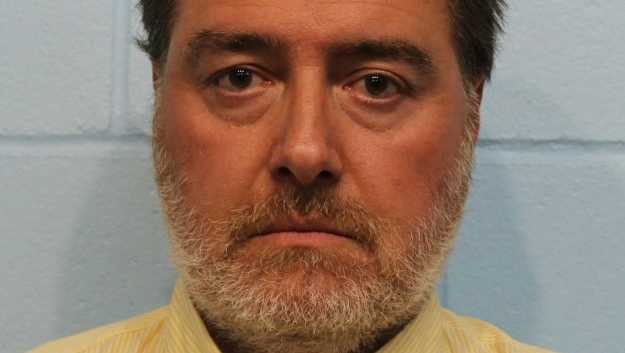
St. Croix County Sheriff Scott Knudson said the victims and suspect, 52-year-old Nicolae Miu from Prior Lake, Minnesota, were all on the Apple River when the attack happened Saturday afternoon.
St. Croix Sheriff’s Office
Knudson said investigators were working to determine what led to the stabbings and whether the victims and suspect knew each other. They were tubing with two different groups that included about 20 people.
“We don’t know yet who was connected to who, who knew each other or what precipitated it,” Knudson said.
The knife attack happened on a difficult-to-access section of the river near the town of Somerset, Wisconsin, which is about 35 miles (56 kilometers) east of Minneapolis. The suspect was arrested about an hour and a half later while getting off the river downstream.
“Thank goodness a witness had taken a photo of him,” Knudson told the Minneapolis Star Tribune. “Another witness located him at the exit of the tubing area, where he was taken into custody.”
A 17-year-old boy from Stillwater, Minnesota, died. Two of the other victims were flown to a hospital in St. Paul, Minnesota, and two others were taken there by ambulance. The sheriff’s office said Sunday that the condition of all four surviving victims _ a woman and three men in their 20s _ ranged from serious to critical. They suffered stab wounds to their chests and torsos.
The sheriff’s office didn’t name the victims, but did provide a few details about them. The victims included a 20-year-old man and a 22-year-old man from Luck, Wisconsin; a 22-year-old man from Elk River, Minnesota; and a 24-year-old woman from Burnsville, Minnesota;
The name of the suspect wasn’t immediately released, but St. Croix County jail records show a 52-year-old man was being held without bond on suspicion of first-degree homicide, four counts of aggravated battery and four counts of mayhem.








.jpg "A Texas man is dead after he shot a woman and himself with one bullet, according to the Dallas Police Department.")