Categories
Technology

‘Klonoa Phantasy Reverie Series’ Is A Faithful But Basic Retro Tribute

Klonoa: Door to Phantomile on the original PlayStation was one of those strange games that I experienced exclusively through a coveted PS1 demo disc. Whether it was PlayStation Underground or Official PlayStation Magazine, I can’t particularly remember, but here’s what I do know: I absolutely loved running through the 2.5D platformer’s bright and colorful first level over and over, relishing the excellent soundtrack and charming visuals. It was like Crystal Dynamics Pandemonium!only starring a bunny cat…thing?

You’d figure such a positive impression would have led me to acquire the full game at some point, but no, this (sadly) never happened. Considering the complete game’s astronomical Ebay value at this point, you can probably understand my ongoing regret.

Gamers from that era can relate to this sort of problem, I’m sure. We all had those select games we worshiped via demo discs, though something kept us from taking the MSRP retail plunge. Do young gamers today even know what demo discs are? I feel so ancient. Excuse me while I go cough dust.

I suppose my ’90s stories don’t matter much at this point, because Bandai Namco has benevolently released Klonoa Phantasy Reverie Seriesa heartfelt — though terribly named and somewhat barebones — remastered compilation of the first two Klonoa games. This includes the aforementioned Door to Phantomile as well as Klonoa 2: Lunatea’s Veil, the cel-shaded PS2-relegated sequel. The latter isn’t cel-shaded anymore, but we’ll get to that.

As far as I can tell, the remastered Door to Phantomile is based on the 2008/2009 Nintendo Wii version, which itself was a remake of the original PS1. So in essence, the new 2022 Door to Phantomile is a remaster of a remake, which totally isn’t confusing at all. On the other hand, the included sequel game is a remake-ish remaster, I suppose, since it’s also based on its corresponding original PS2 version but adds some changes.

Basically, if you haven’t played any of the Klonoa games, they’re arguably great platformers with an interesting surrealist style. Between the two of them, they’ve occupied a somewhat niche corner of Namco’s storied library, and I still don’t think a whole lot of people have played these games. Probably more gamers experienced the Wii remake, so it’s nice that we’re getting a pair of largely ignored classics in one modern, accessible, updated collection.

On that note, the updated graphics do look excellent, minus some egregious blooming effects here and there. I’ll always prefer the rudimentary sprite-heavy visuals of the PS1 release, but what’s here is nicely and lovingly brought into the current generation. If you go in expecting graphical powerhouses, you’ll surely be disappointed, but Klonoa has never really been about pushing hardware. The draw is in the art, the environments, and the cute appealing nature of our anthropomorphic hero’s entire world.

It does seem that Bandai Namco has altered the look of Klonoa 2, stripping the game of its charming cel-shading in favor of a more homogenized display. This bummed me out, because I’ll always have a soft spot in my heart for cel-shading, and I blame Jet Set Radio for that. At least the music from the first game appears to be in-tact from the PS1 release, though I can’t be certain for the sequel, since I didn’t play that title nearly as much.

The last thing I’ll mention is that I was definitely expecting a little bit more in terms of franchise history with Phantasy Reverie Series. I’m thinking in terms of stuff like design documents, interviews, anything to ‘plus’ a retro compilation like this. Many of the recent throwback collections (say, from Capcom) have dabbled in such extras and I think it goes a long way in making a re-release like this more special. It should also be noted that none of the other Klonoa games, like from the Game Boy Advance, made the cut.

It looks like a digital artbook is included in the special edition, but I’d have preferred some kind of Klonoa museum feature in-game. I mean, Namco is no stranger to awesome PS1 museum compilations, so I feel a bit let down.

That said, the Klonoa games are beautiful, fun, (mostly) hidden gems and I’m hoping that enough interest shows up for this new collection that Bandai Namco seriously considers making Klonoa 3. In the meantime, I’ll be listening to the amazing Windmill Song on the first level of Door to Phantomile over and over, just like I did all those years ago.

But if you haven’t played these games yet, do yourself a favor and give them a shot. You might be pleasantly surprised.

Disclosure: Bandai Namco provided a review code for coverage purposes.

.

Categories
Technology

Nintendo is not increasing the Switch’s price in Japan

Nintendo has confirmed it isn’t planning on bumping up the price of its Nintendo Switch in Japan. The publisher, along with fellow console makers Microsoft and Sony, was recently asked about this possibility by Bloomberg. Nintendo’s response was that it had “no plans” to do so at this time.

Currently, Japan’s yen is falling in value, having dropped 21 percent over the past year. As a result, electronics manufacturers have been slightly increasing the prices of electronics to compensate. For example, Apple products are now 25 percent costlier in Japan compared to in the United States.

As Bloomberg noted, video game consoles are currently $100 cheaper everywhere in the world except Japan. There’s reason for all three major console developers to worry that increasing the price of a console will turn away players and developers to competition.

Last week during its earnings call, Sony financial officer Hiroki Totoki simply said there was “nothing specific” to share about a PS5 price increase, though that question was in relation to the system across the world, rather than simply Japan. Like Sony, Microsoft declined to speak definitively on the possibility of a price increase.

Though console makers seem reluctant to hike up prices, analyst Kazunori Ito pointed out to Bloomberg that at this point, Japanese customers have adjusted to the country’s price inflation for TVs, monitors, and household appliances. “I don’t see them getting upset if game consoles followed suit,” he said.

Right now, the Switch’s most current model—the OLED, which released in 2021—is $349 in North America, and 37,980 yen in Japan, which converts to roughly $290. Scalpers and resellers have jumped on the opportunity, buying consoles at the Japanese price and upselling them when a major console game is close to release.

Both Sony and Microsoft (which made their own earnings call in late July) reported a drop in sales and service usage for their respective systems.

Categories
Technology

Apex Legends adds laser sight attachments for SMGs, pistols

If you’ve played Apex Legends for any length of time in the past, you’re probably well aware of how dominant shotguns and SMGs were in the meta. Over time, however, the map began to grow, leading players to start using mid and long-range weapons, such as sniper rifles and assault rifles, leaving many to wonder why anyone would use an SMG if they didn’t have to.

That’s fixing to change with the new season. In Season 14: Hunted, new attachments for SMGs and pistols are on their way. This attachment, a laser sight, will reduce bullet spread when players fire from the hip — which is the intended way to use such short-range weapons. These laser sights will replace the barrel stabilizer in-game for the barrel attachment slot.

For colourblind players or players that like to change things up, you’re able to change the color of the laser pointer in your game settings. A welcome inclusion, as I can’t imagine light red against green grass is easily visible in the heat of battle.

In addition to this change, Kings Canyon has been reworked heavily. New areas, new routes, new points of interest and more were designed to encourage close-range combat and shift away from the sniper and rifle-heavy meta of previous seasons.

The new Season starts off August 10th, featuring plenty of changes alongside a new Legend — Vantage. We’ll have plenty of info about her in future articles.

Be sure to hit up our Apex Legends – Season 14 hub for more on the new Season: Hunted.

Written by Junior Miyai on behalf of GLHF.

.

Categories
Technology

Street Fighter developer breaks sales milestones with multiple titles

Capcom, the developer and publisher of several popular titles like Street Fighter, Monster Hunter, and Resident Evil, recently updated its list of “Platinum Titles” — titles that have sold over one million copies. These numbers are recent as of June 30, 2022.

While Capcom publishes regular updates to its Platinum Titles, several of the updates included in the recent filing include huge milestones for popular titles, such as Monster Hunter Rise and Resident Evil Village.

Here is a list of the biggest updates:

• Monster Hunter Rise (Switch/PC) sold 10.3 million units, with an additional 1.3 million units since March 31.

• Devil May Cry 5 (PS4, Xbox One, PC) sold 5.7 million units, with an additional 700,000 since March 31.

• Resident Evil Village (PS5, Xbox Series, PS4, Xbox One, PC) sold over 6.4 million units, with an additional 300,000 since March 31.

• Monster Hunter World: Iceborne (PS4, Xbox One, PC) has sold over 9.5 million units, adding 300,000 since March 31.

• Resident Evil 3 (Remake) (PS4, Xbox One, PC) sold over 5.4 million units, adding only 200,000 since March 31.

• Resident Evil 2 (Remake) (PS4, Xbox One, PC) sold over 9.8 million units, adding only 200,000 since March 31.

• Resident Evil 7 biohazard (PS4, Xbox One, PC) broke the 11 million unit threshold, adding 200,000 sales since March 31.

• Devil May Cry HD Collection (PS4, Xbox One, PC) finally entered the Platinum Title list, selling over 1.1 million copies.

While it shows that Resident Evil 2 (Remake) reached 9.8 million units, in the month since June 30, it was confirmed that the title pushed over the 10 million copies sold hurdle.

While these numbers are fantastic for Capcom’s game division, not everything is sunshine and roses. Resident Evil fans are not happy about the recent Netflix series that launched a few weeks ago, as it only tangentially relates to the existing franchise. Capcom is also set to reveal new information about its upcoming fighter, Street Fighter 6, at this weekend’s fighting game world championship Evo.

Written by Junior Miyai on behalf of GLHF.

.

Categories
Technology

Bacteria powering truly green revolution in personal electronics

AMHERST, Mass. – Researchers at the University of Massachusetts Amherst recently announced that they have figured out how to engineer a biofilm that harvests the energy in evaporation and converts it to electricity. This biofilm, which was announced in Nature Communications, has the potential to revolutionize the world of wearable electronics, powering everything from personal medical sensors to personal electronics.

“This is a very exciting technology,” says Xiaomeng Liu, graduate student in electrical and computer engineering at UMass Amherst’s College of Engineering and the paper’s lead author. “It is real green energy, and unlike other so-called ‘green-energy’ sources, its production is totally green.”

That’s because this biofilm—a thin sheet of bacterial cells about the thickness of a sheet of paper—is produced naturally by an engineered version of the bacteria Geobacter sulfurreducens. G. sulfurreducens is known to produce electricity and has been used previously in “microbial batteries” to power electrical devices. But such batteries require that G. sulfurreducens is properly cared for and fed a constant diet. By contrast, this new biofilm, which can supply as much, if not more, energy than a comparably sized battery, works, and works continuously, because it is dead. And because it’s dead, it doesn’t need to be fed.

“It’s much more efficient,” says Derek Lovley, Distinguished Professor of Microbiology at UMass Amherst and one of the paper’s senior authors. “We’ve simplified the process of generating electricity by radically cutting back on the amount of processing needed. We sustainably grow the cells in a biofilm, and then use that agglomeration of cells. This cuts the energy inputs, makes everything simpler and widens the potential applications.”

The secret behind this new biofilm is that it makes energy from the moisture on your skin. Though we daily read stories about solar power, at least 50% of the solar energy reaching the earth goes toward evaporating water. “This is a huge, untapped source of energy,” says Jun Yao, professor of electrical and computer engineering at UMass, and the paper’s other senior author. Since the surface of our skin is constantly moist with sweat, the biofilm can “plug-in” and convert the energy locked in evaporation into enough energy to power small devices.

“The limiting factor of wearable electronics,” says Yao, “has always been the power supply. Batteries run down and have to be changed or charged. They are also bulky, heavy, and uncomfortable.” But a clear, small, thin flexible biofilm that produces a continuous and steady supply of electricity and which can be worn, like a Band-Aid, as a patch applied directly to the skin, solves all these problems.

What makes this all work is that G. sulfurreducens grows in colonies that look like thin mats, and each of the individual microbes connects to its neighbors through a series of natural nanowires. The team then harvests these mats and uses a laser to etch small circuits into the films. Once the films are etched, they’re sandwiched between electrodes and finally sealed in a soft, sticky, breathable polymer that you can apply directly to your skin. Once this tiny battery is “plugged in” by applying it to your body, it can power small devices.

“Our next step is to increase the size of our films to power more sophisticated skin-wearable electronics,” says Yao, and Liu points out that one of the goals is to power entire electronic systems, rather than single devices.

This research was nurtured by the Institute for Applied Life Sciences (IALS) at UMass Amherst, which combines deep and interdisciplinary expertise from 29 departments to translate fundamental research into innovations that benefit human health and well-being.

/PublicRelease. This material from the originating organization/author(s) may be of a point-in-time nature, edited for clarity, style and length. The views and opinions expressed are those of the author(s).

Categories
Technology

Symphony Of War Is A Steam Hit Perfect For Fire Emblem Fans

Warriors prepare to fight in one of Symphony of War's tactical battles.

screenshot: Dancing Dragon Games

There’s been a raft of intriguing strategy RPGs this yearbut one of my favorites so far is Symphony of War. It’s been climbing the charts on Steam in recent months, and for good reason. From a distance it looks like another Fire Emblem knockoff. Up close it’s doing enough interesting things to stand on its own, and I really recommend you give it a shot.

Symphony of War: The Nephilim Saga quietly came out on Steam in June and has been rack up positive reviews ever since. Developed by an indie team called Dancing Dragon Games with a history of RPG Maker projects, it’s a trope-filled military drama about civil war and demonic threats. But you can pretty much ignore all that. Beneath the predictable plot and airbrushed character portraits is a deep strategy game that’s hard to put down. Personally, I think it’s even better in the strategy department than Triangle Strategy.

Make no mistake: Symphony of War is old-school. While newer entries in the Fire Emblem series have delved deeper into visual novel elements and relationship mechanics, it’s focused almost exclusively on renewing the nuts and bolts of classic grid-based battles. What works so well is that Symphony of War nails the basics and also adds plenty of new wrinkles for fans to dig into (especially those who also dug last year’s Dark Deity).

gif: Dancing Dragon Games / Kotaku

The biggest one is that each individual unit represents an entire squad made up multiple types of fighters. Maybe there are some knights in front flanked by pikemen while wizards and archers rain down death from the back. When two units move next to each other and throw down, a mini-turn-based skirmish ensues. Mages in the back cast fireballs and healing spells while knights in the front dish out melee damage. Combat unfolds across two rounds, with attackers getting the first turn and the defending side going second. Some fighters can only attack on the first or second turn, while others will occasionally luck into a bonus turn. The action is easy to follow and yet also opens up plenty of room for customization.

Adding more subtle layers of complexity are unique fighter bonuses and an extensive research tree. Horseback fighters get to attack first without retribution. Infantry provide defensive bonuses to nearby units. And archers can naturally attack from a distance without facing counter-attacks. These and other stats can then be augmented and magnified by researching new tech. Rather than leveling up specific units, you’re growing the overall capabilities of your army.

A map shows where grid-based combat takes place in Symphony of War.

screenshot: Dancing Dragon Games

in this way Symphony of War forces you to sometimes think like a 4X strategist while playing like a traditional JRPG enthusiast. Instead of customizing one single party and fighting through a dungeon, you’re building up a small army of them and taking on a whole battlefield. Completing missions faster and capturing enemy units and buildings along the way nets you extra money and points that can then be poured back into outfitting your various crews. Just a few novel tweaks and the decades-old tactical JRPG formula feels fresh and modern again in 2022.

A few other games have also taken hybrid approaches to tactical RPGs recently. The Iron Oath and Songs of Conquest both come to mind. The former is a roguelike with battles that take place on a hexagonal grid. The latter also sports a hexagonal battlefield in service of map exploration and city-building closer to a 4X game. They’re really promising games in their own right (and still in Early Access), yet neither is as focused on plumbing the depths of leveraging small advantages so one group of animated sprites can wipe the floor with another.

Symphony of War is far from a perfect package, but it offers one of the more meaty and innovative takes on the tactics RPG formula I’ve come across in years.

.

Categories
Technology

Intel’s Sapphire Rapids Had 500 Bugs, Launch Window Moves Further

Intel has delayed the release of its 4th Generation Xeon Scalable “Sapphire Rapids” processor for a number of times without disclosing its reasoning. Last week the company admitted that it had to change up Sapphire Rapids because of a security bug, but it appears that the problem is bigger than Intel says. According to Igor’s LabSapphire Rapids had about 500 bugs that required the company 12 steps to fix them.

Intel’s fourth Gen Xeon Scalable Sapphire Rapids’ processor will not only increase core count to up to 60, but will bring in numerous new features, including Advanced Matrix Extensions (AMX), Data Streaming Accelerator (DSA), CXL 1.1 protocol, DDR5 and HBM2E memory support, PCIe Gen 5 interface, and many more. But the host of additional features increase probability of hardware bugs, so Intel had to fix almost 500 of them, Igor’s Lab reports.

Categories
Technology

You Should Play ‘Xenoblade Chronicles 3’ in First-Person

Xenoblade Chronicles 3 is one of the year’s best-reviewed Nintendo Switch games, thanks to its deep combat, sweeping story, and giant world that’s fun to explore. The game is engrossing from the moment you start, but there’s a way to get even more immersed in this epic JRPG.

As pointed out by the YouTube channel BoomStickGaming, Xenoblade Chronicles 3 is entirely playable in first-person. Xenoblade series veterans will recognize this as a recurring feature, but as someone who has bounced off most of the prior games in the series, I was completely unaware it was possible.

I’ve now played the first 10-ish hours exclusively in first-person mode (aside from one boss battle), and while it’s probably not the optimal way to experience the entire game, playing in first-person truly helped me sink into Xenoblade Chronicles 3‘s early chapters, and I intend to play as much of the game as possible this way.

how to play Xenoblade Chronicthe 3 in first person

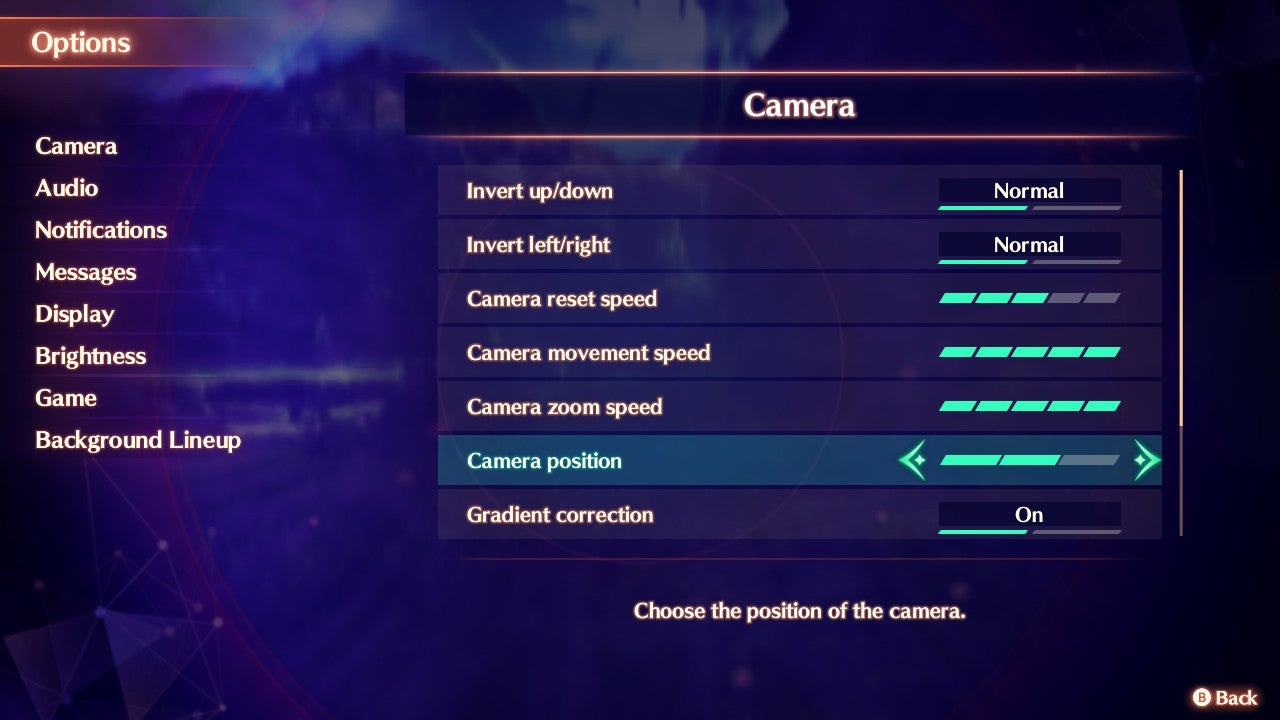
To play in first-person, hold down the ZL button on your Switch controller and push the right thumbstick up to zoom the camera all the way in to a first-person view, then push the stick left or right to adjust the height. You can also adjust the “camera movement” and “camera zoom” speed in the settings menu to suit your preferences. Make sure the “camera position” setting is set to the middle option to center on your character’s head, otherwise your view will be awkwardly offset to the left or right.

To further the sense of immersion, I also disabled the “mini-map,” “auto-targeting,” and “additional information” settings, and made sure to hide or disable all quest markers and notifications whenever possible.

Screenshot: Brendan HesseScreenshot: Brendan Hesse

These are optional changes, but they’re worth trying, even if you’re playing in the default camera view. Doing so removes much of the UI clutter, so you can see even more of the world as you’re exploring. It also forces you to pay closer attention to your surroundings, which I find helps me connect to the environment more (you can easily open the map from the shortcut menu if you need to double-check your heading).

Es Xenoblade Chronicles 3 actually playable in first-person?

just because you dog do something doesn’t mean you should, but so far, Xenoblade Chronicles 3’s first-person view feels great to me, though it took some getting used to.

Playing the game in first-person gives you a closer look at the characters, enemies, and locations you interact with, and really emphasizes the world’s massive scale. The obvious comparisons to other large-scale first-person RPGs like The Elder Scrolls are immediately apparent, but running around these vast landscapes dotted with high-tech military bases and populated with alien flora and fauna reminded me of an anime-tinged No Man’s Sky.

Moving, jumping, and picking up collectible items remains easy, and most other actions you’ll perform — like swapping between party members, talking to NPCs, climbing ladders, and interacting with important objects — are intuitive and work as intended.

Combat is the only part of the game that takes some real adjustments to make it work, but it’s doable.

Overall, the MMO-like battle system works just fine in first-person. Since the game clearly marks whether you’re standing to the front, back, or side of your target, it’s easy to tell if you’re in the right spot for an attack, even if you’re staring up at a giant alien gorilla , and your party members’ banter will fill you in on what moves they’re using. In first person mode, the battles feel more like the tactical combat in CRPG blobbers like wizardry 8 or Might & Magic X.

That said, you’ll need to tweak some settings if you plan to play Xenoblade Chronicles 3 in first-person for the long haul, since the constant visual barrage of combat UI and other effects can be downright chaotic in that mode. Do as the BoomStickGaming video above suggests and disable all battle numbers except your character’s damage pop-ups in the settings menu. This will make fighting a lot more comfortable in first-person. I also chose to disable the “Battle camera” option to stop the cinematic cutscenes intercuts for certain attacks.

So far I’ve found the game to be entirely playable at the normal difficulty mode after implementing those settings tweaks, but feel free to set the gameplay difficulty to “Easy” if you still find the combat too difficult to manage. You can always pan out the camera just before a battle starts to take advantage of the third-person perspective, then zoom back in while exploring.

No, first-person mode is not the “intended” way to play Xenoblade Chronicles 3, but it’s made it much easier for me to get into one of the year’s best JRPGs. If you prefer first-person games, or just want to try playing Xenoblade Chronicles 3 in a novel way, I definitely recommend giving it a shot.

Categories
Technology

Researchers engineer biofilm capable of producing long-term, continuous electricity from your sweat

Researchers engineer biofilm capable of producing long-term, continuous electricity from your sweat

A biofilm-powered sensor, on the neck, that measures the mechanical signal of swallowing. Credit: Liu et al., 10.1038/s41467-022-32105-6

Researchers at the University of Massachusetts Amherst recently announced that they have figured out how to engineer a biofilm that harvests the energy in evaporation and converts it to electricity. This biofilm, which was announced in Nature Communicationshas the potential to revolutionize the world of wearable electronics, powering everything from personal medical sensors to personal electronics.

“This is a very exciting technology,” says Xiaomeng Liu, graduate student in electrical and computer engineering at UMass Amherst’s College of Engineering and the paper’s lead author. “It is real green energy, and unlike other so-called ‘green-energy’ sources, its production is totally green.”

That’s because this biofilm—a thin sheet of bacterial cells about the thickness of a sheet of paper—is produced naturally by an engineered version of the bacteria Geobacter sulfurreducens. G. sulfurreducens is known to produce electricity and has been used previously in “microbial batteries” to power electrical devices. But such batteries require that G. sulfurreducens is properly cared for and fed a constant diet. By contrast, this new biofilm, which can supply as much, if not more, energy than a comparably sized battery, works, and works continuously, because it is dead. And because it’s dead, it doesn’t need to be fed.

“It’s much more efficient,” says Derek Lovley, Distinguished Professor of Microbiology at UMass Amherst and one of the paper’s senior authors. “We’ve simplified the process of generating electricity by radically cutting back on the amount of processing needed. We sustainably grow the cells in a biofilm, and then use that agglomeration of cells. This cuts the energy inputs, makes everything simpler and widens the potential applications.”

Researchers engineer biofilm capable of producing long-term, continuous electricity from your sweat

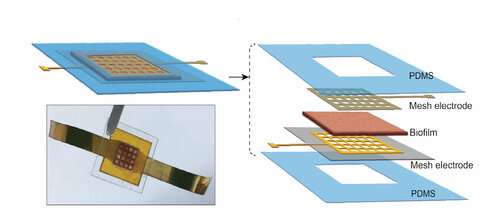
Schematic view (r) and actual photo (l) of a biofilm device. Credit: Liu et al., 10.1038/s41467-022-32105-6

The secret behind this new biofilm is that it makes energy from the moisture on your skin. Though we daily read stories about solar power, at least 50% of the solar energy reaching the earth goes toward evaporating water. “This is a huge, untapped source of energy,” says Jun Yao, professor of electrical and computer engineering at UMass, and the paper’s other senior author. Since the surface of our skin is constantly moist with sweat, the biofilm can “plug-in” and convert the energy locked in evaporation into enough energy to power small devices.

“The limiting factor of wearable electronics,” says Yao, “has always been the power supply. Batteries run down and have to be changed or charged. They are also bulky, heavy, and uncomfortable.” But a clear, small, thin flexible biofilm that produces a continuous and steady supply of electricity and which can be worn, like a Band-Aid, as a patch applied directly to the skin, solves all these problems.

Researchers engineer biofilm capable of producing long-term, continuous electricity from your sweat

An integrated device array powers a small LCD screen. Credit: Liu et al., 10.1038/s41467-022-32105-6

What makes this all work is that G. sulfurreducens grows in colonies that look like thin mats, and each of the individual microbes connects to its neighbors through a series of natural nanowires. The team then harvests these mats and uses a laser to etch small circuits into the films. Once the films are etched, they’re sandwiched between electrodes and finally sealed in a soft, sticky, breathable polymer that you can apply directly to your skin. Once this tiny battery is “plugged in” by applying it to your body, it can power small devices.

“Our next step is to increase the size of our films to power more sophisticated skin-wearable electronics,” says Yao, and Liu points out that one of the goals is to power entire electronic systems, rather than single devices.


New green technology generates electricity ‘out of thin air’


More information:
Xiaomeng Liu et al, Microbial biofilms for electricity generation from water evaporation and power to wearables, Nature Communications (2022). DOI: 10.1038/s41467-022-32105-6

citation: Researchers engineer biofilm capable of producing long-term, continuous electricity from your sweat (2022, August 2) retrieved 2 August 2022 from https://techxplore.com/news/2022-08-biofilm-capable-long-term-electricity .html

This document is subject to copyright. Apart from any fair dealing for the purpose of private study or research, no part may be reproduced without the written permission. The content is provided for information purposes only.

Categories
Technology

AMD reference Ryzen 7000 system demoed with PCIe Gen5 SSD based on Micron 232-layer TLC memory

PCIe Gen5 storage on AMD platform

At 2022 Flash Memory Summit AMD and Phison have demonstrated PCIe Gen5 SSD running on Ryzen 7000 platform, reports Tom’s Hardware.

This is not the first time Phison is showing off the speed of next-gen SSD storage. Around May this year, the company showcased its PS5026-E26 PCIe controller attached to ASUS X670 Hero ROG motherboard. There, the SSD offered up to 12 GB/s of sequential read and up to 10 GB/s write speed.

AMD Ryzen 7000 system with Phison PCIe Gen5 SSD, Source: Tom’s Hardware/Future

The new demo at Flash Memory Summit does not have any PCIe riser card, it is straight up connected to the M.2 slot and running off the available PCIe Gen5 lanes from the CPU. Furthermore, it is based on Micron 232-layer B58R TLC technology which is still in the tuning phase. For this reason the read and write speed is actually lower than in previous demos (reaching up to 10 GB/s).

This new TLC flash memory is currently running at 1600 MT/s, however it should reach 2000 MT/s, which should eventually enable 12/11 GB/s sequential read/write speeds.

AMD Ryzen 7000 system with Phison PCIe Gen5 SSD, Source: Tom’s Hardware/Future

It is said that the AMD Ryzen 7000 reference platform that pictured above featured an undisclosed Ryzen CPU with OPN code of “100-000000593-20_Y”. As it turns out, we already know what CPU this is thanks to this leak. The CPU was Ryzen 5 7600X 6-core Raphael CPU with Zen4 microarchitecture.

AMD X670 and B650 motherboards will both support PCIe Gen5 M.2 storage. The company is also set to launch X670E and B650E chipsets which will additionally enable Gen5 interface for GPUs. For now, no Gen5 storage and gaming GPUs are available, however this is likely to change in the fourth quarter as both Intel and AMD release their new platforms.

Source: Tom’s Hardware