Categories
Australia

Tanya Plibersek proposes blocking Clive Palmer’s Queensland coal mine on environmental grounds

For the first time in Australian history, a federal environment minister has set the wheels in motion to reject a coal mine.

Environment Minister Tanya Plibersek has proposed the rejection of Clive Palmer’s Central Queensland Coal Project on the grounds it is likely to damage the Great Barrier Reef.

The decision remains a “proposal” because a final decision can only be made after 10 days of further consultation, including public comment. But given the wide range of reasons cited by the minister, it is unlikely to be approved.

The planned mining site is just 10 kilometers from the Great Barrier Reef near Rockhampton, and was likely to have contributed to ocean pollution, according to the minister.

“Based on the information available to me at this stage, I believe that the project would be likely to have unacceptable impacts to the Great Barrier Reef Marine Park, and the values ​​of the Great Barrier Reef World Heritage Area and National Heritage Place,” Ms Plibersek said.

A map shows the location of a mine and the location of the Great Barrier Reef.
Clive Palmer’s proposed coal mine site is just 10 kilometers from the Great Barrier Reef World Heritage Area.(abcnews)

The decision was also based on potential impacts to local water resources.

Although it is the first time a federal environment minister has proposed to reject an application to develop a coal mine, the Queensland government recommended the rejection last year.

The move was announced the same day the government passed its climate bill through the lower house, with the support of the cross bench including the Greens.

The Greens have been pushing the government to reject all coal and gas projects while the government has said it will approve those that stack up environmentally.

“That’s now one down and 113 to go. There’s 114 of these projects in the pipeline,” Greens leader Adam Bandt said.

The Greens have also been pushing for a “climate trigger” that would require the potential impacts of coal and gas projects on climate change to be considered by the environment minister. As it stands, the potential climate change impact of this mine was not considered in the approval process.

Conservationists, activists glad minister ‘listened to warnings’

The preliminary decision was applauded by conservationists and climate activists.

“This is the right proposed decision for the Great Barrier Reef from the environment minister,” Cherry Muddle from the Australian Marine Conservation Society said.

“We are glad she has listened to warnings from government-appointed and independent scientists, as well as the Queensland government who said the mine was ‘not suitable’ to proceed in April 2021.

“In the wake of the fourth mass bleaching event on the reef since 2016, it is vital new coal and gas projects like this one are refused. It shows the government are serious about saving the reef and tackling the issues that threaten it.”

A photo from above the Great Barrier Reef shades of blue ocean
Queensland’s environment department deemed Clive Palmer’s project “not suitable” to proceed last year.(Facebook: Great Barrier Reef Legacy/File photo)

The proposed project included two open-cut pits north of Rockhampton over an area of ​​more than 2,660 hectares.

The detailed reasons for the proposed decision have not yet been released, but included impacts on a world heritage area, and on-water resources. The project’s potential impacts on threatened species was not listed as a reason for rejection.

The public has 10 days to comment on the proposed decision.

Mr Palmer’s company Central Queensland Coal was not available for comment.

The Queensland government concluded in 2021 the mine would generate royalties for the state of between $703 million and $766 million in total.

.

Categories
Australia

Queensland child commission, advocates call for use of spit hoods on minors to be banned

The use of spit hoods on young people is “completely unacceptable and should be outlawed,” Queensland’s Family and Child Commission (QFCC) says.

Principal Commissioner Luke Twyford says there are a range of alternatives to the fabric hoods, which are put over a detainee’s head to prevent spitting or biting.

Mr Twyford’s remarks on ABC Radio Brisbane follow revelations Queensland police have used spit hoods on 20 young people in Queensland watch houses since 2015.

Yesterday a budget estimates hearing was told that the hoods were in use up until about seven months ago and there had been eight instances of use in the state since 2019.

Greens MP Michael Berkman asked Police Commissioner Katarina Carroll how many times spit hoods had been used.

A man speaks to the media during a press conference.
Michael Berkman asked about the use of spit hoods in Queensland.(AAP: Glenn Hunt)

Ms Carroll acknowledged that Queensland was one of the few jurisdictions where the hoods were still in use.

“We are looking at very closely working with the Children’s Commissioner to stop that use in the future,” she said.

“We are working closely with the Children’s Commissioner to look at other options.”

When asked what steps the government was taking to ban the use of spit hoods and restraint chairs, Police Minister Mark Ryan said the government needed to get the policy mix right in order to work with the operational requirements of the Queensland police.

“Certainly it would be the government’s view that we would work alongside the Police Service to ensure that they had appropriate use of force options which did not include spit hoods,” he said.

A woman in a police uniform sitting at a police station.
Katarina Carroll says are working to put an end to the use of spit hoods. (ABC News: Lucas Hill)

Ms Carroll confirmed spit hoods could be used inside watch houses in Queensland.

‘Dangerous and archaic’

Mr Twyford said all of Australia’s children commissioners had already written an open letter calling for the practice to be banned.

“We are working with the Queensland Police Commissioner there to ensure that they are not used,” he said.

“When a young person is in a heightened state, putting a bag over their head isn’t a sensible solution.”

Change the Record co-chair Cheryl Axleby said the idea that it was acceptable to put a bag over the head of a distressed child or adult was “cruel” and “archaic”.

A woman stands in front of a yellow Indigenous artwork.
Cheryl Axelby says First Nations people are at higher risk of being subjected to spit hoods. (Supplied)

She said the organization had called on the Queensland government and every other state and territory government to follow the lead of South Australia, where spit hoods have been outlawed.

“First Nations peoples are affected by discrimination at every point of the criminal justice system,” Ms Axleby said.

“This means Aboriginal and Torres Strait Islander peoples are at a greater risk of being subjected to the use of cruel and inhumane treatment like the use of spit hoods when in police or prison custody.

“In an era where we have world-class [personal protective equipment] there is absolutely no need for these dangerous and archaic devices.”

ABC’s Four Corners showed footage of a child detainee bound to a restraint chair with their face covered by a spit hood in the Northern Territory’s Don Dale detention center in 2016.

.

Categories
Australia

WA infrastructure advisory body floats per-kilometre charge to ease traffic pressure

Infrastructure WA, the body charged with advising the Premier’s Department on the state’s medium and long-term infrastructure needs, has proposed overhauling road funding by eventually replacing the fuel excise with a road-user charge that also creates incentives to reduce congestion.

The wide-ranging 20-year plan, Foundations for a Stronger Tomorrow, was tabled in State Parliament on Wednesday.

One of the 93 recommendations involves planning for the eventual transition from internal combustion to electric vehicles and how road infrastructure will be funded with the decrease of the fuel excise.

Nicole Lockwood, chair of Infrastructure WA, told Nadia Mitsopoulos on ABC Radio Perth that while the switch to electric vehicles would be “fantastic for the environment and climate change,” it also posed challenges.

“It does mean that the revenue source that comes from our fuel at the moment, that goes towards paying for our roads, will diminish over time,” she said.

“SW [the recommendation] is trying to find a mechanism where the government still has the ability to fund that infrastructure in a way that doesn’t disincentivize people from moving towards electric vehicles.”

EV tax coming in 2027

While the state government has already announced it will introduce a 2.5 cent per kilometer charge for EV’s from mid-2027, Infrastructure WA’s recommendation 58 goes further, proposing that WA work with other states to develop a nationally consistent road user charge that could influence driver behaviour. .

“The scheme has the potential to include vehicle mass, distance, location and time-of-day pricing elements,” the recommendation says.

Such a scheme could potentially charge different rates for road usage in peak hours, or differential rates for different roads.

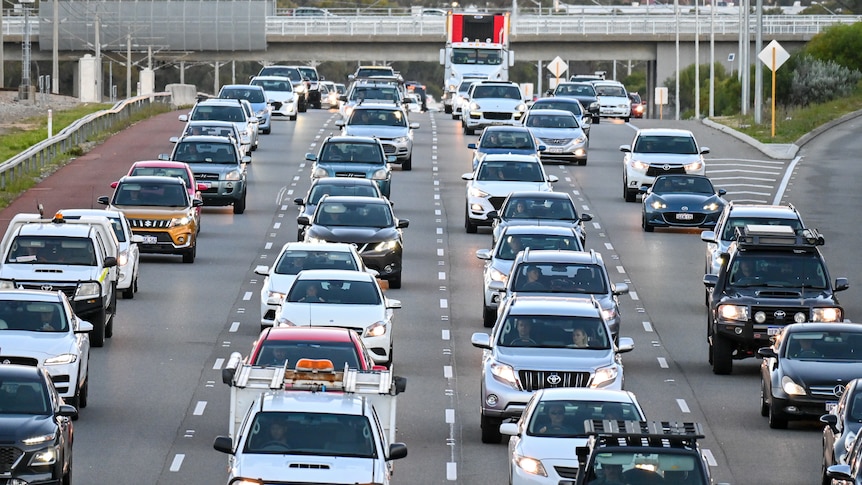
A mix of cars and trucks fill four lanes of peak hour traffic on the freeway.
Ms Lockwood says the report recommends looking at ways to influence congestion and road use.(ABC News: Andrew O’Connor)

“What we’ve said is, let’s design a mechanism that has flexibility, so that in time if we wanted to use those levers we could,” Ms Lockwood said.

“We saw it very starkly during COVID, when people were not using the roads during the day, at certain times suddenly we had huge amounts of capacity.

“In the future, when we can’t continue to build more lanes, we will need other mechanisms to be able to manage demand on the system.”

The proposal met with a mixed response from ABC Radio Perth listeners:

Mike: “Again lower socio-economic people who cannot afford to live close to work will pay the most, the system working to keep the gap between the haves and the have nots.”

Greg: “The state government is not incentivizing enough the use of electric vehicles. The proposed road tax is a major disincentive. The benefit to the environment is the major issue and there won’t be the gains there should be. We pay for our roads Mainly via our local government rates so EV drivers will be paying double if we get this bad policy.”

Cynthia: “Surely a toll on cars with only one occupant would make sense? Or a fast lane for cars with two occupants.”

An artist's impression of people walking on Hay Street Mall with light rail lines in the background and a train in the background.
While Max Light Rail was shelved in 2016, Infrastructure WA recommended future planning around light rail and rapid bus networks.(Supplied: PTA)

Planning for light rail mooted

The report also recommends the state government look again at the role of light rail and rapid bus transit in Perth’s public transport mix.

A previous plan to link Perth suburbs through the Max Light Rail network was shelved by the Barnett government in 2016, and the McGowan government has been focused on delivering its expansion of the heavy rail network, Metronet.

Ms Lockwood said a plan to link people across suburbs and between stations was still needed.

“We very much back the government’s commitments to Metronet and the heavy rail system, but what we see in the future is a need to look at the next tier of connection for the city,” she said.

“That mid-tier public transport system that links buses and other parts of the network into the Metronet network is really important.

“Part of that is about making sure that the [already identified transport] corridors are protected.

“We really have to think about the spaces we’ve got and how we use them… then the state government needs to then pull a plan together to map that out for the whole of the metro area,” she said.

The infrastructure report also recommended a new desalination plant at Alkimos, a whole-of-government emissions reduction target and a package to reform hospital emergency departments.

The WA Government has six months to respond to the report and is obliged by legislation to respond to each recommendation as well as provide an implementation plan for the ideas that it accepts.

.

Categories
Australia

‘Magnificent’ jellyfish found off coast of Papua New Guinea sparks interest among researchers | marine life

A diver has captured footage of an unusual-looking jellyfish off the coast of Papua New Guinea, sparking interest among researchers.

The video was captured by Dorian Borcherds, who owns Scuba Ventures in Kavieng, in the New Ireland province of PNG.

Borcherds, who has been diving in the area for more than two decades, said he saw about three or four of the jellyfish and was struck by their intricate detail and the way they seemed to move decisively through the water.

“They don’t have brains, so I don’t know how they do that,” he said.

Looking for answers, he sent the footage to his wife in South Africa, who uploaded it to the Jellyfish app, a project Dr Lisa-ann Gershwin, a jellyfish expert at Australian Marine Stinger Advisory Services, co-founded.

In her words, the app’s purpose is to “answer the age-old question: what is that blob and should I pee on [its sting]?”

“As soon as I saw this one, honestly, I could barely contain my excitement,” she said. “I almost fell out of my chair.”

Gershwin initially thought the footage was the second sighting of a mysterious jellyfish – Chirodectes maculatus – found decades ago on the Great Barrier Reef, but she now believes the “magnificent” creature is a new species.

While Gershwin is confident in her findings, her paper on the species classification is yet to undergo peer review.

Prof Kylie Pitt, a marine ecologist who specializes in jellyfish from Griffith University, said it could be a new species, but doesn’t think it would be possible to know for sure based only on a video.

She said she had certainly never seen it before, but said a researcher would “need to hold the animal in your hand” to be sure of its species.

“It would be great if we got the specimen and could describe its morphology, coupled with genetic testing,” she said.

Prof Jamie Seymour, a toxicologist from James Cook University who specializes in Australia’s venomous animals, says he prefers Gershwin’s earlier theory, believing the jellyfish is a Chirodectes maculatus.

Sign up to receive the top stories from Guardian Australia every morning

Gershwin had helped reclassify Chirodectes maculatus – a jellyfish that has been sighted only once off the coast of far north Queensland, after a cyclone in 1997.

She said it had remained a mystery where the invertebrate had come from ever since. At first glance, she thought the new video could provide the answer. She listed the help of Peter Davie, a now retired – but still active – curator from the Queensland museum, where the original jellyfish specimen was kept.

The pair pored over the footage from PNG frame by frame, and noticed the jellyfish had different markings, it was much larger – about the size of a soccer ball compared with something that could fit in your hand – and various other technical differences.

To their delight, they decided this was probably a new species of jellyfish, probably belonging to the same genus as the one seen in 1997.

Categories
Australia

‘Magnificent’ jellyfish found off coast of Papua New Guinea sparks interest among researchers | marine life

A diver has captured footage of an unusual-looking jellyfish off the coast of Papua New Guinea, sparking interest among researchers.

The video was captured by Dorian Borcherds, who owns Scuba Ventures in Kavieng, in the New Ireland province of PNG.

Borcherds, who has been diving in the area for more than two decades, said he saw about three or four of the jellyfish and was struck by their intricate detail and the way they seemed to move decisively through the water.

“They don’t have brains, so I don’t know how they do that,” he said.

Looking for answers, he sent the footage to his wife in South Africa, who uploaded it to the Jellyfish app, a project Dr Lisa-ann Gershwin, a jellyfish expert at Australian Marine Stinger Advisory Services, co-founded.

In her words, the app’s purpose is to “answer the age-old question: what is that blob and should I pee on [its sting]?”

“As soon as I saw this one, honestly, I could barely contain my excitement,” she said. “I almost fell out of my chair.”

Gershwin initially thought the footage was the second sighting of a mysterious jellyfish – Chirodectes maculatus – found decades ago on the Great Barrier Reef, but she now believes the “magnificent” creature is a new species.

While Gershwin is confident in her findings, her paper on the species classification is yet to undergo peer review.

Prof Kylie Pitt, a marine ecologist who specializes in jellyfish from Griffith University, said it could be a new species, but doesn’t think it would be possible to know for sure based only on a video.

She said she had certainly never seen it before, but said a researcher would “need to hold the animal in your hand” to be sure of its species.

“It would be great if we got the specimen and could describe its morphology, coupled with genetic testing,” she said.

Prof Jamie Seymour, a toxicologist from James Cook University who specializes in Australia’s venomous animals, says he prefers Gershwin’s earlier theory, believing the jellyfish is a Chirodectes maculatus.

Sign up to receive the top stories from Guardian Australia every morning

Gershwin had helped reclassify Chirodectes maculatus – a jellyfish that has been sighted only once off the coast of far north Queensland, after a cyclone in 1997.

She said it had remained a mystery where the invertebrate had come from ever since. At first glance, she thought the new video could provide the answer. She listed the help of Peter Davie, a now retired – but still active – curator from the Queensland museum, where the original jellyfish specimen was kept.

The pair pored over the footage from PNG frame by frame, and noticed the jellyfish had different markings, it was much larger – about the size of a soccer ball compared with something that could fit in your hand – and various other technical differences.

To their delight, they decided this was probably a new species of jellyfish, probably belonging to the same genus as the one seen in 1997.

Categories
Australia

Adelaide City Council renames laneway in honor of musician Paul Kelly

Adelaide City Council is renaming a laneway after singer-songwriter Paul Kelly, with the music icon saying he is “honoured” by the gesture.

The newly named Paul Kelly Lane runs from Flinders Street to Pirie Street, behind the Adelaide Town Hall.

It features a series of artworks that light up and contain lyrics from various Paul Kelly songs.

Kelly was born and raised in the Adelaide suburb of Norwood and several of his songs reference places in the city.

“I’m honored to be a part of this musical laneway project and I’m glad the lane is so close to the Adelaide Town Hall where I’ve had an association for over 50 years, from playing trumpet at school speech nights, attending concerts and, later on, doing my own shows,” he said.

Adelaide Lord Mayor Sandy Verschoor said Paul Kelly Lane — previously called Pilgrim Lane, after a church next to it — would become a destination for his fans.

“Our city has an incredible musical history and Paul Kelly is an icon,” she said.

“We have such great musicians who come from this city and continue to come from this city.”

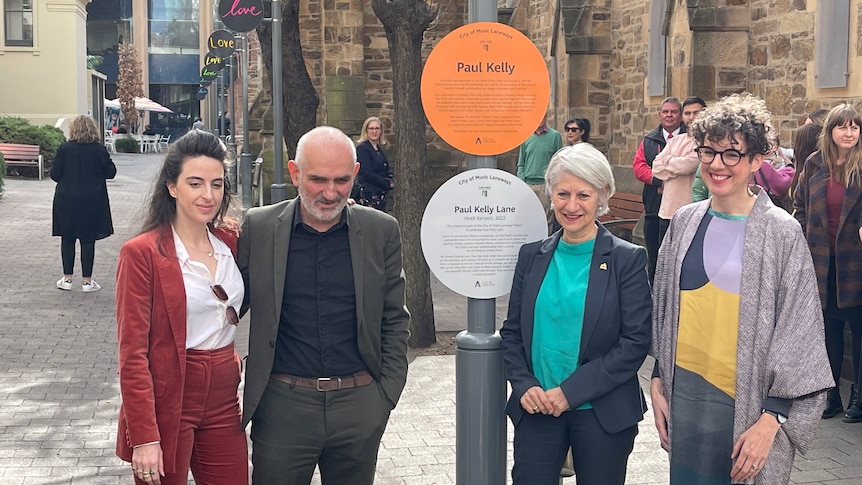
A street sign that says Paul Kelly Lane
Pilgrim Lane was renamed in honor of Kelly as part of the City of Music program.(ABC NewsRichard Davies)

South Australian artist Heidi Kenyon created the “love” light boxes along the laneway which quote some of Kelly’s famous songs.

“Really it’s just thinking about different forms of love and I guess love as a theme in song writing,” she said.

“For me, Paul Kelly speaks to love and friendship and kinship.

“I wanted it to be accessible and for people to be able to walk past and piece together some of the lyrics.”

Adelaide has been championing its musical history by naming several laneways after artists with ties to the city.

“The city of Adelaide is committed to celebrating Adelaide’s status as a world UNESCO City of Music,” Ms Verschoor said.

“Paul Kelly is the fourth City of Music laneway to be officially opened.

“We have Sia Furler, Cold Chisel, No Fixed Address [and] now Paul Kelly and the Angels will be joining. And I just said to Paul we will make a laneway for Archie Roach and Ruby Hunter.”

Space to play or pause, M to mute, left and right arrows to seek, up and down arrows for volume.

Play Video.  Duration: 5 minutes 32 seconds

Paul Kelly sings his classic How to Make Gravy on News Breakfast last year.(abcnews)

The Angels will be the next band to be honoured, with a lane off Gawler Place being renamed in their honour.

A lane in the western part of the CBD was named after Cold Chisel in March as part of the council’s planned City of Music Laneways Trail.

Lindes Lane, off Rundle Mall, was renamed No Fixed Address Lane earlier that month, after the Aboriginal reggae rock band that formed in Adelaide in 1979.

Sia Furler Lane, off Morphett Street, was also renamed in March.

Adelaide’s CBD also has a Don Lane and North Adelaide has a Lois Lane.

Melbourne renamed AC/DC Lane in 2004.

.

Categories
Australia

Catholic Church to rely on ‘Ellis defence’ in civil damages claim involving Cardinal George Pell

The Catholic Church is using a controversial legal tactic in a bid to be excused from a civil damages claim lodged in the Victorian Supreme Court involving Cardinal George Pell.

A man is suing the Catholic Archdiocese of Melbourne and Cardinal Pell for damages, claiming he suffered nervous shock after learning of allegations Cardinal Pell sexually assaulted his son when he was a choirboy at St Patrick’s Cathedral in East Melbourne in 1996.

In 2018, Cardinal Pell was found guilty of the assault, but the High Court unanimously quashed the conviction in 2020.

The Cardinal has always maintained his innocence.

Church calls upon ‘Ellis defence’

In a preliminary hearing in the Victorian Supreme Court today, the Archdiocese indicated it wanted to rely on what is known as the ‘Ellis defence’ to be excused from the case.

The Ellis defense emerged out of a 2007 NSW Court of Appeal judgment that prevented an abuse survivor suing the Church because it was not a legal entity.

Survivors have long complained about the Church using the Ellis defence, and in 2018 the Victorian Parliament passed legislation that required unincorporated associations like the Church to nominate an entity that is capable of being sued.

But lawyers for the Archdiocese argued that legislation did not apply in this case because the father of the choirboy was not the primary victim of the alleged abuse.

The facade of St Patrick's Cathedral reaches into a cloudy sky.
The civil damages claim relates to allegations of abuse at St Patrick’s Cathedral in 1996.(ABC News: Danielle Bonica)

The father’s barrister, Julian Burnside QC, disagreed, arguing the 2018 legislation applied to both primary victims and their families.

“What our learned friends’ submission amounts to is this: if the victim of child abuse dies then the family has no remedy, they have no-one they can sue,” Mr Burnside said.

“Now that’s plainly wrong in our submission.”

Justice Michael McDonald has reserved his decision on whether to excuse the Archdiocese.

Archdiocese pledges to pay any potential damages

If the Archdiocese is excused, Cardinal Pell would remain a defendant.

In a letter to the court, solicitors for the Archdiocese indicated that even if the Church avoided liability it would still pay any damages, should the judge find against Cardinal Pell.

“If the plaintiff is awarded damages against the second defendant [George Pell] the Archdiocese will ensure that the award is paid by indemnifying the second defendant in respect of the award,” the letter said.

The father of the choirboy, who cannot be named for legal reasons, launched his case last month.

His son died of a drug overdose in 2014 and the father only learned of the allegations against Cardinal Pell the following year.

The father is claiming general damages, special damages and seeking compensation for past loss of earning capacity and past and future medical expenses.

His solicitor Lisa Flynn said the High Court’s decision to quash Cardinal Pell’s conviction would not affect the civil proceedings.

“The High Court made some decisions in relation to the criminal prosecution against [George] Pell, our case is a civil case against George Pell and the Catholic Archdiocese,” she said.

.

Categories
Australia

Rental crisis: employer’s shock at real estate agent’s questions

Support has piled on for an employer who called out real estate agents who asked “invasive” questions about one of his employees, prompting other Aussies to share their own horror stories and distrust for the industry.

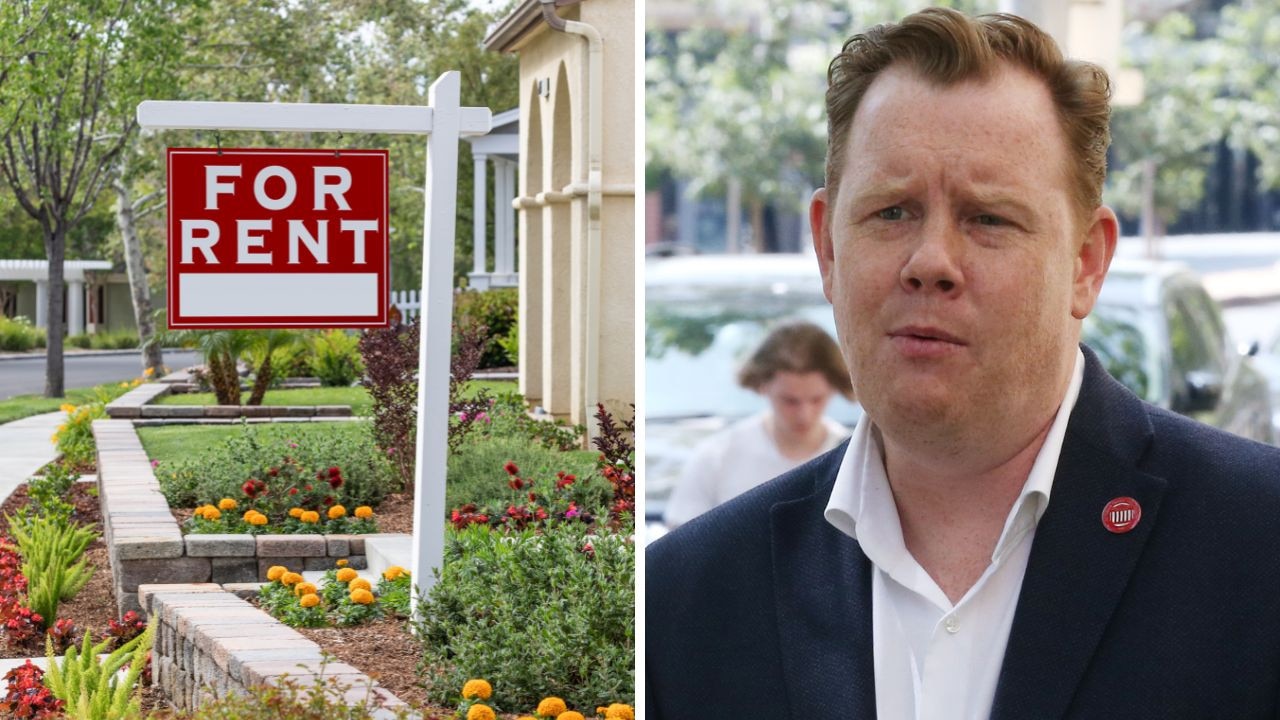
Taking to Twitter, Victorian Trades Hall Council secretary Luke Hilakari shared his dismay at being asked questions about his employee that he said had no relevance to applying for a rental property.

“I was a reference for an employee & the agent asked q’s like: Total salary, do they come to work on time, are they hard working,” he shared.

“These q’s are none of the agents business & no boss should have the power to spike where u live.”

Now, others on Twitter are sharing their own experiences, and backing up Mr Hilakari’s stance.

“Have you had many girlfriends? Would you trust him with your kids? Does he like to go out late?” answer one. “True questions recently asked to my reference when applying for a rental. Get in the bin.”

“I’ve done one of these too, but even worse,” replied another employer. “It’s stupid. Even if the employee is seconds away from being fired, there is no incentive and a lot of risk for a manager to write anything remotely meaningful. I cannot discuss an employee’s performance with a real estate agent.”

Another was quick to speculate it was likely the real estate agent had taken it upon themselves to ask the questions, and questioned if landlords even knew this was happening: “This is total power tripping and I bet the landlord has no idea it’s even happening and isn’t given that info.”

“That’s 100% correct. Real estate agents think that they are a law unto themselves. They are the root of the housing crisis, as well as developers riding roughshod over homebuyers and governments,” agreed another.

Although most were firmly against the apparently not uncommon line of questioning, not everyone supported renters, with one Twitter user replying that these were fair questions to ask.

“Of course they’re relevant questions. If they don’t make enough money then they may not be able to afford the rent. If they don’t come to work on time then they might not pay their rent on time. If they are not hard working then they may not look after the rental property,” they said.

“Sorry to burst the bubble but these kind of things add up to someone who is probably responsible and would probably reliably pay their rent on time,” said another.

While some argued that seeking to find out what type of person an agent might be allowing to rent a property is fair, others pointed out that those looking to buy weren’t held to the same standard.

“I recently got a mortgage and they didn’t call my employer,” a Twitter user commented. “Pay slips/bank statements were enough. Renters are being scrutinized to a greater degree for a much shorter term/less beneficial to them financial commitment.”

We all know that the process of applying for an overpriced rental is competitive, invasive and absolutely stacked in the landlord’s favor — just look at the reaction one potential tenant got when he asked for something as simple as a reference for the landlord.

Now, Mr Hilakari says changes to the Victoria’s Residential Tenancies Act are needed to regulate the types of questions real estates can ask.

Speaking to news.com.au, Mr Hilakari further explained that he was concerned with invasive questions like this were not only getting worse, but unfairly gave an employer too much power of their employees’ life.

“We’ve received reference checks for rentals before for and the questions being asked are getting much more invasive,” he said.

“As the rental market has tightened, it seems real estate agents think they have the unfettered right to ask whatever they want.

“Employers are put in the terrible situation of either having to give personal information or risk their employee missing out on a house to live in.

“I’ve had both employers and renters reach out and say they have universally had a gut full. Renters feel completely put over a barrel and feel they have no choice but to share their personal data.

“The system has to change.”

.

Categories
Australia

Music teacher reunited with her stolen car and beloved 87-year-old violin

Musician Gleny Rae has been reunited with her beloved 87-year-old German-made Roth violin more than 24 hours after it was stolen from outside a restaurant in Alice Springs.

“I have to say that it was directly attributable to the ABC story,” she said.

Ms Rae said that the local man who found her car, a 1999 Toyota troop carrier, was working in his yard with his sons when he heard some activity in a street close to the CBD.

“(He) went out had a look and sure enough there were three young fellas mucking around,” she said.

“As soon as they were interrupted they did the runner… But of course, they got away.”

The gentlemen who only would like to be known as Stu, realized that Ms Rae’s high-top Troopy was like a second home as it was adorned with photos of family and friends.

“Then he saw the violin. And he was like, ‘Oh, somebody is going to be in deep distress’,” she said.

desperate to return

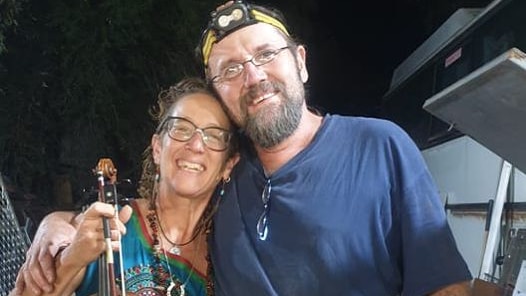
Gleny Rae, her 1935 Roth violin and Stu- the gentleman who found the troopy and the violin
Gleny Rae, her 1935 Roth violin and Stu — the gentleman who found the car and violin.(Supplied: Gleny Rae)

Ms Rae said that Stu did everything to try and return the vehicle and the instrument to the rightful owner, including reporting it to the police.

“He was desperately trying to find some way of contacting me.

“He ended up contacting me through the ABC Alice Springs Facebook page,” she said.

Ms Rae said she could not believe the news.

“My heart just about jumped out of my chest,

“I just felt this surge of adrenaline and excitement and hope through my body,” she said.

When reunited with her “best friend”, Ms Rae said she checked the condition of the violin and serenaded Stu with an Irish jig to reflect her celebratory mood and relief at finding the instrument she had owned for 35 years.

“Stu is a very humble gentleman… and just a brilliant person.

“I am so lucky; I am the luckiest person on this planet,” she said.

loading

Ms Rae said that she had assumed the car had been hot-wired in record time before learning what happened.

“Stu found a bunch of old Toyota keys just on the ground,” she said.

Ms Rae said the thieves had broken a window before trying random keys.

“Try this one, try this one, try this one — bingo. It starts and off they go,” she said.

Worn-out keys

Rick Hall is an Alice Springs mechanic and has been working in car yards all his life.

Dual cab LandCruiser
Dual cab LandCruiser utes are popular both as work and recreational vehicles. (Supplied: JP Engineering)

He said that he commonly uses older keys in Toyota vehicles up until 2005, especially when presented with cars with missing keys.

“Old Toyota keys get worn out and old ignition barrels also get worn out,

“You do find keys that aren’t necessarily the key for that particular car but if it is close enough to the original key, it will work,” he said.

Mr Hall was surprised to hear what had happened.

“Where did they get access to a whole bunch of keys?” he said.

His advice is to retrofit a kill switch.

“It’s the easiest solution and will only cost a couple of hundred dollars,” he said.

.

Categories
Australia

Albanian government passes climate bill through the lower house

the Albanian government has passed its climate bill through the lower house with a number of amendments.

The new bill locks in a 43 per cent emissions reduction by 2030 and net zero by 2050 which is an update to Australia’s obligations under the Paris Agreement.

The bill passed through the House of Representatives 89 votes to 55.

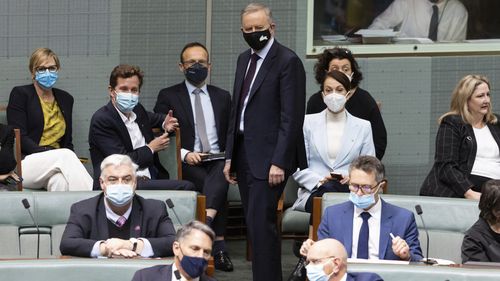
Prime Minister Anthony Albanese speaks with Greens leader Adam Bandt and crossbench MPs ahead of the vote on the bill.
Prime Minister Anthony Albanese speaks with Greens leader Adam Bandt and crossbench MPs ahead of the vote on the bill. (Alex Ellinghausen)

“I am very pleased that the climate legislation has passed the House of Representatives,” Prime Minister Anthony Albanese said.

“This is a fulfillment of a core promise that we made at the election of a 43 per cent reduction in emissions by 2030 and a renewable sector that will grow to 82 per cent of our national energy market by 2030.”

The government was able to pass the bill after Greens and Teal independents supported the bill.

But the key crossbenchers say the bill doesn’t go far enough in terms of emissions reductions but agreed to vote to move the debate along and give businesses more certainty around clean energy investments.

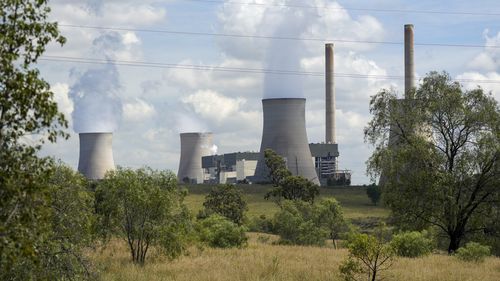
The Bayswater Power Station, a coal-powered thermal power station near Muswellbrook in the Hunter Valley, Australia, Tuesday, Nov. 2, 2021. Australias Prime Minister Scott Morrison has launched a billion Australian dollar ($738 million) investment fund to fast track emerging low emissions technologies including carbon capture and storage, Wednesday, Nov. 10, 2021. (AP Photo/Mark Baker)
The Albanian government has passed its climate bill through the lower house. (AP)

Greens leader Adam Bandt the passing of the climate bill is a “small step to tackling the climate emergency”.

Bandt said the “good work” of the climate bill can be undone by new coal and gas mines.

“If they proceed, they will blow Labor’s weak targets,” he said.

“Even one of those projects, the Beetaloo Basin, would lift Australia’s pollution by up to 13 per cent.

“If 114 of those projects go ahead and Labor is currently backing them, Australia’s pollution could lift by an additional third from where we are now.”

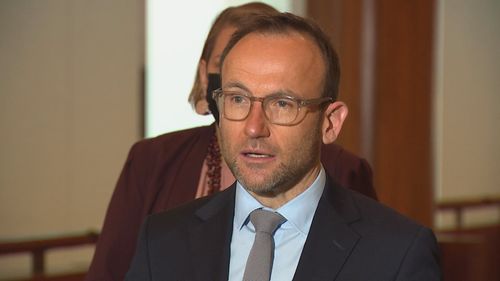
Greens leader Adam Bandt
Greens leader Adam Bandt said passing the climate is a good but small first step. (9News)

Meanwhile, independent MP Zali Stegall said earlier the climate bill is “exciting.”

“This is an exciting day, we are locking into law net zero by 2050,” Stegall said.

“The climate wars are nearly over.”

The Coalition refused to back the bill, claiming it “wasn’t necessary.”

“Had the legislation been necessary to commit to higher level targets then I would have wanted to support it in a heartbeat,” shadow minister Simon Birmingham said.

“I would have expected we should back in behind it, but it wasn’t necessary.”

However, one Liberal MP, Bridget Archer, crossed the floor to vote with Labor and the independents in favor of the bill.

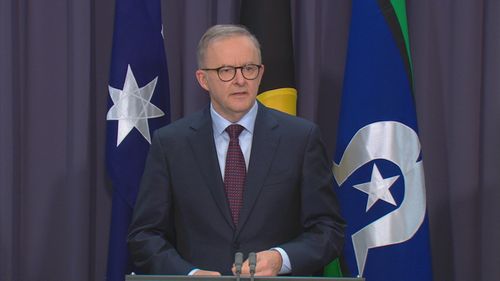
Prime Minister Anthony Albanese
Prime Minister Anthony Albanese says he was pleased the climate bill passed the lower house. (9News)

Albanese took aim at the Coalition for not supporting the bill, claiming it was “stuck in time while the world warms around it”.

“They have an opportunity when the legislation gets to the Senate to change their mind and to bring themselves into the 21st century and make themselves relevant to the debate,” Albanese said.

“The impact of climate change is real. We need a response that is real.”

The bill will go to the Senate next month.

a travel warning has been issued as thick fog covers Brisbane this morning.

‘River City’ wakes to white-out as fog swallows city