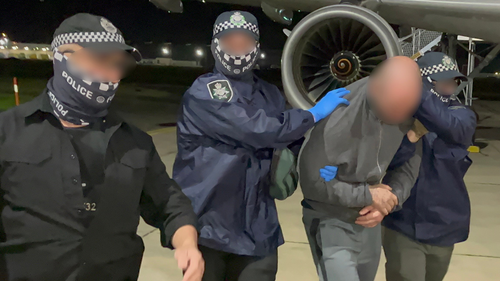
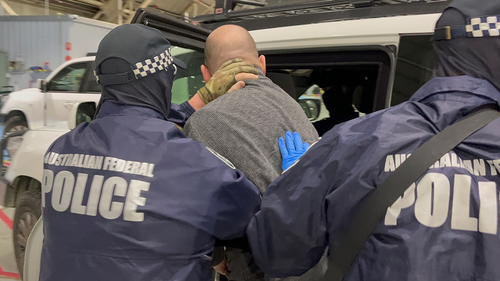
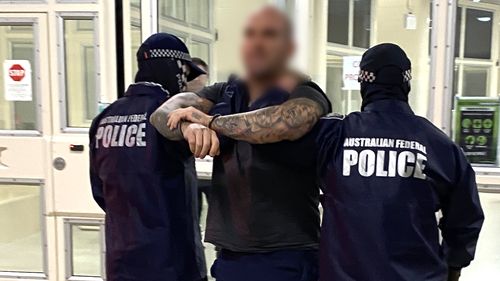
Fugitive Comanchero boss Mark Buddle has been extradited from Darwin to Melbourne over allegations he imported $40 million worth of drugs.
Australian Federal Police (AFP) confirmed the 37-year-old touched down in the Victorian capital this morning.
“AFP officers have escorted a man, 37, on a chartered flight from Darwin to Melbourne this morning to face two charges for allegedly importing cocaine worth about $40 million,” a statement said.
AFP officers escorted Mark Buddle on a chartered flight from Darwin to Melbourne this morning. (AFP)
Buddle is expected to appear in Melbourne Magistrates’ Court today where he will be charged with two offences.
Each carry a maximum sentence of life imprisonment.
Mark Buddle is expected to appear in Melbourne Magistrates’ Court today. (AFP)
Buddle’s extradition to Melbourne was originally delayed amid “security concerns”.
The Comanchero’s leader was arrested by Australian Federal Police at Darwin airport on Wednesday, six years after fleeing the country.
The arrest came a day after his deportation from Turkey.
AFP revealed Buddle had been a target of a top-secret, three-year investigation, which was set up to bring home Australia’s most wanted criminals.
Buddle was a user of the AN0M mobile phone system, which the AFP and FBI had been operating in secret before making 500-plus arrests in a worldwide takedown.
Mark Buddle was arrested at Darwin Airport on Wednesday, six years after fleeing the country. (AFP)
AFP Assistant Commissioner Nigel Ryan said Operation Ironside had tracked encrypted communications showing cocaine would be shipped from Hong Kong to Melbourne and Sydney.
“This investigation has been going for a significant amount of time,” Ryan said.
Buddle’s “complex” arrest, Ryan said, would deal a serious blow to drug syndicates operating in Australia and offshore.
More than 250 people have been charged in Australia under Operation Ironside.
No charges have been brought into the US, where privacy laws prevented arrests.
When Alison Taylor’s father lost the ability to walk she had no idea an over-the-counter vitamin was to blame.
Ms Taylor told ABC Radio Melbourne her father was diagnosed with vitamin B6 toxicity — a condition that can cause peripheral neuropathy, or nerve damage — after he was unknowingly consuming about 70 times the recommended daily intake for a man his age.
The 86-year-old was active and living independently until last year when Ms Taylor noticed the strength in her legs declining.
He was eventually admitted to hospital after losing the ability to walk.
“We took him to all sorts of different specialists. He’s had a number of consulting neurologists, he’s had MRIs, he’s had CT scans, everything you could think of to investigate why he was losing his mobility,” Ms Taylor said.
After a nine-week stint in hospital, Ms Taylor said one final test was carried out.
“They checked his B6 levels and to quote the doctor, ‘they were off the charts’,” she said.
double dose
Ms Taylor said about four years ago her father went to his GP where routine blood tests revealed he was deficient in B vitamins.
“[The GP] suggested he takes a mega-B supplement, so dad kept taking that,” Ms Taylor said.
“In his mega-B there were 50mg [of B6] and in his multivitamin there was also 50mg.”
Her father was also taking a magnesium supplement, which contained B6.
“Two of the breakfast cereals that Dad was eating everyday were fortified with B6,” she said.
The recommended daily intake of B6 is 1.7mg for men aged over 51.(ABC Health: Tegan Osborne)
Ms Taylor said it had been difficult watching her father decline.
“Twelve months ago he was driving. He’s now in aged care and in a wheelchair,” she said.
Her father has been in care for about six weeks to receive additional support and intensive physiotherapy to help rebuild his strength.
Ms Taylor said she was hopeful her father would start to regain his mobility in about six months’ time as his B6 levels returned to normal.
“There’s no suggestion he’ll start to walk as independently as he was before but potentially he won’t have to be in the wheelchair,” she said.
Condition rare but dangerous
RMIT University nutritional scientist and dietician Jessica Danaher said vitamin B6 toxicity was rare as excess B vitamins were generally flushed out by the body in the form of urine.
“However a toxic level could occur from taking too much B6 from supplements over the long-term,” Dr Danaher said.
“In rare cases, having a reduced kidney function as well as taking too much vitamin B6 may contribute to it gradually building up in the body.”
Dr Danaher said people generally received enough B6 through a “healthy and varied diet”.
“[It’s] found in a wide range of foods including meat, poultry, fish, eggs, beans and lentils, seeds and nuts, whole grains, vegetables — especially green and leafy types — and fruits,” she said.
Those who consumed high levels of alcohol, had an overactive thyroid, or were taking contraindicated medications could be more likely to develop a deficiency.
A good diet should provide adequate B6 requirements.(Flickr: Jeremy Keith)
“If you are concerned about the levels of nutrients in your blood speak with your GP,” Dr Danaher said.
The Therapeutic Goods Association (TGA) said it was aware of reports in Australia and overseas indicating peripheral neuropathy due to high levels of B6 consumption.
Products that contain more than 50mg are required to display a warning.
In 2020, the TGA said they were reviewing the problem, and the outcome might result in changes to the requirements for medication that contain B6.
Many a friendship has begun at the pub over a sherbet or two.
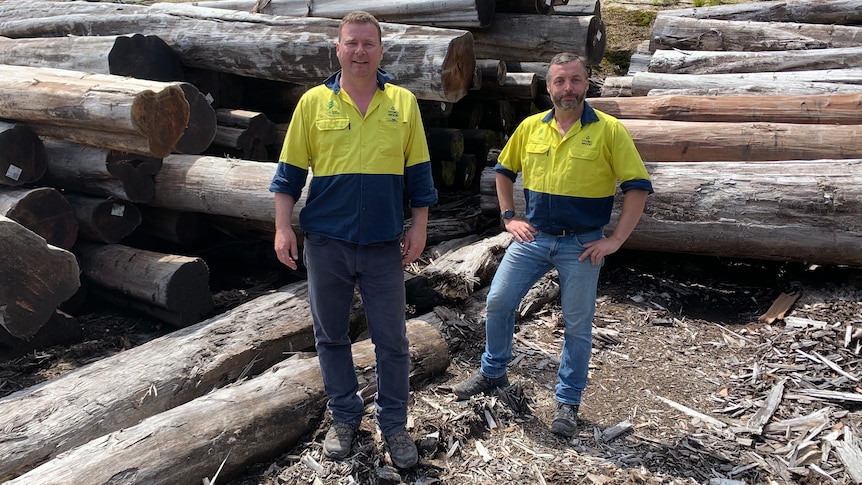
But for mates Andrew Morgan and Dave Wise, a chance meeting at the university bar led not only to a long friendship, but also the creation of Australia’s first drowned timber company.
It’s logging but with a big twist.
The pair extract dying logs from under the surface of Lake Pieman, which was dammed for hydropower in 1986, flooding Tasmania’s remote north-west forests.
Sometimes the logs are more than 20 meters deep
Andrew Morgan and David Wise had to invent an underwater harvester to extract the logs.(ABC Movin’ to the Country: Tim Noonan)
.
A time-consuming process
If you are scratching your head thinking, “If this is so genius, why hasn’t it already been done?”
It turns out extracting logs in tannin-stained, pitch-black water in freezing conditions in a remote part of the wilderness is a bit tricky.
For the Hydrowood lads it meant making up a lot of the processes themselves.
They invented a complex and robust underwater harvester, and had to find workers with unique skills, as well as maneuvering through a lot of red tape.
“We’ve definitely had some challenges,” Mr Morgan said.
“We had to do the feasibility study, design the equipment, build it, find our fantastic staff that run the operation, work out how to drive the timber, how to market it and keep it going into the market.”
It took three years from creating the concept to pulling up the first tree.
“I think one of the biggest learnings I’ve had, is business takes time,” Mr Morgan said.
“I think the media is to blame somewhat, in that those success stories that someone’s come up with an idea and sold it for x-gazillion dollars in a week. That’s not the real world.”
A chance flight
Like many great moments of ingenuity, necessity was the mother of invention.
The pair were forced to come up with a new business during the global financial crisis, when the major plantation companies they had been working for collapsed.
Up until that point, managing plantations on behalf of big companies had been the bulk of their bread and butter.
Mr Morgan said they lost all of their clients when those companies closed.
“We really needed to seek new sources of revenue and new clients,” he said.
They needed a new idea and as luck would have it, Mr Wise, a pilot, spotted it when he was flying out of the north-west one day.
Logging waste timber is expensive, and the final product costs up to 30 per cent more than a standard piece of timber.(ABC Movin’ to the Country: Tim Noonan)
“I saw the trees sticking out of the water and thought ‘Is that a potential resource?'” Mr Wise said.
“[We] had a look at what they were doing in Canada with the same use of drowned timbering, fundamentally in hydro lakes. Then we started looking at the feasibility of doing it in Tasmania, and nearly 10 years later, here we are.”
Taking on the controversy
Tasmania has a long history in the forest industry and was one of the pioneers in hardwood plantation development.
But harvesting native forests is controversial.
Mr Wise and Mr Morgan said that it was their point of difference: they use a product that would otherwise go to waste.
“It is deteriorating slowly underwater,” Mr Morgan said.
“This product’s been sitting here for 30 years, everyone else has looked at it and decided it had no value until we came along and had a crazy idea that we could actually salvage it.
“So yeah, it’s a waste product.”
Lake Pieman is located near the coast in Tasmania’s rugged north-west.(Supplied: Adam Gibson)
It is that story which has attracted a niche and lucrative market.
Companies are drawn to the sustainability as well as the beauty of the timber, which is getting harder to source.
It’s also why they charge a pretty penny.
“The timber that we’re pulling out is obviously more expensive than your standard terrestrial logs,” Mr Morgan said.
“It’s not a cheap process to pull them out. In general… it’s 20 to 30 per cent more expensive than a standard piece of timber of the same species.”
Demand for a ‘waste story’
Furniture designer Simon Ancher embraces using salvaged underwater timber in his designs.(ABC Movin’ to the Country)
Furniture designer Simon Ancher was one of their first clients and said his customers were increasingly asking questions about where timber was sourced and how.
“I think it’s really important,” he said.
“In this current climate change discussion and growing awareness around our consumption of resources and so forth, we really need to pride ourselves for the planet as much as for ourselves and be knowledgeable about where things come from and why.
“To make use of this lost resource in a really positive way — without cutting down old growth forests but actually just extracting it from this frozen state — is a fantastic story and really positive one in making the most of available resources.”
A table made from hydrowood has found itself at the heart of politics at Tasmania Parliament Square. (Supplied: Adam Gibson)
Mr Morgan said he sometimes marvels at how far his mate’s crazy idea has taken them.
“One minute I can be talking to a contractor, talking about harvesting a forest, the next minute I’m talking to a world-renowned designer,” he said.
To learn more about Hydrowood and other regional innovators, watch Movin’ to the Country on ABC TV, Fridays at 7.30pm or any time on ABC iview.
A quick-thinking truck driver saved more than 100 head of cattle after one of his trailers caught fire while he was traveling on one of the Northern Territory’s roughest and most remote roads.
Key points:
The Tanami is a vital connection from Central Australia to WA’s Kimberley region
Road train driver Cory Stirling was able to save more than 100 head of cattle after his trailer caught fire
One of his trailers was destroyed and had to be left more than 350kms from Alice Springs
Late last month Cory Stirling was transporting six decks of cattle to Alice Springs via the Tanami Road when he heard a loud bang at about 10pm.
Colloquially known as the Tanami, the road connects Central Australia to the Kimberley region of WA, stretches over 1,000 kilometers, and is notorious for its poor condition.
Mr Stirling explained he pulled the road train up immediately and ran down the side of the 50-metre-long rig to find his rear airbag brake had blown and was on fire.
“I see my airbag was alight so, I just ran back up to my truck to grab my fire extinguisher, went back, tried to extinguish, but it ran out of fire powder,” Mr Stirling said.
“Then it got under the tires, then once they lit up, she was all over.”
Fire damage to a trailer on the Tanami Road.(Supplied)
Mr Stirling had to act quickly to separate the trailers to ensure the safety of the cattle.
“I dropped the front run-throughs and then just started jumping as many cattle off [as possible],” he said.
One died on the crate and another had to be euthanized.
“You’ve got love animals and if you love doing something, like I love carting cattle… it’s really tough to watch.”
A representative of the station where the cattle came from ABC Rural has informed that the remaining cattle on the front two trailers have safely arrived in Alice Springs.
The cattle let off the burning trailer were tracked by helicopters the next morning and moved to a water point on a nearby station and will be collected at a later date.
A defaced truck stop road sign along the Tanami Road.(ABC Rural: Hugo Rikard-Bell )
Poor condition of Tanami an old foe
Mr Stirling pointed to the poor condition of the road as the primary culprit for the loss of cattle and damage to his truck.
“You have a brand-new crate that could do the same thing,” he said.
“You prep yourself for it, but it’s very harsh conditions, you let your tires down to half the per cent of PSI but still it’s terrible.”
For decades, truck drivers have been calling for maintenance of the Tanami Road.
Local companies in the Northern Territory told ABC Rural they were losing up to $10,000 a week to repairs.
Losing a trailer is a lot of money to a small business.
Mr Stirling said this was a hefty blow to his haulage company.
“Income revolves around having a crate cattle now I’ve lost a crate,” he said.
“So, I won’t be able to get the income.
“Hopefully [we can] source or replace, but they’re very hard to find at the minute.
“We spend hundreds of thousands of dollars on maintenance a year.”
A road train travels down the Tanami Highway(Rural ABC: Xavier Martin)
Bitumen is on the way
The NT government is funding upgrades to the Tanami Road, with work underway to seal a further 60 kilometers of the road beyond the Yuendumu turn-off.
In a statement to ABC Rural, a spokesperson for the Department of Infrastructure said “150 kilometers of the Tanami Road is set to be sealed over the next two years.”
This would seal past the point where Mr Stirling’s truck caught fire but, for the road train industry, the bitumen for the road could not come quick enough.
NT Road Transport Association CEO Louise Bilato said the expansion of the Tanami gold mine meant there were a lot more trucks on the road.
“The corrugations on the Tanami Road are very well known … corrugations will appear very quickly after a grade, and as it gets hotter it will get worse,” Ms Bilato said.
Ms Bilato said last week’s incident was not the first time she had heard of a bad road causing a fire in a truck.
“If it’s not batteries, brakes or shock-absorbers, it can be something else [that catches fire],” she said.
“My strongest urging to the road transport industry is to constantly monitor your equipment and don’t assume that you know the Tanami Road.”
the sydney apartment where the bodies of two Saudi sisters were found in June is back on the rental market with a real estate ad advising their deaths were “not a random crime and will not be a potential risk for the community”.
Asra Abdullah Alsehli, 24, and her 23-year-old sister Amaal Abdullah Alsehli, were found dead on June 7 in separate bedrooms of the apartment in the south-west suburb of Canterbury.
Police believe they died in early May. The decomposed state of their remains complicated the task of determining the causes of death.
Two women, 24-year-old Asra Abdullah Alsehli and 23-year-old Amaal Abdullah Alsehli were found dead inside their western Sydney home nearly two months ago. (9News)
The first-floor Canterbury Road apartment was open for inspection on Monday with rent set at 520 Australian dollars ($362) a week. That is AU$40 ($28) more than the sisters were charged.
An online ad said the apartment had been designated a crime scene and the mysterious deaths remained under police investigation.
“According to the police, this is not a random crime and will not be a potential risk for the community,” the ad said.
But police would not confirm or deny the realtor’s advice.
“As the investigation is ongoing, police continue to appeal for information in relation to the deaths of the two women,” a police statement said. “No further information is available at this stage.”
Police released the sisters’ names and photographs last week in an appeal for more public information about how they died, but investigators have remained tight-lipped about many details, including how the sisters came to Australia as teenagers in 2017, their visa status and how they earned money.
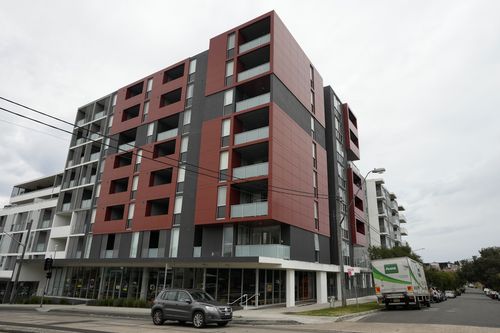
An apartment building stands on a corner in a Sydney suburb on Thursday, August 4, 2022. (AP Photo/Rick Rycroft) (AP)
Multiple sources with knowledge of the case said the sisters had been seeking asylum in Australia, The Sydney Morning Herald reported. They had worked for a time as traffic controllers and drove a luxury BMW 5 Series coupe, the newspaper reported.
Police detective Inspector Claudia Allcroft said their family in Saudi Arabia was cooperating with police and there was “nothing to suggest” that they were suspects.
She described the decomposition of the bodies as “problematic”. Police last week had yet to see the results of toxicology tests.
There was no evidence of forced entry to the apartment, where the sisters kept to themselves before their suspicious deaths, Allcroft said.
“The girls were 23 and 24 years old and they have died together in their home. We don’t know the cause of death, it’s unusual because of their age and the nature of the matter,” Allcroft added.
The sisters seemed fearful and suspicious that food delivered to their apartment had been tampered with, unidentified associates told Sydney media.
The real estate ad said the apartment’s bedrooms both had new flooring.
A senior bureaucrat was sent the selection panel report for former public servant Jenny West in order to “discuss” it with Stuart Ayres, further linking the former minister to the recruitment process for the controversial New York trade role.
Ayres resigned from cabinet on Tuesday night as the saga over John Barilaro’s US trade job reached its seventh week and anxious senior Liberals pinned their hopes on Premier Dominic Perrottet being able to pull the government out of its worsening crisis.
Former deputy premier John Barilaro has since withdrawn from the New York trade job, while former trade minister Stuart Ayres, right, was forced to resign from cabinet this week.Credit:SMH/iStock
Investment NSW managing director Kylie Bell was emailed West’s selection panel report ahead of her meeting with Ayres in December – two months after West had already had her offer for the role rescinded and just days before the job was readvertised.
The report, from Investment NSW human resources executive Kristy Manton to Bell, was sent on December 13 with a comment that said “for your discussion with the minister”.
Ayres has confirmed he told former deputy premier John Barilaro that the $500,000-a-year job was going to be readvertised and sent him the newspaper advertisement once it appeared on December 17.
Ayres, who denies any wrongdoing, resigned after Premier Dominic Perrottet was shown a draft excerpt of an independent inquiry into the appointment of John Barilaro to the US job which convinced him the process was not done at “arm’s length” from the government.
However, Ayres’ resignation has not calmed the nerves of Coalition MPs, with some convinced the next few weeks could be particularly rocky for the premier.
A senior Liberal, speaking on the condition of anonymity, said while Perrottet’s leadership was secure for now, any more damaging revelations could result in him losing the confidence of colleagues.
“Dom is OK for now but the next few weeks could be bumpy for him,” the Liberal said.
Authorities and farmers in Queensland are preparing for a wet spring after a “nightmare” winter of rain and flooding.
Key points:
The Indian Ocean Dipole is in a “negative” phase for the second year in a row
Wet conditions delayed planting of crops during winter
Authorities have started preparations in case of further dam spills
The Bureau of Metrology this week declared the Indian Ocean Dipole was “negative”, which typically meant wetter than normal weather over winter and spring for much of southern and eastern Australia.
The bureau said there was also a chance La Nina could re-form for a third time during spring.
Condamine farmer Jake Hamilton said he was slightly concerned about the forecast after an “absolute nightmare” winter of muddy paddocks at his southern Queensland property.
Mr Hamilton said he had received more than 150 millimeters of rain in May, which severely delayed the planting of crops.
“We’ve had a 75-tonne snatch strap tied to the front of our planting tractor for the last three months, and it has certainly got a lot of use,” Mr Hamilton said.
“We’ve been bogging machines left, right and centre, whether it’s tractors or sprayers, just trying to get through the mud.
“I don’t think anyone in our area is going to want to go through a harvest that was as wet as the planting that we just had.”
Tractors have been getting bogged down in wet paddocks. (Supplied: Jake Hamilton)
Mr Hamilton said the season overall had been as good as farmers could have hoped for.
But he said if the forecast for a wet spring did eventuate, it could exacerbate problems with plant diseases.
He said combined with a shortage of fungicides, it could result in significant crop losses.
“But at the end of the day, it is just a forecast,” Mr Hamilton said.
“We’ve had La Nina years where we’ve had little to no rain, so we can only just keep an eye on the short range and see what happens.
“But at least we are sort of preparing for it to be quite wet.”
Jake Hamilton says he’s slightly concerned about forecasts of a wet spring.(Supplied: Jake Hamilton)
Authorities get ready
Authorities have also started preparations for a wet spring, with flooding in Queensland this year having already claimed more than 20 lives.
Dam operator Sunwater said 11 of its 19 reservoirs across Queensland were either at or close to capacity.
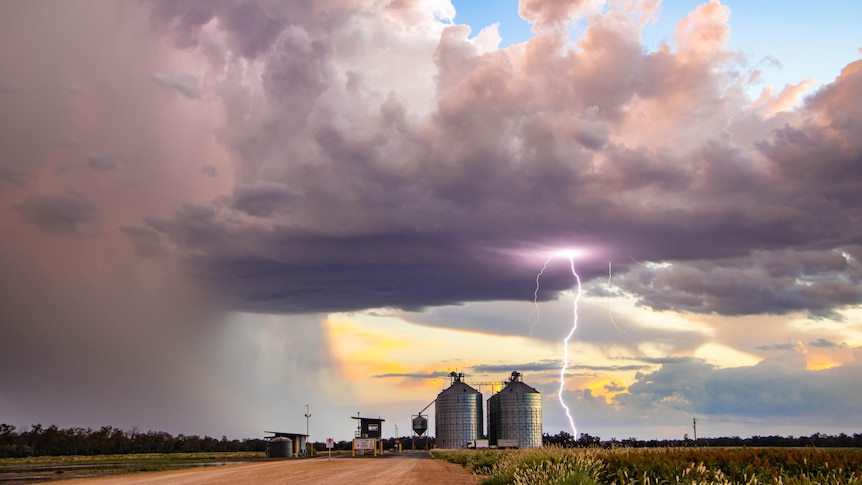
Leslie Dam at Warwick is one of the 11 dams at full capacity.(Supplied: Chris McFerran)
Sunwater executive general manager of operations, Colin Bendall, said communities needed to be vigilant if more early spring or summer rain was coming.
“Some of the preparation we’ve been doing is we conduct exercises with the local disaster management groups, and the Bureau of Meteorology,” Mr Bendall said.
He said staff were also being trained in the use of emergency action plans in the event of any further spills from dams.
loading
wet-summer
University of Southern Queensland climatologist Chelsea Jarvis said there was between a 65 to 80 per cent chance regions such as the Darling Downs would exceed their median rainfall.
She said scientists would continue to monitor the situation to see whether the Indian Ocean Dipole strengthened towards the end of the year.
“The end of this Indian Ocean Dipole event, whether it be October or December, can also determine how the likelihood of rain going into summer,” Ms Jarvis said.
“The second thing I’d be looking out for is what’s going on in the Pacific Ocean with this La Nina event, it’s just sort of hanging out there.”
But she said servers would also be trained to avoid risks “rather than plastering the walls with ‘this abuse won’t be tolerated’” messaging.
Gillespie said Bakers Delight had received sexual harassment complaints from staff in the past, but they were isolated incidents and she was confident they had been dealt with appropriately.
The federal government has pledged to fully implement the recommendations of Sex Discrimination Commissioner Kate Jenkins’ Respect@Work report.
Among the recommendations, Jenkins called for the Sex Discrimination Act to be amended to include a positive onus on employers to prevent workplace sexual harassment, rather than relying on complaints.
Bakers Delight has agreed with the watchdog to rectify the failings over 12 months, including by providing a 16-week training program for prospective franchisees, and developing a policy on dealing with the potential movement of perpetrators between stores.
loading
However, the Victorian Equal Opportunity and Human Rights Commission must go to the Victorian Civil and Administrative Tribunal to give it the power of a court-enforced order.
The agreement will be published in a move to increase the accountability of the employers’ undertakings.
The commission’s general counsel, Emily Howie, said it hoped the investigation would raise awareness among employers that they needed to be proactive to prevent sexual harassment rather than just reacting when it occurred.
Howie said while Bakers Delight had been a “very co-operative party”, the investigative and enforcement powers of the Victorian agency and a future federal model should be given more teeth.
“I think if governments take preventing sexual harassment seriously and want to make sexual harassment more enforceable, and if they do really want to remove that burden from people who suffer harm, then we need to increase the regulatory powers given to commissions like ours,” she said.
“It would give us powers to compel attendance and documents without the need to get an order from VCAT,” she said, adding it could also include the power to issue infringement notices.
Cut through the noise of federal politics with news, views and expert analysis from Jacqueline Maley. Subscribers can sign up to our weekly Inside Politics newsletter here.
Searching for a purpose in life, Gavin Tunstall joined the Australian Army in 2005 and quickly found one.
Key points:
Mr Tunstall said he struggled to cope with what he had seen in Afghanistan, and his mental health declined significantly
He was eventually discharged from the army on mental health grounds
He is now working to teach veterans with post-traumatic stress disorder how to scuba dive
He threw himself into army life and loved every moment.
“It gave me a group of men to be around. I started to feel like I had a family,” he told the Royal Commission into Defense and Veterans’ Suicide, which is holding hearings in Hobart.
But things started to fall apart when he was deployed to Afghanistan a few years later and saw the bodies of two young boys killed in combat.
“It’s not usual for children to be fighting, it’s not usual for children to be firing a machine gun,” he told the commission.
“It is not usual for me to be inspecting their dead bodies. I expected men.”
Mr Tunstall said he struggled to cope with what he had seen, and his mental health declined significantly.
“If you haven’t been in that situation you have no clue until you’ve gone through it,” he said.
“You can’t be trained for that. You don’t know how you’re going to react.”
He went on his first lot of mental health leave but said he soon started hiding his symptoms to get back to work and progress through the ranks.
A series of physical injuries — shoulder and ankle reconstructions and a torn anterior cruciate ligament — derailed his career, and led to him drinking alcohol on top of a cocktail of pain medication.
He was placed on limited duties, which he said his colleagues struggled to understand, and his mental health spiraled to a point where he was admitted to hospital in 2019.
The lack of support for service personnel and veterans’ families has been a common theme of the royal commission.(ADF)
Change of medication ‘the start of everything’
Mr Tunstall was placed on medication and his mental health started to improve, but he said a new doctor and a change of medication meant things started to unravel again.
“That was the start of everything… I have no doubt what he did lead to what happened next,” he said.
“[I had] bad dreams, night terrors, started locking myself away in my room, started isolating myself from all my friends, anger, no tolerance of any noise.”
He was arrested on domestic violence charges in early 2020 and told the commission that the officer who arrested him was a member of the Army Reserves.
“He said he was tired of arresting veterans, and he had tears in his eyes,” he said.
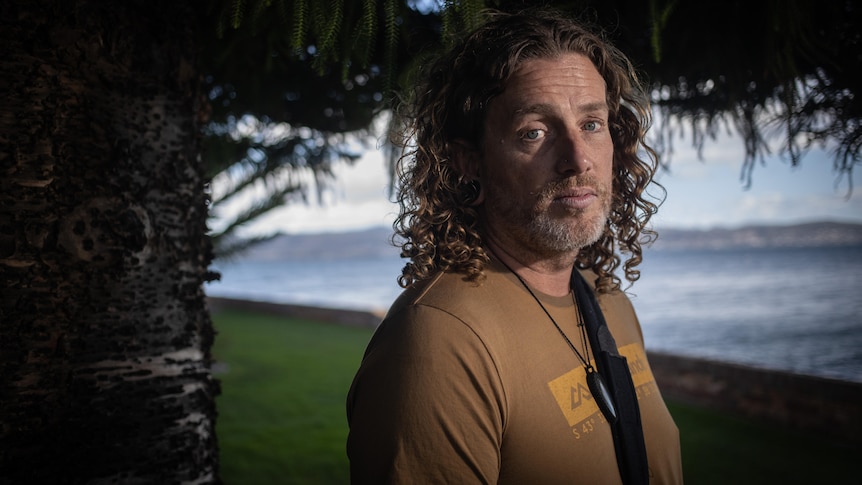
Mr Tunstall said he struggled to cope with what he saw in Afghanistan.(ABC News: Luke Bowden)
Mr Tunstall was immediately readmitted to hospital for three months and discharged from the army on mental health grounds later that year.
His criminal charges were later dropped on mental health grounds.
Having lost his family and feeling betrayed by the job he loved while he waited for his discharge to be processed, Mr Tunstall said he thought about taking his own life.
“I struggle every day with the pain of my physical injuries and the mental anguish of my service. My life will never be the same again,” he told the commission.
Mr Tunstall now works to help veterans like himself.(ABC News: Luke Bowden)
With time and support in hospital, plus seeking psychological support, Mr Tunstall’s mental health gradually improved.
He said he was now working with a provider teaching veterans with post-traumatic stress disorder how to scuba dive, in a bid to ensure others do not go through what he did.
“I was a veteran in the dark, I’m now starting to get out of it,” he said.
“I want to offer that to other people like myself who are stuck. I don’t want any more [veterans] to take their own life.”
Mr Tunstall said his family was getting no support.(ABC News: Luke Bowden)
Families ‘given no support’
But while Mr Tunstall is receiving support, he told the royal commission his family had been effectively abandoned.
“My family pretty much lost their provider. My kids lost their dad. My wife lost her husband,” he said.
“They are sitting down there… with no support, in government housing, my three children are living like poor people and there is no assistance.
“I’m getting help, but they are getting nothing and it’s a common story.”
A lack of support for the families of service personnel and veterans has been a common theme of the royal commission during its six public hearing blocks.
The Hobart hearings will conclude next week, with the commission to hand down its interim report on August 11.
Following an ABC investigation, the state government has ordered a review into how vulnerable foster children were placed into the care of a Brisbane private school headmaster who has since been convicted of child abuse.
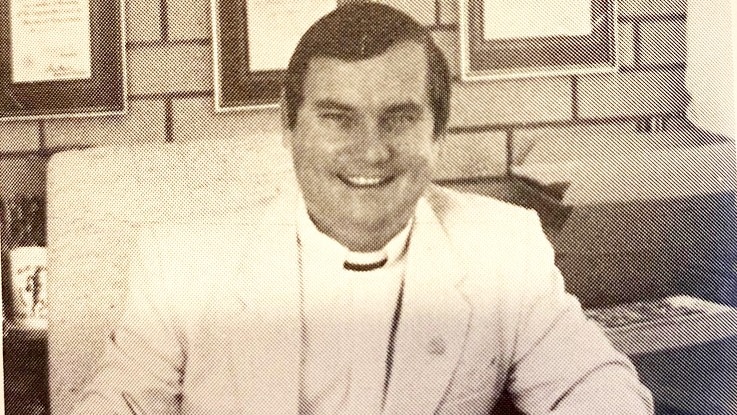
Former Christian Brother Stephen David McLaughlin had claimed in 1996 to have been a foster carer for up to 40 children through an arrangement involving private boy’s boarding school St Joseph’s Nudgee College and the then Families Department.
McLaughlin had been headmaster of the prestigious college from 1988 to 1993 before being appointed head of the Brother’s Xavier province in 1996.
Earlier this year, McLaughlin was convicted of abusing a child he had been babysitting in 2015. The child had no connection to Nudgee College.
McLaughlin had been the subject of several failed police investigations related to child abuse allegations in the late 1990s and early 2000s including allegedly taking children to stay with him in motels. His lawyers have said their client denies any child abuse allegations.
He was also alleged to have been associated in 1997 with a paedophile Nudgee old boy, Dennis Norman Douglas, who had pleaded guilty to abusing a child in 1994.
On Thursday Children’s Department Minister Leanne Linard said she had ordered a review of the arrangement involving foster children being placed at the school.
“I asked for a review of all information holdings the department has on this matter and whether there are any matters of policy or practice to be addressed moving forward,” Ms Linard said.
A spokesman for Nudgee College said the college discontinued the program many years ago and those who oversaw the program are no longer involved with the college.
Department calls for alleged victims to come forward
The Children’s Department confirmed McLaughlin was given “caring responsibilities” for foster children in the 1990s despite having never been “formally assessed” as a foster carer.
These caring responsibilities included him being “referred to as a foster carer” and treated as such, according to a spokesperson.
This included being given permission to care for children away from school.
The spokesperson said McLaughlin had offered a range of scholarships to Nudgee College and support to vulnerable children and their families, some of whom were in the care of the department at the time.
The department has called for any former student to come forward if they were harmed.
Lawyers for McLaughlin said while he was the Nudgee headmaster he was nominated as the “temporary on-site foster care nominee for some students” as part of a plan to introduce education for needy families and disadvantaged children.
They said, their client undertook this for approximately three months prior to completion of his five-year term as college principal.
“At no time did any student from the program make any allegations of wrongdoing against our client,” the lawyers said.
Foster children were sent to Nudgee College as part of an arrangement with the then Department of Families.(ABC News: Michael Lloyd)
They said their client had nothing to do with the selection of the students concerned, the daily life or ongoing care of those chosen under the program.
McLaughlin’s lawyers have said the various allegations made against their client in the 1990s and early 2000s were “found to be lies and constituted a complete fabrication of events and circumstances”.
McLaughlin was earlier this year convicted of abusing a 12-year-old boy he had been babysitting in Brisbane in 2015.
Judge Tony Rafter ordered McLaughlin to serve a two-year suspended sentence on two indecent dealing convictions saying the offending had a significant impact on the victim.
McLaughlin’s lawyers said their client was taking legal action to mount an appeal in respect of his recent conviction for the “dreadful and baseless charges” leveled against him.
Judge Rafter suspended McLaughlin’s sentence for two years taking into consideration the defendant’s health condition.
The Christian Brothers have also appointed Brisbane barrister Troy Spence to conduct an inquiry into issues associated with McLaughlin.