If you’re having an off day, spare a thought for one Mackay man who’s probably feeling worse.
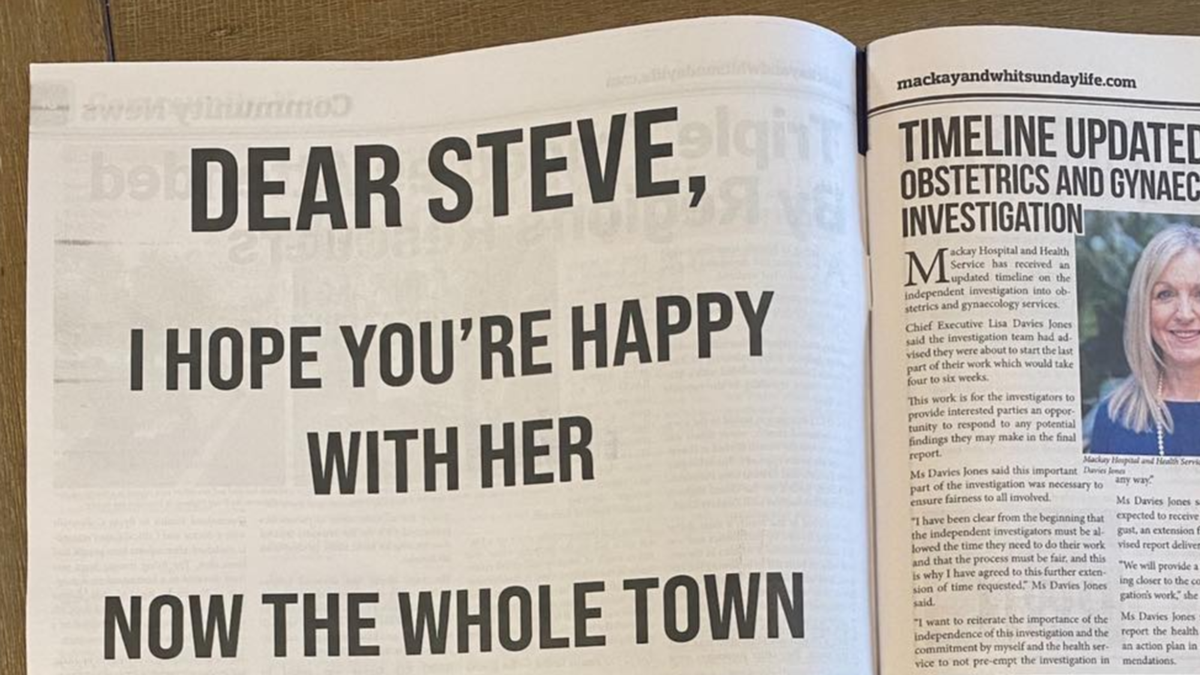
Everyone is wondering about the identity of “Steve”, whose newly former partner Jenny took out a full-page ad in the Mackay And Whitsunday Life newspaper to denounce him as a “filthy cheater”.
“Dear Steve, I hope you’re happy with her. Now the whole town will know what a filthy cheater you are. From Jenny. . I bought this ad using your credit card,” it read.
Watch the latest News on Channel 7 or stream for free on 7plus >>
The ad created so much interest the editor posted a response saying: “We have been inundated with dozens of messages this morning about the Advert on Page 4 of Mackay Life – as there’s too many to reply to, we would like to address it here.
“1. We do NOT know who Steve is, but apparently he’s been very, very bad.
“two. We won’t be revealing any details about Jenny.”
Jenny paid for the ad on her ex’s credit card – but the paper confirmed it had not charged him.
“Jenny sounds like someone I want to be friends with,” one person commented. “Never trust Steve.”
“Not all heroines wear capes. Jenny is my new favorite person,” said another.
One Jenny even clarified: “So all my friends are aware. I am not the legend ‘Jenny’ and my ‘Steve’ has not been bad.”
But not everyone was convinced. Some claimed Jenny and Steve didn’t exist at all and the ad was a very clever marketing tactic by the team at Mackay And Whitsunday Life newspaper.
“This has PR stunt written all over it,” one user wrote, and another: “Good way of getting more likes and readers to your page.”
Woman confirms the man her dad set her up with is now her boyfriend.
Woman confirms the man her dad set her up with is now her boyfriend.
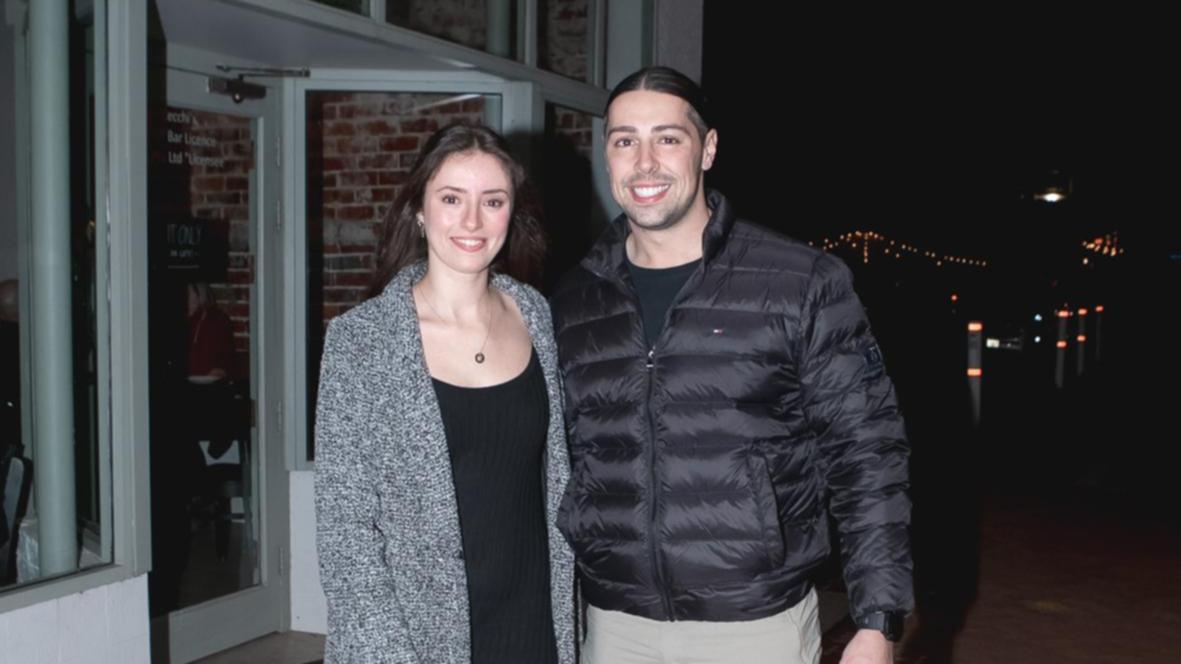
I met Luke on a Friday night at Cecchi’s in Inglewood. My first impression was that he’s a really good looking guy with a massive smile. The man bun got me — in a good way! I’d describe him as friendly, confident and someone I felt comfortable around instantly.
I was nervous because I just didn’t know what to expect or what my date was going to be like but I tried to go in with an open mind. I was a little worried I would feel uncomfortable on this date, but thankfully it wasn’t like that at all.
We sat down and started chatting. Luke was really easy to talk to. We spoke about general interests and he mentioned he played soccer and does crossfit and that the people at his gym were like a second family. He is super close with his parents and is family oriented. I am as well so that was nice.
The server sold me on an appetizer that ended up being amazing. The food overall was incredible, I wouldn’t mind going back and trying more from the menu. We had one drink each as we both drove. Luke mentioned he wasn’t a big drinker, which I actually quite liked. I recently went on a date and the guy ordered a shot with dinner.
Luke ticked a lot of boxes for me. He is the age I am looking for, he seems like he’s got his life from him together but I just felt like the spark was missing. I’m not sure if it was because usually you know who you’re meeting on a date and can build up a bit of excitement beforehand? It is hard to say.
I’m not currently using any dating apps, although my friends tell me I should. Right now, I’m just trying to meet people organically through friends/out etc.
We ended the date at the restaurant and added each other on socials. I don’t see there being a second date. Interestingly, when I looked at his social media from him, it was full of him playing guitar and singing — something he did n’t even mention. I was like, “wow, OK, this guy can sing!” All in all, Luke is a total catch but I think he felt the lack of spark as well.
Rating 8/10
Luke, 29, says:
I’m trying to say “yes” to more experiences and I went into this with a “why not” attitude.
My first impression of Emily was really good. I was sort of surprised because I considered myself a bit fussy, but this was a good choice. When we arrived it was a little awkward, just because it was the first time either of us had done anything like this before and you never really know what to expect. But I think we both recognized we were in the same boat and once we started talking, we both relaxed and it was comfortable.
Emily and I started chatting about food. She had already scoped out the menu and knew exactly what she wanted so that was cool. We spoke about our families, she she’s Macedonian so we bonded over all the similarities between Macedonians and Italians. We are also both one of three children and we are both in the middle. Our discussions mainly revolved around food, culture and family.
I found out there was a spy at the restaurant. One of my sister’s friends of her happened to be there and then was messaging her saying I was there on a date and asking if she knew.
Emily strikes me as someone who is content within herself. She is a really positive person who had nothing negative to say about anyone or any experiences.
I didn’t feel a spark between us. We could have talked for another three hours, the conversation was great but it was just missing that spark.
We ended up staying and chatting for a few hours then as we finished, we added each other on Instagram. I think we were both happy to be doing our own thing and comfortable being by ourselves. We both said yes to this opportunity, had a good time and left it at that. The date overall was great—I think we both had a good time.
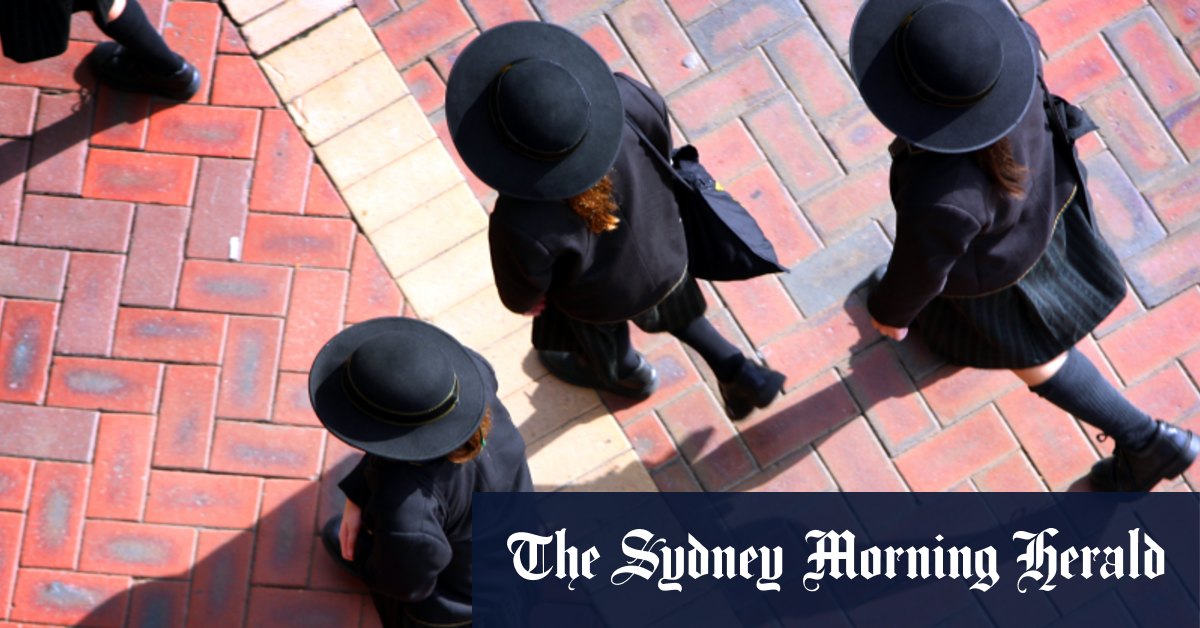
Private schools will be forced to be more transparent about the salaries of their top staff and principals, some of whom earn triple their public school counterparts with pay packets exceeding $600,000.
Under a shake-up to Australian Charities and Not-for-profits Commission (ACNC) rules, all large charities – which include most private schools – will be forced to disclose the total sum paid annually to their biggest earners.
Most private schools will be forced to disclose the remuneration packages of their biggest earners.Credit:louis douvis
Private schools will need to report the aggregate amount paid to their most senior staff – likely to include principals, deputies, bursars and financial officers – in their 2022 annual information statements, but it will remain voluntary to disclose individual salaries.
“Given the scale of public funding provided to private schools this is definitely a step in the right direction,” said Paul Kidson, an education leadership academic at the Australian Catholic University and a former independent school principal.
“Transparency and confidence in expenditure is expected of public institutions. Other government and public companies reveal chief executive salaries, so it’s more than reasonable we expect more accountability from independent schools, particularly when teachers’ salaries are public, as are the salaries of principals, in government schools.”
loading
A national survey of 275 private school principals by the Association of Heads of Independent Schools of Australia (AHISA) provided to the herald shows the mean base salary for private school principals jumped by more than $10,000 in the past two years, rising from $326,166 in 2020 to $337,183 in 2022.
AHISA chief executive Beth Blackwood said there was a significant spread in principal salaries across independent schools – from just over $100,000 through to $600,000 – which takes in variables such as enrollments, boarding, whether schools are regional or metropolitan and the funding they receive.
NSW public school principals earn a maximum salary of $194,816 and the secretary of the state’s Department of Education, who runs 2,200 schools, has a salary of $600,000.
A young couple who met on an outback cattle station have turned their desire to make their own life on the land into an unexpected business—farming Christmas trees.
Key points:
Brad and Katrina Fraser tired of life in the outback so set up a huge Christmas tree farm
The couple are growing 15,000 trees, raising two children and running a shop
Their farm employs seasonal 25 staff and attracts visitors from all over Queensland and New South Wales
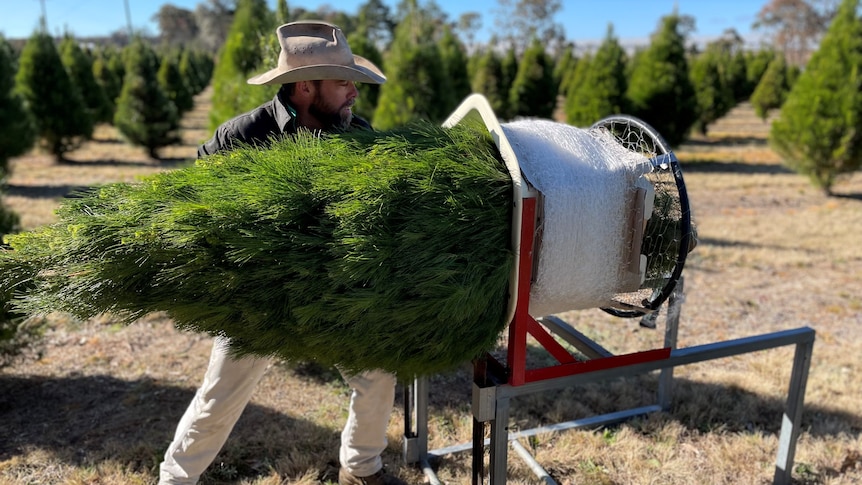
Brad and Katrina Fraser hand-planted their first crop of 2,000 Christmas trees on Queensland’s Granite Belt seven years ago.
Today, they’re growing 15,000.
“It all really came about when I was pregnant with my our first child Evelyn and I wanted to be a stay-at-home mom,” Katrina says.
“Brad was just like, ‘Well if you’re going to be a stay-at-home mom, we’re going to need to get creative with what we’re going to do on 20 acres.’
“We just thought really hard about what was missing from the region, and came up with Christmas, and that’s how it was born really.”
Brad Fraser previously worked as a jackaroo near Boulia.(Supplied: Katrina Fraser)
Farming Christmas trees in the coldest part of the Sunshine State was a big leap for Brad and Katrina, who met while working on a remote station in western Queensland.
“I was just a ringer out there at Boulia, and Katrina was our station cook. I thought, ‘Oh gee, she cooks good meals — I could end up in a good paddock here,” Brad says.
They both loved outback life, but drought forced them to make a change.
“It was a really hard time, seven days a week on the property for Brad, and I would drive into Longreach,” Katrina recalls.
Katrina Fraser says life at the remote cattle station was tough.(Supplied: Katrina Fraser)
“So it was that decision that we’re like, ‘OK, we need to, for mental health reasons, get away and do something for us.'”
The pair admits that taking the plunge in 2015 was a huge gamble.
Katrina says they ordered the seedlings and decided to plant them in their back paddock.
“I think Brad hand-pushed the rotary hoe, so no machines.”
Once the trees were in the ground, it would still be four to five years before they’d be big enough to harvest.
You have to wait four or five years for a Christmas tree crop.(ABC: Courtney Wilson)
With nothing to do but wait, Brad and Katrina set about turning what was once accommodation quarters on their former apple farm into a beautiful Christmas gift shop.
Their farm shop opened in 2017, six weeks after the arrival of their second child.
“In the beginning I had the little cot in the back room and I thought, I’m just going to play shops and be a mum,” Katrina says.
“And that lasted I think, two weeks.”
The reality of running the farm, a shop, a cafe and looking after a toddler and a newborn meant the pair quickly had to come up with “Plan B”.
The Frasers balance running the farm with raising their two children.(ABC: Courtney Wilson)
“Mr Stockman had to turn into a retailer,” Brad says.
“I’ve never done retail or hospitality. And yeah, I was the face of the business for the first two years. People would walk in to the Granite Belt Christmas Farm and see me.”
Perfecting the Christmas tree shape also keeps Brad busy. Each tree requires careful pruning six to seven times a year.
“I just self-learned,” he says.
“You get your eye in with what is straight. So that’s what I reckon has really helped me to get the edges right — although I still stuff it up.”
The trees require careful pruning to give them their distinctive shape(ABC: Courtney Wilson)
As well as honing his pruning skills, caring for the trees in general has been a big learning curve for the former jackaroo.
“Oh yeah, cows are so much easier,” he says.
“I thought, ‘I’ll just check a tree in the ground and flick a bit of water on it and give it a little bit of a prune and away I go.’
“I can do something today and I won’t find out for weeks if it’s even done anything.”
The harvest starts the last weekend in November, and runs right through until December 23 — unless they sell out earlier.
During that Christmas rush, the Frasers employ 25 people across their farm, shop and cafe.
Every farm needs some animals.(Kate Newsom)
Visitors come from all over — mostly Queensland and New South Wales — looking to make a tradition out of getting a living Christmas tree.
Besides the Christmas harvest, July is their next busiest time of year.
As well as their usual farm experiences, they also host special Christmas in July lunches every Saturday.
“We’ve probably been working maybe 60 days straight now, if not more,” Katrina says.
“So it gets very tiring! But in saying that, in the Christmas world there’s so much to be thankful for, and such good customers.”
Not everyone is sure about living Christmas trees though.
Christmas comes but twice a year for the Frasers, as July celebrations also keep them busy(ABC: Courtney Wilson)
Brad and Katrina say often the reluctance stems from a past experience where people have perhaps not treated their cut trees properly.
“Some people have put them in the wrong,” Brad says.
“They put them in sand and water [and] sand it just turns them off real quick. They need to be just in water.”
Becoming Christmas tree farmers was by no means a lifelong ambition for Brad, nor Katrina, but now that they’ve put down some serious roots in Stanthorpe they both agree they’re fully committed.
“We are growing and expanding too, and having another shop put on site in November,” Katrina says.
“We love seeing that joy, and that really adds to the community,” Brad adds.
“Coming from out west, you know, people mean a lot to you out there, so having this shop and having the feelings it gives to people — that’s paying too, and that’s pretty cool.”
The Judith Neilson Institute for Journalism and Ideas (JNI) has dismissed the remaining members of its international advisory council ahead of a review of the not-for-profit which has now been stripped of its founding board, expert journalism panel and management.
The billionaire philanthropist funded the institute to the tune of $100m in 2018, but blindsided the organization earlier this year by announcing she wanted to take it in a different direction.
The chief executive officer of the Judith Neilson Foundation, Simon Freeman, said it made sense to dissolve the panel while an internal review of the JNI’s direction is undertaken.
“A number of the advisory council members have indicated they may be interested in continuing to work with us,” Freeman told Guardian Australia on Friday.
In June, Neilson took control after four independent directors – the former New South Wales chief justice James Spigelman, the Australian’s editor-at-large, Paul Kelly, the chief executive of Free TV, Bridget Fair, and Kate Torney, the former chief executive of the State Library – walked out en masse.
Staff and media beneficiaries remain perplexed about what the institute’s new mission to promote “social change journalism” means.
The executive director, Mark Ryan, formally exited the institute last week saying he was considering legal action.
“To date, no coherent rationale has been provided for what was a totally unnecessary disruption to the institute and its hard-working staff,” Ryan said in an email to council members.
“I remain unable to provide a full account of the behavior of the patron and have no intention of responding to the many media requests I’ve received to provide my version of events.
“I’m advised by Australia’s preeminent employment law firm Clayton Utz that I have strong grounds to pursue an adverse action claim and I’m reserving my rights in that regard.”
Sign up to receive the top stories from Guardian Australia every morning.
Neilson recently arrived back in the country after an extended overseas trip. Her daughter Ella Beau joined the JNI board, along with Neilson’s lawyer, Daniel Appleby, after the resignation of the independent directors.
Sources say Neilson wants to become more personally involved in the activities of the institute and for it to focus more on the consumers of journalism rather than the producers, including non-English speaking communities and those in regional areas.
Freeman told the advisory council members, who included Australians Tom Switzer, Catherine Liddle, Richard McGregor and Antoinette Lattouf, their services were no longer needed because JNI was taking a “different approach”.
In an email seen by Guardian Australia, Freeman added that Neilson “remains committed to the future of JNI.”
JNI once described the council, who include Kyle Pope, the editor-in-chief and publisher of the Columbia Journalism Review, as “a group of eminent figures in journalism from around the world” appointed to advise the “independent, non-partisan institution ”.
“As JNI embarks upon its new direction we would hope that you remain friends of the institute and remain open to the possibility of working together in the future,” Freeman said. “Judith and the board acknowledges and appreciates your contribution in establishing the Institute and bringing it to its present position.”
JNI has funded several projects for large and small media outlets, including Nine newspapers and Guardian Australia. It has also organized events and education.
Until mid-2021, the institute had distributed $2.5m in grants and had a total expenditure of $7.7m, according to the Australian Charities and Not-for-profits Commission.
A dozen raw milk cheeses from the United Kingdom have been approved for export to Australia in a deal likely to please cheese lovers, but not necessarily local cheesemakers.
Key points:
Consumers will be able to choose from a dozen raw milk cheese varieties from the UK following a new deal
Only two cheesemakers in Australia can legally sell raw milk cheese
Government authorities say local cheesemakers are on a level playing field, but not all producers agree
Paul Appleby from the West Midlands region of England said the “exciting” deal was a win for English cheesemakers, who make the semi-hard cheeses on-farm from fresh cow’s milk.
He makes two cheeses on the list: Appleby’s Cheshire and Double Gloucester.
“We’ve been selling out to America for quite a while but Australia is certainly a market we’d love to be in,” he said.
“I think we probably pasteurized our cheese about three times about 15 or 20 years ago, and never really had a lot of success with it.
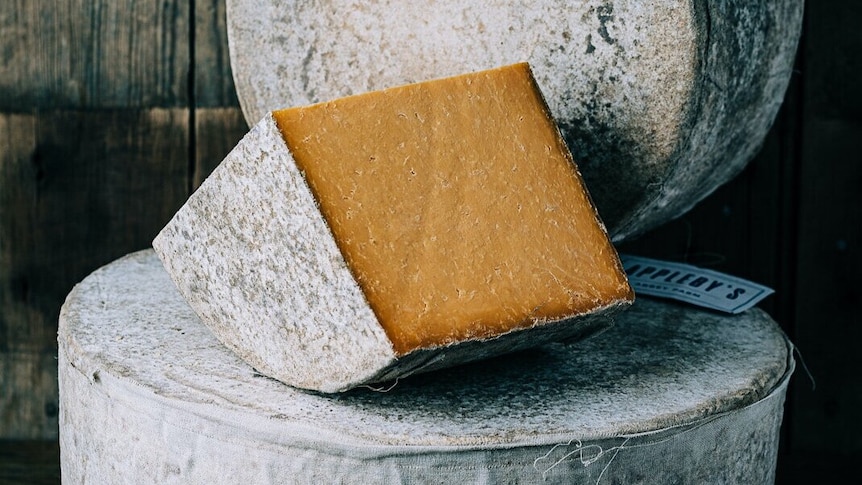
Appleby’s Double Gloucester cheese is one of 12 raw milk cheeses approved for importation into Australia from the UK. (Supplied: Appleby’s Dairy )
“But it is a constant source of worry. Obviously TB’s [Tuberculosis] an issue still in this country, so we still have to be very wary of that.
“Pasteurizing may be something we may have to do at some point, but we certainly wouldn’t want to.”
‘Fantastic for consumers, raw deal for farmers’
For international cheese specialist Will Studd, who first applied to import English raw milk cheeses 18 years ago, the decision is a dream come true.
“These cheeses used to be imported to Australia 40 years ago,” Mr Studd said.
“When I first started in the cheese industry we used to import and sell these cheeses, no problem.
“The idea that they were banned for the last 20 years on some sort of health grounds is absolute nonsense — it’s a story peddled by Food Standards Australia for no good reason, it’s all linked up to this great free trade agreement.”
Food Standards Australia New Zealand (FSANZ) did not respond to Will Studd’s “health ban” claims when contacted by the ABC.
Will Studd, who lives near Byron Bay, wants a fair go for Australian cheesemakers.(Landline: Fiona Breen)
While Mr Studd has welcomed the deal, he says it is not fair to local cheesemakers.
“It’s fantastic for cheese choice, for consumers and lovers of great cheese, but … it doesn’t allow Australian cheesemakers to be able to make the same cheeses, and that is just wrong,” he said.
Mr Studd said the whole purpose of his application in 2004 to import raw milk cheese varieties “was to allow consumers a greater choice not just of imported cheese but of local cheese”.
However, he said, since that time “almost 70 per cent of our small farmhouse producers have disappeared.”
“Milk is cheaper than water in Australia.
“Do we want to have small family farms anymore? They’re not allowed to produce cheese with an authentic taste to place, something that tastes different, something that … genuinely reflects the landscape like the great benchmark cheeses of Europe.”
Natalie Browning, first secretary (Agriculture) at Australian High Commission London and Dr Robert Irvine, deputy chief veterinary officer, UK’s Department for Food, Environment and Rural Affair (DFER) joined by Department of Foreign Affairs and Trade counselor (Economic) Carly Stevens ( back left) and DFER policy advisor Nelly Brewer (back right).(Supplied: Australian High Commission London)
Bilateral trade to ‘level playing field’
However, the Department of Agriculture, Fisheries and Forestry (DAFF) said the UK cheese deal was separate to the free trade agreement between the two countries.
DAFF’s director of imported food Tania Martin said there was a “level playing field” as Australian cheesemakers could make the same cheeses locally.
“The requirements are exactly the same whether they’re being produced domestically, or whether they’re being imported, we’re assessing the cheeses to exactly the same requirements,” she said.
She said Australian raw milk cheesemakers must meet the requirements in the Food Standards Code, Standard 4.2.4 – Primary Production and Processing Standard for Dairy Products.
English cheesemaker Jamie Montgomery, with Will Studd, says it’s brilliant news his cheddar has been approved for export to Australia.(Supplied: Will Studd)
Since DAFF started accepting applications in 2016 from eligible countries, those free of foot and mouth disease, it has received this one from the UK and one from France.
“So with France they had previous permission to export Roquefort to Australia, so Roquefort cheese has been coming in since 2005, and then France also applied for an additional cheese which is Ossau Iraty and that was finalized last year,” she said.
Tough regulatory regime ‘too difficult’ for NSW cheesemakers
In Australia, local production is regulated by state-based food authorities.
Burringbar cheesemaker Debra Allard said the regulatory process to make raw milk cheese was too difficult and not worth it.
Jersey cows ready for milking in Debra and Jim Allard’s dairy at Burringbar.(Rural ABC: Kim Honan)
“I only pasteurise at 65 degrees and that’s still within the legal parameter, commercially it’s 72 degrees, so my cheese is fine,” she said.
“I’d rather not have to bow and scrape to the NSW Food Authority.
“You do a lot of extra testing for raw milk cheese, and that’s an extra cost that you tend to wear.
“People don’t want to pay for an expensive cheese and they don’t want it to go off quickly either.
“My cheese is awesome, it tastes like a French-made cheese because of the way I make it and the fact that we’ve got Jersey milk is an awesome product.”
Debra Allard produces a range of artisan cheeses on her farm at Burringbar.(Supplied: Debra Allard)
The NSW Department of Primary Industries said raw milk cheesemakers must complete a form describing the steps used to make it.
“The pro forma can demonstrate to the Food Authority that the production process used is effective in reducing the numbers of L.monocytogenes to a safe level,” a spokesperson said.
“There are several steps and scientific trials that cheesemakers wishing to manufacture raw milk cheese must go through in order to demonstrate compliance with food safety standards.
“The maturation of the cheese must meet certain time, temperature and water content requirements, a process which has a similar effect to pasteurization in reducing pathogens.”
High entry barrier for Aussies
That process took Pecora Dairy at Robertson, in the Southern Highlands, two years.
Pecora Dairy was the country’s first raw milk cheesemaker and remains one of just two dairies making the product, according to owner Cressida Cains.
She said the milk from Pecora’s East Friesian ewes was taken straight into the vat to make cheese.
“What we’re doing, which has got no heat treatment at all, really allows a complete expression of the indigenous microbes that are in the milk when the animals have been milked to be expressed through the cheese,” she said.
Artisan sheep cheese producer Cressida Cains from Robertson.(Supplied: AgriFutures)
Ms Cains said there was quite a high barrier for Australian cheesemakers to be able to make raw milk cheese.
“In many ways that’s fair and right for Australia because we need to make sure that our cheesemakers really fully understand the process,” she said.
“It’s a science — raw milk cheesemaking isn’t sort of a hit-and-miss and let’s-see-how-we’ll-go [process].
“We still need to test every batch of raw milk cheese, which does make it a very expensive process in Australia.
“So the information, as I understand it, is that we are on a level playing field with these cheeses that are coming into the country but I genuinely do hope that that’s the case.”
Things that used to be easy may not be anymore, appearances change and the body functions differently – but it’s not all bad.
The aging process can’t be stopped, but physical activity can bring a host of benefits as people get older.
According to Pazit Levinger, principal researcher at the National Aging Research Institute, overall wellbeing and health are better for those who exercise into old age.
“Physical activity is one way you can preserve efficient systems in the body that help you overcome diseases, function better and live a good quality of life,” she said.
‘Running has kept me healthy’
While not all older Australians can expect instant health improvements from exercise, 84-year-old Abdon Ulloa swears by his regular running routine.
Abdon Ulloa has been running for the last 40 years.(Supplied: Abdon Ulloa)
Abdon took up the hobby in his mid-40s. He’s now done 75 marathons (his last one of him was at 77 years old) and he estimates his half-marathons of him are now into the thousands.
He goes to park run weekly. He’s been turning up on Saturday mornings for the last three years and has clocked up 184 runs.
All that exercise, he believes, has paid off.
“To keep running, to keep moving, you have very much kept me healthy,” he said.
Abdon believes the exercise he’s done, and is doing, is keeping him healthy.(Supplied: Abdon Ulloa)
“I don’t take any medicines and I visit the doctor once a year. I have no problems at all.”
Abdon is in a league of his own at his local parkrun in Menai in Sydney, where he’s the only runner over 80.
About an hour south, 82-year-old Ron Perry can be found making his way around the North Wollongong track.
“A lot of us still shuffle along up the back of the field,” he said.
Like Abdon, Ron took up running in his 40s and believes it’s kept him in good health.
Ron Perry was at North Wollongong’s first ever parkrun and has been there most Saturdays since.(Supplied: Ronald Perry)
“I started running around the block and then along the beach and just took it on from there,” he said.
In the nine years since starting parkrun, he’s done 215 runs.
‘Use it or lose it’
The World Health Organization (WHO) and Australian Department of Health and Aged Care recommend people aged 65 and older do about 30 minutes of exercise most days of the week. But data from the Australian Bureau of Statistics (ABS) shows half of this cohort isn’t that active.
“It’s one of those things, we know it’s working [exercise]we just need to encourage people to do it more,” Professor Levinger said.
Professor Levinger says overall health and wellbeing is better for those who exercise into old age.(Supplied: Pazit Levinger)
She also explained that ideally, exercise in older age should target the heart and lungs, with a bit of strength and resistance training too.
There should also be a focus on balance exercises.
“The heart has less capacity to function efficiently like it used to when we were younger,” Professor Levinger said.
“And the same with the respiratory system. We often might feel a bit breathless when we get older.”
Then there’s the issue of muscles getting weaker.
“If we don’t use them and preserve the strength we have, we lose muscle mass and strength and that will have a direct impact on how we function,” Professor Levinger said.
“When you exercise, you can improve how those systems function.”
When it comes to running in particular, Professor Levinger said the benefits were large, particularly for the cardiorespiratory system and bones.
Running into older age brings about benefits for the heart, lungs and bones.(Supplied: park run)
“Your blood pressure is in the healthy/normal range, your resting heart rate is reduced and pretty much your heart works more efficiently,” Professor Levinger said.
“Those who, for example, have run for a long time, and they keep running, it’s great for the bones, great for the muscles.
“We often use the phrase ‘use it or lose it’, which is actually correct.”
Someone using it is 98-year-old Colin Thorne, who in New Zealand has become the oldest person to join the 100-club at parkrun.
loading
“I’m not going to give up until I have to,” he said.
It’s never too late
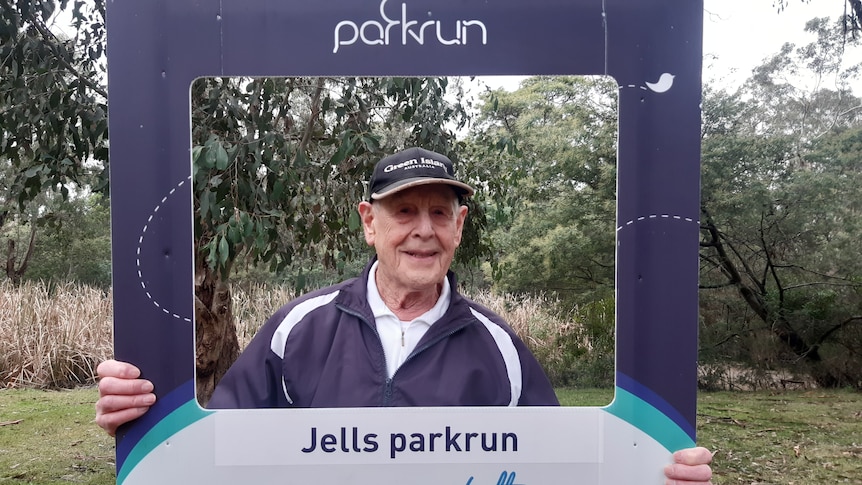
Bill Lamont is Australia’s oldest active parkrunner. He signed up a couple of months ago and broke the record for his age group at Jells parkrun, on his first walk around the track.
“In June, on my 93rd birthday, I decided to give it a try and I’m very pleased that I did so, I’m thoroughly enjoying it,” Bill said.
Australia’s oldest active parkrunner, 93-year-old Bill Lamont, has done nine parkruns so far.(Supplied: Bill Lamont)
Bill has always been active, and even now he does exercise classes, orienteering walks and plays table tennis.
“All those activities, I’m quite sure, are what is keeping me as healthy as I am. I don’t have any medical problems at this age,” Bill said.
Professor Levinger says the bottom line is, do what you can manage, and do what you enjoy.
“Do whatever you can and build up. You don’t have to be fit, you can exercise and start at any age.”
Lenore Rutley took up running at 72.(Supplied: Lenore Rutley)
Just like Lenore Rutley, who’s always done her morning walk, but took up running at 72.
“I wanted to do something a little different,” she said.
Since that decision was made, Lenore has amassed 332 parkruns.
“I just run down hills now. Every so often I’ll get a spurt up and do a little bit of a run and then I’ll do a little bit of walking,” she said.
Professor Levinger said the key thing was that people aim to do something they enjoy.
“You want to do things that you feel comfortable with and find fun, because then you are likely to stick with it,” she said.
And as Lenore puts it – “what else would you do on a Saturday morning?”
ABC Sport is partnering with park run to promote the benefits of physical activity and community participation.
Alistair Baldwin, Billy’s father, said the family redrew about $90,000 “off the house” to fly his son to Madrid and receive the treatment after sending scans to Teo last month. The money included $70,000 that was paid to Teo and other neurosurgeons as well as the hospital.
“It’s the last thing you worry about,” he said of the money.
He said Teo had performed “miracles” after his son underwent two unsuccessful surgeries at the Royal Children’s Hospital at five years old and was told to prepare for palliative care. Billy lost hearing in his left ear after childhood surgery but has gone on to finish schooling, develop a passion for the gym and study personal training.
The latest tumor detected in Billy’s lower back had affected his movement, requiring him to stand for 12 hours on his flight to Spain. He said the surgery had eased the pain.
Just two months before the Baldwins’ trip to Madrid, an online campaign raised tens of thousands of dollars for Teo to be involved in removing a golf ball-sized tumor from a US patient’s brain.
Galarza, who operated on the American patient, confirmed Teo had contacted him to carry out the procedure at his hospital in Torrevieja, about 450 kilometers south-east of Madrid on the Mediterranean coast, after US doctors hesitated to do the surgery.
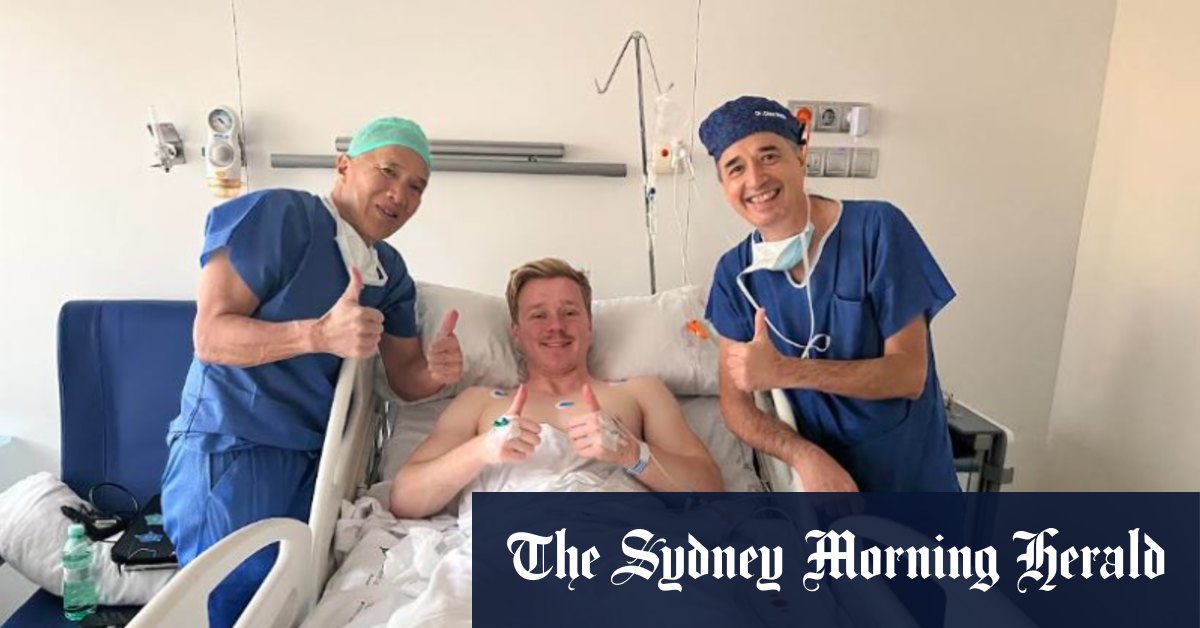
Teo operating on an Italian patient in Torrevieja alongside a team of local doctors.Credit:Facebook
Galarza said he and Teo had previously operated together on an Italian patient with a bihemispheric brain tumor in November 2021 at the same hospital, which mostly treats international patients.
“Generally, he is the first surgeon, and I am usually the assistant,” Galarza said. “The patients are Charlie’s [Teo].”
loading
An investigation by this masthead in 2019 revealed that 14 neurosurgeons and related specialists had raised serious questions about aspects of Teo’s judgment, describing what they said was narcissistic behavior and high fees charged to financially stressed people when public options were available.
The conditions imposed last year by the Medical Council of NSW require another neurosurgeon to be satisfied Teo has explained all material risks to the patient, obtained informed consent and informed financial consent, and complied with the use of systems and plans implemented in his practice for managing interstate patients.
A spokeswoman for the Medical Council of NSW said the council had been in contact with Teo’s representatives in response to reports he was operating on patients overseas.
“The council is considering whether to contact Spanish authorities subject to the information provided,” she said.
In a statement provided via a spokesman, Teo said he was no longer performing brain surgery in Australia “despite demand for his services from both patients and other neurosurgeons”.
loading
The statement said Teo was still registered as a surgeon in Australia but had been precluded from performing surgery in hospitals in the country. He was now assisting in neurosurgical procedures overseas, providing advice to other neurosurgeons and reading.
“I am passionate about caring for my patients, and it is my intention to continue helping them here and overseas,” Teo said.
The Morning Edition newsletter is our guide to the day’s most important and interesting stories, analysis and insights. Sign up here.
Two Mongolian nationals have arrived in Brisbane on a working holiday in an Australian first, as industry bodies call for increased government support to incentivise international workers to fill dire labor shortfalls.
Key points:
Strict COVID lockdowns made Australia a less attractive place for foreign workers
ABS data shows Australia’s job vacancies rose by 14 per cent in the three months to May
The Australian Retailers Association says visas and incentives need to be implemented to get workers back into the country
Prior to the pandemic, up to 150,000 working holiday-makers came to Australia annually, providing local businesses access to casual workers, often in regional areas and the agricultural industry.
The reciprocal cultural exchange scheme opened to Mongolia in July, making it the 47th country to participate in the program.
Khishigdelger Khurelbaatar, 23, is a trained journalist with a degree from the Mongolian State University of Arts and Culture in Ulaanbaatar, who left behind her husband and child to work in Australia.
Turbat Lkhamsuren, 25, has a degree in humanities and has previously worked as a chef.
Mr Lkhamsuren said he was in disbelief upon arrival.
“It’s so wonderful right now, I imagined this for so long. I don’t have any words, it’s like a dream,” he said.
“I’ve only seen Australia in a movie and now I’m here, it’s amazing.
“It’s so different from my country in the culture and the weather, I’m so excited.”
Ms Khurelbaatar said she was eager to start work.
“I really want to see some animals, like a kangaroo and koala bear,” she said.
Khishigdelger Khurelbaatar (left) and Turbat Lkhamsuren arrive at Brisbane Airport from Mongolia on working holiday visas.(Supplied: Brisbane Airport Corporation)
The pair started their time in Australia kayaking down the Brisbane River and abseiling down the Kangaroo Point Cliffs before they headed to a Sunshine Coast farm and hone necessary skills including horse riding, tractor driving, and cattle mustering.
Mongolia was a country with a long and proud tradition of horsemanship, making Ms Khurelbaatar and Mr Lkhamsuren highly sought after.
“Mongolians have a reputation as the greatest horsemen and women on Earth, so their skills will be highly valuable to the employers we place them with in regional areas,” Australian Working Adventures director Joanna Burnett said.
After completing a nine-day program and working for three months on a farm, they will then be eligible to apply for a second-year Working Holiday Maker visa.
Incentivizing foreign workers ‘essential’
Like many Mongolians, Khishigdelger Khurelbaatar is an accomplished horse rider.(Supplied)
Queensland Farmers Federation spokesperson Diana Saunders said these types of schemes were vital in supporting the agricultural industry.
“We are experiencing shortages across all levels, so not just the casual workforce, but also our skilled workforce,” Dr Saunders said.
“Government schemes and incentives are extremely important because they set the parameters of engagement, set out the role and how we can support them.
“Even in terms of being able to match skill sets, and the people available, with the needs of the industry, it’s so essential.”
Khishigdelger Khurelbaatar with her husband, son and parents, before leaving to come to Australia.(Supplied)
Dr Saunders said she would like to see more done to advertise Australia as a great place to work.
“Agriculture has a lot of benefits at the moment and it’s an industry that is set to grow and has a lot of opportunities, but we need the workforce to make that possible and attracting workers from overseas is very important.
“Employers are willing to really work with employees to get them to work on what they want and where they want to go, but also grow that person and develop that person to make sure that they retain them and be a part of the culture.”
‘Retailers screaming to fill jobs’
Australian Retailers Association chief executive Paul Zahra said there were currently more than 40,000 job vacancies in the retail industry.
“That’s up nearly 40 per cent in the last three months and there’s no end in sight,” he said.
“Most retailers are screaming to fill jobs and we just don’t have the people to fill all the vacancies.”
Chief executive of the Australian Retailers Association Paul Zahra says strict COVID lockdowns caused brand damage to Australia.(ABCNews)
Mr Zahra said images of strict COVID-19 related lockdowns broadcast worldwide had made Australia a less attractive location.
“We’ve so heavily relied on international students in the past to fill particularly hospitality roles, but also frontline retail roles. We’re just not seeing those people come back to the country.
“There was a lot of brand damage through the lockdowns and of course we’re no longer a place people want to visit.
“They’re concerned about some of the COVID regulations that have occurred historically in this country, and they’re traveling and working within Europe and aren’t coming to Australia. That’s a massive issue for the country.
“Right now we need an intervention with a new government policy to cut out the bureaucracy with visas, but equally we need incentives to get those people back into the country and here working.”
National job vacancies at record high
According to the latest figures from the Australian Bureau of Statistics (ABS) released in June, there were 480,100 total job vacancies in May.
Graph showing Australia’s job vacancies have risen by about 14 per cent.(Supplied: Australian Bureau of Statistics)
Head of labor statistics at the ABS, Bjorn Davis, said the number of job vacancies rose by 14 per cent over the three months to May.
“This reflected increasing demand for workers, particularly in customer-facing roles, with businesses continuing to face disruptions to their operations, as well as ongoing labor shortages,” he said.
Mr Davis noted the percentage of businesses reporting at least one vacancy had also increased.
“A quarter of businesses reported having at least one vacancy in May 2022,” he said.
“This rate was more than double the pre-pandemic level in February 2020 (11 per cent), which highlights the extent to which businesses are finding it more difficult to find staff.”
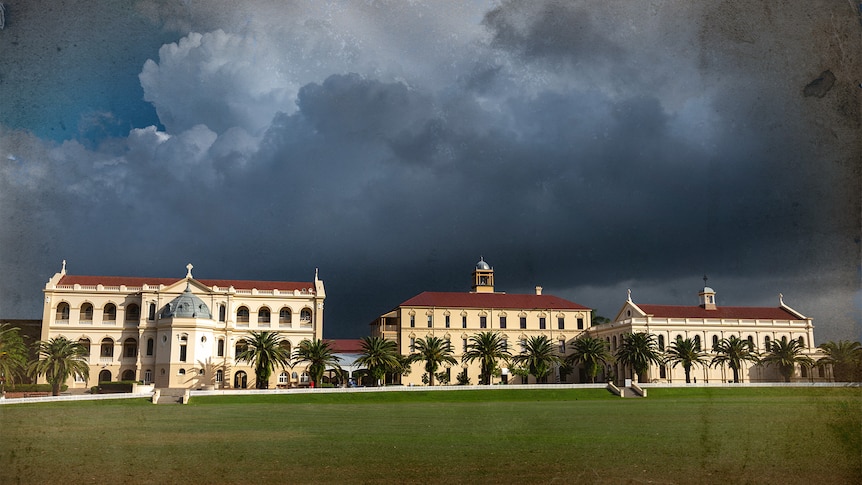
A paedophile old boy was able to spend time with a highly vulnerable foster child on the grounds of Brisbane’s St Joseph’s Nudgee College in 1992, contradicting claims the man was banned from the school at the time.
The ABC recently revealed Nudgee College old boy Dennis Norman Douglas, who was later convicted of multiple child abuse offenses, had an association with the college’s former headmaster Brother Stephen David McLaughlin in the 1990s.
Lawyers for McLaughlin, who was principal of the school from 1988 to 1993, said when their client became aware of Douglas’ visits to the school in about 1991, a directive was issued to ban him from the campus.
Dennis Douglas pleaded guilty to indecently dealing with a child in 1994.
But copies of diaries kept by Douglas and obtained by police, reveal the old boy boasted of visiting the school on a specific day more than a year later in December 1992 and spending hours interacting with boarders including a vulnerable foster child.
The ABC has located the foster child who confirmed contact with Douglas through the school.
In the diary entry, Douglas, who was then in his 20s, writes that at 2:36pm on December 3, 1992, he drove to Nudgee College.
A diary entry from Dennis Douglas revealed he was on Nudgee College grounds in 1992.
“Br McLaughlin was quit (sic) busy to see me and I also tried to see Mr D Gough (then a teacher at the school) and no luck,” he wrote.
“I then went to the toilet and then I went to the car and at the same time I made a phone call at the car… a boy named [name redacted] came up to talk to me.
“It was weird. Anyway we walked around to the old chapel, we went to have a look inside. He enjoyed our talk etc.”
Douglas then wrote that he continued to walk around the school and spoke to “kids” and boarders from Papua New Guinea.
He said he and the boy went back to his car where he allowed the youth to make a phone call on the car phone.
“I then left [name redacted] at 5:37pm and drove home.”
The former foster child, who was a boarder at the school, told the ABC he did not specifically recall the meeting on the school grounds in December 1992, but he does remember being taken away by Douglas on a trip at a later date.
The man said Douglas had taken him to visit a farm owned by the Douglas family at Reesville, about 100 kilometers north of Brisbane near Maleny.
The case raises questions about the practice of sending vulnerable foster children to St Joseph’s Nudgee College and what oversight the then Families Department had of their care.
McLaughlin boasted in 1996 of having personally acted as a foster carer to up to 40 vulnerable children some of whom were wards of the state.
The former student said he encountered Dennis Douglas on the college grounds in the 1990s.(ABC News: Michael Lloyd)
The Children’s Department confirmed that in the 1990s, the then Families Department had given McLaughlin foster care responsibilities despite him never being formally assessed as a foster carer.
In this role McLaughlin was given permission as an approved person to care for children away from the school, a department spokesperson said.
A spokesperson for the Children’s Department said legislation prevents the department from providing any information about a child who was in the care of the department.
The spokesperson did say however that boarding school was a placement option for children known to the department under a variety of circumstances, sometimes initiated by family, foster carers or the department.
“As a boarder, a child in foster care had other arrangements for school holidays, such as staying with a foster carer or family,” the spokesperson said.
“The boarding school contacted the department as guardian for any matters about the young person’s care and the department would have met the child’s care expenses.”
The former principal McLaughlin was this year convicted of abusing a 12-year-old child in 2015. The child had no connection to Nudgee College.
Stephen McLaughlin traveled to the Philippines in 2004.(christianbrothers.com.au)
His lawyers have said that in early 1992 their clients, and some college staff and parents, instigated a program to provide education for needy families and disadvantaged children through the school.
They said pursuant to the requirements of the Family Services Department, McLaughlin was nominated as the temporary on-site foster care nominee for some students, a role he undertook for approximately three months.
“Our client had nothing to do with the selection of students under the program or indeed the daily life and ongoing care of those chosen under the program,” the lawyers said.
“At no time did any student from the program make any allegations of wrongdoing against our client.”
His lawyers said their client found it deplorable to link or associate him in any way with the many shameful acts which Douglas has been convicted of.
The ABC has obtained a recording of a phone call made in December 1997 between McLaughlin and Douglas, where the pair discuss their interactions and how McLaughlin had loaned Douglas money.
At the time Douglas was a self-confessed child abuser having pleaded guilty to abusing a young boy in 1994.
McLaughlin’s lawyers said their client did not know until about 1998 that Douglas had pleaded guilty to child abuse four years earlier.
Douglas was last year released from jail after serving time for child abuse offenses unrelated to Nudgee College.
State Attorney-General Shannon Fentiman unsuccessfully tried to block his release under the Dangerous Prisoners Sex Offender Act.
McLaughlin’s lawyers said their client has suffered ill health and is in the process of appealing his conviction for the 2015 indecent dealing charges.
Nudgee College says it discontinued the program that provided schooling for the foster children many years ago and those who oversaw the program are no longer involved with the school.
The school has declined to provide any further details about how the program worked.
A spokesman for Nudgee College said the college acknowledges the bravery and courage of those who have come forward to tell their stories of this period.
“We continue to encourage anyone with information about allegations raised in the ABC reporting to contact Queensland police,” the spokesman said.
“We continue to do all we can to create an environment in which everyone at the college can feel safe. We follow strict protocols around child protection.”