An Adelaide police officer has been stabbed in the hand while making an arrest in the city’s west, according to SA Police.
Key points:
Police were called when two men were seen acting suspiciously around homes and cars at about 2am
One of the men was tracked down after fleeing on a mini dirt bike in Adelaide’s west
A police officer was allegedly stabbed in the hand during the arrest
Patrols were called to Arnold Close in Findon just before 2am today, after reports of two men acting suspiciously, trying door handles on cars and a home.
One man sped off on a mini dirt bike but was later seen by a police dog and his handler nearby.
When the suspect was confronted, he produced a screwdriver and allegedly attacked the officer, stabbing him in the hand and trying to also stab the dog.
Back-up was called and the man was arrested.
The accused man is taken by ambulance to hospital with dog bite wounds.(abcnews)
Senior Constable Rebecca Stokes said the officer was treated by paramedics at the scene.
“We’re still waiting to hear an update on how serious the injury to his hand is,” she said.
The dog’s stab-resistant harness prevented it from being injured.
A 27-year-old Findon man was taken to the Royal Adelaide Hospital to be treated for dog bite wounds and is expected to be charged later this morning.
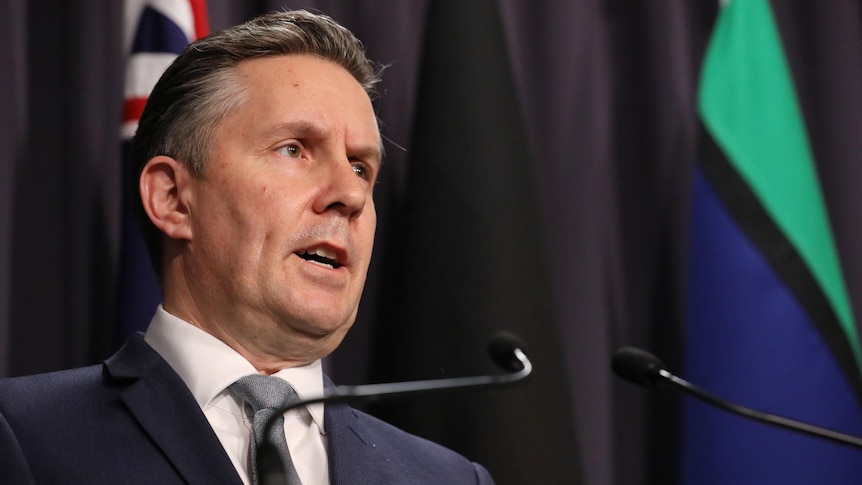
Australia may have seen the worst of the most-recent wave of COVID-19’s Omicron variant, which has swept through aged care facilities and strained hospitals, according to federal Health Minister Mark Butler.
Key points:
COVID-19 hospitalizations are high, but appear to be declining
Australia may have reached its winter peak sooner than expected
Millions of Australians overdue for a booster shot haven’t received one
Mr Mark Butler said ahead of a national cabinet meeting this morning he was cautiously optimistic COVID-19 cases have peaked.
“The data we’re seeing right now indicates we might have reached the peak earlier than we expected to,” Mr Butler said.
“We’re being a bit cautious about that because what we’ve seen through the pandemic is the ‘school holiday effect’, which shows numbers and transmission takes a slightly different course because of different activity in the school holidays.”
The Health Minister said hospital admissions were down, though remained high: about 5,000 admissions across the country.
State and territory health departments reported 66 COVID-19-related deaths yesterday.
In recent weeks, Australia has had one of the highest infection rates in the developed world, exacerbated by the emergence of more infectious strains of the Omicron variant of COVID-19.
The federal government has renewed a push to encourage people to receive their booster shots, including a fourth dose for people, because vaccination rates have plateaued.
Mr Butler said there were still five million Australians eligible for a third dose who had not received it and had gone more than six months since their second dose.
“I’d really, really encourage anyone who is eligible for a booster shot — whether it’s a third dose or a fourth dose — [to] get it now. Get the vaccine that is in front of you,” he said.
Mr Butler said fourth-dose vaccination rates had shot up since eligibility was expanded three weeks ago to include anyone aged over 30 years, and recommended for those older than 50 years.
Space to play or pause, M to mute, left and right arrows to seek, up and down arrows for volume.
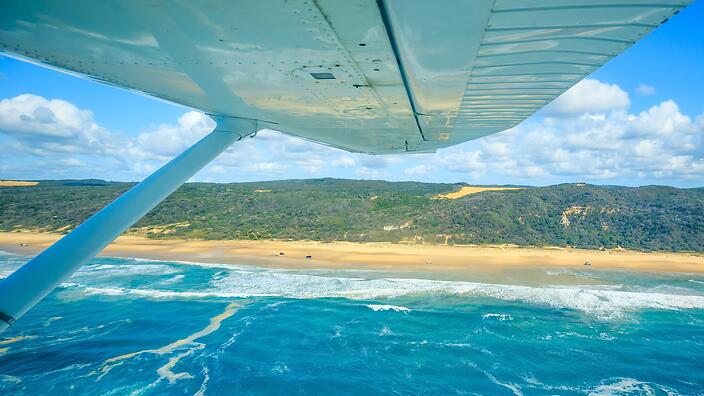
It’s hoped K’gari will follow the lead of Uluru and only be known by its traditional name, as the Queensland government flags an official name change.
The proposal will take a step forward this week as two months of public consultation begin, Resources Minister Scott Stewart said on Wednesday.
He hopes the process will lead to the Butchulla name of K’gari entering the common vernacular in the same way Uluru has retaken its proper place.
“No one calls it Ayers Rock any more, they call it Uluru, and it’s about respecting our First Nations people, and about respecting the connection they have with this land,” Mr Stewart said.
“(For) 60,000 years they’ve been calling it K’gari, I think it’s about time we started to do exactly the same.”
While the World Heritage Area became K’gari last year, the official place name for the world’s largest sand island had yet to change.
The reinstatement of K’gari as the island’s name has been a long time coming, chair of the Butchulla Aboriginal Corporation Aunty Gayle Minniecon said.
“It means so much to the Butchulla people,” she said.
“For us it’s about respect for our people. It’s important for us to let our ancestors know that our culture is still strong and we continue to care for our country.”
The consultation follows the island’s world heritage area being renamed K’gari last year, Environment Minister Meaghan Scanlon said
“K’gari means paradise in the Butchulla language and as a popular destination for its natural beauty, is a much more fitting name for such an iconic place,” Ms Scanlon said.
“The name Fraser Island is culturally inappropriate – it is a tribute to Eliza Fraser, a woman whose narrative directly led to the massacre and dispossession of the Butchulla people.”
K’gari was originally known by Europeans as Great Sandy Island before it was changed to Fraser Island after Scotswoman Eliza Fraser was shipwrecked there in 1836.
While the World Heritage Area became K’gari last year, the official place name for the world’s largest sand island had yet to change.
Defense Minister Richard Marles says Australia is not going to challenge the status-quo of the “One China” policy in relation to Taiwan and has refused to weigh into Nancy Pelosi’s visit to the disputed territory.
Speaking on Radio National earlier, Marles said Australia is taking the risk of escalation in the region “very seriously” as a result of China’s live military exercises taking place around Taiwan.
Defense Minister Richard Marles.Credit:James Brickwood
“We’re monitoring events very closely,” the defense minister said.
“Our position, which we’ve said repeatedly over the last few days – but over a long period of time now – is that we want to see is that there’ll be no alteration to the status quo, which exists on either side of the Taiwan Strait.
“And, in that sense, the One China policy – which has been, you know, the bipartisan position of governments of both persuasions in Australia since the 1970s – remains the case.”
loading
Australia’s One China policy means it does not acknowledge Taiwan as a separate country.
Asked whether Pelosi’s recent diplomatic visit represented a break from that stance, Marles replied that he wasn’t going to comment on the visit as it was a matter between the US and Taiwan.
“We are not about to tell people that they can or can’t go to Taiwan, that’s that’s not our position. And there are many people from the Australian government who are in the Australian parliament who have gone to Taiwan. And, obviously, we have a strong engagement with the people of Taiwan, and that will continue.”
When the national State of the Environment report was released a fortnight ago – an important report that told “a story of crisis and decline”, according to federal minister Tanya Plibersek – it had been delayed for around six months.
Key points:
The Tasmanian State of the Environment report is supposed to be released every five years, but one hasn’t been released since 2009
The Australia Institute Tasmania said RTI documents “reveal that no material progress has been made towards the preparation of a State of the Environment report”
Planning Minister Michael Ferguson said the government was “undertaking a review of the reporting requirements”
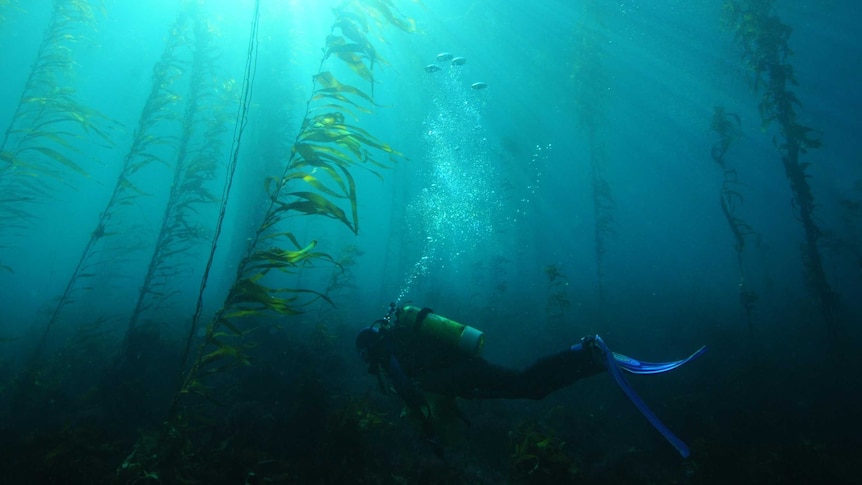
Specifically for Tasmania, the report highlighted the pressures of climate change, including abrupt changes in ecological systems, affecting things like giant kelp forests, agriculture and the increasing frequency of extreme weather events, and also touched on the impact of humans on the endangered Tasmanian devil. .
But its delayed release after it was handed to the Morrison government in December last year is nothing on the Tasmanian State of the Environment report, which was last seen 13 years ago — missing its last two reports, in 2014 and 2019.
That is despite legislation (the State Policies and Projects Act 1993) stating the Tasmanian Planning Commission must produce a report every five years.
The Act says the report should cover the condition of the environment, trends and changes in the environment, the achievement of resource management objectives, and recommendations for future environmental management.
The Planning Minister should then present it to parliament within a speedy 15 days.
So where is it?
We’ve done a deep dive to try to answer that question.
The most recent report was in 2009, which said the Tasmanian Planning Commission’s top priority over the next five years was to “improve the standard of land use planning and to ensure that Tasmania’s sustainable development objectives are furthered as far as possible”.
“This SOE Report is a first step to facilitate that change without losing our baseline environmental performance data and reporting framework,” it said.
“This will be achieved through a number of mechanisms including performing its statutory roles and functions effectively and efficiently in accordance with section 29 of the State Policies and Projects Act 1993 and the Tasmanian Planning Commission Act 1997.”
So, basically: future reports were considered important. However, since then, there has been radio silence.
Tasmania’s environment is world-renowned.(ABC News: Peta Carlyon)
RTI documents reveal ‘no material progress has been made’
The Australia Institute Tasmania has been on the case, submitting a Right to Information (RTI) request.
Institute director Eloise Carr said the RTI documents showed a “complete disregard for the law by the Tasmanian Planning Commission and a lack of oversight by the government”.
“They reveal that no material progress has been made towards the preparation of a State of the Environment report and that the Planning Commission as statutory authority appears to have made a decision not to comply with the law, which requires it to produce these reports every five years,” she said.
“The Minister for Planning, who is responsible for receiving the State of the Environment Reports, has not intervened. The Department of Justice, which has responsibility for administering the Tasmanian Planning Commission has not intervened.
“The Environment Minister appears to have been absolved from his responsibilities to the environment.”
Planning Commission executive commissioner John Ramsay stated in an email released as part of the RTI documents that the reasons for the failure to produce a report “are somewhat elusive”.
“Whatever the rationale, when the Commission initiated some action of the SoE a couple of years (sic) back, the outcome … was a recommendation to the Minister that the Commission no longer be responsible for SoE,” he wrote.
“Shortly after that, the review of the Commission was undertaken, and it also recommended that SoE not be part of the Commission responsibilities. That recommendation and the rest of the review recommendations have not to my knowledge been resolved.”
Ms Carr said the national report showed the impacts of the changing climate and highlighted its importance.
“We know there’s a global hotspot of warming off the east coast of Tasmania, we know that we’ve had several high impact fire seasons since the last SoE report, we know that industries are increasing their size and their impacts,” she said.
“And without accurate data, how can we make decisions about how we manage the impacts on the environment? It’s like flying blind.”
The national report highlighted how climate change is affecting Tasmania’s environment.(Supplied: Arko Lucieer)
Government ‘currently reviewing reporting requirements’
The State of the Environment Report website offers little insight.
It states: “Over recent years the Commission has conducted internal reviews on meeting the SoE requirement, identifying a need for a policy review of the SoE legislation. In 2019, the Commission formally recommended that such a review be undertaken.”
But there is no detail about the gaping hole where reports should have been released in 2014 and 2019. The website said the review was started in late 2019 but no further updates have been provided.
Planning Minister Michael Ferguson had little to say on the matter.
“The Tasmanian State of the Environment sits with the Tasmanian Planning Commission, but given its statutory roles and responsibilities, it is widely recognized as not the most appropriate authority for this work,” he said in a written statement said.
“The government is currently undertaking a review of the reporting requirements, the format of the report and the most suitable authority for the work and will include extensive public consultation.
“I understand that a number of Tasmanian government agencies contributed to the Commonwealth State of Environment report.”
The Walls of Jerusalem, part of Central Tasmania’s spectacular natural environment(ABC News: Rick Eaves)
Planning Commission ‘effectively hog-tied by government failure’: Greens
Tasmanian Greens environmental spokeswoman Rosalie Woodruff laid the blame for the lack of reports on successive Liberal governments, which have held power since 2014.
“The Tasmanian Planning Commission is guilty of not doing the SoE assessment – but it’s been effectively hog-tied by the Liberals’ failure to provide the necessary information, or to resource this demanding, important body of work,” she said.
“The multiple agency failures to deliver a report for 13 years are a deliberate tactic to hide the evidence of the impact of Liberal policies on the health of Tasmania’s environment.
“They’d be confronted with the evidence that they’re trashing the place.”
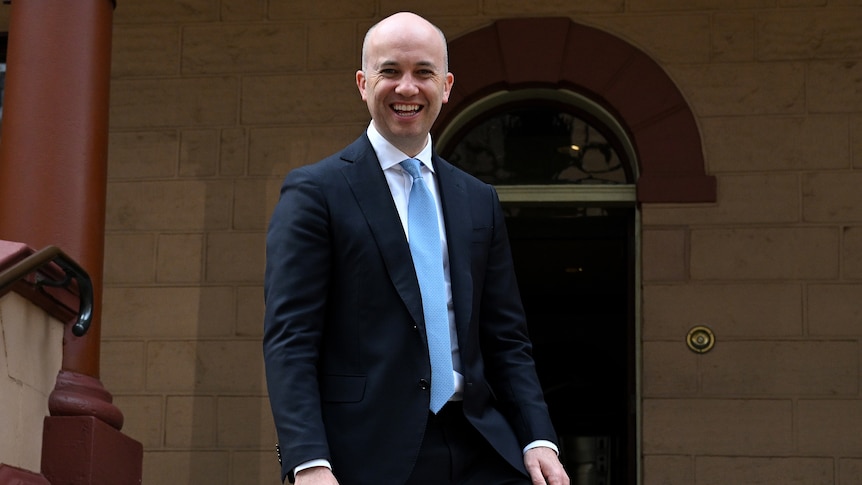
Jostling is underway for the deputy leadership of the New South Wales Liberal Party after the resignation of Stuart Ayres from cabinet yesterday.
The main contenders so far are: Treasurer Matt Kean, Transport Minister David Elliott, Metropolitan Roads Minister Natalie Ward and the Science, Innovation and Technology and Skills and Training Minister Alister Henskens.
Mr Ayres resigned from his portfolios and leadership position in the Liberal Party after an inquiry “raised concerns” about his conduct in the appointment of John Barilaro to a lucrative US trade role.
The deputy leadership will be determined at a party room meeting next Tuesday.
Premier Dominic Perrottet has announced three New South Wales ministers will have their portfolios expanded to take over Mr Ayres’s ministerial responsibilities.
Mr Henskens will also add Enterprise, Investment and Trade and Sport to his list of portfolios.
Ben Franklin — who already is Minister for Aboriginal Affairs, Minister for the Arts, and Minister for Regional Youth — will add Minister for Tourism to his portfolio.
David Elliott — who is Minister for Transport and Minister for Veterans Affairs — will add Minister for Western Sydney to his portfolio.
Aboriginal inmates on rise
New data reveals Aboriginal people remain over-represented in NSW jails.
Bureau of Crime Statistics figures show the overall number of prisoners dropped since the start of the COVID pandemic, with around 1,000 fewer inmates than three years ago.
However the number of Aboriginal men in jail has risen by more than 100 and they are now 28 per cent of the jail population.
Aboriginal women make up 40 per cent of the state’s jail population.
Police release images in murder probe
Police have released images of a man and woman who may have seen something that can help their investigation. (Supplied: NSW Police)
Detectives have released images of two people they believe could help with their investigations into the murder of Western Sydney man Shady Kanj.
Shortly after 11pm on Friday, August 6, Mr Kanj was treated for gun shot wounds by paramedics on Rhodes Avenue, Guildford.
Despite their efforts, Mr Kanj died at the scene.
Strike force detectives have released CCTV of a man and woman in a white Audi Q5 captured at a fast-food restaurant on the corner of Vaughan Street and Olympic Drive at Lidcombe prior to the murder.
They do not believe the man and woman were involved in the murder, however, they may have information that could assist with inquiries.
Homicide squad commander Detective Superintendent Danny Doherty urged the man and woman, or those with knowledge of their identities, to come forward.
Premier criticized over Leichhardt snub
Leichhardt Oval is set to miss out on redevelopment funding.(AAP Images: Craig Golding)
New South Wales Premier Dominic Perrottet has been criticized for committing more than $300 million to rebuilding Penrith Stadium while ignoring Leichhardt Oval.
NRL boss Peter V’landys said the government had reneged on a promise to upgrade a number of suburban grounds.
Inner-West Deputy Mayor Jessica D’Arienzo said that it was despite more games and more sports being played at Leichhardt.
“It means that, again, Leichhardt misses out,” Ms D’Arienzo said.
“We should make it clear that it’s not just the Tigers that play there. Actually, you’ve got soccer, the rugby league and rugby union. We’ve got around 50 to 60 games a year being played on Leichhardt oval.”
Call for flood report’s release
NSW Labor’s Jihad Dib wants the findings released.(abcnews)
The New South Wales government has been criticized by the opposition for failing to release the findings of an inquiry into the floods earlier this year.
Severe weather and flooding devastated the Northern Rivers and Hawkesbury Nepean regions in February and March.
Premier Dominic Perrottet was due to release the final report from the inquiry on July 31.
Opposition emergency services and climate and environment spokesperson Jihad Dib said Mr Perrottet must put aside political issues within his party and release the report immediately.
“Local communities that are devastated by the floods are not interested in the government’s internal rumblings,” he said.
“What they’re interested in is a report that identifies what went wrong and a pathway forward into the future.
“He needs to release the report now rather than when its politically expedient to do so.”
Empty CBD offices
The number of empty offices in Sydney’s CBD has risen, which the property council says is due to an increase in supply.
Office vacancies in the CBD have risen from 9.3 per cent to 10.1 per cent, according to the Property Council of Australia’s latest Office Market Report.
The council says that, while vacancies have risen, the figures are actually positive, given the pressures of COVID-19, working from home and industrial action.
Property Council executive director Luke Achterstraat said there was still strong commercial property confidence in Sydney.
Thredbo cancels lift operations
Damaging winds averaging 80 to 90 kilometers per hour are forecast. (ABC South East NSW: Adriane Reardon)
Thredbo resort has made the decision not to operate any ski lifts on Thursday due to an extreme weather forecast.
A complex low pressure system, along with an associated through and cold front, are causing vigorous winds across south-east New South Wales, as well as the potential for heavy rainfall from Thursday morning.
Damaging winds averaging 80-90 kilometers per hour are forecast for Alpine areas above 1,900 meters.
Five teenagers charged after stabbing
Police have charged five teenagers after a stabbing at Bankstown in South-West Sydney.
About 3:15pm yesterday, emergency services were called to Chapel Road, where they found a 15-year-old boy with stab wounds, who they took to hospital.
Two other 15-year-old boys were also injured.
Five teenagers aged between 15 and 16 years were arrested.
The five were taken to Bankstown Police Station, where all were charged with reckless wounding in company, and affray.
They were refused bail and are due to appear before a Children’s Court on Thursday.
An aged care advocate wants the federal government to support facilities in rural and remote areas to have registered nurses, rather than giving them an exemption to the requirement.
Key points:
Proposed aged care reforms would mean registered nurses would need to be in aged care facilities at all times
Rural aged care facilities want more information about how exemptions will be applied
Many rural facilities are finding it difficult to recruit staff
Labor’s aged care reforms include a requirement for there to be a registered nurse (RN) on-site at aged care facilities at all times, but there will be exemptions for rural facilities that are unable to find staff.
Charles Sturt University academic Maree Bernoth acknowledged the regional workforce shortages but said the government was taking an “easy” option.
“Our older people in rural areas deserve the same standards of care as everywhere else,” Dr Bernoth said.
Maree Bernoth wants a long-term strategy to recruit and retain nurses in aged care.(ABC Riverina: Emily Doak)
“We shouldn’t be looking for a lesser standard or a lesser qualification of people working with our rural older people than is available in metropolitan areas.”
A Senate committee is considering the proposed legislation for 24-7 registered nursing in aged care and will report back at the end of August.
Paul Sadler of the Aged and Community Care Association said exemptions were necessary, particularly for facilities in rural and regional areas.
Paul Sadler from the Aged and Community Care Providers Association is lobbying for clarity around exemptions.(Source: Paul Sadler Twitter)
“In particular we don’t want the process of making it mandatory to have a registered nurse 24-7 mean at the end of the day that small aged care homes in country towns have to close because they fail to do that,” Mr Sadler said.
RNs ‘like hen’s teeth’
At Hillston in south western NSW, the community-run aged care facility has first-hand experience of the challenges in recruiting a registered nurse.
Board member John McKeon said the first registered nurse for the 18-bed facility was employed last year after but finding her somewhere to live was also a problem.
“It’s very hard to get accommodation for people, especially out of town people,” Mr McKeon said.
“The manager we have now has to live in a caravan park which is far from satisfactory.
“It’s almost double the cost to have a nurse on your staff as it is a standard care worker, if we need to have more than one nurse it’s going to cost a lot more money and we would struggle without government assistance.”
It is a similar story at Coleambally, also in southern NSW, where the not-for-profit aged care home provides 18 beds for full-time residents and one for respite service.
Manager of Cypress View Lodge at Coleambally, Karen Hodgson is calling for more detail about the aged care reforms.(Supplied: Karen Hodgson)
Manager Karen Hodgson said she was lucky to have two part-time registered nurses.
“Registered nurses are just like hen’s teeth, they’re just not out there, they’re certainly not in our community but they are not even the wider community,” she said.
Concern for the future
Ms Hodgson said there had been no detail about how the proposed exemptions to the aged care reforms would be applied.
“We just want to keep providing the excellent care that we do but I worry about these 19 people; what’s going to happen to them,” she said.
“We run here so that the elderly in our community can stay here, so that they don’t have to go to the nearest town, which is 50 minutes away… My concern is where do they go if we shut our doors? “
Dr Bernoth said long-term strategies were needed to tackle the underlying problem of workforce shortages.
“In our smaller centers we need to think about reliability and certainty of employment, accommodation once they’re there, and a career pathway for them,” Dr Bernoth said.
“I would suggest we think of a another model … where a team of registered nurses might be able to move around a number of smaller facilities.”
Space to play or pause, M to mute, left and right arrows to seek, up and down arrows for volume.
Northern Australia’s wet season is likely to arrive earlier this year, according to the Bureau of Meteorology (BOM), bringing with it a higher likelihood of more tropical cyclones off coasts.
Key points:
The Bureau of Meteorology is forecasting an early onset of rain across the Top End.
Two powerful climate forces have at least a 50 per cent chance of forming, driving higher than average rainfall
The prawn industry says wetter weather will hopefully drive a bumper harvest next year
Much of south-eastern Australia has been impacted by record-breaking floods as a result of La Nina, while the north of the continent recorded decent rainfall totals during the last wet season.
Now the weather bureau has officially declared another climatic phenomenon — known as the negative Indian Ocean Dipole — that’s expected to add to recent unrelenting rain on the east coast.
The weather system is also predicted to lead to wetter weather across the Top End of the Northern Territory and Far North Queensland. However, parts of northern Western Australia are likely to remain somewhat drier.
The Bureau of Meteorology is forecasting vast parts of northern Australia will see an early onset of rainfall, but a later onset in WA is possible.(Supplied)
Northern Australia’s wet season typically runs from December to April, following a build up of hot and humid conditions from October.
The weather bureau measures how early or late the rainfall onset is by how long it takes for rain gauges to record 50mm after the start of September. Typically, gauges hit the 50mm threshold in Darwin in late October.
“There is a high chance of getting to 50mm from the 1st of September potentially by early October or maybe even late September,” the BOM’s senior forecast Moses Raico said of this year’s conditions.
The culprits are vast climate drivers across the Pacific and Indian Oceans, including the La Nina, responsible for much of the east coast’s wet weather so far this year.
The BOM is predicting a 50:50 chance of La Nina forming for a third straight summer, however Mr Raico said it was actually a negative Indian Ocean Dipole that was more likely to influence rainfall in northern Australia.
He said this was when “waters across the eastern side of the [Indian Ocean] basin are warmer than compared to what’s over on the western side.”
“The combination of those warmer waters, and if we also get La Nina called later on, it could help contribute to seeing wetter conditions than what we’d expect, which would contribute to a greater chance of a rainfall thresholds being met.”
While every year is different, the areas shaded in green usually receive wetter than normal weather during a negative Indian Ocean Dipole – particularly the south-east of Australia.(ABC: Shakira Wilson)
Earlier rain, more potential cyclones
Each year, the monsoon arrives at roughly the same time. In Darwin, drenching rains typically begin between Christmas and New Years.
But Mr Raico said the combination of a La Nina and a negative Indian Ocean Dipole could bring the monsoons forward to sometime earlier in December.
“The exact timing though, it’s a bit hard to actually pin point,” he said.
“Definitely, if that were to take place and we do see those warmer sea surface temperatures, then that generally would play out with potentially greater than average tropical cyclones in the season.”
Typically, a negative Indian Ocean Dipole and La Nina triggers higher than average rainfall across northern Australia during its wet season.
But the BOM, in its report wrapping up the 2021-22 wet season, acknowledges this wasn’t entirely true.
“The 2021–22 La Nina was conducive to the early start to the wet season and above average rainfall until January 2022,” the BOM said.
“However, somewhat atypically for a La Nina, many areas of northern Australia were drier than average from February to April 2022.”
Michael O’Brien says the forecast will benefit prawn fishers. (ABC News: Dane Hirst)
Rainfall good news for some
Increased wet weather might bring to a premature end the Northern Territory’s bumper tourism season, which runs through the dry.
But those likely to benefit include prawn fishers, whose benefits greatly from rainy conditions.
Australia Bay Seafoods general manager Michael O’Brien said 16 boats had already gone out into the Gulf of Carpentaria in the past week for the tiger prawn season.
“[The forecast] is great news for us because our banana [prawn] season, which is the first half of the year, is totally related to the amount of rain we get to flush the rivers out,” he said.
Mr O’Brien said rains flushed “the rivers out with all the smaller prawns so they can go out and grow”.
“Our prawns will be bigger, which is good for everybody – good for the market, good for us and good for the consumer that’s going to eat big prawns.”
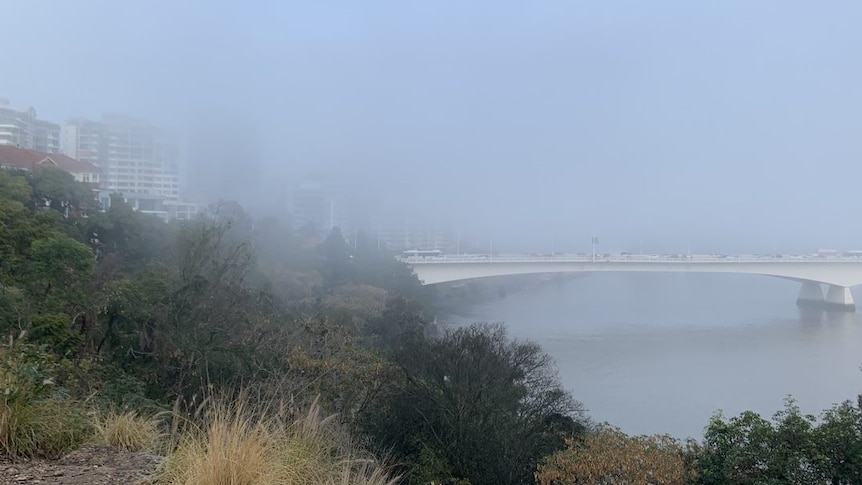
Greater Brisbane has been blanketed in thick fog for the second time this week, prompting the Bureau of Meteorology (BOM) to issue an alert for dangerous road conditions.
But today the pea soup is more widespread, with patches of fog impacting cities along the Queensland coast all the way north to Townsville.
BOM forecaster Matthew Bass said the fog was a “similar event” to what Brisbane experienced on Tuesday, but heavier today in outer suburbs.
“Maybe a little bit more extensive through southern parts of Brisbane, down towards the Logan area,” he said.
Patches of fog can be seen all the way to Townsville.(Supplied: BOM)
“Out west [of Brisbane] it is maybe a little bit more extensive but relatively similar to what we saw a couple of days ago.”
Mr Bass said visibility was down to 100 meters in parts of south-east Queensland, and down to 2,000 meters at the Brisbane Airport at 6am.
Lord Mayor Adrian Schrinner said Brisbane ferry and CityCats were running a “little slower” due to the fog.
The Captain Cook Bridge on the Pacific Motorway lost in the haze.(ABC New: Curtis Rodda)
“Everyone does need to pay attention on the road, take it that little bit slower and a little bit more careful in the reduced visibility,” he said.
“Definitely quite low visibility in the city as well.”
The hazy view from Brisbane’s William Jolly Bridge at 5am. (ABC News: Matt Eaton)
Mr Bass said the fog was likely to hang around for a few hours until after sunrise.
With visibility so low, police also asked commuters to drive with caution.
Mr Bass warned the fog could also cause disruptions to flights in and out of Brisbane airport.
Victoria Bridge hidden in fog from South Bank on Thursday morning.(ABC News: Matt Eaton)
“There’s a reasonable chance that the fog will make it to the airport and cause flight disruptions,” he said.
BOM forecaster Steven Hadley told ABC Radio Brisbane the fog was likely to clear before 9am in most places.
“The main Brisbane airport is just starting to clear up there, but Archerfield Airport is pretty fogged in,” he said.
The city view lost in fog from Highgate Hill in Brisbane. (ABC News: Curtis Rodda)
“It is quite a thick fog across some of the western, southern suburbs and inland as well, so expect it to probably lurk a bit longer through that part of the world.”
Mr Hadley said once the fog cleared it would be a nice day in the Brisbane area.
The pedestrian and cycle bridge at Indooroopilly was shrouded in fog on Thursday morning. (Supplied: Peter Doherty)
The view across the Brisbane River from the South Bank on Thursday morning.(ABC NewsBrian Hurst)
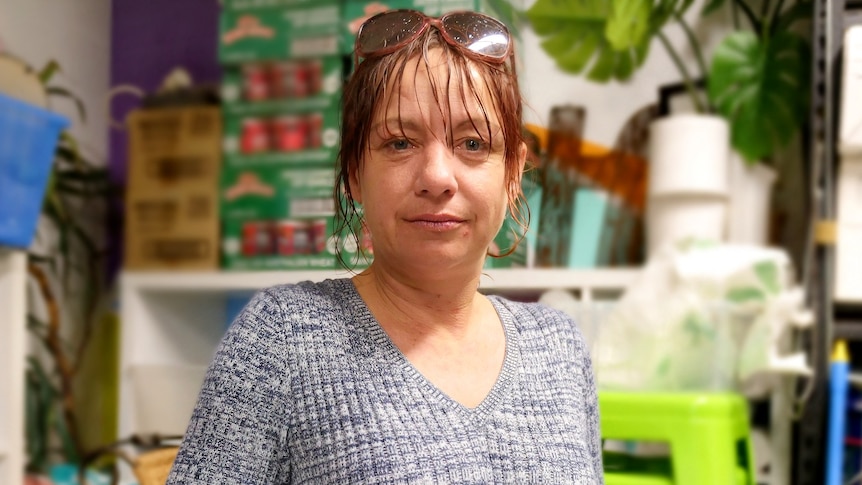
As wet weather lashes Perth’s southern regions Kirsty Buchanan is spending her nights on the cold, rainy, streets of Mandurah — one of many in the Western Australian seaside city doing it tough.
Key points:
Almost a quarter of people without a home in Mandurah are sleeping on the street or in improvised dwellings
Support workers say there’s support for people doing it tough, but not enough services to get the long-term homeless off the streets
Families and pensioners are also reaching out to food kitchens amid the rising cost of living
Mental health issues, brought on by family tragedies, prompted Ms Buchanan to leave her home of 26 years and her stable job when her life took a turn.
“I just ended up with nowhere to stay,” she said.
“I’m on the priority list [for housing]. I have been about eight months.”
She has relied on homeless support services for food, dry clothes, and sleeping bags during the harsh winter.
“Being winter, this week out of all the weeks has been the coldest. [It’s] cold. But it’s the boredom as well,” she said.
She is not the only one struggling.
Timothy Tonkin spent six years living on the streets in the Peel region and now shared a motorhome with his friend while he tried to find a house and a job.
Timothy Tonkin is living in a van and struggling to find work, and says the cost of living has hit him hard.(ABC Radio Perth: Jacqueline Lynch)
“We’re actually arguing now as we speak because of the cost of living, the cost of everything. I haven’t got a cent to my name and neither does she,” he said.
“I would love to go back to work but work is hard to find in my situation – no license and no proper qualifications.
“It’s not easy living day-to-day.”
Unemployment high and many sleeping rough
A recent Deloitte Access Economics report, adopted by the City of Mandurah, outlined unemployment rates in Mandurah as “stubbornly higher” than Perth with a “nationally significant” level of people dependent on rent assistance payments.
Community organizations are playing a big role in helping the homeless.(ABC Radio Perth: Jacqueline Lynch)
It also highlighted a great deal of housing stress among residents, high illicit drug use, and a rising number of people living with mental health issues in the city.
The local council has vowed to look at what can be done to address the issues.
Meanwhile, a recent University of WA Center for Social Impact report found while the rate of homelessness in Mandurah was lower than other parts of Western Australia, the region had the highest proportion of homeless people sleeping rough in the state.
It showed that almost 25 per cent of those without a home were staying on the street or in improvised dwellings as opposed to staying with friends or in crowded houses.
More broadly, the UWA report highlighted a 39 per cent increase in the number of people accessing government-funded homeless services over the past five years in Western Australia.
Significantly, it outlined an over-representation of Aboriginal and Torres Strait Islander people among the state’s homeless population.
‘We’re all struggling to eat’
Vanessa Nelson is a proud Whadjuk Ballardong Bibbullmun woman who spent years on the streets.
She secured a house in Mandurah earlier this year but said her struggle was not over.
Vanessa Nelson struggles to pay bills and fill her refrigerator, but her greatest worry is for others.(ABC Radio Perth: Jacqueline Lynch)
“I’m empty, I have got a loaf of bread, no butter … my cupboard’s empty,” she said.
“I come down to the soup kitchen along with many other family members and non-family members. We’re all in the same boat.
“We’re all suffering, we’re all struggling to eat. We’re all struggling to pay our bills. We are not getting jobs and we are not moving forward,” she said.
But her concern was not for herself, it was for others.
“I sit and I worry every day for the hundreds and thousands of people who are still out there that are living rough, living cold, living sick,” she said.
Fed for free but no place to sleep
There are many community-led organizations, businesses, and individuals lending a hand in Mandurah.
As a city also harboring great wealth, coordinator of the Peel Community Kitchen, Tracey Bain, said there was a drive within the community to help the homeless.
“[The wealthy] donate clothes, a lot of come in and donate money at tax time. So I think there wouldn’t be so much help for the homeless if there wasn’t that much wealth here,” Ms Bain said.
Tracey Bain said there was plenty of support for the homeless, but a lack of services to help them transition into stable housing.(ABC Radio Perth: Jacqueline Lynch)
But she said the city lacked what was needed to help combat long-term homelessness, such as affordable housing, more mental health services, and support to help people break drug and alcohol addictions.
“In Mandurah you can get fed every day of the week for free, you can get clothes, you can get shower. The only place it doesn’t offer is somewhere to live,” she said.
“I have been here eight years and I’m still seeing the same people on the streets that were on the streets eight years ago.”
Advocates say housing the key
The state government is set to spend more than $28 million setting up a Common Ground-supported housing facility in Mandurah which will provide up to 50 self-contained apartments and wraparound support to rough sleepers.
But the site is not expected to open to residents until 2024.
Ms Bain said the facility was a step in the right direction.
The CEO of Halo, Dee Freitag, agreed to housing in Mandurah was a key issue that needed to be addressed.
Halo provides food, clothing, household items, furniture, transitional accommodation, and outreach support assisting with welfare services.
Halo CEO Dee Freitag said a lack of housing was a key problem in Mandurah that needed to be addressed. (ABC Radio Perth: Jacqueline Lynch)
Ms Freitag said the rental crisis in Western Australia had prompted an increasing number of new people to reach out for help.
“We are also seeing a lot of families because of the housing crisis … and the elderly,” she said.
“We are seeing a major increase in people who are not eating because they’re trying to keep a roof over their head.
“And then there are the ones, in this bucketing down rain, who are sleeping on pathways and verandahs because they don’t have cars.”
Whether it be social housing or private rentals, Ms Freitag said any offering would be welcome to get people off the streets.
“Any house that goes up for rent is a bonus,” she said.