Woolworths has released a new ultra rare Fix-Em for fans to collect – and it just might make you a fortune.
The Infinity Gauntlet, a favorite for fans of Disney’s Marvel franchise, is a special extra Woolies Fix-Em that has been in circulation.
Woolworths has released just 200 of this exclusive Fix-Em in stores across Australia.
For more Lifestyle related news and videos check out Lifestyle >>
But with the promotion due to end on August 9 – or while stocks last – fans have a short amount of time to score an Infinity Gauntlet for their collection.
“Since launching Fix-Ems earlier this month, we’ve been inspired and impressed by the creativity of our customers who are giving their everyday belongings a bit of extra flair with Fix-Ems,” Woolworths Senior Manager Continuity and Collectibles Paul Stibbard said.
Woolworths has released this ultra rare Infinity Gauntlet Fix-em. Credit: Supplied
“As we begin to see many customers complete their collection, there are still dozens of ultra rare Fix-Ems in circulation waiting to be collected.
“We encourage collectors to double check their collection in case they have unknowingly already collected the ultra rare Infinity Gauntlet, and look forward to seeing even more creative ways our customers are using their Fix-Ems.”
In past supermarket promotions, fans have paid tens of thousands of dollars for ultra rare collectables.
One fan bid $100k for an ultra rare Furry Simba Ooshie during Woolworths’ 2019 Lion King Ooshie promotion.
In 2020, another ultra rare furry The Child Disney+ Ooshie also sold for $100k.
Other rare collectables have sold for tens of thousands of dollars on eBay and other buy, swap and sell sites.
The new Woolworths Fix-Ems. Credit: Supplied
Woolies shoppers can collect Disney, Pixar, Marvel and Star Wars Fix-Ems when they spent $30 in store on online*.
New to the Australian market, Fix-Ems are reusable woven patches that can be adhered to a vast range of surfaces or permanently ironed onto some fabrics for a longer lasting design.
The Fix-Ems, created in partnership with Disney, are made from at least 80 percent recycled material and Good Environmental Choice Australia (GECA) certified.
Woolworths Fix-Ems are available to collect in stores and online until Tuesday 9 August, or while stock lasts.
* For full Fix-Ems Terms and Conditions, head here.
Police are investigating an unprovoked attack at a McDonald’s restaurant in Melbourne’s northwest that has resulted in the victim requiring reconstructive surgery to his face.
It’s understood a 49-year-old Keilor man was on the patio area outside the Keilor Park Drive McDonald’s outlet just after midnight on the morning of July 8.
The Keilor Park Drive McDonald’s outlet. Credit: Google Maps
Watch the latest News on Channel 7 or stream for free on 7plus >>
Two men who were exiting the restaurant walked past the man, before one of them returned to confront the 49-year-old.
The unknown man, without provocation, then struck the victim in the face, causing him to lose consciousness.
The victim suffered a shattered cheek that required reconstructive surgery.
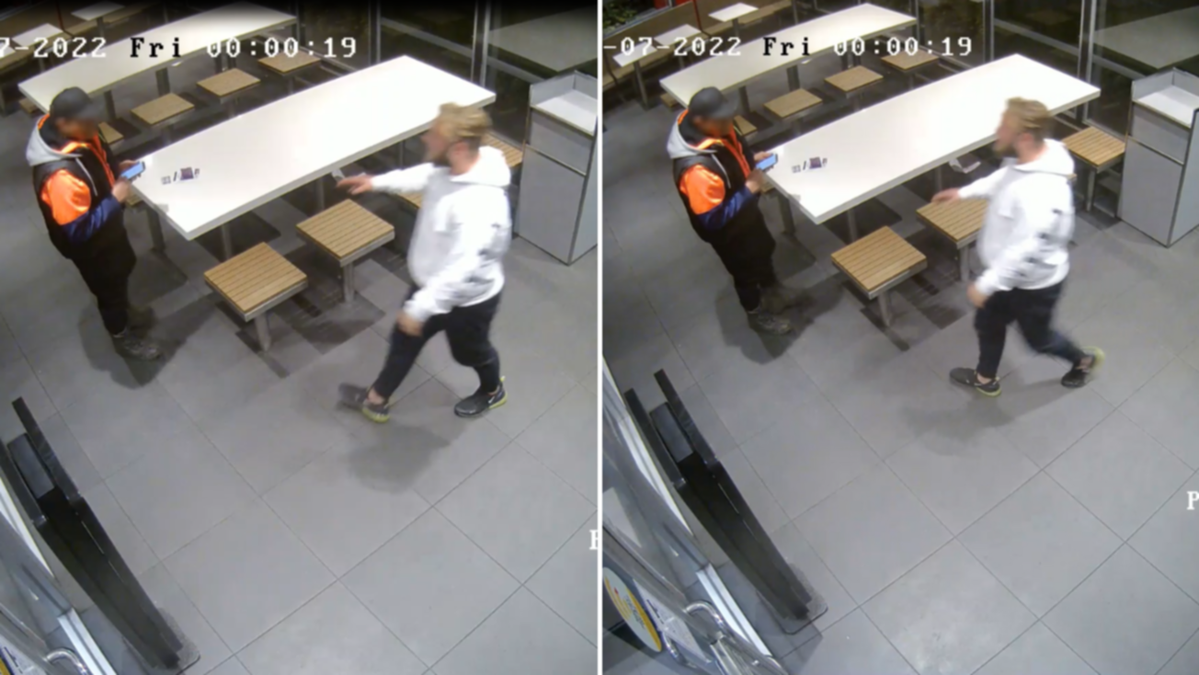
The man police believe may be able to assist with their enquiries. Credit: Victoria PoliceThe man is seen on CCTV approaching the victim without any provocation. Credit: Victoria Police
Police have released an image and CCTV footage of a man who they believe may be able to assist with their enquiries.
He is described as Caucasian in appearance, with light brown hair and a beard, and was wearing a white hoodie and black pants.
Anyone who witnessed the incident or has information is urged to contact Crime Stoppers on 1800 333 000 or submit a confidential report online at www.crimestoppersvic.com.au.
WASHINGTON — A Donald Trump fan from Texas who attempted to storm the US Capitol while armed with a gun was sentenced to more than 7 years in prisonon Monday after a judge denied the Justice Department’s request for a “terrorism enhancement” that would have resulted in a lengthier prison sentence.
Guy Reffitt was the first Jan. 6 defendant to go to trial. Reffitt’s own son actually tipped off the FBI a couple of weeks before Jan. 6 but didn’t hear back until after the attack. The government had an enormous amount of evidence against Reffitt, including his friend’s testimony that Reffitt was carrying zip ties and that the duo had made a decision to carry guns because they’d rather be “tried by a jury of twelve than carried by six. “
Reffitt was convicted on five counts in March, including transport of a firearm in support of civil disorder and obstruction of an official proceeding, although he did not make it inside the Capitol or use physical violence because he was eventually incapacitated after charging the police line.
In court Monday, Reffitt described himself as “af**king idiot” and was “not thinking clearly” when he tried to storm the US Capitol.
“I clearly f**ked up,” Reffitt said.
“I did want to definitely make an apology, multiple apologies really, and accept my responsibility because I do hate what I did,” he said.
Reffitt, who was a member of the Texas III%ers, told the judge that he no longer want to associate with militia groups or “or any stupid s**t like that.”
Judge Dabney L. Friedrich, a Trump appointee and a former member of the US Sentencing Commission, said that giving Reffitt a sentencing enhancement for carrying a gun during the commission of a crime and for committing a crime of domestic terrorism would create a sentencing disparity with other Jan. 6 defendants.
“There are a lot of cases where defendants committed very violent assaults and even possessed weapons… that did not receive this departure,” Freidrich said.
Prosecutors had argued that the upward departure for terrorism was warranted because Reffitt was “planning to overtake our government.”
“He wasn’t done,” Assistant US Attorney Jeffrey Nestler said. “January 6 was the preface.”
“We do believe that what he was doing that day was terrorism, we do believe he is a domestic terrorist,” Nestler continued.
Reffitt wore a camera on his body that recorded his violent rhetoric during the Trump rally that preceded the riot.
Guy Reffitt at the Capitol on Jan. 6, 2021.US District Court for DC
“I’m taking the Capitol with everybody f**king else,” Guy Reffitt said in his own recording, as “Tiny Dancer” played at Trump’s Jan. 6 rally. “We’re all going to drag them motherf**kers out kicking and screaming, I don’t give as**t. I just want to see Pelosi’s head hit every f**king stair on the way out, and Mitch McConnell too, f**k ’em all… It’s time to take our country back… I think we have the numbers to make it happen.”
He also recorded a Zoom meeting on his computer where he talked extensively about his actions on Jan. 6.
Nestler argued that Reffitt “is in a class all by himself,” but Freidrich said she was “not so sure I agree with the government on that” given how many other Jan. 6 defendants said similar things.
“This defendant has some frightening claims that border on delusional, and they are extraordinarily concerning for the court,” Freidrich said. “But other defendants did too. That’s the point I’m trying to make.”
Under Friedrich’s rulings, without the sentencing enhancements, Reffitt’s sentence guidelines were 87 to 108 months in federal prison.
Prosecutors argued during his trial in March that Reffitt “lit the match“ on the west side of the Capitol on Jan. 6, leading the mob up towards the Capitol building where rioters broke in.
“He was ecstatic about what he did, about what the mob did,” a federal prosecutor told jurors. “Back home in Texas, I thought I’ve gotten away with it.”
In court on Monday, Assistant US Attorney Risa Berkower read a brief letter from Reffitt’s son Jackson Reffitt, who testified against his father. He wanted mental health treatment to be part of his father’s sentence from him.
“My father has lost himself to countless things,” Jackson Reffitt wrote. “The prison system should be used not to destroy a person, but to rehabilitate one.”
Former US Capitol Police Officer Shauni Kerkhoff also delivered a victim impact statement, asking for the maximum sentence for Reffitt because of his lack of remorse, his pride in his actions and the turmoil he caused.
“His actions weren’t acts of patriotism, they were acts of domestic terrorism,” Kerkhoff said.
Peyton Reffitt, one of Guy Reffitt’s daughters, said her father was not a threat and that his mental health was “a real issue.” She had a hard time making it through some of her statement because she was overcome with emotion, and her father was visibly crying.
Reffitt’s daughter had previously written a letter to the judge that it was “enormously embarrassing” that her father — like a lot of “middle-aged white men” — was sucked in by Trump and that her dad “fell to his knees when President Trump spoke.”
“President Trump deceived my father and many other normal citizens with families to believe that this past election was fraudulent,” the 18-year-old wrote in her letter.
She argued Monday that her father did not play a leadership role on Jan. 6.
“My father’s name wasn’t on all the flags that were there that day, that everyone was carrying,” she said in court. “It was another man’s name.”
Rice University’s open-source VegSense app allows researchers to gather field data about understory vegetation as they walk and look at vegetation using Microsoft’s HoloLens headset. This split-screen image shows what VegSense creator Daniel Gorczynski sees through the headset (top) while he walks and looks at vegetation beneath trees on Rice’s campus (bottom). Credit: Brandon Martin/Rice University
Rice researchers set up a Microsoft HoloLens as a mixed-reality sensor to feed VegSense, their application to measure understory vegetation, plant life that grows between the forest canopy and floor.
A proof-of-concept study by graduate student Daniel Gorczynski and bioscientist Lydia Beaudrot shows VegSense could be a suitable alternative to traditional classical field measurements at a low cost.
Their study in Methods in Ecology and Evolution shows the hardware-software combination excels at quantifying relatively mature trees in the wild, which is one measure of a forest’s overall health.
Gorczynski came up with the idea to try HoloLens, commonly marketed as a productivity tool for manufacturing, health care and education. I have developed the open-source software for the device and noted that while the combination is less effective at picking up saplings and small branches, there’s ample room for improvement.
Gorczynski said he was introduced to mixed-reality sensing while an undergraduate at Vanderbilt University and recognized its potential for biological studies. “It seemed sort of like a natural fit,” he said. Gorczynski brought the idea to Beaudrot in 2019 shortly after his arrival at Rice.
The combination of stock hardware and custom software cost far less than systems based on lidar (for “light detection and ranging”) most often used in three-dimensional field studies, said Gorczynski, who developed VegSense on a platform geared more toward 3D games and interactive experiences than hard science.
Credit: Rice University
Field tests at Houston’s Memorial Park showed that at least for mature trees, the smaller solution is just as good. In their case study, VegSense easily detected 48 of 50 such trees in the target area, a circle about 30 feet in diameter that Gorczynski walked, looking up, down and around to build the 3D database. (“Imagine an asterisk with a circle around it,” he said, describing the data-capture pattern.)
“For this study, we wanted to be really deliberate in trying to replicate more traditional understory vegetation structure measurements,” Gorczynski said. “We tried to get that level of detail.”
What he sees as he scans the environment is a holograph-like grid pattern that tracks the surfaces of vegetation. “What’s really cool about that is you can see what the scanner is picking up, but also the spots you missed,” Gorczynski said. “The idea is to get the mesh to cover as much of the vegetation as possible because that’s what gets you the best scan.”
Rice University’s open-source VegSense app for the Microsoft HoloLens headset allows researchers to record data about vegetation they see as they walk through a field site and create downloadable files for later analysis. Credit: Brandon Martin/Rice University
“The results were so nice that Dan quickly wrote it up for publication,” Beaudrot said, noting that Gorczynski expanded his validation of the gear during a subsequent field trip to Tanzania, the focus of one of 15 tropical forests in a recent rainforest study by the Rice group.
“This device can facilitate a lot of great ecological research, particularly because it’s so cost-effective,” she said. “Collecting vegetation information on the forest floor right now is really hard to do without a lot of manual labor, or a really expensive lidar system.”
“So this is a groundbreaking, cost-effective device,” Beaudrot said. “It’s not going to give you the same resolution data that lidar will, but this is just the first application. We hope making VegSense open-source to the ecological research community will spur all the potential ways it can be developed.”
National parks preserve more than species
More information:
Daniel Gorczynski et al, Measuring understorey vegetation structure using a novel mixed‐reality device, Methods in Ecology and Evolution (2022). DOI: 10.1111/2041-210X.13927
Provided by Rice University
citation: VegSense makes sense for forest studies (2022, August 1) retrieved 1 August 2022 from https://phys.org/news/2022-08-vegsense-forest.html
This document is subject to copyright. Apart from any fair dealing for the purpose of private study or research, no part may be reproduced without the written permission. The content is provided for information purposes only.
Hunter Moore is a 36-year-old convicted criminal who was born and raised in Woodland, California. Per The New Yorkerhe was expelled from his school during his adolescence.
In 2010, he started a website named isanyoneup.com which he claimed was intended to cover nightlife culture. But things changed when he and his friends received explicit images of the woman they were dating. Moore began uploading some of these images to the site along with links to the women’s social media profiles, though these women claimed that they had never consented to their images being used, with some even claiming the photos had been hacked from their personal computers, per rolling Stone. The publication coined Moore as ‘The most hated man on the internet’.
At the height of its infamy, Moore claimed the site was garnering more than 30 million page views monthly, but it would soon come crashing down.
Was Hunter Moore convicted?
Moore was at the center of an FBI investigation when Charlotte Laws, the mother of a woman whose images were posted to the website, compiled evidence from more than 40 other victims. She gave her research to the FBI, and in 2014, Moore was indicted in a federal court in California on charges of conspiracy, unauthorized access to a protected computer.
He was released on a $100,000 bond two days later, but a year later iIn 2015, I pleaded guilty to aggravated identity theft and aiding and abetting in the unauthorized access of a computer.
He was sentenced to two and a half years in federal prison, followed by three years of supervised release. He was also ordered to undergo a mental health evaluation while he was in prison along with a $2000 fine and a restitution fee of $145.70.
Charlotte Laws in ‘The Most Hated Man On The Internet’.
Netflix
Where is Hunter Moore now?
Moore was released from prison in 2017 and has since kept his movements largely under the radar. He was also banned from Facebook after his crimes were revealed, though he had an active Twitter account until recently. It appears the account has now been suspended by the social media giant.
Per good to know, Moore posted predominantly images from the gym and of his dog. I have also Tweeted in 2021, “You know my name not my story. You’ve heard what I’ve done, Not what I’ve been through.”
In 2022, he Tweeted: “Look guys, I did my time behind bars. Living my life peacefully now, it’s been a decade about what happened. Some of you loves me, most of you hates me, if you want me to apologize well I wouldn’t. I don’t owe anyone anything.”
What happened to isanyoneup.com?
IsAnyoneUp.com was taken down in 2012 and was redirected to an anti-bullying website belonging to activist James McGibney. The site is now McGibney’s personal web page.
After getting pummeled by multiple consecutive days of 90 degrees or higher that had climbed into the triple digits in some cities, the Pacific Northwest is expected to gain some relief this week before temperatures rise again this weekend, forecasters said.
In Portland, Ore., a heat wave has lasted for a week, with a record high for the day set on July 26 at 102 degrees, said Lisa Kriederman, a meteorologist with the National Weather Service in Portland.
Sunday was the seventh consecutive day in Portland in which temperatures reached 95 degrees or higher, breaking the previous record of six days in a row. Temperatures have been 90 or greater for eight days in a row, still below the record of 10 days set in 2009.
Temperatures in Portland have also not yet reached the record set last summer of 116 degrees, but this recent heat wave has lasted longer. Cool air from the coast is keeping the moisture levels higher, causing temperatures not to rise as much. That is compared with last year when the air was coming to Portland from the drier Central Oregon area, Ms. Kriederman said.
“This one isn’t getting as hot but the above-average temperatures are lasting longer,” she said.
The area is expected to cool down through Thursday, and then warm up again on Friday and through the weekend, Ms. Kriederman said. The high temperature is expected to be 87 degrees on Tuesday, 86 on Wednesday, 78 on Thursday, and 83 on Friday, according to the National Weather Service.
Read More About Extreme Weather
Last month was the fourth-warmest July on record in Portland at 73.7 degrees, measured by average temperature. The average maximum high was 85.7 and the average minimum temperature was 61.8, which was the highest on record, Ms. Kriederman said.
The Multnomah County Medical Examiner said on Sunday that it was investigating two additional deaths suspected to be associated with the heat wave, bringing the total number of heat-related deaths to five. The Clackamas County Medical Examiner’s Office said on Saturday that it was investigating the death of an older man that was potentially linked to the heat.
About 200 miles east of Portland, in Pendleton, Ore., the temperature reached 111 degrees on Friday, said Larry Nierenberg, a meteorologist with the National Weather Service in Pendleton. Through Sunday, Pendleton recorded seven days of temperatures at or above 100 degrees, he said.
Smoke from the McKinney fire in Northern California caused temperatures in Pendleton to drop from 110 degrees on Saturday to 101 on Sunday. Smoke from wildfires acts like clouds, preventing the sun from coming through for a few hours, Mr. Nierenberg said.
The cities of Kennewick, Pasco, Richland and West Richland in southeast Washington had similar patterns, with a high of 112 on Friday. Temperatures have reached 100 or more on eight consecutive days. This area remained under an excessive heat warning as of Monday afternoon.
During the past week, Pendleton and southeastern Washington as a whole were about 10 to 20 degrees above the normal average, which is in the low 90s for Pendleton and slightly higher in the cities, Mr. Nierenberg said.
In eastern Washington and the Idaho Panhandle, average temperatures in July were not record-setting, said Daniel Butler, a National Weather Service meteorologist in Spokane, Wash.
But there were four days in a row where the maximum temperature reached or exceeded 100 degrees in Spokane, he said. The record for consecutive days of temperatures of 100 degrees or more — six — was set in 1928.
While the recent heat wave has not brought the hottest days on record, the heat has lasted longer, Mr. Butler said.
“It’s been pretty impressive — the longevity of this event,” he said.
Xenoblade Chronicles 3, the latest entry in the Xenoblade series, is finally here, and that means there is a mountain of new RPG systems to master. One of the systems in Xenoblade Chronicles 3 is the Gem system, which allows you to craft items that give characters boosts in battle. These gems take the place of most regular equipment and weapons that would be present in other RPGs. Here is everything you need to know about the Gems in Xenoblade Chronicles 3.
How Gems work in Xenoblade Chronicles 3
Crafting Gems with Riku is introduced in chapter 2 of Xenoblade Chronicles 3, at which point each character has one gem slot. A second slot is unlocked at level 20 and a third unlocked at level 30. Gems can be crafted at most campsites in the wilderness. Gems are divided into four categories; Defender, Attacker, Healer, and Specialty, with five gems in each category.
Size:
Want us to remember this setting for all your devices?
Sign up or Sign in now!
Please use a html5 video capable browser to watch videos.
This video has an invalid file format.
Sorry, but you can’t access this content!
Please enter your date of birth to view this video
By clicking ‘enter’, you agree to GameSpot’s
Terms of Use and Privacy Policy
NowPlaying: Xenoblade Chronicles 3 Video Review
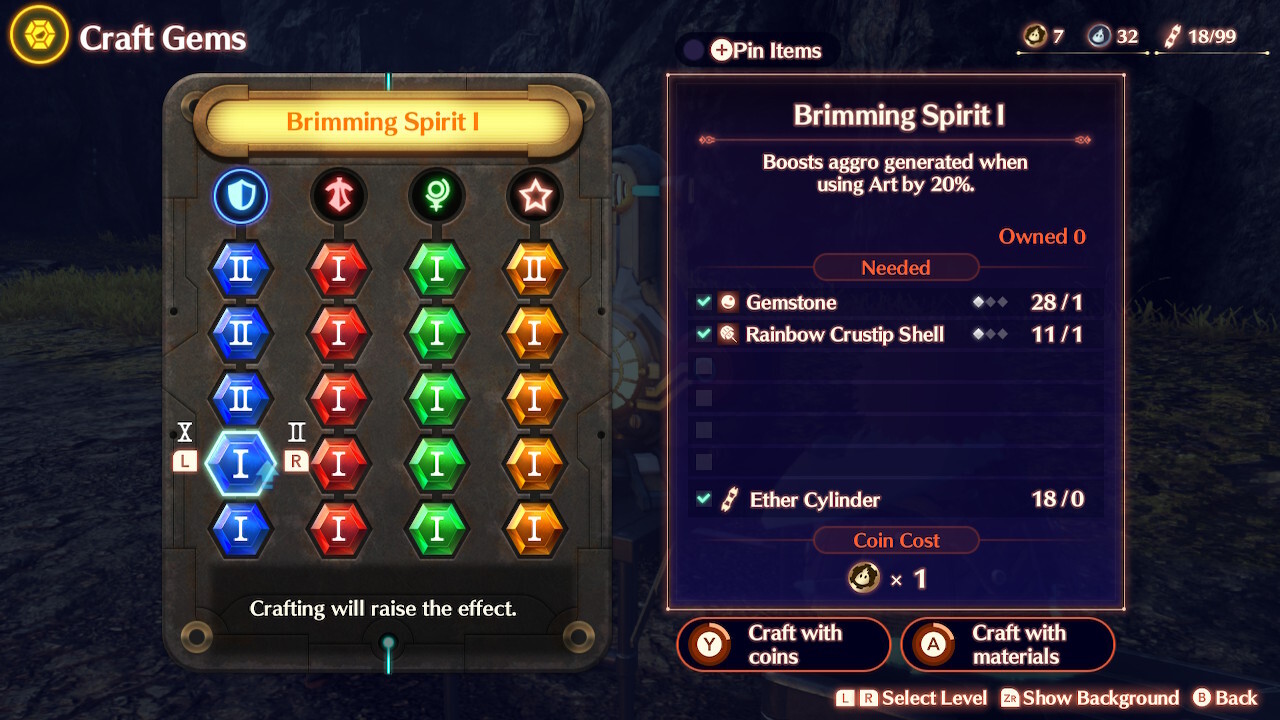
Each gem can be upgraded up to level 10. Crafting or upgrading a gem will take a gemstone, a variety of random crafting materials found throughout the world, and an Ether Cylinder after level 1. You can pin a Gem’s crafting materials from the crafting menu , but finding specific items in the open-world has an element of chance, so you’re better off picking up as many materials as you can while exploring.
You can also bypass the required materials using Gold Nopon coins, although the required amount increases dramatically each level. If you are really struggling to find specific materials, you should use Nopon coins to bypass the requirements, as the needed materials change each upgrade level. It’s important to note that a single Gem can be equipped by multiple characters. That means every member of your party could have the same gem equipped if you wanted.
Every gem in Xenoblade Chronicles 3
The Gem crafting menu in Xenoblade Chronicles 3.
Here is the complete list of gems available in Xenoblade Chronicles 3, along with their level 1 stats.
Defend
Tailwind: Increases Agility by 10
Steel Protection: Increases Block Rate by 5%
Ultimate Counter: Deals 80% of Attack damage when you take damage
Brimming Spirit: Boosts aggro generated when using Art by 20%
Perilous Presence: Start each battle with aggro
Attacker
Steelcleaver: Increases Attack by 20
Accurate Grace: Increases Dexterity by 20
Analyze Weakness: Increases critical hit damage bonus by 20%
Swelling Scourge: Boosts power of debuffs applied to enemies by 25%
Refined Incantation: Extends duration of timers of debuffs applied to enemies by 25%
healer
Lifebearer: Increases Healing by 20
Soothing Breath: When helping an incapacitated ally, revives them with 20% more HP; also raises Healing by 5
Lifesaving Expertise: Boosts speed of ally revival by 20% and raises Healing by 5.
Swelling Blessing: Boosts power of buff effects issued by self by 25%
Refined Blessing: Extends duration of buff effects issued by self by 25%
specialty
Ironclad: Raises maximum HP by 100
Steady Striker: Shortens auto-attack interval by 15%
Doublestrike: Adds 15% chance to strike twice per auto-attack
Empowered Combo: When canceling, boosts damage dealt by 25%
Disperse Bloodlust: Reduces aggro generated when using Art by 20%
GameSpot may get a commission from retail offers.
The products discussed here were independently chosen by our editors. GameSpot may get a share of the revenue if you buy anything featured on our site.
In her 51 years, My Unorthodox Life star Julia Haart has lived a big life. But for the majority of her years, she had no control over her de ella—what she ate, what she thought, what she wore and what she was allowed to do in a day was regulated by a strict religious code.
After emigrating from Russia to America with her family, Julia’s parents settled in Monsey, New York. They soon decided to join an ultra-Orthodox Jewish community in Monsey that practiced Haredi Judaism – a branch of Judaism known for its religious conservatism and social seclusion.
From a very young age to her early 40s, Julia was part of this community. And initially, it was something she was comfortable with.
While she loved being Jewish, it was the fundamentalist lifestyle that Julia couldn’t accept – a world where she says little boys were taught to thank God every morning “for not making me a woman.”
When we think about New York, visions of Sex and the City, progressive politics and a 21st Century life come to mind. But in Monsey, particularly the community Julia was a part of, this was far from reality.
“Go back a couple of hundred years and the life women lived in the 1800s is exactly the life I lived in Monsey. Women are not educated, they’re married off and they’re told they are inferior to men,” Julia said to Mia Freedman on Mamamia‘s No Filter.
Listen to No Filter with Julia Haart. Post continues after audio.
She was taught that all non-Jewish people or irreligious Jewish people were dangerous. Her community of her and its people of her were the ‘chosen ones’. Everyone else was not. And ever so slowly, her world was shrinking-and so was her autonomy, particularly due to her gender.
From a young age, Julia was taught that if any part of her body was uncovered in public, she would go to a “special kind of hell” reserved for just her and her mother. It was a confronting ‘cautionary tale’ to have drummed into you as a child.
“That’s the danger of when people are taking away rights – you don’t even realize because it’s so gradual. It started with, ‘okay Julia we’re going to keep kosher’. That very basically means you can’t eat at your friend’s houses anymore and can only eat certain foods, and have to eat in a certain way. Then it was ‘okay Julia, you can’t wear shorts anymore’. ‘You can’t dance in public anymore’. cover yourself head to toe’. And before you realise, your world has shrunk.”
By the age of 19, she was forced into an arranged marriage. Her first husband was Yosef Hendler, and together they had four children. She practically knew nothing about him prior to walking down the aisle. Julia also never had access to a proper education – the thought among the community was simply: “why do you need to educate women if their only purpose is to do what their husband says and have babies?”
Annemiek van Vleuten soars to the Tour de France Femmes victory on La Super Planche des Belles Filles (Image credit: Getty Images Sports)
picture 1 of 41
Annemiek van Vleuten soars to the Tour de France Femmes victory (Image credit: Getty Images Sports)
picture 1 of 41
Second overall and the mountains jersey was a victory for Demi Vollering (Image credit: Getty Images Sports)
picture 1 of 41
Annemiek van Vleuten soars to the Tour de France Femmes victory (Image credit: Getty Images Sports)
picture 1 of 41
Annemiek van Vleuten (Movistar) in the Tour de France Femmes leader’s jersey (Image credit: Getty Images Sports)
picture 1 of 41
Annemiek van Vleuten takes photos with her teammates before the final Tour de France Femmes stage (Image credit: Getty Images Sports)
picture 1 of 41
The classification leaders: Demi Vollering, Annemiek van Vleuten, Marianne Vos and Shirini Van Anrooij take a selfie at the start (Image credit: Getty Images Sports)
picture 1 of 41
Marianne Vos wearing the points classification jersey (Image credit: Getty Images Sports)
picture 1 of 41
Stage 8 of the Tour de France Women (Image credit: Getty Images Sports)
picture 1 of 41
Stage 8 of the Tour de France Women (Image credit: Getty Images Sports)
picture 1 of 41
Victoire Berteau (Cofidis) on the attack (Image credit: Getty Images Sports)
picture 1 of 41
Ane Santesteban (BikeExchange) in the breakaway (Image credit: Getty Images Sports)
Anya Louw and Ilse Pluimers make it to the end (Image credit: Getty Images Sports)
picture 1 of 41
Valentine Fortin (Cofidis) elated at the finish (Image credit: Getty Images Sports)
picture 1 of 41
Maria Giulia Confalonieri and Kathrin Schweinberger (Ceratizit-WNT) (Image credit: Getty Images Sports)
picture 1 of 41
Cecilie Uttrup Ludwig (FDJ-SUEZ Futuroscope) (Image credit: Getty Images Sports)
picture 1 of 41
Van Vleuten celebrates with her partner (Image credit: Getty Images Sports)
picture 1 of 41
Annemiek Van Vleuten (Movistar Team) the overall winner (Image credit: Getty Images Sports)
picture 1 of 41
Marianne Vos won the points classification (Image credit: Getty Images Sports)
picture 1 of 41
Annemiek van Vleuten, the winner of the Tour de France Femmes (Image credit: Getty Images Sports)
picture 1 of 41
The jersey winners: Vos, Van Vleuten Van Anrooij and Vollering – all Dutch (Image credit: Getty Images Sports)
picture 1 of 41
Mavi Garcia won the most combative rider of the Tour prize (Image credit: Getty Images Sports)
picture 1 of 41
Canyon-SRAM were the best overall team (Image credit: Getty Images Sports)
picture 1 of 41
Shirin van Anrooij was the best young rider (Image credit: Getty Images Sports)
picture 1 of 41
Vollering, Van Vleuten and Niewiadoma were the top three overall (Image credit: Getty Images Sports)
picture 1 of 41
Annemiek van Vleuten (Movistar) etched her name into history as the winner of the first Tour de France Femmes avec Zwift, sealing the stage victory on La Super Planche des Belles Filles.
After Van Vleuten’s dominant performance on stage 7 where she gained over three minutes on Demi Vollering (SD Worx), the margins were much closer in the grand finale as riders emptied their tanks on the brutally steep final ascent.
In a near repeat of Saturday’s mountain showdown, Vollering was Van Vleuten’s closest competitor, taking second on the stage 30 seconds behind to secure the runner-up position on the podium. Silvia Persico (Valcar Travel & Service) led Kasia Niewiadoma (Canyon-SRAM) to the finish for third.
The Pole held onto third place in the final standings after finishing fourth on the stage at 1:52.
Van Vleuten came under pressure mid-stage, having to chase back from multiple bike changes ahead of, and on, the category-1 climb of the Ballon d’Alsace. On the descent, she struggled to withstand another downhill attack from Vollering.
But when the road tilted up into the brutally steep pitches on La Super Planche des Belles Filles, Van Vleuten’s climbing prowess propelled her up and away from all of her rivals.
After nearly dropping out due to illness in the opening stages, the Dutch phenom launched her second solo attack of the Tour with 6km to go and passed all nine of the breakaway riders who had escaped midway through the 123.3-kilometre stage, with Mavi Garcia ( UAE Team ADQ) the last to let go as the jersey jaune danced away to another solo victory.
“It’s actually a dream that comes true – winning in yellow at the top. It was not an easy stage, it was not an easy week. It was a super big rollercoaster for me. To finish in yellow solo – the best way,” Van Vleuten said.
“I’m super proud to be the first winner of the TDF for the women. To have it back on the calendar and be the first woman to win it in this new version – I hope it’s a big start and we can build this into a bigger event for the women. It’s a milestone to win this first one.”
how it unfolded
As was the case on stage 7, it was another fast and furious start, with no breakaway managing to form on the flat opening roads. With 50km before the first climb, the peloton, led largely by FDJ SUEZ Futuroscope, barreled along at more than 40km/h.
Maria Giulia Confalonieri (Ceratizit-WNT) nipped away to take the intermediate sprint after 47.4 kilometres, just ahead of the first categorized climb, where the race would finally break open. The Côte, d’Esmoulières was only short, at 2.3km, but the vicious 8.5% gradients helped open some cracks among the bunch.
Rachel Neylan (Cofidis) kicked off the hostilities, but Vollering soon hit out and led the race over the summit, extending her lead in the mountains classification by five points. The polka-dot jersey wearer soon settled back into the fold but the subsequent uncategorized drag uphill was the cue for others to force a breakaway.
Soon, a group of 10 riders went clear, including the Canyon-Sram duo of Elise Chabbey and Pauliena Rooijakkers (Canyon-Sram), plus Leah Thomas (Trek-Segafredo), Paula Patiño (Movistar), Grace Brown (FDJ Suez Futuroscope) , Riejanne Markus (Jumbo-Visma), Liane Lippert (Team DSM), Mavi Garcia (UAE Team ADQ), Yara Kastelijn (Plantur-Pura), Coralie Demay (St Michel Auber 93). The best-placed riders on GC were Garcia, 9th overall at 12:06, and Chabbey, 10th overall at 12:26.
As the yellow jersey group eased and allowed a group containing green jersey Marianne Vos to return, more riders sensed it was now or never. Victoire Berteau (Cofidis) attacked and was joined in a. Chasing quartet by Ane Santesteban (BikeExchange-Jayco), Jeanne Korevaar (Liv Racing Xstra) and Antri Christoforou (Human Powered Health).
There were two more in Christine Majerus (SD Worx) and Mie Bjørndal Ottestad (Uno-X) but suddenly things all changed as drama struck and Van Vleuten was forced into panic mode. On the downhill following the drag, with 60km to go, Van Vleuten had a mechanical and stopped to change bikes with teammate Arlenis Sierra.
As she made her way back towards the bottom, the peloton started to split as both SD Worx and Trek-Segafredo put the hammer down. Van Vleuten stitched her way back onto a group but it was soon well behind the main bunch. At that point Majerus was called back to try and turn the screw on the yellow jersey.
Van Vleuten burned through two teammates in Sheyla Gutierrez and Aude Biannic in a panicked chase, before taking matters into her own hands and blasting her way back into the GC group on the lower slopes of the Ballon d’Alsace – all on a bike that was too big for her. Once back, she stopped again to get her own bike back, but it was an all-yellow spare, and not the one she started on. So after a few more kilometers she had to stop for a third bike change, to get back on the original bike that had apparently been repaired.
After battling her way back to the group for a fourth time, Van Vleuten calmly made her way up the cat-1 climb in the thinning GC group, where Vollering launched a volley of accelerations to reduce it to 17 riders by the summit.
At the top, Garcia, who set pace in the breakaway for much of the climb, led the race over the Ballon d’Alsace with 38.5km to go. Santesteban and Christoforou had been dropped but there was another member in Krista Doebel-Hickock (EF), who’d bridged across earlier on the climb. Vollering led the GC group over at 1:10.
Vollering continued her effort on the descent and, like on stage 7, succeeded in briefly dropping Van Vleuten, who was kept under constant pressure. With 15km in the valley, things soon settled down and the breakaway continued with a lead of 1:30 over a swelled GC group.
The breakaway games began on the flat with 13.5km to go as Doebel-Hickok attacked and split the group, with Garcia, Markus, and Rooijakkers joining her in going clear. However, Brown dragged Chabbey, Patiño, Lippert, and Kastelijn back to make it a nine-rider break with a lead of just over a minute as they hit the final climb.
As soon as the final climb reared up, Rooijakkers went on the attack, with Garcia responding, but it was soon clear it wasn’t a breakaway day. After less than a kilometre, Van Vleuten made her move, accelerating out of the saddle while speaking into her radio to tell Patiño to drop and pace her. Her teammate of Ella duly provided the springboard, with no one else able to follow. As yesterday, Vollering mustered the best effort but the rest were left floundering.
Van Vleuten reached Garcia just over 5km from the summit and ripped clear with a vision acceleration. From there, she gained on everyone as she rode alone all the way to the top of the mountain, finishing with super steep ramps and gravel tracks. Vollering rode alone to take another second place and cement second overall, crossing the line 30 seconds down.
The next group on the road was soon down to Niewiadoma, Persico, Labous, Ewers, and Ludwig, although the latter started to fade 2.5km from the top. Persico had the edge on the final 24% ramp to take third place on the stage, just ahead of Niewiadoma, who sealed the final spot on the overall podium.
Results powered by FirstCycling (opens in new tab)
IONIA COUNTY, MI – Those in the Make-A-Wish and bicycling communities are grieving the loses of two men killed over the weekend while riding in the 35th Annual Wish-A-Mile Bicycle Tour.
Names of the cyclists killed in the Saturday, July 30 crash are expected to be officially released sometime Monday, Aug. 1, according to the Ionia County Sheriff’s Office. Police said the driver’s identity will be released after arraignment in court, which is scheduled for Monday afternoon.
“Our staff and the entire Make-A-Wish family are heartbroken and offer our deepest sympathy for the riders involved, their loved ones, and all members of the WAM community during this difficult time,” Make-A-Wish Michigan said in a statement.
RELATED: Two dead, several injured after SUV crashes into Make-A-Wish bike tour
Police agencies responded to an 11:15 am report July 30 about a vehicle that drove into a group of bicyclists on Stage Road in Ionia County’s Ronald Township. Police said an SUV crossed the center line into oncoming traffic while trying to pass another vehicle.
The driver struck five cyclists, killing two and severely injuring three.
The cyclists were participating in the Wish-A-Mile Bicycle tour, the largest Make-A-Wish fundraising event in Michigan, which began in 1987 as a 300-mile trek from Canton to Mackinac.
“We are supporting our riders, staff, and volunteers with grief counseling and assisting with the law enforcement investigation,” Make-A-Wish said in a statement.
To pay respect to the victim’s families, Make-A-Wish canceled its third day of the 300-mile trip on Sunday, July 31.
Read more on MLive:
Abortion ban injunction to stay but prosecutors can enforce, appeals court says
Waves could reach 7 feet at popular Lake Michigan beaches
Professor who made profanity-laced viral lecture video settles for $95K and withdraws