Kansas voters chose to protect abortion rights in their state. The political comeback of a former Missouri governor was shut down. And the matchup in what will be one of the key gubernatorial races this fall was set.
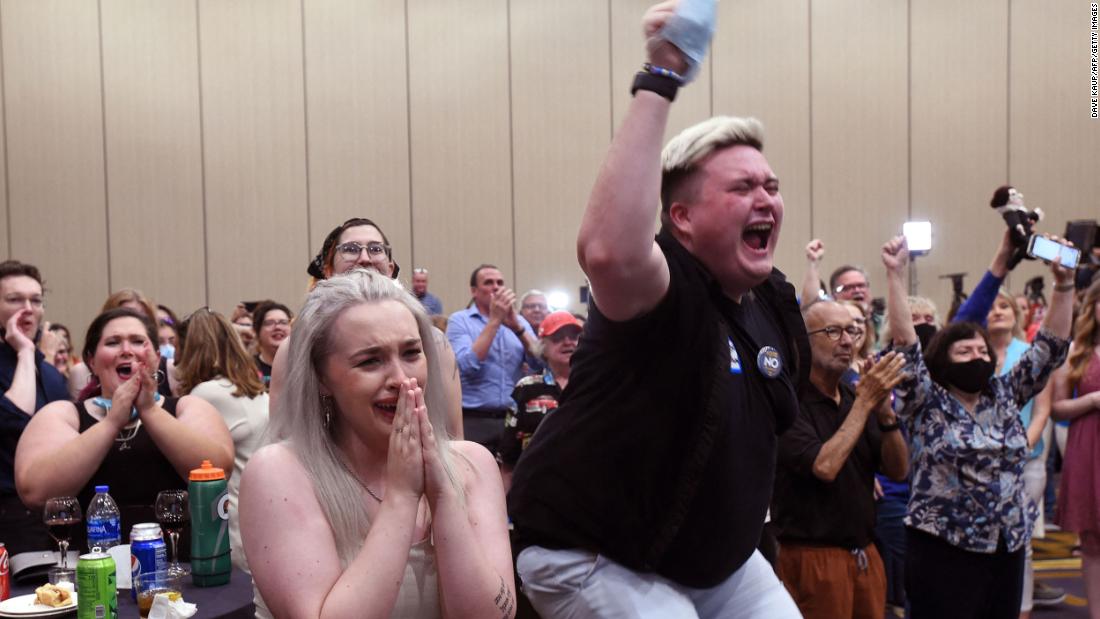
Kansas voters sent a dramatic message on Tuesday, opting to maintain the right to an abortion in their state’s constitution just weeks after the US Supreme Court decided to overturn Roe v. Wade.
Polls have long shown that voters overwhelmingly support protecting abortions rights. But the win for the “no” vote in Kansas is proof of that and signals that the Supreme Court decision has further angered voters and possibly shifted the politics of the issue ahead of the November elections.
The “no” leaves the state constitution unchanged. While lawmakers in the state can still try to pass restrictive abortion laws, courts in Kansas have recognized a right to abortion under the state constitution.
The biggest warning to Republicans, many of whom have trumpeted the overturning of Roe and backed pushes to pass stricter abortion laws, is perhaps the turnout in Kansas. With 78% of the vote in on Tuesday night, nearly 700,000 people have cast ballots in the primary, a figure that already dwarfs the turnout in the 2020 presidential primary election.
“This is further proof of what poll after poll has told us: Americans support abortion rights,” said Christina Reynolds, a top operative for Emily’s List, an organization that looks to elect women who support abortion rights. “They believe we should be able to make our own health care decisions, and they will vote accordingly, even in the face of misleading campaigns.”
Greitens’ attempted comeback falls flat
Republicans in Missouri breathed a sigh of relief after state Attorney General Eric Schmitt won the wide-open Senate primary, according to a CNN projection.
Perhaps more significant than who won, though, in the deep-red state, is who lost: disgraced former Gov. Eric Greitens, who was attempting a political comeback. Greitens resigned in 2018 amid a sex scandal and accusation of campaign misconduct, and subsequently faced abuse allegations from his ex-wife of him, which he has denied
Schmitt, the attorney general, emerged from a crowded field that included two members of Congress, Reps. Vicky Hartzler and Billy Long.
Former President Donald Trump stayed out of the race, issuing a tongue-in-cheek statement supporting “Eric” on the eve of the primary — leaving it up to voters’ interpretation whether that meant Schmitt or Greitens.
Dixon victory in Michigan governor’s race sets up referendum on Covid policies
Tudor Dixon, the conservative commentator endorsed by Trump in the final days of the race and backed by large factions of the Michigan Republican establishment, won the state’s GOP primary to take on Democratic Gov. Gretchen Whitmer, CNN projected.
The clash in Michigan could be one of the nation’s most competitive governor’s races.
Whitmer has cast herself as a bulwark for abortion rights in a state where Republicans have sought to enforce a 1931 law that would impose a near-total ban on abortion.
Dixon, meanwhile, framed the race in her victory speech Tuesday night as a referendum on restrictions Whitmer imposed during the Covid-19 pandemic.
Dixon, a mother of four who is backed by former Education Secretary Betsy DeVos’s family, is also an advocate of school choice — potentially positioning education as a marquee issue in November’s midterm election.
Progressives suffer another defeat in Michigan
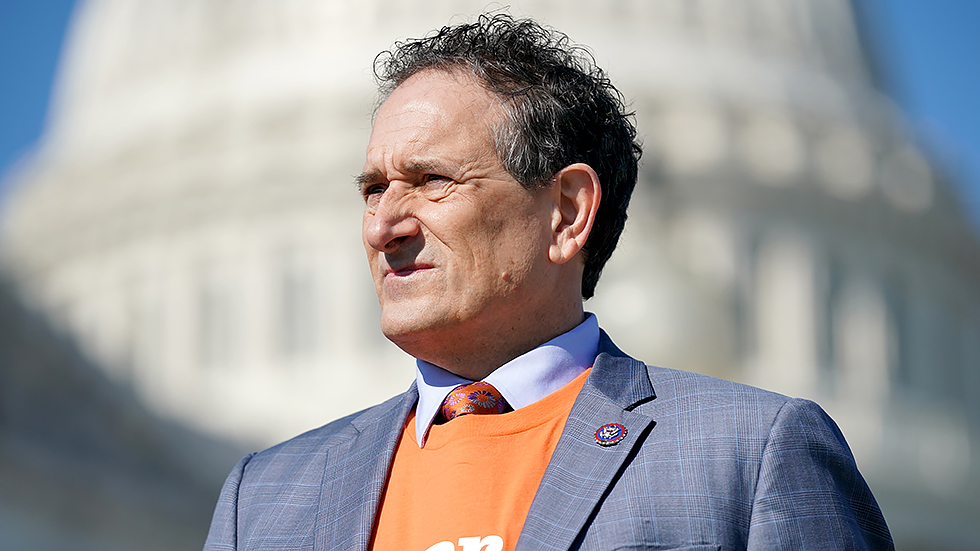
Rep. Haley Stevens’ projected Democratic primary victory in Michigan’s newly drawn 11th Congressional District over fellow Rep. Andy Levin marks another blow against progressives in what has been a mostly disappointing primary season.
It’s also a resounding victory for the American Israel Public Affairs Committee, or AIPAC, and its super PAC, United Democracy Project, which has spent millions backing moderate, more staunchly pro-Israel candidates in Democratic primaries.
Stevens and Levin are both supportive of Israel, but Levin — who is Jewish — has been more willing to criticize its government’s treatment of Palestinians and is the lead sponsor of the Two-State Solution Act.
Progressive Democrats, frequently targeted by AIPAC spending this primary season, have smoked at fellow Democrats for accepting or courting support from the group, which has also contributed to Republican election deniers. AIPAC has defended the practice, arguing that its policy goals need bipartisan support.
J Street, a liberal pro-Israel group that has clashed with AIPAC, tried to boost Levin with a $700,000 July ad buy, but that sum paled in comparison to the millions bundled by AIPAC and more than $4 million spend by UDP.
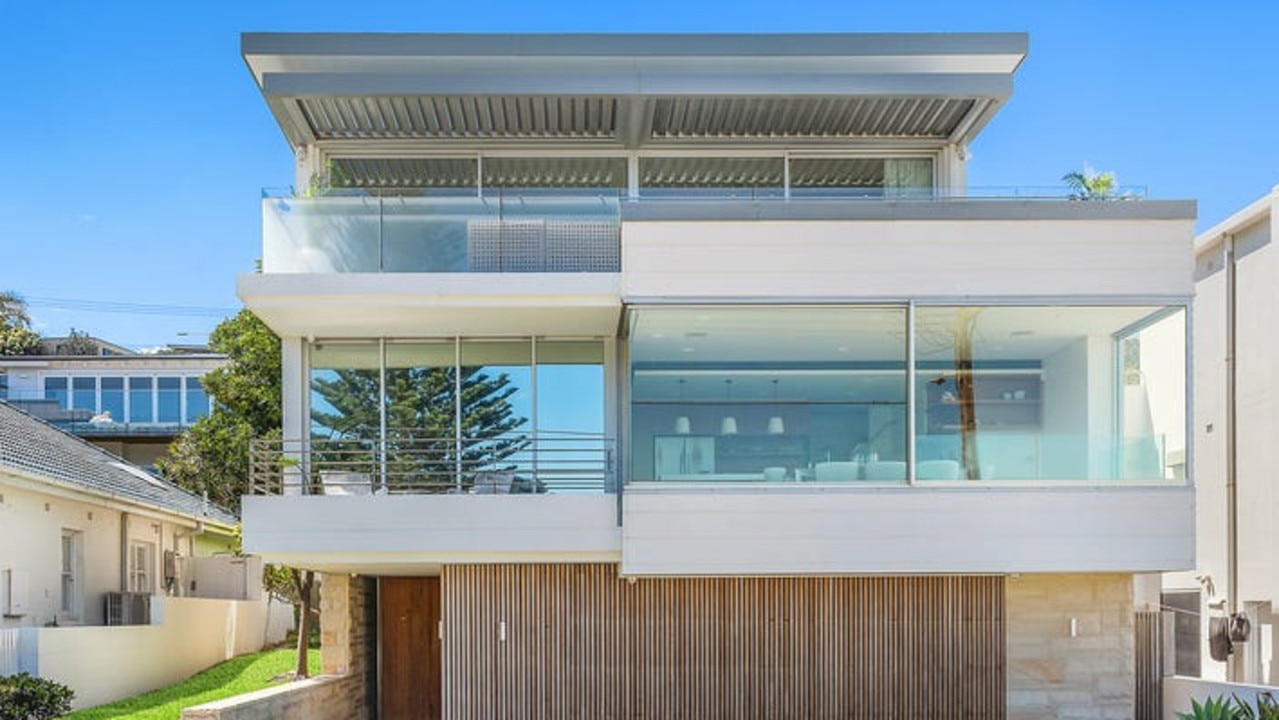
The picturesque Sydney beachside manor owned by F45 co-founder Adam Gilchrist is set to go under the hammer after the Australian fitness giant’s stunning downfall.
Mr Gilchrist (not the cricketer), who stepped down as F45’s chief executive last week amid stock plunges and company-wide lay-offs, is selling his “beachfront trophy home” at Freshwater on Sydney’s northern beaches.
The home, 52 Ocean View Rd, grew into infamy in 2018 when Mr Gilchrist and his wife Eli bought the property for a whopping $14m due to a minor neighborly dispute.
The couple had purchased a three-bedroom cottage on 50 Ocean View Rd for $5.4m in 2017 and planned to spend $2.5m to develop the property.
But neighbors complained it would not comply with building height or boundary controls, which led to Mr Gilchrist taking the extraordinary step of withdrawing his proposal and setting the matter by buying his neighbour’s bigger home for the obscene amount.
The $14m price was a record for the Freshwater suburb, with agents considering 52 Ocean View Rd’s mammoth coming out an outlier price.
But the three-storey home is again on the market, with real estate agents billing it as “unquestionably one of the finest homes and locations in Sydney”.
“Cutting-edge architectural design and an unsurpassed beachfront setting combine in this state-of-the-art luxury residence to deliver the ultimate designer beach house,” a description of the home reads.
“Set to a picture-perfect backdrop that sweeps over the surf to the ocean’s horizon and North Head, the tri-level residence showcases living spaces and lift access to all three levels and has been appointed and furnished with every conceivable luxury.”
The home’s features include five bedrooms, three bathrooms and giant retractable windows in the dining room.
Mr Gilchrist suddenly announced last week that he was stepping down as F45’s chief executive after co-founding the business with Rob Deutsch back in 2013.
The company also revealed it would be laying off 110 staff and cuttings its operational expenses, which caused its stock price to fall by more than 60 per cent.
F45 hoped that by reducing its corporate workforce by 45 per cent it could return to a positive cash flow.
Mr Gilchrist said he would be “forever grateful” as he exited the company.
“To the staff that have worked tirelessly since our inception, you have been incredible in your efforts, and I thank you for all of your support,” Mr Gilchrist said in a statement.
“To the investors that have joined us along our journey, I thank you for your commitment to F45.
“Lastly, I am forever grateful to our franchisees who deliver the world’s best workout each day to F45 members around the world.”
Mr Deutsch, who stepped down as chief executive and sold his shares in the company in 2020, said there were “enormous issues needing fixing”.
“Never in my wildest dreams could I have imagined this,” he wrote on Instagram.
“When I exited, and sold out of F45, I left a healthy, phenomenal, beast of a business. All the way from the company culture to the heart beat of the business… the workouts. F45 was special.
“I genuinely hope all of the 110 laid-off staff, find happiness and opportunities elsewhere.”
F45 was a global fitness powerhouse before its stock shock last week, with more than 1500 studios in 45 countries and Hollywood superstar Mark Wahlberg among its investors.
Mr Gilchrist made $500m overnight when the company went public on the New York Stock Exchange in July last year.
His northern Sydney home will be up for auction on August 27.
Employees walk past the logo of SK Hynix at its headquarters in Seongnam, South Korea, April 25, 2016. REUTERS/Kim Hong-Ji
Register now for FREE unlimited access to Reuters.com
Register
SEOUL, Aug 3 (Reuters) – South Korea’s SK Hynix Inc (000660.KS) has developed its most advanced NAND flash chip made up of 238 layers of memory cells for use in PC storage devices and later smartphones and servers, the world’s second- largest memory chip maker said on Wednesday.
SK Hynix described it as the “industry’s highest” NAND flash chip and it follows US rival Micron Technology Inc (MU.O) saying last week it had begun shipping a 232-layer NAND chip. read more
SK Hynix said the new 238-layer chip is the smallest NAND flash chip in size, boasts a 50% improvement in data transfer speed over previous generation chips and power efficiency as well, as it cuts the volume of energy consumed for data reading by 21 %.
The company plans to start mass production of the chip in the first half of 2023.
SK Hynix and Solidigm, the new name of Intel’s NAND business which SK acquired, hold a combined 18% share of the NAND flash market, behind Samsung Electronics with 35.3% and Kioxia with 18.9%, according to first-quarter data from TrendForce.
Register now for FREE unlimited access to Reuters.com
Register
Reporting by Joyce Lee; editing by Jason Neely
Our Standards: The Thomson Reuters Trust Principles.
This is the era of pleasure, of umami, of taking the most decadent ingredient you can find, throwing a bunch of fish sauce and fresh herbs at it, and then adding crisp and wobble and a little more fun to the mix. It’s the era of creamy sauces, bright pickle, food built specifically to go with booze, sex-on-a-plate debauchery.
Let’s take a donut and stuff it with crab; let’s cook the crap out of our vegies so they melt and sizzle and then smother them with three kinds of dairy. Let’s not hold back.
This is the manifesto that came to mind while dining at Dessous – the Flinders Lane venue owned by Mulberry Group – a place that captures the vibe of the moment perfectly.
“Bloody delicious”: Crab doughnut. Photo: Simon Schluter
If there’s one thing the Mulberry Group knows how to conjure, it’s a sense of place. It was Mulberry that took the idea of the Melbourne cafe and turned it into something closer to a nightclub, not in tone but in excitement and attention to aesthetics, with Top Paddock, Kettle Black and Higher Ground, and then, after selling those venues, withLiminal.
In 2019, when they opened Hazel, they created a space that was beloved for its clean-slate-meets-rococo good looks. At that same time, underneath Hazel, they launched Dessous, a moody basement space that’s part lounge, part restaurant, part wine bar, and 100 per cent of its place.
What does that mean? The Flinders Lane basement bar is almost a design genre in its own right, and this place has it down.
If there’s a better snack bar in this universe, it doesn’t come to mind.
You must, of course, enter through several doors, punctuated by a staircase downwards. The sweep of a velvet curtain uncovers a room you had glimpsed from the footpath but, nonetheless, the act feels like revealing a hidden world.
Candlelight casts a glow across the tables, illuminating shadowy botanical upholstery and gold-framed paintings. Entering is like a scene from a high-budget movie.
Blame COVID-19, blame the inordinate attention given to sister restaurant Hazel, blame lockdowns, but for some reason Dessous didn’t make the stir it might have upon opening. I can’t speak to whether that stir might have been warranted then, but I can say that as it stands right now, Dessous is well worthy of our consideration.
Bar snack perfection: Pickled mussels with whipped cod roe and house-made potato crisps. Photo: Simon Schluter
Chef Dan Sawansak, who was the head chef at Higher Ground before taking on the role here, is a master at that of-the-moment cooking I describe above, the too-much-is-not-enough marriage of fat and acid and umami and pleasure.
Most of his dishes, if not made with booze in mind, are wickedly perfect matched with wine or cocktails. (Speaking of cocktails, these are some of the best I’ve had recently, courtesy of beverage manager and artist Kris Leombruni.)
A pork hock croquette ($9) is all tender shredded meat and crispy exterior, sitting on a smear of aioli shot through with crunchy pickled mustard greens. It practically begs for a gulp of rich white Burgundy or racy pinot noir, both of which are easily found on the medium-length, fairly priced wine list.
Grilled duck leg with pickled figs. Photo: Simon Schluter
And yes, there’s a yeast-raised savory doughnut, its copious filling mimicking some sort of custard or cream but instead made from gobs of spanner crab, salmon roe acting as fishy hundreds and thousands. There’s a lot of humor in this dish, made more delicious by the fact that it’s bloody delicious.
Equally as delicious are the pickled mussels with salty whipped cod roe, served with house-made potato crisps. If there’s a better snack bar in this universe, it doesn’t come to mind.
Sawansak really shows his cooking chops with a duck leg ($38), which had been confit and grilled, then paired with morcilla and pickled figs. The balance of richness, cutting acid and musky sausage is revealing.
Bone marrow and sticky rice.
The one place where I thought Sawansak might take a moment to step back is in a dish of bone marrow with sticky rice. In some ways it’s a brilliant combination of fat and funk and fistfuls of mint and Thai basil, but in other ways it goes a touch too far. The fish sauce and lime juice border on overpowering, and the sticky rice is so crisped that it loses its ability to soak up the wobble and slick of the marrow or the pungent dressing. Bone marrow, for all its gutsy glory, is actually pretty subtle, and its flavor ends up getting lost in a dish in which it should shine.
And a very quick note about service, which is incredibly adept, right up until the point that it’s not. My (young-looking) dining companion ordered a drink and was (reasonably) asked for ID – when he took a while to find it, the bartender attending to us abruptly left, saying “I’ll come back.” I never did. Towards the end of the night, the plates stopped being cleared, the bill was impossible to come by, and I longed for those early-meal moments when we were considered important enough to dote upon.
But generally, Dessous meets hits its brief with style and verve. It’s a place to pile on the pleasure, pull out the stops, and bet on elegant excess.
It’s one of the most famous and unique trades in footy history.
Famous because it involved two players, Chris Judd and Josh Kennedy, that end their careers with stacked CVs, with surely the latter to join the former in the Australian Football Hall of Fame.
And unique because both Carlton and West Coast could claim they ‘won’ the trade.
Watch every blockbuster AFL match this weekend Live & Ad-Break Free In-Play on Kayo. New to Kayo? Start your free trial now >
Debate over the famous 2007 deal between the Blues and Eagles has, inevitably, emerged this week after Kennedy announced West Coast’s upcoming match against Adelaide would be his 293rd and final AFL game.
The soon-to-be 35-year-old will depart as the Eagles’ greatest goalkicker, as well as several accolades including a dual Coleman Medallist, seven-time Eagles leading goalkicker and triple All-Australian. He was also a pivotal member of West Coast’s thrilling 2018 premiership triumph over Collingwood.
‘Josh is the greatest Eagle ever!’ | 03:56
Kennedy’s achievements came almost exclusively at the Eagles after Carton’s No. 4 pick from the 2005 draft was central to one of footy’s most famous trades.
In late 2007, Judd – West Coast’s 2005 premiership captain and arguably the best player in the AFL at the time – wanted to return to Victoria, with the Blues keen to secure his services.
After 11 goals from 22 games at Carlton, Kennedy moved back to Western Australia – although he was happy and settled in Melbourne at the time.
As part of the deal, Carlton acquired Judd and Pick 46, which it used to select Dennis Armfield, who played 145 games for the Blues). The Eagles got Kennedy, as well as Picks 3 (Chris Masten – a premiership Eagle that played 215 games for West Coast) and 20 (Tony Notte, who played two games in three seasons).
NEW FOX FOOTY PODCAST — Six polarizing finals contenders, latest trade whispers
Listen below or subscribe in Apple Podcasts or Spotify
The struggling Blues not only needed a star player, they sought a leader and standard-setter, hence he was made captain in his first year. In his first four seasons at the Blues, Judd made the All-Australian team in each year, won the Blues’ best and fairest in the first three, claimed the 2010 Brownlow Medal and won the AFL Players’ Association’s MVP award.
Judd was four years older than Kennedy when the 2007 trade went down. He was also already a Brownlow Medallist, Norm Smith Medallist and premiership captain.
But as Judd was coming to the end of his career, Kennedy reached his prime. He kicked 59 goals as a 23-year-old before a golden run where he booted 60, 61, 80 (Coleman Medal), 82 (Coleman Medal) and 69 majors across five seasons. Most crucially, the next year he kicked 3.2 from 18 disposals and 11 marks in a winning Grand Final.
Ex-Carlton coach Brett Ratten with Chris Judd on the day he officially became a Blue. Picture: Simon MossmanSource: AAP
Injury forced Judd to retire at 31 following a couple of seasons where it was clear he was part of his incredible prime. Kennedy will retire after a mighty, warrior-like finish to his career that’s seen him kick 43, 49, 34, 41 and 29 goals from the past five seasons. Considering the Eagles’ plight, the poor delivery inside 50 and his own injury niggles, the fact Kennedy has booted 29 goals this year is remarkable.
Ultimately, the Blues got seven seasons out of Judd and the Eagles got 15 out of Kennedy.
So all things considered, who won the 2007 Judd-Kennedy trade?
Fremantle legend Matthew Pavlich perhaps put it most diplomatically.
“Probably West Coast in the long run, but it’s one of those ones where you could probably argue the case either way on who had the better result,” Pavlich told foxfooty.com.au.
“Judd was captain and All-Australian and took the Blues to a finals win in 2013. So maybe the short-term winner was Carlton, but definitely the long-term winner has been West Coast in terms of Josh Kennedy being an incredible forward for a long, long period of time, All-Australian, Coleman Medalist and eventually a premiership player in 2018. He’s been a star for a long time.
Eagle calls time on phenomenal career | 04:15
“So short-term Carlton, long-term West Coast – it’s not usually you get a trade like that where both teams could argue that they got a better result.”
Ultimately, the business of footy is winning, which is what swayed two Fox Footy pundits to the Eagles.
“Without judging the individual players but judging from the time of the trade, I would feel West Coast won the trade,” triple premiership Lion Alastair Lynch told foxfooty.com.au. “That’s not reducing or belittling Judd’s contribution because he is one of the all-time greats of the game, but post-trade, West Coast got a flag out of it and I suppose Carlton didn’t, so I’d have them just in front.”
Bulldogs games record-holder Brad Johnson told foxfooty.com.au: “Well West Coast won a flag, so I think with what West Coast got out of Kennedy was absolutely spot on for what they needed as a team.”
Triple premiership forward Cameron Mooney also leant towards West Coast – but not by much.
Josh Kennedy with the 2018 Premiership Cup. Picture: Michael KleinSource: News Corp Australia
“I think it worked out pretty well for both. But if I had to pick, being a forward and knowing how hard it is to kick 700 goals and to win a premiership, which is the main game of the game, you have to think probably West Coast,” Mooney told foxfooty.com.au. “But I would’ve been very, very happy if Chris Judd walked through my doors.
“The thing for Carlton was at the time, the club just wasn’t a good club – and it’s probably the perfect example of one person cannot change a football club. He’s in the top handful of players this century and as great as he is, he couldn’t change a club that, probably until recently, had been seen as a poor club.”
AFL 360 co-host Mark Robinson declared it a win-win for the Eagles and Blues.
“They both won. Judd was a champion and Kennedy played 15 years,” Robinson told Fox Footy’s AFL 360.
“His second headline in football was ‘Carlton are giving away Josh Kennedy’ – and his last headline will be ‘Josh Kennedy retires a champion of the game’. It’s a great story.”
AFL 360 co-host Gerard Whateley added: “It’s quite clear Carlton didn’t know what they were trading, because nobody trades THAT player. He was two years in and the forecasting wasn’t he was going to become one of the top 25 goalkickers of all-time. He might’ve been reluctant at the start, but he found his home from him and West Coast and he won his reputation from him at West Coast.
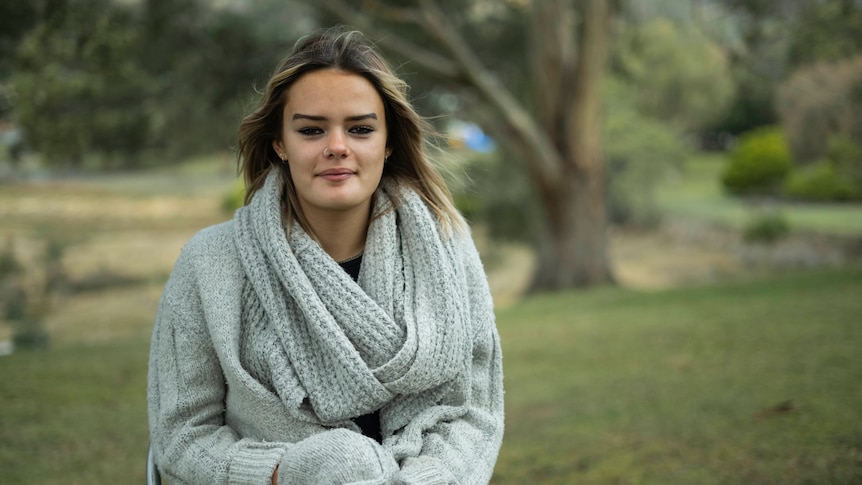
Layla was only in grade eight when she found herself on the streets.
Key points:
Youth homelessness is on the rise in Tasmania
Support groups say there is a big disparity between the Youth Allowance and rental prices
There are calls to increase access to social housing for young people
After family conflict, she spent four months homeless, couch surfing, going to shelters and even sleeping rough.
Now, at 16, she understands more than most about what lies behind a statistic.
“When I was on the streets, I think I went to school three times the whole time I was out there. I didn’t have a social life … I didn’t know what was going to happen,” she said.
“Towards the end of it, I was at a house that wasn’t the nicest of houses, but I had a roof over my head most nights,” she said.
It was an incident she does not want to detail that prompted her to seek a different path.
“One thing opened up my eyes and I didn’t want to stay out there, so I packed up my crap and just went home.”
Layla then stayed with her sister and began rebuilding her life.
Homelessness on the rise
The latest Census data on homelessness will not be released until next year, but support groups say it is already apparent the issue has worsened over the past five years.
Shelter Tasmania’s Pattie Chugg says the state has the highest proportion of people who are homeless.(ABC News: Scott Ross)
A recent Mission Australia survey found that, during the COVID pandemic, more than one in 30 young Tasmanians experienced homelessness for the first time in their lives.
Pattie Chugg from Shelter Tasmania said 6,600 people a year accessed housing services and that number was increasing all the time.
“Tasmania has the highest proportion of people [who] are homeless because they haven’t got affordable rental, and for young people that’s exacerbated very much for them when they are on lower incomes, part-time [or] casual wages or Youth Allowance,” Ms Chugg said.
“It’s a really simple equation in some ways. We’ve got a lot of people on low incomes. We’ve got rents that are rising and then those two things come together. It is the people with the least amount of resources [who] are the ones missing out the most.
“We’ve got this perfect storm really of not enough affordable housing to house people in Tasmania.”
Middle group emerging
Tania Hunt from the Youth Network of Tasmania has called for more social housing for young people.(ABC News: Maren Preuss)
Advocacy group Youth Network of Tasmania is concerned there is an emerging group of young people who are homeless because they do not qualify for the public housing waiting list.
“We are seeing young people {who]are not necessarily eligible for social housing, and can’t afford to enter the rental market. So, what do we do for those individuals?” Youth Network chief executive Tanya Hunt asked.
“They need to be allocated more social housing in my view. They need to be prioritized, to reduce homelessness in our community.
“We know that there is high youth unemployment in Tasmania. We know that underemployment is a significant issue. [There’s] transport disadvantage, low incomes — there’s a range of challenges that contribute to housing insecurity and homelessness for young Tasmanians.”
Ms Hunt said the COVID-19 pandemic had also taken a toll.
“Young people experienced unprecedented job losses and a range of other challenges that resulted in housing insecurity and homelessness.”
She said it was difficult to know the exact number, but young people were over represented in the homeless population.
“The problem in Tasmania is often hidden, with young people couch surfing with friends and family, sleeping in their cars and sleeping rough.”
Both Shelter Tasmania and Youth Network say that increasing the Youth Allowance is key to keeping young people off the streets.
“Very few people know how little Youth Allowance is: It’s only $500 a fortnight,” Ms Chugg said.
“Why is Youth Allowance so low and less than an adult’s income on unemployment and other benefits when all their other costs are the same?”
Support groups say there is a growing disparity between government youth payments and rental prices.(abcnews)
State government urged to do more
Hobart City Councilor Jax Fox was behind a move to cap new, short-stay accommodation in an effort to increase rental stock, a measure that is now before the Planning Commission.
In the past, they have also couch surfed and lived in tents, but they say it was “very much on the light end” of homelessness.
“When I was younger my family would just kind of camp, we moved around a lot. It was very socially isolating,” Cr Fox said.
Hobart City Councilor Jax Fox has experienced couch surfing and living in tents.(ABC News: Maren Preuss)
“Housing is the first thing that you need to survive.
“If you don’t know somebody who is going through this, or has gone through this, you are deliberately not looking, because it’s everywhere.”
The Tasmanian government has promised to build 10,000 homes in the next 10 years but Cr Fox says even that is not sufficient.
“There are 4,000 families — not individuals, families — on the [waiting] list now. So, if we are going to build houses just for them without the list growing, it is going to take four or five years for the current demand to be met.”
Cr Fox wants more money for emergency housing, access to hotels and a vacancy tax.
“Aside from building more housing, we need a vacancy tax. There are heaps of empty houses around Hobart,” Cr Fox said.
“If people can sit on houses as investments and incomes when others are starving on the streets, how detached from reality do you have to be to think that’s an OK thing to do?
“We should ban short-stay accommodation altogether.”
Data shows that, once a young person experiences homelessness, they are more likely to do so again in later life.
Layla, pictured with her support worker, Heidi, is no longer homeless and tries to help others who are.(ABC News: Maren Preuss)
And being homeless brings with it complications that are hard to overcome.
Understanding much of that, Layla is now looking out for others in the same predicament.
“We’ve got a friend down at the supermarket who is homeless and we help him out every time we go down there. Every day he is there,” Layla said.
“Everyday he’s there and he lives up in a tent in South Hobart and he’s freezing at the moment.
“We bought him some tuna and stuff last night and he can’t even get Centrelink because he doesn’t have a home address. It’s a bit sad.”
Unemployment and transport disadvantage are some of the factors at play in youth homelessness.(ABC News: April McLennan)
Pattie Chugg has urged young people to seek out support services by contacting Housing Connect.
“It’s important to make contact through school, support services. There is help there and it’s important our youngest citizens are looked after.”
Premier Jeremy Rockliff said his governments’ plan for 10,000 affordable homes over the next 10 years was “a number that is no doubt a challenge, but we will get there.”
He said the government “recognizes the pressures of homelessness [and we are] looking behind the reasons for homelessness, the mental health pressures, people’s health and wellbeing.”
Mr Rockliff said the government would “engage with key stakeholders such as the Tasmanian Council of Social Service and other advocates in ensuring we have the right policy settings and investment is targeted in the right areas.”
Rep. Haley Stevens (D) was projected to defeat fellow Rep. Andy Levin (D) in the Democratic primary for Michigan’s 11th District.
The Associated Press called the race for Stevens at 10:46 p.m. ET.
Stevens and Levin were both elected four years ago in the 2018 midterm elections that saw Democrats reclaim control of the House. But the redistricting process forced them into a member-on-member match-up that will ultimately determine who will go on to seek a third term in November.
Stevens and Levin occupied different lanes in the primary, with Stevens cutting a more moderate reputation and Levin casting himself as more progressive.
Stevens ultimately went into the primary with a financial advantage over Levin. Their latest federal filings show Stevens with nearly $1.5 million on hand to Levin’s $726,000.
But Levin also had the advantage of name recognition. While he was elected to the House in 2018, his father of him, former Rep. Sander Levin (D-Mich.), Represented the district for more than three and a half decades, while his uncle of him is the late Sen. Carl Levin (D-Mich.).
The race drew the attention of pro-Israel groups, with J Street’s PAC supporting the more left-leaning Levin and American Israel Public Affairs Committee’s PAC backing Stevens.
Michigan’s 11th District leans toward Democrats, giving Stevens an easier path to reelection this year after winning twice before in a more competitive district.
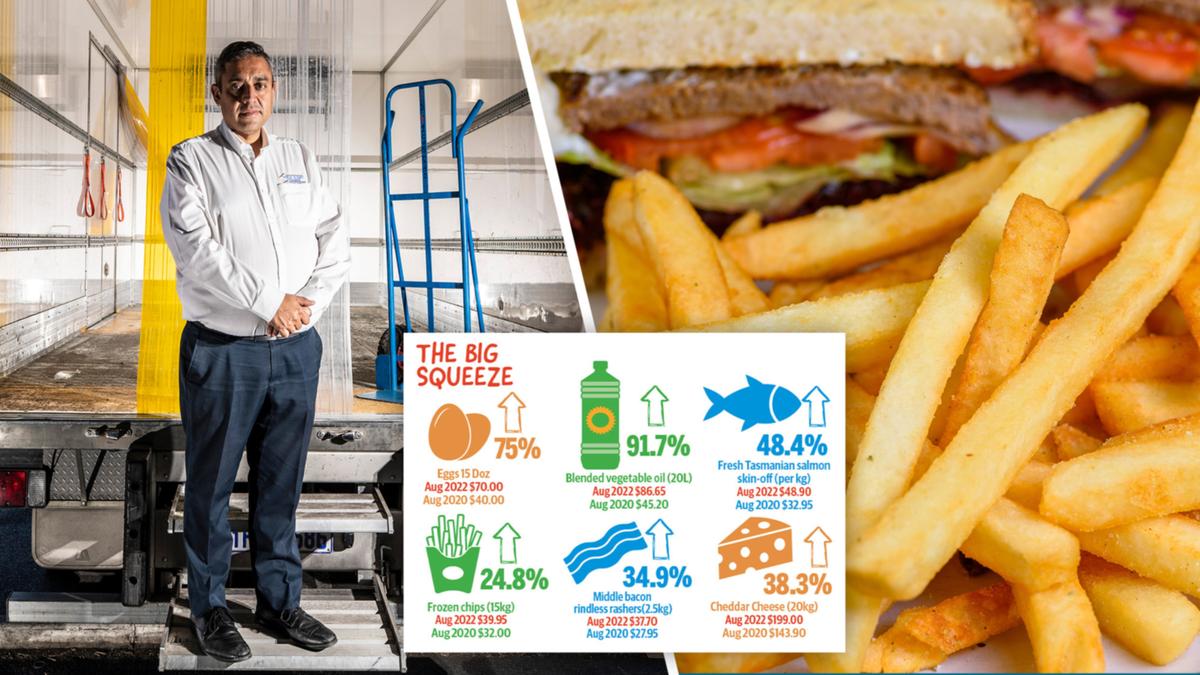
WA’s biggest independent food distributor has warned consumers to expect further hikes at their favorite pubs and restaurants – and eventually supermarkets – as supply chain pressures and skyrocketing input costs continue to drive up prices.
The price of vegetable oil supplied by New West Foods to hundreds of eateries across WA has almost doubled since August 2020, with eggs up 75 per cent over the same two-year period.
Salmon has jumped 50 per cent while cheese and bacon are both up around 35 per cent.
Even the humble frozen chip – a staple of takeaway menus everywhere – has climbed 25 per cent.
The scale of price rises over the past two years. Credit: The West Australian
The majority of those price rises have come in the last 12 months as myriad factors combined to create what New West Foods managing director Damon Venoutsos said was the “perfect storm” for food costs.
Mr Venoutsos described distribution businesses like his own as the “canary in the coal mine” for price increases because – unlike supermarkets and fast-food chains – they did not enter into long-term agreements with suppliers.
“Most of the time we get 30 days’ notice from our suppliers that prices are going up whereas your big retailers (such as Coles and Woolworths) and quick service restaurants (such as KFC) can lock in their prices for anything up to six months ,” he said.
“Often we’re using the exact same supplier so while I don’t know when (the supermarkets) are going to catch up, it’s inevitable they will have to.”
Mr Venoutsos said prices had increased “very quickly and very dramatically” in recent months and that practically no food type had been spared, although some – such as fish, meat and dairy – had been impacted worse than others.
The biggest riser – vegetable oil – is in short supply globally, with exports largely cut off from war-torn Ukraine which traditionally produces 50 per cent of the sunflower oil used around the world.
New West Foods clients include Optus Stadium, King Edward Memorial and Sir Charles Gairdner hospitals and hundreds of restaurants and cafes.
New West Foods managing director Damon Venoutsos has warned of more price hikes. Credit: simon santi/The West Australian
Mr Venoutos said takeaway-oriented restaurants such as fish and chip shops and pizzerias were among the hardest hit with practically all their staple ingredients surging in price.
Independent Food Distributors Australia chief executive Richard Forbes listed half a dozen reasons for the escalating costs including clogged ports globally, COVID lockdowns in China, a shortage of sea containers and spiraling domestic energy and transport prices.
Last month, Manjimup-based WA Chips – the State’s only local manufacturer – revealed its gas bill was up $400,000 (60 per cent) compared to the previous year.
Mr Forbes said additional costs were being incurred at every step of the production, distribution and storage supply chain.
“Anyone that refrigerates product in bulk – which would be practically all distributors – have seen those costs go from around $50,000 to $80,000,” he said.
Labor shortages were also a major issue, with Mr Forbes estimating there were 160,000 vacancies between the agriculture, transport, warehousing and hospitality sectors.
Sennheiser has already teased the arrival of Momentum 4 Wireless on August 8. But it does not mean that we will be getting leak-free week until the event. A Canadian retailer has managed to list the upcoming wireless ANC over-ear headphones early which includes the changes to expect including a significant battery upgrade.
TL;DR
Sennheiser Momentum 4 Wireless leaked by a retailer.
The upcoming over-ear headphones will feature up to 60 hours of battery and a refreshed design.
The price of the Sennheiser Momentum 3 Wireless could be cheaper than its predecessor.
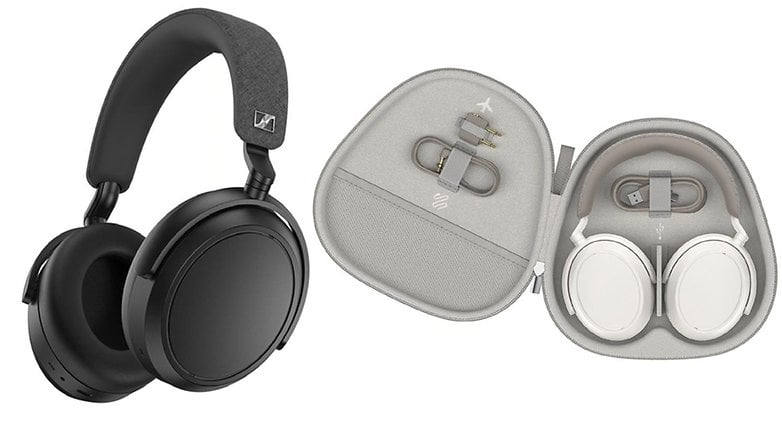
Based on the listing of Canada Computers & Electronics, Sennheiser’s Momentum 4 Wireless will feature a drastic design iteration. The new over-ear headphones will boast a traditional, yet flatter finish compared to the busy and extended foldable design of the Momentum 3 Wireless. Its limited flat folding mechanism means carrying the headphones will require a larger case than its predecessor. It’s unclear if we could also get a lighter form factor this time around.
As for the headphones’ specs, it is mentioned by the retailer that Sennheiser Momentum 4 Wireless will arrive with up to 60 hours battery rating on a single charge. This is a major improvement considering the previous Momentum 3 Wireless only comes with 17 hours battery life.
This year, the headphones will take advantage of the newer aptX Adaptive Bluetooth codec from Qualcomm as opposed to the original aptX. In addition, Sennheiser Momentum 4 Wireless will also get an improved audio bit rate of 24-bit at 420kbps compared to the 16-bit 384kbps of the older model.
Surprisingly, Sennheiser’s headphones are listed for CAD $450 which is cheaper than the third-gen headphones that were launched in 2019 at CAD $530 ($400 / £350) in 2019. If the retailer’s pricing is accurate, Sennheiser Momentum 4 Wireless could undercut the current SonyWH-1000XM5. We will all confirm the remaining details next week once the headphones become official.
Stephen Colbert kicked off the month of August recess in Washington with news that Joe Biden tested positive for Covid for the second time days after testing negative, a rebound case after taking the anti-viral drug Paxlovid. “Wow, getting Covid twice in a row because you took Paxlovid? Who could’ve seen this coming?” the Late Show host said, pointing to himself. (Colbert had two bouts of Covid in May after taking Paxlovid.)
“It’s happened to a lot of folks. I don’t know anyone who’s taken Paxlovid who didn’t get it again,” he said. “It’s the hottest rebound since JLo tested positive for a second case of Affleck.”
Experts say the rebound infections are caused by “insufficient drug exposure” – as in, not enough of the drug gets into infected cells to stop all viral replication. “So the Covid pops right back up, which is why the White House is trying to give Paxlovid to Biden’s poll numbers,” Colbert quipped.
Colbert then turned to infuriating news from Washington regarding veterans’ healthcare. “I’ve been making the political jokey make-em-ups for over 20 years now, and I have never seen anything so baldly cynical and pointlessly malicious as this,” he said. “And if there are children in the room, tell them to age quickly and please vote.” Colbert referred to the Pact Act, which would expand healthcare coverage to military veterans exposed to toxic chemicals or burn pits during their service. “That’s something we can agree on – if we’re going to go to war, we have to take care of the warriors,” said Colbert.
Both the House and the Senate initially passed the bill, but due to an administrative issue, the Senate had to revote. Twenty-five Republican senators flipped their votes, blocking the Pact Act’s passage. “Why would Republicans screw over veterans on a bill that they previously voted for?” Colbert wondered. “Well, one theory is that they had their boxers in a bunch after Joe Manchin and Chuck Schumer secretly negotiated a big climate deal.” Jon Tester, Democratic senator from Montana, attributed the vote to “political payback” from people who had “lost their minds”.
“Well, that would be some misdirected anger, GOP,” Colbert fumed. “That’s like a quarterback saying, ‘OK, huddle up, we’re down 20, I just threw an interception and the other team scored. Here’s the play: I’m going to go sucker-punch that old guy at the hot dog stand.’”
Colbert then skewered Ted Cruz, who fist-bumped fellow GOP senator Steve Daines after blocking the bill for veterans’ healthcare he had previously voted for. “I imagine there’s some veterans out there who would also like to bump Ted Cruz with their fists,” said Colbert.
Trevor Noah
On the Daily Show, Trevor Noah marveled at the pettiness of Donald Trump, who last month had his ex-wife Ivana Trump buried near the first hole of Trump National Golf Club in Bedminster, New Jersey, probably for a tax break. The strange burial site would exempt the golf course from New Jersey’s tax code, which does not tax land used as a cemetery.
“Wow. A lot of people say, ‘I’ll pay taxes on my dead body,’ but Trump means it. Over someone else’s body,” Noah said.
“Even for him, this feels like a step too far,” he continued. “I don’t care what anyone says. I wouldn’t even laugh at that as a joke. If someone said to me, ‘Donald Trump’s ex-wife died, he’s probably going to bury her on his golf course de ella to save de ella on taxes,’ I’d be like, ‘yo, that’s not cool, man.’
“But it turns out Trump was like, ‘wait wait, say more. I’m going to send this to my accountant, keep going.’
“What this really shows you is how strange the tax system can be,” Noah concluded. “All this tax break does is incentivize you to be a weirdo. Who came up with this? It almost feels like the law was written by a serial killer – ‘there should be a law, that if you bury a body in your yard, you don’t have to pay taxes any more.’”
Jimmy Fallon
And on the Tonight Show, Jimmy Fallon began with Biden’s rebound Covid case. “Right now, Biden’s looking on the bright side,” he said. “He’s like ‘well, at least my Covid got a second term.’
“Usually when a 79-year-old is on the rebound, you’re meeting your new aunt named Barbara,” he joked. “The virus came back so fast the staffers didn’t even have time to take down the Get Well Soon balloons.”
Fallon also wondered about the single Illinois ticket that won the $1.34bn Mega Millions jackpot over the weekend. “The winner hasn’t come forward yet, so either they’re contacting financial experts, or they’re at home being like, ‘crap, where is it, I went swimming, no one turn on the washing machine!’” he said.
And after a trip to Canada using a wheelchair and walker, Pope Francis said that he will need to either slow down or retire. “So I guess we know who won the Mega Millions,” Fallon joked. “Congratulations, your holiness.”