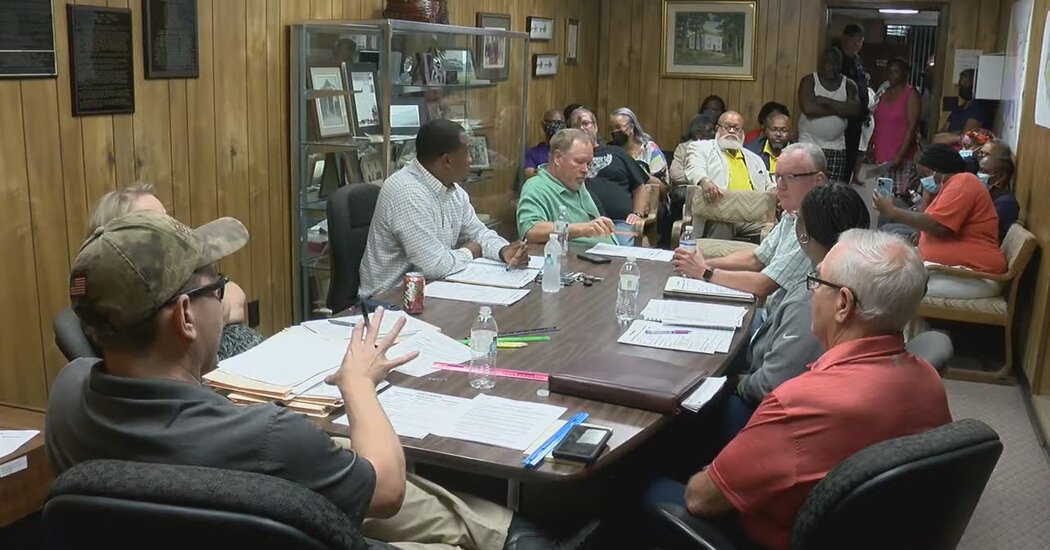
A small city in Alabama moved this week to disband its three-member police force after one of them sent a racist text message that then circulated on social media.
Pending an investigation into the text message, the City Council in Vincent, Ala., suspended the police chief and assistant chief at a meeting on Thursday and moved to dissolve the department, the mayor, James Latimer, said on Saturday. After that decision, the remaining member of the department resigned, the mayor said.
After the suspensions and resignations, the Shelby County Sheriff’s Office said in a statement on Friday that it was handling law enforcement emergency calls for the city. The statement added that officials at the Sheriff’s Office “equally condemn” the allegations of misconduct.
The city, which is about 30 miles southeast of Birmingham, has a little under 2,000 residents, 392 of them Black, according to census figures.
“This has turned this community apart,” a member of the City Council, Corey Abrams, said at the meeting, according to AL.com, which reported this week on the text message. Mr. Latimer said the assistant chief, John L. Goss, had sent the message, an offensive remark about slavery.
The Rev. Kenneth Dukes, the president of the Shelby County branch of the NAACP, said that the text was the “tip of the iceberg” and reflected unaddressed community concerns about racism in the community.
“I think now the Council, along with the mayor, see that this is totally unacceptable and that the people have said, ‘No more,’” he said.
Mr. Latimer said that the police chief, James Srygley, and Chief Goss had been suspended with pay at the council meeting on Thursday. An officer, Lee Carden, resigned. The council approved a resolution to pursue the termination of the chief and assistant chief, the mayor said.
Chiefs Srygley and Goss and Officer Carden could not be reached for comment on Saturday.
The council also agreed to draft an ordinance to dissolve the police department and to work with the Shelby County Sheriff’s Office to contract for law enforcement coverage.
The Rev. Dukes said his organization planned to meet with community members in the coming weeks to hear their feedback before the next City Council meeting on Aug. 16. He said he appreciated the city’s quick response to the text message allegation and was waiting to see if the chief and assistant chief would be terminated in keeping with the Council’s recommendation.
“I think at this moment we are pleased with the outcome and hopefully everybody will move forward, once it’s confirmed,” he said.
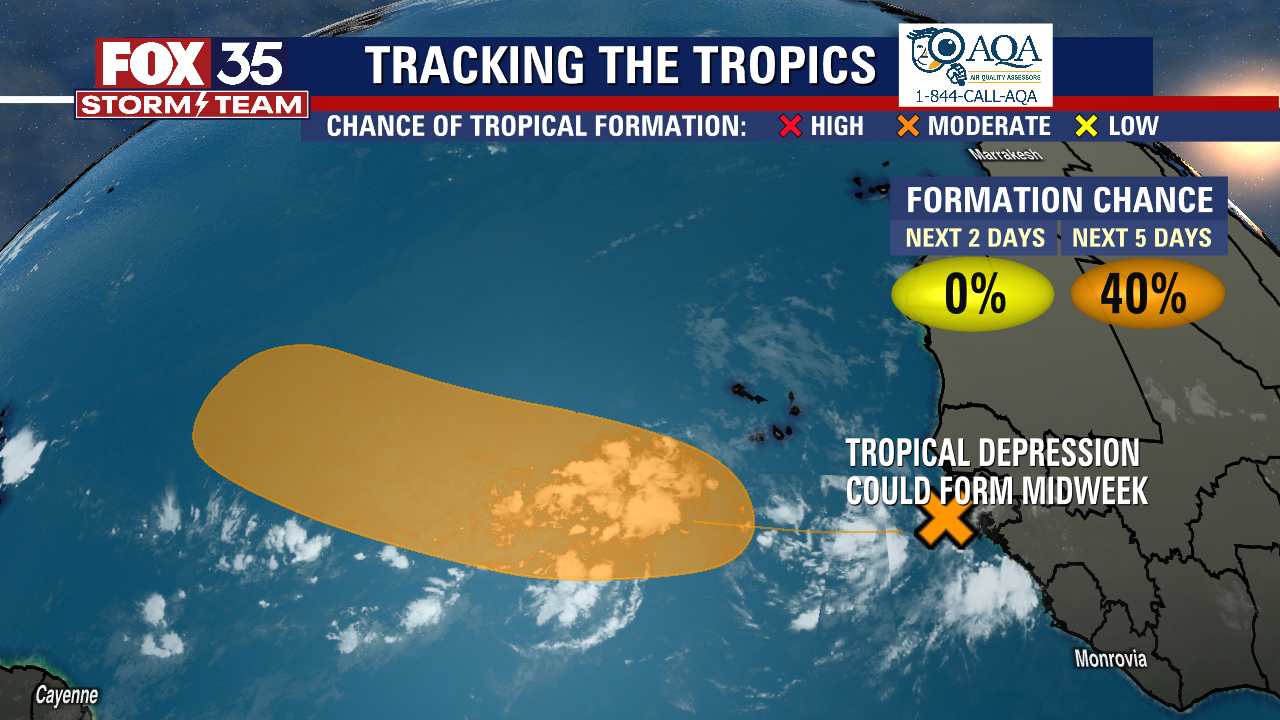
ORLANDO, Fla. – The National Hurricane Center is watching a tropical wave for possible development after weeks of silence in the Atlantic.
The wave is located off the west coast of Africa and is producing disorganized showers and thunderstorms over the far eastern tropical Atlantic, according to the NHC.
“Environmental conditions appear generally conducive for gradual development of this system while it moves westward to west-northwestward at 15 to 20 mph across the eastern and central tropical Atlantic, and a tropical depression could form around the middle part of this week.”
The area has a 40% chance of development over the next five days and could potentially become a tropical depression by mid-week.
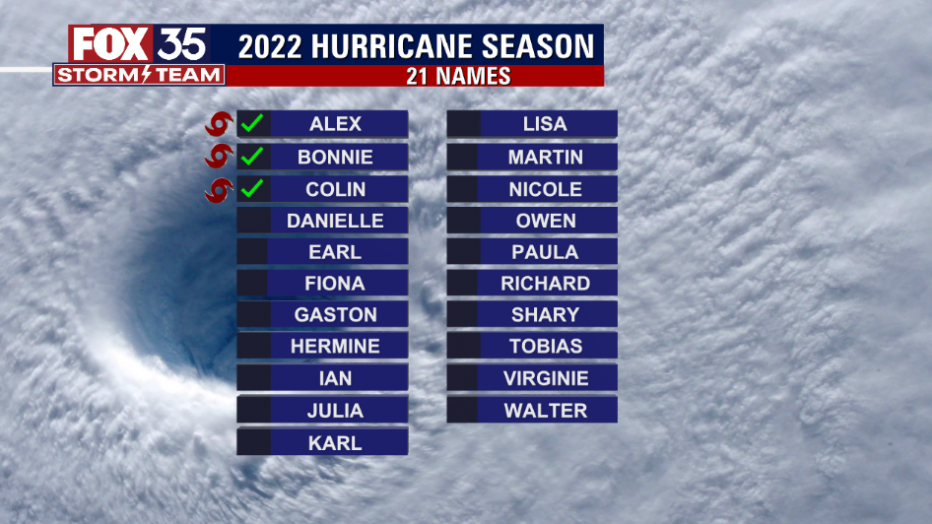
“If it were to become anything, this would be Danielle,” FOX 35 Storm Team Meteorologist Ian Cassette said.
There has been no major hurricane to form this season, just three tropical storms: Alex, Bonnie, and Colin, and even though this is less active than past seasons, it is on schedule for an average season.
MORE NEWS:
VIDEO: Florida deputies rescue 6-foot shark caught in crab trap
81-year-old Florida man shot after firing at officers in Clermont, police say
Nurses sue Florida hospital alleging they were not warned of active shooter drill, and thought it was real
We are now moving closer to the peak of hurricane season, which is Sept. 10, and roughly 90% of tropical activity occurs after Aug. 1. Therefore, both NOAA and Colorado State remain confident in their predictions.
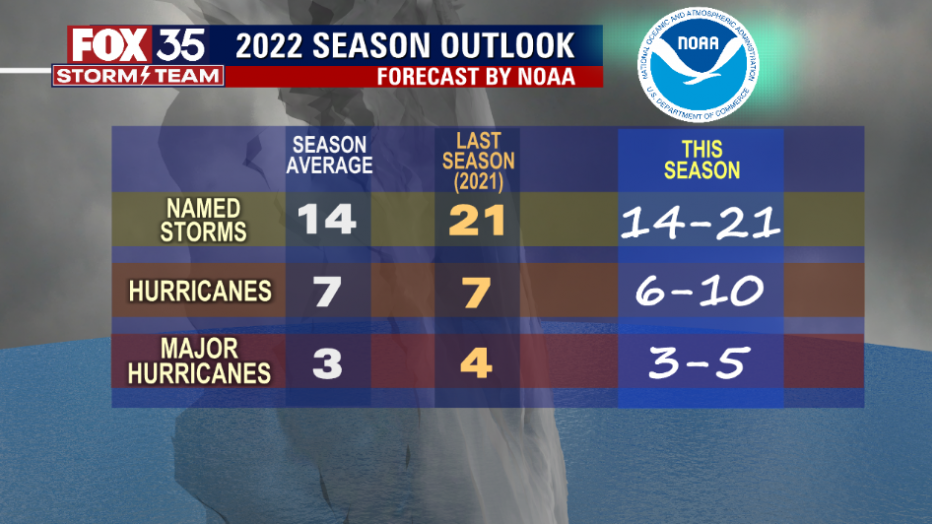
The experts at Colorado State University and the National Oceanic and Atmospheric Administration released their updated 2022 Atlantic hurricane season outlooks Thursday. Both organizations decreased the forecast number of named storms from what they initially predicted in earlier outlooks, but they say you should still prepare for an active season.
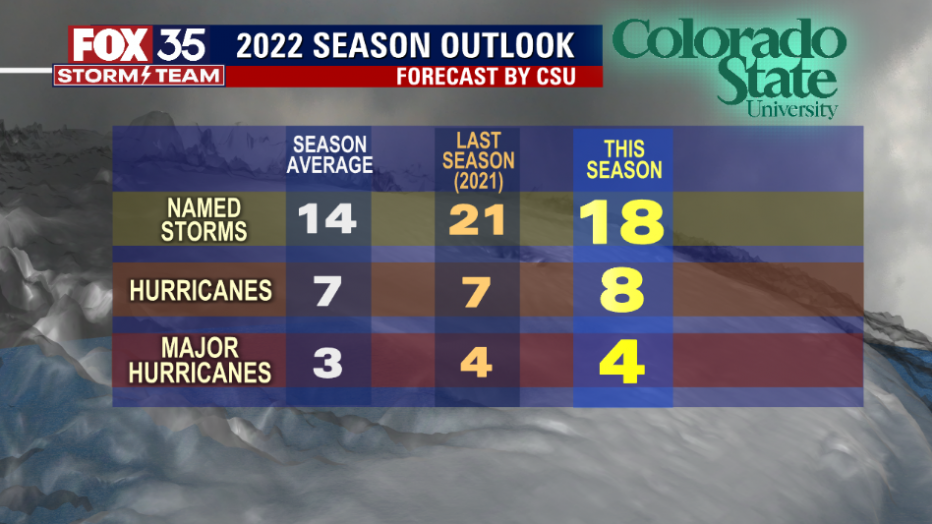
CSU is still expecting an above-average season with 18 named storms, eight of which could become hurricanes with winds of at least 74 mph. Experts say out of the hurricanes, four of them could be major (Category 3 or higher) with winds of at least 115 mph.
NOAA expects a similar outcome to the Atlantic hurricane season, predicting 14 to 20 named storms, six to 10 hurricanes and three to five major hurricanes, which is a slight decrease from its initial outlook in May.
Make sure you have the FOX 35 Storm Team App downloaded and ready to receive daily forecasts and to be the first to know when severe weather is coming to your area.
As the US Senate kicked off its budget reconciliation Vote-a-rama Saturday night, one senator used a few moments to highlight Rep. Jackie Walorski and members of her staff, who died in a car accident this week.
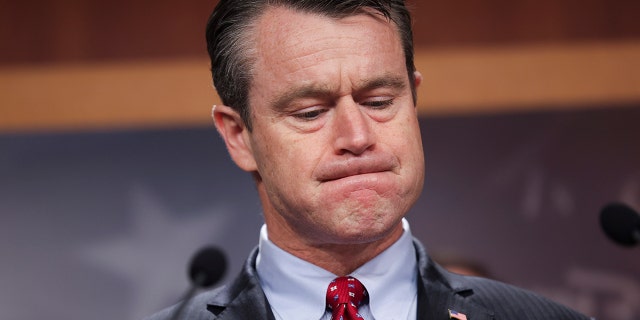
“Mr. President, I rise today to honor the lives of four Hoosiers were tragically lost in a car accident this week,” said Sen. Todd Young, R-IN, before the Senate chamber.
He then named Walorski, 58, communications director Emma Thomson, 28, and district director Zachary Potts, 27, who were killed in a head-on collision Wednesday in Elkhart County, Indiana. Edith Schmucker, 56, the sole occupant of the other vehicle, was also killed in the collision.
“We grieved them all and we prayed for their family and friends,” Young said. “Like everyone here and back home in Indiana, I’m absolutely heartbroken.”
FUNERAL FOR REP. JACKIE WALORSKI SET FOR THURSDAY
“This is, of course, a profoundly difficult time for those of us who knew one or more of these Hoosiers, it’s such a difficult time for their families and their friends and all of us,” he added.
“I think one thing that hit everyone particularly hard was the loss of two young congressional staff members, whether you knew Zach or Emma personally or not, you certainly know their type. If you’re watching these proceedings from Capitol Hill, you know the type of hardworking, smart, committed young person who comes to work on a congressional staff. They dedicate so much of their time, their talents, and other opportunities are given up in order to serve their country.”
INDIANA GOP CONGRESSWOMAN JACKIE WALORSKI KILLED IN CAR CRASH
“We should celebrate their accomplishments while we grieve their losses. It’s a reminder, I think, for all of us to thank the many congressional staff members who do much more than the public will ever know,” Young continued.
Young also recognized his colleague, who said he had “infectious” confidence and “could light up a room.”
“Jackie knew that she belonged here. Jackie understood that this was her calling,” he said. “She did n’t need people to tell her that she belonged but she got right to work because she she had some things to accomplish.”
REPUBLICANS, DEMOCRATS REACT TO REP. WALORSKI’S TRAGIC CAR CRASH DEATH: ‘JUST THE WORST NEWS’
“Her confidence was infectious. Everyone saw it. Everyone was impressed by it. People love being around her and including me,” Young added. “Jackie had so many other amazing qualities.”
US Sen. Todd Young, R-IN, speaks on the economy during a news conference at the US Capitol on May 04, 2022 in Washington, DC. (Kevin Dietsch/Getty Images)
He continued: “She was always so full of energy. She was a lightning bolt. She could light up a room like no other. She was high-spirited and full of fire. And Jackie also had a really big heart.”
Young also described Walorski as a “larger-than-life figure” who “inspired motivated and people.”
CLICK HERE TO GET THE FOX NEWS APP
“It’s not too much to say that Jackie’s last breath was spent in service, in service to her constituents, to her God, to the great state of Indiana and to her country,” he concluded.
Walorski’s funeral will be held on Aug. 11 at 11 am ET at Granger Community Church in Granger, Indiana.
After the 2020 election, Americans were clear: they wanted a viable third political party.
In modern US history the country has been dominated by the Republican and Democratic parties almost to the exclusion of all others, effectively creating a near two-party monopoly on power in the White House, Congress and the state level.
Other parties, like the Reform party, the Greens or the Libertarians have never really broken through. In 2021, as the fallout from the 2020 election continued, polling showed widespread support among Americans for a fresh third party that would offer something different from the status quo. Even a majority of self-identified Republicans said they wanted a new party in the mix.
This should be prime ground, then, for the Forward party, founded in July by a group of self-defined centrists including the former Democratic presidential candidate Andrew Yang and former Republican New Jersey governor Christine Todd Whitman.
People wanted a new third party, and they have been given one – one that has boasted of already raising more than $5m. So what are the chances of Yang and co winning office, and holding forth on the floors of the US Capitol?
“Slim to none,” says Marjorie Hershey, professor emeritus of political science at Indiana University Bloomington. “With an emphasis on none.”
Third parties face resource problems, for one thing. Forward’s $5m pales in comparison with the $1bn Joe Biden raised from donors during his 2020 election campaign.
Donald Trump raised $774m from donors, according to Open Secrets, while data from the Federal Election Commission shows that House and Senate candidates raised $4bn between 1 January 2019 and 31 December 2020, spending $3.8bn.
The two dominant parties also have huge structural advantages: mailing lists, email addresses, existing supporters and name recognition, things that have taken decades to build.
A more fundamental issue is that the US election system just isn’t set up to accommodate a third party.
The first-past-the-post system, in which one person is elected in each congressional district, means that a third party could, in theory, win 49% of the vote in a given area, and it would count for nothing if their opponent wins more.
Forward, which launched on 23 July, was formed from three existing political groups: Renew America Movement, made up of dozens of former Republican administration officials; the Forward party, which was founded by Yang after his failed bid to become the Democratic party’s nominee for New York City Mayor; and the Serve America Movement, a centrist group of Democrats, Republicans and independents.
“The rigid, top-down, one-size-fits-all platforms of the outdated political parties are drifting toward the fringes, making solutions impossible,” Forward’s website reads.
“We stand for doing, not dividing. That means rejecting the far Left and far Right and pursuing common ground.”
The party’s mission: “Not left. Not right. FORWARD,” as its slogan lays out, is a noble one. But there are doubts about what a centrist party might actually look like and stand for.
“There are a lot of people who would consider themselves moderate or centrist, who disagree very strongly with other people who consider themselves moderate or centrist. It’s not one group,” Hershey said.
The Forward party is yet to lay out a detailed platform. But once it does set out its positions on divisive issues like abortion, social security and tax cuts, Hershey said, “some of that middle is going to disagree with other parts of that middle, and the so-called huge middle is no longer huge.” .”
In a statement, the Forward party said it “can’t be pegged to the traditional left-right spectrum because we aren’t built like the existing parties.
“The glue that holds us together is not a rotten ideology, it is a shared commitment to actually solving problems. The hunger for that simple but revolutionary kind of politics is immense.”
In terms of how it will compete with Democrats and Republicans, the party said it “isn’t looking to drop a billion dollars in a 2024 presidential race”.
Instead, it will focus on gaining ballot access and recruiting candidates to run in races across the country.
“That takes money,” Forward said. “But more than money it takes people, and we are rich with them.”
Forward is less than two weeks old, but has already attracted a good deal of both cynicism and criticism, not least for the false equivalency it deployed when describing the need for a third party.
In an op-ed in the Washington Post titled “Most third parties have failed. Here’s why ours won’t,” Yang, Whitman and David Jolly, another co-founder who was previously a Republican congressman from Florida and executive chairman of the Serve America Movement, appeared to offer disingenuous arguments for why their efforts were required.
Ross Perot, center, takes part in a 1992 presidential debate as a third-party candidate alongside Bill Clinton, left, and George Bush. Photograph: Mark Cardwell/Reuters
On guns, Forward suggested that most Americans are “rightfully concerned by the far right’s insistence on eliminating gun laws”, but “don’t agree with calls from the far left to confiscate all guns and repeal the Second Amendment”.
As Andrew Gawthorpe, a historian of the United States at Leiden University and host of the America Explained podcast, wrote in the Guardian:
“These two things are not the same: the first is what is actually happening in America right now, whereas the second is a view that was attributed to Kamala Harris as part of a fabricated smear on Facebook and enjoys approximately zero support in the Democratic party .”
Third parties can have an impact, said Bernard Tamas, associate professor of political science at Valdosta state university and author of The Demise and Rebirth of American Third Parties: Poised for Political Revival?. But there’s usually a pretty specific formula.
“It’s always built on outrage,” Tamas said. “It has to be where the public is galvanized.”
Tamas pointed to the Progressive party, founded in 1912. That party, led by former president Theodore Roosevelt, advocated for child labor laws and the establishment of improved working conditions, including and eight-hour working day and “one day’s rest in seven” for workers.
Roosevelt, who was shot during his campaign, won 27.4% of the vote, besting William Howard Taft, the incumbent Republican, but losing to the Democrat Woodrow Wilson. But progressive reforms were eventually introduced.
“What they have historically done successfully could be described with an analogy of ‘sting like a bee’,” Tamas said.
“They emerge, really often quite suddenly, and they attack the two parties [and] they effectively pull voters away from them.
“And the two parties then respond, and in critical moments, they respond by trying to take away these issue bases, whatever is making the third party successful. They take those away, the major party changes, and then effectively the third party dies.”
Forward, which has pledged that it will reflect “the moderate, common-sense majority”, has plenty of people skeptical as to whether it can sting like a bee – let alone do more and actually elect candidates.
“The way that they’re presenting themselves, it may not have the galvanizing message,” Tamas said.
“Simply saying: ‘Hey, you know, let’s all get together and work together’ is barely something that gets people running on the streets protesting.”
Over-the-Rhine bar owner recounts moments people sought shelter during mass shooting
Updated: 8:43 AM EDT Aug 7, 2022
THE CASE AS WE GET MORE INFORMATION. WE APPRECIATE THE REPORT. WITNESSES OF THE SHOOTING OBVIOUSLY SHAKEN UP. PEOPLE ON SOCIAL MEDIA SAY THEY HAVE NEVER SEEN A POLICE PRESENCE LIKE THIS DOWN IN THE OVER-THE-RHINE AREA. MEREDITH STUTZ HAS BEEN TALKING WITH WITNESSES AND YOU HAVE SURVEILLANCE VIDEO IN THE MOMENTS AFTER THE SHOOTING WHEN, AS RICHARD WAS EXPLAINING IT, IT WAS ESSENTIALLY CHAOS. MEREDITH: IT WAS CHAOS BECAUSE IT WENT FROM A COMFORTABLE SATURDAY NIGHT, EVERYONE ENJOYING THE TIME OUT IN OTR HERE ON MAIN STREET, AND THEN THOSE SHOTS RANG OUT. THIS WAS JUST ONE SPOT WHERE PEOPLE HAD COME TO ENJOY THE SATURDAY NIGHT. THE OWNER TELLS ME THAT SHE HEARD SOMEWHERE AROUND 30 SHOTS RING OUT IN TWO DIFFERENT TIMES. ABOUT 10 SHOTS AND THEN LATER, 20 SHOTS. AS RICHARD WAS TALKING ABOUT, THAT IS WHEN PEOPLE JUST STARTED RUNNING, TRYING TO FIND SAFETY. THEN, TRYING TO RUN FOR COVER. A LOT OF PEOPLE ENDED UP RUNNING INTO YEAR. PEOPLE GRABBING THE HANDS OF THEIR LOVED ONES, JUST TRYING TO FIND THE NEAREST DOOR TO GET OFF OF MAIN STREET HERE AND TRIED TO GET TO SHELTER. AND HOW CRAZY IS THIS — WE WERE TALKING WITH THE OWNER WHO TELLS US THAT AMONG THE PEOPLE WHO SOUGHT COVER INSIDE THE BAR HERE AT THE HUB WAS A WEDDING PARTY. SO YOU HAD A BRIDE IN A WEDDING DRESS ALL OF THE SUDDEN SEEKING SHELTER BECAUSE OF MULTIPLE SHOTS RING OUT ON THE DAY OF THEIR WEDDING. NOT ONLY IS THIS DEVASTATING FRUSTRATING, IS INFLURIATING. INCLUDING FOR BUSINESS OWNERS AND BARS HERE. THE OWNER HERE TOLD ME THAT OUT OF HER FRUSTRATION AND CONCERN, SHE TRAINS HER STAFF TO BE ABLE TO BE ADVOCATES FOR SAFETY. WHO IS COMING INTO THE BAR, WHAT IS GOING INTO THE DRINKS, BUT NOW HAVING TO TRAIN WHAT TO DO IF THERE IS AN ACTIVE SHOOTER. HOW DO YOU COMFORT PEOPLE? ALL OF A SUDDEN, YOU HAVE THIS MIND SHIFT OF JUST A FEW MOMENTS, A FEW SECONDS WHERE EVERYTHING CHANGES. WE HAVE A CLIP WE WANT TO SHARE WITH YOU FROM A CONVERSATION WITH THE OWNER OF WHAT SHE SAW THIS MORNING WHEN THOSE SHOTS RANG OUT. TAKE A LISTEN. >> THERE WAS PROBABLY ABOUT 25-30 SHOTS FIRED OFF IN TWO SEPARATE ROUNDS. FIRST WHERE IT WENT BANG BANG BANG, AND THEN WE HEARD BANG BANG BANG, AND THAT IS WHEN EVERYONE STARTED RUNNING INSIDE OF WHERE YOU COULD GO. I MADE SURE EVERYONE WAS INSIDE AND I WALKED UP THE STREET TO SEE WHAT HAPPENED AND THERE WAS OF COURSE, MORE SHOOTING VICTIMS. I’M NOT SURE HOW MANY. >> IF YOU CAN, WHAT DID YOU SEE WHEN YOU SAW THE VICTIMS? >> I SAW TWO MEN LAYING ON THE GROUND, KIND OF HOLDING THEIR LEGS, SHOT IN THE LEGS. THERE WAS ANOTHER MAN SITTING IN A CHAIR WHO SEEMED TO BE UNABLE TO MOVE. ANOTHER MAN ON THE GROUND. I’M PRETTY SURE THEY WERE GIVING HIM CHEST COMPRESSIONS, SOMEBODY WAS OVER HIM. I WENT BACK DOWN THERE MAYBE 15 MINUTES LATER TO TRY TO WALK SOMEBODY HOME DOWN THE STREET, AND EVERYTHING WAS ROPED OFF OR TAPED OFF TO TRY TO GET MORE TAPE. THEY RAN OUT OF TAPE. THAT IS WHEN THE MAN IN THE CHAIR HAD TO BE LIFTED OUT OF THE CHAIR AND INTO AN AMBULANCE, HE DID NOT REALIZE HE HAD BEEN SHOT. >> WHAT WAS THAT LIKE? >> TO LOT. MEREDITH: WE KNOW IT WOULD BE A LOT, UNDERSTANDABLY SO. YOU’RE JUST TRYING TO ENJOY A NIGHT WITH YOUR FRIENDS, AND THEN ALL OF THIS HAPPENS. AND A LOT HAPPENED IN JUST A MATTER OF SECONDS. SO AS YOU JUST HEARD, SHE WAS TALKING ABOUT SEEING THOSE VICTIMS JUST LAYING ON THE GROUND, AND SHE SAYS THAT SHE HAS BEEN HERE FOR 10 YEARS, AND SHE HAS NEVER SEEN VIOLENCE LIKE THIS. IT IS JUST SO DEVASTATING AND FRUSTRATING BECAUSE SHE ULTIMATELY SAYS THAT WITH THIS WEEKEND, WHAT IS GOING TO HAPPEN NEXT WEEKEND? JUST THAT FRUSTRATION OF BUSINESS OWNERS AND STAFF MEMBERS SAYING WHAT KIND OF ENVIRONMENT ARE WE WORKING IN AND LIVING IN, BUT INVITING CUSTOMERS TO COME DOWN AND ENJOY DOWNTOWN CINCINNATI IN? PEOPLE ARE JUST UNDERSTANDABLY DEVASTATED. THE SOUNDS OF GUNFIRE WILL STAY WITH THEM FOR DAYS IF NOT LONGER IN ADDITION TO THE FOLKS WHO, UNFORTUNATELY, WERE INVOLVED IN THE SHOOTINGS, EITHER INTENTIONALLY OR UNINTENTIONALLY AND NOW HAVE SUFFERED WOUNDS FROM THIS. WE CONTINUE THAT CONVERSATION WITH LINDSAY EVEN BETWEEN SHOTS AND SHE WAS TELLING ME THAT SHE HEARD THAT POTENTIAL INJURIES OF SOMEONE. SHE ALSO TOLD A SHE RECEIVED A PHONE CALL THAT’S OF A FAMILY FRIEND HAD BEEN INJURED. IT IS NOT JUST THAT WE HEARD ABOUT IT OR READ ABOUT IT, WE KNOW SOMEONE. IS THAT FRUSTRATION AND FEAR AND SADNESS THAT COMES WITH THESE TYPE OF SHOOTINGS AND JUST TRYING TO FIGURE OUT ANSWERS BUT ALSO TRYING TO FIGURE OUT WHAT WE DO, WHAT IS BEING DONE TO PREVENT A SHOOTING LIKE THIS AND WHAT OUR INDIVIDUAL PEOPLE DOING TO PREVENT SOMETHING LIKE THIS HAPPENING AGAIN EVEN NEXT WEEK IN? KELLY: WE COULD SEE LINDSAY GETTING EMOTIONAL, UNDERSTANDABLY SO. AS YOU JUST MENTIONED, THE GROUP OF BARS, RESTAURANTS, BUSINESSES DOWN THERE, THAT IS A FAMILY. THEY ALL SEEM TO LOOK OUT FOR EACH OTHER. IT IS A TIGHTKNIT GROUP, NOT KNOWING SOMEONE WHO IS POTENTIALLY INJURED IN THE SHOOTING. MEREDITH: SHE WAS SHARING THAT WHILE WE WERE WATCHING THE FOOTAGE, SAYING THAT YOU HAVE COWORKERS WHO WORK AT DIFFERENT BARS, EVERYBODY HAS POTENTIALLY SEVERAL JOBS, AND THEN YOUR PHONE IS BEING BLOWN UP BY ASKING A SIMPLE QUESTION THAT YOU NEVER THOUGHT YOU WOULD RECEIVE : ARE YOU ALIVE? SHE WAS SHARING JUST HOW EMOTIONAL SHE WAS THINKING WHAT IS MY MOM GOING TO WAKE UP TO TOMORROW? IS SHE GOING TO THINK THAT HER DAUGHTER WAS HURT WHILE JUST GOING TO WORK LAST NIGHT? THOSE REAL-TIME CONSEQUENCES AND REALITIES. THERE WAS A SHOOTING, AND THEN THOSE RIPPLE EFFECTS JUST START. I KIND OF FRUSTRATION AND ANGER MIXED WITH SADNESS OF JUST NORMAL PEOPLE AND FAMILIES JUST TRYING TO ENJOY A SATURDAY NIGHT. BACK TO YOU. KELLY: INCREDIBLY BUSY TIME OF THE NIGHT. TO REITERATE WHAT RICHARD HAD MENTIONED, AT THIS POINT, ALL INJURIES SEEM AS IF THEY ARE NON-LIFE-THREATENING. THAT IS STILL BEI
Over-the-Rhine bar owner recounts moments people sought shelter during mass shooting
Updated: 8:43 AM EDT Aug 7, 2022
Witnesses of Sunday morning’s shooting in Over-the-Rhine are shaken up, with many telling WLWT they’ve never seen such a large police presence in the area.It very quickly went from a comfortable Saturday night, the rain had cleared and people were enjoying their night out to a night of chaos and confusion. At The Hub on Main Street, a video premier was being hosted at the time the shots began to ring out. Lindsey Swadner, owner of The Hub, tells WLWT that she heard somewhere around 30 shots ring out in two different time periods; about 10 shots, then a few seconds later, about 20 shots. She says after that, that’s when the chaos erupted. People began to run and find safety moments after they were enjoying a night out with friends and family. The Hub became a safe haven, with multiple people running inside to seek cover and safety.” There was probably about 25 to 30 shots fired off in two separate rounds.You had first where it went ‘bang, bang, bang, bang,’ we all start looking around going, ‘Was it over?’ And then you heard ‘bang, bang, bang, bang’ and everyone started running inside of wherever you could go,” Swadner recalled. “And so we started pulling people inside. I made sure everyone was inside, I walked up the street to see what happened and there was, of course, more shooting victims, I’m not sure how many.” people seeking cover inside The Hub was a wedding party.”I saw two men laying on the ground, kind of holding their leg, so, shot in the legs. There was another man who was sitting in a chair and he seemed to be unable to move,” Swadner added. “There was another man on the ground, I’m pretty sure they were giving him chest compressions or somebody was over him. I went back down there, maybe 15 minutes later, to try to walk somebody home down the street. Everything was roped off, or taped off. They were trying to get them more tape, they ran out of tape, and that’s when the man in the chair had to be lifted out of the chair not realized he had been shot.”
CINCINNATI—
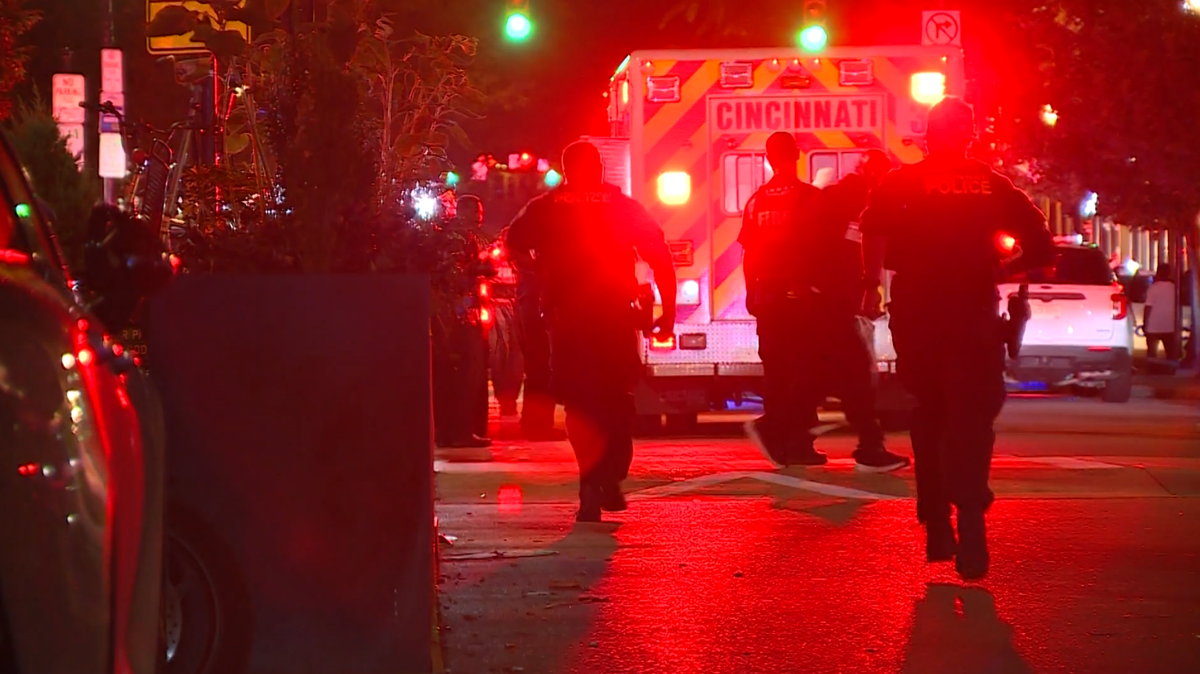
Witnesses of Sunday morning’s shooting in Over-the-Rhine are shaken up, with many telling WLWT they’ve never seen such a large police presence in the area.
It very quickly went from a comfortable Saturday night, the rain had cleared and people were enjoying their night out to a night of chaos and confusion.
At The Hub on Main Street, a video premiere was being hosted at the time the shots began to ring out.
Lindsey Swadner, owner of The Hub, tells WLWT that she heard somewhere around 30 shots ring out in two different time periods; about 10 shots, then a few seconds later, about 20 shots. She says after that, that’s when the chaos erupted. People began to run and find safe moments after they were enjoying a night out with friends and family.
The Hub became a safe haven, with multiple people running inside to seek cover and safety.
“There was probably about 25 to 30 shots fired off in two separate rounds. You had first where it went ‘bang, bang, bang, bang,’ we all start looking around going, ‘Was it over?’ And then you heard ‘bang, bang, bang, bang’ and everyone started running inside of wherever you could go,” Swadner recalled. “And so we started pulling people inside. I made sure everyone was inside, I walked up the street to see what happened and there was, of course, more shooting victims, I’m not sure how many.”
She added that among the people seeking cover inside The Hub was a wedding party.
“I saw two men laying on the ground, kind of holding their leg, so, shot in the legs. There was another man who was sitting in a chair and he seemed to be unable to move,” Swadner added. “There was another man on the ground, I’m pretty sure they were giving him chest compressions or somebody was over him. I went back down there, maybe 15 minutes later, to try to walk somebody home down the street. Everything was roped off, or taped off. They were trying to get them more tape, they ran out of tape, and that’s when the man in the chair had to be lifted out of the chair not realized he had been shot.”
A few more potential threats loomed at sunrise Sunday, particularly on the legislation’s insulin price cap. But Republicans otherwise made little headway during a legislative endurance run of politically tricky votes on immigration, taxes and other issues.
“I want my colleagues to understand what this is really about. These motions … are motions to kill this bill, period,” said Senate Finance Chair Ron Wyden (D-Ore.).
During the vote-a-rama, Democrats offered alternative amendments to buy some cover for their own vulnerable members on several GOP proposals. That included a side-by-side debate on Title 42, a polarizing Trump-era policy that placed limits on migration during the pandemic.
Democrats also rejected amendments from within their own caucus during overnight voting. Sen. Bernie Sander (I-Vt.) tried to insert provisions that would bolster prescription drug reforms, expand Medicare and create a Civilian Climate Corps, but he failed to attract support from the vast majority of his colleagues. Only Georgia Sens. Raphael Warnock and Jon Osoff joined Sanders in his effort to expand Medicare.
The vote-a-rama is the final episode of a lengthy drama that began more than a year ago with a Democratic budget designed to set the stage for a $3.5 trillion social spending package that could sidestep a filibuster. That vision for whittled down over the course of many months to the bill that the Senate is still set to pass later Sunday.
Democrats warned against making significant changes during the all-night Senate session, arguing that it was time to pass the bill after roughly a year of high-profile haggling that shined a spotlight on divisions between progressives and moderates.
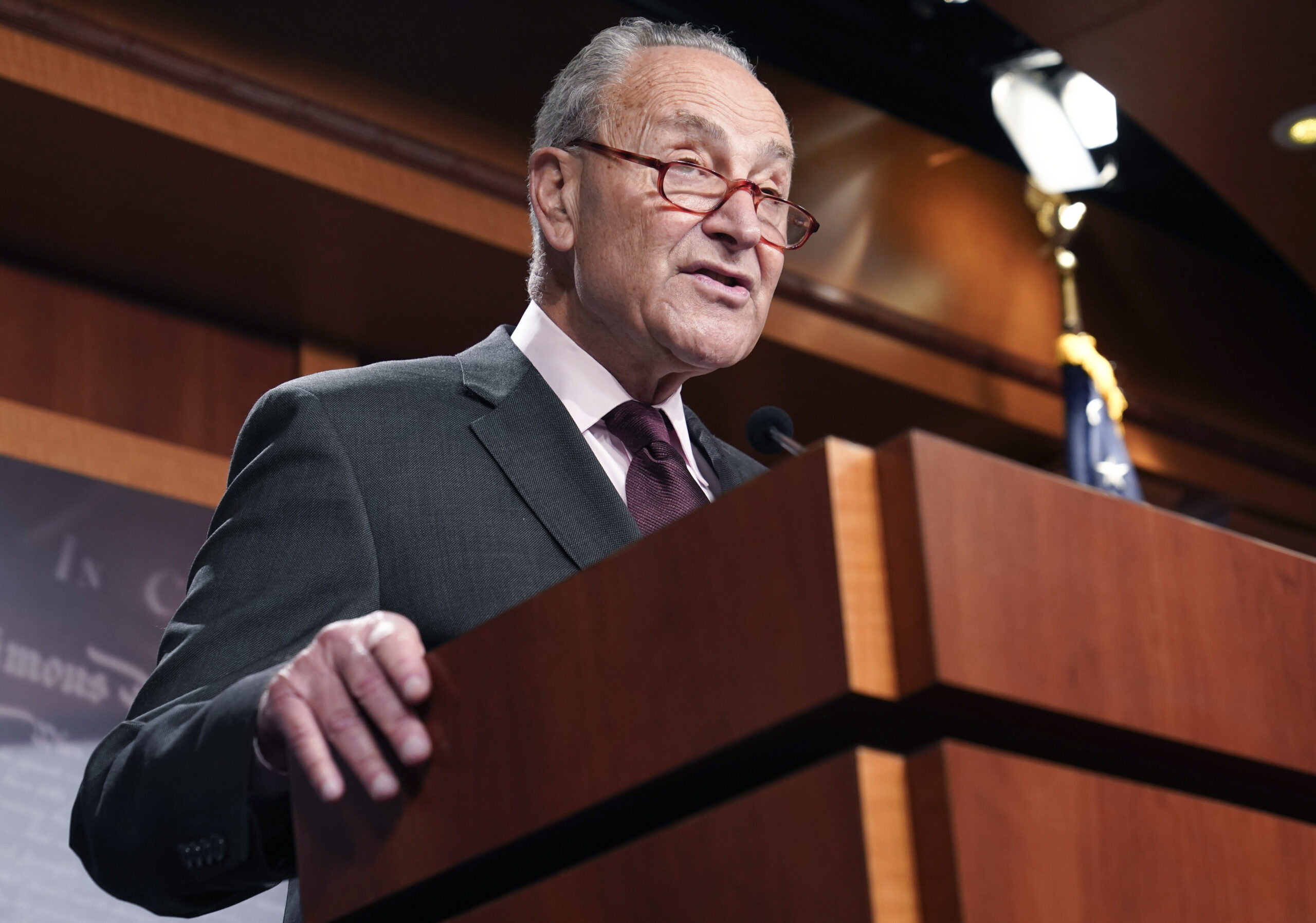
The final bill was carefully negotiated to be able to win support from all 50 members of the Senate Democratic caucus. Sen. Joe Manchin (DW.Va.) surprised his colleagues late last month when he reached a deal with Majority Leader Chuck Schumer on tax and climate provisions as part of the agreement.
Before that Schumer-Manchin pact, Democrats had expected to pass a much smaller health care-only package to reduce drug costs and extend Affordable Care Act subsidies.
The deal struck by Schumer and Manchin kicked off a dayslong race to sell it to the rest of the caucus and vet the legislative text against stringent Senate budget rules that Democrats must obey to pass their bill without a GOP filibuster. Sen. Kyrsten Synema (D-Ariz.) later secured a handful of changes in exchange for her support to start debate.
Schumer made a handful of major changes to appease Sinema, eliminating language that would have tightened a loophole allowing certain investors to pay less in taxes that would have raised $14 billion in revenue. Instead, the pair agreed to add a 1 percent excise tax on stock buybacks, which is expected to raise $73 billion, while tweaking the corporate minimum tax to appease anxious manufacturers.
The bill could still change before it crosses the Senate’s finish line, however.
Democrats are still facing a Republican challenge to their proposed $35 monthly cap on what people pay out-of-pocket for insulin, a plan championed by Warnock. Republicans have argued that the provision does not comply with Senate budget rules.
The Senate parliamentarian, or the upper chamber’s rules referee, could decide in real time whether the insulin provisions should stay or go.
If the parliamentarian rules against it, Democrats are expected to try to muster 60 votes to overrule the decision and keep it in the bill. That would require finding support from 10 Republicans, which they’re not expected to get.
“I need them to not block it,” Warnock said of Republicans. “If they don’t block it, it will pass.”
The outcome of the insulin provision was the biggest question mark as the hourslong voting marathon stretched into Sunday.
On Saturday, the party-line proposal survived Senate vetting of the Medicare portions of its prescription drug reform plan, while Democrats lost ground on a separate pillar that penalizes drug companies for raising prices on individuals with private health insurance. The legislation’s tax and environmental provisions also advanced unscathed.
Democrats ultimately preserved the core pieces of their proposal: lowering some prescription drug prices, providing more than $300 billion into climate change and clean energy and imposing a 15 percent minimum tax on large corporations, plus a new 1 percent excise tax on stock buybacks. The bill also increases IRS enforcement and extends Obamacare subsidies through the 2024 election.
A few more potential threats loomed at sunrise Sunday, particularly on the legislation’s insulin price cap. But Republicans otherwise made little headway during a legislative endurance run of politically tricky votes on immigration, taxes and other issues.
“I want my colleagues to understand what this is really about. These motions … are motions to kill this bill, period,” said Senate Finance Chair Ron Wyden (D-Ore.).
During the vote-a-rama, Democrats offered alternative amendments to buy some cover for their own vulnerable members on several GOP proposals. That included a side-by-side debate on Title 42, a polarizing Trump-era policy that placed limits on migration during the pandemic.
Democrats also rejected amendments from within their own caucus during overnight voting. Sen. Bernie Sander (I-Vt.) tried to insert provisions that would bolster prescription drug reforms, expand Medicare and create a Civilian Climate Corps, but he failed to attract support from the vast majority of his colleagues. Only Georgia Sens. Raphael Warnock and Jon Osoff joined Sanders in his effort to expand Medicare.
The vote-a-rama is the final episode of a lengthy drama that began more than a year ago with a Democratic budget designed to set the stage for a $3.5 trillion social spending package that could sidestep a filibuster. That vision for whittled down over the course of many months to the bill that the Senate is still set to pass later Sunday.
Democrats warned against making significant changes during the all-night Senate session, arguing that it was time to pass the bill after roughly a year of high-profile haggling that shined a spotlight on divisions between progressives and moderates.
The final bill was carefully negotiated to be able to win support from all 50 members of the Senate Democratic caucus. Sen. Joe Manchin (DW.Va.) surprised his colleagues late last month when he reached a deal with Majority Leader Chuck Schumer on tax and climate provisions as part of the agreement.
Before that Schumer-Manchin pact, Democrats had expected to pass a much smaller health care-only package to reduce drug costs and extend Affordable Care Act subsidies.
The deal struck by Schumer and Manchin kicked off a dayslong race to sell it to the rest of the caucus and vet the legislative text against stringent Senate budget rules that Democrats must obey to pass their bill without a GOP filibuster. Sen. Kyrsten Synema (D-Ariz.) later secured a handful of changes in exchange for her support to start debate.
Schumer made a handful of major changes to appease Sinema, eliminating language that would have tightened a loophole allowing certain investors to pay less in taxes that would have raised $14 billion in revenue. Instead, the pair agreed to add a 1 percent excise tax on stock buybacks, which is expected to raise $73 billion, while tweaking the corporate minimum tax to appease anxious manufacturers.
The bill could still change before it crosses the Senate’s finish line, however.
Democrats are still facing a Republican challenge to their proposed $35 monthly cap on what people pay out-of-pocket for insulin, a plan championed by Warnock. Republicans have argued that the provision does not comply with Senate budget rules.
The Senate parliamentarian, or the upper chamber’s rules referee, could decide in real time whether the insulin provisions should stay or go.
If the parliamentarian rules against it, Democrats are expected to try to muster 60 votes to overrule the decision and keep it in the bill. That would require finding support from 10 Republicans, which they’re not expected to get.
“I need them to not block it,” Warnock said of Republicans. “If they don’t block it, it will pass.”
The outcome of the insulin provision was the biggest question mark as the hourslong voting marathon stretched into Sunday.
On Saturday, the party-line proposal survived Senate vetting of the Medicare portions of its prescription drug reform plan, while Democrats lost ground on a separate pillar that penalizes drug companies for raising prices on individuals with private health insurance. The legislation’s tax and environmental provisions also advanced unscathed.
Democrats ultimately preserved the core pieces of their proposal: lowering some prescription drug prices, providing more than $300 billion into climate change and clean energy and imposing a 15 percent minimum tax on large corporations, plus a new 1 percent excise tax on stock buybacks. The bill also increases IRS enforcement and extends Obamacare subsidies through the 2024 election.
When Peter Meijer voted to impeach Donald Trump, breaking with nearly all of his Republican colleagues in one of his first acts as a newly elected member of Congress, Democrats praised him as the kind of principled conservative his party – and the nation – desperately needed.
But this election season, as Meijer fought for his political survival against a Trump-endorsed election denier in a primary contest for a Michigan House seat, Democrats twisted the knife and helped his extremist opponent win.
It is part of a risky, and some say downright dangerous, strategy Democrats are using in races for House, Senate and governor: spending money in Republican primaries to elevate far-right candidates over more mainstream conservatives in the hope that voters will recoil from the election-denying radicals in November.
In Michigan, the gamble paid off – for now. Meijer lost after the House Democrats’ official campaign arm spent $425,000to elevate Meijer’s opponent, John Gibbs, a former Trump administration official who asserted, falsely, that Joe Biden’s victory was “simply mathematically impossible”.
It is impossible to know what impact the Democrats’ ad had on the race, but cost more than the Gibbs campaign raised.
Now, as the primary season nears its conclusion and the political battlefield takes shape, Democrats will soon learn whether the gambit was successful. While election deniers have prevailed in Republican primaries across the country without any aid from Democrats, critics say the effort has already undermined the party’s grave warnings about the threats to democracy.
“It is immoral and dangerous,” said Richard Hasen, a UCLA law professor and director of the Safeguarding Democracy Project. He said the risk of miscalculation was great, particularly at a moment when the January 6 committee is attempting to show just how destructive Trump’s stolen election myth has been for American democracy.
“It’s hard for Democrats to take the high road when they’re cynically boosting some of these candidates in order to try to gain an advantage in the general election,” he said. “That doesn’t mean that what Democrats are doing is as bad as what Republicans are doing, but it still makes it objectionable.”
Meijer’s defeat has fueled a sharp debate among Democrats over the potential perils of the tactic, especially as the party warns of the risks posed by these very Republicans. But others argue it’s a necessary and calculated gamble in pursuit of keeping a dangerous party from winning power.
“If you let Republicans back in power, it is going to be those Maga Republicans who are going to take away your rights, your benefits and your freedom,” Congressman Sean Patrick Maloney, chair of the Democratic Congressional Campaign Committee, said, defending the strategy in a recent interview on MSNBC’s Morning Joe. “We need to stop it.”
The president’s party historically loses ground during the midterms. Decades-high inflation and widespread frustration with leaders in Washington have dragged Joe Biden’s approval ratings to record lows, hampering Democrats’ efforts to preserve their razor-thin majorities in Congress.
The ads are ostensibly scripted as an attack – highlighting a candidate’s loyalty to Trump and their conservative views on abortion. In Michigan, for example, Democrats charged that Gibbs was “handpicked by Trump to run for Congress” and “too conservative” for the district. But when aired during a primary, the message is intended to appeal to the conservative base.
“The voters in the Republican primary had agency,” said Bill Saxton, the Democratic party chair in Kent county. “They had two choices.”
Saxton, whose county is situated in the west Michigan district, said it was now time to set aside the bickering over tactics and focus on the real threat: Gibbs’s extremism.
In 2020, Gibbs could not win Senate confirmation to direct Trump’s Office of Personnel Management over past comments he made, among them calling Democrats the party of “’Islam, gender-bending, anti-police, ‘u racist!’”.
Democrats’ efforts to pick their opponents extends far beyond a single Michigan House race. They have deployed this strategy in House, Senate and governor’s races across the country.
In Maryland, the Democratic Governors Association boosted Dan Cox, who attended the January 6 rally and called Vice-President Mike Pence a “traitor” for not stopping the congressional certification of Biden’s victory as Trump wished. He won the party’s nomination for governor. That was after Democrats’ spent millions of dollars to successfully promote the Trump-backed election denier in the Illinois Republican gubernatorial primary. Both states lean Democratic and the party is reasonably confident their candidate will prevail.
Doug Mastriano, an election denier, is the Republican nominee for governor in Pennsylvania. His Democratic opponent of him spent big to support him in the primary. Photograph: Carolyn Kaster/AP
The race causing the most angst is in Pennsylvania battleground. There the Democratic nominee for governor, Josh Shapiro, spent hundreds of thousands of dollars in TV ads boosting the rightwing extremist Doug Mastriano – far more than the candidate spent on his own campaign. Mastriano, who attended the January 6 rally and has cast doubt on the legitimacy of the 2020 election, is now the Republican nominee in a swing state where the chief elections officer is appointed by the governor.
Polls show a tight race.
The strategy hasn’t always worked. In California, the incumbent Republican congressman David Valadao narrowly beat back a rightwing challenger despite Democratic spending on ads that highlighted his vote for him to impeach Trump.
And in Colorado, an outside group aligned with Democrats spent millions to boost an election denier who marched to the Capitol with rioters on January 6 over a relatively moderate Republican, businessman Joe O’Dea, in the race to take on the Democratic Senator Michael Bennet . O’Dea won and now the resources Democrats spent to make him unpalatable to the Republican base may help him appeal to moderate and independent swing voters.
Meddling in the opposition’s primary is not a new tactic. In 2012, Claire McCaskill, then a Democratic senator from Missouri, was facing a difficult re-election in a state where Barack Obama was deeply unpopular.
Surveying her prospective opponents, she devised a plan to lift the one she thought would be the weakest candidate, the far-right congressman Todd Akin. It worked: he won the primary, and she beat him decisively in the general.
But a decade later, she is urging caution.
“This has to be done very carefully,” she told NPR, adding: “You also have to be careful what you wish for.”
Maloney, the DCCC chair, has said the committee has a “high bar” for meddling in a Republican primary, but insisted that there are races where it “does make sense.” Still, it has become an issue for Maloney in his own primary race, where his challenger, Alessandra Biaggi, has accused him of playing “Russian roulette with our democracy”.
Some Democrats have also expressed misgivings about punishing the few Republicans willing to stand up to Trump. David Axelrod, a longtime Democratic strategist and political adviser to Barack Obama, said Democrats’ involvement in Meijer’s primary “makes them an instrument of Trump’s vengeance”.
Trump’s support has been one of the most decisive factors in choosing the party’s standard bearers, not Democrats, said David Turner, a spokesman for the Democratic Governors Association. In these races, he said Democrats seized the opportunity to expose a prospective opponent’s extremism early and pre-emptively blunt any attempt to “pivot” toward the mainstream during the general election.
Turner blamed Republican leaders for being “too cowardly to tell their voters the truth” about the 2020 election, a failure that he said ensured the success of election-deniers in the GOP’s 2022 nominating contests.
In Pennsylvania, one of Mastriano’s chief rivals was Lou Barletta, a signatory to the state’s fake elector scheme. And in Colorado, the candidate deemed more moderate won the Republican primary for governor but then selected an election denier to be her running mate.
“There aren’t any Liz Cheneys running for governor,” he said, referring to the Republican vice chair of the January 6 committee who may lose her primary over efforts to hold Trump accountable. “In terms of gubernatorial candidates, the scary part is that all these Republicans are regurgitating the same Maga talking points.”
Still, some Democrats argue that they are being held to a different standard than Republicans, who have failed to hold Trump and loyalists in Congress accountable. They say Republicans often cheer their leaders for being ruthless while Democrats are criticized for refusing to play hardball, especially when the stakes are the highest.
As a result of gerrymandering, Republican dominance of the redistricting process and historical trends, Democrats see few opportunities to flip House seats this cycle. Michigan’s third congressional district is one of them.
Gibbs has downplayed the impact of the ads, and projected confidence that he can win in November.
Hillary Scholten, the Democrat who will face him in the Michigan House race and had no involvement in the DCCC’s decision, called the focus on her party’s tactics an unwanted distraction from the issues voters care most about.
Scholten said: “It is the Republicans that decided who they wanted in their primary, and they chose John Gibbs, an extremist that embraces conspiracy theories and is way out of step with west Michigan. I’m focused on making sure he doesn’t get to Congress.”
Her newly redrawn Michigan district is considerably more favorable to Democrats this cycle than it was two years ago. And many Democrats believe Scholten, a former justice department attorney in the Obama administration who came close to beating Meijer in 2020, would have been a strong contender in a rematch.
While many are confident she can beat Gibbs, those still haunted by Trump’s against-the-odds victory in 2016 fear that in a “wave” election, Republicans deemed unelectable could be swept to power.
On the eve of his primary race, Meijer lashed Democrats in an online essay that accused them of “selling[ing] out any pretense of principle for political expediency”.
“Republican voters will be blamed if any of these candidates are ultimately elected,” Meijer wrote in an online essay published on the eve of the primary, “but there is no doubt Democrats’ fingerprints will be on the weapon. We should never forget it.”
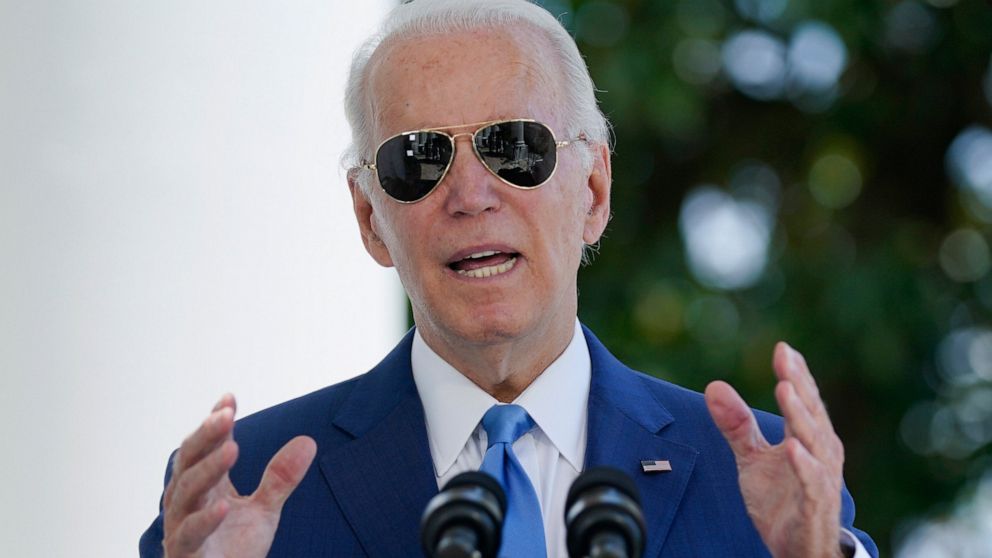
REHOBOTH BEACH, Del. — Ending his most recent COVID-19 isolation, President Joe Biden on Sunday left the White House for the first time since becoming infected with the coronavirus last month, settling in for a meeting with first lady Jill Biden in their home state of Delaware.
The president tested negative Saturday and Sunday, according to his doctor, clearing the way for him to emerge from an isolation that lasted longer than expected because of a rebound case of the virus.
“I’m feeling great,” Biden said before boarding Marine One outside the White House.
The Bidens were expected to spend the day in Rehoboth Beach, a popular vacation destination.
Biden originally tested positive on July 21, and he began taking the anti-viral medication Paxlovid, which is intended to decrease the likelihood of serious illness from the virus. According to his doctor, Biden’s vital signs remained normal throughout his infection, but his symptoms included a runny nose, cough, sore throat and body aches.
After isolating for several days, Biden tested negative on July 26 and July 27, when he gave a speech in the Rose Garden, telling Americans they can “live without fear” of the virus if they get booster shots, test themselves for the virus if they become sick and seek out treatments.
But Biden caught a rare rebound case of COVID-19 on July 30, forcing him to isolate again. He occasionally gave speeches from a White House balcony, such as when he marked the killing of an al-Qaida leader or a strong jobs report.
He continued to test positive until Saturday, when he received his first negative result. While the president was isolating in the White House residence, the first lady remained in Delaware.
The Bidens are scheduled to visit Kentucky on Monday to view flood damage and meet with families.
Police in Albuquerque, New Mexico, are working to determine if the murders of four Muslim men over the past nine months are connected, the latest of which occurred Friday night.
In a news briefing Saturday afternoon with local and federal officials, Albuquerque Police Chief Harold Medina disclosed that a “young man who is part of the Muslim community was murdered.”
The victim’s name and the circumstances of the crime were not immediately provided. However, Medina said the killing is believed to be linked to the previous three, all of which have been described as ambush-style shootings.
“As with the previous three murders we mentioned on Thursday, there is reason to believe this death is related to those shootings,” Medina said.
According to the Albuquerque Journal, 27-year-old Muhammed Afzaal Hussain was shot and killed on Aug. 1, while 41-year-old Aftab Hussein was killed on July 26. Both were from Pakistan and members of the same mosque.
Those followed the November 2021 killing of Mohammad Ahmadi, 62, a Muslim man of South Asian descent. Ahmadi was killed behind a market and cafe he owned with his brother.
Authorities Saturday did not release any suspect information, nor would they confirm if the murders were believed to be hate crimes.
“At this point, we don’t know that,” Albuquerque police spokesman Gilbert Gallego told reporters.
New Mexico State Police, the FBI and the US Marshals Service are among several agencies involved in investigating the killings. Medina said that overtime caps for officers have been lifted in order to allow the department to increase its patrols.
“I would like to assure those members of the Muslim community that we are devoted resources, but we also would like them to remain vigilant, watch out for one another,” Medina said.
New Mexico Gov. Michelle Lujan Grisham tweeted Saturday evening that she was deploying extra state police officers to Albuquerque to assist in the investigation.
“The targeted killings of Muslim residents of Albuquerque is deeply angering and wholly intolerable,” Grisham wrote. “I am sending additional state police officers to Albuquerque to work in close coordination with APD and the FBI to bring the killer or killers to justice – and they WILL be found.”
Grisham, Albuquerque’s mayor and civil rights groups have raised concerns, saying violence against members of the community based on race or religion will not be tolerated.
“The community certainly is in need of understanding the egregiousness of the conduct displayed in all three of these shootings,” Ahmad Assed, president of the Islamic Center of New Mexico, said at a news conference Thursday. “If it’s true that we were targeted as Muslims, then they need to be very vigilant in protecting themselves and taking measures of precaution. They need to watch out for their surroundings.”
The Council on American-Islamic Relations also announced Saturday that it is offering a $10,000 reward for information leading to an arrest.
“This tragedy is impacting not only the Muslim community – but all Americans,” CAIR national executive director Nihad Awad said in a statement Saturday. “We must be united against hate and violence regardless of the race, faith or background of the victims or the perpetrators. We urge anyone with information about these crimes to come forward by contacting law enforcement.”