The flashy Brooklyn minister robbed at gunpoint mid-sermon returned to his Brooklyn church Sunday — and lay down on the floor to reenact the heist for his parishioners.
“We could’ve been planning our funerals,” Bishop Lamor Whitehead told worshipers. “But we made it.”
Whitehead on Sunday performs a reenactment of last week’s robbery. (Peter Senzamici/Peter Senzamici)
During his sermon in the rented-out Canarsie workspace that doubles as his church, Whitehead reflected on the events of last Sunday — and the video that went viral worldwide showing him lying down in the middle of the sermon as the crooks raided the room.
“I got a phone call,” Whitehead said of the attention. “They said, ‘You’re in Ukraine.’”
Lamor was preaching at Leaders of Tomorrow International Ministry on Remsen Ave. near Avenue D about 11:15 am Aug. 24 when three masked bandits stormed into the church, video shows. Whitehead stopped his sermon and crouched down, saying, “Yo, all right, all right, all right” as he lay on the floor.
High-profile Brooklyn bishop robbed mid-sermon, thieves make off with $400k in jewelry (New York Daily NewsExclusive)
Police sources told the Daily News Whitehead’s stolen jewelry was worth $1 million though Whitehead told a Daily News reporter in an exclusive sit-down interview last week that figure is inflated and inaccurate. He declined to give his own estimate.
Whitehead rolled up to church in his Rolls-Royce convertible Sunday and preached to a crowd of about 20 worshipers. I have discussed a Bible passage where King David brutally smites, with God’s blessing, those who stole from him.
Whitehead wore a Gucci and Balenciaga suit Sunday with Gucci loafers along with a large ring on his right hand showcasing an oversized red gemstone. At one point, Whitehead removed a heavy gold watch and placed it on a table by his pulpit.
Whitehead’s white Rolls-Royce convertible outside of his church. (Peter Senzamici/Peter Senzamici)
His family and friends expressed concern over what he was planning to wear to church, he said.
“I’m gonna wear my Gucci,” Whitehead told parishioners he told them, “because God says, ‘You are my chosen vessel.’ He didn’t tell me I couldn’t wear what I want to wear.”
“’Why’s he gotta wear Gucci?’” he said, imitating his critics. “Because I want to. It is my civil right to wear what I want to wear. … We are a church of wealth. We’re not a church of poverty.”
Less than half the seats were filled, but a parishioner who only gave her name as Tonya supported Whitehead.
“People are talking about, ‘Oh, maybe he was the one who set himself up, it could be an insurance scam.’ Or ‘He’s a bling-bling pastor,’” she said, “If he works hard, why can’t we wear what we want to wear?”
Whitehead preaches about the “enemies” of the church Sunday. (Peter Senzamici/Peter Senzamici)
“You would think that there would be more support, like more pastors, more of the community out here to support him,” she added. “What I find is that he’s not getting a lot of sympathy.”
Whitehead said some worshipers claiming they were too scared to come to church were just looking for an excuse to skip out.
“When they shot up the club last week,” he said, rhetorically, “you were back there the next week.”
Missing parishioners too traumatized to attend included the pastor’s wife and children, who Whitehead said had not “stopped crying” all week. One of the crooks held a gun to his 8-month-old daughter’s head, Whitehead says.
Parishioner Krystal Moore said she wasn’t at services during the robbery but that she “felt secure” Sunday morning.
“I really enjoyed the service,” she said. “I wasn’t even thinking about [the robbery] half the time I was really in the moment.”
The Daily NewsFlash
Weekdays
Catch up on the day’s top five stories every weekday afternoon.
The bishop also spoke at length about a recently surfaced lawsuit accusing him of defrauding a former congregant out of her life savings after promising to buy her a house with the money.
Whitehead speaks to media after the Sunday service. (Peter Senzamici/Peter Senzamici)
“If that was my parishioner,” Whitehead said, referring to the plaintiff in the case, “where are they?”
“Oh, it’s an elderly lady and that’s my savings,” Whitehead said mockingly before shouting, “That’s what the enemy wants you to believe.”
On Friday, Whitehead raised eyebrows when he held a press conference to urge elected officials to pass a law allowing clergy to carry guns to protect themselves and their congregations.
“They don’t like Bishop Whitehead because I am God-made, not man-made,” he said Sunday of his critics.
Witnesses recall coming to rescue of Apple River tubing stabbing victims
Some of the people to came to the rescue of five people who were stabbed while tubing down the Apple River in Wisconsin recounted the terrifying moments as they came upon the victims.
SOMERSET, Wis. (FOX 9) – Some of the people who came to the rescue of five people stabbed while tubing down Apple River in Wisconsin recounted the terrifying moments as they encountered the wounded victims.
The Saturday afternoon stabbing attack in Somerset, Wisconsin claimed the life of a 17-year-old boy from Stillwater and left four others hurt. A 52-year-old man from Prior Lake, Minnesota is now being held in St. Croix County Jail for the attack.
Mark Olson and his family were part of a chaotic scene on the water in Somerset.
“All we heard was ‘call 911 call 911,'” said Mark Olson.
“It was just scary because we didn’t know where that person was or what he was doing,” said Spencer Olson.
Olson and his group were just a few minutes away from the attack. They came upon the victims on the shoreline, surrounded by 15 to 20 people trying to help them.
“Scrambling and then there are these kids that were with the one that passed away like ‘how could this happen, how could this happen’ and it was just very traumatic, very traumatic,” explained Mark.
The four victims that survived are now at Regions Hospital with a number of stab wounds throughout the torso and chest.
RELATED: Apple River stabbing: Teen dead, 4 hurt after man goes on stabbing spree while tubing in Wisconsin
“The first one they were giving CPR to then the next one they were just telling him it’s going to be okay it’s going to be okay,” said Kat Fenton, another witness.
Off the water, Kat Fenton says she helped the father of one of the victims who came speeding towards her home nearby.
“I saw blood on his shirt and he was crying,” said Fenton. “I got in and I touched his arm and I just said I’ll get you through this I’ll show you where you need to go.”
An hour later, at the end of the River Run, Mark Olson’s family watched the arrest of this 52-year-old suspect.
“All of a sudden they took his hat off and then they hauled him away and he was calm as can be with his wife there,” added Mark.
SAN FRANCISCO (KRON) — Bay Area residents are warned about possible thunderstorms late Sunday night into Monday, the National Weather Service (NWS) announced on Twitter. A map shows those listed with a “limited” lightning risk include all Bay Area counties except Solano County.
Although forecasters say chances are “low,” possible thunderstorms can arrive as early as 12 am to 3 am Monday in Monterey County. “Isolated” thunderstorms are then projected to work its way north to the area of Santa Cruz County from 3 am to 6 am
The majority of the Bay Area can expect thunderstorms around 6 am to 9 am, according to an NWS map. The northernmost parts of Marin and Napa Counties can expect thunderstorms late Monday morning to early afternoon.
(NWS San Francisco Bay Area)
KRON On is streaming news live now
NWS offered tips on safety for the possible upcoming conditions:
Do
Go inside if you hear thunder or see lightning
Find a roof, building or a car with a “hard-top” roof
Stay indoors for at least 30 minutes after you last hear thunder
no
Retreat to dugouts, sheds, pavilions, picnic shelters or other small structures
Use touch electronic devices, outlets or corded phones
Go under or near tall trees
Swim, be near water or be near metal objects/windows
For latest weather conditions, check out KRON4’s Weather Center.
A former high-ranking advisor to Russian President Vladimir Putin — who fled the country after the invasion of Ukraine — has fallen seriously ill and was in intensive care Sunday, a report said.
Anatoly Chubais was suffering from a neurological disorder at a European hospital, according to Ksenia Sobchak, a Russian television personality and friend of Chubais.
Sobchak, on Telegram, spoke with Chubais’ wife and was told he was suffering from Guillain-Barre syndrome.
According to the Centers for Disease Control and Prevention, Guillain-Barre occurs when a person’s immune system harms the body’s nerves, which can lead to muscle weakness and even paralysis.
Chubais, 67, had grown numb in his hands and legs. Specialists in “chemical protection suits” probed the room where he suddenly got sick, according to the New York Times.
Chubais did not explain why he stepped down from his post in March, though the assumption is it was due to Russia’s invasion of Ukraine on Feb. 24. His high-profile resignation was one of many following the start of the war.
Chubais’ wife shared he was suffering from Guillain-Barre syndrome.Getty Images/Daniel BerehulakChubais served as a former high-ranking advisor to Vladimir Putin.TVK6/east2westnews
He most recently was part of Putin’s envoy to international organizations on sustainable development and is well-known in the country after holding many top-level posts since the early 1990s.
His illness raises suspicion considering other Kremlin opponents have mysteriously and suddenly gotten sick in the past, most famously Alexei Navalny, who was apparently poisoned in 2020.
Governor Charlie Baker’s announcement last weekthat the state’s record-setting revenues are poised to trigger a nearly 40-year-old tax cap law upended negotiations over a separate $1 billion tax relief proposal that lawmakers spent months developing and were aiming to finalize before the end of the weekend.
The 1986 voter-passed law at issue seeks to limit state tax revenue growth to the growth of total wages and salaries in the state. Should revenue exceed that “allowable” amount, taxpayers are then due a credit equal to the excess amount.
The Baker administration said last week that the state is poised to trigger it for the first time since 1987, and estimated taxpayers could be due back more than $2.9 billion. In response, House Speaker Ronald Mariano had left open the possibility of seeking to undo, change, or suspend the law just as it’s about to potentially benefit millions of taxpayers.
The might-be windfall for taxpayersroiled the Legislature’s own plans for millions of one-time rebates and a slew of permanent tax changes.
Lawmakers’ constituents face rapidly rising inflation, and economic worries have topped residents’ list of concerns. Aiming to help, the House and Senate each tucked a similar tax relief package into hulking economic development legislation, including proposals to increase a tax deduction for renters, hike the Earned Income Tax Credit, and lift the state’s child and dependent tax credits. The economic development bill itself would also borrow or spend more than $4 billion to help prop up housing production, financially strained hospitals, and the state’s unemployment trust fund, among a slew of other things.
But that package remained locked in negotiations Monday morning, along with any potential legislation addressing the tax cap law — two pieces that insiders said cast a shadow over everything else in the session’s final hours.
“We are kind of perplexed,” Senator Cindy F. Friedmantold reporters shortly before midnight. “We’ve got this tax piece, which is really serious and was laid in front of us in a pretty short amount of time.”
Friedman said lawmakers were considering passing an economic development bill that does not include any tax relief, and then “continuing discussions with the taxes.” That would mark an extraordinary flip, after legislators had recently heralded the meaningful relief their plan was poised to offer.
Senator Cindy F. Friedman spoke to reporters just before midnight.Carlin Stiehl for The Boston Globe
A late-session crunch is typical on Beacon Hill. Lawmakers’ self-imposed deadlines often provide the last antidote to legislative logjams, forcing compromise, horse-trading, or in some cases, the death of major bills. But not at leasta generation has the Legislature entertained such major tax relief plans, let alone in the session’s waning hours.
On Sunday afternoon,the Legislature actually added to its list of bills in closed-door negotiations. Members created a sixth conference committee shortly before 3 pm to reconcile differences on a bill that would tighten the state’s firearms laws in the wake of a Supreme Court decision expanding gun rights across the country. But that, too, had not emerged as the night dragged into the early Monday morning hours.
While joint legislative rules require formal lawmaking to conclude by midnight, on Beacon Hill, lawmakers can—and often do—suspend their own rules.
Besides barreling toward making major changes to state law in the dead of night, lawmakers’ tardiness also gave the upper hand to Baker, a lame-duck Republican governor who isn’t seeking reelection this fall. Baker is allowed 10 days to act on any legislation that reaches his desk, meaning he can veto a bill and the Legislature will have little ability to act beyond calling a special session, a rarity on Beacon Hill.
Baker was in the State House at around 9 pm Sunday and was in “regular communication” with legislative leadership on major bills still being negotiated, including the economic development bill, spokeswoman Sarah Finlaw said.
A woman spoke on her cellphone in the entryway to the House chamber in the Massachusetts State House.Carlin Stiehl for The Boston Globe
As they awaited word on pending bills, lawmakers did take action on some items.
The chambers sent to Baker an $11.3 billion infrastructure and transportation borrowing bill that also includes a slew of policy, including regulations on so-called e-bikes and $275 million in funding to extend passenger rail service from Boston to the western part of the state.
Cut from the final version, however, was a Senate-passed provision that would have required the MBTA to produce a plan for a low-income fare program. A coalition of transit advocates called the decision “deeply disappointing.”
Lawmakers also delivered a response to a series of amendments Baker sought on a sweeping climate and energy bill, sending it back to him Sunday night.
They agreed to several of Baker’s proposed changes, notably one to eliminate the “price cap” on offshore wind projects — a mechanism that requires each new project to offer power at a lower price than the one brought online before it. Some have worried that the cap has discouraged bids, and while lawmakers had initially left it intact, they ultimately capitulated to Baker’s push to kill it.
“Removing the price cap has been a top priority for the governor, and we share his view that it will allow our future procurements to give us more value per dollar,” Representative Jeffrey N. Roy, the House’s lead negotiator, said from the chamber floor.
Legislative leaders, however, rejected other changes, including Baker’s bid to inject $750 million of federal American Rescue Plan Act funding into the legislation.
Legislators in the overwhelmingly Democratic House and Senate also accepted changes Baker made to a bill that would reshape oversight of the state’s two soldiers’ homes, including elevating the Department of Veterans Services to a Cabinet-level executive office that reports directly to the governor.
In a letter to lawmakers, Baker said he supports the changes, but asked that deadlines for standing up new offices be pushed back four months until March — when Baker’s successor, not him, will be in office.
And early Monday lawmakers sent Baker a compromise package of reforms to the state’s marijuana industry that cracked down on steep local fees charged to marijuana operators and steered a significant chunk of the state excise tax on recreational pot sales into a fund for disenfranchised cannabis entrepreneurs.
Advocates, cannabis businesses, and progressive lawmakers had spent years lobbying for the reforms, arguing they are straightforward fixes to well-documented problems with the original legalization law, passed by voters in 2016 and rewritten by the Legislature in 2017.
Among those issues: an onerous municipal approval process that has been implicated in two federal corruption investigations, and a lack of institutional financing that has allowed larger corporations backed by wealthy private investors to dominate the space at the expense of smaller, locally owned businesses with more different ownership.
Ace ofMonday morning, lawmakers were still working to iron out differences in other major pieces of legislation where the House and Senate differed.
After years of failed efforts, lawmakers were attempting to nail down a final version of a bill to legalize sports betting.
At the center of the disagreement was a proposal to allow people to place wagers on collegiate games. The House wants it, and the Senate—whose top leaders havehistorically opposed legalized gambling—does not.
If signed into law by Baker, who has expressed his support in the past, Massachusetts will join 30 states and Washington, DC, in allowing for the increasingly popular type of gambling, according to the American Gaming Association.
Ever since the Supreme Court in 2018 struck down a federal law that banned sports betting, the concept has been a priority of Mariano, the House speaker, who said a year ago that a sports betting bill without the ability to bet on college games “probably would be” a deal-breaker for him.
Last week, Senate President Karen E. Spilka told WBUR’s “Radio Boston,” that Mariano should soften his “all or nothing” stance.
A conference committee, a compromise-seeking group of representatives and senators, had been deliberating on sports betting since early June.
The prospects of the betting bill, a House priority, were unclear as August dawned. So, too, was the potential of a separate measure on mental health access that Spilka has personally touted as a top priority.
The Senate version of the bill would mandate insurance coverage for an annual mental health wellness exam, and mental health bills passed by both chambers attempt to ensure compliance with the state’s mental health parity laws.
A woman walked toward the Senate chamber in the Massachusetts State House.Carlin Stiehl for The Boston Globe
Amid the fray of the last day, lawmakers were also negotiating a relatively obscure piece of conservation legislation intended to protect public lands from development pressure.
The House last year passed a bill that environmentalists have championed for more than 20 years, and would require anyone looking to sell or develop protected public greenspace to replace it with another comparable property.
The Senate, however, embraced a different version, which has the support of the Baker administration and would create an alternative where developers or communities could set aside money to purchase property later when replacement land cannot be found in the community.
Dan Adams of the Globe staff and Globe correspondent Simon Levien contributed to this report.
A reflection near the Senate chamber in the Massachusetts State House.Carlin Stiehl for The Boston Globe
This story has been updated to include the names of the failed officer and suspect.
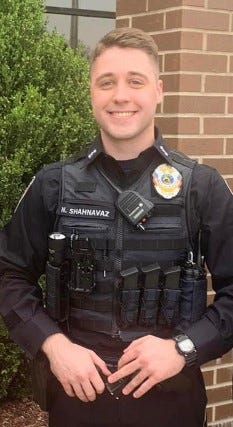
ELWOOD, Ind. – Elwood police officer Noah Shahnavaz was killed early Sunday during a traffic stop in Madison County.
Just after 2 am, Shahnavaz conducted a traffic stop on a 2012 Buick LaCrosse near the intersection of State Road 37 and County Road 1100 North, said Indiana State Police Public Information Officer Scott Keegan during a press conference. During the stop, the driver, identified as Carl Roy Webb Boards II, 42, of Anderson, Indiana, exited the vehicle and fired at the officer multiple times, striking him at least once, Keegan said.
Medical personnel arrived at the scene and transported Shahnavaz, 24, to Ascension St. Vincent Mercy in Elwood. Shahnavaz was then flown by helicopter to an Indianapolis area hospital where he later died from his injuries.
“This is a sorrowful time for law enforcement and definitely the community of Elwood,” Keegan said. “It’s always a sad moment when an officer sacrifices his life in the duty of service to the community.”
Shahnavaz was a five-year military veteran and had served the community of Elwood for 11 months. Shahnavaz lived in Fishers. He is survived by a mother, father and siblings, Keegan said.
“Noah proudly wore the Elwood Police Department uniform, serving the citizens of Elwood, he was part of our city family,” said Elwood Mayor Todd Jones. “On behalf of myself, my family and a most grateful city, I’m asking you to keep Noah’s family, Noah’s friends, the Elwood Police Department and our city in your thoughts and prayers as we attempt to navigate through this tragic time.”
Boards fled the scene in the vehicle before additional officers from the Elwood Police Department and Madison County Sheriff’s Department arrived. The reason for the shooting is currently unknown, Keegan said.
Hamilton County Sheriff’s Department later located and pursued the vehicle as it traveled southbound on State Road 37 shortly after 2:30 am Hamilton County Sheriff’s deputies deployed a tire deflation device near State Road 37 and 141st Street. However, this attempt was unsuccessful in stopping the vehicle as it continued on State Road 37 toward Interstate 69 where Fishers Police Department personnel conducted two Precision Immobilization Techniques (PIT), causing the vehicle to strike a guard rail in the median, Keegan said.
Boards was then taken into custody and is currently in the Hamilton County jail with no bond, Keegan said.
Andrew Hannah, chief deputy prosecutor in Madison County, said his office will charge Boards with murder, possession of a firearm by a serious violent felon, resisting law enforcement, as well as the use of a firearm enhancement — which carries an additional sentencing penalty — and the usual offender enhancement based off his criminal history.
“After reviewing all of the evidence and discussions with the family and all those involved,” Hannah said, “we will make a determination as to whether we seek the death penalty in this case.”
This is currently an active and ongoing investigation led by Indiana State Police Pendleton Post detectives. This story will be updated.
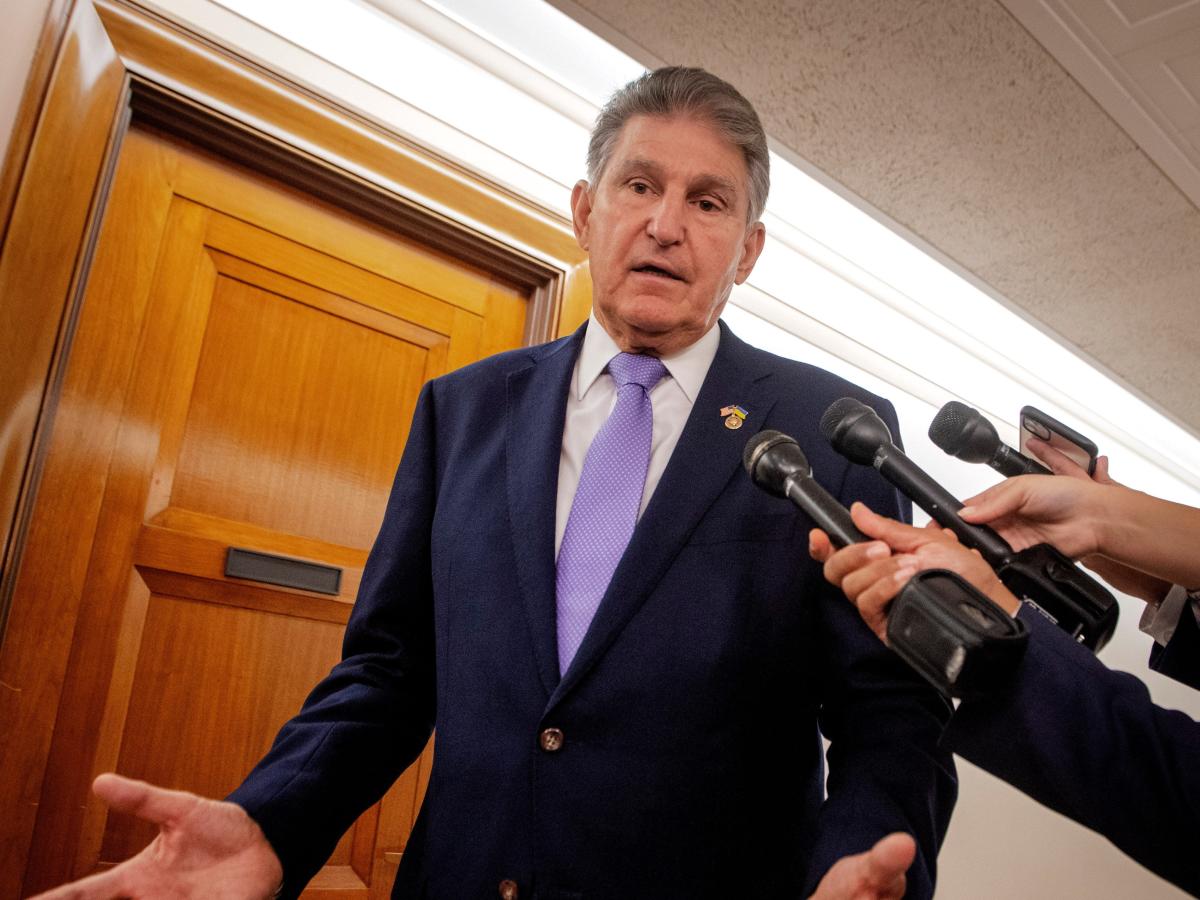
WASHINGTON – Sen. Joe Manchin on Sunday declined to answer whether he will support President Joe Biden running in 2024, and did not say if he wants Democrats to keep control of the House.
“Everybody’s worried about the election. That’s the problem,” Manchin, DW.Va., said when asked by ABC’s Jonathan Karl if he would support Biden if he runs again in 2024.
He added that he will not get into the next two election cycles, but would rather focus on the current president.
Manchin, who was asked a few times by Chuck Todd on NBC’s “Meet the Press,” Sunday if he hoped Democrats would keep control of the House and the Senate, responded by saying that “people are sick and tired of politics.”
Democrats have a thin margin in the House and are widely expected to lose control in November’s election. The Senate is even split between the parties.
When Todd asked Manchin whether he cared about this year’s election outcomes, Manchin said he respects whoever he has to work with, and respects those states that they represent.
“Whatever the voters choose,” Manchin said. “I’ve always taken the approach whoever you send me, that’s your representative and I respect them. And I respect the state for the people they send, and I give it my best to work with them, to do the best for my country .”
Manchin, who faces reelection in 2024, has opposed some key parts of Biden’s domestic agenda by refusing to back the Build Back Better social spending bill, calling it too expensive.
Last week, though, he and Senate Majority Leader Chuck Schumer agreed on a bill that includes some climate change provisions and allows Medicare to negotiate drug prices.
Will Sinema support the bill?:Democrats deal with Sen. Joe Manchin raises new question: What about Sen. Kyrsten Synema?
Joe Manchin has been one of the biggest obstacles to the Democratic Party passing major legislation in the Senate.Bill O’Leary/The Washington Post via Getty Images
Joe Manchin avoided a question on whether he wants the Democratic Party to win the House and Senate.
Manchin said he thought people were sick of politicians fighting and holding “hostage” legislation.
He said he’d be OK with whoever the voters choose and would “work with whatever I have.”
Sen. Joe Manchin on Sunday dodged a direct question about whether he wanted the Democratic Party to win the November midterms and keep control of the House and Senate.
Speaking to NBC’s Chuck Todd on “Meet the Press,” the West Virginia lawmaker said: “I think people are sick and tired of politics, Chuck. I really do.”
“I think they’re sick and tired of Democrats and Republicans fighting and feuding and holding pieces of hostage legislation because they didn’t get what they wanted, or something or someone might get credit for something,” Manchin added.
Todd then pressed Manchin, asking him directly if he wanted the Democrats to win.
“I think the Democrats have great candidates that are running. They’re good people I’ve worked with,” the senator responded. “And I have a tremendous amount of respect and friendship with my Republican colleagues. So I can work on either side very easily.”
“You don’t care about the outcome this year of the election?” Todd asked Manchin.
“Well, whatever — whatever the voters choose. I can’t decide what’s going to happen in Kansas or California or Texas. I really can’t,” Manchin said.
He added that he has always respected the representatives elected by the states and does his best to work with them.
“I don’t play the politics that way. I don’t like it that way,” Manchin added. “That’s not who I am.”
Manchin has been one of the biggest obstacles to the Democrats passing major legislation in the Senate, despite the party having control of the chamber. For one, the senator killed President Joe Biden’s landmark Build Back Better legislation.
In April, Manchin also addressed claims that he might switch parties to the GOP — an idea touted by Senate Minority Leader Mitch McConnell — saying he’s “never considered” the idea from “such a standpoint.”
Manchin has also been reticent about expressing support for Biden in 2024.
In a surprise U-turn last week, Manchin said he would back the Inflation Reduction Act, a deal that he and Sen. Chuck Schumer cut that allots $370 billion for climate and energy programs and commits the US to a 40% emissions reduction by 2030.
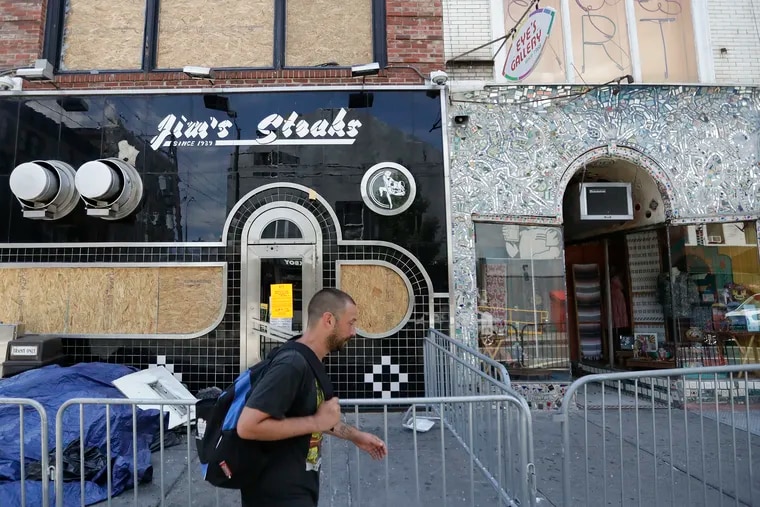
Could people be lining up again for cheesesteaks at Fourth and South Streets by Memorial Day 2023?
“I have to put a line in the sand somewhere,” Jim’s South St. Steaks owner Ken Silver said Sunday, two days after a fire sent 125 first responds to the landmark and put him and his 33 employees out of work at the height of the summer business peak.
The damage from the fire, believed to have started in the heating, ventilation, and air-conditioning system, was not as bad as feared, Silver said. I have credited firefighters, who remained on the scene for 10 hours dousing hot spots.
» READ MORE: Two-alarm fire damages Jim’s South St. Steaks
City inspectors found the four-story, century-old building to be structurally sound, he said, moving up the timeline for reopening.
On Friday afternoon, Silver had vowed to rebuild, even as he feared that the building would be a total loss.
Water and smoke damage to the Art Deco interior was extensive, but impossible-to-reproduce memorabilia on the first- and second-floor walls — including poster-size photos of Kobe Bryant dunking over the Sixers and a scene of long-ago South Street —were spared.
“My files were intact,” said Silver, 58, who operates the business that his father, Abner, cofounded in 1976. “The receivable bills [were there]. It could have burned the bills up, right?”
Next door at Eye’s Gallery — the Latin American-themed boutique that Julia Zagar opened in 1968 with a facade decorated with mosaics by her husband, artist Isaiah Zagar — damage could close the business for a year. Three full-time employees and two part-timers had worked there.
“It’s devastating,” Julia Zagar said Sunday. “There’s four to five feet of water in the basement,” which was part of Eye’s sales space, she said. Soot covered merchandise, business records were damaged, and a “very potent” smell permeated the whole building, she said.
When Eye’s returns, “it will be a whole different place,” said Zagar, 82. “Back then, we were hippies making things out of found objects,” she said. “We’ll find our way back.”
A GoFundMe for the Jim’s workers has been created at https://gofund.me/5d67ca38. Through additional wages, “we’re going to take care of them and make them whole,” Silver said. “We’re not a big business. We’re a family-run, tightly knit group.”
A GoFundMe drive for Eye’s Gallery to support recovery efforts has been created at https://gofund.me/37e72a9f.
A temporary Jim’s location could be set up in a nearby storefront, Silver said. He said he has heard offers of support from the local business community.
Fresh food, including 3,000 pounds of beef stored in Jim’s basement freezer, will be trashed. A pallet of canned foods and dry goods that Tilotta’s Provisions had delivered Friday to Jim’s sidewalk was given to Ishkabibble’s, a nearby sandwich shop, Silver said.
Silver spent Saturday at MilkBoy, the bar-restaurant across the street, to await city inspectors and to greet well-wishers, including John Foy, a founder of Bridget Foy’s restaurant two blocks away. An electrical fire in 2017, whose origin appeared similar to Friday’s blaze, destroyed the restaurant. Bridget Foy reopened in December 2020 after it was rebuilt.
Silver watched as a stream of limo, Uber, and Lyft drivers pulled up outside of Jim’s to drop off customers — many from out of town — who had not heard about the fire.
“There’s this family from the Middle East who always comes to us as soon as they land,” he said. “Their reaction was heartwarming,” he said.
The business traces its founding to 1939, when Jim Perligni (by some accounts spelled Pearligni) opened the store at 62nd and Noble Streets in West Philadelphia. The business was sold in the mid-1960s to William Proetto.
In 1976, Abner Silver, a lawyer who had done work for Proetto, joined him in opening the Jim’s at Fourth and South Streets, then Philadelphia’s Fabric Row. South Street was literally at a crossroads in the 1970s, as plans for a crosstown expressway had been scuttled shortly before and businesses catering to young people — such as JC Dobbs and the TLA — were moving in.
The location was a natural for cheesesteaks, a tourist favorite, thanks to Pat’s and Geno’s in South Philadelphia.
Silver, who also had a shop called Abner’s at 38th and Chestnut Streets, assumed sole ownership of what is formally Jim’s South St. Steaks & Hoagies after Proetto’s death in 2011. Shortly after, Silver’s son, Ken, took over the business as his father was suffering from Alzheimer’s disease. He died at age 79 in 2015.
The Proetto family operates the Jim’s Steaks location in Springfield, Delaware County.
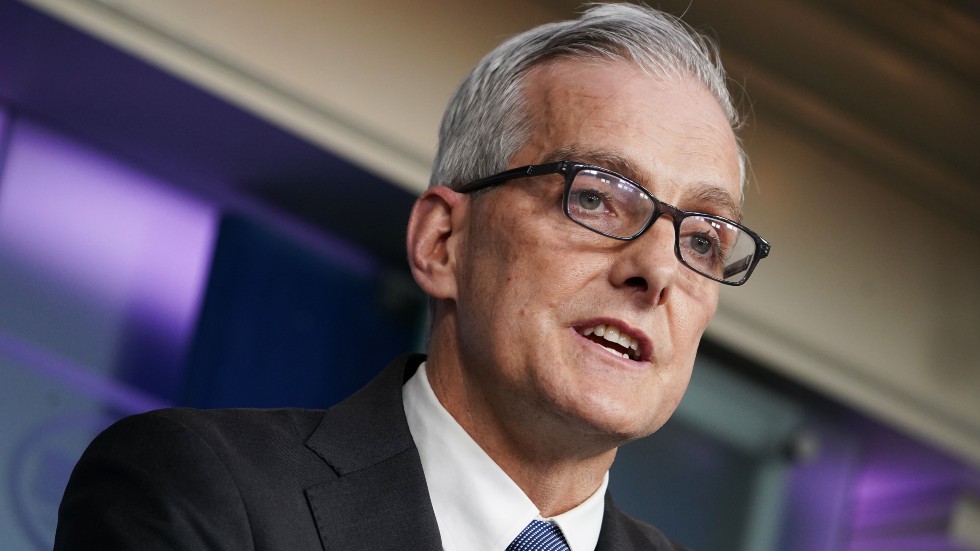
Proposed amendments by Republican senators to a bill aimed at aiding veterans exposed to toxic burn pits would result in “rationing of care for vets,” Veterans Affairs Secretary Denis McDonough said on Sunday.
“I can’t in good conscience do that, because the outcome of that will be rationing of care for vets, which is something I just can’t sign up for,” McDonough told Jake Tapper on CNN’s “State of the Union.”
Sen. Pat Toomey (R-Pa.) appeared on the show earlier Sunday morning to explain Republican opposition to the bill, which was blocked last week when it fell five votes short of the tally needed to bypass the filibuster.
All Democrats and eight Republicans backed the proposal, and Senate Majority Leader Charles Schumer (DN.Y.) said Democrats will bring the bill forward a second time on Monday.
Republicans have accused their Democratic colleagues of a “budgetary trick” in the bill’s funding.
Toomey said Sunday that “to hide behind a veterans bill the opportunity to go on an unrelated $400 billion spending spree is wrong.”
But McDonough said the dollar amount Republicans are worried about isn’t a Trojan horse for the Democrats’ agenda.
“If you look at the bill for $400 billion that he’s talking about, you won’t see it. You would have to go deep in some — into some charts of the back of the CBO [Congressional Budget Office] report about — to find that. Why is that fund in the bill? The fund is in the bill so that we can ensure [that] all the spending for this program is for the veterans exposed to these toxins.”
GOP-backed amendments would put a year-on-year cap on spending and do away with the funding for veterans after 10 years.
“So the impact of that would be, if we — if his estimates are wrong about what we will spend in any given year, that means that we may have to ration care for veterans,” McDonough said.
“The CBO suggested, for one program we’re currently running, the MISSION Act, that we would be spending $14 billion a year less this year. So they’re $14 billion off. And that’s just four years out from their initial investment.”
Toomey is “asking us to take their word for it in eight or 10 years,” the secretary said. “I can’t in good conscience do that, because the outcome of that will be rationing of care for vets, which is something I just can’t sign up for.”

:quality(70)/cloudfront-us-east-1.images.arcpublishing.com/tronc/M6ULOZY2JFB4JJTS7GLPSQUWPI.jpg)
:quality(70)/cloudfront-us-east-1.images.arcpublishing.com/tronc/6GWHN3JEXRC25NFRYIKMJZMAPM.jpg)
:quality(70)/cloudfront-us-east-1.images.arcpublishing.com/tronc/6BLEOLSUK5C3LD6O75NT65DRMI.jpg)
:quality(70)/cloudfront-us-east-1.images.arcpublishing.com/tronc/W2SMXK3AEFDY3NMWYXAXRRUEHE.jpg)