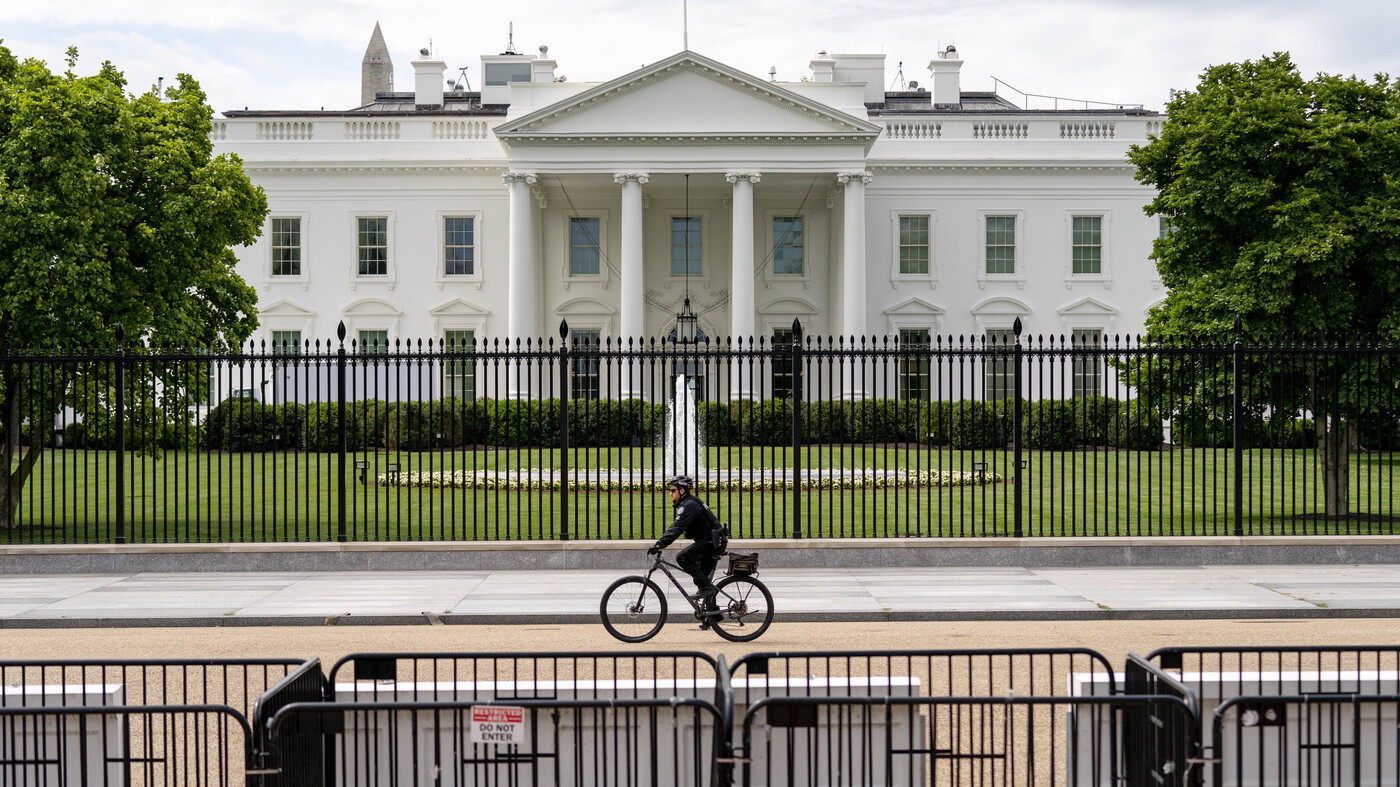
Across the street from the White House, shown here in 2021, is Lafayette Park. On Thursday, a lightning strike hit four people, and two of them were pronounced dead on Friday.
Andrew Harnik/AP
hide caption
toggle caption
Andrew Harnik/AP
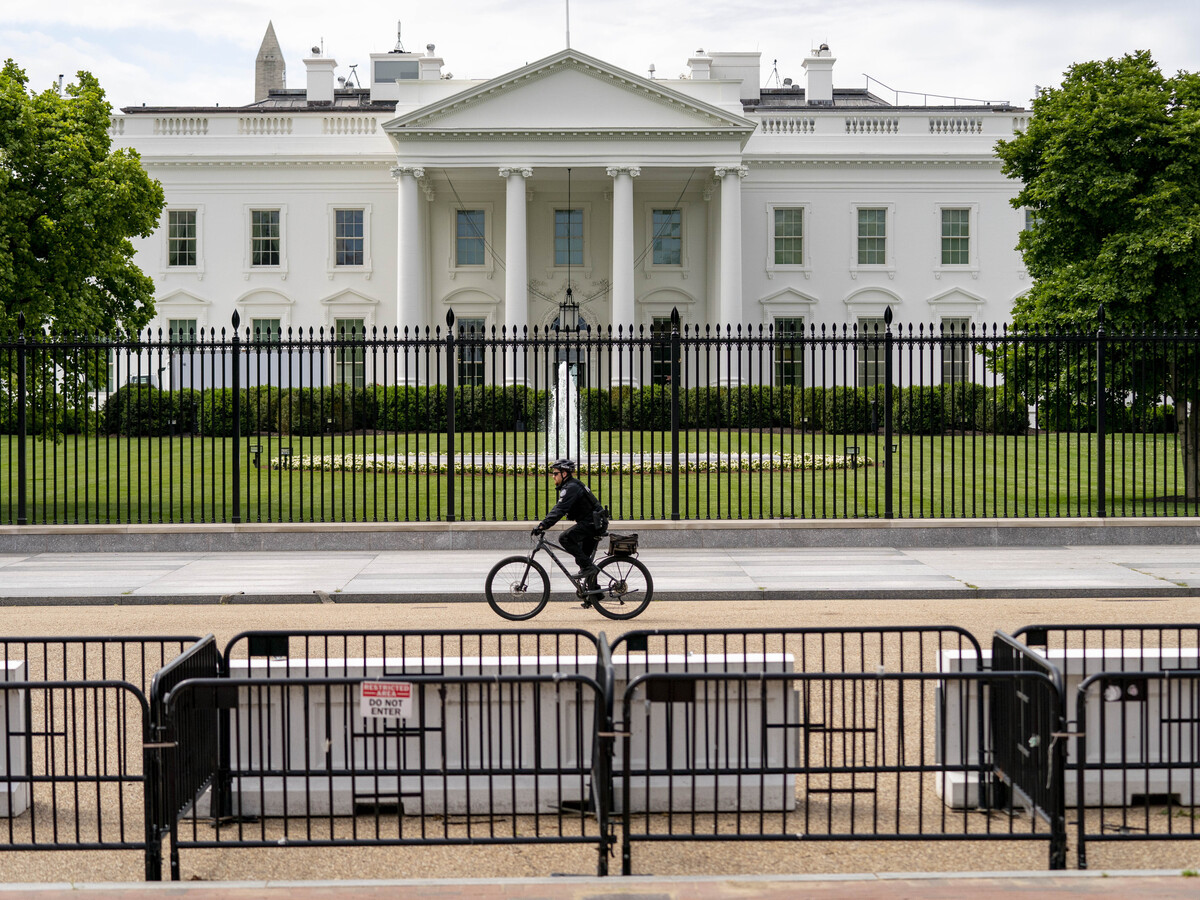
Across the street from the White House, shown here in 2021, is Lafayette Park. On Thursday, a lightning strike hit four people, and two of them were pronounced dead on Friday.
Andrew Harnik/AP
Two people were killed and two others are in critical condition after lightning struck at the park next to the White House in Washington, DC
Emergency responders received a report about people found injured in Lafayette Park at 6:52 pm on Thursday evening. US Park Police and members of the US Secret Service who were in the area at the time also rushed to assist the four people hurt. No property or vehicles were damaged by the strike, said DC Fire and EMS official Vito Maggiolo.
It is believed that the four might have been struck while they were near a tree during the heavy downpour, Maggiolo told NPR.
On Friday morning, 76-year-old James Mueller and 75-year-old Donna Mueller, both from Janesville, Wis., were pronounced dead, according to the Metropolitan Police Department.
“We are saddened by the tragic loss of life after the lightning strike in Lafayette Park. Our hearts are with the families who lost loved ones, and we are praying for those still fighting for their lives,” White House Press Secretary Karine Jean-Pierre said in a statement.
As more thunderstorms are expected in the US capital Friday evening, Maggiolo advises people to stay indoors.
“If you see lightning or hear thunder, you should seek shelter inside of a building or a vehicle. Do not attempt to seek shelter under a tree,” he said.
Latest: The United Nations has expressed hope that the first grain shipments from blocked Ukrainian ports could start Friday. However, the exact coordinates needed to ensure a safe passage for ships were still being negotiated on Thursday, UN aid chief Martin Griffiths said.
The fight: Russia’s recent operational pause, which analysts identified in recent weeks as an effort to regroup troops before doubling down on Ukraine’s south and east, appears to be ending. Russia appears set to summarize ground offensives, with Defense Minister Sergei Shoigu telling troops on Saturday to intensify attacks “in all operational sectors” of Ukraine.
The weapons: Ukraine is making use of weapons such as Javelin antitank missiles and Switchblade “kamikaze” drones, provided by the United States and other allies. Russia has used an array of weapons against Ukraine, some of which have drawn the attention and concern of analysts.
Photos: Post photographers have been on the ground from the very beginning of the war — here’s some of their most powerful work.
How you can help: Here are ways those in the US can help support the Ukrainian people as well as what people around the world have been donating.
Read our full coverage of the Russia-Ukraine crisis. Are you on Telegram? Subscribe to our channel for updates and exclusive video.
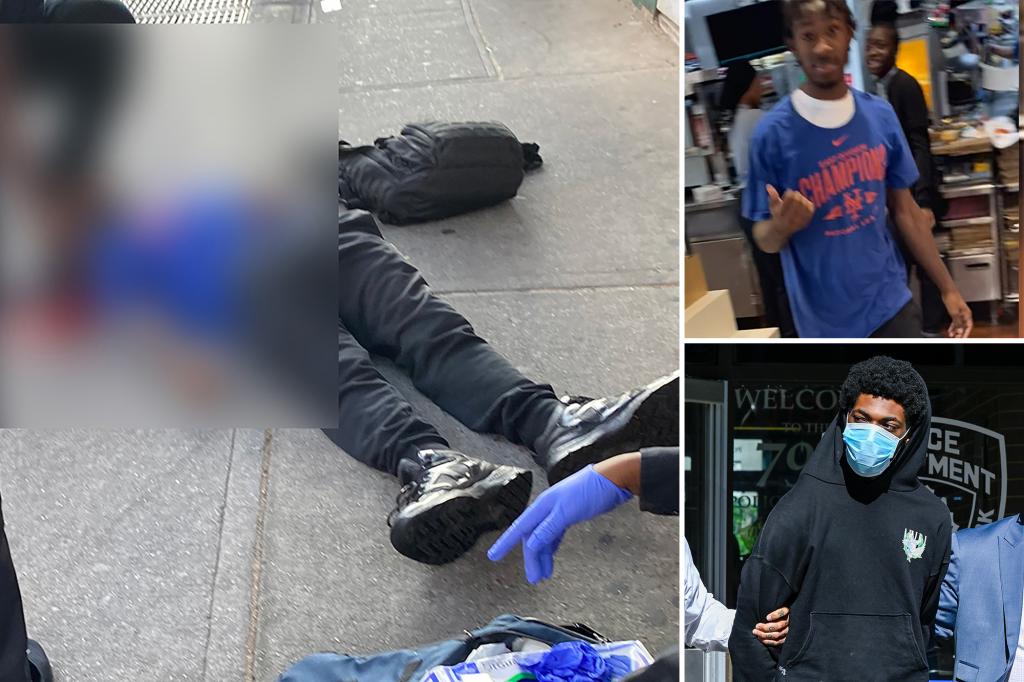
The Brooklyn McDonald’s worker who was shot in the neck in a spat over cold fries has died, cops announced Friday.
Matthew Webb, 23, “succumbed to his injuries” after he was shot Monday outside the Bedford-Stuyvesant fast-food restaurant where he worked, the NYPD said.
The attack “has been deemed a homicide,” the force said early Friday, stressing that “the investigation remains ongoing.”
Michael Morgan, 20, has already been charged with attempted murder and criminal possession of a loaded firearm for blasting Webb in anger at his mom getting served cold fries.
He is expected to face upgraded homicide charges, prosecutors told a court hearing Thursday, even before Webb’s death was confirmed.
Matthew Webb, 23, “succumbed to his injuries” Wednesday, two days after he was shot in the neck in the fight at the Brooklyn McDonald’s where he worked.
Webb was serving at the Fulton Street eatery on Monday evening when Morgan’s mom, Lisa Fulmore, complained to workers that her fries were cold and asked to speak to a manager.
Tap the right side of the screen below to watch this web story:
When the workers began laughing at her, Fulmore was FaceTiming with Morgan, who came to the restaurant and got into a fight with Webb that spilled out onto the sidewalk.
Morgan punched Webb in the face and when he got back up, he pulled out a gun and blasted him in the neck, prosecutors alleged.
Matthew Webb, 23, died after being shot outside the Brooklyn fast-food joint Monday.
His mom later told the police that her son told her “he gotta do what he gotta do.”
The suspect’s girlfriend, Camellia Dunlap, has also been charged with weapons possession for allegedly handing Morgan the gun. She was arraigned later on Wednesday and held on a $50,000 cash bail, after prosecutors said she admitted to possessing the gun.
Michael Morgan, 20, is expected to be hit with upgraded murder charges.Paul Martinka
Morgan was also charged with an earlier murder after allegedly confessing during questioning about the McDonald’s shooting.
He allegedly killed Kevin Holloman in October 2021.
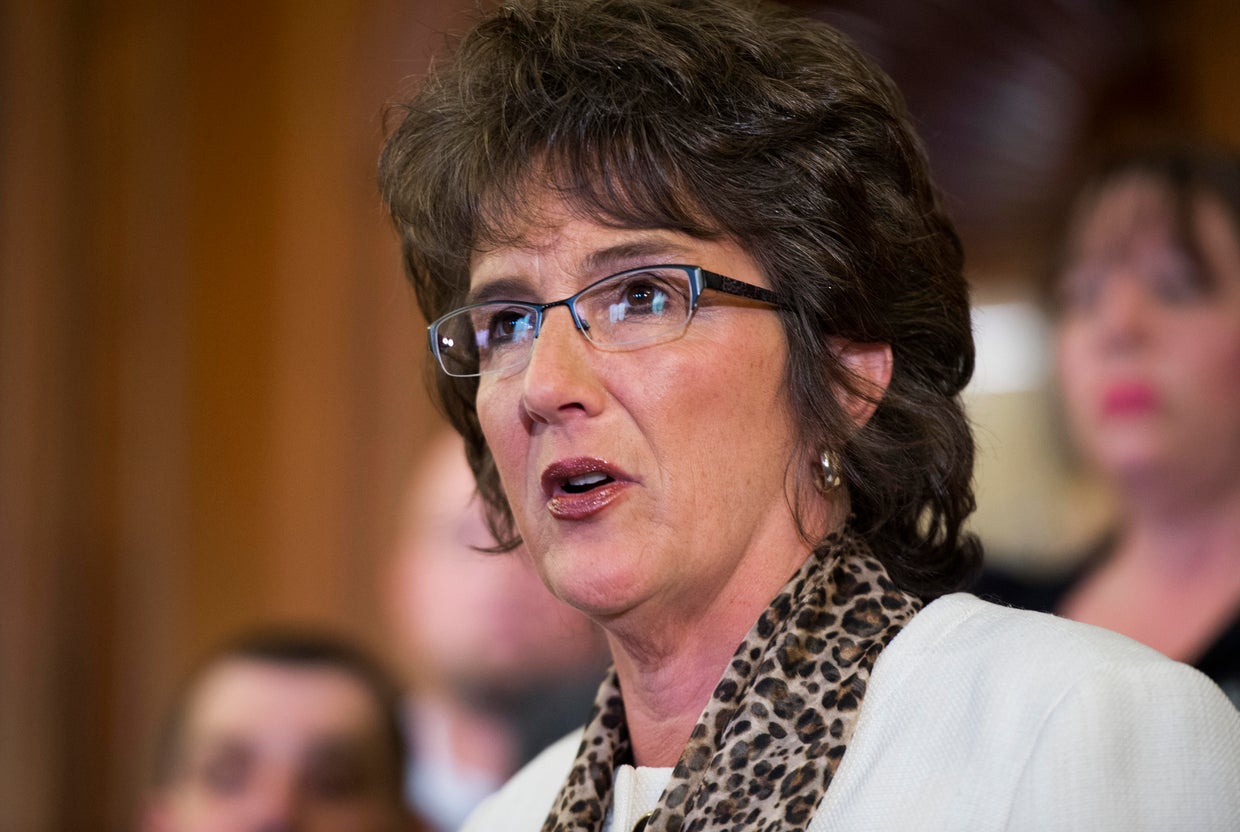
The car Indiana Congresswoman Jackie Walorski was riding in when she and three others died was the one that caused a crash when it veered into oncoming traffic, contrary to initial reports that it was the other driver’s fault, authorities said.
CBS Chicago points out that the Elkhart County Sheriff’s Office originally said a maroon Buick LeSabre headed south on State Road 19 crossed the center line and hit the Toyota RAV 4 in which Walorski and two aides were heading north on Wednesday afternoon.
But the sheriff’s office said Thursday morning that, based on new information, it had determined that its preliminary findings were incorrect. It said additional eyewitness and video evidence confirmed it was the RAV 4 that crossed into oncoming traffic “for reasons that are unknown at this time.”
All three people in the RAV 4—Walorski, 58; her district director Zachery Potts, 27; and communications director Emma Thomson, 28 — died as a result of their injuries. The driver and sole occupant of the LeSabre — 56-year-old Edith Schmucker — also died in the crash.
Officials said all four were wearing seatbelts and the vehicles’ airbags did deploy.
The crash remains under investigation.
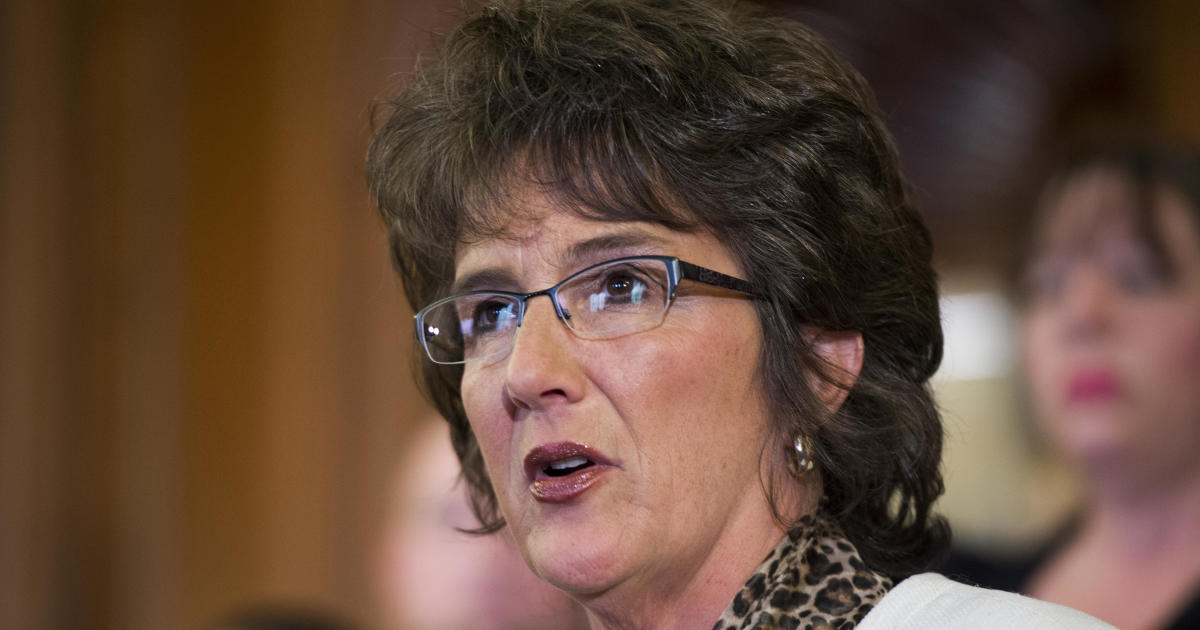
Rep. Jackie Walorski, R-Ind., speaks during a news conference in the Capitol on legislation that would increase the accountability of the Veterans Affairs Department, on April 3, 2014.
Photo By Tom Williams/CQ Roll Call
Walorski was elected to represent Indiana’s 2nd Congressional District, which includes South Bend, in 2012 after serving three terms in the statehouse. She was the top Republican on the House Ethics Committee and served on the Ways and Means Committee as well.
“She has returned home to be with her Lord and Savior, Jesus Christ,” House Minority Leader Kevin McCarthy said in a statement on Walorski’s death. “Please keep her family in your thoughts and prayers.”
Tributes for Walorski quickly poured in from elected officials on both sides of the aisle and from members of Indiana’s congressional delegation.
Rep. Kevin Brady, the top Republican on the Ways and Means panel, said the congresswoman was “the ‘happy Hoosier’ who would light up a room with her joy, passion, brilliance and love of life.”
“There is nothing [Walorski] couldn’t do,” I tweeted.
Rep. Carolyn Maloney, a Democrat from New York, said on Twitter she is “absolutely heartbroken” and “my heart goes out to the families of each of the victims,” while fellow Indiana Rep. Jim Banks praised Walorski as a “true public servant — selfless, humble, and compassionate.”
“From my first day in Congress, Jackie showed me kindness and grace,” he said in a statement. “She had a heart of gold, and I will miss her dearly.”
Former Vice President Mike Pence, who also represented Indiana in the House before serving as the state’s governor from 2013 to 2017, said he and his wife are praying for Walorski’s family and the families of Potts and Thomson.
“She served Indiana in the statehouse and the Congress with integrity and principle for nearly two decades and will be deeply missed,” he said in a pair of tweets.
Indiana Sen. Todd Young tweeted that he is “truly devastated” by Walorski’s death and said she “loved Hoosiers and devoted her life to fighting for them. I’ll never forget her spirit from her, her positive attitude, and most importantly her friendship from her. “
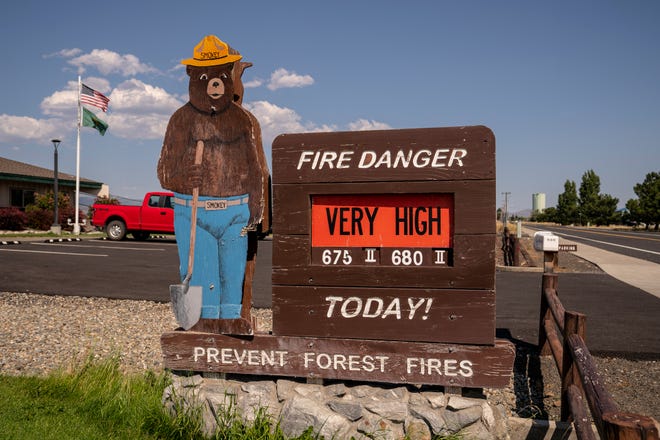
Fires, heat waves, floods – the reality of climate change is front and center for millions of Americans. Yet among the downbeat of climate-related disasters, some hopeful news rang out last week with Democrats’ surprise announcement of a bill designed to help the country meet its goals of curbing greenhouse gas emissions enough to help the planet avoid the worst projections of global warming .
To do that, the world needs to keep global temperatures from rising no more than 1.5 degrees Celsius, or about 2.7 degrees Fahrenheit, since 2005 averages. And the US needs to curb its emissions by about half before the end of the decade.
How close would the far-ranging provisions in the $485 billion Inflation Reduction Act bring the US to meet its goal?
“Within shouting distance,” said Anand Gopal, executive director of strategy and policy at Energy Innovation, a climate policy research firm. “It’s about two-thirds of the way there.”
Here’s a closer look:
The climate bill gets the US close
The United States’ goal for reducing the greenhouse gas emissions that cause climate change is a 50% to 52% reduction from 2005 levels by 2030.
If the Democrats’ bill passes, it would reduce emissions by between 31% and 44% from 2005 levels, according to various estimates. The estimates depend in large part on how much US emissions increase in the next eight years, which in turn depend on future fossil fuel prices, economic growth and technology costs.
It would reduce cumulative US greenhouse gas emissions by about 6.3 billion tons through 2032, according to an analysis by Princeton University’s Zero-carbon Energy Systems Research and Optimization Laboratory.
“While more action across other levels of government will be required to cut emissions by 50-52% below 2005 levels, the Senate package represents an important and historic step forward,” the Rhodium Group, an environmental and energy think tank, wrote in its analysis.
Renewable energy already making headway
Even if the US makes no changes to its current greenhouse gas emissions, models predict emissions would fall 24% below 2005 levels within the next eight years.
That’s partly due to already-scheduled retirements of coal-fired power plants, the rapid fall in prices for wind and solar energy and the increasing adoption of electric vehicles by American drivers.
Between 2009 and 2021, the average price of US solar power contracts fell 15% a year, according to the Department of Energy. The $33 cost to produce a megawatt hour of wind power in 2020 was less than half the $67 cost to produce one in 2005, according to DOE.
Is the other 10% possible?
It would require President Joe Biden and states to make use of executive actions and stronger regulations. “But it’s now doable,” said Gopal.
There’s also a flywheel effect, with small gains building on each other over time to create a self-sustaining momentum. Just as government investment in oil and gas allowed for the fossil fuel booms of the 20th century, and investment in wind and solar made possible the rapid drop in price in the past two decades, the millions for investment and research in the climate bill could launch the US into a new, cleaner and wealthier era.
It could create at least 1.5 million new jobs in manufacturing, construction and service industries and increase Gross National Product by between 0.84 and 0.88% by 2030, according to Energy Innovation’s analysis.
“The innovation, the investment, the jobs, the growth this unlocks can enable us to move faster than we would otherwise project,” said Manish Bapna, president of the Natural Resources Defense Council, an environmental advocacy nonprofit.
What about the oil and gas leases?
A provision in the IRA requires that three canceled oil and gas lease sales in the Gulf of Mexico and Alaska’s Cook Inlet be reinstated. In addition, permits for solar and wind projects on federal lands and water would be allowed only if lease sales for oil and gas drilling were also held.
While this commitment sweetened the deal for oil and gas producing states — while angering many environmentalists — it still wouldn’t significantly impact the positive climate effects of the act, according to Energy Innovation’s analysis.
For every additional ton of greenhouse gas emissions caused by the oil and gas leases, at least 24 tons of emissions would be avoided by the act’s other provisions, they estimate.
Does it matter if only the US acts?
Part of the push to get the United States to meet its climate action goals is that many countries have been dragging their feet, waiting to see what the US does. Their thinking has been that if the US — historically, the biggest emitter of greenhouse gases — doesn’t act, there’s no point in them doing so.
“If this passes, it will resuscitate energy around global climate action,” said Bapna. “It enables the US to go to China, to go to the European Union, and say ‘We’re doing our share, we think it’s important that you do yours,'” he said.
Why is this so important?
Last month United Nations Secretary-General António Guterres said the world was on course for “collective suicide” if it doesn’t deal with climate change now and lower emissions so global temperature doesn’t rise above the scientists’ benchmark.
“The battle to keep the 1.5-degree Celsius goal alive will be won or lost this decade,” he said.
The current path of carbon dioxide emissions could increase global temperature by as much as 4.4°C by the end of the century, the UN notes: “The more the world warms, the greater the changes in the climate system become. This includes more frequent and intense hot extremes, marine heatwaves, heavy precipitation, agricultural and ecological droughts in some regions, the proportion of intense tropical cyclones, and reductions in Arctic sea ice, snow cover and permafrost.”
‘People are dying’: Global warming already being seen in North America, UN report finds
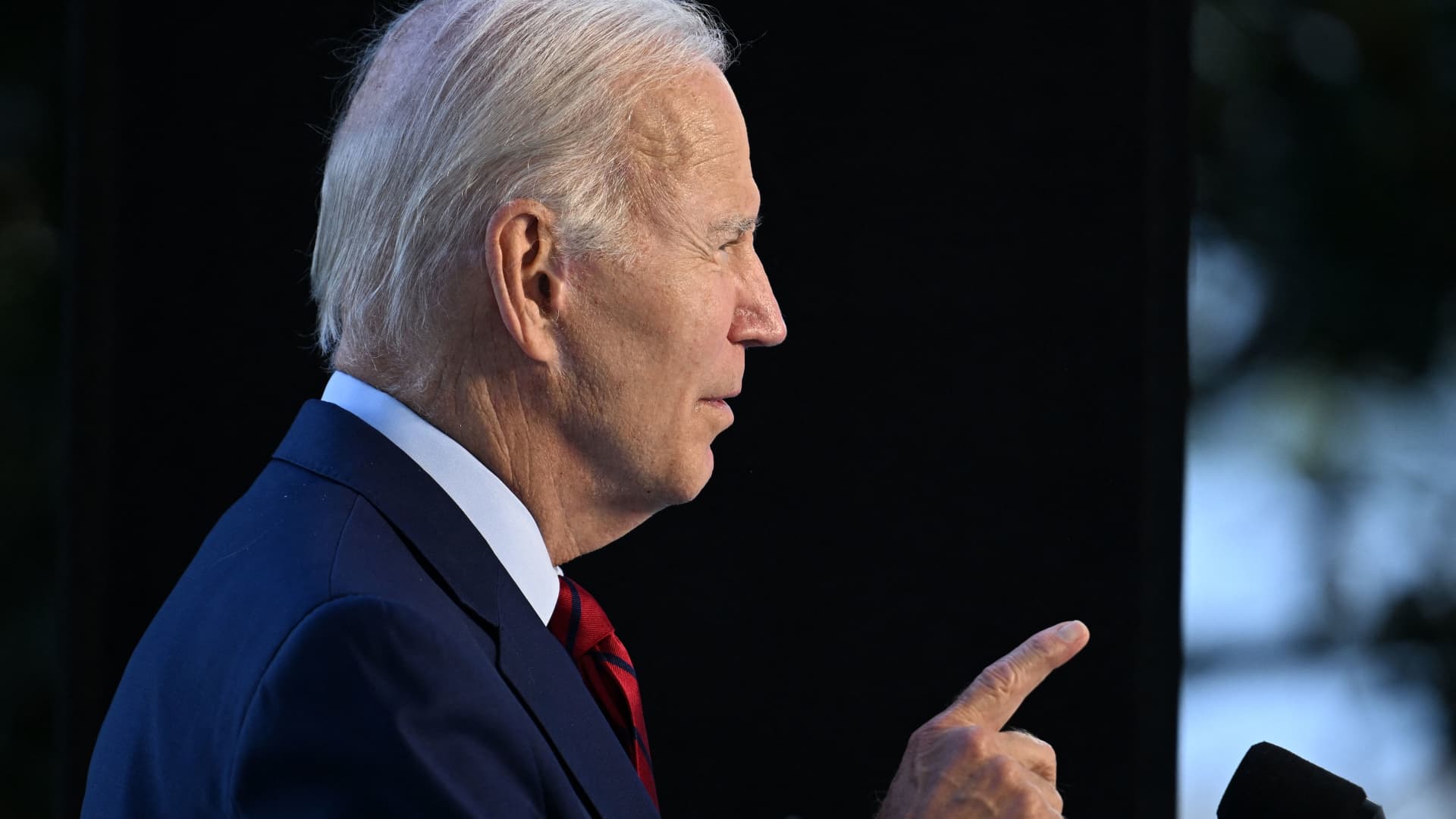
Senate Democrats’ package of climate change, health-care, drug pricing and tax measures unveiled last week has proponents and opponents debating whether the legislation violates a pledge President Joe Biden has made since his presidential campaign, todo not raise taxes on households with incomes below $400,000 a year.
The answer isn’t quite as simple as it seems.
“The fun part about this is, you can get a different answer depending on who you ask,” said John Buhl, an analyst at the Tax Policy Center.
More from Personal Finance: Embryos can count as dependents on Georgia state tax returns Would you be included in student loan forgiveness? Remote work is helping fight inflation
The White House has used $400,000 as a rough dividing line for the wealthy relative to middle and lower earners. That income threshold equates to about the top 1% to 2% of American taxpayers.
The new bill, the Inflation Reduction Act, doesn’t directly raise taxes on households below that line, according to tax experts. In other words, the legislation wouldn’t trigger an increase on taxpayers’ annual tax returns if their income is below $400,000, experts said.
But some aspects of the legislation may have adverse downstream effects — a sort of indirect taxation, experts said. This “indirect” element is where opponents seem to have directed their ire.
What’s in the Inflation Reduction Act
The legislation — brokered by Senate Majority Leader Chuck Schumer, DN.Y., and Sen. Joe Manchin, DW.Va., who’d been a key centrist holdout — would invest about $485 billion toward climate and health-care measures through 2031, according to a Congressional Budget Office analysis issued Wednesday.
Broadly, that spending would be in the form of tax breaks and rebates for households that buy electric vehicles and make their homes more energy-efficient, and a three-year extension of the current Affordable Care Act subsidies for health insurance.
The bill would also raise an estimated $790 billion via tax measures, reforms for prescription drug prices and a fee on methane emissions, according to the Congressional Budget Office. Taxes account for the bulk — $450 billion — of the revenue.
Critics say corporate changes could affect workers
Specifically, the legislation would provide more resources for IRS enforcement of tax cheats and would tweak the “carried interest” rules for taxpayers who earn more than $400,000. The change to carried-interest rules — which allow certain private equity and other investors to pay a preferential tax rate on profits — is likely dead, though, after Democratic leaders agreed to scrap it to win support from Sen. Kyrsten Sinema, D-AZ.
Those elements aren’t controversial relative to the tax pledge — they don’t raise the annual tax bills middle and low earners owe, experts said.
The Inflation Reduction Act would also implement a 15% corporate minimum tax, paid on the income large companies report to shareholders. This is where “indirect” taxes might come into play, experts said. For example, a corporation with a higher tax bill might pass on those additional costs to employees, perhaps in the form of a lower raise, or reduced corporate profits may hurt 401(k) and other investors who own a piece of the company in a mutual fund.
The Democrats’ approach to tax reform means increasing taxes on low- and middle-income Americans.
Sen. mike krapo
Republican of Idaho
The current corporate tax rate is 21% but some companies are able to reduce their effective tax rate and therefore pay back their bill.
As a result of the policy, those with incomes below $200,000 would pay almost $17 billion in combined additional tax in 2023, according to a Joint Committee on Taxation analysis published July 29. That combined tax burden falls to about $2 billion by 2031, according to the JCT, an independent scorekeeper for Congress.
“The Democrats’ approach to tax reform means increasing taxes on low- and middle-income Americans,” Sen. Mike Crapo, R-Idaho, ranking member of the Finance Committee, said of the analysis.
Others say financial benefits outweigh indirect costs
However, the JCT analysis does not provide a complete picture, according to experts. That’s because it doesn’t account for the benefits of consumer tax rebates, health premium subsidies and lower prescription drug costs, according to the Committee for a Responsible Federal Budget.
Observers who consider indirect costs should weigh these financial benefits, too, experts argue.
“The selective presentation by some of the distributional effects of this bill neglects benefits to middle-class families from reducing deficits, from bringing down prescription drug prices and from more affordable energy,” a group of five former Treasury secretaries from both Democratic and Republican administrations wrote Wednesday.
The $64 billion of total Affordable Care Act subsidies alone would “be more than enough to counter net tax increases below $400,000 in the JCT study,” according to the Committee for a Responsible Federal Budget, which also estimates Americans would save $300 billion on costs and premiums for prescription drugs.
The combined policies would offer a net tax cut for Americans by 2027, the group said.
Further, setting a minimum corporate tax rate shouldn’t be viewed as an “extra” tax, but a “reclaiming of revenue lost to tax avoidance and provisions benefitting the most affluent,” argued the former Treasury secretaries. They are Timothy Geithner, Jacob Lew, Henry Paulson Jr., Robert Rubin and Lawrence Summers.
There are additional wrinkles to consider, though, according to Buhl of the Tax Policy Center.
For example, to what extent do companies pass on their tax bills to workers versus shareholders? Economists differ on this point, Buhl said. And what about companies with a lot of excess cash on hand? Might that cash buffer lead a company not to levy an indirect tax on its workers?
“You could end up going down these rabbit holes forever,” Buhl said. “It’s just one of the fun parts of tax pledges,” he added.
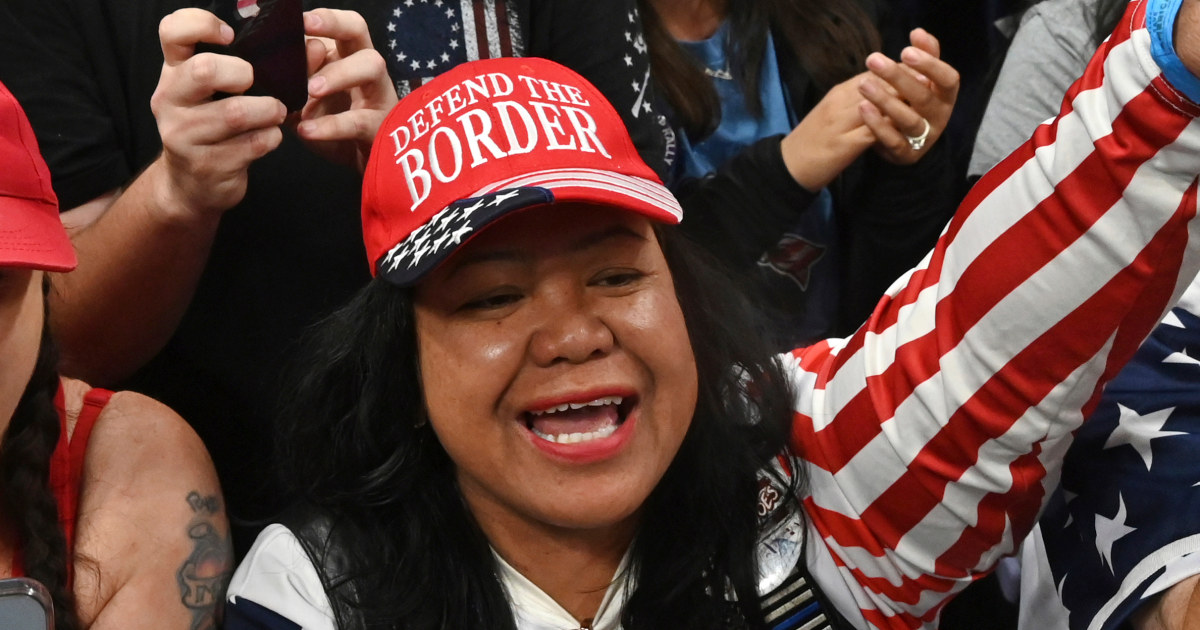
ANCHORAGE, Alaska — Two Anchorage police officers violated department policy during a traffic stop last month when a woman in town for a rally by former President Donald Trump showed them a “white privilege card” instead of a driver’s license and was not ticketed, an Alaska newspaper reported.
However, it’s not clear what policy was violated or what disciplinary actions the two officers faced, if any, because the department is treating it as a confidential personnel matter, the Anchorage Daily News reported.
Mimi Israelah said in a Facebook post that she was pulled over for weaving at 3:43 am on July 9 while driving to a pizzeria in Anchorage after arriving on an early-morning flight from California for Trump’s rally.
She couldn’t find her driver’s license, she wrote on Facebook in a now-deleted post.
“When I saw my White Privilege card, I gave to him if it’s ok,” she wrote. “He laughed and called his partner her. It’s their first time to see a White Privileged (sic) card,” she said.
The top of the novelty card reads: “White Privilege Card Trumps Everything.”
Israelah in her Twitter biography describes herself as Pinay, or a woman of Filipino origin.
A video apparently taken by Israelah of the encounter has been reposted on Twitter. Two officers are seen standing outside her car window. She asks one, “You like my White Privilege card?” One officer says, “That’s hilarious.”
Anchorage police officers identified in the incident were Nicholas Bowe and Charles Worland.
Deputy Chief Sean Case said some people who saw the post had negative reactions to it, and believed it was inappropriate. “We recognize that,” he said.
Israelah was not cited during the stop. She did not immediately respond to a message seeking comment.
Anchorage municipal code requires that all drivers carry their license at all times when operating a vehicle. Police spokesperson Sunny Guerin said police can do a computer check to determine if a person has a valid driver’s license.
Police Sgt. Jeremy Conkling, president of the police union, said officers have discretion and generally don’t write citations for minor offenses, like not having a physical license present.
“Especially in this circumstance, where you had a very, very low-level minor offense and the officers are really just focused on trying to find DUIs — I’m not at all surprised they didn’t write a citation. I don’t know that a lot of officers would have written that citation, if any,” Conkling said.
However, Celeste Hodge Growden, president of the Alaska Black Caucus, said she wonders if the lack of citation was tied to the novelty card.
“Is it because the white privilege card was effective?” she asked.
Worland and Bowe were placed on administrative during the 11-day investigation, Case said. Police would not provide additional information about the internal investigation, including which policies were violated and what, if any, repercussions the officers faced.
“The investigation regarding the incident is completed and is a part of confidential personnel files that will not be released publicly,” Guerin said.
Another police spokesperson said both officers remain employed by the department.
Hodge Growden said she wants the police department to accept accountability for what happened and be transparent about any disciplinary actions the officers faced. This could have been a teachable moment, she said.
National Security Council spokesman John Kirby said Thursday that the US had made a “serious proposal” for a prisoner swap and urged Russia to “accept it.”
“They should have accepted it weeks ago when we first made it,” he said. Asked if Washington was considered a counteroffer from Russia, he said: “I don’t think we go so far as even call it a counteroffer.”
Griner, 31, was sentenced to nine years in Russian prison Thursday after being found guilty of drug possession and smuggling. She will also have to pay a fine of 1 million rubles ($16,590), but she can appeal the verdict.
The basketball star was detained at Moscow’s Sheremetyevo Airport in February after Russian authorities said they found vape canisters containing cannabis oil in her luggage.
Griner, a center for WNBA’s Phoenix Mercury who has played in Russia for the last seven years in the winter, admitted the canisters were hers. However, she said she had brought them to Russia unintentionally after packing her luggage in a hurry.
In a final plea for leniency Thursday, the two-time Olympic gold medalist apologized and repeated that she had never meant to break any Russian laws and had made “an honest mistake.”
Griner’s legal team said the basketball star was “very disappointed,” by Thursday’s outcome.
“The court completely ignored all the evidence of the defense, and most importantly, the guilty plea,” her lawyers said in a separate statement sent on the Telegram messaging app. They said they will file an appeal.
Griner’s WNBA team, the Phoenix Mercury, said it was hopeful the Biden administration would be able to secure her freedom.
“While we knew it was never the legal process that was going to bring our friend home, today’s verdict is a sobering milestone in the 168-day nightmare being endured by our sister, BG,” the franchise said in a statement.
“We remain heartbroken for her, as we have every day for nearly six months. We remain grateful to and confident in the public servants working de ella every day to return her to her family de ella and us, “ella it said ella.
The Kremlin has been accused of using Griner as a political pawn, while the Biden administration has been under growing pressure from her family and teammates to secure her release.
Chantal Da Silva is a breaking news editor for NBC News Digital based in London.
Officially, the NBER defines a recession as “a significant decline in economic activity that is spread across the economy and lasts more than a few months.” In fact, the latest quarterly gross domestic product report, which tracks the overall health of the economy, showed a second consecutive contraction this year.
Still, if the NBER ultimately declares a recession, it could be months from now, and it will factor in other considerations, as well, such as employment and personal income.
What really matters is their paychecks aren’t reaching as far.
Thomas Philipson
former acting chair of the White House Council of Economic Advisers
That puts the country in a gray area, Philipson said.
“Why do we let an academic group decide?” he said. “We should have an objective definition, not the opinion of an academic committee.”
Consumers are behaving like we’re in a recession
For now, consumers should be focusing on energy price shocks and overall inflation, Philipson added. “That’s impacting everyday Americans.”
To that end, the Federal Reserve is making aggressive moves to temper surging inflation, but “it will take a while for it to work its way through,” he said.
“Powell is raising the federal funds rate, and he’s leaving himself open to raise it again in September,” said Diana Furchtgott-Roth, an economics professor at George Washington University and former chief economist at the Labor Department. “He’s saying all the right things.”
However, consumers “are paying more for gas and food so they have to cut back on other spending,” Furchtgott-Roth said.
“Negative news continues to mount up,” she added. “We are definitely in a recession.”
What comes next: ‘The path to a soft landing’
The direction of the labor market will be key in determining the future state of the economy, both experts said.
Decreases in consumption come first, Philipson noted. “If businesses can’t sell as much as they used to because consumers aren’t buying as much, then they lay off workers.”
On the upside, “we have twice the number of job openings as unemployed people so employers are not going to be so quick to lay people off,” according to Furchtgott-Roth.
“That’s the way to a soft landing,” she said.
3 ways to prepare your finances for a recession
While the impact of record inflation is being felt across the board, every household will experience a pullback to a different degree, depending on their income, savings and job security.
Still, there are a few ways to prepare for a recession that are universal, according to Larry Harris, the Fred V. Keenan Chair in Finance at the University of Southern California Marshall School of Business and a former chief economist of the Securities and Exchange Commission .
Here’s his advice:
Streamline your spending. “If they expect they will be forced to cut back, the sooner they do it, the better off they’ll be,” Harris said. That may mean cutting a few expenses now that you just want and really don’t need, such as the subscription services that you signed up for during the Covid pandemic. If you don’t use it, lose it.
Avoid variable-rate debts. Most credit cards have a variable annual percentage rate, which means there’s a direct connection to the Fed’s benchmark, so anyone who carries a balance will see their interest charges jump with each move by the Fed. Homeowners with adjustable-rate mortgages or home equity lines of credit, which are pegged to the prime rate, will also be affected.
That makes this a particularly good time to identify the loans you have outstanding and see if refinancing makes sense. “If there’s an opportunity to refinance into a fixed rate, do it now before rates rise further,” Harris said.
Consider stashing extra cash in Series I bonds. These inflation-protected assets, backed by the federal government, are nearly risk-free and pay a 9.62% annual rate through October, the highest yield on record.
Although there are purchase limits and you can’t tap the money for at least one year, you’ll score a much better return than a savings account or a one-year certificate of deposit, which pays less than 2%. (Rates on online savings accounts, money market accounts and certificates of deposit are all poised to go up but it will be a while before those returns compete with inflation.)
Two Wisconsin residents have died following a lightning strike near the White House on Thursday night, police confirmed to ABC News Friday.
Police said 76-year-old James Mueller and 75-year-old Donna Mueller, both from Janesville, Wisconsin, died after being injured in the strike in Lafayette Park in front of the White House.
Thursday night, DC Fire and EMS said it had responded and was treating four patients that were found in “the vicinity of a tree.”
It said the two men and two women were transported to area hospitals with “life-threatening injuries.”
Officials said it’s still unclear what the adults were doing prior to the lightning strike, if they knew each other and why they were in the park.
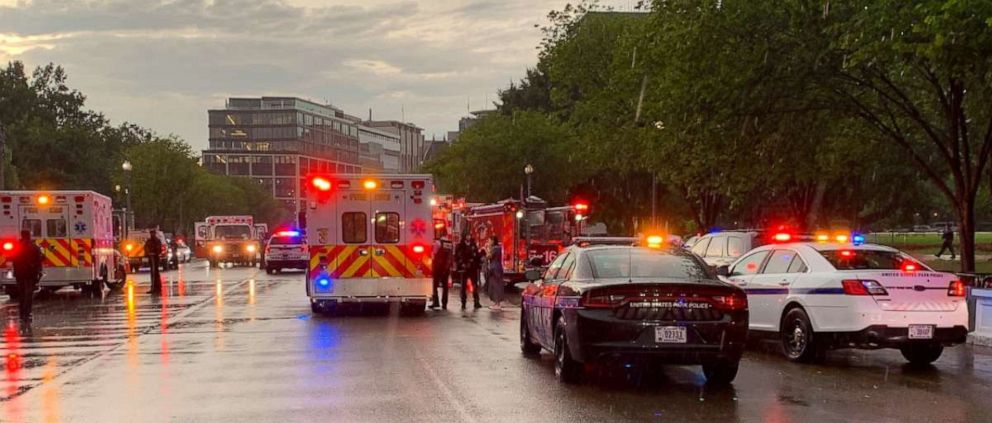
In this photo posted to the DC Fire and EMS Twitter account, first responders work at the scene of a lightning strike in Washington, DC, on Aug. 4, 2022.
DC Fire and EMS/Twitter
Uniformed US Park Police officers and members of the Secret Service were also on the scene and immediately rendered aid to the victims, an EMS official said during a news conference.
In this photo posted to the DC Fire and EMS Twitter account, first responders work at the scene of a lightning strike in Washington, DC, on Aug. 4, 2022.