Intel’s Arc GPUs won’t just be for PC gamers. The company is expanding the graphics line to also target professional users, such as 3D artists and architects.
The company is doing so through a new “Arc Pro A-series” range of GPUs, which Intel announced on Monday. They’re slated to arrive for both desktop and laptop workstations, which will put them head-to-head with rival GPUs from Nvidia and AMD.
To target laptops, Intel is preparing the Arc Pro A30M GPU. For desktops, the company is planning the A40, a single-slot graphics card, and the A50, a dual-slot card. Both will be meant for “small-form factor” PCs, suggesting they’ll operate as lower-end GPUs.
Intel’s announcement was mum on details, including specs, pricing, and an exact launch date. But the Pro series will feature “built-in ray tracing hardware, machine learning capabilities, and industry-first AV1 hardware encoding acceleration,” the company said.
Intel added that the first Arc Pro A-series GPUs will arrive sometime later this year through “leading mobile and desktop ecosystem partners.” So it sounds like the desktop Arc Pro graphics cards will only be available inside pre-built workstation PCs.
The current challenge facing Intel’s Arc series has been limited product availability. The company has been slow to launch the gaming-focused Arc GPUs outside Asia amid rumors of sagging support from third-party vendors. The other issue has been optimizing the Arc GPUs to play well with older PC games.
That said, Intel insists that the first Arc desktop GPUs will launch globally before the end of Q3. In the meantime, the company plans on demoing the first Arc Pro A-series GPUs later today during SIGGRAPH, the annual computers graphics conference, in Vancouver, Canada.
The company also noted that Intel Arc Pro GPUs are “targeting certifications with leading professional software applications within the architecture, engineering and construction (AEC), and design and manufacturing (D&M) industries.”
EA explains why Skate went free-to-play…and the short answer is social interactions.
The main reason why most games go free-to-play is to maximize reach and microtransaction spending. This is certainly one of EA’s big motivations with Skate, which is indeed F2P and will also have microtransactions. EA makes billions every year from live services and Skate will feed into this stream.
Aside from the game’s business tactics, EA management gives more color, saying that Skate’s new F2P release will appeal and cater to a very specific age group: Gen Z and Gen Alpha, both of which are very much connected to live games.
“One of the most important growth potential that we have as a company is how we show up for Gen Z and Gen Alpha players, how they socially connect, how they consume content. There’s been a significant focus from the team on this,” EA Chief Operating Officer Laura Miele said during the Q1 earnings call.
“Back in the day, skate was a bit even ahead of its time. A lot of the core motivation around our skate experience was around creative self-expression and in social connection and competition. And we are bringing that to life in the biggest way we possibly can.”
EA CEO Andrew Wilson also had prepared remarks about these age demographics
“We continue to see Gen Alpha and Gen Z turning to games as their primary form of entertainment, consuming more content than any generation of the past. They love playing with friends. They stay connected with family. And they’re creating content at every turn, both in and around their entire gaming experience.
When we look at Skate, I think what happened is our ambitions have continued to grow. As you’ve seen what the team has been able to do around that experience, I think we continue to see opportunity.
Skateboarding is kind of a cultural language for many generations. It transcends so many things, certainly geography and as we think about the ability to bring a global community of youth together through the language of skateboarding, we think this represents one of the biggest and strongest opportunities we have to build a global online community deeply engaged. in a world that involves creativity both from us and from them experiencing what starts out as skateboarding and almost certainly reaches more deeply into the cultural sensibilities of a generation.
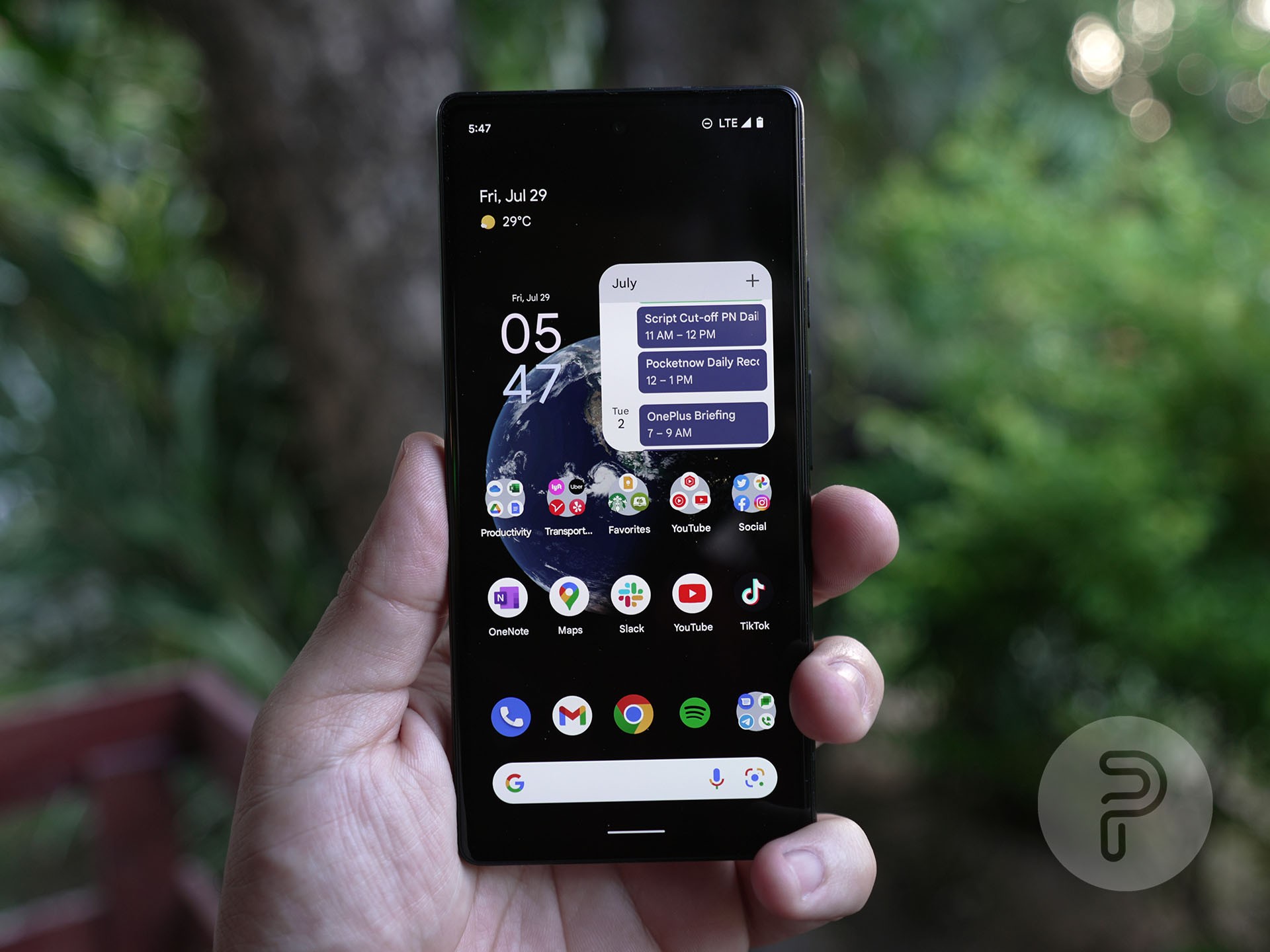
This is the Google Pixel 6a, but it’s also NOT what I think many of us have come to expect.
See, we’ve known this Pixel “a” series as the company’s most successful lineup ever, but it’s also more of a nod to the past. Just like the early days of the Pixel, the Nexus also started as a premium offering, only for things to not pan out, and for the company to shift strategies with the Nexus 4 in creating the world’s first flagship killer.
In sort-of the same approach, the Pixel 3a was a genius move. Instead of only focusing on one phone, you could choose between flagship and mid-ranger, with the benefit that great photography became a Pixel trait across the board. It was pretty irresistible at just $399, but then Google kept experimenting. Over the next two years we saw all Pixels tip completely to become mid-rangers, but then this year, it seems the formula is now to go hard on defying the establishment.
POCKETNOW VIDEO OF THE DAY
So sure, even if the Pixel 6a is a successor to every “a” variant we’ve seen before, it’s different because it’s not really a mid-ranger, and sure, I wouldn’t call it a flagship either. At a time when most heroes have lived long enough to become the villain, this phone is something else.
Let’s try to remember the flagship killer formula one more time. These all had flagship processors, powerful specs, and probably skimped out on things like the camera, certifications and a few other things, but then they were priced so aggressively you wouldn’t argue. Ok, that’s the Pixel 6 but with a great camera. I still think that is probably the best value for a phone right now, but then the Pixel 6a takes that approach even further.
It follows on the look and feel of his more-expensive brother in almost every way. It’s slightly smaller, but not necessarily a one-handed phone either. It shares the same flat aluminum rails but instead of a glass back, this is actually a thermoformed plastic composite that could’ve fooled me easily. Yet, the choice of materials and the footprint help it feel so good in the hand. After spending months complaining about the behemoth the Pixel 6 Pro was, this is like the answer to anyone left missing the Pixel 5.
Source: Pocketnow
Specs
Once you look into internals though, you’ll debate calling this a flagship killer, but mostly because of certain choices to keep the price down. Flagship processor, check. Decent amount of RAM, storage and battery, check. Latest 5G, Wi-Fi and Bluetooth, check. It’s not until you get to the IP rating that you won’t get the same as others, but it’s here, but where things fall apart is in its lack of wireless charging, though if we’re fair, it has never been an A series Pixel trait. That said, if you came here looking for the headphone jack the A series was famous for, tough luck. It’s gone.
I also know it’s already become a common thing to get at least some boost in refresh rate on the screen at this price, but blame the iPhone SE for setting the bar pretty low. The Pixel 6A does beat the pants off of that with a more futuristic approach to the bezels, and a much better OLED panel. It might not bring anything over 60Hz, but at least its color reproduction is far better than most of the phones that go beyond at this price. If anything I wish the dual firing speakers depended less on just the bottom firing module, but you and I know even the Pixel 6 Pro has that problem.
Source: Pocketnow
And listen, I also heard there were some complaints about choppy performance from this phone, but it’s one of the reasons I like to take my time. It was kind of a thing for the first 3 days or so, but it’s as if the Tensor chip got to know me quick. Even putting it next to the 120Hz of the Nothing Phone (1) I see this Pixel 6A launching folders faster. Obviously, that is to be expected if Android belongs to Google, but I will tell you I prefer the implementation of Material You more here than in the more expensive Pro. The smaller screen allows for a denser feel and easier one-handed use, which is only augmented by its cohesive design aesthetic. Pixel perks like the at-a-glance widget, voice recorder transcriptions, that in-your-face always-on display, timely Android updates, and almost every other thing you get with the regular and Pro siblings are all here.
Source: Pocketnow
Performance
That said, this also means you also can’t spare yourself from the things that come with the territory, like not being able to remove some of these UI elements. It’s the same case with battery life where this phone is not bad, but it’s also not great. I do consider it sips on power better than even its larger brothers with their extra juice given its lack of high refresh rate, but all you need to do is leave this phone untouched for a couple of hours to notice how inefficient Tensor can be on idle . The good thing is that since Google already ironed out all the connectivity bugs we had last year, the experience with phone calls and data connectivity was pretty good while I tested it on AT&T’s 5G network, or as I traveled with Google Fi.
Source: Pocketnow
Camera
Maybe the most controversial move is with the cameras because I kid you not, these sensors are at least four years old. Yes, if you’re still rocking a Pixel 3, I won’t blame you for thinking this isn’t an upgrade, but it’s not that simple. Surely those specs must be dated, but Tensor brings a new ISP to power those cameras, and we all know that when it comes to computational photography, a Pixel is a Pixel.
I spent a good deal of time saying wow to some of the results, mainly given the amount of detail this phone can pull in tough scenarios, and that’s even some of these not being fully optical. It’s got some of the contrast of the Pixel 6 Pro, but not all of it, and yet it’s there when I want it, like when I take photos of landscapes, and that’s regardless of the focal length I pick. This phone can do a pretty amazing job in closeups, and since it does a great job at locking focus, this is also while the wind is giving flowers a hard time. Colors have this added sense of character that you’d need to pay for a Pro iPhone to get. And sure, there is no Telephoto on board, but even the crop is handled so well you might struggle to notice physics didn’t take part in it.
Source: Pocketnow
Same with night photography, where this phone pulls in a crazy amount of detail and handles colors and light pretty well. The Ultra-wide struggled a bit in some cases but not always, and where I seriously have no complaints about the primary. Sadly we don’t get a lot of the long exposure tricks the Pixel 6 Pro brings, but Astrophotography is here, and you’ll be shocked to know that at almost half the price, this Pixel 6a takes the same amount of time at taking the shot than the Pro.
Selfies are good, though not my favorite because I feel skin tones are overdone, and even if portraits were mostly the same, I do feel separation was mostly hit or miss, and this even applies from the primary cameras.
Source: Pocketnow
Where you will find differences with the Pro Pixel is in video capture. Even if voice enhancement features are here, I feel this phone pulls in a lot more grain than the Pro model, and where the codec struggles a lot, particularly with all the moiré you’ll see in certain scenarios. It’s not terrible but not close to being my favorite. Switch to selfie video and you’ll see how that gets even worse, and not just because you’re stuck at 1080p. Grain is pretty strong, dynamic range is almost not there at all, and stabilization can be kind of weird, even if the primary handled that mostly well. Overall, you’ll love the photos, but this is not the phone for TikToks, Instagram Reels or meaningful family videos.
Source: Pocketnow
Conclusion
To conclude, I think you now understand why it was so important for me to introduce this video with how this lineup came to be, and how this phone is not necessarily that. Yes, this is the Pixel 6a, but we saw Google switch the formula with the 4a by giving us a 5G variant. We then saw the company switch the cheap feel for metal and a more aggressive price with the 5a.
Point is, yes, this is Google’s most affordable Pixel, but it’s also another switch in strategy. Yes, it’s like an iPhone SE because it includes a flagship chip, but if we’re honest, it’s nothing like it because Apple sticks to a six-year-old design, and doesn’t take full advantage of the chip in photography. By contrast, the Pixel 6a is almost as good as the Pixel 6, which in our opinion is the flagship killer, all while giving you an option to pay less for most of those features
So, it’s not really a flagship. It’s not really a mid ranger. The Google Pixel 6a is something else which I feel you should really consider. If you don’t care about high refresh rate, wireless charging, a glass back and a few other tidbits, this should be your phone. It’s a Pixel, but less expensive. Another bold move from the same company that already made all other phones look bad with the rest of the 6 series launched earlier.
Google Pixel 6a
Not a flagship, not a mid-ranger
If you don’t care about high refresh rate, wireless charging, a glass back and a few other tidbits, this should be your phone. It’s a Pixel, but less expensive.
Panasonic will release a mirrorless camera that it will jointly develop with Leica “in about a year” that is the result of the expanded partnership the two brands signed in May.
The report comes courtesy of Nikkei, which has found evidence that shows that the manufacture of all small digital cameras has basically ceased across the board. As part of that report, the publication spoke with Panasonic which confirmed that not only has it ceased production of Lumix-branded compact cameras, but that it would also be focusing on the high-end of the market which includes leveraging its partnership with Leica to produces a co-developed mirrorless camera next year.
“Production of existing products will continue for the time being, but in the future, the company plans to concentrate on developing high-end mirrorless machines aimed mainly at enthusiasts and professional filmmakers,” Panasonic tells Nikkei.
“We are planning to release a mirrorless machine jointly developed with Leica Camera, which we formed a comprehensive partnership with at the end of May, in about a year.”
In May, Panasonic and Leica announced a new agreement that was categorized as a “business alliance” that further tightened the relationship between the two companies. The two brands had already been working closely together for several years, but this agreement, known as Ltwowould join both business and marketing together in the development of cameras.
What the two brands would do under this new relationship was vague at the time, but this somewhat offhanded remark from Panasonic to Nikkei is the first confirmation that the two brands are working on a future camera product together under the new Ltwo partnership. Given Panasonic’s statement about a focus on high-end products and the history of Leica’s brand, it is probably safe to assume the final product will exist in that space.
It is not clear how this new camera will fit in with Panasonic or Leica’s current full-frame offerings. The two companies both produce mirrorless L-mount cameras that exist in that high-end space, and whether or not the co-developed camera will replace both lines or be in addition to them was not revealed.
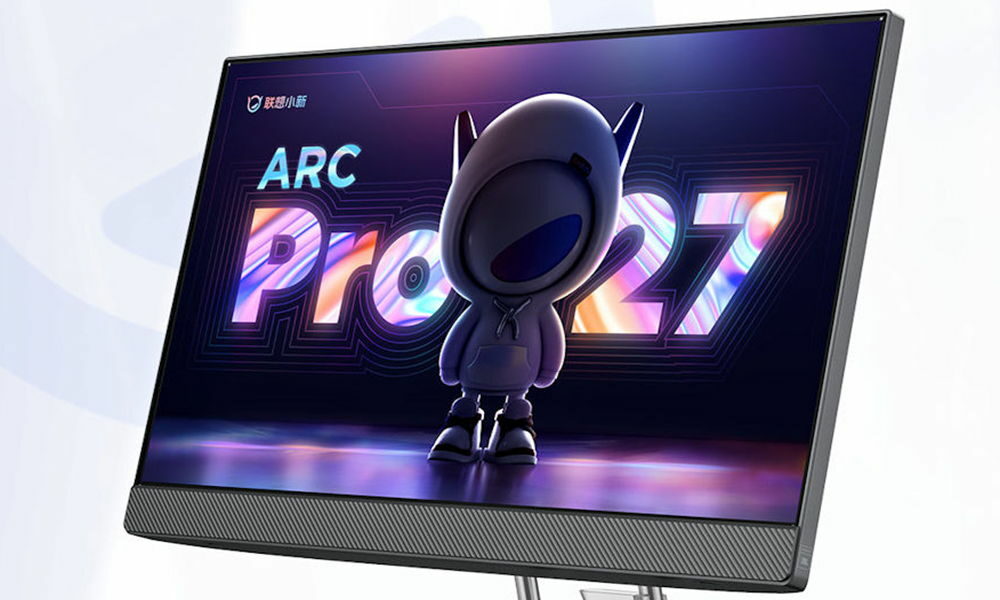
Lenovo has published a preview image of the Xiaoxin Pro 27, an all-in-one AIO that happens to be the first we see with intel Arc graphics.
Intel is going slowly, but surely, in its return to the dedicated graphics market. The already marketed models of the M series for notebook computers will also be used in other product lines. We saw it last week in the Intel NUC 12 mini-PCs and now its presence is coming to us in an AIO.
Lenovo Xiaoxin Pro 27
It is a compact all-in-one desktop computer based on a 27 inches diagonally. (It is also announced that the series will be available in another 24-inch model). Other announced data tells us that its native resolution is 2K (2560 × 1440 pixels)
The panel has technologies against annoying blue light and has a refresh rate of 100Hz. In its chassis, it mounts 5-watt stereo speakers from the JBL brand, an FHD webcam and noise-canceling microphones. It has USB Type C and HDMI inputs, while its power supply is 230W.
The great novelty of this AIO is the integrated Intel graphics that it uses, the first time it has been announced in the segment. The model chosen by Lenovo is the A370M. Although it is the entry range of Intel, Lenovo ensures that outperforms an RTX 3050M of NVIDIA in video editors such as Adobe Premier or Davinci Resolve and says that it achieves 152 FPS in League of Legends (with 2K resolution), 110 FPS in Counter Strike GO and 142 FPS in World of Tanks with FHD resolution.
This AIO will use 12th Gen ‘Alder Lake’ Intel processors, but we don’t know the amount of RAM (probably 8GB LPDDR5 and up) and storage (surely at least 256GB M.2 PCIe SSD).
This Lenovo Xiaoxin Pro 27 is interesting for those looking for a compact desktop with an Intel base hardware and the first dedicated ones in the segment. It will be available next fall without a defined official price.
Love foldable smartphones? Save up to $699 on Samsung Galaxy Z Flip3 5G and Fold3 5G. Know how to.
Love foldable smartphones? If yes, then this could be the best chance for you to get your hands on a feature packed foldable smartphone. Yes, Samsung Galaxy Z Flip3 5G and Fold3 5G prices have been slashed in the US ahead of Samsung Galaxy Z Flip4 and Fold4 launch. Bestbuy is offering an exciting deal on both of the handsets that let you save up to $699. You just have to choose an eligible plan from broadband service provider Verizon. That’s not all, you can even opt for EMI options to pay the remaining cost in monthly installations starting from $8.33/mo. This is a pretty decent deal for those who are looking for a premium foldable smartphone on a budget.
Samsung Galaxy Z Flip3 5G and Fold3 5G price drop in US: How to grab it
To grab the deal all you have to do is go to Bestbuy and select a Samsung Galaxy Z Flip3 5G 128GB phone and then choose an eligible network plan from Verizon. Pay the one time activation fee along with EMI and it’s done. Your device will be shipped to you. However, do note that you will have to opt for Verizon service for a period of 36 months in order to avail this discount. The handset is originally priced at $1049.
Similarly, if you want to grab a Fold3 5G 256GB, you can save $1000 on an eligible T Mobile plan. The monthly installation plan starts at $33.33 for 24 months. The phone was originally priced at $1799.
This is a limited time deal and if you’re planning to get a stylish 5G phone on budget, you must pick any of the Galaxy Z series handsets from Bestbuy sooner, rather than later.
Further if you want to save more, you can save $800 on trade-in of an eligible device like iPhone X, iPhone XR, iPhone XS, iPhone XS Max, iPhone 11 Pro, iPhone 11 Pro Max, iPhone 11, iPhone 12 Pro and others.
Aerodynamic drag’s supreme reign over the cycling industry is apparently over, as the wind tunnel has made way over the past two years for the coronation of the “do-it-all” bike, frame, and wheels.
Nowhere has this transition of power been more evident than at Zipp. The brand’s carbon wheels, synonymous with aerodynamics, have undergone a shift of focus in recent years. Outright aerodynamic efficiency has been replaced with a focus on Total System Efficiency, or as Zipp describes it, “a balanced attack against the four barriers to speed: wind resistance, gravity, rolling resistance, and vibration.”
Zipp’s new approach was first seen in the new 303-S, and the 303 Firecrest, then the 353 NSW, and most recently the 454 NSW, and 404 Firecrest as each of these wheels got lighter, wider, tubeless, disc-brake only, and even sacrificed some purely aero savings, all in the name of going faster in the real world.
Now joining that list are the new 808 Firecrest and the 858 NSW wheelsets as Zipp’s deepest, fastest, and most aerodynamic wheels get the “real-world” treatment.
858 NSW – All kinds of faster
While, technically speaking, the 858 NSWs were last updated a mere 14 months ago, that update simply added Zipp’s new Cognition V2 hubset to the existing 77/82 mm undulating rim. The 858 NSWs unveiled today feature an entirely new rim paired to that same Cognition V2 hubset and a host of updates tackling Zipp’s four barriers to speed.
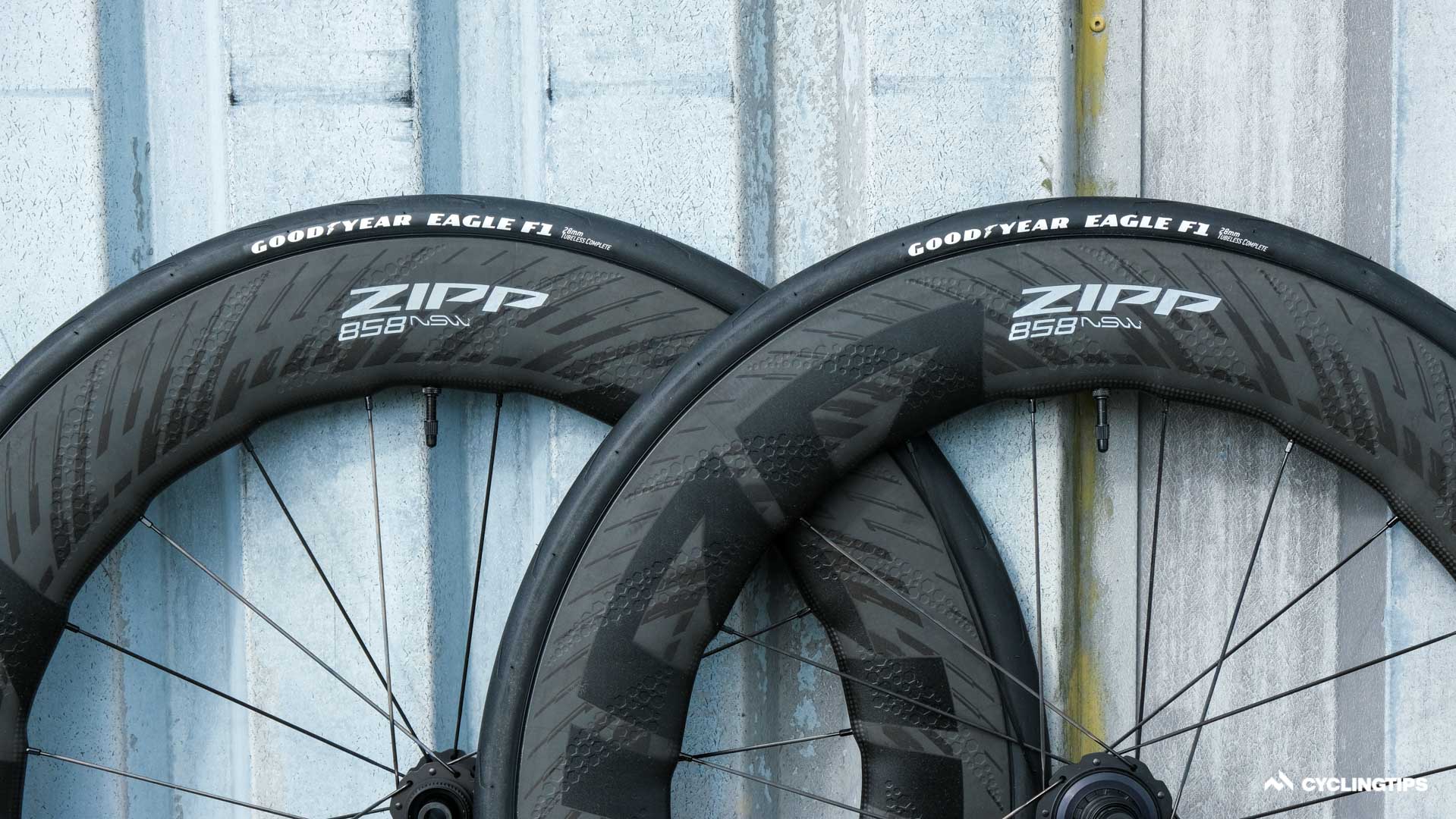
The new 858 NSW rim still features Zipp’s almost signature Sawtooth undulating rim shape with varying 82/85mm depth, but has grown wider with 23mm internal and 27mm external rim widths. This wider rim is now hookless tubeless only and optimized for 28mm tyres. While many manufacturers are now “optimizing” rim widths to specific tire sizes in pursuit of aerodynamic gains, Zipp’s optimization claims here are based on a balance of aerodynamics and rolling resistance.
The brand claims the wider rim shape paired with a wider 28mm tire reduces tire deflection and results in lower rolling resistance. Furthermore, Zipp claims the wider tire bead interface and external rim width actually create a smoother and more aerodynamic interface from the tire to the rim, despite the 27mm external rim not conforming with the widely accepted “rule of 105”.
The so-called “Rule of 105” states that the rim must be at least 105% the width of the tire to improve the chances of re-capturing airflow from the tire and controlling it or smoothing it over the rim and was originally coined by Josh Poertner of Silca.cc. However, Zipp points out that “the rule of 105” doesn’t account for the speed gains from a wider tire at lower tire pressures and claims the aerodynamic cost of a 28mm tire versus a 25mm tire is lower than the savings in rolling resistance.
“A wider tire bead interface also allows for a wider tire, which allows for lower tire pressure. Lowering tire pressure can increase overall system efficiency, reduce rider fatigue, and offers better handling in rough conditions.”
zipp
New Zipps, built for wider tyres.
Those increased rim widths are disguised behind Zipp’s signature sawtooth profile, retained for the new 858 NSW rims. First introduced on the 454 NSW wheels back in 2016, the sawtooth profile rim design is said to offer both improved aero efficiency and crosswind stability. Further improving this “Aerobalance” is Zipp’s other signature design cue, the HexFin ABLC dimple pattern rim.
Of course, with a hookless profile comes certain restrictions. While Zipp recommends a 28mm wide tire to maximize speed, 25mm is the minimum and 32mm the maximum tire widths compatible with the new wheels. Of course, regardless of tire width, the tire itself must be hookless tubeless compatible. Zipp has a list of compatible tires published on SRAM.com.
So what does all that mean? In terms of outright aerodynamics and wind tunnel testing, the new 858 NSWs are merely a single watt faster than the previous generation 858, but that is almost the point. Zipp explained its objective for the new wheels was merely to match the previous generation’s aerodynamics, focusing instead on other aspects of the wheels which make for a faster setup in the real world. The optimization around 28mm tires is just one part of these real-world improvements.
Zipp explained the 808 and 858 wheelsets are still their go-to option for time trials and triathlons, but now with the Total System Efficiency treatment, the 80+mm deep wheels are said to provide a real option for road racing and general road riding.
Dimpled, wavy, lighter, wider, the new 858 NSWs are for time trialling, road racing, and even general riding, according to Zipp.
A significant weight saving is central to Zipp’s versatility claims for the new wheelset. Zipp shed a relatively huge 243 grams from the new wheels versus the outgoing 858s. In doing so it brought the total weight of the wheelset (without tape and valves) down to just 1530 grams (719g front, 811g rear) and into the territory of many shallower wheels.
Zipp found most of this weight-saving with the move to a hookless rim. Each of the new wheelsets mentioned earlier all feature a hookless rim, and so while the move to hookless may still prove controversial, it was entirely predictable for the new 858s. In addition to helping drop the rim weight, Zipp claims the hookless design creates a stronger rim, and reduces both pricing and waste.
The brand credits an additional 10% of the rim weight savings to its Carbon internal Reinforcement (CiR) laminate technology. Most carbon rims feature uniform layup thickness throughout. However, Zipp suggests the forces exerted on the rim are not uniform, and explains CiR helps Zipp to place the optimal amount of carbon fiber precisely where it’s needed and less where it is not. Zipp claims this variable layup results in a rim with the same stiffness, strength, and durability but with a significant weight saving.
The updated Axial Clutch design supposedly runs with less friction, but what’ll likely be more significant to owners is that the simpler parts layout should be more reliable over the long haul. Photo: Zipp.
Unsurprisingly, Zipp has retained the new Cognition hubs introduced to the 858 NSW wheelset last year. The rear hub features Zipp’s Axial Clutch V2 technology said to reduce drag, lower friction, and offer quicker engagement with its Sylomer spring system and 54 points of engagement.
The Zipp 858 NSW wheelset uses Sapim CX-Ray spokes, with 20 spokes front and rear and external alloy nipples in a two-cross spoke pattern for the front wheel and radial laced drive side and two-cross non-drive on the rear.
All told, other than suggesting the new wheels are aerodynamically equal to the outgoing wheels, Zipp isn’t making any claims about exactly how much faster the new 858 NSW wheels are, focusing instead on the new wheel’s lower weight, comfier ride, and more stable handling characteristics. And while the wavy profile, dimples, and similar decals all combine to create a wheelset that at least aesthetically looks very similar to the narrower and heavier previous 858s, the good news is the pricing has dropped.
The new 858 NSWs are priced at $4,400 USD / €4,000 / £3,570 / $6,630 AU. While still a staggering amount of money for a wheelset, at least the pricing is going in the right direction. The new 858 NSWs will be available soon after launch through local retailers and online.
808 Firecrest – more dimply, less pricey
The 808 Firecrest wheelset has also received an update. The lower priced of the two new wheelsets, the 808 features a round 80mm-deep rim shape with a 23mm internal width hookless rim profile and maximum outside width of 27mm. The rim stats are broadly similar to that of the range-topping 858 NSW, with the 808s merely missing out on the sawtooth profiling and gaining 105 grams.
The new 808 Firecrest is also wider, lighter, and less pricey. Photo: Zipp.
What the 808 lacks in outright fanciness, it more than makes up for in other departments. While heavier than the new 858 NSWs, the new 808s actually achieve a greater weight saving of 282 grams over the previous model. The 808s weight saving is again largely thanks to the shift to a hookless rim and additionally a 2mm decrease in rim depth from 82mm to 80mm.
The new 808s also now feature wider internal and external rim widths optimized around a 28mm tire, with Zipp again pointing to the real-world speed gains offered by the wider setup.
Zipp has equipped the new 808 Firecrest Tubeless Disc-brake wheelset (to give its full title) with its ZR1 Disc-brake hub with a Center Lock disc rotor interface. Again, the Zipp ZR1 hub might not be quite as fancy as the range-topping Cognition, but with 66 points of engagement, it has a trump card of its own.
Go wide or go home, Zipp says “if you want to be faster, ride 28mm tires.” Photo: Zipp.
Laced to those ZR1 hubs are 20 Sapim CX-Sprint spokes. Built with external alloy nipples in a two-cross spoke pattern for the front wheel, the rear wheel has a radial laced drive side and two-cross non-drive.
All in, the new 808 Firecrests weigh in at 1,635 grams (without valves and tape). Perhaps more importantly though, the 808 Firecrests offer a significant cost saving versus their higher-tier NSW siblings. A complete 808 Firecrest wheelset will set you back US$2300.00 / £2235.00 / AU$3466 / €2500.00.
In other words, the new 808 Fircrests cost less than the 858 NSW rear wheel alone and offer a new, wider, lighter, and presumably faster wheelset than the previous generation 858 NSWs. I’d hazard a guess most riders considering the 808 Firecrests will gladly take the aero gains without a second thought given to the 1,635 gram total weight.
The suggested rider system weight limit (rider + gear) for both new wheelsets is the same as all other Zipp road wheels, 250lb / 115kg. Furthermore, both wheelsets are covered under Zipp’s lifetime warranty against manufacturing defects and impact damage during intended use. The usual original owner and proof of purchase caveats apply, but the coverage will provide some peace of mind for wheelsets which are both still substantial investments.
Zipp suggests both new wheelsets will be available shortly after today’s launch through local dealers and online.
Wide and very dimpled. Disc brake and hookless. Introducing the new 808 Firecrest.
incoming reviews
A pair of the new 858 NSW arrived at my door two days ago. With only two days to ride the new wheels so far, my thoughts right now are nothing more than first impressions. The wheels are certainly fast, and impressively lightweight for such a deep, tubeless, and disc brake wheelset. But anyone hoping for an 80+mm deep wheel with the stability of a shallower wheel might be disappointed.
I’d classify myself as pretty confident and competent in riding deep-section wheels in windy and even blustery conditions. Rarely, if ever, do I get spooked by a gust of wind catching my front wheel. However, on both rides on the new 858 NSW so far, I have noticed the increased side forces catching me off guard on several occasions. Again, these are 80+mm deep wheels and so, buyer beware, despite Zipp’s best endeavors, a ride in blustery conditions will still result in some hairy moments.
Given the extra speed available and impressively low weight penalty, I can’t imagine choosing anything other than the 858 NSWs for all but the hilliest or windiest of races. But based on two days of riding so far, I can’t imagine these very deep rims becoming my everyday wheelset either. Time will tell. Stay tuned for a longer-term review.
Printers remain one of the most frustrating pieces of consumer electronics, but it turns out a thirst for pricey ink and occasionally chewing up and choking on paper aren’t the biggest challenges of using an Epson printer. Ace some users have discoveredthe hardware might be programmed to simply stop working one day, if used too frequently.
The phrase ‘planned obsolescence’ gets thrown around a lot with consumer electronics, as a practice where a product is specifically designed and built with a limited lifespan so that it needs to be upgraded or replaced in just a few years’ time. Most companies deny using this approach, or will cite very specific but questionable reasons as to why it’s necessary, as Mark Havena writer and lecturer at the University of New Haven in Connecticut, recently discovered.
Haven recently took to Twitter to share a frustrating experience with their wife’s “very expensive @EpsonAmerica printer” which, seemingly out of the blue, displayed a warning message stating that “it had reached the end of its service life.” It then simply stopped working, requiring either a servicing to bring it back from the dead, or a full-on replacement.
So what was the issue with the printer? A dead engine? A faulty circuit board? Nope. The error message was related to porous pads inside the printer that collect and contain excess ink. These wear out over time, leading to potential risks of property damage from ink spills, or potentially even damage to the printer itself. Usually, other components in the printer wear out before these pads do, or consumers upgrade to a better model after a few years, but some high-volume users may end up receiving this error message while the rest of the printer seems perfectly fine and usable .
According to the Fight to Repair Substack, the self-bricking issue affects the Epson L130, L220, L310, L360, and L365 models, but could affect other models as well, and dates back at least five years. There’s already videos on YouTube showing other Epson users manually replacing these ink pads to bring their printers back to life. The company does provide a Windows-only Ink Pad reset utility that will extend the life of the printer for a short period of time, but it can only be used once, and afterwards, the hardware will either need to be officially serviced, or completely replaced.
A few years ago, Epson released its EcoTank line of printers, which were specifically designed to address the extremely high cost of replacing the ink cartridges for color inkjet printers. The printers featured large ink reservoirs which could be easily refilled with cheaper bottles of ink, and although Epson’s EcoTank printers were more expensive as a result, in the long run they would be cheaper to operate, especially for those printing a lot of color imagery. But that assumes they actually keep working for the long run. Videos of users manually replacing their Epson printers’ ink pads seem to indicate that the company could redesign the hardware to make this part easily user-serviceable, which would extend the life of the hardware considerably. But as it stands, the company’s solution runs the risk of contributing to an ever-growing e-waste problem and forcing consumers to shell out for new hardware long before they really need to.
We’ve reached out to Epson for comment about this functionality and have asked the company which models specifically are affected by this limitation. We’ve also asked whether servicing is covered under the printer’s warranty, and what the cost may be if not, and will update this story when we hear back.
All advertising is evil, obviously. But sometimes, despite this, it can be extraordinarily entertaining. This latest 3D billboard from outside of Tokyo’s Shinjuku Station is maybe the best use of this optical illusion tech I’ve seen, and it’s cross-promoting Pokémon GO and, er, World Cat Day.
We’ve covered the amazing 3D billboard before, funnily enough the last time it appeared to house a cat. Its cunning use of a two-storey curved screen that reaches around the corner of a building creates anamorphic optical illusions that are impressively effective. In this case, as spotted by nintendo lifeit’s to have poor Pikachu seemingly squished, then hounded off the screen by a series of Pokemon cats. Here, you can watch the full loop:
So you’ve got Meowth, Alolan Meowth, Galarian Meowth, Skitty, Purrloin, Litten, Espurr, Glameow, and, um, Vanillite? Clearly someone wanted to do a whole frozen thing, and then realized there are no Ice type cat-likes!
The effects are just fantastic. The Poké Balls cascading to fill up the space, then seeming to spill out the front, must have people below putting up arms to shield their heads. But creepy ol’ Glameow’s moment is by far the most effective, as she appears to entirely float out of the screen.
So much about it is the fake framing of the billboard, especially those mocked up bits of scaffolding at the bottom, that allows characters to appear to reach beyond the boundaries of the screen. I could watch it all day.
This is, apparently, just the first of a series of Pokemon ads that will be appearing on the billboard between now and September 5, this first one inspired by how today is International Cat Day. No, seriously, it’s a thing. Presumably organized by cats.
It seems worth keeping an eye on Pokémon GO Japan’s YouTube channel over the month, as they’re uploading videos of the billboard there.
Taking the headlines, Pro Clubs and VOLTA FOOTBALL progression is now combined. VOLTA is the pick-up-and-play, launched in FIFA 20. A take on street football (RIP FIFA Street) where small-sided games and skills reign, with thousands of unlockable cosmetics available.
Now, wherever you play, your two avatars earn the same progression items. You’ll earn VOLTA coins and XP/skill points across both modes, taking the grind out of either mode. Great when you fancy casual VOLTA Arcade games over focused soccer.
In FIFA 22, Pro Clubs fans played for hours without making a dent in their level. Thanks to community feedback, the player progression system has been increased to 100 levels, allowing players to level up sooner.
There’s a host of new perks to unlock including ‘poacher’, ‘interceptor’, ‘light passes’ and an exciting new signature ability called ‘take flight’. You’ll be high-jumping at corners like Cristiano Ronaldo in no time.
At the end of a match, you’ll now see an accolades screen showing the top performers from your game, such as most distance covered and most tackles made. This is a great way of comparing yourself against the rest of your party without looking at the scoresheet.
Speaking of comparing performances, player ratings have had a refresh, and are now fairer on Pro Clubs players who play defensive roles and don’t score goals.
New, larger VOLTA stadium in rotation which has much bouncier walls and a bigger goal area. More space equals more time on the ball, and this will change the way VOLTA plays. Fans of the small, current arenas don’t fear – the new stadium will appear 50% of the time along with other arenas.
With every new game comes new cosmetics, and finally in FIFA 23, your Pro Clubs and VOLTA player can have tattoos! There are also loads of the latest soccer boots and facial accessories including the broken nose protector. Sadly, some of the sillier items won’t be usable in Pro Clubs. As ever, players can expect new content to be released in batches throughout the year.