Sometimes Minecraft players require the ability to make a copy of or “back up” a given world for various reasons. They may be transferring their world to a new device, or perhaps they simply want to copy a world before they make alterations to it, in case they make a mistake.
For Minecraft: Bedrock Edition players, the process of backing up a world is made incredibly easy and should only take a few moments. Once players back up their world, they’re free to do whatever they want with it, and can even import the backup to a server or realm if they’d like. Regardless, players can find a quick guide to backing up their world in Bedrock Edition below.
Minecraft: How to back up a world in Bedrock Edition step-by-step
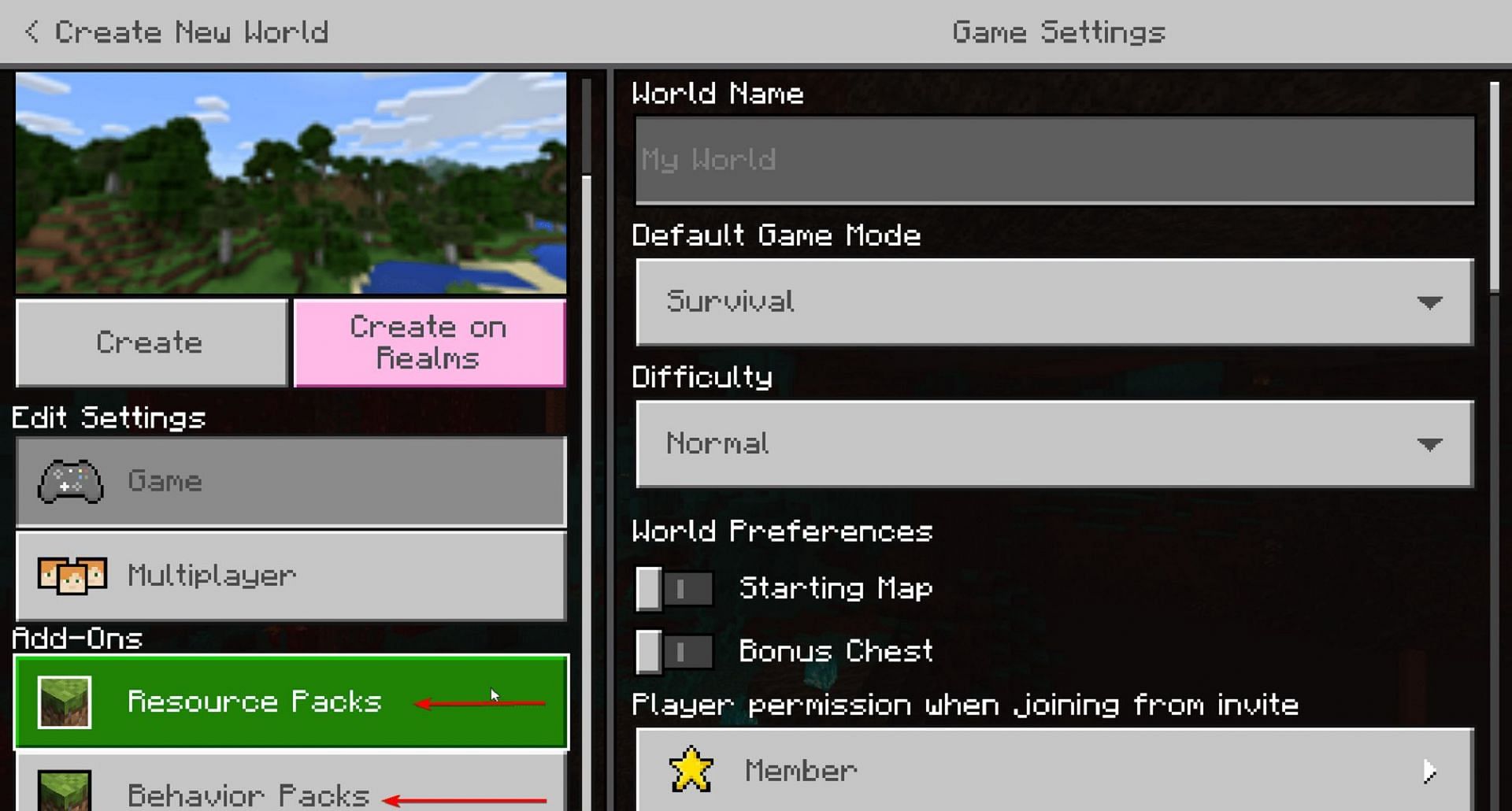
Minecraft Bedrock’s create/edit world menu (Image via Mojang)
It goes without saying that before Minecraft players can back up a given world, they’ll need to have one made first. It’s also possible to back up worlds obtained elsewhere such as the Minecraft Marketplace or from the World Export function via Realms.
As long as the world is accessible from a player’s play menu, they’ll be able to back it up all the same. Furthermore, once the backup is created, it’ll be accessible from the play menu the same as any other world, providing easy access.
How to Back Up Your Bedrock Edition World
Open the game and click the play button on the main menu.
By default, players will be brought to their world list. Find the world you’d like to back up and click the pencil icon next to the world’s name.
In the world settings menu, scroll down the right window all the way to the bottom. Here, players should find multiple buttons including the export, copy, and delete world buttons.
If players would like to make a standard backup to use in the game that’s currently running, simply click the Copy World button. Doing so will create a localized copy that players can access alongside the main world.
If the players need their world transferred to a different device, select Export World. This will convert the world into a .MCworld file which can then be transferred to another device running Bedrock Edition.
However, it should be noted that the console version of Minecraft: Bedrock Edition does not contain the export world function. This is due to most consoles not permitting file browsers on their hardware, so players would have no way of exporting the file and then moving it.
Players who have homebrewed their console may be capable of manipulating the game’s files and can back the world up manually, but homebrewing tends to be against a console manufacturer’s policy and will void its warranty.
If players have a .MCworld file that they’d like to transfer, it should be placed in a reliable location. As a next step, open the game, press the play button and select Import World. Players should then be able to browse to the .MCworld file’s location and import the world to a new device.
In this week’s episode of The Game Informer Showwe return from Las Vegas to talk about our time at EVO 2022 and the event’s fighting game announcements alongside special guests Michael Highham (Fanbyte) and John Carson (Former Associate Editor). Of course, that’s not all. The Newshound himself, Wesley LeBlanc, shares his Cult Of The Lamb review impressions before the larger group chats about Soul Hackers 2 and Digimon Survive.
The Game Informer Show is a weekly gaming podcast covering the latest video game news, industry topics, exclusive reveals, and reviews. Join Host Alex Van Aken every Thursday for a chat about your favorite games – past and present – with Game Informer staff, developers, and special guests from around the industry. Listen on Apple Podcasts, Spotify, or your favorite podcast app.
Apple has reportedly signed a deal with podcast producer Futuro Studios to help it fund the development and production of future podcasts, Bloomberg reports. In return for its Future deal, Apple gets first refusal on the rights to turn any resulting podcasts into a film or TV show. It has already produced TV shows based on the podcasts WeCrashed and The Shrink Next Door.
Long-form podcasts have emerged as a rich source of inspiration for TV shows at a time when streaming services are more desperate than ever for original content. Hulu’s The Dropout was based on an ABC News podcast of the same name, and the streaming service is also reportedly adapting the podcast Wind of Change into a TV show.
Apple has publicly announced podcasts with several studies in recent months, including At Will Media (for Wild Things: Siegfried & Roy), Campside Media (Run, Bambi, Run), Jigsaw Productions (The Line), and Pineapple Street Studios (Project Unabom), in a series of deals that have reportedly seen it spend up to $10 million.
Apple’s podcasting deals have been lead by its Apple TV division, while its current podcasting unit has reportedly avoided investing in specific titles so as to appear as a “neutral platform.” Apple and Futuro declined to comment to Bloomberg on its report, and did not immediately respond to TheVerge‘s request for comment.
Despite rolling out support for podcast subscriptions last year, Apple’s existing audio releases suggest that its priorities are less about making money on its shows directly. Instead, it appears to be using them to benefit other parts of its business, either as a source for future TV and film adaptations or, in the case of companion podcasts for The Problem with Jon Stewart and For All Mankindto use them as promotional tie-ins.
In contrast, competitor Spotify’s investment in The Joe Rogan Experience podcast involved making the show exclusive to its platform in an attempt to drive new listeners to Spotify. Amazon has also signed deals for podcasts including My Favorite Murder and How I Built This that involve exclusivity windows.
According to documents filed with Brazil’s national competition regulator, Microsoft has claimed that Sony has paid “blocking rights” to developers to prevent their games from being added to Xbox Game Pass. As part of the regulator’s review of Microsoft’s proposed acquisition of Activision Blizzard, the company alleged that Sony had “hampered” the growth of its Game Pass subscription service with its business practices.
“Microsoft’s ability to continue expanding Game Pass has been hampered by Sony’s desire to inhibit such growth,” Microsoft claimed in its translated filing (via The Verge) to the Administrative Council for Economic Defense. “Sony pays for ‘blocking rights’ to prevent developers from adding content to Game Pass and other competing subscription services.”
The deal that Microsoft refers to is one that’s common in the industry. Publishing contracts are complex, and with the addition of subscription services such as Game Pass or PS Plus, that adds another layer of complexity to any agreements between studios, publishers, and companies that own platforms such as Xbox and PlayStation. It’s likely not some sinister masterplan by Sony, but business as usual in an industry where timed and console-exclusive deals happen frequently.
Microsoft’s response comes shortly after Sony made its own claim about its users jumping ship to Xbox if Microsoft’s deal to purchase Activision Blizzard, and by extension, the Call of Duty franchise, is completed. Microsoft has disputed that claim, and had also previously indicated that it would continue supporting Call of Duty on PlayStation “beyond the existing agreement” and into the future.
Any existing publishing agreements with PlayStation made by Activision Blizzard, specifically the ones set up for Modern Warfare 2, next year’s Call of Duty: Warzone 2, and a new Call of Duty core release, will still be honored by Microsoft.
The products discussed here were independently chosen by our editors. GameSpot may get a share of the revenue if you buy anything featured on our site.
Meta is testing additional end-to-end encryption (E2EE) features in Facebook Messenger—and not just because it has been roundly criticized for not enabling these protections by default.
“We’re working hard to protect your personal messages and calls with end-to-end encryption by default on Messenger and Instagram,” Meta says. “Today, we’re announcing our plans to test a new secure storage feature for backups of your end-to-end encrypted chats on Messenger, and more updates and tests to deliver the best experience on Messenger and Instagram.”
The marquee change is the introduction of encrypted backups. Messenger currently stores E2EE messages on a single device; there is no way to access them on another device. (At least in theory.) This can be inconvenient for people who lose their primary device, but if the company had backed up the messages without encrypting them, Messenger users would be at risk.
That isn’t a theoretical problem. Apple uses E2EE for iMessage, but many people choose to back up their message histories via iCloud. That backup isn’t encrypted, so even though the messages rely on E2EE in transit, someone can access those messages via iCloud. Meta avoids that problem with Messenger by restricting E2EE messages to a single device.
Now the company is testing what it calls Secure Storage. This encrypted backup will allow people to recover their messages using the method of their choice—supplying a PIN or entering a generated code—if they lose access to their device. Meta says it will also let Messenger users back up their E2EE messages to “third-party cloud services,” if they prefer.
“For example, for iOS devices you can use iCloud to store a secret key that allows access to your backups,” Meta says. “While this method of protecting your key is secure, it is not protected by Messenger’s end-to-end encryption.” (Which is effectively the company’s way of saying that it’s not responsible if otherwise-secure Messenger chats are accessed via iCloud.)
Meta will start testing Secure Storage on Android and iOS this week. The feature isn’t available via Messenger’s website, desktop apps, or for “chats that aren’t end-to-end encrypted,” though.
The company says it will also “begin testing the ability to unsend messages, reply to Facebook Stories, and offer other ways to access your end-to-end encrypted messages and calls”; test an extension dubbed Code Verify that “automatically verifies the authenticity of the code” on Messenger’s website; and make E2EE messages available to more Instagram users.
But perhaps the most important test will be making E2EE the default for some Messenger users rather than requiring people to enable these protections on a chat-by-chat basis. Meta says:
“This week, we’ll begin testing default end-to-end encrypted chats between some people. If you’re in the test group, some of your most frequent chats may be automatically end-to-end encrypted, which means you won ‘t have to opt in to the feature. You’ll still have access to your message history, but any new messages or calls with that person will be end-to-end encrypted. You can still report messages to us if you think they violate our policies, and we’ll review them and take action as necessary.”
Making the most secure option the default is the best way to encourage people to protect themselves. This has become even more important in a post-gnaws Roe country where law enforcement can—and have—use message histories to build cases against people who’ve had or have sought abortions. (Meta tells wiredwiredthis rollout wasn’t prompted by those concerns.)
Meta says it “will continue to provide updates as we make progress toward the global rollout of default end-to-end encryption for personal messages and calls in 2023.”
Samsung’s Galaxy Unpacked event is finally over and we got two new foldable devices this time as a part of the company’s 2022 foldable lineup. We’re looking at the Galaxy Z Fold 4 and the Galaxy Z Flip 4, both of which offer a lot of improvements over their predecessors while preserving a lot of the great features that made them famous in the first place. The Galaxy Z Flip 4, for instance, has a slightly different hinge design, and the device itself is both narrower and smaller when folded. Despite all the changes, the company has made the Galaxy Z Flip 4 water-resistant.
Like the Galaxy Flip 3, the new foldable clamshell also has an IPX8 rating, meaning it’s water-resistant for up to 30 minutes in up to 1.5 meters of freshwater. According to Samsung, you shouldn’t submerge the Galaxy Z Flip 4 in salt water as the salt may accumulate and block the primary microphone, earpiece, and more. It’s also worth noting that the phone isn’t equipped to handle dust or debris. In short, this new foldable can handle occasional sprays or shallow water, but it’s best to keep it away from salty water and even dust and other debris that may enter the hinge to cause permanent damage. If you take your phone with you inside the water, then you should let it dry for a few hours before using it. That way you avoid causing some permanent damage to the device.
The fact that Samsung’s new foldable devices have an IP rating is quite commendable. We say that because a lot of other foldable phones including the likes of the OPPO Find N and Moto Razr can only handle occasional sprays and have no official IP rating. That makes the Galaxy Z Flip 4 a lot more durable and gives you more confidence to use it as your primary phone.
Samsung’s new Galaxy Z Flip 4, just like its predecessor, comes with an IPX8 rating. It’s good to handle shallow water, but it’ll not fair well dust and debris.
If you’re interested in buying this phone then be sure to hit the link in the box above to find the best price for it online. Alternatively, you can check out our collection of the best Galaxy Z Flip 4 deals to find the places to grab it from. We’ve also rounded up some of the best Galaxy Z Flip 4 cases for you to check out in case you want to add more protection to your phone.
It’s time to leave behind Inazuma in Genshin Impact 2.8 and jump to the big 3.0. HoYoverse has pulled out all the stops in its drip marketing tactic, hyping its playerbase for Sumeru with teaser content galore. Now, with the Genshin Impact 3.0 livestream coming up, it’s time for players to get the full explanation of the new region, the Dendro element, and the already leaked characters. We might not see as many dark-skinned characters as expected, but that doesn’t mean we won’t see any other wild updates that’ll keep the game worth playing.
Here’s how to watch the Genshin Impact 3.0 livestream and what to expect from it.
when is the Genshin Impact 3.0 livestream start time?
the Genshin Impact 3.0 livestream airs on August 13, 2022, at 8 am Eastern on Twitch. If it’s anything like past livestreams, then it should be rerun on YouTube four hours later at 12 pm
Where can I watch the Genshin Impact 3.0 live stream?
You can watch the Genshin Impact 3.0 livestream on Twitch, YouTube, or even Bilibili with subtitles. Just show up at the scheduled time. Don’t worry if it takes a bit to start up!
Does Genshin Impact 3.0 have a trailer?
And it is, Genshin Impact 3.0 has multiple trailers. There are three preview teasers that feature translated input from the devs, and a promotional video of the Sumeru gang in action.
We suggest watching all of them as an appetizer to the main course coming up:
Also, HoYoverse’s latest promotional video isn’t a preview teaser but a high-quality animation with a preview of the Traveler and new companions in Sumeru. The developer first dabbled in promotional animation for Inazuma, now it’s doing the same for Sumeru and it’s improved. Definitely heartbeat worthy!
What will be revealed during the Genshin Impact 3.0 live stream?
These little fun guys are apparently everywhere in Sumeru.hoyoverse
Sumeru and its characters will probably be the hot topic of the Genshin Impact 3.0 live stream. HoYoverse has spent the past few weeks releasing story trailers about the new region and introducing players to new characters including Tighnari, Collei, and Dori. It’s a full cast ready to meet Genshin players when they travel to the Traveler’s latest destination.
What are the Genshin Impact 3.0 banner?
New Genshin Impact banners are usually confirmed on the day of the stream. However, the Genshin Impact community has scarily reliable leakers, who have “confirmed” the upcoming banners.
SaveYourCousinsa Genshin Impact information sharer, pooled information from popular leakers like Uncle Chasm, Ubatcha, and Lumie to deduct the following banners:
Genshin Impact 3.0 first half: Tighnaria 5-star bow user, will be the first Dendro 5-star featured on a banner. Zhongli will rerun alongside him. Players will receive Colley, a forest ranger trainee, as a free 4-star unit. She’ll also be available to pull from Tighnari’s banner with boosted rates.
Genshin Impact 3.0 second half: So far, Tighnari is the only 5-star Dendro we should expect. The second half of the Genshin Impact 3.0 update features Ganyu and kokomi rerun banners with dorianother 4-star Sumeru character.
Leakers estimate that Genshin Impact 3.0 will start on August 24, 2022. The second half will likely begin on September 28, 2022, based on past schedules.
Genshin Impact is available for PC, PlayStation 4, PlayStation 5, iOS, and Android. It’s still in development for Nintendo Switch.
Interested in learning what’s next for the gaming industry? Join gaming executives to discuss emerging parts of the industry this October at GamesBeat Summit Next. Register today.
TerraGenesis developer Alexander Winn has just launched the sequel to the popular mobile title. Called Operation Landfall, the new game takes the terraforming concept of its predecessor and puts players a lot closer to it. GamesBeat spoke with Winn about working on his sequel and how player requests led to its creation.
The original TerraGenesis: Space Settlers launched in 2016 with Winn’s company, Edgeworks Entertainment. Winn began working with Tilting Point in 2017 to launch the title on Android, and Tilting Point acquired the game in 2020. TerraGenesis has over 22 million downloads at last report.
Winn announced the successor, called TerraGenesis Landfall, earlier this year. While the original game allowed players to terraform entire planets, it did so from a gods-eye perspective. Landfall, on the other hand, brings players right down to the planet’s surface and immerses them in the nitty-gritty of setting up a settlement on the planet. It’s inspired by and rooted in real science from NASA.
GamesBeat spoke with Winn about his new project and what he brought it about. We also discussed how different the development process was between the two sims. Here’s an edited transcript of our interview:
GamesBeat: So I understand you’re working on a new project?
alexander winn: Yes, indeed! TerraGenesis: Operation Landfall — which, by the way, you may hear me refer to as TerraGenesis Landfall because that was the title until quite recently. Operation Landfall is a new game on iOS and Android, coming out soon. It’s a survival city builder that allows you to build outposts on Mars, the Moon, Venus and more worlds to come.
TerraGenesis is the brainchild of developer Alexander Winn.
GB: What happened after TerraGenesis’ launch that led you to this point?
win: TerraGenesis was a wild ride. I made it by myself in my spare time, and it was actually the 25th app that I ever made. Then I released it, and I moved on to the 26th. And then all of a sudden, that blew up. We got over a million downloads in our first year. At this point, it’s been six years, and we’ve passed 28 million, I think. It’s been absolutely insane. The first few years were bug fixes and adding features and trying to ride the wave of, ‘Whoa, we actually have a hit on our hands.’ But eventually, it became, ‘What’s next?’ We kicked around a bunch of different ideas.
Ultimately, what we settled on was really driven by player requests. TerraGenesis is a game where you control an entire planet over the course of thousands of years. And you can build cities, but you can’t see them. They’re just city lights on the surface of your planet.
For six years, players have been saying, “When are you going to let us see our cities? We want to see our cities.” I didn’t know how to do that. I made it by myself. I’m not a 3D modeler or anything like that. That was so far out of my experience. But I’ve learned a lot these last six years. So when we were trying to decide what the next game should be, sort of the obvious answer was one of we made a TerraGenesis game where you could see your cities. That became Landfall, the game we have now. I often refer to it as the prequel to TerraGenesis, because TerraGenesis, again, takes place over the course of thousands of years. This game takes place over the course of weeks or months. More accurately, it’s like you took the first 30 seconds of a game of TerraGenesis and made a whole game about that first act of building your first city. That’s the game.
GB: Other than the perspective shift, what’s different about Landfall?
win: One of the ways I described the two games is like we made Civilization, and then we followed it up with SimCity. They’re both strategy games, they’re both about building community and civilization, but the new game is much more intimate in scope. You’re not dealing with the fate of the planet. You’re dealing with running out of oxygen. It’s much more on the ground level dealing with individual people on your planet. You’re bringing them in on rockets five or ten at a time.
Each person is a very valuable resource. We have different types of settlers. You can bring in scientists and engineers and workers, and you’re balancing the makeup of your city. Where do you put your resources? Your people need more food, that’s definitely a priority. But what is the priority between more entertainment and more industrial output? Things like that.
TerraGenesis: Operation Landfall lets users get up-close with their extraterrestrial civilizations.
The other thing that this more intimate scope allows us to do is it allows us to really make you confront how hard space is. TerraGenesis was about transforming an entire planet. If you landed on a planet like Venus, which is way too hot and the atmosphere is way too think, that’s something to be fixed in TerraGenesis. In Landfall, you don’t have that ability. You have to deal with this hellish landscape and live in it. That allows us to bring out the flavor of each of these worlds.
Something that was very important to me with both TerraGenesis and Landfall is that they’re both very grounded in realistic science. When you land on Kasei Valles in Landfall and you start building your city, the map that surrounds your city is an actual map of Kasei Valles on Mars. You’re sending rovers out to explore actual craters and actual mountains as they exist on Mars on the Moon or on Venus. We get to bring out the character of these worlds. These are just a generic red rock that so many sci-fi games use. This is March. And Mars has very specific conditions that you have to deal with.
Then you go to Venus, which is hot enough to melt lead, and the air is thicker than seawater. That is a whole different set of problems you have to face. Then you go to Mercury, where it’s over 600 degrees F degrees in the day and -300 degrees F at night. These things are real, and now you live there. So that’s the challenge.
GB: What’s it like working with that kind of data? Does that change anything? You’re not working with a fantasy setting. This is an actual place where we could go.
win: I’m a huge advocate for working with real science and real history in games and entertainment. It’s what we’ve built our company, Edgeworks Entertainment, around. It has a dual effect. The first is that it makes things a lot easier. When I was making TerraGenesis and the region maps in Landfall I didn’t have to hire a map designer. I just went to nasa.gov and downloaded a map of Mars. Donate. Level design becomes incredibly easy, because you just use what’s there. A lot of the assets and challenges are presented to you almost on a silver platter. You just have to integrate the fact. That makes the game design process really easy.
But at the same time it makes it hard because these are not the kind of places where a sane person would want to live. You as the game designer have to put on your NASA hat and say, “Okay, so how would we live on Venus? Would it take to live on Venus? You have to design fictionalized-but-grounded and realistic takes on how we would solve that problem. It’s been a lot of fun to have that scientific focus, because it offers a guiding direction.
Games fundamentally are about restriction. That is what an interactive experience. We could just let you kill the bad guy, but we’re not going to. We’re gonna put little bad guys in front of him. And we’re gonna make the map really hard. And we’re gonna add puzzles and all this stuff. The whole process of game design is about challenge, and space is so full of challenges. It’s like you’re being handed a lot of the game design. Now you just have to make it fun. That is a really fun challenge on our side as well as on the player side.
TerraGenesis: Operation Landfall uses real maps of other planets in the solar system.
GamesBeat: What has the reception to TerraGenesis been like, overall? Both the original and Landfall?
win: It’s been amazing. We’ve soft-launched [Landfall] in a couple of countries to test for bugs and all that, and the response has been really great. We’ve announced the game and shown off some screenshots and a trailers to the TerraGenesis audience and they are going nuts. I’m super-excited with how they’ve been responding. As for the response to the original TerraGenesis, it was like being struck by lighting. I did not expect that game to blow up the way it did. I was so excited and also terrified. It really felt like five or six years of laying the tracks down in front of the train. This huge audience were so excited for what we had done and they wanted more, so it was adding more playable worlds and more scenarios and more mechanics. It was an incredible ride. And I’m really excited to reconnect with that audience with Landfall.
GamesBeat: Out of everything that’s in Landfall, what are you most excited to give the fans? What feature are you most excited to see them get hold of?
win: The obvious answer is the game itself. They’ve been clamoring for six years that they want a TerraGenesis game where they can see their cities and place their buildings, and that’s this game. The number one thing that I’m excited about is the fulfillment of this dream that the players have been having for so many years. But in terms of specific mechanics within Landfall, I think it’s going to be the environments. The team has done such a good job of coming up with random events that can happen on other planets and resources that you can find on other planets. Space is incredibly exciting on the one hand, but on the other hand… it’s a dead rock. You land on the moon, and it’s like, “Okay, cool, but there’s not actually that much to do other than what you came to do.” On Earth, there’s weather, there’s life, there’s all sorts of stuff. That just doesn’t exist in space. There was a period where we were struggling to figure out what exactly you’re going to find on the surface of Venus (other than just more rock samples). The team has done a great job of coming up with cool ideas.
One of my favorites is from the surface of Venus. Venus is a very Earth-like planet, but it’s incredibly hot. It’s hot enough to melt lead on the surface. The clouds are made of sulfuric acid. Lighting strikes constantly. It’s a nightmare. We were kicking around ideas, and I think the original idea was from my wife and co-founder, Lacey Hannan. She came up with this idea that, when lightning strikes sand, even here on Earth, it can form glass, and that lightning glass can be a prized commodity. She said, “Wouldn’t it be interesting if Venusian glass became a resource that people wanted? This golden sand from Venus created by the constant lightning strikes that you can actually go out and gather on the surface, and it will become a luxury item throughout the solar system?” I said, “Yes, that’s amazing!” So now we have a Venusian glass mechanic on Venus. Things like that bring to life not only the world as it exists right now, but the world as it exists right now, but the world as it could exist when people get there. That is the most exciting part of space exploration for me: What is it going to be like when we get there? I think this game does a really good job of bringing that flavor out.
GamesBeat’s creed when covering the game industry is “where passion meets business.” What does this mean? We want to tell you how the news matters to you — not just as a decision-maker at a game studio, but also as a fan of games. Whether you read our articles, listen to our podcasts, or watch our videos, GamesBeat will help you learn about the industry and enjoy engaging with it. Learn more about membership.
Call of Duty is a massive, sprawling video game franchise that has sent players through dozens of battlefields ranging from the beaches of Normandy to the abandoned city of Pripyat to the frozen moon Europe. Now, it has become the staging ground for a new conflict brewing between Sony and Microsoft.
In January, Microsoft announced its intention to buy Call of Duty publisher Activision Blizzard for $68.7 billion. While the Federal Trade Commission has been scrutinizing the deal in the United States, Brazil also placed Microsoft under review by the Administrative Council for Economic Defense (or CADE), the country’s national antitrust regulator, and asked various gaming companies such as Ubisoft, Riot Games , Warner Bros. Interactive Entertainment and Sony for comments on the potential merger. Out of the 11 companies CADE reached out to, Sony was the sole objector.
At the heart of Sony’s concern was Microsoft potentially owning Call of Duty, which Sony claimed would position Microsoft at the critical mass of a gaming monopoly. Microsoft had already gained some of gaming’s most revered franchises such as Fallout, The Elder Scrolls and Doom after purchasing ZeniMax Media in 2020. These high profile acquisitions have been integral to Microsoft’s plan to solidify the power of Xbox Game Pass, a subscription service where users gain access to a rotating catalog of downloadable games for a monthly fee.
“One of the reasons Microsoft’s Game Pass has grown so quickly is because, since 2017, Microsoft has acquired several third-party studios,” wrote Sony in its response to CADE, as translated by The Washington Post. Sony noted those studios included Double Fine, Obsidian Entertainment, Ninja Theory and Bethesda, adding content from each to Game Pass. “Such acquisitions have given Microsoft a greater mass of content — even without Activision’s games. Adding Activision’s games to that content would represent a turning point.”
Blizzard reportedly cans World of Warcraft mobile game over financial dispute
Sony described Call of Duty as an exceptional property in the gaming world, one to which Activision devotes a staggering amount of resources with impressive returns. To date, the series has generated $30 billion in revenue for Activision Blizzard.
Each annual Call of Duty title is the collective effort of multiple studios working together for years. In a 2021 investor report, Activision stated there are over 3,000 workers assigned to the franchise. With production values that high, Sony maintained that no other publisher could possibly challenge Activision’s position in the market, citing Electronic Arts’ Battlefield (another blockbuster military action series) as a competitor that has still failed woefully short of threatening the world’s most lucrative first- person shooter. Call of Duty has sold 425 million copies in its lifetime. Comparatively, Battlefield has sold roughly 88 million copies as of 2018. EA has not yet revealed the sales numbers for its latest Battlefield game, 2021′s “Battlefield 2042.” “Battlefield 2042′s” sales were described as “disappointing” by then-EA Chief Financial Officer Blake Jorgensen during the publisher’s February investor call.
“No other developer can devote the same level of resources and expertise to game development,” wrote Sony. “Even if they could, Call of Duty is overly entrenched so that no rival — no matter how relevant — can catch up.”
From 2019: The making of Modern Warfare
Moreover, Call of Duty is a wildly popular series among PlayStation owners, a devotion which Activision Blizzard has promoted and rewarded. PlayStation players have long enjoyed exclusive Call of Duty perks unavailable to gamers on other platforms such as earlier access to in-game gear, experience bonuses, Battle Pass tier skips, player skins and more. The Call of Duty League, Activision’s premier esports league for the series, competed exclusively on the PlayStation in its inaugural season. Fans on PlayStation who preorder “Call of Duty: Modern Warfare II,” the highly anticipated sequel to 2019′s “Call of Duty: Modern Warfare,” also get first dibs to the game’s open beta on Sept. 16 — a full week ahead of Xbox and PC gamers, who must wait until Sept. 22.
Microsoft has assured audiences that Call of Duty will remain multiplatform if the merger goes through. However, someone paying $10 a month for Xbox Game Pass could have access to every Call of Duty ever made and the latest releases upon launch, along with access to hundreds of other games. Microsoft previously utilized a similar tactic with its own popular first-person shooter franchise, Halo. Comparatively, a PlayStation player would have to buy each Call of Duty title separately. The upcoming title, “Call of Duty: Modern Warfare II,” alone is priced at $70 before players consider purchasing any other games or purchasing Sony’s own game subscription service, PlayStation Plus.
But is that encouraging enough for PlayStation owners to jump ship for Xbox? Sony believes it is, describing Call of Duty players as die-hard fans who would readily swap to Xbox if it offered more comprehensive access to their beloved series. As Christopher Dring at GamesIndustry.biz points out, Microsoft owning the most popular video game series on PlayStation puts Sony in a very awkward spot, giving its leading competitor a direct line to its fan base on its own system with each new Call of Duty game. .
Video game giants see hundred million dollar dip in revenue amid recession fears
Sony, however, has been building its own powerful stable of exclusive titles for years, also by purchasing talented studios. Bungie, the studio that created the Microsoft-exclusive Halo series, was the latest developer to be bought by Sony. The Last of Us series as well as Uncharted, Marvel’s Spider-Man, Horizon and “Ghost of Tsushima” are all critically acclaimed Sony exclusives made by previously independent studios now owned by Sony.
Microsoft pointed this out to CADE in its rebuttal to Sony’s comments, saying Sony had fortified its own subscription service by partnering with Ubisoft, maker of the Assassin’s Creed and Tom Clancy Rainbow Six franchises, among others.
“The launch of the new PlayStation Plus, perceived by the industry as ‘a rival to Xbox Game Pass,’ reflects the intense rivalry in the game distribution industry,” Microsoft wrote. “The offering of Ubisoft’s catalog of ‘popular’ and ‘best-selling’ games on PlayStation Plus reinforces such rivalry and also emphasizes the diversity of high-quality third-party games available to subscription service providers.”
In a recent CADE filing, Microsoft claimed that Sony has paid for “blocking rights” to stonewall developers from adding content to Xbox Game Pass, as reported by the Verge. Microsoft also said that it invested heavily in Xbox Game Pass as a counterattack to Sony’s superior buy-to-play strategy in the previous console generation, according to a translator in the gaming forum ResetEra.
Project Magma: The origins of “Call of Duty: Warzone”
Third-party companies Ubisoft, Riot Games, Bandai Namco and Google all agreed that Call of Duty does indeed have competitors such as “Apex Legends,” “Counter-Strike: Global Offensive” and “Valorant.” Sony disagreed, arguing that no major developer has ever managed to create a franchise that could top Call of Duty.
Recently, Respawn Entertainment’s “Apex Legends,” published by Electronic Arts, has been enjoying a resurgence in popularity thanks to swift updates, new gameplay modes, frequent competitions, detailed worldbuilding and a steady stream of overall content. Respawn is also led by Vince Zampella, who is one of the co-founders of Infinity Ward and oversaw the production “Call of Duty,” “Call of Duty 2,” the original “Call of Duty: Modern Warfare″ in 2007 and 2009 ′s “Modern Warfare 2” (not the upcoming reboot).
Nonetheless, Sony insists that Call of Duty is just too big to contend against, referring to the franchise as “a category of games in itself.” And the company is fighting to prove it.
Gabriela Sa Pessoa in São Paulo contributed to this report.
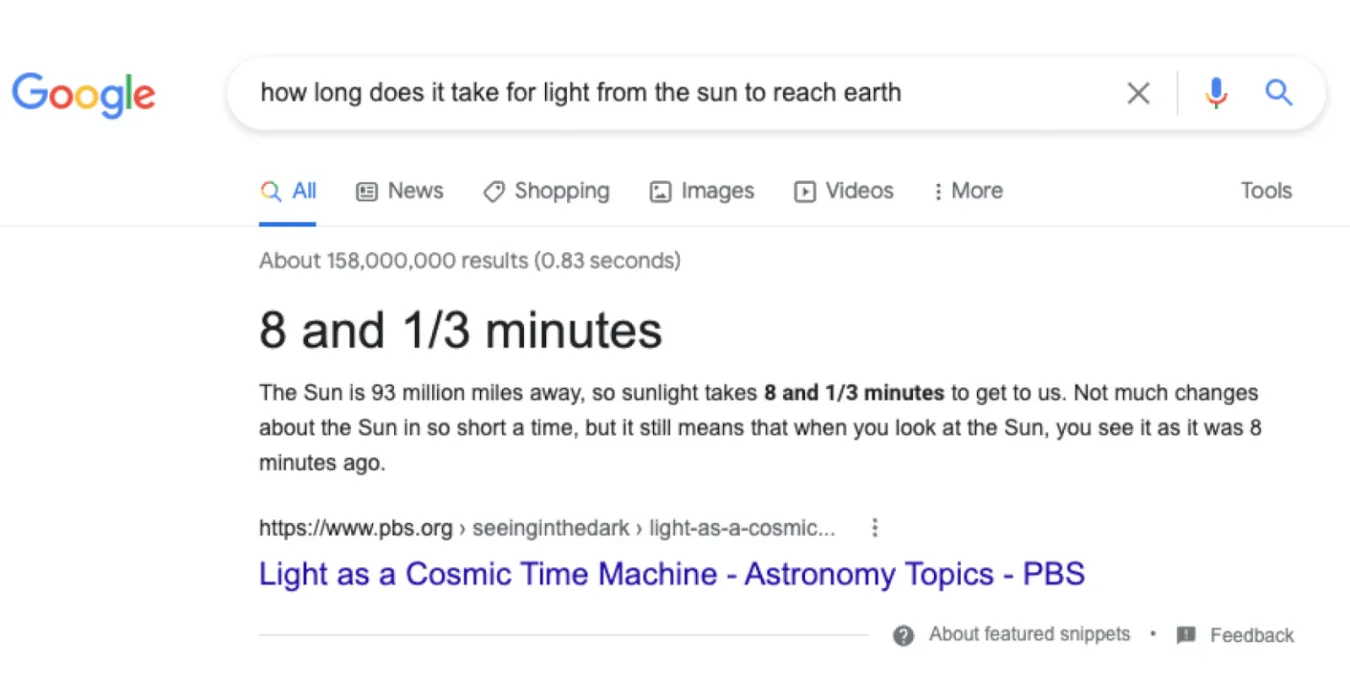
You know that highlighted piece of text at the very top of a Google search results page when you look up a piece of information? That’s called a “featured snippet,” and it’s meant to provide you with a quick answer to your query. Now, Google is making sure that the information it highlights is reliable and accurate by using its latest AI model, the Multitask Unified Model, so that Search can now look for consensus when deciding on a snippet to feature.
Google’s Search AI can now check snippet callouts — those are the information with larger fonts that serve as heading for featured snippets — against other high-quality sources online. It can figure out if there’s a general consensus for that callout, even if sources use different words or concepts to describe the same fact or idea. Google says this “consensus-based technique has meaningfully improved the quality and helpfulness of featured snippet callouts.”
Google featured snippet
But for some queries, such as those with false premises, displaying features snippets isn’t the best way to deliver information. To address that issue, Google tweaked its Search AI so that this particular update reduces the triggering of snippets for those types of queries by 40 percent.
Google is now also making its “About this result” tool more accessible. That’s the panel that pops up when you click on the three dots next to a result, showing you details about the source website before you even visit. Starting later this year, it will be available in eight more languages, including Portuguese, French, Italian, German, Dutch, Spanish, Japanese and Indonesian. It’s adding more information to the tool starting this week, as well, including how widely a publication is circulated, online reviews about a company, or whether a company is owned by another entity. They’re all pieces of information that could help you decide whether a particular source is trustworthy.
Finally, in case Google’s AI has determined that the overall results for a search query may have questionable quality, the results page will now display a content advisory. “It looks like there aren’t many great results for this search,” the advisory will say, telling you to check the source you’re looking at or to try other search terms. It could help you stay alert and be on the lookout for potential fake information while checking the results the website had presented.
All products recommended by Engadget are selected by our editorial team, independent of our parent company. Some of our stories include affiliate links. If you buy something through one of these links, we may earn an affiliate commission.