We’ve known for a while that Google is planning on merging Google Duo and Google Meet, and the company revealed those plans a few weeks ago. Now, the merger is finally happening, XDA-Developers reports, and a new Google Duo update is rolling out for Android and iOS which finally starts everything.
Google Duo and Meet merger finally starts
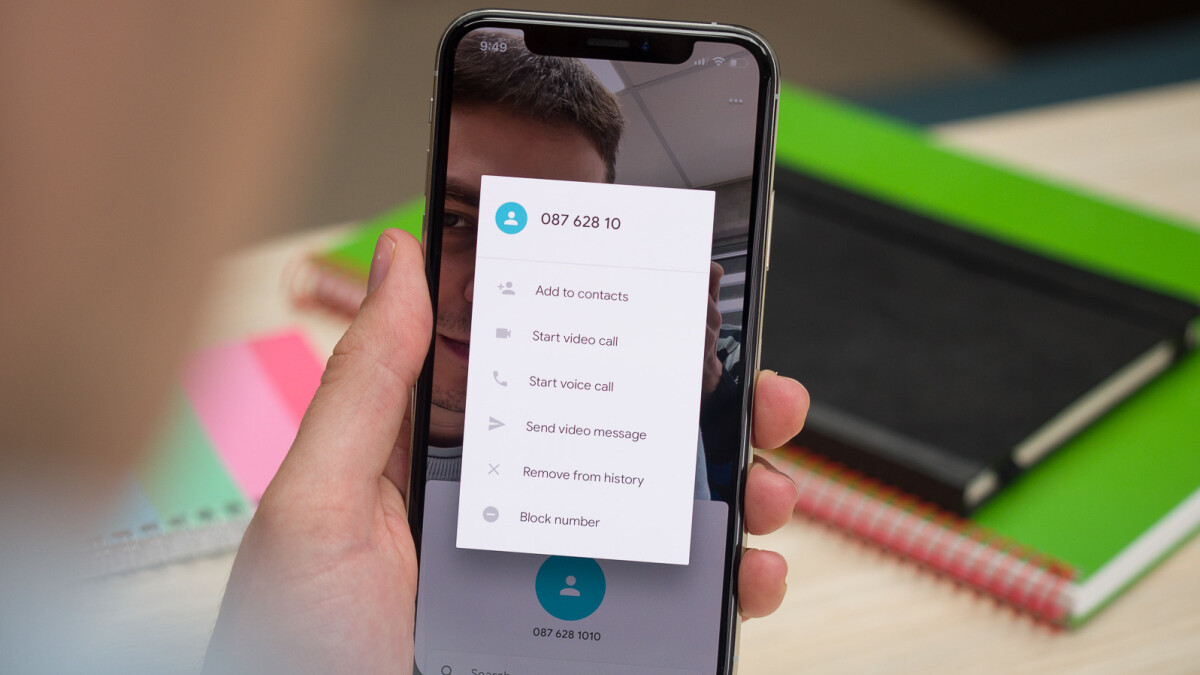
Earlier, Google released a Google Duo update that introduced meeting features to the app. Now, a new update is coming for Google Duo on Android and iOS, rolling out in a phased manner. This new update replaces the icon and logo of the app from Duo to Meet. And, on top of that, the update introduces a new notification saying “Duo has been upgraded to Meet”. Of course, the change should be reflected everywhere too – Google has updated the Duo branding on the web version, and now it has been replaced by the Meet icon and name.
The merger is expected to be completed by September. After that, the updated Google Meet app (which would have been the former Duo) with video calling and meeting features will be widely available on Android and iOS.
On top of that, in the next few months, Google plans to redirect the link duo.google.com to meet.google.com/calling.
On the other hand, the legacy Google Meet app will remain (probably, for a certain amount of time) as an app with meeting capabilities but without Duo’s video calling. Google is expected to phase out Meet after the upgrade of Duo has been completed.
The update to Google Duo is now starting in a phased manner, meaning initially a small number of users will be getting it, and a wider rollout will be happening subsequently.
Google Meet and Duo merger will make a single video-calling and meeting platform
Back in the beginning of June, Google announced the big change officially. The merging of the two apps has as a goal to have a single Google platform that is responsible for video calling and meetings, and it will be under the name of Google Meet. Let’s look into a bit more details as to what this merger means.
First off, Google Meet as it is right now is a video platform that’s mainly aimed at video calls with many people (mainly work-related meetings). On the other hand, Duo was a free video chat app, and it has a lot in common with Apple’s FaceTime, basically aimed at one-to-one video chats, rather than large conferences.
The merging between the two apps will happen with an upgrade to Duo, which will become Meet. The current Meet is expected to get the name “Meet Original”. This new Meet (the former Duo) will become the default. Duo will be getting a few new features in consequence.
Here’s what you will be able to do once Duo becomes completely upgraded with Meet features. You will be able to customize virtual backgrounds in calls and meetings, you will be able to schedule meetings, use in-meeting chat, share content live during meeting, and get real-time closed captions for a better accessibility. On top of that, the size of video calls will be upgraded from the current 32 to 100 participants.
And last but not least, you will be getting integration with other Google tools. Those tools include Gmail, Google Calendar, Assistant, Messages, and others.
During the pandemic, Google Meet’s popularity surged as many people started using it for conferences and work-related video calls and meetings. Because of this growth, the platform became the obvious chose for Google to focus on video and voice options.
Google stated earlier “As part of our mission to build a connected experience for all users, we’re excited to bring our video calling and meeting technologies together into a single, powerful, easy-to-use solution.”
Cooking is one of many mechanics in Xenoblade Chronicles 3, and players can collect various food items for their recipes as they move along on their journey. One such item is Cured Armu Sirloin, which can be found from Armu, the female counterparts of the Ardun.
Cured Armu Sirloin should be fairly easy to procure in Xenoblade Chronicles 3. However, some players may not have paid much attention to cooking in the past and may be looking to catch up and find the food items for themselves. Below, players can find a quick guide to procuring Cured Armu Sirloin for their cooking needs.
Collecting Cured Armu Sirloin in Xenoblade Chronicles 3
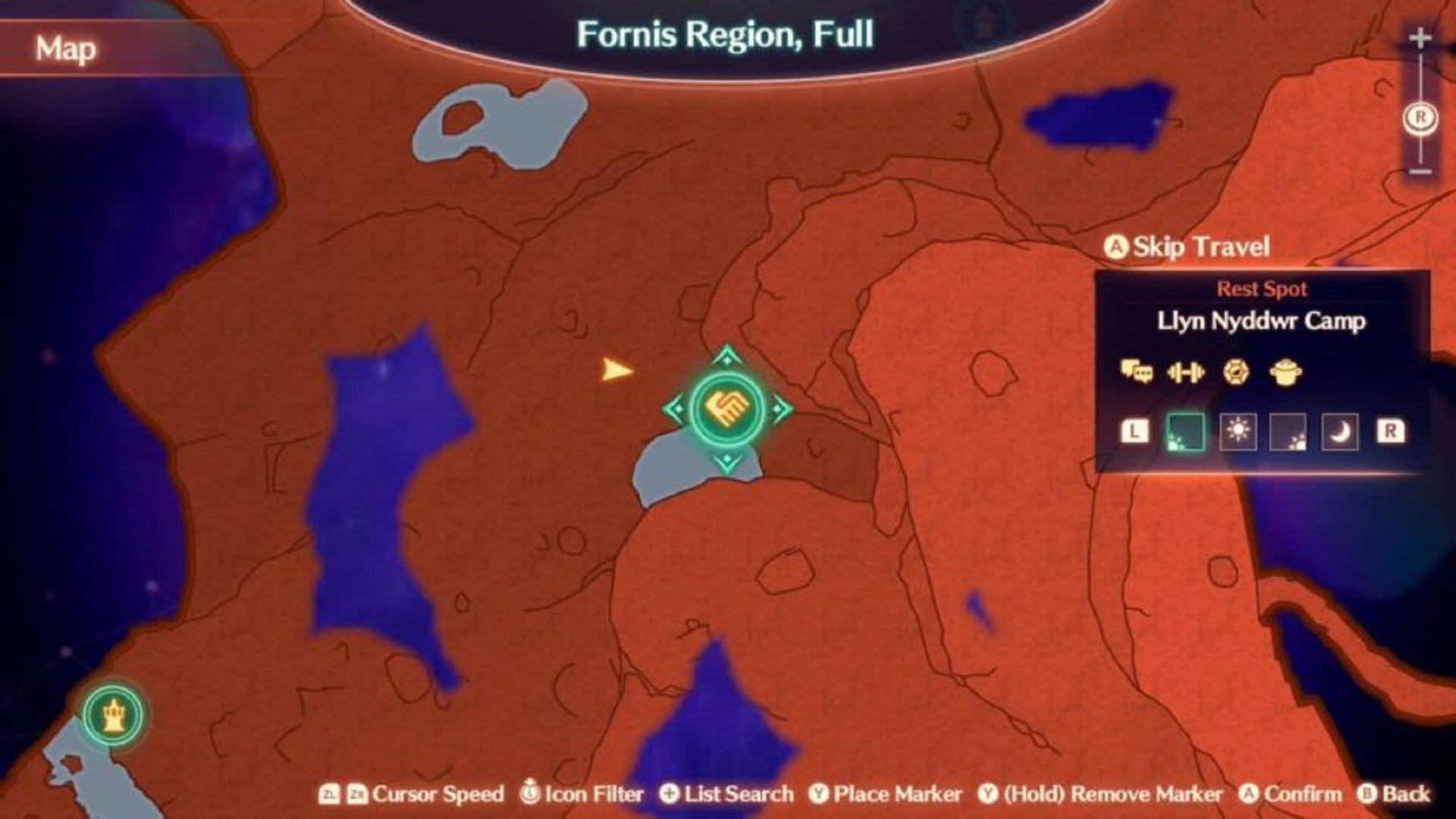
The Llyn Nyddwr Camp is a great place to hunt Armu in Xenoblade Chronicles 3 (Image via Nintendo)
Before Xenoblade Chronicles 3 players can harvest meat from Armu, they’ll need to ensure that they’ve reached the second chapter of the story. This will unlock the Fornis Region, which comes complete with various areas where different creatures roam. One such area, Ribbi Flats, is a perfect location to hunt down Armu for their cured meat.
Finding and collecting Cured Armu Sirloin
For quick access to Armu, head to the Llyn Nyddwr rest camp in the Fornis Region. Right around the area, players should find a large number of Armu roaming the locale along with other creatures.
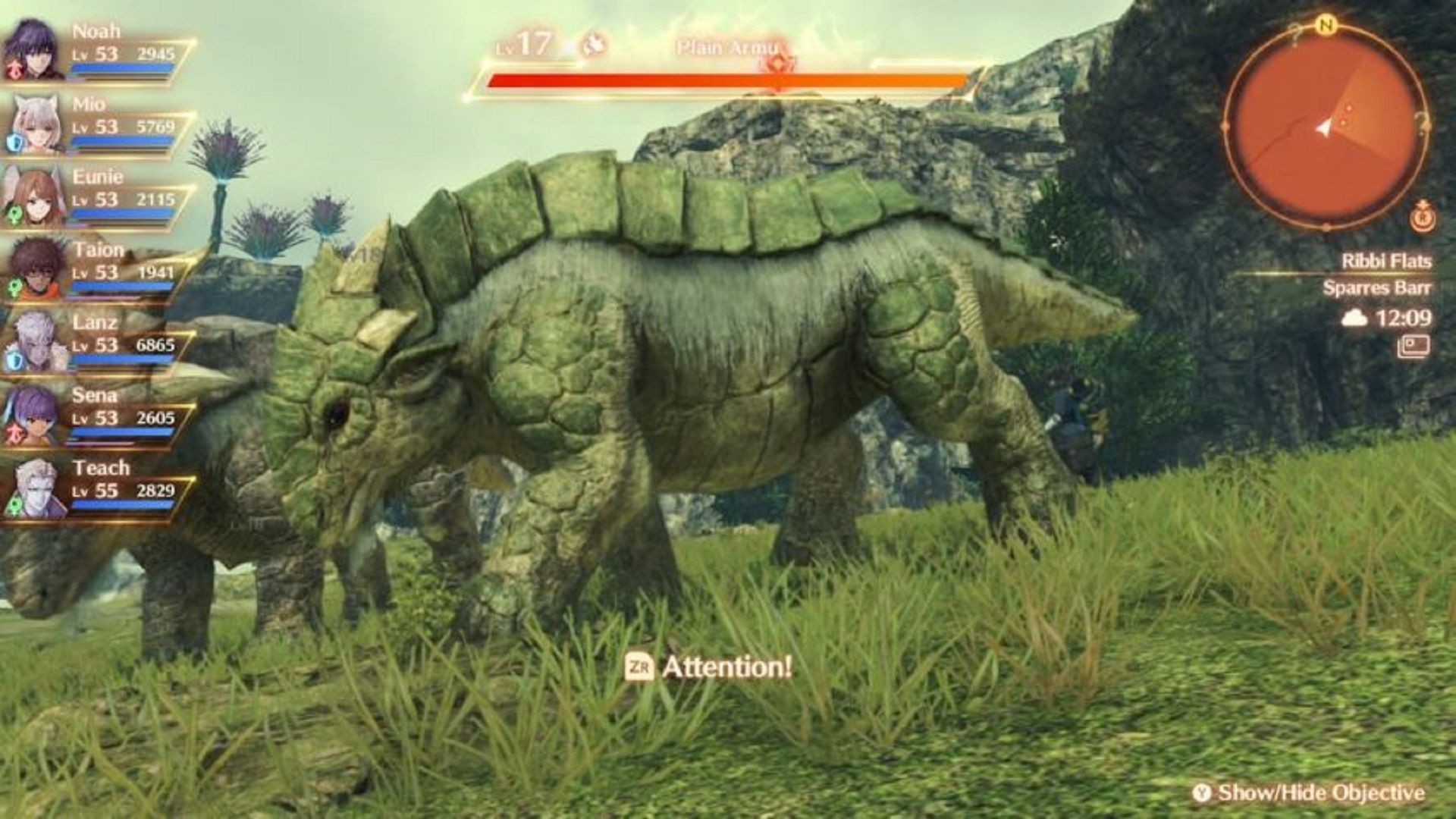
Players can recognize the Armu by their distinct lack of horns compared to the Ardun. Their heads are more platelike in appearance, and they are also smaller in size compared to their male counterparts.
Kill the Armu. These enemies are particularly low level (level 18), so they shouldn’t be tough to take down and should drop fairly quickly. Since Cured Armu Sirloin is a common drop, most Armu players kill should drop the food item.
Once the Armu in the area have been cleared out, players can use their fast travel to return to the campfire at Llyn Nyddwr. Doing so will refresh the local wildlife, allowing Xenoblade Chronicles 3 players to continue farming the Armu as much as they need until they have all the sirloin they can carry.
In addition to being used in cooking, Cured Armu Sirloin is also quite handy with regard to Collectopaedia Cards. If players have some left over after their farming excursion, they may want to save the cured sirloin for the Collectopaedia. Otherwise, players can also always return to the Fornis Region and take down the Armu for additional sirloins if necessary. As long as players refresh the area with fast travel, they’ll never run out of Armu to defeat and loot.
Also Read Story Continues below
It’s also important to note that many other food drops in-game can be given a very similar treatment. Simply clear out an area of a certain enemy, collect their drops, then fast travel back to the nearest rest point to respawn the creatures. It then simply becomes a process of lather, rinse, and repeat until players have the items they require.
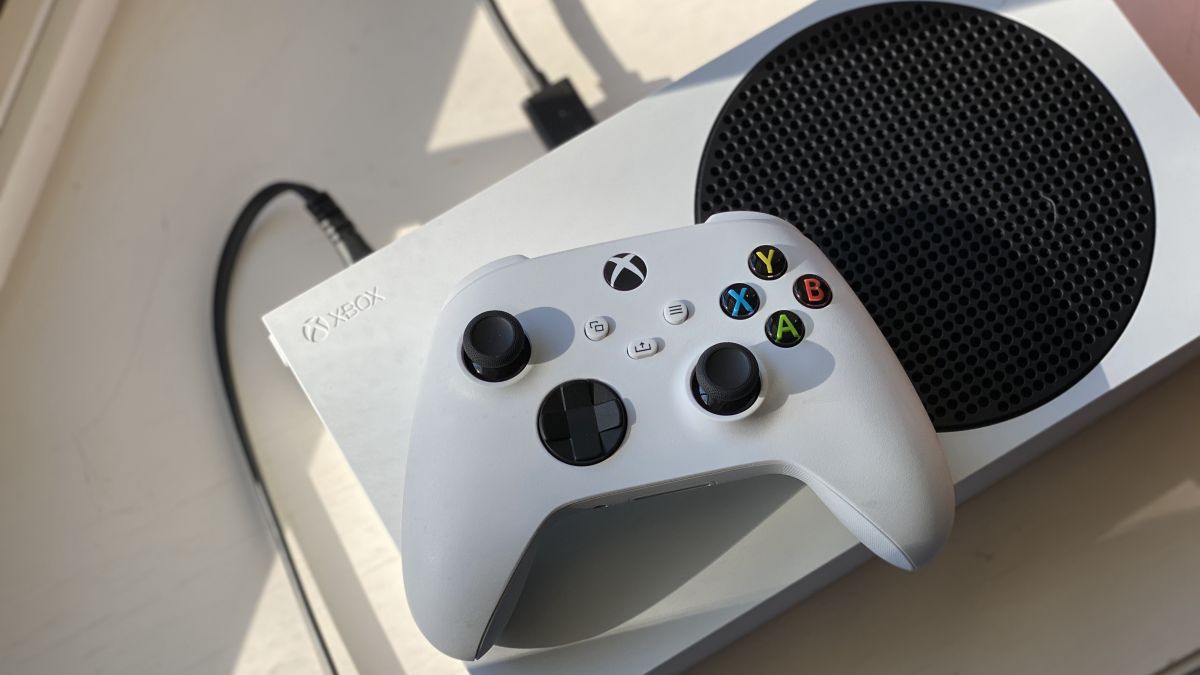
It’s now been one full year of Telstra spruiking its own Telstra Day once a month, and to mark the occasion, the telco is offering its best deal yet. Today only (August 4), you’ll get a free Xbox Series S and a subscription to Xbox Game Pass Ultimate (opens in new tab) when you purchase any Samsung Galaxy S22 device outright or on a plan.
The bonus console comes as part of Xbox All Access, which gives you the Series S console and 24 months of Game Pass Ultimate – a total value of AU$792!
Keen to grab it? The deal officially launched on Thursday, August 4 at 1am AEST and runs until midnight.
Any of Samsung’s S22 devices are eligible for this bonus Xbox deal, including the regular S22 (opens in new tab)the S22 Plus (opens in new tab) and the S22 Ultra (opens in new tab). While there’s no actual discounts available on the phones themselves, we think this is a pretty great deal to jump on if you’re in the market for a new handset (and want to grab an Xbox Series S for free).
This deal is available whether you buy a Samsung S22 outright or on a plan, but it’s important to note that if you get the device on a contract and decide to cancel before the term is up, the bonus Xbox deal will likely be void and you ‘ll probably need to return the console to Telstra or pay out the full value (AU$792). We’ve asked Telstra to confirm this and will update this article if told otherwise.
There’s more deals available on Telstra Day too, including a AU$300 discount on the Samsung Galaxy S21 FE (opens in new tab), bringing the device down to just AU$699. That’s edging towards the lowest price we’ve seen for this handset, which was AU$649 last month.
Other deals you’ll find available on August 4 include the Samsung Galaxy A53, the Samsung Galaxy Tab S8 Ultra and the Sony WF-1000XM4 wireless earbuds to name a few – find everything on Telstra (opens in new tab).
The best features don’t always have to cost top dollar, as Motorola proves in the Moto G82 5G, bringing 5G, water resistance, and a 120Hz AMOLED screen to $499.
Design
Motorola is no stranger to the mid-range, and it’s “G” series has practically been about that since its inception, but there’s one thing this mid-range model has never been all about, and that’s design.
The G series has long been somewhat generic, and the G82 5G keeps that feeling going, with very little playfulness or sleek efforts in how it looks.
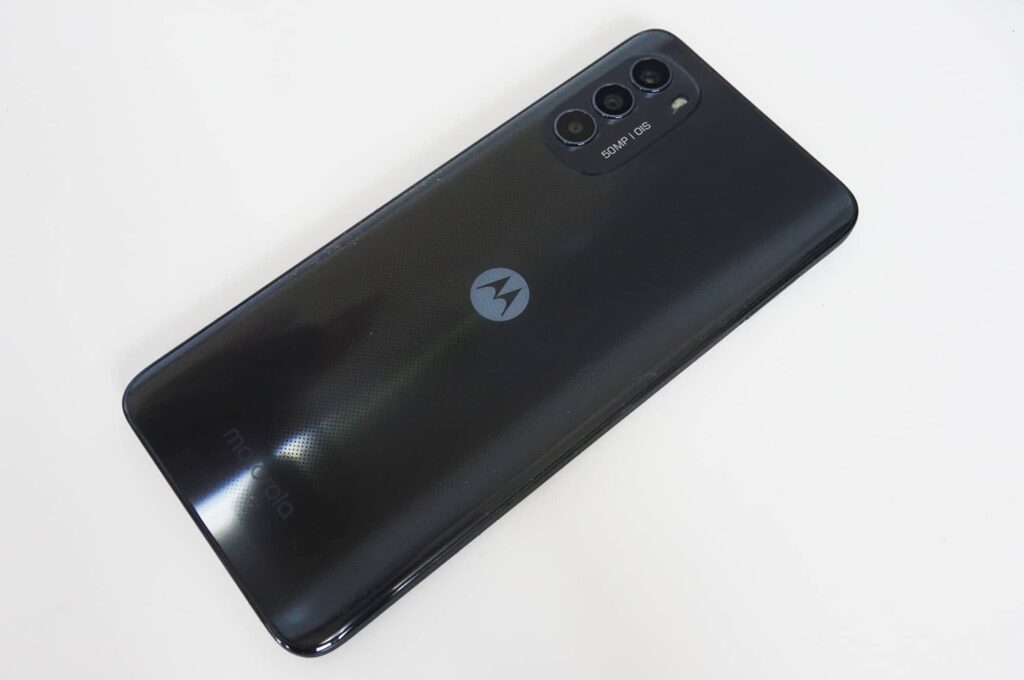
In a word, it’s “ordinary”, with a simple design — plastic back, glass front — though in a nice twist, Motorola has brought back some of the water resistance it offered on the G3 many years ago, the only Moto G series model that provided a hint of water protection. Back in the G3, the IPX7 protection wasn’t much, while here in the G82 5G, you’ll get IP52, which is water-repellant and useful for the odd splash of water or other liquids, but please don’t go swimming with this phone, as it just won’t tolerate it. There’s not that much water resistance here.
Features
But you will find a reasonable amount of features, more than we’re used to seeing in the mid-range. Indeed, the G82 5G could be Moto’s way of saying “this is the new mid-range”, which it may well be. Kinda, sorta.
Kicking off that new mid-range is the Qualcomm Snapdragon 695 5G chip, a model Qualcomm launched last year to get 5G into more hands, including the mid-range, which is where the G82 is aimed at, for sure.
It’s paired with 6GB RAM and 128GB storage, the latter of which can be expanded using a microSD card slot, while Android 12 runs on the phone out of the box.
Connections are fairly normal for a mid-range phone these days, keeping the 3.5mm headset jack alongside a USB Type C port, but forgoing wireless charging, as it’s not a mid-range feature. You’ll find support for Bluetooth 5.1, GPS, 802.11a/b/g/n/ac WiFi 5, and Near Field Communication (NFC) for Google Pay, plus the “5G” that’s in the name, alongside support for older mobile connections if 5G isn’t available at the time.
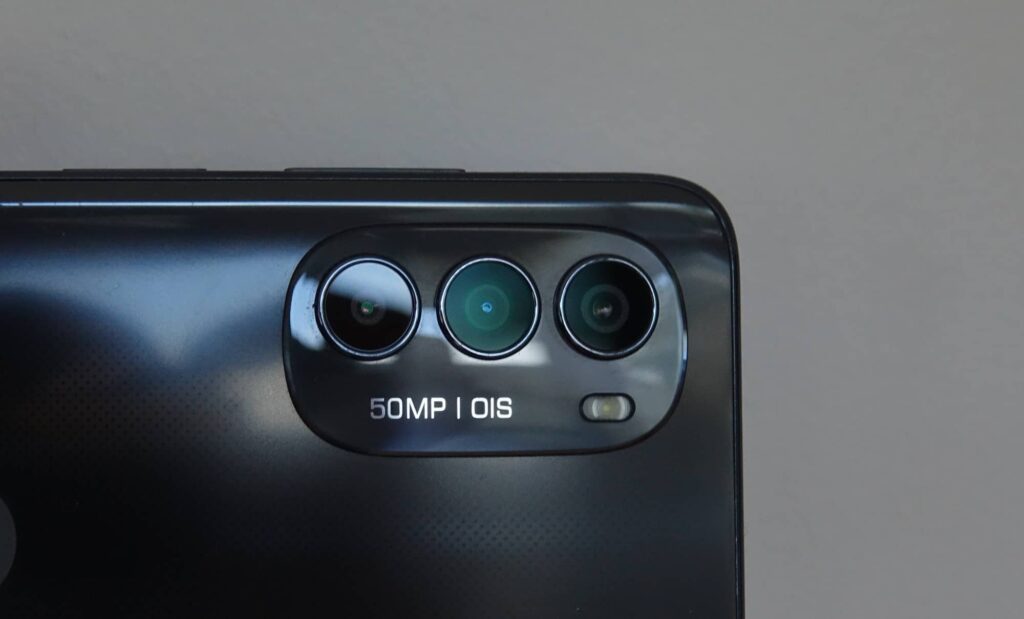
And there are three cameras on the back, providing a 50 megapixel F1.8 main wide camera, alongside an 8 megapixel F2.2 ultra-wide and 2 megapixel F2.4 macro camera, too. That’s on the back, while the front sees a 16 megapixel F2.2 camera.
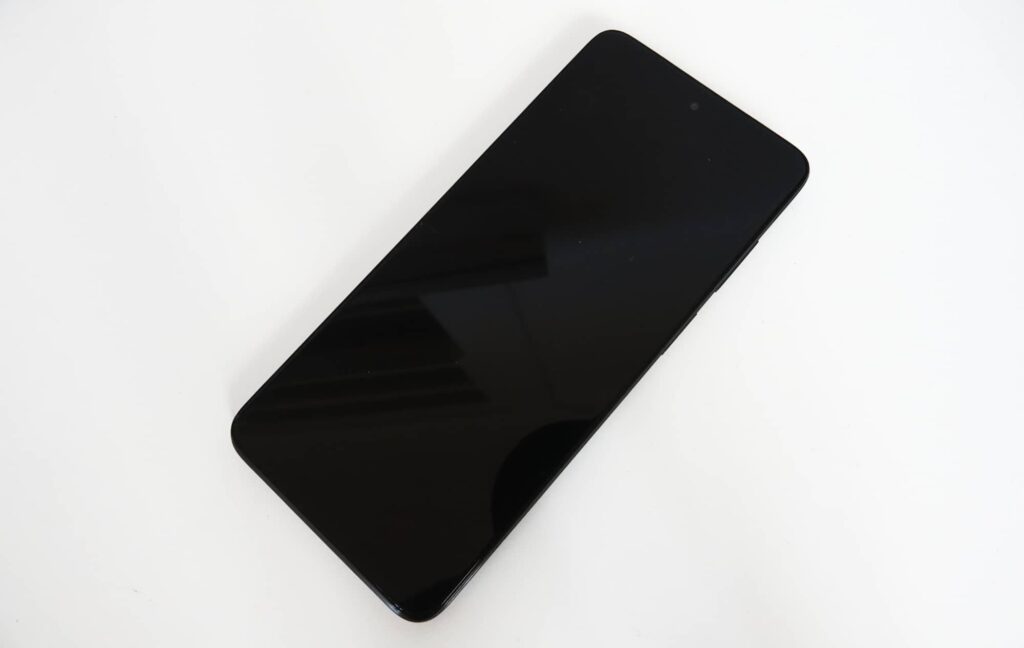
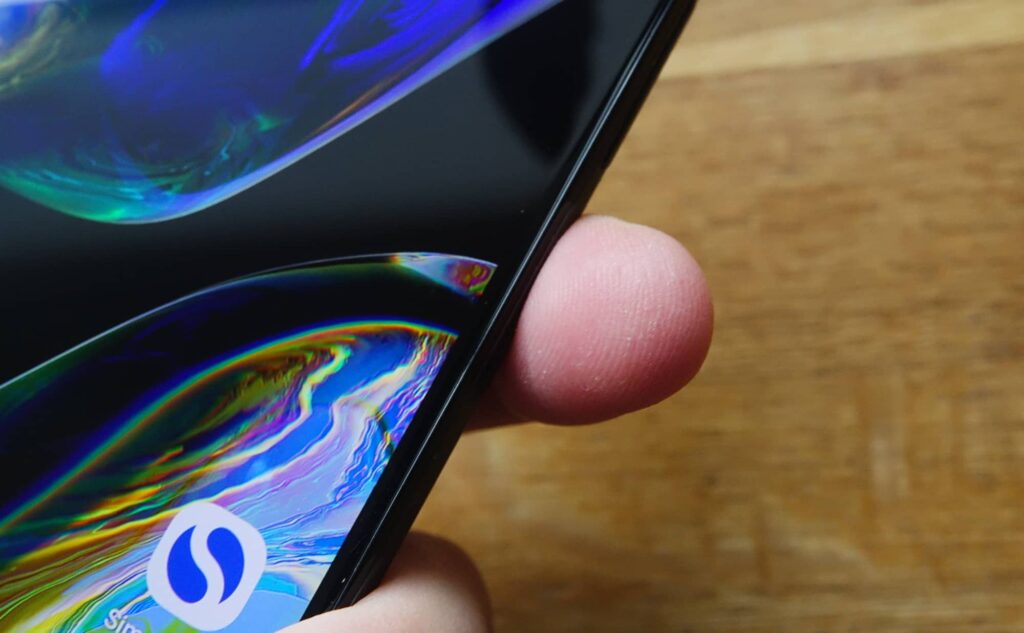
There are other features, such as Dolby Atmos support on two speakers, a fingerprint sensor built into the power button, and a 5000mAh battery, and it all sits under a 6.6 inch Full HD+ 2400×1800 AMOLED display sporting support for a 120Hz refresh rate , something of a premium feature in phones these days.
In use
Pick up the G82 and you’ll find a simple design that’s easy to hold, even if it’s nothing spelled in terms of aesthetics.
You won’t find an in-screen fingerprint sensor here, though like the Moto G 5G we saw last year, the G82 5G offers a fingerprint sensor built into the power button on the side, which is easy to grip and switch on, plus bring back from standby.
If anything, using the G82 5G reminds us very much of the Moto G 5G Plus, and we imagine given the similar price and feel that this new model is the spiritual successor to that first mid-range 5G G-series model.
Using Android 12 is also easy enough, and Moto’s changes mean you can opt for either the Google suggestion of gestures or the old on-screen virtual soft buttons, while some of the older Motorola additions are also along for the ride. That includes a favorite of this journalist, whereby you shake your wrist to fire up the camera from any screen. We wish more phone cameras triggered that way.
Performance
Using the G82 5G, you’ll find the animations are slick thanks to the support of a 120Hz screen, which tends to jump between 60Hz and 120Hz rather nicely, and doesn’t need you to use that higher refresh rate at all times, likely helping the battery. However, you can opt to leave it on permanently if you dive into the system settings.
More importantly than the screen’s performance is the system performance, which is mostly good, save for some obvious lag. You’ll notice it when it happens, and it seems the 6GB RAM isn’t quite enough to help Motorola balance it out in the G82 5G.
Even though the benchmarks show the G82 to be fairly formidable, especially against some other mid-range models, we saw hiccups here and there more often than we’d like.
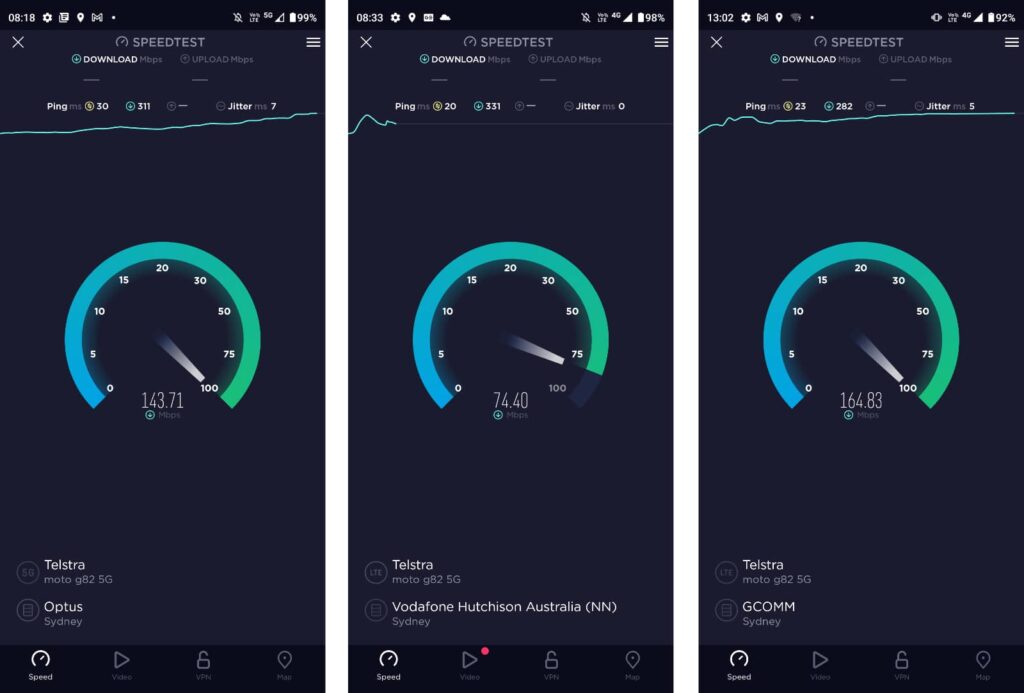
Mobile performance is relatively consistent, though, and with support for 5G in the phone — it’s there not just in the name of the phone, but also the name of the chip! — you can expect solid mobile speeds, network dependent of course.
In our tests across Sydney, we found speeds ranging from 100 to 300Mbps, though depending on what your network is doing at the time, you may see much, much better.
Camera
Mobile and system performance are one part of the performance equation, but so too is camera performance, and that may give you pause.
While the G82 5G is a triple camera phone, this is not a formula that adds to great pictures at all, unless you’re only focused on snapping shots in daylight. And even then, well, there are hiccups.
A quick recap, you’ll find a 50 megapixel F1.8 standard wide camera here, accompanied by an 8 megapixel ultra-wide also handling depth in portrait shots (the blurry background), plus a 2 megapixel F2.4 macro camera. That’s your assortment, and in theory, it sounds great. On paper, it seems like a great idea, but life isn’t on paper.
It’s more than 50 meh-gapixel camera, because while it captures totally fine photos in daylight, the speed of the camera can be frustrating at times. Unless the light is superbly bright, you may find the 50mp main camera captures blur from arms and faces, softening the image considerably.
When the scene loses some light and gets a touch darker — or even a lot darker — the 50 megapixel camera isn’t much help, either in or out of the night mode.
Images range from impossible to see to blotchy and useless, so make sure you have some light going for you, because the G82’s night capability isn’t going to help you here at all.
We captured a small plush of Winnie the Pooh without a lot of light, and regardless of whether night mode’s stacking is switched on or not, you’re not going to see Winnie in a good light, or any at all.
There’s also a macro camera, something we’ve seen on mid-range cameras for a while, but it’s not quite as advanced as what you can find in the iPhone 13 Pro, hardly a surprise given the cost. Rather, this is a 2 megapixel camera, letting you get close, but penalizing you with a very low resolution to work with, which doesn’t exactly highly the exciting details a macro looks to hone in on.
Overall, it’s a meh rear camera, and probably the part of the package that feels as underwhelming as could be, and the front camera isn’t much better.
While you can snap a decent selfie here and there, the 16 megapixel selfie camera on the G82 5G makes images feel soft regardless of the shot.
Images from the front-facing picture are nice, especially when you have an adorable baby, but they’re also quite soft, like the adorable baby.
Battery
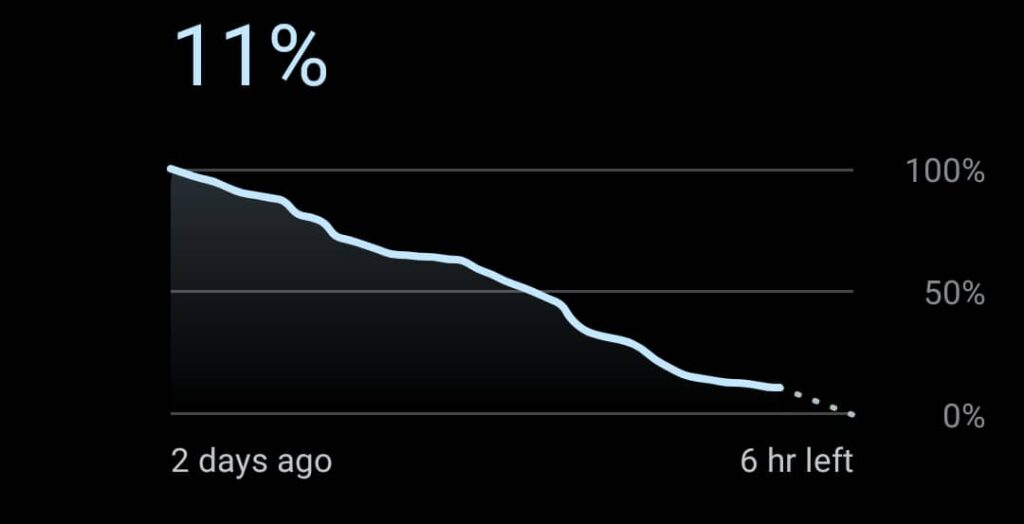
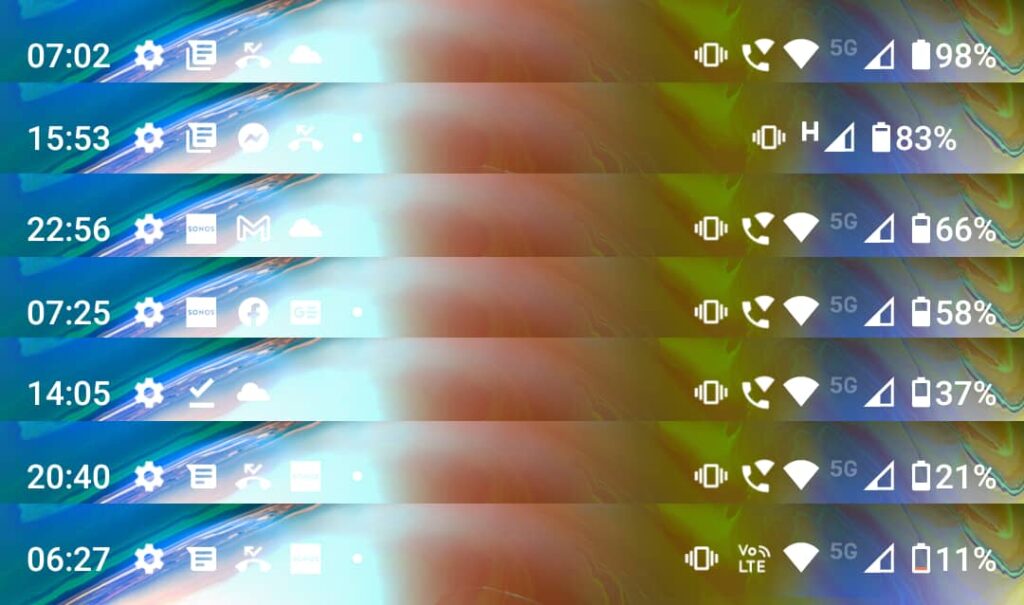
But while the camera isn’t super impressive, the battery definitely is, boasting a good two days of life from regular use, while hefty users should easily see 24 hours.
Testing the Moto G82 5G for several days, we found Motorola didn’t need to warm up to our usage style, and used its 5000mAh battery to get an impressive two days of life. That’s two days of battery while we did the regular thing of calls, texts, web surfing, music listening, and even keeping a Bluetooth wearable linked the whole time, too.
Heavy users should handle 24 hours with no problems, and likely get a little more, but the Moto G82 5G could well be a two day phone for most others, needing a charge the second night, though you could probably wrench out a full 48 hours if you desperately had to.
In a world where 5G phones barely scrape the second day comfortably, Motorola’s G82 5G does exceedingly well.
Value
It’s a similar story for the value, which doesn’t surprise us given that it’s an area Motorola is well known for lately.
Our Pickr Best Pick for value phones in 2021 was the $499 Moto Edge 20 Fusion, and the Moto G82 5G continues that with more excellence for the price.
While the chip, screen size, and camera assortment are different between the 2021 Edge 20 Fusion and the 2022 G82 5G, they both nail value quite well, costing $499 and feeling like they’re both well worth it.
What needs work?
That’s not to say the G82 5G is perfect, because it’s not. There are things that remind you of that, yes, this is a mid-range phone, with the performance and cameras reminding you of that through out.
The performance isn’t terrible, but you might see slowdowns from time to time, even though the benchmark doesn’t scream problems.
Frankly, the Qualcomm Snapdragon 695 is going to handle most of what you intend to throw its way, and the 6GB RAM isn’t a bad amount, either. But it’s just not that new or high-end, especially not when we’re beginning to see Snapdragon 7xx models in similarly priced gear, or Apple’s A15 chip straight from the iPhone 13 if you spend a little more on the 2022 iPhone SE.
We have more words for the camera, which feels like Motorola could have done a lot better.
In last year’s identically priced Moto Edge 20 Fusion, you could find a 108 megapixel F1.9 camera for wide and standard alongside an 8 megapixel ultra-wide and 2 megapixel depth camera. Here in the Moto G82 5G, it’s a 50 megapixel F1.8 alongside the same 8 megapixel ultra-wide and a 2 megapixel macro camera. Frankly, we think last year’s phone nailed phone camera value much more obviously than what’s in this phone, and that’s not the only problem.
The G82 5G camera also suffers from speed issues and is frankly too slow. You’ll fire either the on-screen shutter or even the volume button as a physical trigger, and it might wait a half second to fire. Sometimes it’s instant, but you could still see blur, and overall the camera feels slow. It’s just not a great experience with the camera in this phone.
Final thought (TLDR)
Outside of the camera, the Moto G82 5G is otherwise a decent phone, delivering some high-end features without a high-end price.
Water resistance is unusual in the mid-range, and so is a 120Hz AMOLED screen. Marry that with a great price, and you can see why the G82 5G reads like value. If you can skip needing a great camera, there’s value to be had here.
The Moto G82 5G isn’t a super pretty phone, and it’s not going to win design awards, but if you’re after a value that works, there’s something to consider in this phone.
One of the smaller players in the cycling shoe market, QUOK have been gaining solid traction over recent years. Here we test their new all-road offering plus a work boot!
Adventure shoes seem to be one of the fastest growing sectors of the cycling footwear market with more new offerings, better inclusions and improved features headlining each regular release.
Today we are riding and reviewing a new model from UK-based QUOK, their updated Grand Tourer gravel shoe.
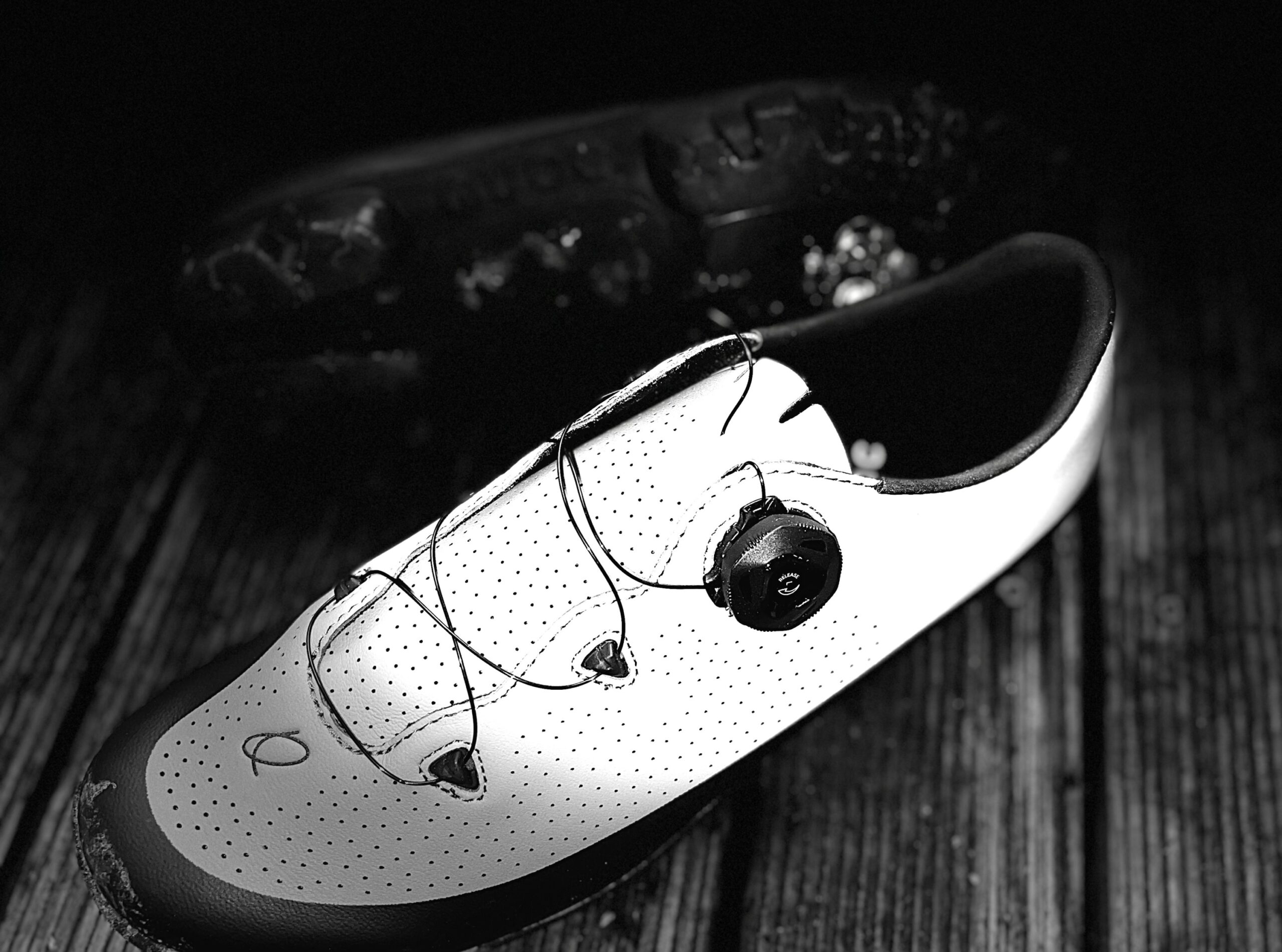
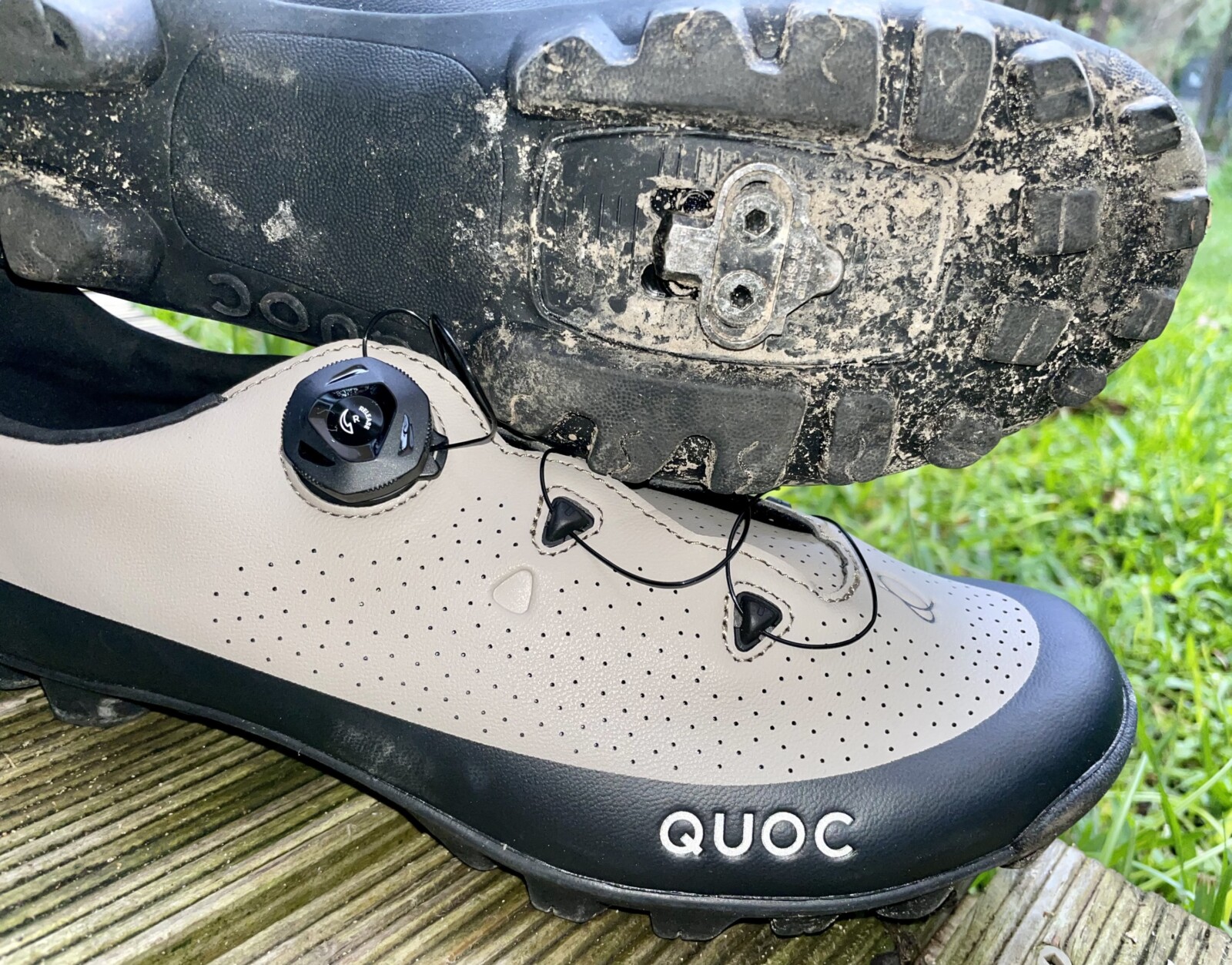
Replacing the original lace up version, the Gran Tourer II now features a BOA style dial closure along with a stiffer sole, improved weather sealing and increased overall comfort. For traditionalists, the company still offers the lace up option in the new mark II, but for this review we are riding the dial up version.
Unashamedly QUOC, the shoes are stylish and quite different to look at when compared to the increasing number of gravel and bike-packing options out there.
And similar to the companies Mono II road shoe, there’s somewhat of a serious demarcation between the business-like bottom-half and comfort-oriented upper.
Starting from the underside, and the shoe features a rugged and aggressive tread constructed of a proprietary rubber compound the company called ‘GravelGrip’. This, say QUOC, is designed for the multi-day rider keen to carry just one pair of shoes.
QUOC have gained a strong reputation for offering high-performance shoes with a surprising level of comfort. Having worn these shoes for the past few weeks we can attest to the company’s design notes of ‘a supple, foot-hugging upper that evenly distributes pressure’.
“…QUOC have gained a strong reputation for offering high-performance shoes with a surprising level of comfort…”
In addition to the soft and comfortable feel from what comes across as a tough-looking, heavy-duty shoe, we have found the shoe to be stiff and sturdy enough for efficient power transfer but supply enough to walk with ease when off the bike. Ever seen that parody video of riders carefully walking from bike to cafe? With the grip and walkability of the this shoe, that twinkle-toe hot shoe shuffle is a thing of the past with these.
In summary, this is a specialist gravel / bike-packing / adventure shoe with clearly each and every aspect of the design backed by real world testing, feedback and experience. We found them an impressive, high quality and very comfortable option. Gravel and adventure shoes are very popular these days and we see the Grand Tourer II as an impressive offering.
A Boot With Cleats?
QUOC, to their advantage, still seem small enough to a brand to be able to closely listen to their audience and do their best to fill gaps in the market. And it seems they’ve done just that with the left-field release of a classic work boot that takes cleats!
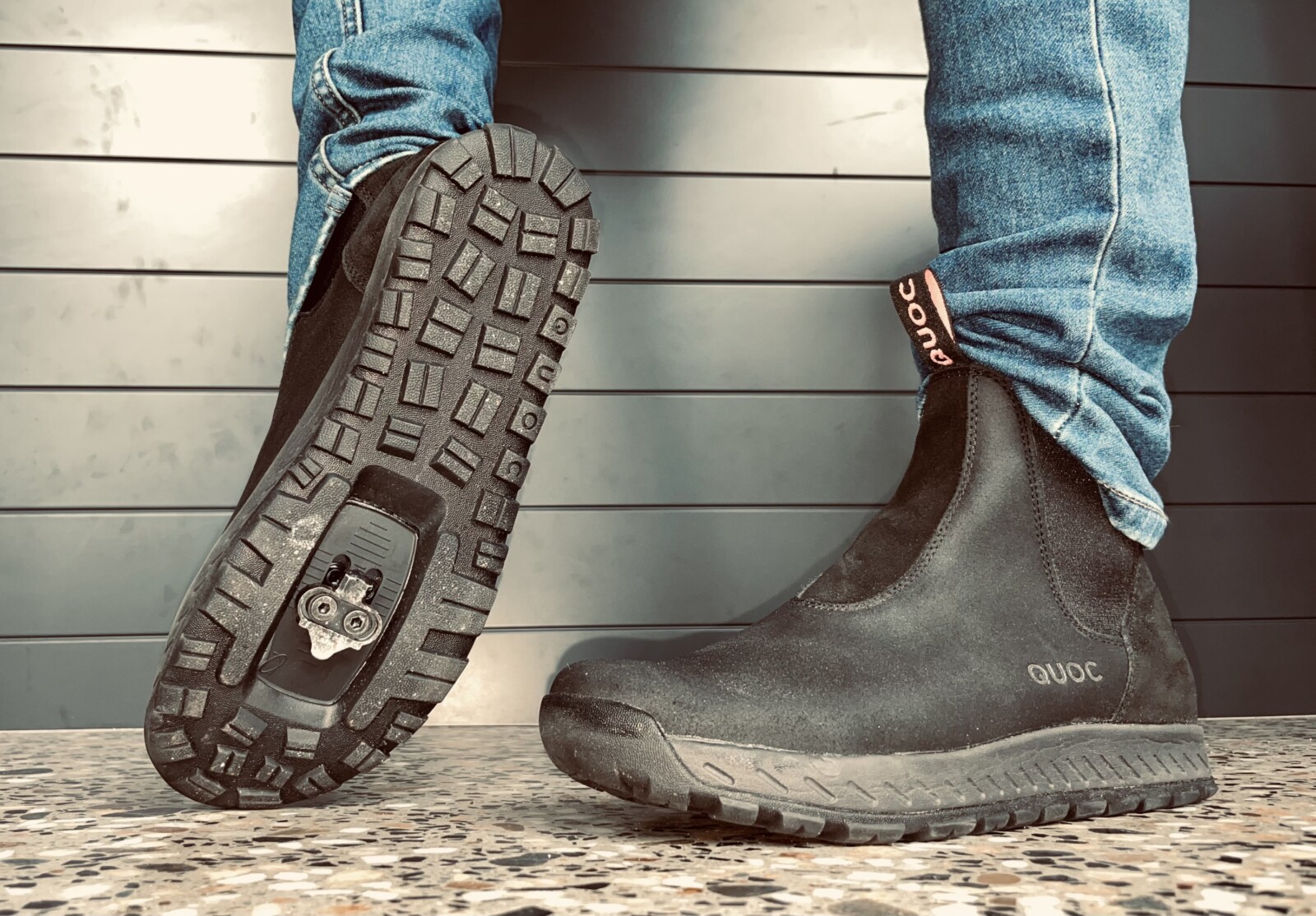
Bicycling Australia have recently been walking around in and riding the traditional, elastic-sided boot in black (yes, they are also available in brown). It slips on well, fits true-to-size, and feels surprisingly comfortable to wear.
Combining a boot and sole to suit both the flexibility required for walking and stiffness required for cycling is always going to be a big ask. So while you probably wouldn’t want to spend a day walking around the city or country back blocks in these boots—or embark on a 100km bike ride in them—you actually could.
A rubber inset is fitted over the cleat mount, this is unscrewed to allow fitting of the MTB SPD cleats. Importantly there’s enough recess for the cleats to sit below the rubber and therefore not contact the ground when walking.
We’ve found the boot to be surprisingly comfortable and indeed feels better on the foot over time. They have proven to be a great compromise between wearing a stylish-looking everyday boot and being able to clip in for that trip into town or commute to work.
The gravel shoe and boot are available via www.quoc.cc
when ferrari first it was announced making a hybrid over a decade ago, a lot of people were skeptical. Purists felt a Ferrari should be solely powered by an engine, not assisted by something else. However, when the Ferrari LaFerrari launched in 2014 the critics soon fell silent.
The LaFerrari was ruthlessly quick and incredibly beautiful. It instantly captured the hearts of every Ferrari fan, despite being a mild hybrid. Now, Ferrari is taking it up a notch. Instead of a mild hybrid that only recharges when you brake, the firm has launched two plug-in hybrid models. The first Ferrari PHEV unveiled was the SF90 Stradale, a 986 hp hypercar akin to the LaFerrari.
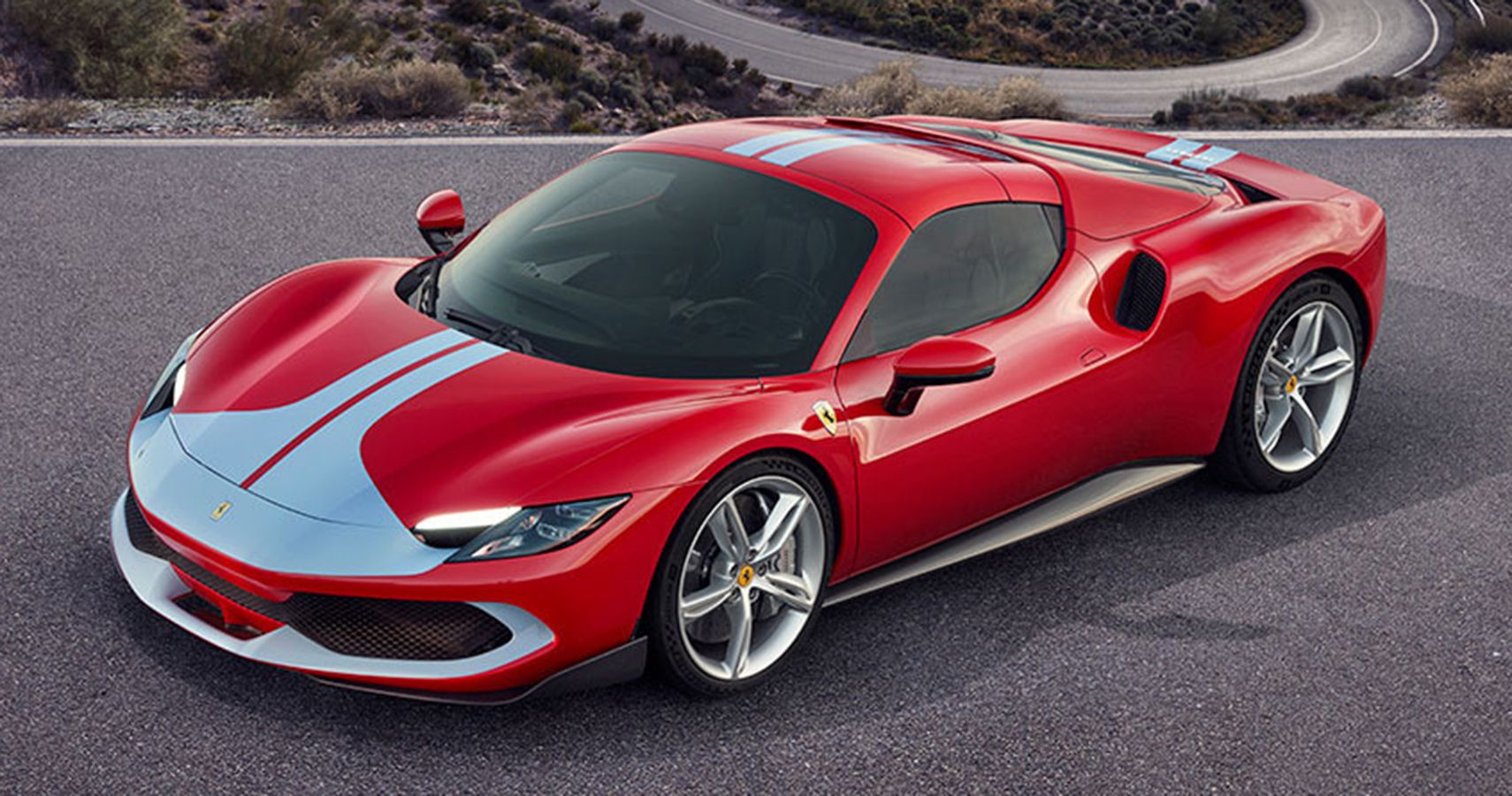
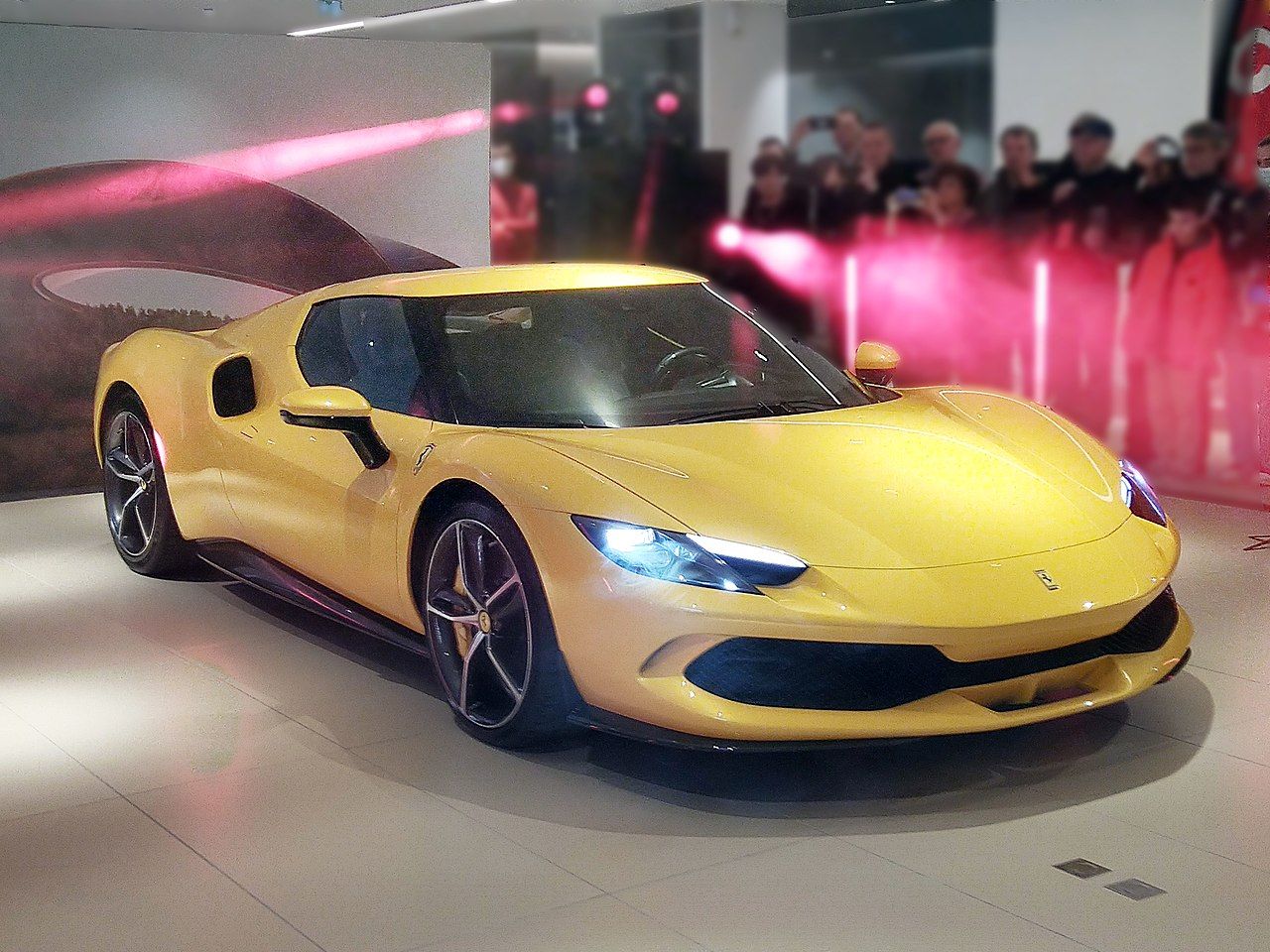
Arguably more intriguing is the 296 GTB, which was presented in June 2021. The 296 costs around half as much as the SF90. Therefore, while the SF90 is a collector’s piece that will rarely be seen outside private garages, the 296 GTB is a “mainstream supercar” that aims to compete with the Lamborghini Huracán and McLaren 720s.
Offers more power than any other supercar in its price bracket
Cons
Doesn’t sound as good as a V8 or V12 Ferrari
Electric range is laughable
A Significant Milestone For Ferrari
When the 296 GTB debuted last summer, Ferrari placed a strong emphasis on the fact that it was the first “real Ferrari with six cylinders”. Previously, only Dino models of the 1960s and ’70s featured a V6 engine, and they were never sold as true Ferraris – in fact, Dino was technically a sub-brand.
Furthermore, while the 296 is not the first hybrid Ferrari (nor the first plug-in hybrid Ferrari) it is the brand’s first rear-wheel drive hybrid. The 296’s RWD layout allows for more thrills on the road and better performance on the track. Moreover, the 296’s turbochargers are between the cylinder banks to allow for better packaging and to lower its center of gravity. Again, this is a first for Ferrari.
The 296 GTB also debuts a lot of new technical features. For example, it has a six-axis sensor called 6w-CDS that measures acceleration and the rotation speeds of the X, Y and Z planes. It uses this data to communicate with other systems like the Slide Slip Control and E-Diff to optimize cornering speed.
Related: 10 Things Gearheads Forget About the Ferrari 488 Pista
The Best Of Both Worlds
Via: Ferrari
By combining a V6 engine with an electric motor, Ferrari has made an incredibly powerful vehicle. Individually, the 296’s engine produces 654 hp and its engine 165 hp. Collectively this adds up to 819 hp, which makes the 296 the most powerful 2-door supercar in its price bracket (at least until the updated Tesla Roadster arrives).
The 296 GTB’s 7.45 kWh battery pack allows for up to 15 miles of all-electric driving according to Ferrari. However, in reality you’ll be lucky to get over 10 miles of electric range according to WLTP testing. Still, this means the 296 can dodge congestion charges in a lot of European cities and drive through certain zones at times of the day when combustion-only vehicles cannot.
When in e-mode, the 296 has a top speed of 84 mph. It’s not supposed to be fast, as touched on above the electric mode is best used for cruising around the city and running errands. However, when you engage the engine the 296 GTB turns into a monster. Ferrari claims 0-60 mph takes 2.9-seconds, meanwhile top speed is 205 mph. What’s most impressive is how slow the 296 is beyond 60 mph. 60-120 mph takes just 3.8-seconds, a remarkable figure.
Related: A Detailed Look Back At The Ferrari F50 And What Made It So Special
A Driver-Focused Cabin
Via: Ferrari
The 296 GTB is ultimately all about the driver. Unlike the Ferrari Roma, it’s not a grand tourer but instead a fully fledged supercar. Therefore, creature comforts are minimal. You get the basics like AC and a navigation/radio system, but that’s about it. Given the 296 is lugging around a 7.45 kWh battery and a load of performance tech it already weights a hefty (for a supercar) 3,572-pounds.
That said, the 296’s cabin is high quality throughout. All information lies in front of the driver on the instrument cluster, there is no central display. There is however a slender passenger display which shows current speed and has a few limited options. Five different types of bucket seats are available, all clad in luxury Italian leather.
Related: These Are Our Favorite Features Of The Ferrari 812 Competizione
It Won’t Come Cheap
Via: Ferrari
Unsurprisingly, the 296 GTB is incredibly expensive. Prices start at $322,986 – however getting your hands on one from Ferrari could take a while (expect a 2-year wait time). That said, the 296 GTB and Mercedes-AMG GT 63 SE Performance are the only non-EVs currently on sale that offer over 800 hp for less than $500,000. The 296 GTB also outclasses the V8 F8 Tributo on the track (it’s a second quicker around Fiorano) and the drag strip (the 296 runs a 10.4-second quarter-mile, the F8 takes 10.5-seconds). So all-in-all that price seems somewhat justified, especially when you consider the pioneering performance tech the 296 GTB comes with. For those chasing after a roofless experience, a GTS variant of the 296 will hit the market in a few months time.
Some of Melbourne’s top deli sanga connoisseurs, Saul’s Sandwiches is an enterprise that’s always looking forward. They’ve swooned the hearts and stomachs of many with their Carnegie, Bentleigh, and Hawthorn stores as well as a drive-thru store in South Melbourne for good measure.
The newest opening from the team is a smack bang on Carlisle Street in Balaclava and is a culmination of the collective’s progress, with this being their flagship store—a Saul’s showroom if you will. Speaking to co-owner Leor Haimes he described the new space as “a new iteration, a bit more refined, sophisticated but not really”. The Balaclava store will be predominantly a takeaway operation with a few spots to park up if you prefer to take your time.
Opening up next week the new location will feature plenty of Saul’s classics like their smoked pastrami and chicken parm but with a few bonus extras; the foremost is a decadent new hazelnut-glazed crueller donut which is filled with their house-made custard. If you’ve ever sampled a Saul’s custard puff you know how much of a weapon this dessert will prove to be.
To kick off the new store, Saul’s will once again be teaming up with Melbourne clothing label, Ichpig for a saucy capsule of fits. There’ll also be a launch party to celebrate the store and clothing drop with a limited-edition sanga, ice cold beers and more.
Saul’s Balaclava is located 256 Carlisle Street, Balaclava—head over here for all the updates on the opening.
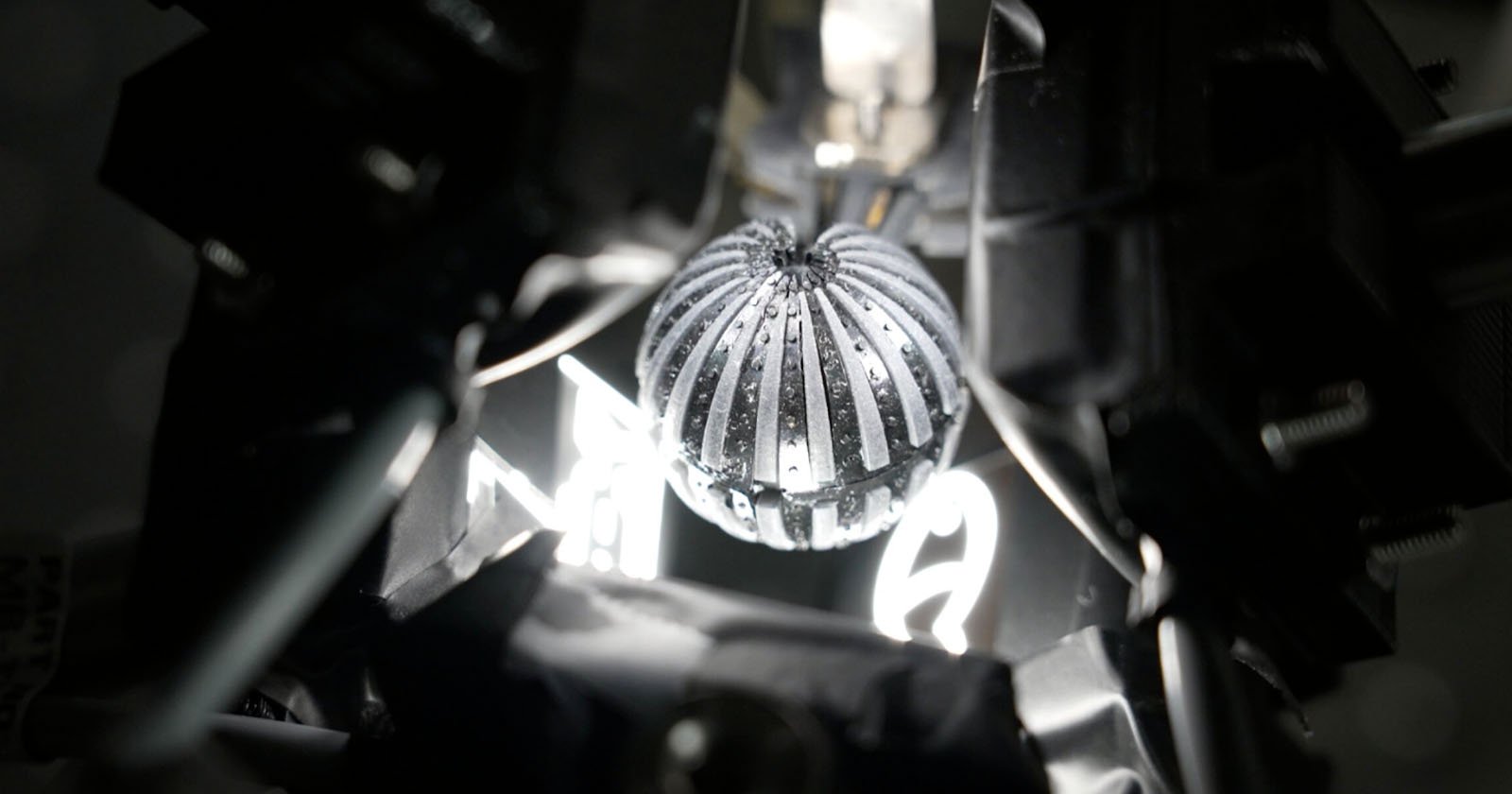
A team of researchers has developed an artificial vision system that offers a full, panoramic view both above and under the water that is inspired by the eyes of fiddler crabs.
Scientists from the Massachusetts Institute of Technology (MIT), the Gwangju Institute of Science and Technology (GIST), the Seoul National University in Korea, and The University of Texas at Austin, presented the amphibious system, which can work both on land and underwater , in a paper published in Nature last month
The new vision system will enable robots to gain a panoramic 360-degree view of their surroundings so that they can detect obstacles and navigate environments more effectively, reports TechXplore.
There have been several, previous attempts to develop cameras that mimic the eyes of insects, fish and other living creatures. However, the development of artificial vision systems that can see both underwater and on land is extremely limited and are usually restricted by a 180-degree field of view.
“Previous works, including our group’s research, on wide field of view (FoV) cameras were always at fewer than 180-degrees, which is not enough for the ‘full’ panoramic vision, and they were not suitable for changing external environments,” researcher Young Min Song tells TechXplore. “We wanted to develop a 360-degree FoV camera that can image both in air and water.”
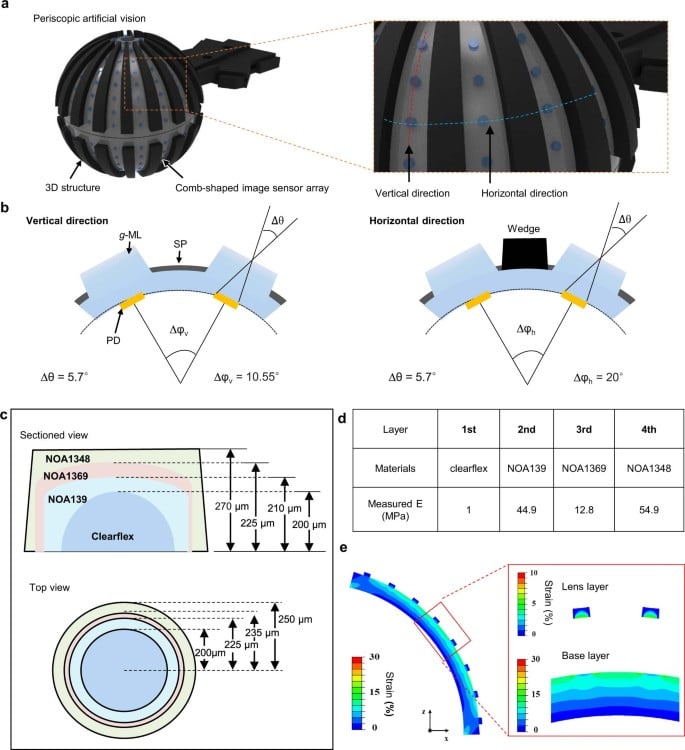
Design of the panoramic artificial vision using the spherical 3D structure and finite element analysis (FEA) of the induced strain in the image sensor array.
The team was inspired by the eyes of the semi-terrestrial fiddler crab, which has a 3D omnidirectional field-of-view. This unique species, also known as calling crabs, can gain a full panoramic view of their surroundings without having to move their eyes and body. They evolved to be able to look at almost everything at once on land and underwater to avoid attacks and to communicate with fellow fiddler crabs.
In the past, scientists have struggled to find a way to sustain a camera’s focusing capability when the environment changes, which is why this team decided to take a closer look at the fiddler crab.
“If you use a conventional lens with curvature for imaging, its focal point changes when you dip the lens into the water,” Song explains to TechXplore.
“On the other hand, if you use a lens with a flat surface, you can see a clear image regardless of ambient conditions. The fiddler crab living in the intertidal region has this kind of flat surface of its lens and we just imitated this crab-eye-lens,” he adds.
To create the amphibious vision system, the researchers integrated an array of flat microlenses with a graded refractive index and an array of flexible comb-shaped silicon photodiodes on a spherical structure. The microlenses they used can retain their focal length irrespective of changes in the external refractive index between air and water.
Song says the artificial vision system is the first to demonstrate the ability to switch between imaging in air and water seamlessly while offering a panoramic view and could lead to 360-degree omnidirectional cameras for everything from all-weather autonomous vehicles to virtual and augmented reality systems .
Song says the technology will be tested and implemented on several different hybrid and amphibious robots, however, his team is also “interested in developing a new type of camera with unique imaging features inspired by other animal eyes.”
The second wave of tracks from Mario Kart 8 Deluxe’s Booster Course Pass dropped earlier than expected overnight, and it’s also made a few other changes to the game.
Not only are there two new cups and eight new tracks, which all knew about, of course, but they’ve made some tweaks to the game and a big change on Coconut Mall.
When the first wave of tracks arrived and Coconut Mall’s cars before the final turn didn’t move, many were upset – but be upset longer. Now on any mode other than Time Trial, they move. They even do doughnuts!
Some other changes to the game have been made, and we’ve included the version 2.1.0 patch notes below.
You’ll need to update the game to get the new tracks; of course, you’ll need to have bought them or have a Nintendo Switch Online Expansion Pack subscription.
Ver. 2.1.0 (Released August 4, 2022)
Support for DLC
Now supports paid DLC: Mario Kart 8 Deluxe – Booster Course Pass, Wave 2 (two cups and eight courses).
General
Increased the number of ghosts you can download from 16 to 32.
Adjusted the extent to which a vehicle is thrown, depending on its weight.
Further shortened the time it takes for item boxes to regenerate after another player takes them.
Shortened the time it takes for one player to be able to pick up a coin that another player has dropped.
Made it so that it is easier to face the way forward in mid-air when using Smart Steering.
The cars that the Shy Guys are riding in in Wii Coconut Mall now move from time to time in all modes other than the Time Trial mode.
fixed issue
Fixed issue where player could not choose a DLC course even though a player in the lobby in “Friends” has the Booster Course Pass.
Fixed issue where player did not receive coins even though they used the Feather in Coin Runners to steal a rival’s coins.
Fixed issue where player could receive two items from one item box in N64 Toad’s Turnpike.
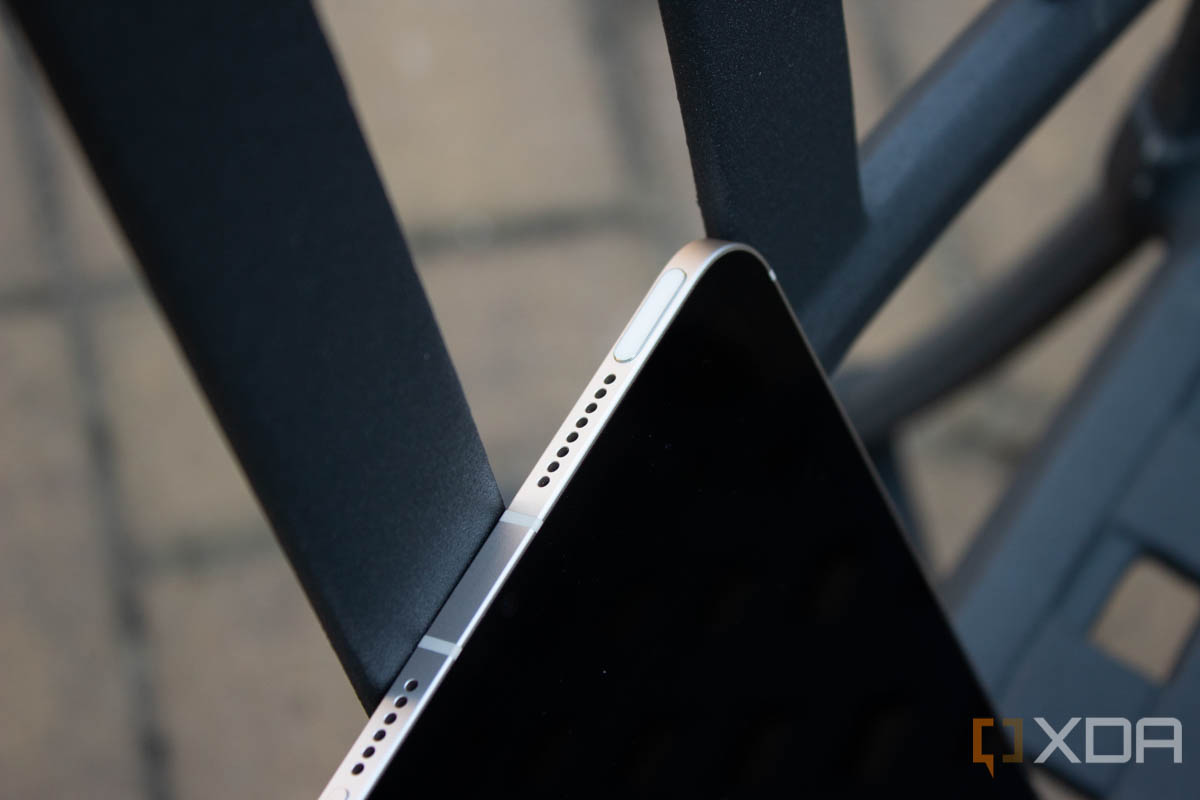
The iPad started as a stretched-out iPhone. In recent years, though, it has been getting more exclusive features that shape its unique personality. With iPadOS 16 enabling resizable app window support, these glass slabs are truly becoming unrivaled in the tablet department. That’s not to mention that Apple sells a wide variety of great iPads, which cater to different needs and budgets. So no matter what you’re looking for, there is likely an iPad that scratches your particular itch.
Few years ago, Apple started overhauling the iPad design, starting with higher-end models. It springs to a flat-edged frame, thinner display bezels, and ditched the physical Home button. Now all recent iPads utilize the new chassis design — except for the entry-level, affordable iPad, which still features the classic build. The good news is that this could be changing this upcoming fall.
We’ve been hearing about a potential iPad 10 redesign for a few months. We now have an idea of what this affordable tablet could look like. mysmartprice has leaked CAD renders that reveal this Apple tablet’s possible design. As you can see, the company could be sticking to the physical Home button. However, the rest of the body could look more like the Air and Mini variants of this device. The edges could become flat, and a camera bump might appear. The bump points at a likely camera sensor upgrade, too.
Unfortunately, the charging port is censored in these renders, so we have no idea whether this iPad will utilize a USB Type-C or Lightning port. Additionally, it’s unclear if the flat edge will be compatible with the Apple Pencil 2 or not. Otherwise, we expect it to pack the iPhone 12’s A14 Bionic chip — which supports 5G networks on cellular models.
What do you think of this potential design overhaul? Do you plan on buying a unit this fails? Let us know in the comments section below.










 A Significant Milestone For Ferrari