Categories
Australia

Second jobs, burnout and too much work: Teachers demoralized as education ministers meet for crisis talks on staff shortages

Five days a week, Karl* goes to work as a high school teacher, planning lessons, marking tests, and dealing with admin. Then, on Sundays, he puts on his uniform and works a sixth day at a local shop.

It’s a long week even though, technically, he’s a part-time teacher.

Despite only being contracted to work two full days at the school — and three half-days — the amount of unpaid overtime needed to prepare for the next day’s classes quickly fills the spare time.

Which is exactly why Karl chose not to take on full-time teaching when he recently graduated, despite a widespread shortage of Australian teachers.

“I kept hearing horror stories of the first-year — early teachers they burn out, they struggle, and I was concerned about it,” he says. “I haven’t sat through a degree so I can do a job for a couple of years and then burnout. I want to do this for a long time, so I need to pace myself.”

Horror stories, like those that led Karl to choose his phased entry into the profession, have become all too common in the teaching industry.

Correna Haythorpe, the national president of the Australian Education Union (AEU) which represents public school teachers across the country, believes the attrition rate for teachers could be as high as 30 per cent within the first five years in some parts of the country.

The cause is often chalked up to “burnout”, a far-reaching condition that can be driven by ballooning workloads, the expansion of responsibility and periods of high stress, like the COVID pandemic.

“The big word that I would use to describe what’s happening to teachers is demoralisation,” says Gabbie Stroud, a former teacher (or “recovering teacher”, as she describes it) and author of a book about her own burnout.

Gabby Stroud
Former teacher Gabbie Stroud recently answered the call to return to casual teaching due to staff shortages. (Supplied: Gabbie Stroud)

“But how that’s happening is broad and varied: it’s increasing workload, it’s data collection, administration and standardization, and all of those activities that take teachers away from the core business of teaching.”

These issues and more will form part of a roundtable discussion between national, state and territory education ministers on Friday, as they look for ways to attract new teachers to the profession, retain existing staff and stem the chronic shortages plaguing schools.

It comes as Department of Education modeling revealed demand for high school teachers was set to outstrip graduates by more than 4,000 over the next three years.

.

Categories
Australia

Perth Children’s Hospital chief Aresh Anwar resigns amid overhaul after death of Aishwarya Aswath

The head of Perth Children’s Hospital has resigned amid an overhaul following the death of seven-year-old Aishwarya Aswath.

Western Australia’s health department on Thursday confirmed the departure of Child and Adolescent Health Service chief executive Aresh Anwar.

Dr Anwar, who had served in the role since 2018, will finish up on Friday.

He was at the helm when Aishwarya died of sepsis in April last year, after presenting to the hospital’s emergency department with a fever.

An internal review into her death found staff had missed opportunities to escalate her care despite her parents pleading for help.

Dr Aresh Anwar, who had served in the role since 2018, will finish up on Friday.
Camera IconDr Aresh Anwar, who had served in the role since 2018, will finish up on Friday. Credit: daniel wilkins/The West Australian
Perth Childrens Hospital
Camera IconThe Perth Children’s Hospital. Credit: AAP

The government has since replaced several of the health service’s board members and recently appointed a new executive director to address “cultural challenges” at the hospital.

Chair Rosanna Capolingua said in a statement that she was confident the health service had the “right team in place”.

“The community can be assured that staff at the Child and Adolescent Health Service will continue to give their utmost to providing quality care for Western Australia’s children and young people and support them to lead healthier lives,” she said.

Health director-general David Russell-Weisz said Dr Anwar had brought dedication and integrity to the role.

.

Categories
Australia

Eleni Petinos concerns relayed to ICAC peripheral to sacking, Dominic Perrottet says

“As advised to you I received a call from the Minister’s Office shortly after a draft order was issued on Coronation’s Merrylands Development,” the letter said.

loading

Shortly after speaking to Petinos’ office he said he received a message from Barilaro, “who I was advised had recently joined the Coronation Board. This contact came to me as a message on my personal phone requesting a meeting with me.”

Chandler said he copied the message to Hogan, and later met Barilaro to answer his questions. “A separate record of that meeting exists,” he wrote.

His letter pointed to the challenges that the NSW residential apartment industry faced when he entered the job in 2019 as “frankly horrific”.

“Turning around the brand of the NSW residential apartment market is now at a stage where demonstrable public confidence has lifted,” the letter said.

The building commissioner also described the difference in his engagement with the minister’s office after a reshuffle last year resulted in Petinos taking over the portfolio from now-Hospitality Minister Kevin Anderson.

Alas, the same level of engagement has not been experienced since. My personal experience has been one where engagement with the minister’s office has been problematic,” he wrote.

“Given where all the above matters now rest, I believe my continued role as NSW building commissioner is no longer viable.”

The NSW opposition used upper house orders to compel the government to release the letter after disclosures in her former ministerial diary revealed Petinos met representatives from Coronation.

Both Petinos and Barilaro have issued statements saying that Barilaro was not in attendance at a June 2 meeting between Petinos and Coronation Property. A second meeting with Coronation on June 21 was disclosed in her diary out of “an abundance of caution”, Petinos has said.

In question time on Thursday the premier conceded he was told about Chandler’s concerns in a phone call with Hogan on July 31, the same day he sacked Petinos, but said the issues were “not relevant at all to the decision that I made”.

“I had a discussion with the department secretary and the main purpose of that discussion was in relation to staff matters,” he said in question time.

Perrottet has said he was only told the letter had been referred to the ICAC on Tuesday night.

Opposition spokeswoman for better regulation and innovation Courtney Houssos said the premier was yet to explain why he sacked Petinos, adding that Chandler’s letter raised more questions.

Houssos said it “does not pass the believability test” Hogan would brief the premier on July 31 about concerns in Petinos’ office and not raise her intention to send Chandler’s letter to the ICAC the next day.

The Morning Edition newsletter is our guide to the day’s most important and interesting stories, analysis and insights. Sign up here.

Categories
Australia

National approach to coercive control to be discussed by state and federal law officers

The father of murdered Brisbane woman Hannah Clarke says the push for a nationally consistent understanding of coercive control is critical to protecting women from abusive partners, as the country’s top law officers prepare to meet to discuss the issue.

Developing national principles on coercive control will be a key focus of the first meeting of state and federal attorneys-general since the election of the Albanese government. The meeting will be chaired by Commonwealth Attorney-General Mark Dreyfus in Melbourne on Friday.

Sue and Lloyd Clarke, parents of Hannah Clarke who along with her three children was murdered by her estranged partner, have campaigned for criminalizing coercive control.

Sue and Lloyd Clarke, parents of Hannah Clarke who along with her three children was murdered by her estranged partner, have campaigned for criminalizing coercive control.Credit:alex ellinghausen

The awareness of coercive control has grown significantly since the horrific murder of Clarke and her three young children by her estranged husband, Rowan Baxter, in Brisbane in 2020. Following their deaths, it emerged that while Baxter had not previously been physically violent, he had Clarke subjected to escalating forms of controlling and possessive behaviour.

Clarke’s father, Lloyd, and his wife, Sue, have spearheaded a campaign to criminalize coercive control in Queensland. He said it was “fantastic” that the issue was being discussed at a national level because it was poorly understood.

“Coercive control is one of the most insidious things going around,” Lloyd Clarke said. “We’ve been pushing for it because there’s so little understanding about it. If there is a national approach, everyone will get a better understanding on what it is and how dangerous it can be.”

loading

Coercive control is generally recognized as including controlling what someone wears, limiting access to money, tracking their location, controlling whom they see, and persistent texting, and can be a precursor to physical violence.

The Queensland government committed to criminalizing coercive control following the murder of Clarke and her children. In May, it pledged to have laws in place by 2023, after it accepted the recommendations of its women’s safety taskforce which identified the need for a new offense that captured psychological, emotional or financial harm as constituting domestic violence.

NSW is also moving on the issue. Releasing a draft bill to criminalize coercive control last month, the state’s Attorney-General Mark Speakman noted the NSW domestic violence death review team had identified coercive and controlling behavior by the abuser in 99 per cent of intimate partner domestic violence homicides between 2008 and 2016.

Categories
Australia

Nitrogen use in the spotlight as grain industry pushes to reduce greenhouse gas emissions

With several governments around the world pursuing limits on nitrogen fertilizer use in agriculture, how would farmers adapt if the Australian government took a similar approach?

Birchip Cropping Group senior research manager James Murray said the obvious way to reduce emissions from nitrogen fertilizer was to use less of it.

“I naturally guess the go-to option is to grow more legumes in the rotation, because when we grow legumes we don’t need to apply nitrogen to meet production,” he said.

“But it’s not as simple as that, because there are greenhouse gas emissions such as nitrous oxide associated with the breakdown of legume stubbles.”

In broadacre cropping, fertilizer production and use accounted for 58 per cent of the Australian wheat crop’s greenhouse gas footprint in the past five years, according to the Department of Agriculture.

Of that, 31 per cent occurred on-farm, a large part of which came through the volatilization of nitrogen fertilizer, where nitrous oxide is released into the atmosphere.

Nitrous oxide is a greenhouse gas that is almost 300 times more potent than carbon dioxide.

A man with short fair hair, wearing a jumper, stands beside a window with a logo and "BCG" written on it.
James Murray says regardless of motivating factors, more efficient fertilizer use will benefit both the environment and the hip pocket.(Rural ABC: Angus Verley)

Apart from growing more nitrogen-fixing legumes to reduce fertilizer use, Mr Murray says there are products available to slow the volatilisation process, which occurs when nitrogen is applied to a crop and there is insufficient rainfall following application to break it down.

“There are a couple of products on the market — one is a urease inhibitor, which reduces that volatilization risk by slowing that release when you apply if you don’t get follow-up rainfall relatively quickly,” he said.

“The other one is a polymer coating, which slows the release of nitrogen quite significantly.

“But the challenge with them is they’re not necessarily cost-effective to utilize, with the urease inhibitor retailing for about $50 a tonne on top of your urea cost, so it opens up a question about how cost effective that is in farming system.”

Mr Murray said whether or not farmers used a urease inhibitor, there was significant value in getting nitrogen application right and minimizing volatilisation.

“We talk a bit about the four Rs — so the right rate, the right product, the right source and the right timing, which at the end of the day will have significant benefits for production, and if we’re reducing our greenhouse gas footprint at the same time, that’s a bonus,” he said.

Countries including New Zealand, Canada and the Netherlands are enforcing limits on fertilizer application to reduce emissions, which Mr Murray says is a consideration for farmers here.

“There are considerations around market access and potential future mandates on how things are utilized,” he said.

“I think there’s a great opportunity for the Australian grains industry to be ahead of the game on this stuff, whether it’s for market access or potential mandate considerations.

“In terms of improving the way we use our inputs, the biggest benefit is to the bottom line in terms of improving crop production.”

A pair of hands cradling innumerable small balls light-coloured of fertiliser.
Urea can release nitrous oxide into the atmosphere.(ABC Wimmera: Andrew Kelso)

What are the alternatives?

Some farmers are trialling alternatives to synthetic fertilizer under the broad umbrella of “regenerative agriculture”.

.

Categories
Australia

Public display of Nazi flags and memorabilia bearing swastikas banned in New South Wales following parliamentary inquiry

Knowingly displaying Nazi flags or memorabilia bearing swastikas has been outlawed in New South Wales, with offenders facing up to a year’s jail time or a possible fine of over $100,000.

The Crimes Amendment (Prohibition on display of Nazi symbols) Bill 2022 swiftly passed in the state’s upper house on Thursday with unanimous support.

It followed an inquiry earlier this year which recommended a ban on the public display of Nazi symbols in a bid to tackle rising anti-Semitism.

It made NSW the second state in Australia to pass the landmark legislation after Victoria in June.

NSW Jewish Board of Deputies chief executive Darren Bark described the passing of the law as a historic day for NSW.

“Nazi symbols are a gateway to violence and are used as a recruitment tool by extremists,” he said.

“Banning their display is a long-overdue and much-needed law in our state. The perpetrators will finally be held to account.

“The legislation is also a game-changer in tackling online hate.

“It is time our tech companies step up and ensure these illegal symbols are removed from their platforms, and the offenders are banned and prosecuted.”

The Holocaust was the genocide perpetrated by the Nazi regime in Germany that killed some six million Jews and other minority groups including homosexuals, black people and Roma people during World War II.

loading

NSW Attorney-General Mark Speakman said the bill’s passing was a significant moment for Holocaust survivors and their families.

“The events that occurred under the Nazi regime represent one of the darkest periods of recorded human history,” he said.

“The atrocities committed during that period are almost unimaginable, and the intergenerational trauma they have caused continues to be felt by many people today.

“This new offense sends a clear message that the display of Nazi symbols, and the hatred and bigotry they represent will not, and should not, be tolerated.

“This new criminal offense will provide important, additional safeguards against hate speech and vilification in our state.”

a man looking
Attorney-General Mark Speakman said the ban sends a clear message to potential offenders. (AAP Image: Joel Carrett)

A section in the bill allows for the swastika symbol to be used in academic, historical or educational settings where it is in the public interest.

The section paves the way for its display by Hindus, Buddhists and Jains in which it holds religious significance.

“For too long, the Hindu community has not felt comfortable to display our symbol of peace because it resembled a symbol of evil. This is no longer,” said Hindu Council of Australia national vice-president Surinder Jain.

“We were so pleased to work with the Jewish community to make this a reality.

“Thank you to everyone involved in this important work for the benefit of our entire community.”

.

Categories
Australia

Four Queensland children abducted by man with ‘Joker’ tattoos may be at ‘significant risk’

Four young children may be at “significant risk” after a man abducted them from a Queensland property on Thursday morning.

Queensland Police said the children – aged 8, 7, 4 and 3 – were taken from a property at The Leap, north of Mackay, about 11.30am.

“All of the children are described as being Caucasian in appearance with a slim build and brown hair,” police said in a statement.

Watch the latest News on Channel 7 or stream for free on 7plus >>

An amber alert has been issued asking members of the public to help locate the youngsters.

The children – aged three, four, seven and eight years old – were taken by a man from a property at The Leap. Credit: QLD Police

A man, with identifiable Batman ‘joker’ themed facial tattoos, was seen taking the children from a Maraju Yakapari Road address in a white 2005 Nissan Patrol 4WD with the Queensland Registration 063BC9.

The car was last seen heading toward Bruce Highway.

Police said the alleged offender is described as Caucasian, solid build, approximately 175cm tall with a shaven head and full bushy beard.

Police said the man seen taking the children, pictured, has identifiable facial tattoos. Credit: QLD Police
The man was seen driving toward Bruce Highway in a white 2005 Nissan Patrol 4WD. Credit: QLD Police

Anyone with information about the abduction is asked to call 131 564.

Those with life-threatening information about the incident should contact triple-0.

CCTV captures father using pram and pants to steal from shop.

CCTV captures father using pram and pants to steal from shop.

.

Categories
Australia

Perth abortion rally: City protest marred by hecklers, ugly confrontation

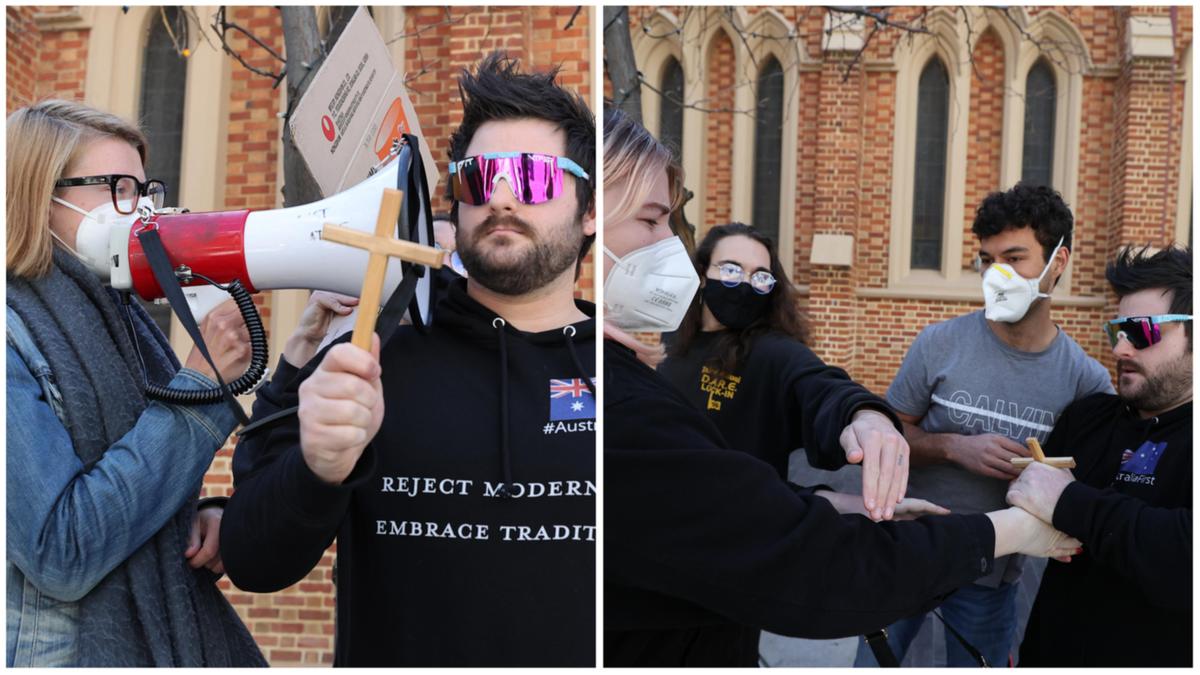
Activists at an abortion rights protest have clashed with men bearing crosses at a rally in Perth on Thursday.

Around two dozen pro-choice supporters gathered outside Wesley Church before marching through the city to call for better abortion access in WA.

It follows a recent decision in the United States Supreme Court to strip back the laws allowing safe abortions.

Several men holding up wooden crosses tried to disrupt the rally in Perth by heckling speakers.

.

Categories
Australia

Kiribati constitutional crisis deepens as it detains Australian-born high court justice | Kiribati

Kiribati is in the midst of a constitutional crisis after its government detained one of its most senior judges, Australian citizen David Lambourne, after a failed attempt to deport him.

Despite an order from the Kiribati court of appeal that Lambourne should not be removed from the country, police and immigration officials sought to forcibly deport him at Bonriki international airport on Thursday.

Lambourne was only saved from deportation when the Fiji Airways captain refused to take the judge on board, given his unwillingness to travel. After a standoff of several hours on Thursday afternoon, during which the plane remained on the runway, the flight departed without Lambourne.

The judge was subsequently detained and taken to motel-style accommodation near the airport. It was unclear whether the government would attempt to deport Lambourne on the next flight to depart the island, on Sunday.

The separation of powers dispute escalated on Thursday morning when officials arrived at Lambourne’s residence in Tarawa, the capital, in the early hours with a deportation order and a same-day airline ticket to Fiji. After an urgent application by Lambourne, the court of appeal ordered the government not to deport the judge.

“This is a devastating assault on the rule of law in Kiribati,” Lambourne told the Guardian as he was awaiting deportation. It is the first time the judge has spoken publicly about the saga.

Kiribati has been in the midst of a dramatic battle between the government and the independent judiciary. In late 2021 Lambourne, who is married to the opposition leader, Tessie Lambourne, won a high court constitutional claim against the government, which had refused to allow him to return to the Pacific country and sought to end his tenure of him.

“In defying a clear order of the high court the government of Kiribati is demonstrating its contempt for the constitution and the judiciary,” he said. “The government is also displaying its blatant disregard for the rights of the ordinary people of Kiribati, by denying them a functioning court system.”

Lambourne is a longtime resident of Kiribati and was formerly its solicitor general. Kiribati’s attorney general subsequently appealed against the ruling to the court of appeal, and in May suspended Lambourne, citing unspecified misconduct allegations. Lambourne engaged Australian barristers Perry Herzfeld SC and Daniel Reynolds to contest his suspension of him.

In late June, as the nation’s chief justice, New Zealand judge William Hastings was about to begin hearing a constitutional challenge by Lambourne to his suspension, the government also suspended Hastings. There is currently no functional high court in Kiribati.

The government’s appeal against the original ruling was due to be heard on Thursday, by a court of appeal consisting of retired New Zealand judges. But on Wednesday, the government drew the appeal.

In a letter filed with the court of appeal discontinuing the proceedings, Ravi Batra, a New York-based lawyer representing the Kiribati government, claimed the government had vacated the original decree appointing Lambourne. It is unclear how such a step would be constitutional.

“All those who are aiding and betting David Lambourne to engage in an attempted unconstitutional judicial coup are subject to an appropriate investigation by the attorney general and may receive lawful rebuke, civil and/or criminal,” the letter stated.

The commission of two court of appeal judges expires later this month, and under the Kiribati constitution they can only be replaced with the involvement of the chief justice. With Hastings suspended, it is likely Kiribati will soon have no functioning court of appeal. Appeals to the privy council in Britain are only available in certain narrow circumstances.

The Guardian has approached the attorney general for comment.

The saga has parallels to a 2014 fiasco in Nauru, when the government canceled the visa of its chief justice, Australian Geoffrey Eames. The judge was forced to resign and described the move as an abuse of the rule of law. The use of foreign judges in the Pacific is common, but leaves them vulnerable to the use of visa restrictions to undermine judicial independence.

The Guardian understands that Lambourne re-entered Kiribati this month on a visitor visa, having received assurances from immigration officials that he would be issued a work visa once in the country.

Categories
Australia

Minister apologises for system failing Defense and veterans

Keogh did not give a formal response to the report’s 13 recommendations, but said it was his view the government should get on with implementing them as quickly as possible.

loading

The commissioners said there was “a compelling case” for a permanent body to be established by the time the commission ends in mid-2024 to keep track of implementation progress. They will make a special report next year on what this should look like.

Research has found there are much higher rates of suicide among ex-service personnel than in the general population. But the commission’s report says existing data does not give the full picture and there are gaps.

Census data revealed for the first time there are more than 581,000 Australians who are either veterans or currently serving in the ADF. Approximately 6,000 people leave the ADF each year.

In June, the Department of Veterans Affairs had almost 62,400 claims on hand but was yet to assign 41,800 of them to be examined. The wait time on claims has also grown significantly over the past five years, with the median processing time more than 300 days in some cases.

Keogh said the government had already lifted a staffing cap, meaning the department could transfer temporary contractors to permanent positions, and begun work to recruit the 500 more staff promised during the election.

Commission chair Nick Kaldas said the backlog was unacceptable.

The 13 recommendations include several about sufficiently resourcing DVA to clear the backlog of claims. It also says the laws around veteran compensation and rehabilitation should be simplified by mid-2024.

The report says while change would not be easy, “the difficulties of reform provide no justification to delay any further”.

RSL Australia ambassador Pete Rudland said it was vital for government and ex-service organizations to work together on the “mammoth task” of simplifying the system.

Tasmanian Senator Jacqui Lambie, who gave evidence to the commission last week, warned the government had to be flexible if the department needed more than 500 people.

“When it takes two to four years to get a delegate, that’s before the claim is looked at, we have got massive problems,” she said.

She also urged veterans to speak to the royal commission, which runs for another two years.

“This is our one shot. If you don’t want to come forward for yourself, do it for your mates,” she said.

The commissioners also flagged further work will examine whether the support available to families is sufficient.

loading

Rudland said this was vital to getting better at helping veterans.

“Anything that happens to the soldier happens to the family… we should never separate one from the other,” he said.

Department head Liz Cosson told the commission the department had sought extra funding over the years but the money given to it in the budget hadn’t kept up with the volume of work.

Former veterans minister Andrew Gee, a National MP, also told the commission that despite the limited staffing for claims processing, he was made to cut $430 million from the department’s budget.

If you are a current or former ADF member, or a relative, and need counseling or support, contact the Defense All-Hours Support Line on 1800 628 036 or Open Arms on 1800 011 046.

Cut through the noise of federal politics with news, views and expert analysis from Jacqueline Maley. Subscribers can sign up to our weekly Inside Politics newsletter here.