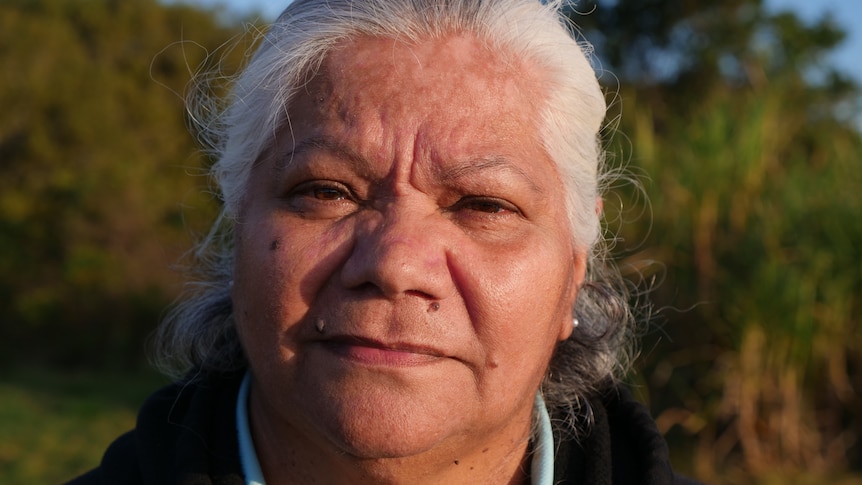
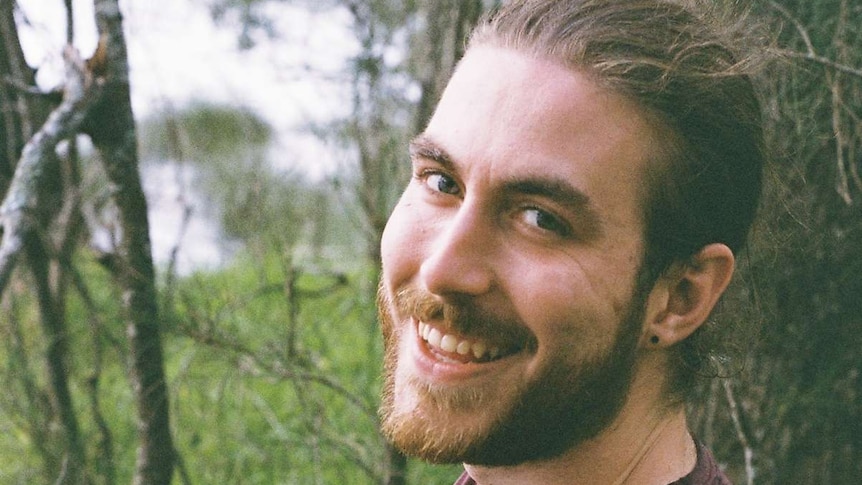
After moving accommodation five times in five months, Nyangbal and Dunghutti woman Teresa Anderson has had enough.
Key points:
Flooding in the Northern Rivers displaced many Indigenous communities
Elders say a disproportionate number of First Nations people are still homeless almost six months on
They say the many in the community are suffering because of it
The elder’s Cabbage Tree Island home, nestled on a flood plain of cane fields in northern New South Wales, was deemed uninhabitable after the February floods.
She has been homeless since.
“I’ve been moved around five times,” she told the ABC.
“We were at the Ramada[hotel] then we went to Brisbane. Then we had to go outside of town.
“It’s taken a toll on my health. I couldn’t even cope, I couldn’t go to work. It just got me really emotional.”
Teresa in front of her grandmother’s house, which is unsafe for occupancy.(ABC NewsEmma Rennie )
Teresa Anderson was in good health before the floods.
But she believes a series of new health issues have been a direct result of the grief and stress of being displaced.
“YO‘I’m struggling,” she said.
As floods devastated Lismore and surrounding towns earlier this year, a sludge of sewage-contaminated water raged down the Richmond River, destroying every home in the Aboriginal community.
Floodwater damage at Cabbage Tree Island. (ABC News: Rani Hayman)
There are 23 homes on the island — with some housing up to 12 people — and at the time every single resident of the 180-strong community was left homeless.
Today, every house is still uninhabitable.
According to the Jali Local Aboriginal Land Council, today, almost six months after the disaster, about 500 of the 1,296 northern New South Wales residents who are still homeless are First Nations people.
“That tells me clearly that we’re disproportionate again in relation to the numbers of people who are homeless,” Widjabul man and Jali Land Council chief executive Chris Binge told the ABC.
Mr Binge said a disproportionate number of the Indigenous community remains homeless.(ABC News: Rani Hayman)
According to Ms Anderson, Indigenous flood victims have been pushed to the back of the line when it came to finding permanent accommodation.
“They are homeless and staying in tents in front of their homes,” she said.
“It’s hard for us to try to get accommodation like rental houses, because once they know it’s an Aboriginal family, they just say, ‘no, I’m sorry, it’s not available.”
Temporary housing plan
The NSW Department of Communities and Justice, the organization responsible for helping flood victims into emergency accommodation, told the ABC in a statement it did not collect data on Indigenous status.
But it said it had assisted “10,676 people into emergency accommodation across the Northern Rivers” since February.
The federal and state governments have promised $70 million for Aboriginal housing solutions for communities across the Northern Rivers.
There are plans for Cabbage Tree Island residents to move to a temporary housing site at the nearby Wardell Recreation Ground.
But according to Resilience NSW the “persistent wet weather has significantly impacted the progress of earthworks”.
Some residents have been told it could be three months before the project is finished, but Resilience NSW have not provided a specific time frame.
The temporary housing site at the nearby Wardell Recreation Ground, which is still in development. (ABC NewsEmma Rennie)
As members of the Cabbage Tree Island communities wait for news on when and if they’ll be able to return home, there are concerns the health and wellbeing of elders is deteriorating.
Nyangbal woman Delia Rhodes, also from Cabbage Tree Island, said not knowing when or if she’ll be able to return home to the country has severely impacted her mental health.
Delia Rhodes just wants to get back to her community.(ABC NewsEmma Rennie)
“I can understand the wider community has been affected, too,” she said.
“But it’s a slow process for us to get us back into housing, into a permanent home. It’s hard work.
Dimity Blundell was 35 weeks pregnant with her son, Finley, when she was suddenly woken up in the middle of the night by her cat.
Warning: This story discusses stillbirths and contains photos and other content that may be distressing to some people.
“I used the bathroom and started bleeding, a lot,” she said.
Dimity, and her husband Michael, rushed to hospital, where doctors told them the news no parents want to hear: “we can’t find a heartbeat.”
Dimity had had a placental abruption, a rare but serious pregnancy complication where the placenta partly or completely separates from the uterus before delivery.
She was taken into an operating theater at 12:16am on February 22 this year.
“I was prepped by 12:17am, knocked out at 12:18am, the surgery started at 12:19am, and Finley was born at 12:20am,” Dimity said.
Finley was declared dead at 1:24am.
‘Is this the worst day of my life?’
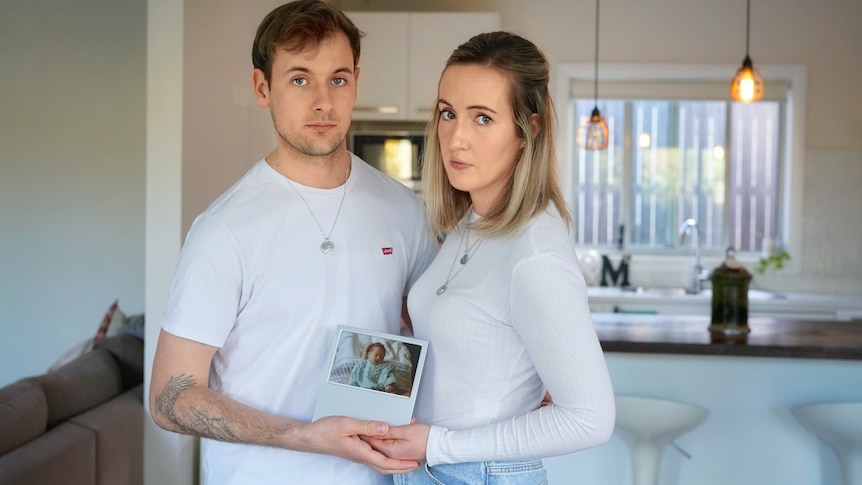
Michael and Dimity are taking it “day by day” since their son’s death.(Supplied)
Later that morning, a midwife asked if the grieving couple wanted to meet their son.
Dimity recalled the midwife telling her: “he’s very cute, he really does just look like he’s sleeping.”
Finley spent four days in the loving arms of his parents, and a handful of other family members and friends.
Dimity said she always asks herself, “is the worst day of my life the day he was born, or the day I had to leave him? I think it was the day we had to leave him.”
“Then we came home, and we had a nursery and we had baby things, and then we became the people whose baby died,” she said.
“Everyone else gets to bring their baby home, so why didn’t we?”
Dimity and Michael with baby Finley, who was stillborn in February 2022.(Supplied)
Five-and-a half months on, Dimity and Michael said they were taking each day as it came.
But Dimity said Finley’s death “affects every single aspect” of their lives.
“Everything that you do, it’s just woven into the fabric of who you are,” she said.
Michael said it was hard to describe the pain, that still had not gone away, but said it had “certainly gotten a little easier to deal with, with all the counseling and work we’ve put in.”
“It definitely burns less; I’d say it would be a campfire now rather than a bonfire,” Dimity said.
“Moving forward is weird though, because the further forward you move, the further away you get from your baby.”
‘We are the strength of other people, we are the strength of the Red Nose families’
Bonnie Carter is the ACT representative for the Red Nose Community Advisory Committee.(ABC News: Dave Scasci)
Shortly after Finley’s death, the couple reached out to the charity Red Nose — best known for its annual major fundraiser Red Nose Day, which is today.
Each year, the national charity raises hundreds of thousands of dollars to continue vital research into the causes of stillbirth and sudden infant death and support families impacted by the death of a baby or child.
Through Red Nose’s Canberra branch, Dimity and Michael were able to participate in counselling, and said they discovered a whole community of people who had gone through the same experience as them.
“Once you step into the community, you realize how big it is, and we’re all here for one another,” Michael said.
“The mums and the dads and the siblings of the little people who are with Finley, those people are phenomenal, and they will get you through this,” Dimity said.
“People often tell Michael and I, ‘you’re so strong, you’re so brave’. And I say, ‘No. We are the strength of other people, we are the strength of the Red Nose families.'”
Bonnie Carter and her husband Steve had these tags made for their two little girls, who were stillborn.(ABC News: Adam Kennedy)
Another member of the Red Nose community in Canberra, is bereaved parent Bonnie Carter, who lost her two daughters, Grace and Matilda, in the span of 18 months.
“It was a very raw, unique pain that I wouldn’t wish on my worst enemy,” she said.
“There’s some sort of pain you cannot describe in words when a baby dies in the comfort of your belly.”
Bonnie is the ACT representative for the Red Nose Community Advisory Committee and said it was important to talk about stillbirth, as the latest statistics showed 3,000 Australian babies died suddenly and unexpectedly each year.
“By the time you roll into bed tonight, nine Australian families will have lost a baby,” she said.
Dimity and Michael said they found “talking about stillbirth took away the stigma.”
“You’re pregnant and you’re carrying a baby and then it dies, and there’s a lot of stigma around, ‘what did you do?'” Dimity said.
“By talking to Red Nose and hearing the different stories, people have a lot more understanding that it does just happen.”
Funds raised to assist research into stillbirth
Current research from Red Nose shows more than 50 per cent of stillbirths, that occur in the last weeks of an otherwise healthy pregnancy, have no known cause.
But Bonnie said she hoped that ongoing research undertaken at Red Nose could ensure “zero babies pass away, and zero little lives are lost.”
She said, until that time came, counseling and community support allowed bereaved parents and families to open up about their experience.
Bonnie has since welcomed baby daughter Evie, but continues to advocate for parents who have lost a baby through stillbirth or miscarriage.(Supplied)
“You need those other parents to lean on, to talk to, to vent to, to cry to, to laugh with,” she said.
“There is a whole community of families, especially in the Canberra region, who get it, who feel your pain, who understand it, and we’re your backbone. You can lean on us whenever you need to.”
Dimity and Michael said, one day, when they were “further down the path” they wanted to join Bonnie and become involved in the Red Nose charity.
“So that other people don’t have to sit in their hospital beds holding their baby and thinking ‘this doesn’t happen to other people,'” Dimity said.
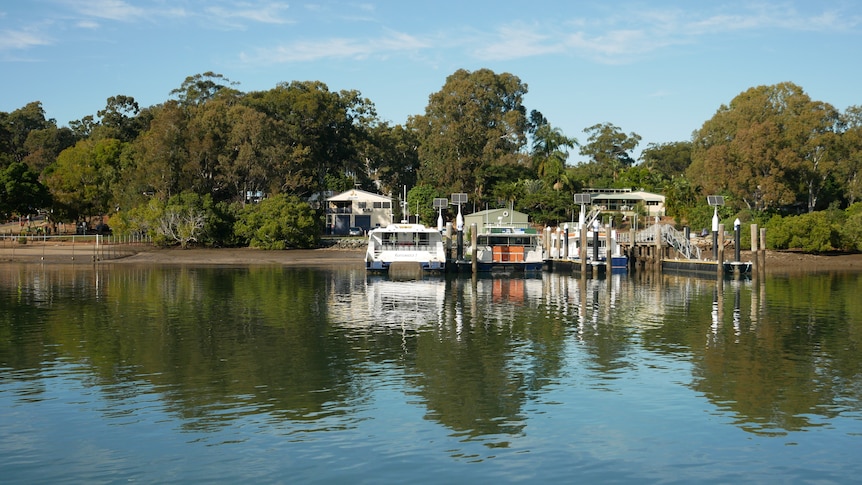
The Southern Moreton Bay Islands sit in the middle of a picturesque marine park that’s home to turtles and dugong, protected from the open sea by North Stradbroke Island and just an hour from the Brisbane CBD.
But residents of the islands say behind the beauty, social and physical infrastructure has fallen drastically short of what is required in the face of a dramatic population boom.
The population of Karragarra, Lamb, Macleay and Russell islands grew by nearly 20 per cent, from 6,153 to 7,635 between 2016 and August last year, according to the 2021 census.
In addition, Redland City Council has approved almost 1,000 new builds since 2018, a boom that has added to the population growth as well as an influx of traditions to the area.
The population on the islands has grown in recent years.(ABC News: Julius Dennis)
And part of the reason why residents say the population growth feels a lot higher than the census figures show.
For locals, the car parks at either end of the ferry, where islanders return to and from the mainland, are the funnel point where transport pressures are felt the most.
Helen Thompson has lived on the islands for almost 20 years, commuting to Redland Bay by ferry before driving to work. She says parking in the area has “always been a nightmare”, but the population spike has made it increasingly difficult.
“There are more parking facilities now, but there are also more people,” she says.
Many people keep a car on the mainland in Redland Bay.(ABC News: Julius Dennis)
Redland City Council says about 2,000 parking spaces are available around the terminal, but Ms Thompson says on the weekend it is nearly impossible to find a park.
“I generally avoid coming to the mainland on the weekend because of parking. Once you move your car there’s very little chance of getting another park.”
Helen Thompson says she struggles to find a park on weekends.
(ABC News: Julius Dennis)
Lack of sewers ‘not feasible’
Another concerning infrastructure limitation for residents is the requirement for all homes to have their own septic system. There is no sewage on the islands.
Jasmine Person is a long-time local and former president of the Chamber of Commerce, she says the conveyancing work done by her firm has “tripled” in recent years.
“I don’t think the council envisaged this much growth in such a short amount of time,” she says.
Jasmine Person says her work on the islands has tripled.(ABC News: Julius Dennis)
She says of all the infrastructure problems facing the islands, the lack of sewage on the islands poses the biggest risk.
“That should have been done back in the 2000s when the water was put on — now it’s an expense to council that is not feasible for them,” she says.
“I don’t know how they’re going to find a solution. It’s their responsibility.
“You can’t keep on having this much growth and that wastewater leaking into the ground on the back of a marine park. It’s just not going to work long term.”
The Southern Moreton Bay Islands are a collection of four islands off the Redlands Coast east of Brisbane.
(ABC News: Julius Dennis)
For Clem Ebber — another two-decade veteran of island life — it’s another example of poor planning for one of Queensland’s most unique communities.
From his deck on Lamb Island he can see North Stradbroke, a tourism jewel of Queensland with a full-time population of just over 2,000.
“We cannot understand that we’ve got here on our Southern Moreton Bay Islands about 10,000 people with no sewerage and Stradbroke has got sewerage,” he says.
Redland City Council says the islands are not within their “declared service area for reticulated sewerage”, but they do “ensure on-site sewerage facilities are constructed in accordance with the relevant plumbing, health and environmental standards”.
There is also a large community push to seal the roads after some residents claimed they were suffering lung issues from the unfinished roads.
Council agreed to a green sealing program.
“Unfortunately, the council has scrapped this green sealing program for this financial year,” Mr Ebber says.
Dirt roads on the islands have long been a contentious topic. (ABC News: Julius Dennis)
The council said it had identified 61 kilometers of island roads that may be suitable for green sealing, “pending future budget considerations and funding assistance from the state and federal governments.”
Boom fueled by cheap land
On the islands the signs of growth are everywhere.
“For sale” signs slapped with red “sold” stickers line the streets.
Vehicle barges laden with traditions come across every day, filling the air with the sound of power tools and filling cafes, fish and chip shops and pubs with their business.
Vehicle bars bookings fill up quickly. (ABC News: Julius Dennis)
One of the main drivers of the boom is property prices. An hour away in Brisbane, house prices have surged over $1 million, but on Russell Island an empty block can still be purchased for $40,000.
Angela Collins is the manager of Southern Moreton Bay Islands Community Services Incorporated (BICSI) — the longest tenured service provider on the islands with more than 100 volunteers and workers running op-shops, a Centrelink, plant nurseries and emergency relief.
Over the 28 years of operation Ms Collins says BICSI has, “basically been the first port of call for anything that goes on on the islands.”
Angela Collins is the manager of Southern Moreton Bay Islands Community Services Incorporated.(ABC News: Alexander Lewis)
She says the population spike in the past few years has resulted in a rent bubble that is putting strain on the locals.
Rent has jumped up to $80 a week in two years, from $270 to $350 on average for three-bedroom homes.
“What we’re finding is a lot of phone calls coming in saying, ‘Can you help me? I’m about to be evicted from my house I’ve rented for 20 years because the lease has expired’,” Ms Collins says .
“That’s very, very difficult for the unemployed and the pensioners and that’s why we’re seeing a change in our demographic.”
Rent on the islands has risen dramatically in recent years.(ABC News: Julius Dennis)
Hilton Travis is the president of SMBI Listeners, an organization which aims to link people and services on the island.
He says higher rents are not in the budgets of many islanders, many of whom are pensioners or survive off a low income base.
“Our average rent is about $80 or $90 cheaper than the average Australian rent, [but] the average income of people over here is a couple hundred bucks a week less than the average income,” he says.
“It means we’ve got a large percentage of people who have a lower income who spend a large percentage of that lower income on their rent.”
Hilton Travis is the president of SMBI Listeners.(ABC News: Alexander Lewis)
‘We don’t get a fair deal’
Both Mr Travis and Ms Collins say the boom is also putting pressure on service providers with many organizations physically based in Redlands and not on the islands.
“Services that are available on the mainland are not the same services that are available over here. Not only in number but also in their ability to actually deliver,” Mr Travis says.
“We don’t get a fair deal on that. There’s still a number of services who will only serve Redlands because they see the time taken to get here and it’s a fair issue — if it’s going to take you an hour over on a barge and an hour back on a barge.
A vehicle barge travels between the islands and the mainland. (ABC News: Julius Dennis)
“Services will start ringing us up saying, ‘We’re funded, we’re coming over to the islands, can we come and see you?'” Ms Collins says.
“They have no idea of the logistical complexity with the water barrier that we have, which means that they’ve got funding for the islands, but it’s four islands.”
Service providers on the islands have long called for more “place-based” organizations with a full-time presence.
“People who live on the islands understand the logistical issues that we have here, while mainland people really don’t,” Ms Collins says.
“If the funding was presented to organizations on the islands or people who are qualified to even work for those organisations, but live on the islands, I think it would be massive.”
People catch ferries from Redland Bay to the islands. (ABC News: Julius Dennis)
Nowhere to go in a crisis
Julie “Chook” Larson manages Running Wild, a service founded in 2013 on Macleay Island, which is being forced to downsize despite the increasing demand.
Ms Larson is a trained support worker and says Running Wild has been fueled by grants for specific programs like training and employment or conservation projects but are involved in a wide range of other community services.
“We’re not a specific youth service. We’re not a specific DV service. We’re not a specific mental health service, but we’re here in the community,” she says.
Julie “Chook” Larson says there is not enough services on the islands for those in crisis. (ABC News: Alexander Lewis)
“We are the only organization on the islands that is based here and able to, through relevant qualifications and trauma informed training, be able to provide a response to a crisis,” Ms Larson says.
“On paper it would look like these islands are all being serviced by professional support workers, but they’re actually not — they’re mainland based. They’re not here, they come on an outreach basis.”
Ms Collins agrees.
She says once the last ferry has left at night there is nowhere for people in need to turn.
“I’ve turned up at work and found a family with children sitting outside in their car saying that they’ve just gone through domestic violence and they’ve been sleeping in the car overnight,” she says.
“They’ve got no money, they can’t get off the island.”
But the stream of grants Running Wild has relied on has dried up and the organization is being forced out of their location on Macleay Island.
Mr Travis says this will “leave a hole in local access, particularly after hours”.
“If anything happens and people need support [at night] you’ve just got to get it from the people on your island,” he says.
“There’s really nowhere that you can have that separation over here. Nobody’s got a safe place they can go to.”
Only one ambulance boat services the islands.(ABC News: Julius Dennis)
As well as being “just one grant away from closing”, Ms Larson says Running Wild is having difficulty finding a suitable home.
Previously, a council-owned 10-acre block was earmarked for Running Wild but after a council meeting in July Ms Larson says she was told there was no land available.
Ms Larson says the lack of facilities made it “even more difficult in a competitive grant environment”.
Redland City Council says if land or a facility became available Running Wild could put forward an expression of interest.
Ms Larson says she will continue her work as a volunteer, but will have to find another job.
“Shift the resources here. We know what works here, we’ve been here, we live here, we know what works for our community – give us the resources to do something.”
Midwest police are calling for calm after multiple alleged attacks on officers in the past week.
Key points:
A hotel owner says violence affects all businesses, not just the venue in question
Several people have been charged over alleged offenses against police
Police say the behavior is all too common
Geraldton Officer in Charge Senior Sergeant Chris Martin said he was alarmed by the incidents.
“It really concerns me that my officers are going to jobs in Geraldton and people are [allegedly] actively looking to assault them — that’s very concerning,” he said.
“We have seen a steady increase in assaults over police in the last 12 to 24 months.”
The WA Police Union says assaults on Midwest-Gascoyne officers have risen more than 55 per cent in the last year.
Police say more than 100 people were gathered in groups in the hotel car park.(Supplied)
Late night pub brawl
A 24-year-old woman appeared in the Geraldton Magistrates court on Wednesday charged with two counts of assaulting a public officer and one count of obstructing public officers.
The charges followed a ticketed event at the Wintersun Hotel on Friday night, which about 250 people attended.
Senior Sergeant Martin said when the event finished a crowd spilled into the car park and police received a disturbance call.
“When we attended there was about 100 people present, fighting in all kinds of different groups and police were required to take some evasive action,” he said.
“Some of our officers were kicked, punched, pushed, spat on.
“That behavior is not uncommon, unfortunately, in Geraldton.”
Senior Sergeant Martin said one police officer was struck to the neck with a bottle.
The officers were taken to Geraldton Health Campus for a medical assessment.
He said three other people had been charged over the brawl.
‘pretty dislike’
On a separate occasion this week Geraldton police were called to an alleged domestic violence incident in Karloo.
Senior Sergeant Martin said an attending officer was allegedly spat on.
“Being spat on is pretty disgusting,” he said.
There was also an incident in Rangeway, where a person allegedly bit an officer on the finger.
“We deal with a lot of violent people, we deal with a lot of dynamic situations,” Senior Sergeant Martin said.
“I’ll be the first to say we don’t always get it right, but police officers come to work to do their jobs and keep the community safe.”
Police were called to the Freemasons Hotel after an alleged fight on the patio pub.(Midwest & Wheatbelt: Rachael Clifford)
‘Ruining a lot of businesses’
Freemasons Hotel co-owner Kristina Drage said she had noticed an increase in tension in the community after a fight unfolded out the front of her pub while a guest speaker was entertaining an audience inside.
“Unfortunately, some people who had been evicted from the premise earlier in the evening decided they wanted to have a fight with some people enjoying themselves in the alfresco area,” she said.
“When people come and behave like that it is really embarrassing for the town, the people, or the talent who are visiting.”
Ms Drage said a lot of money and effort went into hosting events, which other businesses also benefited from.
But ongoing behavior is acting as a deterrent for event organizers.
“By people carrying on like this are ruining a lot of businesses, not just ours,” she said.
“If we had a better infrastructure of public transport and taxis, it certainly would solve a lot of after-hours problems when establishments close.”
Leaders of Ballarat’s Chinese community say they will continue to fight to protect a house significant to Chinese and Ballarat history after a council vote opened the path for its demolition.
Key points:
Landowners have applied to demolish the home and outbuildings
The family of a Chinese mine manager lived in the house for more than 100 years
City of Ballarat’s heritage consultant Robyn Ballinger has determined the house to be of local significance
Chinese Australian Cultural Society Ballarat president Charles Zhang says he will seek an interim protection order from Heritage Victoria for the site known as Victory House in the suburb of Canadian.
“We won’t let this go. This is very important to us,” he said.
“We will find a solution to save this house.”
Victory House, named after the 1902 Melbourne Cup winner The Victory, was built in 1906 near goldmines and was home to a family of Chinese goldmine manager James Wong Chung.
The Chung family lived in the Geelong Road home until 2008, when it was sold.
The Chung family. (Supplied)
The home was widely known as a welcoming place that hosted large gatherings of Chinese people to celebrate culture and heritage.
It is recognized for its strong links to Ballarat’s goldrush history and Chinese history in Ballarat.
But four Ballarat councilors believe it is not significant enough to warrant protection in a city where countless old homes could be argued to have historical and social significance.
James Wong Chung was the manager of Chinese mine You Sing. (Supplied)
Their vote, four against three, at a planning meeting on Wednesday night, defeated a council officer’s recommendation to seek interim and permanent heritage protection for the site.
Landowners want to demolish Victory House and other outbuildings sites to construct four new dwellings.
Not worth protecting
Councilor Mark Harris led the vote against protection, and told the ABC council must draw a line on interference with privately owned property and this house did not make the cut to be saved.
Four Ballarat councilors have voted against protecting the house.(ABC News: Lexie Jeuniewic)
“It is not a good example of that turn of the century federation house. And, in and of itself, I didn’t think it had the merit to preserve it,” he said.
“At some stage, you ask the question, how much do the owners have rights on it?
“Can any house fall victim to the fact council may decide it to be preserved for historical values they might not have known about?”
The City of Ballarat received a request to demolish the home and outbuildings on July 7 this year.
The land is currently not subject to precinct or heritage controls under the planning scheme.
Heritage consultant Robyn Ballinger prepared a report on the history of the site upon council request.
Dr Ballinger determined it was of local significance.
‘Very bad decision for Ballarat’
Ballarat historian Anne Beggs-Sunter said it was a “bad look” and “very concerning” for councilors to vote against the advice of heritage and planning experts.
“If the council is not seeking heritage protection, there is nothing to stop the demolition of the buildings on the site,” she said.
“It is a very bad decision for Ballarat, particularly with this heritage push to get world listing for the Goldfields.
“Here is a site that is so rich in its association with the very early goldrush in the Canadian area, and the association with the Chinese is so important.”
Victory House in Ballarat is considered a significant part of Chinese history in Ballarat. (Supplied)
City of Ballarat’s heritage advisor told the statutory planning department they would not support the demolition of the home.
The council’s Development and Growth director Natalie Robertson has already written to the Planning Minister Lizzie Blandthorn advising of plans to seek interim heritage protection.
Heritage Victoria can put an interim protection order on a place that is under threat if it is likely to be of state heritage significance and there is an immediate threat to it.
A Queensland mother has described the “soul-destroying” ordeal of her teenage daughter being sexually abused by paedophiles and becoming addicted to ice while she was under the care of the Department of Child Safety, saying every day was “just waiting for her to die “.
Key points:
Helena made the heartbreaking decision to relinquish care of her 13-year-old daughter after she became violent
She said her daughter had made a number of disclosures to her and her carers about what has transpired during her time in out-of-home care, including drug use and sexual abuse
Helena said at eight separate meetings, she begged the Department of Child Safety to transfer her daughter to another location, but was “shut out”
Warning: This story contains details some readers may find distressing.
Three years ago, Helena* was in fear of her life and felt she had no choice but to contact the department.
Her 13-year-old daughter Xanthe* was becoming increasingly violent, hitting her, smashing holes in walls, and ripping doors off their hinges.
“She threw something at me and it split my leg open,” Helena said.
“I realized one of us was going to die.
“I was scared she was going to kill me. Not on purpose, she’s not vindictive or anything like that, it was more that she was so out of control that I was scared she was going to kill me by accident and that she was going to have to live with that.
“That was my biggest fear.”
Helena desperately sought counseling and mental health support for her daughter, but with a limited number of professionals in the regional part of Queensland where she lives, it was around five months before she could get an appointment.
Her daughter was later diagnosed with conduct disorder with traits of borderline personality disorder.
But by this time, Helena had already made the heartbreaking decision to relinquish care.
But worse was to come.
Helena relinquished care after facing increasing violence from her daughter.(ABC News: Paul Yeomans)
Men ‘injected her with meth’
Helena said Xanthe has made a number of disclosures to her and her carers about what has transpired during her time in out-of-home care.
She said she learned that a youth worker dropped her daughter at a 16-year-old boy’s house for a “sleepover” four days after she went into care.
She said her daughter was allowed to do whatever she wanted, including being driven by youth workers to buy marijuana every Friday, “then they would come back to resi (residential care) and smoke that until it was gone.”
Helena said her daughter was later moved to another care placement against her wishes and preyed upon for sex by some older men in the area with a criminal history.
Helena said Xanthe would constantly go missing and that “she was with the paedophiles.”(ABC News: Paul Yeomans)
“They injected her with meth (methamphetamines) in the neck and she has been addicted to it since,” she said.
“There were people taking videos of her… while she was flipping out.”
Helena made numerous complaints to the department and asked for her daughter to be moved.
“When her drug addiction started, the department refused to accept that it was happening,” she said.
“They believed [she] was making it up.”
She said her daughter would constantly go missing — “she was with the paedophiles.”
But she said the police could not charge anyone unless her daughter was prepared to make a statement.
“Xanthe constantly stated she didn’t feel safe to press charges until she was moved away from the area.”
Mother constantly feared the worst
Helena said at the age of 14, her daughter was used for sex by a man in his 40s who also had a criminal history.
“That’s when she started getting really sick,” she said.
At one point, she said, her daughter turned up at her home covered in bruises after going missing for days.
“I heard my baby out the front yard just crying, ‘Mum, Mum, Mum, Mum’.
“She flipped out here. I watched her be held down by two policemen in the front yard.”
Xanthe stayed with her mother for several weeks but eventually had to be transferred to a different residential care home to comply with her care order.
“We could have been starting to reunify and bringing her back home, but because of the legislation, we had to send her back to resi.”
Helena said after that “everything got really, really bad.”
“We all knew that she was with the paedophile but we didn’t know exactly where because he was moving her from one place to another.”
She said she constantly feared the worst.
“She was missing all the time, she was basically going on the missing persons (list) every second day.”
‘Shut out’ by department
Helena said at eight separate meetings, she begged the department to transfer her daughter to another location.
“I discovered [later] the department hadn’t even put her on the list for a transfer.”
She said a safety plan was put in place for her daughter but she later discovered that a case worker “was contacting the paedophile to check if [my daughter] was ok … and transporting Xanthe to the paedophile’s address.”
Helena said she was “shut out” by the department.
“I made too many complaints about the neglect and poor conduct of care providers and youth workers.
“The callous disregard for my daughter’s well-being has been frightening to witness.”
She said it was only after the paedophile went to prison and her daughter was moved to a bigger city that life started to improve.
“She’s doing really well,” she said.
“She’s been engaging with normal friendships with children of her own age … and preparing to look for work.
“She says she feels free… [she says] ‘Now I can heal, mum’.”
‘I want my daughter to know this is not OK’
Helena said while her daughter was still in care, she had spent time at a drug rehabilitation center and is hoping they may be able to reunite in the future.
For now, she has decided to speak out.
“I want my daughter to know that this is not OK,” Helena said.
“I want her to know what happened to her is not right.
Helena is hoping she and her daughter may be able to reunite in the future.(ABC News: Paul Yeomans)
“She thinks because it’s happening to her that this is what she deserves. She doesn’t. No child deserves this.
“My daughter’s story reveals the sad reality of the current state of the system.”
Helena has shared her story as part of an ABC investigation into child protection.
Seven hundred people came forward with stories of rape, abuse, neglect and racism within child protection.
“I want the department to realize that they are hurting these kids, they’re not helping them, and if they don’t start collaborating with the parents, the kids and the future generations are just going to go through much of the same, said Helen.
She said while some youth workers were “really good people”, she felt the department failed her.
“They’re more focused on their annual reports than their current outcomes,” she said.
She believes if she had been able to access timely mental health support for her daughter, things might have turned out differently.
“It shouldn’t have happened, she needed help, she needed help to regulate her behaviour.”
Staff work to make sure ‘our most vulnerable children are safe’
Helena said because her child was in care, as a mother she was “perceived as the bad person straight away”.
“I am not the only mum like it, there are hundreds of us,” she said.
“At least my daughter had me there advocating for her rights. Imagine what’s happening to the children in care that have no-one.”
A spokesperson for the Department of Children in Queensland said the Child Protection Act prevented the department from disclosing whether an individual or family was known or not known to the department.
“However, whenever any criminal activity is disclosed to the department, staff work with the child and family to report this to the police and support the child,” the spokesperson said.
“Sexual offending against children is an abhorrent crime.
“No-one wants to see children harmed or suffering, and child safety staff work every single day to ensure our most vulnerable children are safe.
“Many children who are placed in residential care have very complex needs and have often experienced deep trauma.
“Staff work hard to ensure they are connected to the right services to get them the help they need, including specialist services for substance misuse.”
As part of the department’s policies and procedures for residential care providers, “no illegal substances are to be used within homes.”
“Staff also work with parents if they wish to make a complaint through the department’s complaints processes,” the spokesperson said.
System ‘broken’: Children’s Commissioner
Ms Hollands is the National Children’s Commissioner.(ABCNews)
Attorney-General Mark Dreyfus held a meeting with National Children’s Commissioner Anne Hollands following the “horrific” cases the ABC investigation uncovered.
Ms Hollands described the system as “broken”.
Principal Commissioner for Queensland Family and Child Commission Luke Twyford said he could not comment on individual cases, but called for a greater national focus on early intervention.
“Child protection workers respond to a crisis, an emergency much like an ambulance or a police officer responds to a report,” he said.
“Really, what we want to focus on is how do we prevent the urgency or the crisis from ever occurring? That means we need services focusing on the underlying causes that are making children unsafe.
“Improving access to education and employment, improving housing, improving the cost of living for families living in poverty… looking at our domestic violence responses and other forms of harm that are out there in families.”
Mr Twyford said he would welcome a further meeting with the federal Attorney-General involving children’s commissioners from across the country to discuss the issue.
On August 1, she emailed the university’s People and Culture department saying she was having issues with her supervisor and her contracts. She received a contract for the winter intensive period on August 3, but was told the university was cutting 450 jobs and her second semester contract was “in the pipeline”.
Fair Work alleges Tsongas’ supervisor said words to the effect of, “if you claim outside your contracted hours, don’t expect work next year”.
The Fair Work Ombudsman alleges the staff were threatened because they complained about needing to work more than the anticipated hours in their contracts. It also claims their supervisor prevented them from claiming extra hours.
In January 2021, Tsongas again submitted a time card that included extra hours worked. But she was allegedly told she’d only be paid for hours agreed in her contract de ella, with an initial reference to “anticipated hours” deleted. She was allegedly told to resubmit her time card.
In an email exchange to a professor outlined in court documents, a supervisor allegedly called Tsongas a “self-entitled Y-genner”.
loading
Fair Work Ombudsman Sandra Parker said the university’s conduct undermined fundamental employee rights.
“We treat allegations of employers taking action to stop or prevent employees from claiming their lawful entitlements very seriously. Adverse action and coercion directly undermine workplace laws and the ability of employees to exercise their lawful rights,” Parker said.
A University of Melbourne spokesperson said the university was committed to complying with all of its obligations to staff under the enterprise agreement and “highly values” all its employees, including casual staff and “the significant contribution they make”.
The university is looking over the allegations and will respond through relevant court processes.
The spokesperson said the university was working to identify any practices that were inconsistent with their obligations and doing “everything we can” to remediate and “fully comply”.
The legal action comes while a separate ombudsman’s investigation is underway into alleged underpayments of casual academics by the University of Melbourne.
National Tertiary Education Union branch president Annette Herrera said it was shocking and that investigations were continuing “school by school, faculty by faculty”.
“How many more inquiries do we have to do to make this change?”
The Morning Edition newsletter is our guide to the day’s most important and interesting stories, analysis and insights. Sign up here.
Infectious disease experts have warned that, while Australia might have passed the peak of its winter COVID-19 wave, there could still be future surges and strains of the deadly virus in the future.
Key points:
Health authorities say Australia may have hit its winter COVID-19 peak earlier than predicted
But they warn the virus has repeatedly mutated and different strains still pose a real risk
On August 10, there were 133 deaths and 27,263 new cases recorded nationwide
James Cook University’s Professor Emma McBryde told the ABC that, while she was “cautiously optimistic” about the latest Omicron wave being over, there was still a risk of new COVID-19 variants.
“We’re still seeing a lot of deaths, [more than] 100 a day across Australia, which is an alarming number,” she said.
“We should be concerned about it rather than just dismissing it, but we should be cautiously optimistic that, bit by bit, we’re going to see a decline in cases in the medium term.
“I’m much-less optimistic about it being all over, as in the whole COVID pandemic being over,” she said.
loading
“Because we’ve seen this virus mutate again and again, and some of those mutations make it milder and more infectious, and other mutations make it more severe and more infectious.
“So we don’t know what’s coming next.
“I wouldn’t be bold enough to make any statements on [the end of the pandemic].”
On Wednesday, Australia recorded 27,263 new cases of COVID-19 and 133 deaths. There were 4,415 cases being treated in hospital.
Federal Health Minister Mark Butler also said last week he was cautiously optimistic the most-recent wave had peaked.
“The data we’re seeing right now indicates we might have reached the peak earlier than we expected to,” he said on August 4.
Health Minister Mark Butler has warned of the “school holiday effect” on case numbers. (ABC News: Matt Roberts)
“We’re being a bit cautious about that because what we’ve seen through the pandemic is the ‘school holiday effect’, which shows numbers and transmission takes a slightly different course because of different activity in the school holidays.”
Professor Robert Booy — an infectious diseases pediatrician at the University of Sydney — said there was a “lot of good news.”
“The possibility of a new variant remains there, but we don’t see one on the horizon,” he said.
“[The Indian sub variant BA2.75] has fizzled out and we’ve had BA5 now for six months without a new variant taking over.
“So our immunity to BA5 is getting better and better.
Professor Robert Booy warns against complacency towards COVID-19. (ABC: 7.30)
“There isn’t a variant yet that looks likely to replace it, so there is hope on the horizon.”
However, I added, it was “no time for complacency.”
“We’re still seeing rampant deaths,” he said.
“It’s in front of our eyes and we’re looking at it with rose-tinted glasses. We’re seeing the positive and forgetting so many people are still dying and being damaged.”
He said the elderly and disabled were, “first of all”, precious people.
University of South Australia epidemiologist and biostatistician Professor Adrian Esterman said three key things needed to be done to improve case numbers:
1.Higher percentage of the population getting their booster shot
two.Encouraging correct usage of face masks in the correct places
3.Better ventilation of indoor areas.
“If those three things are done, we have a much better chance of getting these case numbers lower,” he said.
“This is all assuming if this trend continues with new sub-variants of Omicron.
“That might not be the case. Tomorrow there might be a new variant, which would be called Pi, and that will be more transmissible than BA5 because that’s how these viruses take over.
“It could potentially be far more deadly. We simply don’t know.
“Are we getting towards the end game of this? Yes.
“We are for two reasons, we have vaccines that work reasonably well to stop people from dying [and] we have reasonably good antivirals.
“So we’re in a much better place than the start of the pandemic but it’s not over yet.”
Australia’s national peak body for suicide prevention is calling for urgent reforms to care offered at emergency departments for young people in mental distress.
Key points:
A report found Emergency Departments need to be improved to deal with young people in distress
Recommendations include trialling “alternatives” to ED for mental health crisis care
These could be separate “safe haven” facilities that aren’t located in hospitals
Suicide Prevention Australia consulted dozens of young people with lived experience of self-harm or suicidal ideation and found hospital emergency departments were poorly equipped to deal with young people needing critical mental health support.
The report’s authors recommend all states and territories fund trials for youth-specific “alternatives to ED” to better support young Australians who present to a hospital after self-harming or attempting suicide.
Nieves Murray, the CEO of Suicide Prevention Australia, said young people were being failed by EDs.
“Emergency departments are not the place for people in suicidal distress, particularly not younger people in suicidal distress.
“We need to co-design places for people in suicidal distress with the people who use them … particularly young people.”
Ms Murray warned that youth suicide rates tend to worsen a few years after a traumatic event – like a global pandemic.(Supplied: Facebook)
Ms Murray said evidence showed that poor quality care for a young person’s first suicide attempt tended to lead to worse mental health outcomes, and highlighted the need for specialized “peer support workers”.
“It’s really critical that the first time that somebody tells their story, they’re telling it to someone who can actually assist them, to navigate through that.”
‘Sent home barefoot in a taxi’
Jack Heskett, 25, from Sydney, was 17 when they attempted to take their own life.
Jack said the months and years following were spent in a “revolving door” between home and presenting to emergency departments after multiple suicide attempts.
Jack, who was consulted in Suicide Prevention Australia’s report, believes EDs are a “terrifying” place to be when in acute mental distress, and can make patients like them feel significantly worse – not better.
“It feels overwhelming, it feels terrifying, and very isolating. You’re in a bed with very thin curtain partitions around you. But you can still hear absolutely everything going on around you, and can feel that chaos.
“It only seemed to add to that feeling that I was a burden.”
Jack remembers feeling particularly disappointed after one suicide attempt, when they left the hospital barefoot.
“I’d probably been in the ED for about eight hours… I was told once again, there’s not really anything more they can offer me. And that’s when I had to leave the ED, I didn’t even have any shoes on, and I had to get a taxi home.
“And it was terrifying for me, because I would swing in and out of these acute experiences, and then all of a sudden be at home, left quite isolated.
“Each time I was sent home with no support, it just solidified to me that there was no help.”
Jack said they were “lucky and privileged” to eventually receive extensive care at a private hospital with a specialized team to help with their treatment and mental health diagnoses.
‘Stop talking about 1950s solutions’
Ian Hickie from The University of Sydney’s Brain and Mind Centre, who was not involved in the report, agreed that EDs were at breaking point – and often weren’t appropriate places for young people in distress.
“We saw a movement in the 2000s to wanting to put more mental health in emergency departments as if it would fit easily. It doesn’t.
“It works for some people for some needs, but it hasn’t really worked for young people.
“It’s not that the health professionals don’t care. The system is under pressure. And the physical environment is very challenging.”
Professor Hickie says EDs often don’t provide quality care for suicidal young people(ABC News: Bryan Milliss)
Professor Hickie said emergency departments played an important role for young people who have physical injuries after self-harming or a suicide attempt, but alternative places for acute care were needed for young people with psychological symptoms.
“It could be another safe location that can be staffed by people who have healthcare experience, or have personal experiences and provide a safe, supportive, warm, human environment.
“It might be close to a hospital, it might be quite separate.”
Professor Hickie said it was “time to stop talking about 1950s solutions and start talking about 2030 solutions” and that preventing youth suicides should be a priority for all governments.
“What we need is it to be at the top of every health minister’s list…young people’s mental health is the future of this country.”
Jack Heskett hoped alternatives to emergency department care were taken seriously by health departments around the country.
“These changes have been required for years. And this report only solidifies that standpoint that something needs to change – otherwise we’re just going to see more young Australians dying.”
Nieves Murray warned that youth suicide rates tend to worsen a few years after a traumatic event – like a global pandemic.
“We know that in two or three years’ time, that’s when we’re going to see the greatest risk for suicide. So if we don’t act now, we’re missing an opportunity to get ready for the distress levels as they increase over the coming few years.
Barilaro returns to give evidence at trade job inquiry
Mr Barilaro will give evidence at the second time.(AAP: Bianca De Marchi)
Today former NSW deputy premier John Barilaro will again front a parliamentary inquiry into his appointment to a lucrative US-based trade job.
Mr Barilaro is at the center of a controversy engulfing the state government about possible political interference in the selection of the senior trade and investment commissioner to the Americas.
Mr Barilaro was selected for the position in April despite the fact senior bureaucrat Jenny West had already been offered the job by the body responsible for hiring, Investment NSW.
When Mr Barilaro gave evidence to the inquiry on Monday he was told to prepare for questions on Friday about his girlfriend and former media adviser, Jennifer Lugsdin.
Ms Lugsdin got a job at Investment NSW after a recommendation from Mr Barilaro and was included in an email chain about the US trade job.
The Public Service Commissioner previously told the inquiry she never would have signed off on Mr Barilaro’s appointment had she known of the level of ministerial involvement.
Mr Barilaro withdrew from the $500,000-a-year job in June, saying it was no longer “tenable” given all the media scrutiny.
Rail industrial action to continue as negotiations fail
Next Wednesday’s rail strike and other industrial action throughout August will go ahead. (AAP: Bianca De Marchi)
The rail union and state government have failed to come to an agreement overnight confirming industrial action will continue throughout August.
The two sides have had ongoing disagreements over a new enterprise agreement and safety concerns over the new intercity fleet.
Today cleaners are banned from using vacuums and scrubbing machines, while another strike is planned for Wednesday.
Rail, Tram and Bus Union Secretary Alex Claassens said the government needed to commit to fixing the intercity fleet.
“I made it very clear that our industrial action for August will continue unabated, exactly as per our program until I’ve got a document that we feel satisfied with before we make any decisions about dialing back any industrial action,” he said.
However, Minister for Employee Relations Minister Damien Tudehope said the union kept changing its list of demands.
“The meeting started on the premise that the industrial activity was taking place because the government would not enter into a deed evidencing their commitment to the alterations of the fleet,” he said.
“We have now given that commitment and yet now there are other reasons why the industrial action will take place.”
Report on parliament’s workplace culture due today
The report on parliament’s workplace culture and practice will be realized on its website.(Facebook: Parliament of NSW)
A report investigating the culture within New South Wales parliament will be released today.
Since last year, former sex discrimination commissioner Elizabeth Broderick has led the independent review looking into bullying, harassment and sexual misconduct at state parliament.
Its findings are expected to add to the list of woes plaguing Premier Dominic Perrottet’s government.
Speaking about the report earlier this month, the Premier said it would be an “eye-opener” for the political sphere in NSW.
They also come after the sacking of minister for small business and fair trading Eleni Petinos over bullying allegations which she denies.
The report, commissioned by former premier Gladys Berejiklian, will be published on the parliamentary website.
A separate review in 2021 found the parliament’s sexual assault complaints processes were unclear, ineffective and inadequate, according to the report’s author, former sex discrimination commissioner and former NSW minister Pru Goward.
‘New era’ for casino regulation
The new body overseeing the state’s casinos will be operational from September 5.(ABCNews)
New South Wales’ new independent casino regulator will begin operations from next month after the state government passing laws yesterday.
The creation of the NSW Independent Casino Commission (NICC) is part of a suite of reforms hailed as marking a “new era” in how the state’s two casinos are monitored for money laundering and other criminal activity.
Minister for Hospitality and Racing Kevin Anderson said the NICC’s unprecedented powers would allow it to “take strong disciplinary action against operators and individuals who engage in misconduct”.
“This essential reset will give the people of NSW confidence that the state’s casino operators will be held to the highest possible standards,” he said.
“Its (the NICC’s) first major task will be to consider the findings of the review into The Star casino, with Adam Bell SC due to hand down his report by the end of the month.”
The NICC, which will be funded by a levy paid by the casinos, will take over responsibility for Crown Sydney’s conditional opening of its gaming areas.
A chief commissioner will head the new agency with the support of four commissioners, including one with anti-money-laundering experience.
Prison officers strike in support of colleague
Thousands of Corrective Services officers in regional NSW will strike for 24 hours today.(Facebook: Dept of Communities and Justice)
Operations at courthouses and prisons across regional New South Wales will be impacted today as thousands of Corrective Services officers walk off the job.
Public Service Association (PSA) union members will strike for 24 hours in response to a prison officer who is facing an upgraded murder charge over the fatal shooting of an inmate trying to escape custody in 2019.
Operations, including escorting inmates to court, as well as staffing within jails, will be affected.
The union’s David McCauley said staff were supporting the charged officer, who he said was just doing his job.
“It’s beyond belief. Murder must be intent. How can this person have intent when he’s just doing his job?” he said.
“No-one goes to work in the morning with the attempt to murder somebody. That’s ridiculous.”
In a statement, a Corrective Services NSW spokeswoman said all prisons across the state would continue operating securely during the strike, with essential services maintained.
However, centers would not facilitate family visits or court appearances, she said.
The department is also seeking the assistance of the Industrial Relations Commission to return staff to work.
lion cubs turn one
The birth of the five cubs in 2021 was the first at the zoo in 18 years.(Supplied: Taronga Zoo)
Taronga Zoo is celebrating the first birthday of its five lion cubs today.
The birth of the litter last year was the first time in nearly two decades there had been lion cubs at the Sydney zoo.
The pride will get to play with heavy-duty toy balls and eat some of their favorite food as a treat to mark the special occasion.
They are named Khari, Luzuko, Malika, Zuri and Ayanna.