The disappearance of a New South Wales man who lived a “somewhat reclusive lifestyle” is out of character, police say as they launch a fresh appeal for information this morning.
Allan Bentley, aged 63, was last seen leaving his home on Pindimar Road, in the state’s Hunter region more than a year ago on the morning of April 27, 2021.
A close friend reported him missing two days later after he failed to return home and attended pre-arranged appointments.
Police are appealing for public assistance to locate Allan Bentley, a man missing from the state’s Hunter region. (NSW Police)
An extensive search was launched but police failed to locate Allan.
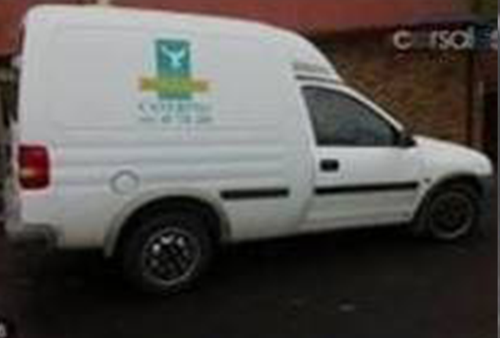
It’s believed he was driving a white colored Holden combo van with NSW registration plates – UQG 146 – with the word ‘catering’ written on the side at the time of his disappearance.
Port Stephens-Hunter Police District Commander, Detective Acting Superintendent Gerard Lawson, said his mysterious disappearance has left his family and friends “longing for answers.”
Allan Bentley was last seen leaving his home in Pindimar, about 7.30am on Tuesday 27 April 2021. (Supplied)
Police hope a fresh appeal for information will help generate new information.
“Mr Bentley has no bank accounts or other assets investigators can use aside from his vehicle – which has never been located nor has its registration been renewed,” he said.
“We’ve established that he rarely left the Tea Gardens area where he resided and worked locally for cash-in-hand payments to make ends meet.
“He had very little money, had no known enemies and was well liked, (while) his unit was left in a state which implies to investigators that he had planned on returning home.
“We hope this appeal spurs the flow of new information into where he may be.”
Allan is described as being of Caucasian appearance, about 180cm tall, of medium build, with a beard and short brown and gray hair.
Allan Bentley may have been driving a white Holden combo van with NSW registration plates – UQG 146 – and the word ‘catering’ on the side. (Supplied)
The appeal for information comes during Missing Person’s Week 2022, an annual national campaign that runs between July 31 and August 6.
Anyone with information about Alan Bentley or Kathleen Riethmuller are urged to contact Crime Stoppers on 1800 333 000 orhere.
Henry ‘Cocky’ Bignell has spent most of his 89 years in the small outback town of Isisford in central west Queensland.
Key points:
Henry ‘Cocky’ Bignell has embarked on his third monumental project for his tiny home town
Isisford’s big yellowbellies have helped put the town back on the map
The Isisford Fishing Competition celebrated its 20th year
“I was born and bred here, I put a lot of years away,” Mr Bignell said.
But 12 years ago, when he and his late wife Veronica planned to return home after a stint in Rockhampton, he could not shake the feeling that the town he loved was missing something.
“We were talking about coming back home and I just thought a little town wants something to put us back on the map,” he said.
Since then, his vision to have larger-than-life yellowbelly (golden perch) monuments on the banks of the Barcoo River has become reality, twice.
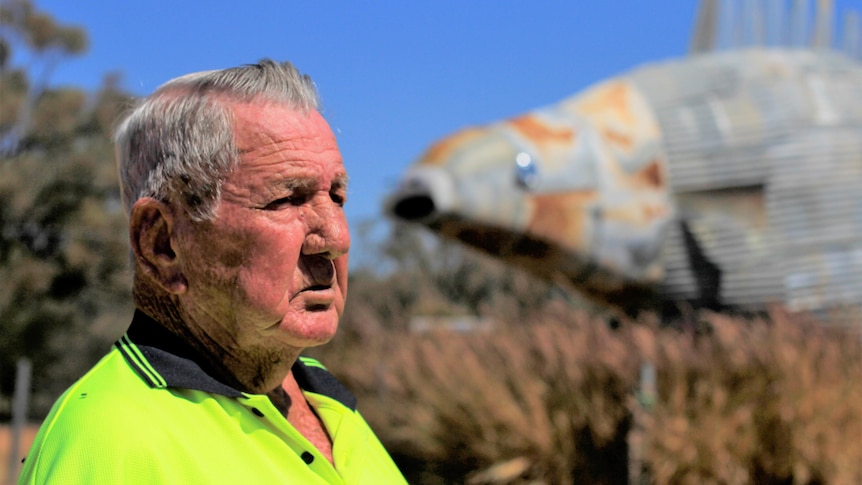
Scrap from windmills, old cars, and even a Cessna went into this sculpture.(ABC Western Qld: Dan Prosser)
Mr Bignell’s biggest catch is a nine-metre whopper on the road in from Ilfracombe, built in late 2018.
“It was supposed to be 6 meters, but like all fish stories it finished up 9 meters,” he said.
“Not in my wildest dreams did I think it would turn out like this.”
school of giant fish
Construction of Isisford’s third metal marine monument is underway on the opposite side of town.
Second-hand 2cm galvanized pipe, angle iron, and new windmill sails will be used in the town’s third big fish.(ABC Western Qld: Dan Prosser)
“It won’t be anything like the other one, it’ll be flat, on a 90-degree angle to the road, [a] good view coming [from] both ways,” Mr Bignell said.
“A lot of the [windmill] sails I’m going to use have never been used, they’re still in the crates that I got them in, so they could be a bit shiny.
“It’ll stand out like nobody’s business.”
Isisford’s third big fish is still under construction, and Mr Bignell already has ideas for another one down by Oma Waterhole.(ABC Western Qld: Carli Willis)
After years of fashioning fish sculptures for his hometown, Mr Bignell said it had all been worth it.
“I’m still getting messages from overseas people who have driven through and had a look at it and found out who I was,” he said.
“I’m so happy, so proud of it.”
Mr Bignell helped a family friend finish building this fish out of horseshoes.(ABC Western Qld: Dan Prosser)
Always a bigger fish
Whether it is oversized attractions or ancient fish fossils, the waterways of Isisford are one of the town’s main attractions.
During the cooler weather of the outback tourist season, residents say hundreds of caravans make themselves at home on the banks of the Barcoo River or at Oma Waterhole.
Such were the scenes at the weekend, when almost 750 people wet a line with the hopes of snagging the biggest yellowbelly at the Isisford Fishing Competition.
Other events at the fishing competition included damper cook-offs, whip cracking, bale rolling.(Supplied: Dawn Bailey)
Isisford Fishing Club president Rob Anderson said the popular event, now in its 20th year, had come a long way.
“Twenty years ago, everyone just had old utes and tents, now there’s that many camper trailers and caravans,” Mr Anderson said.
“It’s a good drawcard, it’s a lot of money coming into the town, and a lot of people come and join it from everywhere around.
There is an irony in the circumstances surrounding Lynn Arnold’s discovery that he was under ASIO surveillance throughout several decades of his life.
Key points:
Former SA premier Lynn Arnold recently applied for and received his partial ASIO file
The document has prompted mixed feelings, admitting he is shocked by some of the contents
He’s unsure when the surveillance stopped
It was only when the former South Australian premier found himself detained — by chance rather than by force — that he decided to investigate the investigations that he had been subjected to.
While SA’s COVID lockdowns were hardly house arrest, they provided Dr Arnold with the opportunity to apply for his ASIO file.
Dr Arnold reacted to the contents with a mix of amusement, bemusement and shock.(ABC Radio Adelaide: Daniel Keane)
“It took about 15 months but I finally got it,” he told ABC Radio Adelaide’s Simon Royal.
“I certainly knew I was under surveillance during the anti-Vietnam War movement.
“[But] I hadn’t actually guessed I was going to be under surveillance while I was a member of parliament.”
As a Labor MP, Dr Arnold was premier for about 15 months from mid-1992 until late-1993, but his commitment to left-wing causes dated back to the 1960s.
An Anglican priest today, Dr Arnold was an “ardent pacifist” in his student years and heavily involved in “the Vietnam moratorium, which I was the chair of in 1970”.
His ASIO file is an eclectic compilation of summaries of meetings, newspaper clippings, and photographs of anti-war rallies.
Certain details, including names, were redacted.
Dr Arnold’s file includes heavily redacted sections, such as this one.(ABC Radio Adelaide: Daniel Keane)
“They indicate that there were six folders of information. I’ve got 150 pages out of it,” Dr Arnold said.
“A lot of information they haven’t released for various reasons and other information’s been destroyed, and I don’t know the balance between the destroyed and the not-yet-released.
“Their main concern with me was to find out whether I was a communist or not, and at some point in the files it actually makes the conclusion that, ‘No, he’s not’.”
Mixed feelings about file’s contents
The revelation that Dr Arnold was not a red did not determine the intelligence service.
As one of the papers, from 1981, states:
“[T]here is no evidence at this stage to suggest that Arnold is being used to promote pro-Soviet attitudes in Australia. However, his position as a World Peace Councilor makes him worthy of future study.
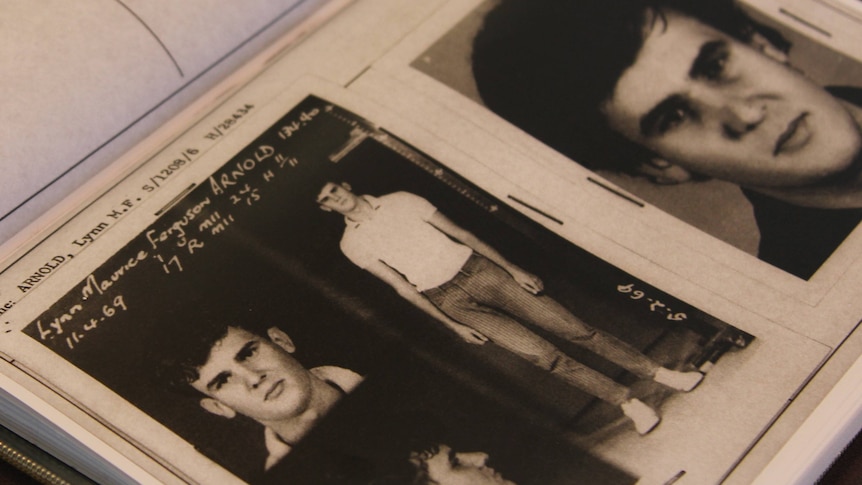
The document contains several mugshot-style portraits.(ABC Radio Adelaide: Daniel Keane)
While much of the material relates to Dr Arnold’s anti-war activism there are also later references to activities after his 1979 election to SA parliament, including meetings he held in a ministerial capacity with the East German consul.
Dr Arnold’s feelings about his file are mixed.
On the one hand, he accepts the necessity of a strong national intelligence agency.
“I don’t have a problem with Australia having a security service. I think it’s essential that we have, and I felt so then,” he said.
“The issue is how it was administered in terms of the national interest.
“I accept the fact that in the period of the Cold War there really was a specter of communist infiltration that did have to be monitored, did have to be watched.”
Resorting to code names
But some of the episodes reflected in the file disturbed him, such as one involving a trusted ally who was later revealed to be an infiltrator.
The file summarizes Dr Arnold’s student activism and opposition to the Vietnam War.(ABC Radio Adelaide: Daniel Keane)
Dr Arnold was surprised to discover details about a meeting that occurred in the lead-up to the September 1970 Moratorium where anti-Vietnam War groups stopped work and turned out in their tens of thousands.
“The room wasn’t bugged, it turns out that one of the 15 people in the room — one of our own committee — was reporting back to ASIO and had written these copious notes,” he said.
“I’ve been quite shocked by that. To know that one of these people, whom I knew, shared a drink with and shared a cause with, was actually reporting.
“That I found a violation.”
When Dr Arnold first came to ASIO’s attention, opposition to the Vietnam War was increasing globally.(Supplied: Richard Hogg, National Library of Australia)
Dr Arnold does not know for certain, but presumes his activities were monitored even after he became premier.
But that assumption is not a new one — he suspected it even at the time and responded accordingly.
“When I had conversations with family members or colleagues we sometimes resorted to coding about what we said on the presumption that we might have been tapped,” he said.
“You’d have replacement names for key figures and you’d also have code names for topics.”
ASIO’s headquarters is today located in Canberra.(ABC News: Adam Kennedy)
How much further material relating to his past is still locked away in archives remains unclear to Dr Arnold.
“What you don’t know is what was destroyed,” he said.
“It does beg the question as to how much more there is, and I don’t know how one gets to find that out.”
But the thought that ASIO might still have stuff up its sleeve is one that prompted a moment of mirth.
“I don’t keep a file on them, so I don’t know,” he joked.
An Australian Aboriginal language only spoken by a handful of people in the Northern Territory has become the inspiration for a new artificial intelligence system, potentially helping people better communicate with machines.
Key points:
The AI system aims to help humans and robots to better communicate
Researchers developed it drawing on some features of the Aboriginal language, Jingulu
It’s considered an endangered language, with only several elderly speakers remaining
Jingulu is considered an endangered language that’s traditionally spoken in the Northern Territory’s Barkly region.
A study, recently published in the academic journal Frontiers in Physics, suggests it has special characteristics that can easily be translated into commands for artificial Intelligence (AI) swarm systems.
“Maybe one of the most powerful things with Jingulu [is] that it gives us the simplicity and flexibility which we can apply in lots of different applications,” lead researcher at University of New South Wales Canberra, Hussein Abbass, said.
AI swarm systems are used in machines to help them to collaborate with humans and undertake complex tasks than humans command them to do.
Experts say Australian law is not up-to-date to sufficiently regulate the rising use of artificial intelligence. (Chris Yang: Unsplash)
Dr Abbass said he stumbled on the Jingulu language by accident, while developing a new communication system.
“When I started looking at the abstract, it didn’t take much time to click in my mind about how suitable it is, for the work I do on artificial intelligence and human AI teaming,” he said.
Language easily translatable into AI commands
Dr Abbass said it was normal for AI researchers to draw on different forms of communication for their work, including other human languages, body language and even music.
However, he said the Jingulu language was especially well-suited to AI because it had only three verbs — ‘go’, come’ and ‘do’ — which meant it could be easily translated into commands.
“The specific AI model that we are working on relies on the very simple concepts of attraction and repulsion, in physics …. and underneath this very simple concept fits the mathematics of our AI,” he said.
“We can apply the ‘go’ and ‘come’ to the attraction and repulsion concepts, in the mathematical model that we have, and the ‘do’, to when there’s no movement in a space.
“The structure of Jingulu matches extremely nicely to the mathematics, and that’s what made it really fascinating, for what we do.”
“I have not encountered another language that has all of these advantages simultaneously, and in alignment with AI.”
Jingulu is a language traditionally spoken in the Northern Territory’s Barkly region.
‘Unique’ elements of language beneficial for AI
Study co-author and University of Canberra professor in linguistics Eleni Petraki said Jingulu’s flexible sentence structure was also an advantage.
“[In most languages] words appear in a specific order …. in Jingulu however you can split those elements,” she said.
With only several, elderly fluent speakers remaining, Jingulu is considered an endangered language, according to Rachel Nordlinger, a linguistics professor at the University of Melbourne and director of the Research Unit for Indigenous Language.
She said while there were related Aboriginal languages with similar features, Jingulu had some unique characteristics.
“What’s different about Jingulu is that other languages might have small numbers of verbs, but there might be 20 of them or 30 of them, whereas Jingulu has only three,” she said.
“The structure’s similar, but it’s different in having such a small number of verbs, that combine with other words.”
AI system has ‘almost infinite’ applications
The new artificial intelligence system created with Jingulu in mind, JSwarm, was initially developed to help farmers herd sheep, as a language which would allow an app used by farmers to communicate with unmanned aerial vehicles performing the task.
It has not yet been implemented, with its developers still working to secure funding.
However Dr Abbass said the system could potentially be used beyond agriculture in the future, including in areas such as medicine to defence.
“[There are] almost an infinite number of applications,” he said.
Like most Australian Indigenous languages, Jingulu is considered endangered.
Sign of growing interest in Indigenous languages
Dr Abbass said the AI system was the first instance he was aware of in which an Australian Indigenous language had been used “at the interface of human and AI communication”.
“You never know where good ideas will come from, and without keeping our minds open, we won’t be able to innovate,” he said.
Dr Nordlinger said researchers’ use of Jingulu to develop the system was an example of the growing level of interest in Indigenous languages in Australia, both from Indigenous communities themselves and the wider Australian public.
“People are becoming more aware of how fascinating these languages are, but also how endangered they are, and therefore how precious they are,” she said.
“I think [this study] is a sign of the growing interest for sure, and it can be a real positive.
“It can only be a good thing to have more attention and more appreciation of these languages.”
Kyle Chalmers touched the wall, popped up his head to check the results, then stood up and brought his index finger to his lips.
The Australian had just won the men’s 100m freestyle, a Commonwealth Games gold six years in the making – his first at a major international event since becoming Olympic champion at Rio 2016.
And after a week of unfounded speculation and relentless questions about his private life, his time of 47.51 seconds symbolically silenced all the unwelcome attention.
“I thought about it before,” Chalmers told the Seven Network after the race, in which England’s Tom Dean and Scotland’s Duncan Scott won silver and bronze respectively.
“Normally I do a bit more powerful celebration after a win but that one was one that probably means more than giving a fist bump or flexing the muscles.
“It is special to win, but unfortunately I think it is hard to enjoy the moment when all that has happened has gone on. It makes it a challenging time.
“I am grateful that I was able to block it out enough to stand up and win tonight. I hope this is a learning point for everybody, and I hope nobody else has to go through what I have gone through.”
On a day when table-toppers Australia again added to their already-bulging Birmingham medal tally, with Emma McKeon, Kaylee McKeown, Matthew Levy (swimming), Matthew Glaetzer (track cycling), Georgia Godwin (gymnastics), Ellen Ryan (lawn bowls) ) and Tinka Easton (judo) among the gold medalists, Chalmers said he was uncharacteristically emotional before the race.
“This last 48 hours has been hell, it has been an emotional rollercoaster,” he said. “I appreciate all the support that I have had. I would not have been able to get through [without] Item.
“Yesterday there were points where I thought I would not continue on. That just lets the media win. For me, I had to stand up and do it, not for myself but for everybody at home, everybody going through similar things. I hope I can inspire and I will continue this conversation.”
Also at the pool, McKeown cruised to 200m backstroke victory to add to her 100m triumph, beating Kylie Masse and breaking the Canadian’s Commonwealth Games record in the process.
And Levy won gold in the men’s 50m freestyle S7 to bring down the curtain on an illustrious career featuring a string of Paralympic, world championship and Commonwealth Games gold medals.
“It is great to finish here and to back it up from four years ago,” Levy said. “I’ve had a very long career and it is great to continue that high standard throughout 20 years and I’m very proud of tonight and proud of my career.”
Meanwhile, Cody Simpson advanced to the men’s 100m butterfly final, qualifying fifth fastest with a third place in his semi-final.
“Pretty wild, pretty special,” Simpson said. “That was my goal, to make sure I got into the night. Just relieved that I am.”
At the velodrome, Glaetzer put two days of setbacks behind him to win the 1km time trial and equal Anna Meares’s Australian record of five Commonwealth Games cycling golds.
Meares said her former teammate’s performance in defending his four-lap title by edging Australian silver medalist Tom Cornish – a race he said was likely his last at a Commonwealth Games – made her emotional.
“When you consider he had a heavy fall in the keirin, then got relegated from the medals after winning the [sprint] bronze last night, and that he’s come back from thyroid cancer and his coach Gary West passed away from motor neurone disease, he’s had so many challenges,” Meares said.
In the gymnastics, Godwin won the individual vault to bring her haul to two gold medals and two silver, in a campaign that has almost single-handedly thrust gymnastics into the spotlight.
“I do my best to try and show that gymnastics is a safe sport and that everyone should feel safe doing gymnastics,” the 24-year-old said. “And we’re heading in the right direction, so that is really exciting to see.”
When Cora Whitfort needed to update her will, she turned to a trusted, century-old institution that makes them for free: Queensland’s Public Trustee.
She wanted her estate to be divided equally among her four children and, to ensure it would go smoothly, she altered her previous will to make the Public Trustee her executor.
Cora developed dementia about two years later and when she died, “dementia” was listed on her death certificate.
That meant that the Public Trustee, as the executor, had a legal obligation to make “due inquiries” about Cora’s capacity when she made her will back in 2011.
Cora Whitfort with her grandchildren.(Supplied)
None of her family could have predicted those inquiries would lead to almost two years of anguish for those left behind and cost the estate more than $20,000.
Her son Chris Whitfort cannot understand why the authority went to such lengths when no-one in the family was disputing the will.
“She had been share trading. She’d been driving a car, her doctor had not taken a license off her at that time. So, there was nothing that we saw in that period that suggested there was any cognitive degradation,” Mr Whitfort told ABC Investigations.
Estates lawyer Lucy McPherson said it should have been resolved much more quickly since the officer who prepared the will told the Public Trustee he would not have done so unless he was satisfied that she had capacity at the time.
“One would expect a little bit of common sense to prevail,” Ms McPherson said.
“To satisfy that issue of capacity on the death certificate should have taken no more than a couple of hours of additional work.”
“You’re looking at under $1,000 of additional work.”
Estates lawyer Lucy McPherson says the Public Trustee’s investigation of Cora’s capacity could constitute overservicing.(ABC News: Michael Lloyd)
Crucially, the Public Trustee had received a report early on in its investigations showing that Cora had passed a cognitive test at her doctor’s surgery just three weeks before she went to make her will.
Mental assessments and doctor’s certificates are often requested by lawyers when an elderly person is making a will to ensure they have capacity. Cora scored 27 out of 30 on her test, indicating normal mental cognition.
The Public Trustee’s current CEO, Samay Zhouand, was not in the role at the time but said its lawyers continued to investigate “because they wanted to ensure that there was no other conflicting information”.
“The individuals involved can rightly feel frustrated from some of these things. Unfortunately, as a matter of law, the Public Trustee is required to fully inform the court so … [it] is fully informed and satisfied that the person had capacity,” Mr Zhouand told 7.30 in his first TV interview.
Samay Zhouand commenced acting as CEO of Queensland’s Public Trustee in 2019.(ABC News: Christopher Gillette)
Ms McPherson said the Public Trustee office’s extensive research and fees were unnecessary, and potentially constituted overservicing.
“If all of those who are beneficially entitled to the estate are not agitating the validity of this document, why was it necessary to go to such great lengths? It wasn’t necessary at all,” she said.
The Public Trustee’s lawyers chased down medical records going as far back as 1995.
They also tracked down the clerical worker who had witnessed Cora’s signature on the will seven years earlier.
“It was just this merry-go-round looking for information, and they’d get a bit and that wouldn’t be enough, and they’d have to get some more, and we never really knew what the end goal was, Mr Whitfort said.
Mr Zhouand said the Public Trustee had to continue investigating because there was an earlier will in which Cora had promised her house to her grandchildren.
However, because that property had been sold, both wills were effectively the same with the entire estate left to her four children, a fact that the Public Trustee itself accepted in its final application to settle the estate.
The estate was finally settled in 2019, almost two years after Cora’s death. Chris Whitfort demanded the legal bill and found the estate had been charged $378 per hour for his investigation into his mother’s capacity.
“I thought it was mining the estate and doing it properly, legally within the letter of the law,” he said.
Cora’s son Chris Whitfort says his mother had been driving a car and trading shares around the time she made her will.(ABC News: Kyle Harley)
The Public Trustee of Queensland is an entirely self-funded authority, receiving nothing from the state government but relying on fees, commissions and taking part of the interest from its clients in order to operate.
Mr Zhouand said: “The fees and charges of the Official Solicitor’s office … are comparable to a mid-tier firm.”
He also apologized to the family “if the Public Trustee has not met their expectations” and encouraged them to file a complaint.
Trustee office accused of charging fees for no service
Luka was a toddler when she lost her father Clay.(Supplied)
Luka was just one and a half when her father Clay took his own life.
He did not have a will, so his estate, including $72,000 from his super fund, was handled by the Public Trustee.
Luka’s mother Helen, as a single parent with no income, needed financial assistance to care for her daughter, and over five years she was approved to use about $12,500 from the trust.
After that she said there was no contact with the Public Trustee for several years.
When she eventually reached out to the office, she discovered Luka’s fund had dropped to $46,000 back in 2013 and had remained at that amount ever since.
Luka’s mother Helen says she is disappointed with how the Public Trustee office has managed her daughter’s inheritance.(ABC News: Kyle Harley)
Mr Zhouand told the ABC he could not speak about Luka’s case because she was a minor but said “the impact of the global financial crisis, and other factors such as withdrawals for maintenance do lead to a reduction in capital”.
Financial planner Dacian Moses reviewed Luka’s files and said the Public Trustee office made the “unforgiveable” mistake of selling Luka’s shares at a loss after the global financial crisis and putting her money into a low-return cash account.
“The only time you really absolutely lock in a loss in the share market is if you sell after they fall in value,” he said.
In addition, over the past 16 years, the Public Trustee has taken more than $14,000 in fees from Luka’s account which has eaten up all the interest earned on the account.
“It would have performed a lot better if it had just been left alone in a bank account,” Helen said.
Luka was also charged a “service fee” of about $400 each year, but the ABC could find no evidence of any transactions on Luka’s behalf on her statements.
However, it also says it can charge a fee of $444 a year even if there are no transactions.
Luka will soon turn 18 and become eligible to access the inheritance from her father.(ABC News: Kyle Harley)
Luka’s statements over the past nine years show no evidence of any transactions on her behalf.
Mr Zhouand said the fees that customers pay “includes the support and servicing of them in terms of … paying maintenance and paying bills and things of that nature”.
“We didn’t receive any support or services at all. We don’t know these people,” Luka’s mother said.
“It was going to be an 18th birthday gift for her from her father and so it’s disappointing that it has played out this way.
“I certainly don’t have any trust in the Public Trustee.”
Mr Zhouand has said the Public Trustee’s fees “are on the lower end compared to some of the private trustees” and Luka could apply for a review.
Space to play or pause, M to mute, left and right arrows to seek, up and down arrows for volume.
The Queensland government called two inquiries following a Four Corners investigation into its Public Trustee office.
Queensland’s Public Trustee office invested Luka’s money in its own managed funds, allowing it to earn a commission and take part of her returns.
This practice was criticized by the Office of the Public Advocate — another government body which supports people who lack mental capacity — as being in conflict with the trustee’s fiduciary duties.
“I think that there is an inherent conflict of interest in the business model with the Public Trustee in that there are the revenue-raising activities within the Public Trustee, when the Public Trustee is supposed to be serving the clients, whom they are acting for. ,” estates lawyer Lucy McPherson said.
Mr Zhouand said investing clients’ money in the Public Trustee’s investment funds and taking some of the interest had been “authorized by multiple parliaments” in order to “fund operations and services to fund support for our vulnerable customers”.
“The vast majority of the Public Trustee customers receive a quality service at an affordable price. Having said that there is always room for improvement” he said, encouraging clients who were unhappy to apply for a review.
Earlier this year, Four Corners exposed the treatment of financial administration clients under Queensland’s Public Trustee office including how it charged high fees and mismanaged their property and financial affairs.
The state government announced two inquiries following the program. Another review into its fees and charges — which was prompted by a scathing report from the Public Advocate in 2021 — will be released by the government later this year.
Additional research by William Creamer
Watch this story tonight on 7.30 on ABC TV and ABC iview.
A breakthrough in one of Australia’s most enduring mysteries — the case of the Somerton Man — last week saw the previously unidentified man named as Melbourne electrical engineer Carl “Charles” Webb.
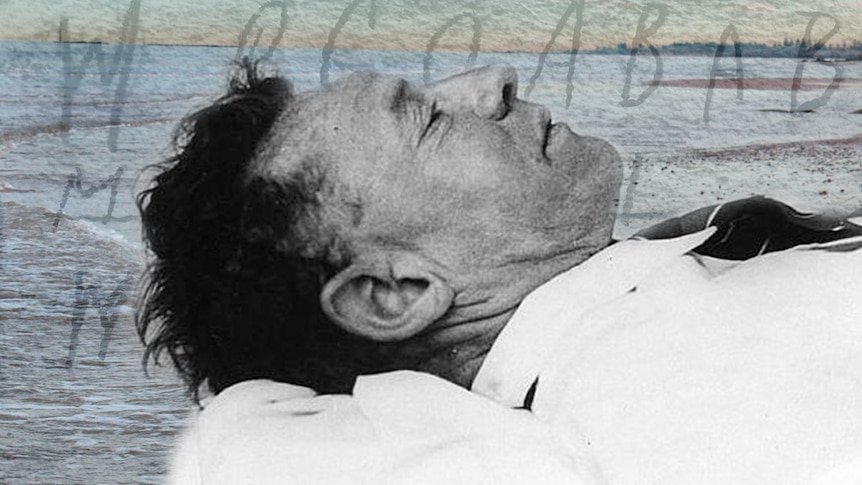
The case had baffled detectives and amateur sleuths since the 43-year-old’s body was found slumped on Adelaide’s Somerton Beach in 1948.
University of Adelaide professor Derek Abbott made the breakthrough while working in conjunction with US investigator Colleen Fitzpatrick, after decades of independently researching the case.
This week is your chance to ask the experts how they cracked the Somerton Man case — and why it has attracted so much attention. Join our live Q&A blog from 12pm AEST on Thursday.
What do we know about Carl “Charles” Webb so far?
November 1905
Carl Webb is born on November 16, 1905, in Footscray to Richard August Webb (1866-1939) and Eliza Amelia Morris Grace (1871-1946).
Documents show his father was born in Hamburg, Germany, to Johannes Fredk Webb and Eliz Buck and his profession was a baker.
According to his birth certificate, his mother was born in Percydale, Victoria, and Carl was the couple’s sixth child.
His siblings are listed as Russell, 12, Freda, nine, Gladys, eight, Doris, four, and Roy, one.
October 1941
Carl Webb marries Dorothy Jean Robertson on October 4, 1941, at St Matthews church in Prahran, Victoria.
Their marriage certificate lists Carl Webb as a 35-year-old instrument maker and Dorothy Robertson as a 21-year-old foot specialist.
The couple live on Domain Road in South Yarra.
A suitcase with this luggage tag was left at Adelaide Station in 1948 and was connected to the Somerton Man mystery.(Supplied: Caroline Billsborrow)
November 1948
On November 30, 1948 — the day before his body was found — the Somerton Man bought a bus ticket and caught a bus from the railway station to Somerton Beach.
According to the coronial inquiry, a number of people saw him on the beach that day.
December 1948
On December 1, 1948, a man’s body is found slumped against a wall under the esplanade at Somerton Beach.
He was wearing a brown suit, had a clean-shaven face and appeared to be about 40 years old.
He had a half-smoked cigarette on his lapel and, according to a newspaper report, his legs were crossed.
He is found with a few personal items including two combs, a box of matches, a used bus ticket to the area, an unused second-class train ticket, a packet of chewing gum and cigarettes.
A post-mortem finds the man had a “stinkingly” enlarged spleen and internal bleeding in the stomach and liver.
The coroner concludes the death resulted from poison.
The personal items found inside a suitcase believed to belong to the mysterious Somerton Man. (Supplied)
January 1949
A suitcase believed to belong to the mystery man is found at Adelaide Railway Station.
It contains an assortment of his belongings including a shaving brush, a knife in a sheath and boot polish.
Some of his clothes have the tags removed and others, including his tie, had T Keane printed on them.
The scrap of paper found in the Somerton Man’s fob pocket with the Persian words “Tamam Shud”.(Supplied: Professor Derek Abbott)
May 1949
A tiny rolled-up piece of paper inscribed with the words “Tamam Shud” is found hidden deep in the fob pocket of the man’s trousers.
The torn paper is later traced back to a book of ancient Persian poetry, the Rubaiyat of Omar Khayyam, which had been left in the back seat of a car near where the body was found.
The words roughly translate to “the end” or “the finish”, and the poems touch on themes including the need to live life to the fullest and having no regrets when it ends.
June 1949
Coroner Thomas Erskine Cleland begins the inquest into the Somerton Man’s death on June 17, 1949.
The inquest is added four days later with no answers to who the mystery man is or what caused his death.
The torn final page of a copy of Rubaiyat by Omar Khayyám, a 12th-century poet. (Supplied: Carolyn Billsborrow )
July 1949
A copy of The Rubaiyat with the page containing “Tamam Shud” torn out is handed in to the police on July 22, 1949, by a man who says he found it in the back of his car in November 1948.
The book contains a sequence of letters and a couple of telephone numbers.
Jessie ‘Jo’ Thomson was interviewed by police in July 1949.(Supplied: Professor Derek Abbott)
One of the telephone numbers belongs to a nurse called Jessie Thomson, who lives just hundreds of meters from where the body was found.
In July 1949, police interview Jessie Thomson but she denies knowing the Somerton Man.
October 1951
On October 5, 1951, Dorothy Webb puts a public notice in The Age newspaper in Melbourne, publicizing that she had started divorce proceedings against her husband on the ground of “desertion”.
“Unless you enter an appearance in the Prothonotary’s Office of the Supreme Court of Melbourne on or before the 29th day of October, 1951 the case may proceed in your absence and you may be ordered to pay costs,” the ad states.
The public notice published in The Age newspaper on October 5, 1951.(Source: Trove)
During this time, Dorothy Webb relocated to Bute on South Australia’s Yorke Peninsula.
It is not clear what led her to the country town or how long she lived there.
Descendants of her sister have told Professor Abbott she remarried and died in the late 1990s in New South Wales.
November 2013
Jessie Thomson’s daughter, Kate Thomson, reveals her mother told her she knew the identity of the Somerton Man.
“She said to me she knew who he was, but she wasn’t going to let that out of the bag,” Kate Thomson tells current affairs program 60 Minutes.
The Somerton Man was buried in Adelaide’s West Terrace cemetery. (Australian Story: Ben Cheshire)
November 2020
An artist’s impression of what the Somerton Man would have looked like is released by Canadian cinematographer Daniel Voshart.
The only images previously available were unflattering black-and-white post-mortem photographs and a death mask of his face and upper torso.
The virtual-reality specialist worked with researcher Derek Abbott and genealogist Colleen Fitzpatrick to create the impression.
Canadian special effects artist Daniel Voshart recreates the Somerton Man’s face. (Image: Daniel Voshart)
May 2021
South Australian police exhume the Somerton Man’s remains from Adelaide’s West Terrace Cemetery in the hope that DNA samples will solve the case.
Previous police investigations and a coronial inquest left the matter unresolved, with hundreds of candidates being identified and then ruled out over the years.
May 2022
University of Adelaide researcher Derek Abbott and American genealogist Colleen Fitzpatrick announce that they believe the Somerton Man’s name is Carl “Charles” Webb.
They arrived at the result by comparing DNA from hair stuck in a plaster bust of the man’s head with samples uploaded by millions of people around the world in online databases used to create family trees.
The match is yet to be formally confirmed by South Australia’s coroner, but Professor Abbott says he is 99.9 per cent confident they have correctly identified the Somerton Man.
Police are investigating an unprovoked attack at a McDonald’s restaurant in Melbourne’s northwest that has resulted in the victim requiring reconstructive surgery to his face.
It’s understood a 49-year-old Keilor man was on the patio area outside the Keilor Park Drive McDonald’s outlet just after midnight on the morning of July 8.
The Keilor Park Drive McDonald’s outlet. Credit: Google Maps
Watch the latest News on Channel 7 or stream for free on 7plus >>
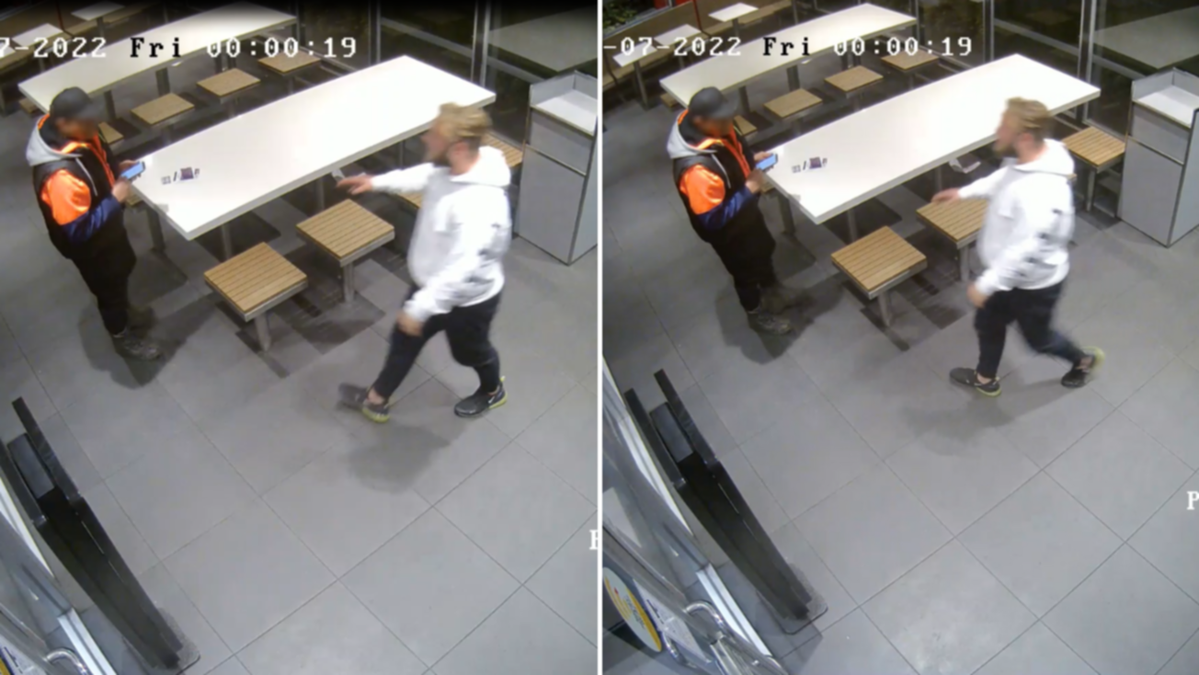
Two men who were exiting the restaurant walked past the man, before one of them returned to confront the 49-year-old.
The unknown man, without provocation, then struck the victim in the face, causing him to lose consciousness.
The victim suffered a shattered cheek that required reconstructive surgery.
The man police believe may be able to assist with their enquiries. Credit: Victoria PoliceThe man is seen on CCTV approaching the victim without any provocation. Credit: Victoria Police
Police have released an image and CCTV footage of a man who they believe may be able to assist with their enquiries.
He is described as Caucasian in appearance, with light brown hair and a beard, and was wearing a white hoodie and black pants.
Anyone who witnessed the incident or has information is urged to contact Crime Stoppers on 1800 333 000 or submit a confidential report online at www.crimestoppersvic.com.au.
Western Australian teachers, nurses, police officers, cleaners and public servants have been offered a six per cent wage rise over the next two years as a buffer to rising inflation.
The Western Australia government has increased its pay offer for 150,000 workers to three per cent annually for the next two years, along with an additional $2,500 cost of living payment.
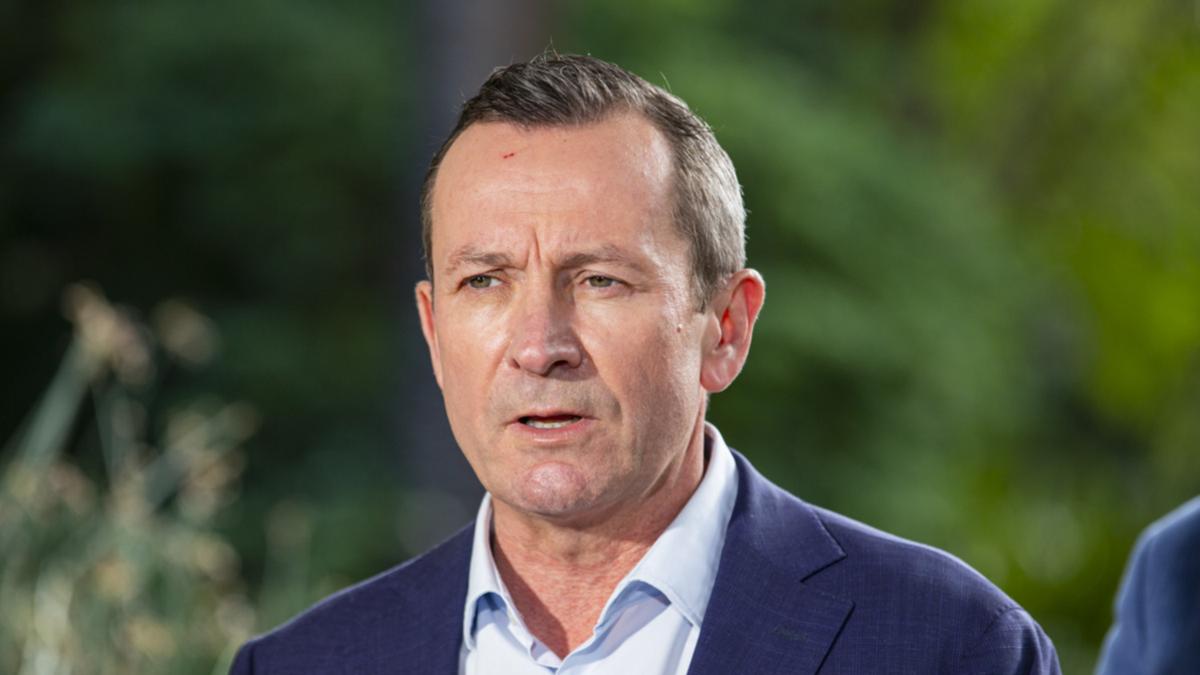
Premier Mark McGowan said the move was in response to peaking inflation and would cost the budget an extra $634 million over the next four years.
“Given the current economic climate we’ve listened and reviewed our wages policy,” he wrote on social media on Sunday.
“This is a reasonable and generous policy, but also responsible in these volatile economic times.”
The changes will immediately flow through to industries that have already accepted the government’s previous 2.75 per cent pay increase offer, including teachers and public hospital doctors.
Some workers’ wages will be increased more than the three per cent annual rate, with a patient care assistant who earns just over $55,000 a year set to effectively get a 7.5 per cent wage rise over the first year.
Perth’s consumer price index jumped 1.7 per cent in the June quarter, according to Australian Bureau of Statistics data, pushing its annual inflation rate well above the national average to 7.4 per cent.
Health workers and other WA public servants were lobbying for a pay rise above 2.75 per cent, with some holding stop-work meetings outside Perth hospitals in recent weeks.
The McGowan government banked a $5.7 billion surplus in this year’s state budget, which included a one-off $400 electricity credit for every household.
The remaining students at Colmont School in Kilmore will be forced to leave the school within days after voluntary administrators failed to secure an emergency bailout from the government and could not secure rent relief from the school’s landlords.
Administrators for Colmont, an independent school that was heavily reliant on fees from international students, had been appealing to the school’s landlords, Taiwanese-born businessman Chien-Long Tai and his wife, Yuyu Chen, for rent relief.
Colmont School went into voluntary administration last week, leaving hundreds of families scrambling to find a new school.Credit:Jason South
The school collapsed last week due to a lack of funds, leaving hundreds of students in years 3 to 10 with just two days to find a new school. Students in years 11 and 12 were told the school would remain open to them for a longer period so they could continue their international baccalaureate studies without the disruption of having to find a new school at short notice.
Paul Langdon, an administrator at Vince & Associates, said the school “is running out of funds and in the absence of any significant financial support, cannot continue to operate for much longer.”
“The administrators have explored funding options with the federal and state governments on several occasions. Unfortunately, both governments will not be providing additional funding to the school,” he said.
“In addition, the administrators had sought a rent relief release from the landlord, which has also not been forthcoming.”
Dozens of students protested in front of the school gates on Monday, supported by family members, chanting “save our school” and “we want justice”. Members of Victoria Police attended the protest, warning the group to stay off school property.
More than 30 independent and Catholic schools have offered places to students at the school, although most lacked the capacity to take more than a handful.