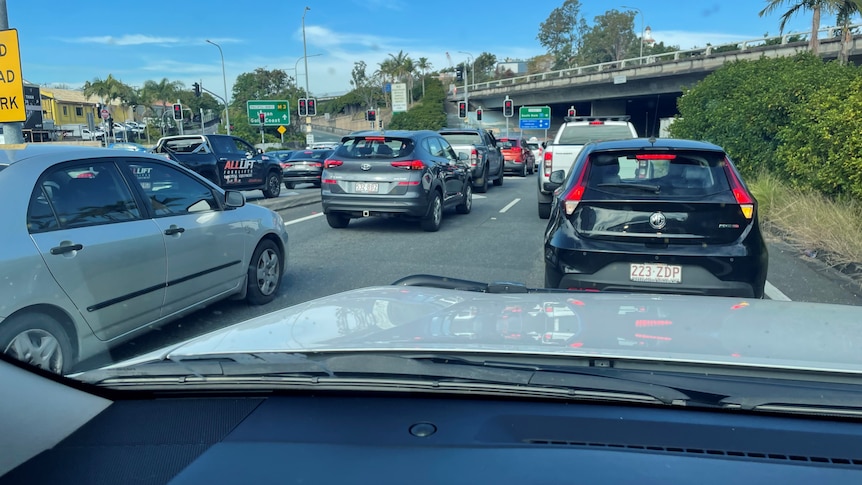
A safety concern during Brisbane Metro tunneling works has prompted an emergency shutdown of a key CBD street, causing hour-long delays for commuters, forcing some people to get off buses and walk the rest of their way to work.
Brisbane councillor Ryan Murphy, chair of the council’s transport committee, released a statement before 10.30am, in which he was thankful “no one was injured”.
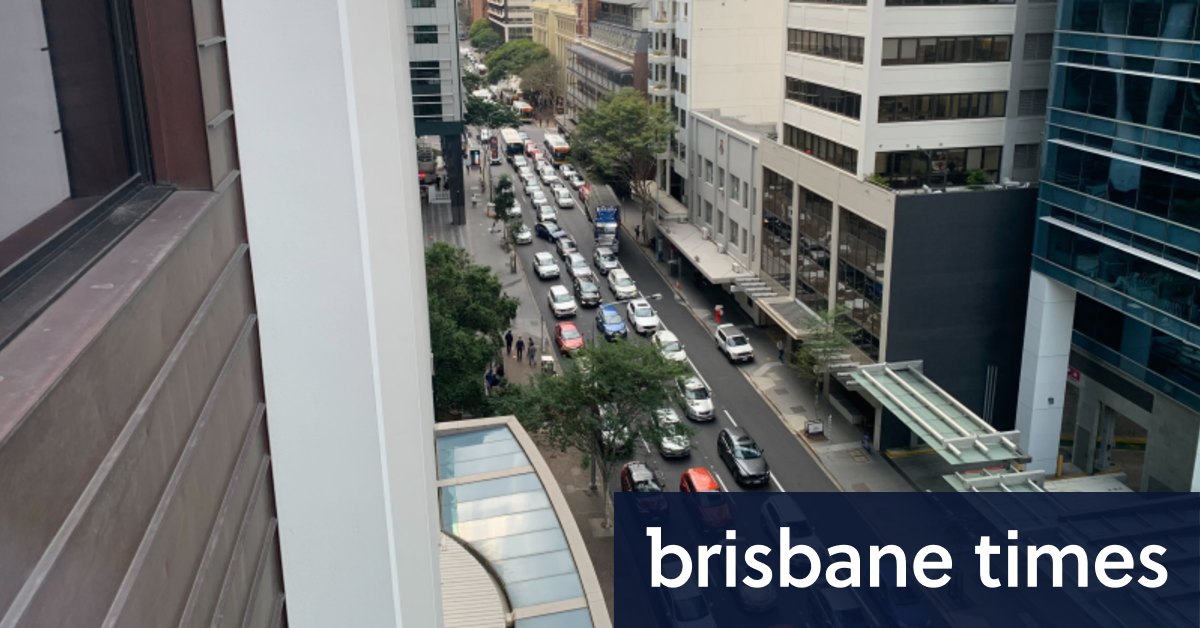
Traffic was backed up on Ann Street on Wednesday morning.Credit:Cameron Atfield
All lanes were blocked from all directions on Adelaide Street between George Street and North Quay on Adelaide Street on Wednesday morning, with the Queensland Traffic website urging people to seek an alternative route from about 8am.
The cause of the emergency works was believed to be road subsidence, or deterioration.
“Unfortunately, this morning we’ve had to close a small section of Adelaide Street between North Quay and George streets which has impacted morning commuters,” Murphy said.
“This decision was made for safety reasons after a contractor reported an issue with tunneling works beneath Adelaide Street for the Brisbane Metro project.”
The emergency roadworks on Adelaide Street.Credit:Sean Parnell, Brisbane Times
Earlier, a Translink spokesman confirmed emergency works were behind the delays.
“It looks like the works are causing delays all the way back to Brisbane and West End,” he said.
It was a typical Saturday night for best friends Kerry Bartley and Michelle Lewis, spent watching movies and making plans for the next day.
Not wanting to worry her foster mum, Michelle said good night to her friend and hopped on her most prized possession, her mountain bike, about 10pm.
The ride home was less than a kilometer and should have only taken a few minutes but Michelle never made it home.
“That was the last time I’ve seen or heard from her,” Kerry said.
Best friend Kerry Bartley is urging anyone with information about Michelle Lewis’s disappearance to come forward.(abcnews)
Kerry was the last person to see Michelle Coral Lewis alive before she vanished in central Queensland on Saturday, January 14, 1989.
“It’s been 33 long years,” she said.
“Every year that passes becomes harder, not easier, because there are no answers.
“How does someone, and their bike, just disappear?”
It is a $500,000 question police are determined to answer, with help from the public.
Who was Michelle Lewis?
Kerry and Michelle’s bond began when they became neighbors in Rockhampton at 13 years old.
“Michelle was a creature of habit and over the weekends mostly spent the whole day at my place,” Kerry said.
A former Glenmore High School student, the “tomboy” was “very independent”, with only a handful of “close female friends”.
Michelle Coral Lewis disappeared in Rockhampton, central Queensland, in January 1989.(Supplied: Queensland Police Service)
Like many 21-year-olds in Rockhampton, Michelle found joy in socializing at Flamingo’s Nightclub.
“Michelle had a rough upbringing, but she had a heart of gold and was loyal to her friends,” Kerry said.
She tried a range of jobs, including one at a local piggery and another at a panel beater shop, but struggled to land permanency.
“Michelle never had much to call her own,” Kerry said.
“She had nothing. But she would save everything to give to somebody else.”
Michelle’s traumatic childhood
Michelle was “abandoned by her mum” at just “a few weeks old”, then raised by her grandma.
Adaline Salhus, known better as Dell, stepped in to foster Michelle when her grandmother died.
She spent about four years living with Dell and her family in North Rockhampton.
But when Dell woke up at 7am on January 15, 1989, she found no trace of Michelle, or her beloved bike, and reported her missing.
The former lead investigator, retired detective Ann Gumley, said it was a case that has haunted her well beyond her 34 years of service.
“Because of the kindness shown to her by her [foster] mother Dell Salhus, Michelle would not have done anything that would have made Dell concerned,” Ms Gumley said.
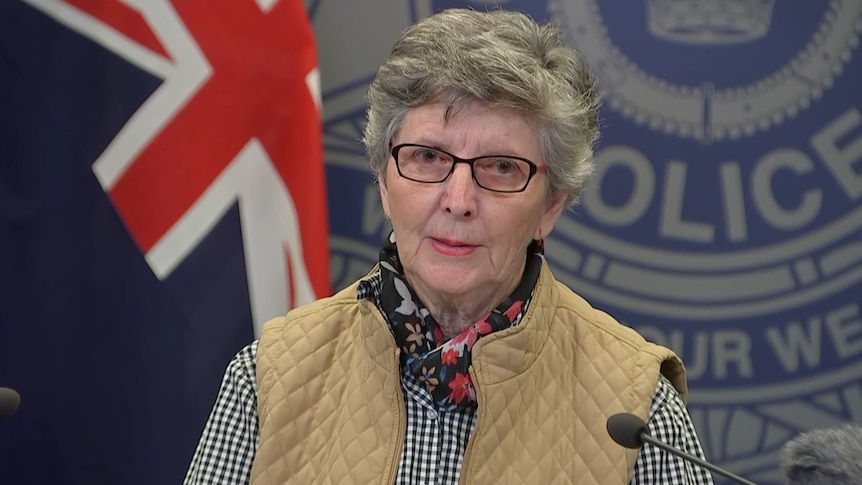
Former lead investigator, retired detective Ann Gumley, says the case still haunts her.(abcnews)
Dell, who has since died, told police at the time that Michelle was very responsible and always phoned if she was going to be home late.
“She had such a sad life, and then to just disappear just seemed so unfair,” Ms Gumley said.
“It’s very hard to comprehend that someone can just disappear off the face of the earth and no-one knows anything about it.”
How the original investigation unfolded
Michelle was last seen on her bike leaving Kerry’s house on Stenlake Avenue, North Rockhampton, around 10:45pm, intending to ride a short distance to her home on Alexandra Street.
Ms Gumley said police launched a major investigation and completed 150 tasks, initially taking 42 statements.
“A large number of persons were located, interviewed and statements obtained.
“However, there was nothing to indicate to us as to how Michelle disappeared.”
Ms Gumley said she had done everything she could to try to find Michelle.
“We had to try and keep the ball rolling as much as we could to try to get as much information as we could,” she said
“But once that information dries up, that leaves us with nowhere to go.”
Ms Lewis’s case was reviewed in 1999 as part of the investigation into crimes committed by notorious serial killer Leonard John Fraser, who died in 2007.
But police said there was no information to suggest he was involved in Michelle’s disappearance.
Michelle Lewis was last seen alive riding this maroon and white mountain bike on Saturday, January 14 1989.(Supplied: Queensland Police Service)
Can you help?
Detectives are urging a man, who called police around midday on February 18, 1989, but hung up before speaking to detectives, to come forward.
Michelle is described as 155 centimetres tall, with black shoulder-length hair and brown eyes and had two tattoos on the inside of her ankles, one a cross, the other her initials, ML.
She was last seen wearing a hot pink tie-dye singlet top with the word surf across the front, a pair of multi-coloured board shorts and white Dunlop sneakers.
Michelle Lewis was last seen alive wearing this pink tie dye singlet top that says “surf”.(Supplied: Queensland Police Service)
Even after 33 years, the former lead investigator said she remained committed to seeking justice for Michelle.
“Miracles do happen,” Ms Bartley said.
“If there is anyone out there who may have some information, regardless of if they feel it is insignificant, please let the investigating officers know.
“If they find Michelle’s bike, they’ll find Michelle. If they find her, they’ll find her bike.
“That’s the way I look at it because she never went anywhere without that bike.”
If you live along the Australian coast, there may be a phenomenon of electrical storms which has left you scratching your head.
As large and moody thunderstorms roll in from the sea, why do bolts of lightning seem to get bigger and zap harder once they hit land?
Researchers claim to have now solved that weather puzzle, and it turns out salt in sea spray is the key ingredient, according to a just-released study.
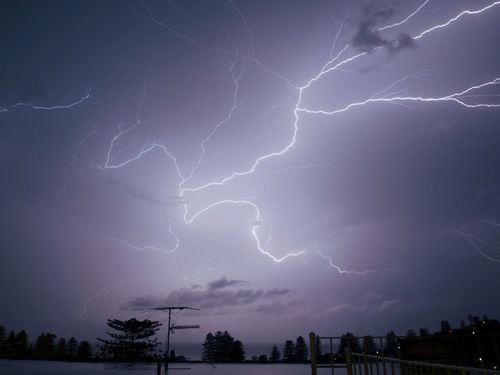
Salt in sea spray could reduce lightning activity during marine thunderstorms, suggests a paper published in Nature Communications. The findings could help to explain why levels of lightning over tropical oceans are reduced compared to the number seen over land. (SMH/Nick Moir)
The findings “reconcile long outstanding questions” about the differences between land and marine storms, the study said, and could explain why levels of lightning over tropical oceans are reduced compared to the number seen over land.
To investigate, researchers analyzed weather, aerosol and lightning activity data from Africa and its adjacent oceans from 2013–2017.
They discovered that coarse marine aerosols, such as salt, reduced lightning frequency.
Researchers found fine aerosols promoted the electrification of clouds, as they do over land, while coarse salt particles from ocean spray reduced lightning by weakening convection within clouds.
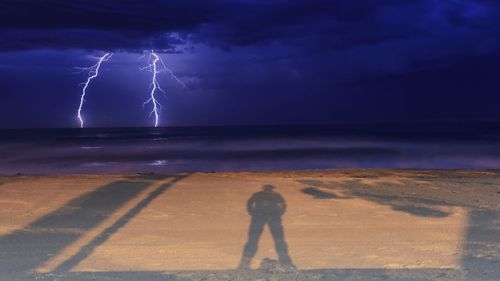
International researchers say that the salt in ocean-spray might hinder lightning during marine thunderstorms in the tropics, and likely explains why the big zaps seem to get worse after the storm hits land. (SMH/Nick Moir)Lightning is an electrical discharge caused by imbalances between storm clouds and the ground, or within the clouds themselves. (SMH/Nick Moir)
The study said large particles promoted warm rain to fall before cloud water had a chance to rise up and reach required levels for super-cooling – a necessary step towards cloud electrification.
This has the effect of reducing the upwards transfer of heat over the sea, the study said, affecting the amount of rainfall necessary to drive atmospheric circulation.
Australia’s lightning hotspot is in the far north, closest to the equatorial zone.
‘River City’ wakes to white-out as fog swallows city
According to the Australian Bureau of Statistics, between five and ten people are killed from lightning strikes each year, while about 100 are injured.
A Supreme Court judge has acquitted two men of murdering Oliver Todd at Murray Bridge in 2019.
Key points:
Oliver Todd’s body was found in Jervois in 2019
Three men were charged over his murder
One pleaded guilty and two have been acquitted
WARNING: This story contains content that some readers may find upsetting.
Ned Timothy Hutchinson, 33, and Terrence Bradley Wilson, 34, faced a 16-day trial for the murder of Mr Todd inside his Murray Bridge home.
Justice Kevin Nicholson acquitted both men of murder and manslaughter, but convicted Hutchinson of assisting an offender.
Oliver Todd’s body was found near Jervois.(Supplied)
David James Russell has already pleaded guilty to the murder.
The court had previously heard Mr Todd died after being hit on the head 11 times with a blunt object before being covered in a Hessian sack secured with ratchet straps and a belt around his head.
During the trial, Hutchinson told the Supreme Court he helped in the aftermath of the murder because he was “in shock.”
The trial heard Mr Todd was taking drugs with his housemate at their Murray Bridge address on the night of the murder, before Mr Wilson came over to accuse Mr Todd of wanting his girlfriend.
Mr Todd’s body was found in an open area of land near Jervois, about 24 kilometers from Murray Bridge.
During the peak of the storms at 3am, about 16,000 homes and properties had their electricity knocked out, she said.
Train services have resumed along the Hurstbridge and Belgrave lines after services were suspended on Wednesday morning due to storm damage.
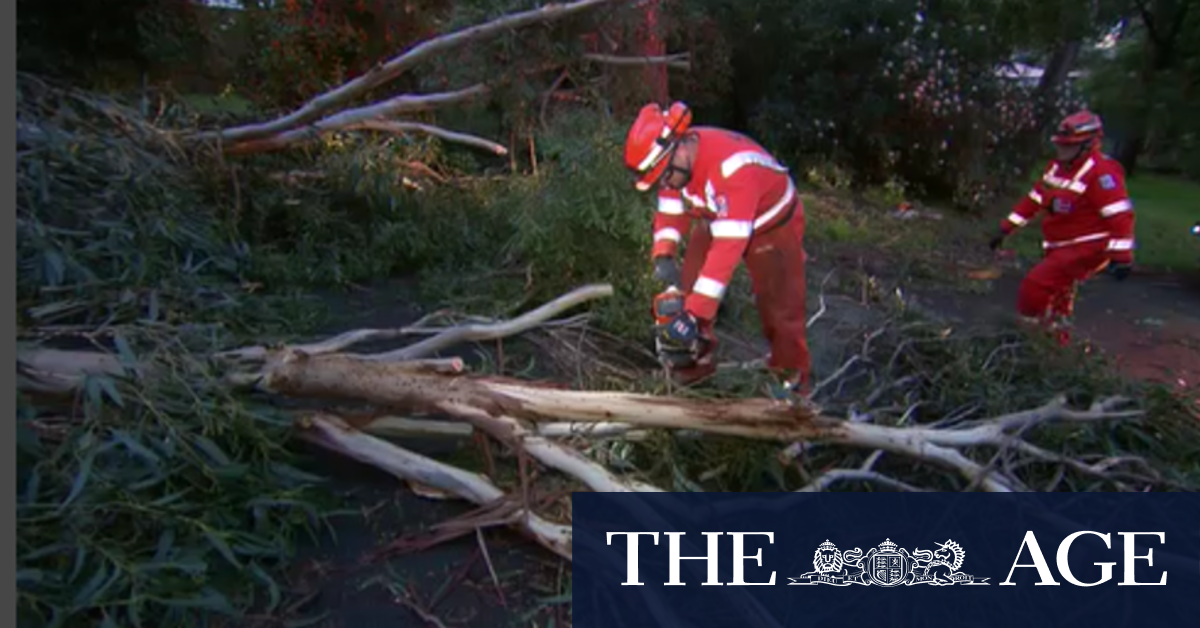
SES workers removed fallen trees on roads in Melbourne on Tuesday night as wild winds lashed the city.Credit:Nine News
The Bureau of Meteorology’s duty forecaster Phoebe de Wilt said there were “strong and gusty winds” across Melbourne overnight but they would be easing today.
“While the winds are easing it’s still going to be a windy day across Victoria,” she said.
“It’s not going to be calm, including in the metro area it’s going to be a relatively breezy day.”
In the metropolitan area, the top likes of 89 km/h were recorded at Essendon Airport, with Moorabbin Airport recording 85 km/h overnight.
“We have seen tastes of over 100 km/h in the alpine peaks and elevated areas,” de Wilt said.
Mt Hotham recorded the fastest winds overnight, with winds reaching up to 128 km/h.
loading
The forecaster said there was still a severe weather warning for the alpine areas because the cold front is still moving through the region.
“We are expecting more vigorous winds to come into the southwest of the state later this evening,” she said.
These likes are expected to be around 50 to 60 km/h with peak winds hitting up to 90 km/h.
Despite the windy conditions, she said temperatures were going to be relatively mild for the rest of the week.
The Morning Edition newsletter is our guide to the day’s most important and interesting stories, analysis and insights. Sign up here.
The case of the Somerton Man has baffled detectives and amateur sleuths for decades.
Now it’s your chance to ask the experts just how one of Australia’s most enduring mysteries has been solved — and why the story has attracted so much attention.
University of Adelaide professor Derek Abbottwho spent decades researching the case and helped to uncover the man’s identity, will join us from 12pm (AEST) to tackle all your curly questions.
Colleen Fitzpatricka renowned forensic genealogist who lent her expertise to the case, and ABC journalist and host of Radio National podcast The Somerton Man Mystery, Fiona Ellis Joneshave also slow their time to respond to your top questions from our audience call-out.
The live feed will begin at midday but, in the meantime, here’s what you need to know about the case:
A man is found dead on the beach — but no-one knows who he is
Digital illustrator Daniel Voshart created an image of the Somerton Man based on the face mold created after he was found dead.(Supplied: Daniel Voshart)
On December 1, 1948, a man’s body was found slumped against a wall under the esplanade at Somerton Beach in Adelaide. But there were few clues to determine his identity.
He had a half-smoked cigarette on his lapel and a few personal items in his possession: two combs, a box of matches, a used bus ticket to the area, an unused second-class train ticket, a packet of chewing gum and cigarettes .
A post-mortem revealed the man had a “stinkingly” enlarged spleen and internal bleeding in the stomach and liver, and it was concluded the death resulted from poison.
Then the paper was found: ‘Tamam Shud’
In the months following the mystery man’s death, the case took a strange turn.
A suitcase believed to belong to him was found at Adelaide Railway Station. It contained an assortment of his belongings including a shaving brush, a knife in a sheath and boot polish.
The personal items found inside a suitcase believed to belong to the mysterious Somerton Man.(Supplied)
Some of his clothes had the tags removed and others, including his tie, had T Keane printed on them.
Then, a tiny rolled-up piece of paper inscribed with the words “Tamam Shud” was found hidden deep in the fob pocket of the man’s trousers.
The scrap of paper found in the Somerton Man’s fob pocket with the Persian words “Tamam Shud”.(Supplied: Professor Derek Abbott)
The torn paper was later traced back to a book of ancient Persian poetry, the Rubaiyat of Omar Khayyam, which had been left in the back seat of a car near where the body was found.
The words roughly translate to “the end” or “the finish”, and the poems touch on themes including the need to live life to the fullest and having no regrets when it ends.
Was the Somerton Man a spy?
In July 1949, a copy of The Rubaiyat with the page containing “Tamam Shud” torn out was handed in to police.
The man who contacted the authorities said he found it in the back of his car in November 1948 — a month before the man’s body was discovered.
A scrap of paper which read Tamam Shud was torn from the final page of copy of Rubaiyat of Omar Khayyám, authored by 12th-century poet, Omar Khayyám.(Supplied: Carolyn Billsborrow )
The book contained a sequence of letters and a couple of telephone numbers, but they didn’t lead investigators any closer to uncovering the Somerton Man’s identity.
The strange sequence and the fact labels had been removed from the man’s clothes fueled speculation he might have been a spy.
Forensic science and excavation crews were onsite to assist with the Somerton Man’s exhumation.(ABC News: Michael Clements)
ABC Radio Adelaide’s Daniel Keane spoke to University of Adelaide professor Derek Abbott last month, prior to the Somerton Man’s identity being uncovered, about the theories.
“I don’t think there’s compelling evidence — just these scattered circumstantial things that can be explained in different ways,” Professor Abbott said.
Last week, after decades of searching for answers, Professor Abbott and forensic genealogist Colleen Fitzpatrick made a breakthrough.
The previously unidentified man was named as Melbourne electrical engineer Carl “Charles” Webb — far from the answer some were expecting.
live updates
By Bridget Judd
You’re a little early, but check back at 12:00pm (AEST)
Over the next couple of hours, we’ll put your questions to Derek Abbottwho helped uncover the Somerton Man’s identity.
You can make a submission by clicking the blue ‘leave a comment’ button above.
The live stream will begin at 12:00 p.m. (AEST)so come and join the conversation then!
That’s a wrap on the premier’s press conference for this morning.
But the issue will not be going away – our live coverage of the NSW parliamentary inquiry into the appointment of former deputy premier John Barilaro to a $500,000-a-year trade post in the US is about to begin.
It is the fourth day of hearings into Barilaro’s controversial appointment since it was first announced by the government almost seven weeks ago. Yo soy Natassia Chrysanthos and I will keep you updated on the latest evidence as it comes before the public accountability committee.
The inquiry is due to hear from Amy Brown from 10.30am until about 4.30pm, with a couple of breaks in between. Brown is the chief executive of Investment NSW and head of the Department of Enterprise, Investment and Trade appointed – meaning she was the top bureaucrat overseeing the process that saw the former deputy premier.
In NSW Premier Dominic Perrotte’s comments this morning, he made it clear that stuart ayres′ engagement with Brown during the recruitment process was central to the reason the minister resigned from cabinet last night.
Brown giving evidence on the first day of hearings, on June 29.Credit:Janie Barrett
Brown appeared before the committee on its first day of hearings, back on June 29.
But she has been called back for a second time due to apparent contradictions in her testimony compared to that of others who gave evidence, as well as dozens of bombshell documents that have emerged over recent weeks.
Labor’s leader in the upper house, Penny Sharpeyesterday said Brown had many questions to answer.
“We want to know about her conversations in the shortlisting process in relation to the second round. We want to understand what direction and discussions she was having with Minister [Stuart] Ayres,” Sharpe said.
“And we still haven’t got to the bottom of why she decided that Jenny West was the best candidate for the job one day, and then after the ministers had met, and decided to change the process, all of a sudden, Jenny West was unsuitable.
“She’s got many questions to answer and they’ll just be some of them.”
Two trailblazing Queensland women have made history at world-renowned rodeo events in the United States that have traditionally excluded women.
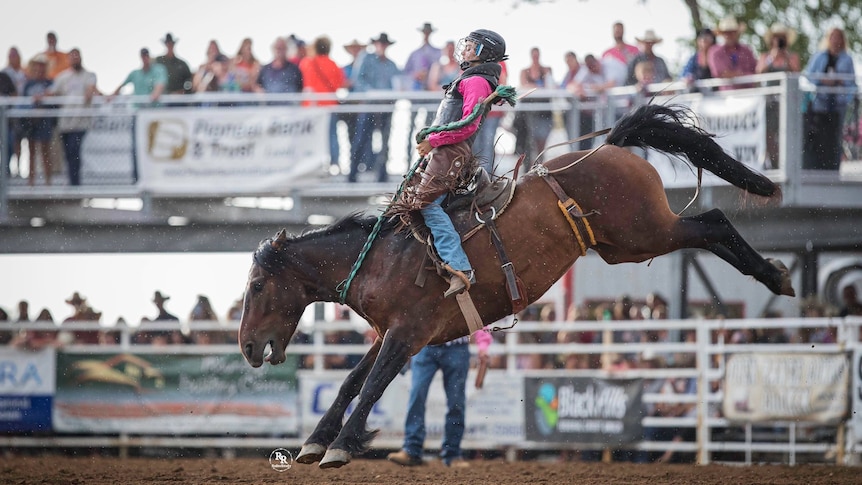
Rockhampton bronc rider Jaime-Lee Mant and Normanton’s Emily Collits joined 10 other women from the US and Canada to show the world what they’re made of on the American rodeo circuit.
“If you look at rodeos and if you even say ‘rodeo’ to anyone, what do you think of?” Collits said.
“It’s a cowboy.
“You don’t think of a cowgirl getting in there behind the chutes, saddling her horse off, jumping on and getting bucked off.”
Emily Collits won third place at Durango, Colorado — something she never expected to do.(Supplied: Emily Collits)
The daring sport of roughstock bronc riding is one of the toughest and most dangerous events on the rodeo circuit and the women are using their success overseas to push for greater women’s participation in the sport on home soil.
The aim is simple: try not to get bucked off a horse that’s doing its darnedest to kick you off.
But holding on tight for eight seconds would seem like a lifetime to amateurs.
“The experience of riding a bronc is like riding fire,” Collits said.
“I get bucked off more times than I ride time — it’s a mental and physical challenge within yourself.”
Collits, seen here in Bell Fourche, South Dakota, says the horses are bigger and rougher in the US.(Supplied: Emily Collits)
Making rodeo history
High caliber events in the US are invitational and riders must provide their skill and commitment to be able to participate.
“It’s like getting the golden ticket at Willy Wonka’s chocolate factory,” Collits said.
Collits made the most of her opportunity, traveling thousands of kilometers to tour nine events through four states.
These women made history on the American rodeo circuit.(Supplied: Emily Collits)
It paid off when she took first place at Douglas, Wyoming and third place at Durango, Colorado.
“I didn’t have many expectations coming into it,” Collits said.
“I wanted to ride time on a few of these big strong American horses.
“I’ve exceeded those dreams.”
Emily Collits competed at nine events, including Bell Fourche South Dakota.(Supplied: Emily Collits)
It’s the first time these American rodeos have opened their chutes to female participants from Australia.
The event all the competitors had their eyes on was the prized Cheyenne Frontier Days — one of the biggest, oldest and longest running rodeos in the world.
Jaime-Lee Mant (middle) won third place at the Cheyenne Frontier Days rodeo, which was attended by 21,000 people and watched by 50,000 more.(Supplied: Jaime-Lee Mant)
Keep won third place.
“It was pretty cool to be able to walk out from underneath the grandstand and have 21,000 people stare at you and cheer you on, and the roar of the crowd is pretty cool,” she said.
“As I walked up on the back of the chutes there, I just kind of looked out and I had a … moment of like, ‘Holy dooly, I’m really here,'” she said.
“My dreams are coming true.”
Emily Collits (far left) and Jaime-Lee Mant (second from left) at the roughstock event in Deadwood.(Supplied: Emily Collits)
To wrap the tour up the women put on a non-competitive showcase at a rodeo in Deadwood, Colorado.
The rodeo hasn’t seen a women’s roughstock event in more than 80 years and the riders hope it sets the bar for future events.
“In the future it’ll hopefully mean we can add this as another stop on our tours while we’re over here in the States,” Collits said.
Collits hopes this tour has laid the foundation for more to come.(Supplied: Emily Collits)
Women’s bronze riding ‘frowned upon’
Appetite for the rough-riding sport is on the rise in Australia, but there are still hurdles to overcome.
Mant said there was a lot to be learned about women’s saddle requirements, horse and training needs to grow the sport back home.
“For us girls, we don’t really get many opportunities over here in the way the American girls do,” she said.
“I just thought if an Australian girl could come home with a win or a place, it may open Australia’s eyes a bit more to it.
“I really want it to be something big in Australia — it’s getting there, but very, very slowly.”
Cam Eiser said not everyone was accepting of women riding when he decided to help train them.(ABC Capricorn: Jasmine Hines)
Blackall Trainer Cam Eiser hosts training schools where Collits and other outback women attend.
“It seemed to be – when we started – pretty well frowned upon, letting girls ride bucking horses and we copped a fair bit of [flak] over it,” he said.
“I just saw an opportunity to help girls go ahead and compete [in the US] and get them schooled up safely, without any injury.”
Daryl McElroy and his wife host women’s bronc riding events at American rodeos.(Supplied: Emily Collits)
The founder of the Women’s Ranch Bronc Championships in Texas, Daryl McElroy, worked with central Queensland trainer Ken Reid to organize this year’s tour.
“We need to put them on the stage and let them show their talents to the world,” McElroy said.
“We get emails and we get messages from all over the world and I’m just amazed by it.”
Emily Collits was obsessed with horses from a young age.(Supplied: Emily Collits)
‘fingers over their eyes’
From a young age, horseriding became an obsession for Collits, who grew up on the Gold Coast.
“My parents both live just outside of the city and I don’t think they in a million years imagined their little girl getting on horses that want to buck her off,” she said.
“But it doesn’t matter what I do, they’re always going to be in my corner supporting me as best they can — even if it’s with their fingers over their eyes.”
Mant said her parents also worried she would hurt herself, but trusted her now because of her rigorous training over the years.
“My mum, she thinks it’s cool and she’s very supportive of me,” Mant said.
Brisbane’s CBD was hit by transport chaos on Wednesday morning, with roadworks and several accidents causing delays of up to 45 minutes.
Translink informed commuters that all CBD buses were delayed due to congestion, with some passengers told their buses would divert to nearby train stations due to a “massive backlog into the city”.
A section of Adelaide Street between North Quay and George streets was closed for safety reasons, according to a statement from Brisbane City Council (BCC).
“Emergency roadworks” contributed to the delays. (ABC News: Michael Rennie)
“This decision was made for safety reasons after a contractor reported an issue with tunneling works beneath Adelaide Street for the Brisbane Metro project,” Brisbane Civic Cabinet Chair for Transport Ryan Murphy said.
Mr Murphy said no-one was injured and further updates would be provided as they became available.
Some commuters were stuck in buses for more than an hour while others were turned away from boarding buses in some locations.
Police motorbikes have been dispatched to Adelaide Street and George Street in an attempt to get traffic flowing.
There have been complaints of drivers blocking intersections, exacerbating the issue.
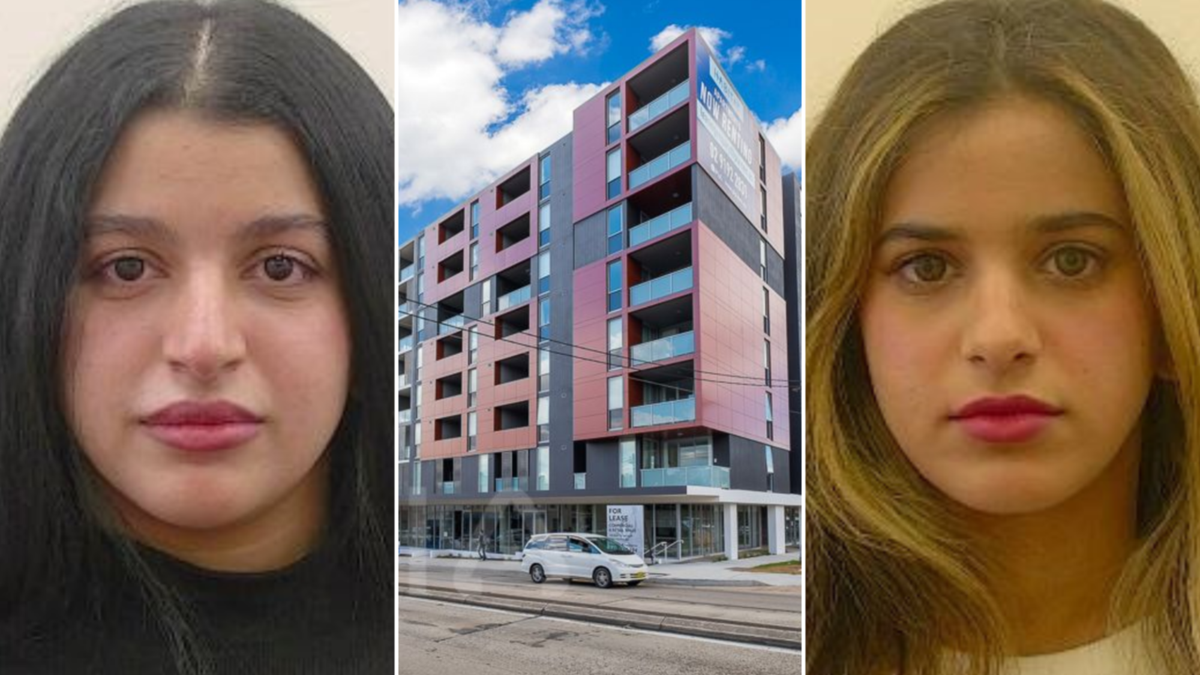
The Sydney apartment where two sisters were found dead under mysterious circumstances has now been listed for rent, with a disclaimer for any prospective tenants.
In early June, two Saudi-born sisters Asra, 24, and Amaal Alsehli, 23, were found dead in separate beds inside their Canterbury unit in “unusual circumstances”.
They were believed to have been dead for up to a month before their bodies were found inside the inner-west apartment on June 7.
Watch the latest News on Channel 7 or stream for free on 7plus >>
The cause of death is still unknown, with Detective Inspector Claudia Allcroft saying the deaths were “suspicious in nature in that we don’t know the cause of death”.
Now, the Canterbury Road apartment where the two sisters were found is up for rent again for $520 a week, with the listing informing those interested of the deaths early last month.
“This property has found two deceased person on 06/07/2022, crime scene has been established and it is still under police investigation,” the listing said.
“According to the police, this is not a random crime and will not be a potential risk for the community.”
The sisters’ apartment is now up for rent again. Credit: Domain Mystery continues to shroud the deaths of the two sisters, who arrived in Australia from Saudi Arabia as teenagers in 2017. Credit: Domain
The apartment – which is available now – is described as a “newly renovated modern 2-bedroom apartment with timber flooring in the bedroom” that “ensures a life of seamless and luxurious comfort”.
Mystery continues to shroud the deaths of the sisters, who arrived in Australia from Saudi Arabia as teenagers in 2017.
A worker with access to the apartment claims two crucifixes were found inside the Sydney unit after the sisters’ bodies were removed, the ABC reported.
It has been reported that the pair renounced Islam and changed their names after arriving in Australia.
The sisters both seemed to be extremely nervous and paranoid, with those who knew the sisters saying they seemed to live in fear and were “very afraid of something”.
A plumber who attended the apartment told building manager Michael Baird he was never going back to the apartment again.
“When (he) came out of that unit, he said that he was concerned that there was something untoward happening in the apartment. He got a very bad vibe,” Baird told the ABC.
Asra Abdullah Alsehli, 24, and her sister Amaal Abdullah Alsehli, 23. Credit: NSW Police
The women also claimed a suspicious man had been lurking outside their unit in the months before their deaths.
When building management checked CCTV, a man was spotted, however he was not deemed suspicious due to the busy location.
“That spot is busy. There is a burger shop there and Uber Eats drivers coming and going all the time. He could have been anyone,” an employee from the building management company told The Daily Mail.
“We couldn’t determine why he was there, but he didn’t look like he was doing anything untoward, so there was no need to chase it up further.”
The sisters also allegedly had concerns that someone was tampering with their food deliveries and contacted building management in January, but surveillance cameras again found no evidence.
Burwood detectives have established Strike Force Woolbird to investigate the women’s deaths.
“As the investigation is ongoing, police continue to appeal for information in relation to the death of the two women,” NSW Police told 7NEWS.com.au on Tuesday.
Anyone with information is urged to contact Crime Stoppers on 1800 333 000.
Aussie sprinter benefits from rivals’ big mistake.
Aussie sprinter benefits from rivals’ big mistake.