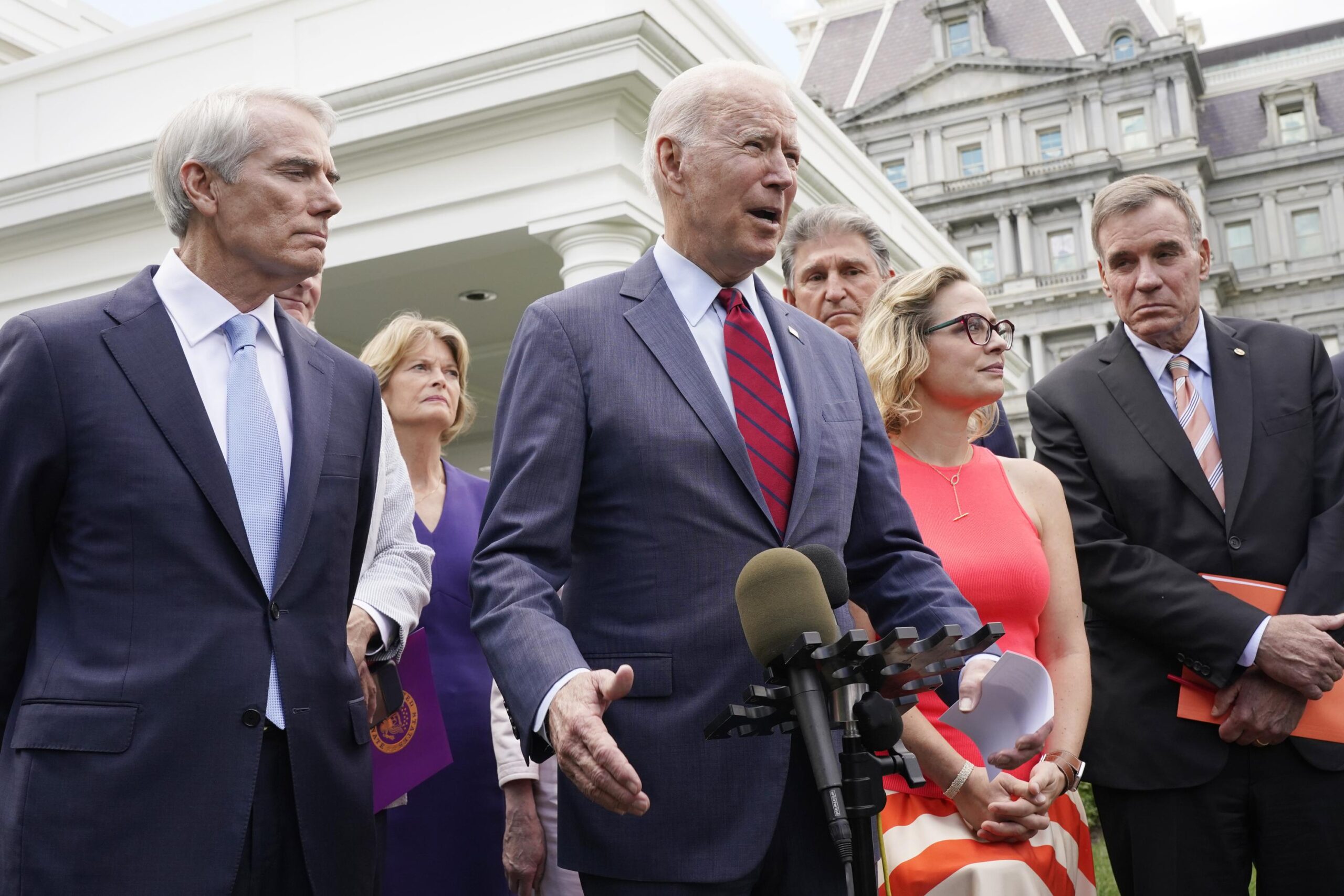
WASHINGTON (AP) — Democratic Sen. Kyrsten Sinema’s views remained a mystery Monday as party leaders eyed votes later this week on their emerging economic legislation and both parties pointed to dueling studies they used to either laud or belittle the measure’s impact.
With Democrats needing all of their 50 votes for the energy and health care measure to move through the Senate, a Sinema spokesperson suggested the Arizona lawmaker would take her time revealing her decision. Hannah Hurley said Sinema was reviewing the bill and “will need to see what comes out of the parliamentarian process.” It could take days for the chamber’s rules umpire to decide whether the measure flouts procedural guidelines and needs changes.
Senate Majority Leader Chuck Schumer, DN.Y., and Sen. Joe Manchin, DW.Va., announced an agreement last week on legislation increasing taxes on huge corporations and wealthy individuals, bolstering fossil fuels and climate change efforts and curbing pharmaceutical prices. Overall, it would raise $739 billion over 10 years in revenue and spend $433 billion, leaving over $300 billion to modestly reduce federal deficits.
The legislation would give President Joe Biden a victory on his domestic agenda in the runup to this fall’s congressional elections. If Sinema demands changes, she would face enormous pressure to reach an accord with top Democrats and avoid a campaign-season defeat that would be a jarring blow to her party’s prospects in November.
Manchin is one of Congress’ most conservative and contrarian Democrats. He has spent over a year forcing his party to starkly trim his economic proposals, citing inflation fears, and his compromise with Schumer last week shocked colleagues who’d given up hope that he would agree to such a wide-ranging measure.
Sinema has played a lower-profile but similar role as Manchin — a lawmaker who can be unpredictable and willing to use the leverage all Democrats have in a 50-50 Senate. Last year, she lauded a proposal for a minimum tax on large corporations — which the new legislation has — but has also expressed opposition to increasing corporate or individual tax rates.
“She has a lot in this bill,” Manchin, citing her support for past efforts to rein prices for prescription drugs, told reporters Monday. He said she’s been “very adamant” about not increasing taxes, adding, “I feel the same way.”
Manchin has asserted the bill’s imposition of a 15% minimum tax on corporations earning over $1 billion annually is not a tax increase. He says it closes loopholes such companies use to escape paying the current 21% corporate tax.
Republicans mocked that reasoning and said its tax increases would weaken the economy and kill jobs. They cited a report from Congress’ nonpartisan Joint Committee on Taxation that said about half of the corporate minimum tax would hit manufacturing firms.
“So in the middle of a supply chain crisis, Democrats want huge job-killing tax hikes that will disproportionately crush American manufacturing and manufacturing jobs,” said Senate Minority Leader Mitch McConnell, R-Ky.
Biden has said he will not raise taxes on people earning under $400,000 annually. Manchin has said the Democratic package honors that pledge.
Republicans recently distributed another Joint Committee on Taxation analysis that said the measure would raise taxes on people earning below that figure. Democrats criticized the study as incomplete, saying it omitted the impact on middle-class families of the bill’s health insurance subsidies and clean energy tax cuts.
Democrats touted a report by Mark Zandi, chief economist at Moody’s Analytics. It said the measure “will nudge the economy and inflation in the right direction, while meaningfully addressing climate change and reducing the government’s budget deficits.”
Schumer said he expected votes to begin this week in the Senate, where Vice President Kamala Harris could cast the tie-breaking vote to assure its passage. The narrowly divided House has left town for an August recess, but Democratic leaders have said they would bring lawmakers back for a vote, perhaps next week.
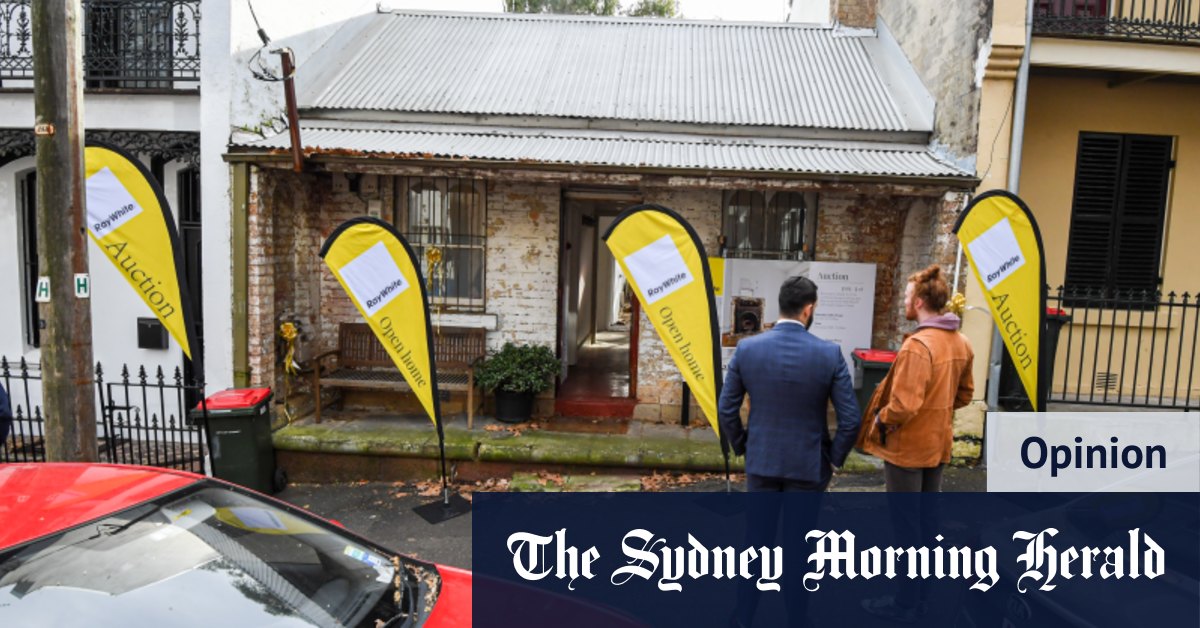
The rapid fall in house prices demonstrates that the RBA rises are hitting that mark.
Having begun tightening monetary policy too late, the RBA’s catch-up is occurring at warp speed and borrowers can do little but buckle up and brace for impact.
The RBA has lifted the official interest rate by 0.5 percentage points for a third consecutive month, taking the cash rate to 1.85 per cent.Credit:
The velocity of the house price falls won’t be a concern for the RBA – quite the opposite – it will be a demonstration that its policy is working, at least in the housing market.
The RBA jury is not so certain about how this is flowing through to household spending.
“Employment is growing strongly, consumer spending has been resilient and an upswing in business investment is under way,” the RBA said on Tuesday while announcing the latest rate rise.
Painful as this will be to some mortgage holders, for the RBA, this represents positive pain – the kind that borrowers need to endure to fix the economy’s more dangerous ailment, inflation.
loading
With inflation breaking its own records, running at its highest pace in 21 years, its treatment needs to be painful.
In previous rising interest rate cycles or when introducing changes to macro prudential measures, the RBA was alive to the desire to manage the impact on house prices. But this time around, it is more prepared to risk housing price deflation.
The central bank is laser focused on seeing inflation peak no later than the last quarter of this financial year and at no higher than its anticipated 7.75 per cent. It also needs the community and business to avoid a mindset that inflation could become a medium or longer-term feature of the Australian economy.
Borrowers will be collateral damage.
loading
The majority of borrowers are ahead in mortgage payments and given we are experiencing unemployment at a 50-year low, loan serviceability has been regularly called out by lenders as something of a non-issue.
There is little or no evidence to date from banks that delinquencies from home loans have grown; there are even suggestions they have failed since the RBA began boosting interest rates in May.
There is a vintage of borrowers who came to the market last year when rates (particularly fixed interest rates) were at an historic low and property prices were peaking and who were lulled by the RBA projections that rates wouldn’t rise before 2024, who will be especially vulnerable to this round of rate rises.
For Australia’s largest lenders, the four major banks, it’s become a case of, be careful what you wish for.
loading
The rising rates are widely expected to provide a sugar hit to bank earnings – expanding the previously shrinking net interest margins.
The withdrawal – a slowdown in loan growth – will be more painful for earnings.
Where the RBA moves from here is clear enough from Tuesday’s statement. The round of rate rises is not over yet.
But the size and timing is now an open question.
“The size and timing of future interest rate increases will be guided by the incoming data and the Board’s assessment of the outlook for inflation and the labor market,” the RBA said on Tuesday.
The Business Briefing newsletter delivers major stories, exclusive coverage and expert opinion. Sign up to get it every weekday morning.
Scientists and engineers are constantly developing new materials with unique properties that can be used for 3D printing, but figuring out how to print with these materials can be a complex, costly conundrum.
Often, an expert operator must use manual trial-and-error – possibly making thousands of prints – to determine ideal parameters that consistently print a new material effectively. These parameters include printing speed and how much material the printer deposits.
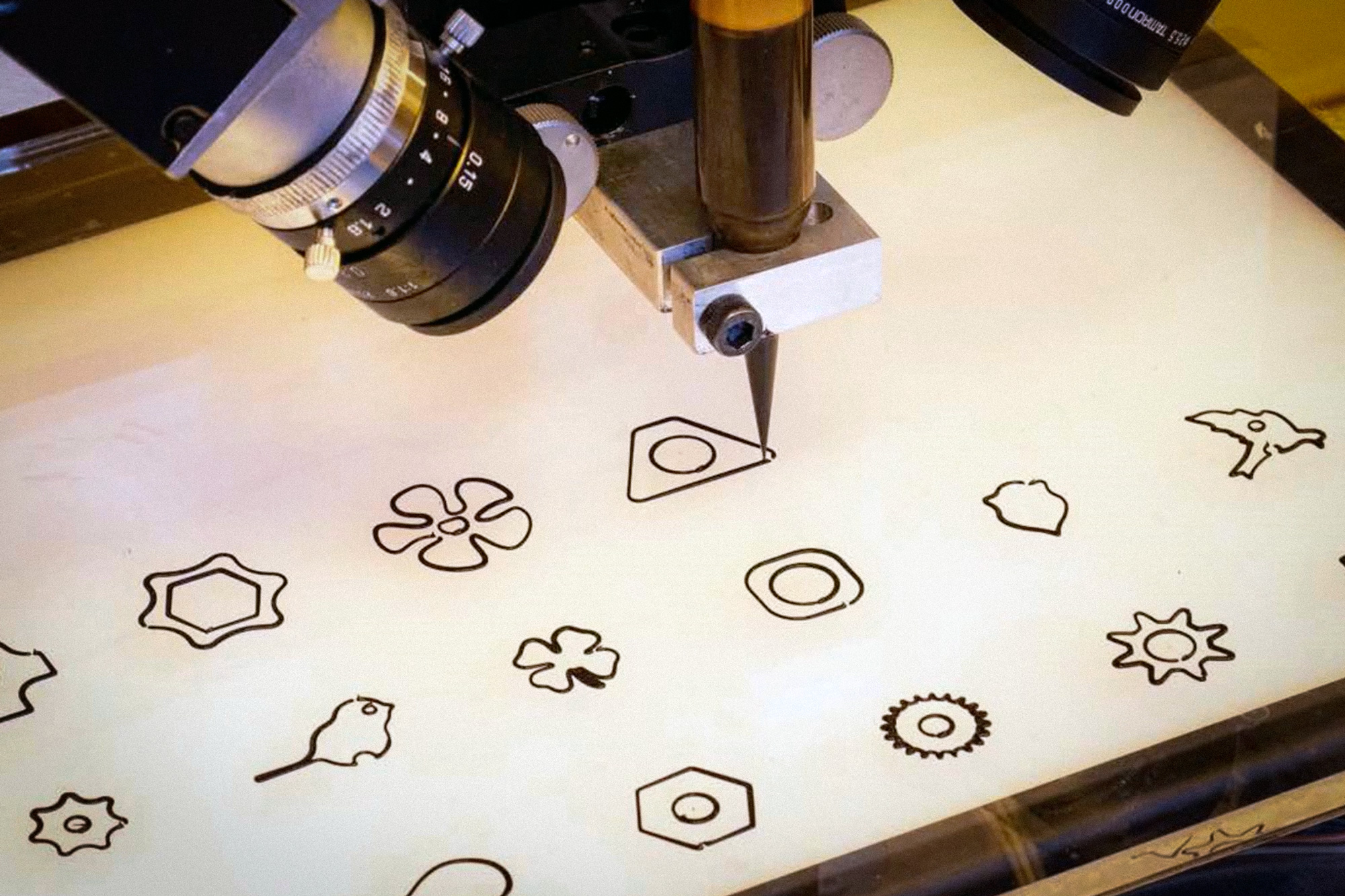
MIT researchers have now used artificial intelligence to streamline this procedure. They developed a machine-learning system that uses computer vision to watch the manufacturing process and then correct errors in how it handles the material in real-time.
They used simulations to teach a neural network how to adjust printing parameters to minimize error, and then applied that controller to a real 3D printer. Their system printed objects more accurately than all the other 3D printing controllers they compared it to.
The work avoids the prohibitively expensive process of printing thousands or millions of real objects to train the neural network. And it could enable engineers to more easily incorporate novel materials into their prints, which could help them develop objects with special electrical or chemical properties. It could also help technicians make adjustments to the printing process on-the-fly if material or environmental conditions change unexpectedly.
“This project is really the first demonstration of building a manufacturing system that uses machine learning to learn a complex control policy,” says senior author Wojciech Matusik, professor of electrical engineering and computer science at MIT who leads the Computational Design and Fabrication Group (CDFG ) within the Computer Science and Artificial Intelligence Laboratory (CSAIL). “If you have manufacturing machines that are more intelligent, they can adapt to the changing environment in the workplace in real-time, to improve the yields or the accuracy of the system. You can squeeze more out of the machine.”
The co-lead authors on the research are Mike Foshey, a mechanical engineer and project manager at the CDFG, and Michal Piovarci, a postdoc at the Institute of Science and Technology in Austria. MIT co-authors include Jie Xu, a graduate student in electrical engineering and computer science, and Timothy Erps, a former technical associate with the CDFG.
Pick parameters
Determining the ideal parameters of a digital manufacturing process can be one of the most expensive parts of the process because so much trial-and-error is required. And once a technician finds a combination that works well, those parameters are only ideal for one specific situation. She has little data on how the material will behave in other environments, on different hardware, or if a new batch exhibits different properties.
Using a machine-learning system is fraught with challenges, too. First, the researchers needed to measure what was happening on the printer in real-time.
To do this, they developed a machine-vision system using two cameras aimed at the nozzle of the 3D printer. The system shines light at material as it is deposited and, based on how much light passes through, calculates the material’s thickness.
“You can think of the vision system as a set of eyes watching the process in real-time,” Foshey says.
The controller would then process images it receives from the vision system and, based on any error it sees, adjust the feed rate and the direction of the printer.
But training a neural network-based controller to understand this manufacturing process is data-intensive, and would require making millions of prints. So, the researchers built a simulator instead.
Successful simulation
To train their controller, they use a process known as reinforcement learning in which the model learns through trial-and-error with a reward. The model was tasked with selecting printing parameters that would create a certain object in a simulated environment. After being shown the expected output, the model was rewarded when the parameters it chose minimized the error between its print and the expected outcome.
In this case, an “error” means the model either dispensed too much material, placing it in areas that should have been left open, or did not dispense enough, leaving open spots that should be filled in. As the model performed more simulated prints, it updated its control policy to maximize the reward, becoming more and more accurate.
However, the real world is messier than a simulation. In practice, conditions typically change due to slight variations or noise in the printing process. So the researchers created a numerical model that approximates noise from the 3D printer. They used this model to add noise to the simulation, which led to more realistic results.
“The interesting thing we found was that, by implementing this noise model, we were able to transfer the control policy that was purely trained in simulation onto hardware without training with any physical experimentation,” Foshey says. “We didn’t need to do any fine-tuning on the actual equipment afterwards.”
When they tested the controller, it printed objects more accurately than any other control method they evaluated. It performed especially well at infill printing, which is printing the interior of an object. Some other controllers deposited so much material that the printed object bulged up, but the researchers’ controller adjusted the printing path so the object stayed level.
Their control policy can even learn how materials spread after being deposited and adjust parameters accordingly.
“We were also able to design control policies that could control for different types of materials on-the-fly. So if you had a manufacturing process out in the field and you wanted to change the material, you wouldn’t have to revalidate the manufacturing process. You could just load the new material and the controller would automatically adjust,” Foshey says.
Now that they have shown the effectiveness of this technique for 3D printing, the researchers want to develop controllers for other manufacturing processes. They’d also like to see how the approach can be modified for scenarios where there are multiple layers of material, or multiple materials being printed at once. In addition, their approach assumed each material has a fixed viscosity (“syrupiness”), but a future iteration could use AI to recognize and adjust for viscosity in real-time.
Additional co-authors on this work include Vahid Babaei, who leads the Artificial Intelligence Aided Design and Manufacturing Group at the Max Planck Institute; Piotr Didyk, associate professor at the University of Lugano in Switzerland; Szymon Rusinkiewicz, the David M. Siegel ’83 Professor of computer science at Princeton University; and Bernd Bickel, professor at the Institute of Science and Technology in Austria.
The work was supported, in part, by the FWF Lise-Meitner program, a European Research Council starting grant, and the US National Science Foundation.
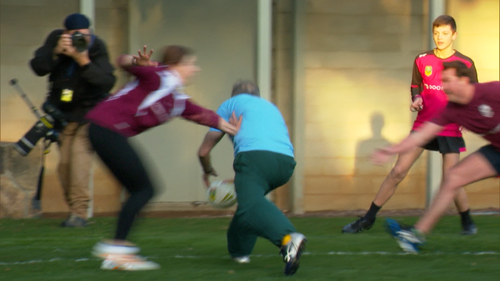
There are urgent calls for a ‘try’, awarded to Prime Minister Anthony Albanese during this morning’s State of Origin grudge match at Parliament House, to be referred to the NRL bunker.
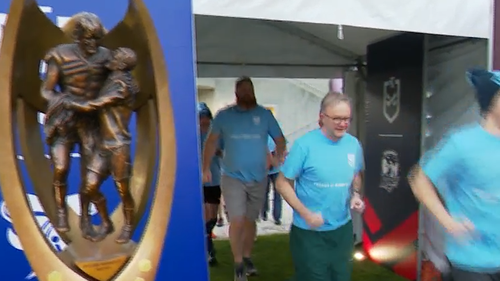
Donning a blue jersey, track pants and footy boots, the prime minister joined the ‘Parliamentary Friends of Rugby League’ on Tuesday morning for their fourth annual State of Origin touch football match.
Sucking back the cold Canberra air, the group ran out for the ‘friendly’ – put on by NRL Chief Executive Andrew Abdo – taking place on the parliament playing field.
There are urgent calls for a ‘try’, awarded to Prime Minister Anthony Albanese during this morning’s State of Origin grudge match at Parliament House, to be referred to the NRL bunker. (9News)
New South Wales and Queensland sides consisted of veteran pollies, like former Nationals leaders Michael McCormack and Barnaby Joyce.
The latter, helping to make up the numbers for the queensland sideseemingly as red as his maroon jersey after a valiant effort.
Some speculated he was worthy of the Wally Lewis medal, but the PM apparently disagreed.
“Barnaby has very short stints on the field. Even though he represents the NSW seat, he has a Maroons jersey on as well,” Mr Albanese told Today.
“Look, there should be an inquiry into some of these players and where they are playing for, I tell you.”
He then took issue with former Wallaby turned Senator David Pocock, who also hit the field for the Maroons during the match.
NSW and QLD sides consisting of veteran pollies, like former Nationals leaders Michael McCormack and Barnaby Joyce. (9News)
“I can report the greatest scandal since GI (Greg Inglis) playing for Queensland, David Pocock from the ACT pulling on a Queensland jumper.
“They will stop at nothing.”
But the biggest controversy came just before half-time.
With a sweaty and exhausted NSW side already up 2-1, the Prime Minister hit the gas, making a glorious run toward a gap.
Hot on his heels, was newly-minted junior minister, Anika Wells.
Diving across the try line, the crowd cheered, and an elated Albanese raised both arms while running toward the group, before taking a lap of high-fives.
All the while though, Ms Wells was appealing to the referee, claiming she’d made contact with her boss, before he put the ball down… and replays would suggest, she did.
Albo’s blues taking home bragging rights and the odd cramp, winning 3-1. (9News)
The referee ultimately gave Mr Albanese the benefit of the doubt, awarding NSW the final try of the morning.
Albo’s Blues took home bragging rights and the odd cramp, winning 3-1.
Asked about the contentious call in a press conference, meters from the Prime Minister’s Office, Ms Wells laughed off the controversy.
“Before I walked back into the Prime Minister’s Office, I’ve really loved being the Minister for Sport, it’s been an honour.
“I think we can all agree that the referee is probably going to be the next governor-general based on that decision,” she said.
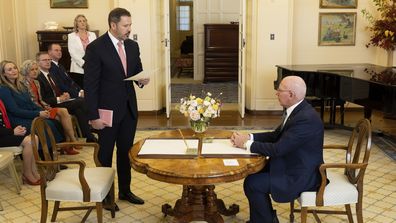
Labor cabinet minister makes history, with a small pink book
Just weeks after a damning WA parliamentary report into sexual harassment and assaults in the mining industry, a FIFO worker has been sentenced to 10 years in jail for repeatedly raping a colleague.
Key points:
Small and his victim worked for BHP at the time of the offenses
The assaults occurred in Perth, when both were on rostered days off
With time already served, he will be eligible for release in 2028
Jonathan David Small, 44, was found guilty by a District Court jury of six charges of sexually penetrating the 22-year-old woman without her consent, after they went out to dinner while they were on rostered days off in Perth.
Both worked for BHP at the time, but Small was sacked after the woman reported what happened to her superiors when she returned to her worksite, in the Pilbara, two days later.
Small was charged with eight offenses. He denied them all, maintaining the sex was consensual, but he was found guilty of six of the charges and acquired of the other two.
The court was told the sexual assaults included violence, with Small repeatedly choking, slapping, and pulling her hair, telling her “I can tell you’re not into guys.”
At one point the woman hid in the bathroom and tried to contact a friend for help but Small banged on the door and threatened to break it down.
She only came out when Small told her he would leave.
She went to bed but awoke to him undressing her before he raped her again.
The next day Small sent her text messages saying, “I’m so sorry for last night … please don’t hate me” and “no one knows … it’ll stay that way”.
Victim subjected to ‘callous’ attack
Judge Bruce Goetze described the sexual assaults as “prolonged and repeated”, saying it was “particularly callous” of Small to again rape the woman after she came out of the bathroom.
He said the comment to her about not being “into guys” was aggravating because it had the effect of denigrating and humiliating, and he also noted the assaults had involved physical force and coercion.
Judge Goetze said the woman had trusted Small as a work colleague and as a friend, but he had violated that trust in a way that would have a long-standing and emotional impact on her.
Small, who still maintains his innocence, will have to serve eight years before he can be released on parole.
With time already served he will first be eligible for release in July 2028.
Case comes in wake of damning report
The case comes just six weeks after the WA Parliament published a report into sexual assaults and harassment within the state’s mining industry.
It found both were rife in the “fly-in, fly out” workforce and that women within the industry had been subjected to what it described as “an appalling range of behaviours.”
The report, titled “Enough is Enough”, heard evidence from 55 witnesses, including women who detailed harrowing stories of their experiences.
One woman recounted being knocked unconscious in her donga and then waking up to find her jeans and underpants around her ankles.
Another testified about being told to “get on her knees” if she wanted a permanent job with a mining company.
The report contained 24 recommendations, including the setting up of an industry wide register to stop the perpetrators from working at different sites, and the establishment of a government run forum to document the experiences of victims.
It’s not the first time officials have come together to celebrate construction of a New Portal North Bridge — a replacement for the notorious choke point that delays up and down the Northeast Corridor as it opens for river traffic.
But, New Jersey Gov. Phil Murphy promised at a groundbreaking Monday, that it would be the day work to replace “one of the most critical connection points along the entire Northeast corridor begins in earnest.”
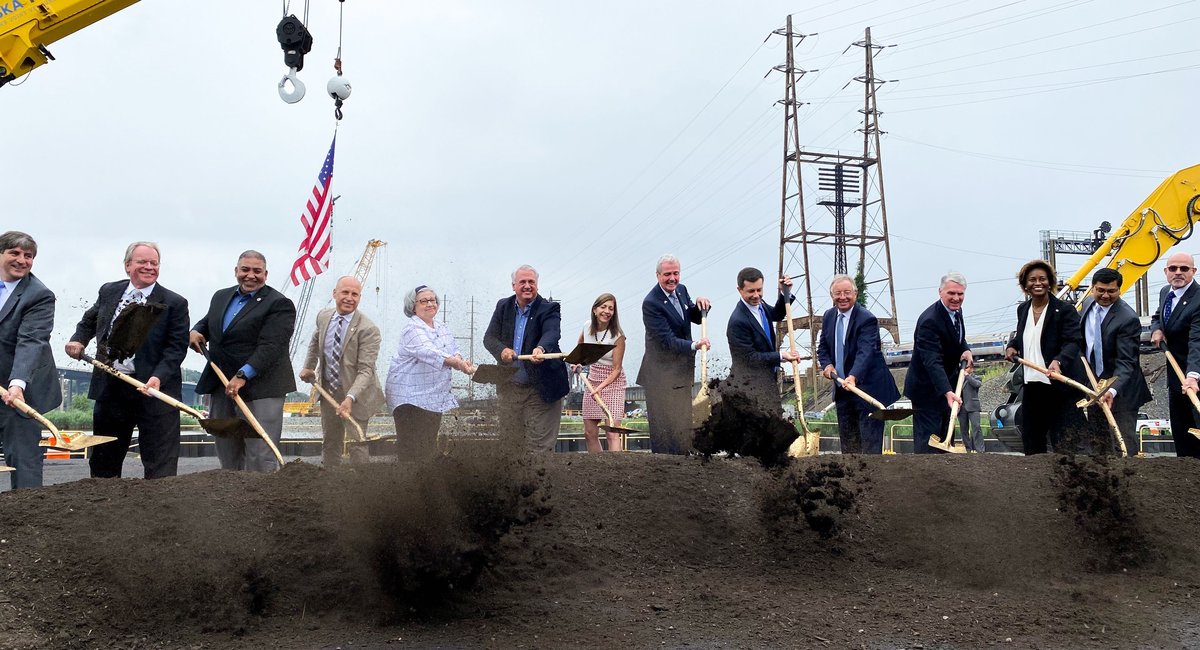
Federal, state and city lawmakers pledged the start of the long-delayed project, pegged as an economic boon to the region. They gathered around a pile of manure in a parking lot across from where the new bridge will be located, dug in faux gold shovels and tossed several shovelfuls to mark the occasion.
Afterward, lawmakers and attendees lined up to get a photo with US Secretary of Transportation Pete Buttigieg in a tent.
“Over the years, this critical piece of infrastructure has evolved from a transit marvel into a transit nightmare,” US Senator Bob Menendez, a Democrat representing New Jersey, said. “It’s old, it’s limiting and it’s unreliable.”
One out of seven times, the current, nearly 112-year-old bridge swings open to let river traffic through, it gets stuck, he said. Workers have to slam it with sledgehammers to get the alignment back in place, Buttigieg said.
Menendez called the Portal North Bridge a “choke point on the busiest stretch of rail in America.”
The bridge will be 50 feet high, more than double the current bridge’s height, so boats can easily pass below. It’ll also be part of a new 2.4-mile span of track with a gradual incline leading to the bridge, which will allow trains to maintain their speed when crossing. The current bridge has speed restrictions, which forces trains to slow down when crossing.
NJ Transit President Kevin S. Corbett said the first track of the new bridge would open in 2026.
New York and New Jersey officials agreed last month to split about $772 million not covered by federal funding. NJ Transit last year announced it had awarded a nearly $1.6 billion construction contract for the project.
“This project turns the Portal North Bridge from a choke point to an access point,” Buttigieg said at the groundbreaking. “I hope that this bridge will not only bring people to work and loved ones to where they need to be, but it brings renewed confidence in our ability to get things done together. We’ve got a lot more good work where this came from — we are entering into a true infrastructure decade.”
Still, speaking to reporters later, Buttigieg, who was appointed by President Joe Biden, couldn’t say whether a new administration would be able to pull the plug on funding for this project and the much larger Gateway Project — an infrastructure undertaking aimed at expanding rail service into and out of New York City.
During the Trump administration, Gateway and the MTA’s congestion pricing program languished while federal authorities held up the federal review process.
The next step of the $30 billion Gateway Project is to build a new tunnel under the Hudson River. Amtrak, which owns the tunnels, hopes to break ground on that element of the project next year. But it has yet to secure a funding commitment from the federal government.
Buttigieg told the Gothamist his office is doing its best to push that along, but said all projects need to complete the proper paperwork.
“Our focus is to make sure that the gears of government turn as efficiently as they can, knowing that, obviously when you’re talking about what will add up to tens of billions of dollars of taxpayer money, you gotta do everything right,” he said. “And there’s no do overs.”
The Moto G40 Fusion is an excellent phone in many ways. You get what you pay for, whether it’s the smooth 120Hz display, clean software, or smooth performance. However, the camera quality is poor, and the phone’s weight makes it an unappealing choice.
Moto G40 Fusion: Price in India
In India, the Motorola Moto G40 Fusion is available in two color options: black and white. Dynamic Gray and Frosted Champagne There are also two storage and two RAM configurations to choose from.
The 64GB+4GB variant costs Rs 13,999/-, while the higher 128GB+6GB variant costs Rs 15,999/-. On Flipkart India, you can save up to Rs 14,600/- on eligible phone exchanges.
Design
Smartpirx
Motorola has decided to go with something like providing powerful features in the phone, including an interesting camera efficiency so that the phone appears bulky. We measured its weight at 225g and its thickness at 9.7mm.
On the front, there are tiny bezels on three sides, but the chin is quite large, though not as large as the chin on the Samsung Galaxy M42 5G, and there’s a punch-hole in the center that doesn’t bother you as much. as a notch would, that’s subjective.
display
The Motorola Moto G40 Fusion comes with the same 6.8-inch IPS LCD display as the Moto G60 Phone. It has a resolution of 1080 x 2460 pixels, which allows you to play Full HD+ videos and games without lags or scratches.
Motorola was able to combine a less expensive display technology with a higher refresh rate to create an IPS LCD panel with a high refresh rate of 120Hz. I would have preferred an AMOLED display with deeper blacks and brighter whites, but there are some tradeoffs when purchasing a smartphone under 15K INR, and here’s the one for the G40 Fusion.
Performance
The Financial Express
The Moto G40 Fusion is powered by a high-performance Qualcomm Snapdragon 732G processor manufactured on an 8nm node. It features a dual-cluster octa-core configuration with two 2.3GHz Kryo 470 Gold cores and six 1.8GHz Kryo 470 Silver cores.
It is currently the cheapest smartphone to run on Qualcomm’s Snapdragon 732G on a Sub-15K INR smartphone. Without a doubt, the GPU and CPU in the chipset will contribute to impressive processing capabilities regardless of what you throw at it.
cameras
In terms of cameras, the Moto G40 Fusion has a triple camera configuration on the back. This includes a 64MP primary sensor, an 8MP ultrawide sensor, and a 2MP depth sensor. It should be noted that the main difference between the Moto G40 Fusion and G60 is in the camera department.
This rear camera setup can capture 4K video at 30 to 120 frames per second and 1080p video at up to 240 frames per second. There is an incredible camera setup. If you are looking for a camera phone, this is the phone for you.
In terms of the front camera, there is a punch-hole cutout in the middle of the display that houses a 16Mp camera for making video calls and shooting front-facing vlogs.
Former AFL champion Eddie Betts has revealed for the first time the trauma he felt after a “weird” and “completely disrespectful” leadership training camp he attended as an Adelaide Crows player in the 2018 pre-season.
In his autobiography, The Boy from Boomerang Crescentto be released on Wednesday, the three-time All-Australian player says the secretive four-day camp held on the Gold Coast, run by a group he has chosen not to name, left him feeling “like a piece of me was brainwashed ”.
In the book, Betts writes that confidential information he had given in a private counseling session on the camp had been misused, and that the camp co-opted sensitive Aboriginal cultural rituals that offended him, jeopardised the wellbeing of other, younger Indigenous players within the Crows’ playing squad, and affected his family life. He blames it for a lack of form in 2018 that ultimately prompted him to leave the Crows.
“The camp ended up appropriating a First Nations peoples’ ritual of a ‘talking stick’ and attempting to apply it to all of us, even the non-Indigenous players and coaches.
“In my view, the talking stick was used incorrectly, and I was not aware that any Elder had given permission for it to be used either.
“There was all sorts of weird shit that was disrespectful to many cultures, but particularly and extremely disrespectful to my culture,” Betts writes in the book.
Betts says he would have to live for the rest of his life with the shame of having participated in some of the more confronting exercises.
‘It all made me feel really sick’
Betts writes that his first “serious reservations” about the camp began after a compulsory hour-long psychological assessment, conducted over the phone by a person he understood to be a counselor from the mind-training and leadership specialist group.
“We were told that we weren’t to do the interview with our partners in ear-shot and that the objective of the questions was to build a profile about us that we would work through on the camp,” Betts writes.
Eddie Betts with partner Anna and their children.
He says he opened up to the interviewer and divulged what he described as private life experiences, believing that it would assist the specialists to appreciate “the cultural complexities” of his life.
“I thought it would be used to build a profile about me that showed obstacles I’ve overcome to be successful and to play AFL.”
The red flag for Betts was when the interviewer tried to gain Betts’ confidence by claiming familiarity with Aboriginal culture: “He tried to make out as though he was like me, as though I should feel comfortable disclosing to him my trauma.”
Then 30 years old, Betts, who was part of the Adelaide club’s senior leadership group, says he was told the camp would do more than just invigorate his game-day performances. “I was told that I would come back a better husband and father, a better teammate and that I’d get a lot out of the camp,” he says.
However, the Wirangu, Kokatha and Guburn man, who is a father of five, says he returned with feelings of shame and humiliation that left him angry, paranoid, secretive and “feeling drained and lethargic”. Betts says the emotional fallout immediately began to harm his family relationships from him. His partner, Anna, noticed “the extent of my distress”, Betts writes. “Anna noticed I was starting to get snappy at the kids and I started getting really bad anxiety,” he says.
That’s when the couple sat down and talked about what had happened.
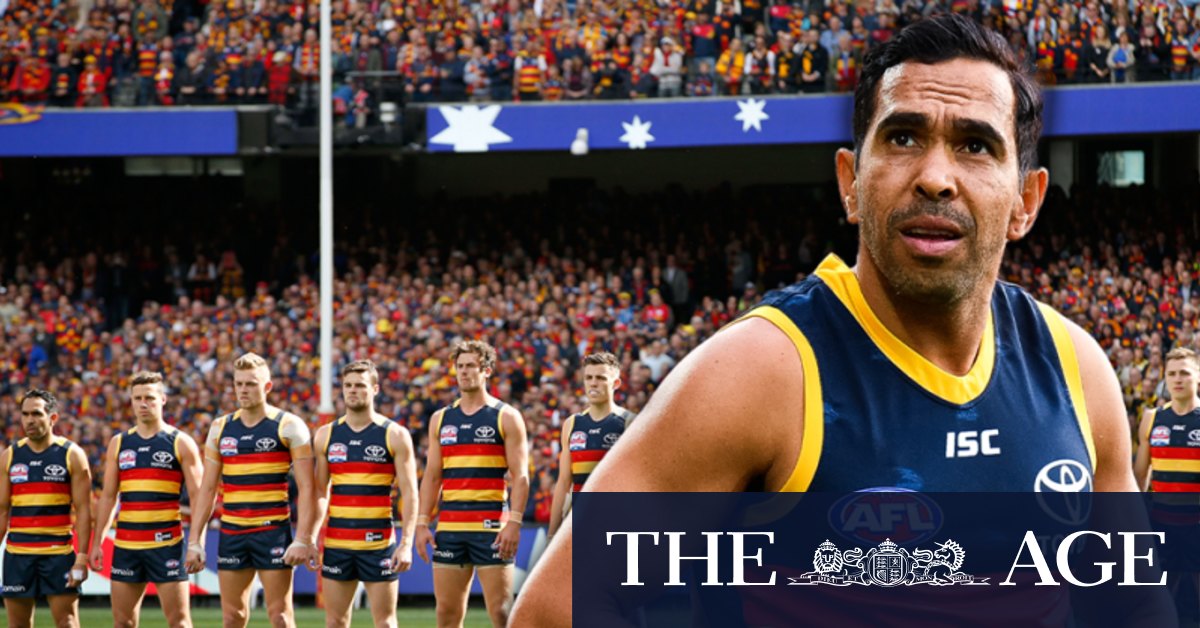
The Crows adopt the ‘power stance’ as they face off against Richmond before the 2017 Grand Final.
The ‘power stance’
The Adelaide Crows began working with the leadership training group midway through the 2017 season, Betts writes.
“This mind training was centered, mainly, around us being ‘warriors’ – things like inner-voice, dominance, mindset.”
Betts was reluctant to buy into these early programs and their “one-size-fits-all approach” over players from diverse backgrounds. As a designated leader, Betts felt he needed to check in on the wellbeing of his younger Indigenous teammates.
After the Crows lost successive games in the 2017 season, Betts says the training group reviewed game videos and claimed they had identified where the playing squad had lost these games. At fault was the way players had run through the supporters’ banner onto the ground, they said.
“Apparently, our facial expressions weren’t up to game mode,” Betts writes. The playing group was made to practice their facial expressions, he says.
Another mind-training technique Betts found concerning was intended to emphasize the players’ masculinity. The exercise involved the players forming a circle, making eye contact with one another, and screaming obscenities. Betts says elements of the program make him cringe in hindsight.
Betts warms up prior to the first preliminary final in Adelaide in 2017.Credit:Getty
“One of the young fullas said to me, ‘I see you as an Uncle. I don’t really like screaming “f— you” at you’. In our culture, from a young age, our older people are a model of respect to our kids and we quickly learn to reciprocate that respect back towards our elders. In my view, some of the younger brothers were getting wala [angry] with these leadership specialists.”
“For me, it didn’t make any sense for the leadership specialists to try and increase my angry man energy, or whatever the f— it was they were after.”
Betts writes that on the eve of the 2017 final series, the mind-training instructors devised and implemented a technique for the team to present itself after it had run through the club banner onto the playing pitch. They called it “the power stance”, Betts says, which meant all 22 Crows players and coach Don Pyke standing with their arms down, slightly away from their sides, in a commanding posture.
Betts says the choreographed stance, which was intended to intimidate the game-day opposition, was even practiced at Crows training. The Crows deployed the trick before their qualifying and preliminary finals and came away from each of those games with the win, before slumping to a spectacular defeat in the grand finale.
The grand finale drubbing at the hands of the Richmond Tigers still haunts Betts, but he says some of that may stem from the techniques deployed by the instructors at pre-season training for the 2018 season.
Betts is abandoned after losing the 2017 grand finale.Credit:Getty
“We had some weird sessions pop up. One consisted of us training while the Richmond club song blasted around AAMI Park while we did a gruelling running session.”
A harness and a knife
The technique geared up again when the squad was flown to a training camp on the Gold Coast in late January 2018, Betts says.
He recalls that the camp began normally enough with routine footy training drills, but soon the team was separated into groups, made to surrender their mobile phones and subjected to what he describes as a barrage of verbal abuse and psychological intimidation involving fake weapons.
According to Betts, players were then blindfolded, loaded onto a bus with papered-over windows and conveyed to an undisclosed location as the Richmond team song played on a loop loudly through the bus’s sound system. When the squad arrived at the secret destination, team members were instructed to remove their blindfolds.
Betts says the first thing they saw was a dozen or so burly men, all dressed in black, greeting them with the power stance.
The welcoming committee laid out the camp rules for the bemused players, Betts says.
“Things like, we weren’t allowed to shower… we had to stay sweaty and smell ‘manly’. We also had to keep what they described as ‘noble silence’,” Betts writes.
Camp life, which Betts’ partner, Anna, later told him was “cult-like”, also involved an “initiation process” for each of the participants, an exercise Betts views as cultural appropriation of sensitive traditional Aboriginal ceremonies.
When the time came for Betts to be “initiated”, he says he was again informed that it would make him a man. He was put into a body harness with a rope attached and told to try and fight his way towards a knife to cut himself free while teammates holding the rope physically obstructed him. The initiation also involved the camp instructors hurling verbal abuse at him, he says.
“Things were yelled at me that I had disclosed to the camp’s ‘counsellors’ about my upbringing. All the people present heard these things,” Betts writes. “I was exhausted, drained and distressed about the details being shared. Another camp-dude jumped on my back and started to berate me about my mother, something so deeply personal that I was absolutely shattered to hear it come out of his mouth from him.
At the end of the camp, the players were told that this exercise had provided each other with a safe space and that any issues affecting them were only to be shared with other group members.
“Then we started an exercise that consisted of role-playing our responses to our partners… One of the responses suggested to us was, ‘I feel like a better father and husband, having come from this camp.’”
Betts with his family at the beach, one of the photos included in his new book.
But after sharing his experience with his partner, Betts developed an increasingly deeper sense of regret. He also spoke to his Aboriginal elders about some of the co-opted rituals, and the use of sacred and culturally sensitive words that were used at the camp. The conversations led to Betts and his partner approaching the club’s executives with their concerns.
Betts says he wanted to have the program discontinued to protect other Crows players from the same experiences and to establish an internal support network for some of the other players who Betts says were struggling.
“After a meeting with all the Blackfullas at the club, I decided to address the playing group and talk about how I found the camp, mainly addressing the cultural safety implications for us brothers. I sought permission to remove all the Aboriginal boys from any further interactions with the ‘leadership specialists’ and their mind-training exercises. I told the club I wouldn’t be involved in any more mind-training exercises at all.”
Three weeks later, Betts says he was dropped from the squad’s leadership group. The decision devastated him.
“It takes a lot of work for us Blackfullas to provide other people that we’re capable of leading,” he says.
The Adelaide Crows Football Club declined to comment when contacted by The Age and The Sydney Morning Herald.
The group that ran the camp has previously said it recognizes “that some parts of the camp didn’t resonate with some players”. However, it said it had received overwhelmingly positive feedback from players and the club at the time, and that the group would have been “fired in an instant” if the camp had gone as badly wrong as some had suggested.
loading
Betts says the effects on him continued into the 2018 season. His on-field form of him slumped with the four-time AFL goal-kicker of the year not kicking a single goal until round three. That season, the Crows failed to qualify for the finals series, and Betts says he was left questioning his playing future of him.
“Personally, I felt like I’d lost the drive to play footy, and to be honest, I’m not sure I ever had the same energy I did before that camp,” he writes.
At the end of the year, Betts left the Crows and South Australia to reunite with the Carlton Blues in Victoria, where he finished his 17-year playing career in 2021 at the club that gave the boy from Boomerang Crescent his debut.
In 2021, a SafeWork SA inquiry made no findings of any wrongdoing against the mind-training specialists.
The author of this article, Jack Latimore, did a “cultural edit” of Betts’ book, The Boy from Boomerang Crescentpublished by Simon & Schuster Australia, released on Wednesday, August 3, 2022. Ali Clarke conducted the book’s research and interviews.
The Morning Edition newsletter is our guide to the day’s most important and interesting stories, analysis and insights. Sign up here.
For a poor kid, having wealthy friends is one of the strongest determinants of economic mobility later in life.
Why it matters: That data point, from a study published in the journal Nature today, underscores the real-world power of friendship.
We know accumulating friends in different stages of our lives can decrease stress, lengthen life, improve our performance at work and even make us better parents.
We know friendships with our neighbors can be the difference between life and death in tragedies and natural disasters.
And now we know cross-class friendships are drivers of wealth and success for less fortunate children.
The big pictures: The study authors did a first-of-its-kind analysis of 72 million Facebook friendships between US adults.
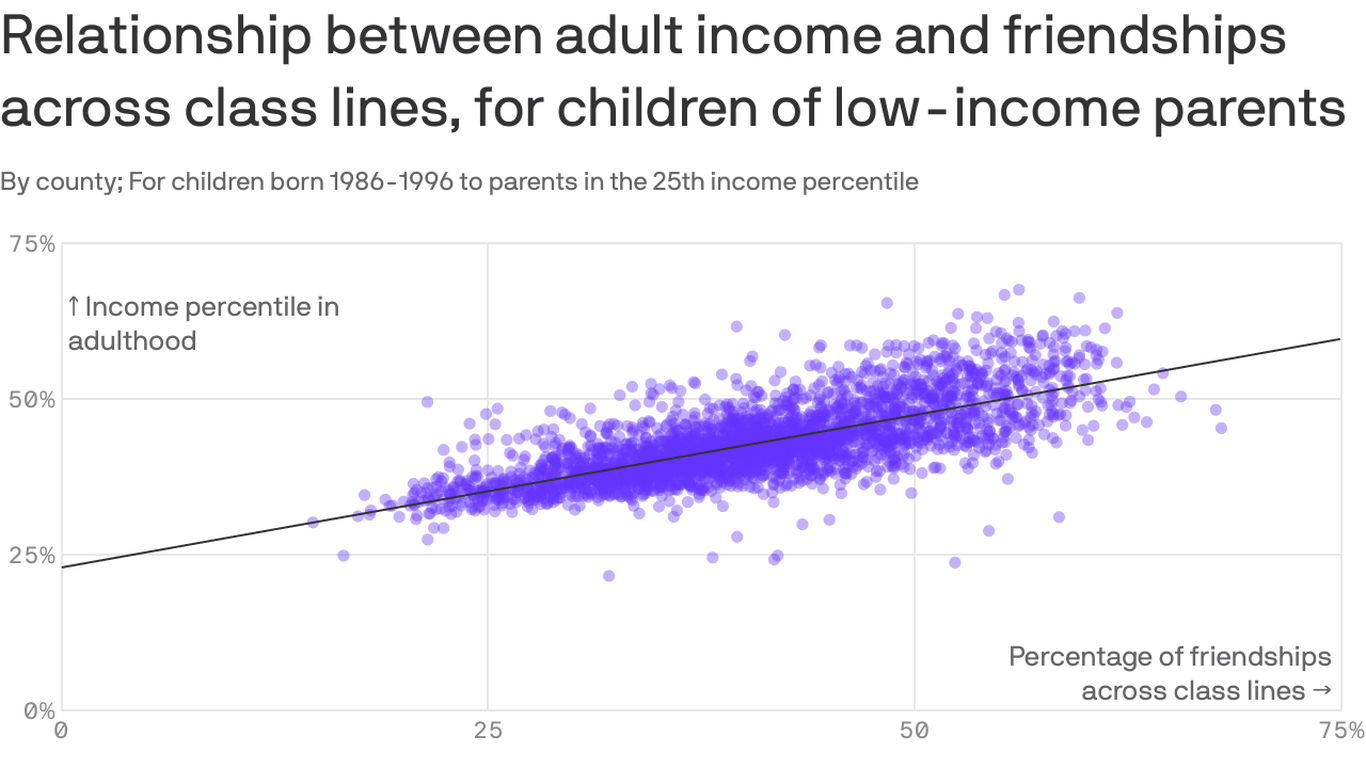
What they found: If poor children grew up in neighborhoods in which 70% of their friends were rich, their future incomes would be 20% higher than their counterparts who grew up without these bonds across class lines.
This was a stronger indicator of future income than factors like family structure and school quality, as well as the racial makeup and job availability in the child’s community.
reality check: It’s not that simple. Friendships across class are increasingly hard to come by in our divided country.
For example, for people in the bottom 10% of the income distribution, only 2.5% of their friends are in the top 10%, Johannes Stroebel, an economist at NYU and one of the study authors, tells Axios.
There are some cities that are doing better than others. In Salt Lake City and Minneapolis, nearly half of the friends of folks in the bottom half of the income distribution are in the top half. But in Indianapolis, only about 30% of poorer people’s friends are rich.
And there are certain spaces where cross-class bonds are built more frequently, Stroebel says. Churches, temples and other religious spaces are in that category.
What to watch: There are big policies — like implementing school busing, diversifying college admissions by class, and increasing the availability of affordable housing — that can increase the prevalence of cross-class friendships.
But we can all make a greater effort to diversify our friend circles.
reach out to people at your place of worship, your dog park or your grocery store.
Meet people through volunteer work around your community.
take your kids to free activities at parks and local libraries that are available to families of all backgrounds and where children can make friends with kids from all walks of life.
Premium Economy cabins are becoming more and more popular among travellers, as they offer the chance to upgrade your flying experience without having to shell out a massive amount of extra cash to do so.
And now Aussies will have another airline to choose from, as Emirates has today celebrated the arrival of its Premium Economy Cabin to Australia for the first time.
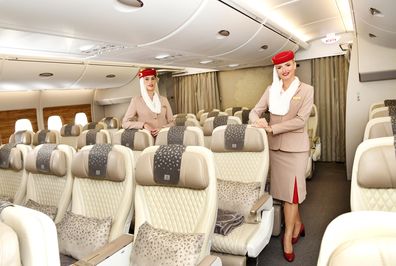
A total of 56 Premium Economy Seats are now available on the airline’s twice-daily service from Sydney to Dubai on board its flagship A380 aircraft.
READMORE:Aussie mum’s shock diagnosis after hip pain
Emirates Premium Economy Cabin has arrived in Australia for the first time. (Supplied)
Flight EK412 touched down in Sydney shortly after 6am.
As part of the celebrations, passengers received exclusive gifts, including certificates, passport holders, special polaroids, and an individual cake.
Customers have been able to book Premium Economy seats since June 1, with the airline recording a significant demand for this cabin since announcing its debut in Sydney.
The A380 Premium Economy also comes with a dedicated airport experience and check-in areas exclusive to the Premium Economy passengers.
On board you’ll enjoy more legroom and footrests and a separate dining experience with elements inspired by Business Class.
READMORE:Passenger slammed for ‘gross’ act on flight
56 seats are now available on the airline’s twice-daily A380 service from Sydney to Dubai. (Supplied)
It comes after Emirates recently held a national recruitment drive, looking for prospective Australian candidates to join its multinational cabin crew team.
The Dubai-based airline held recruitment open days at three locations across the country last month.
Emirates’ Australian cabin crew member, Laura Garside, says that since working with the airline she has visited 45 countries worldwide and has reaped the many benefits that come with living at the airline’s exciting Dubai base.
“Emirates has provided me with not only a dream job, but the incredible training and resources that have allowed me to fully immerse myself in a new career and foreign country,” she said. “This job has given me my happiest moments, greatest achievements and provided me with the most unique, life-changing experience.”
For a daily dose of 9Honey,subscribe to our newsletter here.
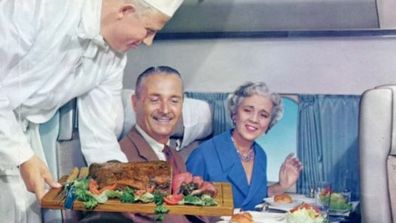
Vintage airline photos shows plane food wasn’t always so bad