From 10am to 4pm today there will be no trains running on the T4 Eastern Suburbs and Illawarra and South Coast rail lines due to ongoing industrial action.
Although the protected action does not officially start until 10am, the head of Sydney Trains predicts impacts from about 6am.
“We urge all our customers to plan ahead by catching alternative public transport or working from home on Wednesday if possible,” Matt Longland said.
He said the line, which runs from Bondi Junction to Bomaderry, would not be fully operational until about 8pm.
Rail, Tram and Bus Union (RTBU) secretary Alex Claassens said union members were fighting for a greater commitment from the government to fix the new intercity fleet.
The RTBU says the fleet, built in South Korea, has a safety flaw which means guards cannot monitor passengers getting on and off the train.
The government has agreed to the safety changes in an enterprise agreement but the union wants a deed of agreement.
Mr Claassens said the NSW government chose to inconvenience customers on the T4 line today by not bringing in trains from other areas.
“90 per cent of our train crews and trains are still available to go form the other regions into that region to provide a level of service,” he said.
“Unfortunately… [Sydney Trains] management made a decision that they weren’t going to run any additional trains on that Illawarra line.”
Monkeypox vaccine rollout goal
There are currently 33 cases of the virus in NSW, two of which were locally acquired.(Reuters: Given Ruvic/Illustration)
The government wants everyone in NSW who takes HIV-prevention medication to be vaccinated against monkeypox before WorldPride 2023.
Health Minister Brad Hazzard said the government was aiming to have the 22,000 people who currently took pre-exposure prophylaxis (PrEP) inoculated before Sydney hosted the pride event next March.
“NSW Health has been working with community partners … including doctors who have a special interest in HIV and sexual health … to support the vaccine rollout,” Mr Hazzard said during Question Time in parliament yesterday.
“With monkeypox cases increasing internationally, it’s expected there will be further cases in NSW and local transmission may increase rapidly.”
Men who have sex with men are considered most at risk of contracting monkeypox, which spreads through skin to skin contact.
There are currently 33 cases of the virus in NSW, two of which were locally acquired.
Vaccines are already being distributed in Sydney and on the Far North Coast, with 5,500 doses being provided by the federal government.
NSW Health expects to receive between 24,500 and 30,000 doses in September and another 70,000 in early 2023.
The symptoms of monkeypox include headache, fever, chills, sore throat, body aches, rash, swollen lymph nodes and fatigue. The rash may initially look like pimples.
Resignation letter sought from building commissioner
The NSW Building Commissioner’s private resignation could be made public amid scrutiny over the conduct of sacked Fair Trading minister Eleni Petinos.
Commissioner David Chandler quit in late July.
The state opposition wants to see Mr Chandler’s resignation letter, amid reports the relationship between Mr Chandler and Ms Petinos had soured.
Debate on a motion to compel the state government to hand over a copy of the letter is expected today.
Ms Petinos was sacked from cabinet last month over bullying allegations.
Bill to ban Nazi symbols passes
A state government bill to ban displays of Nazi symbols in public has passed the lower house with unanimous support.
The bill criminalises knowingly displaying a Nazi symbol in public without a “reasonable excuse”, which includes artistic, academic or educational purposes.
Offenders can face 12 months’ imprisonment or fines of up to $11,000 for individuals and $55,000 for corporations.
Attorney-General Mark Speakman said the bill would provide additional safeguards against hate speech.
“The display of a Nazi symbol undermines our shared values and causes harm and distress to others in the community, including those from the Jewish faith,” he said.
“This bill recognizes that the public display of Nazi symbols is abhorrent, except in very limited circumstances such as for educational purposes.”
The bill will ensure that use of a swastika by religious groups including Buddhists, Hindus and Jains will not be a criminal offence.
Mr Speakman said he expected the bill to pass the upper house and be enacted by next week.
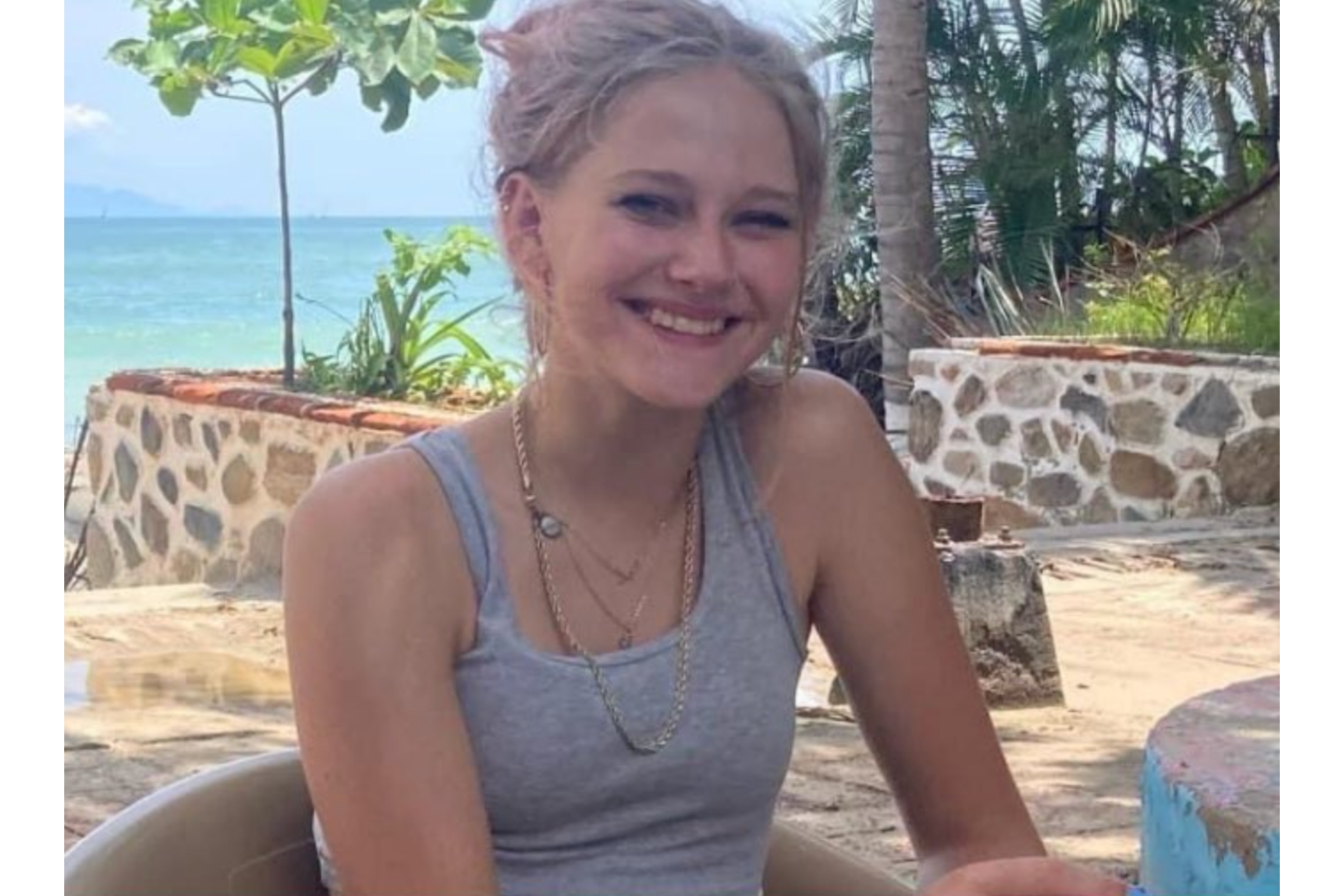
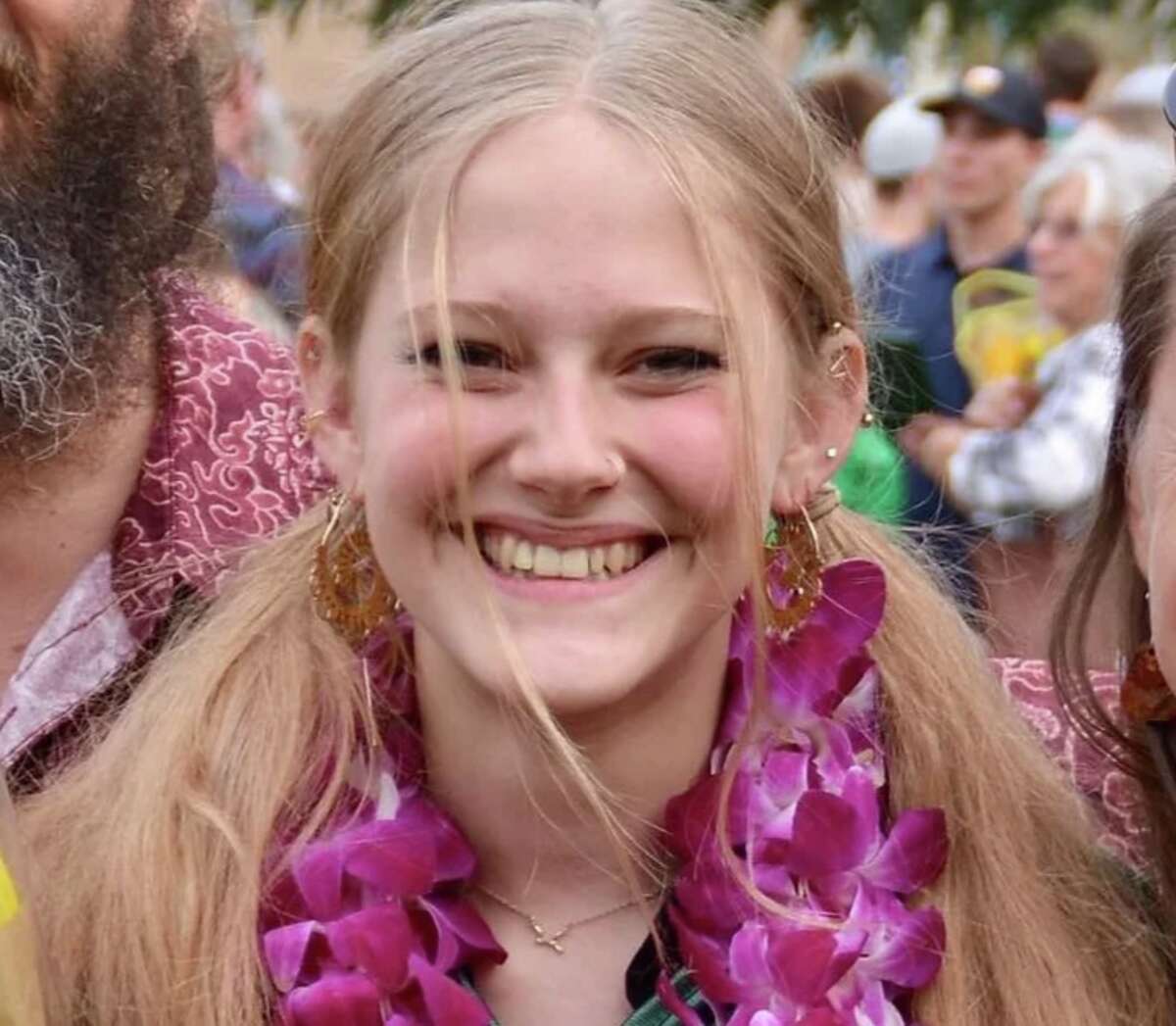
The frantic search for Kiely Rodni continues in the Tahoe area Tuesday after the 16-year-old seemingly vanished into thin air after attending a party over the weekend.
Kiely was last seen around 1:30 am on August 6 near the Prosser Family Campground about 10 minutes north of Truckee. According to the Placer County Sheriff’s Office, she was attending a party “of more than 100 juveniles and young adults.” Her vehicle, a silver 2013 Honda CRV, is also missing, and her phone has been out of service since she disappeared.
The sheriff’s office and FBI are treating the case as a possible abduction because Kiely’s vehicle is still missing. On Monday, search-and-rescue teams fanned out across the area looking for any sign of Kiely. A helicopter was also deployed for aerial sweeps along the I-80 corridor between Donner Summit and the Nevada border.
“Despite the numerous resources we have utilized, Kiely and her vehicle are still missing,” the sheriff’s office said in a statement Monday afternoon. “We are currently coordinating with the California Highway Patrol, Truckee Police, FBI, and the Nevada County Sheriff’s Office as we continue our search for Kiely.”
There are a flurry of online rumors but scant real clues in the case. Friends say Kiely intended to stay at the campground overnight, but they lost track of her in the large party. At least one witness says Kiely was too intoxicated to drive.
Kiely Rodni, 16, has been missing since Aug. 6, 2022 after disappearing while attending a party at a campground in Truckee.
Placer County Sheriff’s Office/Handout
“I know that she wasn’t in the right mindset or state to drive. And if she were to have driven, she wouldn’t have made it far,” a friend told CBS News. “So my concern is that somebody might have offered to drive her home de ella and then did n’t take her home.”
Detectives say they’ve had difficulty getting witness statements due to the age of party-goers and the underage drinking that occurred at the gathering.
“If you are a parent of a child who attended this party or attended yourself, please look at yours or your child’s photos/videos/social media for any images of Kiely potential persons of interest in the background,” states a website run by Kiely’s loved ones. “Someone out of place, someone no one really knows. We are still piecing together a usable timeline; who she may have been with, when she may have left.”
Volunteers will be meeting at the Truckee community rec center this morning to conduct more searches. At 5 pm tonight, friends are hosting a “teen to teen” meetup at the Tahoe City Save Mart parking lot to encourage young witnesses to come forward without adults or law enforcement present.
Kiely is 5-foot-7 and 115 pounds and has blonde hair, hazel eyes and a nose ring. She has multiple piercings and a tattoo of the number 17 on her ribs. Witnesses say she was wearing a black tank top and green Dickies pants at the party. Her silver Honda CRV de Ella has the California license plate 8YUR127. Kiely’s family runs the Lost Trail Lodge in Truckee, about a 12-mile drive from the Prosser campground.
“We just want her home. We’re so scared and we miss her so much and we love her so much,” Kiely’s mother Lindsey Rodni-Nieman said Monday. “Kiely, we love you, and if you see this, please just come home. I want nothing more than to hug you.”
Anyone with information regarding Kiely’s disappearance is asked to immediately contact the Placer County Sheriff’s Office tip line at 530-581-6320, option 7. Callers may remain anonymous.
The ongoing Prison Bar jumper feud has taken a fresh twist, with Collingwood reportedly prepared to offer a teal-coloured alternative to Port Adelaide.
Power president David Koch was fuming earlier this month when he claimed he’d “been played” by the Magpies after the Power’s request to wear their heritage jumper, which features thin black and white stripes in a panel, was again knocked back by the Victorian club.
But the Herald Sun reported on Tuesday night the Pies were prepared to make a minor concession and allow the Power to wear their prison bar jumper once a season … if Port was happy for the white in the panels of the jumper to be replaced by teal stripes.
Watch every blockbuster AFL match this weekend Live & Ad-Break Free In-Play on Kayo. New to Kayo? Start your free trial now >
Collingwood believes the compromise would allow Port to combine its proud SANFL heritage, which includes 36 SA league premierships, with its 25-year AFL history as teal has featured heavily in many Power jumpers since they entered the competition in 1997.
An agreement was put in place when Port Adelaide entered the AFL that the Prison Bar jumper could only be worn in AFL heritage rounds. But as there’s no longer one dedicated AFL-driven round by the AFL, the Power want to don their Prison Bar guernsey for one Showdown against the Crows per year – a request the Magpies have so far denied.
Connor Rozee wearing the Prison Bar strip at training in 2021. Picture: Dean MartinSource: News Corp Australia
“We always have discussions,” Magpies chief executive Mark Anderson told SEN last month, Port is a great football club and we do have great respect for them, so (we are) always happy to sit down and have a conversation and we have since signing that agreement as well,” he said.
“But as we stand here now, the agreement is the agreement.”
NEW FOX FOOTY PODCAST — Finals fight down to 10 amid a Blue’s big bump and Crows camp fallout
Listen below or subscribe in Apple Podcasts or Spotify
Koch said earlier this month he was hopeful clubs could move “past these trivial arguments”, saying the club’s request was “logical, harming nobody and promoting the history of Australian football”.
“What we are asking for is entirely reasonable. To wear our iconic Prison Bar Guernsey in Showdowns to celebrate the heritage of Port Adelaide and South Australian football. Not against Collingwood, just two times a year, in Adelaide. I don’t see how it impacts anyone negatively at all,” he said.
Last year, the Power were threatened with the loss of premiership points if they wore the Prison Bar jumper against the AFL’s ruling for a Showdown.
Cheekily, the team waited until post-match to change out of their playing strip to don the heritage jumper.
For two years, Sarah McLay has dipped into her personal savings, sacrificed a take-home wage and run her central Queensland medical practice at a loss of “several hundred thousand dollars”.
Key points:
A 2021 survey of 846 GPs found 47 per cent of female GPs’ weekly consultations involve mental health
RACGP is urging the federal government for more equitable rebates for mental health-related appointments
Federal Health Minister Mark Butler says the Strengthening Medicare Taskforce will examine potential rebate increases
Regardless of the hours Dr McLay worked or the patients she saw, the numbers did not stack up.
“We were really subsidizing the public’s health care,” Dr McLay said.
“Nothing is ever truly free. Everything costs someone something.”
Most patients probably don’t think about the finances of a medical clinic — and that’s provided you can get into the waiting room in the first place.
Yet financial strain is part of a hidden toll that Dr McLay and other general practitioners say is disproportionately affecting women and adding to skills shortages as burnt-out doctors leave the profession.
A financial and emotional gender disparity has emerged because female GPs tended to see more patients needing longer consultations.
Dr McLay says Clermont will have no permanent doctor if she was forced to close her clinic.(Supplied)
“Yes, I did medicine because I wanted to help people, but I can’t change the reality that our Medicare rebate is actually completely inadequate to pay our bills,” Dr McLay said.
“I can’t keep sacrificing and suffering because the government doesn’t value what we do.”
Short appointments more lucrative
General practitioners across the board have reported struggling to provide care with Medicare rebates that have not increased with inflation.
Louise Stone, a Canberra GP and medical educator said short consultations received a higher rebate per minute than longer appointments.
Dr Stone said she would “earn four times as much” doing back-to-back vaccination appointments than a 40-minute consult for someone with mental health or chronic physical conditions.
Added to this, Dr Stone said GPs were also facing long wait times to find patients specialized help above the mental health help they were trained to deliver.
“This is what I hear from other GPs around the country: the patients that you carry home in your head and worry about, there’s only so long you can do that before it starts to impact your health and wellbeing when there’s a lot we can’ t do,” she said.
“Living with that stress of watching patients that we do care about not being able to get the services they need, eventually that burns you out much more than working hard.”
A 2021 survey of 846 GPs by the General Practice Mental Health Standards Collaboration came to similar conclusions.
Dr Richmond says reducing her hours was the only way to cope with the emotional and financial toll of general practice.(ABC Capricorn: Michelle Gately)
The survey found while male GPs do 49 per cent of all consultations involving mental health, it only accounts for 32 per cent of their weekly consultations.
This is compared to 47 per cent of female GPs’ weekly consultations involving mental health.
“Female GPs, therefore, have the potential to feel the pressure on their time, income and emotional wellbeing more acutely,” the report stated.
‘Many general practitioners feel the same way’
For Rockhampton-based Vicki Richmond, the only way to avoid the “enormous” personal demands of general practice was to work part-time.
“Over the years, I think, I’ve often felt that it was a personal weakness on my behalf,” she said.
“Why couldn’t I cope? Perhaps it was something about me.
“More recently, I’ve recognized that, actually, my experience is not mine alone and that many, many general practitioners feel the same way.”
Dr Richmond said more recognition of the issue was needed.
“To feel every day like you’re not able to actually achieve what needs to happen because of all those other pressures, let alone my own pressures of needing to get home and get dinner on the table and pick up my kids from school,” she said.
“It is a lot to carry, isn’t it?”
Mounting debt for doctors
For Dr McLay, who owns her own practice in Clermont, reducing her hours was not an option.
The only solution she saw for the growing financial hole and mounting pressure was to be frank with her community.
Dr McLay recorded a video and shared it on Facebook, explaining why the clinic could no longer bulk bill appointments.
The reaction was mixed.
Dr McLay said some colleagues warned her to stay quiet and avoid seeming “greedy”, while some community members explained they did not have the money to pay up-front.
But she said most people had a new appreciation for and understanding of the system.
“It’s heart-wrenching because you just want to say, ‘Sure’… but, ultimately, if we keep going like that, we’ll have to shut this business,” she said.
“Then this town will have no permanent doctors.”
Calls for equitable rebates
The Royal Australian College of General Practitioners (RACGP) is calling on the federal government to create more equitable rebates for mental health-related appointments.
RACGP rural chair Michael Clements said this would help GPs while giving patients better access to care and reduce pressure on hospitals.
Mr Butler says the Strengthening Medicare Taskforce will examine potential rebate increases.(ABC News: Che Chorley)
Federal Health Minister Mark Butler said the average out-of-pocket cost for GP services had risen 60 per cent over the past decade.
In a statement, Mr Butler said the government had committed to investing almost $1 billion, which included the Strengthening Medicare Taskforce to examine potential rebate increases and other improvements.
GP practices can also apply for funding to improve equipment and staff skills as part of a $220 million grant program.
While both Dr McLay and Dr Richmond admit there is no quick fix, both believe seeing the human beneath the profession goes some way towards helping GPs feel valued.
“No one goes through the gut-wrenching, challenging experience of university, and then all the special training afterwards because they want money,” Dr McLay said.
“We all got into medicine because we care about people, and we care about outcomes.”
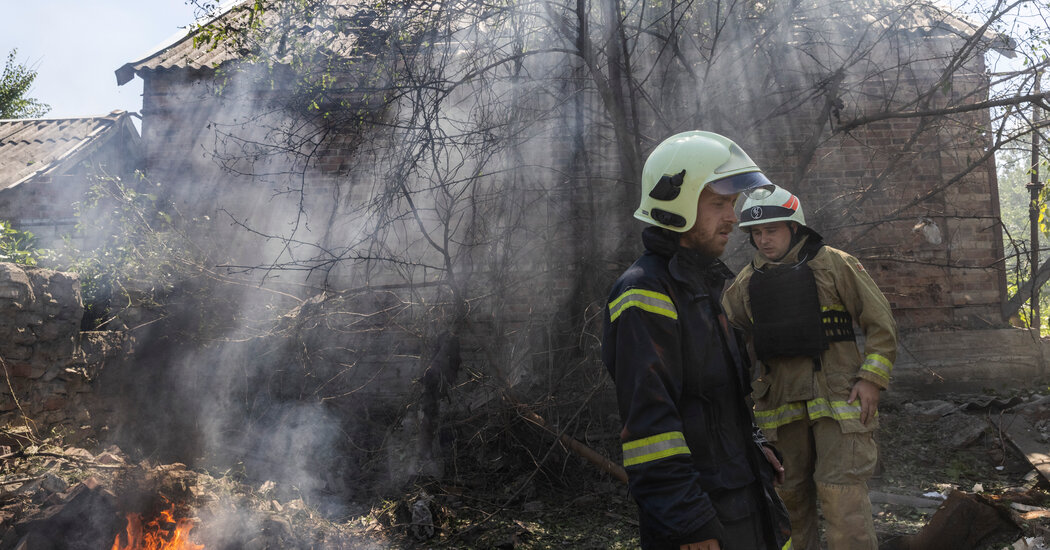
Ukraine claimed responsibility for a rare attack on a Russian air base in the occupied Crimean Peninsula.CreditCredit…Reuters
ODESA, Ukraine — A series of explosions rocked a key Russian air base on the Kremlin-occupied Crimean Peninsula on Tuesday, sending up huge plumes of smoke, killing at least one person and sowing confusion among local officials about what exactly had occurred.
As Russian and occupation officials scrambled to determine the cause, raising the terrorist threat level in the area, a senior Ukrainian military official with knowledge of the situation said that Ukrainian forces were behind the blast at the Saki Air Base on the western coast of Crimea.
“This was an air base from which plans regularly took off for attacks against our forces in the southern theater,” the official said, speaking on the condition of anonymity to discuss sensitive military matters. The official would not disclose the type of weapon used in the attack, saying only that “a device exclusively of Ukrainian manufacture was used.”
A Ukrainian attack on Russian forces in the Crimean Peninsula would represent a significant expansion of Ukraine’s offensive efforts, which until now have been largely limited to pushing Russian troops back from occupied territories after Feb. 24, when the invasion began.
It would also be an embarrassment for President Vladimir V. Putin of Russia, who often speaks of Crimea, which he illegally annexed from Ukraine in 2014, as if it were hallowed ground.
Ukraine possesses few weapons that can reach the peninsula, aside from aircraft that would risk being shot down immediately by Russia’s heavy air defenses in the region. The air base, which is near the city of Novofederivka, is nearly 200 miles from the nearest Ukrainian military position.
Videos verified and reviewed by The New York Times show that a plume of smoke was rising from the air base just before the explosions. There were at least three explosions: two in quick succession and a third a few moments later. It is unclear from the videos what caused the blasts. In addition, a video uploaded to social media shows at least one warplane, an Su-24M, completely destroyed on the tarmac at the base.
The senior Ukrainian official said the attack involved partisan resistance forces loyal to the government in Kyiv, but he would not disclose whether those forces carried out the attack or assisted regular Ukrainian military units in targeting the base, as has sometimes occurred in other Russian-occupied territories.
To reach targets deep behind enemy lines, Ukraine has increasingly turned to guerrillas in Russian-occupied territories, officials said. Partisans, for instance, have helped Ukrainian forces target Russian bases and ammunition depots in the Kherson Region, Ukrainian officials say.
Publicly, Ukrainian officials on Tuesday would not confirm the involvement of Ukraine’s military. Ukraine’s defense ministry said in a statement that it could not “determine the cause of the explosion,” and suggested that personnel at the base adhere to no-smoking regulations.
Other officials did not exactly deny that Ukraine was behind the explosion.
“The future of the Crimea is to be a pearl of the Black Sea, a national park with unique nature and a world resort, not a military base for terrorists,” Mykhailo Podolyak, a senior adviser to President Volodymyr Zelensky of Ukraine, said in to tweet. “It is just the beginning.”
Russia’s Defense Ministry said in a statement that the explosion was caused by the detonation of stockpiled ordnance for warplanes at the base. While the ministry offered no speculation about whether Ukrainian forces might have been involved, the decision by Crimea’s Kremlin-installed leader, Sergei Aksyonov, to raise the terrorist threat level to yellow suggested that officials were concerned about security on the peninsula.
“This measure is exclusively prophylactic, because the situation in the region is under full control,” Mr. Aksyonov said in a statement on Telegram.
In the eight years of Russia’s occupation of Crimea, the peninsula has transformed from a quiet southern Ukrainian beach destination into a major base of military operations. The Saki Air Base is home to Russia’s 43rd Separate Naval Attack Regiment, which is part of the Black Sea Fleet. Ukraine’s military intelligence service has accused pilots from the regiment of committing war crimes by bombing civilian areas during the war.
Shortly after the explosion occurred, Mr. Aksyonov arrived at the scene. Standing in front of a large black plume of smoke, he said that a three-mile perimeter had been erected around the site of the base to protect residents.
“Unfortunately, one person died,” he said. “I express my most sincere sympathies to family and friends.” Crimea’s health ministry said that at least nine people had been injured.
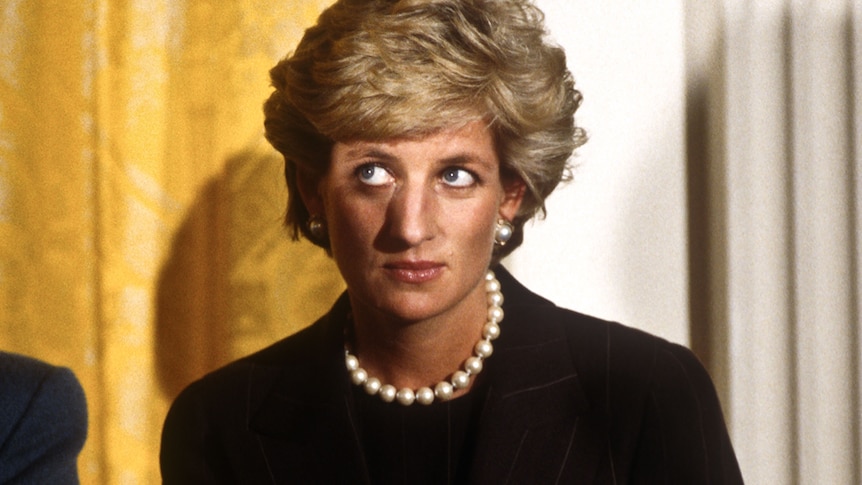
“All we do is take pictures,” says an unseen paparazzo midway through the new Princess Diana documentary, The Princess. “The decision to buy the pictures is taken by the picture editors of the world, and they buy the pictures so their readers can see them. So at the end of the day, the buck stops with the readers.”
It’s a cop-out, of course, and just one of the many unsettling voices laid over the film’s archival tapestry of news footage, television clips and tabloid shots, which resembles less historical record than it does some kind of elaborate media simulation; a woman’s life manufactured and sold to an eager public until her handlers decided she was expendable.
But the remark does summon those age-old specters of supply and demand. Who really killed Diana that fateful day in 1997, when her Mercedes collided with a Parisian pole at high speed? Was it the paparazzi? The Queen? Might it have been – to paraphrase Sympathy for the Devil – you and me?
After their divorce in 1996, Diana stayed in the Kensington Palace apartment she’d shared with Charles until her death the following year.(Supplied: Madman)
As one of the reigning titans of late-20th-century monoculture, the Princess of Wales was both a harbinger of our current 24/7 celebrity obsession and the last – alongside her fellow superstar deer-in-the-spotlights, Michael Jackson – of a literal dying breed of stars, their colossal fame complicated by narratives often dependent on, and at the mercy of, a ruthless media.
Comprised entirely of archival footage, the film captures the short, meteoric life of the world’s most photographed woman through the eyes of the mass media that surveilled her, moving from the tail end of Diana Spencer’s teenage years to the turbulent events of the 90s that played out across the tabloids.
It’s an approach that’s become more common in documentary cinema in recent years, especially in films that tangle with beloved famous figures, such as Asif Kapadia’s Amy, or the forthcoming David Bowie tribute Moonage Daydream; these are works that eschew talking heads and downplay overt editorialising, allowing the footage to speak for itself. (Frederick Wiseman, venerable master of the form, is owed quite a few checks.)
Director Ed Perkins, who was Oscar-nominated in 2019 for his short film Black Sheep, has a sound grip on the style. He understands the inherent power of editorial silence, of allowing the footage to evoke our collective memories of Diana, and to implicate us as viewers in the process.
The effect is both nostalgic – it’s a time we’ll never see again, buried in the fuzzy grain of U-Matic history – and eerily prescient, anticipating the current social media-fueled era of celebrity obsession. Diana’s fame was the 80s and 90s equivalent of a life lived extremely online, filtered through endless screens over which she had little control. She did n’t seem like a real person – until the shock of her mortality proved otherwise.
From the earliest footage, quaint by the standards of what was to follow, in which the shy, shag-cut teenager is questioned about her burgeoning relationship with the Prince of Wales, it’s clear that Diana is staring down a long and gruelling road of media scrutiny.
The film includes footage from the BBC’s Panorama interview, which was discredited after an independent review found it used “deceitful tactics”.(Supplied: Madman)
There are some early, eyebrow-raising moments: Charles, 12 years Diana’s senior, interviewed on British TV just before their wedding, remembers his first meeting when she was a “bouncy and attractive 16-year-old.” One news commentator cheerfully announces that Diana’s father de ella – in the year 1981, though you’d think it was the 19th century – “even vouched for her virginity de ella”.
Things are already fraught by the time the film lays out the couple’s famous nuptials, a fairytale-like event that gripped – and distracted – an economically depressed nation plagued by unemployment and a rising National Front. (“Don’t do it, Di!” announces one cheeky badge sold on the day; it must be a collector’s item.)
Seen here, the marriage – and the births of Princes William and Harry in 1982 and 1984 – seems less celebratory than chilly, with Perkins and his editors cutting almost immediately from the wedding to arrival of Diana’s sons, as though she was merely conscripted to crank out her husband’s heirs and secure his succession to the throne.
The Princess is Perkins’s second feature-length documentary. His short documentary Black Sheep was nominated for an Oscar in 2019.(Supplied: Madman)
In one creepy scene, Diana, holding baby William, is flanked by the Queen and the Queen Mother, who look less like benign monarchs than the doting-but-devilish old neighbors of Rosemary’s Baby, delighted that their young bride has born seed.
It’s only when Diana begins to emerge as her own person that she becomes a figure of inconvenience; her style, charm, and ability to connect with the people soon eclipsing the appeal of her archaic family.
Yet as one TV talking head notes: “When you put a modern person in an ancient institution, they will be destroyed.”
The Princess quietly builds an impression of a woman with little to no agency in her own life, who’d been ushered into an institution as a teenager without experiencing the outside world. Diana was bound to crack – a familiar narrative that resurfaced, in abstracted horror-movie form, in Pablo Larraín and Kristen Stewart’s collaboration on Spencer earlier this year.
Perkins offers a dramatically scored scene of royal hounds tearing apart a rabbit to underscore Diana’s plight, while teasing clips in which Camilla Parker Bowles – Charles’s longtime lover – lurks at the edges of the frame, anticipating the end of the fairytale marriage whose collapse would play out in the tabloids.
It’s in these late sequences – so-called Dianagate, “annus horribilis”, the bombshell interview with Martin Bashir – that the true ugliness of the media takes shape, while Charles and Diana lob shots at each other for the nation to see.
In one of the film’s most affecting moments, Diana strides through an airport using a tennis racquet as a shield against a paparazzi scrum – yet can’t help but stop to accept flowers from a little girl, even in this horrific moment.
“This story has been told very widely. The question that really interested me was, ‘what does [it] tell us about ourselves?'” Perkins told IndieWire.(Supplied: Madman)
There’s nothing in The Princess that we haven’t seen before, no historical revelation to the narrative, but its construction possesses a quiet, eerie grace.
Funeral footage of Diana’s coffin being carried from Westminster Abbey echoes her fairytale appearance on the steps of St. Paul’s Cathedral on her wedding day – 16 years apart, but, thanks to cinema’s uncanny ability to compress time, seeming like they bookended the same long, turbulent day.
It’s as though the princess emerged from her wedding directly into a casket.
The sense of inevitability – of our own role in manifesting these images – only makes it more haunting.
Native trees like the paperbark are central to the culture of the traditional owners of K’Gari (Fraser Island).
“These species are living stories,” says Matilda Davis, who works with the Butchulla Aboriginal Corporation as a biosecurity and climate change officer on the World Heritage-listed island.
Matilda Davis has been checking the health of trees after wild fires on K’gari (Fraser Island).(Supplied: Matilda Davis)
Apart from many being edible or medicinal, these trees have ancestral and spiritual connections, and are key to the health of Butchulla country, she says.
For example, the paperbark (Melaleuca quinquenervia)—called “deebing“ by the Butchulla people — can let them know when it’s safe to sustainably harvest certain foods.
“When the deebing flowers, it’s a seasonal indicator for particular kinds of seafood,” Ms Davis says.
Paperbark and other tea-trees belong to a large family known as Myrtaceae, which also include eucalypts, lilly pillies, bottlebrushes and guavas.
But a pandemic of an invasive fungal disease is making it harder for some Myrtaceae species to bounce back after intense bushfires.
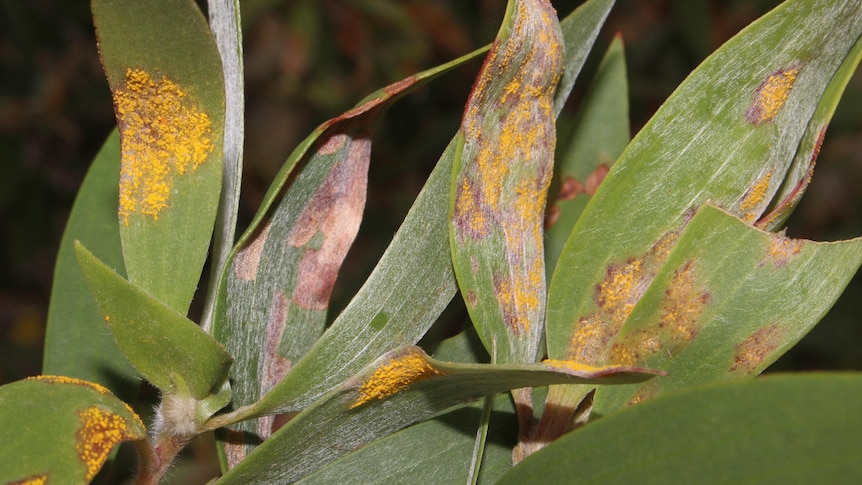
Myrtle rust (Austropuccinia psidii), which can appear as a bloom of golden spots on leaves, can suck the life out of new growth.
The disease, which was first detected on K’gari in 2013, is a real worry for the Butchulla, Ms Davis says.
“Myrtle rust is threatening our ability to practice culture.”
The ‘other pandemic’: the spread of myrtle rust
Myrtle rust originally comes from South America, where the native Myrtaceae species have co-evolved a natural resistance to it.
But, the plant fungus has jumped from the wild — not unlike the virus that causes COVID-19 — and become a “pandemic strain”, causing disease across the globe.
The pandemic strain (see pink) is the most wide-spread strain of myrtle rust.(Supplied: Alistair McTaggart)
Its tiny spores have hitched a ride on the wind or on people’s clothes, with globalization playing a key role in the spread.
The disease has proven devastating to many “naïve” species of Myrtaceae that did not evolve with fungus.
Since it landed in Australia in 2010, it has infected forests in New South Wales, Queensland, Victoria, the Northern Territory, Tasmania and most recently Western Australia.
Tiny myrtle rust spores, which are so light they can spread on the wind, as seen under the microscope.(Supplied: Geoff Pegg)
Fungus targets growing tips of plant
When the fungus lands on species susceptible to infection it can robthe plant’s cells of nutrients, and kills off the growing tips — the new leaves, stems, flowers and fruit.
The plant is forced to put more energy into new growth, but if the plant cannot fight off the fungus, it becomes re-infected.
Midyim berry fruits are being attacked by the fungus before they can even mature.(Supplied: Matilda Davis)
“So you get this repeated cycle of growth and dieback and eventually the plant runs out of reserves and declines,” says forest pathologist Geoff Pegg of the Queensland Department of Agriculture and Fisheries.
Dr Pegg has been working to document the impacts of myrtle rust on trees impacted by fire, including on K’Gari where he is collaborating with Ms Davis and the Butchulla Aboriginal Corporation.
A shrub called midyim berry (Austromyrtus dulcis) is among the Myrtaceae species affected on K’Gari.
The plant is important for the health of the country, Ms Davis says.
She says many animals depend on the berry, which is “sweet with a distinct aftertaste.”
But myrtle rust affects the formation of the flowers and tasty berries in plants growing in areas recovering from bushfire.
‘Unprecedented’ extinction event of rainforest species likely
A recent survey of rainforests in Eastern Australia predicted a “plant extinction event of unprecedented magnitude” due to myrtle rust.
“Sixteen speciesare doomed with extinction within a generation,” says co-author of the survey, Rod Fensham, a plant ecologist from the University of Queensland.
Among the most at risk were the thready-bark myrtle (Gossia inophloia) and native guava (Rhodomyrtus psidioides).
And a further 20 species could be at risk.
“It’s an extraordinary example of a disease phenomenon,” he says.
“It’s a pretty profound event.”
Native guava (Rhodomyrtus psidioides) is at risk of going extinct thanks to myrtle rust.(Supplied: Glenn Leiper)
Dr Pegg has also seen the devastating effects of myrtle rust on the east coast, and not just in rainforests.
“There are thousands of dead trees in some sites that we’ve looked at.”
He points to one forest at Tullebudgera not far from the Gold Coast, where there were 3,400 dead trees per hectare.
When he started the study in 2014, the high-rainfall forest was dominated by Myrtaceae species such as eucalypts and silky myrtle (Decaspermum humile).
Now most of seedlings that are surviving are non-Myrtaceae natives, and weeds like lantana and camphor laurel.
All mature silky myrtle trees (Decaspermum humile) are now dead at the Tallebudgera study site, Dr Pegg says.(Supplied: Geoff Pegg)
fire and rust
While Dr Fensham doesn’t count paperbarks among the worst affected trees, others like Dr Pegg emphasize they are still at risk, especially after bushfires.
“We’ve seen quite significant impacts in some sites,” Dr Pegg says.
Bob Makinson of the Australian Network for Plant Conservation is also worried about paperbarks from a biodiversity perspective.
Paperbark trees (Melaleuca quinquenervia) vary in their susceptibility to myrtle rust.(Supplied: Glenn Leiper)
Even without sending paperbarks extinct, he says, the impact of myrtle rust on such species could have broader implications for the ecology.
“The paperbark is such an important tree for wetlands and riverbanks where there are not many other trees that can tolerate the water-logging conditions there,” Mr Makinson, a conservation botanist, says.
“This species is important for providing shade on the water, for reducing erosion and for keeping freshwater wetlands running.”
Paperbark forests play an important ecological role.(Supplied: Glenn Leiper)
And, he adds, insects, birds and flying foxes rely on the paperbark’s flowers.
“We don’t know what the knock-on effects will be of reduced flowering in those populations that are severely affected by myrtle rust,” Mr Makinson says.
Some individual trees in a species are more resistant to myrtle rust — just as some of us appear to be naturally more resistant to COVID-19.
But Dr Pegg says only 15 to 35 per cent of paperbark seedlings in New South Wales study sites have shown natural resistance to the fungus.
Ms Davis says another species on K’Gari that’s being “smashed” by fire and rust is the the Satinay (Syncarpia hilli).(Supplied: Matilda Davis)
What about eucalypts?
During the 1970s, myrtle rust decimated eucalypts in Brazil, where they were planted as an exotic tree.
Thankfully, testing so far has showneucalypts growing natively in Australia have promising levels of resistance, although there is some concern about a few eucalypt species.
And just as we’ve had to worry about the rise of more infectious strains of COVID-19, new strains of myrtle rust may be on the way.
This Plunkett mallee (Eucalyptus curtisii) is one eucalypt that could be at risk from myrtle rust.(Supplied: Glenn Leiper)
In fact, last year, Brazilian scientists reported the evolution of a new “highly aggressive” fungus that was attacking eucalypt plantations in that country, which had been bred to be resistant.
“An introduction of a new strain like that to Australia could actually increase the risk to our eucalypts,” Dr Pegg says.
Stopping the spread to save species
To stop the spread of the disease to new areas, quarantine is essential – as is monitoring.
When the fungus reached the Northern Territory in 2018, this kicked off a monitoring program which subsequently picked up myrtle rust in the Kimberley region of Western Australia.
Symptoms of myrtle rust can appear variable and are sometimes hard to identify the disease unless the plants are dripping with what some have described as a “yellow sludge” of spores.
Botanic gardens and others are using every tool in the book to identify plants with natural resistance to myrtle rust.
The idea is to preserve seed or other biological material which could be crucial in saving species.
And, it wouldn’t be a pandemic without a vaccine in the wings — Australian scientists hope to use RNA-interference vaccines to get the fungus to self-destruct.
Another tree at risk of extinction is the thready bark myrtle (Gossia inophloia), which has edible fruit.(Supplied: Glenn Leiper)
But you can also help by washing your clothes (including hat!) if you’ve been in the bush in affected states, and by following quarantine rules.
And think about planting threatened species in your backyard.
Dr Fensham suggests that native guavas can make a nice addition to the home garden.
“We need more people committed to growing these things and trying to get them to reproduce,” he says.
Avoiding ‘upside-down country’
Meanwhile, back on K’Gari, Ms Davis hopes to collect seeds from paperbarks and other affected trees in an effort to conserve genetic diversity, which will be key to their survival.
And she wants to see a shift away from “bad fires” with high flames that leads to a reverse in the color scheme of forests—resulting in brown burnt treetops and green new growth below.
“That is a good indicator for us that that country is stressed,” she says.
“We call it upside-down country.”
After an intense hot fire the colour-scheme of forests can be reversed.(Supplied: Matilda Davis)
She says evidence links cooler, less-intense fires with lower impacts from myrtle rust infection.
So she’d like to see a move towards traditional “Galangoor gira” — or “good fire” — practices, something Dr Pegg agrees could be explored in the future.
Ms Davis says the “positive and respectful” partnership with scientists like Dr Pegg is allowing for a two-way learning, placing traditional custodians of the land at the center of the response to ecological problems like myrtle rust
“I do believe the answers are in our old people’s ways.” she says.
A hostage situation in Edgewater ended with three people dead Monday night. Police are calling it a double murder-suicide. It happened in the area of Ridgewood and East Knapp Avenue. A suspect walked into a Narcotics Anonymous meeting, shot a man and took a woman hostage, according to Edgewater police. The rest of the people at the meeting, about 20, escaped. Edgewater police spent hours trying to talk the suspect out of the building, but the SWAT team finally had to break through the door to get in and find the victims. When they breached the door, they found the original victim, the woman, and the shooter all dead. The victims were identified as 59-year-old Ian Greenfield and 33-year-old Erica Hoffman. The accused shooter was 49-year-old Quinton Hunter, who went by the nickname “Rags.” Police say the incident stemmed from a love triangle. Hunter was the ex-boyfriend of Hoffman, who was in a new relationship with Greenfield. Police say Hunter went on Facebook live while inside the building at the Narcotics Anonymous meeting after he shot Greenfield but before he shot Hoffman. In the video, he’s just staring at the camera and breathing strangely, police say. Police say Hunter has an extensive criminal history. If you or someone you know is struggling, there are resources available: Harbor House of Central Florida 24-hour confidential crisis hotline: (407) 886-2856 Victim Service Center of Central Florida 24/7 helpline : (407)-500-HEALNational Domestic Violence Hotline 24/7 and in English and Spanish: 1-800-799-7233United Way of Central Florida 2-1-1 services: Call or text 211 for confidential domestic abuse support, and other services. If you or someone you know may be contemplating suicide, call the National Suicide Prevention Lifeline at 1-800-273-8255 or text HOME to 741741 to reach the Crisis Text Line.
EDGEWATER, Fla. —
A hostage situation in Edgewater ended with three people dead Monday night.
Police are calling it a double murder-suicide. It happened in the area of Ridgewood and East Knapp Avenue.
A suspect walked into a Narcotics Anonymous meeting, shot a man and took a woman hostage, according to Edgewater police. The rest of the people at the meeting, about 20, escaped.
Edgewater police spent hours trying to talk the suspect out of the building, but the SWAT team finally had to break through the door to get in and find the victims.
When they breached the door, they found the original victim, the woman, and the shooter all dead.
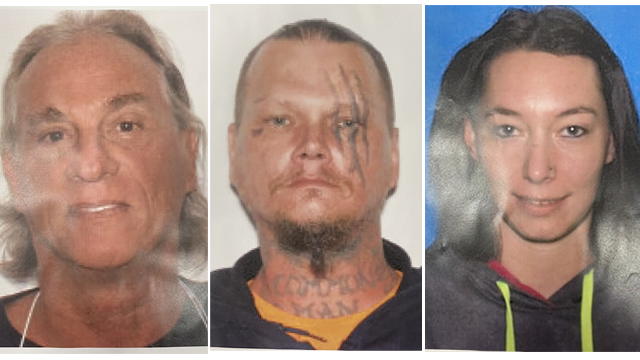
The victims were identified as 59-year-old Ian Greenfield and 33-year-old Erica Hoffman. The accused shooter was 49-year-old Quinton Hunter, who went by the nickname “Rags.”
Police
(Left to right) Greenfield, Hunter, Hoffman
Police say the incident stemmed from a love triangle. Hunter was the ex-boyfriend of Hoffman, who was in a new relationship with Greenfield.
Police say Hunter went on Facebook live while inside the building at the Narcotics Anonymous meeting after he shot Greenfield but before he shot Hoffman. In the video, he’s just staring at the camera and breathing strangely, police say.
Police say Hunter has an extensive criminal history.
If you or someone you know is struggling, there are resources available:
Harbor House of Central Florida 24-hour confidential crisis hotline: (407) 886-2856
Victim Service Center of Central Florida 24/7 helpline: (407)-500-HEAL
National Domestic Violence Hotline 24/7 and in English and Spanish: 1-800-799-7233
United Way of Central Florida 2-1-1 services: Call or text 211 for confidential domestic abuse support, and other services.
If you or someone you know may be contemplating suicide, call the National Suicide Prevention Lifeline at 1-800-273-8255 or text HOME to 741741 to reach the Crisis Text Line.
Nigella Lawson is delighting Australian viewers with her My Kitchen Rules debut.
The British home cooking queen, who has replaced controversial chef Pete Evans on the 2022 season of Channel 7 reality series, has managed to reinvigorate the struggling franchise with her on-screen charisma and star power.
And even though she’s been on the culinary circuit for decades, people have been surprised to learn of the food writer’s real age.
Lawson, who published her first cookbook in 1998 before breaking onto TV with her own show Nigella Bites the following year, turned 62 in January. Yes, you read that right.
Lawson, who has two children with her first husband, late journalist John Diamond, recently credited her youthful looks to avoiding sun exposure and eating “lots of fats.”
She also previously told Oprah.com she was “trying to go with” aging.
“I think what ages a face most is disappointment and a lack of enjoyment. So I try to do what I love,” she said.
The 12th season of the Channel 7 cooking show follows a two-year hiatus for MKRwhich suffered declining ratings in 2019 and 2020.
Presumably in a bid to compete with its rival prime-time show, Channel 9’s Married At First Sight, the series was copping criticism for overdoing it on the dramatics and straying from its humble roots.
In an effort to bolster the franchise, the network parted ways with original judge Evans following a slew of controversies, and promised the series would be bouncing back to its core values of “real food and real people” in 2022.
It’s understood Lawson will only feature in half of the season, with former MasterChef judge Matt Preston joining Feildel for the back half. Celebrity chefs Colin Fassnidge and Curtis Stone are also set to return as guest judges.
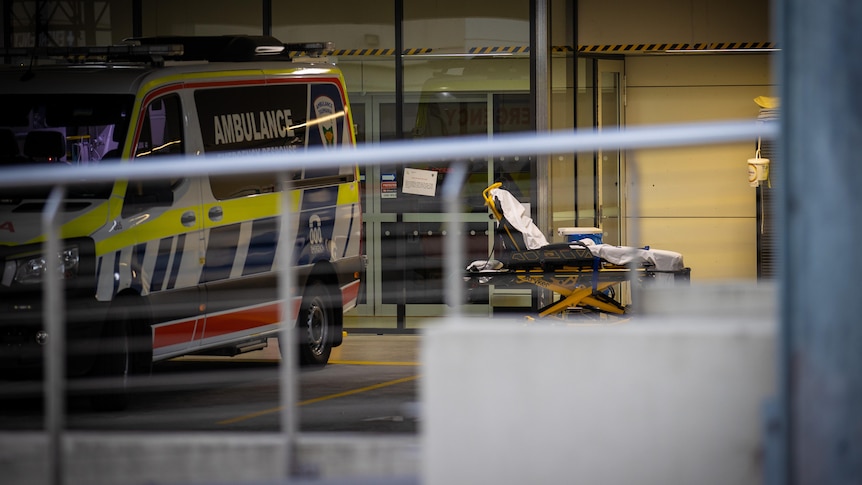
The death of a woman in her 70s who was ramped and waiting to be admitted to a Tasmanian hospital’s emergency department for more than nine hours is “totally unacceptable” and shows the state’s health system is crumbling, a union says.
Key points:
Ambulance ramping happens when hospital emergency departments are full and cannot admit new patients
In June this year, 52 per cent of patients were seen on time at the LGH ED, according to Tasmania’s Health Department
Tasmanian Health Department secretary Kathrine Morgan-Wicks says a formal review of the case is underway
The union that represents paramedics in Tasmania said the woman was taken to the Launceston General Hospital about midnight on Friday night, and died at about 9am on Saturday.
“The patient had been ramped for nine hours at the time when they passed away, and they were still in an inappropriate setting and had not been allocated a bed at that time,” said Robbie Moore from the Health and Community Services Union (HACSU) .
“This is a very sad situation that just demonstrates how bad our health system is, that we couldn’t have a bed available for a patient who clearly needed medical assistance, and shows that ambulance ramping is out of control and patients’ lives are being put at risk.”
Ambulance ramping happens when hospital emergency departments are full and cannot admit new patients.
Paramedics care for the patients they have transported in an area of the hospital outside of the emergency department.
Mr Moore said the patient received care from emergency department staff while they were waiting for an ED bed to become available, and was also cared for by ambulance paramedics.
“A patient being ramped for nine hours is totally unacceptable, and demonstrates that we are letting down the Tasmanian community,” he said.
“Unfortunately this is not an isolated incident … we’re unfortunately aware of several other incidents where patients have been unable to get a bed and passed away on the ramp.”
Nursing staff ‘distraught’ at conditions in LGH emergency department
The Australian Nursing and Midwifery Federation’s Tasmanian secretary Emily Shepherd said on the night the woman was brought to the hospital, the LGH’s emergency department was full, with 20 patients waiting to be admitted to beds in other parts of the hospital, about 50 people in the ED waiting room, and seven ambulances ramped up.
“It’s incredibly concerning [to have a patient die on the ramp],” she said.
“Our members have been absolutely distraught for many years about the situation in the LGH emergency department, and indeed across the state.”
Ms Shepherd said nurses, doctors and paramedics did their best to care for patients who were waiting to be admitted to the ED.
“We’ve got patients receiving care not only on the ramp but also in waiting rooms surrounded by dozens of other people.
“Clearly the environment and circumstances upon which care is being delivered is sub-optimal, of course our members would like to see every patient presenting to the emergency department moved into a cubicle and cared for appropriately in the appropriate environment and the appropriate space.
“But we know for many years now that unfortunately that just isn’t the case.”
Space to play or pause, M to mute, left and right arrows to seek, up and down arrows for volume.
What is bed block?
Patients spend twice as long at LGH ED as at comparable hospitals
Access-block, also known as bed-block, is the root cause of ambulance ramping.
It occurs when acute beds in hospitals are full, so patients in the emergency department cannot be admitted to the hospital, meaning new patients cannot be admitted to the emergency department.
In 2019, the Australian College of Emergency Medicine determined the Launceston General Hospital’s ED suffered the worst access block in Australia.
According to the Australian Institute of Health and Welfare, up to 10 per cent of patients spent more than 16 hours at the LGH ED, compared with more than eight hours at comparable hospitals nationwide in 2020-21.
While the number of patients presenting at the LGH ED has barely changed over a decade, the number of emergency presentations has nearly doubled from 3,228 in 2011-12 to 6,117 in 2020-21.
In June this year, 52 per cent of patients were seen on time at the LGH ED, according to Tasmania’s Health Department.
Formal review into ramping death underground
Tasmanian Health Department secretary Kathrine Morgan-Wicks said a formal review of the case was underway.
“As is the case whenever a patient dies in our care, we take this matter very seriously and we give our sincere condolences to the family and friends of this patient,” Ms Morgan-Wicks said.
“The Launceston General Hospital and Ambulance Tasmania will be conducting a root cause analysis to fully review and understand the circumstances around this patient’s death.”
Ms Morgan-Wicks said she could not comment further due to patient confidentiality.
Asked on Tuesday about what the state government was doing to reduce ambulance ramping, Premier and Health Minister Jeremy Rockliff said his government had employed an extra 870 frontline health staff over the past 12 months and was working on system improvements.
“It’s about ensuring that we get the access and flow from triple zero right through to patient discharge through our hospital system and through our emergency department,” he said.
“And it’s those system improvements that are so crucially important, as well as, of course, the investment into staff and infrastructure resources.”
According to the Australian Institute of Health and Welfare, up to 10 per cent of patients spent more than 16 hours at the LGH ED.(ABC News: Luke Bowden)