Categories
Sports

Ken Hinkley will coach Port Adelaide in 2023 says David Koch, Power contract

Port Adelaide president David Koch has emphatically declared Ken Hinkley will see out his current contract and coach the club in 2023.

A question mark had been hovering over Hinkley and his position at the Power, despite being contracted to the club until next year and his defiant AFL 360 interview on Monday night where he said he expected to be at Alberton next year.

Amid mounting criticism over Hinkley’s coaching from fans, Koch said earlier this week “every single person’s role” would be assessed at the end of the season, which has seen the Power drop out of finals contention after back-to-back preliminary final runs.

Watch every blockbuster AFL match this weekend Live & Ad-Break Free In-Play on Kayo. New to Kayo? Start your free trial now >

Koch spoke on 5AA radio on Monday and conceded the club was “not afraid to make change.” His comment from him, “turn it around or watch out”, fueled speculation there could be sweeping changes to the club’s football department.

But Koch confirmed to 7 News Adelaide on Thursday night Hinkley would remain at Alberton.

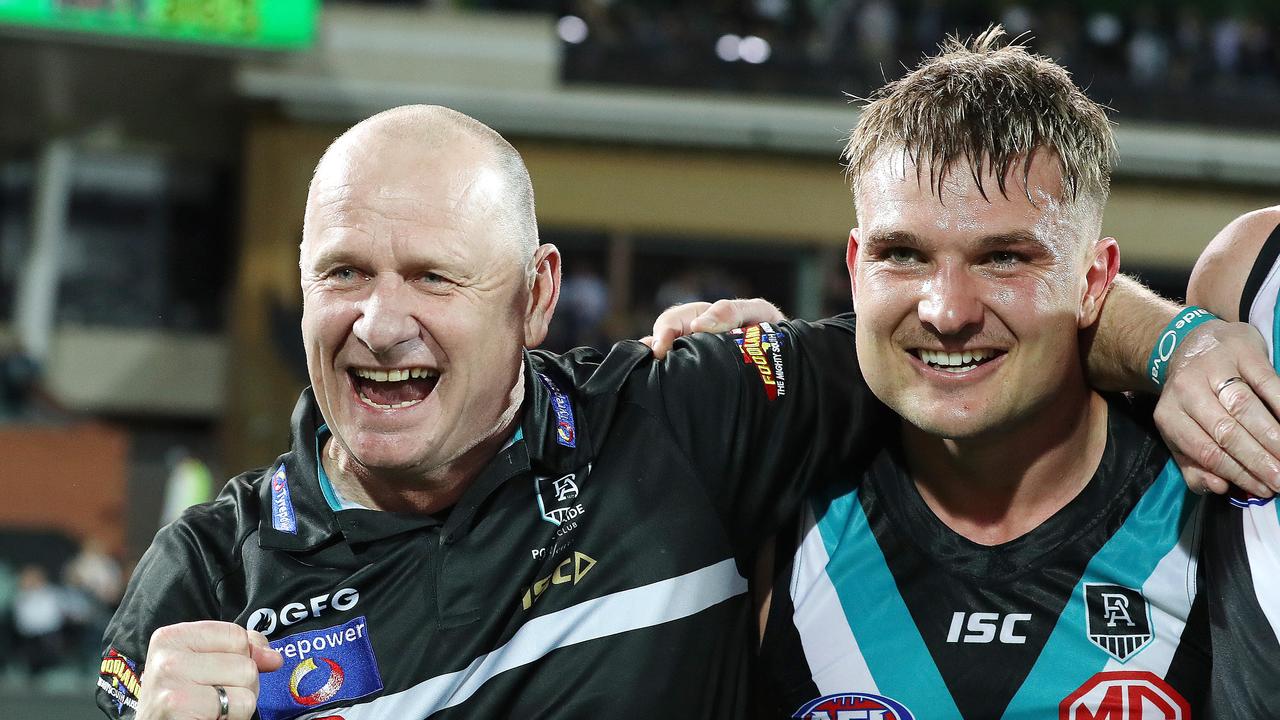
Port Adelaide coach Ken Hinkley with Chairman David Koch.Source: Twitter

“Obviously, for all of us, this season has been a major disappointment … (and) as we always do, we’ll thoroughly assess our football program at season’s end,” Koch told 7 News Adelaide.

“But, as the club has maintained all year, Ken Hinkley is contracted and will be our coach in 2023

“Prior to this season, Ken led us to two consecutive preliminary finals.

“Some will argue we should make a change based on our performance this season alone and that Ken has never taken the team to a grand finale.

“But we base decisions on all the information in front of us.

“We believe Ken gives us the best chance of successfully rebounding next season, of successfully attracting new talent and football department resources to make us better.”

NEW FOX FOOTY PODCAST — Finals fight down to 10 amid a Blue’s big bump and Crows camp fallout

Listen below or subscribe in Apple Podcasts or Spotify

Speaking on Fox Footy’s AFL 360 on Thursday night, St Kilda champion Nick Riewoldt said it was a “big backflip” from Koch that should never have happened.

“I like it from the point of view that it provides fodder for all of us to talk about, but Ken Hinkley must get to the end of the week and think: ‘What did I just go and endure – and for what?’” a passionate Riewoldt said on AFL 360.

“So Kochie comes out on Monday saying what he said after the CEO, the footy manager, everyone else in the club has been on the same page – and five days later he backflips on the statement? He could’ve said on Monday what he said tonight, but he chose not to – and by omission, he put Ken Hinkley under ridiculous, undue pressure this week. It was really poor.

“I think Ken’s probably got a reasonable tolerance for it now after all of this time, but I’d be scratching my head.”

Hinkley is Port’s second longest serving coach, behind the club’s sole AFL premiership coach in Mark Williams.

In his 10 seasons in charge, Hinkley has steered the Power to finals in four seasons and has a 60.8 per cent win rate from his 212 games as coach.

When asked directly on AFL 360 if he felt any uncertainty as coach after Koch’s “turn it around or watch out” comments, Hinkley replied: “No, no I don’t”.

Koch statement awkward for Hinkley? | 01:36

“David (Koch) himself has said that he expects me to be coaching Port Adelaide in 2023, as I do and that’s what I am preparing for,” he said.

“I think I’ve been given enough assurances (he’ll see out his deal) through the season, not that I needed them to be fair.

“We all get there’s a finish line for everyone at some point.

“But as I sit here tonight, I’m more than confident that that won’t be at the end of 2022.”

Hinkley said despite the outside pressure, his players “100 per cent” continued to back him in for an 11th season in 2023 – and final year of his current contract — saying:

“My players, they play for me every week. They play for us every week.

.

Categories
US

Karine Jean-Pierre roasted over ‘Orwellian’ tweet touting ‘0% inflation’

President Biden’s top spokesperson was accused of lying on Wednesday in a tweet touting “0% inflation in July” — even as federal data indicated that the consumer price index rose by 8.5% year over year.

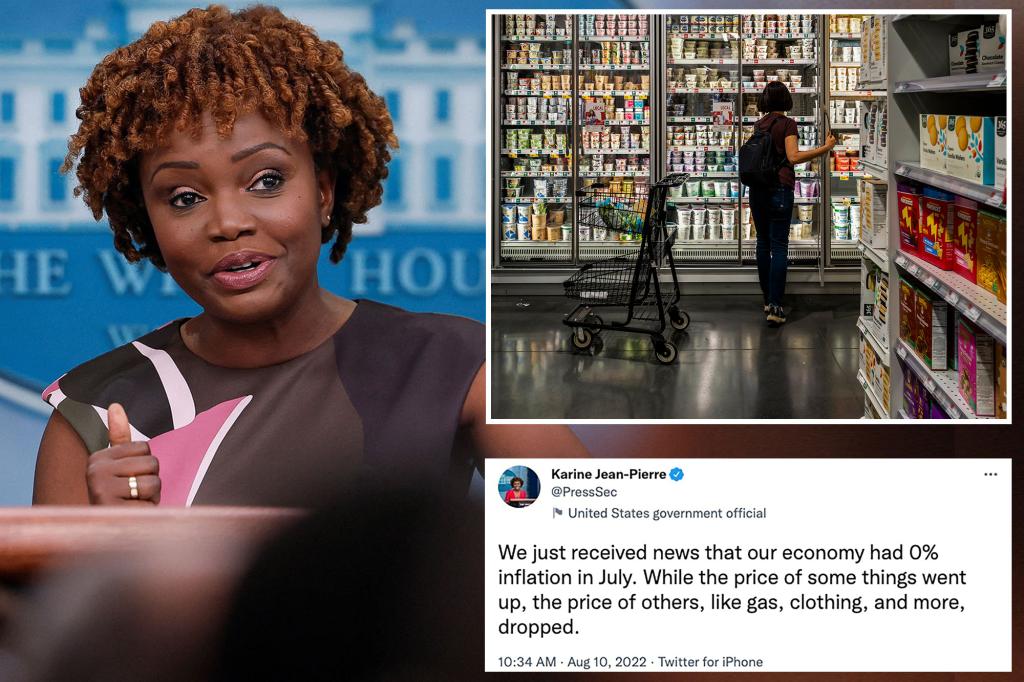
“We just received news that our economy had 0% inflation in July,” White House press secretary Karine Jean-Pierre tweeted on Wednesday.

“While the price of some things went up, the price of others, like gas, clothing, and more, dropped.”

Jean-Pierre also hailed the dip in gasoline prices, which she called “the fastest in a decade” which was “saving American families with two cars $106 per month on average.”

In the same tweet thread, Jean-Pierre wrote that “real wages went up for the first time in almost a year.” She also urged the House to pass the Inflation Reduction Act “as soon as possible” in order to “lower health care, prescription drug, and energy costs.”

But Twitter users pushed back against Jean-Pierre’s claims.

White House press secretary Karine Jean-Pierre toed the administration line that the country saw "0% inflation in June."
White House press secretary Karine Jean-Pierre toed the administration line that the country saw “0% inflation in July.”
REUTERS
Twitter users pushed back on Jean-Pierre's tweets on Wednesday.
Twitter users pushed back on Jean-Pierre’s tweets on Wednesday.

“Great. No need for the ‘Inflation Reduction Act’ anymore…” tweeted Yossi Gestetner.

Another Twitter user, Kevin Dalton, posted a link to a news article indicating that inflation was 8.5% in July, writing: “Other than the complete lie you just told, I totally believe you…”

Joel Griffith, a research fellow at the Heritage Foundation, posted a tweet showing the increased prices of key goods.

“Inflation this past year of 8.5% is near a 40-yr high,” he noted.

One Twitter user went so far as to add a “clown face” filter to a clip of Jean-Pierre touting the strength of the economy from the White House press room podium.

The rate of inflation was 8.5% in July -- hovering around record levels not seen in four decades.
The rate of inflation was 8.5% in July — hovering around record levels not seen in four decades.

Supporters of the administration, however, tried to clarify Jean-Pierre’s tweet. One noted that the press secretary meant that “inflation over the last month has been 0%” and that it “hasn’t increased in the past month.”

But another Twitter user responded: “You don’t compare inflation month to month. It is compared year to year. But you wouldn’t know that.”

Last month, Jean-Pierre was widely mocked for claiming that “we are stronger economically than we have been in history.”

Americans continue to be saddled with higher-than-usual food prices.
Levine-Roberts/Sipa USA

She cited low unemployment as well as “more than 8.7 million new jobs created” — though critics noted that it was due to the end of pandemic-related lockdown measures and Americans returning en masse to the workforce after the vaccination drive.

The 8.5% rise in inflation last month was lower than the sharp, 9.1% increase in June, but still hovering at a high not seen since four decades ago.

Core inflation, which excludes food and gas prices, rose by 5.9% annually and by 0.3% compared to June.

Analysts said that a drop in demand has led to falling gas and energy prices, though that trend can easily reverse itself given volatile geopolitical conditions, including the ongoing Russian invasion of Ukraine, as well as possible hurricanes in the US.

.

Categories
Technology

Overwatch’s Paid Loot Boxes Are Finally Going Away

Overwatch’s Loot Boxes may not have been the first in video game history, but they quickly became one of the most important, even if we were sick of them as early as June 2016, which was…one month after the game’s release.

While somewhat novel at the time, they helped pave the way for even worse examples, like Battlefront II’s disastrous implementation, and as profitable as they were for publishers they were also so unpopular with fans (and with governments and regulators who accuse them of encouraging kids to gamble) that many series — including Overwatch itself — have begun to move away from them.

That’s right, Overwatch 2 won’t be using Loot Boxes, instead opting for a more direct way of purchasing stuff:

There will be no Loot Boxes in Overwatch 2. Instead, the modernized live service will give our players the power to shape their own experiences. Players can acquire the items they want directly through the Battle Pass and an all-new and consistently updated in-game shop. Our team will create and deliver seasonal content every nine weeks to ensure there’s always something fresh and exciting waiting for everyone.

And with the sequel due out soon (it’s currently slated for an October release), that means the end is near for Overwatch 1’s Loot Boxes. Blizzard announced earlier today that after August 30, players won’t be able to buy them anymore, bundling the news with a plea for users to go and buy some Loot Boxes one last time:

Earn and purchase Anniversary Loot Boxes throughout the event! Each Loot Box has a chance to contain items from past Anniversary and seasonal events; don’t wait too long to snag those skins you’ve been eyeing for the past year, though–Loot Boxes will no longer be available for sale after the end of the Anniversary Remix Vol. 3 event on August 30. However, you will still be able to earn standard loot boxes after the end of the event.

So there’ll still be some to earn, just not to buy. Interestingly, Blizzard adds that any Loot Boxes that players are sitting on “will open automatically before the launch of Overwatch 2“.

RIP, Loot Boxes. You will not be missed.

Categories
Sports

When a player like Meg Lanning needs to ask for a break it should ring alarm bells | Australia women’s cricket team

Meg Lanning is never one to give much away. An intensely private person, she is known for predictable answers in interviews and her dislike of team meetings. She is a woman of few words and for years she has appeared something of a cricket machine.

Aside from a brief stint on the sidelines for shoulder surgery after the 2017 World Cup, Lanning has been an ever-present figure in the game since her debut in late 2010 at just 18 years of age. Throughout her time in the team, the profile of women’s cricket has risen exponentially, exposing Lanning to greater levels of media and public attention – something that has never appeared to quite sit comfortably with a player who would rather let her actions on the cricket field do the talking.

It was perhaps surprising then, that she was asked to take on more responsibility and visibility in January 2014 when, after the retirement of Jodie Fields, Lanning was thrust into the captaincy at age 21, having had never held a leadership position at any level before . The marketing contract that Lanning – with Ellyse Perry, Alyssa Healy and Holly Ferling – received to essentially be the faces of women’s cricket in Australia led to even more time in the public eye and more pressure to be one of the ‘golden girls’ of Australian sport.

This pressure only increased in the wake of the sandpaper scandal involving the Australian men’s team in 2018, when the very culture of cricket was called into question and Cricket Australia turned hurriedly to its sparkling women’s team – who had never been caught up in any scandals – in a bid to distract from the poor behavior of the men.

The cumulation of all this – the public-facing roles, the increased visibility of the sport and the pressure to maintain not only the performance of the team, but its squeaky-clean image – has perhaps led to this point. Lanning is taking an indefinite break from cricket. In a written statement, she put it as briefly and succinctly as anyone would expect.

“After a busy couple of years, I’ve made the decision to take a step back to enable me to spend time focusing on myself,” she said. “I’m grateful for the support of CA and my teammates and ask that my privacy is respected during this time.”

We may never know exactly why Lanning is taking this break. Nor should we expect to. But in contrast to many of her counterparts from a range of different sports who have taken breaks, it does not seem likely that Lanning will do a tell-all interview opening up about her struggles, or even just clarifying that she really wants to spend summer at the beach instead of on a cricket field for once in her life.

Meg Lanning jumps on Jess Jonassen and Alyssa Healy after Australia won Commonwealth Games gold.
Meg Lanning jumps on Jess Jonassen and Alyssa Healy after Australia won Commonwealth Games gold. Photograph: Dave Hunt/EPA

However, the reason for Lanning’s break is not necessarily important. What is, are the lessons that can be learned from a player at the top of her game needing to take time off. For someone so ingrained in cricket, who appears to love being out in the center of the field with her bat in hand, to need to step back and take time away for whatever reason is something worth reflecting on.

The professionalism of women’s cricket – and women’s sport more broadly – ​​has come along fairly quickly and while it hasn’t yet reached the levels of men’s sport, it is in stark contrast to what a young Lanning would have experienced in her early days in the team. With greater salaries have naturally come greater expectations – more touring, more public appearances, more time in front of the media.

For a man coming through the high performance pathways, this is understood and expected. They are prepared for the pressures of public life and know exactly what they are getting into. For the young women who entered the arena in the amateur era and have grown into professionalism, it is more akin to the proverbial frog in the pot of water. The water started off cold, but over time slowly increased to boiling without anyone being aware of what a difference that would make.

Increased professionalism for women’s sport is unequivocally a good thing. But a player of Lanning’s stature needing to ask for a break should send alarm bells around professional women’s sport. It should make organizations look at their schedules and question – are we leaving enough breaks that our players do not need to publicly stand down to get some rest?

Hopefully Lanning will return in time, refreshed and ready to once again destroy opposition bowling attacks with her cover drive. But maybe this time she – and the other hardworking women she captains – will have more rest and recovery built into their schedules to stay at the top for as long as they desire.

Categories
US

After the fall of Roe, Republican pursuit of abortion bans appears to falter | Roe v. Wade

YoIn the leadup to the US supreme court overturning Roe v Wade and thus scrapping federal abortion protection, Republican lawmakers across the country maintained an uncompromising rallying cry against abortions, vowing to implement a sweeping wave of restrictions in their states.

However, since the highest court in the US overturned the ruling, many Republican leaders and officials have become more hesitant – or have even gone silent – ​​over the exact type of bans they promised to enact.

As Republicans move towards an election season rife with internal disagreements within their own party and mixed public opinions on exceptions in abortion bans such as instances of rape and incest, many rightwing lawmakers are finding it increasingly difficult to implement cohesive abortion policies.

The phenomenon has been starkly illustrated by Kansas’s referendum last week, where the usually reliably Republican state voted to keep abortion protections in its state constitution, providing an unexpected boost from red state America to the abortion rights movement.

With delays in passing abortion bills across the US and contentious questions on how far the bans will reach, Republicans are now, as Sarah Longwell, a moderate Republican strategist, said to Politico, “the dog that caught the car.”

According to a survey conducted between 27 June and 4 July by the Pew Research center, a majority of the American public disapproves of the supreme court’s decision to overturn Roe: 57% of adults disapprove of the court’s decision, including 43% who strongly disapprove, and 41% of American adults approve while 25% strongly approve of the court’s decision.

The survey also found that 62% of Americans say that abortion should be legal in all or most cases, and 36% of Americans say that abortion should be illegal in all or most cases. Only 38% of Republicans say that abortion should be legal in all or most cases, marking a 1% decrease from poll results obtained in 2007.

As Republican lawmakers grapple with mixed public opinions, many lawmakers have been divided over just how far they should go to ban abortions. With the recent case of the 10-year-old rape victim traveling across state lines from Ohio to Indiana to obtain an abortion continuing to dominate national headlines, many Republicans are realizing that the reality they are presented with vastly differs from their initial narratives surrounding abortion politics.

What kind of exceptions should be made in cases of rape and incest? Should a woman be granted an abortion if she is faced with a life-threatening ectopic pregnancy or an incomplete miscarriage? If an outright ban is put in place, should there be expansions of paid family leave benefits and increased funding for foster care and women’s health?

Some states have plowed ahead. Indiana has now passed a Republican-sponsored bill that would ban nearly all abortions in the state with limited exceptions, including cases of rape and incest, and to protect the health of the mother. That made it the first state in the US to put new restrictions in place, rather than just rely on a pre-existing “trigger law” passed before the supreme court’s decision.

But even in Indiana the move came after a series of thorny debates in the Indiana congress that reflect the growing divide Republicans are facing when it comes to fleshing out the specifics of abortion ban bills.

Before Roe v Wade was overturned, lawmakers did not spend “enough time on those issues, because you knew it was an issue you didn’t have to really get into the granular level in. But we’re in there and we’re recognizing that this is pretty hard work,” Republican Indiana state senator Rodric Bray told the New York Times.

Another Indiana Republican state senator, Kyle Walker, who voted against the ban last month, said: “I believe we must strike a balance for pregnant women to make their own health decisions in the first trimester of the pregnancy and also provide protections for an unborn baby as it progresses toward viability outside the womb.”

Even state senator Sue Glick, the sponsor of the bill, said that she was “not exactly” happy with the bill.

Meanwhile, the American Civil Liberties Union of Indiana called the bill “cruel” and “dangerous”, while Indiana Right to Life criticized it as being “weak and troubling”, saying that it “lacks any teeth to actually reduce abortions in Indiana by holding those who perform abortions or would intentionally skirt the law accountable with criminal consequences.”

South Dakota, a predominantly Republican state, is facing a similar situation.

Shortly after the bombshell leak of the supreme court draft opinion on Roe, Republican governor Kristi Noem announced that she will “immediately call for a special session to save lives and guarantee that every unborn child has a right to life in South Dakota.”

However, since the supreme court overturned Roe, Noem has yet to publicly give any indication of when or if a special session will still take place. In response to the Associated Press asking if the special legislative session is still on the table, Noem’s office said it will happen “later this year”.

Noem has largely kept her language surrounding South Dakota’s abortion bans vague, simply reaffirming that “there is more work to do” and promising to “help mothers in crisis”. In June, Noem appeared to soften her approach on abortions by saying that doctors, not their patients, should be prosecuted for offering abortion pills.

“I don’t believe women should ever be prosecuted,” she said. “I don’t believe there should be any punishment for women, ever, that are in a crisis situation or have an unplanned pregnancy,” she said. The governor also set up a website for pregnant women that aims to “help mothers and their babies before birth and after by providing resources for pregnancy, new parents, financial assistance and adoption.”

Speaking to the Associated Press, South Dakota Right to Life’s executive director, Dale Bartscher, said that Noem’s actions reflect a turning point in the anti-abortion movement.

“An entirely new pro-life movement has just begun – we stand ready to serve women, the unborn and families,” he said. The Guardian reached out to Bartscher for additional comments.

In Arkansas, the Republican governor, Asa Hutchinson, appears to have taken a softer approach on the issue after the state’s abortion trigger ban immediately went into effect when Roe was overturned. Last month, Hutchinson did not confirm that abortion will be a topic on the agenda of this month’s special session that is supposed to focus on tax cuts.

Referring to alternatives to abortion, Hutchinson said: “That’s come up in conversations … I’ve mentioned that I need. You know, what can we do more for maternity care? What can we do more for adoption services because of the increased number that’s going to be demanding that? And so that is a potential issue… so just stay tuned.”

In May, Hutchinson acknowledged that his state’s abortion trigger law would result in “heartbreaking circumstances”, adding that “whenever you see that real-life circumstances like that, the debate is going to continue and the will of the people may or may not change. ”.

The governor admitted that abortions performed in the exceptions of rape and incest are increasingly “reflecting the broad view of Americans” but acknowledged that the issue is “still a very divided [topic].”

However, whether Hutchinson will ask lawmakers to consider the exceptions during the state’s upcoming legislative special session remains to be seen.

Meanwhile, in Ohio, the Republican governor, Mike DeWine, has refused to comment on the state’s recently enacted “heartbeat bill”, which makes abortions illegal after six weeks into a pregnancy. As a result of the state’s strict abortion laws, a 10-year-old rape victim from the state had to travel to Indiana to receive an abortion.

DeWine condemned the case as a “horrible, horrible tragedy” but did not signal whether he would amend abortion restrictions in the state. Speaking to reporters last month, DeWine refused to advocate for specific abortion policies and said that he is “going to let the debate play out a little bit”, referring to the legislative debate that is expected to happen in a few months.

“We’re going to hear from medical experts, we’re going to hear from other people,” he said, adding: “then there’ll be a time when I’ll certainly weigh in.”

Since Roe got overturned, Virginia’s top Republican lawmaker has been expressing similar sentiments to DeWine’s. In June, Governor Glenn Youngkin told an anti-abortion group that he would “happily and gleefully” sign any bill that would protect life, which he believes begins at conception.

Youngkin has expressed support for a ban on abortions after 15 weeks with exceptions for rape, incest and risk to the mother’s health.

Youngkin did not specify his support for any particular policies, although he acknowledged the divisive nature of the issue and called for a legislative process to hash out nuances in abortion ban bills.

“I’m a pro-life governor and I will sign a bill that comes to my desk that protects life and I look forward to that. But as of now, what we need is the process to start and to take the next four or five or six months and to work on a bill that can be supported on a bipartisan basis,” he said.

As Republicans across the country face a widening divide over the particularities of implementing abortion bans, a leading anti-abortion group has been urging Republicans in Congress not to leave the issue to the states. Many anti-abortion activists worry that extreme measures by Republican state lawmakers may cost Republican lawmakers seats nationally, especially with midterms on the horizon.

At the same time, in the wake of the Kansas referendum result, many Democratic strategists now believe public opinion, even in many red states, will be on their side. The issue can be used to shore up under-threat Democrats and wielded as a weapon against Republican candidates who can be portrayed as out of step with most Americans.

In a memo from Susan B Anthony Pro-Life America sent out in July, Republican lawmakers were encouraged to stay away from phrases such as “nationwide ban” and were urged not to relay the issue to state lawmakers.

“It is vitally important that pro-life Members of Congress highlight the abortion extremism of Democrats, who support abortion on demand, up until the moment of birth, paid for the taxpayer,” the memo said.
Categories
Technology

Visual Studio Code 1.70 eases title bar customization

Credit: Dreamtime

Visual Studio Code 1.70, the latest release of Microsoft’s popular code editor, promises easier title bar customization and Git merge conflict resolution, among a host of other improvements.

Introduced August 4, VS Code 1.70 can be accessed from visualstudio.com for Linux, Windows, and macOS.

Also known as the July 2022 update, VS Code 1.70 brings easier title bar customization, with developers now able to right-click to the title bar to open a context menu that toggles the menu bar. For Windows users expecting the system context menu, the menu still can be triggered by right-clicking the VS Code icon in the top left corner of the window, or by pressing. Alt+Space.

Also in VS Code 1.70, the three-way merge editor, for quickly resolving Git merge conflicts, is enabled by default. The merge editor features improved context menus, new commands to accept all changes from one side, enhanced diff colors, and a greater emphasis on conflicting versus non-conflicting changes.

Microsoft also introduced command line options to bring up the merge editor in VS Code. The company said it is beginning to explore alternative diffing algorithms to improve the precision of merge conflicts.

.

Categories
Entertainment

From pilaf to pudding: six winter-friendly ways with rice | Food

Australians eat about 300,000 tonnes – or 12 kg of rice for each person – each year.

Given its long shelf life, low cost (as little as $1.40 for a kg in supermarkets), and the fact that it is flexible enough to use in sweet or savory dishes from hundreds of cuisines, this is hardly a surprise.

Here’s how to go on a round-the-world tour with one staple ingredient.

Congee and soups

To make congee, a nourishing rice porridge traditionally eaten for breakfast, chef and Trentham cooking school owner, Tony Tan uses a medium-grain rice, simmered in chicken stock.

“Use around a cup of rice to 10 cups of stock,” he says.

“Add shredded cooked chicken and any condiments from your pantry – like pickles, fried shallots or chopped spring onions and finish with a dash of soy sauce and roasted sesame oil.”

Eun Hee An's take on tarak-juk – king's congee
Eun Hee An’s take on tarak-juk – king’s congee Photograph: Blake Sharp-Wiggins/The Guardian

Eun Hee An’s elegant king’s congee is cooked with milk as well as stock. Although the dish comes with a royal title, its crab-meat topping can be bought canned from supermarkets for as little as $4.30 – enough to serve two with some to spare.

Rice also makes an appearance in soups like the classic Greek avgolemono, used to add body to the lemony, chicken soup, like in this one from Peter Mantis.

Rachel Roddy offers an Italianate winter warmer; rice and cabbage soup; “cheap and generous,” she says.

Risotto

Choose an Italian rice such as arborio, vialone or carnaroli when cooking risotto, says Katrina Ryan, owner and chef at Brisbane’s Golden Pig cooking school.

“Cooked in stock and stirred like a porridge, it releases its starch and results in a creamy, cohesive, wet dish with pleasantly al-dente texture right to the center of the rice.”

A good flavorsome stock, (always added hot) is vital too, she says. Cheese such as parmesan or pecorino adds richness while butter gives gloss.

“My favorite simple risotto is made by sweating lots of baby spinach in butter then blitzing to a puree and adding it to a simple onion, garlic, white wine and chicken stock risotto at the end, with the cheese and butter. Serve it with a wedge of lemon.”

Anna del Conte’s lemon risotto, scented with rosemary and sage, is enriched with eggs and cream, stirred in at the last minute.

If you have neither time nor the will to stand stirring risotto, Rachel Roddy’s minimal-stir method, with zucchini, peas and broad beans could be adapted to whatever vegetables you have to hand, or even in the freezer.

rice balls

Shuko Oda's onigiri bento box.
Shuko Oda’s onigiri bento box. Photograph: Jean Cazals/The Observer

If you wind up with leftover risotto, it’s the ideal base for upcycling into arancini, a traditional Sicilian street food of rice molded around fillings. Felicity Cloake suggests ragu, pesto or sauteed mushrooms for the center.

But not all rice balls require deep frying. Japanese lunchbox staple onigiri features a smaller quantity of filling, but is quicker and easier to make. Shuko Oda stuffs her version of her with umeboshi – pickled plum.

Vietnam has its own equivalent too, cơm nắm. Lucas Doan, head chef at Sydney’s Luna Lu, counts it as one of his favorite dishes. “When I was a child… my grandmother used to make it for me to bring to school as my snack.”

Still-warm, short grain rice is kneaded until firm, then shaped into small balls or logs, that you can eat with your hands.

“The best part is the condiments,” Doan says. “I personally like to dip my cơm nắm into a mixture of salt, sugar, and toasted sesame seeds.”

fried rice

A good fried rice starts with pre-washing the grains to remove the starch. That way it doesn’t become gluey, says Doan.

“You can use any type of long-grain rice, but I prefer Thai jasmine rice because of the texture and unique fragrance.”

“Steam it, then let it cool down,” he says. “This makes the rice firmer and easier to fry.”

Doan’s go-to starts with scrambling an egg in a hot pan with vegetable oil, then adding in the rice and cooking “for a good three to five minutes, depending on whether your rice is fridge-cool or at room temperature”.

“Season with a pinch of salt and two pinches of sugar and a small amount of unsalted butter, mixing them together well on high heat until the butter has melted. Add more seasoning if needed. Finish the dish with some fried garlic and finely chopped green shallot.”

Kylie Kwong makes an omelette topper for her fried rice; and she cooks the dish with bacon and a splash each of tamari and shao hsing wine.

Thomasina Mier’s brown rice version is topped with a crisp fried egg, and flavored with Korean staples – kimchi and gochujang chilli paste (approximately $3.20 for 170 grams at supermarkets).

Pilaf

Buttery, fluffy pilaf (or pilau) is a star side dish across cuisines stretching from south Asia to the Middle East, east Africa, the Caribbean and beyond. Katrina Ryan advises using a long-grain rice like basmati, as it will “produce a light texture with separate grains that are not at all sticky or starchy”.

“Look for an aged basmati rice for those lovely, extra-long grains.”

Anna Jones's lemon rice pilaf.
Anna Jones’s lemon rice pilaf. Photograph: Yuki Sugiura/The Guardian

Anna Jones’s homely butter lemon pilaf can be eaten with a curry, a winter stew or just on its own, she says.

Studding the rice with ‘jewels’ of dried fruit, Ravinder Bhogal makes her Persian-style pilaf, with a crisp, crusted tahdig bottom. She suggests serving it with roast chicken flavored with honey and preserved lemon.

pudding

Felicity Cloake's rice pudding recipes.
Felicity Cloake’s rice pudding recipes. Photographer: The Guardian. Food styling: Jack Sargeson.

The subtle flavor of rice lends itself to desserts, too. “I use short grain arborio for making a simple milk pudding,” Tan says.

“Just simmer half a cupful of rice in two cups of full cream milk with a tablespoon of sugar, a cinnamon stick and a slice of lemon and cook until soft and creamy. You can top with sliced ​​banana or chopped strawberries.”

Nigel Slater makes his with caramelised bananas and adds cardamom seeds to flavor the simmering rice while Felicity Cloake uses cinnamon, nutmeg, vanilla and a bay leaf.

“My mum used to substitute cooked rice for bread in a ‘bread and butter’ pudding with lots of fresh lemon zest,” says Katrina Ryan. “I absolutely loved this version… and much preferred it to white sliced ​​bread.”

Categories
Sports

Surprises loom as Ian Foster set to shake up All Blacks for last stand at Ellis Park

Marc Hinton is a senior rugby writer for Stuff

OPINION: Could this be Ian Foster’s final All Blacks team? And, more to the point, how could he dare not swing for the fences with a lineup to potentially change the narrative on a team sinking faster than Donald Trump’s presidential prospects.

That is the intriguing prospect ahead of Thursday night’s (NZ time) announcement of the All Blacks to face the Springboks in the second Rugby Championship clash of 2022 at the cauldron that is Ellis Park in Johannesburg.

The word is that Foster is set to spring a few surprise selections in the wake of his team’s 26-10 defeat at Mbombela Stadium that consigned the All Blacks to a fifth loss in their last six tests and the coach most likely to scrapheap.

What have you got to lose?

New Zealand Rugby chief executive Mark Robinson is hovering here in the City of Gold and it is hard to see how he is not about to light the fuse on an All Blacks coaching rebuild in a process that is surely well under way.

Maybe the “something special” that Foster defiantly suggests is brewing this week saves his job. But it is doubtful. Both that it plays out and that it will be enough to earn a reprieve. The damage has been done and it is likely Plan B has already been enacted. Or soon will be.

If his tummy settles, where will Ian Foster put a try-scoring sensation Will Jordan to face the Boks in Jo'burg?

Hagen-Hopkins/Getty Images

If his tummy settles, where will Ian Foster put a try-scoring sensation Will Jordan to face the Boks in Jo’burg?

So, if this is Foster’s last stand, why wouldn’t he throw caution to the wind? take a chance Think outside the square. Put it this way, what he has been doing for the past year or so certainly has not been working out too well for him.

The All Blacks are not just losing, they look befuddled. The fluency and flair which has long been a hallmark of their game appears to have deserted them. They are being squeezed and pressured and, frankly, out-executed by sides who are clearly superior to them.

They have fallen to No 5 in the world, which pretty much adds up to the slippage that has occurred in the Foster era. There has been a price to pay for a succession plan of Mr Magoo proportions.

Quinn Tupaea is an option if Ian Foster decides to rejig his ineffective midfield for Ellis Park.

Dave Rowland/Getty Images

Quinn Tupaea is an option if Ian Foster decides to rejig his ineffective midfield for Ellis Park.

Which brings us to the side to run out at Ellis Park. What are the changes Foster could make as he looks to sign off in style or, in some unimaginable twist of this tale, avoid the executioner’s axe?

Well, it is not entirely easy to predict, especially with the unknowns around the injuries to Beauden and Jordie Barrett, and the illness of Will Jordan. The latter missed Tuesday’s training, the former seemed to be moving freely and the strapping fullback took part but appeared short of a full gallop.

Let’s start at the back. There has to be a temptation to give Jordan, if his stomach has settled, a crack at his favored fullback position. He does not have Jordie’s size and aerial capability but the All Blacks won five of 15 contestable kicks that came their way in Mbombela, so can it really get any worse? Beauden Barrett, too, could shift there in a back-to-the-future move to allow Richie Mo’unga a deserved start.

Sevu Reece hovers as an option on the wing and maybe Rieko Ioane does too if there is a midfield shakeup, which seems the most logical place for change.

The All Blacks midfield has been largely anonymous all year and there are numerous options for a refresh. Foster could run with Jordie Barrett at 12, if fit, or bring in Quinn Tupaea as a strong-running option, or even roll the dice with Roger Tuivasa-Sheck.

Where will the Barrett brothers line up and will they all be available for the rematch against the Boks?

Dan Peled/Photosport

Where will the Barrett brothers line up and will they all be available for the rematch against the Boks?

At centre, Leicester Fainga’anuku would be an intriguing pick if it was decided Ioane’s continued lack of impact necessitated a change.

Would Foster dare drop Aaron Smith at halfback? His pass from him remains slick but beyond that he is a minimal threat.

In the loose, No 6 appears the most likely change-up. Maybe Shannon Frizell comes in to add his power game from the off against that imposing Boks trio, or maybe Scott Barrett shifts back there to provide similar qualities.

If Barrett moves, Tupou Vaa’i would be worthy of a shot in the second row, with Patrick Tuipulotu also an option. Sam Whitelock surely stays on the back of much-heralded lineout and maul defense improvements.

There will almost certainly be change in jerseys 1-3, with Foster noting that he had been pleased with the work of his front row in the second spell in Mbombela. Ethan de Groot and Tyrel Lomax were the impact props then, and one or both could be in line for a promotion.

Is it time to throw Crusaders tighthead Fletcher Newell into the deep end too? As mentioned, what has Foster to lose?

You have to think Samisoni Taukei’aho deserves another crack after a strong showing at starting hooker last week. He and Ardie Savea were the best of a beaten pack.

Plenty to ponder. One thing we do know: “Foster’s imposters”, as they have been dubbed by South African media, did not get the job done last week.

Categories
US

What the bill will actually mean for inflation : NPR

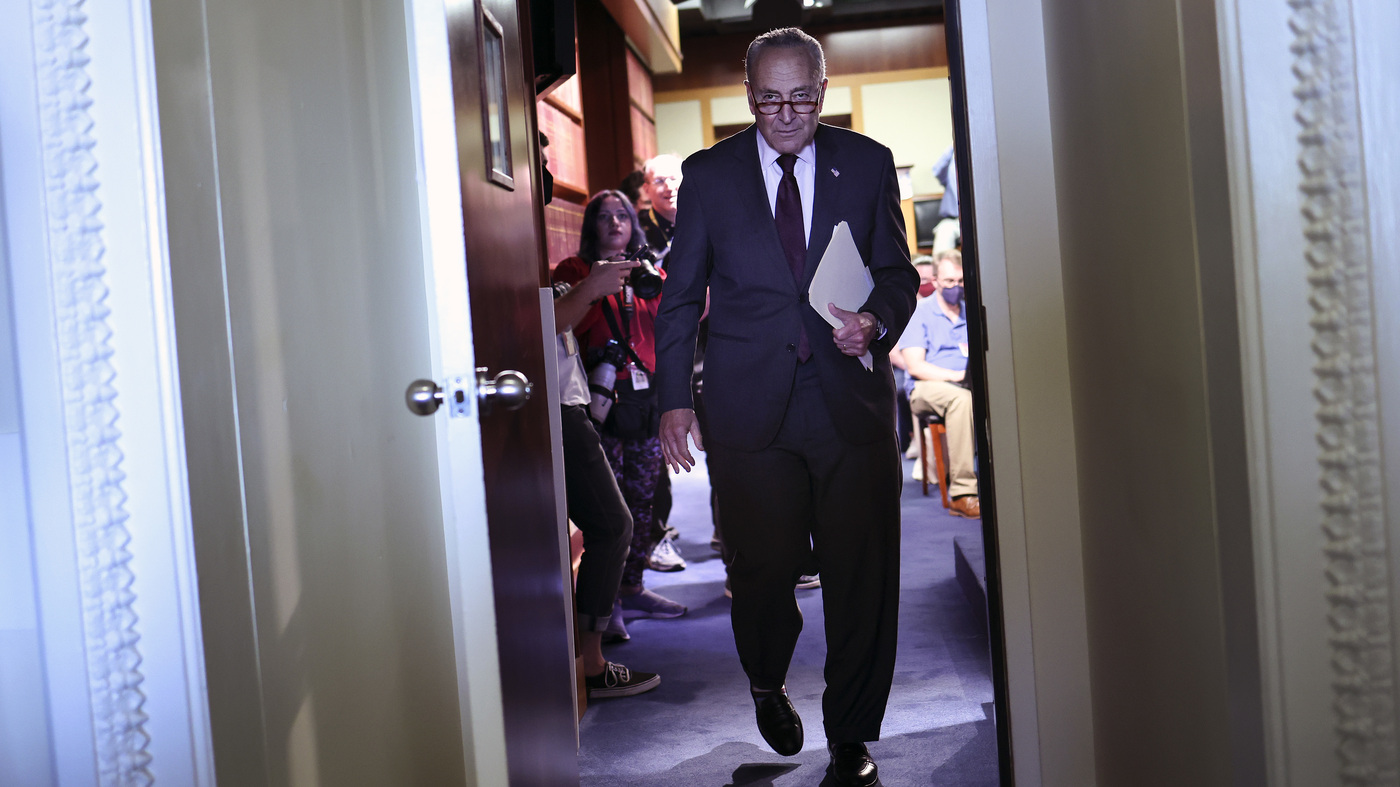
Senate Majority Leader Chuck Schumer, DN.Y., leaves a news conference at the US Capitol on Friday, where he spoke to reporters about the Inflation Reduction Act.

Kevin Dietsch/Getty Images


hide caption

toggle caption

Kevin Dietsch/Getty Images


Senate Majority Leader Chuck Schumer, DN.Y., leaves a news conference at the US Capitol on Friday, where he spoke to reporters about the Inflation Reduction Act.

Kevin Dietsch/Getty Images

The massive climate, health care and tax bill making its way toward President Biden’s desk is called the Inflation Reduction Act. But how much does it actually do to slow consumer prices that are climbing at their fastest pace in about 40 years?

After months of negotiations, a 755-page version of the bill passed the Senate on Sunday and will soon be up for vote in the House, where it is expected to pass.

The White House says the roughly $700 billion package will address inflation in two key ways: by lowering energy and health care costs for families and by helping to bring down the deficit.

“And that’s why even Democrats and Republicans, former Treasury secretaries, economists across the board have said that this bill will make a positive impact on inflation while also tackling some of the biggest and long-standing issues facing our country, like prescription drugs and like tackling climate change,” said Brian Deese, director of the National Economic Council, in an interview this week with NPR’s Morning Edition.

While experts generally agree that the legislation will modestly help slow the growth of prices, it may not do so in the ways you think, or as quickly. As the legislation nears final passage, here are some answers about what it means for inflation.

How will this bill bring down inflation?

The bill will make small steps to help bring inflation back to normal levels, said Shai Akabas, the director of economic policy at the Bipartisan Policy Center.

“It will generally work in the right direction and help the Federal Reserve, which has the primary responsibility for getting a hold of inflation,” Akabas said.

There are three main ways the bill targets rising prices, according to Akabas. First, it plans to reduce the federal deficit, which is the difference between how much the US government spends and how much it makes in taxes and revenue. When there’s less money floating in the economy, there tends to be less demand and fewer price hikes, Akabas said.

Because there are several provisions to encourage spending in the bill, the net impact on inflation is unclear.

Second, it will promote the production of certain goods, mainly in renewable energy. Having more supply than demand could help lower some costs over time, I added.

Third and more directly, one provision of the bill will help limit the price growth of certain prescription drugs by allowing Medicare to negotiate their cost with pharmaceutical companies. Still, some of the biggest drivers of inflation, including food and energy costs, are not immediately addressed.

OK — so how soon?

The proposal won’t help curb inflation dramatically nor right away, experts say.

“It’s not likely to have a major effect on inflation in the next few months,” Akabas said.

Some experts, like Kent Smetters, faculty director of the Penn Wharton Budget Model, do not expect a significant impact in the next few years.

“On one hand, it does not add to inflation, which was what the previous concern that people had about passing legislation like this right now,” Smetters said. “But at the same time it doesn’t really take away from the rise in prices either.”

The nonpartisan Congressional Budget Office, which scored the bill, also determined that the bill will have a “negligible effect” on inflation this year and next.

If the impact on inflation is limited, then what else does it do?

The package includes $430 billion in new spending to reduce greenhouse gas emissions, invest in clean energy technologies and extend subsidies for the Affordable Care Act.

The bill also plans to bring in more than $300 billion in new revenue, Democrats say, by imposing a 15% minimum tax on corporations making over $1 billion and through a new excise tax on corporate stock buybacks.

“The way to think about this is not about inflation at all, but about the tradeoffs between helping people who need more help, especially in health care and reducing carbon, versus the potential impact on future investment,” Smetters said.

What are some changes I’ll see in the near future?

While experts don’t see a rapid curb to inflation through this bill, there are a range of measures to help with high costs. Forinstance:

  • The bill offers a number of tax credits for people switching to cleaner energy sources, including electric vehicles and rooftop solar panels. Those incentives will take effect in 2023, and according to Democrats, they will mean a 40% cut in greenhouse emissions from 2005 levels by the end of the decade.
  • The Internal Revenue Service will get a boost in funding, particularly to improve its customer service and tax enforcement. Akabas said that investment could help alleviate some of the challenges with long response times or getting tax refunds processed. It could also increase collection of taxes that are currently owed but go unpaid.
  • Millions of Americans will continue to benefit from subsidies that help with rising health insurance premiums that were originally slated to expire next year.
  • The bill will put a $2,000 annual cap on out-of-pocket prescription drugs for people insured by Medicare, which will be most impactful for senior citizens with illnesses such as cancer and multiple sclerosis. But that provision won’t materialize until 2025.

“Prices are high now but we’re talking about prices that have been putting burdens on household budgets for decades,” said Rakeen Mabud, the chief economist of the Groundwork Collaborative, a progressive economics think tank.

“We’ve been struggling with skyrocketing health care costs for a really long time and this bill is an important step forward.”

Am I going to see an increase in my taxes?

It’s unlikely that a vast majority of households will see a direct impact on their taxes, said Akabas, who focuses on federal budget policy.

Instead, the tax increases will largely fall on corporations. That being said, some employees may feel that tax burden indirectly.

“If a company is less profitable and less able to spend money on labor and less able to pay higher wages, then that will be felt by individuals throughout the economy,” Akabas explained.

Chye-Ching Huang, the executive director of the Tax Law Center at New York University, doesn’t expect a significant impact on wages. Since the tax cut in 2017, economists did not see a major difference in wages, Huang said.

“Reversing some of that for the very largest corporations can be expected to have a similarly small or imperceptible effect,” she said.

Categories
Entertainment

Bindi Irwin’s husband Chandler Powell in hospital after surgery, with Terri Irwin looking after little Grace

Bindi Irwin’s husband Chandler Powell has revealed a recent health scare, lavishing praise on his wife while he recovers in hospital.

The husband of Bindi Irwin had his tonsils removed this week, sharing the update with a photo on social alongside his wife in hospital.

In the snap, the couple are pictured smiling at the camera from Powell’s hospital bed.

The Instagram post was captioned with a sweet message to Irwin, who was by his side every step of the way.

“Just wanted to write a note to my amazing wife. I had to get my tonsils out and she has been taking the best care of me,” he said.

“I’m so lucky to be loved by you, Bindi.”

.