After the blistering social commentary of Jordan Peele’s first two movies, Get Out and Us, there’s an expectation that his latest, Nope, would have the same level of thematic richness.
nope toys with those expectations. The visceral and entertaining movie definitely has a lot to say about a lot of things, but there’s also a suspicion that Peele is having his own cheeky meta moment, a playful ribbing to audiences.
Because nope is nothing if not a spectacle. Peele wants you to look and he wants you to think about the exercise of him looking and consuming – and he has all the tricks to hypnotise and bewitch his audiences so they never look away.
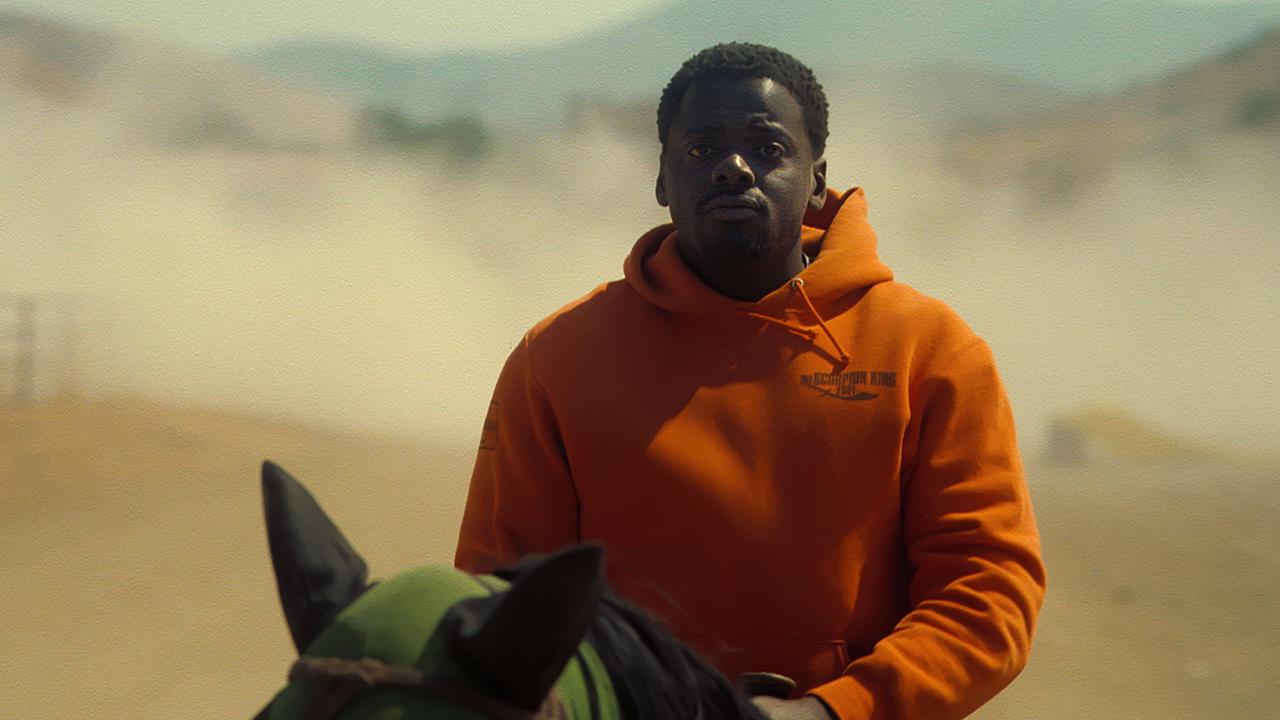
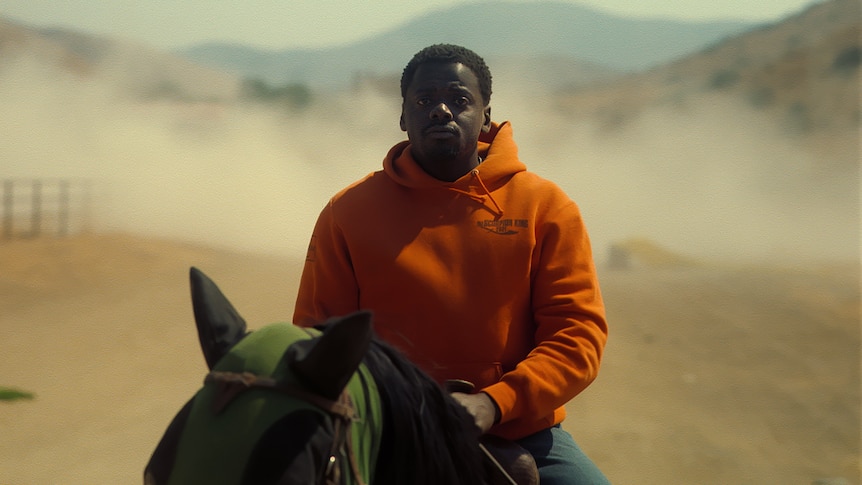
OJ (Daniel Kaluuya) is outside on his family’s horse ranch when small objects mysteriously start falling at great velocity from the sky. His father of him is struck and killed by a coin and the ranch passes to OJ and his sister of him Em (an electric Keke Palmer).
Six months on, the ranch is struggling and OJ has had to sell horses to the neighboring theme park run by a former child actor, Jupe (Steven Yeun).
There’s a mysterious force in the skies above them, a UFO that hides inside a stationary cloud and OJ and Em and Jupe all want to exploit its presence for their own profit agendas.
But they’re going to find out they can’t bend a primal force to the will of men and a lot of blood will be spilled before the credits roll.
Utterly captivating, you can approach nope in multiple ways. If you want to have a leanback popcorn experience, Peele delivers. The film is a sensory smorgasbord – the set-pieces are variously tense, booming, draw-your-breath and exhilarating. And it’s also just really funny with Peele deploying his extensive experience in comedy.
You can go along for the ride on a pure spectacle level and inhale what it offers in visual and auditory thrills. Cinematographer Hoyte van Hoytema (dunkirk, Ad Astra, Her) does a tremendous job in shooting these expansive frames that make the story feel big.
There are visual questions to the likes of poltergeist and even The Godfatherwhile the tone, especially in that final act, evokes the Amblin movies of the 1980s.
Or you could engage with nope on a more cerebral level because Peele is working with several intersecting ideas.
There’s the man versus beast motif, which, without spoiling things, shows up in more ways than one, connecting a traumatic event in Jupe’s past to his present ambitions involving the visitor in the sky.
The main thrust of it though is these ideas around spectacle, this voracious appetite we have to be entertained, to be enticed into an experience away from the everyday, and the need to record it because if it doesn’t exist for posterity, did it even really happen?
nope can be heavy handed in how it deals with spectacle – the repetition of mirrors and reflections, including that which is captured by cameras, different aspects of performativity and a reference to chimp attack victim Charla Nash.
Of course, spectacle is almost always heavy handed, it’s about the fireworks and not grace. nope explores the cost of our obsession with spectacle and it reflects back to the audience our own complicity.
The ideas are sometimes a little undercooked and lose cohesion but Peele carefully works the balance between commentary and entertainment, which mostly succeeds.
above all, nope commands attention because it’s so conscious about itself being a spectacle and it’s asking us to decide whether it works as more than just a fun time.
In the skies above a dusty ranch on the outskirts of LA, something — or someone — is watching. A mysterious presence, an other-worldly entity. It appears briefly — like a smudged oval shape in a UFO photo — and occasionally it sends earthly debris raining down, like someone tipping out the contents of a celestial handbag.
Coins, keys, bits of plastic and general detritus fall from the sky — you want to watch you don’t get hit by anything sharp.
In writer-director Jordan Peele’s first two films, Get Out and Us, plots involving doppelgangers and body swaps showed us the world is a false front, hiding lethal dangers and dystopian conspiracies. In Nope, the California sky becomes a heavenly Loch Ness, and people turn their cameras on it, trying to capture proof of the sinister thing that lurks behind its clouds, or just beyond the horizon.
Getting the money shot, however, proves to be a life-ending event for some.
Peele’s 2017 debut Get Out won a slew of awards, including an Academy Award for Best Screenplay.(Supplied: Universal Studios)
Like Peele’s previous films, the tone of Nope mixes internet urban legend, gallows humor and an appetite for forthright political critique. It’s also wrapped up in a widescreen cinematic package that is his most visually accomplished, and harks back to the blockbusters of the 70s and 80s.
The ranch where the UFO appears belongs to an African American family who train horses for Hollywood. Their patriarch (Keith David) is killed by the entity early in the film, so it’s left to his unassuming but diligent son OJ (an excellent Daniel Kaluuya, reuniting with Peele after his breakout role in Get Out) and fast-talking, prodigal daughter Em (a charming Keke Palmer) to carry on the business.
Nope is “about the human addiction to spectacle and the monetization of it,” Peele said at the film’s Hollywood premiere.(Supplied: Universal Studios)
They enlist salesclerk Angel from a big box tech store (a well-cast Brandon Perea, channeling minimum wage ennui) to install an elaborate, off-the-shelf security camera system at their house, to monitor the skies. It’s the kind of DIY flex you might expect from the suburban hero of a 70s Spielberg blockbuster — squint your eyes and Nope could be the love child of Jaws and Close Encounters of the Third Kind.
It doesn’t quite sustain the intensity of those classics, but on the other hand, it’s trying to say a lot more.
Threading through the mystery thriller are questions of seeing and what it means to be seen — apt for a film that is set on the outskirts of a city synonymous with showbusiness, and is also about people of colour.
OJ and Em claim ancestry that links them to one of the earliest surviving motion picture clips: a clutch of frames that constitute a kind of proto gif, made in 1887 by photographer Eadweard Muybridge, in which a Black jockey rides a galloping horse in perpetual motion . The idea that they are direct descendants of one of the cinema’s pioneer performers (whose name was never recorded) is presented with a degree of irony in the film.
Peele first met Keke Palmer (pictured) in 2013 when she guest starred on Key and Peele, his sketch comedy series with comedian Keegan-Michael Key.(Supplied: Universal Studios)
On set, the historical pedigree doesn’t amount to any special treatment or even much respect, as Peele observes in a superbly directed scene where OJ turns up for a TV commercial shoot. As technicians scurry about setting up a shot of OJ’s horse, oblivious to the animal’s rising anxiety, Peele adds a touch of farce with an exchange between a finicky female star and a frazzled assistant. The scene cuts to OJ’s point of view amidst the commotion as he tries to keep the animal calm, but despite his best efforts someone spooks the horse — with disastrous consequences.
It’s not the first time an animal goes berserk in the film.
Nope’s most disturbing sequence is a cryptic flashback that occurs at the beginning and returns later – where a chimpanzee goes ballistic during the filming of an 80s sitcom. Here, Peele uses the point of view of a Korean American child actor hiding under a table to obscure our full view of the bloody carnage, heightening the suspense and terror. That child, years later, ends up living next to OJ and Em, running a Western-themed amusement park (he’s played by a Stetson-wearing Steven Yeun).
In 2021, South Korean-born Steve Yeun (pictured) became the first Asian American to receive an Academy Award nomination for Best Actor, for Minari.(Supplied: Universal Studios)
How this thick backstory relates to the mystery of the alien visitation is something Peele leaves the audience to ponder. But the notion of trauma, and how it echoes through the lives of these characters, is of central concern.
In all of this, cinematographer Hoyte van Hoytema (Dunkirk; Tenet), shooting on widescreen celluloid, brings a sense of momentum and pace, and serves up some slick shots of horseback riding and aerial acrobatics against the expansive landscape in starlight and bright sun.
Various people descend on these rolling hills with different agendas, including a slightly mad, jaded cinematographer (Michael Wincott) who turns up with his wind-up film camera, reinvigorated by the thought of capturing a never-before-seen image. He hunkers down beneath camouflaged webbing, his hand vigorously turning the camera crank, a portrait of clenched-jaw determination and manic intensity.
The flurry and movement of the film as it crescendos is impressive, even as the narrative canvas seems to contract once the object in the sky is revealed, and a CGI entity replaces whatever we’d shaped in our imagination.
Peele’s layering of themes and ideas, which don’t always cohere but form a multifaceted and thought-provoking critique, takes second place to a popcorn thrill ride of high stakes and bruising action.
Peele cites Japanese animated sci-fi action film Akira and anime television series Neon Genesis Evangelion as influences for Nope.(Supplied: Universal Studios)
Once the dust has settled, however, Nope’s best moments involve the horror of filmmaking itself. Its funniest and most confronting revelations happen on set, whether it’s via the perspective of the Korean American child star or Kaluuya’s horse wrangler, and are bound up in the industry’s absurd excesses and nightmarish oversteps.
The central idea of UFO chasing is obviously an extension of this theme. But the metaphor of voyeurism and spectacle, as well staged as it is, creeps towards overstatement.
To be fair, Peele uses it to pose important questions about where to draw certain ethical lines. What is the difference between depiction and exploitation, between opportunism and collaboration? In an era where issues of representation are central to public discussion of film and television, especially in the US, the film feels like a substantial contribution.
But as a horror film about filmmaking, its most radical idea is that we should put that camera down. Sometimes. Lest we become monsters ourselves.