A father of two is suing one of Australia’s biggest engineered stone manufacturers after contracting the deadly lung disease silicosis.
Nic Lardieri loved his job as a stonemason, when he helped manufacture kitchen and bathroom benchtops made from engineered stone.
But now the 38-year-old is suffering from the life-limiting lung disease silicosis. It’s caused by inhaling silica dust, which is released during stone cutting and drilling.
The 38-year-old is suffering from the life-limiting lung disease silicosis. (9News)
“I guess it’s hard for the family, you know, you try to be as strong as you can,” Lardieri said.
“There was no protocol, no one came out to talk to us, to tell us you know this stuff is harmful.”
Shine Lawyers’ Dust Diseases National Special Counsel Roger Singh is seeking compensation on Lardieri’s behalf.
The claim, lodged in the Victorian Supreme Court, lists several of Lardieri’s former employers and major engineered stone benchtop manufacturer Caesarstone.
Nic Lardieri loved his job as a stonemason, when he helped manufacture kitchen and bathroom benchtops made from engineered stone. (9News)
“Silicosis is an irreparable lung disease which can be terminal,” Singh said.
“It’s our view that Caesarstone knew – ought to have known – about the deadly product.”
Last year, there were more than 400 silicosis claims by Australian tradies against various companies.
“I just wish I could have my health back and live a normal life and do the normal things, kicking a footy and that sort of stuff,” Lardieri said.
By his own admission, Adam Hollier is not the kind of guy you want to have a beer with.
“You remember when George W. Bush was running and they were like, ‘He’s the kind of guy you want to have a beer with?’” he told me, by way of explaining his personality. “No one wants to have a beer with me.”
Why not, I asked?
“I’m not fun,” he said. “I’m the friend who calls you to move a heavy couch. I’m the friend you call when you’re stuck on the side of the road. Right? Like, I’m the friend you call when you need a designated driver.”
He repeated it again, in case I didn’t get it the first time: “I am not fun.”
Hollier, 36, a Democratic candidate for a House seat in Michigan’s newly redrawn 13th Congressional District, which includes Detroit and Hamtramck, is a whirlwind of perpetual motion. A captain and paratrooper in the Army Reserves, he ran track and played safety at Cornell University despite being just 5-foot-9. After a fellowship with AmeriCorps, I have earned a graduate degree in urban planning from the University of Michigan.
Hollier’s brother, who is 11 years older, is 6-foot-5. His eldest sister of him is a federal investigator for the US Postal Service who went to the University of Michigan on a basketball and water polo scholarship.
“I grew up in a household of talent. And I don’t really have much of it,” Hollier said with self-effacing modesty. “My little sister is an incredible musician and singer and, you know, she has done all of those things. I can barely clap on beat.”
Hollier is running — when I spoke with him, he was quite literally doing so to drop his daughters off at day care — to replace Representative Brenda Lawrence, a four-term congresswoman who announced her retirement early this year.
Her district, before a nonpartisan commission remapped boundaries that were widely seen as unfairly tilted toward Republicans, was one of the most heavily gerrymandered in the country, a salamander-like swath of land that snaked from Pontiac in the northwest across northern Detroit to the upscale suburb of Grosse Pointe on Lake St. Clair, then southward down the river toward River Rouge and Dearborn.
Defying the odds, Hollier has racked up endorsement after endorsement by doing what he’s always done — outworking everybody else.
Early on, Lawrence endorsed Portia Roberson, a lawyer and nonprofit leader from Detroit, but she has failed to gain traction. In March, the Legacy Committee for Unified Leadership, a local coalition of Black leaders run by Warren Evans, the Wayne County executive, endorsed Hollier instead.
In late June, so did Mike Duggan, the city’s mayor. State Senator Mallory McMorrow, a fellow parent and a newfound political celebrity, backed him in May. A video announcing her endorsement of her shows Hollier wearing a neon vest and pushing a double jogging stroller.
Hollier’s main opponent in the Democratic primary, Shri Thanedar, is a self-financing state lawmaker who previously ran for governor in 2018 and came in third place in the party’s primary behind Gretchen Whitmer and Abdul El-Sayed. His autobiography of him, “The Blue Suitcase: Tragedy and Triumph in an Immigrant’s Life,” originally written in Marathi, tells the story of his rise from lower-class origins in India to his success of him as an entrepreneur in the United States.
A wealthy former engineer, Thanedar now owns Avomeen Analytical Services, a chemical testing laboratory in Ann Arbor. He has spent at least $8 million of his own money on the race so far, according to campaign finance reports.
Pro-Israel groups, worried about his position on the Israeli-Palestinian conflict, have backed Hollier, as have veterans’ groups and two super PACs backed by cryptocurrency donors. The outside spending has allowed Hollier to compensate for Thanedar’s TV ad spending, which dwarfs his own.
A firefighter’s son who couldn’t become a firefighter
The son of a social worker and a firefighter, Hollier recalls his father sitting him down when he was 8 years old and telling him he must never follow in his footsteps.
Asked why, his father replied, “You don’t have that little bit of healthy fear that brings you home at night.”
The comment stunned the young Hollier, who still considers his father, who ran the Detroit Fire Department’s hazardous material response team and retired as a captain after serving on the force for nearly 30 years, his own personal superhero.
“And that’s a weird experience,” Hollier said. “Because, you know, at Career Day, nothing trumps firefighter except astronaut. Every kid’s dad is their hero, but my dad is, you know, objectively” — objectivelyhe said again, emphasizing the word — “in that space.”
When he was 10 years old, in 1995, he persuaded his father to take him to the Million Man March in Washington, a gathering on the National Mall that was aimed at highlighting the challenges of growing up Black and male in America. They went to the top of the Washington Monument, where young Adam insisted on taking a photograph to get a more accurate sense of the crowd size.
His parents were not political “at all,” he said — he notes that when Martin Luther King Jr. visited Detroit just ahead of his famous “I Have a Dream” speech, his father went to a baseball game instead.
Years later, Hollier admitted sheepishly, he did rebel against his father — by becoming a volunteer firefighter in college.
Hollier says he’s most proud of scrambling to save jobs in his district after General Motors closed a plant in Hamtramck just after he took office in the State Senate.Credit…Emily Elconin for The New York Times
Early interest in politics
Hollier was very much a political animal from a young age, he acknowledged.
“I know it’s in vogue for people to say they never thought they would run for office, but I always knew I was, right?” he said. “Like, I was always involved in the thing.”
That same day in Washington, for instance, he met Dennis Archer, the mayor of Detroit at the time, who told him he should “think about doing what I do” someday — a heady experience for a 10-year-old. He took the advice to heart, winning his first race for student council president in high school.
Hollier’s first official job in politics was in 2004, working as an aid to Buzz Thomas, a now-retired state senator who considers his political mentor. Hollier lost a race for the State House in 2014 to the incumbent then, Rose Mary Robinson. In 2018, he was elected to the State Senate, where he worked on an auto insurance overhaul and lead pipe removal.
But the achievement he’s most proud of, he said, is scrambling to save jobs in his district after General Motors closed a plant in Hamtramck just after he took office. In a panic, he called Archer, who gave him a list of 10 things to do immediately.
One of the top items on Archer’s list was tracking down former Senator Carl Levin, a longtime friend of labor unions who had recently retired, and whom he’d never met.
Don’t accept that GM would close the plant, Levin told him when they spoke.
“They’re not going to produce the vehicles that they produce there right now,” Hollier recounted Levin saying. “But you’re fighting for the next product line.”
Hollier took that advice to heart, and worked with a coalition of others to steer GM toward a different solution. The site is now known as Factory Zero, the company’s first plant dedicated entirely to electric vehicles.
Motivations and milestones
If Hollier loses, Michigan is likely to have no Black members of Congress for the first time in seven decades.
When I ask him what that means to him, he jumps into an impassioned speech about how important it is for Black Americans, and for young Black men in particular, to have positive role models. It’s one I suspect he has been giving some version of him for his entire life in politics.
Growing up in north Detroit, Hollier often ran into his own representative, John Conyers, the longest serving African-American member of Congress. Conyers, who died in 2019 at age 90, was known for walking every nook and cranny of his district.
But when Hollier knocked on his first door the first time he ran for office, the woman who opened it asked him, “Are you going to disappoint me like Kwame?” — a reference to Kwame Kilpatrick, the disgraced former mayor of Detroit.
That experience sobered him about running for office as a Black man in Detroit, a highly segregated city where Black men are disproportionally likely to end up jobless or in prison. But it also motivates him to prove the woman wrong.
On his 25th birthday, Hollier recalled going to pick up some food from a store near his parents’ house. Told about the milestone, the man behind the counter replied: “Congratulations. Not everybody makes it.”
With just one day left before the primary, Hollier has spent 760 hours asking for donations over the phone, raising more than $1 million. His campaign says it has made 300,000 phone calls and knocked on 40,000 doors — double, he tells me with pride, what Representative Rashida Tlaib was able to do in the district next door.
But when I asked him if he would be at peace if he lost, he confessed, “That’s a tough one.”
He paused for a moment, then said, “I feel strongly that I’ve done everything I could have done.”
what to read
Republican missteps, weak candidates and fund-raising woes are handing Democrats unexpected opportunities in races for governor this year, Jonathan Martin writes.
Sheera Frenkel reports on a potentially destabilizing new movement: parents who joined the anti-vaccine and anti-mask cause during the pandemic, narrowing their political beliefs to a single-minded obsession over those issues.
Madison Underwood, a 22-year-old woman from Tennessee, was thrilled to learn she was pregnant. But when a rare defect in the developing fetus threatened her life from her, she was thrust into post-Roe chaos. Neelam Bohra has the story.
—Blake
Is there anything you think we’re missing? Anything you want to see more of? We’d love to hear from you. Email us at [email protected].
By now, everyone who regularly visits the Gear section of powerup! knows that I am a huge sucker for big, beautiful, color-accurate ultrawide gaming monitors. Not only that, but MSI has previously impressed me with a Quantum Dot monitor that comfortably sits at my top spot for a 4K gaming monitor. So it’s somewhat surprising to me that I’ve been struggling to endorse the MSI MPG Artymis 343CQR.
Retailing for $999, it sits on the higher tier of mid-range ultrawides and the question I had going into this review is whether its worth it. That money gets you an ultrawide 34-inch Curved VA panel with 165Hz refresh, 1ms response time with HDR, 8-bit wide color gamut and all the essential gaming features.
However, after living with one for the past few weeks and playing a ton of different games plus some content creation work, I confess I am not as enamored with the value proposition of the Artymis 343CQR. After using MSI’s own do-it-all Optix MPG321QRF-QD and Alienware’s exceptional QD-OLED Ultrawide, this monitor just feels like something from a by-gone era. Let’s get into it.
MSI MPG Artymis 343CQR Review
The Artymis 343CQR is subtle in it’s design choices and looking at it from the front wouldn’t tell you it’s a gaming monitor. The large and curved 34-inch panel is the think that quickly brings us back to reality. On the back is an MSI Mystic light strip and Dragon logo which are more for aesthetic than ambient lighting for your setup. The only other color on the back comes from a bright, cherry red joystick nub which is used for navigating the OSD menu.
The stand looks sharp and aggressive thanks to its angled metallic legs that taper off to the front. The legs to take up a good chunk of space but you can always put your accessories or IKEA desk plants in between them. The stand is sturdy and offers the usual range of height, swivel and tilt adjustment and I didn’t get any monitor wobble from my typing. There’s a cubbyhole for cable management at the base of the stand as well.
Those cables will plug into the many I/O ports on the back of the Artymis 343CQR. There’s a DisplayPort, two HDMI 2.0 and a USB Type-C which is great for laptop connections. The lack of HDMI 2.1 can be forgiven due to consoles lack of support of 21:9 aspect ratio. The Artymis has also has two USB 3.2 Type-A ports powered by a Type-B upstream. Given its size, I’d have liked extra USB ports on the bottom or side for ease of access and a KVM switch so I can use the same peripherals between my PC and MacBook.
Panel and performance
The Artymis 343CQR uses a 34-inch Curved VA panel which is great for fast paced gaming thanks to it’s high 165Hz refresh and 1ms response time. Running the UFO Test, the Artymis 343CQR showed a little bit of ghosting which was unexpected for 165Hz refresh. However, I never experienced any ghosting while playing games at even higher framerates than the native.
Using a supplied MSI Trident X with an RTX 3080Ti, games like Wolfenstein Youngblood and Doom Eternal easily exceeded the maximum refresh and yet the monitor handled motion with clarity and smoothness. The Artymis 343CQR supports AMD FreeSync Premium which worked just fine with the NVIDIA card nonetheless.
Colors on Artymis 343CQR are saturated, punchy and vibrant which looks great in games. However, outside of games, it’s not great and I had to play around with the different presets to dial in something that looked more realistic and accurate. The situation is particularly worse when in HDR mode where white balance is off giving whites a brownish tint.
The OSD doesn’t offer any tools to adjust the HDR picture which is a bummer. However, things are better in SDR mode with controls for contrast and color balance as well as several presets for both gaming genres and professional work. I found the sRGB mode to work best for color accuracy though still not 100%.
Additionally, because the Artymis 343CQR uses an edge lit backlight, there really isn’t much in the way of local dimming to do proper HDR but while playing certain games, the HDR did have a positive impact on the visuals. Assassins Creed Origins dark interiors lit by candles and lamps was a clear example where HDR helped. The contrast in SDR is much better though with deeper blacks and whiter whites so avoid using HDR for non-gaming purposes. Again, after using the QD panel on the MSI Optix MPG321QRF-QD or the Alienware QD-OLED, this one really pales in comparison.
The 3440 x 1440 resolution is perfect for high resolution, high frame rate, immersive gaming. It’s a lot easier than 4K for most graphics cards to handle at high settings with good frame rates and my favorite way to play. With the RTX 3080 Ti, I was easily hitting getting over 100fps in vast majority of games at the highest settings which made everything look and feel wonderful. The panel’s 1000R curve is noticeable but not aggressive and seeing all corners of the display is easy which is important for seeing your HUD in games. The only downside to having a 21:9 aspect ultrawide is the pillar-boxing when you attach a games console.
I find this really immersion breaking but you can still absolutely do it. Games will run at a maximum of 2560 x 1440p at 120Hz which the Xbox Series X|S can output but for the PlayStation 5, the Artymis 343CQR automatically down samples the 4K input to 2K so you can still play games at fake 4K resolution. Alternatively, you could just use the Picture-in-Picture or Picture-by-Picture modes and split the display between two outputs in a 4:3 aspect ratio. That can be handy for a number of use cases.
Outside of gaming, the large screen estate is also perfect for multitasking with plenty of space for several full or half size windows in your different apps of choice. The pin sharp resolution means text is always clear and using things like Adobe Premier allows you to easily see your whole video timeline. Ultrawides are just so much better for more things.
Should you buy it?
At this point in 2022, I’d say no. The MSI MPG Artymis 343CQR is a good ultrawide that has since been outpaced by newer monitors that have come out this year. The Alienware QD-OLED has radically redefined our expectations of a high-end ultrawide gaming monitor and this older offering from MSI just can’t match. It’s fine by it’s own right but it doesn’t exist in a vacuum.
At $1000, you can get much better value for your money with something like the Gigabyte G34WQC or the Prismplus XQ340 Pro which cost several hundred less. I’m excited to see how MSI is going to refresh its monitor line very soon in answer to the competition; hopefully we’ll see a QD-OLED ultrawide with HDMI 2.1 and a KVM switch. Until then, save your money.
NRL match review committee members spent almost an hour deliberating over a Nelson Asofa-Solomona tackle before concluding the Melbourne prop had no case to answer.
The panel’s boss, Luke Patten, described any contact with Warriors hooker Wayde Egan as “possibly minor”.
Asofa-Solomona’s failure to attract a charge for an apparent forearm to the face and neck region of Egan sparked incredulity from some commentators, including Immortal Andrew Johns. “Look, I back the players all the time, and I don’t apologize for that but to me, that’s four months’ suspension,” Johns said on Nine’s Sunday Footy Show.
Patten took the unusual step of recording a video on Monday to explain how the panel had arrived at its decision not to charge Asofa-Solomona.
According to sources familiar with the situation, Patten and his fellow match review members agonized over the tackle for 45 minutes before deciding not to issue a further sanction against Asofa-Solomona, one of the most charged players in the game.
The NRL said it had clearer vision of Roosters enforcer Jared Waerea-Hargreaves’ elbow into Manly debutant Zac Fulton, which resulted in the Kiwi international being fined, as opposed to the camera angles of Asofa-Solomona’s tackle on Egan.
Nelson Asofa-Solomona escaped charge from the match review committee.Credit:Getty
Patten said the match review committee was comfortable Asofa-Solomona was trying to create space between himself and the ball carrier to avoid a crusher tackle, and decided against classifying the incident as a head slam.
A replay appeared to show Asofa-Solomona forcefully dropping his forearm onto the chin of Egan, who left the field with what he later said was two cracked teeth, despite initial fears he had broken his jaw.
“This historic legislation makes crucial investments in energy, health care, and in shoring up the nation’s tax system. These investments will fight inflation and lower costs for American families while setting the stage for strong, stable, and broadly-shared long-term economic growth,” 126 economists said in a letter sent to congressional leadership Tuesday, which was first obtained by CNN.
The letter was signed by key economists including former Clinton Treasury Secretary Robert Rubin and Obama Treasury Secretary Jack Lew, Obama Labor Department chief economist Betsey Stevenson, Moody’s Analytics chief economist Mark Zandi, former Congressional Budget Office Director Doug Elmendorf, and Nobel prize-winning economist Joseph Stiglitz, among others.
“This started to come together late last week with some of the signatories connecting with each other to discuss how they could highlight the economic value of the bill and push back on some of the economic disinformation surrounding it,” a familiar source said of the letter .
The economists touted the bill’s historic $369 billion investments in combating the climate crisis and, they wrote, it will “quickly and notably bring down health care costs for families” by allowing Medicare to negotiate certain prescription drug prices, along with extensions to expanded Affordable Care Act subsidies.
Those investments, the group wrote, “would be more than fully paid for,” pointing to its provision to impose a 15% minimum tax on certain corporations.
“This proposal addresses some of the country’s biggest challenges at a significant scale. And because it is deficit-reducing, it does so while putting downward pressure on inflation,” the economists said.
That relief comes as prices continue to rise, with inflation hitting 40-year highs. The latest data from the Bureau of Labor Statistics show that inflation surged to a pandemic-era peak in June, with US consumer prices jumping by 9.1% year-over-year.
The bill, which was negotiated by moderate Democratic Sen. Joe Manchin of West Virginia and Senate Majority Leader Chuck Schumer of New York, is currently undergoing a technical process with the Senate parliamentarian known as the “Byrd Bath,” a test designed to keep out extraneous provisions from legislation using the reconciliation process. Once the legislation has gone through that process, Democrats should be able to pass the bill with a simple majority. It remains to be seen, however, whether key holdout Sen. Kyrsten Sinema, a moderate Democrat from Arizona, will vote with her party on the legislation.
Schumer said Monday he expects the parliamentarian’s process to be complete and for the Senate to vote on the bill this week ahead of the August recess.
“This week the Senate will take action on a groundbreaking piece of legislation, one that we haven’t seen in decades,” he said on the Senate floor. “Over the coming days, both sides will continue conversations with the parliamentarian in order to move forward the bipartisan ‘Byrd bath’ process. Our timeline has not changed, and I expect to bring this legislation to the Senate floor to begin voting this week. “
Some economists have said the legislation would do little to curb rapidly rising prices, particularly in the short term. Moody’s Analytics estimates that the legislation would have a “small” impact on inflation, and the Penn Wharton Budget Model also indicated it would have little impact on prices.
And Senate Republicans opposed to the legislation are pointing to an analysis from the nonpartisan Joint Committee on Taxation, which said the bill would raise taxes on Americans.
Kimberly Clausing, one of the signers of the letter and an economist at the UCLA School of Law, disputed the JCT’s analysis, suggesting in a tweet that it was incomplete.
“Many key factors are left out in these tables including, importantly, the effects of deficit reduction, the positive effects of the spending on clean energy, and the benefits from lower drug prices,” Clausing wrote.
CNN’s Tami Luhby, Matthew Egan, and Ali Zaslav contributed to this report.
The only way that a recent report about the Pixel 6a could be more surprising would be if someone said their new phone refused to take photographs at concerts and parades.
9to5Google says it has come across accounts in which owners of Google’s new Pixel 6a allow any fingerprint to open their phone.
The trade publication is not making too much out of this; they have only found eight reports. It is eight out of tens of thousands of reports. Of course, new phones have more niggling problems than those that are a generation old and biometric systems can break. Or, saints preserve us, the Internet could be lying to us.
But this is like a flip phone that would not flip or an iPhone 15 years ago that would not perform the illusion that you were pouring a beer into your mouth.
Biometric scanning is table stakes, and it is the only way a lot of people know how to secure their phones. If this is the type of a hardware iceberg, Google is headed for a tough quarter. But even if it is a software problem, company providers now supplying phones to employees will have to do (another) risk assessment.
Here is what is being reported by 9to5Google: At least two of the reports are from India, others are surfacing on Reddit.
The trade publication’s editors could not replicate the problem and “you either have it or don’t,” which means it does not happen after a fall.
If you hand your phone to a stranger and they are able to get in, immediately switch to PIN or password unlock.
The biometric sensor was changed by Google for the Pixel 6a, away from a Goodix sensor, 9to5Google previously reported, after reports of slow operation.
Nadia Bartel put on a brave face on Monday as she stepped out in Melbourne a week after being accused of pretending to have flaws in a bid to ‘stay relevant’.
The former WAG-turned-fashion designer went makeup free and donned all-black activewear while running errands near her multimillion-dollar home.
The mother of two, 37, wore a $150 fleece and $110 leggings from her label Henne.
Nadia Bartel put on a brave face on Monday as she stepped out in Melbourne a week after being accused of pretending to have flaws in a bid to ‘stay relevant’
She carried her belongings in a black handbag and added a pair of casual sneakers.
Nadia sported a deep golden tan, and wore her long brunette hair loosely.
The ex-wife of retired Geelong star Jimmy Bartel appeared a little distracted as she glanced nervously at her iPhone.
The former WAG-turned-fashion designer went makeup free and donned all-black activewear while running errands near her multimillion-dollar home
Nadia was last week forced to defend herself after trolls criticized her for posting a photo of her ‘mummy tummy’ on Instagram.
She raised eyebrows after she shared a video of her smooth midsection, which she followed up with a ‘realistic’ photo of her stomach skin bunching up as she sat down.
‘My tum today that has carried two boys. Don’t forget that you always see the angles that people want you to see online so be kind to yourself,’ she captioned the post.
The ex-wife of retired Geelong star Jimmy Bartel appeared a little distracted as she glanced nervously at her iPhone
Unfortunately, Nadia’s empowering message fell flat, with some followers accusing her of overstating her ‘flaws’ in order to seem more relatable.
She returned to Instagram last Monday to defend herself against the naysayers.
‘I’ve had a lot of comments and messages… mostly a lot of them positive, but quite a few of them thinking I’m just posting that to try to stay relevant, and that I’m not sending the right message posting it,’ she said in a video recorded in her car.
Nadia was last week forced to defend herself after trolls criticized her for posting a photo of her ‘mummy tummy’ on Instagram (pictured). Her de ella empowering message de ella fell flat, with some followers accusing her of overstating her ‘flaws’ de ella in order to seem more relatable
‘I didn’t think about it too much, to be honest. It was basically just that I get a lot of messages from people thinking I look really fit and my stomach is really toned and flat, but the reality is that it’s just the same as most other mums out there.’
‘Once you have a few babies, you have loose skin on your stomach. It doesn’t matter how much you work out’, Nadia added.
She reminded fans that not everything they see on social media is reality.
She returned to Instagram last Monday to defend herself against naysayers who accused her of posting the photo simply to ‘stay relevant’
‘We’re always posting our best angles and that’s just human nature… you want to show yourself looking your best,’ she said.
‘But if you actually saw most of these people that you follow online every single day, you’ll see that they don’t look perfect.
‘And everyone is going through the same s**t, basically.’
Nadia insisted that even the most famous Instagram models have insecurities about how they look – including herself.
She reminded fans that not everything they see on social media is reality
‘It doesn’t matter who you are. Try not to compare yourself to others. I know it’s really hard and I am also guilty of it,’ she said.
She concluded by sharing an uplifting message about body positivity.
‘Just know that you’re doing the best thing for yourself, for your situation, for your family. You’re setting up a really beautiful, positive body image, and you just know that every single day you’re doing little steps to make yourself happy,’ she said.
Nadia shares sons Aston, six, and Henley, three, with ex-husband Jimmy, from whom she split in 2019 after five years of marriage.
Nadia insisted that even the most famous Instagram models have insecurities about how they look – including herself
Senate Republicans are looking for a way to quietly end a standoff over legislation to help veterans suffering from toxic exposure that has turned into a major distraction and put them on the defensive at a critical moment.
Activists representing veterans are enraged after GOP lawmakers blocked a $278 billion bill aimed at helping veterans suffering from health ailments because of their exposure to toxins. They’ve been staging a sit-in protest on the Capitol steps since Thursday to draw attention to the Republican opposition.
The legislation initially passed the Senate in June by a lopsided 84-14 vote, and Republican senators are struggling to explain why they’re now holding up the same bill on the Senate floor.
Jon Stewart, the former “Daily Show” host who for years has acted as an activist for veterans and first responder groups, has relentlessly pummeled the GOP over its stance, drawing a barrage of media attention to the issue.
Stewart took delight in pillorying conservative Sen. Ted Cruz (R-Texas) in a recent video in which he responded to Cruz’s objections to the bill point by point. He characterized Cruz’s arguments as “inaccurate, not true, bullshit” and concluded the video with footage of Cruz fist-bumping a colleague after the legislation failed on the floor last Thursday.
Republicans concede the standoff is not a good look for them three months before a crucial election and that they’re taking most of the blame for the stalled bill.
Asked if Republicans are getting blamed, Sen. Joni Ernst (R-Iowa), a combat veteran, replied: “Yeah, and it’s unfair.”
Now Republicans, including Senate Minority Leader Mitch McConnell (R-Ky.), are predicting the bill will pass this week, even if they can’t amend it, signaling they’re ready to move on from the politically damaging fight.
GOP senators insist they support the substance of the bill, but are objecting to what they say is an accounting gimmick that will likely add to future budget deficits.
Sen. Steve Daines (R-Mont.), whose home state has one of the highest numbers of veterans per 100,000 residents, said strong Republican support for the bill was demonstrated by the bipartisan vote to pass it in June.
“I want to see the PACT Act pass,” Daines said referring to the Honoring Our Pact Act.
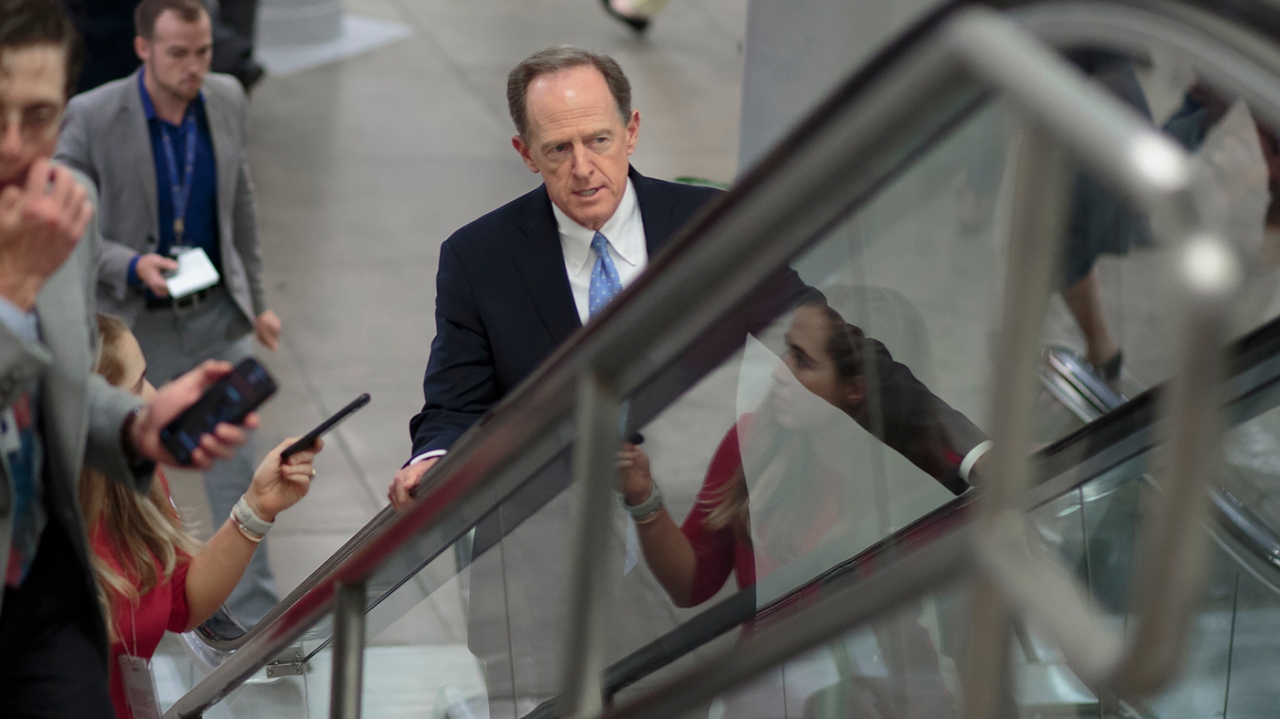
He said that he and other Republicans agreed to support Sen. Pat Toomey’s (R-Pa.) objection to the bill because “Sen. Toomey raised a legitimate question about how the funding works.”
Toomey, a leading Republican voice on fiscal issues, says the bill designates the $400 billion the Department of Veterans Affairs is slated to spend over the next decade to help veterans exposed to toxins as mandatory spending. Traditionally, this spending is classified as discretionary, which means it needs to fit under annual discretionary spending caps.
Toomey, who is not up for reelection this year because he is retiring from the Senate, argues that converting to the mandatory side of the ledger will give Congress flexibility to fit other spending programs under the annual budget caps.
“Here’s the problem with this bill, here’s the budgetary gimmick, this is what’s outrageous,” Toomey said on the floor recently. “It enables that spending to be shifted from the discretionary category to the mandatory category of spending.
“By moving this big category of spending, this $400 billion, out of the discretionary category and putting it into mandatory, you create this big hole under the [budget] chap,” he added. “Guess what happens with that big hole? It gets filled with spending on who knows what.”
The problem for Senate Republicans, however, is that it’s not easy to explain to the American public why this is a deal-breaker.
It’s complicated by the fact that 34 Republicans voted for the bill six weeks ago, even though that version of the bill also designated the new veterans funding as mandatory spending.
Stewart in the video responding to Cruz and other Senate GOP critics declared: “There was no budgetary trick and it was always mandatory and when they voted in the Senate June 16, they actually got 84 votes.”
Veterans Affairs Secretary Denis McDonough warned in a CNN interview over the weekend that Toomey’s amendment could lead to the “rationing of care for vets” because it would place “a year-on-year cap” on what his department can spend to help veterans suffering from exposure to burn pits.
Republicans have also come under criticism from Democrats over their motivation for blocking the bill.
Several Democrats view it as retaliation for a separate deal worked out last week by Senate Majority Leader Charles Schumer (DN.Y.) and Sen. Joe Manchin (DW.Va.). That budget reconciliation package is a top priority for Democrats and is being moved under special budget rules that prevent a GOP filibuster.
After 25 Republicans who had previously voted “yes” for the veterans bill voted “no” on a measure to advance it last week, Sen. Kirsten Gillibrand (DN.Y.) accused them of “holding our service members hostage for the sake of politics.”
Sen. Chris Murphy (D-Conn.) accused them of plotting revenge after learning of the Schumer-Manchin deal on climate and taxes.
“Republicans are mad that Democrats are on the verge of passing climate change legislation and have decided to take their anger out on vulnerable veterans,” he told Vox.com.
Senate Veterans Affairs Committee Chairman Jon Tester (D-Mont.), who has led the floor debate, said it’s “a very bad decision by the Republicans.”
Democratic aides say Schumer offered Toomey a vote on an amendment related to the mandatory spending designation six weeks ago, but 34 Republicans still voted for the bill even though that amendment vote never happened.
In other words, even many of Toomey’s GOP colleagues weren’t prepared to block the popular bill over arcane debate over mandatory and discretionary spending earlier this summer. That changed when Democrats announced a breakthrough deal on climate and taxes.
But now Republicans are being forced to play defense and offer complicated explanations about why they’re holding up the veterans bill.
They would prefer to go on the offense and attack Democrats for raising taxes and fueling inflation with the climate and tax bill they intend to pass later this week.
Republicans backed Toomey last week but are ready to end the standoff soon.
“Some of our members are like, ‘Toomey’s talking about this for several weeks in our conference meetings, let’s try and fix this.’ He’s got a legitimate issue but clearly at some point this is going to pass and it’s going to pass big,” said Senate Republican Whip John Thune (SD).
Discord’s product team has updated the blog post to announce that the company has revamped its Android app. The new update will help Android users to receive new features at the same time as iOS and desktop. Previously, DiscordAndroid users get new features months after they were announced on iOS. According to a report by The Verge, the recently released Server Profiles feature was also available for iOS users a long time before it arrived for Android users. The blog post explains that earlier work on Android implementation of new features was usually delayed before its desktop and iOS rollout was completed. This resulted in some features to release first on one platform before eventually arriving on another one. However, this new update is expected to stop showing users “coming soon to Android” messages for future Discord features, the report claims. New Discord Android app availability Discord has started rolling out the latest Android app update. Users will be able to see the changes in the underlying codebase over the coming weeks. Discord has decided to switch to ReactNative for its Android app.
What is React Native and how will it help users React Native is an open-source UI software framework created by Goal which can be used to develop apps for multiple platforms. As per the report, React Native is widely used across multiple popular mobile apps, including — InstagramMicrosoft Outlook, Shopify, Tesla and Pinterest among others. Discord started using this framework for its iOS app since Meta open-sourced it in 2015, the report mentions. The report also claims that This switch will allow the company to release new features across every platform, simultaneously. Moreover, the design of Discord on Android will look more like the one found in the desktop or the iOS versions, the report suggests. The Discord Android app will retain some specific customizations, however, designs and font size will be aligned with the iOS app.
Discord has explained that React Native has allowed the company to “streamline and consolidate” its processes, which has helped its engineers to “work more efficiently and push out updates more frequently.” Now, the team won’t need to spend much time maintaining “different codebases for different devices” the report states.