Two Hellfire missiles ended al Qaeda leader Ayman al-Zawahiri’s life in a safehouse balcony in a wealthy neighborhood in Kabul, the capital of Afghanistan, at 6:18 am Sunday, a senior administration official said Monday.
The missiles were launched by an unmanned aerial vehicle, or drone, killing him instantly.
The nature of the strike as described by a senior administration official signals that the US may have used the R9X Hellfire variant, also known as the “Ninja” or “Flying Ginsu” missile, nicknamed for knives famously sold on TV in the 1980s. This variant has been used in the recent past to kill other extremist leaders.
The R9X Hellfire has six blades that rotate at high speed and deploy before impact — instead of conventional warhead explosives, according to Janes, a defense intelligence provider. The missile pierces and cuts its target, rather than blowing it up. The design makes it easier to take out an intended target, while lessening the likelihood of causing additional casualties.
Ayman Al-Zawahiri in an undated image from video
Maher Attar/Sygma via Getty Images
The White House has not shared details about the type of Hellfire missiles used. A reporter asked a senior administration official on a call Monday about the nature of the missile, but the official did not answer.
The senior administration official who briefed reporters said the strike only killed al-Zawahiri, avoiding civilian casualties and that the strike did not completely destroy the safehouse where al-Zawahiri was hiding with his family. It is unclear whether the missiles inflicted structural damage beyond the patio. Two intelligence sources familiar with the matter said the CIA carried out the strike.
Hellfire missiles are air-to-surface missiles initially designed for anti-armor strikes, but later versions have been used for precision drone strikes. The arms manufacturer Lockheed Martin developed the missiles with the name “Heliborne, Laser, Fire, and Forget Missile,” which evolved into the Hellfire missile, as it is now known.
The R9X variant was initially deployed in secret in 2017, according to a US Army equipment guide, and was used to kill Abu Khayr al-Masri, a member of al Qaeda’s leadership.
Photos of the aftermath on social media showed the car where al-Masri was purportedly killed as having damage to the passenger compartment of the beige Kia sedan but no damage to the engine block. The roof was blown open on the right side of the vehicle.
An image from video posted online by Syrian activists in Idlib province shows people inspecting a sedan damaged heavily by a purported US airstrike on Feb. 26, 2017. There were unconfirmed reports that al Qaeda deputy leader Abdullah Muhammad Rajab Abdulrahman, aka Abu al-Khayr al-Masri, was killed in the strike.
The Hellfire variant became public knowledge after it was used in 2019 to take out Jamal Ahmad Mohammad Al Badawi, who was behind the 2000 USS Cole Bombing.
The Wall Street Journal reported in 2019 that a weapon similar to the R9X was considered as an alternative way to kill former al Qaeda leader Osama bin Laden in 2011, but officials ultimately decided to use special forces fighters.
If you want to understand the nature of Australia’s energy crisis right now, look beyond the headlines and the rhetoric from both sides off the fossil fuel fence, and just take a look at market prices.
Australian consumers – both big and small – are being ripped off at the petrol pump, at the power socket, and the gas pipelines by a massive industry used to setting its own rules and regulations, and having its own way with markets and governments.
Australia has no shortage of gas, that much is now clearly well established. But what should also be recognized is that it has no shortage of gas cartel like behaviour, even if the country’s impotent regulators prefer to look the other way.
On Monday, something extraordinary happened. On the same day that the Australian government finally dared to call its bluff, and threaten the imposition of the so-called “gas trigger”, prices plunged on both the electricity futures market and the gas market.
It was as if the fossil fuel industry had been caught red handed, like a trillion dollar toddler with its hand in the cookie jar, its pockets full of sugary sweets and its mouth bursting with lollies as it protested its innocence. It insists, always, that it only ever has the consumer at heart.
Gas prices plunged in Victoria – from around $30 a petajoule to just $12, and in NSW from $30 to $20, with predictions of further falls to match the Victoria price.
In the electricity market, the futures price for “baseload” contacts in multiple markets did a rapid about turn, plunging more than $15/MWh in one day. Maybe it was just a coincidence.
Try as they might, the regulators have struggled to find any evidence of gaming, just of perfectly legal “re-bidding”. The industry has even evolved its own vocabulary – opportunistic cost, for instance – to assign some sort of economic rationale, if not moral justification, for the exploitation of consumers.
As energy analyst Dylan McConnell noted this week, the spectacular price falls “belled the cat” on the fact that Australian gas producers, and many other parts of the industry, have been enjoying windfall profits at the expense of consumers, and justifying it by pointing to international prices.
It’s a story, as we have noted, of a fossil fuel industry that has lost all perspective, and has effectively thrown away its social license. But still it craves more money and regulatory indulgence.
Bruce Robertson, an energy finance analyst from the Institute for Energy Economics and Financial Analysis, says the report from the Australian Competition and Consumer Commission that attracted so much attention on Monday has confirmed there is no shortage of gas in Australia.
“This is a contrived shortfall. It doesn’t exist. There is an abundance of gas – an embarrassment of riches – on the east coast of Australia,” he told RenewEconomy.
“What’s happening is that these companies are just starving the gas market. It’s what they’ve been doing consistently since 2015.”
Robertson says the east coast gas market has all of the features of a cartel, in that just a few companies control 90% of the supply, they have been reported to be using anti-competitive practices, and they are forcing prices up above international levels .
“What the ACCC report actually outlines is that there’s a gas cartel operating… the report forensically details all of those three things, and yet it doesn’t call them a cartel.
“We have all these things happening, and yet they won’t actually call it what in economic terms it is: a cartel.”
The clean energy industry has been able to launch a few devastatingly effective raids on the gas cartels so far.
The most notable is perhaps the influence of the original Tesla big battery in South Australia that broke the cartel that had been openly rorting frequency markets by making all but 1MW of supply available at low prices, and then charging a fortune for the remaining MW that flowed through the entire market.
The oil market is another case in point. The previous federal government slashed the fuel excise in half, and is now arguing that it be extended to protect consumers. The refiners, meanwhile, are making off with huge margins and profit lifts.
Wind and solar can sometimes break the control of the fossil fuel generators when they produce enough to that they become the price setters, not coal, gas or hydro.
So can other technologies such as demand response, but the incumbent fossil fuel industry has fought such initiatives, including energy efficiency, with tooth and nail.
In the last two months, under the cover of international price spikes, the legacy industry – largely but not exclusively fossil fuels – has been able to do what it wants, except when it went too far and forced the market operator to suspend the market.
In the UK, the government and the regulator are sick of it, and are now seeking to design new markets that will ensure that the low price of wind, solar and storage is not polluted by the cartel-like practices of the fossil fuel industry.
Robertson says the Australian federal government and the regulators need to take stronger action and be smarter about the problem at hand, which means thinking of alternatives like efficiency and regulation rather than just supply.
“The idea that you can chat to these companies and ask them to play nicely is off with the pixies,” he says.
“The same applies to the idea that we can produce more gas and it will reduce prices. We’ve tried that time and time and time again over the last six years and it doesn’t work. We need to get a grip and do something that will work.
“Cartels are illegal. Price fixing is illegal… What we have is a government that is cow-towing to an illegal price fixing organization to the detriment of the Australian people.”
Robertson also suggests that the developers of the massive and duplicated LNG terminals around Gladstone in Queensland are breaking the approval conditions for their projects, which essentially was a guarantee that export activities would not impact the domestic market.
“We also have a government that is refusing to enforce the rules under which those conditions were made. They’ve had an immense effect on prices and in many cases pushed them above international prices.
“Someone has got to call it out for what it is: obscene. We’re being held for ransom by a cartel and the government refuses to prosecute.”
Many analysts suggest a windfall tax to ensure Australian consumers get some benefit from the massive profits being earned by the gas industry and the fossil fuel industry in general.
Robertson’s preferred solution is domestic gas reservation on all fields, and forcing the price down to a similar level of Western Australia.
“This has to end – we’ll see massive job losses and genuine hardship for anyone who is not well off if we don’t do something. It’s not hard to do, it’s called legislation it’s called government policy.
“We need to do it now. Like literally today, we need to start drawing up this legislation and get it happening. Get a domestic gas reservation that sets aside more than what we need.”
We need more than that.
Greens Senator Sarah Hanson-Young on Tuesday noted the energy system, as it stands, is obviously broken.
“These big gas companies have been ripping off customers, consumers, households and small businesses for far too long
“They’re making windfall profits. They’re not paying enough tax. And they’re taking Australians for a ride. There is no shortage of gas here in Australia. We’ve got plenty of it.”
But Hanson-Young says rather than green-lighting yet more gas and coal projects, “one of the things we’ve got to really do is fast track the transition… of our energy grid making sure we have it powered by renewables and storage. That would make cheaper, more reliable power and push down prices very, very quickly.”
The NSW Coalition government gets it. Industry gets it. Investors get it. Consumers get it. Why doesn’t the federal government get it?
See also: “Exciting and pivotal moment:” NSW prepares for big switch from coal to renewables
A muon, center, spins like a top within the atomic lattice of a thin film of superconducting nickelate. These elementary particles can sense the magnetic field created by the spins of electrons up to a billionth of a meter away. By embedding muons in four nickelate compounds at the Paul Scherrer Institute in Switzerland, researchers at SLAC and Stanford discovered that the nickelates they tested host magnetic excitations whether they’re in their superconducting states or not—another clue in the long quest to understand how unconventional superconductors can conduct electric current with no loss. Credit: Jennifer Fowlie/SLAC National Accelerator Laboratory
Electrons find each other repulsive. Nothing personal—it’s just that their negative charges repel each other. So getting them to pair up and travel together, like they do in superconducting materials, requires a little nudge.
In old-school superconductors, which were discovered in 1911 and conduct electric current with no resistance, but only at extremely cold temperatures, the nudge comes from vibrations in the material’s atomic lattice.
But in newer, “unconventional” superconductors—which are especially exciting because of their potential to operate at close to room temperature for things like zero-loss power transmission—no one knows for sure what the nudge is, although researchers think it might involve stripes of electric charge, waves of flip-flopping electron spins that create magnetic excitations, or some combination of things.
In the hope of learning more by looking at the problem from a slightly different angle, researchers at Stanford University and the Department of Energy’s SLAC National Accelerator Laboratory synthesized another unconventional superconductor family—the nickel oxides, or nickelates. Since then, they’ve spent three years investigating the nickelates’ properties and comparing them to one of the most famous unconventional superconductors, the copper oxides or cuprates.
And in a paper published in Nature Physics today, the team reported a significant difference: Unlike in the cuprates, the magnetic fields in nickelates are always on.
Magnetism: Friend or foe?
Nickelates, the scientists said, are intrinsically magnetic, as if each nickel atom were clutching a tiny magnet. This is true whether the nickelate is in its non-superconducting, or normal, state or in a superconducting state where electrons have paired up and formed a sort of quantum soup that can host intertwining phases of quantum matter. Cuprates, on the other hand, are not magnetic in their superconducting state.
“This study looked at fundamental properties of the nickelates compared to the cuprates, and what that can tell us about unconventional superconductors in general,” said Jennifer Fowlie, a postdoctoral researcher at SLAC’s Stanford Institute for Materials and Energy Sciences (SIMES) who led the experiments.
Some researchers think magnetism and superconductivity compete with each other in this type of system, she said; others think you can’t have superconductivity unless magnetism is close by.
“While our results don’t settle that question, they do highlight where more work should probably be done,” Fowlie said. “And they mark the first time that magnetism has been examined in both the superconducting and the normal state of nickelates.”
Harold Hwang, a professor at SLAC and Stanford and director of SIMES, said, “This is another important piece of the puzzle that the research community is putting together as we work to frame the properties and phenomena at the heart of these exciting materials.”
Enter the muon
Few things come easy in this field of research, and studying the nickelates has been harder than most.
While theorists predicted more than 20 years ago that their chemical similarity to the cuprates made it likely that they could host superconductivity, nickelates are so difficult to make that it took years of trying before the SLAC and Stanford team succeeded.
Even then, they could only make thin films of the material—not the thicker chunks needed to explore its properties with common techniques. A number of research groups around the world have been working on easier ways to synthesize nickelates in any form, Hwang said.
So the research team turned to a more exotic method, called low-energy muon spin rotation/relaxation, that can measure the magnetic properties of thin films and is available only at the Paul Scherrer Institute (PSI) in Switzerland.
Muons are fundamental charged particles that are similar to electrons, but 207 times more massive. They stick around for just 2.2 millionths of a second before decaying. Positively charged muons, which are often preferred for experiments like these, decay into a positron, a neutrino and an antineutrino. Like their electron cousins, they spin like tops and change the direction of their spin in response to magnetic fields. But they can “feel” those fields only in their immediate surroundings—up to about one nanometer, or a billionth of a meter, away.
At PSI, scientists use a beam of muons to embed the little particles in the material they want to study. When the muons decay, the positrons they produce fly off in the direction the muon is spinning. By tracing the positrons back to their origins, researchers can see which way the muons were pointing when they winked out of existence and thus determine the material’s overall magnetic properties.
Finding a workaround
The SLAC team applied to do experiments with the PSI system in 2020, but then the pandemic made it impossible to travel in or out of Switzerland. Fortunately, Fowlie was a postdoc at the University of Geneva at the time and already planning to come to SLAC to work in Hwang’s group. So she started the first round of experiments in Switzerland with a team led by Andreas Suter, a senior scientist at PSI and an expert in extracting information about superconductivity and magnetism from muon decay data.
After arriving at SLAC May 2021, Fowlie immediately started making various types of nickelate compounds the team wanted to test in their second round of experiments. When travel restrictions ended, the team was finally able to go back to Switzerland to finish the study.
The unique experimental setup at PSI allows scientists to embed muons at precise depths in the nickelate materials. From this, they were able to determine what was going on in each super-thin layer of various nickelate compounds with slightly different chemical compositions. They discovered that only the layers that contained nickel atoms were magnetic.
Interest in the nickelates is very high around the world, Hwang said. Half a dozen research groups have published their own ways of synthesizing nickelates and are working on improving the quality of the samples they study, and a huge number of theorists are trying to come up with insights to guide the research in productive directions.
“We are trying to do what we can with the resources we have as a research community,” he said, “but there’s still a lot more we can learn and do.”
New leap in understanding nickel oxide superconductors
More information:
Jennifer Fowlie, Intrinsic magnetism in superconducting infinite-layer nickelates, Nature Physics (2022). DOI: 10.1038/s41567-022-01684-y. www.nature.com/articles/s41567-022-01684-y
Provided by SLAC National Accelerator Laboratory
citation: Study finds nickelate superconductors are intrinsically magnetic (2022, August 1) retrieved 2 August 2022 from https://phys.org/news/2022-08-nickelate-superconductors-intrinsically-magnetic.html
This document is subject to copyright. Apart from any fair dealing for the purpose of private study or research, no part may be reproduced without the written permission. The content is provided for information purposes only.
A Suns star is still off-contract—and the Crows are preparing to pounce.
Plus the intriguing contract situation surrounding a young Magpies forward.
Get the latest player movement news and updates in AFL Trade Whispers!
Watch every blockbuster AFL match this weekend Live & Ad-Break Free In-Play on Kayo. New to Kayo? Start your free trial now >
NEW FOX FOOTY PODCAST — Six polarizing finals contenders, latest trade whispers
Listen below or subscribe in Apple Podcasts or Spotify
CROWS KEEPING TABS ON SUNS STAR
Adelaide is making a major play for homegrown forward Izak Rankine in what would be one of the biggest coups of this year’s trade period.
Gold Coast officials have long been confident of retaining Rankine after already re-signing fellow South Australian Jack Lukosius, as well as Ben King, Ben Ainsworth, Elijah Hollands and Mac Andrew.
The Suns are also expected to soon ink Lachie Weller on a four-year contract.
Rankine, who was drafted from SANFL club West Adelaide with the No. 3 pick in the talent-laden 2018 class, is out of contract at season’s end but is not a free agent.
The Crows would likely need to part with their first-round draft selection, which is currently No. 4 after their weekend win over Carlton, if they convince Rankine to leave, but that may be only the start of what was required.
However, the 22-year-old’s contract status, and the possible threat of Adelaide grabbing him in the pre-season draft, could complicate any potential negotiations.
Izak Rankin of the Suns. Picture: Russell FreemanSource: Getty Images
The Blues did exactly that with ex-Gold Coast footballer Jack Martin three years ago after discussions between the clubs broke down, heavily front-ending his deal to ward off other suitors.
Essendon already made a lucrative pitch to Rankine’s management this year to try to lure him to Victoria, with the young star’s career-best season catching rivals’ attention.
His agent, Garry Winter, of W Sports and Media, was previously on Adelaide’s board, and it could be worth up to $800,000 per season for Rankine to become a Crow on a long-term deal.
Rankine’s three-goal performance against West Coast on Sunday was his seventh match with multiple majors in 2022, along with averaging 14 disposals and six score involvements.
He would be a significant upgrade on rebuilding Adelaide’s small forward corps and could form a deadly duo with last year’s first-round draftee Josh Rachele.
Rachele’s 17 goals rank fourth at the Crows – behind tall targets Taylor Walker (42) and Darcy Fogarty (22), as well as spring-heeled forward Shane McAdam (18) – while Ned McHenry and James Rowe have each kicked only 10.
They sit in the bottom four on the ladder and for scoring, so Rankine would provide an excellent boost ahead of a season where Matthew Nicks’ team hopes to take a leap.
Suns keep finals hope alive | 01:25
Adelaide’s list management team met with Melbourne goals neak Kade Chandler, another South Australian, during last year’s trade period before he decided to stay at the Demons.
The Crows were linked with Western Bulldogs midfielder Josh Dunkley for many months but it’s now believed Port Adelaide would be the South Australian club he would join if he left the Kennel.
Dunkley’s girlfriend, Tippah Dwan, plays netball for the Adelaide Thunderbirds.
Asked last week about the delay in Rankine re-signing, Gold Coast coach Stuart Dew said they were “still confident” he would be at the club in 2023.
“There’s always a process. Things happen at different rates and different speeds,” Dew said.
“A number of contracts we’ve done have actually taken longer, so as long as the conversations are happening, that’s where the confidence comes from.
“It’s when it goes quiet (that you get concerned), and it’s certainly not like that – the dialogue’s still there.”
—NCA Newswire
HENRY, PIES ‘NOT OVERLY CLOSE’ TO FRESH CONTRACT
Collingwood and young forward Ollie Henry are “not overly close” on signing a new deal, but both parties remain confident a contract will be signed soon, reports SEN’s Sam Edmund.
Henry has had a promising yet rollercoaster 2022 season with the Magpies so far, booting 21.15 from 14 games. He started as the sub against Freo in Round 10 but came on to kick 4.1, while he was the unused medical sub against the Adelaide Crows in Round 18 and has spent the past two weekends in the VFL, booting 4.2 and 3.1 respectively.
The 20-year-old is uncontracted beyond this season. In May I told AFL Media he wasn’t in a rush to sign a new contract but declared he was “loving his time at Collingwood”.
Goodwin and Fagan discuss trade rumors | 03:43
Edmund reported on SEN Breakfast on Tuesday that talks between Henry’s management and the Magpies were ongoing, adding they’d met “in the last week or two”.
“Not overly close at this stage at Collingwood, but I think this one gets worked out. Both parties expect that to be the case,” Edmund told SEN Breakfast.
“The Pies want him to stay and Henry wants to stay, but with (Dan) McStay coming in there’s some things to work out around what his future looks like on game day.”
“I think they’ll get there, no real reason to think otherwise at this stage. It just needs to be worked through with the pieces coming back the other way like Dan McStay and the like.”
That’s a wrap on the premier’s press conference for this morning.
But the issue will not be going away – our live coverage of the NSW parliamentary inquiry into the appointment of former deputy premier John Barilaro to a $500,000-a-year trade post in the US is about to begin.
It is the fourth day of hearings into Barilaro’s controversial appointment since it was first announced by the government almost seven weeks ago. Yo soy Natassia Chrysanthos and I will keep you updated on the latest evidence as it comes before the public accountability committee.
The inquiry is due to hear from Amy Brown from 10.30am until about 4.30pm, with a couple of breaks in between. Brown is the chief executive of Investment NSW and head of the Department of Enterprise, Investment and Trade appointed – meaning she was the top bureaucrat overseeing the process that saw the former deputy premier.
In NSW Premier Dominic Perrotte’s comments this morning, he made it clear that stuart ayres′ engagement with Brown during the recruitment process was central to the reason the minister resigned from cabinet last night.
Brown giving evidence on the first day of hearings, on June 29.Credit:Janie Barrett
Brown appeared before the committee on its first day of hearings, back on June 29.
But she has been called back for a second time due to apparent contradictions in her testimony compared to that of others who gave evidence, as well as dozens of bombshell documents that have emerged over recent weeks.
Labor’s leader in the upper house, Penny Sharpeyesterday said Brown had many questions to answer.
“We want to know about her conversations in the shortlisting process in relation to the second round. We want to understand what direction and discussions she was having with Minister [Stuart] Ayres,” Sharpe said.
“And we still haven’t got to the bottom of why she decided that Jenny West was the best candidate for the job one day, and then after the ministers had met, and decided to change the process, all of a sudden, Jenny West was unsuitable.
“She’s got many questions to answer and they’ll just be some of them.”
LOS ANGELES (CNS) — The Los Angeles County Board of Supervisors ratified a local emergency declaration Tuesday in response to the monkeypox outbreak.
Board Chair Holly Mitchell issued a proclamation late Monday declaring the emergency in Los Angeles County, where more than 400 monkeypox cases have been identified so far — nearly the double the amount from a week ago.
“This proclamation is critical in helping us get ahead of this virus,” Mitchell said in a statement. “By declaring a local emergency, it allows us to cut through the red tape to better dedicate resources and educate residents on how to protect themselves and help stop the spread. It will also allow the county to quickly administer vaccines as more become available and to take the necessary efforts to obtain supplies and enhance outreach and awareness.”
The Board of Supervisors ratified the declaration Tuesday on an unanimous vote.
As part of the proclamation, the Board of Supervisors will request recovery assistance be made available under the California Disaster Assistance Act, and that the state expedite access to state and federal resources and any other appropriate federal disaster relief programs.
The Board of Supervisors will also direct county departments to implement all assessment, assistance and monitoring efforts as applicable.
Gov. Gavin Newsom issued a state of emergency for California on Monday in response to the increase of monkeypox cases in the state. New York also issued an emergency declaration, as has San Francisco.
Supervisor Janice Hahn wrote on Twitter Monday she supports the emergency declaration.
“I’m hopeful this will help vaccination efforts and ultimately help slow the spread of this virus,” Hahn said in a tweet.
Supervisor Kathryn Barger said in a statement the county “needs to draw down all the support available to accelerate the distribution of vaccines and resources to those at risk and suffering from this terrible disease. I will work to ensure we’re doing so quickly and efficiently We don’t have any time to waste.”
As of Monday, a total of 824 monkeypox cases were confirmed in California — the second-highest of any state, behind New York’s 1,390 — while nationwide, the aggregate count was at 5,811, according to the latest data from the US Centers for Disease Control and Prevention. There were more than 400 cases in Los Angeles County as of Tuesday, primarily in gay men.
Monkeypox is generally spread through intimate skin-to-skin contact, resulting from infectious rashes and scabs, though respiratory secretions and bodily fluids exchanged during extended physical episodes, such as sexual intercourse, can also lead to transmission, according to the CDC. It can also be transmitted through the sharing of items such as bedding and towels.
Symptoms include fresh pimples, blisters, rashes, fever and fatigue. There is no specific treatment. People who have been infected with smallpox, or have been vaccinated for it, may have immunity to monkeypox.
According to health officials, the vaccine can prevent infection if given before or shortly after exposure to the virus.
Gay, bisexual and other men who have sex with men are at increased risk of contracting the virus, according to the CDC.
Last week, the Board of Supervisors voted to lobby federal health officials for more monkeypox vaccine supplies and boosted funding for testing and administration of the shots. The county has been slowly expanding eligibility for the JYNNEOS monkeypox vaccine, but supplies remain extremely limited.
In Los Angeles County, monkeypox vaccines are available to people confirmed by the Department of Public Health to have had high- or immediate-risk contact with a known monkeypox patient, and to people who attended an event or visited a venue where they were a high risk of exposure to a confirmed case. Those people are generally identified through county contact-tracing efforts, and they will be notified by the county.
Shots are also available for gay and bisexual men and transgender people with a diagnosis of rectal gonorrhea or early syphilis within the past year.
Also eligible for the shots are gay or bisexual men or transgender people who are on HIV pre-exposure prophylaxix, or PrEP, or who attended or worked at a commercial sex venue or other venue where they had anonymous sex or sex with multiple partners — such as at a sauna, bathhouse or sex club — in the past 21 days.
Eligibility was expanded Tuesday to include gay or bisexual men or transgender people aged 18 and older who have had multiple or anonymous sex partners in the past 14 days.
People who believe they fall into any of the criteria can contact their health care provider to see if that provider can administer the vaccine.
Qualified people who do not have a health care provider — or whose provider does not carry the vaccine — can either make an appointment at a designated vaccine clinic or visit a walk-in location. Information is available at ph.lacounty.gov/monkeypox. A list of monkeypox vaccine locations is available here.
The county has also activated a website where residents can fill out an online form to see if they may be eligible for a shot and pre-register to be added to a waiting list.
People who register at the site and are eligible for the vaccine will receive a text message when it is available, with information on where to get the shot.
The registration website is here.
The county on Wednesday will open a monkeypox vaccination site at the West Hollywood Library, 647 N. San Vicente Blvd., for people who pre-registered for the vaccine. It will be open by appointment only from 9 am to 6 pm
The vaccine is a two-shot regimen, so additional supplies will be reserved to provide second doses to those who received the initial shot.
On Wall Street, shares fell, paced by losses on the Dow. Real estate led all 11 of the S&P500 industry sectors down.
Today’s schedule
Local: Second quarter retail sales volumes at 11.30am AEST; NZ second quarter jobs data at 8.45am AEST
Overseas data: July services PMIs for China (Caixin), Japan (Nikkei), Euro zone (Markit) UK (Markit), US (Markit); Euro zone June PPI, June retail sales; US June factory and durable goods orders, July ISM non-manufacturing index
market highlights
ASX futures down 14 points or 0.2 per cent to 6893 near 6.30am AEST
AUD -1.5% to 69.20 US cents
Bitcoin +0.2% to $US23,039.74 near 6.30am AEST
On Wall Street: Dow -1.2% S&P500 -0.7% Nasdaq -0.2%
In New York: BHP -2.2% Rio -1.6% Atlassian +1.7%
Tesla +1.1% Apple -0.9% Amazon -0.9% Netflix -2.1%
Spot gold -0.01% to $US1771.97 an ounce at 1.59pm New York time
Brent crude +1.7% to $US101.69 a barrel
Iron ore +0.4% to $US113.30 a tonne
10-year yield: US 2.75% Australia 2.97% Germany 0.81%
US prices as of 4.33pm in New York
United States
After years of just missing out on the top spot, JPMorgan Chase & Co’s equities trading business has finally eked out the No. 1 place on Wall Street.
Between April and June, the bank’s revenue from the business outperformed both Goldman Sachs Group and Morgan Stanley for the first time in a quarter since at least 2006, reaching nearly $US3.1 billion. Further down the ranking, a strong set of results Friday for BNP Paribas’s equities unit means it has overtaken Barclays this quarter.
US household debt increased by 2 per cent to $US16.2 trillion in the second quarter, with mortgages, auto loans and credit-card balances all seeing sizable increases, according to a report by the New York Federal Reserve Bank.
The increase in borrowing, which equals to $US312 billion over three months, reflected in part higher prices for homes and cars. Americans also are putting more on their credit cards to cover rising costs amid decades-high inflation.
US job openings fell in June to a nine-month low, suggesting tightness in the labor market is easing somewhat amid growing economic pressures.
The number of available positions decreased to 10.7 million in the month from an upwardly revised 11.3 million in May, the Labor Department’s Job Openings and Labor Turnover Survey, or JOLTS, showed. The 605,000 decline was the biggest since April 2020.
The level of openings was lower than all but one estimate in a Bloomberg survey of economists.
Europe
European shares fell on Tuesday as weak global factory data fanned economic slowdown fears.
The pan-European STOXX 600 slipped 0.2 per cent.
“After the best month for STOXX 600 in July, European equities are giving back some of those gains to kick off August, suggesting the rally was slightly overdone,” said Victoria Scholar, head of investment at Interactive Investor.
In Europe, miners were among the biggest drags, falling 1.4 per cent amid a drop in commodities’ prices as traders rushed to safer assets.
Semiconductor stocks such as ASML Holding, ASM International and BE Semiconductor fell between 1.2 per cent and 2.2 per cent.
Meanwhile, Moody’s Investors Service flagged an increased risk of stagflation in European Union countries.
Across European indexes, UK’S FTSE 100 fell the least among European peers thanks to bumper profits from oil giant BP, shares of which signed 2.8 per cent.
Maersk gained 2.1 per cent after raising its 2022 profit guidance for a second time following a beat in quarterly revenue, as congested supply chains boost freight rates.
Ferrari gained 1.1 per cent after beating earnings forecasts and reporting record orders for the second quarter, prompting the luxury sports car maker to also raise its full-year targets.
commodities
Dalian and Singapore iron ore futures rose in a volatile session on Tuesday, as traders focused on improving steel margins in top steel producer China, while weighing prospects of further output cuts.
The most-traded iron ore, for September delivery, on China’s Dalian Commodity Exchange ended daytime trade 1.5 per cent higher at 807 yuan ($US119.32) a tonne, near Monday’s four-week high of 817.50 yuan.
On the Singapore Exchange, the steelmaking ingredient’s benchmark September contract climbed 0.7 per cent to $US115.50 a tonne, as of 0725 GMT, but off the previous session’s four-week peak of $US120.95.
Copper edged lower on Tuesday alongside global equities as tensions between China and the United States and a run of weak economic data pushed investors to safer assets.
Benchmark copper on the London Metal Exchange (LME) was down 0.1 per cent at $US7815 a tonne at 1626 GMT, having fallen as low as $US7665.
Russian metals producer Nornickel said that its sales of nickel, palladium and platinum fell in the first half of 2022 due to disrupted supply chains, while net profit rose by 18 per cent to $US5.1 billion due to a stronger rouble.
Apple is dropping its mask requirements for corporate employees at “most locations,” according to an internal memo obtained by TheVerge.
Apple’s COVID-19 Response Team on Monday told corporate employees that the company is updating current protocols “in light of current circumstances,” and urged staff to continue wearing a face mask if they feel more comfortable doing so.
Apple also noted in the email that “everyone’s personal circumstances are different” and reminded corporate employees to respect every individual’s decision to wear a mask or not.
Apple has been shifting its operating policies throughout the pandemic to keep in line with local regulations and to mitigate risk for employees and customers in areas where COVID is spiking.
For example, Apple in March relaxed its mask requirements for its retail employees in the United States due to a decline in Covid-19 cases and a relaxation of local mandates.
The latest move however comes amid a fresh wave of infections in California that were first identified in the Bay Area, due to the highly-contagious Omicron BA.5 subvariant.
Masks were previously still required in “public spaces,” but not at desks. Now requirement dropped altogether. Doesn’t seem like the most ideal time to do so however. See that big case decline between Feb. and March? That was the last time Apple dropped the requirement. https://t.co/vyKX3okvhu pic.twitter.com/MfcaumfNq2
— Mark Gurman (@markgurman) August 2, 2022
Apple is still operating a hybrid home/office work policy for corporate employees in the United States. Staff began returning to their offices on April 11 for one day a week, ending a two-year work from home policy that Apple implemented during the pandemic.
Apple originally planned to have staff in the office for three days of the week by May 23, but the company reversed the decision after a surge in infections, and a two-day requirement was imposed on May 4.
Note: Due to the political or social nature of the discussion regarding this topic, the discussion thread is located in our Political News forum. All forum members and site visitors are welcome to read and follow the thread, but posting is limited to forum members with at least 100 posts.
Related Stories
Apple Reinstating Employee Mask Mandate at Approximately 100 US Retail Stores
Apple retail employees at around 100 stores will need to go back to wearing a mask while working, according to Bloomberg’s Mark Gurman. Apple is mandating masks for employees again due to a rising number of COVID cases across the United States. Customers who visit an Apple Store are not required to wear a mask at this time, but Apple is continuing to recommend masks for all Apple Store…
Apple Dropping Mask Mandates for Retail and Corporate Employees
Apple is planning to drop its mask requirements for retail and corporate employees in the United States due to a decline in Covid-19 cases and a relaxation of local mandates, reports Bloomberg. For vaccinated corporate employees, masks are now optional in regions where local indoor mask mandates have ended. Retail staff in a small number of locations have also been informed that masks will…
Apple Stores to Drop Mask Requirement for Customers in Many US States
Apple will no longer require customers to wear a mask to enter many of its retail stores in the United States, reports Bloomberg. Mask mandates will disappear at several stores starting on Friday due to positive trends in vaccinations and declining COVID-19 cases. More than 100 stores will drop the mask mandate starting Friday, with the policy then expanding to additional stores based on…
Apple Ending Mask Mandates in Many Stores, Plans to Reintroduce In-Person Classes
Apple is no longer requiring customers to wear masks when visiting Apple Stores in many locations across the United States, reports Bloomberg. Apple has dropped mask mandates following changes in local guidelines and a reduction in COVID-19 cases. Employees have been informed of the mask updates, and Apple has also updated its website to provide details on which locations are no longer…
Apple Once Again Requiring Masks at All US Retail Stores
Apple retail stores are implementing stricter COVID measures, once again requiring customers to wear masks in all locations in the United States and enacting social distancing rules in some locations that had been eliminated earlier this year. Apple in November dropped its masking requirements for customers in many US states due to positive trends in vaccinations and declining COVID-19…
Apple’s Corporate Employees Returning to Offices on Hybrid Schedule Starting Today
Corporate Apple employees in the United States began returning to their offices today, ending a two-year work from home policy that Apple implemented during the pandemic. Employees at locations like Apple Park and Infinite Loop were last month given a deadline of April 11 for returning to in-person work. Apple has been eager to get employees back in the office and scheduled return dates…
Apple Tightens COVID Prevention Rules for Developers Attending Apple Park WWDC Viewing Event
Developers who have been invited to attend the June 6 WWDC viewing event at the Apple Park campus in Cupertino, California will need to adhere to stricter COVID prevention rules that Apple has recently implemented. In emails sent out today, Apple informed developers that they will need to wear N95 masks while indoors, and that a negative FDA-approved COVID antigen test is required the day…
Popular Stories
Top Stories: iOS 16 Beta 4, ‘Apple Watch Pro’ Rumors, and More
We’re probably about six weeks away from the unveiling of the iPhone 14 lineup and Apple is continuing to polish the iOS 16 update that will be released alongside the new hardware, so we’re seeing a number of tweaks as it moves through the beta testing period. This week also saw some rumors about the rugged “Apple Watch Pro” planned for launch later this year, as well as some of the…
iPhone 14 Still to Boost Performance Improvement Despite Sticking With A15 Chip
The standard iPhone 14 models will still have better performance than the iPhone 13, despite containing the same A15 Bionic chip, according to leaker “ShrimpApplePro.” In March, Apple analyst Ming-Chi Kuo claimed that only the iPhone 14 Pro models will feature the A16 chip, with the standard iPhone 14 and iPhone 14 Max models to be equipped with the A15 chip like the iPhone 13. In an April.. .
Intel to Introduce Wi-Fi 7 in 2024 as Apple Plans Imminent Move to Wi-Fi 6E
Intel is planning to install its next-generation Wi-Fi 7 (802.11be) technology in devices by 2024, ETNews reports. Wi-Fi 7 is the successor to Wi-Fi 6E (802.11ax), bringing two times faster data processing speeds of 5.8 Gbps and more stable 6 GHz bandwidth stability, as well as support for up to 36 Gbps when working with data. Intel plans to expand its Wi-Fi 7 development efforts ahead of…
Apple’s Online Store is Currently Down in Some Countries [Updated]
Apple’s online store is currently down in some countries, including the United States, Canada, Australia, France, Germany, Italy, Spain, the United Kingdom, and more. The downtime is not worldwide, with the store still operational in some other countries. “We’re making updates to the Apple Store,” the store page says, as usual when there is downtime. Apple advises customers to “check back…
Apple Adds Eight More Macs to Vintage Products List
As expected, Apple today updated its vintage products list with eight more MacBook, MacBook Air, MacBook Pro, and iMac models released in 2015 and 2016. Notably, the first MacBook Pro models with the Touch Bar are now classified as vintage. Apple introduced the Touch Bar in October 2016 as part of a complete redesign of the MacBook Pro. Apple has since removed the Touch Bar from higher-end…
VMware Fusion Tech Preview Brings Windows 11 to Apple Silicon Macs
VMware this week announced that its latest VMware Fusion update brings Windows 11 support to both Intel and Apple silicon Macs. Available as a free tech preview, the 2H22 version of Fusion will finally allow Apple silicon Mac users to download and use Windows on their machines through virtualization. Features include Windows 11 support with 2D GFX and networking, VMtools installation for…
Apple Expands Apple TV Gift Card Offer to More Countries
Apple has expanded a previously US exclusive Apple TV gift card offer to more countries worldwide, offering customers a gift card alongside the purchase of an Apple TV 4K or Apple TV HD. The original offer was launched for US customers last month, giving buyers a $50 gift card with the purchase of an Apple TV. Following the Apple Store going down in several countries, Apple has…
Melbourne champion Garry Lyon says it’s no surprise an infamous pre-season camp “destroyed” Adelaide after reading Eddie Betts’ confronting recollection of his experience.
An excerpt from Betts’ upcoming autobiography, ‘The Boy from Boomerang Crescent’, was released on Monday night via The Age in which the triple All-Australian labeled the camp “weird” and “completely disrespectful”.
Several players, including Betts, and officials departed the club in the years following the pre-season leadership camp, which foxfooty.com.au revealed details of in March that year.
Watch every blockbuster AFL match this weekend Live & Ad-Break Free In-Play on Kayo. New to Kayo? Start your free trial now >
In the most damning first-hand account of the 2018 camp yet, Betts claimed private details shared in a counseling session during the camp were misused, while sensitive Aboriginal cultural rituals were misappropriated.
“There was all sorts of weird shit that was disrespectful to many cultures, but particularly and extremely disrespectful to my culture,” he wrote.
Betts also wrote he was told he would “come back a better husband and father, a better teammate” after the camp – terms veteran players Taylor Walker and Rory Sloane used when defending the four-day event.
speaking on SEN Breakfast on Wednesday morning, Lyon said he was stunned by Betts’ account, but added it provided important context as to the turmoil that followed at the Crows.
Rory Sloane and Eddie Betts during an Adelaide Crows game in 2019. Picture: Scott BarbourSource: Getty Images
“When you read those words from Eddie, there is no debate about how it impacted on him. He talks about the Indigenous players, the cultural differences or sensitivities that he were not adhered to. That’s Eddie … and that’s unequivocal, right? You can’t argue with any of that,” Lyon told SEN Breakfast.
“And then you read this from Taylor Walker: ‘The camp that we went on as a footy club, personally I found one of the most beneficial and rewarding camps I’ve ever been on as an individual. I encourage any of my mates, family members to do the same. Our footy club, like most other AFL clubs, are trying to get an edge over (other teams).’ Rory Sloane: ‘I can speak about what I got out of it personally. I absolutely 100 per cent came back from that camp feeling like a better husband, a better son and a much better teammate than when I was before. For me, the experience was unbelievable.’
NEW FOX FOOTY PODCAST — Six polarizing finals contenders, latest trade whispers
Listen below or subscribe in Apple Podcasts or Spotify
“Now, clearly, everyone’s own experiences have been caught up in this and from an Indigenous point of view, a lot of it since Eddie said that cultural sensitivities weren’t adhered to – and that is very, very real.
“In the end, it was untenable. We talk about the atmosphere and environment … take apart who you agree with and you don’t agree with, the fact of the matter is it split the club down the middle. When you get the Sloane’s and the Walker’s, who have their recollection, and then you’ve got Eddie and others I would imagine… no wonder it destroyed that joint.
“You’ve got a section of the football club – and I’m not just putting this at the feet of Walker and Sloane, there may be others in the same boat – saying ‘I got so much out of this, it was good ‘. And then on the other hand, right at the other end of the scale, you’ve got ‘no, it ripped me apart, it ripped my relationship apart’. No wonder then from a footy club point of view and trying to stay together and on the same page, it ended up where it was.”
Eddie Betts was a star for the Crows. Picture: James ElsbySource: Getty Images
Essendon legend Tim Watson said he was shocked by the claims of cultural insensitivities during the camp.
“Given what they did at that camp you would think the planning that went into that – as part of that planning from a football club perspective – they would’ve said to these guys: ‘OK, what is it that you’re planning to do?’ And you would expect them to outline all the different areas that they were going to go, how they were going to go about it, what their objectives were – all those sorts of things,” Watson told SEN Breakfast.
“So you would think somewhere in there, there would be somebody representing the Adelaide Crows and there would be somebody there as part of the Adelaide Crows group who would understand the cultural sensitivities for some of those Indigenous players if they were to present the camp in the way that it was obviously presented. At that point, you would think somebody would say ‘no, you are going into territory now that we shouldn’t venture into’.”
Lyon said Betts’ belief his private details he shared were then misused during the camp was a “betrayal”.
“I’m just reading the excerpt, so I haven’t read the whole book. But if you are told, whether you’re black or white or otherwise, ‘these camp people want to speak to you and they say to step aside from everyone else privately and we want you to have a conversation where you are open and vulnerable’ … And I go ‘OK. In terms of building me as a better player and a leader, I’ll share and I’ll give you these really sensitive things that, to me, are important’. Then to have that thrown back in my face, that’s not cultural for me,” Lyon said.
Crows surprise Blues at Adelaide Oval | 01:31
“How it affects me and someone else might be different based on culture, but that’s a betrayal for me.”
After kicking 310 goals across six seasons with Adelaide, Betts was traded back to Carlton at the end of 2019 to finish his career.
Four-time Power best and fairest winner Kane Cornes dubbed Betts one of the two most popular players to ever represent Adelaide alongside Tony Modra. So for Cornes, to “read how he was treated by his own football club – of which he is an icon of – that was the saddest part for me”.
Cornes said he would be fascinated by how the Crows, as well as South Australian media personalities, would respond to the Betts book.
“The question is, all of the people who have defended the camp and have said nothing went on… what do they do now?” I have asked on SEN SA Breakfast.
“How are they going to deal with that? Because we do now have a ‘blow-by-blow account’, which is pretty harrowing that your second or most popular player in the club’s history was treated like an animal, really, on this camp.”
Cornes added: “There’s a lot of egg on the face from Crows supporters, from the footy club and a few players that were there.”
Two trailblazing Queensland women have made history at world-renowned rodeo events in the United States that have traditionally excluded women.
Rockhampton bronc rider Jaime-Lee Mant and Normanton’s Emily Collits joined 10 other women from the US and Canada to show the world what they’re made of on the American rodeo circuit.
“If you look at rodeos and if you even say ‘rodeo’ to anyone, what do you think of?” Collits said.
“It’s a cowboy.
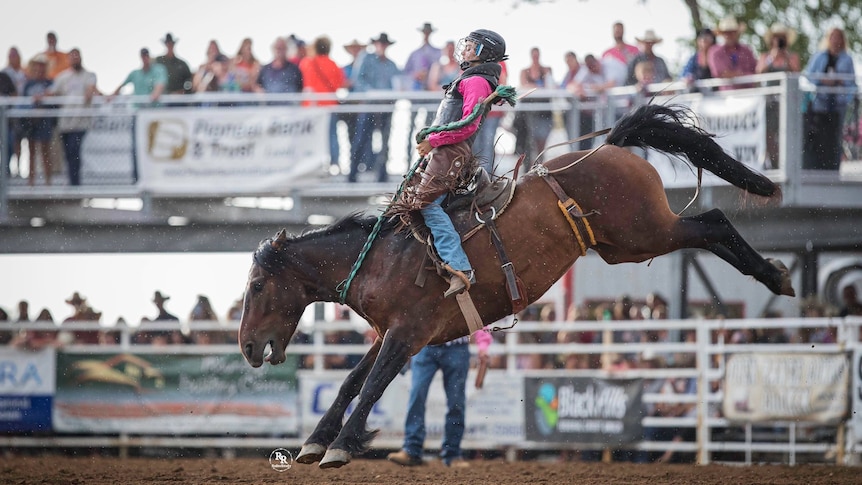
“You don’t think of a cowgirl getting in there behind the chutes, saddling her horse off, jumping on and getting bucked off.”
Emily Collits won third place at Durango, Colorado — something she never expected to do.(Supplied: Emily Collits)
The daring sport of roughstock bronc riding is one of the toughest and most dangerous events on the rodeo circuit and the women are using their success overseas to push for greater women’s participation in the sport on home soil.
The aim is simple: try not to get bucked off a horse that’s doing its darnedest to kick you off.
But holding on tight for eight seconds would seem like a lifetime to amateurs.
“The experience of riding a bronc is like riding fire,” Collits said.
“I get bucked off more times than I ride time — it’s a mental and physical challenge within yourself.”
Collits, seen here in Bell Fourche, South Dakota, says the horses are bigger and rougher in the US.(Supplied: Emily Collits)
Making rodeo history
High caliber events in the US are invitational and riders must provide their skill and commitment to be able to participate.
“It’s like getting the golden ticket at Willy Wonka’s chocolate factory,” Collits said.
Collits made the most of her opportunity, traveling thousands of kilometers to tour nine events through four states.
These women made history on the American rodeo circuit.(Supplied: Emily Collits)
It paid off when she took first place at Douglas, Wyoming and third place at Durango, Colorado.
“I didn’t have many expectations coming into it,” Collits said.
“I wanted to ride time on a few of these big strong American horses.
“I’ve exceeded those dreams.”
Emily Collits competed at nine events, including Bell Fourche South Dakota.(Supplied: Emily Collits)
It’s the first time these American rodeos have opened their chutes to female participants from Australia.
The event all the competitors had their eyes on was the prized Cheyenne Frontier Days — one of the biggest, oldest and longest running rodeos in the world.
Jaime-Lee Mant (middle) won third place at the Cheyenne Frontier Days rodeo, which was attended by 21,000 people and watched by 50,000 more.(Supplied: Jaime-Lee Mant)
Keep won third place.
“It was pretty cool to be able to walk out from underneath the grandstand and have 21,000 people stare at you and cheer you on, and the roar of the crowd is pretty cool,” she said.
“As I walked up on the back of the chutes there, I just kind of looked out and I had a … moment of like, ‘Holy dooly, I’m really here,'” she said.
“My dreams are coming true.”
Emily Collits (far left) and Jaime-Lee Mant (second from left) at the roughstock event in Deadwood.(Supplied: Emily Collits)
To wrap the tour up the women put on a non-competitive showcase at a rodeo in Deadwood, Colorado.
The rodeo hasn’t seen a women’s roughstock event in more than 80 years and the riders hope it sets the bar for future events.
“In the future it’ll hopefully mean we can add this as another stop on our tours while we’re over here in the States,” Collits said.
Collits hopes this tour has laid the foundation for more to come.(Supplied: Emily Collits)
Women’s bronze riding ‘frowned upon’
Appetite for the rough-riding sport is on the rise in Australia, but there are still hurdles to overcome.
Mant said there was a lot to be learned about women’s saddle requirements, horse and training needs to grow the sport back home.
“For us girls, we don’t really get many opportunities over here in the way the American girls do,” she said.
“I just thought if an Australian girl could come home with a win or a place, it may open Australia’s eyes a bit more to it.
“I really want it to be something big in Australia — it’s getting there, but very, very slowly.”
Cam Eiser said not everyone was accepting of women riding when he decided to help train them.(ABC Capricorn: Jasmine Hines)
Blackall Trainer Cam Eiser hosts training schools where Collits and other outback women attend.
“It seemed to be – when we started – pretty well frowned upon, letting girls ride bucking horses and we copped a fair bit of [flak] over it,” he said.
“I just saw an opportunity to help girls go ahead and compete [in the US] and get them schooled up safely, without any injury.”
Daryl McElroy and his wife host women’s bronc riding events at American rodeos.(Supplied: Emily Collits)
The founder of the Women’s Ranch Bronc Championships in Texas, Daryl McElroy, worked with central Queensland trainer Ken Reid to organize this year’s tour.
“We need to put them on the stage and let them show their talents to the world,” McElroy said.
“We get emails and we get messages from all over the world and I’m just amazed by it.”
Emily Collits was obsessed with horses from a young age.(Supplied: Emily Collits)
‘fingers over their eyes’
From a young age, horseriding became an obsession for Collits, who grew up on the Gold Coast.
“My parents both live just outside of the city and I don’t think they in a million years imagined their little girl getting on horses that want to buck her off,” she said.
“But it doesn’t matter what I do, they’re always going to be in my corner supporting me as best they can — even if it’s with their fingers over their eyes.”
Mant said her parents also worried she would hurt herself, but trusted her now because of her rigorous training over the years.
“My mum, she thinks it’s cool and she’s very supportive of me,” Mant said.