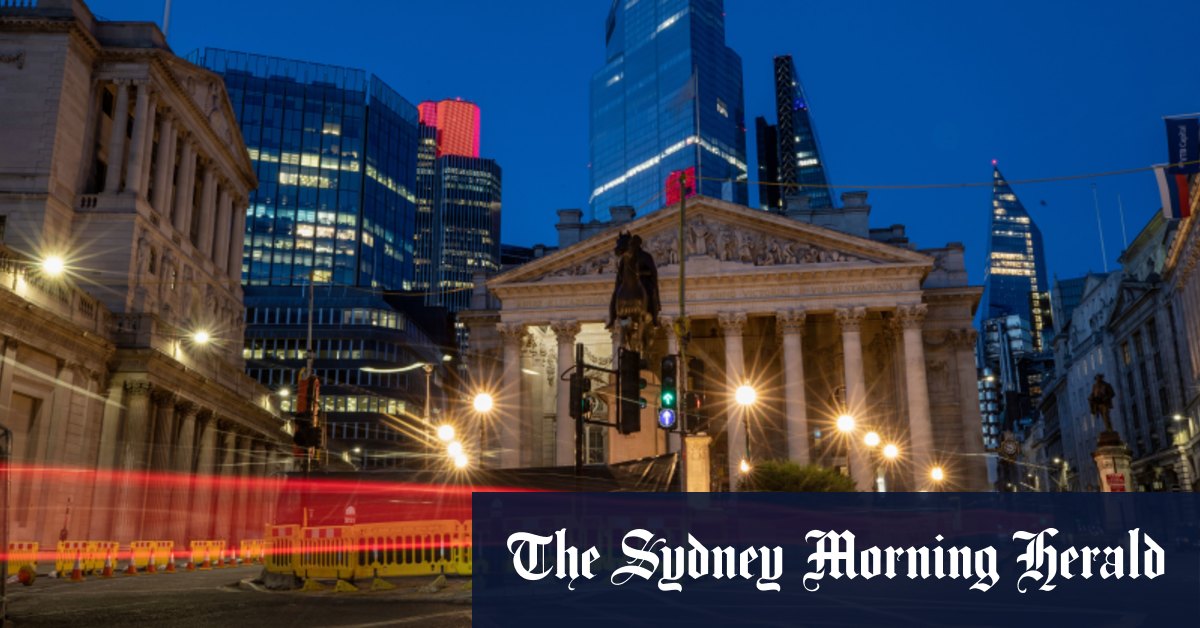
Birmingham: Britain is facing a lengthy recession and the worst decline in living standards for a generation after the Bank of England raised interest rates sharply and forecast that inflation would hit 13 per cent by Christmas.
The bank’s lifted interest rates by 0.5 percentage points to 1.75 per cent on Thursday evening, the biggest increase in 27 years, with forecasts suggesting Britain is now facing a much bleaker economic outlook than either the United States or Europe.
A woman rides a bicycle past a job center in Shepherd’s Bush in London.Credit:AP
The bank forecast the country would slide into a 15-month recession later this year, with GDP shrinking by 1.5 per cent next year. Officials expect the slowdown to begin in the fourth quarter of this year, and continue until the end of 2023 – which would indicate a steady economic decline throughout next year.
Households are also more exposed to the energy price shock than in the US, and less protected by government measures than in the eurozone. At the same time, the British economy has also been damaged by the effects of leaving the European Union.
The cost of household gas and electricity is expected to rise in October by another 75 per cent, up from the Bank’s previous forecast of 40 per cent, to about £3,500 ($6,100) a year. By autumn energy bills, which have already risen by 54 per cent this year, will be at triple their level a year earlier.
Annual inflation is expected to rise from 9.4 per cent in June to a peak of 13.3 per cent in October, the highest level since September 1980. It will remain “very elevated” through much of next year before falling back to the 2 per cent target in two years’ time.
People walk past a closed down shop unit on Oxford Street, in London, where energy prices are spiraling.Credit:AP
The pound fell 0.5 per cent against the US dollar to $US1,208, having been 0.7 per cent higher before the announcement. It was down 0.5 per cent against the euro to €1,182.
Against the Australian dollar, the pound dipped as low as $1,735 in response to the rate hike before recovering to around $1,746.
Back in April, Samsung US and iFixit announced their Galaxy self-repair program though it did not immediately start selling the parts required for it. The floodgates are finally open and you can now order genuine spare parts and tools to repair your Samsung devices.
Devices covered by Samsung and iFixit’s self-repair program
The repair program only covers the Galaxy S20 series and S21 series phones, as well as the Galaxy Tab S7+ tablet for now. You get access to three component types – display assemblies, back covers and charging ports. Interestingly enough Samsung has still not shared any details about battery replacements.
Component prices for the older Galaxy S20 series models range from $59.99 for the charging port assembly on all three models to $224.99 for the S20 Ultra’s display assembly. The Galaxy S21’s display assembly comes in at $160.99 while the S21 Ultra’s is $232.99. A Galaxy Tab S7+ display will go for $219.99 while the charging port assembly is $59.99.
Those who want to repair their own Galaxy device can order the genuine Samsung parts and tools from Samsung Store including retail and service locations as well as from iFixit’s site. Samsung is committed to expanding the devices and repair components covered by the program in the future.
Ed Langdon has taken aim at former Fremantle coach Ross Lyon over a long-sleeve jumper rule he enforced during his time at the Dockers.
A notorious long-sleeve jumper wearer, Langdon thought the ban was “ridiculous”, but felt he couldn’t speak up given he’d only played a handful of games.
“I had five years at Freo and I was never allowed to wear it because Ross Lyon was never a big fan of it,” Langdon told SEN’s The Run Home.
“I thought it was a bit ridiculous, but at that point in my career, I wasn’t really in a position to be arguing, put it that way.”
Subscribe to the SEN YouTube channel for the latest videos!
As for Langdon’s current coach Simon Goodwin, the premiership Demon revealed he never had to ask Goodwin whether or not he could wear a long-sleeve jumper.
“No – and nor should you have to,” Langdon said.
“That’d be like saying, ‘can I wear a headband this week or do I have to tie it up?’
“As soon as I came to the Demons, I wanted to make it my own, I used to wear it at junior footy and Melbourne is a lot colder than Perth.”
Langdon has been critical of Lyon’s coaching methods in the past.
“I’ve come from five years of the Ross Lyon method, so it’s absolutely a nice change to have someone as cool, calm and collected as Goody,” Langdon said on AFL Nation last year.
“I don’t think I’ve heard him raise his voice since I’ve been at the club.
“Coming over from Freo, where if you don’t look Ross in the eye at a meeting, he starts yelling at you.
“So it’s been a nice change.”
Langdon played 68 games for the Dockers before departing at the end of 2019.
The gloom settling over the vanquished Liberals and Nationals deepened as history tripped away from their grasp.
They could do nothing but demand a series of doomed divisions – the ringing of bells, the locking of doors, the counting of woes and noes, the inevitable defeat – intended to slow the inevitable.
These remnants of a once-dominant Coalition, having spent the better part of a decade turning themselves inside out to ensure climate action never led, like dancing, to anything too vigorous, were left without an embrace among them.
The Nationals were so bent on opposing everything that they even voted against an amendment by independent Helen Haines of Indi, and moved by fellow Independent Rebekha Sharkie of Mayo – both country electorates – designed to assist rural and regional districts.
The amendments require the Climate Change Authority to ensure any measures to respond to climate change should boost economic, employment and social benefits in rural and regional Australia.
Labor supported the Haines amendments, just as it supported other amendments by crossbenchers, even if the government didn’t need the numbers.
The climate wars.Credit:David Rowe
Minister for Climate Change Chris Bowen, rubbing it in, described Haines’s ideas as “very sensitive”. Haines rubbed it in further by noting on Twitter (she is in COVID-19 isolation) the Coalition parties, having opposed everything, hadn’t bothered to come up with a single amendment among them.
Independent Zali Steggall grew so expansive she declared: “The climate wars are almost over.”
Given the history, this seemed optimistic.
loading
But it served, surely, an outbreak of celebrating on the floor of the House of Representatives that left the old Abbott government’s “death of the carbon tax” shindig looking lame.
In the end, however, everyone simply trooped away, trailing their wins and their losses.
Exhaustion, after all the years of those climate wars, had swept the day.
Cut through the noise of federal politics with news, views and expert analysis from Jacqueline Maley. Subscribers can sign up to our weekly Inside Politics newsletter here.
Texas Senator Ted Cruz slammed his boot on a table during a Senate Judiciary Committee hearing Thursday while expressing concerns that the FBI and Justice Department have become “thoroughly politicized.”
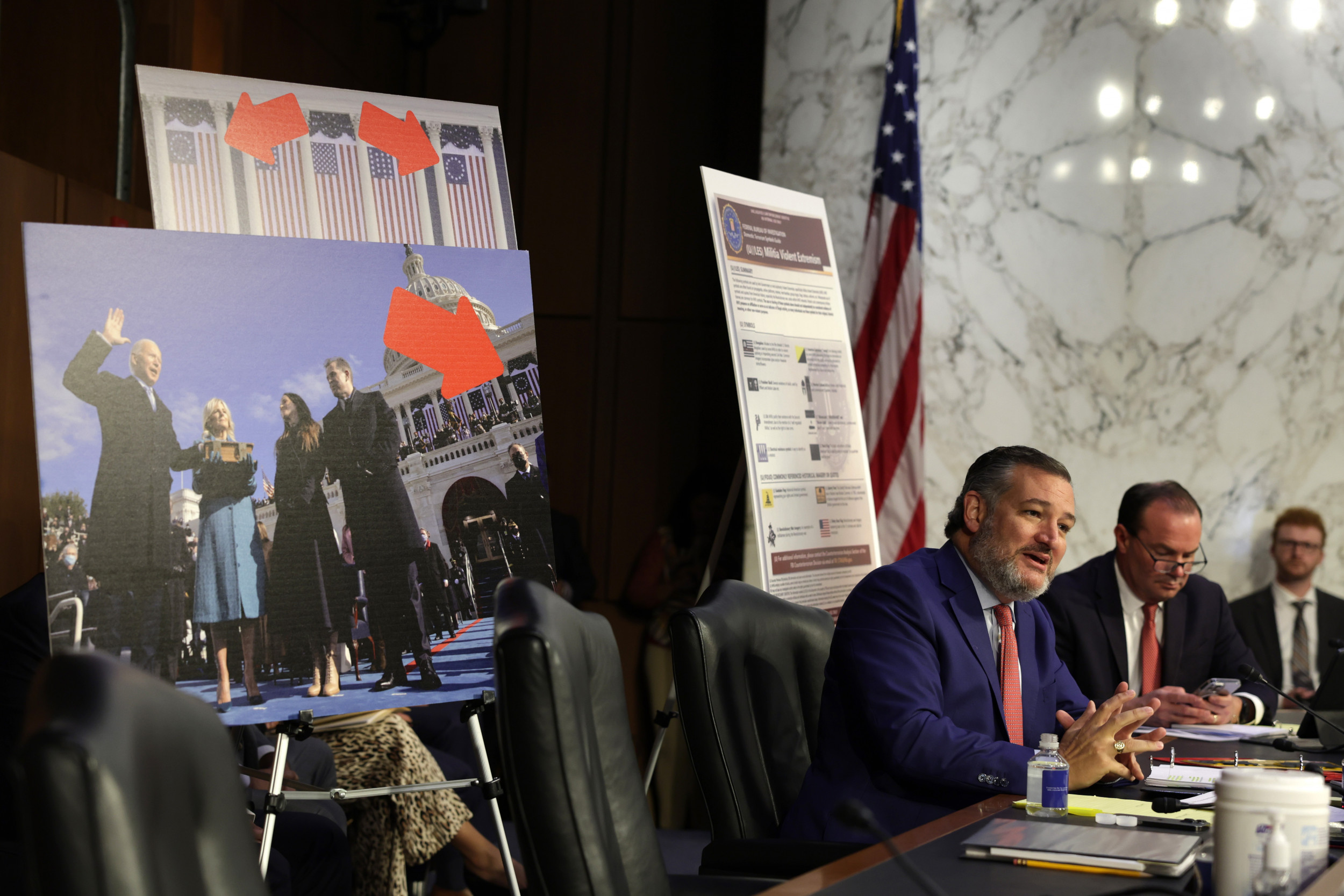
Senators were questioning FBI Director Christopher Wray during an FBI oversight hearing when Cruz asked about what he said was an FBI training document obtained by conservative organization Project Veritas. This document, Cruz said, “listed various symbols and themes which in the FBI’s estimation, were indicative of ‘militia violent extremism.'”
Sen. Ted Cruz (R-TX) slams his boot on the table in opposition to FBI guidelines on symbols that indicate violent extremist groups:
“I will self-report right now that everyday in the Senate I wear my boots that have the Gonzales battle flag on the back.” pic.twitter.com/HxsqbEXaqJ
Those symbols included the Betsy Ross flag, an earlier design of the current US flag that featured 13 stars instead of 50, and the Gonzales battle flag, according to Cruz. The lawmaker then slammed his boot on the table in front of him to show that it depicted the Gonzales battle flag.
“Well, I will self-report right now that every day in the Senate, I wear my boots that have the Gonzalez battle flag on the back of them,” I have said.
While Newsweek was not able to independently verify the existence of such a document, the FBI does provide information and resources to help define and pinpoint violent extremism. When responding to Cruz, Wray said that he wasn’t familiar with the document and is “not in the practice of trying to comment on documents that I haven’t recognized.”
“But I will tell you that when we put out intelligence products, including ones that reference symbols, which we do across a wide variety of contexts, we usually make great pains, take great pains to put caveats and warnings in the document that make clear that a symbol alone is not considered evidence of violent extremism,” Wray said.
Texas Senator Ted Cruz slammed his boot on a table during a Senate Judiciary Committee hearing Thursday while expressing concerns that the FBI and Justice Department have become “thoroughly politicized.” Above, Cruz (left) speaks as Senator Mike Lee (second from left) listens during a hearing of the Senate Judiciary Committee at the Hart Senate Office Building on Capitol Hill on August 4 in Washington, DC Alex Wong/Getty Images
“Director Wray, you don’t include things like Antifa,” Cruz responded, referencing the alleged FBI document. “You don’t include things like Black Lives Matter. Instead, you identify patriotic Americans as suspect.”
when Newsweek reached out for comment and confirmation of the existence of such a document, the FBI shared the following statement: “It is our usual practice to decline comment on articles about allegedly leaked FBI documents, internal FBI products, or information shared with law enforcement partners. In this case, we would point out an online article referencing an allegedly leaked document on symbols that may be used by Militia Violent Extremists (MVE) contains the following words highlighted in bold near the top of the document: The use or sharing of these symbols alone should not independently be considered evidence of MVE presence or affiliation or serve as an indicator of illegal activity, as many individuals use these symbols for their original, historic meaning, or other non-violent purposes.”
It was not immediately clear what article the FBI was referencing, but The Epoch Times, a far-right newspaper, reported Wednesday on the alleged FBI document. That article shared a picture of the purported memo, which included the same sentence in bold near the top that was referenced by the FBI in its statement.
The Gonzales battle flag is linked to the Battle of Gonzales, during which the first shots of the Texas Revolution were fired, according to the History Channel’s website. The battle in October 1835 saw Mexican soldiers fail in an attempt to take a small cannon from a village in Texas due to resistance from a militia of Texans.
The flag depicts a cannon, with a lone star above it and the message “Come and Take It” underneath.
As the story goes, NPR reported, the Texans sewed this flag from a woman’s wedding dress and raised it during the conflict.
Cruz’s office declined to comment further to Newsweek.
Update 04/08/22, 4:50 pm ET: This article was updated with a statement from the FBI.
More gradual rate increases would have led to slower declines, Oliver said, but it was ultimately the end point that had the biggest impact on property prices.
loading
Oliver said his price forecast is based on the cash rate reaching a high of 2.6 per cent later this year or early next. Were the rate to lift to 3.5 or 3.6 per cent, as forecast by others, prices might fall 25 to 30 per cent, but he cautioned the Reserve Bank was unlikely to lift rates to a point that could push the property market down that far.
Gareth Aird, head of Australian economics at Commonwealth Bank, said the pace and size of rate rises had sped up price declines in Sydney and Melbourne, where the market had already been cooling. The sizable hikes had also seen price falls spread.
“The Brisbane market recently turned too… and has turned in a short space of time given the speed at which the RBA has put through rate hikes,” he said.
Aird had expected prices nationally to fall 15 per cent by the end of 2023, but said the trough could now be earlier than anticipated. He has forecast the cash rate to peak at 2.6 per cent by November.
Aird said more buyers were holding back, awaiting the floor in the market, which in turn put further downward pressure on prices.
Property prices are expected to keep falling as interest rates rise.Credit:Rhett Wyman
Center for Independent Studies chief economist Peter Tulip, who co-wrote a paper modeling the relationship between cash rate changes and property prices, said faster changes led to a faster response, but he did not expect it would make a noticeable difference to overall declines.
“As a rough rule of thumb a 1 per cent increase in the cash rate means an 8 per cent decline in house prices,” he said.
He noted it could take about two years for the impact of rates to flow through the market, and part of the picture now is a response to fixed mortgage rates starting to increase a year or more ago.
Westpac Business Bank chief economist Besa Deda said prices were falling at a sharper rate than in previous cycles, which could reflect the speed of rate hikes. While rates were rising from very low levels, and households in aggregate had built up financial buffers to handle higher repayments, the speed had affected the outlook for the property market.
Westpac has deepened its peak-to-trough forecast to a 16 per cent drop, expecting the cash rate would have to move higher, faster, to tackle inflation.
“The amount of tightening we’ve seen over the past four months…that’s probably accelerated the decline in dwelling prices, but that has been a necessity because of elevated inflation,” she said.
“If the RBA took a more casual approach… the risk is you’d end up with a higher [peak] rate, as it would take longer to bring down inflation and require more rate rises.”
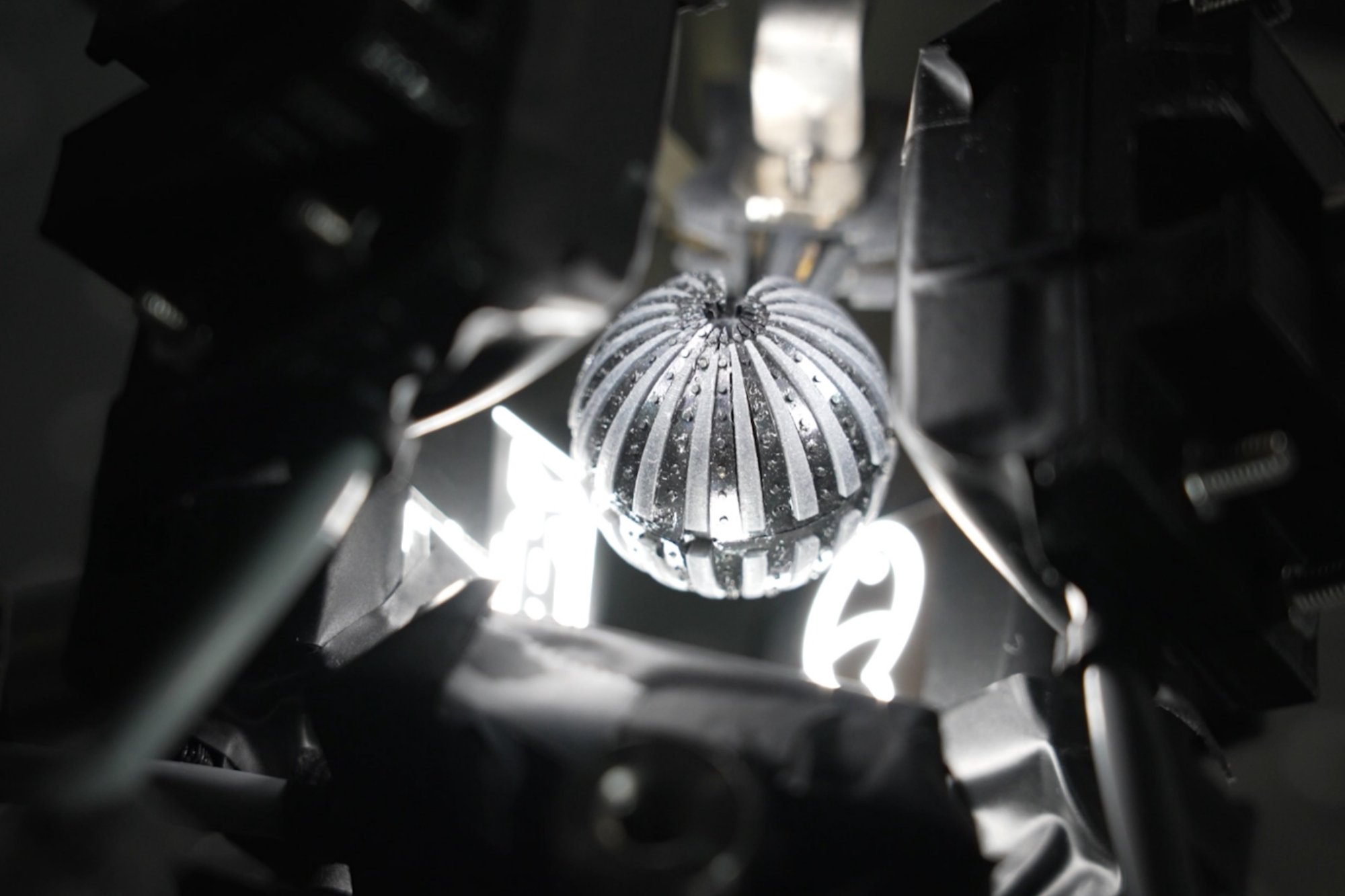
Giving our hardware sight has empowered a host of applications in self-driving cars, object detection, and crop monitoring. But unlike animals, synthetic vision systems can’t simply evolve under natural habitats. Dynamic visual systems that can navigate both land and water, therefore, have yet to power our machines — leading researchers from MIT, the Gwangju Institute of Science and Technology (GIST), and Seoul National University in Korea to develop a novel artificial vision system that closely replicates the vision of the fiddler crab and is able to tackle both terrains.
The semi-terrestrial species—known affectionately as the calling crab, as it appears to be beckoning with its huge claws—has amphibious imaging ability and an extremely wide field of view, as all current systems are limited to hemispherical. The new artificial eye, resembling a spherical, largely nondescript, small, black ball, makes meaning of its inputs through a mixture of materials that process and understand light. The scientists combined an array of flat microlenses with a graded refractive index profile, and a flexible photodiode array with comb-shaped patterns, all wrapped on the 3D spherical structure. This configuration meant that light rays from multiple sources would always converge at the same spot on the image sensor, regardless of the refractive index of its surroundings.
A paper on this system, co-authored by Frédo Durand, an MIT professor of electrical engineering and computer science and affiliate of the Computer Science and Artificial Intelligence Laboratory (CSAIL), and 15 others, appears in the July issue of the journal Nature Electronics.
Both the amphibious and panoramic imaging capabilities were tested in in-air and in-water experiments by imaging five objects with different distances and directions, and the system provided consistent image quality and an almost 360-degree field of view in both terrestrial and aquatic environments. . Meaning: It could see both underwater and on land, where previous systems have been limited to a single domain.
There’s more than meets the eye when it comes to fiddler crabs. Behind their massive claws exists a powerful, unique vision system that evolved from living both underwater and on land. The creatures’ flat corneas, combined with a graded refractive index, counter defocusing effects arising from changes in the external environment — an overwhelming limit for other compound eyes. The crabs also have a 3D omnidirectional field of view, from an ellipsoidal and stalk-eye structure. They’ve evolved to look at almost everything at once to avoid attacks on wide-open tidal flats, and to communicate and interact with mates.
To be sure, biomimetic cameras aren’t new. In 2013, a wide field of view (FoV) camera that mimicked the compound eyes of an insect was reported in Nature, and in 2020, a wide FoV camera mimicking a fish eye emerged. While these cameras can capture large areas at once, it’s structurally difficult to exceed 180 degrees, and more recently, commercial products with 360-degree FoV have come into play. These can be clunky, though, since they have to merge images taken from two or more cameras, and to enlarge the field of view, you need an optical system with a complex configuration, which causes image distortion. It’s also challenging to sustain focusing capability when the surrounding environment changes, such as in air and underwater — hence the impetus to look to the calling crab.
The crab proved a worthy muse. During tests, five cutesy objects (dolphin, airplane, submarine, fish, and ship), at different distances were projected onto the artificial vision system from different angles. The team performed multi-laser spot imaging experiments, and the artificial images matched the simulation. To go deep, they immersed the device halfway in water in a container.
A logical extension of the work includes looking at biologically inspired light-adaptation schemes in the quest for higher resolution and superior image-processing techniques.
“This is a spectacular piece of optical engineering and non-planar imaging, combining aspects of bio-inspired design and advanced flexible electronics to achieve unique capabilities unavailable in conventional cameras,” says John A. Rogers, the Louis Simpson and Kimberly Querrey Professor of Materials Science and Engineering, Biomedical Engineering, and Neurological Surgery at Northwestern University, who was not involved in the work. “Potential uses span from population surveillance to environmental monitoring.”
This research was supported by the Institute for Basic Science, the National Research Foundation of Korea, and the GIST-MIT Research Collaboration grant funded by the GIST in 2022.
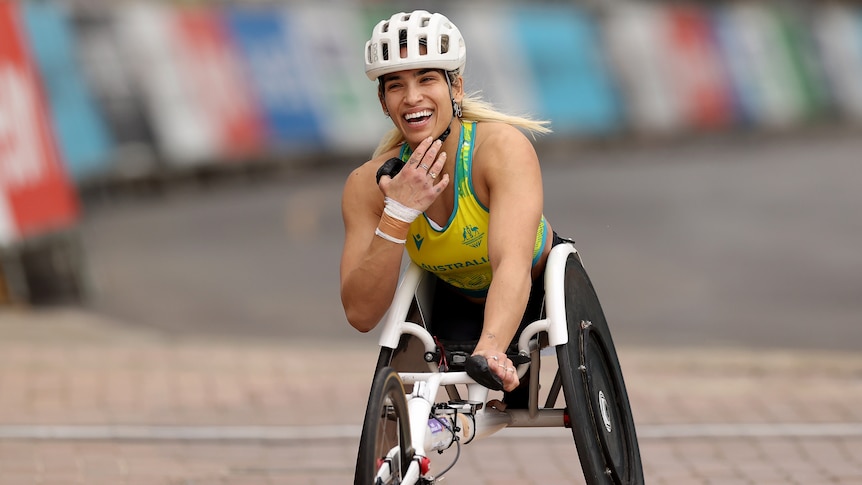
Five days ago, Madison de Rozario won one of the toughest marathons of her career.
It left her completely exhausted — usually the marathon is the final event in for track and field.
However, she wasn’t going to let that stop her from adding to her growing legacy as one of Australia’s finest athletes.
So, the defending champion hit the track for the 1,500-meter race and, in the process, won her fourth Commonwealth Games gold, the most of any Australian para athlete.
Madison de Rozario will be one of the biggest names competing for the Australian team. (Getty Images: Alex Davidson)
De Rozario had hoped to sit back in the race and watch the field fight it out in front of her before making her charge.
However, it was a slow start, and she knew that, if she was going to win, she was going to have to change her tactics and go for broke.
“I realized I was going to be out front from one lap in. When you commit to taking the lead, you have to just back yourself,” she said.
While she looked comfortable for most of the race, the final stretch was tense.
De Rozario looked to be tiring, as Scotland’s Samantha Kinghorn started to push up.
The Australian — who is coached by retired legendary para athlete Louise Sauvage — managed to find just enough to pull ahead once again, while compatriot Angie Ballard produced a barnstorming final few meters to pip Kinghorn for silver.
“I definitely lost it for a little bit there. Angie came home so strong and Sam’s last 300 [metres] was unbelievable. [I’m] so happy I just managed to hold on to win,” Rozario said.
It was extra special to share the podium with her teammate, too.
“She has been in my corner since day one. We’ve been to four Paralympic Games together and to get to do this is its amazing,” she said.
loading
It was even more impressive considering the physical toll the marathon took on her — she described it as one of the most challenging courses she had ever tackled.
And, even though the 28-year-old thought she had recovered, she quickly realized that wasn’t the case.
“About maybe 600 meters into my warm-up, I was like, ‘Oh no, I’m definitely still feeling those 42kms in the arms today’. So, definitely brought that with me out there.”
De Rozario’s racing wheelchair was damaged in transit to Birmingham, and she had to rely on a cable-tie quick fix to hold it together for the marathon.
It’s been a hectic few days since then to get it ready for the track.
“This chair’s been driven all over the UK to try [to] get it fixed and, and I’ve had so many people come together [to help],” she said.
“Finishing touches this morning on it, so it’s something in the last-minute, kind of pulled together.”
De Rozario collected two Commonwealth Games gold medals on the Gold Coast in 2018, in the 1,500m T54 race and the T54 marathon.
It’s difficult to ask athletes to reflect on their achievements while they’re still in the thick of competing, so Rozario is simply enjoying this one before moving on to the next.
“Each race really does exist on its own, and so each one means as much as the last one.
“It’s incredible to look back on a career and be proud of it as a whole, but you remember each race and how it felt at the moment.”
As Holly Nicholls grew up, her mother struggled to support the family while her father was in jail.
She was often forced to skip dinner or have toast as a substitute, and her family’s lack of money did not go unnoticed at school.
“Never having nice shoes, nice clothes, never getting your hair cut … and other young people notice that and then you cop the bullying,” she said.
Ms Nicholls’ father was incarcerated when she was young, meaning her family lived on a single income.
She said the stigma directed towards people who had been incarcerated was particularly confronting for children.
“They ask you questions like ‘is your dad a murderer or a rapist?'” she said.
“That’s really a full on thing to hear … because you still have that connection and love for that person and here people are in society demonizing them.”
Ms Nicholls shared her story as a report focusing on the way parental incarceration affects children was tabled in the Victorian Parliament.
Holly Nicholls (right) says her father’s imprisonment marked her early life.(abcnews)
The report found the traumatic nature of parental incarceration could interrupt childhood development, a lack of support could contribute to intergenerational patterns of incarceration and that for Aboriginal families, separating children from their parents could perpetuate historical trauma.
It also highlighted that the number of parents being incarcerated in Victoria was likely to be rising in line with an overall increase in the number of people being jailed.
Children with parents in jail ‘invisible victims’
The committee behind the report recommended the Victorian government set up a dedicated unit to support those young people.
Crossbench MP Fiona Patten, who chaired the committee, said children with parents in jail were the “invisible victims of crime”.
“They serve a sentence alongside their parent, an experience which may affect them negatively for their whole lives,” she said.
Committee chair Fiona Patten says it was a privilege to hear personal stories, including some from prison inmates.(Supplied)
The committee looked at policies and services for children affected by parental incarceration across the state.
The report outlined 29 recommendations, including reducing the number of parents serving time in prison, developing arrest practices among police that are more child-aware and improving consideration of children’s interests when sentencing parents.
Data is scarce, but it is estimated that about 7,000 children in Victoria have a parent in jail at any time and 45,000 will have a parent imprisoned during their childhood.
Aboriginal children are disproportionately affected by parental incarceration in Victoria, with about 20 per cent likely to experience parental incarceration compared with 5 per cent of non-Aboriginal children.
Inmates’ experiences considered by committee
Rachael Hambleton, whose father spent time in prison while she was growing up, said dedicated support for young people going through a similar experience was needed.
“There are lots of not-for-profits that are trying to gap-fill services that don’t really exist,” she said.
Ms Hambleton also said it was important to consider the greater issues at play in the justice system.
“We all want to see a reduction in crime,” she said.
“Incarceration increases recidivism, while many evidence-based holistic approaches have been proven to reduce it.
“It’s time we looked to what works and dared to dream bigger.”
The committee heard from both inmates and prison officers.(AAP: Dave Hunt)
The report recommended setting up a designated government unit within the Department of Families, Fairness and Housing to “design ways to help support children’s interests through their parent’s journey in the criminal justice system.”
In the report’s foreword, Ms Patten thanked those who shared their experiences as part of the committee’s work, which included inmates in Victorian prisons whose own parents had been incarcerated.
“We were told by individuals that they have been silenced from speaking about their experiences for so long because of stigma that they could only face and describe their experiences in late adulthood and did so, in some cases, for the first time to the committee, she said.
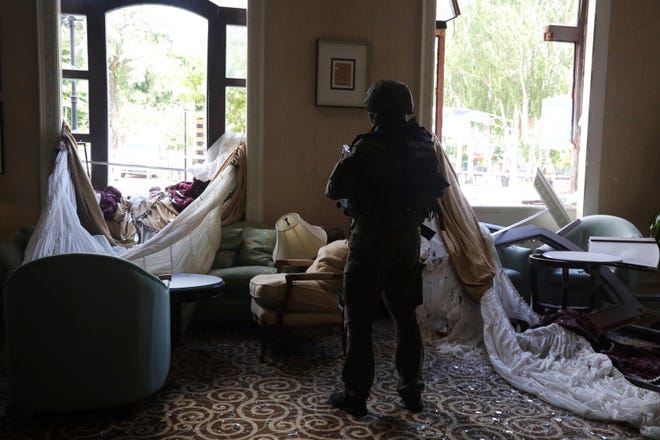
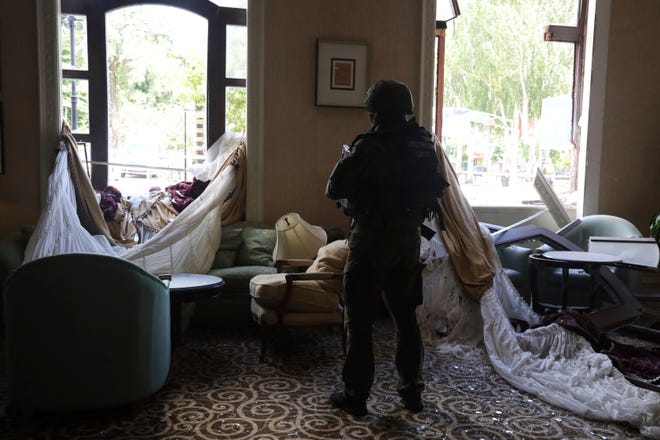
Shelling killed civilians, damaged residential buildings and knocked out power lines in nine regions of Ukraine on Thursday, the country’s presidential office said.
At least four people were killed and 10 more were injured in 24 hours as explosions rocked cities, officials said, including the frequently targeted Mykolaiv and Nikopol, which is close to Europe’s biggest nuclear power plant in Zaporizhzhia.
Shelling killed five civilians and wounded six others in the eastern city of Donetsk, Russian-backed local authorities said. The separatist officials blamed Ukrainian forces for the shelling, which Ukrainian officials denied. Mandatory evacuations in the Donetsk province began Wednesday, Ukrainian Deputy Prime Minister Iryna Vereshchuk said on Telegram, as the first evacuation train arrived in Kropyvnytskyi.
About 50 residential buildings were damaged by Russian rockets in Nikopol, located across the river from the Zaporizhzhia nuclear power plant, which was occupied by Russian troops early in the war. The projectiles also hit power lines, leaving residents without electricity, Ukrainian officials said.
Rafael Grossi, director general of the International Atomic Energy Agency, told the Associated Press this week the power plant is “completely out of control” and urged Russia and Ukraine to allow experts in to assess the situation.
“Every principle of nuclear safety has been violated,” Grossi said. “What is at stake is extremely serious and extremely serious and dangerous.”
USE TODAY ON TELEGRAM: Join our Russia-Ukraine war channel to receive updates
Latest developments
►A ship that Ukraine says is carrying 10,000 tons of grain stolen by Russia has left a Lebanese port after an investigation, Lebanon’s transport minister said Thursday. The Laodicea’s departure, which is likely to anger Ukraine, comes as a vessel carrying grain from Ukraine is sailing toward Lebanon, the first ship to leave Ukraine’s Black Sea ports since the war began.
►US intelligence officials say Russia is working to plant false evidence to blame Ukrainian forces for the attack on Olenivka Prison that left 53 dead and dozens wounded, the Associated Press reported.
►The US Senate delivered near-unanimous bipartisan approval to NATO membership for Finland and Sweden on Wednesday, voting 95-1 for the candidacy of two Nordic nations that, until Russia’s war against Ukraine, had long avoided military alliances.
Brittney Griner sentenced to 9 years in Russian prison
Griner, 31, who entered a guilty plea weeks ago, apologized to her family and wife. “I made an honest mistake, and I hope that in your ruling, it doesn’t end my life here,” Griner said addressing the judge.
Griner was detained in Russia Feb. 17 after vape canisters containing cannabis oil were found in her luggage at Moscow’s Sheremetyevo airport, but her arrest did not become public knowledge until nearly three weeks after it occurred.
President Joe Biden released a statement in which he condemned Griner’s detainment, saying, “It’s unacceptable, and I call on Russia to release her immediately so she can be with her wife, loved ones, friends and teammates. My administration will continue to work tirelessly and pursue every possible avenue to bring Brittney and Paul Whelan home safely as soon as possible.”
Amnesty International says Ukraine endangered civilians
Ukrainian forces have violated international law by establishing bases and operating weapons systems in populated residential areas, turning civilian areas into military targets, Amnesty International said in a report Thursday.
Researchers for the human rights organization found evidence Ukrainian based themselves in buildings like schools and hospitals in 19 towns and villages, exposing populated areas to Russian strikes that killed civilian forces and destroyed infrastructure.
However, in cities including Kharkiv, Amnesty International found Russia had unlawfully targeted civilian areas and had committed war crimes. Ukraine’s use of civilian areas as military bases “does not in any way justify” Russia’s use of indiscriminate weapons like internationally banned cluster munitions, the organization said.
Russian state and pro-Kremlin media extensively quoted the report, which to a certain extent aligns with Moscow’s official narrative.
“We’re talking about it all the time, calling the actions of Ukraine’s armed forces the tactics of using the civilian population as a ‘human shield,’” Russian Foreign Ministry spokeswoman Maria Zakharova said on Telegram.
WHAT’S NEXT:Brittney Griner convicted on drug charges, sentenced to nine years in Russian prison
Now that the trial has concluded, negotiations to free Griner are expected to continue between the US and Russia despite high tension between the countries.
The US State Department said last week it had proposed a “substantial offer” to secure the release of Griner and Paul Whelan, an American serving a 16-year sentence in Russia on espionage charges.
White House press secretary Karine Jean-Pierre said Russia made a “bad faith” counteroffer. Russian presidential spokesman Dmitry Peskov called for “discreet” talks, accusing the US of “megaphone diplomacy” that won’t move the negotiations forward.
‘For the benefit of America’: Rare near-unanimity in Senate NATO vote
In an evenly split and polarized US Senate where so much legislation goes to die, near-unanimous support for any measure is reason for astonishment and even celebration.
And indeed, the often-antagonistic parties were cheerful Wednesday evening after a 95-1 vote in favor of supporting the NATO memberships of Sweden and Finland, two Nordic countries that had remained militarily non-aligned for decades until Russia’s invasion of Ukraine changed their stance .
“This historic vote sends an important signal of the sustained, bipartisan US commitment to NATO, and to ensuring our Alliance is prepared to meet the challenges of today and tomorrow,” President Joe Biden said in a statement.
Frequent foil Mitch McConnell, the Senate minority leader, referenced Sweden and Finland’s well-funded, modernizing militaries and their experience working with US forces and weapons systems in calling their inclusion into NATO a “slam-dunk for (US) national security.”
McConnell, a longtime NATO supporter, had gone as far as assuring Finnish president Sauli Niinisto that the Senate would promptly ratify Finland’s membership in encouraging him to apply, even though the Kentucky Republican no longer heads the majority in the upper chamber.
McConnell pressed his caucus for strong support – only Sen. Josh Hawley of Missouri voted no – emphasizing that the US playing a leadership role globally “is not just important militarily, but commercially as well, all of which is good for this country. This is not a charity we’re involved in here. This is for the benefit of America.”
Contributing: Chris Bumbaca, USA TODAY; Associated Press