Very few details are confirmed about Pokemon Scarlet and Violet, but one rumor suggests a controversial Sword and Shield feature will return.
Pokemon is indubitably one of the most iconic franchises in all of gaming, as it’s a household name among even non-gamers. Many gamers grew up on Pokemonand to this day, continue to play every generation and game that comes out. Pokemon Scarlet and Violet is that new set of games, and when they release in November, it stands to reason fans old and new will flock to them.
However, this presence in the industry isn’t without its drawbacks. Some Pokemon fans believe the games are too heavily marketed and designed for children, even if they are designated family-friendly at their core. Many fans believe Pokemon games have become too easy, hold players’ hands throughout it all, and haven’t evolved with the times, potentially evidenced by the fact that Pokemon Scarlet and Violet are the first open-world games in 9 generations. All of this is, of course, up for debate, but one controversial element about the “Pokemon games are too easy” debate may rear its head again.
GAMERANT VIDEO OF THE DAY
RELATED: Pokemon Scarlet and Violet Leaker Details the Pseudolegendary Dragon Type
The EXP Share has long been part of Pokemon video games, beginning as a way to confer extra experience to a single Pokemon and by Sun and Moon becoming a toggleable way to give all Pokemon in the party XP. Pokemon Sword and Shield included the EXP Share too, but in what amounted to tons of controversy, it could not be turned off in someone so chose. The recent remakes of Pokemon Diamond and Pearl did not allow for it to be toggled off either. Now, rumors suggest the EXP share will return in pokemon scarlet and violet, which comes as no surprise, but it would seem that it cannot be toggled off either. This means it will likely operate as it did in Pokemon Sword and Shield and BDSP.
A recent tweet by Pokemon S/V leaker Blaines suggests that EXP is “forced on by default,” and while this doesn’t necessarily mean it can’t be toggled off, it highly suggests it. The writing was already on the walls. With EXP Share being forced on in Pokemon Sword, Shield, Brilliant Diamondand shining pearlthere’s really no way it won’t be a permanent mechanic in the new generation.
It should be noted that the EXP Share’s impact on Pokemon Scarlet and Violet‘s open world will be interesting to see, unlike the guided adventures of the previous titles. It would seem that Pokemon Scarlet and Violet doesn’t feature level scaling, and because of this, perhaps the EXP Share will find a more fair use and a better reception in the new generation of games. Fans should keep in mind this is only a rumor for now, but it wouldn’t be surprising to see it come from legit.
Pokemon Scarlet and Violet release on November 18 on Nintendo Switch.
MORE: Pokemon Scarlet and Violet Are Breaking a Longstanding Legendary Tradition
Gold Coast’s leadership group has made an impassioned plea for out-of-contract young star Izak Rankine to reject Adelaide’s advances and remain a Sun.
News Corp revealed last week that the Crows were making a major play for Rankine, offering him a five-year deal worth as much as $800,000 per season to return to his home state.
Gold Coast is highly unlikely to match that financial offer and will instead rely on convincing him that his best chance of realizing his potential is at the Suns, while still being willing to pay him about $650,000 a year.
Adelaide is increasingly confident Rankine will request a trade to play for Matthew Nicks’ side, but that wouldn’t come until after Gold Coast’s season ends.
Suns chairman Tony Cochrane told News Corp on Monday they would do “all we can to retain him”.
“I think the club has proven over four years we’re doing everything possible to keep him there and obviously he’s a required player,” Cochrane said.
Izak Rankine is weighing up a five-year offer from the Crows. Picture: Getty ImagesSource: Getty Images
“We’ve got a great association and relationship with Izak, as everyone has around the club. He’s bought a house up here, he’s very much settled in up here, so that’s just our position for the moment.
“He’s an incredibly popular person around the club. I know first-hand how much time and effort people like (coach) Stuart Dew have put into him and, importantly, I know how highly Stuart rates him.
“He’s got that message loud and clear at the Gold Coast footy club.”
Co-captain Touk Miller also made it clear that convincing the “special” small forward to stay was a top priority, having already re-signed Ben King, Jack Lukosius, Ben Ainsworth, Elijah Hollands and Mac Andrew this year.
“I know there’s a lot of speculation around him and his future, but for us we really want him to be at this club. He’s a special person, a special player,” Miller said.
“We’ve gone to him and had a few chats about how much he means to us and means to the club, so whether that plays a part in the decision, hopefully it does.
Stay or go? Izak Rankine has a big call to make on his playing future. Picture: Getty ImagesSource: Getty Images
“As a leadership group; that’s part of what you have to do. This club wants success, and he can be a key part of that.”
Miller sympathized with Rankine’s situation as he weighs up a career- and life-changing decision, especially with the Suns looking to have turned the corner as a club.
“I know speculation like that can make it really hard around the club and can make things awkward and nervous, but we want him to feel as comfortable as possible, feel like he can still be himself and play his best footy,” he said.
“He’s human. I can say it’s not easy for him and you probably do have your head down a bit more. In saying that, we’ve still got a lot of good things out of him on game day.
“I’m not in his head, I can’t exactly say what he’s going to do, but we really want him to stay. He’s such a special part and key part to our club going forward. We’d love to have him.”
Miller was famously forthright with ex-Gold Coast co-captain Tom Lynch when he revealed in 2018 he was exercising his free agency rights to join Richmond after meeting with several Melbourne-based clubs.
A coastal council in South Australia is warning the public to watch out for further cliff collapses around a giant hole that is growing near a popular tourist attraction.
Key points:
Coastal cliffs around the Robe blowhole are continuing to collapse due to erosion and wave activity
Locals have nicknamed a giant hole the ‘Woe Hole’ due to safety concerns
A Flinders University professor says more erosion and subsequent collapses are likely
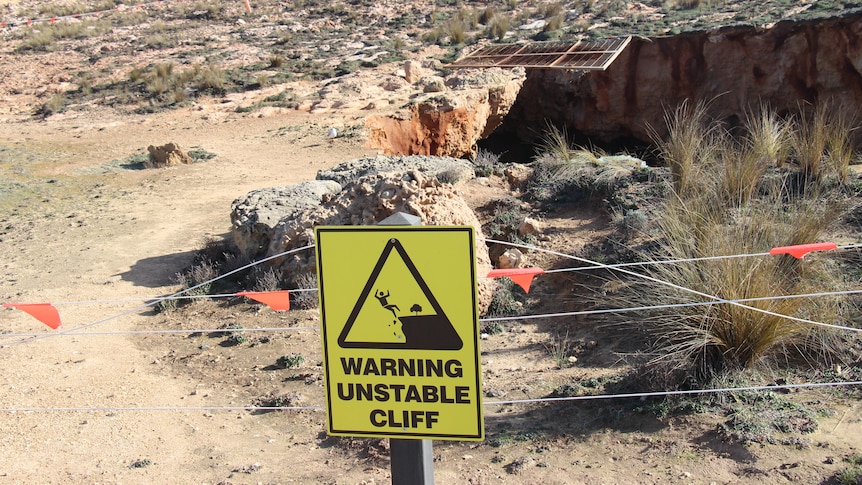
What used to be a small blowhole opening near the Robe obelisk has expanded into a significant gap after the surrounding cliff collapsed for a second time in recent months.
The hole was the size of half a tennis court when it suddenly appeared last year, and has widened since, with residents calling it the “Woe Hole” due to the concern it has caused.
District Council of Robe chief executive James Holyman said the collapses were “part of the natural cycle.”
“From time to time, we have pieces of the coastline fall,” he said.
James Holyman says the safety of the public is paramount.(ABC South East SA: Grace Whiteside)
But Mr Holyman said the “key thing” was that the public was safe.
“I want them to be very aware that we’ve roped off the Woe Hole,” he said.
“So that’s not a reason to jump the fence and go and have a look, because most people wouldn’t be aware where the key weak areas are.
“Don’t walk too close to the cliff face anywhere in Robe, because the worst outcome for us is that somebody is injured or killed because they’re not behaving in the right way.”
Mr Holyman said he had witnessed a person cross over the barrier and head towards the edge of the hole.
“Because I was there at the time, I was able to say to the individual, ‘Please, sir, come away from there, that area’s extremely unsafe’,” Mr Holyman said.
“But there’s not somebody there all the time.
“Individual decisions and individual behavior needs to be from a safety perspective.”
Mr Holyman with the results from the LiDAR aerial monitoring of the Robe blowhole.(ABC South East SA: Grace Whiteside)
He said the limestone cliffs made it “very difficult” to erect more permanent safety barriers.
“We would struggle because it’s all limestone and it is porous in some areas, so putting posts and things in is very difficult,” Mr Holyman said.
“We are also reasonably certain — but we will continue to monitor — that it is going to continue to erode.
“So you could put a reasonable amount of infrastructure in but it would need to be replaced fairly quickly.”
The council has employed light detection and ranging (LiDAR) survey technology to determine the locations of weak spots in the cliffs.
“We’re very fortunate to have LiDAR, which has mapped the whole of the cave there,” Mr Holyman said.
“We know it’s getting reasonably close to the coastal trail, so we want to be proactive and plan where the trail goes in the future.”
More likely erosion
Flinders University strategic professor for coastal studies Patrick Hesp said these types of collapses were “likely” to continue.
“The continual erosion of the limestone along the Limestone Coast is occurring due to wave activity, and also solution by rainwater and groundwater,” he said.
“While there is a surface calcrete — which is this highly cemented, very lithified, very hard layer across the top of the limestone — it’s been very significantly excavated underneath into a cave by waves over time.”
Mr Holyman says the limestone cliffs make it difficult to erect permanent safety barriers. (ABC South East SA: Grace Whiteside)
Professor Hesp said continuous monitoring was key.
“We have, for example, [a] 2018 LiDAR flight along the coast and it’s critical to keep that kind of monitoring going,” he said.
“Unfortunately, it’s enormously expensive.
“It gives you incredible digital detail of the coast and so it’s a brilliant monitoring mechanism in terms of being able to see how the coast is changing.
“Certainly the rate of erosion that we see, for example, at Cape Dombey [in Robe] and other areas where we have some monitoring would indicate that, yes, the erosion is continuing everywhere.”
Sen. Brian Schatz (D-Hawaii) was visibly emotional after the Senate passed a sweeping spending bill Sunday afternoon, emphasizing the importance of what Democrats are heralding as the largest climate investment in US history.
“This is a planetary emergency and this is the first time that the federal government has taken action that is worthy of the moment,” Schatz said outside the Senate chamber minutes after the bill passed.
“This is the biggest climate action that any country has ever taken, and now I can look my kids in the eye and say we’re really doing something about climate,” he added.
The Senate passed the mammoth bill shortly after 3 pm on Sunday, capping off a marathon session that featured more than 15 hours of debate. Vice President Harris cast the tie-breaking vote to send the measure to the House, where it is widely expected to pass.
The bill, titled the Inflation Reduction Act, provides $369 in energy security and climate investments. The measure includes $4,000 and $7,500 tax credits for purchasing used and new electric vehicles, but the funds cannot go towards vehicles that have batteries made from minerals processed in China.
The legislation is expected to bring down climate-warming emissions by 40 percent over the next 10 years.
Schatz, chief deputy whip for the Democratic caucus, told reporters “we’ve been fighting for this for decades.”
Democrats approved the bill through budget reconciliation, an arcane process that requires a simple majority vote for passage. The process allowed Democrats to avoid a GOP filibuster.
During a press conference shortly after passage of the bill Sunday, Senate Majority Leader Charles Schumer (DN.Y.) said the upper chamber “has now passed the most significant bill to fight the climate crisis ever.”
“It’s gonna make a difference to my grandkids. The world will be a better place for my grandchildren because of what we did today. And that makes me feel very, very good. Very, very good,” the Democratic leader added.
A new crash test has highlighted the dangers posed by utes and SUVs to sedans and hatchbacks.
America’s Insurance Institute for Highway Safety has developed a new side-impact test with a heavier and faster impact to better reflect real-world hazards.
The IIHS, which says motorists face a “much greater risk of head injury from impacts with taller vehicles”, has introduced a tougher side-impact test that should result in safer cars in the future.
IIHS president David Harkey said vehicles that sat lower to the ground took side impacts higher on the door panel in the revised T-bone test.
“That potentially puts sedans and wagons at a disadvantage in this evaluation but reflects what happens in a real-world crash when these vehicles are struck by a higher-riding pick-up or SUV,” he said.
Crash experts increased the weight of their side impact barrier from 3300 to 4200 pounds (1497 to 1905kg) and ramped up speeds from 31 to 37 miles per hour (50 to 60km/h).
The resulting test has 82 per cent more energy than before.
Cars tested in the new program receive one of four scores – good, acceptable, marginal or poor.
Re-testing of cars that received full marks in the old test format returned alarming results.
The Toyota Camry received a “poor” rating, joining mid-sized sedans from Nissan and Chevrolet on the bottom tier for side-impact safety.
Toyota’s sedan was the only vehicle in the test that recorded a “poor” safety outcome for rear passenger injuries, though it did a better job protecting drivers than the Chevy Malibu and Nissan Altima.
Side airbags in the Camry, Malibu and Altima failed to stop the heads of crash test dummies from colliding with the cars’ window sills.
Honda’s Accord received a “marginal” overall score, falling behind “acceptable” results for the Hyundai Sonata and Volkswagen Jetta.
The only car worthy of a “good” score in the latest batch of testing was Subaru’s Outback, a car that benefits – in this test – from additional ground clearance more akin to an SUV than a conventional sedan.
But 10 out of 18 family SUVs earned good ratings, with larger and higher-riding cars such as the Mazda CX-9, Nissan Pathfinder and Toyota Kluger performing much better than conventional sedans.
No family SUV received a poor rating, though smaller SUVs were hit harder by the test.
.
Only one – Mazda’s CX-5 – received a “good” rating, while popular models such as the Subaru Forester, Toyota RAV4, Honda CR-V and Nissan X-Trail were deemed “acceptable”.
The Hyundai Tucson, Ford Escape, Kia Sportage and others received “marginal” ratings, while the Honda HR-V and Mitsubishi Eclipse Cross were deemed “poor”.
Honda’s HR-V – a model that has since been updated – came under fire for a pillar between the driver and passenger doors that “began to tear away from the frame, allowing the side of the vehicle to crush inward almost to the center of the drivers seat”.
IIHS research shows side-impact crashes account for 23 per cent of fatal smashes in the US.
The ASUS Zenfone 9 is a brilliant small smartphone, with an obvious focus on performance at the cost of camera quality.
If you’re someone who doesn’t take a lot of photos, then it’s hard to look past the ASUS Zenfone 9. The internal performance of this phone is on par with the best from Google, Samsung and OPPO, however its cameras are how the cost is kept down.
As a small phone lover, here’s what I think.
ASUS Zenfone 9
WHAT IS IT?
The newest premium smartphone from ASUS.
PRICE
Likely above $999, TBA.
LIKE
Smaller phone than the rest of the Android phone market, top-end processing power, not much bloatware.
DO NOT LIKE
The camera is quite bad, no wireless charging, size may be unattractive to some.
compact king
This phone was made for me. I am a massive fan of small phones and I don’t take many photos. My standard phone is the iPhone 13 Mini, which is smaller than the Zenfone 9, but ASUS’ new premium handset is far more powerful.
I prefer smaller phones. If I can’t use it one-handed, then I’m not interested. It’s not that I have small hands or anything, it’s that I like the convenience of a smaller device more often than not.
This is why I was so in love with the ASUS Zenfone 8, and why I’m so happy with the Zenfone 9: because it’s everything I want out of a phone. It’s small, it’s beautiful, it has terrific performance and it’s not riddled with software I’ll never use.
My criticisms of the phone are few and far between. As you’ll see in the cameras section, there’s a fairly annoying blur when using the 1x zoom (for standard photos, I’ve been using 0.9x). Moreover, there’s no wireless charging, which isn’t essential, but it’d be nice if it were there, as the feature is becoming synonymous with premium handsets.
ASUS Zenfone 9 (left) Google Pixel 6a (right). Image: Zachariah Kelly/Gizmodo Australia
Size doesn’t matter
The ASUS Zenfone 9 is the smallest premium Android smartphone in the market at the moment, smaller than its predecessor and a bit smaller than the recently released Google Pixel 6a.
Despite its size, ASUS has slapped on a beautiful 120hz AMOLED display and built in a Snapdragon 8+ Gen 1 processor. This is supported by an Adreno 730 GPU, making for some of the best specs you can get in any phone at the moment.
This translates incredibly well to day-to-day performance. Using my standard assortment of apps, which includes the full Google suite (Drive, Docs, Gmail and the like), along with Twitter, Instagram, Messenger, Slack and Discord, I don’t think I noticed the phone lag once.
For my battery test, where I chucked on Avengers: Endgame at full brightness and volume, the phone was down to 93 per cent in the first hour, 86 per cent by the second and 79 per cent by the third. This 4300mAh battery can fast charge very efficiently, and I was able to go from 7 per cent to 100 per cent within half an hour. It’s similar in performance to the ROG Phone 6.
For gaming it’s just as impressive, managing to retain high frame rates and great performance for several matches on League of Legends: Wild Rift and Call of Duty: Mobile.
If you’re of the mind that the best Android performance means a requirement for a big screen, then you have been misled. This phone is as powerful as you’re likely to get from juggernauts like Google and Samsung.
Its only problem is the camera, which ASUS has never really gotten right.
The ASUS Zenfone 9 besides the Google Pixel 6a. Image: Zachariah Kelly/Gizmodo Australia
falling short
ASUS doesn’t really care about camera tech, despite the protruding lenses on the back of this phone taking up quite a bit of space (it’s quite a distinctive design).
Portrait testing. Image: Zachariah Kelly/Gizmodo Australia
Really, I can let these photos speak for themselves, but I’ll add some context. I’ve compared them to the two other leading compact phones available right now, the iPhone 13 Mini and the Google Pixel 6a.
Wide testing. Image: Zachariah Kelly/Gizmodo Australia
Check out the ugly blur on the wide camera test above (this is a standard 1x lens test). I wasn’t able to shake this blur throughout my testing with the ASUS Zenfone 9, but I was able to counteract it by using the 0.9x lens instead. It’s a shame that the 1x lens is just this bad, but again, I would never recommend an ASUS product for the cameras.
The Pixel 6a, which retails for $749, is the right pick if you’re after a small and cheap phone with great camera performance, but I want to reiterate that the ASUS Zenfone 9 is the likely pick for internal specs. If you want a good camera, look elsewhere.
Ultra wide testing. Image: Zachariah Kelly/Gizmodo Australia
measure-up
This year, the ASUS Zenfone 9 is directly competing with the Google Pixel 6a in the Australian market as a small phone (a market that includes the iPhone 13 Mini and the iPhone SE). The Pixel 6a beats it on price and camera performance, easily, however, the ASUS Zenfone 9 packs a 120hz AMOLED screen and much more capable internal specs.
With this comparison, even though the ASUS Zenfone 9 is still arguably affordable, it’s an uphill battle against the Google Pixel 6a. Considering just how well the Pixel 6a has ASUS beat on price and photos, it’s difficult to say that this is the best phone for every small lover.
Come next year, ASUS may need to start actually focusing quite a bit on the camera technology – I don’t want to see the Zenfone brand be discontinued for not keeping up with competitors. It doesn’t have to be the best, but what we’ve been given this year is below average.
That said, this is likely my favorite phone of the year. Again, I’m not a photographer, but I do like having a powerful and small handset.
I believe in you ASUS.
Where to buy the ASUS Zenfone 9
Retailers of the ASUS Zenfone 9 haven’t been announced yet. It’s expected to be priced similarly to the ASUS Zenfone 8, which started at $999.
Watching Peter V’landys answer media questions on the stadiums fiasco, it is clear the ARLC chair is highly skilled at being elusive with interrogators, while appearing candid. But when he says the NRL grand final will likely be played in Sydney to honor an agreement with the NSW Government, he is being selective with the truth.
The real reason the season decider will be played in Sydney, rather than Brisbane, is the ARLC makes more money staging it in Sydney.
Consider the maths. In pre-COVID-19 times, the range for high to low earning grand finals in Sydney was a profit of between $7m and $11m.
This range reflected the support of the two teams in the grand finale. For example, a Storm versus Sea Eagles decider would yield less than the Dragons versus Eels.
Although both are sell outs at Homebush stadium, there would be a large number of free/low-priced tickets to the Storm-Sea Eagles grand final, while almost every ticket in the Dragons-Eels would be an A class ticket, meaning high- priced.
Pre Covid-19, there was also an annual $4m payment from the NSW Government to secure the grand final in Sydney.
From 2019 onwards, the NSW Government stopped paying the fee because of a signed agreement with the ARLC to make a significant spend on new stadiums in Sydney. However, in order to compensate for the loss of the $4m, the NRL financial boffins negotiated a charge to each of the Homebush stadium gold pass members reserving seats. Up to 2018, the NRL received nothing from the 15,000 to 20,000 gold pass holders. Assuming 90 per cent of these seats are occupied at 75 per cent of ticketed face value, it adds $3m to $5m to the profit range. This increases the range of low and high yielding grand finals to $10m -$16m.
The Panthers celebrate with the NRL Premiership Trophy after victory in the 2021 Grand Final in Brisbane.Credit:Getty
It is extremely unlikely the 52,000 seat Suncorp stadium in Brisbane would exceed a profit of $5m to $7m. Therefore, taking the midpoint of the Sydney range ($13m) and the midpoint of the Brisbane range ($6m), the Queensland Government would need to offer minimum support of $7m to win the grand finale. Given that the Queensland Premier Palaszczuk copped flak last year when she outlaid $4.6m to secure the Panthers versus Rabbitohs grand final in Queensland, she may be reluctant to bid. And why would she pay $7m when there is no alternative bidder?
“For nearly everybody, it’s just tipping the balance of their underlying medical condition much like any other infection would do, but just with a bit more vigor.”
The median age for a person who has died while infected with COVID-19 in Australia is 84.7 years old.
Deakin University chair in epidemiology Professor Catherine Bennett said the older age explained why most of WA’s COVID-19 deaths were occurring outside hospitals, with some people in aged care homes choosing not to be transferred.
“When people are very frail sometimes a cold could be enough to tip someone over, it doesn’t take much for a system that is really just coping to be overwhelmed,” she said.
“COVID-19 is a more severe infection, even in a mild form, so it’s still going to lift the number of deaths we are seeing and we’re seeing it outside of the normal flu season so if someone gets through a flu season, they might survive to the next, but now they might be exposed to COVID-19 all year round and that’s an extra challenge.”
Statistics compiled by Bennett showed WA’s death rate for COVID recently was 25 per cent less than the national average.
As WA comes down from its third Omicron wave peak, Curtin University epidemiologist Archie Clements said the lower fatality rate was the result of the state’s high vaccine coverage and its dominant strain being the milder Omicron variant.
“I think we’re unlikely to see the health service being overburdened by COVID-19 in the near future unless there is a completely new variant that emerges that is more pathogenic and where there is no cross-protection,” he said.
“We’ll keep getting waves but I would expect that overtime the size of those waves will continue to decline and eventually, we will end up at some endemic state where we will have smaller numbers of cases that may cause outbreaks in the winter seasons.
“Overtime our vaccine immunity is going to wane in fact it already has for the majority of people in the population who haven’t had their third or fourth shot, but the majority of people have now been exposed which will induce some natural immunity and protect people.”
loading
WA Health statistics showed to date just over 1 million COVID-19 cases have been in the community this year, with 4814 people admitted to hospital with the virus, 213 of those in intensive care. The total number of deaths recorded was 500 (figures include those with incidental COVID-19).
Modeling released by the Telethon Kids Institute in April predicted up to 147,000 infections by the end of July, and up to 740 deaths.
Premier Mark McGowan conceded previous forecasts by the state government had also been inaccurate at predicting the severity of the virus.
“We don’t know where [the COVID-19 numbers] will go, but what I find with modeling is it’s always wrong and so I think you’ve got to actually take account of the lived experience,” he said.
“The best thing people can do is wear a mask in a crowded indoor environment and make sure you get tested and stay home if you are positive.”
NB: Hospitals were unable to provide the vaccination status of those who died on ventilators.
Follow WAtoday on Instagram, LinkedIn, Facebook and Twitter for handpicked selections of the day’s biggest local, national and international news.
Michigan Attorney General Dana Nessel (D) on Friday requested a special prosecutor investigate her opponent’s alleged involvement in a group that gained unauthorized access to voting machines.
Politico published a petition from Nessel’s office calling for the special prosecutor after her investigation into the alleged scheme found ties to Matthew DePerno, the presumptive Republican nominee for Michigan attorney general, who is endorsed by former President Trump.
“When this investigation began there was not a conflict of interest,” the petition states. “However, during the course of the investigation, facts were developed that DePerno was one of the prime instigators of the conspiracy.”
The Hill has reached out to Nessel’s office and the Michigan Prosecuting Attorneys Coordinating Council, the group that received the petition, for comment.
Nessel’s investigation began after a request in February from Michigan Secretary of State Jocelyn Benson, who said she received reports that at least one unnamed third party was able to “gain inappropriate access” to voting machines in Richfield Township and Roscommon County.
Reuters on Sunday first publicly revealed DePerno’s alleged ties in Nessel’s investigation, and Politico moments later reported on her office’s request for a special prosecutor.
Reuters cited court documents alleging DePerno led a team that gained unauthorized access to voting machines in Richfield Township.
In its petition, Nessel’s office said the special prosecutor should review charges like willfully damaging a voting machine and fraudulent access to a computer system.
Trump in September endorsed DePerno, who is a vocal supporter of the former president’s unfounded claims of election fraud.
Tyson Shepard, DePerno’s campaign manager, in a statement called Nessel’s actions “unethical.”
“Dana Nessel has a history of targeting and persecuting her political enemies,” Shepard said.
“At the same time she has refused to prosecute any crime involving Democrats including the deaths resulting from the nursing home COVID scandal,” he added.
Republican state lawmakers have grilled Michigan Gov. Gretchen Whitmer’s (D) administration for her executive order early in the pandemic that placed seniors recovering from COVID in dedicated isolation wings in nursing homes, arguing the policy led to more deaths.
There’s nothing quite like the disappointment of opening a food order and discovering what’s inside isn’t exactly what you ordered.
So spare a thought for this Macca’s customer who claims she found an unexpected item in her McChicken Sandwich.
The Irish woman was recorded by her boyfriend expressing her shock after she took a bite of her burger and pulled out what appears to resemble a dandelion.
“There’s a flower in my McChicken Sandwich,” she states, holding the mayo-covered piece of greenery.
“Is this actually for real?”
She then places the mysterious green item into the top of the burger box, showing it was an entire stem complete with yellowing buds.
The video of the unimpressed woman – captioned, “Flowers in chicken legend meal looks lovely so it does” – has clocked up over two million views since it was shared on TikTok on Sunday.
But while many people sympathized with the woman’s plight – others were suspicious.
“I work at McDonald’s. No you didn’t,” one bloke wrote.
“Yeah nah Maccies worker here, that’s not possible,” another agreed.
While another said: “I work in McDonald’s and I can assure you that everything is checked, so I feel like this has been planted in.”
Others tagged McDonald’s UK in the video, stating: “You owe her free food for life.”
“That’s true, I find these all the time in the bags of lettuce when at work,” one user said.
“Would have been in the lettuce mix. Staff wouldn’t have known it’s contaminated,” another argued.
Despite not being able to tell if the video was authentic, many saw the funny side, remarking it made the fast-food item “healthier”.
“That’s a weed, they must have run out of lettuce,” one teased.
“Still better than a bug or plastic. It is organic girl!” another laughed.
“Cost of living is so bad now, they’re just tricking us with dandelions instead of lettuce,” someone else joked.
It’s not the first time a hungry diner has found something unexpected in their Macca’s order – with a Sydney woman recently claiming there was a cockroach crawling in her fries.
The woman posted photos of the shock found on social media in April with the caption: “Straya – where you get a free live toy with every Happy Meal.”
As a result, McDonald’s launched an investigation into the gross discovery, which was found in an order delivered via UberEats.
It’s still unclear how the roach got into the food but Reddit users posted several theories.
“My guess is he crawled in while our food was sitting on the front porch of the wrong address for half an hour,” the woman said.
“I’m Australian and should be used to them I guess, but give me snakes, spiders and rats over cockroaches any day. Those things are unspeakably revolting.”
Other users agreed with the theory the cockroach got in the bag while it was being delivered.
“Christ, driver’s car must have been a dumpster fire, I reckon that’s the only way it got in there,” a user commented.
“I’ve not seen inside an Uber/Menulog etc bag but I reckon they’d be rank,” a second said.