Xiaomi CEO, Lei Jun announced the company’s CyberOne humanoid robot at its launch event in Beijing on August 11th. The debut is ahead of Tesla’s AI Day which many are anticipating a working Optimus Bot prototype. It will be interesting to see the two robots side by side.
According to Xiaomi, the CyberOne robot has arms, and legs, supports bi-pedal motion posture balancing, and reaches peak torque of up to 300 Newton meters (Nm). It can detect human emotions, has advanced vision capabilities, and can create a three-dimensional virtual reconstruction of the real world.
Jun spoke about the robot’s AI and mechanical capabilities being self-developed by the lab.
“CyberOne’s AI and mechanical capabilities are all self-developed by Xiaomi Robotics Lab. We have invested heavily in R&D spanning various areas, including software, hardware, and algorithms innovation.”
“With AI at its core and a full-size humanoid frame as its vessel, this is an exploration of possibilities of Xiaomi’s future technological ecosystem and a new breakthrough for the company.”
In the video below, Jun debuses the robot taking small quick steps as it walks on stage handing the CEO a flower. The robot commented that Jun was taller than he thought and said the flower was for him. In the demonstration, the robot said that it had just learned to walk but that its lower body is still not stable. Although, it is also learning Kung Fu.
Will Xiaomi CyberOne Compete With Optimus?
Some have speculated that Xiaomi unveiled the CyberOne to compete with Tesla’s Optimus Bot. It’s most likely true given the timeframe of CyberOne’s debut. And it’s not surprising that there will be competitors.
Although Tesla hasn’t unveiled a working prototype of the Optimus Bot just yet, Elon Musk announced that AI Day was moved to September 30th with the hopes that Tesla would have one by then.
Elon Musk has said many times that the Optimus Bot was one of the most important products Tesla was developing. During the Q4 2021 Tesla earnings call, Elon said,
“So, in terms of priority of products, I think actually the most important product development we’re doing this year is actually the Optimus humanoid robot. This, I think has the potential to be more significant than the vehicle business over time.”
“If you think about the economy, it is—the foundation of the economy is labor. Capital equipment is distilled labor. So, what happens if you don’t actually have a labor shortage? I’m not sure what an economy even means at that point. That’s what Optimus is about. So, very important.”
As we have seen with Tesla’s vehicles, I’m looking forward to the day when we can compare the Tesla Optimus Bot and the Xiaomi CyberOne robot.
Disclaimer: Johnna is long Tesla.
I’d love to hear from you! If you have any comments, concerns, or see a typo, you can email me at [email protected]. You can also reach me on Twitter @JohnnaCrider1
You might have heard the news already. Almost 14 years after he first created CyclingTips, our founder, Wade Wallace, is leaving.
While Wade is playing down the significance of his departure and what it will mean for CyclingTips, this is a seismic occasion for the site and for all of us that work here. We hope you’ll indulge us for a few moments as we reflect on Wade’s legacy of him.
For those that aren’t familiar with CyclingTips’s origin story here’s the abridged version. After moving from Canada to Australia for an engineering job back in the 2000s, Wade created a blog as a way of sharing all the riding knowledge he’d picked up over the years. He ran that CyclingTips blog from his kitchen table from September 2008 through to early 2013, writing almost all of the content himself, while also working to build the business.
For those of us who have been fans of CyclingTips since the beginning, those early days are some of the most memorable in the site’s history. Every day we hung out for Wade’s short but insightful riding tips (here’s the very first post he wrote), or to follow along with his latest cycling adventure, or to be educated or inspired by the guest authors he pulled into the fold (one such post played a formative role in the creation of Everesting).
In early 2013, Wade took the plunge and moved CyclingTips from his kitchen table to a small one-room office in inner-eastern Melbourne. He started hiring his first employees from him, and before too long that small office was too small for the whole team.
As CyclingTips continued to grow and started bringing in staff from around the world, Wade continued to forge an ambitious path forward for the site, helping us to adapt to the changing media landscape along the way. He invested heavily in greater coverage of women’s cycling (first through Ella CyclingTips, which then morphed into increased coverage of women’s cycling under the CyclingTips banner), and guided us through several periods of change as we were acquired by BikeExchange, and then Pinkbike, and more recently, Outside.
In concert with Andy van Bergen, Wade built the membership program we now know and love as VeloClub, which has helped the site pivot away from an exclusively advertiser-funded model, to a membership-backed site, ensuring the longevity of everything we do.
It’s been years now since Wade wrote for CyclingTips on a regular basis. And while Caley Fretz leads our editorial efforts today (and Neal Rogers did before him), Wade’s always been there in the background, making little tweaks here and there to ensure we’re always on the right path. To ensure CyclingTips is being the best it can be.
CyclingTips has clearly evolved a lot since 2008. We don’t write nearly as many tips as Wade once did, we focus a lot more on professional racing than Wade ever did, and these days CyclingTips is much more than a one-person blog. But those early articles from Wade, written for a primarily Melbourne-based audience, set the tone for what CyclingTips would become.
At the heart of it all, underpinning everything, is a love and passion for our great sport. It was there when Wade first started blogging back in 2008, and it’s still here today, guiding everything we do. There’s a reason our tagline is “The Beauty of Cycling”.
In the end, it’s pretty simple: CyclingTips wouldn’t exist were it not for Wade. But it’s also hard to overstate the impact he’s had since, both on the site itself and for all of us that have worked with and for him. In truth, the words here do little to convey the magnitude of the role he’s played and what his departure from him will mean to us all.
We’ll miss his positive energy, his vision for a better future, and his ever-supportive and encouraging nature.
So, Wade, thank you for everything you’ve done for the CyclingTips family, for the site, and for everyone that’s read CyclingTips at one time or another. All the time, energy, and care you’ve put in are appreciated more than you know.
An Australian-born high court justice continues to be held in immigration detention in Kiribati, despite an order from the country’s court of appeal on Friday morning ordering his release.
David Lambourne, who serves on the high court of Kiribati and is a long-time resident of the country, was detained on Thursday after a failed attempt by the Kiribati government to deport him, contrary to court orders.
The appeals court of Kiribati ordered Lambourne be released pending a further hearing next week, but the judge remained in a motel in the capital, Tarawa, with a police officer stationed outside the entrance. Lambourne’s passport has also been seized.
‘It’s a very sad day for the constitution in Kiribati’: Australian-born judge detained – video
Speaking to the Guardian at the airport in Tarawa on Thursday as officers attempted to detain him, Lambourne called the actions “an unlawful order to remove me in defiance of the order of the court of appeal”.
“It is a very sad day for the constitution in Kiribati,” he said.
Lambourne told ABC TV on Friday he believed the attempt to deport him was politically motivated; Lambourne’s wife, Tessie, is the opposition leader.
The ongoing separation-of-powers saga, which in recent months has seen the government suspend both Lambourne and the chief justice, New Zealand judge William Hastings, exploded on Thursday morning when police attended Lambourne’s home with a deportation order.
An urgent hearing by the appeal court, consisting of three retired New Zealand judges, saw the Kiribati authorities ordered not to proceed with the deportation.
Immigration officials nonetheless attempted to forcibly place Lambourne on a Fiji Airways flight on Thursday afternoon. After a dramatic standoff – which saw the flight captain refuse to allow authorities to board Lambourne, following which the flight was denied permission to take off – the judge was detained and taken to nearby accommodation. The plane eventually departed.
The court reconvened on Friday morning to consider an urgent application for Lambourne’s release. The court ordered his release from him and barred the government from making further attempts to deport him, pending further litigation.
The court condemned efforts to deport Lambourne. “Their efforts were unsuccessful but appear to have been in clear breach of our order which we understand had been shown to them by a court officer,” the judgment said. “Such behavior is unacceptable and risks putting… the persons directly concerned in contempt of court. It must cease.”
Dr Tess Newton Cain, senior research fellow and project lead for the Pacific Hub at Griffith University’s Asia Institute, expressed concern about the latest developments. “The fact that the government was prepared yesterday to deport David Lambourne in contravention of an order from the court of appeal is a huge red flag when it comes to the rule of law in Kiribati,” she said.
In a statement on his Facebook page, the office of the Kiribati president said: “The Government of Kiribati abides by the laws and the constitution of Kiribati and has a higher duty to protect the interest of the people of Kiribati. It is disheartening to see neocolonial weaponizing forces the laws that have been enacted to protect a Kiribati person to pursue their own interest and suppress the will of the people.”
With Lambourne and Hastings suspended, and the commission of two court of appeal judges shortly expiring, Kiribati is on the verge of having no functional judiciary.
A spokesperson for Australia’s Department of Foreign Affairs and Trade told the Guardian it was monitoring the situation and providing consular assistance to Lambourne.
“The broader issues between the government of Kiribati and its judiciary are matters for the government of Kiribati to resolve, consistent with its constitutional and legal processes,” said the spokesperson.
Australia and New Zealand are Kiribati’s primary development partners, although Chinese influence in the country has been growing since Kiribati withdrew its diplomatic recognition of Taiwan in 2019.
“So price falls would be deeper, but we may get to the bottom faster. I was originally thinking the top to bottom falls could drag out into 2024, but it now looks like it could be as short as 12 months.”
Dr Oliver said there were already tentative signs, such as slower consumer spending, that the aggressive rate rises appeared to be getting traction earlier than normal in a tightening cycle.
AMP Capital chief economist Shane Oliver. Jim Rice
“The accelerating pace of home price declines would further depress consumer spending via negative wealth effects,” he said.
“This could prompt the RBA to cap rates around 2.6 per cent later this year or early next year and start cutting by late 2023.”
The downturn in house prices accelerated last month. National values fell 2 per cent over three months, which is comparable to what happened in the 2008 global financial crisis and the recessions of the early 1980s and ’90s. Sydney fell by 4.7 per cent over the period, and Melbourne dropped by 3.2 per cent.
“The fall in home prices this cycle could well see some cities – notably Sydney and Melbourne – reverse all or much of the boom in prices since their 2020 pandemic low, which will likely see a rise in negative equity for recent low-deposit buyers, Dr Oliver said.
Sydney housing values peaked in mid-February, based on CoreLogic’s daily home value index (HVI), and have since fallen by 5.9 per cent, a much faster rate of decline than in the previous 2017-2019 downturn.
Over the same number of days after the market peak in 2017, Sydney housing values were down only 2.9 per cent, CoreLogic data shows.
Fastest rate of decline
“Looking at the decline phases historically using monthly data, this is the fastest rate of decline over the first six months of a downturn since at least the early 1980s when CoreLogic’s HVI commences,” said Tim Lawless, CoreLogic’s research director.
“Sydney’s decline trend started off fairly mild. However, the May rate hike was a clear inflection point in the market, causing the pace of decline across Sydney home values to noticeably steepen and diverge from earlier decline trends.”
Similarly, in Melbourne, housing values fell more sharply, down 3.7 per cent from the market peak in early March, compared with a 1 per cent drop during the 2017-2019 downturn over the same number of days.
During the 2017 to 2019 downturn, Sydney house prices took 22 months from the peak to bottom out. It took another 22 months to post a nominal recovery, data from CoreLogic shows.
In the earlier downturn of 2010 and 2012, Sydney values took 16 months to find a floor and another 13 months to record a nominal recovery.
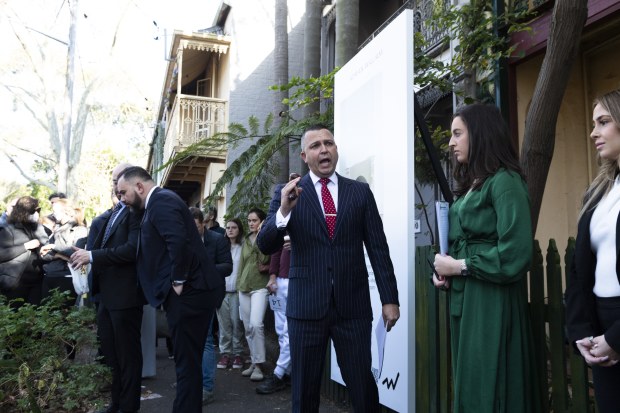
A home at Darlington in inner Sydney goes under the hamer last weekend. Rhett Wyman
Mr Lawless said similar to the pandemic upswing, which was relatively short but sharp, the downturn could be over quickly.
“It depends to a large extent on the trajectory of interest rates. With forecasts for the cash rate to stabilize either late this year or early next year, and potentially a reduction in interest rates through the second half of next year, we could see housing markets finding a floor and potentially recording a subtle rise as interest rates reduce. ,” he said.
“Considering higher interest rates have flowed through to weaker housing market conditions very quickly, we could see the reverse once rates start to fail. However, it really depends on how high rates go, and how the economy is faring after the surge in interest rates.
“If higher interest rates push the economy into reverse, it may take some time for momentum to shift.”
Rebound could be slower
Dr Oliver said the house price rebound this time could be slower because of persistently high inflation and interest rates.
“The long period of falling interest rates in the past 30 years had supercharged the upswings in the past, like waving a magic wand of interest rate cuts, which guaranteed a robust rebound each time, but we no longer have that tailwind because rates are rising again,” he said.
“The return of immigrants could increase demand and rising rents could attract more investors into the market, which may provide a bit of a burst once interest rates top out and start to fall again, but I suspect that the overwhelming influence will be interest rates.
“We’re unlikely to go back to record low interest rates and therefore the recovery may be a more gradual one compared to, say, the last 30 or 40 years, and may take longer than 20 months before prices reach a new high. I think we’ll probably go through a couple of years where prices rise between 5 and 10 per cent.“
Despite the prospect of sharp price falls in the near term and slower growth over the long term, Sydney investor Deniz Sabuncuoglu remains upbeat.
“I’m one of those people who are bullish about the housing market,” he said. “We’re still planning to expand our portfolio. I understand the possibility of recession and rising inflation can scare a lot of people, especially first-time investors.
“For the medium to long term, I understand there may be some price fluctuations, but as long as rents are coming, we can pass the rate rise through rental increases.
“As long as we stick to our own fundamentals of buying affordable properties between $600,000 and $1.2 million in areas with strong growth prospects, we’re not worried about what’s happening with inflation, interest rates and the possibility of subdued growth.”
Flip phones are back, but not as we’ve ever known them. Photo: Supplied
This is branded content for Samsung
Samsung Electronics has today delighted fans with the announcement of their latest generation of premium, foldable smartphones and wearables within the Galaxy Series.
The latest additions to the Galaxy family includes a range of Galaxy Watches, buds and the highly anticipated smartphones, featuring the latest foldable technology.
The Galaxy Flip4 and Galaxy Fold4 have been long awaited by eager and curious consumers, and they challenge everything preconceived about the possibilities of hand-held tech.
The Galaxy Flip4 features an upgrade thanks to a larger screen and enhanced performance, all with the unrivaled portability and style that Samsung is renowned for.
Available in 128GB, 256GB and 512GB and in four beautiful colours, including the iconic new Bora Purple, Pink Gold, Graphite and Blue, the Flip4 redefines the art of self-expression through a powerful design that slips right into your back pocket.
The Galaxy Flip4 retails from $1,499 and comes in either the base or Bespoke model, for a more personalized experience.
Its cousin in the Galaxy series, the Galaxy Fold4, pushes all limits in smartphone technology, pairing convenience with luxury where other manufacturers have compromised.
As one of Samsung’s most premium designs, the Z Fold4 provides the ultimate one-hand experience with a slim, reengineered hinge for the thinnest, lightest Galaxy Fold yet.
The Z Fold4 provides the ultimate one-hand experience with a slim, reengineered hinge for the thinnest, lightest Galaxy Fold yet. Photo: Supplied
The Galaxy Fold4 gives consumers the best of both worlds, with an extra large immersive screen to work with that folds in half, providing portability, and dual screen capabilities that allow for seamless integration between apps.
“The new Galaxy Z Series range is the generation of foldables that will see the category become mainstream. Adoption cues are steadily growing from the volume of foldable devices ‘in the wild’, increasing consumer online search trends, indication of purchase intent, app optimization and more,” said Garry McGregor, vice president of Mobile Experience division at Samsung Australia.
“We know there’s been a doubling in consideration for foldables among 18 to 45 year olds, and generation Z specifically showing a colossal 273% increase since last year.
“Without a doubt foldables have more than emerged, they’ve arrived and have a bright future.
“The foldables market is predicted to continue its rapid growth, more than doubling in 2023, and the fact Samsung Australia has maintained year-on-year pricing we see this being very much the case in this market,” said Mr McGregor.
The Galaxy Fold4 comes in Phantom Black, Beige or Greygreen and offers multiple memory options, with 256GB, 512GB and 1TB memory variants. The Galaxy Fold4 retails from $2,449, and both Z series smartphones are available for pre-order from August 11, 2022.
Samsung foldables are engineered to be strong, with Gorilla Glass Victus and aircraft-grade strength Armor Aluminum. Photo: Supplied.
But smartphones weren’t the only gadgets unveiled in the latest product lineup.
Samsung’s expanded Galaxy Watch 5 Series and Galaxy Buds2 Pro also made their Australian debut this week.
The Galaxy Watch5 Pro is a brand new addition to the range, with toughness and durability at its core. Made with the adventurous athlete in mind, it acts as the perfect sidekick to an active lifestyle. The Watch5 on the other hand, is a customizable addition to enhance everybody’s everyday life.
“We know there is a clear desire for an ecosystem of connected products. That is why we are especially excited for our latest additions to the Galaxy portfolio of wearables as well as the all new Watch5 Pro,” said Mr McGregor.
“They offer our customers supreme audio and improved health and well-being functionality – bringing the best of the best.
“It is a very exciting time for the category and with the full support from our partners, offering complete ranges of color skews, memory variants at the best value, we know our customers in Australia are going to love these new devices.”
Pre-orders for all devices begin on August 11, with on-sale launching on September 2. Retailers have various different pre-order offers, with fantastic savings to be made.
The Galaxy Z Series smartphones will be available from the Samsung eStore and Experience Stores, as well as all Samsung retail and telco partners.
For more information about the latest Samsung Galaxy devices, including the Z Series, visit https://www.samsung.com/au/smartphones/galaxy-z/
Matty Johns believes that South Sydney can “come from nowhere” to win the NRL premiership this season, but only if they address a potentially decisive part of their game.
South Sydney can move up to fifth on the ladder if they beat Parramatta in a crunch clash at CommBank Stadium on Friday night.
Both teams will be looking to keep their top four hopes alive with a win in the blockbuster, while the loser could risk dropping down the ladder.
Stream every game of every round of the 2022 NRL Telstra Premiership Season Live & Ad-Break Free During Play on Kayo. New to Kayo? Start your free trial now >
PAUL GREEN NEWS
OBITUARY: 167cm great who became a giant and the gamble that set him up for glory
‘FUNNY, CARING’: Legends’ emotional tribute to ‘wonderful friend’ Green
‘HAD TOO MUCH TO OFFER’: Bennett reveals Dolphins’ talks with Green in tribute
The Rabbitohs began their impressive run of form against Parramatta early last month, recording the first of four consecutive wins.
After wins over the struggling Newcastle Knights and Bulldogs, Souths made a statement with a 12-point win over the Melbourne Storm.
While they lost in golden point the week after against the Sharks, they bounced back with an emphatic win over the Warriors on the Sunshine Coast.
But not everyone is sold on their recent successes, with Matty Johns comparing the team to a “nice Sunday drive.”
“South Sydney, their recent performances remind me of someone taking a nice Sunday drive, and I mean that both in praise and criticism,” Johns said on SEN’s Morning Glory.
“Watching South Sydney, and I think it’s a bad practice, it’s something they’ve got to be really careful of, they’re lifting the intensity only when they think they need to.
“That’s a concern because intensity and focus and poise under pressure is not something you just reach for out of the kit bag and say ‘alright we’re gonna do it now’.
“Last week I was expecting a real statement game against the Warriors, and they delivered in the first-half. Their intent and their blueprint (on) how they played their best football was the evidence.
Rabbitohs star Latrell Mitchell has been in some sensational form for the Rabbitohs since returning from injury. (Photo by Ashley Feder/Getty Images)Source: Getty Images
“But the second-half there was just no intensity in the contest… and I’m probably knit-picking a little bit because I do like to see coaches showing a range of emotions, but in that second-half when they were really wiping the floor with the Warriors, whenever they cut up to the coaches box the whole coaching staff were really pissing themselves laughing.
“That’s almost a little bit symbolic of where Souths are. It’s got to start tonight, they’ve got to start to lift and they’ve got to start to play with finals intensity football.”
Latrell Mitchell has been in sensational form for the Rabbitohs, after returning from an almost three month absence against the Eels.
Mitchell has had nine try assists since returning just over one month ago, as well as 33 tackle breaks and four tries.
While the Rabbitohs have largely reaped the rewards since he returned, although Johns issued the team with a warning.
“Latrell plays his best football when he’s relaxed. He’s come back from the States really relaxed, and his touch from him, the way he’s playing is just superb, but it does n’t mean that the rest of the side play their best relaxed, ”he added.
“At the moment there’s a reliance on ‘Trell will get it done’. When you’ve got players like Latrell Mitchell in your football side, they are the icing on the cake. They’re the one who can actually get it done for you.
“But you can’t rely on them. Even with Andrew Johns in our side, our forwards were tearing heads off, hitting the line that hard… If suddenly we went out there and say ‘Joey will get us home’, it just doesn’t happen.”
Storm sizzle poor Panthers | 02:01
Despite a tough run home, in which they play the Eels, Panthers, Cowboys and Roosters, Johns believes they can go all the way.
“The way they’re playing, that relaxed style, and the fact they’re playing within themselves and winning, well done to you boys. But they’re in a position, in my opinion, they can win this competition.
“They can come from nowhere and win this competition but they will not win it with the way they’re playing at the moment.
“It’s nothing about talent or anything like that, they’ve just got to develop, in the next few weeks, a really hard edge, and tonight’s a perfect opportunity.”
Sydney Water has been convicted of polluting a Western Sydney creek by discharging hundreds of thousands of liters of untreated sewage into the waterway.
Key points:
The overflow from the pumping station caused significant environmental damage to the Prospect Creek in Carramar
Tankers were supposed to remove the waste but could not keep up with the flow
More than 280,000 liters of sewage overflowed from the pumping station
The guilty verdict relates to an incident on January 15, 2019, which saw a major sewage overflow into the Prospect Creek at Carramar.
Prospect Creek is a major tributary of the Georges River and is used for recreational activities like fishing.
The contamination occurred after a sewer main at Carrawood Reserve in Carramar failed and the nearby pumping station had to be shut down so repairs could be undertaken.
Sydney Water knew there was risk sewage would overflow while the pumping station was shut down and arranged for tankers to be present to transfer the sewage to an alternative location.
However, the tankers were not able to keep up with the volume of overflow as site constraints meant only two tankers could operate at one time.
This meant raw sewage flowed through an underground pipe into the creek.
The incident was described as “significant” by a Sydney Water employee who notified NSW Health, NSW Fire and Rescue, WorkCover as well as the Environment Protection Agency (EPA).
It was estimated by a senior scientist from the NSW Department of Environment that between 11:59 pm on January 15 and 1:26 am on January 16 more than 280,000 liters of sewage overflowed from the pumping station.
Overflow from the broken main was estimated to be 318,000 litres.
This meant faecal bacteria in Prospect Creek exceeded the national guidelines for water quality by up to 7,900 times, the judgment said.
The overflow also caused increased levels of ammonia, and sewage odor and changed the color of the waterway.
Large areas of Coleman Park and the playing fields at Carrawood Oval were also affected.
Sydney Water argued a defense of necessity, claiming the overflow was necessary to avoid more dire consequences of failing to repair the main.
“The necessity … arose because shutting down the pumping station was required to prevent … unacceptable risk of harm to human health or life if the main was not able to be repaired as quickly as possible,” the judgment said.
However, Justice Tim Moore rejected this defence, noting there wasn’t sufficient evidence concerning the state of mind of those who decided to shut down the station.
The EPA brought three charges against Sydney Water for the incident, but the government-owned corporation was only found guilty on one count, which related to the decision to shut down the pumping station.
The authority, which pleaded not guilty to all charges, will be sentenced on September 6.
Sydney Water told the ABC it “welcomes” the finding of the court and will continue to work with the EPA to “protect and enhance the environment”.
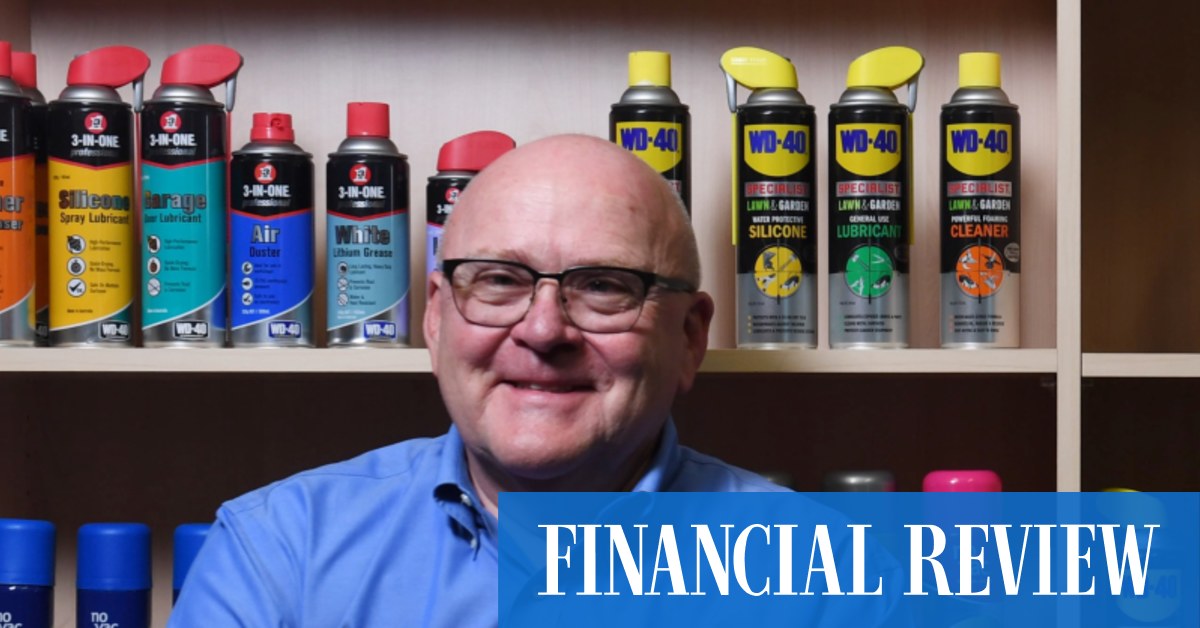
Sitting in a big chocolate-colored booth, Ridge takes a sip of Californian Chardonnay and starts regaling me with tales of his life as a traveling salesman.
He says he’s been to 72 countries selling the famous blue and yellow cans, two of which he has strategically placed on the lunch table. His current American Airlines travel point balance has surpassed 6 million, and he has 4 million Marriott points.
“It all started in the 1970s,” Ridge says. “I had driven from Armidale through to Narrabri in NSW and it was a really hot, hot, hot day.
“So I had these two suitcases with product I’m trying to sell, and I have walked up the street and I go into a store and this guy comes out. And he says, ‘What can I do for you?’
“I said, ‘I am Garry Ridge and I am from Quality Auto Accessories’, and the guy said, ‘You can get the f— out of here. I don’t like your company and I don’t like your boss.’”
“So I put the two bags on the floor and sat on the bags. And he said, ‘What do you think you are doing?’ and I said, ‘If you think that I have carried these two bags all the way here and you’re going to tell me to get out, well, I’m not leaving here until at least you look at what I have in these cases.’”
The store manager responded by telling Ridge he could sit there all night for all he cared. Ridge did sit there for about an hour. When the store manager finally came back, he told Ridge to get a case of beer.
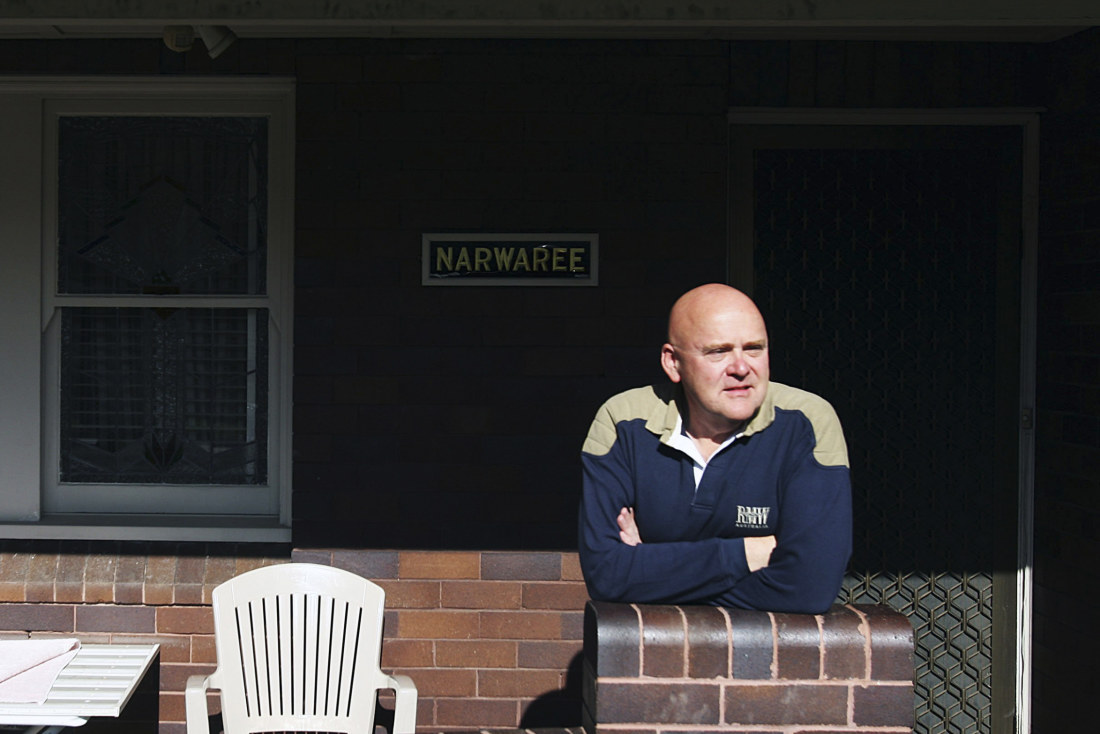
Ridge at his mother’s home in Sydney’s inner west suburb of Five Dock in 2009. Peter Braig
“I said, ‘No problem.’ I go across the road and get a case of beer. I come back. We sit down and have a couple of beers and start talking, and two hours later, I walk out with the biggest order that we’ve ever got from the area.”
As he finishes the anecdote, a big bowl of truffle fries is placed in the middle of the table and Ridge claws at them like an eagle. His fish tacos from him, glistening primary colors, arrive. He neatly arranges them, noting that there is nothing more Southern Californian than his meal from him.
Ridge might be surrounded by Americans and their culture, but he has not lost a gram of his Australian-ness. He grew up in Sydney’s inner west, worked for retailer Waltons and attended Sydney Tech College. He went on to work for Hawker Pacific, which owned the license for WD-40 in Australia, and then joined WD-40 in 1987 as managing director for Australia. He transferred to the US in 1994 as director of international operations, and was appointed chief executive in 1997.
“When I was first given the opportunity to lead WD-40, I was described by Forbes magazine as the ‘one-time traveling salesman from Australia’,” Ridge says.
His loyalty to one company could have something to do with Ridge’s parents. His father, a fitter and turner, worked for one company, which was owned by Westinghouse, for 50 years.
Home is never far away
His accent is still strong; he thinks this might be due to his listening habits of him.
“I listen to Australian breakfast radio every day. I drive home in the afternoon when it’s morning in Australia. I love the Australian culture. I love the Australian point of view. I love the way Australians reflect on things differently to the American culture.
“If I come up to you, as my friend in Australia, and I say, ‘Matt, will you do me a favour?’ Matt would say, ‘Yeah, what is it?’ But if I ask someone here, ‘Can you do me a favour?’ they say, ‘What is it?’, not, ‘Yeah’.”
Those differences in attitude have meant that Ridge had to adapt and evolve his leadership over the decades. He says he’s gone from being the blunt, tough Aussie to more conciliatory and understanding.
“My leadership style has changed over time. In the early days I was the ‘be brief, be bright and be gone’ leadership style. I didn’t understand the need to have people in an organization that were passionate about what they’re doing.
“For example, I do get really frustrated when people don’t do what they say they’re going to do. In the early days, I would have been really in their face, and say, ‘you have no right to do that’. Back then, I was more aggressive about it. Today, I would handle it differently. Now I would be more coaching about it.”
As well as managing people, Ridge has had to learn other skills.
“When the board of directors decided that I should be the CEO, to lead this public company, I’d never even been to Wall Street. I didn’t understand public markets. I was scared.
“I knew that our dream was to take the blue and yellow can with the red top to the world. But I said, ‘How are we going to do that?’ So, I had to go back to school to learn what I didn’t know.”
He completed a master’s degree in executive leadership at the Knauss School of Business at the University of San Diego, where, in his spare time, he is now an adjunct professor specializing in corporate culture.
Ridge takes another sip of the cool wine. He has a 1000-bottle home cellar, but, strangely, he loves a cheap Lindeman’s white.
The man in charge
“I was described by Forbes magazine as the ‘one time traveling salesman from Australia’,” says Ridge. Nick Moir
The day before we meet, I received a bottle of Penfolds as a gift from a long-term investor, GCQ Funds Management chief investment officer Doug Tynan, one of the few Australian businessmen Ridge has known for more than a decade.
“Meeting Garry for the first time was unforgettable,” Tynan recalls. “The first time I visited the old WD-40 headquarters there wasn’t even carpet on parts of the office floor!”
The restaurant has suddenly filled up and become so loud that there is a chance the interview recording might be difficult to understand, so we huddle in a bit like a coach with a player. Above us are pictures of prized horses; they remind me that Ridge rode into Times Square in 2003.
The idea was inspired by Richard Branson’s 1994 stunt, when he drove a tank into the famous location to crush Coca-Cola cans as a way to mark the launch of Virgin Cola. So for WD-40’s 50th anniversary, Ridge dressed up as a knight in shining armor symbolically protecting the secret formula for WD-40.
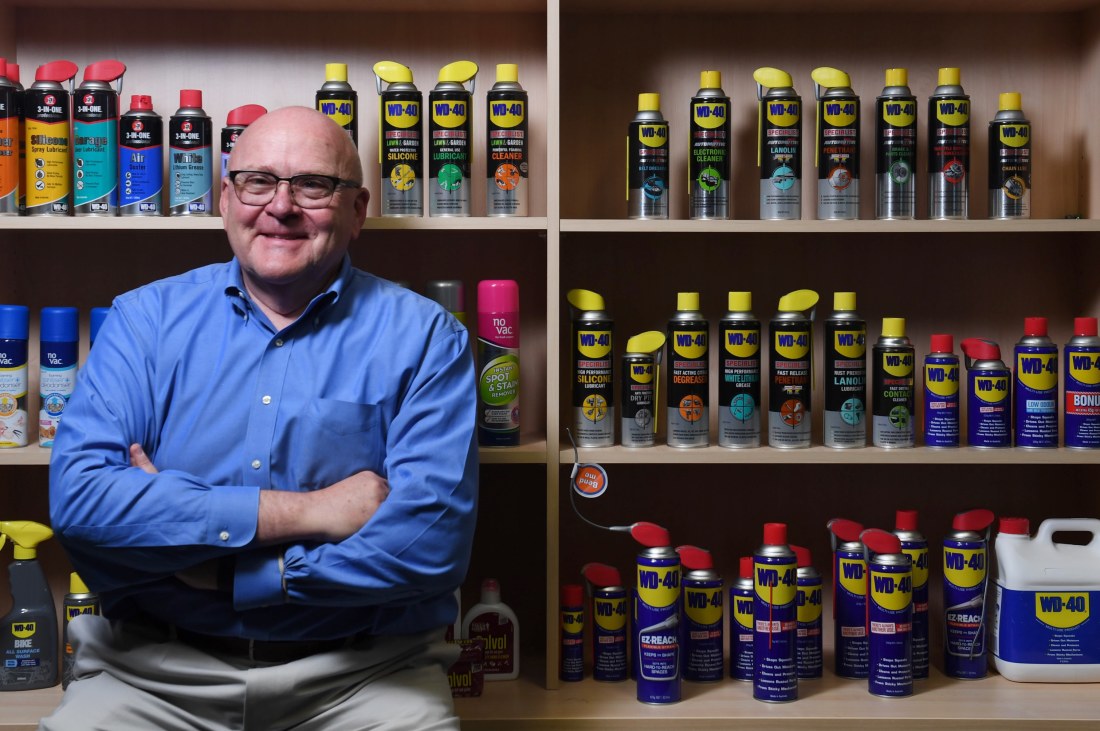
One of the biggest costs for WD-40 – about $US3 million a year – is the maintenance and protection of the company’s trademarks. At the San Diego headquarters are floor-to-ceiling shelves full of spray cans. They are divided into three categories: the first is WD-40 cans since the company began, the second is all WD-40’s competing brands over the ages, and the third is all the counterfeit WD-40 cans seized from around the world.
Remarkably, when Ridge visited a factory in China where fakes were being made, he was told they had a letter approving the manufacture. Ridge asked to see the letter and what they produced before him was a decades-old forgery of his signature.
“We have private investigators who go out into the market and identify the cans; once they’re identified, we then link them up with our enforcement people. And we have to then go to the local law enforcement, they will go in and they’ll raid that warehouse. What we’re trying to do is swim upstream to find the bigger fake manufacturer. It can just be a guy in his garage with an aerosol filling machine. Some of them go to jail.”
The current climate
Ridge recalls being one of the first people to bring a can of WD-40 into China.
“That was back in the ’80s, when the competing product in China then was dirty diesel oil, ignorance and a hammer,” he laughs, before saying how much he respects the Chinese people and their incredible growth story.
“I have a lot of very, very close and treasured Chinese friends. I think the Chinese are some of the hardest working, most honest people I’ve ever seen.
“But how their government is doing things may be different. What does the leadership of China want? I don’t know. I mean, I could guess. Look back in history, from the Romans to Hitler to what’s happening in Russia.”
Ridge is nervous about the current economic situation in America. He’s had to deal with a 40-year high in inflation – when he had to pass on prices and keep them there – without engaging in any so-called shrinkflation. “We’re going to talk ourselves into a recession, there’s no doubt about it,” he says.
We have finished our food and decide upon the very un-American option of tea.
The conversation shifts back to his family.
“I don’t really have a best friend here other than my wife,” he says.
He has two children from his first marriage: a son, Peter, aged 41, who is a senior director of sales at Adidas; and a daughter, Kate, 38, who was a professional dancer until a back injury forced a change of career – she’s now a teacher.
Ridge has just bought a tract of land in Kauai, Hawaii, where he is building a dream home.
“The reason I like it is that it’s 10 hours to Australia and six hours to the US. It has a lot of nature, and there is a lot of hiking.”
Ridge says he is not retiring and wants to help businesses improve their leadership. His successor is the company’s president and chief operating officer, Steve Brass, with whom he has worked for 30 years. Ridge says he still has so much to offer and doesn’t want to leave anything on the table.
His mother lived until she was 99 years and nine months old, so he could have plenty of time.
“I have a lot more I want to achieve. Life is a gift, don’t leave it unwrapped.”
bill
Residence, 5951 Skyline, Rancho Santa Fe, California
Motorola is proving to be the new powerhouse smartphone brand in Australia with ChannelNews able to confirm that the new Motorola Razr foldable smartphone is set to be launched in Australia as early as September.
Also coming is a new Motorola X30 and X30 Pro along with an all new Moto Watch 100.
In an exclusive interview with ChannelNews, Mototola General Manager Australia Kurt Bonnici, confirmed that the all new Razr foldable that comes with a large 3,500mAh battery and a 144Hz OLED display and was revealed in China yesterday will go on sale shortly in Australia.
According to Bonnici most features will stay the same as the new model though there will be variations to the memory configuration for the Austrtalian market.
We understand that carriers and mass retailers are clamoring to range the new device as an alternative to the new Samsung Galaxy Flip 4, that was launched earlier this week, with 30% of consumers who now own a Samsung foldable device brand switching from the likes of Apple and other brands to a foldable device.
Bonnici said “Yes we will launch the new Razr in Australia and pricing will be similar to Samsungs Fold 4″he said.
“The foldable smartphone is set to grow and we will be a key player in this market”, he said.
The move is ideal timing for the Lenovo owned Company that do not have the same marketing funds and the timing of the launch allows them to ride in Samsungs marketing slipstream.
Earlier this week Samsung launch a new $499 Watch 5 and a $799 Watch 5 Pro.
Motorola has confirmed (see separate story) that they will launch with a partner the new Moto Watch 100 smartwatch that is described as a contemporary aluminum smartwatch that’s high on value and impact.
With built in is multiple health and lifestyle features, extended battery life, and an all-new streamlined OS the new Motorola watch is tipped to retail at half the price of the Samsung Watch 5.
In addition the new Motorola watch which will retail around could be given away with the new Razr according to one retailer ChannelNews spoke to.
During the past 12 months Motorola grew their base in Australia by over $250% and the introduction of a new range of premium smartphone which will include the all new Motorola X30 Pro could see the Lenovo owned brand become a key player in the premium smartphone market which has been dominated by Samsung and Apple claim analysts.
After rushing the last Razr the new model is a powerhouse with the latest Snapdragon 8 Plus Gen 1 chipset powering the device, it also has a foldable 144Hz P-OLED display, a secondary screen, two 50-megapixel cameras on the back, and a large 3,500mAh battery that can be charged quickly.
Some reviewers are already describing it as “superior” to the latest Samsung offering.
The inner foldable display is a 6.7-inch OLED screen, while the cover display is a 3-inch display an 800 x 573 resolution, which will deliver nine different widget options for at-a-glance info.
The display will have support for DC dimming and a 10-bit panel with HDR10+ support.
It will be one of the few smartphones in the market to sport an OLED display with a 144Hz refresh rate.
Another notable change is the dual-lens rear camera setup, but there is no word if more color options other than black will be available in Australia.
Observers are claiming that the inclusion of the Snapdragon 8 Gen 1 processor and chipset is a huge jump for Motorola.
By using this Motorola chipset will be able to unlock new capabilities for the camera similar to what Samsung has delivered.
Another big addition with the 2022 Razr is a 1/1.55-inch 50MP primary camera with OIS. It supports 4-in-1 pixel binning, so you can expect to get 12.5MP images.
The main camera is accompanied by a 13MP ultrawide camera with a 121-degree field of view and support for macro shooting. On the front, you get a 32MP sensor.
About Post Author
David Richards has been writing about technology for more than 30 years. A former Fleet Street journalist, he wrote the Award Winning Series on the Federated Ships Painters + Dockers Union for the Bulletin that led to a Royal Commission. He is also a Logie Winner for Outstanding Contribution To TV Journalism with a story called The Werribee Affair. In 1997, he built the largest Australian technology media company and prior to that the third largest PR company that became the foundation company for Ogilvy PR. Today he writes about technology and the impact on both business and consumers.
An infamous F1 villain has been called out over possible collusion in the ongoing Oscar Piastri contract saga at Alpine.
Piastri’s future is up in the air after Fernando Alonso declared he would be leaving Alpine for Aston Martin next season. Alpine quickly announced that their long-time junior prospect Piastri would replace Alonso for 2023 – only for Piastri to reject their statement about him in a public bombshell.
Alpine believe their contract with Piastri will force him to race for them next year, though the young Aussie has also signed a deal to replace Daniel Ricciardo McLaren next season.
F1’s Contract Recognition Board this week reportedly found both Piastri’s Alpine and McLaren contracts are valid, according to Auto Hebdo of France.
Alpine is now threatening to take Piastri and McLaren to court to seek compensation for their huge investment in Piastri’s years of training – and Alpine team boss Otmar Szafnauer’s bold claims didn’t stop there.
Watch Every Practice, Qualifying & Race of the 2022 FIA Formula One World Championship™ Live on Kayo. New to Kayo? Start your free trial now >
‘Expected more loyalty… it’s about integrity’: Alpine boss shreds Piastri in brutal spray
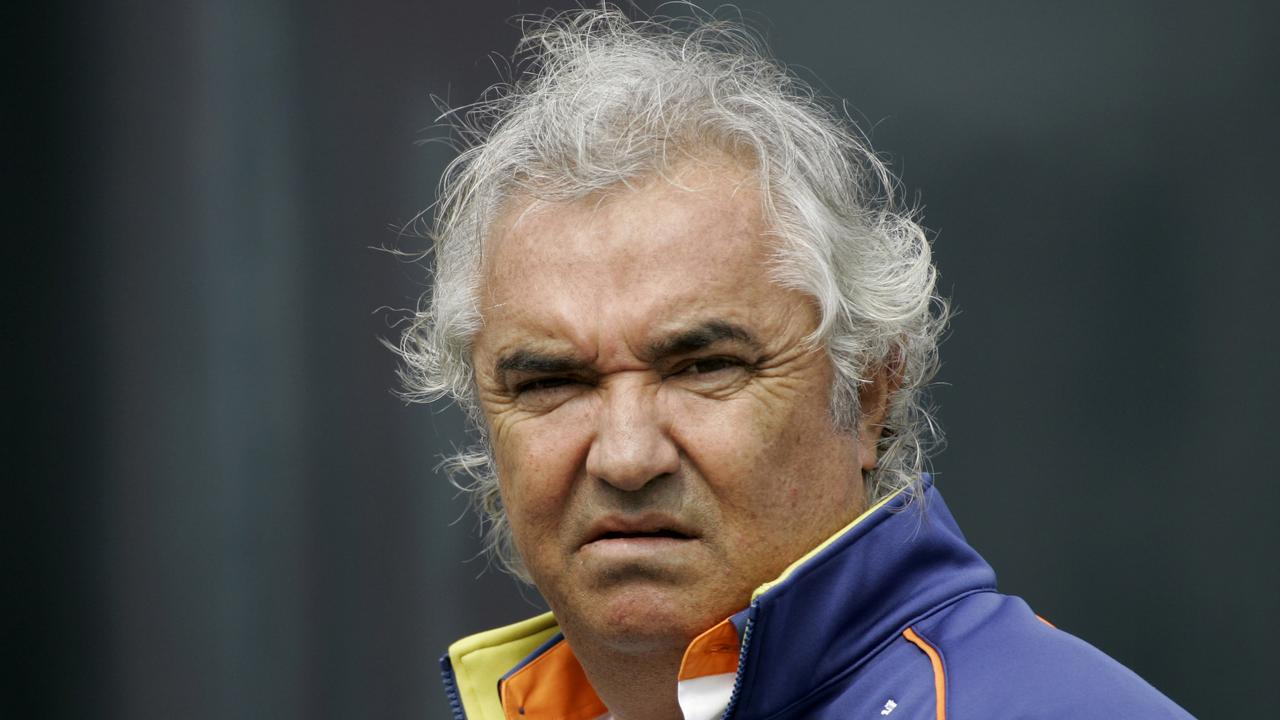
Fernando Alonso (l) and Nelson Piquet Jr (r) with team boss Flavio Briatore (c) ahead of the 2008 F1 season… a year that would end in dramatic controversy.Source: News Limited
“Going to the High Court is over 90 per cent certain that’s what we’ll do,” Szafnauer told Reuters.
“If the CRB (Contract Recognition Board) says ‘Your license is only valid at Alpine’, and then he (Piastri) says ‘That’s great, but I’m never driving for them, I’ll just sit out a year’, then you’ve got to go to the High Court for compensation.”
The Alpine boss also hinted at potential collusion between Piastri’s manager Mark Webber, Alonso and his manager Flavio Briatore.
Alpine’s big Piastri admission as Aussie rising star’s F1 standoff takes another twist: Pit Talk
Costly Dan snub won’t change team’s grim reality; giant tops ‘wildest dreams’: F1 report card
Daniel Ricciardo seeking eye-watering payout as ugly McLaren exit nears
Briatore is one of the most controversial figures in F1, due to his renegade management of the Enstone squad now known as Alpine, having spent years overseeing the team in its former guises as Benetton and Renault. He also managed Mark Webber at one point and remains close to his former charge from him, while he continues to manage Alonso.
“Look, I have no record of it, but this is Formula 1 and maybe in a couple of years someone says that they have evidence of shared information, I would not be surprised,” Szafnauer said.
“I always tell everyone that in Formula 1 you have to act as if everyone knows everything. That there are no secrets in these things. When you ask someone not to say anything, they act like everyone knows.
“That’s how I’ve run my business in Formula 1 for 25 years. And if this (information sharing) has happened, you should not be surprised.”
Mark Webber and his then-manager Flavio Briatore at the Australian GP in 2007.Source: News Corp Australia
Christian Danner, a German F1 driver from the late-1980s who is now a pundit in his native country, also declared Piastri’s actions bear Briatore’s trademark.
“It’s classic Flavio. There was certainly a (Alpine) contract for Piastri that Flavio has skimmed over … there was definitely a clause,” Danner told Motorsport Magazine.
“When he believes in someone, he has the foresight to plan in a positive sense – and not just ruthlessly, which is logically the case in this business.
“I could imagine Piastri (using Briatore) to free himself from Alpine’s grip, so that he can hopefully drive for McLaren for the next two years and then be free for a big deal.
“That definitely has Briatore’s signature.
“It can all go wrong, of course, but if it works out, then he (Briatore) has done everything right.”
Ricciardo set to be replaced by Piastri | 00:32
72-year-old Briatore’s Renault team was charged with race fixing in 2008 at the Singapore Grand Prix, after their driver Nelson Piquet Jr. claimed he had been ordered to deliberately crash his car. Teammate Fernando Alonso had just pitted, and the resulting safety car helped him go on to win the race.
Briatore and Renault engineering chief Pat Symonds were both indefinitely banned from all elite motorsport categories before a French court later overruled the ruling.
It wasn’t the only Briatore scandal, with his Benetton team in 1991 remarkably sacking driver Roberto Moreno in order to sign Michael Schumacher after his debut race.
Moreno successfully appealed to a court – which found his contract was valid – but was paid hundreds of thousands of dollars to leave the team and allow Schumacher to join.
The young Schumacher would subsequently win his maiden title at the Benetton franchise.