Categories
US

What you should know about drug price reform : Shots

Demonstrators outside PhRMA headquarters in Washington, DC, protest lobbying by pharmaceutical companies to keep Medicare from negotiating lower prescription drug prices.

Saul Loeb/AFP via Getty Images


hide caption

toggle caption

Saul Loeb/AFP via Getty Images
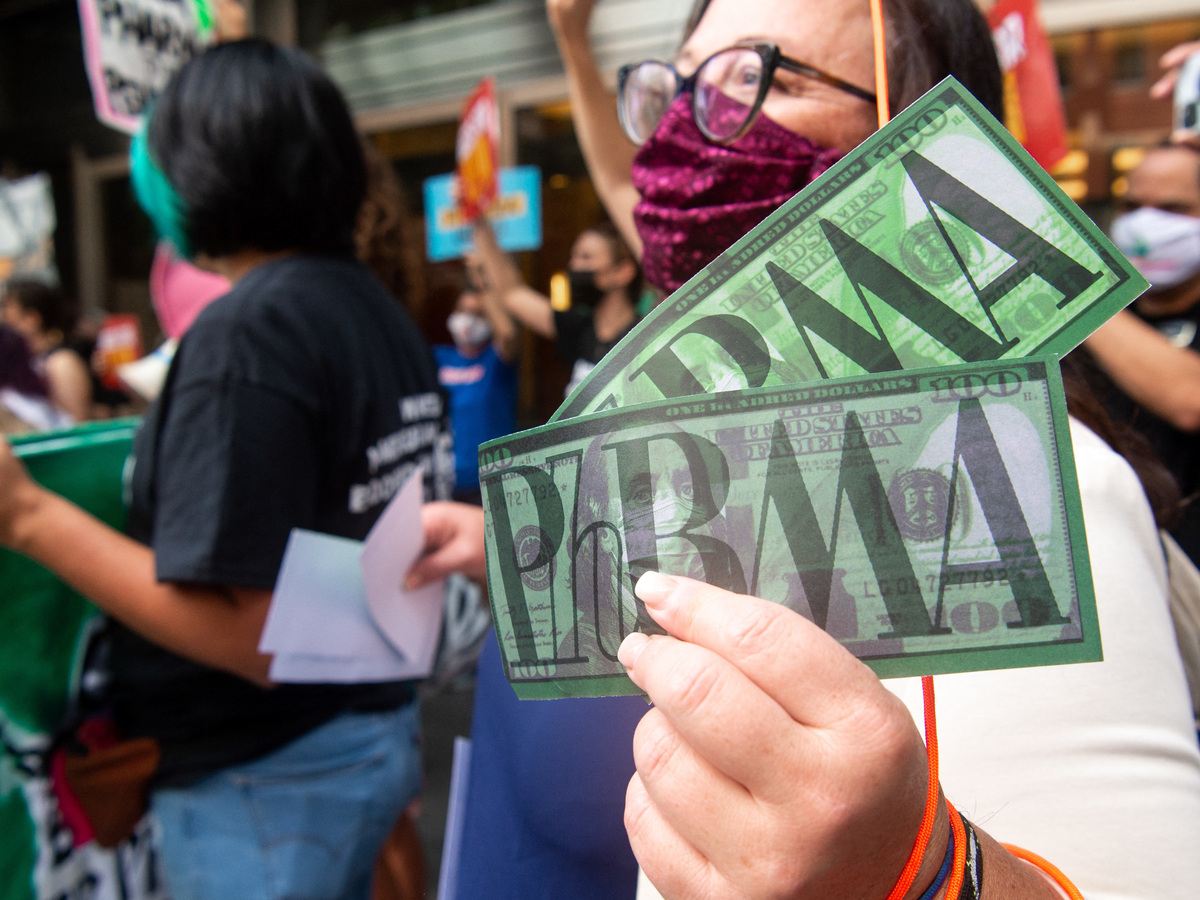

Demonstrators outside PhRMA headquarters in Washington, DC, protest lobbying by pharmaceutical companies to keep Medicare from negotiating lower prescription drug prices.

Saul Loeb/AFP via Getty Images

Americans pay way more than people in other countries do for prescription drugs. This drives voters crazy, and although lawmakers have been vowing to do something about it for decades, they haven’t made much progress.

That could change as soon as this week. The Inflation Reduction Act – hashed out by Senate Majority Leader Chuck Schumer, DN.Y., and Senator Joe Manchin, DW.V. – includes several provisions around drug prices and health insurance. The Senate is planning to start the voting process Saturday, and it appears on track to get through Congress and be signed into law by President Biden.

This is all music to the ears of patients who’ve been burdened by high-priced drugs for years.

“The proposal to limit out-of-pocket expenses that’s on the table right now would absolutely make a huge difference in my life,” says Medicare recipient Bob Parant, 69, of Westbury, New York. He has Type 1 diabetes and pays about $5,000 out of pocket for insulin each year, on top of thousands more for a heart medicine.

Here are details about that proposal and others in the bill, and answers to some frequently asked questions.

What exactly is Congress changing about drug prices?

For the first time, the federal health secretary would be able to directly negotiate the prices of certain expensive drugs each year for Medicare. This starts in 2026 with 10 drugs and increases to 20 drugs by 2029. To qualify for negotiation, the drugs would have to be on the market for several years.

Then there’s the proposal Parant is most excited about: People on Medicare won’t have to pay more than $2,000 a year in out-of-pocket costs for prescription drugs, which will make a big difference for seniors with certain conditions like cancer and multiple sclerosis. This would kick in in 2025.

And, starting next year, if drug companies raise the prices of their drugs faster than inflation, they’ll have to pay a rebate to Medicare. That could affect a lot of drugs – according to an analysis by the Kaiser Family Foundation; In 2019-20, half of all prescriptions covered by Medicare increased in price faster than inflation. This provision could help discourage drug companies from constantly hiking prices.

Do experts think it will make a difference?

Actually, many health policy experts think these changes are significant.

“This is a huge breakthrough,” says Tricia Neuman, who directs the Program on Medicare Policy at KFF. “Congress has been talking about doing something about drug prices for decades. [This] may not be everything everyone wants, but it really is a big deal and it will provide significant help to literally millions of people who need it.”

“It’s a huge deal,” agrees Stacie Dusetzina, professor of health policy at Vanderbilt University. “It really does break a lot of new ground and fix a lot of problems.”

The Congressional Budget Office, which analyzed an earlier version of the bill, estimates these changes will save the government $288 billion through 2031.

Why does it take so long for many of these things to kick in?

For someone who’s on Medicare and spends $10,000 a year on cancer treatment, like Neuman’s friend, the timeline of these changes might be tough to take.

“Clearly, she’ll be wondering next year, ‘Why am I still paying a lot of money?'” Neuman says. “Some things just can’t happen fast enough just because it takes a while to put things in motion.” It will take a lot of work by the federal health agencies and industry groups to get ready for these provisions to take effect.

Neuman says she understands people are anxious for relief, but once provisions like the out-of-pocket cap in Medicare do take effect, “this really will be a big deal for people who rely on expensive medication and for others who have seen their drug prices increase each year.”

I heard the bill will lead to fewer new drugs. Is that true?

This is an argument made by drugmakers to try and scare people into opposing these changes. The pharmaceutical and health products industry has spent more on lobbying Congress in 2022 than any other industry, according to the nonprofit Open Secrets. It’s fighting hard to prevent these changes from becoming law because they would cut into their profits.

For instance, PhRMA, the Pharmaceutical Research and Manufacturers of America, is making its case in an ad campaign that the drug-pricing provisions in the bill could lead to fewer new medicines coming to market by “chilling research and development.” The trade association also pointed NPR to this industry-funded analysis from Avalere, which estimates the bill could reduce drug manufacturer revenue by $450 billion by 2032.

But an analysis by the Congressional Budget Office estimates the effect on drug development would be quite modest. About 15 out of 1,300 drugs would not come to market over the next 30 years – that’s about 1% of new drugs. Also, most big drug companies spend more on marketing than on research and development.

Some ads claim Medicare would be cut. Is this true?

These ads are misleading. For example, a project dubbed Commitment to Seniors launched a seven-figure ad campaign claiming that the Senate bill would “siphon nearly $300 billion out of Medicare.” In fact, that amount of money is what the government is expected to save because Medicare won’t have to pay as much for expensive drugs, it’s not money that’s being taken away from Medicare’s budget. So, importantly, seniors’ benefits would not be cut.

“When people see an ad on TV from a group called Commitment to Seniors, that sounds pretty innocuous,” says Michael Beckel of Issue One who tracks dark money. It turns out, Commitment to Seniors is a project of another group, American Commitment, that has given PhRMA more than a million dollars, including $325,000 in 2020.

Beckel says it’s not unusual to see the industry engage in such tactics. “The pharmaceutical industry is a major lobbying force and major dark money player.”

What about insulin? Would people with diabetes get help with those prices?

Insulin is often the poster-child drug when it comes to out-of-control prices and life-or-death stakes. US insulin prices are four times higher after rebates, on average, compared with other countries, and about 1 in 4 diabetes patients have reported taking less insulin than prescribed because they can’t afford it. At this point, it’s unclear if any of the proposed reforms on the price of insulin – or at least patients’ out-of-pocket costs – will make it into the final bill.

There are ongoing efforts to cap copays at $35 a month for people with insurance who take insulin, which has bipartisan support, but this may not be included in the bill.

What else is in the bill on health?

The other big thing in the bill protects consumers from a potentially disastrous change that would happen without new legislation.

People who buy insurance on the Affordable Care Act marketplaces – like Healthcare.gov and the state marketplaces – will be able to keep generous premium subsidies for three more years. After these extra subsidies went into effect with the passage of the American Rescue Plan, the government estimated 4 out of 5 enrollees qualified for a plan with a premium of $10 or less per month.

Krutika Amin, who works with Neuman at KFF, says it’s important for lawmakers to nail down this extension now, since insurance companies are currently setting their rates for next year’s plans in advance of open enrollment in the fall.

“If Congress is able to extend the extra subsidies before the August recess, it will help provide certainty to both insurance companies and state and federal agencies who are running [the marketplaces] to be able to implement it in a way that’s seamless for consumers,” she says.

The extra discounts on plans have made a difference. Last year 14.5 million people – more than ever – signed up for insurance on Healthcare.gov, and an early analysis from HHS suggests the overall number of people who were uninsured in the US hit a record low in the first months of this year.

NPR Pharmaceuticals Correspondent Sydney Lupkin contributed reporting.

Categories
US

Houston crash: A toddler was killed after a cement truck tumbled over overpass onto a vehicle

The 22-month-old’s twin sister survived, along with the two adults who were in the vehicle, Harris County Sheriff’s Office Vehicular Crimes Division Lt. Simon Cheng told CNN affiliate KHOU.

“The adults were able to exit the vehicle and rescue the girl — one of the twins — unfortunately the boy twin was not able to be freed from the vehicle being crushed by the cement truck,” he said.

Harris County Sheriff Ed Gonzalez said deputies had responded to a “major crash” at the intersection of Wood Forest and East Sam Houston Parkway on Friday afternoon. I have said the truck lost control, “went over the overpass and landed on top of a vehicle with four occupants.”

The driver of the Ford pick-up truck was identified as the twins’ 54-year-old grandmother, while the front seat passenger was their mother, said Cheng.

The two women and the girl were transported to a local hospital in stable condition, according to the sheriff’s office.

The driver of the cement truck sustained possible injuries but refused transport to a hospital, according to Cheng.

She “did not show any signs of impairment or intoxication” and there were no signs of speeding, he said. “She is distracted about the incident, and she is cooperating with the investigation.”

Cheng said investigations into the crash are continuing. “We do want to conduct a full investigation to see why she lost control or any possible contributing factor on the beltway.”

.

Categories
US

Drug industry on verge of rare defeat

The powerful pharmaceutical industry is on the verge of a rare defeat in Congress, as Democrats say they have the votes to pass legislation targeting high drug costs.

After securing the support of Sen. Kyrsten Sinema (D-Ariz.) late Thursday, Senate Democrats appear poised to pass sweeping legislation that, among a host of climate and tax measures, would allow Medicare to negotiate the costs of some prescription drugs for the first time ever.

Democrats have sought for decades to allow Medicare to directly negotiate with drug companies as a way to bring down costs, starting with President Clinton’s ambitious health reform plan in 1993.

While relatively modest, the negotiation provision still represents a major victory for drug pricing advocates, and could give Democrats a boost heading into the midterm elections.

The idea is widely supported by voters, but the industry has long fought off any efforts to impose what they see as price controls, even amid growing bipartisan anger over high drug costs.

The legislation would allow negotiations for up to 10 of the highest cost drugs beginning in 2026, with more allowed in later years. It is expected to save the federal government more than $100 billion.

Another provision would cap out-of-pocket costs for Medicare’s prescription drug benefit at $2,000, saving seniors thousands of dollars. The legislation also aims to prevent companies from massive pricing hikes by imposing rebates on manufacturers that increase prices faster than inflation.

According to the Kaiser Family Foundation, half of all drugs covered by Medicare had price increases above the rate of inflation from 2019 to 2020.

If the legislation passes, “this is a sea change. It’s going to change the trajectory of drug prices and drug price policy in the country,” said David Mitchell, president and founder of the advocacy group Patients for Affordable Drugs.

The legislation could pass the Senate as early as this weekend, assuming that the upper chamber’s parliamentarian says that the drug pricing provisions can be included under budget reconciliation rules, which allow Democrats to bypass the 60-vote legislative filibuster.

The prescription drug plan contains the most popular provisions in the reconciliation package, according to a recent Morning Consult-Politico poll. Roughly three out of four respondents expressed support for the drug pricing measures.

But the pharmaceutical industry is on pace to break lobbying records in its effort to oppose the legislation. According to Open Secrets, the industry has spent $187 million in the first half of 2022 alone.

The industry’s largest lobbying group, the Pharmaceutical Research and Manufacturers of America (PhRMA), sent a letter to every member of Congress on Thursday to urge them to vote against the legislation.

The letter largely reiterated the longstanding argument made by the industry group that the legislation would lead to government price controls and fewer cures available to Americans.

“This bill will not provide relief for families struggling with inflation or help the average American patient afford their medicines. It will be remembered as a historic mistake that devastated patients desperate for new cures,” Stephen Ubl, president and chief executive officer of PhRMA, wrote in the letter, which was also signed by the group’s 31 board members.

During a recent briefing, Ubl said the group is assessing its options, and indicated that even if the legislation passes, the industry won’t back down.

“We’re not going to take any option off the table. We’ll examine all legislative, regulatory, legal efforts to ensure patients continue to have access to medicines and our companies have the ability to develop them,” Ubl said.

In recent years, Congress has tried to rein in drug prices without Medicare negotiation. In 2019, Sens. Chuck Grassley (R-Iowa) and Ron Wyden (D-Ore.) introduced a bipartisan drug pricing bill.

Similar to the reconciliation provisions, it would have included a cap on seniors’ out-of-pocket drug costs in Medicare, and would have limited Medicare drug price increases to the rate of inflation. But the bill was never brought up for a vote.

Congress has also looked into stopping what lawmakers decry as anti-competitive industry practices, like raising prices in lockstep with competitors or manipulating patent laws to extend market exclusivity.

But even modest legislation has been opposed by drug companies.

Rachel Sachs, a law professor at Washington University in St. Louis, said she didn’t think there would be such a strong desire for regulation if drug companies hadn’t fought against every effort.

Sachs said “industry’s own failure to rein in its worst impulses” is to blame.

“We are now in a situation that’s not sustainable for patients or payers and it’s because of their own actions,” Sachs said.

Mitchell said if the legislation passes, it would pierce the pharmaceutical lobby’s veneer of invincibility.

“I do think that this struggle has been about power, and the drug companies have struggled to keep their power to dictate prices,” Mitchell said. “The bite out of pharma from this legislation isn’t that big. It’s meaningful, but it’s not that big. But the idea that we are actually, actually curbing the power of that industry to dictate this to the American people is a very big deal.”

Categories
US

Going after ‘the little guy’: Arizonans oppose billions in IRS funding as Sinema says she will support bill

NEWYou can now listen to Fox News articles!

Arizona residents are expressing their displeasure with the billions of dollars designated for boosting IRS enforcement as part of the massive Democrat-backed social spending and taxation bill agreed to by Sen. Kyrsten Sinema, D-Ariz., late Thursday evening.

Sinema announced she would “move forward” with the bill, officially called the Inflation Reduction Act, after previously signaling changes would have to be made in order for her to agree to support it.

Fox News Digital spoke to a number of residents on the streets of Arizona to get their take on the billions in IRS funding contained within the bill. They expressed displeasure that the federal government would commit such a large amount to “go after the little guy.”

“I don’t like that to tell you the truth, that portion of it,” said resident Willis Daychild, who said that he agreed with the aims of the bill overall. “They’re going to be out there trying to find all the people that have not filed their taxes. Usually the little guy, they’re the one’s getting their hands slapped for their taxes.”

KYRSTEN SINEMA SAYS SHE WILL SUPPORT MANCHIN-SCHUMER SPENDING BILL: HERE IS WHAT ARIZONANS HAD TO SAY

Senator Kyrsten Sinema, D-Ariz., departs from the US Capitol in Washington, DC, on October 28, 2021.

Senator Kyrsten Sinema, D-Ariz., departs from the US Capitol in Washington, DC, on October 28, 2021.
(MANDEL NGAN/AFP via Getty Images)

Resident Gary Kuznia agreed, arguing the IRS would use the money to “go after” less wealthy people rather than the rich.

“No, they’re just going to go after the little guy. They really will. And they’re never going to go after the rich people. Never. Or else they would have done it already because they’re not paying their fair share of taxes right now,” he said.

“Little guys like me — you know, I’m retired, and I hate to see that. I really do. I was an accountant all my life, and I don’t want to see that. And I hope they don’t They’re going to hunt the little guy, people who make less money, and make them pay. Because they have to pay for this bill. How are they going to pay for this bill?” I have added.

Resident Richard Carrillo said he supported the bill, but appeared hesitant about the IRS funding going to increase additional auditing. “I don’t know about the audits, but if it’s going to support and help people then I say yes,” he said.

SENATE AIDES HINT AT MANCHIN DISTRESS OVER SPENDING BILL BACKLASH, DESIRE TO AVOID ‘BUILD BACK BETTER’ MENTION

This photo taken April 13, 2014 shows the headquarters of the Internal Revenue Service (IRS) in Washington.

This photo taken April 13, 2014 shows the headquarters of the Internal Revenue Service (IRS) in Washington.
(AP Photo/J. David Ake)

“No, no, no, not at all. I know taxes kind of make the US go round and round, but at this point there’s a lot of working class people that pay their dues, but I mean, they don’t need to be audited,” said resident Richard Carrillo. “That money can be spent somewhere else. So yeah I think that is a waste of money, giving it to the IRS so that they can give more audits and stuff like that.”

Another resident who wished to remain unnamed argued the money designated for the IRS was “too large” of an amount, and that taxes should be handled at a more local level rather than by the federal government.

CLICK HERE TO GET THE FOX NEWS APP

The Senate is scheduled to reconvene Saturday to vote to begin debate on the bill, which is expected to pass with the support of every Democrat.

Categories
US

Senate parliamentarian OKs most of Dems’ drug price controls

WASHINGTON (AP) — The Senate parliamentarian narrowed Democrats’ plan for curbing drug prices but left it largely intact Saturday, Democrats said, as party leaders prepared to start moving their sprawling economic bill through the chamber.

Elizabeth MacDonough, the chamber’s rules arbiter, also gave the green light to clean air provisions in the measure, including one limiting electric vehicle tax credits to those assembled in the US, Democrats said.

The nonpartisan official’s rulings came as Democrats planned to begin Senate votes Saturday on their wide-ranging package addressing climate change, energy, health care costs, taxes and even deficit reduction. Party leaders have said they believe they now have the unity they will need to move the legislation through the 50-50 Senate, with Vice President Kamala Harris’ tiebreaking vote.

MacDonough said provisions must be removed that would force drugmakers to pay rebates if their prices rise above inflation for products they sell to private insurers. Pharmaceutical companies would have to pay those penalties, though, if their prices for drugs bought by Medicare rise too high.

Dropping penalties on drugmakers for increasing prices on private insurers was a clear setback for Democrats. The decision reduces incentives on pharmaceutical companies to restrain what they charge, increasing costs for patients.

Erasing that language will cut the $288 billion in 10-year savings that the Democrats’ overall drug curbs were estimated to generate — a reduction of perhaps tens of billions of dollars, analysts have said. But other restrictions on rising pharmaceutical costs survived, including letting Medicare negotiate costs for the drugs it buys, capping seniors’ out-of-pocket expenses and providing free vaccines.

The surviving pharmaceutical provisions left Democrats promoting the drug language as a boon to consumers at a time when voters are infuriated by the worst inflation in four decades.

“This is a major victory for the American people,” Senate Majority Leader Chuck Schumer, DN.Y., said in a statement. “While there was one unfortunate ruling in that the inflation rebate is more limited in scope, the overall program remains intact and we are one step closer to finally taking on Big Pharma and lowering Rx drug prices for millions of Americans.”

Senate Finance Committee Chairman Ron Wyden, D-Ore., said that while he was “disappointed” the penalties for higher drug prices for privately insured consumers were dropped, “the legislation nevertheless puts a substantial check on Big Pharma’s ability to price gouge.”

The parliamentarian’s decision came after a 10-day period that saw Democrats resurrect top components of President Joe Biden’s domestic agenda after they were seemingly dead. In rapid-fire deals with Democrats’ two most unpredictable senators—first conservative Joe Manchin of West Virginiathen Arizona centrist Kyrsten Sinema — Schumer pieced together a broad package that, while a fraction of earlier, larger versions that Manchin derailed, would give the party an achievement against the backdrop of this fall’s congressional elections.

The parliamentarian signed off on a fee on excess emissions of methane, a powerful greenhouse gas contributor, from oil and gas drilling. She also let stand environmental grants to minority communities and other initiatives for reducing carbon emissionssaid Senate Environment and Public Works Committee Chairman Thomas Carper, D-Del.

She approved a provision requiring union-scale wages to be paid if energy efficiency projects are to qualify for tax credits, and another that would limit electric vehicle tax credits to those cars and trucks assembled in the United States.

The overall measure faces unanimous Republican opposition. But assuming Democrats fight off a nonstop “vote-a-rama” of amendments — many designed by Republicans to derail the measure — they should be able to muscle the measure through the Senate.

House passage could come when that chamber returns briefly from recess on Friday.

“What will vote-a-rama be like. It will be like hell,” Sen. Lindsey Graham of South Carolina, the top Republican on the Senate Budget Committee, said Friday of the approaching GOP amendments. He said that in supporting the Democratic bill, Manchin and Sinema “are empowering legislation that will make the average person’s life more difficult” by forcing up energy costs with tax increases and making it harder for companies to hire workers.

The bill offers spending and tax incentives for moving toward cleaner fuels and supporting coal with assistance for reducing carbon emissions. Expiring subsidies that help millions of people afford private insurance premiums would be extended for three years, and there is $4 billion to help Western states combat drought.

There would be a new 15% minimum tax on some corporations that earn over $1 billion annually but pay far less than the current 21% corporate tax. There would also be a 1% tax on companies that buy back their own stock, swapped in after Sinema refused to support higher taxes on private equity firm executives and hedge fund managers. The IRS budget would be pumped up to strengthen its tax collections.

While the bill’s final costs are still being determined, it overall would spend more than $300 billion over 10 years to slow climate change, which analysts say would be the country’s largest investment in that effort, and billions more on health care. It would raise more than $700 billion in taxes and from government drug cost savings, leaving about $300 billion for deficit reduction — a modest bite out of projected 10-year shortfalls of many trillions of dollars.

Democrats are using special procedures that would let them pass the measure without having to reach the 60-vote majority that legislation often needs in the Senate.

It is the parliamentarian’s job to decide whether parts of legislation must be dropped for violating those rules, which include a requirement that provisions be chiefly aimed at affecting the federal budget, not imposing new policy.

___

Associated Press writer Matthew Daly contributed to this report.

.

Categories
US

Senate rules official strikes part of Democrats’ drug pricing measures

Democrats’ sweeping economic package was narrowed somewhat on Saturday after a ruling from a top Senate rules official struck one of the provisions aimed at lowering prescription drug prices.

The Senate parliamentarian, an official who determines whether provisions meet the chamber’s complicated budget rules, struck down part of a provision that would limit drug companies’ price increases to the rate of inflation.

Senate Democrats had proposed requiring drug companies to pay rebates back to the government if their prices rose faster than the rate of inflation, both in Medicare and in the private health insurance market.

The parliamentarian allowed the provision to stand in Medicare but struck it for people with private health insurance, such as those who get coverage through their jobs, a substantial chunk of the population.

Still, as expected, the parliamentarian allowed to stand Democrats’ signature drug pricing measure, which would for the first time allow Medicare to negotiate lower drug prices on some drugs.

The parliamentarian also allowed to stand Democrats’ clean energy tax package. Other parts of the package are still awaiting rulings, including a $35 cap on what patients have to pay out of pocket for insulin.

“Democrats have received extremely good news: for the first time, Medicare will finally be allowed to negotiate prescription drug prices, seniors will have free vaccines and their costs capped, and much more,” Senate Majority Leader Charles Schumer (DN.Y.) said in a statement. “This is a major victory for the American people. While there was one unfortunate ruling in that the inflation rebate is more limited in scope, the overall program remains intact and we are one step closer to finally taking on Big Pharma and lowering Rx drug prices for millions of Americans.”

The provisions are being judged on whether they have a sufficiently substantial impact on the federal budget. The rules stem from the special procedure Democrats are using for their package to avoid a GOP filibuster called budget reconciliation.

The end result is that the drug pricing savings included in the package are even more focused on seniors on Medicare and largely do not touch people with private health insurance.

Categories
US

Senate rules official strikes part of Democrats’ drug pricing measures

Democrats’ sweeping economic package was narrowed somewhat on Saturday after a ruling from a top Senate rules official struck one of the provisions aimed at lowering prescription drug prices.

The Senate parliamentarian, an official who determines whether provisions meet the chamber’s complicated budget rules, struck down part of a provision that would limit drug companies’ price increases to the rate of inflation.

Senate Democrats had proposed requiring drug companies to pay rebates back to the government if their prices rose faster than the rate of inflation, both in Medicare and in the private health insurance market.

The parliamentarian allowed the provision to stand in Medicare but struck it for people with private health insurance, such as those who get coverage through their jobs, a substantial chunk of the population.

Still, as expected, the parliamentarian allowed to stand Democrats’ signature drug pricing measure, which would for the first time allow Medicare to negotiate lower drug prices on some drugs.

The parliamentarian also allowed to stand Democrats’ clean energy tax package. Other parts of the package are still awaiting rulings, including a $35 cap on what patients have to pay out of pocket for insulin.

“Democrats have received extremely good news: for the first time, Medicare will finally be allowed to negotiate prescription drug prices, seniors will have free vaccines and their costs capped, and much more,” Senate Majority Leader Charles Schumer (DN.Y.) said in a statement. “This is a major victory for the American people. While there was one unfortunate ruling in that the inflation rebate is more limited in scope, the overall program remains intact and we are one step closer to finally taking on Big Pharma and lowering Rx drug prices for millions of Americans.”

The provisions are being judged on whether they have a sufficiently substantial impact on the federal budget. The rules stem from the special procedure Democrats are using for their package to avoid a GOP filibuster called budget reconciliation.

The end result is that the drug pricing savings included in the package are even more focused on seniors on Medicare and largely do not touch people with private health insurance.

Categories
US

Senate on track to take key vote Saturday to advance Democrats’ sweeping health care and climate bill

The package is the product of painstaking negotiations and will give Democrats a chance to achieve major policy objectives ahead of the upcoming midterm elections. Senate Democrats are using a special process to pass the package without Republican votes.

Once the legislation has passed in the Senate, it would next need to be approved by the House of Representatives before President Joe Biden could sign it into law.

The Senate is expected to take the first procedural vote to proceed to the bill sometime on Saturday. A simple majority is required for the motion to proceed.

Democrats control the narrowest possible majority and only 50 seats in the Senate, but are expected to be united to advance the bill in the initial procedural vote.

Arizona Sen. Kyrsten Sinema on Thursday night offered critical support after party leaders agreed to change new tax proposals, indicating she would “move forward” on the sweeping economic package.
West Virginia Democratic Sen. Joe Manchin has also played a key role in shaping the legislation — which is only moving forward after Manchin and Senate Majority Leader Chuck Schumer announced a deal at the end of July, a major breakthrough for Democrats after earlier negotiations had stalled out.
Senate Democrats only need a simple majority for the final passage of the bill since they are using a process known as reconciliation, which allows them to avoid a Republican filibuster and corresponding 60-vote threshold.
In order to pass a bill through the reconciliation process, however, the package must comply with a strict set of budget rules. The Senate parliamentarian must decide whether the provisions in the bill meet the rules to allow Democrats to use the filibuster-proof budget process to pass the legislation along straight party lines.

In a key ruling, the parliamentarian, Elizabeth MacDonough, has allowed a major component of the Democrats’ prescription drug pricing plans to move ahead — giving Medicare the power to negotiate the prices of certain prescription drugs for the first time.

But MacDonough narrowed another provision aimed at lowering drug prices — imposing penalties on drug companies if they increase their prices faster than inflation. Democrats had wanted the measure to apply both to Medicare and the private insurance market. But the parliamentarian ruled the inflation cap could only apply to Medicare, a Democratic aid said.

Still, Democrats hailed the ruling, with Schumer saying that “the overall program remains intact.”

Democrats are waiting on new cost estimates from the nonpartisan Congressional Budget Office to see how the ruling affects their deficit projections. It’s likely that the curtailed drug provision would somewhat limit the package’s deficit reduction.

Meanwhile, MacDonough ruled to keep intact several climate measures from the Environmental and Public Works Committee in the reconciliation bill, including a methane fee that would apply to oil and gas producers leaking the potent greenhouse gas methane above a certain threshold.

Earlier Saturday, Senate Finance Chair Ron Wyden of Oregon announced that the clean energy tax portion of the bill “adheres to Senate rules, and important provisions to ensure our clean energy future is built in America have been approved by the parliamentarian.”

Schumer has yet to decide the exact time he plans to kick off debate this weekend, according to a senior Democratic aide. The timing of that vote is key because it will kick off the process and will determine when the bill will ultimately get its final vote. If Schumer waits to hold that first vote to open debate, he could push back the rest of the votes on the bill until later Saturday or even all day Sunday.

The reason why Democratic leaders haven’t decided yet is that they were waiting for the parliamentarian’s rulings. While they don’t need her to rule before the first procedural vote, the goal of Democrats is to make any changes she requests before the process begins, the aid said. As a result, the timing of votes on amendments and final passage of the bill is very much in flux.

What happens after the bill faces its first key vote

If the first procedural vote to proceed to the bill gets the backing of all 50 members of the Democratic caucus, which it is expected to, there would then be up to 20 hours of debate evenly divided between the two parties, though some of that time could be yielded back to speed up the process.

Following time for debate, there would be a process colloquially referred to on Capitol Hill as a “vote-a-rama” — a marathon series of amendment votes with no time limit that must run its course before a final vote can take place.

Republicans will be able to use the vote-a-rama to put Democrats on the spot and force politically tough votes. The process typically stretches overnight and into the early hours of the next morning. It’s not yet clear exactly when the vote-a-rama will begin, but it could start as early as Saturday evening. If that happens, a final vote could potentially take place as soon as the early hours of Sunday morning.

The House is poised to come back to take up the legislation on Friday, August 12, according to House Majority Leader Steny Hoyer’s office.

How the bill addresses the climate crisis

For a party that failed to pass major climate legislation over 10 years ago, the reconciliation bill represents a major, long-fought victory for Democrats.

The nearly $370 billion clean energy and climate package is the largest climate investment in US history, and the biggest victory for the environmental movement since the landmark Clean Air Act. It also comes at a critical time; This summer has seen punishing heat waves and deadly floods across the country, which scientists say are both linked to a warming planet.

Analysis from Schumer’s office — as well as multiple independent analyzes — suggests the measures would reduce US carbon emissions by up to 40% by 2030. Strong climate regulations from the Biden administration and action from states would be needed to get to Biden’s goal of cutting emissions 50% by 2030.

The bill also contains many tax incentives meant to bring down the cost of electricity with more renewables, and spur more American consumers to switch to electricity to power their homes and vehicles.

Lawmakers said the bill represents a monumental victory and is also just the start of what’s needed to combat the climate crisis.

“This isn’t about the laws of politics, this is about the laws of physics,” Democratic Sen. Brian Schatz of Hawaii told CNN. “We all knew coming into this effort that we had to do what the science tells us what we need to do.”

Key health care and tax policy in the bill

The bill would empower Medicare to negotiate prices of certain costly medications administered in doctors’ offices or purchased at the pharmacy. The Health and Human Services secretary would negotiate the prices of 10 drugs in 2026, and another 15 drugs in 2027 and again in 2028. The number would rise to 20 drugs a year for 2029 and beyond.

This controversial provision is far more limited than the one House Democratic leaders have backed in the past. But it would open the door to fulfilling a longstanding party goal of allowing Medicare to use its heft to lower drug costs.

Democrats are also planning to extend the enhanced federal premium subsidies for Obamacare coverage through 2025, a year later than lawmakers recently discussed. That way they wouldn’t expire just after the 2024 presidential election.

To increase revenue, the bill would impose a 15% minimum tax on the income large corporations report to shareholders, known as book income, as opposed to the Internal Revenue Service. The measure, which would raise $258 billion over a decade, would apply to companies with profits over $1 billion.

Concerned about how this provision would affect certain businesses, particularly manufacturers, Sinema has suggested that she won changes to the Democrats’ plan to stop back how companies can deduct depreciated assets from their taxes. The details remain unclear.

However, Sinema nixed her party’s effort to tighten the carried interest loophole, which allows investment managers to treat much of their compensation as capital gains and pay a 20% long-term capital gains tax rate instead of income tax rates of up to 37%.

The provision would have lengthened the amount of time investment managers’ profit interest must be held from three years to five years to take advantage of the lower tax rate. Addressing this loophole, which would have raised $14 billion over a decade, had been a longtime goal of congressional Democrats.

In its place, a 1% excise tax on companies’ stock buybacks was added, raising another $74 billion, according to a Democratic aid.

This story has been updated with additional developments.

CNN’s Manu Raju, Ella Nilsen, Tami Luhby, Katie Lobosco and Melanie Zanona contributed to this report.

.

Categories
US

Taiwan says China is rehearsing invasion attack

NEWYou can now listen to Fox News articles!

Taiwan is warning that China’s recent military drills are a rehearsal for a real invasion.

The disputed island has, in recent days, been surrounded by Chinese military vessels and shows of strength on behalf of Beijing.

The Chinese Communist Party has been openly irate that a congressional delegation led by House Speaker Nancy Pelosi visited the island last week.

The delegation proceeded with the visit in direct opposition to Chinese demands that the US abort the meeting.

CHINA SANCTIONS HOUSE SPEAKER NANCY PELOSI OVER ‘EGREGIOUS PROVOCATION’ IN VISIT TO TAIWAN

In this photo provided by China's Xinhua News Agency, a People's Liberation Army member looks through binoculars during military exercises as Taiwan's frigate Lan Yang is seen at the rear, on Friday, Aug. 5, 2022.

In this photo provided by China’s Xinhua News Agency, a People’s Liberation Army member looks through binoculars during military exercises as Taiwan’s frigate Lan Yang is seen at the rear, on Friday, Aug. 5, 2022.
(Lin Jian/Xinhua via AP)

A fighter jet flies in the direction of Taiwan and is seen from the 68-nautical-mile scenic spot, the closest point in mainland China to the island of Taiwan, in Pingtan in southeastern China's Fujian Province, Friday, Aug. 5, 2022.

A fighter jet flies in the direction of Taiwan and is seen from the 68-nautical-mile scenic spot, the closest point in mainland China to the island of Taiwan, in Pingtan in southeastern China’s Fujian Province, Friday, Aug. 5, 2022.
(AP Photo/Ng Han Guan)

After Pelosi’s departure, China’s navy and air force began conducting military exercises in six zones around Taiwan with some overlapping Taiwan’s territorial waters.

The US responded by deploying several warships to the area.

US officials, including high-ranking members of President Biden’s cabinet, have acknowledged the legitimacy of China’s threats to Taiwan.

The People's Liberation Army launched joint military operations around Taiwan island.  China resolutely defends its sovereignty and territorial integrity.

The People’s Liberation Army launched joint military operations around Taiwan island. China resolutely defends its sovereignty and territorial integrity.
(People’s Liberation Army, China)

Secretary of State Antony Blinken said China’s military exercises, including missiles the country recently fired into the Taiwan Strait and Japan’s economic zone, represent “significant escalation.”

“China has chosen to overreact and use Speaker Pelosi’s visit as a pretext to increase provocative military activity in and around the Taiwan Strait,” he told a group of reporters at the ASEAN conference on Friday.

CLICK HERE TO GET THE FOX NEWS APP

Japan, an ally of both Taiwan and the United States in East Asia, has voiced its own concerns.

Japanese Defense Minister Nobuo Kishi said the missiles “threatened Japan’s national security and the lives of the Japanese people, which we strongly condemn.”

US House Speaker Nancy Pelosi, front, center left, and her congressional delegation pose for a photo with Japanese Prime Minister Fumio Kishida, center right, before their breakfast meeting at the prime minister's official residence in Tokyo Friday, Aug. 5, 2022.

US House Speaker Nancy Pelosi, front, center left, and her congressional delegation pose for a photo with Japanese Prime Minister Fumio Kishida, center right, before their breakfast meeting at the prime minister’s official residence in Tokyo Friday, Aug. 5, 2022.
(Kyodo News via AP)

A boat moves through the water at the 68-nautical-mile scenic spot, the closest point in mainland China to the island of Taiwan, in Pingtan in southeastern China's Fujian Province, Friday, Aug. 5, 2022.

A boat moves through the water at the 68-nautical-mile scenic spot, the closest point in mainland China to the island of Taiwan, in Pingtan in southeastern China’s Fujian Province, Friday, Aug. 5, 2022.
(AP Photo/Ng Han Guan)

The problem in Japan is compounded by the island nation’s lack of a formal standing military, which is outlawed by its constitution. Japan maintains a small “defense force” for protection.

China often threatens to annex Taiwan by force, if necessary, while Japan and the US continue to increase their military readiness to potentially respond to such an attack.

Fox News’ Lawrence Richards contributed to this report.

Categories
US

Pennsylvania fire kills a firefighter’s 10 relatives, 3 of them children : NPR

Firefighters on Friday set up lights in front of a fatal house fire in Nescopeck, Pa., that killed 10 people.

Jimmy May/Bloomsburg Press Enterprise via AP


hide caption

toggle caption

Jimmy May/Bloomsburg Press Enterprise via AP


Firefighters on Friday set up lights in front of a fatal house fire in Nescopeck, Pa., that killed 10 people.

Jimmy May/Bloomsburg Press Enterprise via AP

NESCOPECK, Pa. — Fire tore quickly through a house in northeastern Pennsylvania early Friday morning, killing seven adults and three children and horrifying a volunteer firefighter who arrived to battle the blaze only to discover the victims were his own family, authorities said.

The children who died were ages 5, 6 and 7, Pennsylvania State Police said in a news release, while the seven adults ranged from their late teens to a 79-year-old man. Autopsies were planned for this weekend.

Harold Baker, a volunteer firefighter in the town of Nescopeck, said the 10 victims included his son, daughter, father-in-law, brother-in-law, sister-in-law, three grandchildren and two other relatives. He said his two children of him and the other young victims were visiting their aunt and uncle’s home for swimming and other summertime fun.

He said 13 dogs were also in the two-story home, but didn’t say if he knew whether any survived.

“All I wanted to do was go in there and get to these people, my family. That’s all that I was thinking about, getting in to them,” Baker said in a phone interview with The Associated Press.

Baker grabbed a hose and air pack, and started pouring water on the fire, desperate to make his way inside and calling out to his son. His chief realized whose house it was, and fellow firefighters escorted Baker back to the firehouse.

A preliminary investigation suggests the fire broke out on the front porch at around 2:30 am, Luzerne County District Attorney Sam Sanguedolce said Friday evening.

“The information I have is that the fire started and progressed very quickly, making it very difficult to get out,” he said.

Three people were able to escape the blaze, Sanguedolce said. Four state police fire marshals are involved in the investigation, although it won’t be classified as a criminal probe unless they determine the fire was intentionally set, he said.

Nescopeck is a small town on the Susquehanna River, about 20 miles southwest of Wilkes-Barre. The house was on a residential street of largely owner-occupied, single family homes.

Baker said the address initially given for the call was a neighboring house. I realized it was his family members’ residence as the firetruck approached. He said his unit was the first on scene, and the house was already engulfed in flames.

“There wasn’t anything we could’ve done to get in there. We tried, but we couldn’t get in,” said Baker, 57, who’s been a firefighter for 40 years.

His son, 19-year-old Dale Baker, had followed both of his parents into the fire service, joining when he was 16.

“He said it all his life, he was just going to be like his dad,” Harold Baker said.

Heidi Knorr, the Nescopeck Volunteer Fire Company secretary, called Dale Baker “such a fun-loving soul. He just loved life.”

The family was “always willing to help lend a hand to anyone in need,” Knorr said. Dale’s mother was not among the dead listed by Harold Baker.

Mike Swank, who lives two doors away across the street, said he happened to be awake early Friday and looked outside after hearing a sharp explosion. He saw the porch “was really going” and went outside, using another neighbor’s hose to keep the blaze from spreading to a garage.

“I saw two guys outside and they were in various states of hysteria,” Swank told the AP by phone.

One man was on a cellphone, “and I’m trying to ask him if everybody’s out,” he said. “The other guy was out in the street and he was just running around in circles.”

Swank said he wasn’t able to get information from them. A fence prevented him from getting to the back of the property.

Baker said 14 people were living in the home. One was out delivering newspapers, and three others escaped.

Swank said the family had moved in a few months ago under what he understood to be a rent-to-own agreement, and spent a lot of time on the cluttered front porch.

“It was so quick and so much smoke, you just knew nobody was going to make it out,” Swank said. He saw cadaver dogs being used to search the scene until the bodies were located.