Categories
US

Parliamentarian weakens Democrats’ drug plan in Inflation Reduction Act, as Senate prepares to vote

The Senate parliamentarian on Saturday dealt a blow to Democrats’ plan for curbing drug prices but left the rest of their sprawling economic bill largely intact as party leaders prepared for the first votes on a package containing many of President Joe Biden’s top domestic goals.

Elizabeth MacDonough, the chamber’s nonpartisan rules arbitrator, said lawmakers must remove language imposing hefty penalties on drugmakers that increase their prices beyond inflation in the private insurance market. Those were the bill’s chief pricing protections for the roughly 180 million people whose health coverage comes from private insurance, either through work or bought on their own.

Other major provisions were left intact, including giving Medicare the power to negotiate what it pays for pharmaceuticals for its 64 million elderly recipients, a longtime goal for Democrats. Penalties on manufacturers for exceeding inflation would apply to drugs sold to Medicare, and there is a $2,000 annual out-of-pocket cap on drug costs and free vaccines for Medicare beneficiaries.

Her rulings came as Democrats planned to begin Senate votes Saturday on their wide-ranging package addressing climate change, energy, health care costs, taxes and even deficit reduction. Party leaders have said they believe they have the unity they will need to move the legislation through the 50-50 Senate, with Vice President Kamala Harris expected to cast votes to break ties, since all of the Republicans are expected to oppose the bill.

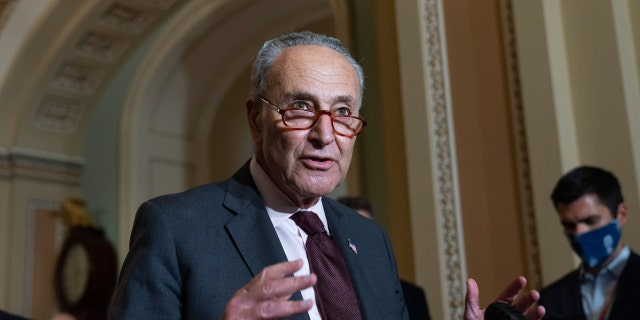
“This is a major win for the American people,” Senate Majority Leader Chuck Schumer, DN.Y., said of the bill, which both parties are using in their election-year campaigns to assign blame for the worst period of inflation in four decades.

“At a time of seemingly impenetrable gridlock, the inflation reduction act will show the American people that when the moment demands it, Congress is still capable of taking big steps to solve big challenges,” Schumer said. “We will show the American people that, yes, we are capable of passing a historic climate package and rein in drug companies and make our tax code fairer.”

In response, Senate Minority Leader Mitch McConnell, R-Ky., said Democrats “are misreading the American people’s outrage as a mandate for yet another reckless taxing and spending spree.” He said Democrats “have already robbed American families once through inflation and now their solution is to rob American families yet a second time.”

Dropping penalties on drugmakers reduces incentives on pharmaceutical companies to restrain what they charge, increasing costs for patients.

Erasing that language will cut the $288 billion in 10-year savings that the Democrats’ overall drug curbs were estimated to generate — a reduction of perhaps tens of billions of dollars, analysts have said.

Schumer said MacDonough’s decision about the price cap for private insurance was “one unfortunate ruling.” But he said the surviving drug pricing language represented “a major victory for the American people” and that the overall bill “remains largely intact.”

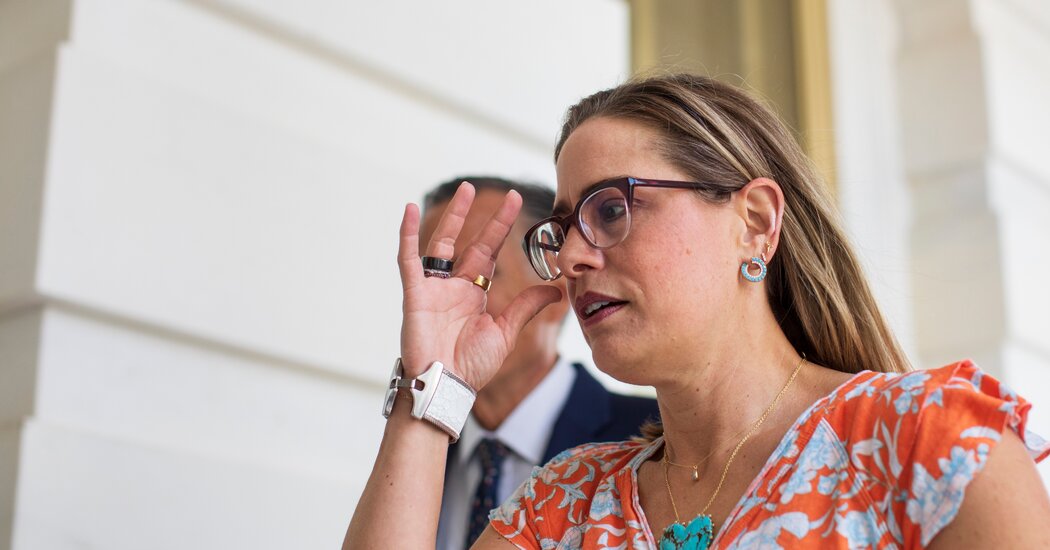
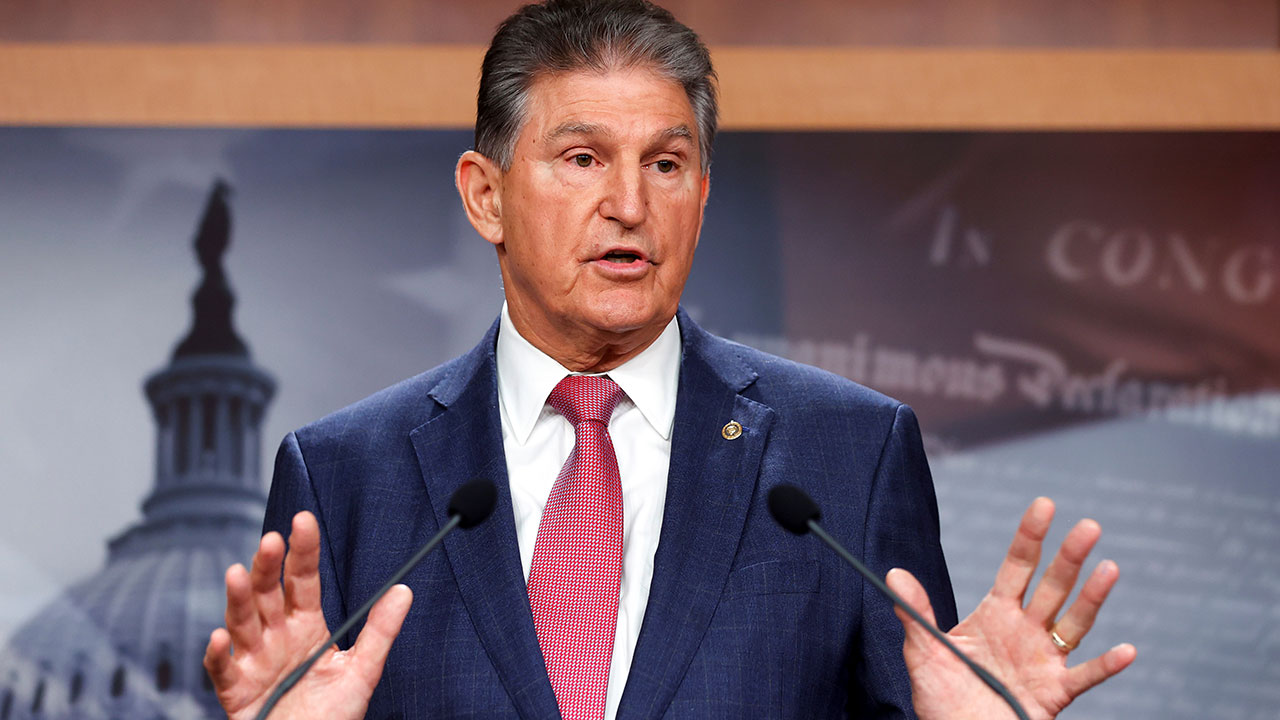
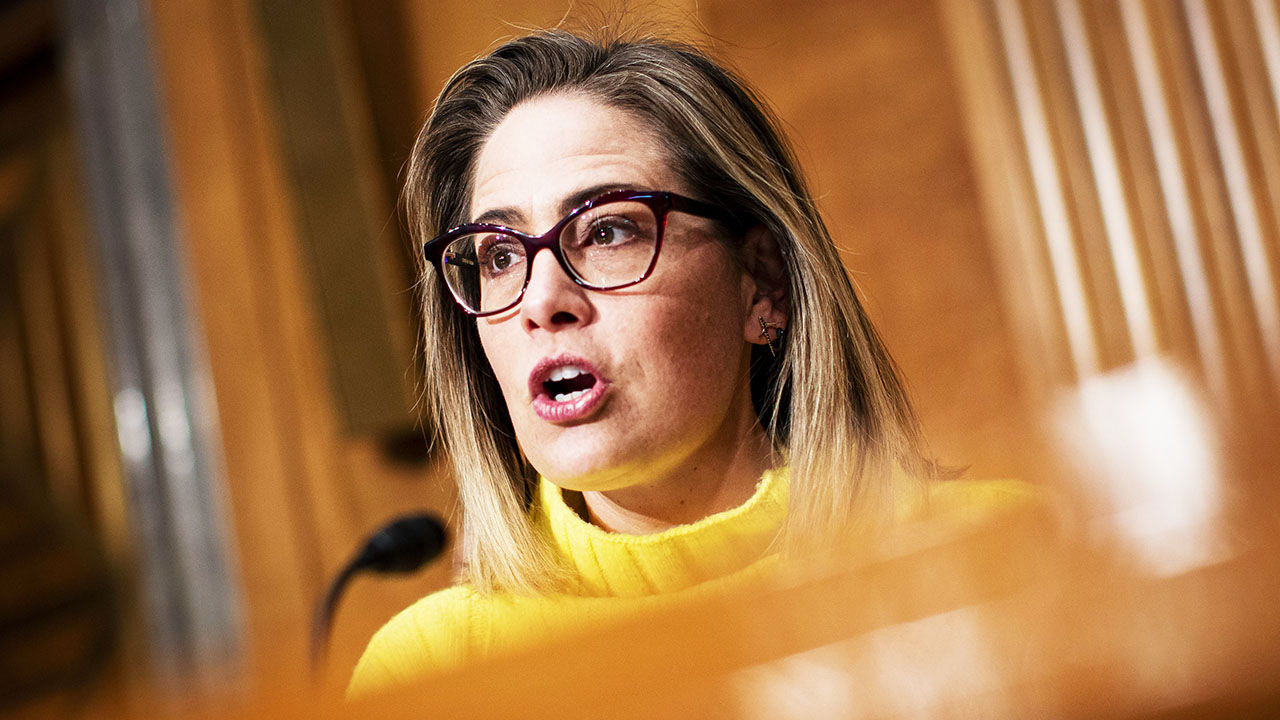
The ruling followed a 10-day period that saw Democrats resurrect top components of Biden’s agenda that had seemed dead. In rapid-fire deals with Democrats’ two most unpredictable senators — first conservative Joe Manchin of West Virginia, then Arizona centrist Kyrsten Sinema — Schumer pieced together a broad package that, while a fraction of earlier, larger versions that Manchin derailed, would give the party an achievement against the backdrop of this fall’s congressional elections.

The parliamentarian also signed off on a fee on excess emissions of methane, a powerful greenhouse gas contributor, from oil and gas drilling. She also let stand environmental grants to minority communities and other initiatives for reducing carbon emissions, said Senate Environment and Public Works Committee Chairman Thomas Carper, D-Del.

She approved a provision requiring union-scale wages to be paid if energy efficiency projects are to qualify for tax credits, and another that would limit electric vehicle tax credits to those cars and trucks assembled in the United States.

The overall measure faces unanimous Republican opposition. But assuming Democrats fight off a nonstop “vote-a-rama” of amendments — many designed by Republicans to derail the measure — they should be able to muscle the measure through the Senate.

The House is returning Friday to vote on the bill.

“What will vote-a-rama be like. It will be like hell,” Sen. Lindsey Graham of South Carolina, the top Republican on the Senate Budget Committee, said Friday of the approaching GOP amendments. He said that in supporting the Democratic bill, Manchin and Sinema “are empowering legislation that will make the average person’s life more difficult” by forcing up energy costs with tax increases and making it harder for companies to hire workers.

The bill offers spending and tax incentives for moving toward cleaner fuels and supporting coal with assistance for reducing carbon emissions. Expiring subsidies that help millions of people afford private insurance premiums would be extended for three years, and there is $4 billion to help Western states combat drought.

There would be a new 15% minimum tax on some corporations that earn over $1 billion annually but pay far less than the current 21% corporate tax. There would also be a 1% tax on companies that buy back their own stock, swapped in after Sinema refused to support higher taxes on private equity firm executives and hedge fund managers. The IRS budget would be pumped up to strengthen its tax collections.

While the bill’s final costs are still being determined, it overall would spend more than $300 billion over 10 years to slow climate change, which analysts say would be the country’s largest investment in that effort, and billions more on health care. It would raise more than $700 billion in taxes and from government drug cost savings, leaving about $300 billion for deficit reduction — a modest bite out of projected 10-year shortfalls of many trillions of dollars.

Democrats are using special procedures that would let them pass the measure without having to reach the 60-vote majority that legislation often needs in the Senate.

It is the parliamentarian’s job to decide whether parts of legislation must be dropped for violating those rules, which include a requirement that provisions be chiefly aimed at affecting the federal budget, not imposing new policy.

.
Categories
US

A fight to curb Everglades’ invasive snakes

  • Burmese pythons threaten Florida’s wildlife and are usually larger than all native snakes.
  • The Burmese python is a large nonvenomous constrictor that is an invasive species in Florida.
  • Florida’s python challenge aims to raise awareness of Burmese pythons and curb a rising population.

Hunters, enthusiasts, experts and spectators will descend upon the Everglades and embark on the Florida Python Challenge – an annual event to curb the invasive Burmese python.

The nonvenomous Burmese python poses a threat to Florida’s native wildlife and is larger than almost all native snakes, according to the Florida Fish and Wildlife Conservation Commission.

Studies have shown pythons wiped out rabbit and fox populations in regions of Everglades National Park.

The commission says hunters may catch and humanely kill Burmese pythons at the time of capture during the 10-day competition, which begins Friday.

The challenge is a conservation effort aimed at raising public awareness of the threat pythons pose to the ecosystem.

Aside from bragging rights, the person who kills the most pythons or kills the longest python can win a range of substantial cash prizes (more on that below).

Here are some of the top pictures from the event over the years:.

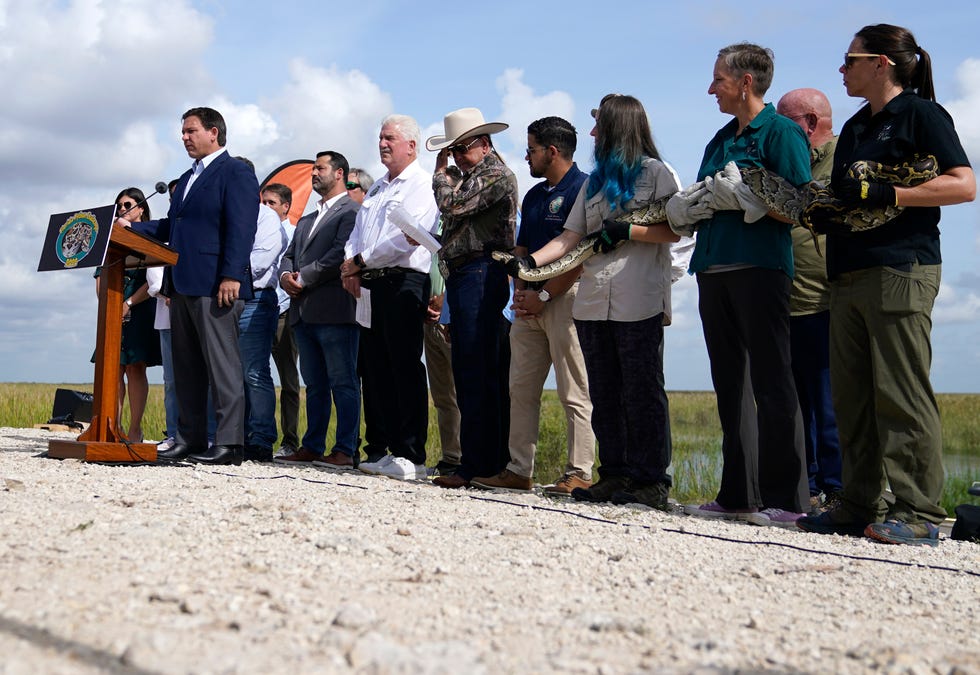
Florida Gov.  Ron DeSantis speaks at a media event where he announced registration for the 2022 Florida Python Challenge.
Bryan Backs, left, with the help of Jake Travers, from the Florida Fish and Wildlife Conservation Commission, learns how to capture a python as he participates in a demonstration before potential snake hunters at the start of the Python Bowl 2020 on Jan. 10, 2020, in Sunrise, Fla.
Dan Keenan wears a knife as he hunts for pythons in the Florida Everglades on the first day of the 2013 Python Challenge on Jan. 12, 2013, in Miami.
Dusty Crum, of Myakka City, Fla., holds up the 11-foot, 6-inch Burmese Python he and his hunting partners captured in the southern Everglades during the Python Challenge.  Crum hates to kill the snakes, as the hunt's rules require. "It's not their fault people are irresponsible," he said.
Jim Howard of Cooper City, Fla., examines a piece of a large snake skin he found under some foliage in the Florida Everglades during his search of pythons as part of the Python Challenge on Jan. 16, 2013.
Dan Keenan, left, and Steffani Burd hunt for pythons in the Florida Everglades on the first day of the 2013 Python Challenge on Jan. 12, 2013, in Miami.

What are the Florida Python Challenge prize amounts?

The first-place winner for the most pythons receives a $2,500 cash prize. Second place wins $750.

The longest python grand prize is worth $1,500. Second place wins $750 too.

Daniel Moniz unfolds a Burmese python snakeskin in his backyard in Lebanon, Ohio, on Dec. 12, 2019. He caught this snake during the 2016 Python Challenge in Florida.

What do Burmese pythons look like?

Pythons are tan in color with dark blotches and primarily live in and around the Everglades in south Florida, according to the commission.

Burmese pythons in Florida are generally between 6 and 10 feet long, although they can grow over 20 feet.

This Burmese python was captured by a biologist from the Conservancy of Southwest Florida.  The female snake measured nearly 18 feet in length and weighed 215 pounds and is the largest snake python captured in Florida.
Jeff Fobb, captain of Miami-Dade Fire Rescue's Venom One Unit, conducts a demonstration on how to handle a Burmese Python during the kickoff for the Python Challenge at the University of Florida Research and Education Center in Davie, Fla.

When was the largest python ever caught in Florida?

In June, biologists captured the state’s largest-ever python – a female with a record 122 eggs and the remains of an adult white-tailed deer in her abdomen – at 215-pounds and nearly 18 feet long, the Conservancy of Southwest Florida reported.

This record-breaking Burmese python was captured by a biologist from the Conservancy of Southwest Florida.  The female snake measured nearly 18 feet in length and weighed 215 pounds and is the largest snake python captured in Florida.

Native snakes often misidentified as pythons

  • Coachwhip
  • Eastern Diamondback
  • Red Rat Snake
  • Cottonmouth
  • Eastern Indigo Snake
  • Water Snakes

Camille Fine is a trending visual producer on USA TODAY’s NOW team.

Categories
US

Multistate manhunt for Ohio man charged with aggravated murder after 4 people fatally shot

The FBI is involved in a multistate manhunt for a man charged with aggravated murder in the fatal shooting of four people in Ohio.

The FBI has issued a wanted poster for 39-year-old Stephen Marlow, whom they said should be considered “armed and dangerous.” He has ties to Indianapolis, Chicago and Lexington, Kentucky, and “could be in one of these cities,” FBI Cincinnati said on Twitter.

Marlow is wanted in connection with the shooting deaths of four people in Butler Township, a small town north of Dayton on Friday, police said.

Police responding to reports of gunfire shortly before noon found the four victims suffering from gunshot wounds at “multiple crime scenes” in a residential area, the Butler Township Police Department said.

The four victims were pronounced dead at the scenes. They have not been identified by police.

Marlow was charged with four counts of aggravated murder on Friday and a state warrant was issued for his arrest, according to the FBI. A federal arrest warrant was also issued on Saturday after he was charged with “unlawful flight to avoid prosecution,” the FBI said.

PHOTO: Police responded to reports of gunfire in Butler Township, Ohio, Aug. 5, 2022. Four people were found fatally shot, police said.

Police responded to reports of gunfire in Butler Township, Ohio, Aug. 5, 2022. Four people were found fatally shot, police said.

WKEF

Butler Township Police Chief John Porter said they don’t believe there is a continued threat to the neighborhood but “we will continue to have crews in the area in case Marlow would return,” he told reporters on Friday. The Dayton Police Department Bomb Squad was also contacted “out of an abundance of caution,” he said.

Neighbors were asked to review any video camera footage from that day.

Porter said police were working to determine “if there were any motive for this horrible tragedy” and did not have any further information on the investigation.

“This is the first violent crime in this neighborhood in recent memory,” Porter said.

PHOTO: Police responded to reports of gunfire in Butler Township, Ohio, Aug. 5, 2022. Four people were found fatally shot, police said.

Police responded to reports of gunfire in Butler Township, Ohio, Aug. 5, 2022. Four people were found fatally shot, police said.

WKEF

Marlow is believed to have fled the area in a white 2007 Ford Edge SUV with the Ohio license plate JES9806, police said.

He was described by police as approximately 5’11”, 160 pounds with short brown hair and was last seen wearing shorts and a yellow T-shirt.

ABC News’ Matt Foster contributed to this report.

Categories
US

How a New Corporate Minimum Tax Could Reshape Business Investments

WASHINGTON — At the center of the new climate and tax package that Democrats appear to be on the verge of passing is one of the most significant changes to America’s tax code in decades: a new corporate minimum tax that could reshape how the federal government collects revenue and alter how the nation’s most profitable companies invest in their businesses.

The proposal is one of the last remaining tax increases in the package that Democrats are aiming to pass along party lines in coming days. After months of intraparty disagreement over whether to raise taxes on the wealthy or roll back some of the 2017 Republican tax cuts to fund their agenda, they have settled on a longstanding political ambition to ensure that large and profitable companies pay more than $0 in federal taxes .

To accomplish this, Democrats have recreated a policy that was last employed in the 1980s: trying to capture tax revenue from companies that report a profit to shareholders on their financial statements while bulking up on deductions to whittle down their tax bills.

The re-emergence of the corporate minimum tax, which would apply to what’s known as the “book income” that companies report on their financial statements, has prompted confusion and fierce lobbying resistance since it was announced last month.

Some initially confirmed the measure with the 15 percent global minimum tax that Treasury Secretary Janet L. Yellen has been pushing as part of an international tax deal. However, that is a separate proposal, which in the United States remains stalled in Congress, that would apply to the foreign earnings of American multinational companies.

Republicans have also misleadingly tried to seize on the tax increase as evidence that President Biden was ready to break his campaign promises and raise taxes on middle-class workers. And manufacturers have warned that it would impose new costs at a time of rapid inflation.

In a sign of the political power of lobbyists in Washington, by Thursday evening the new tax had already been watered down. At the urging of manufacturers, Senator Kyrsten Sinema of Arizona persuaded her Democratic colleagues to preserve a valuable deduction, known as bonus depreciation, that is associated with purchases of machinery and equipment.

The new 15 percent minimum tax would apply to corporations that report annual income of more than $1 billion to shareholders on their financial statements but use deductions, credits and other preferential tax treatments to reduce their effective tax rates well below the statutory 21 percent. It was originally projected to raise $313 billion in tax revenue over a decade, though the final tally is likely to be $258 billion once the revised bill is finalized.

The new tax could also inject a greater degree of complexity into the tax code, creating challenges in carrying out the law if it is passed.

“In terms of implementation and just bandwidth to deal with the complexity, there’s no doubt that this regime is complex,” said Peter Richman, a senior attorney adviser at the Tax Law Center at New York University’s law school. “This is a big change and the revenue number is large.”

Because of that complexity, the corporate minimum tax has faced substantial skepticism. It is less efficient than simply eliminating deductions or raising the corporate tax rate and could open the door for companies to find new ways to make their income appear lower to reduce their tax bills.

Similar versions of the idea have been floated by Mr. Biden during his presidential campaign and by Senator Elizabeth Warren, Democrat of Massachusetts. They have been promoted as a way to restore fairness to a tax system that has allowed major corporations to dramatically lower their tax bills through deductions and other accounting measures.

According to an early estimate from the nonpartisan Joint Committee on Taxation, the tax would most likely apply to about 150 companies annually, and the bulk of them would be manufacturers. That spurred an outcry from manufacturing companies and Republicans, who have been opposed to any policies that scale back the tax cuts that they enacted five years ago.

Although many Democrats acknowledge that the corporate minimum tax was not their first choice of tax hikes, they have embraced it as a political winner. Senator Ron Wyden of Oregon, the chairman of the Senate Finance Committee, shared Joint Committee on Taxation data on Thursday indicating that in 2019, about 100 to 125 corporations reported financial statement income greater than $1 billion, yet their effective tax rates were lower than 5 percent. The average income reported on financial statements to shareholders was nearly $9 billion, but they paid an average effective tax rate of just 1.1 percent.

“Companies are paying rock-bottom rates while reporting record profits to their shareholders,” Mr. Wyden said.

The Treasury Department had reservations about the minimum tax idea last year because of its complexity. If enacted, the Treasury would be responsible for crafting a raft of new regulations and guidance for the new law and for ensuring that the Internal Revenue Service could properly police it.

Michael J. Graetz, a tax law professor at Columbia University, acknowledged that calculating minimum taxes was complicated and that introducing a new tax base would add new challenges from a tax administration perspective, but he said that he did not view those obstacles as disqualifying. He noted that the current system had created opportunities for tax shelters and allowed companies to take losses for tax purposes that do not show up on their financial statements.

“If the problem that Congress is addressing is that companies are reporting high book profits and low taxes, then the only way to align those two is to base taxes on book profits to some extent,” Mr. Graetz, a former deputy assistant secretary for tax policy at the Treasury Department, said.

A similar version of the tax was included in a 1986 tax overhaul and allowed to expire after three years. Skeptics of revisiting such a measure have warned that it could create new problems and opportunities for companies to avoid the minimum tax.

“The evidence from the studies of outcomes around the Tax Reform Act of 1986 suggest that companies responded to such a policy by altering how they report financial accounting income — companies deferred more income into future years,” Michelle Hanlon, an accounting professor at the Sloan School of Management at the Massachusetts Institute of Technology, told the Senate Finance Committee last year. “This behavioral response poses serious risks for financial accounting and the capital markets.”

Other opponents of the new tax have expressed concerns that it would give more control over the US tax base to the Financial Accounting Standards Board, an independent organization that sets accounting rules.

“The potential politicization of the FASB will likely lead to lower-quality financial accounting standards and lower-quality financial accounting earnings,” Ms. Hanlon and Jeffrey L. Hoopes, a University of North Carolina professor, wrote in a letter to members of Congress last year that was signed by more than 260 accounting academics.

Business groups have pushed back hard against the proposal and pressured Ms. Sinema to block the tax entirely. The National Association of Manufacturers and Arizona Chamber of Commerce and Industry released on Wednesday a poll of manufacturing workers, managers and advocates in the state that showed a majority opposed the new tax.

“It will make it harder to hire more workers, raise wages and invest in our communities,” said Chad Moutray, the chief economist of the manufacturing association. “Arizona’s manufacturing voters are clearly saying that this tax will hurt our economy.”

Ms. Sinema has expressed opposition to increasing tax rates and had reservations about a proposal to scale back the special tax treatment that hedge fund managers and private equity executives receive for “carried interest.” Democrats scrapped the proposal at her urging her.

When an earlier version of a corporate minimum tax was proposed last October, Ms. Sinema issued an approving statement.

“This proposal represents a common sense step toward ensuring that highly profitable corporations — which sometimes can avoid the current corporate tax rate — pay a reasonable minimum corporate tax on their profits, just as everyday Arizonans and Arizona small businesses do,” she said. In announcing that she would back an amended version of the climate and tax bill on Thursday, Ms. Sinema noted that it would “protect advanced manufacturing.”

That won plaudits from business groups on Friday.

“Taxing capital expenditures — investments in new buildings, factories, equipment, etc. — is one of the most economically destructive ways you can raise taxes,” Neil Bradley, chief policy officer of the US Chamber of Commerce, said in a statement. He added, “While we look forward to reviewing the new proposed bill, Senator Sinema deserves credit for recognizing this and fighting for changes.”

Emily Cochrane contributed reporting.

Categories
US

Trump easily wins Texas CPAC 2024 GOP presidential nomination straw poll; DeSantis second

NEWYou can now listen to Fox News articles!

DALLAS – Former President Donald Trump convincingly won the 2024 GOP presidential nomination straw poll at the Conservative Political Action Conference (CPAC) three-day gathering in Texas

Trump, who’s repeatedly teased making another presidential run in 2024 to try and return to the White House, captured 69% of ballots cast in the anonymous online straw poll, according to results announced by CPAC on Saturday.

The support for the former president, who remains the most popular and influential politician in the Republican Party and continues to play a kingmaker’s role in GOP primaries, is up from his 59% showing in the anonymous online straw poll at the CPAC gathering in Orlando, Florida in February.

Florida Gov. Ron DeSantis came in second on the 2024 presidential nomination question, at 24%, down from his 28% showing him at CPAC in Orlando five months ago.

2024 WATCH: CPAC ATTENDEES CHOOSE FAVORITE PRESIDENTIAL CANDIDATE AS TRUMP, DESANTIS REMAIN POPULAR

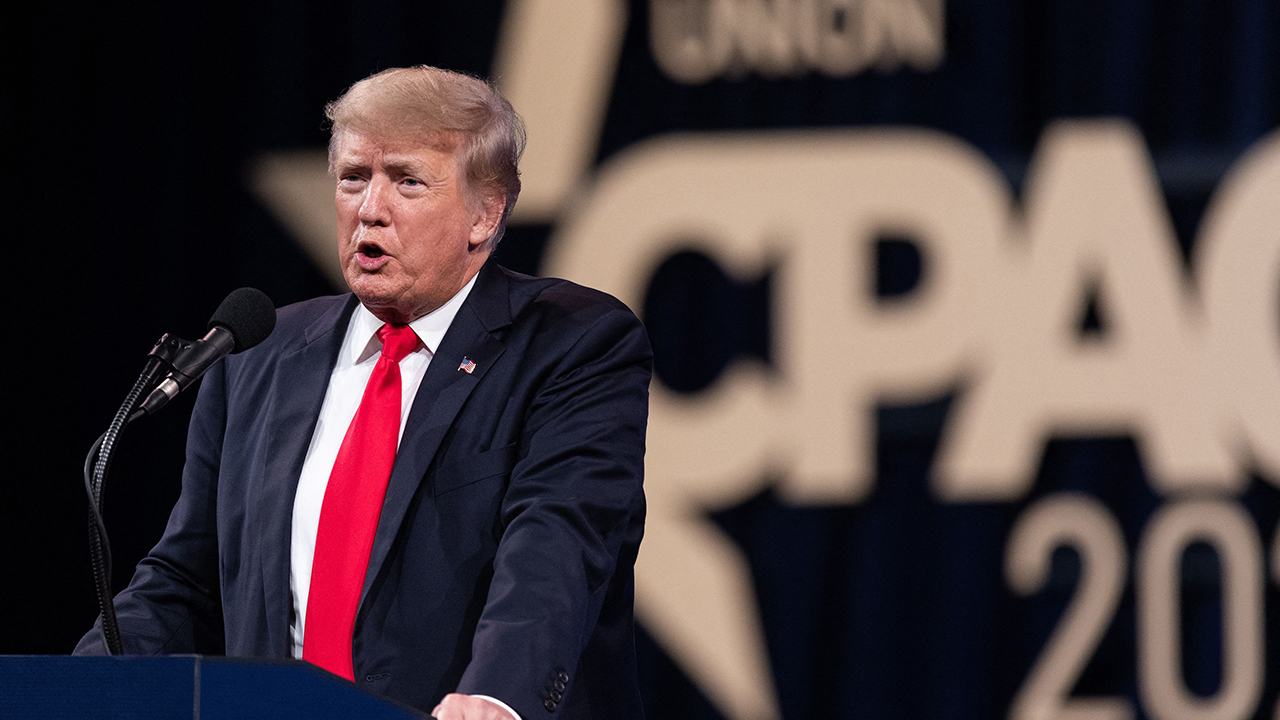
Former President Donald Trump speaks at the Conservative Political Action Conference (CPAC) in Dallas, Texas on July 11, 2021. (Photo by Andy JACOBSOHN / AFP) (Photo by ANDY JACOBSOHN/AFP via Getty Images)

Former President Donald Trump speaks at the Conservative Political Action Conference (CPAC) in Dallas, Texas on July 11, 2021. (Photo by Andy JACOBSOHN / AFP) (Photo by ANDY JACOBSOHN/AFP via Getty Images)
(Photo by ANDY JACOBSOHN/AFP via Getty Images)

DeSantis has seen his popularity surge among Republican voters in his state and around the nation over the past two and a half years, thanks in large part to his relentless pushback against COVID-19 restrictions amid the coronavirus pandemic as well as his aggressive actions in the culture wars.

WHAT TED CRUZ, AT CPAC, TOLD FOX NEWS ABOUT 2024

While DeSantis has repeatedly deflected talk of a potential run for the 2024 Republican presidential nomination, political pundits view him as a potential White House contender.

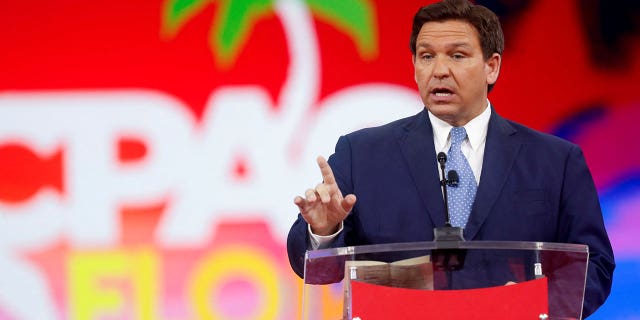
Florida Governor Ron DeSantis speaks at the Conservative Political Action Conference (CPAC) in Orlando, Florida, US February 24, 2022. REUTERS/Octavio Jones/File Photo

Florida Governor Ron DeSantis speaks at the Conservative Political Action Conference (CPAC) in Orlando, Florida, US February 24, 2022. REUTERS/Octavio Jones/File Photo
(Reuters)

The CPAC Texas straw poll results were released just ahead of the confab’s keynote speech by Trump. DeSantis, who appeared at the Orlando conference earlier this year, did not attend the Texas gathering.

Sen. Ted Cruz of Texas, who spoke Friday at the conference, grabbed 2% support on the straw poll ballot. Not one else among the 21 names listed on the ballot topped one percent.

“President Trump remains the most dominant force in American politics, and as yet another poll shows, it’s a reality that will propel the growth and success of the Republican Party through the Midterms and beyond,” Trump spokesman Taylor Budowich told Fox News after the results were released.

The 2024 straw poll also included a second list without Trump. His name of him was replaced by his eldest son of him, Donald Trump Jr.

DeSantis topped the second 2024 ballot, at 65%. Donald Trump Jr. grabbed 8% support, with Cruz at 6% and former Secretary of State Mike Pompeo at 5%. No one else topped two percent on the second ballot question.

The former president’s strong performance on the unscientific survey comes as no surprise. CPAC, long the largest and most influential gathering of conservative leaders and activists, has become a Trumpfest since his 2016 presidential election victory.

In a separate question on whom CPAC attendees would like to see as Trump’s running mate in 2024 if he launched a campaign, DeSantis grabbed 43% support, with South Dakota Gov. Kristi Noem at 9%, and Pompeo at 7%.

No one else topped four percent on the running mate ballot question.

Voting on the CPAC Texas straw poll ballot was only open to attendees of the confab, with voting once again conducted through the CPAC app.

Matt Schlapp, chairman of the American Conservative Union, which runs CPAC, said “there’s an unbreakable bond between President Tump and the conservative movement. He simply did the things he promised to do and for that they are grateful.”

Veteran Republican pollster Jim McLaughlin told Fox News the CPAC straw poll ballot is “the ultimate barometer of what’s going on in the conservative movement.”

CLICK HERE TO GET THE FOX NEWS APP

McLaughlin and Associates, which conducted polling for Trump’s successful 2016 election and unsuccessful 2020 re-election bid, once again oversaw the CPAC straw poll.

McLaughlin, who’s been attending CPAC for decades, said that “just like back in the old days when Ronald Reagan defined and was setting the tone for the conservative movement, it’s the same thing right now with Donald Trump.”

Categories
US

Coroner’s office releases ID of four people shot, killed in Butler Twp. neighborhood – WHIO TV 7 and WHIO Radio

4 people shot, killed in Butler Twp. neighborhood; Police seek person of interest

BUTLER TWP. — UPDATE @12:05 pm:

A police presence remains in a Butler Township neighborhood where four people were shot and killed Friday afternoon.

Police were dispatched to Hardwicke Place and Haverstraw Avenue just before noon Friday on reports of shots fired, Butler Township Police Chief John Porter said Friday afternoon. Police found multiple crime scenes and four people who had been shot. They were all pronounced dead on scene, Porter said.

The victims have been identified by the Montgomery County Coroner’s Office as:

  • Clyde Knox, an 82-year-old man
  • Eva Knox, a 78-year-old woman
  • Sarah Anderson, a 41-year-old woman

The coroner’s office also said a 15-year-old girl was killed in the shooting but said at this time her identity has not been released.

Our crews on the scene reported that investigators had two houses blocked off on Hardwicke Place with police tape. A third house on Haverstraw Avenue was also blocked off and investigators have been seen entering the house.

In a statement, Butler Township Police Department said they are continuing to investigate the shooting and are being assisted by Montgomery County Sheriff’s Office, Federal Bureau of Investigation and the Bureau of Tobacco and Firearms.

>> PHOTOS: 4 killed after shooting in Butler Twp. neighborhood

News Center 7′s John Bedell says there are three Montgomery County Sheriff’s Deputy cruisers as well as a speed trailer at the corner of Hardwicke Place and Haverstraw Avenue in case a 39-year-old man, Stephen Marlow, comes back to the area.

He has been identified as the primary suspect after Friday’s shooting in Butler Township.

>> Butler Twp. deadly shooting: What we’ve learned about the person of interest

In the statement, Butler Township said information indicates Marlow may have left Ohio.

The FBI’s Cincinnati office posted on social media that he had ties to Indianapolis, Chicago and Lexington and could be in one of those cities.

Porter identified Stephen Marlow, 39, as a person of interest in the shooting. Marlow has been described at 5-feet 11-inches and 160 pounds. He has short brown hair and was last seen in shorts and a yellow t-shirt.

He was last seen in a white 2007 Ford Edge with Ohio license plate number JES 9806.

Porter said Marlow should not be approached if spotted and should be considered armed and dangerous. If you see him, call 911 immediately.

A press release is scheduled for 6 pm Saturday.

This is a developing story. We’ll update this as we learn more.

Categories
US

Flashback: Manchin preached bipartisanship. Will he take the same position on inflation act?

NEWYou can now listen to Fox News articles!

A question arising from Sen. Joe Manchin’s, DW.Va., newfound backing of a massive social spending and taxation bill is if he will insist on Republican input and support as he previously did with other high profile legislation being pushed by Democrats.

Last year, Manchin declared that any legislation addressing voting rights, something Democrats declared was “under attack” at the time, must include input and support from Republicans in order to receive his backing.

He ultimately declined to support the Democrat-backed For the People Act, citing its lack of bipartisanship, and slammed his fellow Democrats for “partisan policymaking,” arguing it would “destroy” American democracy.

“The right to vote is fundamental to our American democracy and protecting that right should not be about party or politics. Least of all, protecting this right, which is a value I share, should never be done in a partisan manner,” he wrote in a statement at the time.

OVER 230 ECONOMISTS WARN MANCHIN’S SPENDING BILL WILL PERPETUATE INFLATION

US Senator Joe Manchin (D-WV) delivers remarks to reporters at the US Capitol in Washington, DC, US November 1, 2021.

US Senator Joe Manchin (D-WV) delivers remarks to reporters at the US Capitol in Washington, DC, US November 1, 2021.
(REUTERS/Jonathan Ernst)

“The truth is there is a better way — if we seek to find it together,” he later added.

Every Republican member of the Senate is expected to oppose the Inflation Reduction Act, the official name of the reconciliation spending bill struck in a behind closed doors deal between Manchin and Majority Leader Chuck Schumer.

MANCHIN 2024 RE-ELECTION CHANCES COULD ‘DISAPPEAR IN A FLASH’ FOLLOWING SUPPORT FOR NEW SPENDING BILL

In contrast to his previous demands for bipartisanship, Manchin’s appears ready to help carry the bill over the line without any help from Senate Republicans. A simple majority will pass the legislation, with Vice President Kamala Harris able to break a 50-50 tie in favor of the Democrats.

Fox News Digital reached out to Manchin’s office for comment and received a statement from a spokeswoman touting his past efforts at bipartisanship, but making no mention of any desire for Republican input on the bill.

“For years, Senator Manchin has worked in a bipartisan way to ensure we are producing more energy domestically and paying down our national debt and much of that work is reflected in the Inflation Reduction Act,” communications director Samantha Runyon said in the statement.

Senate Majority Leader Chuck Schumer of NY, speaks to the media after a Democratic policy luncheon, Tuesday, Oct. 19, 2021, on Capitol Hill in Washington.

Senate Majority Leader Chuck Schumer of NY, speaks to the media after a Democratic policy luncheon, Tuesday, Oct. 19, 2021, on Capitol Hill in Washington.
(AP Photo/Jacquelyn Martin)

CLICK HERE TO GET THE FOX NEWS APP

The Senate is set to reconvene Saturday and is expected to vote to begin debate on the bill.

Categories
US

Progressive groups take aim at Sinema over decision to remove carried interest tax loophole from Manchin bill

NEWYou can now listen to Fox News articles!

Progressive groups across the country are at odds with a decision made by Sen. Kyrsten Sinema, D-Ariz., to remove the carried interest tax loophole from a social spending and tax bill that is expected to pass through the Senate, claiming she is providing a “tax break” for the wealthy.

The Arizona Democrat announced Thursday that she would “move forward” in supporting the Inflation Reduction Act, the reconciliation package Senate Democrats unveiled last week. As part of the agreement, she successfully removed the carried interest tax provision, which was largely used by wealthy Americans.

In a series of statements provided to Fox News Digital, progressive groups took aim with Sinema’s decision, arguing that the loophole has historically benefited rich Americans and should be eliminated.

Cynthia Carrizales, the press secretary for the Progressive Change Campaign Committee, insisted Sinema’s move to have the carried loophole removed “only benefits wealthy Wall Street financiers.”

SINEMA AMONG TOP PRIVATE EQUITY CASH RECIPIENTS AS SHE REMOVED BILLIONAIRE TAX LOOPHOLE FROM MANCHIN BILL

Sen.  Kyrsten Sinema, a Democrat from Arizona, is facing backlash from progressives over her move de ella to eliminate the carried interest tax loophole used by wealthy Americans from the Inflation Reduction Act.

Sen. Kyrsten Sinema, a Democrat from Arizona, is facing backlash from progressives over her move de ella to eliminate the carried interest tax loophole used by wealthy Americans from the Inflation Reduction Act.
(Al Drago/Bloomberg via Getty Images)

Cynthia Carrizales, the press secretary for the Progressive Change Campaign Committee, insisted Sinema’s move to have the carried loophole removed “only benefits wealthy Wall Street financiers.”

“Senator Sinema’s move to protect a loophole that only benefits wealthy Wall Street financiers sounds more like a job application for after she loses her next primary than an attempt to help everyday Arizonans or Americans,” said Carrizales. “Fortunately, despite Sinema, Democrats are on track to pass a law for the first time in decades that finally forces tax-avoiding corporations to pay taxes — which lowers the share of the burden on working families.”

Frank Clemente, executive director for Americans for Tax Fairness, said Sinema’s decision is an “affront” to Americans who pay their taxes.

“Senator Sinema’s insistence on maintaining the carried interest tax loophole is an affront to everyone who pays their fair share of taxes,” said Clemente. “Her support from her for a tax break that exclusively benefits ultra-wealthy money managers shocks the conscience.”

Similarly, Americans for Financial Reform, a progressive non-profit organization, favors total elimination of the loophole because it mostly benefits people who are “already rich.”

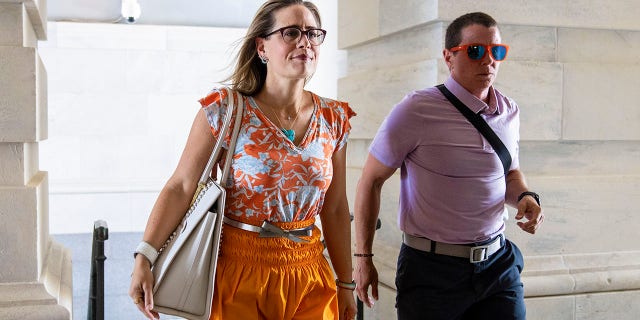
Sinema arrives for a vote at the US Capitol August 4, 2022 in Washington, DC.

Sinema arrives for a vote at the US Capitol August 4, 2022 in Washington, DC.
(Drew Angerer/Getty Images)

“AFR has long sought the complete elimination of this loophole, which mainly benefits people who are already extremely rich,” said Carter Dougherty, communications director for Americans for Financial Reform. “The draft legislation envisioned only extremely modest changes to this tax provision.”

MANCHIN-SCHUMER SPENDING BILL TARGETS TAX LOOPHOLE FAVORED BY INVESTORS

Sinema’s office, however, argued that the senator is doing “what’s best for Arizona” and concluded that disincentives to investments in businesses could be fatal to the economy.

“Kyrsten has been clear and consistent for over a year that she will only support tax reforms and revenue options that support Arizona’s economic growth and competitiveness,” her office said in a statement shared with Fox News Digital. “At a time of record inflation, rising interest rates, and slowing economic growth, disincentivizing investments in Arizona businesses would hurt Arizona’s economy and ability to create jobs. Senator Sinema makes every decision based on one criteria: what’s best for Arizona.”

Sinema was widely considered the final senator needed for Democrats to pass the plan on climate, energy, health care and taxes, which, if it becomes law, will cap over a year of intra-party negotiations. With her support from her, Majority Leader Chuck Schumer, DN.Y., said he expected all 50 Democrats to vote for the measure.

Senate Majority Leader Chuck Schumer, DN.Y., speaks with reporters following a closed-door caucus lunch, at the Capitol in Washington, Tuesday, July 19, 2022.

Senate Majority Leader Chuck Schumer, DN.Y., speaks with reporters following a closed-door caucus lunch, at the Capitol in Washington, Tuesday, July 19, 2022.
(AP Photo/J. Scott Applewhite)

“I am pleased to report that we have reached an agreement on the Inflation Reduction Act that I believe will receive the support of the entire Senate Democratic conference,” Schumer said this week. “The final version of the Reconciliation bill, to be introduced on Saturday, will reflect this work and put us one step closer to enacting this historic legislation into law.”

The move by Sinema is a win for the private equity sector, which pours large amounts of cash into her campaign’s coffers.

CLICK HERE TO GET THE FOX NEWS APP

As previously reported, individuals and political action committees from the private equity and investment sector have provided her campaign with $282,650 in donations this election cycle, making Sinema the Senate’s sixth-highest recipient from the industry, according to data compiled by the Center for Responsive Politics .

Under the loophole, a private equity manager’s income can be taxed as a capital gain — a 23.8% levy — rather than regular income, which is taxed at 37.9%.

Fox News’ Joe Schoffstall, Tyler Olson, and Megan Henney contributed to this article.

Categories
US

Trump easily wins Texas CPAC 2024 GOP presidential nomination straw poll; DeSantis second

NEWYou can now listen to Fox News articles!

DALLAS – Former President Donald Trump convincingly won the 2024 GOP presidential nomination straw poll at the Conservative Political Action Conference (CPAC) three-day gathering in Texas

Trump, who’s repeatedly teased making another presidential run in 2024 to try and return to the White House, captured 69% of ballots cast in the anonymous online straw poll, according to results announced by CPAC on Saturday.

The support for the former president, who remains the most popular and influential politician in the Republican Party and continues to play a kingmaker’s role in GOP primaries, is up from his 59% showing in the anonymous online straw poll at the CPAC gathering in Orlando, Florida in February.

Florida Gov. Ron DeSantis came in second on the 2024 presidential nomination question, at 24%, down from his 28% showing him at CPAC in Orlando five months ago.

2024 WATCH: CPAC ATTENDEES CHOOSE FAVORITE PRESIDENTIAL CANDIDATE AS TRUMP, DESANTIS REMAIN POPULAR

Former President Donald Trump speaks at the Conservative Political Action Conference (CPAC) in Dallas, Texas on July 11, 2021. (Photo by Andy JACOBSOHN / AFP) (Photo by ANDY JACOBSOHN/AFP via Getty Images)

Former President Donald Trump speaks at the Conservative Political Action Conference (CPAC) in Dallas, Texas on July 11, 2021. (Photo by Andy JACOBSOHN / AFP) (Photo by ANDY JACOBSOHN/AFP via Getty Images)
(Photo by ANDY JACOBSOHN/AFP via Getty Images)

DeSantis has seen his popularity surge among Republican voters in his state and around the nation over the past two and a half years, thanks in large part to his relentless pushback against COVID-19 restrictions amid the coronavirus pandemic as well as his aggressive actions in the culture wars.

WHAT TED CRUZ, AT CPAC, TOLD FOX NEWS ABOUT 2024

While DeSantis has repeatedly deflected talk of a potential run for the 2024 Republican presidential nomination, political pundits view him as a potential White House contender.

Florida Governor Ron DeSantis speaks at the Conservative Political Action Conference (CPAC) in Orlando, Florida, US February 24, 2022. REUTERS/Octavio Jones/File Photo

Florida Governor Ron DeSantis speaks at the Conservative Political Action Conference (CPAC) in Orlando, Florida, US February 24, 2022. REUTERS/Octavio Jones/File Photo
(Reuters)

The CPAC Texas straw poll results were released just ahead of the confab’s keynote speech by Trump. DeSantis, who appeared at the Orlando conference earlier this year, did not attend the Texas gathering.

Sen. Ted Cruz of Texas, who spoke Friday at the conference, grabbed 2% support on the straw poll ballot. Not one else among the 21 names listed on the ballot topped one percent.

“President Trump remains the most dominant force in American politics, and as yet another poll shows, it’s a reality that will propel the growth and success of the Republican Party through the Midterms and beyond,” Trump spokesman Taylor Budowich told Fox News after the results were released.

The 2024 straw poll also included a second list without Trump. His name was replaced by his eldest son, Donald Trump Jr.

DeSantis topped the second 2024 ballot, at 65%. Donald Trump Jr. grabbed 8% support, with Cruz at 6% and former Secretary of State Mike Pompeo at 5%. No one else topped two percent on the second ballot question.

The former president’s strong performance on the unscientific survey comes as no surprise. CPAC, long the largest and most influential gathering of conservative leaders and activists, has become a Trumpfest since his 2016 presidential election victory.

In a separate question on whom CPAC attendees would like to see as Trump’s running mate in 2024 if he launched a campaign, DeSantis grabbed 43% support, with South Dakota Gov. Kristi Noem at 9%, and Pompeo at 7%.

No one else topped four percent on the running mate ballot question.

Voting on the CPAC Texas straw poll ballot was only open to attendees of the confab, with voting once again conducted through the CPAC app.

Matt Schlapp, chairman of the American Conservative Union, which runs CPAC, said “there’s an unbreakable bond between President Tump and the conservative movement. He simply did the things he promised to do and for that they are grateful.”

Veteran Republican pollster Jim McLaughlin told Fox News the CPAC straw poll ballot is “the ultimate barometer of what’s going on in the conservative movement.”

CLICK HERE TO GET THE FOX NEWS APP

McLaughlin and Associates, which conducted polling for Trump’s successful 2016 election and unsuccessful 2020 re-election bid, once again oversaw the CPAC straw poll.

McLaughlin, who’s been attending CPAC for decades, said that “just like back in the old days when Ronald Reagan defined and was setting the tone for the conservative movement, it’s the same thing right now with Donald Trump.”

Categories
US

Homan slams Mayor Bowser, Mayor Adams for immigration hypocrisy and ‘out-of-control crime’ in sanctuary cities

NEWYou can now listen to Fox News articles!

Retired acting ICE director Tom Homan responded to Democratic leaders criticizing Texas Governor Greg Abbott over migrant buses by highlighting the hypocrisy over immigration and sanctuary cities. On “Fox & Friends Weekend” Saturday, Homan argued Washington DC Mayor Muriel Bowser and New York City Mayor Eric Adams are not doing “everything they can” to make sanctuary cities safe and apply pressure on the Biden administration to address border security.

JONES RIPS LAWMAKERS OVER BORDER CRISIS: THEY WERE ALL ABOUT COMPASSION UNTIL THEY WERE ON THEIR LAWNS

TOM HOMAN: It’s devastating these communities. I’ve been on the southwest border a dozen times this past year. and look, Muriel Bowser and Mayor Adams, if you want this to stop, how about calling the White House, tell President Biden to secure the border? We did it under the Trump administration, the highest level we ever had. The playbook is there, just dust off the playbook and secure the border. But both of these cities take pride in the fact they’re sanctuary cities, both of them out-of-control crime rates right now, right at each of these cities, releasing criminal aliens to the streets every day. They used to work with ICE. We used to have a dozen agents from Rikers Island. Now, if you’re an illegal alien in New York City and you get arrested for a violent crime, after they’re done with you, they release you back on the street to re-offend. So are these majors doing everything they can to address the crime rate? No. So stop your sanctuary city policy. I got news for you, Mayor Adams. They’re coming to New York anyway. They’re coming there. And you didn’t say a d— word when President Biden was flying people in the middle of the night. That was fine, but when a Republican governor does it, all of a sudden it’s a problem.

CLICK HERE TO GET THE FOX NEWS APP

WATCH THE FULL VIDEO BELOW: