Categories
US

China extends threatening military exercises around Taiwan

BEIJING (AP) — China said Monday it is extending threatening military exercises surrounding Taiwan that have disrupted shipping and air traffic and substantially raised concerns about the potential for conflict in a region crucial to global trade.

The announcement increases uncertainty in the crisis that developed last week with US House Speaker Nancy Pelosi’s visit to Taiwan.

The exercises will include anti-submarine drills, apparently targeting US support for Taiwan in the event of a potential Chinese invasion, according to social media posts from the eastern leadership of China’s ruling Communist Party’s military arm, the People’s Liberation Army.

China claims Taiwan as its own territory and its leader, Xi Jinping, has focused on bringing the self-governing island democracy under the mainland’s control, by force if necessary. The two sides split in 1949 after a civil war, but Beijing considers visits to Taiwan by foreign officials as recognizing its sovereignty.

Xi is seeking a third term as Communist Party leader later this year. His control of him over the armed forces and what he has defined as China’s “core interests” — including Taiwan, territorial claims in the South China Sea and historic adversary Japan — are key to maintaining his nationalist credentials of him.

The military has said the exercises, involving missile strikes, warplanes and ship movements crossing the midline of the Taiwan Strait dividing the sides, were a response to Pelosi’s visit.

China has ignored calls to calm the tensions, and there was no immediate indication of when it would end what amounts to a blockade.

On Monday, Chinese Foreign Ministry spokesperson Wang Wenbin said China would “firmly safeguard China’s sovereignty and territorial integrity, resolutely deter the US from containing China with the Taiwan issue and resolutely shatter the Taiwan authorities’ illusion of “relying on the US for independence.”

China’s slowing economic growth, which has reduced options among migrant workers as well as college graduates, has raised the specter of social unrest. The party has maintained its power through total control of the press and social media, along with suppression of political opponents, independent lawyers and activists working on issues from online free speech to LGBQT rights.

China doesn’t allow public opinion polls, and popular opinion is hard to judge. However, it generally skews in favor of the government and its efforts to restore China’s former dominant role in the region that puts it in conflict with the United States and its allies, including Japan and Australia.

Taiwan’s defense ministry said Sunday it detected a total of 66 aircraft and 14 warships conducting the naval and air exercises. The island has responded by putting its military on alert and deploying ships, plans and other assets to monitor Chinese aircraft, ships and drones that are “simulating attacks on the island of Taiwan and our ships at sea.”

Meanwhile, Taiwan’s official Central News Agency reported that Taiwan’s army will conduct live-fire artillery drills in southern Pingtung county on Tuesday and Thursday, in response to the Chinese exercises.

The drills will include snipers, combat vehicles, armored vehicles as well as attack helicopters, said the report, which cited an anonymous source.

Taiwan President Tsai Ing-wen has called on the international community to “support democratic Taiwan” and “halt any escalation of the regional security situation.” The Group of Seven industrialized nations has also criticized China’s actions, prompting Beijing to cancel a meeting between Foreign Minister Wang Yi and his Japanese counterpart, Yoshimasa Hayashi.

China has cut off defense and climate talks with the US and imposed sanctions on Pelosi in retaliation for her visit.

US Secretary of State Anthony Blinken told reporters on the sidelines of a meeting with the Association of Southeast Asian Nations in Cambodia over the weekend that Pelosi’s visit was peaceful and did not represent a change in American policy toward Taiwan. He accused China of using the trip as a “pretext to increase provocative military activity in and around the Taiwan Strait.”

The Biden administration and Pelosi say the US remains committed to the “one-China” policy that extends formal diplomatic recognition to Beijing while allowing robust informal relations and defense ties with Taipei.

The US, however, criticized Beijing’s actions in the Taiwan Strait, with White House press secretary Karine Jean-Pierre calling them “fundamentally irresponsible.”

“There’s no need and no reason for this escalation,” Jean-Pierre said.

In Washington, Taiwanese de facto ambassador Bi-khim Hsiao said China had no reason to “be so furious” over Pelosi’s visit, which follows a long tradition of American lawmakers visiting Taiwan.

“Well, you know, we have been living under the threat from China for decades,” Hsiao told CBS News on Sunday. “If you have a kid being bullied at school, you don’t say you don’t go to school. You try to find a way to deal with the bully.

“The risks are posed by Beijing,” Hsiao said.

On a visit to Myanmar, whose Chinese-backed military government has been accused of murdering its opponents, Chinese Foreign Minister Wang Yi said Washington was “taking the opportunity to build up its military deployment in the region, which deserves high vigilance and resolute boycott from all sides.”

“China’s firm stance” is aimed at “earnestly safeguarding peace across the Taiwan Strait and regional stability,” Wang was quoted as saying by the official Xinhua News Agency.

Meanwhile, Australian Foreign Minister Penny Wong called for a cooling of tensions. “Australia continues to urge restraint, Australia continues to urge deescalation, and this is not something that solely Australia is calling for, and the whole region is concerned about the current situation, the whole region is calling for stability to be restored,” Wong told reporters in Canberra.

.

Categories
US

5 things to know before the stock market opens Monday, August 8

A trader works on the floor at the New York Stock Exchange (NYSE), New York, August 3, 2022.

Andrew Kelly | Reuters

Here are the most important news items that investors need to start their trading day:

1. Stocks look for momentum

US equities markets were on track to open higher Monday morning after three straight winning weeks for the S&P 500, which is recovering from its worst first half in more than 50 years. The Nasdaq also posted a winning week as investors digested the latest jobs report, which was much stronger than expected, as well as chances for future rate hikes from the Federal Reserve, which is in inflation-fighting mode. Markets will also get a fresh read on inflation this week: The latest consumer price index is slated to be released Wednesday, and economists expect it to show a slight slowdown in the red-hot rate of inflation. Follow live stock market updates here.

2. Senate passes climate and health-care package

US Vice President Kamala Harris smiles during her speech at the NAACP National Convention in Atlantic City, New Jersey, US July 18, 2022.

Hannah Beer | Reuters

Senate Democrats, relying on Vice President Kamala Harris’ tiebreaking vote amid unanimous Republican opposition, finally passed a reconciliation package including provisions to battle climate change and bolster health care. The $430 billion bill ended up much smaller than what President Joe Biden and Democratic leaders were looking for, but the party is touting it as a huge victory ahead of the midterm elections this fall. The party in power tends to lose seats in Congress during a president’s first term, and with inflation raging and Biden’s approval ratings in the gutter, Democrats are in danger of ceding control of both chambers. The House is slated to vote on legislation and send it to Biden later this week. Read NBC News’ report here.

3. Fed governor sees more big rate hikes

Federal Reserve Bank Governor Michelle Bowman gives her first public remarks as a Federal policymaker at an American Bankers Association conference In San Diego, California, February 11 2019.

Ann Saphir | Reuters

The Fed is relatively fresh off its second consecutive three-quarter point rate hike, but expect more to come, according to Fed Governor Michelle Bowman. “My view is that similarly sized increases should be on the table until we see inflation declining in a consistent, meaningful, and lasting way,” She said in remarks over the weekend. Bowman, a voting member of the central bank’s rate-setting Federal Open Market Committee, said high inflation is a bigger threat to the economy than slowing growth. If prices continue to surge like they’ve been doing over the past few months, she said, it “could lead to a further economic softening, risking a prolonged period of economic weakness coupled with high inflation, like we experienced in the 1970s.”

4. Huge loss for SoftBank

SoftBank Founder Masayoshi Son said there is “confusion in the world” and in the markets due to a number of factors including Russia’s invasion of Ukraine, high inflation and central bank moves to raise interest rates. These factors have contributed to a record annual loss at SoftBank’s Vision Fund.

Kentaro Takahashi | Bloomberg | Getty Images

High interest rates have taken a toll on risky tech stocks this year, and SoftBank’s tech-focused Vision Fund is feeling the pinch. The Japanese conglomerate said Monday that the Vision Fund posted a loss of 2.93 trillion yen ($21.68 billion) in the most recent quarter – the second-largest quarterly loss for the fund. Overall, the company reported a record quarterly loss after delivering a profit during the same quarter a year earlier. SoftBank founder Masayoshi Son had already warned during the spring that the company would be more “conservative” with its investments after a massive loss during its previous fiscal year.

5. China sets new military drills near Taiwan

Video screenshot shows a missile launched by the rocket force of the Eastern Theater Command of the Chinese People’s Liberation Army PLA, targeting designated maritime areas to the east of the Taiwan Island, Aug. 4, 2022.

Xinhua News Agency | Xinhua News Agency | Getty Images

China isn’t done with its aggressive drills near Taiwan. The Chinese military said Monday it would conduct new actions in the air and sea near the self-ruled island, which China claims as its own. China’s military had just wrapped up several days’ worth of exercises – its largest ever, according to Reuters – protesting House Speaker Nancy Pelosi’s visit to Taiwan. The drills included the firing of 11 short-range ballistic missiles, while warships, fighter jets and drones made several maneuvers around the island.

– CNBC’s Yun Li, Jeff Cox and Arjun Khrapal contributed to this report.

sign up now for the CNBC Investing Club to follow Jim Cramer’s every stock move. Follow the broader market action like a pro on CNBC-Pro.

.

Categories
US

Windsor Hills crash: Prayer vigil honors Asherey Ryan, who was more than 8 months pregnant, and other victims of fiery collision

WINDSOR HILLS, Calif. (KABC) — Grieving family and community members gathered Sunday at a Windsor Hills intersection to remember six lives lost when a speeding driver ran a red light, triggering a crash that engulfed multiple vehicles in flames.

The driver who is blamed for the crash was hospitalized and is expected to face charges possibly by Monday.

Nicole Linton, 37, was initially being held on a $2 million bail. On Sunday, records indicate the amount had been increased to $9 million.

Authorities say Linton was speeding in a Mercedes when she ran a red light at the intersection of La Brea and Slauson avenues on Thursday. She slammed into multiple vehicles, and three of them were engulfed by flames.

Linton is a traveling nurse from Houston who was working in the Los Angeles area. Police are looking into whether drugs or alcohol played a role in the crash.

RELATED: Woman was heading to prenatal checkup with infant son, boyfriend before deadly Windsor Hills crash

Among the dead were Asherey Ryan, who was more than eight months pregnant, along with her boyfriend Reynold Lester and their unborn baby, named Armani Lester. Asherey’s 11-month old son Alonzo Quintero was also killed. They were heading to a prenatal doctor’s appointment at the time of the crash.

“She was such a beautiful lady,” said Jean Martin of Windsor Hills, who attended Sunday’s vigil. “You know she was a good mom. To her family de ella, be sure to take the life and time you had and cherish that.”

A growing memorial of flowers, photos and candles has been placed at the intersection in memory of the victims.

“His body was damn near cremated on the corner,” said Lester’s aunt, Shanita Guy. “For what? For what?”

Family members and community activists also called for safety improvements at the intersection, which they say has seen other serious crashes.

They also called for Linton to face the maximum penalty allowed by law if convicted.

A GoFundMe has been set up to help Asherey’s family with funeral expenses.

Copyright © 2022 KABC Television, LLC. All rights reserved.

.

Categories
US

Five takeaways on a super August Sunday for Senate Democrats

Senate Democrats after a very long series of votes have approved a massive $740 billion bill that will make significant investments in climate change while lowering the price of prescription drugs and taking steps toward a more equitable tax code.

That the Senate was able to get the bill done is somewhat of a surprise if you look back to December 2021, when Sen. Joe Manchin (DW.Va.) appeared to torpedo the efforts with an announcement on Fox News that he could not support the measure because of inflation.

It was just the first time Manchin appeared to kill the bill, only for him to save it with a last-minute deal with Senate Majority Leader Charles Schumer (DN.Y.) late last month that caught most of Washington and the nation by surprise .

The package now moves to the House, where it is expected to be approved despite opposition from Republicans and some disappointment from Democrats about its size.

Here are five takeaways.

Senate Democrats stuck together

The Senate was in session Saturday, beginning a vote-a-rama at 11:30 pm Saturday that continued through Sunday in which Democrats blocked GOP amendment after GOP amendment.

Republicans had a few goals with their amendment strategy.

One was to force Democrats into tough votes ahead of the midterm elections on gas prices, taxes, immigration and other issues.

Another aim was to add a “poison pill” amendment to the package that might weaken its support in the House and force the whole enterprise to collapse.

None of these amendments were added to the package — at least for the first 14 or 15 hours of the marathon, because Democrats were able to stick together to fight them off.

That changed after 2 pm Sunday, when Sen. Kyrsten Sinema (Ariz.) and six other Democrats backed a measure that raised revenue by extending for one year the cap on state and local tax (SALT) deductions that was a key feature of the 2017 Trump tax cut bill.

Democrats initially worried about the passage of that amendment could hurt the bill, but after its passage they offered another amendment that replaced the SALT cap extension with a different tax provision.

It was somewhat predictable that Democrats stuck together since it was a necessity for final passage, but it was still notable given the stark differences between centrists like Manchin and Sinema and progressive voices such as Sen. Bernie Sanders (I-Vt.).

During the final vote, several Democrats offered hugs to Sinema. The relief on members’ faces as they said goodbye ahead of the August recess was clear.

Sanders, Dems both showed some frustration

It wasn’t all love and roses for Democrats during the marathon night of voting.

While the larger story was Democrats battling off GOP amendments, Democrats also killed off multiple amendments from one of their own caucus members: Sanders, the two-time presidential candidate.

In one of the night’s most heated moments on the floor, Sanders offered an amendment to revive the expanded child tax credit, which lapsed late last year, as part of the Democrats’ sprawling package.

“Pathetically, the United States has the highest child poverty rate of almost any major country on Earth, and it is especially high among young people of color,” Sanders said. “This is the wealthiest nation on Earth, we should not have the highest rate of childhood poverty of almost any country.”

The Sanders measure would have restored an expanded $300 credit for four years, and would have been paid for by raising the corporate tax rate to 28 percent from 21 percent.

Democrats argued that while much of the party agreed with the Sanders proposal, if added it would have sunk the entire package.

“Sen. Sanders is right, the child tax credit is one of the most important things this body did. It brought down the child poverty rate by 40 percent almost immediately,” said Sen. Sherrod Brown (D-Ohio), who nonetheless urged colleagues against voting for the amendment to avoid bringing “the bill down.”

As the debate continued and Sanders pushed back at Brown, asking what harm there would be in at least forcing those Democrats opposed to the tax credit from killing it while the rest of the caucus—48 senators in all—voted for it, Brown could be heard saying “come on, Bernie.”

In the end, Democrats did stick together — with Republicans but without Sanders — voting down the amendment 1-99.

One senator has a lot of power in the 50-50 Senate

At one time the package House and Senate Democrats envisioned would have included the child tax credit and a lot more.

The package being considered last fall would have topped $3 trillion, representing one of the most ambitious legislative plans in US history.

What ended up passing is a lot smaller — mostly because of Manchin and Sinema, who both opposed various parts of the initial plan.

The result reflected the essential truth that Democrats couldn’t do much of anything without Manchin and Sinema, since no Republicans were going to join them on their legislation. That meant they needed complete unity in their ranks in the Senate to get anything done.

Out went the elimination of the “carried interest loophole,” a casualty to Sinema that was meant to raise taxes on hedge fund money managers.

In came language to bolster oil and gas drilling in a package that overall is meant to steer the US away from dependence on fossil fuels. That was a concession to Manchin, who also whittled the size of the bill down largely because he said he did not want it to increase inflation.

Democrats essentially had to buy off Manchin and then Sinema to get the bill through the Senate, and both used their leverage to get a lot of what they wanted.

It’s another lesson in the basic politics of the Senate. If your vote is needed, you can get paid in provisions for your state and interest, something both Manchin and Sinema got in spades.

Sinema flexed her political muscle early in the negotiations when she ruled out proposals to increase the corporate tax rate from 21 percent to 25 percent and to raise the top marginal income tax rate on wealthy individuals.

Democratic colleagues were stunned by her hard line as they assumed corporate and top-bracket income tax breaks would be at the core of any budget reconciliation package.

Some other Democrats tried to use their leverage as well by threatening to derail the package if it included language that would be unpalatable to their constituents.

Sen. Bob Menendez (DN.J.) said he would vote against the final reconciliation bill if it included any Republican-sponsored amendments on immigration and some Western Democrats warned they might vote “no” if a drought relief provision sought by Sinema penalized their home states .

Democrats hope for some help in the midterms

The Democratic base has been down in the dumps for months — in part because of a sense that its political leaders were getting little done in Washington.

This feeling was always subjective and partly linked to expectations of members of the party set.

In his first year in office, Biden saw Democratic majorities approve a massive coronavirus relief package months into his term, and later a trillion-dollar infrastructure bill that will make major investments in roads and bridges across the country.

But because the Build Back Better agenda was blocked — and because a fair number of Democrats identified that as their real top priority — there was a sense the party had accomplished close to nothing.

That feeling contributed to Biden’s negative polling numbers that were already down because of frustration over inflation and high gas prices.

The expectation for much of 2021 was that Democrats would not get much of Build Back Better done. Instead, they are on the verge of passing a $740 billion chunk of it.

The party hopes it will make the base feel a little more strongly about going to the polls to back Democratic House and Senate candidates in November.

Schumer showed his mettle as a leader

Schumer faced a lot of questions about his ability to lead a razor-thin 50-50 Senate majority when he took over control over the upper chamber in January of last year.

Progressives pressed him from the start to consider tossing out the Senate filibuster to pass big, bold proposals such as election reform despite the slim Democratic majority.

Democratic senators said if they failed to pass legislation to tackle climate change the session would have been something of a disappointment.

Prospects for climate change and tax reform legislation looked bleak after Schumer and Manchin blew up at each other in a July 14 meeting but Manchin came back to the leader a few days later looking to rekindle a deal.

Schumer declared the resulting compromise “one of the most comprehensive and impactful bills Congress has seen in decades.”

Getting Manchin to agree to the most sweeping climate bill ever passed by Congress despite the strong opposition of the West Virginia Coal Association will go down in the books as an impressive example of leadership and deal making.

Getting Sinema to agree to give Medicare power to negotiate lower drug price is another impressive accomplishment. Senate Finance Committee Chairman Ron Wyden (D-Ore.) hailed it as a “seismic shift” in power between the government and the pharmaceutical industry.

And Schumer kept Sanders, chair of the Senate Budget Committee, from defecting, despite his loud grumblings that the bill fell far short of what the American public needs to better afford health care, child care and housing.

Democrats voted en masse to defeat several attempts by Sanders to change the bill after Schumer urged them to keep the legislation free of changes. The Vermont senator still stuck with his leader to pass the Inflation Reduction Act Sunday afternoon.

Mychael Schnell contributed.

Categories
US

Senate delivers major boost to Biden’s agenda : NPR

Senate Majority Leader Chuck Schumer, DN.Y., speaks during a news conference after passage of the Inflation Reduction Act at the US Capitol on Sunday.

Drew Angerer/Getty Images


hide caption

toggle caption

Drew Angerer/Getty Images


Senate Majority Leader Chuck Schumer, DN.Y., speaks during a news conference after passage of the Inflation Reduction Act at the US Capitol on Sunday.

Drew Angerer/Getty Images

Congress is on the verge of passing President Biden’s signature legislative achievement after Senate Democrats approved a better climate, health care and tax bill on Sunday.

“It’s been a long tough and winding road but at last, at last, we have arrived,” Majority Leader Chuck Schumer said before Sunday’s vote, which came after more than 24 hours of debate and votes on amendments to the Inflation Reduction Act. measure passed after Vice President Kamala Harris cast a tie-breaking vote.

The vote is a boost for the president, who ended his isolation at the White House Sunday after testing negative a second time for COVID. Although his approval ratings of him are still underwater, Biden has witnessed an unusual stretch of good news: from blockbuster job numbers to bipartisan legislation passing Congress, and the killing of a terrorist leader. Democrats, meanwhile, have something to campaign on with less than three months left for the midterms, where they are expected to lose ground.

In a statement issued after the Senate vote on the roughly $700 billion package, Biden said “doing the important thing almost always” requires compromises. Indeed, Democrats were initially looking at a $3.5 trillion package.

“I ran for President promising to make government work for working families again, and that is what this bill does – period,” Biden said. He also urged the House to pass the bill as possible so he can sign it into law.

That could happen as early as Friday when the House is scheduled to return from its recess.

“The House will return and move swiftly to send this bill to the President’s desk — proudly building a healthier, cleaner, fairer future for all Americans,” House Speaker Nancy Pelosi said in a statement.

With less than three months from the midterms, Democrats are eager to move beyond their internal splits and tout the accomplishments they have been able to get through Congress in the past few months: bipartisan gun reform, a veterans health care bill and a legislation boosting semiconductor chip production in the US

Rep. Josh Gottheimer, DN.J., who had appeared skeptical of the measure, said in a statement Sunday he’ll be voting for it.

“This bill passes my key test that I’ve pushed for since day one: it does not raise taxes on individuals, families, or small businesses in my District,” he said.

What’s in the bill

The measure includes several significant policy changes. It includes roughly $370 billion for climate change policies, including tax credits for electric vehicles and money for renewable energy programs. Democrats say these investments will cut greenhouse emissions by 40% from 2005 levels by the end of the decade.

“Very few pieces of legislation will ever make the kind of impact that this climate bill will have, not just for the United States, but for the entire world,” Sen. Edward Markey, D-Mass., said after the measure passed on the Senate floor.

Additionally, the bill allows Medicare to negotiate the prices of certain prescription drugs, and caps the cost of out-of-pocket costs people on Medicare pay to $2,000 per year, starting in 2025. The powerful pharmaceutical industry lobby has opposed this for years.

The bill also extends the subsidies for the Affordable Care Act that were part of a pandemic relief bill for three more years.

Tax changes include a 15% minimum corporate minimum tax and an excise tax on stock buybacks that will bring in roughly $300 billion in new revenue to pay down the deficit.

republican response

Senate Republicans were united in their opposition to the package.

Minority Leader Mitch McConnell of Kentucky, in a statement, excoriated the bill, saying it would make the deficit worse.

“Democrats have proven over and over they simply do not care about middle-class families’ priorities,” he said in a statement. “They have spent 18 months providing that. They just spent hundreds of billions of dollars to provide it again.”

Democrats, however, argue that the bill will not exacerbate inflation and will actually lower it, pointing to other studies.

A boost for Biden

News of the bill’s passage caps a string of good news for the president. The week began with Biden announcing the killing of al-Qaida leader Ayman al-Zawahiri. The Senate then passed a bipartisan measure to provide health care and benefits for millions of veterans injured by exposure to toxins, from Agent Orange in Vietnam to burn pits in Iraq and Afghanistan. Both came a week after the Senate passed a major industrial bill aimed at investing billions in American-made technology like semiconductors.

As recently ads last month, the Democrats spending package appeared dead after more than a year of internal squabbles between moderates and progressives about the size and scope of the proposal.

Schumer and West Virginia Senator Joe Manchin secretly renewed talks about 10 days ago and put together the framework. Most Democrats were skeptical after Manchin pulled back from talks citing inflation concerns just days before this deal was announced. Democrats also needed the vote of Arizona Sen. Kyrsten Sinema, who forced leaders to remove a provision targeting how hedge funds and private equity funds are taxed.

Categories
US

State Attorney suspended by DeSantis vows to fight ‘abuse of power’

On Sunday, suspended Hillsborough County State Attorney Andrew Warren released a video in which he vows to vigorously fight Florida Gov. Ron DeSantis’ order for his suspension. Warren was suspended Thursday by DeSantis, who claims Warren is guilty of “neglect of duty.”RELATED: DeSantis suspends state attorney due to refusal to enforce laws, including abortion restrictionsDeSantis says that’s because Warren signed statements, Along with dozens of other prosecutors around the country, vowing not to pursue criminal cases against people who seek or provide abortions or gender-affirming care. By Friday, the State Attorney’s website already bore a new name and displayed a photo of Warren’s replacement being sworn in. Now, Warren is fighting back and calling DeSantis’ actions an “illegal and dangerous abuse of power.””Together, we will fight Ron DeSantis’ abuse of power and restore the will of the voters. I hope you’ll join me ,” Warren captioned the video.Warren had been elected twice as state attorney in Hillsborough County.”I was elected because the people of this county share my vision for criminal justice, trust my judgment, and have seen our success. I swore to uphold the Constitution, and that’s exactly what I’ve done. DeSantis is trying to take away my job for doing my job,” Warren said in a video.DeSantis says Warren is refusing to enforce Florida law.”Some of these rogue prosecutors that basically say they are not going to enforce certain laws that they don ‘t like, that they put their personal conception of ‘social justice’ over what the law and their constitutional oath require,” DeSantis said at a news conference Friday.”He came down to Tampa—to Hillsborough County—to illegally remove me as part of some political circus,” Warren said in the video. Warren fires back that the governor is essentially seeking to nullify the will of voters in the Tampa area who elected him in 2016 and 2020. Warren expressed his desire to fight for people’s fundamental rights “Let me be clear. I’m not going down without a fight. I’m a former federal prosecutor, the duly elected State Attorney, a native Floridian, and a proud American. I refuse to let this man trample on your freedoms.” to speak your mind, to make your own health care decisions, and to have your vote count, ”Warren said. He says his goal for him is to continue serving the community.” Represent our community with integrity. Build a 21st Century criminal justice system we can be proud of. Because Ron DeSantis doesn’t get to hand-pick Florida’s State Attorneys; you, the people, do,” Warren said.RELATED: Florida Senate could decide if DeSantis’ suspension of state attorney remains permanentConstitutional law expert, Lawrence Walters explained that the Florida Senate will be deciding whether the state attorney’s suspension remains permanent.The Florida Constitution states the Senate must send out a notice of a hearing within three months after the suspension and must make a decision by the end of the next regular legislative session. Warren says he is assembling his legal team to fight the order and announcements related to the legal case will be made in the coming days. Watch Warren’s full video here:

On Sunday, suspended Hillsborough County State Attorney Andrew Warren released a video in which he vows to vigorously fight Florida Gov. Ron DeSantis ‘order for his suspension from him.

Warren was suspended Thursday by DeSantis, who claims Warren is guilty of “neglect of duty.”

RELATED: DeSantis suspends state attorney due to refusal to enforce laws, including abortion restrictions

DeSantis says that’s because Warren signed statements, along with dozens of other prosecutors around the country, vowing not to pursue criminal cases against people who seek or provide abortions or gender-affirming care.

By Friday, the State Attorney’s website already bore a new name and displayed a photo of Warren’s replacement being sworn in.

Now, Warren is fighting back and calling DeSantis’ actions an “illegal and dangerous abuse of power.”

“Together, we will fight Ron DeSantis’ abuse of power and restore the will of the voters. I hope you’ll join me,” Warren captioned the video.

Warren had been elected twice as state attorney in Hillsborough County.

“I was elected because the people of this county share my vision for criminal justice, trust my judgment, and have seen our success. I swore to uphold the Constitution, and that’s exactly what I’ve done. DeSantis is trying to take away my job for doing my job,” Warren said in a video.

DeSantis says Warren is refusing to enforce Florida law.

“Some of these rogue prosecutors that basically say they are not going to enforce certain laws that they don’t like, that they put their personal conception of ‘social justice’ over what the law and their constitutional oath require,” DeSantis said at a newsconference Friday.

“He came down to Tampa—to Hillsborough County—to illegally remove me as part of some political circus,” Warren said in the video.

Warren fires back that the governor is essentially seeking to nullify the will of voters in the Tampa area who elected him in 2016 and 2020.

Warren expressed his desire to fight for people’s fundamental rights.

“Let me be clear. I’m not going down without a fight. I’m a former federal prosecutor, the duly elected State Attorney, a native Floridian, and a proud American. I refuse to let this man trample on your freedoms to speak your mind, to make your own health care decisions, and to have your vote count,” Warren said.

He says his goal is to continue serving the community.

“I’m committed to doing what the elected voters me to do: to serve. Represent our community with integrity. Build a 21st Century criminal justice system we can be proud of. Because Ron DeSantis doesn’t get to hand-pick Florida’s State Attorneys; you, the people, do,” Warren said.

RELATED: Florida Senate could decide if DeSantis’ suspension of state attorney remains permanent

Constitutional law expert, Lawrence Walters explained that the Florida Senate will be deciding whether the state attorney’s suspension remains permanent.

The Florida Constitution states the Senate must send out a notice of a hearing within three months after the suspension and must make a decision by the end of the next regular legislative session.

Warren says he is assembling his legal team to fight the order and announcements related to the legal case will be made in the coming days.

Watch Warren’s full video here:

.

Categories
US

‘Nobody wants a runoff’: Georgia braces for chance of overtime — again

A repeat of those exact same circumstances would, of course, depend on the results of other races around the country. But the battle for control of the Senate is finely balanced between both parties right now — and the mere thought of the chamber hanging in the balance well after the November election is filling some Georgia organizers with dread.

“Nobody wants a runoff. Nobody wants a runoff,” Sukari Johnson, chair of the Clayton County Democratic Party, repeated with emphasis. “Because it’s very difficult for people to come back out, and at that point you’re spending time and money to get people to come back out. And nobody wants to do that after November.”

the polling average of the Warnock-Walker race from FiveThirtyEight shows Warnock with a 3-point edge — the same margin the Democratic senator enjoyed in the most recent survey from the home-state duo of the Atlanta Journal Constitution and the University of Georgia. Oliver garnered 3 percent support in that survey published at the end of July.

Warnock’s consistent polling advantage has come even as Republican Gov. Brian Kemp has enjoyed small leads over Democratic challenger Stacey Abrams in most surveys. It’s a slice of ticket-splitting that reveals some discomfort with Walker among voters who are prepared to cast GOP ballots in the state’s other big contest.

If the Senate campaign “is a small race, and it’s just down to two personalities, then I think Warnock might win,” former Republican House Speaker Newt Gingrich, a Georgia native who appeared with Walker at a campaign event last week in Alpharetta, told POLITICAL. “But if this is a big race, and it comes down to Warnock’s being part of 9 percent inflation and highest price gas in history, and you can go down the list, then I think Warnock loses.”

Those competing cross-currents are what is keeping the race so close — and with a close race comes the chance of a runoff. And at that point, Democrats concede, fatigue could become a factor as there have been near-nonstop political battles in Georgia over the last few years.

“Fatigue, people feeling overworked, and then people not recognizing that their vote is a powerful tool that they can use to change their circumstances and to change the world around them,” said Nsé Ufot, CEO of the Abrams-founded New Georgia Project, listing off challenges she and her voting rights organization are facing this year.

Jacquelyn Bettadapur, chair of the Democratic Party of Cobb County, agreed that the party faced an enthusiasm and energy deficit heading into the midterm’s homestretch. “This race is about who’s better at mobilizing the grassroots and getting people to turnout and vote. And I think the Republicans have a slight advantage with that … we’re seeing a lot of Republican enthusiasm similar to what the Democrats had in 2017 [after Donald Trump was first elected].”

Bettadapur said she believes people will still go and vote in November, but when it comes to getting volunteers to door-knock, text and phone bank and do other direct voter contact, there’s less enthusiasm than there was four years ago. Gwinnett County Democratic chair Brenda Lopez Romero, for example, is leading an effort to knock on doors and prepare media outreach in five different languages: English, Spanish, Vietnamese, Korean and Chinese.

Republicans have obstacles of their own to navigate. In Muscogee County, home to the city of Columbus, the party is working to flip the 2nd Congressional District and increase their vote share in a strongly Democratic area. Muscogee County GOP Chair Alton Russell is battling fears among base Republicans that their votes don’t matter. Stoked by former President Donald Trump’s insistent falsehoods about voter fraud and the results of the 2020 election, they’re the same fears that may have cost the GOP critical voter turnout in the last Senate runoffs.

“That’s a concern that I have — about people not voting because they have the opinion that everything is crooked, and Trump really won, and that their vote don’t count, and they’re just not going to vote at all. And I see that every day,” Russell said.

He added that there are several ways to engage GOP voters despite these concerns — including priming Republicans to get ready to vote out Joe Biden in 2024. But some Republicans get mad when they are encouraged to move on and look forward to the next election, Russell continued.

While Warnock is ahead in the polls, no one on his campaign believes the lead with last on his own.

“There are going to be polls in all directions over the course of this campaign. Here’s what we know: this race will be close, which is why we can’t take anything for granted and are working hard every day to reelect Reverend Warnock,” said Quentin Fulks, Warnock’s campaign manager, in a statement to POLITICO.

Walker’s campaign did not respond for comment. But Russell, the Muscogee County GOP chair, noted again how important voter outreach will be for the next three months.

“In Georgia, and in every county in Georgia, what’s gonna make the difference is turnout,” he said. “If we turn out, we will win. If we stay home, we won’t.”

Categories
US

Thieves steal $2M worth of valuables from New York City jewelry store, video shows

NEWYou can now listen to Fox News articles!

Smash-and-grab robbers in New York City stole a large amount of high-end jewelry in a heist that was caught on video.

The robbery happened at Rocco’s Jewelry in the Bronx on Friday at around 2:30 pm The business estimates that they lost $2.15 million worth of merchandise in the heist.

The jeweler, which is in the Fordham Heights section of the Bronx and a short walk away from Fordham University, was closed on Saturday while police investigated the scene.

A suspect approached Rocco's Jewelry before opening the door for the rest of the thieves.

A suspect approached Rocco’s Jewelry before opening the door for the rest of the thieves.
(NYPD Crime Stoppers)

Surveillance video shows one of the suspects acting coolly as he approaches the store and waits to be let in.

UTAH MAN ARRESTED AFTER STEALING EXCAVATOR, DIGGING UP GROCERY STORE PARKING LOT IN SALT LAKE CITY: POLICE

After a Rocco’s Jewelry employee buzzed him in, the white T-shirt-clad suspect held the door open for three masked men in black clothing.

One of the thieves is seen using a hammer to smash glass cases as the others shove fistfuls of jewelry into bags.

FLORIDA THIEVES STEAL OVER $100K IN HIGH-END JEWELRY IN SMASH-AND-GRAB AT MALL

The criminals had robbed the Bronx jewelry store by using hammers to smash open displays of high-end diamonds.

The criminals had robbed the Bronx jewelry store by using hammers to smash open displays of high-end diamonds.
(NYPD Crime Stoppers)

LOS ANGELES SHOOTING DURING POSSIBLE ROBBERY OUTSIDE CASINO LEAVES ONE PERSON WOUNDED

The heist – which lasted only around a minute – appears to have been carefully planned. Police have published images and descriptions of the suspects to gather more information.

Surveillance video shows the four suspects running away shortly after the robbery.

Surveillance video shows the four suspects running away shortly after the robbery.
(NYPD Crime Stoppers)

CLICK HERE TO GET THE FOX NEWS APP

Anyone with information regarding the robbery was urged to call the NYPD’s Crime Stoppers Hotline at 1-800-577-TIPS (8477). Tips can also be submitted confidentially through the Crime Stoppers website at www.crimestoppers.nypdonline.org or on Twitter at @NYPDTips.

Categories
US

Maps in Four States Were Ruled Illegal Gerrymanders. They’re Being Used Anyway.

WASHINGTON — Since January, judges in Alabama, Georgia, Louisiana and Ohio have found that Republican legislators illegally drew those states’ congressional maps along racial or partisan lines, or that a trial would very likely conclude that they did. In years past, judges who have reached similar findings have ordered new maps, or had an expert draw them, to ensure that coming elections were fair.

But a shift in election law philosophy at the Supreme Court, combined with a new aggressiveness among Republicans who drew the maps, has upended that model for the elections in November. This time, all four states are using the rejected maps, and questions about their legality for future elections will be hashed out in court later.

The immediate upshot, election experts say, is that Republicans almost certainly will gain more seats in midterm elections at a time when Democrats already are struggling to maintain their bare majority.

David Wasserman, who follows congressional redistricting for the Cook Political Report, said that using rejected maps in the four states, which make up nearly 10 percent of the seats in the House, was likely to hand Republicans five to seven House seats that they otherwise would not have won.

Some election law scholars say they are troubled by the consequences in the long run.

“We’re seeing a revolution in courts’ willingness to allow elections to go forward under illegal or unconstitutional rules,” Richard L. Hasen, a professor at the UCLA School of Law and the director of its Safeguarding Democracy Project, said in an interview . “And that’s creating a situation in which states are getting one free illegal election before they have to change their rules.”

Behind much of the change is the Supreme Court’s embrace of an informal legal doctrine stating that judges should not order changes in election procedures too close to an actual election. In a 2006 case, Purcell v. Gonzalez, the court refused to stop an Arizona voter ID law from taking effect days before an election because that could “result in voter confusion and consequent incentive to remain away from the polls.”

The Purcell principle, as it is called, offers almost no guidance beyond that. But the Supreme Court has significantly broadened its scope in this decade, mostly through rulings on applications that seek emergency relief such as stays of lower court rulings, in which the justices’ reasoning often is cryptic or even unexplained.

Conservatives say the Supreme Court’s wariness of interfering with election preparations is common sense.

“It creates all kinds of logistical issues. Candidates don’t know where they’re running,” said Michael A. Carvin, a lawyer at the firm Jones Day who has handled redistricting cases for Republican clients in a host of states and helped lead the legal team supporting George W. Bush in the 2000 presidential election dispute. Should the original map be upheld later, he said, returning to it would be “triply disruptive to the system.”

Critics argue, though, that the court is effectively saying that a smoothly run election is more important than a just one. And they note that the longstanding guidance in redistricting cases — from the court’s historic one person, one vote ruling in 1964 — is that using an illegal map in an election should be “the unusual case.”

The Purcell doctrine is not always applied to Republicans’ benefit. In March, the court cited an approaching primary election in refusing to block a North Carolina Supreme Court order undoing a Republican gerrymander of that state’s congressional map.

But scholars say such decisions are the exception. “It just so happens that the unexplained rules in election cases have a remarkable tendency to save Republicans and hurt Democrats,” said Steven I. Vladeck, a University of Texas law professor who addresses the issue in a forthcoming book, “The Shadow Docket. ”

“It would be one thing if the court was giving us a compelling or even plausible explanation,” he added. “But the granting of a stay these days is often done with no explanation at all.”

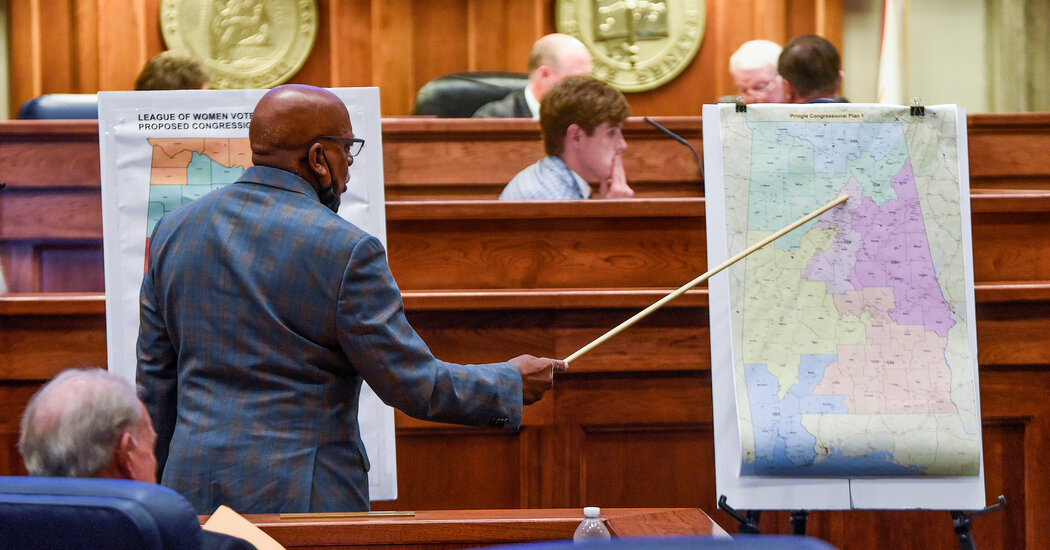
The headline example came in January in Alabama, where a three-judge federal panel said the State Legislature had likely violated the Voting Rights Act by diluting Black voters’ power in its new map of the state’s seven House seats.

The judges ordered the Legislature to draw a new map exactly four months before the May primary elections — a stretch of time that, not long ago, another Supreme Court would have considered generous.

But the Supreme Court issued an emergency stay blocking the order two weeks later, restoring the rejected map for this election. Justice Brett Kavanaugh called the Purcell principle “a bedrock tenet of election law: When an election is close at hand, the rules of the road must be clear and settled.”

In dissent, Justice Elena Kagan shot back: “Alabama is not entitled to keep violating Black Alabamians’ voting rights just because the court’s order came down in the first month of an election year.”

A month later, a federal judge in Georgia cited Mr. Kavanaugh’s words in deciding not to order a new congressional map for that state — this time three months before primary elections — even though he said the State Legislature’s map, like Alabama’s, probably violated the Voting Rights Act.

And in June, the Supreme Court blocked a lower court order for a new congressional map in Louisiana on the same grounds. The justices did not explain their reasoning.

Allowing elections using maps rejected by lower courts has been exceedingly rare in the last half-century. The principal instances occurred after the Supreme Court’s one person, one vote ruling in 1964 forced the redrafting of political maps nationwide.

Politicians have taken notice of the change. In Georgia, the Republican governor, Brian P. Kemp, waited 40 days after the legislature approved a congressional map before signing it into law, leaving a sliver of time for the succeeding court battle.

“The relevant actors are well aware of both Purcell and the court’s inconsistent application of it,” Professor Vladeck said. “So there’s plenty of upside, and very little downside, to try to manipulate the circumstances as much as possible.”

Slow-walking redistricting issues is not confined to federal courts. In Ohio, both congressional and legislative elections this year are being run under maps that the state Supreme Court has ruled are unconstitutional partisan gerrymanders.

The GOP-led Ohio Redistricting Commission, which drew the rejected maps, was threatened with contempt for foot-dragging in producing maps of State Legislature districts. It waited nearly seven weeks this spring to produce a second congressional map after the state Supreme Court rejected the first one.

A three-judge federal panel later imposed the Redistricting Commission’s state legislative maps this spring, citing looming election deadlines. The state Supreme Court again rejected the second congressional map as a partisan gerrymander—but in July, after a long trial, and months after the map had been used in the state’s May primary election.

“What happened in Ohio is an especially egregious flouting of the rule of law, purely for partisan advantage and contrary to what the state’s voters wanted with redistricting reform,” said Ned Foley, an Ohio State University law professor and a leading election law expert. “It’s outright defiance of democracy, and a warning sign for the rest of the nation on how ugly and dangerous this kind of power-grabbing can be.”

Critics say they agree that practical issues matter when elections are imminent. But the Supreme Court “is putting next to no weight on the democratic harms caused by unlawful district maps, while it overstates the administrative inconvenience of redrawing districts,” said Nicholas Stephanopoulos, an election law scholar at Harvard University.

There is, however, one other potential explanation for allowing the use of the rejected maps in November. Some election law experts speculate that the court intends to reverse lower-court decisions striking down the Alabama and Louisiana maps after it hears a crucial election case in October.

The Voting Rights Act clause invoked in those cases, known as Section Two, is used mostly to pursue racial bias in political maps. Mr Carvin, the Jones Day lawyer, said he fully expected the court to take aim at it this term.

“The reality on the ground has changed dramatically” since the act was passed, he said, citing the election of politicians like former President Barack Obama with broad support among white voters. “The Pavlovian requirement that states with a history of racial discrimination need to automatically max out the number of minority-majority districts is no longer the law.”

Critics of the court say it very much is the law, seeing as federal judges in Alabama, Georgia and Louisiana have said so this year. And that is why maps deemed in violation of it should have been replaced, Professor Stephanopoulos said.

But he also said he believed Mr. Carvin’s prediction was probably correct.

.

Categories
US

The market’s big winners and losers in climate, health and tax bill

US Senate Majority Leader Chuck Schumer (D-NY) walks outside the US Capitol in Washington, US August 2, 2022.

Jonathan Ernst | Reuters

Want to know what the Inflation Reduction Act means for the market’s biggest companies, as well as for your wallet? When it comes to politics, you always have to follow the money – and remember that the devil is in the details.

The Senate on Aug. 7 passed the bill that’s designed to fight climate change, make significant tax changes, trim the federal deficit, cut drug prices for Medicare recipients and extend expanded health insurance subsidies under the Affordable Care Act. As it moves to the House of Representatives, the roster of the winners and losers under the bill is coming into sharper focus even before it goes to President Joe Biden.

For both winners and losers, the impact is more modest than you would think, given the sheer size of numbers being bandied about. That’s because of details like strings attached to some of the new or extended tax breaks, or the schedule for implementing Medicare’s negotiations with big pharmaceutical companies over drug prices.

Changes will be more gradual than many headlines imply.

Beginning with the biggest-dollar provisions of the ten-year package of spending and tax cuts, these are some of the effects American corporations and citizens will see from the law. The two biggest changes are the bill’s deficit reducers – just two provisions of the law that account for 80% of its $300 billion in deficit reduction, according to Moody’s Analytics.

Losers: Big tax-avoiding corporations

Members of the Patriotic Millionaires hold a federal tax filing day protest outside the apartment of Amazon founder Jeff Bezos, to demand he pay his fair share of taxes, in New York City, May 17, 2021.

Brendan McDermid | Reuters

The biggest provision by far of the package is the $313 billion Moody’s Analytics says will be raised over 10 years by imposing a 15% minimum tax on corporate profits for businesses that earn at least $1 billion a year.

The law also cracks down on the practice of letting companies announce one set of profit figures to investors, while using another set of numbers that include tax loopholes to show the government. This happens by applying the 15% rate to the “book rate” profits companies disclose to Wall Street, says the liberal-leaning Roosevelt Institute.

The institute says 55 big companies paid no net federal taxes in 2020, including names like Nike, Salesforce.com, Archer Daniels Midland and Fedex. They would have owed $8.5 billion in 2020 at the standard corporate tax rate of 21%, the institute said.

A report by the Center for American Progress says 19 companies in the Fortune 100 alone paid little or no tax in 2021. Among companies that paid 6% or less, as calculated by liberal-leaning think tank: Amazon, Exxon Mobil, AT&T, Bank of America, and both Ford and General Motors. All of them will likely be paying more.

Losers: Drug companies (but not as much as you think)

Participants hold signs as then-Democratic US presidential candidate US Sen. Bernie Sanders (I-VT) spoke at a news conference to introduce the “Medicare for All Act of 2019” on Capitol Hill in Washington, April 10, 2019

Aaron P. Bernstein | Reuters

The government will save $288 billion by negotiating over drug prices, Moody’s says, and that’s a win for senior citizens – but some experts say the change will be more gradual and phased in than many consumers expect.

That’s because the law will only let Medicare negotiate over a few drugs in the early years of the law’s implementation. Medicare will only be able to haggle over 10 drugs in fiscal 2026, and new drugs will not be subject to negotiation for nine to 13 years after their market introduction, said Tricia Neuman, executive director of the Program on Medicare Policy at the Kaiser Family Foundation .

“Savings are exponentially smaller than under the [2019] House bill, which covered many more drugs,” Neuman said. That bill would have let Medicare negotiate terms with 25 top drugs initially, and expanded faster.

One win for seniors is a $2,000 annual cap on their contribution to prescription spending. Most recipients now spend less, but cancer patients can easily spend $10,000 or more, according to a 2019 study. That gives Medicare recipients certainty about drug expenses, Neuman said.

The impact on companies isn’t completely clear because it’s not known yet exactly which drugs will be the first subjected to price negotiations, Neuman said. In 2020, Medicare spent more than $1 billion on each of nearly 40 drugs. Bristol Myers Squibb’s blood-clotting treatment Eliquis ($9.9 billion), Bristol Myers Squibb’s cancer treatment Revlimid ($5.4 billion), and Johnson and Johnson’s blood-clotting drug Xarelto ($4.7 billion) top the list.

What about the spending part of the bill?

Among so-called spending in the bill is actually targeted tax cuts, which the congressional Joint Committee on Taxation calls tax expenditures. One of the three biggest ones in this package, which together account for three-fourths of the $313 billion in tax breaks, is an extension of existing health-care law.

It would extend the subsidies for health insurance under Obamacare that were increased during the Covid pandemic, keeping the benefit hikes from expiring Dec. 31.

People who buy insurance through Obamacare are among the winners. An estimated $64 billion of the package will be in the form of tax credits for people who buy health insurance on Internet exchange markets like Healthcare.gov, according to Moody’s. These credits subsidize the cost of coverage for people whose employers don’t offer benefits and who make too much to be eligible for Medicaid, and were expanded in Covid relief legislation to make policies more affordable.

The provision extends the credit for three years, adding nothing to the deficit after fiscal 2026, Moody’s says. Without it, an estimated 3.1 million Americans would have lost health care coverage, estimates the Center on Budget and Policy Priorities.

Winners: Car companies (but maybe not Tesla)

GM launched ‘EV Live,’ a free online platform that connects electric vehicle owners or consumers who have questions about zero-emissions cars and trucks with an expert who can answer them.

Courtesy: GM

The other big headlines on the “spending” side of the bill are the extension of the $7,500 consumer income tax credit for the purchase of new electric vehicles, and the addition of a new, $4,000 credit for buying a used EV. But the details of the bill make assessing short-term winners and losers complicated.

First, the bill caps the price of eligible new cars at $55,000, excluding the most popular version of Tesla’s Model 3 (as well as all Model S and X vehicles). Trucks and vans can get the credit if they cost less than $80,000. Even that’s a modest win for Tesla, which has not offered its buyers any tax credits since it used up the 200,000 credits it was allotted under existing law. Most or all vehicles from startups like Lucid Motors and Rivian are also excluded under the new bill, at least until they introduce planned cheaper models.

“The Model 3 is right on the border,” said Chris Lafakis, energy economist at Moody’s Analytics.

More crucially, the bill includes requirements for domestic manufacturing of EVs and their battery components to qualify for the extended credit. As written, the law requires that 40% of battery components be sourced from factories in the US or its free-trade agreement partners; that batteries are US made by 2029; and that Chinese components and minerals be phased out beginning in 2024.

Right now, it is not clear if any US battery plant can meet the law’s requirements. To keep the credits flowing once the law takes effect next year, the Biden administration will have to waive some provisions of the soon-to-be-approved law.

One unexpected effect of the law will be to highlight a comment Tesla CEO Elon Musk made on the EV maker’s most recent conference call, and has made before, that coming demand for EVs will make the next half-decade a great time to be an entrepreneur mining or refining the lithium that powers electric vehicle batteries. The law’s buy-American provisions will only add to those pressures.

“It is basically like minting money right now. There’s, like, software margins in lithium processing right now,” Musk said on the recent earnings call. “So I would really like to encourage, once again, entrepreneurs to enter the lithium refining business. You can’t lose.”

Winners: Utilities and homeowners

A wind farm shares space with corn fields in Latimer, Iowa, US

Jonathan Ernst | Reuters

About a third of the tax breaks in the bill — up to $113 billion — are to extend tax credits to encourage production of renewable electricity plants, which have four times as much share of the US market as they did a decade or so ago.

That’s a boon to utilities, which either build plants themselves or buy power from independent operators, Lafakis said. Utilities will also benefit from selling more power as electricity fuels more cars, trucks and appliances, thanks to tax breaks in the law.

More reliance on renewables should also benefit rate payers, since new wind-electricity plants are now much cheaper than new plants that burn coal or natural gas, according to the investment bank Lazard. In some cases, a new wind plant with existing tax subsidies can be cheaper than even continuing to run a coal plant that’s already in use, Lazard said.

Ratepayers who own their own homes may also claim tax credits for shifting more of their home appliances to using electricity, which can be powered by renewables, rather than natural gas. Since most makers of electric hot water heaters and stoves also make gas models, it’s not clear whether the law will cause any major shifts in market share.

“The clear winners are clean energy, solar and other renewables,” said Robert Haworth, senior investment strategy director at US Bank Wealth Management. “And it works hard to make sure there’s not too much disincentive for fossil fuels.”

Winners: Hedge funds (for now)

Losers: Public company shareholders

US Senator Kyrsten Sinema (D-AZ) waits for an elevator to go to the Senate floor at the US Capitol in Washington, US August 2, 2022.

Jonathan Ernst | Reuters

The last minute deal with Arizona Sen. Kyrsten Sinema to gain her vote for her made Democrats drop a plan to impose ordinary income taxes on bonuses that hedge fund and venture capital managers make, closing a loophole that lets these financiers pay lower capital-gains rates on money they never put at risk.

Instead, the plan imposes a 1% tax on stock buybacks – a corporate finance tactic companies use to increase earnings per share by reducing the number of shares outstanding with excess cash.

Proponents of the buyback tax, like Vermont Senator Bernie Sanders, argue that companies can put their cash to work investing more in plants and higher salaries. Opponents say it will hurt returns of retirement plans and pension funds.

Companies in the Standard & Poor’s 500 stock index spent $850 billion on buybacks last year.

.