Categories
US

How the CIA Tracked Ayman al-Zawahri, the Leader of Al Qaeda

WASHINGTON — Intelligence officers made a crucial discovery this spring after tracking Ayman al-Zawahri, the leader of Al Qaeda, to Kabul, Afghanistan: He liked to read alone on the balcony of his safe house early in the morning.

Analysts search for that kind of pattern-of-life intelligence, any habit the CIA can exploit. In al-Zawahri’s case, his long balcony visits gave the agency an opportunity for a clear missile shot that could avoid collateral damage.

The hunt for al-Zawahri, one of the world’s most wanted terrorists, stretches back to before the Sept. 11 attacks. The CIA continued to search for him as he rose to the top of Al Qaeda after the death of Osama bin Laden and after the Taliban takeover of Afghanistan last year. And a misstep during the chase, the recruitment of a double agent, led to one of the bloodiest days in the agency’s history.

Soon after the United States left Kabul, the CIA sharpened its efforts to find al-Zawahri, convinced he would try to return to Afghanistan. Senior officials had told the White House they would be able to maintain and build informant networks inside the country from Afar, and that the United States would not be blind to terrorism threats there. For the agency, finding al-Zawahri would be a key test of that assertion.

This article is based on interviews with current and former American and other officials, independent analysts who have studied the decades-long hunt and others briefed on the events leading up to the weekend strike. Most spoke on the condition of anonymity because of the sensitive intelligence used to find al-Zawahri.

For years al-Zawahri was thought to be hiding in the border area of ​​Pakistan, where many Qaeda and Taliban leaders took refuge after the US invasion of Afghanistan in late 2001. He was wanted in connection with the 1998 embassy bombings in Tanzania and Kenya, and the CIA had tracked a network of people whose intelligence officials thought supported him.

The examination of that network intensified with the US exit from Afghanistan last year and a belief among some intelligence officials that senior leaders of Al Qaeda would be tempted to return.

The hunch proved right. The agency found out that al-Zawahri’s family had returned to a safe house in Kabul. Though the family tried to ensure they were not being watched and to keep al-Zawahri’s location secret, intelligence agencies soon learned he too had returned to Afghanistan.

“There was a renewed effort to figure out where he was,” said Mick Mulroy, a former CIA officer. “The one good thing that might have come out of withdrawing from Afghanistan is that certain high-level terrorist figures would then think it is safe for them to be there.”

The safe house was owned by an aid to senior officials in the Haqqani network, a battle-hardened and violent wing of the Taliban government, and it was in an area controlled by the group. Senior Taliban leaders occasionally met at the house, but American officials do not know how many knew that the Haqqanis were hiding al-Zawahri.

If some senior Taliban officials did not know that the Haqqanis had allowed al-Zawahri to return, his killing could drive a wedge between the groups, independent analysts and others reported on the events said.

It is not clear why Al-Zawahri moved back to Afghanistan. He had long made recruiting and promotional videos, and it may have been easier to produce them in Kabul. He also may have had better access to medical treatment.

No matter what the reason, his ties to leaders of the Haqqani network led US intelligence officials to the safe house.

“The Haqqanis have a very long relationship with Al Qaeda going back to the mujahedeen days,” said Dan Hoffman, a former CIA officer. “They provide Al Qaeda with a lot of tactical support that they need.”

Once the safe house was located, the CIA followed the playbook it wrote during the hunt for Bin Laden. The agency built a model of the site and sought to learn everything about it.

Analysts eventually identified a figure who lingered on the balcony reading, but never left the house, as al-Zawahri.

US officials quickly decided to target him, but the location of the house posed problems. It was in the Sherpur neighborhood of Kabul, an urban area of ​​closely spaced houses. A missile armed with a large explosive could damage nearby homes. And any sort of incursion by Special Operation forces would be prohibitively dangerous, limiting the options for the US government to conduct a strike.

The search for al-Zawahri carried enormous importance for the agency. After the US invasion of Afghanistan, the CIA base in Khost Province became home to a targeting group dedicated to tracking both Bin Laden and al-Zawahri. It was one of the leads developed by the CIA to track al-Zawahri that proved disastrous for the agency’s officers at that base, Camp Chapman.

CIA officers hoped Humam Khalil Abu Mulal al-Balawi, a Jordanian doctor and propagandist for Al Qaeda, would lead them to al-Zawahri. He provided American officials with information about al-Zawahri’s health, convincing them his intelligence was real. But he was in fact a double agent, and on Dec. 30, 2009, he showed up at Camp Chapman with a suicide vest. When it exploded, seven CIA officers were killed.

For many, the Khost attack intensified efforts to find al-Zawahri. “To honor their legacy, you carry on with the mission,” Mr. Hoffman said.

In 2012 and 2013, the CIA focused the hunt on Pakistan’s North Waziristan region. CIA analysts were confident they had found the small village where al-Zawahri was hiding. But intelligence agencies could not find his house in the town of about a dozen compounds, making a raid or drone strike impossible.

Still, the US hunt forced al-Zawahri to remain in the tribal areas of Pakistan, possibly limiting the effectiveness of his leadership within Al Qaeda.

“Anytime anything related to Bin Laden or Zawahri hit the intel channels, everyone stopped to pitch in and help,” said Lisa Maddox, a former CIA analyst. “It was the CIA’s promise to the public: to bring them to justice.”

On April 1, top intelligence officials briefed national security officials at the White House about the safe house and how they had tracked al-Zawahri. After the meeting, the CIA and other intelligence agencies worked to learn more about what they called al-Zawahri’s pattern of life.

One key insight was that he was never seen leaving the house and only seemed to get fresh air by standing on a balcony on an upper floor. He remained on the balcony for extended periods, which gave the CIA a good chance to target him.

Al-Zawahri continued to work at the safe house, producing videos to be distributed to the Qaeda network.

A senior administration official, who spoke on the condition of anonymity to discuss the sensitive decisions leading to the strike, said the intelligence presented to the White House had been repeatedly vetoed, including by a team of independent analysts tasked with identifying everyone who was staying at the safe house.

As options for a strike were developed, intelligence officials examined what kind of missile could be fired at al-Zawahri without causing major damage to the safe house or the neighborhood around it. They ultimately decided on a form of Hellfire missile designed to kill a single person.

William J. Burns, the CIA director, and other intelligence officials briefed President Biden on July 1, this time with the model of the safe house, the senior official said.

At that meeting, Mr. Biden asked about the possibility of collateral damage, prodding Mr. Burns to take him through the steps of how officers had found al-Zawahri and confirmed his information, and their plans to kill him.

Mr. Biden ordered a series of analyses. The White House asked the National Counterterrorism Center to provide an independent assessment on the impact of al-Zawahri’s removal, both in Afghanistan and to the network worldwide, said a senior intelligence official. The president also asked about the possible risks to Mark R. Frerichs, an American hostage held by the Haqqanis.

In June and July, officials met several times in the Situation Room to discuss the intelligence and examine the potential ramifications.

The CIA plans called for it to use its own drones. Because it was using its own assets, few Pentagon officials were brought into the planning for the strike, and many senior military officials learned about it only shortly before the White House announcement, an official said.

On July 25, Mr. Biden, satisfied with the plan, authorized the CIA to conduct the airstrike when the opportunity presented itself. Sunday morning in Kabul, it did. A drone flown by the CIA found al-Zawahri on his balcony. The agency operatives fired two missiles, ending a more than two-decade-long hunt.

Thomas Gibbons-Neff, Adam Goldman and Michael Crowley contributed reporting.
Categories
US

Republicans reverse course as Senate passes burn pits legislation

Comment

The Senate overwhelmingly gave the final sign-off Tuesday on legislation designed to aid veterans fighting diseases they believe are linked to toxic exposure, particularly those who served in the Iraq and Afghanistan wars.

On an 86-11 roll call, the vote served as a political surrender by Senate Republicans, a week after they blocked consideration of the popular legislation seemingly out of political pique because Democrats clinched a party-line deal on an unrelated massive domestic policy bill that could be considered later this week.

Republicans tried for several days to contend that last Wednesday’s blockage of the PACT Act had to do with a technical argument about which portion of the federal budget would fund $280 billion worth of new allocation for veterans health programs.

But 25 Republicans who had recently supported the exact same bill switched their votes last Wednesday, less than an hour after Senate Majority Leader Charles E. Schumer (DN.Y.) and Sen. Joe Manchin III (DW.Va.) announced their deal on the ambitious legislation unrelated to the PACT Act.

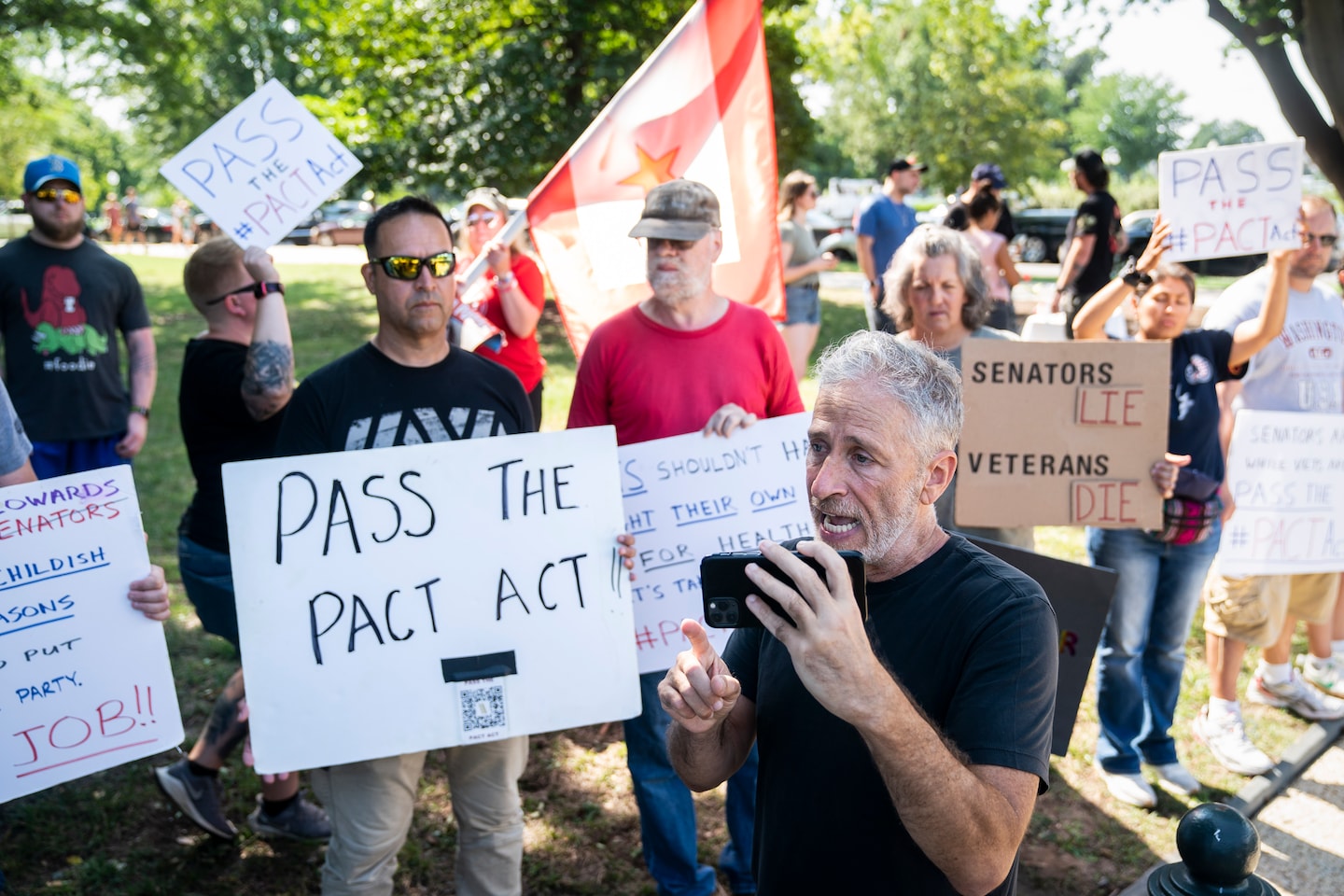
Republicans absorbed a series of political blows, led by comedian Jon Stewart and several prominent veterans groups, that, by lunchtime Tuesday, left many ready to settle the matter and vote to send the legislation quickly to President Biden’s desk.

“He just beat the daylights out of them,” Schumer said Wednesday in a celebratory visit to a couple dozen veterans who have set up a vigil on the Capitol’s north lawn since last week’s failed vote.

Democratic leaders allowed Stewart and dozens of veterans, their families and other supporters into the chamber’s public gallery for the final series of votes — something that has happened less than a handful of times since the onset of the global pandemic in March 2020 prompted officials to not allow the general public into the House and Senate galleries.

In the end, 37 Republicans joined 49 members of the Democratic caucus to vote for the legislation, which compels the Department of Veterans Affairs to presume that certain illnesses came from exposure to hazardous waste incineration, mostly focused on the issue of burn pits from recent wars in Iraq and Afghanistan.

That would remove the burden of proof from the injured veterans.

Sen. Patrick J. Leahy (D-Vt.) missed the vote because of a recent hip-replacement surgery.

In the final moments of debate, the activists grew emotional. Stewart, who took up the cause following a similar effort he helped lead for first responders who suffer lingering effects from the 9/11 site, put his head in his right hand and started to cry as the roll call began. The crowd lit up with brief cheers when the gavel fell, getting quickly admonished by officials for breaking decorum that requires silence.

Asked to explain the GOP reversal, Minority Leader Mitch McConnell (R-Ky.) offered no broad explanation and acknowledged the legislation would pass with broad support.

“These things happen all the time with the legislative process,” McConnell told reporters at his weekly news conference, conceding defeat. “I think in the end the veterans service organizations are going to be pleased with the final result.”

Sen. Jon Tester (D-Mont.), chairman of the Senate Veterans Affairs Committee, credited the veterans groups and Stewart with taking what was previously a relatively obscure health issue and turning it into a national cause.

“That’s who really did it, that’s who elevated it,” Tester said as he joined Schumer at the impromptu celebration outside the Capitol.

Biden also gave the issue prominence in his March State of the Union address, followed by a trip to a Texas community the next week to drive home its importance.

“We’re following the science in every case, but we’re also not going to force veterans to suffer in limbo for decades,” Biden said during the March visit to Texas.

In his remarks, the president has noted that his son Beau served in and around Baghdad as a judge advocate general in the Delaware Army National Guard, on bases where waste was burned in an open-air site.

The state’s attorney general, Beau Biden died in 2015 from brain cancer, although no diagnosis ever connected the cancer to his service in Iraq or other overseas postings.

“While we can never fully repay the enormous debt we owe to those who have worn the uniform, today, the United States Congress took important action to meet this sacred obligation,” the president said in a statement after Tuesday’s vote. “Congress has delivered a decisive and bipartisan win for America’s veterans.”

In a sign of his own devotion to the issue, the president planned to surprise the veterans holding vigil outside the Capitol over the weekend with a pizza delivery, but he tested positive for a rebound coronavirus case and summarized his quarantine.

Instead, Veterans Affairs Secretary Denis McDonough arrived with the pizza.

Experts are often uncertain of a direct link between specific cancers or diseases and the burn pits in Afghanistan and Iraq, where the military often burned large amounts of waste — including plastics, batteries or vehicle parts — that released plumes of dangerous chemicals into the air.

Veterans then have to prove there is a direct connection between their cancer and the burn pit chemicals, a threshold that can at times be difficult to meet, particularly if the condition doesn’t develop until years after a deployment. Studies have shown that Veterans Affairs rejects the vast majority of claims.

“You could talk to any one of these people and they would say we would rather not be here,” Tester said.

Schumer took a similar approach, happy the legislation finally passed.

“All’s well that ends well.”

Categories
US

Phones of top Pentagon officials wiped of Jan. 6 messages

The Pentagon erased a potential trove of material related to the Jan. 6, 2021, attack on the Capitol from the phones of senior defense officials in the Trump administration, according to legal filings.

Court records published on the website of the watchdog group American Oversight indicate that the Pentagon “wiped” the government-issued phones of senior Defense Department and Army officials who were in charge of mobilizing the National Guard to respond to the Capitol attack, including then- acting defense secretary Christopher C. Miller and then-Army Secretary Ryan McCarthy. The erasing apparently was done in keeping with Defense Department and Army policy for departing employees, according to filings that state: “the text messages were not preserved.”

The admission comes as a blow not just to American Oversight’s efforts to unearth critical communications regarding the attack, but also to the House’s Jan. 6 special committee, which had asked Pentagon leaders to preserve and share all documents related to the riot. It also makes the Defense Department the latest known part of the federal government, including the Secret Service and other parts of the Department of Homeland Security, to have deleted records that could have helped investigators piece together what happened on Jan. 6 — and the degree to which President Donald Trump was responsible for delays in responding.

“From the reporting about the Secret Service and the senior DHS officials, it becomes pretty clear that this is not just a DOD problem, not just an Army problem, but multiagency,” said Dara Silvestre, a spokeswoman for American Oversight.

Secret Service cannot recover texts; no new details for Jan. 6 committee

On Tuesday, the group’s executive director, Heather Sawyer, appealed in a letter to Attorney General Merrick Garland to open an investigation into “DOD’s failure to preserve the text messages of several high-ranking officials on or surrounding the day of the Jan. 6 attack .”

“The apparent deletion of records from Jan. 6 by multiple agencies bolsters the need for a cross-agency investigation into the possible destruction of federal records,” the letter continued.

Last week, Sen. Richard J. Durbin (D-Ill.) sent a similar request to Garland, asking him to investigate the missing text messages from the Secret Service and the Department of Homeland Security.

A spokeswoman for the Justice Department declined to comment. A spokeswoman for the Army said: “It is our policy not to comment on ongoing litigation.”

A defense official, speaking on the condition of anonymity because of the sensitivity of the issue, said the deletions were just standard “process.”

“Nobody was trying to hide or conceal anything,” the official said. “That would be a false narrative.”

American Oversight’s case began as a series of Freedom of Information Act requests, filed with various government agencies less than a week after rioters inspired by Trump attacked the Capitol to try to prevent President Biden from being declared the winner of the 2020 election. Among the documents that were sought were text and Signal messages, Silvestre said. The deletions appear to have been conducted after the FOIA requests were filed.

Jan. 6 texts missing for Trump Homeland Security’s Wolf and Cuccinelli

The Defense Department has produced a handful of heavily redacted emails, but no phone communications, according to the group.

The Pentagon’s admission that it had wiped the phones was included as part of a joint status report filed in March, but only published by American Oversight on Tuesday. Silvestre said that in the intervening months, the group has been trying to work with the agencies “to try to get them to release as much as possible,” as there are some phone records that are believed to have been preserved.

The suit is not only seeking records from former senior figures such as Miller and McCarthy. It also has asked for the phone communications of Gen. James McConville, the Army chief of staff, and Lt. Gen. Walter E. Piatt, director of the Army staff, who still work at the Pentagon and whose texts and secure messages should not have been deleted. According to court records, the Army began a search for those records last September, and another court filing updating the status of that search is expected next month.

Dan Lamothe contributed to this report.

Categories
US

How Ayman al-Zawahiri’s ‘pattern of life’ allowed the US to kill al-Qaida leader | Ayman al-Zawahiri

Yon the end it was one of the oldest mistakes in the fugitive’s handbook that apparently did for Ayman al-Zawahiri, the top al-Qaida leader killed, according to US intelligence, by a drone strike on Sunday morning: he developed a habit.

The co-planner of the 9/11 attacks on New York and Washington in 2001 had acquired a taste for sitting out on the balcony of his safe house in Sherpur, a well-to-do diplomatic enclave of Kabul. He grew especially fond of stepping out on to the balcony after morning prayers, so that he could watch the sun rise over the Afghan capital.

According to a US official who briefed reporters on Monday, it was such regular behavior that allowed intelligence agents, presumably the CIA, to piece together what they called “a pattern of life” of the target. That in turn allowed them to launch what the White House called a “tailored airstrike” involving two Hellfire missiles fired from a Reaper drone that are claimed to have struck the balcony, with Zawahiri on it, at 6.18am on Sunday.

It was the culmination of a decades-long hunt for the Egyptian surgeon who by the time he was killed had a $25m bounty on his head. Zawahiri, 71, was held accountable not only for his part as Bin Laden’s second in command for 9/11, with its death toll of almost 3,000 people, but also for several other of al-Qaida’s most deadly attacks, including the suicide bombing of the USS Cole in Yemen in October 2000, which killed 17 US sailors.

The mission to go after the al-Qaida leader was triggered, US officials said, in early April when intelligence sources picked up signals that Zawahiri and his family had moved off their mountainside hideaways and relocated to Kabul. Following the Taliban’s return to power in Afghanistan last August, and with the support of the Haqqani Taliban network, Zawahiri and his wife de él, together with their daughter and grandchildren, had moved into the Sherpur house.

map

In their telling of events, US officials were at pains to stress that under Joe Biden’s instructions the mission was carried out carefully and with precision to avoid civilian casualties and US officials said no one else was killed or wounded in the attack.

Social media images of the strike suggested the use of a modified Hellfire called the R9X with six blades to damage targets, sources familiar with the weapon told Reuters. They caused surprisingly little damage beyond the target, suggesting they may be a version of the missile shrouded in secrecy and used by the US to avoid non-combatant casualties.

The US president was first apprised of Zawahiri’s whereabouts in April, and for the next two months a tightly knit group of officials delved into the intelligence and devised a plan. A scale model of the Sherpur house was built, showing the balcony where the al-Qaida leader liked to sit. As discussions about a possible strike grew more intense, the model was brought into the situation room of the White House on 1 July so that Biden could see it for himself.

The president “closely examined the model of al-Zawahiri’s house that the intelligence community had built and brought into the White House situation room for briefings on this issue”, a senior administration official told reporters.

The White House made further claims to bolster its argument that the attack was lawful, flawless and with a loss of life limited to Zawahiri alone. Officials said that engineers were brought in to analyze the safe house and assess what would happen to it structurally in the wake of a drone strike.

Lawyers were similarly consulted on whether the attack was legal. They advised that it was, given the target’s prominent role as leader of a terrorist group.

Biden, by now quarantined with Covid, received a final briefing on July 25 and gave the go-ahead. It was a decision in stark contrast to the advice he gave Barack Obama in May 2011 not to proceed with the special forces mission that killed Bin Laden in a raid on his safe house in Abbottabad, Pakistan.

On Monday evening, Biden stood on his own balcony – this one in the White House with the Washington Monument and Jefferson Memorial as his backdrop – to address the nation.

“I authorized the precision strike that would remove him from the battlefield once and for all,” Biden said. “This measure was carefully planned, rigorously, to minimize the risk of harm to other civilians.”

Biden’s insistence that no one other than the al-Qaida leader was killed in the attack was amplified repeatedly by US officials. The narrative given by the White House was that Zawahiri was taken out cleanly through the application of modern technological warfare.

Skepticism remains, despite the protests. Over the years drone strikes have frequently proved to be anything but precise.

In August last year one such US drone strike in Kabul was initially hailed by the Pentagon as a successful mission to take out a would-be terrorist bomber planning an attack on the city’s airport. It was only after the New York Times had published an exhaustive investigation showing that the strike had in fact killed 10 civilians, including an aid worker and seven children, that the US military admitted the mission had gone tragically wrong.

Perhaps mindful of the doubts that are certain to swirl around the Zawahiri killing for days to come, the White House said that the Sherpur safe house where the drone strike happened had been kept under observation for 36 hours after the attack and before Biden spoke to the nation. Officials said that Zawahiri’s relatives were seen leaving the house under Haqqani Taliban escort, establishing that they had survived the strike.

Categories
US

Al-Zawahiri was on his Kabul balcony. How Hellfire missiles took him out

Two Hellfire missiles ended al Qaeda leader Ayman al-Zawahiri’s life in a safehouse balcony in a wealthy neighborhood in Kabul, the capital of Afghanistan, at 6:18 am Sunday, a senior administration official said Monday.

The missiles were launched by an unmanned aerial vehicle, or drone, killing him instantly.

The nature of the strike as described by a senior administration official signals that the US may have used the R9X Hellfire variant, also known as the “Ninja” or “Flying Ginsu” missile, nicknamed for knives famously sold on TV in the 1980s. This variant has been used in the recent past to kill other extremist leaders.

The R9X Hellfire has six blades that rotate at high speed and deploy before impact — instead of conventional warhead explosives, according to Janes, a defense intelligence provider. The missile pierces and cuts its target, rather than blowing it up. The design makes it easier to take out an intended target, while lessening the likelihood of causing additional casualties.

Ayman Al-Zawahiri
Ayman Al-Zawahiri in an undated image from video

Maher Attar/Sygma via Getty Images


The White House has not shared details about the type of Hellfire missiles used. A reporter asked a senior administration official on a call Monday about the nature of the missile, but the official did not answer.

The senior administration official who briefed reporters said the strike only killed al-Zawahiri, avoiding civilian casualties and that the strike did not completely destroy the safehouse where al-Zawahiri was hiding with his family. It is unclear whether the missiles inflicted structural damage beyond the patio. Two intelligence sources familiar with the matter said the CIA carried out the strike.

Hellfire missiles are air-to-surface missiles initially designed for anti-armor strikes, but later versions have been used for precision drone strikes. The arms manufacturer Lockheed Martin developed the missiles with the name “Heliborne, Laser, Fire, and Forget Missile,” which evolved into the Hellfire missile, as it is now known.

The R9X variant was initially deployed in secret in 2017, according to a US Army equipment guide, and was used to kill Abu Khayr al-Masri, a member of al Qaeda’s leadership.

Photos of the aftermath on social media showed the car where al-Masri was purportedly killed as having damage to the passenger compartment of the beige Kia sedan but no damage to the engine block. The roof was blown open on the right side of the vehicle.

al-masri-al-qaeda-airstrike.jpg
An image from video posted online by Syrian activists in Idlib province shows people inspecting a sedan damaged heavily by a purported US airstrike on Feb. 26, 2017. There were unconfirmed reports that al Qaeda deputy leader Abdullah Muhammad Rajab Abdulrahman, aka Abu al-Khayr al-Masri, was killed in the strike.

The Hellfire variant became public knowledge after it was used in 2019 to take out Jamal Ahmad Mohammad Al Badawi, who was behind the 2000 USS Cole Bombing.

The Wall Street Journal reported in 2019 that a weapon similar to the R9X was considered as an alternative way to kill former al Qaeda leader Osama bin Laden in 2011, but officials ultimately decided to use special forces fighters.

Categories
US

LA County Board of Supervisors proclaims local emergency for monkeypox amid rising cases

LOS ANGELES (CNS) — The Los Angeles County Board of Supervisors ratified a local emergency declaration Tuesday in response to the monkeypox outbreak.

Board Chair Holly Mitchell issued a proclamation late Monday declaring the emergency in Los Angeles County, where more than 400 monkeypox cases have been identified so far — nearly the double the amount from a week ago.

“This proclamation is critical in helping us get ahead of this virus,” Mitchell said in a statement. “By declaring a local emergency, it allows us to cut through the red tape to better dedicate resources and educate residents on how to protect themselves and help stop the spread. It will also allow the county to quickly administer vaccines as more become available and to take the necessary efforts to obtain supplies and enhance outreach and awareness.”

The Board of Supervisors ratified the declaration Tuesday on an unanimous vote.

As part of the proclamation, the Board of Supervisors will request recovery assistance be made available under the California Disaster Assistance Act, and that the state expedite access to state and federal resources and any other appropriate federal disaster relief programs.

The Board of Supervisors will also direct county departments to implement all assessment, assistance and monitoring efforts as applicable.

Gov. Gavin Newsom issued a state of emergency for California on Monday in response to the increase of monkeypox cases in the state. New York also issued an emergency declaration, as has San Francisco.

Supervisor Janice Hahn wrote on Twitter Monday she supports the emergency declaration.

“I’m hopeful this will help vaccination efforts and ultimately help slow the spread of this virus,” Hahn said in a tweet.

Supervisor Kathryn Barger said in a statement the county “needs to draw down all the support available to accelerate the distribution of vaccines and resources to those at risk and suffering from this terrible disease. I will work to ensure we’re doing so quickly and efficiently We don’t have any time to waste.”

As of Monday, a total of 824 monkeypox cases were confirmed in California — the second-highest of any state, behind New York’s 1,390 — while nationwide, the aggregate count was at 5,811, according to the latest data from the US Centers for Disease Control and Prevention. There were more than 400 cases in Los Angeles County as of Tuesday, primarily in gay men.

Monkeypox is generally spread through intimate skin-to-skin contact, resulting from infectious rashes and scabs, though respiratory secretions and bodily fluids exchanged during extended physical episodes, such as sexual intercourse, can also lead to transmission, according to the CDC. It can also be transmitted through the sharing of items such as bedding and towels.

Symptoms include fresh pimples, blisters, rashes, fever and fatigue. There is no specific treatment. People who have been infected with smallpox, or have been vaccinated for it, may have immunity to monkeypox.

According to health officials, the vaccine can prevent infection if given before or shortly after exposure to the virus.

Gay, bisexual and other men who have sex with men are at increased risk of contracting the virus, according to the CDC.

Last week, the Board of Supervisors voted to lobby federal health officials for more monkeypox vaccine supplies and boosted funding for testing and administration of the shots. The county has been slowly expanding eligibility for the JYNNEOS monkeypox vaccine, but supplies remain extremely limited.

In Los Angeles County, monkeypox vaccines are available to people confirmed by the Department of Public Health to have had high- or immediate-risk contact with a known monkeypox patient, and to people who attended an event or visited a venue where they were a high risk of exposure to a confirmed case. Those people are generally identified through county contact-tracing efforts, and they will be notified by the county.

Shots are also available for gay and bisexual men and transgender people with a diagnosis of rectal gonorrhea or early syphilis within the past year.

Also eligible for the shots are gay or bisexual men or transgender people who are on HIV pre-exposure prophylaxix, or PrEP, or who attended or worked at a commercial sex venue or other venue where they had anonymous sex or sex with multiple partners — such as at a sauna, bathhouse or sex club — in the past 21 days.

Eligibility was expanded Tuesday to include gay or bisexual men or transgender people aged 18 and older who have had multiple or anonymous sex partners in the past 14 days.

People who believe they fall into any of the criteria can contact their health care provider to see if that provider can administer the vaccine.

Qualified people who do not have a health care provider — or whose provider does not carry the vaccine — can either make an appointment at a designated vaccine clinic or visit a walk-in location. Information is available at ph.lacounty.gov/monkeypox. A list of monkeypox vaccine locations is available here.

The county has also activated a website where residents can fill out an online form to see if they may be eligible for a shot and pre-register to be added to a waiting list.

People who register at the site and are eligible for the vaccine will receive a text message when it is available, with information on where to get the shot.

The registration website is here.

The county on Wednesday will open a monkeypox vaccination site at the West Hollywood Library, 647 N. San Vicente Blvd., for people who pre-registered for the vaccine. It will be open by appointment only from 9 am to 6 pm

The vaccine is a two-shot regimen, so additional supplies will be reserved to provide second doses to those who received the initial shot.

Copyright © 2022 by City News Service, Inc. All Rights Reserved.

.

Categories
US

Long Beach child gets monkeypox; LA County declares emergency

A child in Long Beach has contracted monkeypox, health officials said hours after Los Angeles County leaders proclaimed a local emergency amid the spreading illness.

“While news of a pediatric case may cause alarm, please remember that monkeypox is still rare, is much more difficult to get than COVID-19 and other common childhood illnesses, and is rarely dangerous,” Dr. Anissa Davis, city health officer, said in the city’s announcement Tuesday.

Health officials, who said they’re waiting for additional testing from the Centers for Disease Control and Prevention to confirm the infection, added that the child was symptomatic but has since recovered. No further details were released.

Hours before the announcement, LA County Board of Supervisors Chair Holly J. Mitchell introduced a proclamation declaring a local state of emergency amid the growing disease. The action, which was ratified by the board, is an effort to bolster the county’s response to the outbreak. The day before, California declared a state of emergency because of the virus.

“This is a serious health issue that deserves support and swift action,” Mitchell said. “The proclamation of local emergency is to help our county do all that we can to get ahead and stay ahead of this virus.”

Monkeypox cases in LA County rose to 423 Tuesdays, up more than 80% from a week prior, according to the county health department’s count of confirmed and suspected cases. The majority of cases have been confirmed in men who identify as part of the LGBTQ community.

LA County Public Health Director Barbara Ferrer said the state and local emergency declarations would help her agency better respond to the virus — a task that has been stunted for weeks as the supply for monkeypox vaccines remains critically low.

“It does make a difference because it allows us easier access to some of the resources that we’re going to need,” Ferrer said. “It allows us to have more flexibility to use staff from other departments to help with the response.”

She said additional resources and staffing, especially for time-consuming processes such as contact tracing, education and outreach, and administering vaccines, will be a great help, especially as cases continue to rise.

The outbreak in California — and across the world — continues to disproportionately affect men who have sex with men, as well as transgender and nonbinary people, though anyone can catch the virus through close skin-to-skin contact or through fabrics that have touched the virus.

San Diego also declared a local emergency for the virus Tuesday. Confirmed and suspected cases have grown to almost 50.

Los Angeles County and San Francisco far lead the state in cases, making up almost two-thirds of California’s nearly 800 infections. San Francisco last week declared a state of emergency for monkeypox, with cases surpassing 300 as of Monday.

Ferrer also announced Tuesday that LA recently received an additional 9,000 doses of the Jynneos vaccine, allowing the county to expand eligibility for the inoculation and reopen an online registration process. Previous groups that already met eligibility for the shot, including those who were exposed to the virus or had certain sexually transmitted diseases, will remain in place, but now also eligible are gay or bisexual men, or transgender persons, who have had multiple or anonymous sex partners in the last two weeks.

The Jynneos is an approved and effective vaccine that can be used preventively or after exposure, although it remains in short supply. The lack of availability has led to growing frustration and long wait lists for the shot, especially among LGBTQ communities who remain most at risk.

“Even if we took everybody who was just at this higher risk, we don’t have enough doses for everybody in that in that group,” Ferrer said.

Categories
US

Kansas Abortion Amendment Election Results 2022


Kansas Abortion Amendment Election Results 2022 – The New York Times


Categories
US

Live results, races to watch

Polling locations throughout most of Michigan close at 8 pm EST, bringing an end to the August primary election Tuesday to decide which Republican candidate will emerge from a crowded field to face Gov. Gretchen Whitmer this fall along with several hotly contested intraparty congressional and state legislative fights.

Hundreds of thousands of Michigan voters returned absentee ballots before Election Day and by Tuesday morning, more than a million absentee ballots had been received by election officials across the state, according to the Secretary of State’s office.

>> LIVE: Michigan primary election results here

Those casting absentee ballots have until 8 pm Tuesday to return theirs. Polling locations serving in-person voters also close then, but those in line by 8 pm can still vote.

While voting ends at 8 pm EST the vast majority of the state, voting in the four Michigan counties in Central Time Zone — Dickinson, Gogebic, Iron and Menominee counties — is still underway for another hour.

Categories
US

Senate Passes Burn Pits Legislation, Expanding Benefits for Veterans

WASHINGTON — The Senate on Tuesday approved a bill to create a new entitlement program to treat veterans who may have been exposed to toxic substances from burning trash pits on US military bases, sending President Biden legislation that would expand medical care eligibility to an estimated 3.5 million people.

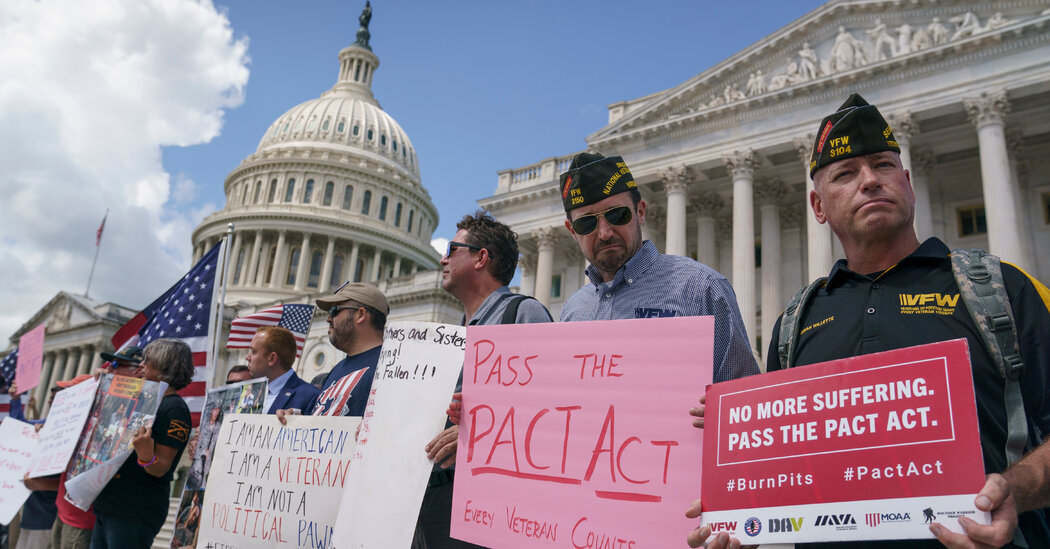
The bill was approved on a lopsided bipartisan vote, 86 to 11, only days after Republicans pulled their support in a dispute over how to pay for the benefits, imperiling the legislation and drawing days of angry protests from veterans who gathered outside the Capitol to demand action.

The measure would be the biggest expansion of veterans’ benefits since the Agent Orange Act of 1991, which increased access to care for Vietnam War veterans who had been exposed to the toxic herbicide that endangered generations of Vietnamese, Laotians and Cambodians.

The new legislation would effectively presume that any American service member stationed in a combat zone for the last 32 years could have been exposed to toxic substances, allocating a projected $280 billion over the next decade to treat ailments tied to those exposures and streamlining veterans’ access. to such care.

The House approved the bill last month, and Mr. Biden, who has championed the measure, was expected to quickly sign it. He has speculated that toxic substances from burn pits contributed to the brain cancer that killed his son Beau Biden, who served in Iraq, in 2015.

The legislation had drawn broad support on Capitol Hill, but just as it was expected to clear the Senate last week, Republicans in the chamber abruptly withdrew their backing, insisting that Democrats allow them a chance to limit the funding available to treat veterans.

The bill would provide guaranteed funding for treating veterans exposed to toxins by setting up a dedicated fund that would not be subject to the annual congressional spending process. Senator Patrick J. Toomey, Republican of Pennsylvania, warned that the measure was written in a way that could allow for immense new spending unrelated to veterans’ care.

Mr. Toomey tried and failed to cap the amount of money that could be put into the fund every year, a move that Denis McDonough, the secretary of veterans affairs, had warned could lead to “rationing of care for vets.”

Mr. Toomey also proposed shifting the fund for treating veterans into so-called discretionary spending after a decade, meaning that the Department of Veterans Affairs would have to request funding each year. That would subject the funding to Congress’s approval and the annual partisan spending battles on Capitol Hill, rather than having it guaranteed.

Democrats opposed both efforts, saying the legislation did not need to be changed.

“This is a bill that will work for this country, that will work for the taxpayers of this country and it will work, most importantly, for the veterans and their families,” said Senator Jon Tester, Democrat of Montana and the chairman of the Veterans’ Affairs Committee.

Susan Zeier, the mother-in-law of Heath Robinson, a member of the Ohio Army National Guard for whom the bill is named, had been protesting outside the Capitol for days to urge the Senate to pass the measure before leaving for its summer recess .

Mr. Robinson served in Iraq and died in 2020 after battling lung cancer believed to have been tied to burn pit exposure, and the bill is called the Sgt. First Class Heath Robinson Honoring Our Promise to Address Comprehensive Toxics Act of 2022.

“For me and my daughter, this is the satisfaction that we fulfilled our promise to Heath,” Ms. Zeier said. “We hope families don’t suffer like we did.”