Categories
Technology

‘Call Of Duty’ case thrown out as plaintiff never played the game

A court case has been dismissed after it was found that the plaintiff hadn’t played enough Call Of Duty: Infinite Warfare to back up claims made about the game.

Back in November, 2021, Brooks Entertainment sued Activision Blizzard – the maker of the Call Of Duty franchise – in the United States District Court for the Southern District of California, for allegedly stealing the identity of Brooks Entertainment’s founder, Shon Brooks, for 2016’s Infinite Warfare (via Wilson Sonsini Goodrich & Rosati and Kotaku).

A document from Court Listener says Brooks Entertainment owns the trademark for Shon Brooks, and that it makes graphics and content for video games that are “aimed at empowering youth” – like games stock picker and Save One Bank.

Brooks Entertainment then says it was working with both Activision Blizzard and Rockstar Games to create a game between 2010 to 2015. Infinite Warfare then released in 2016, with Brooks claiming that Activision Blizzard used “Sean Brooks as its main character in ‘Call Of Duty‘” and that “this character uses the likeness, persona and name of Plaintiff’s owner Shon Brooks and further infringes on Plaintiff’s trademark for Shon Brooks.”

Call Of Duty: Infinite Warfare. Credit: Activision Blizzard

Of the copyrighted material allegedly stolen by Activision Blizzard, Brooks Entertainment listed the following:

  • Sean (Shon) Brooks has missiles at [his] disposal;
  • Save One Bank is uniquely played in First Person Shooter and Third Person Shooter and Call Of Duty copied the same format and is played in First Person Shooter and Third Person Shooter;
  • Both games are played offshore;
  • The main characters of the games both bring thieves to justice;

Those who have played Infinite Warfare will know that Sean Brooks isn’t the protagonist of that game, Nick Reyes is, and that the game didn’t in fact copy the third person shooter format, as the game is exclusively first person.

Then, in January of this year Activision Blizzard’s counsel told Brooks Entertainment counsel that the complaint “contain[ed] serious factual misrepresentations and errors, and that the claims set forth therein are both factually and legally frivolous,” adding that it would file for Rule 11 sanctions – requesting Brooks pay a fine for submitting unsubstantiated arguments.

Call Of Duty: Infinite Warfare. Credit: Activision Blizzard

Activision Blizzard called the claims delusion, with the court recording one of the publher’s arguments as well: ““Sean Brooks” is a common name and Activision’s character is “Sean,” not “Shon” like Plaintiff. Activision’s “Sean” is “an armored Irish space marine,” while the Plaintiff “Shon” is “an African American San Diego-based financial consultant and cigar salesman.””

The court then said in its ruling that Brooks Entertainment’s counsel “could have easily verified these facts prior to filing the factually baseless Complaint, just as the Court easily verified them within the first hour and a half of playing the game.”

Brooks Entertainment cannot file the claim in the same court, which ordered it to pay Activision Blizzard for the time and money wasted, this was written on July 12 this year.

“The court basically finds the whole argument crazy,” said Richard Hoeg, a lawyer in contact with Kotaku . “Brooks Entertainment even included Rockstar Games for no reason (which didn’t help their cause with the judge). So, the sanctions here are Brooks Entertainment [has] to pay for Activision’s legal fees and costs.”

In other news, a new Street Fighter 6 trailer has focused on the new real-time commentary feature in the game.


Categories
Technology

A Duo of Google Meet Apps Is Officially Here, and It’s Confusing

Google is officially kicking off the merger of its two video chat apps, Google Meet and Google Duo. Google announced the merger in June, with the plan to keep the Google Meet brand name while merging the best of both code bases into the Google Duo app. According to Google’s PR email (no links, sorry), people will begin seeing Duo’s app and website branding swap over to Google Meet this week. Google’s various rebrandings are all on a rollout, so they’ll arrive at different times for different people, but Google says the complete rebrand should finish for everyone by September.

So Google Duo is being rebranded to Google Meet, and the existing Google Meet app is sticking around for a bit. That means there are now two apps called “Google Meet.” Google has a help article detailing this extremely confusing situation, calling the two Meet apps “Google Meet (original): The updated Meet app” and “Google Meet: The updated Duo app.” The “Google Meet (original)” app will someday be put out to pasture; it’s just sticking around while Google rebuilds the meeting functionality on top of Google Duo. Did everyone follow that?

The Meet and Duo video services were both built as reactions to Google’s far more stable communication competition. Google Meet was technically created in 2017 as a group business video chat application called “Google Hangouts Meet,” but it really became a major project after Zoom’s growth exploded in 2020 during the Covid-19 pandemic. Google Meet was still locked behind a paywall during the initial months of the work-from-home era, and while it eventually became as easy to use as Zoom, it was after Zoom became a household name.

Google Duo came out in 2016 alongside the “companion app” Google Allo as a reaction to the growth of WhatsApp. Google and Facebook got into a $22 billion bidding war for WhatsApp two years earlier. Google lost and spent the next two years making a WhatsApp clone called Google Allo. Rather than integrate video chat into the app, Google split video functionality into a separate app called Google Duo. WhatsApp didn’t have video chat at the time, so you could use Google Duo video chat with Facebook’s WhatsApp or Google’s Allo, if you wanted.

Allo and Duo were originally focused on India, which led Duo to build a one-to-one video chat system that used little bandwidth and worked well on unstable connections. That efficient video chat system will be the basis for the new combined app, with Google building Meet’s meeting link functionality into Duo and rebranding it. The install base is probably also a factor here. As a default Android app, Google Duo has more than 5 billion downloads on the Play Store while Meet only has 100 million. Google’s path makes for a smoother transition for those 5 billion installs, while the 100 million will have to switch manually. Google says that it will hide the old, original Google Meet app from app store searches in September. Eventually, it will need to implement a pop-up message for existing users of the old Google Meet app that tells them to upgrade.

This move is happening because Google “unified” its messaging teams in 2020, with a single person, Google Workspace VP and GM Javier Soltero, taking the reins of “all of Google’s collective communication products.” That should mean Google Hangouts, Google Meet, Google Chat, Google Messages, Google Duo, and Google Voice, and Google even threw in the Android phone app for good measure. It was announced last month that Soltero is leaving Google, though, so that’s only two years on the messaging unification job. Nobody knows who, if anyone, is taking over as the new “head of messaging.” Single’s plan is still happening, though—besides this Meet and Duo merger, Hangouts will finally shut down in a few months. This new, more cohesive lineup will leave one Google video app and three Google chat apps.

This story originally appeared on Ars Technica.

.

Categories
Technology

Every Rumor and Leak About Quaxly

In a few months, gamers will get to experience the next mainline entry in the Pokemon franchise, pokemon scarlet and violet. The latest trailer revealed more about the upcoming titles, letting players know they will be exploring the Paldea region as students attending one of two academies. Players even got a glimpse of a few characters including Penny, Arven, and Clavell.

Players also discovered they will be able to explore Paldea by riding the legendary Pokemon – Koraidon and Miraidon. The evolved forms of pokemon scarlet and violet‘s starter Pokemon have yet to be seen, but there have been several leaks that give fans a rough idea of ​​what to expect.

GAMERANT VIDEO OF THE DAY

RELATED: How Pokemon Scarlet and Violet’s Tera Raids Can Change The Game

Introducing Quaxly, Pokemon Scarlet and Violet’s Water-Type Starter

Pokemon has a history of featuring cute critters as Water-type starters, and pokemon scarlet and violet do not buck the trend. Quaxly is a duck Pokemon with webbed, blue feet and a blue tuft of hair that looks a bit like a sailor’s hat. Though the Pokemon appears unassuming, its evolutions could reveal hidden potential.

Fans got their first look at Quaxly during pokemon scarlet and violet‘s reveal trailer, which also showcased Fuecoco the Fire-type starter and Sprigatito the Grass-type starter. in most Pokemon games, a player’s rival will pick the starter Pokemon that is strong against theirs, so Quaxly fans should keep an eye on Sprigatito as that may be one of the first Pokemon that Quaxly goes up against often.

Fan Theories Surrounding Quaxly

There have been many theories surrounding the themes that guide starter Pokemon designs. The most prevailing theory is that Fire-type starters are based on the Chinese Zodiac, Grass-type starters are based on prehistoric animals, and Water-type starters are based on weapons. On the surface, the Water-type theory makes sense, as past starters have had final evolutions like Blastoise with its massive cannons, or Greninja with its shuriken, Empoleon who looks like a triton and Swampert has a tail that looks like a Japanese war fan , to name a few. Should the fan theory hold, people could expect Quaxly’s final evolution to incorporate a weapon of some sort.


As Paldea is based on Spain, Quaxly could also be inspired by Spanish culture. One theory claims that the duck Pokemon draws inspiration from Don Quixote, a character in Miguel de Cervantes’ novel The Ingenious Gentleman Don Quixote of La Mancha. In the novel, Don Quixote is a self-proclaimed knight who loses his mind and hallucinates monsters. Trailers have shown Paldea will feature windmills, which may allude to a scene in Cervantes’ novel where Don Quixote fights windmills believing them to be giants. Should the link between Quaxly and Don Quixote be present, the Pokemon may take on a knightly form in its evolutions.


RELATED: Weirdest Pokemon Evolution Requirements and Why Scarlet and Violet Need Them

The Quaxly and Don Quixote theory has also fed into the idea that the Water-type starter’s final evolution will be a Water/Fighting-type. This would be a fresh take, as there has never been a Water/Fighting-type starter before – usually this is left to the Fire-type starter. The theory also appears to have some support from credible leakers.

Leaks and Rumors Surrounding Quaxly

One leak comes from the Twitter account PKMNleaks, which posted images of six Gym Leaders as well as some new Pokemon. Gamers theorized one of the Pokemon is a Quaxly evolution, though it was hard to be certain because the images are blurry. Still, it appears to be the back of a bipedal, blueish-purple Pokemon with blue tail feathers that fan out. Riddler Khu, another leaker with a good track record, vouched for these images, and posted about Quaxly’s evolutions too. Although the image is very blurry, it is possible to tell that the Pokemon is mostly blue with a vertical white stripe on its head. According to Khu, Quaxly’s final evolution will be a Water/Fighting-type, while Sprigatito’s will be Grass/Dark and Fuecoco’s will be Fire/Ghost.


Leaks have also come from an account called CentroLeaks, which provided accurate information surrounding pokemon sword and Shield and Pokemon Legends: Arceus. The leaker has discussed pokemon scarlet and violet‘s region name as well as the new gimmick before it was announced by The Pokemon Company, lending a lot of credibility to their leaks. They provided rough sketches of the final evolutions of the three starters, and it appears that Quaxly retains a bipedal stature with tail feathers that fan out, much like PKMNleaks’ image.

As is the case with all leaks, the information should be taken with a grain of salt because it has yet to be confirmed by The Pokemon Company or Game Freak. Fortunately, gamers will not have to wait much longer, as the game’s release is around the corner. Despite not showing evolutions of the starters in the latest trailer, players were shown the latest battle gimmick they can look forward to: Terastallization.

pokemon scarlet and violet are scheduled to release on November 18, 2022 for Nintendo Switch.

MORE: What Pokemon Scarlet and Violet’s Ancient and Future Forms Could Mean for Regional Variants

Categories
Technology

Beats Studio Buds On Sale for $99.95 [Lowest Price Ever]

Apple’s Beats Studio Buds wireless earbuds are on sale for 33% off today! That brings their price down from $149.95 to just $99.95, their lowest price ever.

Beats Studio Buds are engineered to deliver powerful, balanced sound in a compact design, through an entirely customized acoustic platform. A proprietary, dual-element diaphragm driver resides within a two-chamber housing, resulting in clear sound with outstanding stereo separation. An advanced digital processor then optimizes audio performance for loudness and clarity, while simultaneously ensuring clean noise cancellation. The result — immersive sound that pulls the emotion of music from the studio to your ears to keep you going all day long.

Beats Studio Buds On Sale for $99.95 [Lowest Price Ever]

Features:
● Custom acoustic platform delivers powerful, balanced sound
● Control your sound with two distinct listening modes: Active Noise Canceling (ANC) and Transparency mode
● Three soft eartip sizes for a stable and comfortable fit while ensuring an optimal acoustic seal
● Up to 8 hours of listening time1 (up to 24 hours combined with pocket-sized charging case)
● Industry-leading Class 1 Bluetooth for extended range and fewer dropouts
● High-quality call performance and voice assistant interaction via built-in microphones
● IPX4-rated sweat and water resistant wireless earbuds
● Beats wireless headphones and earphones are compatible with Apple and Android devices
● What’s in the Box – Beats Studio Buds True Wireless Noise Canceling Earphones, charging case, eartips with three size options, USB-C to USB-C charging cable, Quick Start Guide, Warranty card (USB-C power adapter sold separately)

Grab the deal at the link below…

Get Deal

Beats Studio Buds On Sale for $99.95 [Lowest Price Ever]

Beats Studio Buds On Sale for $99.95 [Lowest Price Ever]

Categories
Technology

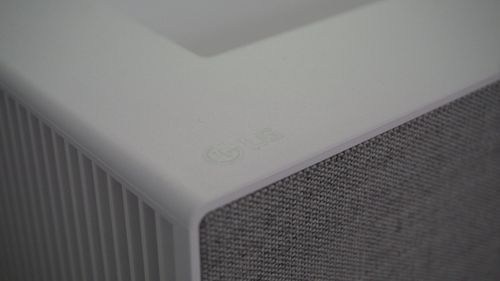
LG CineBeam 4K UHD Laser UST Projector

LG’s new short-throw projectors are as impressive as they are convenient.

I’ve spent the past fortnight watching and playing everything I could on the company’s new CineBeam projector and if it wasn’t for a critical missing connection and its performance in daylight, I’d be tempted to replace my living room TV with one.

That being said, the technology doesn’t come cheap.

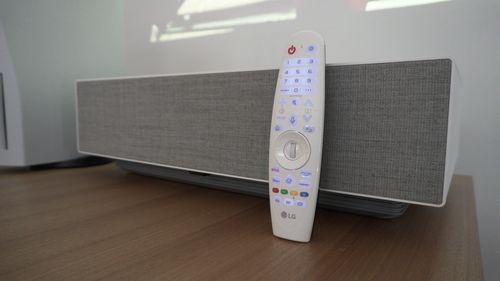
LG’s CineBeam projector and backlit Magic Remote. (Nine)

Setting up LG’s short throw projector is insanely easy.

Plug in the power cord, connect to WiFi and you’re done.

Depending on the distance between it and your wall, the CineBeam will throw up a picture between 80 and 120 inches in size.

There’s no automatic ‘key-stoning’ to straighten that image but you can manually adjust things in the settings or – as I did – take the easiest option and make sure the projector is straight…

Even against a wall, the CineBeam’s 4K image is undeniably impressive.

We gleefully rewatched Dr Strange in the Multiverse of Madness and guess who on a night away at the Peninsula.

The CineBeam’s image – like all projectors – isn’t as vibrant in day light. (Nine)

Most people wouldn’t dream of transporting a 120 inch screen but that proved no problem at all with a short throw projector like LG’s CineBeam.

LG has built in sensors that automatically adjust the projector’s brightness and colors depending on the content you’re watching and the darkness of the room it’s being used in but, like all projectors, the CineBeam’s picture suffers significantly in daylight.

Watching Collingwood play Port Adelaide with sun streaming through our living room windows was far from ideal, especially compared to the colour, contrast and clarity of my Samsung QLED which I had running side-by-side.

Closing the blinds obviously helps but that’s not an ideal solution in spaces being shared by multiple people or families.

The better news is that LG’s CineBeam 4K UHD Laser UST Projector handles down-lights incredibly well.

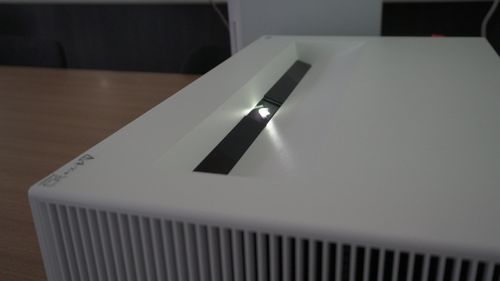
Lasers project the image at an extreme angle. (Nine)

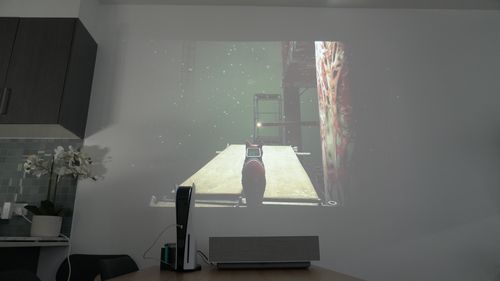
I had no issues booting up my PlayStation 5 and playing through stray, returnal and games of Rocket League while my wife kept the lights on so she could read.

Other reviewers have criticized the lag they measured on the CineBeam while gaming, and while 50+ milliseconds certainly isn’t as responsive as the C2 OLED I recently reviewedI never felt like it was compromising my experience – even during some embarrassingly heated battles in the new Super Mario Strikers game on Nintendo Switch.
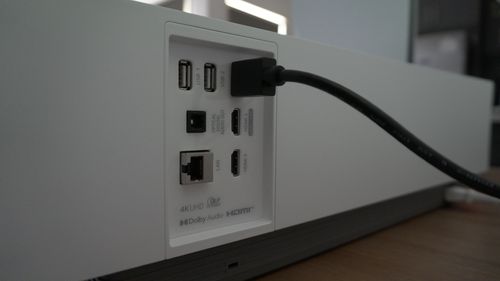
There’s 3 HDMI ports but no aerial connection. (Nine)

There are three HDMI ports on the back of LG’s short-throw projector plus two standard USB ports, an optical digital audio out port and a LAN port for a wired internet connection.

You may have noticed that I didn’t say there was a place to plug in a TV aerial.

It’s absence is immediately reinforced when you first turn on the CineBeam, as a pop-up informs you it needs a set top box to tune into Free-to-Air channels.

Being able to download apps like 9Now helps alleviate that to some degree but I was shocked to discover there was no option to install Kayo natively on LG’s CineBeam.

Thankfully I was able to rewatch Jamie Elliott’s match winner over and over again via the app on my PS5, but it’s disappointing that the projector isn’t a one-stop-shop for footy fans.

Speaking of software, the projector wasn’t able to read or display our wedding pictures inside a folder on a USB.

They’re JPG files that opened on LG’s C2 and my Samsung QLED just fine – and on the CineBeam when they weren’t contained in a folder – so I’m not sure why a folder is tripping the system up.

The CineBeam had no issues playing our wedding video off the same USB and ultimately, on a big screen like this, that’s what matters most.

Short throw projectors are the future for anyone wanting a big screen experience with minimal fuss.

I can’t say enough for the look and the convenience of placing projectors like LG’s on a TV unit (or dining room table like I have).

There’s no need to screw anything into a ceiling or wall and as a result, it’s perfectly portable.

My mind has been racing with ideas of using a projector like it in the background of future videos or for presentations; without the risk of blocking the picture.

Its minimalist design is suited for modern entertainment units. (Nine)

That extreme angle does have its flaws.

Light bleeds over the sharp edges of the bright white PS5 logo and into the black background when starting up the console.

It’s also worth noting that LG’s CineBeam 4K UHD Laser UST Projector hums away at a decent volume.

You can hear it from a few meters away in a quiet room but like most of the projector’s flaws, it’s quickly forgotten once something is playing on screen.

Whether or not it’s the right projector for you depends on where you want to set it up, what you want to watch and what accessories you have to play with.

But the convenience it offers coupled with LG’s slick interface and image quality makes the CineBeam 4K UHD Laser UST Projector hard to ignore.

LG loaned 9News.com.au a CineBeam 4K UHD Laser UST Projector for the purpose of this review.

Categories
Technology

Weekly poll results: tiny Asus Zenfone 9 stirs big excitement

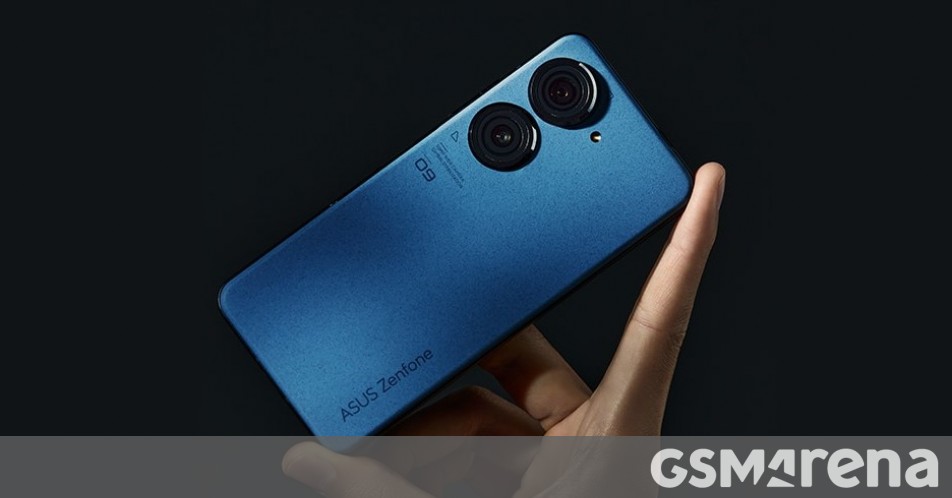
Is the Asus Zenfone 9 the perfect phone for people who want a small Android flagship? That seems to be the case, judging by the glowing reception in last week’s poll – half of people who voted want one.

Another 30% would be interested, if Asus had offered software support longer than two OS updates and security patches spanning two years. To be fair, Asus said “at least two years”, but not everyone is willing to bet $700/€800 on the chance that patches keep coming after mid-2024.

Weekly poll results: tiny Asus Zenfone 9 stirs big excitement

Admittedly, the poll is probably skewed – those interested in a small flagship are more likely to read and vote on a post about the Zenfone 9. Still, the petite handset has a strong chance of becoming a hit in that particular niche, especially since the Xperia 5 IV is nowhere to be seen.

People in the comments argued on how the Zenfone 9 could be improved beyond the software support. The absence of an eSIM, a microSD card and wireless charging were noted.

Price was mentioned as well, but phones with this kind of performance and battery life are not cheap, regardless of size. Even so, the Zenfone 8 launched at €670 last year, €600 if you caught the early bird deal. That would have been a much more palatable price for the 9, but even at €800 people seem willing to pick one up.

Categories
Technology

How Gran Turismo 7’s New Die Cast Photo Mode Came To Be

Grand Touring 7 players received an unexpected treat when July’s title update brought a new and very left-field Scapes location: Tomica Town. Turns out, the racing game’s delightful new photo mode backdrop wouldn’t have happened at all if it weren’t for COVID-related lockdowns.

For the uninitiated, Scapes is a GT game mode in which you can plop the game’s cars into real-world, quasi-three-dimensional backdrops and take pictures. The majority of these are views of interesting streets, notable natural landmarks, or certain spots at racetracks from all around the world. But this latest one takes place in a fantastical Tomica playset—Japanese Hot Wheels, essentially—in which the “real” Grand Touring cars are the same size as those 1:67-scale die-casts.

Here are some visuals for the Olds among you still confused.

The whole thing came as a pretty big surprise to fans given Grand Touring‘s typically very serious, very grown-up (almost to a fault) vibe. As reported by GTPlanetthe idea actually came to be in the throes of lockdown in 2020.

In a translated tweet, Polyphony Digital Scapes developer Hiroshi Kanzaki explained, “Two years ago, during the declaration of a state of emergency, we were in a situation where we couldn’t shoot at all, so it was a desperate idea, but I ‘m glad it was well received!! I am deeply grateful to Takara Tomy for their kind cooperation.”

It’s said that desperation breeds innovation, and GT7‘s very creative new Scapes location is definitely an unexpected pandemic-era innovation. It has also given way to this adorably glorious crossover between three Japanese automotive institutions: Takumi’s AE86 stop-motion-drifting around a Tomica Town playset in Grand Touring 7.

GT7 is playable on PlayStation 5 and PlayStation 4. Read The Drive‘s review of the game here.

Got a tip or question for the author? You can reach him here: [email protected]

Categories
Technology

Flip, Fold, Watch, Buds: 6 things we expect to see at Samsung Unpacked this week

The next Samsung Galaxy product launch is just a few days away; Samsung Unpacked takes place on August 10 and it’s when we’re expecting to find out about all of the company’s upcoming devices.

We’re not talking about the Samsung Galaxy S23; no, Samsung usually saves its big flagship products for a launch at the beginning of the year, and we saw the S22 much earlier in 2022.

Categories
Technology

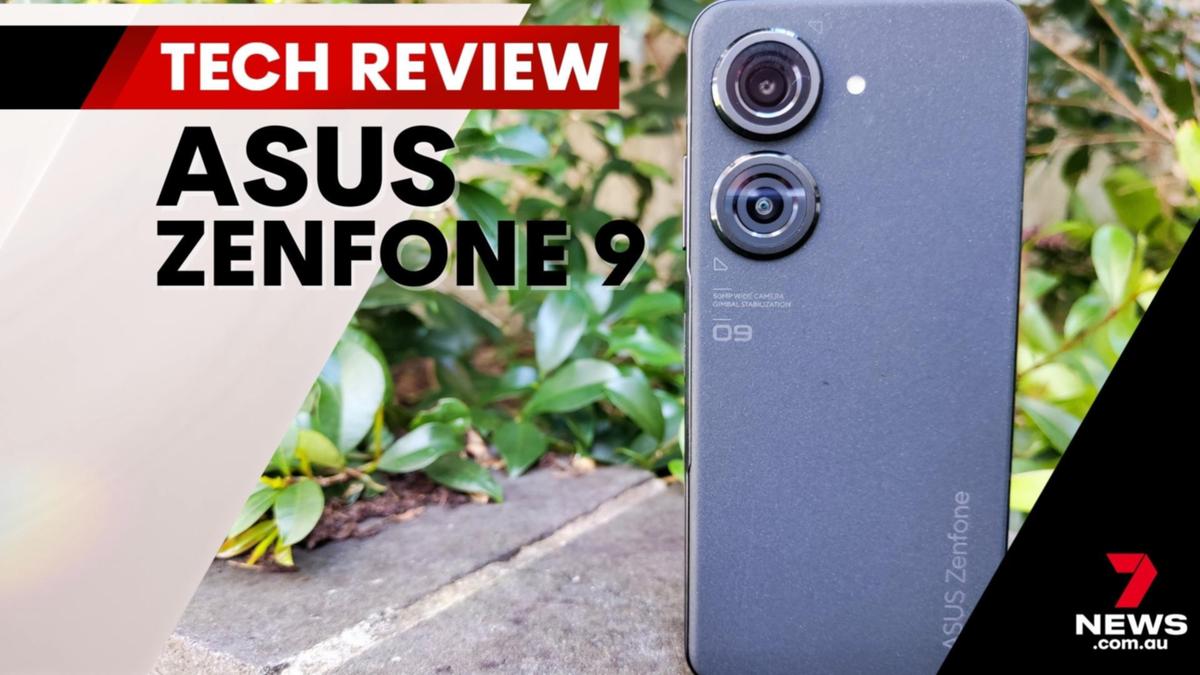
ASUS Zenfone 9 Australian review: Best mobile phone 2022

ASUS hit the ground running with the release of the Zenfone 8 last year, a compact smartphone that had a lot of promise.

However, there were a couple of problems that plagued the device – especially within Australia – when it came to connectivity across our local telco networks.

Has this changed with the impending release of the Zenfone 9? Keep reading to find out as we test the newest release from the Taiwanese company.

Watch the latest News on Channel 7 or stream for free on 7plus >>

How do I get it and what will it cost?

The Zenfone 9 will be released in Australia, however there is currently no official word on when, how much it will cost and color availability. As soon as we get this information, we’ll update.

There are four colors available internationally; black, white, red and blue.

It’s worth noting that you’ll get a USB-C charging cable, 30W charging brick and phone case included in the box, so you won’t need to shell out extra dollars for the accessories. The box is also environmentally friendly and 100 per cent recyclable.

Who is it good for?

Over the course of the last decade, smartphones have increasingly become bigger and more powerful – with very few smaller options in the market that don’t have compromises that become dealbreakers.

The Zenfone 9 sits within the smaller flagship niche. It’s a phone for people who don’t want a large phone, and instead need something more compact without sacrificing good cameras, performance and solid battery life.

This is a 5.9-inch device that is easy to use one-handed. It also fits easily within pockets without any bulk.

If a phone with a smaller footprint sounds appealing to you, the latest from ASUS might be worth taking a closer look at.

How does it work?

Coming from a Pixel 6 Pro, the Zenfone 9 is an absolutely tiny 5.9-inch and weighs only 169 grams. The frame is a matte aluminum, with the usual power (multi-function button) and volume rocker to the side.

ASUS has created a multi-function button which allows for controlling certain parts of the phone with your thumb or finger such as opening the notification shade, scrolling as well as media controls. It’s quite clever, and useful.

On the back is a textured plastic material that helps with grip, but I found easily scuffs with some marks becoming visible in a short amount of time. The bottom back part also became a little duller, compared to when I first started using the phone. I’d guess this is from placing the phone into my pocket. There is a case included in the box if this is something that might worry you.

Around the front is a flat AMOLED display that, quite frankly, is one of the best I’ve seen outside of Samsung’s flagship Galaxy range (it is a Samsung panel after all). The display is also coated in the latest Gorilla Glass Victus to help with scratch resistance.

The display also has a high 120Hz refresh and 240Hz touch-sampling rate, HDR10+ and can be easily viewed under direct sunlight.

As with most flagships, it has the latest Snapdragon 8+ Gen 1 processor, making the whole experience very snappy and responsive. There is also support from the latest Wi-Fi 6E technology and IP68 water and dust resistance. It really does have all the bases covered.

But outside the tech specs, how does the Zenfone 9 actually perform in the real world?

They say good things come in small packages, and that is especially true this time around. ASUS has packed in a very good display, which is great for viewing content and the basic phone features work without an issue.

Clarity of phones calls is fantastic, and network connectivity is a solid performer with 5G, VoLTE and VoWiFi working across Optus, Vodafone and Telstra networks. There were also none of the issue I had around network drop-outs that I saw on the Zenfone 8.

Battery life was better than the Pixel 6 family and Samsung Galaxy S22 series. I was easily seeing over 7 hours of screen on time most days. This was with the high refresh rate turned on as well as 5G – both known to drain batteries quicker. In terms of charging there is no wireless charging, which may disappoint some folks. But I found charging the Zenfone 9 to be pretty quick.

When it comes to the cameras, the main 50MP wide camera is a Sony IMX766 sensor with a six-axis gimbal for some very good stabilization, and it takes some pretty decent snaps in both good and low-lighting conditions. In fact, the night mode from this lens comes extremely close to what the Pixel 6 can achieve when adding in more light and retaining detail.

The 12MP ultrawide (Sony IMX363) struggles a bit more when there isn’t good lighting, but it’s good enough for most situations when you have favorable lighting conditions. This lens also allows for taking macro shots too, if that’s your thing.

The 12MP front-facing camera (Sony IMX663) comes with auto-focus and does a good job of taking a selfie or two, which is typical of most smartphones. It won’t match the quality you get out of a flagship Samsung though which, in my opinion, takes the best selfie photos out of any smartphone.

What surprised me the most was the dual speakers. The sound they produce is fantastic for listening to music, watching YouTube or your favorite streaming service. While there is also a 3.5mm headphone jack, a rarity on a smartphone, the quality of the stereo speakers is very impressive from such a small device.

What we think

I had a love hate relationship with last year’s Zenfone 8. I really put the effort into the relationship, but at the end of the day there were too many things that just soured my time with the device such as sub-par cameras, weak battery life, unreliable fingerprint sensor and hit and miss network connectivity.

These were things that I was keen to test out with the new Zenfone 9, and I can happily say that ASUS has done a stellar job at correcting all those things.

We have three very capable Sony camera sensors, a larger battery cell compared to the previous generation, more responsive fingerprint sensor and during testing across both the three Aussie mobile networks I had no issues when it came to connectivity.

However, there are three things that I can see turning people away from this otherwise very capable phone. The lack of wireless charging could be a hassle for those who have invested into the technology.

ASUS’ software update policy, which currently stands at two years of both Android version and security updates, doesn’t match what other manufacturers are offering.

And the price. Yes, the price hasn’t been announced yet for the Australian market, but the Zenfone 8 started at $999. Anything over the $1000 mark could be a problem.

Our reviews always remain independent of the manufacturer and the first time they will see the review is at the same time you’re reading it.

.

Categories
Technology

AMD’s high-end X670E motherboards from ASUS, MSI, Gigabyte, ASRock and Biostar in detail

AMD motherboard partners such as ASUS, MSI, ASRock, Gigabyte and Biostar have revealed more details about the main ones Designs X670E for Ryzen 7000 Desktop Processor.

ASUS, MSI, Gigabyte, ASRock, and Biostar showcase cutting-edge AMD X670E motherboards

AMD Ryzen 7000 CPUs to be moved to a new home Known as AM5, the successor to the long-lasting AM4 platform. It marks a fresh start for the Ryzen Desktop family and as such, current Ryzen CPUs starting with Ryzen 1000 and not until Ryzen 5000 will be supported by the new platform, we’ll tell you why.

The AM5 platform will feature first and foremost the all-new LGA 1718 socket. That’s right, AMD is no longer going the PGA (Pin Grid Array) route and is now focusing on LGA (Land Grid Array), similar to what Intel uses in its current desktop processors. The main reason for moving to LGA is due to the addition of enhanced features and next generation features like PCIe Gen 5, DDR5, etc. which we will see on the AM5 platform. The socket has a single latch and the days of worrying about screws under your precious processors are gone.

Representatives from every motherboard manufacturer joined AMD’s latest products “Expert Meeting” live broadcast Talking about the next-gen X670E designs, but it looks like we may still be missing a few details regarding overclocking and memory support which is something AMD may not want to talk about right now even though the full product lineup announcement is only a few weeks later on 29 August and is scheduled to be released on August 15. So let’s take a look at what the new high-end motherboard offerings have to offer.

ASUS X670E motherboards

ASUS launched it by revealing the advanced device Motherboards ROG Crosshair X670E Extreme and ROG Crosshair X670E HERO. ROG Crosshair motherboards come with 20 + 2 stages for Extreme and 18 + 2 for HERO models. Both models are built with some crazy 110A power phases and in a coordinated design. The VCore PWM controller is an Infineon ASP2205 while the Power Stages is based on the Vishay SIC850.

  • ROG Crosshair X670E Extreme – 20 + 2 phase (110 amps)
  • ROG Crosshair X670E HERO motherboard – 18 + 2 phases (110 amps)

ASUS specifically states that high-end power delivery is essential when overclocking a CPU because it leads to massive current fluctuations and dramatically increased power demands. Some of the standout features include WiFi 6E (AX210), 10 GbE Marvell AQC113CS connectors, Gen 5.0 PCIe x16 & M.2, USB 4, and Quick Charge 4+.

Asus-Rog-X670 i-motherboards -_- wccftech -_- 6

MSI X670E motherboards

MSI will introduce four new X670E motherboards in the MEG, MPG and PRO series. We recently revealed the flagship MEG X670E GODLIKE motherboards and the manufacturer has confirmed the specifications and PCB we reported. VRM configuration for MSI X670E motherboard as mentioned below:

  • MEG X670E GOODLIK – 24 (105A) + 2 + 1
  • MEG X670E ACE – 22 (90A) + 2 +1
  • MPG X670E Carbon – 18 (90A) + 2 +1
  • PRO X670E-P WiFi – 14 (80A) + 2 +1

MSI pushes things to the extreme with its cutting-edge heatsink designs such as the screwless M.2 Shield Frozr technology, and the M.2 XPANDER-Z Gen 5 Dual AIC (supports up to two PCIe Gen 5.0 x4 SSDs). In an actively cooled solution), 60W USB Type-C power delivery and more powerful power delivery to each layer of the motherboard. We also get a better look at the MEG X670E GODLIKE that looks more beast than ever with a highly saturated PCB design and tons of IO to work with. More details on MSI’s lineup here.

Gigabyte X670E motherboards

The range unveiled by GIGABYTE includes four AORUS motherboards including the X670E AORUS Xtreme, AORUS Master, AORUS Pro AX and AORUS Elite AX. Xtreme is expected to break some OC records on AMD Ryzen 7000 CPUs.

  • X670E AORUS Xtreme – 18 Stage (SPS 105A) Renesas RAA229628
  • X670E AORUS Master – 16 Stage (SPS 105A) Renesas RAA229620
  • X670E AORUS ProAX – 16 Phase (SPS 90A) Infineon XDPE192C3
  • X670E AORUS Elite AX- 16 Stage (SPS 70A) Infineon XDPE192C3

We’ve already covered these motherboards including the previous AERO model here as well as their pricing.

ASRock X670E motherboards

ASRock showcases five X670E motherboards for AMD Ryzen 7000 desktop CPUs. These include the X670E Taichi Carrara, X670E Taichi, X670E Steel Legend, X670E PRO RS & X670E PG Lightning. All five motherboards feature full compatibility with next-generation AMD Zen 4 processors along with DDR5 memory and PCIe Gen 5.0.

The company highlighted some key features like USB Type-C with fast charging, 8-layer PCB design, PCIe 5.0, M.2 heatsink design as well as DDR5 with protection circuits. The lineup is also detailed by us here.

Biostar X670E motherboards

Biostar also talked a bit about the flagship X670E VALKYRIE motherboard which features a 22-stage VRM design and an ultra-durable design that comes with DR.MOS and Digital PWM ICs. This motherboard is a very premium product that is designed to support high-end AMD Zen 4 CPUs.

Will there be mATX and Mini-ITX AM5 motherboards?

In response to a question from viewers on whether we’ll see mATX and Mini-ITX designs within the AM5 family, ASRock’s Mike Yang stated that there are a few hitches they’re working on like heat dissipation on this tiny form factor but once a breakthrough is made, they’re definitely planning to deliver smaller board designs for every AMD 600 series chipset.

Are 2280 M.2 SSDs compatible with the new 2510 M.2 slots?

MSI’s Michel Berchot states that the current 2280 M.2 form factor is fully compatible with the 2510 M.2 slots found on motherboards.

Will Gigabyte have a Tachyon motherboard for the AM5?

Gigabyte’s Sofos Oikonomou stated that there will indeed be a Tachyon motherboard based on the AM5 socket but that it will be based on a different chipset, not the X670, so we’ll likely be looking at a B650(E) product.

It’s always great to hear more information directly from motherboard manufacturers, but key details like AMD EXPO DDR5 memory and overclocking support are still missing. It looks like we now have to wait for the revisions which won’t come out until September 13th to get more data about these revisions but we will try to give you more information about those revisions in the coming weeks.

Which motherboard manufacturer do you think has the best X670E design?