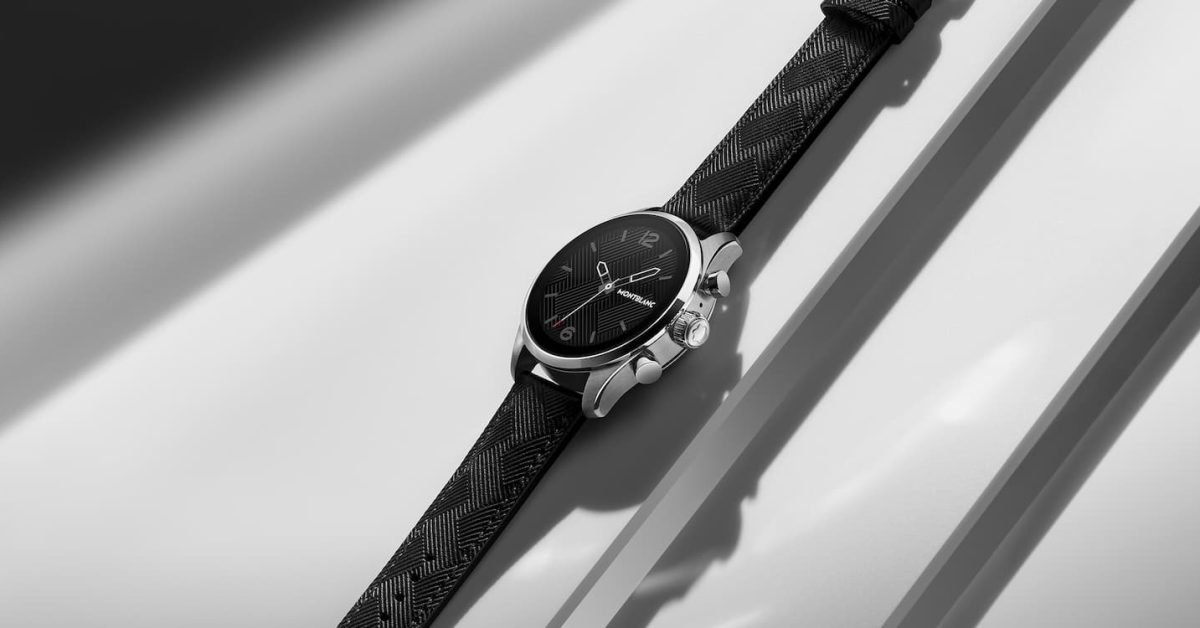
Wear OS 3 is finally on its way to other smartwatches, but its first new option is lacking a major feature. The Montblanc Summit 3 lacks support for Google Assistant entirely.
Announced last month, the Montblanc Summit 3 is a luxury smartwatch running Wear OS 3, the first smartwatch outside of Samsung’s Galaxy Watch 4 lineup to use the OS to date. The short story on the watch is that it runs with a Snapdragon 4100+, has a new companion app for setup, and Wear OS 3 in a relatively stock form, just with several of Montblanc’s apps pre-installed.
In a video from our friend Michael Fisher, it’s been fully confirmed that the Montblanc Summit 3 launches without support for Google Assistant in any capacity. That’s certainly a shocker, as Google Assistant has been a core part of Wear OS for years now.
why?
Unfortunately, there’s no clear answer on that just yet. Fisher says that he got the impression that Montblanc would have included Google Assistant on the Summit 3 if it were available, and Google only offered a generic response when asked about the state of the voice assistant on this watch in particular.
Our priority with Wear OS is to deliver a high performing platform for our partners and users, and we are taking the time to ensure our apps and services deliver a quality experience. We have nothing more to share at this time.
Also gone is Wear OS’s left-most screen that showed contextual information akin to the Google Now of yesteryear, but that was long-suspected in early Wear OS 3 previews. Rather, Google has opted to use both sides of the watchface for Tiles, with swipes up or down reaching the quick settings and notifications as was the case previously.
It’s probably safe to speculate that, going forward, Google Assistant on Wear OS is going to behave a lot more like what we see on the Galaxy Watch 4 series – an app that can be triggered using hardware keys or hotwords, rather than a core part of the operating system. In that light, it makes sense why it’s not pre-loaded on the Montblanc Summit 3, but it certainly has us curious where Google Assistant will be available – and even more so where it won’t – on future Wear OS 3 products.
You can check out Fisher’s full hands-on with the Summit 3 below, and we’re hoping to get our hands on the product soon!
More on Wear OS:
FTC: We use income earning auto affiliate links. More.
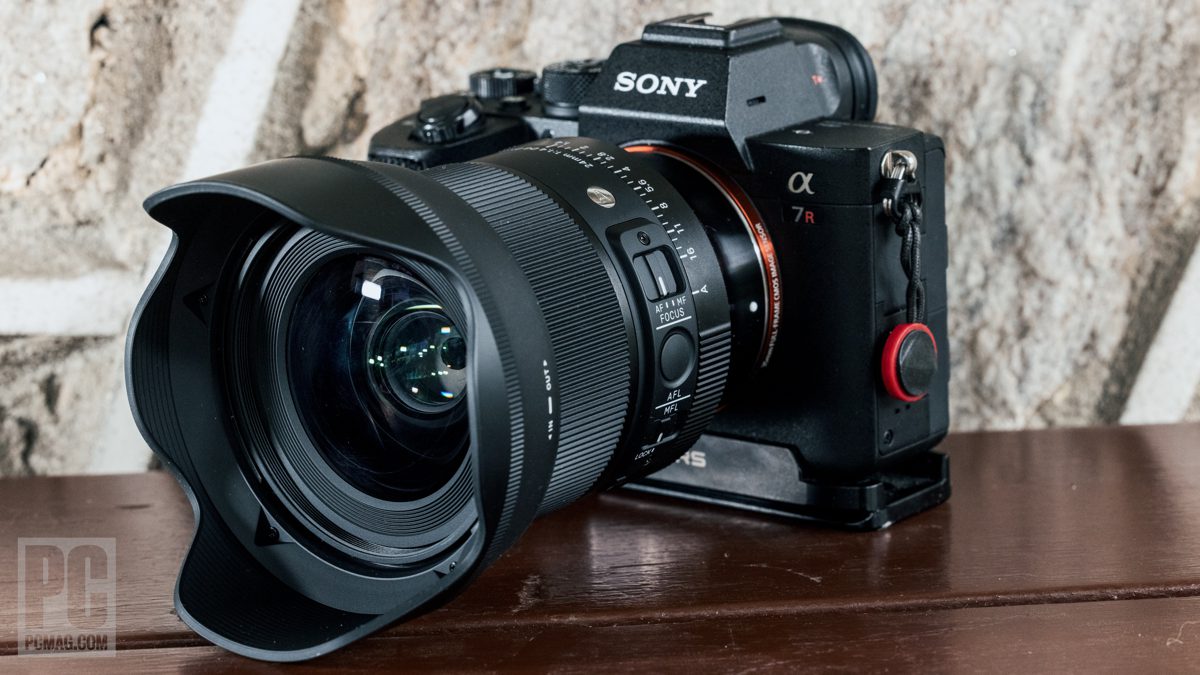
The Sigma 24mm F1.4 DG DN Art ($799) is the mirrorless successor to the company’s well-regarded 24mm F1.4 DG HSM Art for SLR systems. Available for both L-Mount Alliance and Sony cameras, the lens has a relatively carry-friendly design, weather protection for the outdoors, a wide aperture for blurred backgrounds and low-light photography, and robust on-barrel controls. Best of all, it significantly undercuts Sony’s top-end FE 24mm F1.4 GM ($1,399) on price. Simply put, if you’re chasing the F1.4 look, this recent Art entry might be the ideal wide standard prime for your bag. It earns our Editors’ Choice award, though it isn’t a clear favorite over the slimmer Sigma 24mm F2 DG DN Contemporary ($639), which remains a solid option for packing light.
A Standard Lens for Wide-Angle Photogs
In the manual focus days, most starter cameras bundled a 50mm lens, which many considered the standard angle at the time. Tastes have changed, though, and, today, almost every ILC kit lens is a zoom. For full-frame systems, a 24-70mm or 24-105mm is the standard. And many creators now appreciate the wide end of those zooms because the main camera on most smartphones tends to dance around the 24mm focal length.
The number of 24mm primes on the market is no surprise then. But the Sigma 24mm F1.4 DG DN Art sets itself apart from other sub-$1,000 options because of its complex optical formula and fully weather-sealed build. It gathers more light and is a better fit for use outdoors in rough weather compared with the Sigma 24mm F3.5 Contemporary ($549.99) or 24mm F2 Contemporary, for example.
As mentioned, the 24mm F1.4 Art is available fo L-Mount Alliance cameras from Leica, Panasonic, and Sigma, as well as for Sony’s E-mount mirrorless system. We received the latter version for review. It measures 3.8 by 3.0 inches (HD), weighs about 1.1 pounds, and supports 72mm front filters. It’s an easier lens to carry than the older 24mm HSM Art for SLRs (3.6 by 3.3 inches, 1.5 pounds), and only a bit bigger than Sony’s FE 24mm F1.4 GM (3.6 by 3.0 inches, 15.7 ounces).
Sony a7R IV, f/16, 1/2-second, ISO 100
Dust, splash, and anti-smudge fluorine protections are all here, so you can freely use the 24mm F1.4 Art in inclement weather along with a protected camera. The weather protection is on par with Sony FE lenses, including the 24mm F1.4 GM and budget-friendly FE 24mm F2.8 G. The weather protection is also a step above that of Sigma’s two 24mm Contemporary primes. The box includes a reversible lens hood; front and rear caps; and a soft zippered carrying case.
L-mount photographers only have a few autofocusing 24mm prime options. The Sigma 24mm F1.4 Art joins the aforementioned Sigma 24mm F2 and 24mm F3.5 Contemporary primes, as well as Panasonic’s Lumix S 24mm F1.8 ($899). Leica does not make a 24mm but does offer the APO-Summicron 28mm F2 ASPH, which costs a very Leica-like $5,195.
Sony system owners can use any of the aforementioned Sigma and Sony lenses, as well as true value options like the Tamron 24mm F2.8 1:2M ($249) and Rokinon 24mm F2.8 AF ($399). Both often sell for less than their official price; for instance, at press time, you can find them each for around $200.
Handling and Autofocus
We paired the 24mm Art with the full-frame Sony a7R IV for testing. The lens balances well—it’s not overly large or front-heavy like more exotic options such as the Sigma 20mm F1.4 DG DN Art. We definitely prefer the 24mm Art’s form for everyday photography, handheld use, and photo walks; the bigger 20mm Art is a more specialized tool for architecture and night sky photos.
Sigma puts a slew of controls right on the barrel, supplementing those on the camera body. Discrete rings set manual focus and adjust the f-stop. You also get a customizable function button that defaults to AF-ON on most cameras. Toggles include a Lock switch that disables the function button and focus ring when you engage it; this switch is a useful tool for astrophotographers who want to lock in focus on the stars. Another toggle switch swaps between manual focus and autofocus modes.
On-lens aperture control is handy for photos and video alike. The f-stop ring turns from f/1.4 to f/16 and clicks in at third-stop settings for photos. A toggle switch is all it takes to de-click the ring for silent, video-friendly operation. Photos who prefer to set aperture via the camera body have that option, too; the lens ring has a position to move aperture control to the camera body, along with a lock that prevents inadvertent swaps between camera-body and on-lens aperture control.
An STM focus motor drives the lens; it does so quietly and with aggressive speed. The lens drives across its entire focus range, locks, and makes an exposure in just 0.1-second. The manual focus response is nonlinear with Sony cameras, a mark against the lens for cinematographers who want to repeat focus racks from take to take. That said, you can pick between linear and nonlinear response on L-mount system bodies.
Some focus breathing is visible: The lens shows a slightly wider angle of view when you focus at closer distances than at farther ones. Photographers need not worry about this effect but it is a concern for video clips in which focus shifts from one subject to another—viewers tend to notice the change in angle. We haven’t tested a comparable 24mm prime that eschews the effect, however. A handful of Sony cameras offer an in-camera option to compensate for breathing with select lenses including the 24mm F1.4 GM, but not for third-party lenses.
Sony a7R IV, f/2.8, 1/200-second, ISO 200
Close-up focus is available to 9.9 inches, which is good enough for 1:7.1 life-size reproductions. If you’re looking for a wide prime for macro shots though, these results might disappoint. But that’s also the case with other wide aperture 24mm lenses. The Sony FE 24mm F1.4 GM gets a little closer (9.9 inches for 1:5.9 macros) and the Sigma 24mm F2 Contemporary is in the same ballpark (9.7 inches for 1:6.7 reproductions). Photographers who love leaning in are better off with the Sigma 24mm F3.5 or Tamron 24mm F2.8, both of which focus close for 1:2 magnification.
Sigma 24mm F1.4 DG DN Art: In the Lab
We paired the 24mm F1.4 DG DN Art with the 60MP Sony a7R IV and used Imatest software to evaluate its resolution in the lab. It’s an excellent performer (4,450 lines) wide-open and manages outstanding results (5,000 lines) by f/2.8 in the center of the frame. The lens shows some field curvature, so it doesn’t score well in the lab at the edges, but real-world images show sharp performance across the frame.
Sony a7R IV, f/1.4, 8-seconds, ISO 400
Sigma bills the 24mm F1.4 Art as a lens for astrophotography and, although I’m by no means a good night sky photographer, I tried the lens for that purpose. The lens is sharp across the frame at f/1.4, a benefit for disciplines that call for wide-open use. Unfortunately, it doesn’t live up to the promise of suppressing sagittal coma flare—brighter stars toward the edges of the frame show as crosses with some false purple color, not perfect pinpoints.
This crop from the image above shows the sagittal coma flare the exhibited toward edges of the frame
If you’re an astrophotography specialist, we recommend the Sigma 20mm F1.4 DG DN Art more strongly. It captures a broader view, suppresses coma across the frame, and also includes the focus lock feature for night sky work. Sony system owners may also want to look at the FE 14mm F1.8 GM, another astro-tuned lens with an even wider angle of view.
Sony a7R IV, f/2.8, 1/2,000-second, ISO 100
Optics are well-corrected for distortion. There’s just a hint of the barrel effect on Raw files, though dim corners in photos at f/1.4 are more of a nuisance. In-camera corrections do away with both for JPGs and photographers who prefer Raw images can take advantage of a lens correction profile. Sigma provided a Lightroom profile for us to try during testing, which proved effective.
Sony a7R IV, f/1.4, 1/800-second, ISO 100
At wider f-stops, the 24mm Art lives up to its moniker and blurs backgrounds for a soft, defocused look. The bokeh quality is pleasing; the optics draw highlights with smooth, soft edges, for generally soft backgrounds. We did note a bit of longitudinal chromatic aberration (LoCa) in some focus transitions, however. It pops up as false purple and green color just off the plane of focus. LoCa is not an issue in every photo, but it can be tricky to remove when it does appear. Lateral chromatic aberration is completely absent.
Sony a7R IV, f/11, 1/640-second, ISO 100
Landscape photographers may chase the sunstar look. The 24mm F1.4 Art produces its best starbursts at f/16. The stars have an impressive amount of lines, a result of the 11-blade aperture, but are not sharply defined. Flare control was not an issue with into-the-sun shots, however.
Premium Optics at a Reasonable Price
Sony a7R IV, f/16, 0.8-second, ISO 100
Sigma’s Art series lenses combine quality optics with premium build materials and often cost far less than first-party options. The 24mm F1.4 DG DN Art carries on the tradition—for around $800, the lens keeps up with expensive alternatives like the $1,400 Sony FE 24mm F1.4 GM in most respects. That said, pros and well-heeled enthusiasts may prefer the FE 24mm for its video-tuned linear focus response, compatibility with Sony’s breathing compensation function, and lighter weight.
For general use, we don’t have any major complaints about the 24mm F1.4 DG DN Art. Focus locks quickly, photos look sharp, and blurred backgrounds are easy to achieve. Add dust, splash, and anti-smudge fluorine protection, and you get a lens suitable for any condition, indoors or out.
Sony a7R IV, f/1.4, 1/320-second, ISO 100
We’re disappointed the lens doesn’t quite live up to its promise as an astrophotography specialist, however. Although stars were pinpoint through much of the frame, we did see the sagittal coma flare effect toward the edges. If you’re buying a lens strictly for astrophotography, the Sigma 20mm F1.4 DG DN Art is a better choice.
Of course, the 24mm F1.4 Art is just one of several excellent value options from Sigma. The company’s 24mm F3.5 DG DN Contemporary won us over because of its compact size and 1:2 macro focusing. And then, a few months later, the 24mm F2 DG DN Contemporary earned our Editors’ Choice award as a value option with a big f-stop.
As a reviewer, I don’t like to give every participant a trophy, but Sigma’s 24mm F1.4 DG DN Art also deserves our Editors’ Choice award. If you can’t quite justify the cost of the FE 24mm F1.4 GM and frequently work in inclement weather, this is the Sigma 24mm to get. We continue to recommend the 24mm F3.5 and 24mm F2 Contemporary as well. They’re still excellent lenses, but just now have upmarket competition.
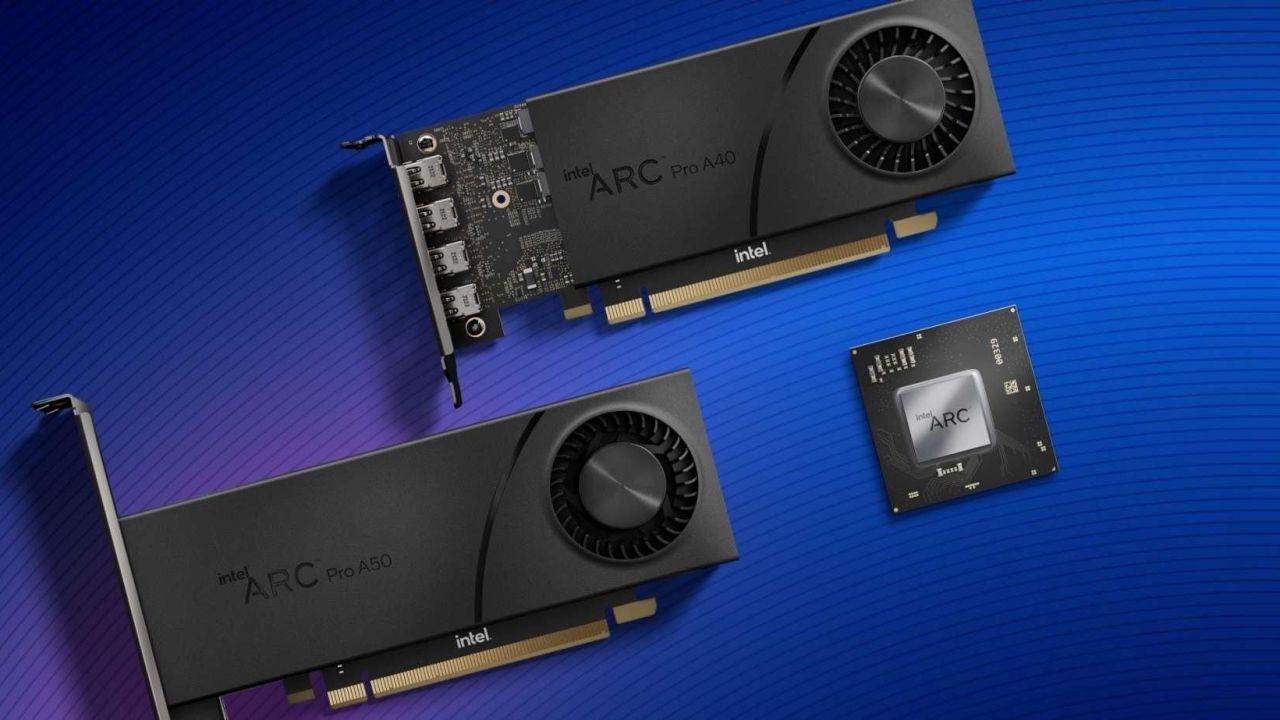
Intel this week revealed its new lineup of Arc Pro series GPUs intended primarily for powerful small form factor desktops and professionally focused laptops. All three of the GPUs, which Intel says are targeted at professional software applications in the architecture, construction, design, and manufacturing industries, offer built-in ray tracing and machine learning capabilities, and V1 hardware encoding acceleration. The reveal comes on the heels of several new Intel GPUs designed for gaming announced earlier this year, as the CPU giant tries to expand its product lineup to compete with the likes of Nvidia and AMD.
Intel showed off the new GPUs, dubbed the Arc Pro A40, A50, and A30M, in a blog post Monday. The A40 and A50 products are both intended for desktop workstations and feature a single and double slot form factor, respectively. The A30M GPU, meanwhile, is designed for laptops and offers similar performance to the A40 though with a tradeoff of less local memory.
According to Intel, the Arc Pro A40 will ship with 3.5 teraflops of power, eight ray tracing cores, 50W peak power, and 6GB of GDDR6 memory. The A50 offers the same in terms of ray cores and memory but offers a slightly higher 4.8 teraflops of graphical power and 75W peak power. Both the A40 and the A50 include four Mini DisplayPort connections. On the laptop side of things, the A30M offers the same graphical performance and ray tracing cores as the A40 though with a slightly lower 4 GB of GDDR5 memory.
By comparison, the weakest Nvidia RTX desktop workstation GPU, the Nvidia RTX 2000, starts at 6GB of GDDR6 memory and 8 teraflops of single-precision power. However, Intel’s cards can still carve a niche for themselves if the price is right, especially since they draw less power and have a single-slot option.
While no one’s going to stop you from using these GPUs for gaming, Intel made it clear that’s not what this series was specifically designed for. These GPUs are reportedly designed with creator apps like Adobe Premiere Pro, Davinci Resolve Studios, and Blender in mind. Intel didn’t provide pricing details or any hard date for when users can expect to get their hands on these new Pro GPUs, though it did say they’ll be available, “starting later this year.”
These more powerful GPUs come several months after Intel released its entry-level discrete Arc 3 GPUs in partner laptops. That series of GPUS sought to supply small mobile laptops with enough graphical power to play most games at 1080p. Not long after that, Intel teased the performance of its Arc A750 Limited Edition desktop graphics card. Since the Arc Pro GPUs are intended specifically for smaller PCs, we wonder if we’ll see beefier professional cards coming from Team Blue down the line.
The Kascada cabinet will be one of the showcase products for global gaming giantLight & Wonder, Inc. when the Australasian Gaming Expo kicks off in Sydney today.
Announcing its plans for the event overnight, L&W said it will unveil a number of new products at AGE – led by thewaterfall cabinet line and its catalog of game brands.
“Going into AGE, customers are seeing the result of some bold decisions we made in 2020 when we invested heavily in our studios and our hardware.,” said L&W’s Executive Vice President & Group Chief Executive, Gaming, Matt Wilson.
“This gave us a launchpad for success that has been steadily gaining momentum starting withKraken Unleashed,Fat Fortunes,Huff n’ More Puff and then Dragon Unleashed that has hit with four new games. It’s an overnight success story that has been two years in the making.
“Of course our story doesn’t end there, I’m super excited to be showingThunder Drums, Gold Fish Feeding Time and of course Jin Ji Bao Xi which has been remastered forWaterfall.”
L&W will also showcase its range of ETGs, including the new six-tab Vegas Star Quartz, bringing increased game combinations into play. Stadium Blackjackwill be able to featureside by sideRouletteXSic Bo, Baccarat and standard Roulette.
“AGE is a great opportunity for the L&W team to meet face to face with our customers and tell them how much we value their partnership as we embark on an exciting time in our company’s journey,” said Wilson.
As Netflix struggles to keep consumers subscribed to its streaming service, its mobile games venture is looking like a flop. CNBC reported that according to app analytics company Apptopia, Netflix games have been downloaded 23.3 million times in total, and on average, there are 1.7 million daily users. This means that fewer than 1% of the streaming giant’s subscriber base — around 221 million subscribers — are interested in Netflix’s games.
Netflix told TechCrunch it doesn’t disclose the number of players. However, the Apptopia’s report can shed light on just how unpopular its gaming offering is.
In comparison, leading mobile games like Subway Surfers, Roblox and Among Us each have more than 100 million downloads, per Apptopia. Netflix has a long way to go before it can reach this level of popularity.
Netflix recently lost nearly one million subscribers, so it’s not hard to see why the company wants to invest in more games. Netflix Games launched in 2021, and currently offers more than 25 games through the Netflix mobile app. The company intends to double its catalog by the end of 2022 and release over 50 games.
While Netflix hasn’t disclosed how much it’s spending to develop its mobile game division, the company has acquired three game studios: Boss Fight Entertainment, Night School Studio and Next Games. As TechCrunch has previously reported, the Next Games acquisition cost the streamer approximately $72 million.
In July, Netflix announced three new games, including award-winning titles Into the Breach and Before Your Eyes. Its catalog also includes a variety of games connected to popular Netflix shows, like “Stranger Things,” “Queens Gambit,” “Shadow and Bone” and “Too Hot to Handle.” If Netflix continues to explore leveraging its own IP for new games, that approach could draw in more subscribers.
However, shows that have been out for a while and don’t have a solid fan base probably won’t do as well as games based on “hot” series like “Stranger Things” for example. When season four of “Stranger Things” premiered, the two Netflix games based on the show — Stranger Things: 1984 and Stranger Things 3: The Game — saw a bump in downloads, Apptopia told TechCrunch.
To play a Netflix mobile game, subscribers can find them free in the streaming app in the dedicated games row. Players are redirected to download a separate app for each game. Once downloaded, only Netflix subscribers can play the games, which are available on Android and iOS devices.
No matter what the game, when a new season drops, it’s an exciting time for players. Apex Legends is just a matter of hours away from hitting Season 14, Hunted, which is bringing in all sorts of things players have been asking for. These include major rebalancing, new weapons, new loot tables, and the new legend, Vantage.
If you’re excited about this update, then you’re going to want to be there the moment it goes live so you can get your hands on the new stuff before anyone else gets a chance. That’s why we’ve collected the release date and launch times for Season 14 from all over the world, so you don’t have to miss a second of the action.
Apex Legends Season 14 release times in your time zone
The official date for the worldwide launch of Season 14 is August 9, however, if you’re in a far eastern timezone like those of Australia or Japan, it’ll actually be releasing very early August 10. This mean you’ll need to either stay up very late, or wake up very early if you want to play it the moment it drops. Alternatively, it’ll be nice and ready for you first thing in the morning.
Here is the full list of the launch time in each major time zone:
Tuesday, August 9
PDT: 10am.
EDT: 1 p.m.
BST: 6pm.
EST: 7pm.
IST: 10:30 p.m.
Wednesday, August 10
CST: 1 a.m.
JST: 2am.
AEST: 3am.
NZST: 5am.
If you want all the details on what’s coming in Apex Legends Season 14 then we’ve got plenty of stuff to keep you in the know. There’s a full breakdown of Vantage, the new character, the new laser sights, and a whole bunch of returning Apex Legends weapons.
As Netflix struggles to keep consumers subscribed to its streaming service, its mobile games venture is looking like a flop. CNBC reported that according to app analytics company Apptopia, Netflix games have been downloaded 23.3 million times in total, and on average, there are 1.7 million daily users. This means that fewer than 1% of the streaming giant’s subscriber base — around 221 million subscribers — are interested in Netflix’s games.
Netflix told TechCrunch it doesn’t disclose the number of players. However, the Apptopia’s report can shed light on just how unpopular its gaming offering is.
In comparison, leading mobile games like Subway Surfers, Roblox and Among Us each have more than 100 million downloads, per Apptopia. Netflix has a long way to go before it can reach this level of popularity.
Netflix recently lost nearly one million subscribers, so it’s not hard to see why the company wants to invest in more games. Netflix Games launched in 2021, and currently offers more than 25 games through the Netflix mobile app. The company intends to double its catalog by the end of 2022 and release over 50 games.
While Netflix hasn’t disclosed how much it’s spending to develop its mobile game division, the company has acquired three game studios: Boss Fight Entertainment, Night School Studio and Next Games. As TechCrunch has previously reported, the Next Games acquisition cost the streamer approximately $72 million.
In July, Netflix announced three new games, including award-winning titles Into the Breach and Before Your Eyes. Its catalog also includes a variety of games connected to popular Netflix shows, like “Stranger Things,” “Queens Gambit,” “Shadow and Bone” and “Too Hot to Handle.” If Netflix continues to explore leveraging its own IP for new games, that approach could draw in more subscribers.
However, shows that have been out for a while and don’t have a solid fan base probably won’t do as well as games based on “hot” series like “Stranger Things” for example. When season four of “Stranger Things” premiered, the two Netflix games based on the show — Stranger Things: 1984 and Stranger Things 3: The Game — saw a bump in downloads, Apptopia told TechCrunch.
To play a Netflix mobile game, subscribers can find them free in the streaming app in the dedicated games row. Players are redirected to download a separate app for each game. Once downloaded, only Netflix subscribers can play the games, which are available on Android and iOS devices.
Almost every major camera manufacturer has either openly discontinued its point-and-shoot line of cameras or has not produced a new one in many years, according to a new report. In short, smartphones have all but totally replaced compact cameras.
The compact camera market, colloquially known as point-and-shoot cameras, has been experiencing a massive collapse in worldwide shipments over the last decade and a half. Since 2008, when worldwide shipments reached 110.7 million cameras, the market has significantly shrunk and failed to 3.01 million units as of 2021 — a 97% drop.
Nikkei reports that in response to the market’s contraction, Canon, Nikon, Panasonic, Fujifilm, and Sony have all either dramatically scaled back productions or outright admitted that there will be no further compact cameras.
“Although we are shifting to higher-end models, we have strong support for lower-end models, and will continue to develop and produce them as long as there is demand,” Canon tells Nikkei.
Canon denies that it isn’t planning to make new compact cameras, but it hasn’t released a new one since 2019.
Sony’s response echoes Canon’s and the company says that it is not discontinuing new product development in the compact camera space, although Nikkei notes the company hasn’t made a new “Cyber-Shot” camera — its compact camera line — since 2019.
Nikkei reports that Nikon has stopped developing cameras that would fall under its “Coolpix” line, the company’s branding for compact point-and-shoot style cameras. Nikon tells Nikkei that it still sells two high-magnification models and that future production volume will be determined by the market, which as noted, isn’t growing.
Panasonic, which at one point owned the top share of Japan’s compact camera market, tells Nikkei that it has been reducing the volume of point-and-shoots that it has been producing over the last several years in response to the shrinking market. Additionally, while it plans to keep making current compact cameras for the time being, it will focus on developing high-end mirrorless cameras aimed at enthusiasts and professionals, including a camera that it plans to release next year that it is developing in conjunction with Leica .
Nikkei claims Fujifilm has ceased production on its compact camera line “FinePix” and is not actively developing new models for it, instead focusing its efforts on higher-end models like the X100V and above.
Ricoh, which owns the Pentax brand, and OM Digital aren’t mentioned in the story, but Ricoh seems unfazed by the market contraction and has notably released two point-and-shoot cameras in the last year: the WG-80 and the GR IIIx (and later along with its special edition). Ricoh seems immune to making decisions in line with market trends, as it has also stubbornly refused to make a mirrorless Pentax camera, going so far as to say that the brand “cannot go mirrorless.”
It has been a long, slow process, but the death of the point-and-shoot appears all but complete at the hands of the smartphone, whose imaging capabilities manufacturers continue to improve.
Image credits: Elements for header photo licensed via Depositphotos.
Robotic or automated manufacturing helps streamline workflow and advance manufacturing processes, allowing companies to remain globally competitive. One of the key factors in these processes is quality control which often requires validating or checking the materials used in the processes.
Image Credit: Shutterstock.com/ Willyam Bradberry
Now, researchers at the Beijing Institute of Nanoenergy and Nanosystems have developed a ‘smart finger’ that has the capacity to identify materials using “triboelectric” sensors that test its ability to gain or lose electrons, as well as determining other characteristics such its roughness, without the risk of causing damage. Published in the journal Science Advancesthe team describes how they developed the triboelectric smart finger.
In principle, as each material has different capabilities to gain or lose electrons, a unique triboelectric fingerprint output will be generated when the triboelectric sensor is in contact with the measured object.
Dan Luo, CAS Center for Excellence in Nanoscience, Beijing Institute of Nanoenergy and Nanosystems
Machine Learning and Quantifying Material Parameters
Humans rely on haptic feedback as an essential sensory function when in direct contact or communication with the surrounding environment.
Tactile perception originates from the response of subcutaneous tactile corpuscles to different stimuli in the environment and the brain’s recognition of signals afferent through nerve fibers.
Dan Luo, CAS Center for Excellence in Nanoscience, Beijing Institute of Nanoenergy and Nanosystems
Typically, quantifying material parameters precisely at the psychological level of tactile perception can be a challenge when it comes to identifying the texture and roughness of a material. The smart finger developed by the researchers also uses machine learning to help improve the triboelectric tactile perception in the mechanism and aid human users of such systems.
Moreover, the team has reported that they have developed a smart finger that has surpassed human tactile perception, enabling accurate identification of material type and roughness through the integration of triboelectric sensing and machine learning.
They claim the smart finger has at least 90% accuracy when sensing the material surface, which suggests that the technology has potential use in automating robotic manufacturing tasks, including materials sorting and quality control assessments.
Developing a Smart Finger
In recent years, various efforts have been made to design sensors or devices with the capacity to identify materials based on various strategies, such as computer vision, thermal conductivity, ultrasound, etc. As a result, computer systems and robots are becoming increasingly proficient at interacting with the world around them, but they will also require a sense of touch before they can reach their full potential.
When tested across a varied number of samples, such as plastic, wood, silicon and glass, the smart finger demonstrated an average accuracy of 96.8% and at least 90% accuracy for all materials.
The system integrates machine learning-based data analysis with four small square sensors, each made of a different plastic polymer that was specifically chosen for its electrically conductive properties. The sensors are housed in a case that resembles a finger, hence the name ‘smart finger’.
When the sensors come into contact with an object’s surface, electrons from each square begin to interact with the surface in a different manner, which the team was then able to measure.
Each of the sensors is connected to a processor and organic light emitting diode (OLED) screen, which highlights the material type being assessed. In effect, the researchers were able to quantify tactile psychological parameters using the triboelectric effect, which could set a new paradigm when it comes to modeling human tactile perception.
Real-World and Future Scenarios
In a real-world scenario, the processor could be directly integrated into a manufacturing control mechanism. The smart fingers could then perform quality control checks and determine whether products are up to manufacturing standards.
Beyond the industrial/manufacturing setting, smart fingers could also be used in prosthetics as robotic limbs with a sense of touch to enhance manipulation techniques and the handling of objects.
The team also aims to introduce other sensors into the system, which include pressure, temperature, and humidity sensors, to help improve the tactile simulation.
In the future, artificial intelligence chips will be integrated into smart fingers to make them “smarter” and confer the ability to process data independent of the computer.
Dan Luo, CAS Center for Excellence in Nanoscience, Beijing Institute of Nanoenergy and Nanosystems
References and Further Reading
Qu, X. and Liu, Z., et al., (2022) Artificial tactile perception smart finger for material identification based on triboelectric sensing. Science Advances, [online] 8(31). Available at: https://www.science.org/doi/10.1126/sciadv.abq2521
Disclaimer: The views expressed here are those of the author expressed in their private capacity and do not necessarily represent the views of AZoM.com Limited T/A AZoNetwork the owner and operator of this website. This disclaimer forms part of the Terms and conditions of use of this website.
If you purchase an independently reviewed product or service through a link on our website, Rolling Stone may receive an affiliate commission.
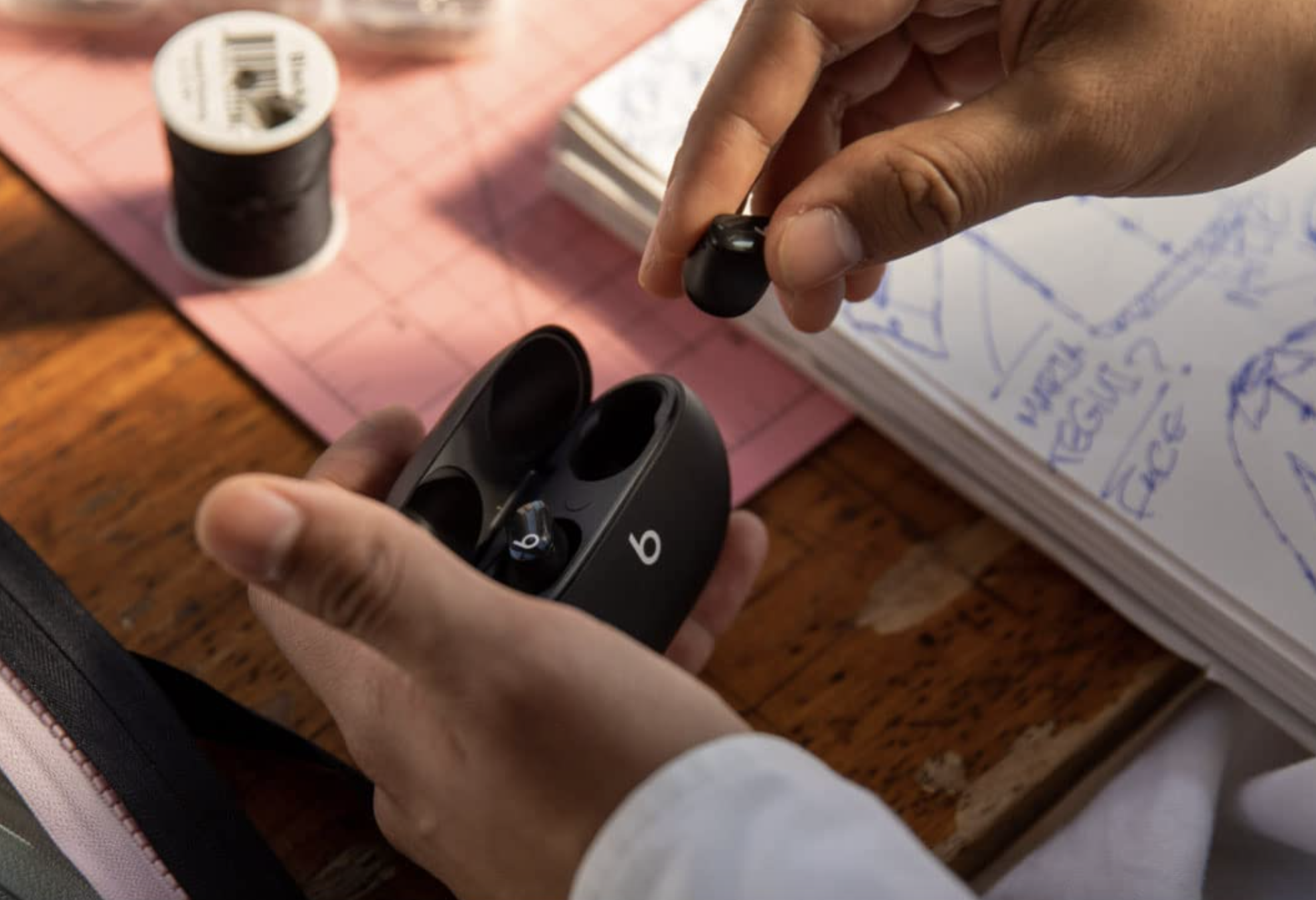
Whether you’re hitting the gym, hiking a new trail or walking through the city, a good pair of wireless earbuds is a must. And, our favorite Airpods Pro alternative, the Beats Studio Buds are currently on sale for just $99.95 — a whopping $50 off from their original price of $149.95.
Courtesy Amazon
Buy: Beats Studio Buds at $99.95
For just under $100, these Beats earbuds pack a whole lot of features. We particularly liked their weightless design and comfortable fit. They weigh just about 5.1 grams ‚ even lighter than the AirPods Pro. The fit can be further personalized if needed, with the three available ear tip sizes.
As for sound quality, you’ve got bass-forward audio and incredibly well-balanced treble and mid-ranges. Whether you’re listening to The Weeknd’s Best Friends or break my soul by Beyoncé, your new Beats earbuds won’t disappoint. There’s active noise canceling too just in case you need to tune out your surroundings.
The battery life outshines most other wireless earbuds on the market, lasting a full eight hours on one charge. The wireless charging case can hold an additional 16 hours of listening time. These buds are also IPX4 water-resistant, meaning they can withstand sweat or light rain as you go about your day.
There’s a built-in microphone as well if you ever need to take a call in between your jamming sessions or if you need to access your chosen voice assistant. These buds are also compatible with both iOS and Android devices, allowing you additional listening flexibility.
Grab any of the five available shades of the Beats Studio Buds for just $99.95 right now, the lowest price we’ve seen on these wireless earbuds since Prime Day. Shop now while stocks last.