It’s a beautiful day in the cult. My benevolence of followers is worshiping at my shrine, their hearts full of faith after witnessing my beautiful marriage to a pig named Pano, just days after my first marriage to a donkey, also named Pano. They smile as they toil away, chopping wood and consecration it into wooden boards. It is time for me to make the rounds, blessing my followers and extorting them for tithes.
In Cult of the Lamb, I play as an adorable lamb given a second lease on life. A dark god rescued me from the clutches of death. In exchange, I will build a cult in their honor of him. I set to work dungeon crawling to gather resources and recruit cult members — all of whom are humanoid animals, just like me. I build facilities, hold sermons and rituals, and grow their loyalty through individual interactions. I approach Thormermer the fox as he prays, and select “extort tithes.” But when I talk to hug the dog, I notice I have the option to “pet dog,” so of course I do.
Other followers do not have the “pet” option
Image: Massive Monster/Devolver Digital via Polygon
You can pet dog followers
Image: Massive Monster/Devolver Digital via Polygon
It’s a cute little Easter egg that’s popular in video games. There’s an entire twitter-account dedicated to the pressing question of whether you can pet dogs in various titles. But Cult of the Lamb‘s version is a little different, as all of your followers are animals of similar shape and attitude, and you can’t pet any of those. Sucks for them, I guess.
It also fits into the game’s weird, devilish sense of humor that often pairs incredibly fucked-up things — like ritual sacrifice and cannibalism — with intensely adorable features like frog acolytes, cute chats, and a dedicated “baa” button. (Yes, you can hit a button and baa anytime, just like stray‘s meow button.) I’ll be sure to pet the dog in between making my spouse shit sandwiches.
Image: Massive Monster/Devolver Digital via Polygon
Google is working on making cloud games easier to find on its search page. The company hasn’t officially announced the feature publicly, but Ars Technica and The Verge have confirmed that the new Play Now ability showed up for them in separate instances.
Play Now essentially adds cloud gaming links to the landing page for the game you’re searching for so that you can instantly hop in from the Google Search page. Clicking the Stadia option should just boot the game up, while links for other services will take you to their own webpages. It seems the feature has just started rolling out, so don’t fret if you don’t see it pop up yet. It showed up for Gizmodo’s deputy editor of consumer tech, Michelle Ehrhardt, but only for destiny 2. Sorry to my editor, who now has an active Stadia account.
I reached out to Google for more information on the Play Now ability and to confirm whether it’s live. I will update when I hear back.
What you’ll see if you have the Play Now ability available on Google Search. (Screenshot: Michelle Ehrhardt/Gizmodo)
If you have the ability, the Play Now tab appears on desktop browser searches for certain video games. I tried the ability twice on two different Google accounts — both times logged into my main Stadia account — and nothing appeared. But Ars Technica has more screenshots that show what it looks like when the Play Now feature is available.
The screenshots show the main Google page with a popular game typed into the search bar. Ars tried typing in games like destiny 2, Controland Fortnite. If it’s on streaming, the play now column will sprout up on the right-hand side, underneath the main title card. If the game is available to play on competing cloud platforms, like Amazon Luna or Nvidia GeForce Now, you’ll see a Play shortcut for those sites, too.
Even if you don’t have the Play Now tab in your search results, querying Google for a game will usually bring up a streaming link on the first page. Usually, a Stadia link shows up, often mixed in with links of where to buy the game outright.
The new Play Now capability might be the proof some users need that Stadia isn’t going away, despite what the blogs — including my blog — have foretold. I’m of the thought that Stadia is going to end up like Google’s other pet projects, which often get rolled up into something greater. It’s not hard to imagine that this plan to instantly launch games is an offshoot of Google’s other instant play ventures — remember the ability to stream Batman: Arkham Knight
for AT&T customers earlier this year? (Now it’s Control.) Who needs the Stadia branding when it’s the web browser helping to facilitate all that?
The idea of being able to quickly jump into a game hosted up in the cloud has clearly taken off — there are so many more choices than there were a mere two years ago. But for Google, it seems the goal is to hone in on the technology so that it becomes a significant part of its most influential real estate on the web: its search engine.
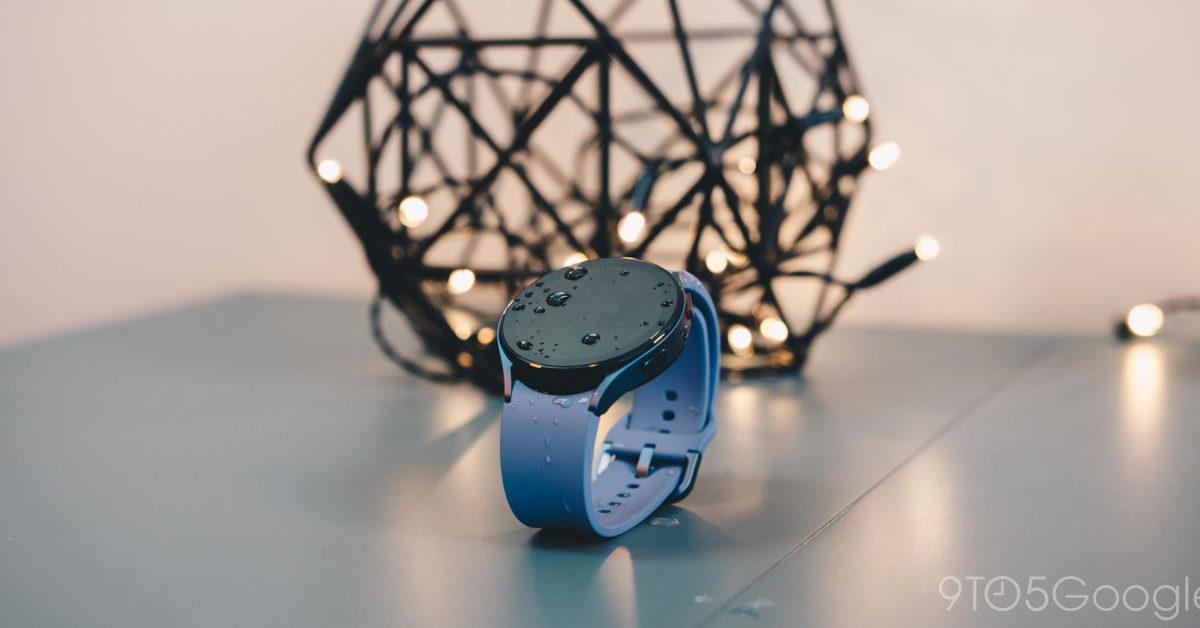
For the last few years, wearables like the Galaxy Watch series have been designed to deal with water exposure at varying levels. The Galaxy Watch 5 can certainly take a splash or two, but at what level? This guide will help you determine just how waterproof your Galaxy Watch 5 is and what you can do with it using Samsung’s Water Lock.
The Galaxy Watch 5 is most definitely water resistant. Not only can it take running water pouring over it, but the watch can also be completely submerged without being damaged at all. In fact, Samsung has workouts in the Samsung Health app specifically designed for swimming exercises. So what can the Galaxy Watch 5 take?
Galaxy Watch 5’s waterproof IP rating and meaning
The Galaxy Watch 5 and 5 Pro both have an IP68 rating, which is broken down into two variables.
The first number indicates the level at which it can resist solid particulates like dust and debris. The second number represents the resistance level of liquids. So, in the Galaxy Watch 5’s case, the dust resistance rating is a 6 and water is an 8, both very high on the spectrum.
IP68 is generally accepted as a very good rating and will allow you to take a swim with the watch and have no issues if you only do it for a certain amount of time. At a rating of IP68, you can submerge your watch for up to 30 minutes at a depth of 1.5 meters. Samsung doesn’t specifically say you can swim with the watch – nor do we advise it – but the company does offer multiple swimming exercises specifically for the Galaxy Watch 5 and 5 Pro.
A different rating the Galaxy Watch 5 has for water use is 5ATM, which refers to the amount of water pressure it can undergo before water starts rushing into the openings, causing damage to the watch. A rating of 5ATM will get you 50 meters deep before your Galaxy Watch 5 will start experiencing issues.
Both of these ratings refer to water resistance, though they can give you insight into different aspects of it. For instance, an IP68 rating lets you know that the watch can withstand a depth of 1.5 meters for a certain amount of time, while the 5ATM rating lets you know what the maximum depth you can reach is before causing damage to the device. One has to do with time, while the other shows you the extremes you can go to.
Can I go swimming with the Galaxy Watch 5?
With all the technical information out of the way, deciding whether to swim with your device comes down to judgment. Are you doing laps with the Galaxy Watch 5, or are you relaxing in the pool for hours on end?
If it’s the latter, we don’t recommend taking your watch in with you. However, above 1.5 meters for under 30 minutes – according to Samsung and the rating stated – is perfectly fine.
Anything less than that is also fine. You can wash your hands with the Galaxy Watch 5 or even reach into an ocean pool to grab a seashell – as long as you run the watch under fresh water afterward. Just don’t go deep-diving or free-diving with the Galaxy Watch 5, since that would most definitely end in a damaged watch.
Water Lock and cleaning your Galaxy Watch 5 after use
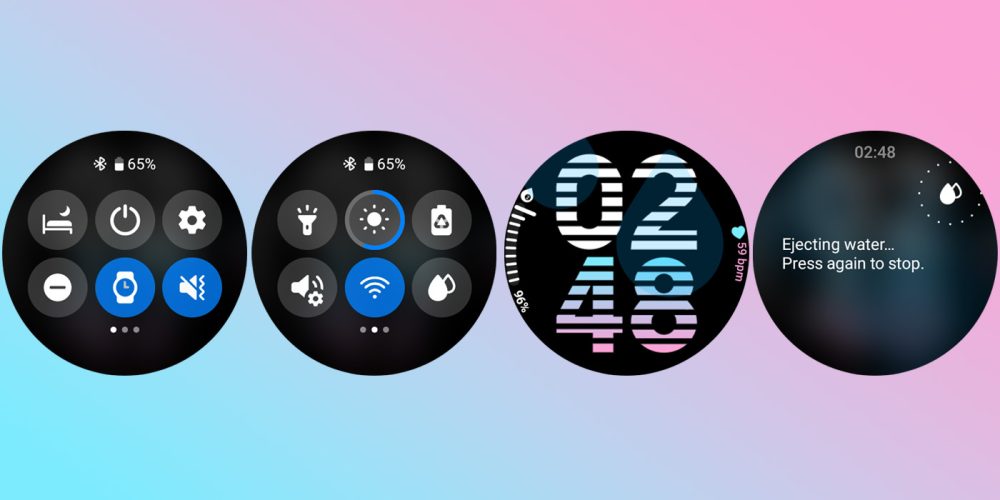
If you decide to take a few laps in the pool or even in the ocean, there are a few measures you should take before and after the dip. First, you need to know how to use the Galaxy Watch 5’s Water Lock to ensure it remains waterproof. Water Lock is a feature that turns off your watch’s touch recognition, which prevents water from activating phantom touches on your device. When this is active, you won’t be able to interact with your Galaxy Watch 5 display.
The added benefit of this feature is when Water Lock is turned off, the Watch 5 undergoes a process that pushes all of the water out of the speakers built into the device by means of low-frequency sounds. The bass pushes out air and water from the Watch 5’s speaker grills, ridding the device of liquid.
Here’s how to activate Water Lock on the Galaxy Watch 5:
On the Galaxy Watch 5, swipe down from the watch face.
Swipe to the left until you see a water droplet icon. Tap it.
You’ll see a faint water droplet icon appear on your main watch face. This means Water Lock is active.
After your swim, deactivate it by holding the Home key for 2 seconds.
You should hear and feel a few loud vibrations.
You might want to run your device under warm water before turning off Water Lock, which will get any contaminates off the screen and from around the body of the watch. After that, disable Water Lock, and you’re good to go.
Note: You don’t have to turn Water Lock on to protect your device. The feature mainly protects against false touches. If you forget, don’t worry. You can turn the feature on and off again to activate the water ejection sounds.
In the end, it all comes down to good judgement. Before swimming, make sure you know how deep you’re going and how long you’ll be under. Make sure you activate Water Lock and clean your Galaxy Watch 5 afterward. Following those guidelines will ensure your Watch 5 and 5 Pro last a good while.
More on Galaxy Watch 5 and 5 Pro:
FTC: We use income earning auto affiliate links. More.
Here’s something that probably won’t surprise Waluigi fans (at least we think!) — Waluigi has gone viral on TikTok. But not for the reasons you might think.
Last week, Emily Yates — Cherrie Sorbet on TikTok — shared a video on TikTok that showed seven different people dressed up as Waluigi. The reason? It was for a bachelorette party — or a hen night, for those of us in the UK. Yes, really, a Waluigi bachelorette party. Did you know there are seven different variations of Waluigi? We didn’t until this.
After the video took the internet by storm, Yates spoke to Kotaku about how she came up with the idea. Yates wanted to do something chaotic for her party, but she did not want to copy anyone else. Yates settled on Waluigi because he’s “just a lanky being of pure chaotic energy”, and we couldn’t agree more. We’re actually a little more surprised that a Waluigi party hasn’t happened before, but Yates has likely started a trend off with her own.
Of course, it’s all well and good throwing the party, but getting people to attend and participate was a whole other thing. To convince people to join in, she put together a PowerPoint Presentation—classic! And even though some of her friends and her family were confused, she still managed to get seven people (originally nine, but two people had to drop out) to join in!
You can check out all seven costumes in the video below, where each Waluigi tries to guess which one will have one too many drinks. That should give you an idea of how the party went!
Of these seven “wah-sonas”, Yates was Elvis Waluigi. Yep. And the bride-to-be made her her own costume from scratch — which she will potentially share more videos of on TikTok in the future. But she doesn’t plan to wear the costume down the aisle. However, she’s been delighted by the response the video has received over on Twitter.
Our favorite Waluigi has to be Cult Waluigi — can you imagine the spiritual chaos he’d cause if this was a real variant? Nintendo, take note.
Tell us what your favorite Waluigi variant is in the comments!
We’re anticipating a high-stakes showdown between the Samsung Galaxy Watch 5 vs. Google Pixel Watch this failed. After all, whichever is a better Wear OS will determine what’s the best smartwatch for Android for the year.
The recently-announced Samsung Galaxy Watch 5 has a lot going for it. It has a new skin-temperature reader, more scratch-resistant display and 50 hours of battery life. The Samsung Galaxy Watch 5 Pro, meanwhile, has 80 hours of battery life to power through outdoor sports.
But the Google Pixel Watch is expected to crash the Galaxy Watch 5’s party this fall. Ever since it was confirmed at Google I/O, the company’s first smartwatch has looked poised to become the ultimate accessory for Pixel smartphone users.
Since the Pixel Watch isn’t here yet, we can’t say whether one smartwatch is better than the other. But based on what we know so far, we can speculate on how the Galaxy Watch 5 vs. Pixel Watch might compare in terms of price, appearance, battery life and more.
And may the best smartwatch ultimately prevail.
Samsung Galaxy Watch 5 vs. Google Pixel Watch: Price and availability
Rumors about the Google Pixel Watch price position the smartwatch between $300 and $400. It’s looking like the Google smartwatch will come in two sizes, but unclear if it’ll also include LTE versions.
According to tipster Jon Prossor, the Google Pixel 7 and Pixel 7 Pro release date could be on October 13, with pre-orders possibly going up on October 6. Assuming the Pixel Watch is announced at the same time as the Pixel phones, we could see it as early as the last week of September. Google hasn’t confirmed the price or release date, so this is just speculation.
The Samsung Galaxy Watch 5 is available as of August 26, 2022 and starts at $279 for the 40mm Bluetooth model. The 40mm LTE model starts at $329. The price goes up to $299 and $349 for the 44mm configurations for Bluetooth and LTE, respectively. The Samsung Galaxy Watch 5 Pro, the new “rugged” model, costs $449 for Bluetooth and $499 for LTE. It comes in just one 45mm size.
Samsung Galaxy Watch 5 vs. Google Pixel Watch: Design
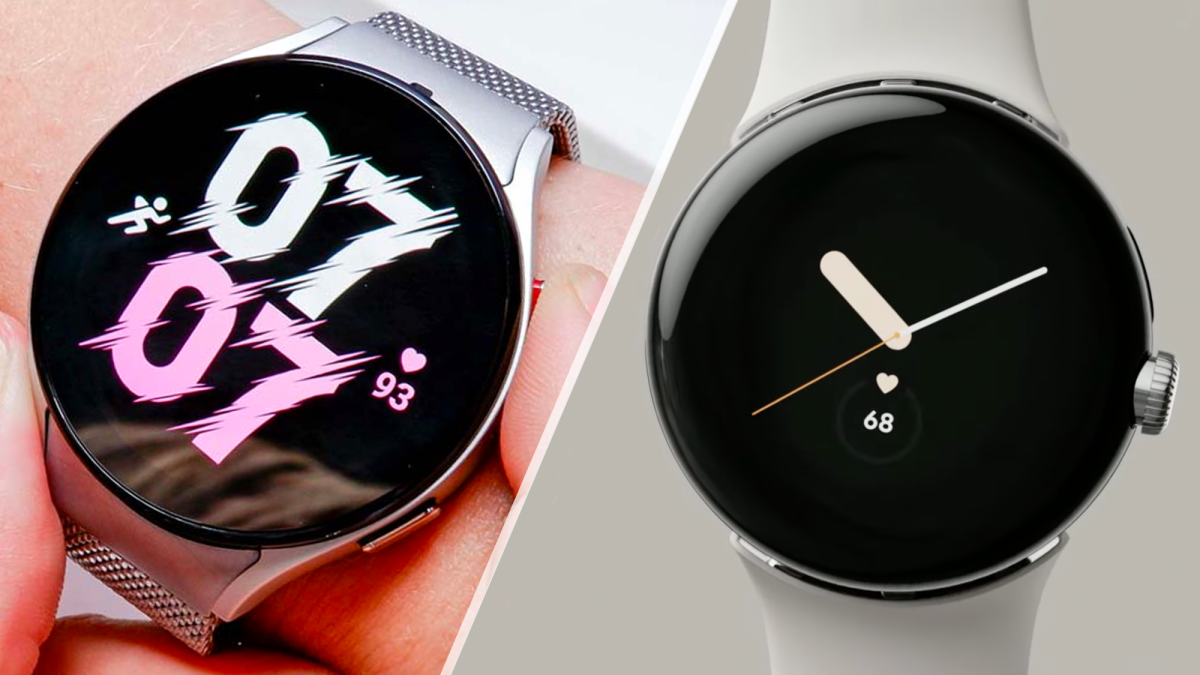
From the small glimpse we’ve received, the Google Pixel Watch design appears to sport rounded face with what looks like a digital crown and a pair of buttons on the right side. Google revealed the device in silver, though we’ll expect to see at least two color options offered. Either way, the Pixel Watch presents as a minimalistic smartwatch, perhaps to follow the design language of other Pixel devices.
(Image credit: Future)
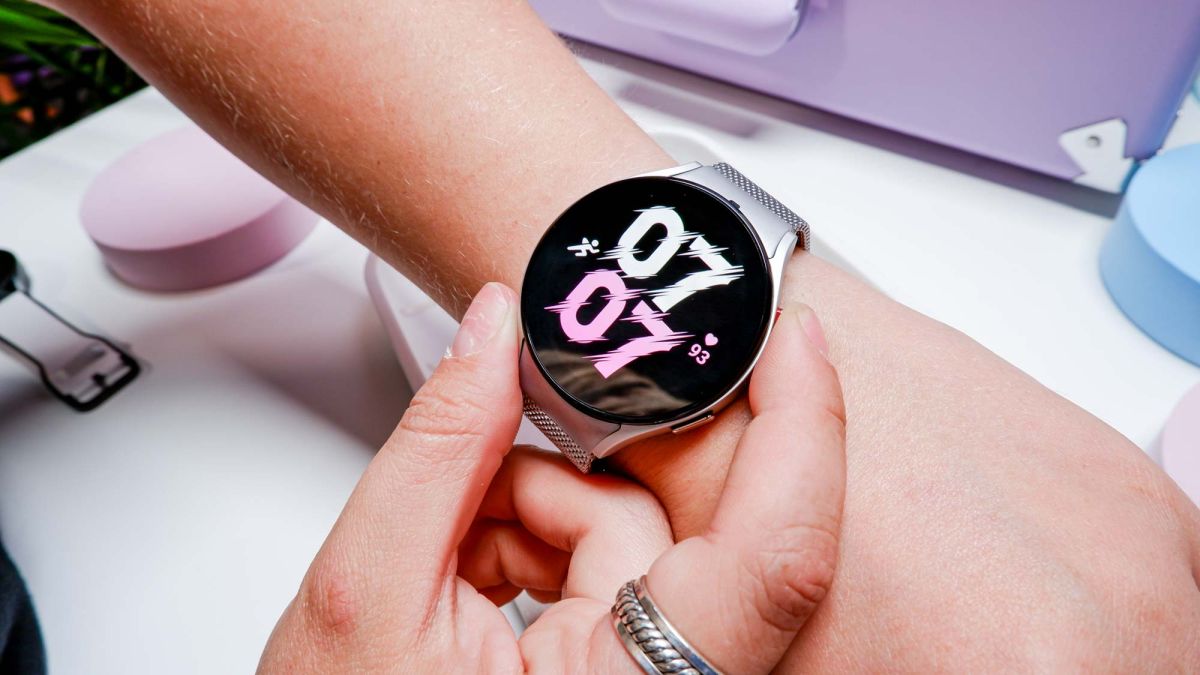
The standard Galaxy Watch 5 is sleek and sporty-looking, also with a round face. It features a reshaped curvature on the bottom, creating more surface area for watch-to-skin contact and thus more accurate health data collection. Also, the display is now made of sapphire crystal glass, which is supposed to be stronger against scratches by 60% more than before.
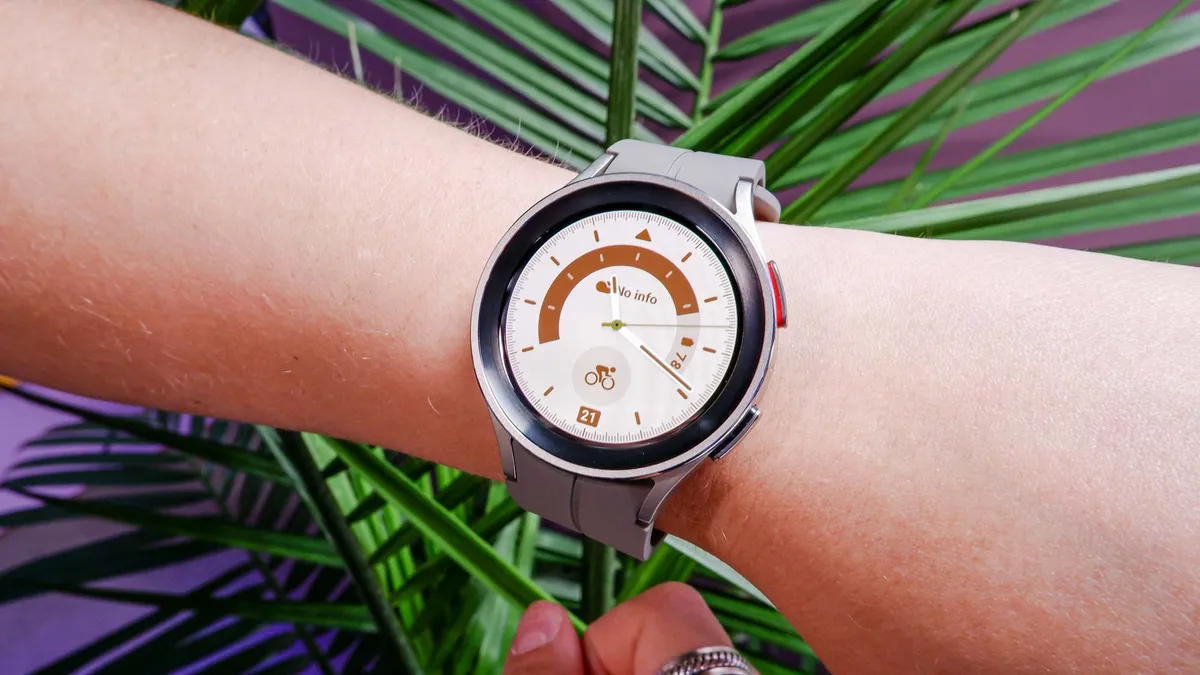
Pitched a more premium, yet outdoor sports-friendly companion, the Galaxy Watch 5 Pro comes in a titanium case and formidable 45mm size. The case is actually elevated around the display, as to further protect the screen from scratches.
(Image credit: Future)
The Galaxy Watch 5 comes in four colors: Graphite, Silver, Sapphire (44mm only) and Pink Gold (40mm only). The Galaxy Watch 5 Pro comes in Black Titanium and Gray Titanium
Samsung Galaxy Watch 5 vs. Google Pixel Watch: Features
For now, we don’t know much about what the Pixel Watch will offer in terms of features. We’re sure it’ll run Wear OS and offer apps like Google Assistant, Google Maps and even the new Google Wallet with IDs announced with Android 13.
Google has suggested that Pixel Watch will also leverage Fitbit fitness tracking in some ways. The inside is still a mystery, but incorporating advanced health sensors such as ECG or EDA could make the Pixel Watch one of the best fitness trackers like the Fitbit Sense.
(Image credit: Future)
The Samsung Galaxy Watch 5 is also a Wear OS watch, but as Samsung tailors Android OS for its smartphones, Wear OS powered by Samsung presents an exclusive user experience. It has many Google programs, but the primary fitness-tracking platform is Samsung Health.
The Galaxy Watch 5 has some notable sensors, including a bioelectrical impedance analysis (BIA) system for measuring body composition and the Samsung Galaxy Watch 5 skin temperature sensor, which is new this year.
There are some GPS-specific features on the Samsung Galaxy Watch 5 Pro as well. It’ll be interesting to see whether the Pixel Watch is pitched as a good hiking or outdoor biking watch and rival Samsung’s Pro model.
Samsung Galaxy Watch 5 vs. Google Pixel Watch: Battery life
Sources say the Pixel Watch’s battery capacity will be 300 mAh. It’s not clear whether this capacity will be consistent across the rumored multiple models of the Pixel Watch, but if we had to guess, the Pixel Watch battery life with regular use will max out at about two days.
The Galaxy Watch 5 has a 15% bigger battery than the Galaxy Watch 4, promising up to 50 hours of battery life. That’s about 10 more hours than before, and also falls around two days. It’s possible the Pixel Watch and Galaxy Watch 5 wind up evenly matched in terms of battery life.
That probably won’t be true for the Galaxy Watch 5 Pro, though. Samsung rates the outdoor sports watch for 80 hours of battery life, so that it can keep up with adventures that require GPS use.
Samsung Galaxy Watch 5 vs. Google Pixel Watch: Outlook
At this point in time, it’s impossible to say which of these will be the better Wear OS smartwatch. But we can’t ignore that Samsung has the advantage in terms of experience and share in the wearable market.
While currently Pixel phone users can use any of the best Samsung watches, some features are tailored to those with Samsung phones. Soon, those with Pixel phones will have a smartwatch made for their product ecosystem. It remains to be seen whether the Galaxy Watch 5 or Pixel Watch will do its job the best.
Soon after Samsung revealed its new Galaxy Watch 5-series, Oppo has launched two new smartwatches in China. The Oppo Watch 3 series features two models – the Watch 3 and Watch 3 Pro. Here’s a deeper look at what Oppo’s latest wearable devices have to offer.
The Oppo Watch 3 and Watch 3 Pro are the first devices to be powered by Qualcomm’s Snapdragon W5 Gen 1 chipset. Both watches have 1GB RAM and 32GB internal storage. In addition to the first Qualcomm chipset for wearable devices, the smartwatches also feature Oppo’s in-house developed Apollo 4 Plus chip, which will help extend battery life.
Both devices have a premium design, are made of aluminum and have 100 workout modes and 150 watch faces. They also feature the same set of sensors which include an accelerometer, geomagnetic sensor, optical heart rate sensor, blood oxygen sensor, ECG sensor, ambient light sensor, air pressure sensor and gyroscope.
Connectivity options include Bluetooth 5.0, GPS/Beidou/GLONASS/Galileo/QZSS, , eSIM and NFC and offer 5ATM water resistance. For those interested in making calls, Oppo has LTE and non-LTE variants for both the Watch 3 and Watch 3 Pro.
So, what’s different?
There are some noticeable differences between the Oppo Watch 3 and Watch 3 Pro. While the Watch 3 comes with a 1.75-inch AMOLED screen with 3D glass on top, the Watch 3 Pro has a larger 3D curved 1.91-inch LTPO AMOLED screen.
Another aspect where the smartwatches differ is the battery capacity. The Watch 3 features a 400 mAh battery that Oppo claims can be charged in 60 minutes. The Watch 3 Pro meanwhile, has a larger 550 mAh battery. The higher battery capacity and LTPO screen compensates for the increase in screen size, allowing the watch to last up to 15 days when used lightly.
Without the strap, the Oppo Watch 3 weighs 31.9 grams whereas the Watch 3 Pro is slightly heavier at 37.5 grams.
Pricing
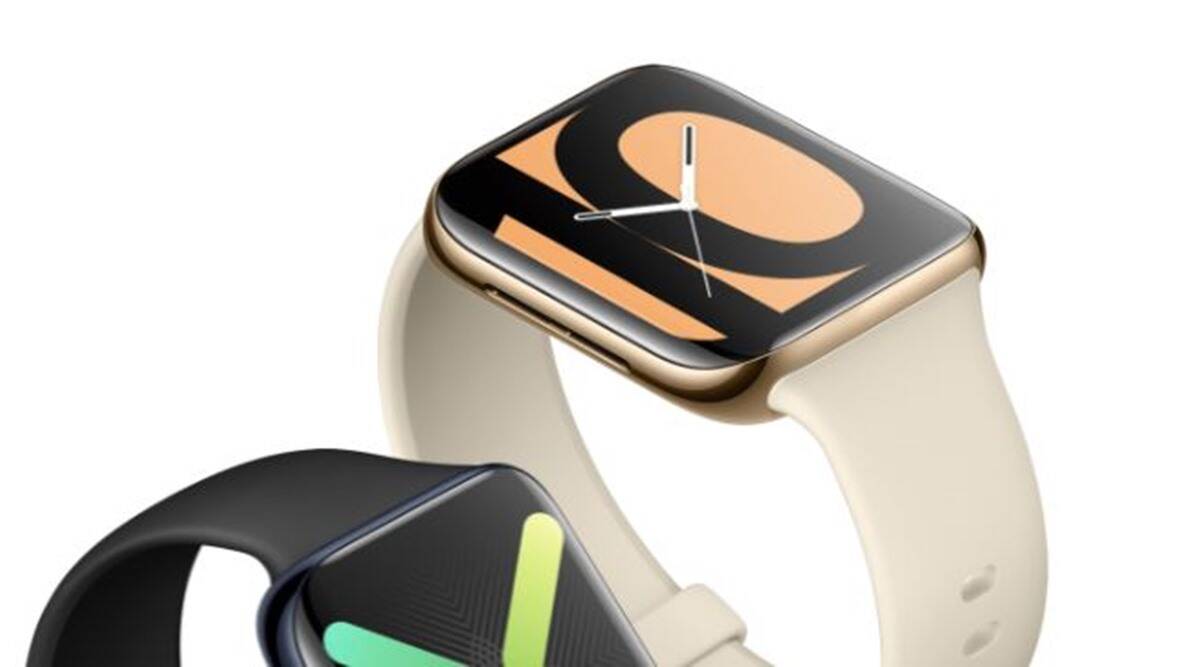
The Oppo Watch 3 starts at CNY 1,499 (about Rs 17,676) with the Pro variant starting at CNY 1,899 (about Rs 22,393). The Oppo Watch 3 is available in Platinum Black and Feather Gold while those interested in Watch 3 Pro will be able to choose between Platinum Black and Desert Brown.
Both devices are available for pre-order and will be officially available for purchase starting August 19. It is still unclear at this point if Oppo has plans to launch these smartwatches globally, so we will have to wait and see.
The Samsung Galaxy Watch 5 skin temperature sensor is among the top upgrades for Samsung’s new smartwatch, but what exactly does it — or will it — do?
I say “will” because the Galaxy Watch 5 skin temperature sensor won’t be operational when the smartwatch first comes out on August 26, 2022. (Here’s where to preorder the Samsung Galaxy Watch 5 and Galaxy Watch 5 Pro in the meantime.) During Samsung Unpacked, Samsung said users will be able to benefit from the feature “in the near future.”
Now, while this is a rather important asterisk on what was among the most anticipated announcements, it’s not a total surprise. On multiple occasions we’ve seen companies release smartwatches with compelling health sensors that can’t yet be used. The Galaxy Watch lineup prior to the Samsung Galaxy Watch 5 and Samsung Galaxy Watch 5 Pro has included a blood pressure sensor for several years that still doesn’t have FDA clearance.
My gut says we won’t be waiting as long for the Galaxy Watch 5 skin temperature sensor functionality. Samsung hasn’t named a culprit for the hold-up, though regulatory clearance could certainly be the cause. It managed to get ECG (electrocardiogram) approval from the FDA at the time of the Samsung Galaxy Watch 3 launch, so there’s no little to suspect the company can’t achieve the same certificates.
Of course, those certificates do vary country-to-country, so it’s possible the Galaxy Watch 5 skin temperature sensor will be approved in certain locales sooner than others. But this is just an educated guess from my experience testing all sorts of smartwatches touting advanced wellness tech, because again, Samsung has yet to clarify what’s impacting availability.
Samsung Galaxy Watch 5 skin temperature sensor — how does it work?
(Image credit: Samsung)
So what will the skin temperature sensor actually do? According to Samsung, skin temperature readings will be factored into sleep insights. Here’s the statement Samsung provided me with regarding the functionality:
Our holistic wellness approach emphasizes the importance of restful sleep. The addition of a skin temperature sensor will now allow users to monitor their health in even greater detail for more insights each night. Additionally, under our open collaboration philosophy, we’re always looking for ways to partner with third parties so users can get a better look at their wellness.
Sleep tracking became a larger health pillar for the Galaxy Watch this year. One of the upgrades between the Samsung Galaxy Watch 5 vs. Samsung Galaxy Watch 4 is a new sleep coach, intended to design actionable sleep plans to improve the quality of your zzz’s. It’s interesting that the Apple Watch is also emphasized sleep more than before with expanded insights in watchOS 9, which we’ll eventually see on Apple Watch Series 8, but I digress.
A close-up look at the infrared skin temperature sensor on the Samsung Galaxy Watch 5 Pro. (Image credit: Future)
From what we’ve learned about skin temperature sensors on other wearables such as the Fitbit Sense, rather than telling you your temperature like a thermometer you use to see if you’re running a fever, a skin temperature instead detects changes in trends. For example, if your skin temperature strays from your baseline one night, it could indicate other irregularities in your daily health.
There are studies that say fertility can also be tracked via skin temperature sensor. Research from the Department of Reproductive Endocrinology, University Hospital Zurich in Switzerland (opens in new tab)(opens in new tab) found that wrist skin temperature can detect ovulation and has a higher true-positive rate than basal body temperature.
The Galaxy Watch does have a women’s health app, so skin temperature readings could be applied for female users. Samsung indicated third-party developers may be able to leverage the Galaxy Watch 5 skin temperature reader for their own health apps, too.
Samsung Galaxy Watch 5 skin temperature sensor outlook
I’m encouraged to see Samsung added a new health sensor this year, offering the Samsung Galaxy Watch 5 as one of the best fitness trackers of the year — not just one of the best smartwatches.
Last year it added the BIA (bioelectrical impedance analysis) sensor for body composition analysis, a feature I initially had some concerns about but have since embraced as a way to track my physique and strength over a long period of time. I don’t imagine having the same hesitations with the skin temperature reader, though.
I also sense the skin temperature reader could give the Galaxy Watch 5 an edge over the upcoming Google Pixel Watch, or even whatever Fitbit Sense follow-up might arrive this fall.
A security researcher has found a way that an attacker could leverage the macOS version of Zoom to gain access over the entire operating system.
Details of the exploit were released in a presentation given by Mac security specialist Patrick Wardle at the Def Con hacking conference in Las Vegas on Friday. Some of the bugs involved have already been fixed by Zoom, but the researcher also presented one unpatched vulnerability that still affects systems now.
The exploit works by targeting the installer for the Zoom application, which needs to run with special user permissions in order to install or remove the main Zoom application from a computer. Though the installer requires a user to enter their password on first adding the application to the system, Wardle found that an auto-update function then continually ran in the background with superuser privileges.
When Zoom issued an update, the updater function would install the new package after checking that it had been cryptographically signed by Zoom. But a bug in how the checking method was implemented meant that giving the updater any file with the same name as Zoom’s signing certificate would be enough to pass the test — so an attacker could substitute any kind of malware program and have it be run by the updater with elevated privilege.
The result is a privilege escalation attack, which assumes an attacker has already gained initial access to the target system and then employs an exploit to gain a higher level of access. In this case, the attacker begins with a restricted user account but escalates into the most powerful user type — known as a “superuser” or “root” — allowing them to add, remove, or modify any files on the machine.
Wardle is the founder of the Objective-See Foundation, a nonprofit that creates open-source security tools for macOS. Previously, at the Black Hat cybersecurity conference held in the same week as Def Con, Wardle detailed the unauthorized use of algorithms lifted from his open-source security software by for-profit companies.
Following responsible disclosure protocols, Wardle informed Zoom about the vulnerability in December of last year. To his frustration, he says an initial fix from Zoom contained another bug that meant the vulnerability was still exploitable in a slightly more roundabout way, so he disclosed this second bug to Zoom and waited eight months before publishing the research.
“To me that was kind of problematic because not only did I report the bugs to Zoom, I also reported mistakes and how to fix the code,” Wardle told TheVerge in a call before the talk. “So it was really frustrating to wait, what, six, seven, eight months, knowing that all Mac versions of Zoom were sitting on users’ computers vulnerable.”
A few weeks before the Def Con event, Wardle says Zoom issued a patch that fixed the bugs that he had initially discovered. But on closer analysis, another small error meant the bug was still exploitable.
In the new version of the update installer, a package to be installed is first moved to a directory owned by the “root” user. Generally this means that no user that does not have root permission is able to add, remove, or modify files in this directory. But because of a subtlety of Unix systems (of which macOS is one), when an existing file is moved from another location to the root directory, it retains the same read-write permissions it previously had. So, in this case, it can still be modified by a regular user. And because it can be modified, a malicious user can still swap the contents of that file with a file of their own choosing and use it to become root.
While this bug is currently live in Zoom, Wardle says it’s very easy to fix and that he hopes that talking about it publicly will “grease the wheels” to have the company take care of it sooner rather than later.
Zoom had not responded to a request for comment at the time of publication.
It looks as though Google has begun integrating Cloud Gaming services into its search results.
The Nerf Report’s Bryant Chappel noted in a series of Tweets (below) that the new feature appears to be rolling out across the search giant’s results pages. It gives users the ability to directly launch a cloud game from the search results using Google Stadia, as well as other cloud services.
The addition of a “Play” button to select search results allows you to launch the game you searched for directly from Stadia – provided it exists on the platform. And that’s a neat step forward when it comes to integrating cloud gaming across the Google platform.
It looks like the Google search engine has a new update for cloud gaming platforms!!!
It certainly feels like a natural progression for cloud gaming – reducing the time taken to go from looking up a game to actually playing it.
Considering we’re talking about Google here, integrating cloud gaming features across its other services is a neat move, but it’s not just Google products being integrated here. It turns out, that this also works for Xbox Cloud Gaming, and some other services, too.
Xbox Cloud Gaming (xCloud) games can also now be launched directly via the Google search results page. pic.twitter.com/LeYbBk7SFH
Other cloud gaming services that appear in this manner include Amazon Luna and Nvidia’s GeForce Now.
However, when IGN attempted to replicate these results, we didn’t find the impressive new feature. Whether or not this is geo-locked or simply being rolled out across select users for testing is unclear. A likely scenario is that Google is A/B testing across its services, and that means that this new feature may (or may not) eventually be rolled out more comprehensively.
However, it’s an interesting new feature that really taps into the potential of cloud gaming. After all, going from search result to playing a game instantly is an impressive leap.
Google Stadia Review
Of course, it’s not quite that simple. You’ll need to be logged in on the service you’re trying to access, so there’s still some friction if you’re accidentally logged out. Otherwise, you’ll be sent to the service’s sign-up page, and that could be a little frustrating.
It also doesn’t appear to work with there games on the cloud gaming services. But since this is a very new feature, it could be that it’s still being rolled out – or is only appearing on select titles currently for testing purposes.
Either way, it’s a neat addition that makes cloud gaming feel even more impressive. Just make sure you’ve got a good internet connection.
Ryan Leston is an entertainment journalist and film critic for IGN. You can follow him on Twitter.
Video games can offer us a chance to inhabit new worlds or discover new experiences. They can show us things we’ve never seen or dreamed of. Like an ancient civilization or a far-off alien planet somewhere deep in the cosmos. Or uh…what about a squirrel with a gun who can shoot people? Yeah, that’s cool too.
Recently on Twitter, clips of a still-in-development game called Squirrel with A Gun have gone viral, with thousands of people sharing the video online. In the gameplay clip, we see a squirrel who happens to have a gun point said gun at a person who tries to take a photo of it. I mean, what did you expect? The game is literally called Squirrel with a Gun.
— Squirrel with a Gun (Dan DeEntremont) (@QuiteDan) August 6, 2022
I do appreciate that the gun isn’t a squirrel-sized gun. That would be ridiculous and would imply that the squirrel had somehow figured out a way to build its own tiny firearms. Very unrealistic. Instead, in Squirrel with a Gunthe squirrel is using a gun it stole from humans against anyone who gets in its way.
Over on Steam — and yes, this game has a Steam page — there’s not much more information about this upcoming game-of-the-year contender. It’s being developed by Daniel DeEntremont and according to him, it’s a “sandbox game” that is all about “exploration and shooting” stuff. DeEntremont says you’ll be able to help people or rob them, and you’ll also be able to use gun recoil to reach out-of-the-way places. How does that work? Take a look at this gif.
Gif: Daniel DeEntremont
Don’t you feel silly for asking?
There’s currently no release date for Squirrel with a Gun. On Steam the game’s release date is listed as “Good Question!” Fair enough.
If you are curious to see more about Squirrel with a Gun and its ongoing development, you can follow DeEntremont on Twitter. There he shares behind-the-scenes clips of his progress on the game, including videos of the squirrel fighting agents using hand-to-hand melee combat and more. watch out Grand Theft Auto 6you got some real competition.



:format(webp):no_upscale()/cdn.vox-cdn.com/uploads/chorus_asset/file/23940987/Screen_Shot_2022_08_11_at_12.53.49_PM.png)
 What you’ll see if you have the Play Now ability available on Google Search. (Screenshot: Michelle Ehrhardt/Gizmodo)










 Gif: Daniel DeEntremont