While Manly Sea Eagles hooker Manase Fainu may not have signed into a Mormon church event where a man was stabbed in 2019, someone called Finau did, a jury has heard.
Under cross-examination during Fainu’s trial on Thursday, the officer in charge of the investigation Detective Brett Hill said one of the adults running the charity dance at Wattle Grove in Sydney had mentioned the sign-in sheet.
The unnamed adult told Senior Constable Odette Hansen that someone with the surname of Finau had signed in, but didn’t say that Fainu’s name was on the list, the court heard.
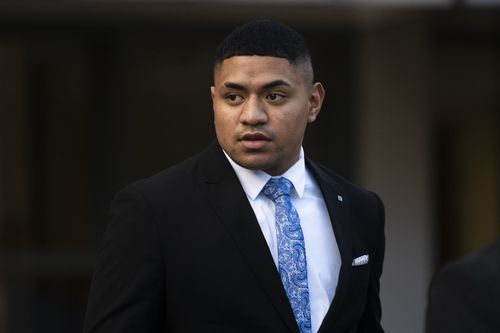
Manly player Manase Vehikite Am Fainu. (Rhett Wyman)
Hill said he had never seen the document, and had not looked for it.
“You’re a detective, aren’t you? Did you try and find it?” defense barrister Margaret Cunneen SC asked.
“I didn’t really think about it,” the detective replied.
Cunneen said the document was clearly important and asked the officer whether he had investigated the other name, Finau.
“I don’t remember,” he told Parramatta District Court.
Fainu is accused of stabbing Faamanu Levi in the back at the 2019 event organized by the Church of Jesus Christ of Latter-Day Saints.
He has pleaded not guilty to one charge of wounding with intent to cause grievous bodily harm.
After a volunteer security guard ushered Fainu and his friends off the dance floor and outside, they later allegedly returned to the car park outside the church to start a brawl.
Manly Sea Eagles hooker Manase Fainu has been stood down from playing while the trial is underway. (APA)
Levi was rushed to hospital after the confrontation, suffering internal bleeding and a collapsed lung.
Hill told the court that Fainu had voluntarily turned himself into the police after the stabbing and had no prior criminal history of violence.
A sling which the league player had been wearing for a month due to surgery was seized from his home.
However, no blood was found on it and the only DNA which was detected was Fainu’s, the jury heard.
The trial in front of Judge Nanette Williams continues.
An Aboriginal man from the New South Wales south coast has been ordered not to fish, dive or possess abalone for the next two years after being found guilty of fisheries offences.
Key points:
Fisher Keith Nye was ordered to pay $4,500 in fines and 200 hours of community service
The magistrate acknowledged his cultural connection but said the crime was a breach of the law
Mr Nye said the fight for cultural fishing wasn’t over
Walbunja man Keith Nye was sentenced to a 26-month intensive corrective order in Liverpool Local Court on Thursday for two offenses of trafficking indictable quantities of abalone.
He was also ordered to pay $4,500 in fines and perform 200 hours of community service, and his vehicle will be seized.
Mr Nye, 65, was arrested in Sydney in January 2017 with 439 abalone in his car. Another 128 were seized elsewhere.
The Fisheries Management Act 1994 defines an indictable quantity of abalone as 50.
In sentencing, Magistrate Adbul Karim acknowledged Mr Nye “had and continues to have a strong cultural connection to fishing for abalone” but noted his conduct was a “substantial breach” of the Act.
Mr Nye was arrested after surveillance by Fisheries officers found he had sold abalone to a restaurant in Sydney on January 20, 2017.
Another 128 abalone were seized from the restaurant’s freezer.
Mr Nye does not hold a commercial fishing license and has been convicted previously for abalone possession.
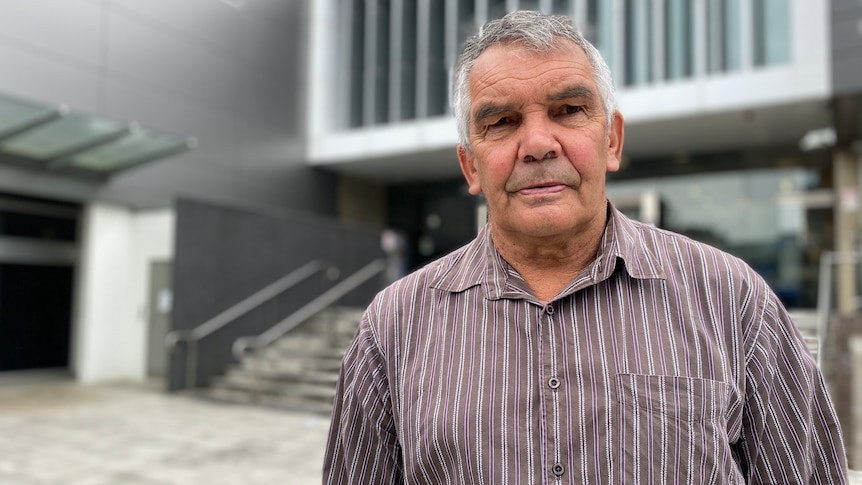
Mr Nye says he has a right to cultural fishing.(Supplied: Vanessa Milton)
Outside court, he said the sentencing ends a five-year court battle.
“I have been found guilty of practicing my culture, something I have done my whole life … but thank God the judge, I believe, took our culture on board and recognized who we are – it could have been much worse,” he said.
The offenses carry a maximum of 10 years imprisonment.
Mr Nye said he has a right to cultural fishing, particularly for abalone, something he said he’s done since childhood.
“The government expects me to walk away from that,” he said.
“Culturally, it’s a food source. Our elders love eating them but the rules and regulations upon us do not allow us to feed our elder people.
“How can one black man with a snorkel, pair of glasses and a pair of flippers rape the ocean.”
Cultural fishing is recognized under the Act but doesn’t consider it a defence.
NSW Aboriginal Land Council Chair Danny Chapman said he was concerned about the court’s inability to find native title rights to fish and to survive.
“Our cultural rights have been taken away from us by government action over the years and all we have left is our fishing rights – and we will not take a backwards step on our fishing rights,” he said.
“We have to practice it, we have to teach it and we have to hand it on.”
A spokesperson for NSW Department of Primary Industries said it “recognizes and encourages cultural fishing through increased take and possession limits.”
It said it “supports the rights of Aboriginal cultural fishers and is actively working to support Aboriginal cultural fishing within a sustainable natural resource management framework”.
Last month, a district court judge dismissed an appeal by Walbunja man John Carriage to overturn his conviction on fishing-related offenses.
Mr Carriage was convicted in October last year on six fishing offenses after he was found in possession of abalone at South Durras on the NSW south coast in December 2017.
In October last year Mr Carriage was convicted on six fishing offences.(Supplied: Vanessa Milton)
He was given a 12-month intensive correction order and ordered not to dive for or possess abalone for two years.
He appealed against the decision, which he said prevented him from practicing cultural fishing.
The matter was heard in the Parramatta District Court on June 1, where Judge Mark Buscombe dismissed the appeal.
Lawyers for NSW Fisheries asked Judge Buscombe to award them $25,000 in legal costs against Mr Carriage.
Mr Carriage’s lawyer, John Waters, described the request as a “heavy-handed” approach, and said his client was not in a position to pay.
He said there was an element of Fisheries “hounding” his client and described the cost as “a serious amount for any person facing this court, but all the more so for this defendant.”
Judge Buscombe told the court Fisheries’ decision to ask for Mr Carriage to pay costs “troubled” him.
“This man is a descendant of people who have fished in these waters for a millennia. As an ordinary Australian I find it repugnant, quite frankly,” he said.
Dozens of Aboriginal people were charged last year, according to the NSW Bureau of Crime Statistics.
Mr Nye said the fight wasn’t over.
“We’re already lobbying … It’s a good feeling to walk out but really is justice there yet? I don’t think it is. We’re not going away.”
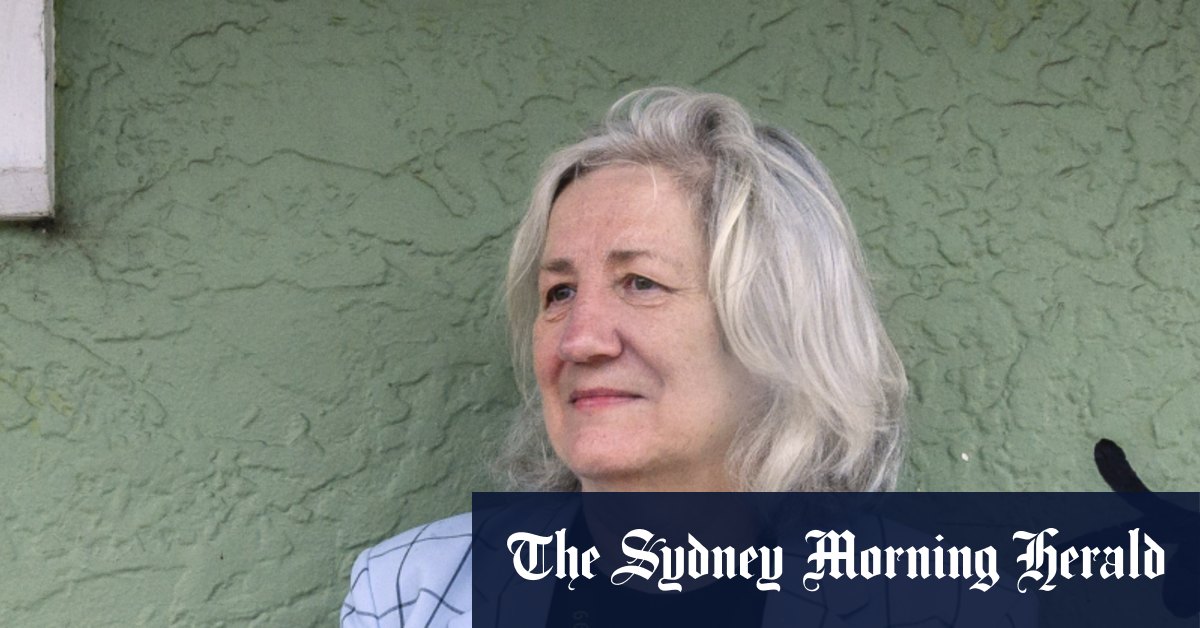
“As a public official, and given the serious nature of the charge, it is my opinion that the vice chancellor should immediately step aside from her duties until the conclusion of court proceedings,” Mr Marshall said.
The family of the schoolgirl came forward on Thursday, telling an NBN News reporter off camera that the vice chancellor touched the teenager’s face and commented on her skin color.
The Catholic Schools Office, Diocese of Armidale, issued a statement on Thursday confirming it was aware that a student had referred a matter to police regarding the “alleged actions of a person at an event … where school students were present”.
“The school was advised of a student’s concern following the event and school staff acted promptly to confirm the student’s wellbeing. No risk to student safety was identified.”
Heywood has been a controversial figure in the university town since she was appointed in 2019, having steered the university through the pandemic and presiding over 200 voluntary redundancies.
Students who were petitioning for a return to face-to-face learning at a Christmas markets in 2020 said the vice chancellor verbally berated them when she learned about their campaign.
Undergraduate student Tamika Kennedy said the vice chancellor had criticized her for not bringing their concerns to her first, although another student had already attempted to do so.
“She said, ‘Do you know who I am? How dare you slander my name on this’,” Kennedy said.
Heywood is due to appear in court on September 26.
Our Breaking News Alert will notify you of significant breaking news when it happens. Get it here.
In a separate letter, the NSW Department of Education said inquiries had been sent to King’s regarding the use of school funds.
loading
“As this matter is the subject of ongoing inquiry, it is not appropriate to comment further,” a spokesperson said. “The Department of Education routinely requests information from non-government schools to ensure compliance with not-for-profit funding requirements.”
It is understood the school is required to respond to the state government this week.
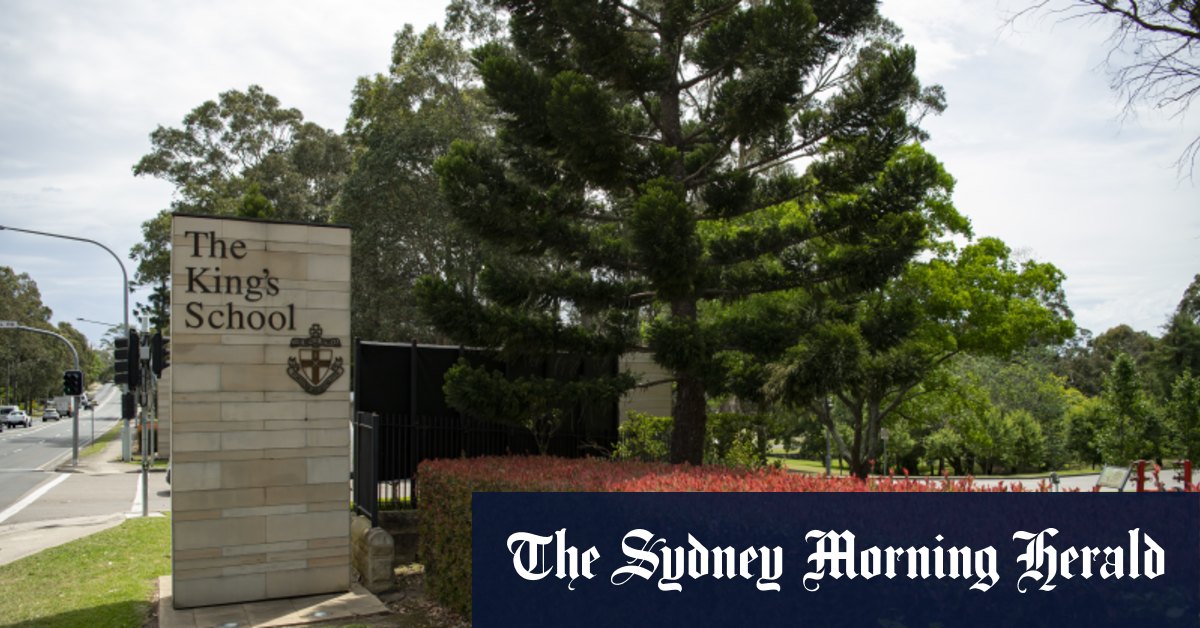
King’s, which has about 2000 students and is located in North Parramatta, charges fees that range from $24,000 for pre-school to $40,000 for year 12 and $69,000 for tuition and boarding in high school.
The school did not respond to questions on the letters from the state and federal governments. King’s previously defended a controversial trip by his headmaster and his wife to the Royal Henley Regatta, saying it was standard practice among independent schools to fly principals overseas, and traditional for principals to go business class. One estimate put the cost of flights and accommodation at $45,000, but the school later said that cost was “grossly exaggerated”.
Paul Kidson, an education leadership academic at the Australian Catholic University and a former independent school principal, said that regardless of how much money private schools receive from Commonwealth and state coffers, schools must be responsible and accountable for the expenditure.
“It should be done in a way that is both transparent and gives confidence about the appropriateness of spending,” he said.
“The issue about transparency is critical. Independent schools get funding from three main sources, the Commonwealth, limited amounts from the state government, and the rest of it from parent fees and other private sources. And a school like King’s will get the vast majority of its funding from fees,” he said.
“But at a time when society is looking to schools for what they contribute to who we are as a community, we should be working even harder to build confidence and trust in the schools, not erode it.”
The Morning Edition newsletter is our guide to the day’s most important and interesting stories, analysis and insights. Sign up here.
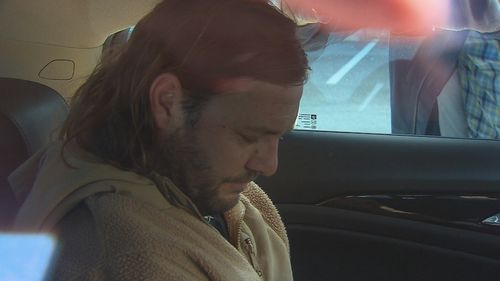
Tobias Friedrich Moran, accused of murdering his former German backpacker girlfriend, will be released on bail as prosecutors decided not to proceed with a detention application.
The 42-year-old was freed by a magistrate today and can now return to Western Australia from where he was extradited.
Bail conditions stipulate he must report to police three days a week and must not communicate via any encrypted websites.
Tobias Moran, formerly known as Tobias Suckfuel, has been danced but will not be released today. (9News)
Magistrate Margaret Quinn in the Downing Center Local Court earlier on Thursday accepted submissions from Moran’s barrister there was no new evidence connecting him to the murder of Simone Strobel in 2005.
And while the Crown submitted new witness statements taken from people in Germany showed that he lied about the state of their relationship, that evidence was not currently before the court.
The magistrate said evidence showed the couple had been fighting, drinking a lot and perhaps on some drugs about the time of the alleged murder.
“(But) it doesn’t appear in this case to be any direct or indirect evidence connecting him to the offence,” Quinn said.
“It’s not the strongest circumstantial case I have seen.”
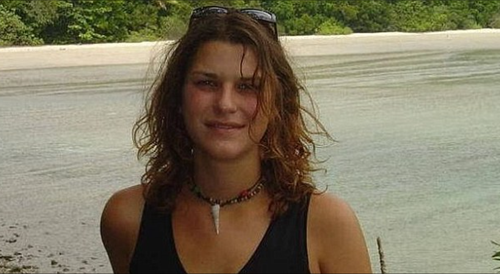
German backpacker Simone Strobel was found dead in Lismore in 2005. (9News)
His wife has offered $200,000 in security if he fails to show up in Lismore court when required, while another $250,000 has been offered as an undertaking.
Moran is charged with murdering his then partner and acting with intent to pervert the course of justice between 11pm on February 11, 2005 and 3.30pm the following day.
Police allege Moran suffocated or smothered his girlfriend in a camper van in Lismore and disposed of her body nearby.
Moran reported the school teacher missing before she was found days later 100 meters from the camper van.
Her body was too decomposed for a coroner to determine the cause of death, but it is believed to be asphyxiation.
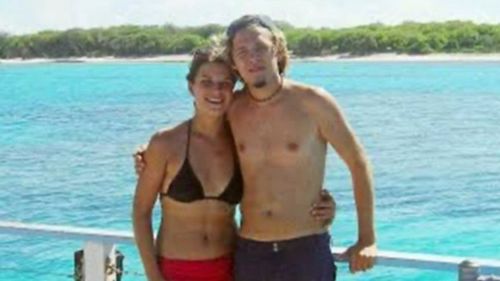
Tobias Moran, formerly known as Tobias Suckfuel, had been traveling around Australia with Simone Strobel in 2005. (Supplied)
The magistrate disagreed with the Crown’s submission that Moran had not co-operated with police, acknowledging he had refused to show up for an inquest in 2007.
But he had submitted plenty of DNA samples to police, one of which was lost, and most recently put himself forward for extradition, she said.
Police last week confirmed they were communicating with German authorities about two arrest warrants for suspects who had been “persons of interest from the very beginning”.
Moran’s sister Katrin Suckfuel and friend Jens Martin were also traveling with the pair.
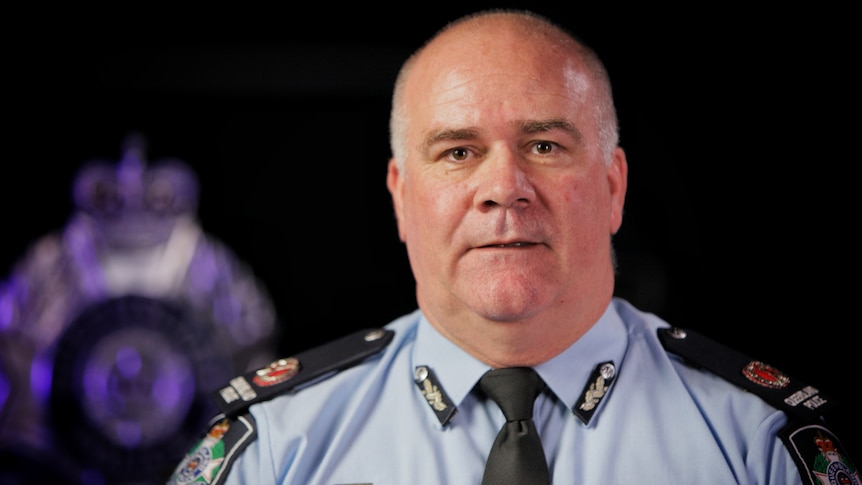
There are “significant” cultural issues within the Queensland Police Service (QPS) affecting how officers respond to domestic violence, the state’s most senior officer in charge of domestic violence investigations has told an inquiry.
Key points:
Assistant Commissioner Brian Codd says the majority of criticism of police cultural issues is “unchallenged”
He told the inquiry inexperience, lack of training and officer burnout were contributing to poor culture
Police data shows a major jump in strangulation cases and DVO breaches in the past five years
The commission of inquiry, which began on May 30, is examining the police response to domestic and family violence cases.
Headed by Judge Deborah Richards, it is also probing the over-representation of Indigenous people in the criminal justice system and the way corrupt conduct and complaints against police are handled.
The inquiry heard today from Assistant Police Commissioner Brian Codd, the head of the state’s domestic violence and vulnerable persons command, who gave his take on the evidence heard in the public hearings so far.
Counsel assisting the commission Ruth O’Gorman said the issues raised included officers avoiding DV call-outs, showing “disinterest” when attending call-outs, conducting “insufficient investigations” and misidentification of the victims and perpetrators.
“There are significant issues of police culture at play here that need to be addressed,” Assistant Commissioner Codd told the inquiry.
“We may have some members, albeit I hope very few, who do have some deeply misogynistic attitudes”
“I do accept that there are significant areas of concern that have been raised… that certainly will require us to look… beyond just isolated incidents.”
‘Pockets of issues’ around police culture
Assistant Commissioner Codd said he accepted “the majority” of evidence given relating to police culture was “unchallenged”.
“There’s very clearly in my view … pockets of issues of poor performance … behaviors and attitudes across our organization — aspects of culture that are impacting on our performance of our duty in DV,” Assistant Commissioner Codd told the inquiry.
“I certainly accept that the evidence provided has highlighted a range of concerning aspects of culture.
“It’s far from, in my humble opinion, the majority.
“But that doesn’t matter to a point, because whilst there’s still victims and people who need our help … [there’s a need for] focus and improvement.
“I do accept that there are significant areas of concern … that certainly will require us to look beyond just isolated incidents. There’s been too many consistencies in too many places.”
The inquiry heard inexperience, lack of training and officer burnout were contributing to poor police culture.(AAP: Dan Peled)
However, Assistant Commissioner Codd told the inquiry he did not believe cultural issues were “widespread” or “systemic” within the Queensland Police Service (QPS).
“I’d avoid the term ‘systemic’ because that suggests it’s absolutely through every part of our organization,” he said.
“I guess the observation I’d like to make though is the term about ‘widespread’ or ‘endemic’ that’s tied to it.
“I’m wary that almost every one of the witnesses, or certainly a number [of them,] …also made the point that it wasn’t their experience with every officer.”
He told the inquiry “a range of complex factors” were contributing to issues with police culture, including inexperience, lack of training and officer burnout.
Strangulation cases more than double in five years
Assistant Commissioner Codd also told the inquiry domestic violence strangulation had “progressively increased” from 1,060 reported occurrences in the 2016/2017 financial year to 2,145 in 2022/2023, according to QPS data.
He said domestic violence reports had also climbed from 89,458 in the 2016/2017 financial year to 138,551 in 2022/2023.
The inquiry heard breaches of domestic violence orders (DVOs) were another area of concern, increasing from 25,771 in the 2016/2017 financial year to 46,601 in 2022/2023.
“There’s been a significant increase there but, by the same token, it is perhaps a measure of us being better at identifying them,” he told the inquiry.
Assistant Commissioner Codd had previously told the inquiry in the first week of public hearings that the police service was struggling to keep up with demand, with officers spending more than 40 per cent of their time responding to domestic violence matters.
He said officers were overwhelmed and fatigued and were reporting high levels of burnout and psychological distress.
The QPS will not comment on specific issues raised during the hearings but has committed to work with the inquiry to “ensure that organizational values, standards of practice and responsibilities are being maintained and, where the opportunity arises, enhanced”.
Public hearings will continue in Brisbane tomorrow, before moving to Mount Isa for the inquiry’s final two days next week.
The inquiry will hand down its final report in October.
Front page newspaper stories and torn excerpts from a damning report into war crimes allegedly committed by Australian soldiers will play a feature role in a month-long exhibition in western Sydney about the 20-year occupation of Afghanistan.
The documents form the foundation of a confronting collection of protest collage artworks by Elyas Alavi, as he struggled to process the stark and shocking findings contained in the Brereton report into war crimes in Afghanistan.
Among the mediums used in the collection are washes of the artist’s own blood.
“As an Afghan Australian I struggled to imagine how Australian defense forces could do such crimes,” he told Guardian Australia.
“I have this paper called citizenship, I am safe, but in Afghanistan there are victims, and here there are families of victims.
“Afghanistan is so far away, the government says it’s a tragic country, there’s nothing more we can do, but Australia went there to help, and innocent people were killed by Australian soldiers. That is why I’m using my blood.”
‘I struggled to imagine how Australian defense forces could do such crimes’: Elyas Alavi in his study. Photograph: Courtesy Elyas Alavi
About 50,000 Afghans now living in Australia will mark the first anniversary of the Taliban moving into Kabul later this month.
More than one in five of those Afghan nationals, most who have arrived in Australia as refugees in the past 20 years, now reside in the greater Sydney area.
With the redacted version of the Inspector-General of the Australian Defense Force Afghanistan Inquiry Report, commonly known as the Brereton report, now in the public domain, these relatively new Australians are grappling with a disturbing truth about how their adoptive country treated their people.
Confronting Australia’s role as co-saviour, co-conspirator and co-offender is one of the dominant themes in Twenty Years: The War in Afghanistan, which officially opens on Thursday at the Leo Kelly Blacktown Arts Centre.
The program includes a series of forums co-ordinated by Maryam Zahid, founder of Afghan women on the Move, with speakers drawn from the Afghan community including public interest lawyer Lala Pordeli, SBS journalist Abdullah Alikhil, and exiled Kabul court judge Farah Altaf Atahee, who fled to Australia with her husband and three children shortly after the Taliban took control of the capital last August.
On 24 August the Afghan war crimes whistleblower David McBride will join an online forum discussing the future of Afghanistan and the social and political challenges Australia faces when dealing with a militant Islamist government.
McBride was one of the subjects in an exhibition of Hoda Afshar’s photographic portraits recognizing the work of whistleblowers, which toured earlier this year.
The work of another exiled photojournalist, Najiba Noori, is featured in the Twenty Years exhibition. Noori was working for Agence France-Presse (AFP) as a video journalist based in Kabul until the Taliban took power a year ago. She is now based in Paris.
Endless Sorrow, a photograph by Najiba Noori. Photographer: Najiba Noori
Noori told the Guardian last October that she feared for her family, friends and colleagues left behind. The new head of the University of Kabul, where her younger brother was a music student, had just called for the death of all journalists.
In February, the International Federation of Journalists reported that about half of media outlets in Afghanistan had collapsed in the preceding five months, and more than 70% of journalists who had fled or gone into hiding were women.
Journalist and film-maker Antony Loewenstein co-curated the extensive program with artist and writer Alana Hunt. He wants the exhibition to provoke, inspire outrage and prompt a wider section of the community to confront Australia’s role in the longest war in this country’s history.
Loewenstein spent time in Afghanistan in 2012 and 2015; he says while the US-led war there may be officially over, its grim legacy lives on.
“We’re all responsible as Australians for the current situation in Afghanistan,” he tells the Guardian. “We occupied the country for 20 years, committed war crimes against Afghan civilians and have very little [that’s] positive to show for our involvement.
“The war has fallen down the memory hole… our legacy there as a nation is tarnished,” he says.
Calls to put the focus back on Afghanistan
A federal government-funded Australian War Memorial project, launched in 2016 to investigate Australia’s military commitment in conflicts in Timor-Leste and the Middle East, is part of a controversial $500m expansion plan for the national war museum.
Australia’s official military historians, however, have not yet been granted access to the full, unredacted Brereton report, which may not be released until investigations are complete later this decade.
Loewenstein says the Afghan community is concerned that if historians are not granted full access to the report, the War Memorial exhibit will continue to present a glossed-over narrative on Australia’s 20-year presence.
The concerns are not without grounds. The existing exhibition documenting Australian forces in Afghanistan makes no mention of alleged war crimes, despite the fact that, as Guardian columnist Paul Daley pointed out almost two years ago, the Brereton inquiry was already at that stage 18 months old.
Loewenstein says organizers hope the Twenty Years exhibition and symposium will throw some of the media attention back on Afghanistan which, perhaps due to entrenched racism, has been left behind by the media and public policy. When Kabul fell, for instance, the Morrison government promised refuge to just 3,000 Afghan asylum seekers in its annual allotment of 13,000; meanwhile, more than 8,000 Australian visas for Ukrainian refugees have been issued since the Russian invasion of Ukraine. Both countries have roughly the same population, of around 40 million.
“All refugees should be treated equally and the new Australian government has an opportunity to repair the damage caused by [the occupation],” Loewenstein says. “Australia has a moral responsibility to help the Afghan people.”
Twenty Years: The War in Afghanistan is at the Leo Kelly Blacktown Arts Center until 3 September
The environment minister, Tanya Plibersek, has said she intends to block a coalmine project backed by mining billionaire Clive Palmer that would have dug for the fossil fuel just 10km from Queensland’s Great Barrier Reef coastline.
Palmer’s Central Queensland Coal project would have mined up to 18m tonnes a year from two open-cut pits near Rockhampton.
It comes amid calls from the Greens to ban new coal and gas projects as the Albanese government’s bill to enshrine a 43% cut to greenhouse gas emissions made its way to the Senate.
The decision is the new environment minister’s first in the portfolio.
Environmentalists said the proposed refusal was a victory for the state, for the Great Barrier Reef, for the environment and for the climate.
A Queensland state government assessment said last year the Central Queensland Coal project was “not suitable” and would risk damaging the reef as well as wetlands, fish habitat and ecosystems that depended on groundwater.
An official notice said the minister is proposing to refuse the mine under the Environment Protection and Biodiversity Conservation Act 1999 and has invited public comment on her draft decision, with submissions closing on 18 August.
In a statement, the minister said: “Based on the information available to me at this stage, I believe that the project would be likely to have unacceptable impacts to the Great Barrier Reef marine park, and the values of the Great Barrier Reef world heritage. area and national heritage place.”
“The available evidence also suggests that the project would be likely to have unacceptable impacts on water resources in the area.”
She said Palmer’s company had been contacted, adding a final decision would be made after public comments were received.
“While I am seeking comment on my proposed decision, and until I make my final decision on this project, I am unable to make any further statements on the matter.”
Last year Queensland’s state government sent a final assessment of the mine to the federal government, saying it posed “a number of unacceptable risks”.
Conservationists had called on the previous environment minister, Sussan Ley, to refuse the mine.
Palmer’s company had rejected claims the mine would do unacceptable damage. Guardian Australia called the Brisbane office of Central Queensland Coal, but was told nobody was available to speak as “everyone from the company is on site in central Queensland”.
Sign up to receive the top stories from Guardian Australia every morning
The director of the Queensland Conservation Council, Dave Copeman, said: “This prompt decision is a welcome change from the delayed and questionable decision making approach of the previous Morrison government.”
“It looks like we now have a minister who understands the science, is willing to listen to community concerns, and act accordingly.
“We won’t reach Australia’s 43% 2030 emissions reduction targets, that passed the House of Representatives today, without strong decisions such as this.
“This will be overwhelmingly positive news for the many locals and organizations who have been making clear the local and scientific opposition to this project.”
Cherry Muddle, a Great barrier Reef campaigner at the Australian Marine Conservation Society, said they hoped the minister “rejects this mine once and for all” and pointed to modeling suggesting mine sediments would have had disastrous impacts on an area that was rich in marine life .
“In the wake of the fourth mass bleaching event on the reef since 2016, it is vital new coal and gas projects like this one are refused,” Muddle said.
“It shows the government are serious about saving the reef and tackling the issues that threaten it.”
Julian Assange’s family have saidthe Albanese government needs to intervene in the case before he is extradited to the US, saying it would effectively be a “death sentence” for the WikiLeaks founder if there was no intervention.
The plight of Assange, who is being held in the UK’s Belmarsh prison pending an appeal against his extradition to the US, has been raised with the new US ambassador to Australia, Caroline Kennedy, by Assange’s Australian solicitor, Stephen Kenny.
Attending Parliament House on Wednesday, Assange’s father, John Shipton, and brother, Gabriel Shipton, raised concern that there had been little progress made since the May election, and urged the prime minister, Anthony Albanese, to make the issue “non-negotiable” with the US.
The family expressed frustration that they had been unable to secure a meeting with either Albanese, the foreign affairs minister, Penny Wong, or the attorney general, Mark Dreyfus, despite requests.
Since the election, Albanese has said the government intends to pursue the matter diplomatically, saying “not all foreign affairs is best done with the loudhailer.”
Gabriel Shipton said he had initially been encouraged by Albanese’s remarks as opposition leader that “enough is enough” in regards to Assange’s incarceration, but was frustrated with the lack of progress since the election.
“It is months ago now that he said this stuff and made the statement that enough is enough, but when is enough, enough?” he said. “Julian’s still in prison. He’s been there for three years and he is not a convicted criminal.
“They could pick up the phone and call Joe Biden and make it a non-negotiable.
“We are strategically vital to the US at the moment, they need our resources, if it was made a non-negotiable, Julian would be here tomorrow.”
Supporters have raised concern about an incoming government brief sent to Dreyfus about the case, which said that “if surrendered, convicted and sentenced in the US, Assange could apply under the ITP [international transfer of prisoners] scheme to serve his sentence in Australia’”.
But sources stressed that this document did not indicate a prisoner transfer was the government’s preferred strategy, saying it merely outlined the conditions of such a process.
John Shipton said the prospect of delaying helping Assange further is ‘ridiculous’. Photograph: Mike Bowers/The Guardian
John Shipton, Assange’s 77-year-old father who has been leading the campaign to bring Assange home to Australia, described the possibility of delaying intervention until Assange was tried and convicted in the US as “grotesque”. He said the process would take many years, and could result in Assange being detained for more than 20 years since the publication of US diplomatic cables by WikiLeaks in 2010.
He said the Americans “stole all his court papers and people say to us ‘put Julian in their hands, he will be safe,’ it is ridiculous, it is grotesque”.
“It is the most feasible way for them to continue to sit on their hands and do nothing,” he said.
Sign up to receive the top stories from Guardian Australia every morning
Gabriel Shipton pointed to expert witness testimony given to the Westminster magistrates court that said Assange would be at risk of suicide if extradition to the US became imminent.
“That scenario is a death sentence for Julian,” he said.
He urged the Australian government to be more vocal on Assange’s plight, suggesting the case was being treated differently because it involved Australia’s closest ally.
“We’re dealing with this prosecution or persecution that in any normal circumstance would be seen as totally illegal, and if it was Iran doing it to somebody, or China, or Vietnam, the government would be calling them out,” he said.
“It is not just about Julian’s life and his wellbeing, it is a matter of principle, and if Australia wants to be the sort of country that calls out nations on their press freedom record, they could definitely be more vocal.”
The Shiptons said Assange was not in a good physical or mental state, having already suffered a stroke in October, with fears he may suffer another. He is being held in a maximum security cell with limited phone and visiting rights, in what his wife, Stella Moris, has described as “atrocious” conditions.
The US has given assurances that if extradited, Assange would not be subject to “special administrative measures” or held at a maximum security facility, which the UK high court ruling described as “solemn undertakings offered by one government to another”.
But advocates remain concerned that Assange will not be given a fair trial for the 17 espionage charges and one charge of computer misuse he faces, which carry a potential combined prison sentence of up to 175 years.
A suppression order on the identity of Adelaide Remand Center’s general manager, who is charged with theft, has now been lifted.
Key points:
Brenton Williams is accused of stealing more than $100,000 of prisoners’ money
A suppression order on his identity has been lifted today
The 47-year-old was arrested last week in relation to theft
Brenton Williams is accused of stealing more than $100,000 of prisoners’ money.
The offense was allegedly committed between April 27 and July 27 this year.
The 47-year-old was arrested last week and charged with an aggravated count of dishonestly taking property without consent.
His identity was suppressed by the Adelaide Magistrates Court “in the interests of the administration of justice”.
The Adelaide Remand Center general manager is accused of stealing more than $100,000 of prisoner’s cash. (ABC News: Alina Eaton)
That suppression order was lifted today, after the police prosecutor confirmed she did not want to pursue it.
The Department for Correctional Services says it will launch an independent investigation into theft.
“The department’s main priorities are the welfare of employees at the Adelaide Remand Center and the person who is currently before the courts,” a departmental spokeswoman said last week.
Serco, the private company that runs prisons in Adelaide’s CBD, said it would also be working with police.
Williams did not apply for bail and was remanded in custody, with the case scheduled to return to court in October.
Corrections Minister Joe Szakacs said the allegations are deeply concerning.
“It is incredibly disappointing to be informed of these serious allegations relating to the senior Serco employee at the privately run Adelaide Remand Centre,” said Mr Szakacs.
“These are serious allegations, which I’m deeply concerned about.
“I want answers, and a full review is being undertaken by DCS to investigate this matter.
“As the matter is now before the courts, the state government cannot make any further comment.”