Thirty years ago, passionate snapper fisher Damon Sherriff was lucky to catch 10 a year in Tasmania.
In the past few years, however, he’s seen his catch rate jump.
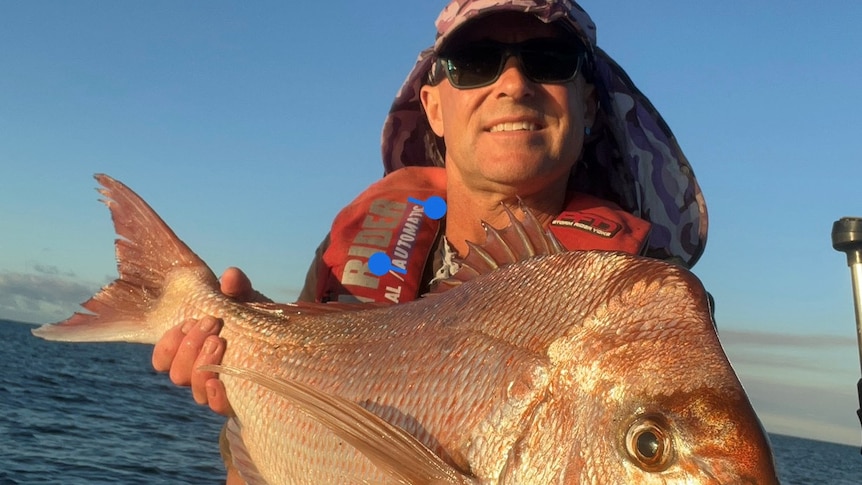
Snapper is Damon Sherriff’s favorite recreational fish.(Supplied: Damon Sherriff)
“I’ve actually caught over 200 [snapper] per season, so it just shows you how much the species has exploded in Tasmania,” he said.
Mr Sherriff has been chasing snapper since the early 1990s and mainly fishes out of the Tamar estuary in the state’s north.
And while he also loves a fresh fillet, the catch rate for his favorite eating fish, King George whiting, has skyrocketed as well.
“The whiting is another emerging species; it’s a fish that’s always been in Tasmania like the snapper, but the last few years it’s really exploded and it’s a very common fish now.”
King George whiting is also finding Damon Sherriff’s hook off north-east Tasmania.(Supplied: Damon Sherriff)
His experience hooking more warm-water fish in Tasmanian waters is backed up by new research from the Institute of Marine and Antarctic Studies (IMAS).
Scientists looking at key biological and ecological traits of snapper, yellowtail kingfish and King George whiting have found all three are settling in.
Alexia Graba-Landry is investigating the potential of new fisheries.(ABC News: Maren Preuss)
“They’ve become more and more abundant in Tasmania,” marine scientist Alexia Graba-Landry said.
“As waters become warmer over a greater proportion of the state, that leads to better habitat for these fish and they’re likely to become more abundant.”
The research found that yellowtail kingfish were present in Tasmanian waters between October and May as small immature fish, while snapper were present year-round and there were reproductively mature adults.
King George whiting were also in Tasmania year-round and with adults successfully reproducing, the research said.
King George whiting caught in Tasmania’s north-east.(Supplied: Damon Sherriff)
“There are historical records of King George whiting since the 1920s but they’re only occasional records, so increasingly we are finding more and more reports of King George whiting in Tasmania from recreational and commercial fishers,” Dr Graba-Landry said.
“For all three species, under future warming the habitat is likely to become more suitable, therefore they are likely to extend their range and increase their abundance.”
Researcher Barrett Wolfe inspects fish frames from warm-water species found in Tasmanian waters.(Supplied: Dave Mossop)
The scientific team also ran data through modeling to work out what effect future population increases would have on local ecosystems.
“Across all scenarios there’s little evidence for any ecosystem collapse should these species extend their range and increase their abundance,” Dr Graba-Landry said.
It’s good news for fishers — King George whiting has become so comfortable it’s been flagged by IMAS as a developing fishery to keep an eye on.
“We’re presented with this unique opportunity to proactively manage these emerging fisheries,” Dr Graba-Landry said.
IMAS officers including Dave Mossop have been investigating snapper numbers.(Supplied)
A lot of the research was done with the help of recreational fishers.
Instead of throwing out their fish waste, they have been donating their fish skeletons to scientists, helping them fill critical knowledge gaps on some species.
There were 16 drop-off points at tackle shops around the state.
“There was a lot of enthusiasm; 30 recreational fishers regularly donated frames,” Dr Graba-Landry said.
Damon Sherriff and a prize snapper caught from a kayak.(Supplied: Damon Sherriff)
Mr Sherriff donated his fair share. For the avid fisher, snapper will remain his favorite.
The amateur artist and fish taxidermist loves to draw and paint them and the prettier ones go on the wall.
“I love the colors in the snapper… I’m an arty-farty person and I really enjoy looking at a snapper fresh out of the water,” he said.
“I really enjoy trying to replicate the colors in a fish.”
Damon Sherriff taxidermises snapper he catches.(Supplied)
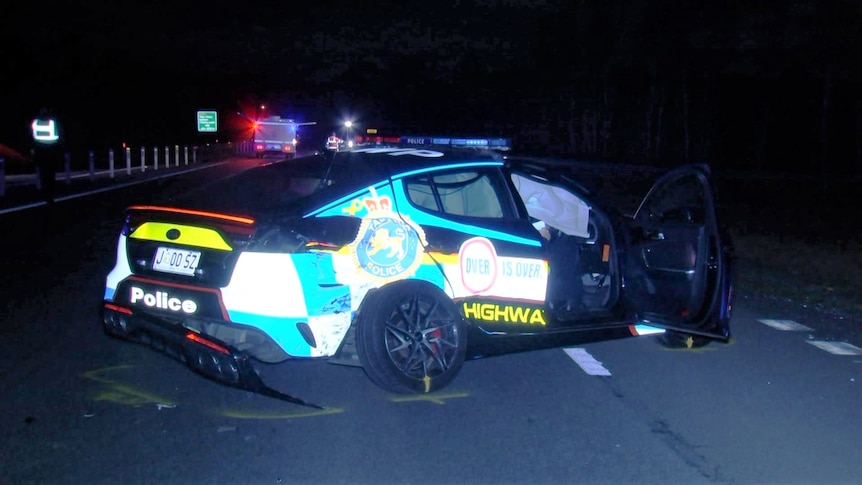
A Tasmanian police officer has been taken to hospital after his new patrol car crashed into another vehicle traveling in the same direction on Tasmania’s main highway on Friday night.
Key points:
Tasmania Police showcased the new Kia Stinger highway patrol car on Wednesday on social media
On Friday, the same car was involved in a crash on the Midland Highway, with the driver taken to hospital
Tasmania Police’s Professional Standards Unit are monitoring the investigation, police said
Police said the acting sergeant in his late 50s was flown to the Royal Hobart Hospital by helicopter and was being treated for non-life threatening injuries.
The three occupants of the other car were not injured.
Police said crash investigators were conducting inquiries and the Tasmania Police Professional Standards Unit would monitor the investigation.
The crash comes two days after Tasmania Police publicly launched its new Kia Stinger highway patrol vehicles, which it said were “adding to the wide range of high-visibility resources available for the new Road Policing Services unit”.
The car involved in Friday’s crash is the same car police featured in their announcement on Wednesday.
loading
On Thursday, it was announced Inspector Gary Williams had “begun in the brand-new role of state road safety coordinator.”
“We’re throwing everything we can at making our roads safer, including these brand-new highway patrol vehicles, and we’re using other resources like drones and our community evidence portal to help us track down traffic offenders,” Inspector Williams said in a statement on Thursday.
“Talk to your family, talk to your friends, talk to your children, about making the right choices on our roads and make it clear that none of us should be taking risks or thinking we’re above the rules.
“Being ‘a good driver’ is irrelevant. It’s time for everyone to take road safety seriously.”
It is unclear how many of the new Kia patrol cars police have on Tasmanian roads.
Eddie Holmes can still remember the exact moment he first learned about COVID-19.
Key points:
Australian virologist Eddie Holmes co-authored a study that has identified a Wuhan wet market as the likely epicenter of the COVID-19 pandemic
Professor Holmes visited the market in 2014 and recognized the risk of virus transmission between animals and humans and suggested taking some samples
His research pinpoints a few square meters where the virus is likely to have been transmitted between animals and humans
The University of Sydney virologist said it was New Years Eve, 2019, when he received a news alert that China had notified the World Health Organization of a strange new virus.
“It said four cases of an episode of pneumonia were found in a live animal market in Wuhan, China,” he said. “It immediately rang alarm bells.”
Professor Holmes told ABC News Daily the story jumped out because he had visited that very market, the Huanan seafood wholesale market, in 2014.
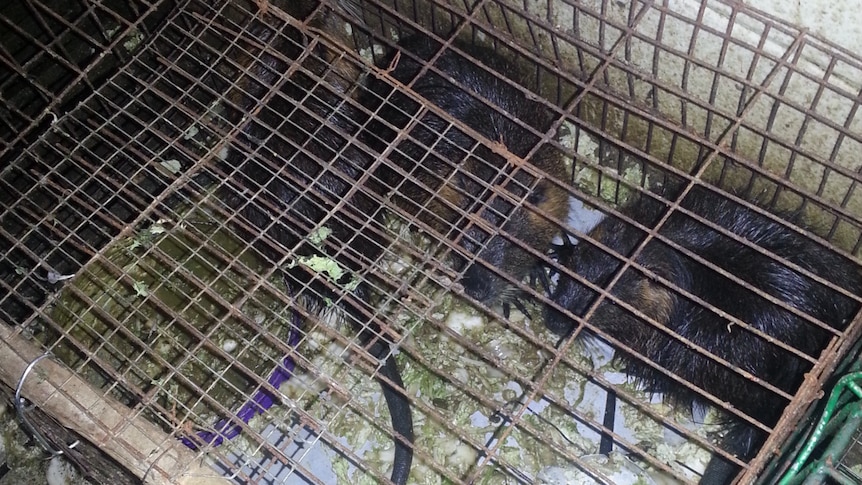
“While I was there, I noticed there were these live wildlife for sale, particularly raccoon dogs and… muskrats” he said.
“I took the photographs because I thought to myself: ‘God, that’s, that’s not quite right’.”
A photo taken in 2014 by Professor Eddie Holmes, showing animals caged in the Huanan Seafood Wholesale Market.(Supplied: Eddie Holmes)
Raccoon dogs had been associated with the emergence of a different coronavirus outbreak, SARS-CoV-1, in 2002-04, which became known worldwide as the SARS virus.
Even in 2014, Professor Holmes believed the market could become a site of virus transmission between animals and humans.
“I said to my Chinese colleagues: ‘This is a really interesting situation here. We should do some sampling of the animal market to see what viruses these animals have got and if they’re going to jump,'” he said.
‘Engine room of disease emergence’
The monitoring that Professor Holmes suggested never took place but, in the early days of COVID-19, he was still convinced that a market like the one in Wuhan was the logical origin of the virus.
“They are the kind of engine room of [this sort] of disease emergence … because what you’re doing is you’re putting humans and wildlife in close proximity to each other,” he said.
While a virus jumping from animals to humans seemed the most-likely cause of COVID-19, by early 2020, another theory had begun to emerge: that the virus had been created by Chinese scientists and had somehow escaped from a lab.
In January of that year, scientists from the Wuhan Institute of Virology released a paper in the journal Nature, comparing the COVID-19 genome to that of its closest-known relative: a bat virus produced in the very same lab.
This, Professor Holmes said, was all that was needed to spark a conspiratorial theory that quickly spread around the globe.
“At that point, people just said: ‘Oh, it’s come from the lab’,” he said.
“It sadly moved from being what it should be—a question of basic science—into a question of global politics.”
“That’s led to this horrendous, blame-game finger-pointing.”
In the months that followed, the University of Sydney professor played a key role in mapping the evolution of COVID-19, earning him the 2021 Prime Minister’s Award for Science and the 2020 NSW scientist of the year.
However, even after the COVID-19 genome was mapped, debates about the origins of the virus continued to gather steam.
Even an investigation by the World Health Organization in early 2021 that ruled the lab-leak theory unlikely, wasn’t able to fully rule it out.
Space to play or pause, M to mute, left and right arrows to seek, up and down arrows for volume.
Why are COVID variants so dangerous?
Ruling out the lab-leak theory
While politicians were engaged in name-calling and speculation, Professor Holmes and his colleagues turned to the task of studying the data on the first known cases of COVID-19 in Wuhan.
“What we intended to do was take all that data and analyze it the best way we could, using the best techniques we have available today, to see what the most-likely place and route of origin for that virus was.”
Using spatial-mapping tools, the researchers pinpointed the locations of more than 150 of the earliest reported COVID-19 cases since December 2019.
In recent weeks, that research has been published in two articles in the journal Science which, Professor Holmes said, left him certain the virus originated in the Huanan seafood wholesale market.
“What you find is there’s a very, very strong clustering around the market,” he said.
“Not just the people who worked at, or visited, the market, but all those early cases, even with no link to the market, they all cluster around that market.
“That’s the epicenter, that’s where the virus definitely started spreading.”
A photo taken in 2014 by Professor Eddie Holmes, showing conditions inside the Huanan Seafood Wholesale Market in Wuhan.(Supplied: Eddie Holmes)
By contrast, the Wuhan Institute of Virology is more than 30 kilometers from the midpoint of the early cases, making it unlikely to be the origin.
“You wouldn’t expect it to be in a relatively obscure market so far from the lab if that’s where it actually began,” Professor Holmes said.
Aside from the geographic clustering, he also points to the fact that two different strands emerged almost simultaneously in humans, something that is much more likely if the virus had already been mutating in animals.
“If you look at the sequence itself, that tells you that there were probably two jumps from animals to humans and that tells you this happened around November 2019,” he said.
“They’re sufficiently far apart that they were probably independent jumps.
“It means there was a pool of infected animals in the market and it’s mutated amongst them before it jumped to humans.”
All of this has led Professor Holmes to conclude that the question of how COVID-19 emerged is settled.
“I’m extremely confident that the virus is not from a laboratory. I think that’s just a nonsensical theory,” he said.
Geographic clustering and spatial mapping
Detailed mapping of where samples were detected inside the Huanan seafood wholesale market allowed Professor Holmes and his colleagues to even pinpoint to a few square meters where COVID-19 was likely to have jumped between humans and animals.
“It’s extraordinary,” he said. “And I took a photo in 2014 of one of the stalls that was the most positively tested in the whole market.”
This image shows aggregated environmental sampling and human case data from Huanan Market, from a study in the journal Science, co-authored by Professor Eddie Holmes.(Supplied: Science)
While Professor Holmes is fairly confident about where the virus emerged, which animal it came from is a much murkier question.
“I’m certain it’s a zoonotic virus. I’m certain it was in the market, but what animals were involved? That is still a difficult question to answer,” he said.
“It could be raccoon [dogs]. But there are a whole variety of species we know being sold in that market at that time.”
“We can’t quite find ‘raccoon dog zero’ or ‘muskrat zero’.”
Professor Eddie Holmes said raccoon dogs, pictured here for sale in the Huanan market in 2014, could have been involved in the emergence of the COVID-19 virus.(Supplied: Eddie Holmes)
While Professor Holmes said the lab-leak theory had been ruled out by science, he did not expect that to stop the conspiracy theories.
“We will never stop hearing from people like Donald Trump about this,” he said.
“I’m not naive enough to believe that it will silence the debate.”
Professor Holmes said his main fear was that the lab-leak theory would continue to be used as a political weapon.
“There’s this horrendous global political battle going on,” he said.
“It’s being used to attack public health officials in the US, like [President Joe Biden’s Chief Medical Advisor, Dr Anthony] Fauci.
“It’s being used as a vehicle to support some of Trump’s views.
“I think this will rumble along for however long people are thinking about COVID, unfortunately.”
Space to play or pause, M to mute, left and right arrows to seek, up and down arrows for volume.
Hi there. It’s Friday, August 12 and you’re reading The Loop, a quick wrap-up of today’s news.
A report into workplace culture at NSW parliament was delivered today by former sex discrimination commissioner elizabeth broderick.
Almost 450 people, or 27.7 per centof all parliamentary workersparticipated in the review.
Known as the Broderick Report, it found that one-in-three staff had experienced sexual harassment or bullying in the past five years.
The report also found:
52 per cent of bullying incidents were allegedly perpetrated by members of parliament
Almost 10 per cent said they had heard about, or witnessed, at least one sexual assault
2 per cent indicated they had experienced actual or attempted sexual assault
Bullying was found to be “systemic“and”multi-directionalacross parliamentary workplaces
Half of the reported incidents occurred at parliament housewith the remainder occurring at electorate officesduring work related travelat work-related social functions and on-line.
Premier Dominic Perrotte said the report’s findings were “sovereign, confronting and unacceptable”, and vowed to end workplace harassment in parliament.
The report found a sexist culture existed within the NSW parliament.(AAP: Bianca De Marchi)
The national Education Minister Jason Clare met with his state and territory counterparts on Friday to address what they can do about the declining number of teachers.
Here are the main takeaways:
Federal, state and territory education ministers will develop a national action plan to help address the “massive challenge” of teacher shortages in Australia
There’s been a 16 per cent drop of young students going into teacher training, and the graduation rate for teachers is sitting at just 50 per cent
The ministers met with teachers, principals and representatives from independent and Catholic school groups, as well as unions
Mr Clare said the ministers heard confronting stories of teachers working 70-hour weeks
The action plan will be prepared by Decemberand will focus on strategies to encourage more people to become teachers, prepare them for the workforce, and retain those already in the industry
The federal government says it is also looking into more skilled visas for teachers to help address the workforce shortage.
The number of people studying teaching degrees is declining, despite growing classroom numbers.(AAP: Dan Peled)
News alerts you might have missed
Four children under the age of 10 years who were abducted north of mackay yesterday have been found safe and well. Police are still searching for Joshua Carter, who they allege took the children from their home about 11:30am yesterday.
loading
Anne Heche suffered a “severe anoxic brain injury” according to a statement from representatives. (AP: Invision/Jordan Strauss/File)
What Australia has been searching for online
McDonald’s. The fast food giant has been hit with claims of wage theft by the union for retail workers, which alleges employees were denied paid breaks. The union is seeking at least $250 million in compensation on behalf of more than 250,000 current and former employees across Australia.
Olivia Wilde. The US actor and director has won custody of her two children from her with her former fiance and Ted Lasso star, Jason Sudeikis, after being served legal documents while on stage at an event in April.
loading
one more thing
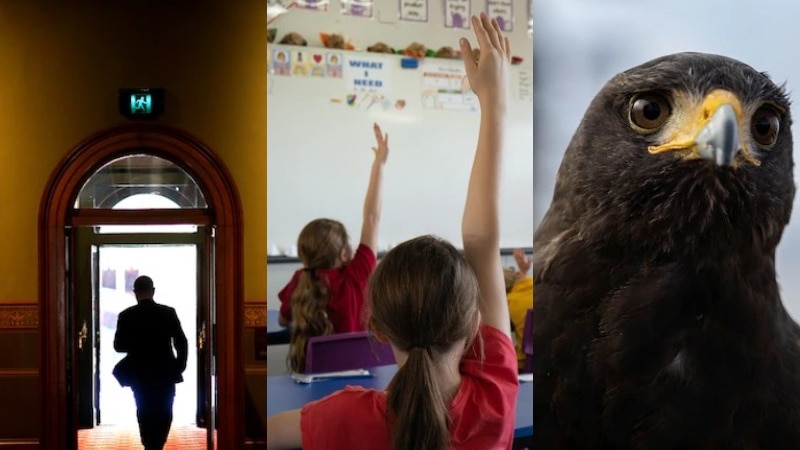
Meet Pac Manthe hawk hired by the San Francisco’s metro system with one job: to scare away pigeons.
The 5-year-old Harris’s hawk has been patrolling the The Little Hill of the North station with falconer Ricky Ortiz to stop pigeons from roasting (and protecting commuters from pigeon poop) three days a week.
To prevent Pac-Man from feasting on the pigeons or local rodents, Mr Ortiz gives him snacks throughout the day.
So far it’s been a success. Mr Ortiz says there’s “probably less than half“of the pigeons at the station now Pac-Man is on duty.
It ain’t much, but it’s honest work for Pac-Man.(Reuters: Carlos Barrio)
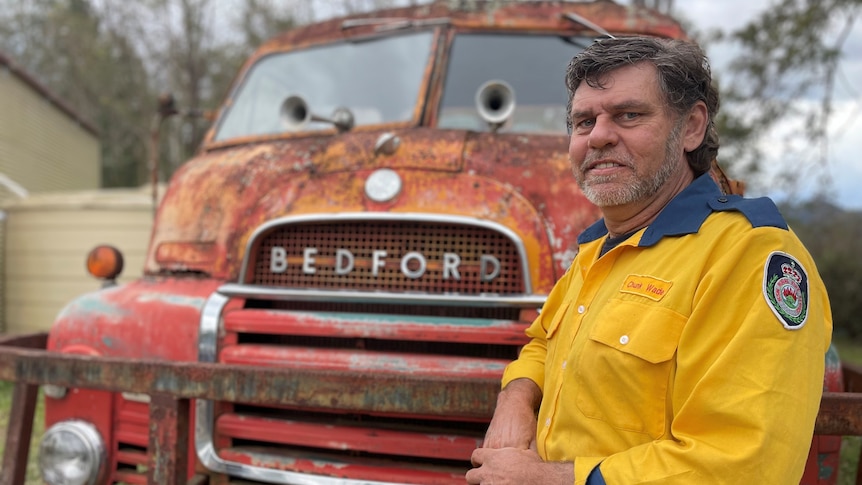
A rural fire brigade captain was driving through a forest in northern New South Wales when a flash of color caught his eye.
He was compelled to investigate and was thrilled to discover it was a vintage Bedford fire truck.
The 1960s vehicle had belonged to the remote Bellbrook Rural Fire Brigade, west of Kempsey on the Mid North Coast, and was used by what is believed to be Australia’s first all-Indigenous Rural Fire Service crew.
Bellbrook Brigade captain Adam Hall said it was an exciting find.
Bellbrook captain Adam Hall is thrilled to have the old truck back.(ABC Mid North Coast: Emma Siossian)
“Captain of the Newee Creek Brigade in the Nambucca Shire was driving through the Tamban State Forest,” Mr Hall said.
“Through some trees he noticed a little flash of red and saw an old fire truck and as firefighters tend to do, he got a bit excited, and he went and had a look and as he got closer, he saw Bellbrook was emblazoned on the side.”
The Bellbrook Brigade launched a public fundraiser so it could purchase the vehicle from the collector who had acquired it- the truck has now been moved from that property back to Bellbrook, with big plans for its restoration.
Gerard “Chunk” Wade served on the old truck in the 1980s.(ABC Mid North Coast: Emma Siossian)
Mr Hall said the truck was supplied to Bellbrook in the 1970s and became the primary truck used by an all-Indigenous branch based at the local Thungutti Aboriginal community in the early 1990s.
“We have a very rich history of Indigenous participation in the brigade here and the truck ended up as the truck that was used by the first all-Indigenous fire crew,” he said.
“We believe it was the first all-Indigenous fire crew in the country… so rebuilding it is very important for the community, for our Thungutti people here as well, and helping to bring some pride into our little village.”
Special memories of Indigenous crew
Ray Quinn remembers his dad serving in the original Indigenous crew.(Supplied: Bellbrook Rural Fire Brigade)
The truck held special memories for Bellbrook Rural Fire Brigade member Ray Quinlan. His late father Eric was part of the original Indigenous crew.
Eric Quinlan was part of the all-Indigenous brigade at Bellbrook.(Supplied: Adam Hall)
In the early 1990s, the truck was used at the local Bellbrook Aboriginal community.(Supplied: Adam Hall)
“It means a lot, my old man used to be out all the time in the fire brigade… I just used to always say, ‘I want to come’,” he said.
“I just want to keep following his footsteps.
“Looking at all the old photos of him back in the day in his fire brigade suit, it just makes me real proud of him and I want to make him proud of me.”
Bellbrook Brigade member Elwyn Toby also remembered seeing the truck in action at the Thungutti community.
“It was great to see our Indigenous leaders step up and have a go,” he said.
“It inspired me as a child, watching our uncles and aunties jump on the truck and become firefighters.”
A different era of firefighting
The truck at the Bellbrook centenary parade in 1992.(Supplied: Adam Hall)
Bellbrook Rural Fire Brigade deputy captain Gerard ‘Chunk’ Wade recalled serving on the truck in the 1980s.
“I remember standing in the back, and there’s not a lot of creature comforts of safety. You had a bar to hang on to and off you went into the fire,” he said.
“It was just a blast from the past just to see it come back to Bellbrook. It’s just a piece of history, I think that it’s just gold.”
Gerard Wade remembers heading into fire events standing on the back of the old truck.(ABC Mid North Coast: Emma Siossian)
Big restoration plans
It’s expected to take a couple of years for the truck to be fully restored.(ABC Mid North Coast: Emma Siossian)
Thanks to social media, there have been offers from around the country to help with the truck’s restoration.
“I expect it will take two to three years to get it somewhere near its former glory, at which point we hope to be able to go to schools and to shows and rusty iron rallies, that sort of thing and just show it off and put Bellbrook on the map,” Captain Hall said.
“We are only a very small, fairly isolated village here and it’s nice to be able to show the rest of the world who we are.”
Offers to help with the truck’s restoration have flowed in from around the country.(Supplied: Adam Hall)
The old Bellbrook sign on the side of the truck caught the eye of a local fire captain.(ABC Mid North Coast: Emma Siossian)
Bringing community together
Bellbrook’s current truck now also has ties to the region’s Indigenous heritage, featuring an artwork created by Mr Toby, who works as a local cultural arts teacher.
Elwyn Toby (right) has created an Indigenous artwork for the current Bellbrook fire truck.(ABC Mid North Coast: Emma Siossian)
“The artwork is recognized for our local Indigenous population in Bellbrook and the wider community,” he said.
“In the blue you have the fire truck, then water around the truck… the symbols in the yellow are people.
“It’s about coming together in the fires.”
It’s hoped the old and new trucks at Bellbrook will eventually be displayed side-by-side.(ABC Mid North Coast: Emma Siossian)
An ominous-looking storm was rolling in when Kristoffer Green and his family pulled up at an Ipswich medical center in queensland.
It was November 2015 and Green’s young daughter had a wasp bite he and his wife wanted a doctor to take a look at.
“We saw the dark clouds and we said, ‘Oh, we better watch that’,” the father-of-two, 31, told 9news.com.au.
Kristoffer Green was holding an umbrella when he was struck by lightning back in 2015. (9News)
Green thought nothing more than the storm until they were leaving the medical center in the pouring rain.
“I was helping my wife get my daughter in the backseat of the car and I was holding an umbrella,” Green said.
“The umbrella had a wooden handle, but the tip of my right index finger was resting on the metal pole in the center.”
Green said he remembers almost nothing of the moment the lightning bolt struck, hitting the metal top of his umbrella, traveling down its shaft and up his index finger into his arm.
“It was just like a blinding light and then I blacked out,” he said.
“My wife said I just simply collapsed.”
Thinking fast, Green’s wife raced into the medical center to get help from staff.
“When I woke up in the medical center my wife was crying over me and I was just completely shocked. I had no idea where I was or what had happened,” he said.
Medical center staff had hooked Green up to a monitor, which showed his heart was racing “a million miles an hour”, he said.
The young dad, who was 24 at the time, was taken by ambulance to Ipswich hospital for monitoring before being sent home the next day.
Every year, around five to ten Australians are killed by lightning strikes and 100 injuries are reported, according to the Bureau of Meteorology.
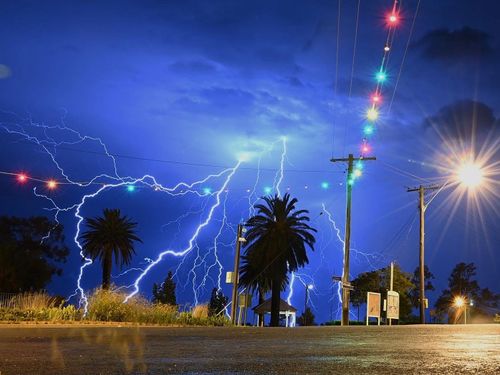
Bolts of lightning during a storm in Sydney. (SMH/Nick Moir)
Green is one of the lucky majority to survive a lightning strike.
But the effects, both physical and psychological, would linger for him.
For days after the strike, Green said his right arm would not stop tingling.
Green went from liking storms and taking pleasure in watching the lightning dance across the sky, to having an extreme aversion to the weather phenomenon.
“If there was a storm, I would get stressed and have heart palpitations,” he said.
Green claims he even developed a sort of internal barometer of his own, which alerted him if a storm was approaching.
“For a few years after the strike, my right arm – where the lightning went through – would tingle and start to hurt before a storm was overhead.
“I sometimes even still do it. I’ll say to my wife, ‘There’s a storm coming, hun’ and sure enough, a few hours later, there’s a storm coming in.”
Smells of ‘burning flesh and hair’
Far North Queensland man Sol Daley was out on the front verandah watching a storm on his rural property in Innisfail in 2016 when he was hit by a lightning bolt.
“My partner at the time was in the front yard moving pot plants around,” he said.
“Funnily enough, I said to her, ‘Get out of there because there’s lightning about’.
“As she stepped on the verandah, ‘bang’, the lightning hit.”
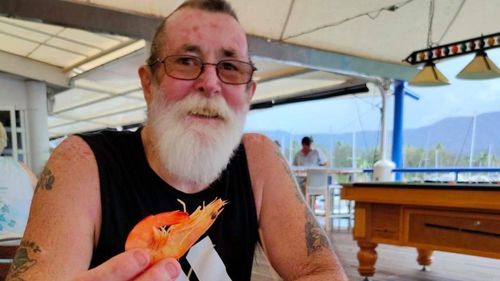
Sol Daley was hit by lightning at his property in Innisfail, northern Queensland, in 2016. (Facebook)
Daley was sitting on an aluminum chair.
“It was like a big blue finger and it came across, went through my arm and came out my foot,” he said.
“All I remember was the incredible bang, the flash of light and it was like someone was trying to kick their way out of my chest and between my legs.
“There was a smell of burning flesh and burning hair.”
Daley spent a day at Innisfail Hospital before being sent home.
But it soon became apparent that his recovery would not be straightforward.
“The next day I woke up, and I felt sort of felt okay, but when I went to speak, I couldn’t. My words were all mixed up like I had a stroke,” he said.
Daley said his speech issues continued for about a month, along with other symptoms.
“I was getting scrambled thoughts and I used to get the shakes, I called it the electric boogaloo.”
Lightning does strike twice
Julie Martineau, from Iowa in the US, is living proof that the old idiom “lightning doesn’t strike twice” has no basis in fact.
The first time Martineau was hit was back in 1999 when she was living in a mobile home.
It was the evening, a storm had blown up and she was doing the laundry.
As Martineau put her hand on the clothes dryer door, a bolt of lightning missed a large tree overhanging her mobile home and shot down the wiring connected to the dryer.
The electric current entered Martineau’s right hand, traveled across her chest and exited through her left hand.
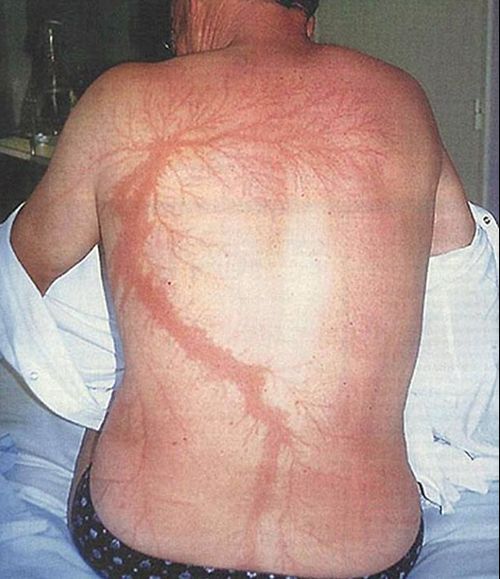
This photo of a lightning strike survivor shows the feathered markings left on his body by the electrical charge. (Massachusetts Medical Society)
“I remember everything,” she said.
“I remember the bolt striking, I remember the crackle of the bolt coming down and feeling like time stopped.
“I could hear my heart beating and counting the heartbeats and thinking ‘Holy crow, there’s something really wrong’ and trying to let go of the dryer and I couldn’t let go, the current was holding me in place.”
Martineau said for months after the lightning strike she suffered a range of debilitating health effects, some of which still plague her today.
“I had a lot of pain, mainly in my arms. There was some confusion, some irritability, some personality changes, but the big one was that I couldn’t sleep.”
Just over a year later, in October 2000, Martineau had moved from her mobile home after buying a house.
It was night-time and a storm was raging outside.
“I was asleep, lying in a waterbed and somehow a bolt came in through the second-storey window,” she said.
“My bed was maybe (a few meters) from the window and the bolt came in through the window and basically flashed over the bladder for the waterbed.
“It kind of flashed over that and caught me in the process, I was collateral damage.”
Rare flurry of snow dusts Western Australia
Martineau has since started up a Facebook support group for lightning strike survivors.
A Native American, Martineau said she sought answers during a traditional ceremony about her two painful lightning experiences and had found peace in the belief the spirits had chosen her.
How to keep safe in a storm
Every day, there are as many as 8 million lightning strikes globally, with around 44 strikes recorded per second at any one time.
In Australia, Darwin is the thunderstorm capital, with over 80 thunderstorm days per year.
So what can you do to keep safe during a storm? Here are some of the Bureau of Meteorology’s top tips:
Stay inside and shelter well clear of windows, doors and skylights
Don’t use a landline telephone during a thunderstorm
Avoid touching brick or concrete, or standing barefoot on concrete or tiled floors; and
Keep checking the Bureau’s website or app and listen to your local radio station for storm warnings and updates.
For Davey, it all comes down to taking care and using common sense.
“Don’t think you’re too good and that it’s not going to happen because it can happen in a heartbeat,” he said.
A south-east Queensland artist has been hunting for matchboxes — but the only fire she is interested in lighting is a creative spark.
Sharks leaping into a waterspout, penguins mingling with nuns and a space shuttle gliding over the Sydney Opera House show some of the stories inside Marlies Oakley’s mind.
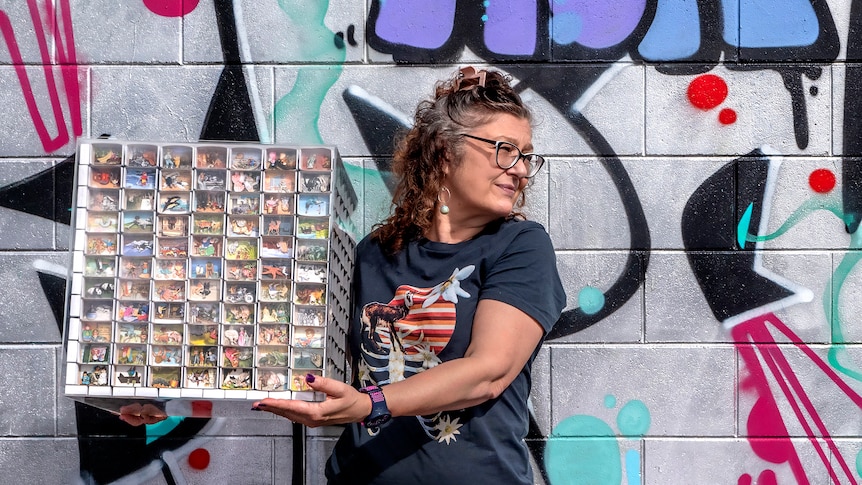
The German-born Bundaberg woman creates miniature stories inside matchboxes using a cut and paste collage technique, then joins the boxes together to create large voyeuristic artworks.
Individual stories contained in the matchboxes symbolize disconnect and isolation.(ABC Wide Bay: Brad Marsellos)
“Every matchbox is different,” Ms Oakley said.
“They consist of a background, with a few other elements within the matchbox for a 3D format. All collage and hand cut.”
Ms Oakley began working with collage after her home and business were devastated by the 2013 Bundaberg floods.
Her early works involved cutting postage stamps to create large-scale portraits and the process helped calm her mind.
Ms Oakley’s early collage work involved portraits created from postage stamps.(Supplied: Marlies Oakley)
Working with matchboxes was triggered by a more recent stress — COVID-19 lockdowns.
“A couple of years ago, I got a big box of matches at the Tender Centre,” Ms Oakley said.
“I forgot about them, but then I opened them up during COVID lockdown and I thought, ‘Oh, what can I do with them?’ and I started to collage them.”
Each matchbox contains its own “weird” or “quirky” tiny tale and when linked they represent the common feelings of isolation and disconnection during lockdowns.
“They are all their own stories because during COVID we have all got sort of inside our own homes and cocoons and nobody went out,” she said.
Each matchbox has a background, with images pasted to form an individual story.(ABC Wide Bay: Brad Marsellos)
“We started to think inside our own box.
“I love them all, I just giggle when I see them.”
Matchboxes strike interest
The artworks have captured the attention of galleries, with Ms Oakley claiming several art prizes for her works including the prestigious Martin Hanson Memorial Art Award and ‘Highly Commended’ Lethbridge Gallery Small Art Award, two years in a row.
Her 2022 entry ‘Thinking Inside the Box (cubed)’ is 462 matchbox stories linked to form a cube.
The cube took Ms Oakley about a week to create, in a process she describes as a “memory game” where she surrounded herself with images she had cut.
Creating the stories is a mindful practice for Ms Oakley but it is cutting the small images from op-shop books and magazines that has been the most helpful in calming her mind.
Marlies Oakley with her cube telling 462 collage stories.(ABC Wide Bay: Brad Marsellos)
“For hours I’m just cutting things out,” Ms Oakley said.
“Even if I don’t glue in a day, every night, even in front of the telly, I’m cutting things out — it’s part of my life now.
“I had a holiday for three weeks and I didn’t do it and at the end I thought, ‘I need it, I miss it’. I go into my own little world and cut and glue.”
An expensive venture
Sourcing the matchboxes is one of the only downsides of Ms Oakley’s creations, with many shops no longer stocking them.
And they are not cheap.
“It’s quite expensive to find the old matchboxes,” Ms Oakley said.
“But I found a really good supply at a major hardware store — I don’t know if they use them for barbecues or whatever, but you can still find them.”
She removes the matches and places them into a large jar, which she may use in an artwork in the future.
Ms Oakley’s artwork ‘Thinking Inside the Box (cubed)’ is currently on display the Bundaberg Regional Art Gallery as part of the HERE + now 2022 exhibition, which runs until November 13.
He flew in his single-engine Gipsy Moth on moonless nights or in torrential rain, often unlicensed, and at least once in his pajamas, with only a magnetic compass for navigation.
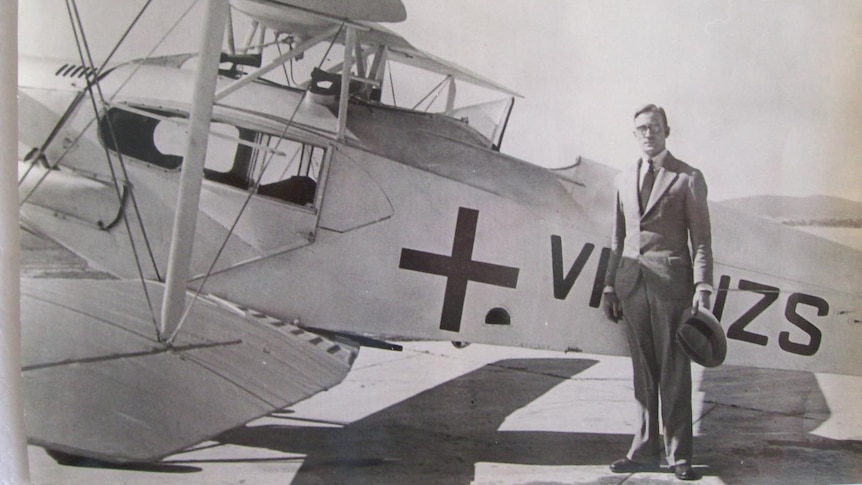
His name was Clyde Fenton – the tall, bespectacled doctor who, in the 1930s, clocked up 3000 hours and a quarter of a million miles, tending to the sick and injured across the Northern Territory.
This year marks 40 years since Dr Fenton’s death, and his legacy as one of Australia’s “original” flying doctors continues to live on.
Dr Fenton working on his plane from the open cockpit at the hangar near Katherine in about 1937. (Supplied: Library & Archives NT)
Every flight an adventure for larrikin of the sky
It was 1934 when Dr Fenton arrived in Katherine to establish an aerial medical service and it wasn’t long before his services became relied upon.
Whether it was a drover with an infected tooth, a woman having difficulty in childbirth or a child with a burst appendix, he would be in the air as soon as the call for help came through.
“In that vast, mysterious, and lonely land, every flight was an adventure,” he wrote in his 1947 autobiography.
But the harsh and remote lands of the Northern Territory ask more of people than most places.
Dr Fenton once went to the rescue of a toddler at Dunmarra who had been charged by a wild buffalo.
Not only did he tend to the child, he also went out and shot the buffalo which had been holding the homestead hostage all morning. He was gifted the horns as a thank you gift.
Another time, in 1940, Dr Fenton was at 2000 feet when a four-foot brown snake slithered along the cockpit floor toward the rudder pedals.
Dr Fenton with former NT administrator Reg Leydin’s wife in Darwin, launching his new plane “Robin” in 1937. (Supplied: Library & Archives NT)
“Not daring to keep his feet on the controls, Dr Fenton almost stood on the pilot’s seat and flew the plane by the joystick alone,” the Argus reported.
He made a rudderless landing near Maranboy and leapt from the plane before it fully came to a stop, swiftly dispatching the snake with a hammer.
Dr Fenton was the kind of person who took risks to save lives. And with bush aviation in the 1930s, the risks were substantial.
A crash course in flying
Bad weather, a spluttering engine, a fuel gauge pushing its limits: these things happened a lot to Dr Fenton, who survived an extraordinary number of plane crashes in his time as a flying doctor.
The first was in 1934 near Victoria River Downs – Dr Fenton was trapped upside down in the plane and his passenger described his eventual exit from the wreckage as “like toothpaste coming out of a tube that had been trodden on”.
Walking from the crash site to the station, the pair encountered a hostile buffalo and waded through croc-filled rivers.
Dr Fenton at the site of a crashed airplane.(Supplied: Library & Archives NT)
Dr Fenton had many close calls during his time out bush, including one in September 1937 that had the whole of the Northern Territory on edge.
While flying to a person in strife in the Gulf, somewhere near Tanumbirini Station, strong winds shook his little Moth and forced him to land in the scrub.
Several days later, Dr Fenton was still sitting beside an almost-dry waterhole feeding on the raw meat of a half-starved cow he had found bogged, hoping the bandages he used to form an SOS sign would catch someone’s attention.
Search parties frantically looked for the beloved doctor, and eight days later he was found, unharmed apart from a little sunburn.
A picture captured of Dr Fenton’s flying doctor biplane flying through a wet season storm.(Supplied: Library & Archives NT)
Grounded in Hong Kong and a hero’s welcome home
Dr Fenton had a reputation as being a bit of a maverick.
When he wasn’t on the job, he was known to land his plane outside the pub in Katherine’s main street for a beer, or sometimes for a laugh he would take the plane up over the town and flour bomb people.
On May 14, 1935, newspapers reported the flying doctor was fined £20 for “endangering public safety” by swooping low over Darwin’s Star open-air picture theater several times, including once between “the front of the circle and the screen”.
And then there was the time in 1936 he flew his tiny single-engine plane to China upon receiving news of his sister’s death in childbirth there.
Dr Fenton’s mother was stranded, so he constructed an extra fuel tank and took off in a monsoon, teaching himself to fly with his knees while he executed a daring mid-air refueling over the water.
The first Government aerial ambulance used by Dr Fenton, who previously flew his own plans as part of his Top End aerial medical service. (Supplied: CDU Nursing Museum)
He had no official permits or papers but managed to talk his way through Koepang and Bangkok, the latter by handing over an aircraft manual in English when asked for an airworthiness certificate.
Eventually, an official in Hong Kong grounded him.
Dr Fenton somehow took off anyway, only to be arrested in Swatow, China, then released because of his “filial piety”.
On the way back he was grounded again by the same Hong Kong official, who not having learned his lesson, gave the doctor permission to test his plane. And Dr Fenton was off again, arriving back in Darwin to a hero’s welcome.
CareFlight ball dedicated to Dr Fenton this year
Upon the outbreak of war, Dr Fenton served as a pilot in the RAAF, responsible for delivering food, mail and personnel from the Batchelor Airstrip to isolated bases and signal units across Arnhem Land and beyond.
He stayed on for a short time as a quarantine officer in the Northern Territory after the war, and in 1949 he married and moved to Melbourne, where he died in 1982.
His legacy lives on across the Top End, with a primary school and an airstrip named after him, and a dedicated wing at the Katherine Museum.
Katherine Museum chief executive, Lauren Reed, said the local community rallied to have one of the flying doctor’s original Gipsy Moth plans returned home and put on display.
“He was quite an iconic person and provided such a vital service, not just to Katherine but to all the regions and communities,” Ms Reed said.
Dr Fenton’s aerial ambulance eventually grew into the Northern Territory Aerial Medical Service.
The service has been succeeded by CareFlight NT, and the organization’s Hangar Ball is being dedicated to Dr Fenton this year.
CareFlight Fundraising Manager Jo Rutherford, who has been researching the territory’s “original” flying doctor for the event, said Dr Fenton paved the way for remote medical care in the north.
“He showed that aeromedical service was essential in the Top End and he was courageous in showing it could be delivered everywhere,” she said.
“He was a pioneer who worked to provide access to medical care wherever people lived.”
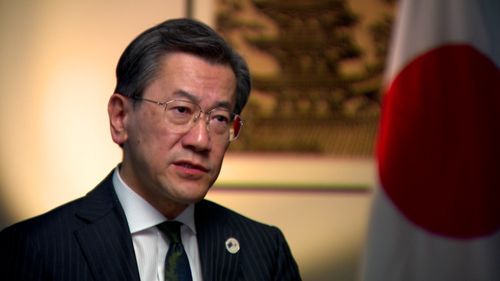
Japan’s Ambassador to AustraliaShingo Yamagami, has branded China’s use of ballistic missiles in its live fire exercises around Taiwan as “shocking” and a “dangerous act”, that matched the rogue behavior of North Korea.
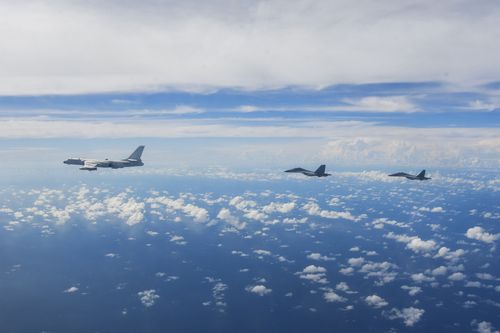
Some of the missiles had failed in Japan’s exclusive economic zone, a response to the visit by US House Speaker, Nancy Pelosi, that was “disproportionate” and “beyond our understanding”.
“Is this a dangerous act? Of course,” Yamagami said.
Japan’s Ambassador to Australia, Shingo Yamagami. (Nine)
“We are talking about busy maritime routes. So without any prior notification missiles are being shot into those waters.”
‘We are living in an increasingly severe security environment’
The Chinese envoy said his nation was a responsible stakeholder in the international order and spoke of the “opportunity to reset the China-Australia relationship” before laying the blame for all the recent trouble at Australia’s door.
In this photo released by Xinhua News Agency, aircraft of the Eastern Theater Command of the Chinese People’s Liberation Army (PLA) conduct a joint combat training exercises around Taiwan on Sunday. (AP)
Xiao stressed that Beijing reserves the right to take Taiwan by force, would not apologize for a dangerous intercept of a RAAF plane by a PLA jet fighter in international airspace, and assured the audience that the “basic rights” of two Australians who had been tried in secret were “well protected”.
“Don’t worry about that,” Xiao said.
Yamagami said he found the tone of the address jarring and that China would be judged by its actions.
“This behavior does not match their words,” Yamagami said.
“So we would like to see their deeds and actions matching their words.”
The Japanese envoy said he was deeply troubled by the strategic competition in the region.
“We are living in an increasingly severe security environment,” he said.
You can watch the full interview at the top of the page.
Ratepayers in rural Tasmania are being slugged with a medical levy to help prop up GP clinics, prompting fresh calls for the commonwealth to step in.
Key points:
Glamorgan-Spring Bay Mayor Robert Young said the levy was necessary to ensure the municipality’s vulnerable population had access to health care
AMA Tasmania president John Saul said rural practice especially was struggling for funding
He said an urgent review into Medicare funding was required, along with long-term planning
Councils including Glamorgan-Spring Bay, the Huon Valley and the Tasman have had to step in to keep local clinics open, and the Australian Medical Association (AMA) fears more will be forced down the same route unless Medicare funding is increased.
Glamorgan-Spring Bay Mayor Robert Young said the levy was necessary to ensure the municipality’s vulnerable population — where the median age is 56 — has access to health care.
Mr Young said about 60 per cent of the adults in his municipality were either retired or on some sort of government benefit.
“The levy is $90 payable every year by every ratepayer and it’s used to subsidize general practice and to encourage general practitioners to come to the east coast,” he said.
“It costs us between $550,000-$650,000 a year.”
He said not being able to attract doctors put pressure on emergency out-patients, and making a trip to Launceston or Hobart was too much for residents.
Moving closer to population centers was also not an option, he said, because they could not afford the higher rent and housing prices.
“There’s not a house or an apartment to rent that any reasonable person not earning a hell of a lot of money — and most of our people are retirees — to rent, so they couldn’t move back to Hobart.”
Dropping Medicare rebate makes it ‘impossible to bulk bill’
AMA Tasmania president John Saul said rural practice especially was struggling for funding, and it was being reflected in reduced levels of care.
The AMA’s John Saul.(ABC News: Luke Bowden)
“[Councils are] covering for the federal government inadequacies here, and they’re doing a great job, but it can’t keep going on forever,” Dr Saul said.
“We are sadly seeing the Medicare rebate drop so much that it’s impossible to universally bulk bill.
“We will see sections of communities that just won’t be able to afford to see a GP and it’s all the result of a government letting our patients down … [Medicare] has just become such a political football. No party seems to be really addressing the key problems.
“They just seem to be skirting around the edges and hiding from the key issues that are facing GPs and specialists alike who use Medicare.”
He said an urgent review into funding was required, along with long-term planning and “urgent strengthening of Medicare.”
“Our state government is doing their best to plug holes where they can, but we need some really systematic planning to work towards here.
“Years of neglect, we just need to get back on track and get some good planning in place.”
‘Not practical to travel to other clinics’
Tom Teniswood from Triabunna.(ABC News: Luke Bowden)
Tom Teniswood has been a resident at Triabunna for more than 40 years and said it was an unfair burden for local governments to be running GP clinics.
“We do want a medical service but I don’t think the local government are the right agency to be running a medical service,” he said.
“But then again, they are bound to look after the welfare of their contingency.”
He said it was not practical to travel across the state to other clinics.
“You’re an hour away minimum to a doctor in Sorell and their practices are full too.
“And with Sorell expanding the way it is, with new subdivisions going in, and things, they’ll be struggling to find more doctors.”
Federal govt must ‘come to the table’
In a statement, a spokesperson for the Tasmanian government said it “acknowledges the important role that GPs and the primary healthcare sector plays in caring for our community”, but added primary healthcare was “the responsibility of the federal government”
“We are working with the federal minister on what further supports from the federal government are required for the sector here in Tasmania,” it said.
“Recently, the government proposed a bold Primary Healthcare Reform vision to the federal government and we look forward to progressing this proposal through the development of a model to present to the Commonwealth for further discussion.”
The spokesperson said the Tasmanian government had “established a GP after-hours support initiative that provides funding through a grant process to support GPs and pharmacies to offer after-hours services to their local community and ease pressures on hospital emergency departments.
“While the Tasmanian government is doing all it can to assist general practice with innovative solutions, the federal government need to come to the table and provide additional supports and incentives to ensure the long-term sustainability of GP practices.”
The federal government has been approached for comment.