So buy up and unlock ’em all before Overwatch 2 if you’re so inclined!
Overwatch loot box sales will conclude on 30 August, Activision Blizzard has proclaimed today.
“Loot Boxes will no longer be available for sale after the end of the Anniversary Remix Vol. 3 event on August 30,” the publisher said in a blog post. “However, you will still be able to earn standard loot boxes after the end of the event.”
Said loot boxes will automatically open in the shift between Overwatch and its sequel Overwatch 2which will fully replace the team-based hero shooter from 5 October.
Overwatch 2 won’t have loot boxes of any kind, though a recent survey sent to players suggested that some of its cosmetic items may set players back up to $45 USD.
original Overwatch‘s Anniversary Remix Vol. 3 event is on now and runs until the end of the month.
Overwatch 2goes free-to-play on Windows PC, Xbox One, Xbox Series S, Xbox Series X, PS4, PS5 and Switch on 5 October 2022 here in Australia. We went in depth on what to expect from it here.
This article may contain affiliate links, meaning we could earn a small commission if you click-through and make a purchase. Stevivor is an independent outlet and our journalism is in no way influenced by any advertiser or commercial initiative.
Australia’s recently crowned Open champion, Cameron Smith, has reportedly signed a $143 million deal to join Greg Norman’s LIV Golf.
It’s a move that will send shockwaves through the sport, given Smith is the most recent major winner, the world No.2, and also the reigning champion at the Players Championship, the flagship event of the PGA Tour.
The London Telegraph reports Smith will make his LIV Tour debut in Boston next month, although confirmation of his switch isn’t expected until after the PGA Tour’s FedEx Cup playoffs, which start this week in Memphis.
READMORE:Memorable cricket icon suffers tragic death
READMORE:Superstar Serena Williams retires in bombshell interview
READMORE:Aussie stars ‘gone’ in shock LIV Golf defection
Another Australian golfer, Cameron Percy, told RSN radio on Tuesday that Smith and Marc Leishman were “gone”, indicating the pair would both sign with LIV, a comment that left Smith far from impressed.
“You know, my goal here is to win the FedEx Cup playoffs. That’s all I’m here for,” Smith said. “If there’s something I need to say regarding the PGA Tour or LIV, it’ll come from Cameron Smith, not Cameron Percy.
“I’m a man of my word and whenever you guys need to know anything, it’ll be said by me.”
Pressed further on the subject of LIV Golf, Smith added: “I have no comment to that. Like I said, I’m here to play the FedEx Cup playoffs. That’s been my focus the last week and a half.
“Like I said, it’ll come from me, it won’t come from Cameron Percy.”
Asked if he intended to play the Presidents Cup in late-September, Smith’s reply was emphatic.
“Absolutely,” he said.
“That’s something we’ve been looking forward to for the last three years. That’s something I look forward to being a part of.”
If Smith did play a LIV Golf event in early September, he would be banned from the Presidents Cup, meaning his comment that he intended to represent the International team in North Carolina effectively represents a denial of the London Telegraph report.
Smith then reportedly walked out of the media conference when asked another question about LIV.
Smith would be the highest-ranked player to join LIV Golf, which has already signed Dustin Johnson, Brooks Koepka, Bryson DeChambeau and Sergio Garcia.
For a daily dose of the best of the breaking news and exclusive content from Wide World of Sports, subscribe to our newsletter byclicking here!
The stars who’ve signed with Greg Norman’s LIV Golf tour
If you’re providing remote access support, it’s crucial that the software is easy to download and set up, because the person on the other end isn’t necessarily tech savvy. And if you’re primarily interested in accessing specific machines, you want software you can sign into securely and leave running in the background. TeamViewer does both of these things extremely well, in addition to offering some of the smoothest remote controls on the market. It also works across platforms and is free for noncommercial use. It’s a bit pricey for business use, but that doesn’t prevent TeamViewer from earning our Editors’ Choice award for remote access software.
How Much Does TeamViewer Cost?
TeamViewer is completely free for personal use. The free version isn’t a gimmick or a demo. I used it for the bulk of my testing, then I tried out the business version. There’s no difference, feature-wise. Home users get everything TeamViewer has to offer, which is great if you, like many of our readers, provide volunteer tech support for friends and family.
Paid plans for businesses start at $418.80 per year. With that license a single user can manage up to 200 computers. The next plan, which costs $1,234.80 per year, allows up to four users to control up to 300 computers. These plans aren’t available on a month-to-month basis.
TeamViewer’s business prices are toward the top of the market. RemotePC, which offers a similar feature set, doesn’t have a free version, but paid plans start at $19.50 a year. The cheapest business plan starts at $59.50 a year. Like TeamViewer, GoToMyPC primarily targets businesses and starts at $420 per year (or $44 per month if you prefer to pay monthly), which is still higher than TeamViewer despite the lack of a free version.
Canceling a TeamViewer plan is a bit of a pain because you can’t do it on the website. Users are instead told to email the support team.
Is TeamViewer Really Free?
The free version of TeamViewer is enforced by an AI designed to detect commercial activity that cuts off access for users it deems suspicious. Some legitimate home users are caught by the AI and cut off, and plenty of negative reviews on Google Play or the App Store complain of accounts being disabled automatically and without warning. Such instances tend to be extreme, however. One such reviewer claims to have been using TeamViewer to play PC games on their Mac, and I find it understandable that the bandwidth required would look like commercial use to an algorithm. (Virtualization software would serve them better anyway.) In any case, users can appeal, so this is more of an annoyance than a dealbreaker.
TeamViewer Platform Support
TeamViewer offers clients for macOS, Linux, and mobile platforms. I tested the software on computers running Windows 10, Windows 11, and macOS 12, and found that all of these versions support all of the features I’d expected. The macOS version of TeamViewer is feature-complete—there’s nothing missing or not working.
Is TeamViewer Dangerous?
According to the company, TeamViewer is secured by end-to-end 256-bit AES encryption, multi-factor authentication (which you should absolutely use), and other industry-grade security features. The company is certified according to SOC2, HIPAA/HITECH, ISO/IEC 27001, and ISO 9001:2015.
Still, some amount of security is up to you. The most important security measure is to never install remote access software if someone you don’t know tells you to do it. It is a common hacking technique people use to remotely steal your information and access financial accounts. For example, if someone claiming to be tech support calls you, out of the blue, to “diagnose a problem” or “fix your bank account,” then asks you to install a remote access app, hang up—you’re talking to to scammer Call the dedicated phone number for the company in question instead and ask if there are any issues you need to address.
Getting Started With Teamviewer
Remote access software, by nature, needs to be installed on at least two machines: the computer you want to access remotely and the computer you have in front of you (or the machine you want to access the other computer from). It’s best if this process is straightforward, in particular if you’re talking to someone through the installation over the phone.
If you’re offering support, having a simple setup process is crucial because it means the people you’re supporting can quickly download and install TeamViewer and give you their information to connect. To get started, you head to TeamViewer.com and click the download button—you get an installer for your system. Follow the installation instructions and you will eventually see the main TeamViewer window.
TeamViewer automatically gives every computer an ID and password, which is shown when you open the application, as seen above. You can use that code to connect to the current machine. This same window has a box where you enter an ID in to connect to another machine, though this method is only just one option for connecting.
If you’d rather not enter an ID and password to access certain machines, however, the other option is to set up an account and sign into it on all systems. If you then check the “Grant easy access” button, you can connect to your own computers in just a couple clicks.
Smooth Controls
I tested TeamViewer both on my local home network and outside near a Portland, Oregon, food cart pod that doesn’t have particularly great Wi-Fi. I connected to a Windows 10 machine from a Macbook, an iPad, and a laptop running Windows 11. TeamViewer worked great in all of these combinations.
On my local network I barely notice when I’m using remote access software. Everything feels more-or-less in real time. I can browse the web, write a document, and even edit images over the network with only the occasional problems caused by lag. The results aren’t quite this smooth farther from my home, but I still don’t have any trouble accessing the other machine. Lag isn’t an issue. By contrast, another PCMag writer mentioned that in Zoom Meetings, which includes a remote access feature, the lag time is noticeable.
TeamViewer supports sharing system audio, which in my tests worked flawlessly. I could listen to music without much disruption. On my local network I could even watch a video with sound this way, albeit with a little bit of stuttering. It worked better than other apps I tested, including Remote PC and GoToMyPC. TeamViewer offers audio sharing on Windows and macOS computers, unlike GotoMyPC which can only share audio from Windows.
Sharing Files (and Your Face)
TeamViewer offers a file-transfer mode for any device you’re connected to. It shows a two-pane file browser, with all files on both computers available to send and receive, allowing you to transfer files directly from a folder on one device to a folder on another.
TeamViewer also offers audio and video chat, so you can see and talk with whoever is sitting at the computer you’re helping control. A whiteboarding feature lets you draw on the screen so that you can point things out, which is very handy if you’re using TeamViewer to offer support. With the audio/video chat and whiteboard features, you can talk out loud, emphasize areas of the screen by drawing them, and even look the person you’re working with in the eye. The only other remote management app we reviewed that offers whiteboarding is Remote PC. TeamViewer also offers the ability to record a remote session.
Nearly Flawless Remote Access
Remote access software is borderline magic when it works well, letting you see and control one computer from another. TeamViewer has been providing this practical magic since 2005, and it shows. Every potential stumbling block seems to have been anticipated, whether you’re offering tech support for someone else or want access to your own computer from the road. That makes TeamViewer an Editors’ Choice winner for remote access software, particularly for free personal use, and our go-to app for remotely driving our own computers from afar.
The Blackcaps will begin a new era without one of their biggest stars after bowler Trent Boult was released from his central contract with New Zealand Cricket.
Boult will have a “significantly reduced role” across all three formats with the Blackcaps, according to a statement released by NZC.
The 33-year-old held multiple conversations with the country’s governing cricket body, before they agreed to his request on Wednesday so he can spend more time with his family.
Watch South Africa’s Tour of England. Every ODI & T20 Live & On-Demand on Kayo. New to Kayo? Start your free trial now >
Boult has played a crucial role in New Zealand’s success on the world stage over the last decade, having taken 317 Test wickets, 169 in ODI’s and 62 in T20 internationals.
The talented left-armer sits at No. 1 on the ICC Men’s ODI Bowling Rankings, having taken 169 scalps at 25.21 since his international debut in 2011. He has also taken 317 Test wickets at 27.49.
The paceman said it was a “really tough decision” for him to make as he began to reflect on his decorated 12-year career with the New Zealand national teams.
“Playing cricket for my country was a childhood dream and I’m so proud of everything I’ve been able to achieve with the Blackcaps over the past 12 years,” Boult said.
“Ultimately this decision is about my wife Gert and our three young boys. Family has always been the biggest motivator for me and I feel comfortable with putting it first and preparing ourselves for life after cricket.”
Boult’s decision will likely have major implication for New Zealand cricket with Black Caps teammates potentially tempted to follow suit in bid to cash in on lucrative domestic T20 leagues.
The world cricket calendar is becoming tighter and tighter with the introduction of several privately-owned domestic leagues, including the United Arab Emirates’ International League T20 and South Africa’s newly-launched T20 competition.
Boult has played in an international final across all three formats, having tasted success in the inaugural World Test Championship final against India in England.
But while he’s been a mainstay of the New Zealand teams since making his Test debut in 2011 against Australia, he acknowledged that this decision would affect his chances of representing his country.
“I still have a great desire to represent my country and feel I have the skills to deliver at the international level. However, I respect the fact that not having a national contract will affect my chances of selection,” he added.
“Having said that, as a fast bowler I know I have a limited career span, and I feel the time is right to move into this next phase.”
Maxwell suffers back injury during win | 01:26
NZC chief executive David White said that Boult has been open about his decision, and why he requested to be released from his deal.
“We respect Trent’s position,” said Mr White. “He’s been completely honest and upfront with us about his reasoning about him and, while we’re sad to be losing him as a fully-contracted player, he leaves with our best wishes and our sincere thanks,” White said.
“Trent’s made a massive contribution to the Blackcaps since his Test debut in late 2011 and is now considered one of the best multi-format cricketers in the world. We’re very proud of what he’s achieved.”
According to NZC, Boult will still be available for national selection “if and when available”.
A federal appeals panel unanimously ruled Tuesday that a House committee can access former President Donald Trump’s tax records after a yearslong legal battle.
A three-judge panel of the US Circuit Court of Appeals for Washington, DC, agreed that the House Ways and Means Committee has the authority to obtain Trump’s tax records from the Treasury Department, upholding a district court ruling from late last year.
Trump’s lawyers are all but certain to appeal the ruling.
NBC News has asked a Trump spokesman and a member of his legal team for comment.
The court ruling adds to Trump’s legal woes after the FBI searched his Mar-a-Lago home in Palm Beach, Florida, on Monday. A source familiar with the matter said the search was tied to classified information Trump is alleged to have taken with him from the White House to his resort in January 2021.
Tuesday’s appeals court ruling is the latest twist in a multiyear legal fight over his tax records. A federal judge in December tossed out Trump’s lawsuit seeking to block the House panel from obtaining his tax returns, rejecting his claim that Congress had no legitimate need to look at the returns and that Congress was simply snooping around to embarrass him.
House Ways and Means Committee Chairman Richard Neal, D-Mass., lauded the appeals court’s “long-anticipated” opinion Tuesday. Neal first requested copies of Trump’s federal tax returns in April 2019, a request the Treasury Department initially refused.
“With great patience, we followed the judicial process, and yet again, our position has been affirmed by the Courts,” Neal said in a statement. “When we receive the returns, we will begin our oversight of the IRS’s mandatory presidential audit program .”
Neal had initially cited a federal law that requires the Treasury Department and the IRS to turn over individual tax returns when any of the three congressional tax committees demand them.
“The Chairman has identified a legitimate legislative purpose that it requires information to accomplish,” the appeals court ruling says. “At this stage, it is not our place to delve deeper than this. The mere fact that individual members of Congress may have political motivations as well as legislative ones is of no moment. Indeed, it is likely rare that an individual member of Congress would work for a legislative purpose without considering the political implications.”
If he appeals, Trump would have to ask the full circuit court to rehear the case or appeal directly to the Supreme Court.
The House committee’s top Republican, Kevin Brady of Texas, urged Trump to appeal.
The ruling “unleashes a dangerous new political weapon,” Brady said in a statement, arguing it would grant Congress the ability “to target and make public the tax returns of political enemies.”
House Speaker Nancy Pelosi, D-Calif., meanwhile,called the court’s decision a “victory for the rule of law” Tuesday on Twitter.
“Access to the former president’s tax returns is crucial to upholding the public interest, our national security & our Democracy,” Pelosi said.
Zoë Richards is the evening politics reporter for NBC News.
Are traveling salespeople still a thing? If so, they can travel a little lighter: The Wemax Go is a portable 1080p laser projector that measures only an inch thick and weighs under two pounds. It’s entirely self-contained, running on battery power and built-in apps. And just because it’s a business expense doesn’t mean it can’t handle the occasional movie night. (Shhh — we won’t tell the boss if you won’t.)
I spent some time putting the projector through its peace, and let me start with the most exciting part: Although it lists for $1,000, right now the Wemax Go Advanced is on sale for just $603.
That price puts the Go Advanced in line with the Xgimi Elfin, another portable 1080p projector. But there’s one key difference: The latter requires AC power; the Wemax can run for up to 90 minutes on its battery.
Wemax Go Advanced design
Obviously, that won’t last you through most movies, but it’s more than enough for a typical PowerPoint slide deck. And if you need more juice, you can plug just about any power bank into the Go’s USB-C port (which is also where it charges via the included AC adapter).
Also at the rear: a headphone jack, USB port, HDMI port and two very small, very low-power speakers (just 2 watts apiece).
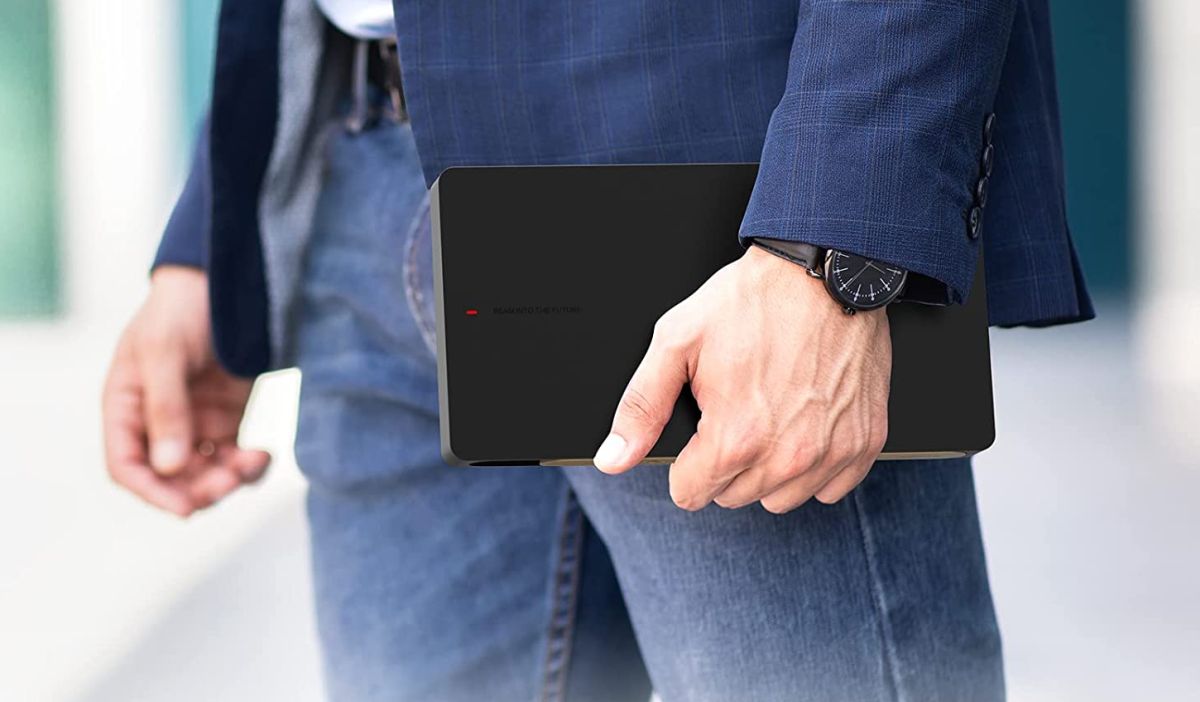
It’s hard to overstate just how compact this thing is; in your hand it feels like a slim hardcover book. Needless to say, it’s incredibly easy to bring along, whether in a backpack, briefcase or carry-on.
A typical use-case here is at the end of a conference-room table, pointed at a projector screen on the wall. To that end, the Go Advanced has a small, hinged stand embedded in its underside; it can tilt the lens up a few degrees as needed.
A particularly nice touch is the gold-colored accent bar on the front edge, which actually serves a practical purpose: It covers and protects the lens. When you slide the cover left, it turns on the projector. Slide it back to turn it off again. There are no other physical controls, however; for everything else you’ll need the included remote (which isn’t backlit, sadly).
You don’t need to be a businessman to benefit from the compact size and battery power of the Wemax Go Advanced. (Photo: Wemax)
Wemax Go Advanced features and performance
The Go Advanced is a native 1080p projector, a more-than-adequate resolution for most business presentations and informal movie viewing. Like a lot of projector makers, Wemax touts “4K support,” but that simply means it can work with 4K sources; it doesn’t upscale or anything like that. Wemax also touts 600 ANSI lumens, a measure of the projector’s brightness. For comparison, the aforementioned Xgimi Elfin produces 800 ANSI lumens.
In the real world, this means the Go needs a relatively low-light environment to give you the best possible image, but it definitely doesn’t need total darkness. In a conference room, you could probably get away with turning off the lights and closing the blinds.
I tested the unit in my basement, where I have a 100-inch screen already in place. It’s relatively dark, the only daytime light coming from a small window. The projector managed just fine, generating bright, crisp, colorful images that I found very satisfying. Indeed, it crushes most of the portable projectors I’ve tried, which were dim and washed out. (They were also priced hundreds less.)
However, there are a few important considerations. First, the Go runs something called FengOS, which unfortunately no one will mistake for Android TV. It’s a simple but limited operating system, able to run a handful of apps (like YouTube and the Firefox web browser) natively but requiring extra steps for the likes of Hulu and Netflix. If you do install those and other streamers, you’ll sometimes have to use something called mouse mode (which turns the remote into a sort of floating cursor) to interact with them. Not fun.
Why not just mirror your phone or tablet and use that as your streaming source? The projector supports mirroring (which works quite well and can be great for presentations, product demos and such), but licensing restrictions prevent you from playing most commercial content. Rats.
My advice: If you want to stream, skip all this and plug in something like an Amazon Fire TV, Google Chromecast or Roku Streaming Stick. Those dongles may ruin the projector’s aesthetic, but they’ll give you a vastly superior, infinitely easier streaming experience.
Wemax Go Advanced problems
Although it worked well overall, the projector did present a few issues. First, it seemed stuck in Eco Mode — which forces a lower brightness setting in order to preserve battery power — unless I connected a power supply. If this is intentional, it’s bad design: I should get to choose the mode I want, regardless of battery status.
My bigger concern is with the auto-keystone feature, which promises to produce a properly sized, rectangular image even when the projector is placed above, below or to the side of the screen. There’s also an obstacle-avoidance setting that can compensate for, say, a plant or painting that’s partially blocking the image.
In my tests, none of this worked properly. In some cases the projector failed to make any discernible adjustments to the image; in others it overcompensated by shrinking it. I tried different angles, distances and so on; it never managed to properly fit the projection to my screen. I’ve tested other projectors that have auto-keystone, and I’ve never encountered this problem.
The good news is that the Go Advanced has simple manual controls, meaning you can adjust the corners as needed to achieve your desired rectangle. And the car-focus feature worked perfectly every time.
Wemax Go Advanced: Should you buy it?
This is a really good projector, and it’s a stone’s throw from greatness. Super-compact and portable, it delivers a sharper, brighter image than many a larger model. If your business could benefit in any way from having a totally wireless projector at the ready, it’s easy to recommend the Wemax Go Advanced.
It’s also decent for the occasional movie, though I recommend using a streaming stick or something similar instead of the onboard app library. Just keep in mind that battery life is around 90 minutes at best (but easily supplemented by a mobile power bank), and the built-in speakers are weak and tinny-sounding (so consider packing a Bluetooth speaker as well).
Wemax Go Advanced Ultra Portable Smart Laser Projector
$603$1,198Save $595
Follow us on Instagram, Facebook, Twitter and pinterest for nonstop inspiration delivered fresh to your feed, every day.
Want daily pop culture news delivered to your inbox? Sign up here for Yahoo Entertainment & Life’s newsletter.
The Blues raised the case involving West Coast’s Willie Rioli when he was cleared after the Eagles successfully argued he was making a legitimate attempt to mark the ball when he crashed into the Suns’ Matt Rowell in round two.
Carlton’s Patrick Cripps appeared before the court after colliding with the Lions’ Callum Ah CheeCredit:The Age
His counsel Peter O’Farrell said there was a range of reasonable responses to the situation both players found themselves in when a spoil from the Lions’ Daniel Rich bounced above eye level and it was critical in determining the extent of Cripps’ liability to accept that neither player had possession of the ball when they both entered the contest.
Although not disputing that the Blues’ midfielder had his eyes on the ball, AFL counsel Nicholas Pane QC argued that Cripps had other options and could have entered the contest with arms outstretched or tapped the ball on.
Pane said it was not reasonable for Cripps to contest the ball in the way he did given he would have been aware he was likely to collide with Ah Chee.
He said the case rested on whether contact was “part and parcel of contesting the ball” and in his view it was not. Pane said contact with Ah Chee was late and Cripps should have recognized that his opponent was vulnerable and therefore entered the contest differently.
Footage showed that Cripps entered the contest before Ah Chee had taken possession of the ball with both players leaping simultaneously to win the ball.
O’Farrell said the collision occurred with both players acting reasonably and therefore there was no need to argue whether it was careless. O’Farrell said Cripps had taken a straight line to the ball as Ah-Chee drifted back across him to also contest the possession.
He said it was not a bump therefore Cripps could not be found guilty of rough conduct.
“It was a collision in an aerial contest and the charge cannot be sustained,” O’Farrell said.
“There was no bump. Cripps was contesting the ball at all times.”
In an earlier appeal West Coast midfielder Tim Kelly had his charge of rough conduct for a dangerous tackle on Adelaide’s Jarrod Berry upheld meaning he will miss Sunday’s derby against Fremantle.
The federal Liberals have rejected an invitation to attend a national jobs summit next month, labeling it a stunt.
Key points:
The opposition has ruled out any of its MPs attending next month’s jobs summit
The federal government is agreeing to a summit with the hopes it will prompt wages and productivity growth
Peter Dutton says the summit is a “stunt” with the unions
The federal government is preparing to agree to a summit for the first week of September that it hopes will be a keystone for its economic policy in the term ahead that will unify business, government and unions.
Government ministers had expressed hesitation over inviting the opposition, saying it would only be invited if it was prepared to be constructive.
On Tuesday Treasurer Jim Chalmers wrote to Opposition Leader Peter Dutton, extending an invitation for him or another Coalition MP to attend.
But Mr Dutton has rejected the invitation.
“It’s a stunt with the unions,” Mr Dutton said.
“We’ll support all sorts of good policies from the government … but we’re not going to support stunts.
“The fact that Jim Chalmers wrote to me and then within a couple of hours dropped it to The Australian newspaper demonstrates it is nothing more than a stunt.”
Unions lay down reform agenda ahead of summit
Overnight, the peak union body outlined its goals for the upcoming jobs summit, with “full and secure” employment being its first priority.
The Australian Council of Trade Unions said despite unemployment being at a historic low, real wages were declining and insecure work was “rife”.
The ACTU said the federal government should implement an excess-profits levy on companies “enjoying windfall profits as a result of current inflation”, cancel planned tax cuts for high-income earners and regulate labor markets to ensure wages rose in line with productivity.
The unions have already flagged they want enterprise bargaining rules overhauled, something the government has indicated it will pursue despite resistance from business groups.
ACTU secretary Sally McManus said for workers to benefit, the government must do more than fiddle around the edges on workplace reforms.
“It requires new ways of thinking about how our system is managed, who benefits from it, and how to change it for the better,” Ms McManus said.
Shadow Finance Minister Jane Hume said despite her party’s refusal to attend, the jobs summit would be an important chance to set the policy agenda for the coming term of government.
“The jobs summit that’s coming up will be a very important event in which a lot of these demands get aired,” Senator Hume told Sky News.
“The real test, of course, will be when Labor starts ruling out some of these demands from their union masters.
“I think this is an important opportunity for the Australian public to really hear what it was they voted on.”
We asked NPR readers from hot countries (including the US!) to share their tips on how to cope with the heat. It’s a follow-up to a story we published last week by heat wave researcher Dr. Gulrez Shah Azhar about how he dealt with super high temps while growing up in India, where his home was one of many with no A/C unit .
Nearly 900 people who grew up without an air conditioner from Vietnam to Minnesota shared their heat hacks via Facebook, Instagram, Twitter and email. They offered all kinds of advice on how to deal with the heat. Here’s a selection of reader responses. These have been edited for length and clarity.
1. Sleep in a wet sheet (really)
To sleep in the St. Louis, Mo., summer heat, I would wrap a sheet around me, get in the shower (yes, with the sheet on) then lay on my bed with a fan blowing on me. I was cool and slept well. In the morning, the sheet and mattress were dry. — Sally Kuhlenschmidt, Bowling Green, Ky.
2. Use frozen water bottles
I grew up without A/C in Tennessee and I would freeze bottles of water and go to sleep with a few of them in my bed. I’d wake up a few hours later and switch the bottles out for others in the freezer. — Lauren VanNostrand
3. Deflect the sun
Deflect sun rays from your house by taping aluminum foil or pop-in reflective screens designed for automobiles to windowpanes. — Patty Besom
4. Go on a cold food diet
I grew up in Minnesota in the ’60s when air conditioning was only just beginning to be a household staple. My mother would do any cooking needed for the day during early morning hours. Sometimes she would make a cold pasta salad for dinner. She also had a recipe for no-bake cookies that would only come out during the hot days of summer. We drink lemonade and iced tea. At the time, popsicles came with two joined together, each with its own stick, and most of the time we [kids] only got half. But during days of extreme heat, we were allowed the entire thing! –Jeanne Pumper
5. Spray yourself with water
Fill a pump sprayer with distilled or purified water (so it won’t leave deposits on you) and liberally spray yourself, especially your face and head. When outside, spray your hat and your shirt with this water until damp. I call it “artificial sweat” and I find it amazingly refreshing. — John Fuhring, Santa Maria, Calif.
6. Lay on a tile floor
Something I learned living in Singapore was to lay on the cold tile floors for a little while. Put a pillow under your head, turn on a good show, lay on the floor and zone out. –Kathryn Lee
7. Cool off with cologne
I live in Valencia, Spain, and the heat is almost unbearable. I don’t have an A/C. I use baby cologne to cool off. I douse it over my neck and shoulders and because it’s mostly made of alcohol, it immediately [evaporates and] refreshes. I keep it in the fridge to stay extra cool! — Lily Adamson
8. Catch a movie
When I lived in Puerto Rico, we also lived without A/C. The most effective way I found to keep cool on very hot days was to go the movies. PR’s movie theaters are notorious for being cold — they really blast the air conditioner! Sometimes it’s so cold that people have to bring in blankets and coats. — Jennifer Gandasegui
9. Pull in the morning air
I have a complex process to cool down my house. Essentially, you pull in cool night and morning air into the house by using box fans, and then close down the house as things heat up outside.
As soon as I get up at 6 or 7 am, I open the windows in every room and prop box fans in the chair. Around 9 or 10 am, I take the fans out, close all the windows, and let the fans run on the floor of each room. Right now, it’s 90-plus degrees outdoors. Inside, my fan is blowing lightly on my back as I sit at my desk, and I feel chilly enough to move my location. — Meenakshi Ponnuswami, Lewisburg, Pa.
10. Laundry = coolness
I grew up in Vietnam in the ’70s and ’80s. We used to wash clothes manually [to cool down with the water] — then we hung our laundry [on clothing lines] outside the house, which provided extra shade to residents during the heat of the day. — Diem Tu, Vancouver, Canada
11. Sleep outdoors
I spent my childhood summers living in Egypt. We lived on the 11th floor of an apartment building and I slept in the top bunk in the kids’ room — with no A/C. And as you know—heat rises! At night, I’d tiptoe to the balcony of our flat with my pillow, lay out a blanket and sleep outdoors in the coolness of the night. —Malaka Gharib, Nashville, Tenn.
Thank you to all who told us your personal stories. For more callouts like these, stay in touch with NPR Goats and Soda by subscribing to our weekly newsletter.
Google is making yet another attempt to persuade Apple to support the RCS phone-messaging standard in its own iMessage service, but this time it’s aiming the sales pitch at iPhone users.
At a “Get the Message” site posted Tuesday, Google calls out the least-common-denominator aspect of texts between iPhone and Android users: Everybody loses such features as encryption, typing indicators, and read receipts supported separately by Apple’s iMessage and the Google -backed Rich Communications Services (RCS), also called “chat features” in Android.
“Apple creates these problems when we text each other from iPhones and Android phones, but does nothing to fix it,” the page declares. “Apple turns texts between iPhone and Android into SMS and MMS, out-of-date technologies from the 90s and 00s.”
Subsequent paragraphs emphasize how iPhone users don’t only suffer the indignity of seeing Android-using friends’ messages in green bubbles but also miss features they enjoy in conversations with other iPhone users. For example: “Without read receipts and typing indicators, you can’t know if your Android friends got your text and are responding.”
Privacy also loses out in cross-platform conversations, the page notes: “SMS and MMS don’t support end-to-end encryption, which means those messages are not secure.”
(But while RCS supports end-to-end encryption in one-to-one Android chats, group Android chats today only get encryption in transit, with “e2e” security advertised as coming later this year. Bringing this same security to chats between different apps and different platforms would be much harder.)
Apple has never shipped an iMessage client for Android, and court documents unearthed during Fortnite’s lawsuit against Apple revealed that the Cupertino, Calif., company rejected an iMessage port because it might weaken iMessage’s customer lock-in effect.
Google has instead tried in vain to get Apple to add RCS support to iMessage–most recently, at its I/O developer conference in May. But while this latest sales pitch may win over some iPhone users, Apple has a history of ignoring requests from users that don’t square with its own product vision.
Google, meanwhile, has struggled to get RCS going in Android. It didn’t get all three major carriers lined up to ship its own Messages app until 2021, leaving an enormous installed base of Android phones running carrier- or manufacturer-specific messaging apps that don’t speak RCS. And Google still hasn’t persuaded Google to add RCS support to its own Google Voice calling and messaging service.
Finally, Google has yet to provide third-party developers with the coding framework they’d need to add RCS support to such SMS-capable apps as Signal and WhatsApp–the two services Google’s new page endorses as alternatives for iPhone users anxious to avoid today’s “broken experience” of cross-platform communication.
Developer posts in a thread on Signal’s site blame that on Google not providing the right API, and Google has yet to say when it might ship that framework.