You know that highlighted piece of text at the very top of a Google search results page when you look up a piece of information? That’s called a “featured snippet,” and it’s meant to provide you with a quick answer to your query. Now, Google is making sure that the information it highlights is reliable and accurate by using its latest AI model, the Multitask Unified Model, so that Search can now look for consensus when deciding on a snippet to feature.
Google’s Search AI can now check snippet callouts — those are the information with larger fonts that serve as heading for featured snippets — against other high-quality sources online. It can figure out if there’s a general consensus for that callout, even if sources use different words or concepts to describe the same fact or idea. Google says this “consensus-based technique has meaningfully improved the quality and helpfulness of featured snippet callouts.”
Google featured snippet
But for some queries, such as those with false premises, displaying features snippets isn’t the best way to deliver information. To address that issue, Google tweaked its Search AI so that this particular update reduces the triggering of snippets for those types of queries by 40 percent.
Google is now also making its “About this result” tool more accessible. That’s the panel that pops up when you click on the three dots next to a result, showing you details about the source website before you even visit. Starting later this year, it will be available in eight more languages, including Portuguese, French, Italian, German, Dutch, Spanish, Japanese and Indonesian. It’s adding more information to the tool starting this week, as well, including how widely a publication is circulated, online reviews about a company, or whether a company is owned by another entity. They’re all pieces of information that could help you decide whether a particular source is trustworthy.
Finally, in case Google’s AI has determined that the overall results for a search query may have questionable quality, the results page will now display a content advisory. “It looks like there aren’t many great results for this search,” the advisory will say, telling you to check the source you’re looking at or to try other search terms. It could help you stay alert and be on the lookout for potential fake information while checking the results the website had presented.
All products recommended by Engadget are selected by our editorial team, independent of our parent company. Some of our stories include affiliate links. If you buy something through one of these links, we may earn an affiliate commission.
The ongoing search for a missing 5-year-old New Hampshire girl is now a murder investigation, New Hampshire Attorney General John Formella said Thursday. Harmony Montgomery disappeared sometime between Nov. 28 and Dec. 10, 2019, but police did not learn of her disappearance from her for more than two years. Formella said all the evidence leads them to believe the child is dead. “All of the (investigative) efforts have led us to conclude that Harmony Montgomery was murdered in Manchester in early December of 2019,” he said. “At this point, while Harmony’s remains have not yet been located, we do have multiple sources of investigative information, including just recently confirmed biological evidence that have led us to this difficult and tragic conclusion.” Holding back tears, Manchester Police Chief Allen Aldenberg implored anyone with information to come forward. “I’m not asking you to do it for me, for the people in this room, the people who have been working on this investigation. Do it for this little girl who’s on the screen. The time is now. Time to step up and do the right thing,” he said. In June, law enforcement officers from state and federal agencies swarmed a Manchester, New Hampshire, apartment building where the girl’s father, Adam Montgomery, and his estranged wife Kayla Montgomery, previously lived. Officials were seen removing a refrigerator. Investigators wrapped the appliance in black plastic and loaded it onto a waiting truck. At the time of the girl’s disappearance, Adam Montgomery had legal custody of Harmony. He has been indicted on an assault charge alleging that he struck Harmony in the face in July 2019 He’s also accused of unrelated firearms theft charges and has pleaded not guilty.No charges have been directly filed in Harmony’s disappearance.Kayla Montgomery is charged with two felony counts of perjury for allegedly lying to a grand jury.The couple told police that Harmony was brought to be with her mother in Massachusetts around Thanksgiving 2019. Her mother said she last saw her daughter during a phone video conversation around Easter that year.Police have received hundreds of tips. They’re offering $150,000 for information that will lead them to the missing child. Anyone with information about Harmony Montgomery’s disappearance can call or text a 24-hour tip line at 603-203-6060.
MANCHESTER, NH—
The ongoing search for a missing 5-year-old New Hampshire girl is now a murder investigation, New Hampshire Attorney General John Formella said Thursday.
Harmony Montgomery disappeared sometime between Nov. 28 and Dec. 10, 2019, but police did not learn of her disappearance for more than two years.
Formella said all the evidence leads them to believe the child is dead.
“All of the (investigative) efforts have led us to conclude that Harmony Montgomery was murdered in Manchester in early December of 2019,” he said. “At this point, while Harmony’s remains de ella have not yet been located, we do have multiple sources of investigative information, including just recently confirmed biological evidence that have led us to this difficult and tragic conclusion.”
Holding back tears, Manchester Police Chief Allen Aldenberg implored anyone with information to come forward.
“I’m not asking you to do it for me, for the people in this room, the people who have been working on this investigation. Do it for this little girl who’s on the screen. The time is now. Time to step up and do the right thing,” he said.
In June, law enforcement officers from state and federal agencies swarmed a Manchester, New Hampshire, apartment building where the girl’s father, Adam Montgomery, and his estranged wife Kayla Montgomery, previously lived.
Officials were seen removing a refrigerator. Investigators wrapped the appliance in black plastic and loaded it onto a waiting truck.
At the time of the girl’s disappearance, Adam Montgomery had legal custody of Harmony.
He has been indicted on an assault charge alleging that he struck Harmony in the face in July 2019. He’s also accused of unrelated firearms theft charges and has pleaded not guilty.
No charges have been directly filed in Harmony’s disappearance.
Kayla Montgomery is charged with two felony counts of perjury for allegedly lying to a grand jury.
The couple told police that Harmony was brought to be with her mother in Massachusetts around Thanksgiving 2019. Her mother said she last saw her daughter during a phone video conversation around Easter that year.
Police have received hundreds of tips. They’re offering $150,000 for information that will lead them to the missing child.
Anyone with information about Harmony Montgomery’s disappearance can call or text a 24-hour tip line at 603-203-6060.
iOS 16 was announced in June with multiple new features, including a new lock screen with widgets, revamped notifications, improved Focus mode, options to edit and unsend messages in iMessage, and more. This week the company released iOS 16 beta 5 to developers, and it came with a surprise: the battery percentage for modern iPhones. However, the once beloved feature now seems quite controversial.
The battery percentage is back
iPhone 3GS was the first iPhone to show the exact battery percentage in the status bar for users. Since then, every iPhone had the option to show the battery percentage, until 2017. Due to the new design of the iPhone X, which was the first to feature an edge-to-edge display with a notch at the top, some interface elements had to be removed from the status bar.
The battery percentage was one of these elements. Starting with the iPhone X, users had to open the Control Center to see the full battery indicator. Apple has never commented on this decision, but many users argue that seeing the battery percentage all the time made them anxious.
In the meantime, developers have created multiple solutions to bring the battery percentage back to modern iPhones using jailbreak tools. Apple never seemed to care about this, until now. The latest beta version of iOS 16 brings battery percentage back to modern iPhones. But there are a few catches.
Not everyone seems to like it
The thing is, not everyone seems to like the new implementation of the battery percentage in iOS 16. That’s because it is indeed a bit confusing. As detailed by 9to5Mac’s José Adorno, the battery icon doesn’t match the battery percentage as it drains. This can easily make users believe that the battery is still full while it’s not.
The icon only changes when the battery level drops to 20%, then it becomes red and empty. For now, Apple is making the feature optional, so you can disable it if you don’t like it. However, turning on Low Power Mode will make the system show the battery percentage. Another thing to keep in mind is that battery percentage is not available for iPhone XR, iPhone 11, iPhone 12 mini, and iPhone 13 mini.
Personally, the new implementation seems lazy to me. Apple could have done much better than this, especially for a feature that took five years to be introduced. Of course, we’re talking about beta software, so things might change until the official release of iOS 16 next month.
What are your thoughts on the battery percentage in iOS 16?
Now we would like to know your thoughts on this. Do you think that Apple’s implementation of battery percentage in modern iPhones is good enough? Or do you think the company could have done better? Let us know in the poll and comments section below.
FTC: We use income earning auto affiliate links. More.
The father of murdered Brisbane woman Hannah Clarke says the push for a nationally consistent understanding of coercive control is critical to protecting women from abusive partners, as the country’s top law officers prepare to meet to discuss the issue.
Developing national principles on coercive control will be a key focus of the first meeting of state and federal attorneys-general since the election of the Albanese government. The meeting will be chaired by Commonwealth Attorney-General Mark Dreyfus in Melbourne on Friday.
Sue and Lloyd Clarke, parents of Hannah Clarke who along with her three children was murdered by her estranged partner, have campaigned for criminalizing coercive control.Credit:alex ellinghausen
The awareness of coercive control has grown significantly since the horrific murder of Clarke and her three young children by her estranged husband, Rowan Baxter, in Brisbane in 2020. Following their deaths, it emerged that while Baxter had not previously been physically violent, he had Clarke subjected to escalating forms of controlling and possessive behaviour.
Clarke’s father, Lloyd, and his wife, Sue, have spearheaded a campaign to criminalize coercive control in Queensland. He said it was “fantastic” that the issue was being discussed at a national level because it was poorly understood.
“Coercive control is one of the most insidious things going around,” Lloyd Clarke said. “We’ve been pushing for it because there’s so little understanding about it. If there is a national approach, everyone will get a better understanding on what it is and how dangerous it can be.”
loading
Coercive control is generally recognized as including controlling what someone wears, limiting access to money, tracking their location, controlling whom they see, and persistent texting, and can be a precursor to physical violence.
The Queensland government committed to criminalizing coercive control following the murder of Clarke and her children. In May, it pledged to have laws in place by 2023, after it accepted the recommendations of its women’s safety taskforce which identified the need for a new offense that captured psychological, emotional or financial harm as constituting domestic violence.
NSW is also moving on the issue. Releasing a draft bill to criminalize coercive control last month, the state’s Attorney-General Mark Speakman noted the NSW domestic violence death review team had identified coercive and controlling behavior by the abuser in 99 per cent of intimate partner domestic violence homicides between 2008 and 2016.
FBI Director Christopher Wray speaks during a news conference Wednesday in Omaha, Neb.
Charlie Neibergall/AP
hide caption
toggle caption
Charlie Neibergall/AP
FBI Director Christopher Wray speaks during a news conference Wednesday in Omaha, Neb.
Charlie Neibergall/AP
OMAHA, Neb. — The director of the FBI had strong words Wednesday for supporters of former President Donald Trump who have been using violent rhetoric in the wake of his agency’s search of Trump’s Mar-a-Lago home.
Christopher Wray, who was appointed as the agency’s director in 2017 by Trump, called threats circulating online against federal agents and the Justice Department “deplorable and dangerous.”
“I’m always concerned about threats to law enforcement,” Wray said. “Violence against law enforcement is not the answer, no matter who you’re upset with.”
Wray made the remarks following a news conference during a long-planned visit to the agency’s field office in Omaha, Nebraska, where he discussed the FBI’s focus on cybersecurity. He declined to answer questions about the hours-long search Monday by FBI agents of Trump’s Palm Beach, Florida resort.
It has been easy to find the threats and a call to arms in those corners of the internet favored by right-wing extremists since Trump himself announced the search of his Florida home. Reactions included the ubiquitous “Lock and load” and calls for federal agents and even US Attorney General Merrick Garland to be assassinated.
On Gab — a popular social media site with white supremacists and antisemites — one poster going by the name of Stephen said he was awaiting “the call” to mount an armed revolution.
“All it takes is one call. And millions will arm up and take back this country. It will be over in less than 2 weeks,” the post said.
Another Gab poster implored others: “Lets get this started! This unelected, illegitimate regime crossed the line with their GESTAPO raid! It is long past time the lib socialist filth were cleansed from American society!”
The search of Trump’s residence Monday is part of an investigation into whether Trump took classified records from the White House to his Florida residence, according to people familiar with the matter. The Justice Department has been investigating the potential mishandling of classified information since the National Archives and Records Administration said it had received from Mar-a-Lago 15 boxes of White House records, including documents containing classified information, earlier this year.
Console gamers can get access to closed beta access codes for EA Sports’ FIFA 23
EA Sports is set to release the FIFA 23Closed Beta codes, which will give players early access to the game ahead of its release on September 30.
It is common practice for the game developer to hand out a code to some players which allow them to get their hands on the game before it is officially released. Simultaneously, it provides EA with the opportunity to fix any bugs that might have remained.
How to get the FIFA 23 Closed Beta access code
You must sign up for EA email notifications to get a chance to grab the FIFA 23 Closed Beta codes. All so:
Go to your EA Account email preferences.
Confirm your email under Primary Email is correct.
Check the box under Manage your email preferences.
Click Update.
Closed Beta access is not available to everyone, but if you are one of the lucky ones you will get an email with the code. Sharing codes is not possible.
When does FIFA 23 Closed Beta access start & end?
FIFA 23 Closed Beta will be released on August 11, 2022 at 6pm BST (1pm ET / 10am PT).
Closed Beta access ends on September 1, 2022.
Which platforms is FIFA 23 Closed Beta available on?
gamers with Xbox One, Xbox Series S, Xbox Series X, PlayStation 4 and PlayStation 5 are eligible to play the game with the codes. The Beta is not available to players on Nintendo Switch, Stadia, or PC.
You also need to have an active subscription to Xbox Live Gold or PlayStation Plus to play.
Which countries are eligible for FIFA 23 Closed Beta?
The Closed Beta is only available to players in the United States and the United Kingdom. There may be some exceptions to this, based on certain feedback that EA Sports is looking to get.
What game modes are available to play in FIFA 23 Closed Beta?
FIFA 23 Beta will give you compulsory access to the following game modes.
kick off
Online Seasons
Online Friendslies
Practice Arena
Some players might also get access to FUT, Career Mode, Volta Football or Pro Clubs.
Does FIFA 23 Closed Beta progress carry over?
No, your progress in the Beta edition won’t carry over to the full game.
How to report a bug or send feedback to EA Sports?
EA Sports is eager to gather as much feedback as possible before the official launch of the game. So if you find a bug or have feedback you can share them in the FIFA 23 Closed Beta forums on Answers HQ.
Only people with access to the Closed Beta can use the forums. You’ll also need to sign in to your EA Account.
With several governments around the world pursuing limits on nitrogen fertilizer use in agriculture, how would farmers adapt if the Australian government took a similar approach?
Key points:
Fertilizer production and use is responsible for more than half of the greenhouse gas footprint of the national wheat crop
Nitrous oxide emissions come from the volatilisation of nitrogen fertilizers like urea
Volatilization can be minimized through management, but synthetic nitrogen is hard to replace in cropping systems
Birchip Cropping Group senior research manager James Murray said the obvious way to reduce emissions from nitrogen fertilizer was to use less of it.
“I naturally guess the go-to option is to grow more legumes in the rotation, because when we grow legumes we don’t need to apply nitrogen to meet production,” he said.
“But it’s not as simple as that, because there are greenhouse gas emissions such as nitrous oxide associated with the breakdown of legume stubbles.”
In broadacre cropping, fertilizer production and use accounted for 58 per cent of the Australian wheat crop’s greenhouse gas footprint in the past five years, according to the Department of Agriculture.
Of that, 31 per cent occurred on-farm, a large part of which came through the volatilization of nitrogen fertilizer, where nitrous oxide is released into the atmosphere.
Nitrous oxide is a greenhouse gas that is almost 300 times more potent than carbon dioxide.
James Murray says regardless of motivating factors, more efficient fertilizer use will benefit both the environment and the hip pocket.(Rural ABC: Angus Verley)
Apart from growing more nitrogen-fixing legumes to reduce fertilizer use, Mr Murray says there are products available to slow the volatilisation process, which occurs when nitrogen is applied to a crop and there is insufficient rainfall following application to break it down.
“There are a couple of products on the market — one is a urease inhibitor, which reduces that volatilization risk by slowing that release when you apply if you don’t get follow-up rainfall relatively quickly,” he said.
“The other one is a polymer coating, which slows the release of nitrogen quite significantly.
“But the challenge with them is they’re not necessarily cost-effective to utilize, with the urease inhibitor retailing for about $50 a tonne on top of your urea cost, so it opens up a question about how cost effective that is in farming system.”
Mr Murray said whether or not farmers used a urease inhibitor, there was significant value in getting nitrogen application right and minimizing volatilisation.
“We talk a bit about the four Rs — so the right rate, the right product, the right source and the right timing, which at the end of the day will have significant benefits for production, and if we’re reducing our greenhouse gas footprint at the same time, that’s a bonus,” he said.
Countries including New Zealand, Canada and the Netherlands are enforcing limits on fertilizer application to reduce emissions, which Mr Murray says is a consideration for farmers here.
“There are considerations around market access and potential future mandates on how things are utilized,” he said.
“I think there’s a great opportunity for the Australian grains industry to be ahead of the game on this stuff, whether it’s for market access or potential mandate considerations.
“In terms of improving the way we use our inputs, the biggest benefit is to the bottom line in terms of improving crop production.”
Urea can release nitrous oxide into the atmosphere.(ABC Wimmera: Andrew Kelso)
What are the alternatives?
Some farmers are trialling alternatives to synthetic fertilizer under the broad umbrella of “regenerative agriculture”.
Among them is Luke Batters, who farms with his family near St Arnaud in western Victoria.
“Our operation is largely a synthetic-based system and our use of synthetic fertilizers and chemicals has increased substantially,” he said.
“I was working out of agriculture for seven years and when I came back to the farm I had a different mindset and so we’re trialling a few different things around inputs, in terms of how different carbon and biological and chemistry-based inputs affect the system.”
Mr Batters is trialling alternatives like compost, manure, seaweed and vermicast, which is a mixture of products, including worm castings.
“It wasn’t until I started doing this trial work that I realized how reliant we were on nitrogen as a synthetic input,” he said.
Nitrogen-rich sheep urine patches are growing much better than surrounding areas on Luke Batters’s farm.(Rural ABC: Angus Verley)
What are the problems?
Mr Batters said while he thought his trials were otherwise healthy, they were severely lacking in nitrogen and he had not been able to make up the shortfall with the alternatives he has used.
“I went largely cold turkey and stopped using synthetic fertilizers and it’s been quite stark, the difference between applied synthetic fertilizers and no synthetic fertilizer and having to rely on those alternatives,” he said.
“These things will work in a system once the biology gets up and going, but because our current system is so depleted of biology, it really hasn’t taken off.”
Mr Batters said he had not achieved the results he was hoping for but he would persist.
“If there are regulations in the future around what we can and can’t do and we haven’t got an alternative we’ll come unstuck,” he said.
With California enduring a historic drought amplified by global warming, Gov. Gavin Newsom on Thursday released a new plan to adapt to the state’s hotter, drier future by capturing and storing more water, recycling more wastewater and desalinating seawater and salty groundwater.
The governor’s new water-supply strategy, detailed in a 16-page document, lays out a series of actions aimed at preparing the state for an estimated 10% decrease in California’s water supply by 2040 due to higher temperatures and decreased runoff. The plan focuses on accelerating infrastructure projects, boosting conservation and upgrading the state’s water system to match the increasing pace of climate change, securing enough water for an estimated 8.4 million households.
Newsom called it “an aggressive plan to rebuild the way we source, store and deliver water so our kids and grandkids can continue to call California home in this hotter, drier climate.”
Newsom was scheduled to speak about the plan Thursday morning in Antioch, where a desalination plant is being built to treat brackish water.
“The best science tells us that we need to act now to secure California’s water future. Climate change means drought won’t just stick around for two years at a time like it historically has,” Newsom said in a statement. “Drought is a permanent fixture here in the American West and California will adapt to this new reality.”
The plan calls for expanding water storage capacity above and below ground by 4 million acre-feet; expanding average groundwater recharge by 500,000 acre-feet; accelerating wastewater recycling projects to reuse at least 800,000 acre-feet of water by 2030; building projects to capture more runoff during storms, and desalination of ocean water and salty groundwater.
The projected loss of 10% of the state’s water supply within two decades translates to losing 6 million to 9 million acre-feet per year on average — more than the volume of Shasta Lake, the state’s largest reservoir, which holds 4.5 million acre-feet .
The state’s plan refers to how warmer temperatures unleashed by rising levels of greenhouse gases are leading to what many scientists describe as aridification. A warmer climate makes the atmosphere “thirstier,” pulling more moisture from the landscape through evaporation and increasing the amount plants take in, leaving less runoff flowing into streams and rivers.
“Regardless of drought or flood, in this changed climate there will be less water available for people to use,” the state plan says. “To match the pace of climate change, California must move smarter and faster to update our water systems. The modernization of our water systems will help replenish the water California will lose due to hotter, drier weather.”
The extreme dryness and high temperatures during the 2012-16 drought, closely followed by the current drought since 2020, “send a strong climate signal that we must heed,” the plan says. It says these more extreme conditions make clear that California should “double down” on a set of actions to bolster the state’s water supply “with haste.”
State officials said executing the strategy, which builds on the governor’s water resilience portfolio released in 2020, will require coordination with local and federal agencies and tribes.
The plan includes targets and timelines, such as expanding desalination of brackish groundwater to 84,000 acre-feet by 2040, and increasing the state’s capacity to capture storm water by 500,000 acre-feet by 2040. For comparison, the total annual water use of Los Angeles is nearly 500,000 acre-feet.
Among other things, the state plan calls for creating a groundwater recharge coordinating committee to help implement projects that will capture water and replenish aquifers.
To offset the increased evaporation and reduction in supplies brought on by the changing climate, the plan says, “California must capture, recycle, de-salt, and conserve more water.” It says the new set of priorities will “put to use water that would otherwise be unusable, stretch supplies with efficiency, and expand our capacity to bank water from big storms for dry times.”
The plan says this approach is designed for a “climate prone to weather whiplash.”
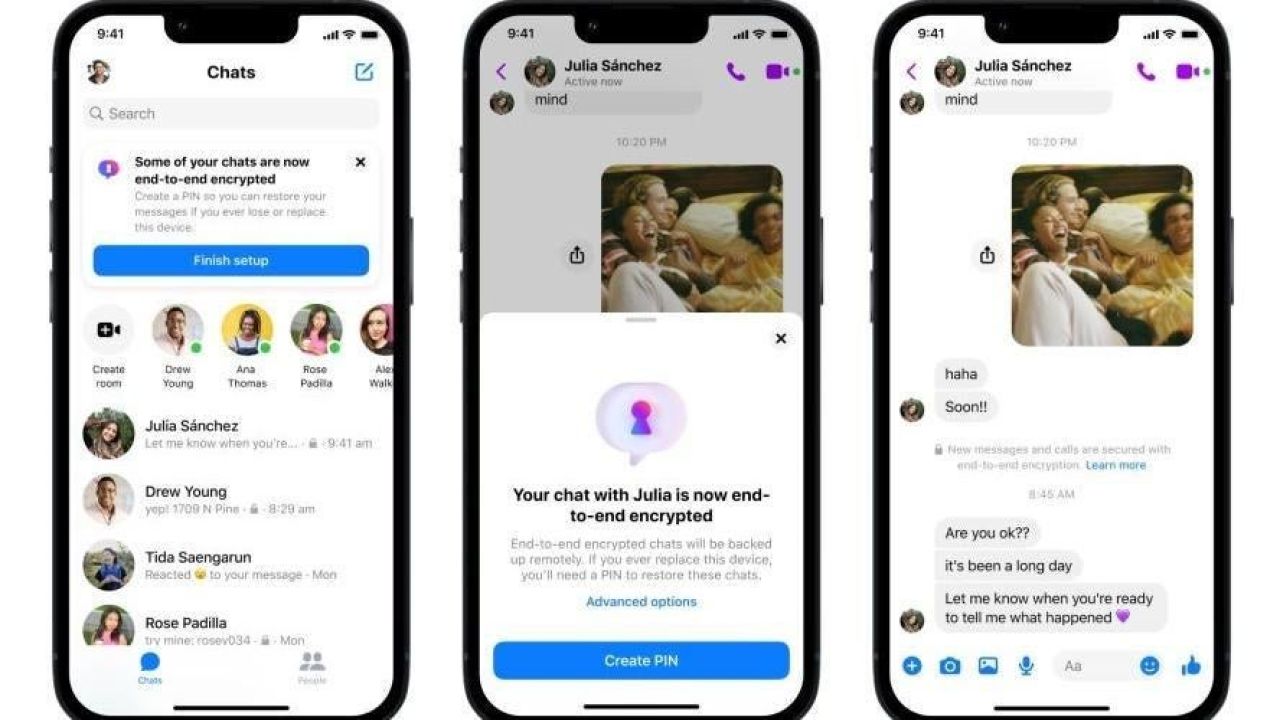
Meta’s expanding end-to-end encryption on its Messenger platform. The company is now testing the privacy feature as the default setting for certain chats, as announced in a Thursday press release. E2E encryption is the gold standard for online data privacy. With E2E, messages can theoretically only be viewed by the sender and intended recipient(s) — even Meta shouldn’t be able to see the content of chats sent with this level of encryption.
Though the company first introduced E2E encryption as an option in 2016, this is the platform’s first major step towards actually making the privacy setting the default — something that’s critical for users’ true online security.
Previously, Meta has indicated that default E2E is the ultimate goal for Facebook and beyond, yet the timing of today’s announcement is hard to ignore. It comes in the immediate aftermath of news that Meta shared Messenger chats with police in a criminal case concerning a 17-year-old’s abortion.
The Nebraska teenager and her mother are facing multiple felony charges after allegedly using medication to induce an abortion after 20-weeks, which is illegal in the state. A significant part of the case against the two are Messenger chats that Meta handed over to Nebraska police in compliance with a search warrant, which seems to discuss the mother and daughters’ plans for medication abortion and disposing of evidence.
The company faced public backlash over the news, and has responded by denying it knew the case was about abortion. But if those messages had been encrypted from the start, neither the company nor the police would’ve easily been able to read them.
Meta did not immediately respond to Gizmodo’s request for comment, but a company spokesperson, Alex Dziedzan told Wired that, “This is not a response to any law enforcement requests.” He further added, “we’ve had this date in the diary for months, but the short notice is because Messenger product teams have been finalizing the tests that are going live. These tests will start [Thursday]. We want people to hear about these tests from us before they see changes in the app.”
The Test Specifics
Currently, during testing, E2E is only the default “between some people”. Which means, if you’re in the test group, only some of your most frequent conversations will convert to default encryption. In their statement, Meta clarified that message histories will still be viewable, and that users will still be able to report messages to the platform if they are in violation of Meta policies.
Along with default E2E, the company announced a few other encryption-related tests and updates. Meta said it’s also testing a “secure storage feature” for backing up encrypted messages, and allowing those message histories to be transferred between devices. “As with end-to-end encrypted chats, secure storage means that we won’t have access to your messages, unless you choose to report them to us,” the company wrote.
Further changes include the end of “vanish mode” in Messenger, an encryption verification feature, and an expansion of opt-in E2E encryption on Instagram. Meta is also moving to bring more features to its encrypted messaging, and said that deleted messages will soon sync across platforms, that it will test the ability to unsend messages, and that the company is planning to make accessing E2E encrypted calls through Messenger easier.
Taken together, the changes are a big move for user security on Meta’s platforms. But remember that tech companies’ privacy promises aren’t always what they seem, and there’s the perennial risk the government could get in the way.
Knowingly displaying Nazi flags or memorabilia bearing swastikas has been outlawed in New South Wales, with offenders facing up to a year’s jail time or a possible fine of over $100,000.
Key points:
The ban allows the swastika to be used when it’s in the public interest, including in academic, historical and educational settings
NSW Attorney-General Mark Speakman says it sends a “clear message” Nazism “will not, and should not, be tolerated”
ASIO said in 2020 far-right violent extremism, largely neo-Nazi ideology, made up around 40 per cent of its counter-terrorism caseload
The Crimes Amendment (Prohibition on display of Nazi symbols) Bill 2022 swiftly passed in the state’s upper house on Thursday with unanimous support.
It followed an inquiry earlier this year which recommended a ban on the public display of Nazi symbols in a bid to tackle rising anti-Semitism.
It made NSW the second state in Australia to pass the landmark legislation after Victoria in June.
NSW Jewish Board of Deputies chief executive Darren Bark described the passing of the law as a historic day for NSW.
“Nazi symbols are a gateway to violence and are used as a recruitment tool by extremists,” he said.
“Banning their display is a long-overdue and much-needed law in our state. The perpetrators will finally be held to account.
“The legislation is also a game-changer in tackling online hate.
“It is time our tech companies step up and ensure these illegal symbols are removed from their platforms, and the offenders are banned and prosecuted.”
The Holocaust was the genocide perpetrated by the Nazi regime in Germany that killed some six million Jews and other minority groups including homosexuals, black people and Roma people during World War II.
loading
NSW Attorney-General Mark Speakman said the bill’s passing was a significant moment for Holocaust survivors and their families.
“The events that occurred under the Nazi regime represent one of the darkest periods of recorded human history,” he said.
“The atrocities committed during that period are almost unimaginable, and the intergenerational trauma they have caused continues to be felt by many people today.
“This new offense sends a clear message that the display of Nazi symbols, and the hatred and bigotry they represent will not, and should not, be tolerated.
“This new criminal offense will provide important, additional safeguards against hate speech and vilification in our state.”
Attorney-General Mark Speakman said the ban sends a clear message to potential offenders. (AAP Image: Joel Carrett)
A section in the bill allows for the swastika symbol to be used in academic, historical or educational settings where it is in the public interest.
The section paves the way for its display by Hindus, Buddhists and Jains in which it holds religious significance.
“For too long, the Hindu community has not felt comfortable to display our symbol of peace because it resembled a symbol of evil. This is no longer,” said Hindu Council of Australia national vice-president Surinder Jain.
“We were so pleased to work with the Jewish community to make this a reality.
“Thank you to everyone involved in this important work for the benefit of our entire community.”
Mr Bark noted the legislation was also “a game-changer in tackling online hate” and called on tech companies to ramp up efforts to remove imagery and symbols associated with Nazism.
Labor’s Walt Secord, a member of the parliamentary committee examining the ban of Nazi symbols and an ardent advocate for the bill, said 31 incidents of displaying the Nazi flag were reported to the police in 2020.
Many members from the government and Opposition in the upper house recounted personal stories of their families’ lived experiences during the Holocaust.
Others warned of the dangers of rising neo-Nazi trends.
Mr Secord referred to a NSW man arrested by counter-terrorism police in September found to be in possession of a Nazi flag and a map of the state on his bedroom wall.
The man had planned to make a 3D-printed gun.
ASIO said in 2020 that far-right violent extremism with its emphasis on neo-Nazi ideology made up around 40 per cent of its counter-terrorism caseload.