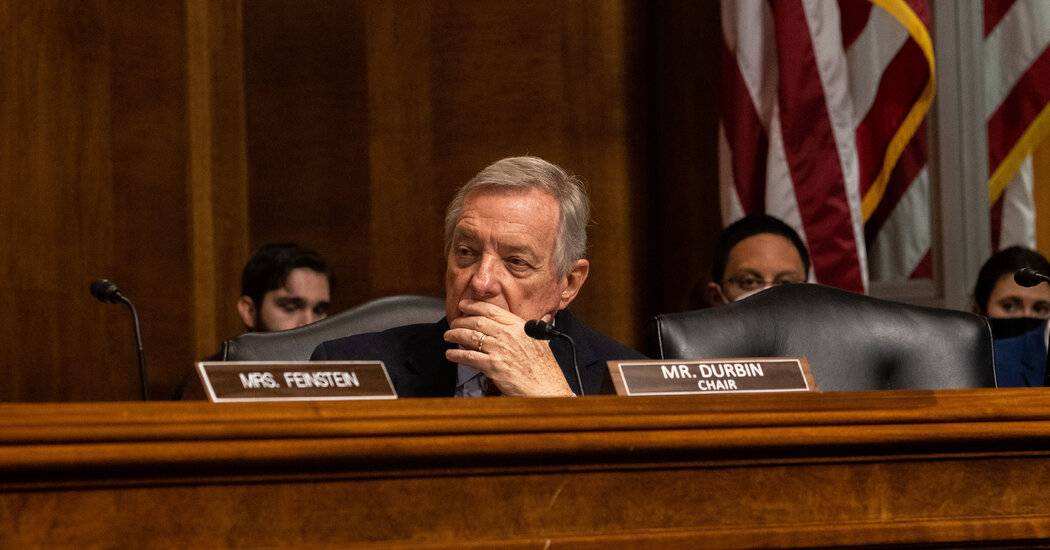
WASHINGTON — The No. 2 Senate Democrat on Wednesday called for an inspector general investigation into missing text messages from top Defense Department officials in the Trump administration related to the Jan. 6 attack on the Capitol.
Senator Richard J. Durbin of Illinois, the chairman of the Judiciary Committee, said he was sending a letter to Sean O’Donnell, the Defense Department’s inspector general, seeking an investigation into the disappearance of text messages from the phones of at least five former Trump administration officials, including Christopher C. Miller, the acting defense secretary; Kash Patel, the Pentagon’s chief of staff; and Ryan D. McCarthy, the Army secretary.
The officials were involved in discussions about sending the National Guard to the Capitol during the mob violence.
“The disappearance of this critical information could jeopardize efforts to learn the full truth about Jan. 6,” Mr. Durbin said in a statement. “I don’t know whether the failure to preserve these critical government texts from Jan. 6 is the result of bad faith, stunning incompetence or outdated records management policies, but we must get to the bottom of it.”
A spokeswoman for the inspector general said he was awaiting Mr. Durbin’s letter and would “review the letter once we receive it.”
Key Revelations From the Jan. 6 Hearings
Cards 1 of 9
Making a case against Trump. The House committee investigating the Jan. 6 attack is laying out a comprehensive narrative of President Donald J. Trump’s efforts to overturn the 2020 election. Here are the main themes that have emerged so far from eight public hearings:
Mr. Durbin’s call for an investigation into the missing texts from the Pentagon came on the same day the Justice Department filed a civil suit against a former White House adviser to Mr. Trump, Peter Navarro, saying that Mr. Navarro had failed to preserve messages from a private email address he used in conducting government business.
In the suit, the Justice Department said that it had reached out to Mr. Navarro about providing the emails, but that he had declined to provide the records “absent a grant of immunity for the act of returning such documents.”
Mr. Navarro was indicted in June on two charges of contempt of Congress after failing to comply with subpoenas from the House Jan. 6 committee seeking his testimony and documents.
Mr. Navarro’s lawyers, John Irving and John Rowley, said that he had “never refused to provide records to the government.”
“As detailed in our recent letter to the Archives, Mr. Navarro instructed his lawyers to preserve all such records, and he expects the government to follow standard processes in good faith to allow him to produce records,” the lawyers said in a statement. “Instead, the government chose to file its lawsuit today.”
In the case of the missing Pentagon texts, Mr. Durbin wrote to the inspector general a day after the watchdog group American Oversight sent a letter to Attorney General Merrick B. Garland calling for an investigation. CNN reported earlier on the agency’s missing texts.
American Oversight discovered the issue in March through litigation over the Defense Department’s response to public records requests it filed related to the Jan. 6, 2021, attack on the Capitol. In a court filing, lawyers for the Defense Department and the Army told the group that the government could not produce certain communications because when an administration official leaves a post, “he or she turns in the government-issued phone, and the phone is wiped .”
“For those custodians no longer with the agency, the text messages were not preserved,” the lawyers wrote, although they added that they would try to retrieve the texts through other means.
American Oversight had been seeking senior officials’ communications with Mr. Trump and Vice President Mike Pence on Jan. 6.
The group has specifically asked for the communications of Mr. Miller; Mr Patel; Mr McCarthy; Paul Ney, the general counsel for the Defense Department; Gen. James McConville, the Army chief of staff; James E. McPherson, the general counsel of the Army; and Lt. Gen. Walter E. Piatt, the director of the Army staff.
Mr. Miller, Mr. Patel, Mr. Ney, Mr. McCarthy and Mr. McPherson all left the Defense Department or the Army by the end of the Trump administration.
Mr. Durbin’s letter came after he called on Mr. Garland last week to take over an investigation into missing Department of Homeland Security text messages from Jan. 5 and Jan. 6, 2021, including those on the phones of Secret Service agents. Also missing were the texts of Mr. Trump’s homeland security secretary, Chad Wolf, and Kenneth T. Cuccinelli II, his deputy.
Two influential House Democrats have also called for two officials at the Department of Homeland Security’s independent watchdog to testify to Congress about the agency’s handling of missing Secret Service texts from Jan. 6, accusing their office of engaging in a cover-up.
Valve is expanding Steam Deck shipments to some regions that could take the handheld PC-meets-console to new heights. The company just announced that reservations are now open in Japan, South Korea, Hong Kong, and Taiwan through Komodo, a site that also sells Valve’s Index VR headset for PC among other games and gaming merchandise. If you visit steamdeck.com in one of those regions, you should be rerouted to Komodo’s site soon, or you can click here and select your language.
Valve spokesperson Kaci Aitchison Boyle tells TheVerge that the first batch of new reservations will be fulfilled later this year; a press release adds that shipments will begin in Japan, “with additional units planned to ship to customers in Korea, Hong Kong, and Taiwan in the weeks immediately following.”
Pour one out for our friends in Australia, though, who are still waiting on news of a launch after Valve name-dropped the country during its November 2021 developer summit.
In Japan, the Steam Deck will be priced starting at 59,800 yen (roughly $447), ranging up to 99,800 yen (roughly $746) for the premium 512GB model. In the US, those models cost $400 and $650, respectively. Like before, you only have to pay a tiny refundable amount now to secure your reservation: 1,000 yen (around $7.50).
Screenshot by Sean Hollister / The Verge
Here are the starting prices elsewhere, according to Valve:
NT$13,380 in Taiwan
HK$3,288 in Hong Kong
KRW 589,000 in Korea
Each translates to around $450 USD.
Valve credits its recent upswing in production for making this big expansion possible, and it notes that serving these additional countries will not push back delivery estimates for those who have already reserved a Deck.
If you’re in Kyoto this weekend for the annual BitSummit gaming conference, Valve will apparently have some sort of presence there with Steam Deck as well as at the Tokyo Game Show in September 2022.
Handheld gaming is popular around the globe but particularly so in places like Japan in which huge swaths of the population commute in and out of major cities every day by rail. While access to Steam is nothing new in these regions, having the option to purchase a moderately powerful, well-built, and relatively compact handheld (while huge, compared to the Nintendo Switch) where they can play those PC games is a big deal.
The past couple of months have delivered a lot of good news regarding Deck availability, most prominently that you can reserve one right now and probably get it by the end of the year. Valve announced in late June that it would begin doubling shipments of the Steam Deck, which in turn could lead to many people getting their Deck hardware earlier than anticipated. And more recently, in late July, Valve shared that it was ramping up production to better meet demand after it had cleared some supply chain issues.
Kane Cornes wonders what Collingwood would be thinking after watching Brisbane’s Dan McStay play on the weekend.
The Magpies continue to be linked with the Lions forward with some reports suggesting they have offered the 27-year-old a five-year deal worth $600,000 per season.
While the Pies are in need of a key forward, they could perhaps be unconvinced by his performances in 2022, particularly given he has returned just 16 goals from 16 matches.
Cornes believes another goalless showing in the loss to Richmond on Sunday should be a “warning sign” to Collingwood.
“It’s another example for Collingwood, it’s a warning sign,” he said on Channel 9’s Footy Classified.
“You got to see McStay on the big stage and it is the eighth time this year that he’s been goalless out of 16 games.
“This is what you are going to get, a player who has kicked 16 goals.”
The Port Adelaide greatly raised concerns of what he believes to be a ‘contract with’ in the current AFL landscape when players are coming out of contract.
He referenced a number of examples of players being paid and offered what he deems to be overs.
“There is a ‘contract with’ going on in the AFL,” Cornes added.
“The contract with is when you pay for a Mercedes but you get a Toyota. Your value increases just because you are out of contract.
“There’s some names there this year – Karl Amon, I’m hearing five years at 650 (thousand), they’re yet to realize that every third possession he hands it back to the opposition.
“Luke Jackson’s the same, he’s in really ordinary form. I understand why you would pay him, but you’re paying more than what he’s worth. (Jordan) De Goey is the same and McStay.
“Then the previous contract cons in the past. Rory Atkins, just because he was out of contract, (Jared) Polec, (Aidan) Corr last year.
“I can’t stand the (Angus) Brayshaw deal, six years, I can’t believe Melbourne have paid that, that’s extraordinary. Tom Boyd to the Bulldogs is another example.”
McStay is out of contract this year and is yet to re-sign with the Lions as he ponders a $3 million offer to join the Magpies.
“The court practically dared women in this country to go to the ballot box to restore the right to choose,” President Biden said by video Wednesday, as he signed an executive order aimed at helping Americans cross state lines for abortions. “They don’t have a clue about the power of American women.”
In interviews, Senator Elizabeth Warren, Democrat of Massachusetts, urged Democrats to be “full-throated” in their support of abortion access, and Representative Sean Patrick Maloney, the chairman of the House Democratic campaign arm, said the Kansas vote offered a “preview of coming attractions” for Republicans. Representative Elissa Slotkin, a Michigan Democrat in a highly competitive district, issued a statement saying that abortion access “hits at the core of preserving personal freedom, and of ensuring that women, and not the government, can decide their own fate.”
Republicans said the midterm campaigns would be defined by Mr. Biden’s disastrous approval ratings and economic concerns.
Both Republicans and Democrats caution against conflating the results of an up-or-down ballot question with how Americans will vote in November, when they will be weighing a long list of issues, personalities and their views of Democratic control of Washington.
“Add in candidates and a much more robust conversation about lots of other issues, this single issue isn’t going to drive the full national narrative that the Democrats are hoping for,” said David Kochel, a veteran of Republican politics in nearby Iowa. Still, Mr. Kochel acknowledged the risks of Republicans’ overstepping, as social conservatives push for abortion bans with few exceptions that polls generally show to be unpopular.
“The base of the GOP is definitely ahead of where the voters are in wanting to restrict abortion,” he said. “That’s the main lesson of Kansas.”
Read More on Abortion Issues in America
Polls have long shown most Americans support at least some abortion rights. But abortion opponents have been far more likely to let the issue determine their vote, leading to a passion gap between the two sides of the issue. Democrats hoped the Supreme Court decision this summer erasing the constitutional right to an abortion would change that, as Republican-led states rushed to enact new restrictions, and outright bans on the procedure took hold.
The Kansas vote was the most concrete evidence yet that a broad swath of voters — including some Republicans who still support their party in November — were ready to push back. Kansans voted down the amendment in Johnson County — home to the populous, moderate suburbs outside Kansas City — rejecting the measure with about 70 percent of the vote, a sign of the power of this issue in suburban battlegrounds nationwide. But the amendment was also defeated in more conservative counties, as abortion rights support outpaced Mr. Biden’s showing in 2020 nearly everywhere.
After months of struggling with their own disengaged if not demoralized base, Democratic strategists and officials hoped the results signaled a sort of awakening. They argued that abortion rights are a powerful part of the effort to cast Republicans as extremists and turn the 2022 elections into a choice between two parties, rather than a referendum just on Democrats.
“The Republicans who are running for office are quite open about their support for banning abortion,” said Senator Warren. “It’s critical that Democrats make equally clear that this is a key difference, and Democrats will stand up for letting the pregnant person make the decision, not the government.”
A Kansas-style referendum will be a rarity this election year, with only four other states expected to put abortion rights directly to voters in November with measures to amend their constitutions: California, Michigan, Vermont and Kentucky. However, the issue has already emerged as a defining debate in some key races, including in Michigan and Pennsylvania, where Democratic candidates for governor have cast themselves as bulwarks against far-reaching abortion restrictions or bans. On Tuesday, Michigan Republicans nominated Tudor Dixon, a former conservative commentator, for governor, who has opposed abortion in cases of rape and incest.
And in Pennsylvania, Doug Mastriano, the far-right Republican nominee for governor, said, “I don’t give a way for exceptions” when asked whether he believes in exceptions for rape, incest or the life of the mother. Governor’s contests in states including Wisconsin and Georgia could also directly affect abortion rights.
Other tests of the impact of abortion on races are coming sooner. North of New York City, a Democrat running in a special House election this month, Pat Ryan, has made abortion rights a centerpiece of his campaign, casting the race as another measure of the issue’s power this year.
“We have to step up and make sure our core freedoms are protected and defended,” said Mr. Ryan, the Ulster County executive in New York, who had closely watched the Kansas results.
Opponents of the Kansas referendum leaned into that “freedom” message, with ads that cast the effort as nothing short of a government mandate — anathema to voters long mistrustful of too much intervention from Topeka and Washington — and sometimes without using the word “abortion” at all.
Some of the messaging was aimed at moderate, often suburban voters who have toggled between the parties in recent elections. Strategists in both parties agreed that abortion rights could be salient with those voters, particularly women, in the fall. Democrats also pointed to evidence that the issue may also drive up turnout among their base voters.
After the Supreme Court’s decision, Democrats registered to vote at a faster rate than Republicans in Kansas, according to a memo from Tom Bonier, the chief executive of TargetSmart, a Democratic data firm. Mr. Bonier said his analysis of him found roughly 70 percent of Kansans who registered after the court’s decision were women.
“It is malpractice to not continue to center this issue for the remainder of this election season — and beyond,” said Tracy Sefl, a Democratic strategist. “What Democrats should say is that for Americans your bedroom is on the ballot this November.”
Inside the Democratic Party, there has been a fierce debate since Roe was overturned over how much to talk about abortion rights at a time of rising prices and a rocky economy — and that is likely to intensify. There is always the risk, some longtime strategists warn, of getting distracted from the issues that polls show are still driving most Americans.
Senator Brian Schatz, Democrat of Hawaii, said he understood the hesitancy from party stalwarts.
“The energy is on the side of abortion rights,” he said. “For decades that hasn’t been true so it’s difficult for some people who have been through lots of tough battles and lots of tough states to recognize that the ground has shifted under them. But it has.”
He urged Democrats to ignore polling that showed abortion was not a top-tier issue, adding that “voters take their cues from leaders” and Democrats need to discuss abortion access more. “When your pollster or your strategist says, ‘Take an abortion question and pivot away from it’ you should probably resist,” he said.
A Kaiser Family Foundation poll released this week showed that the issue of abortion access had become more salient for women 18 to 49 years old, with a 14-percentage-point jump since February for those who say it will be very important to their vote in midterm elections, up to 73 percent.
That is roughly equal to the share of voters overall who said inflation would be very important this fall — and a sign of how encouraging abortion has become for many women.
Still, Republicans said they would not let their focus veer from the issues they have been hammering for months.
“This fall, voters will consider abortion alongside inflation, education, crime, national security and a feeling that no one in Democrat-controlled Washington listens to them or cares about them,” said Kellyanne Conway, the Republican pollster and former senior Trump White House adviser.
Michael McAdams, the communications director for the National Republican Congressional Committee, said that if Democrats focused the fall campaign on abortion they would be ignoring the economy and record-high prices: “the No. 1 issue in every competitive district.”
One of the most endangered Democrats in the House, Representative Tom Malinowski of New Jersey, agreed that “the economy is the defining issue for people.”
“But there is a relationship here, because voters want leaders to be focused on fighting inflation, not banning abortion,” he said. Mr. Malinowski, who said he was planning to advertise on abortion rights, said the results in Kansas had affirmed for him the significance of abortion and the public’s desire to keep the government out of such personal decisions.
“There is enormous energy among voters and potential voters this fails to make that point,” he said.
peter baker contributed reporting from Washington.
While traditional gaming via consoles or PC will continue to dominate, game streaming services are having a moment, offering an alternative way to play video games on the go or at home. Samsung Gaming Hub was released towards the end of June and allows 2022 Samsung Smart TV and Smart Monitor series owners instant access to an extensive library of streaming games from leading game streaming services. Today, Samsung announced it is adding Amazon Luna to its Gaming Hub platform, ushering in even more games into the service.
Amazon Luna was only recently made available to those in the US. Several different tiers are available, with the lowest costing $2.99 a month and the highest costing $17.99 a month. Some examples of tiers include a retro tier, a family tier, and even a tier with Ubisoft. There is also a free tier included with an Amazon Prime membership. Each offers a different assortment of games that change each month.
Previously, Samsung Gaming Hub partners included heavy hitters like Xbox, Nvidia, Google Stadia, Utomik, and others. With Amazon Luna becoming a partner, consumers will have more options, gaining access to over 250 or so additional games. While the number is impressive, Samsung Gaming Hub now has a total offering of over 1000 games. This is quite impressive.
Thanks to optimizations from Samsung’s Tizen software, Samsung Gaming Hub provides crisp graphics and solid performance. While you can play without a proper controller using your smartphone, Gaming Hub offers support for external hardware, which means you can also pair up your existing Amazon Luna controller to the service for the best experience. Gaming Hub users can seamlessly connect their Amazon Luna controller or other supported controllers without issues. Like magic, controllers automatically connect to each supported service without needing individual pairing. Gaming Hub will also support streaming media with services like Spotify and YouTube.
One of Australia’s greatest boxers, Johnny Famechon, has died, aged 77.
Born Jean-Pierre Famechon in France, he emigrated with his family to Australia at the age of five.
The son of a French lightweight boxing champion and nephew of a French and European featherweight titleholder, Famechon followed in their footsteps, skipping amateur boxing to begin his professional career at the age of 16.
With a fighting style based on quick movement, smart boxing and solid defence, he was described as “the classiest boxer in Australia” by the media.
In a nine-year career, he would amass a record of 56 wins (20 by knockout), six draws and five losses.
Famechon beat Les Dunn in 1964 for the Victorian featherweight title. He went on to win the Australian title and later the Commonwealth title in 1967.
He fought Cuban boxer Jose Legra at the Albert Hall in London and won a tough points decision to become the undisputed world featherweight champion in 1969, holding the belt at the same time as fellow Australian Lionel Rose.
Johnny Famechon won the world featherweight boxing title in 1969, and successfully defended it twice.(Getty Images: Express/A. jones)
Famechon would successfully defend the title twice, against former world flyweight and bantamweight champion Fighting Harada of Japan, who Rose had beaten to win the latter crown.
loading
The first fight was controversial as the referee first called the result a draw before changing it to a win for Famechon. He would win the rematch by knockout in early 1970 before retiring later that year after a loss to Mexican Vicente Saldivar.
His career made him a household name, and he was named Melbourne’s King of Moomba in 1970.
In 1991, he suffered life-changing injuries when hit by a car whilst jogging — before he was inducted into the World Boxing Hall of Fame in 1997.
loading
Former world boxing champion, Barry Michael, said Famechon overcame the odds to claim the world title in London.
“It was the universal world title then,” Michael said.
“To beat Jose Legra, Famo was a huge underdog and then he went and beat him convincingly.
“Then he went along and fought Fighting Harada and they had the draw in Sydney, which they later gave to Famo on a recount, then they fought again on Tokyo and he knocked Harada out [in the 14th round].”
Famechon was inducted into the Sport Australia Hall of Fame in 1985.
In 2018, a bronze statue of Famechon was unveiled in his hometown of Frankston in Victoria.
He was appointed a Member of the Order of Australia (AM) in this year’s Queens Birthday Honors for significant service to boxing at elite level.
Surging populations of wild dogs and pigs are giving farmers a collective headache, as feral animal numbers continue to grow.
The NSW Farmers Association said members across the state had reported increases in both dog and pig numbers, while deer are also expanding their territory.
Then there’s the ever-present problem of feral cats, which the CSIRO estimates as being responsible for 1.8 billion native animal deaths each year.
Farmers say threats from feral animals such as wild pigs are growing. (Alex Ellinghausen)
Tweed farmer Neil Baker said there were shocking reports of livestock being attacked by feral animals.
“It’s really nasty some of the stories you hear, animals being ripped apart by predators,” Baker said.
“We’re really very concerned that these pests aren’t being properly controlled by some public and private landholders, and that’s giving them safe haven to breed and grow their territory.”
Dingoes and wild dogs can also pose a danger to livestock. (Robert Rough)
He said the rules around controlling pest animals were clear and needed to be enforced.
It is estimated that management of wild dogs by individual farmers and agencies costs $50 million per year and feral pig incursions cost the Australian agricultural industry upwards of $100 million a year.
NSW Farmers western division council chair Gerard Glover said there were a lot of feral cats appearing on cameras that had been set up across the region, and the expansion of deer into new areas would create headaches for motorists, but pigs and dogs remained the main concern for farmers.
Australian marsupial listed as endangered
“Cats and foxes typically prey on small native animals, which is a big concern, while deer present a new danger for people driving on country roads,” Glover said.
“Far and away though the pigs and the dogs are the most destructive, tearing up paddocks and fences, and attacking livestock.
“In my experience you need good, co-ordinated controls that everyone sticks to, otherwise you get these population explosions and the whole problem starts again.”
LURCHING RIGHT — Even before Donald Trump, Arizona Republicans had a soft spot for hard-liners. Think Evan Mecham and Joe Arpaio, or the party’s pre-Trump censorship of the late Sen. John McCain.
But what may soon be different after Tuesday’s elections is that with Kari Lake poised to win the gubernatorial primary alongside a stable of fellow election conspiracy theorists, there is no longer any traditionalist wing of the Republican Party in Arizona holding the line.
Not McCain or Doug Ducey, the outgoing Republican governor who went in for Lake’s more establishment-minded opponent, Karrin Taylor Robson. Not former Vice President Mike Pence, whose own trip to the state to help Robson — and oppose Trump — fell flat.
In some states where Trump’s endorsed candidates have lost primaries this year, including in Georgia, Nebraska and Idaho, institutionalists held on. But in one of the most critical swing states in the country — and in a place where Trump’s brand may be especially damaging in the general election and in 2024 — the old Republican establishment has been replaced with election deniers from the top to the bottom of the statewide ticket.
“I will call in a bit to talk about the doomsday ticket,” Barrett Marson, a Republican political strategist in the state, said today, when Nightly reached out to him to talk about the results. “Let me wake up and finish crying.”
A prominent Republican in the state had texted him a GIF of Thelma and Louise driving off the cliff.
Marson’s concerns are shared by mainstream Republicans in other states. But Arizona has an especially toxic relationship with Trump. The GOP during his tenure de el lost two Senate seats and a presidential election in the state for the first time since 1996. Trump-ism, as was painfully obvious to the GOP in Arizona in 2020, is a hard sell in Phoenix and its heavily populated suburbs.
Yet if Trump-y politics are difficult for the GOP in Arizona, that’s about all the state party has going now.
As of this evening, Lake, a former TV anchor who has said she would not have certified the 2020 election, had pulled ahead in the gubernatorial race. If her lead de ella holds, as Republicans in Arizona expect, she will now be the party’s standard bearer.
Then there’s state Rep. Mark Finchem, a celebrity in election conspiracy circles, who won his primary for secretary of state. Republican speaker of Arizona’s House Rusty Bowers, who was censored by the state Republican Party for testifying to the Jan. 6 committee about Trump’s efforts to overturn the election, got shellacked by a Trump-backed challenger who thinks the devil was at work in the 2020 outcome.
In the primary for state attorney general, Trump-endorsed Abe Hamadeh, another election denier — and a critic of “weak-kneed Republicans” — prevailed. And in the US Senate primary, Blake Masters, who maintains Trump won in 2020also won.
“The Trump-endorsed candidates ran the table,” said Stan Barnes, a former state lawmaker and longtime Republican consultant.
For Democrats, this was all good news.
Instead of inflation or education any of the other “traditional campaign issues that candidates normally discuss,” Barnes said, Democrats in Arizona this fall “get to talk about the Trump candidates. They get to talk about running against Donald Trump.”
It might be enough to keep Trump’s class of Arizona Republicans from ever taking office. On the other hand, the environment is so good for the GOP nationally this year that some or all of them may win.
For Republicans hoping for a post-Trump reform, that outcome may be even worse.
“I think the only way back is by humiliation at the ballot box, and the problem is the Democrats aren’t strong enough to do that,” said Bill Gates, a Republican Maricopa County supervisor.
Of the Republicans, he said, “I think they are electable, which is frightening.”
“The election last night was a catastrophe for the Arizona Republican Party,” Gates said, “and, I would argue, our democracy.”
Welcome to POLITICO Nightly. Reach out with news, tips and ideas at [email protected]. Or contact tonight’s author at [email protected] or on Twitter at @davidsiders.
— Indiana GOP Rep. Walorski, 3 others die in auto accident:The Indiana Republican was a senior House member, her party’s top member on the House Ethics Committee and a member of the Ways and Means Committee. Her communications director de ella, Emma Thomson, and Zachary Potts of the St. Joseph County Republican Party were also killed in the accident, the sheriff’s office announced, as was the driver of the vehicle that collided with theirs. Walorski’s death is a shock to the Capitol community, where two other sitting House members have died this year: Rep. Don Young (R-Alaska) and Jim Hagedorn (R-Minn.) died within a month of each other earlier this year.
— Justice Department sues Peter Navarro for Trump White House emails:The Justice Department today sued the former Trump trade adviser in an effort to force him to turn over emails from his tenure in the White House. Navarro, who worked for the White House during the entirety of Trump’s presidency, had used “at least one non-official email account … to send and receive messages constituting Presidential records,” the Justice Department said in a court filing. Attorneys also accused him of “wrongfully retaining them” in violation of federal record-keeping laws, as Navarro did not copy the messages into an official government account, nor did he respond to the National Archivist’s initial request for the emails.
— Sinema requests changes to party-line climate, health care and tax bill:Sen. Kyrsten Sinema (D-Ariz), who has not weighed in on whether she will vote for the legislation, wants to nix language narrowing the so-called carried interest loophole, which would change the way some investment income is taxed, according to three people familiar with the matter. Cutting that provision would ax $14 billion of the bill’s $739 billion in projected revenue. Sinema also wants roughly $5 billion in drought resilience funding added to the legislation, a key request for Arizona given the state’s problems with water supply.
— Biden and Harris praise Kansas voters for defeating anti-abortion amendment:President Joe Biden today lauded voters in Kansas for rejecting a constitutional measure that would have stripped abortion protections from the state’s constitution. The failed Kansas amendment comes as the Biden administration makes a move to protect pregnant people who travel for access to reproductive care. Biden signed an executive order at today’s meeting that would examine ways to protect pregnant people who have to travel out of state for an abortion if their state bans it.
— Senate overwhelmingly backs NATO membership for Finland, Sweden:The Senate today voted overwhelmingly to admit Finland and Sweden to NATO, putting the military alliance on track for a historic expansion in response to Russia’s war in Ukraine. With 95 senators voting in favor, the defense treaty heads to President Joe Biden’s desk where he is expected to ratify it in the coming days, making the US the 22nd NATO nation to give its approval. All 30 NATO members are expected to complete the ratification process before the end of the year, in a signal to Moscow that the alliance will not shirk from deterring future Russian aggression. Josh Hawley (R-Mo.) was the only senator to vote against the treaty.
DOWN TO THE WIRE — The European Union is making a final push to save the Iran nuclear deal, agreeing all negotiators for an unexpected and sudden resumption of talks on Thursday, three sources familiar with the situation told POLITICO.
The goal — as it has been for months — is to restore a 2015 deal that saw Iran agree to limit its nuclear ambitions in exchange for heavy sanctions relief, writes Stephanie Lichtenstein. The agreement has been all but dead since the US pulled out in 2018. Talks to revive it ran aground earlier this year.
Negotiators are now descending on Vienna to see if there’s any sliver of hope left. Diplomats will be present from the US, Iran, China, Russia, Germany, Britain and France, as well as the EU, which is acting as a mediator since Iran refuses to talk directly to the US
It is not yet clear how senior the present officials will be and how long the talks will last. Sources familiar with the negotiations played down expectations and cautioned that it was far too early to say whether the talks will be successful.
PERMISSION FOR FLYBY — Washington is on edge as China readies a series of provocative military drills set to kick off on Thursday in response to House Speaker Nancy Pelosi’s visit to Taiwan, writes Lara Seligmann and Paul McLeary. Beijing has threatened incursions into the island’s territory, and for the first time, conventional missile launches over the island.
The Chinese navy is positioning warships around the island, including its two aircraft carriers that have left port in recent days, in what officials described as a blockade. The Chinese defense ministry released a map of six zones surrounding the island where it plans to conduct the drills, some of which potentially overlap with Taiwan’s territorial waters. The live-fire exercises will begin at noon local time on Thursday and last three days.
Officials say they see China’s moves thus far as mostly bluster. But there are signs Beijing is planning more provocative military actions during the upcoming exercise. China has never before flown aircraft or launched missiles into Taiwan’s territorial waters — something that could happen during the drills, said Bonnie Glaser, an East Asia analyst at the German Marshall Fund of the United States.
WALKING BACK — Conspiracy theorist Alex Jones testified today that he now understands it was irresponsible of him to declare the Sandy Hook Elementary School massacre a hoax and that he now believes it was “100% real,” according to the Associated Press.
Speaking a day after the parents of a 6-year-old boy who was killed in the 2012 attack testified about the suffering, death threats and harassment they’ve endured because of what Jones has trumpeted on his media platforms, the Infowars host told a Texas courtroom that he definitely thinks the attack happened.
“Especially since I’ve met the parents. It’s 100% real,” Jones said at his trial to determine how much he and his media company, Free Speech Systems, owe for defaming Neil Heslin and Scarlett Lewis. Their son Jesse Lewis was among the 20 students and six educators who were killed in the attack in Newtown, Conn., which was the deadliest school shooting in American history.
At one point, Heslin and Lewis’s lawyer Mark Bankston informed Jones that his attorneys had mistakenly sent Bankston the last two years’ worth of texts from Jones’ cellphone. Jones had previously testified in a deposition that he had no texts on his phone about the shooting. “Do you know what perjury is?” Bankston asked Jones.
Did someone forward this email to you? Sign up here.
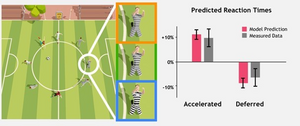
image: The new approach determines a user’s real-time reaction to an image or scene based on their eye movement, particularly saccades, the super-quick movements of the eye that jerk between points before fixing on an image or object. The researchers will demonstrate their new work titled, “Image Features Influence Reaction Time: A Learned Probabilistic Perceptual Model for Saccade Latency”, at SIGGRAPH 2022 held Aug. 8-11 in Vancouver, BC, Canada.
view more
Credit: ACM SIGGRAPH
What motivates or drives the human eye to fixate on a target and how, then, is that visual image perceived? What is the lag time between our visual acuity and our reaction to the observation? In the burgeoning field of immersive virtual reality (VR) and augmented reality (AR), connecting those dots, in real time, between eye movement, visual targets, and decision-making is the driving force behind a new computational model developed by a team of computer scientists at New York University, Princeton University, and NVIDIA.
The new approach determines a user’s real-time reaction to an image or scene based on their eye movement, particularly saccades, the super-quick movements of the eye that jerk between points before fixing on an image or object. Saccades allow for frequent shifts of attention to better understand one’s surroundings and to localize objects of interest. Understanding the mechanism and behavior of saccades is vital in understanding human performance in visual environments, representing an exciting area of research in computer graphics.
The researchers will demonstrate their new work titled, “Image Features Influence Reaction Time: A Learned Probabilistic Perceptual Model for Saccade Latency”, at SIGGRAPH 2022 held Aug. 8-11 in Vancouver, BC, Canada. The annual conference, which will be in-person and virtual this year, spotlights the world’s leading professionals, academics, and creative minds at the forefront of computer graphics and interactive techniques.
“There has recently been extensive research to measure the visual qualities perceived by humans, especially for VR/AR displays,” says the paper’s senior author Qi Sun, PhD, assistant professor of computer science and engineering at New York University Tandon School of Engineering.
“But we have yet to explore how the displayed content can influence our behaviors, even noticeably, and how we could possibly use those displays to push the boundaries of our performance that are otherwise not possible.”
Inspired by how the human brain transmits data and makes decisions, the researchers implement a neurologically-inspired probabilistic model that mimics the accumulation of “cognitive confidence” that leads to a human decision and action. They conducted a psychophysical experiment with parameterized stimuli to observe and measure the correlation between image characteristics, and the time it takes to process them in order to trigger a saccade, and whether/how the correlation differs from that of visual acuity.
They validate the model, using data from more than 10,000 trials of user experiments using an eye-tracked VR display, to understand and formulate the correlation between the visual content and the “speed” of decision-making based on reaction to the image. The results show that the new model prediction accurately represents real-world human behavior.
The proposed model may serve as a metric for predicting and altering eye-image response time of users in interactive computer graphics applications, and may also help to improve design of VR experiences and player performances in esports. In other sectors such as healthcare and auto, the new model could help estimate a physician’s or a driver’s ability to rapidly respond and react to emergencies. In esports, it can be applied to measure the competition fairness between players or to better understand how to maximize one’s performance where reaction times come down to milliseconds.
In future work, the team plans to explore the potential of cross-modal effects such as visual-audio cues that jointly affect our cognition in scenarios such as driving. They are also interested in expanding the work to better understand and represent the accuracy of human actions influenced by visual content.
The paper’s authors, Budmonde Duinkharjav (NYU); Praneeth Chakravarthula (Princeton); Rachel Brown (NVIDIA); Anjul Patney (NVIDIA); and Qi Sun (NYU), are set to demonstrate their new method Aug. 11 at SIGGRAPH as part of the program, Roundtable Session: Perception. The paper can be found here.
About ACM SIGGRAPH ACM SIGGRAPH is an international community of researchers, artists, developers, filmmakers, scientists and business professionals with a shared interest in computer graphics and interactive techniques. A special interest group of the Association for Computing Machinery (ACM), the world’s first and largest computing society, our mission is to nurture, champion and connect like-minded researchers and practitioners to catalyze innovation in computer graphics and interactive techniques.
Disclaimer: AAAS and EurekAlert! are not responsible for the accuracy of news releases posted to EurekAlert! by contributing institutions or for the use of any information through the EurekAlert system.
Cricket Australia is worried a pandemic-induced dive in the number of first-time cricketers could lead to a “missing generation” of kids taking up the sport around the nation.
Key points:
Cricket Australia is concerned by a 10pc drop in first-time participants for the 2021-22 season
It is feared the pandemic will create a missing generation of cricketers
Tasmania has bucked the trend, with numbers growing 40 per cent on pre-COVID levels
Its annual cricket census for 2021-22 has revealed a 10 per cent drop in participants in the organisation’s Blast programme, largely caused by closures to centers in major cities as a result of COVID-19 lockdowns.
“It’s absolutely something that is a worry for us,” James Allsop, who heads up the community arm of Cricket Australia, said.
“It’s something we are mobilizing around as part of the new strategy that we’re about to launch in the next couple of years.”
A year of new, young cricketers have been lost, according to Allsop, and cricketing authorities are desperate to ensure it does not happen again for fear of losing a generation of budding batters, bowlers and fielders.
“We’ve lost one year. I’m really confident we’re not going to lose two years,” Allsop said.
“But we might have lost some kids as six-year-olds but we can get them back as a seven-year-old.”
Allsop pointed to Cricket Australia data which underscores the importance of attracting first-time cricketers at a young age.
Ninety per cent of participants play for the first time before the age of 12, according to the data, and, last year, 70 per cent started before the age of nine.
“Cricket is probably unique from other sports in that you do have to come in at an early age to develop those skills,” he said.
The cricket census paints a positive picture on the whole. (Getty Images: Kelly Barnes)
First-timers aside, the cricket census paints a positive picture, in spite of more than two years of disruptions to community sport.
Club cricket has grown. Junior club registrations rose by 5 per cent on the year prior, and six per cent compared to pre-pandemic levels.
Senior club registrations have risen, too, by 5 per cent.
The number of girls registered for junior club cricket lifted too on pre-COVID levels.
A big reason the sport has been able to grow despite the pandemic is timing. Winter sports like AFL and NRL were hit harder by state-based lockdowns.
“There’s no doubt we’ve been really fortunate with seasons and obviously the lockdowns in winter haven’t affected us as much from a club participation point of view,” Allsop said.
“But nonetheless, our big markets were still in lockdown in October, November.”
Registered participation overall is still down 16 per cent since before the pandemic, something attributed mostly to the impacts on indoor cricket and school competition.
Tasmanian bucks the blast trend
While the Blast program has suffered in bigger metropolitan areas such as Melbourne and Sydney, it has actually grown in Tasmania, according to Cricket Australia.
The census showed Blast in Tasmania grew 40 per cent on pre-COVID levels.
The key, Allsop explained, was that the program traveled to different communities, targeting a variety of multicultural and socio-economic backgrounds.
Allsop said Cricket Australia’s strategy over the next five years would see it look to become more flexible, “opening up more opportunities to play Blast cricket”.
“So rather than a center only opening up at a club on a Saturday morning, we’ll work with them to open up on a Friday and Monday night and a Saturday,” he said.
“Last year, we’ve had a hiccup but I’m really confident we’ll turn it around in the next 12 months and beyond.”

:format(webp):no_upscale()/cdn.vox-cdn.com/uploads/chorus_asset/file/23921965/japan_steam_deck_prices.jpg)